The purpose of this paper is to determine the future of the tourism industry in Haiti. More specifically, the paper answers the following question: will Haiti be able to reclaim a positive image and leading position in the Caribbean as a tourist destination?
Within the paradigm of theory building and exploratory approach, this conceptual study is based on a narrative literature review.
The turning point in the development of the tourism industry in Haiti has been the 2010 earthquake which has triggered a will to provide quality products and service specifically in the hospitality sector, the most dynamic sector of the tourism industry. With the diaspora, Haiti has the potential to reclaim a positive image and a leading position in the Caribbean. That said, before performing at this level, the destination must first and foremost contribute to the wellbeing of its people as a sine qua non condition for the success of its tourism industry.
The findings of this research may help potential investors to decide whether or not they want to invest in Haiti. The findings of the paper may also assist the DMO in its branding and marketing strategy.
The alleviation of poverty using tourism as a tool in a post-colonial, post-conflict and post-disaster context should be analysed, understood and approached from a human aspect point of view and perspective. Resilience is what better describes the tourism industry and the locals in Haiti. The locals are neither passive nor powerless.
1. Introduction
Despite the fact that the tourism industry is a major economic industry in the world (Botti, 2010; Cooper and Hall, 2004; Bertho-Lavenir, 1999), there is no consensus among academics regarding its date of birth (Séraphin, 2012). For Youel (1998), tourism started with the Greek who organised the first Olympic Games in 776 BC. For Boyer (1999) tourism started with the first published tourist guide in 1551. Boyer (1999) also identified the Grand Tour (seventeenth to eighteenth century) as an important factor in the development of the industry. For King et al. (2006), tourism started in the eighteenth century with the development of transport and more specifically the introduction of the stagecoach in the mid-eighteenth century. Before then, it was rare for people to travel any further than the nearest town in their entire life. Hoerner (2002) also acknowledged the role played by transport in the development of the tourism industry, but he mainly took into consideration the first packaged tour put together by Thomas Cook in 1841 as the starting point of the tourism industry. That said, the tourism industry only started to be considered as an economic activity in 1911 (Scutariu, 2009). The reasons why people have been travelling and are still travelling for are sport and leisure; culture; visiting friends and relatives; business; health; religion; education (Barrow, 2008; Draper, 2007; Davidson, 1998; Davidson and Maitland, 1997) that contributed to the branding of some destinations. As a result, since 1682, date when Louis XIV moved to Versailles, France established itself as a destination known for the quality of its food and luxury hotels. Also, cities like Bath (in England), Baden (Germany) and Vichy (France) became known as health destinations because of their natural water sources used to treat some conditions, hence the origin of the word Spa that stands for Salus Per Aqua (Séraphin, 2012; Barrow, 2008; Davidson, 1998; Davidson and Maitland, 1997). In the eighteenth century, places like Ostend (Belgium) and in the nineteenth century, places like Miami Beach and Palm Beach (USA) became known as seaside destinations. As early as the nineteenth century, Switzerland for instance became known for its mountains (Merlin, 2001). Destination branding can therefore be considered as a long existing phenomenon. “Brands and branding have existed for as long as it has been possible to trace artefacts of human existence” (Moore and Reid, 2008, p. 419).
As for Haiti, it is located between the North Atlantic and the Caribbean Sea. It occupies the western, smaller portion of the island of Hispaniola, in the Greater Antillean archipelago, which it shares with the Dominican Republic. Haiti was the richest French colony. It was even called the “Pearl of the Antilles” (Roc, 2008). The image of Haiti then became associated with Toussaint L’ Ouverture, also called the “Bonaparte of the Antilles” who set free all Haitian slaves. Despite the fact that he recognised the sovereign rights of France, in 1801, Toussaint L’ Ouverture was seized by the French in Cap-Français and shipped as a prisoner to France in 1802. He died in 1803. Dessalines who then ordered the massacre of most of the whites who had remained on the island became a key emblem of the country. In 1804, Dessalines declared the independence of Haiti. The country became known worldwide as the first black republic in the world (Hector and Hurbon, 2009, cited in Gilles, 2012). Up to that point Haiti was positively branded as the pearl of the Caribbean and then as the first black republic. The positive image of the destination did not last very long due to an absence of leadership (Séraphin, Ambaye, Gowreesunkar and Bonnardel, 2016; Thomson, 2004). Today, the country is branded as politically unstable, disorganised, very poor and unsafe (Ève di Chiara, 1988; Higate and Henry, 2009; Girault, 2010).
With its negative image it is very difficult for Haiti to develop a sustainable tourism industry (Séraphin, 2014a). Despite this difficult context, tourism development has been for a very long time one of the main priorities of the Haitian governments (Séraphin, 2014a). The first administration in charge of tourism was created in 1939 (Séraphin, 2014a). Haiti was one of the most popular tourist destination in the Caribbean between 1940s and 1960s. It was branded as a cultural destination (Séraphin, 2010; Thomson, 2004). Under the Duvalier dictatorial administration (1957–1986) Haiti stopped being considered as a destination. It is only in 2013 that Haiti reclaimed its position as a tourist destination (Séraphin, 2014a).
As any other destination, the Haitian Destination Marketing Organisation (DMO) has adopted strategies to mitigate its problematic image (Alvarez and Campo, 2014). Thus, as part of its rebranding strategy, the DMO adopted a new logo in 2012 (Séraphin, Ambaye, Gowreesunkar and Bonnardel, 2016). The private sector also embarked a rebranding strategy to match the ambition of the destination. The case of Haiti provides solid evidence that the tourism sector is especially vulnerable to exogenous factors like political instability, economic crisis, natural disasters and the outbreak of diseases (Hai and Chick, 2011; Ritchie et al., 2004). Those factors can cause destinations to decline and sometimes even totally disappear from the tourism map. In this respect, tourism is a problematic industry (Getz, 2008) but also a resilient industry (Korstanje and Ivanov, 2012).
Based on historic facts and analysis, the objective of this paper is to determine the future of the Haitian tourism industry. For Thomson (2014, pp. xv-vi), “much has changed in Haiti […] but in some ways nothing has changed […] Haiti struggles to rebuilt itself, the past intrudes on the present”. Based on this quote, this paper is going to address the following research question:
Will Haiti be able to reclaim its positive image and a leading position in the Caribbean as a tourist destination?
Haiti was chosen as a destination for three main reasons. First, it was an opportunity to study unsuccessful short-lived brands, as most attention is given to successful, long-live brands (Lopes and Guimaraes, 2012), subsequently enabling this paper to touch upon the topic of destination struggles in a post-colonial, post-conflict and post-disaster (PCCD) context. Second, tourism in post-conflict destinations is a newly emerging sub-field of tourism studies (Alvarez and Campo, 2011, 2014; Novelli et al., 2012).
2. Historical and contextual framework
2.1 Haïti: a cultural destination (1939–1960)
The first Haitian DMO was created (and managed by Sylvio Cator) on 17 May, 1939, right after the American occupation (1915–1934). The president at the time, Stenio Vincent (1939–1941), was the first to have identified tourism as a potential source of income for the country (Clammer, 2012). The Port-au-Prince International Exhibition (1949) happened under the administration of Dumarsais Estimé. This event contributed to put Haiti on the world map of tourist destinations (Séraphin, 2014a). As a result, Haiti became one the most popular tourist destination in the Caribbean between 1940s and 1960s (Séraphin, 2010), and as such attracted an international jet set. Mick Jagger, Charles Addams and Jackie Kennedy were among those who popularised Haiti (Thomson, 2014; Tardieu, 2014). As for the first logo of the Haitian DMO (designed in 1939), it was representative of the colonial aesthetics adopted by former colonies (Deneault, 2005). Based on Bancel (2005) research on ethnic tourism and colonialism, the logo could be seen as a will from the destination to brand itself as a natural, authentic, welcoming destination, with strong and stable historical background and landmarks, untouched by globalisation. The Haitian tourism industry has its best years under Paul Magloire’s administration. This period (1950–1956) was known as the Golden Age (Destin, 2014).
2.2 A period of neglect for “the Pearl of the Antilles” (1960–2010)
This period was mainly characterised by the Duvalier era. Francois Duvalier (1957–1971) did not invest in infrastructures. However, Jean-Claude Duvalier (1971–1986), his son, a.k.a “Baby Doc” started in 1971, an “economic revolution” (approved and supported by the Americans) that contributed to attract foreign direct investments despite the political context that could be described as “repressive” (Bazabas, 1997). It is in this context that Club Med opened a resort in Haiti in 1981 (Séraphin, 2014a). As in other Central American countries many investments were made by corporates after getting concessions from local governments keen to attract foreign capital to modernise their economies (Buchelli, 2008). The American embargo in 1991, as a response to the military junta that overthrown Jean-Bertrand Aristide, also thrown Haiti into a deep economic and social crisis (Bazabas, 1997). It is in this context that Club Med decided to leave Haiti in 1996 (Séraphin, 2014a). Despite the difficult economic context described above, the number of tourists continued to grow (Table I), and as a consequence hotels were built (Table II).
Number of tourists visiting Haiti
| Year | Number of visitors |
|---|---|
| 2003 | 136,031 |
| 2004 | 96,439 |
| 2005 | 112,267 |
| 2006 | 107,783 |
| 2007 | 386,060 |
| 2008 | 258,070 |
| 2009 | 387,219 |
| 2010 | 254,732 |
| 2011 | 348,755 |
| 2012 | 349,237 |
| 2013 | 419,736 |
| 2014 | 465,174 |
Source: CTO
Hotels built in Haiti 1960–2010
| Name of hotels | Opening |
|---|---|
| Idéal Villa | 1970s |
| Ouanga bay | 1972 |
| Prince hotel | 1974 |
| Moulin sur mer | 1975/1982 (groupe d’actionnaires) |
| Hôtel la Jacmélienne | 1976 |
| Hôtel Cormier plage | 1978 |
| Xarangua hôtel | 1980 |
| Hôtel Chateaubrilland | 1981 |
| Club-med Magic Haiti Club Indigo (ex Club-Magic Haiti) | 1981–1997/2006 (réouverture) |
| Villa Taina | 1982 |
| Wahoo Bay Beach | Joli Beach (1983) devient Wahoo Bay en 1989 |
| Hotel Villa Ban Yen/APV | 1989 |
| Visa Lodge | 1990 (réouverture 2000) |
| Cyvadier | 1994 |
| La Reserve restaurant and guest house | 1995 |
| Kaliko beach | 1997 (réouverture) |
| Hôtel Villa Ban Yen | 1997 |
| Port Morgan | 1998 |
| L’amitié hôtel | 1999 |
| The lodge Furcy | 2002 |
| Auberge du Picolet | 2003 |
| Palms residence | 2003 |
| Palm Inn Hôtel | 2003 |
| Hôtel Jaclef Plaza | 2004 |
| Auberge du Mont Saint Jean | 2004 |
| Jardin sur Mer | 2004 |
| Auberge du rayon vert | 2004 (2013 – extension) |
| Abakabay | Réouverture en 2005 |
| Hôtel Ermitage de Pandiassou | 2007 |
| Hôtel La colline enchantée | 2008 |
| Hôtel Le Recul | 2008 |
| Karibe hotel | 2008 |
| Le Plazza | 2008 |
| La colline enchantée | 2008 |
| Villa Cana | 2010 |
| B&B comfy | 2010 |
At this stage it is important to mention the fact that the tourism industry (and specifically the hospitality sector) survived in Haiti thanks to the presence of non-governmental organisations (NGOs) and other international organisations. The country stopped receiving “conventional tourists” between the 1960s and 2010s (Séraphin, 2014a). It is during this period that the number of international organisations (NGOs/military from the MINUSTAH) reached its peak (Séraphin, 2014a; Thomson, 2004).
Despite the context, the French magazine, Paris Match (18 September, 1997) hailed Haiti to be a destination to experience. The special issue (on Haiti) in this magazine also emphasised on the huge potential of the destination (despite the fact it was an unsafe destination).
2.3 Rebirth after a dark period: tourism in the republic of NGOs (2010–2016)
The earthquake that shook Haiti to its foundations on 12 January 2010 further damaged the tourism industry as most of the infrastructures and facilities of the sector were destroyed (Séraphin, 2014a). Saint-Louis explained that the earthquake put an end to the tourism industry in Haiti. The only “tourists” in Haiti were staff working for NGOs. As for the only conventional tourists, they stayed in the resort of Labadee, an enclave developed and managed by Royal Caribbean International (Seraphin et al., 2018). Despite the fact the locals are not fully benefiting from this form of tourism (enclave), it has proven to be so far, a success story (Seraphin et al., 2018).
Under the administration of President Martelly (2011–2016), the tourism was re-established as a priority. It was also during this period that Haiti reclaimed its position on the world map as a tourist destination (Séraphin, 2014a). The case of Haiti shows the importance of political stability on the performance of a destination (Hai and Chick, 2011; Ritchie et al., 2004). In 2012, the DMO adopted a new logo that symbolises the new positive image that the Ministry of Tourism of Haiti wants to spread around. In this endeavour, in 2014, the Haitian DMO started a classification of the hotels in Haiti. The purpose was to motivate hoteliers to provide quality products and services. So far, this has been an ongoing issue (Thomson, 2014; Théodat, 2004).
Hotels of international standard are still very limited in Haiti. For instance, out of the 525 hotels, only 5 of them have 5 Hibiscus (equivalent of 5 stars):
Hotel Royal Oasis (Occidental Hotels and Resorts – bought by Barcelo Hotels in June 2015) opened in December 2012.
NH Haiti El Rancho (NH Hotel Group) opened in December 2012.
The Best Western Premier (Best Western) opened in April 2012.
Marriott, opened in March 2015.
Hilton Garden Inn, opened in 2016.
It is also important to mention that the all the above international hotels opened as part of a master plan of the government: “Haiti is open for business”. Hotel Oasis is totally representative of the rebirth of the tourism industry in Haiti (Séraphin, 2014a). With this first world-class international hotel, the destination has started to brand itself as a quality destination.
2.4 Summarising and understanding the performance of Haiti as a destination (1939–2016)
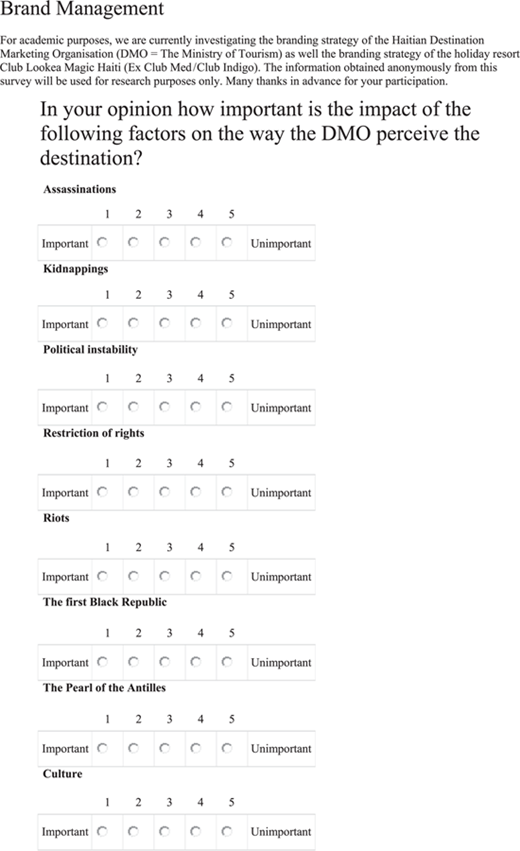
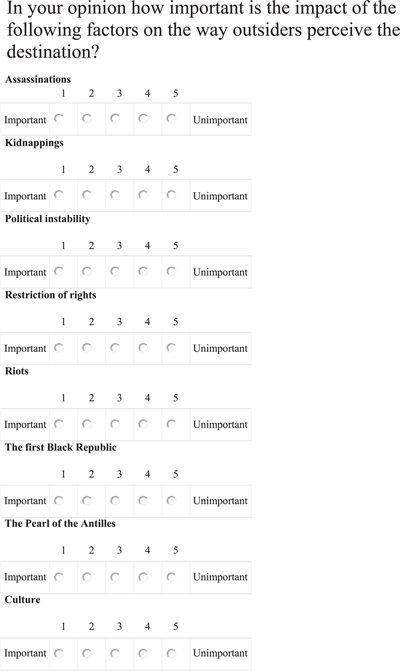
Overall, this historical overview of the tourism industry in Haiti reveals that the destination has a huge potential that has never been fully exploited due to political instability. Also, some primary research (below) also reveals that the poor performance of the destination can also be explained by a discrepancy between the way the DMO and outsiders perceive the destination. The only correlation between both perceptions is the “restriction of rights” and “assassinations”. The following paragraph explains the method used to collect the data.
2.5 Methodology
Expert opinion is a qualitative method used when historical data are not available or very limited and dealing with complex issues (Gandy and Casmira Coladangelo, 2011; De Bruin and Rosemann, 2005). This method provides robust forecast for planning (Hammond and Wellington, 2013). Once recruited, the experts were asked a series of questions using a questionnaire (the Appendix).
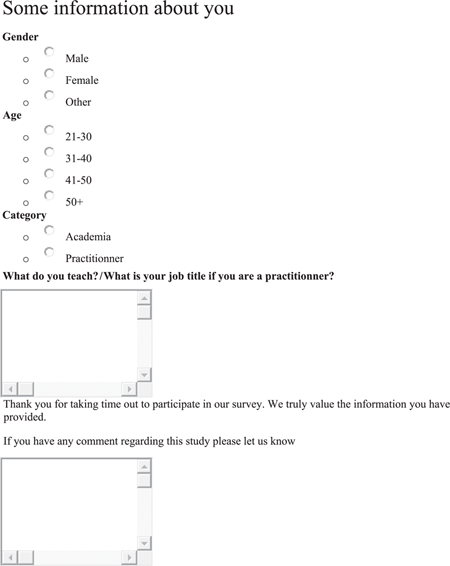
The panel of expert for this study included three academics and six practitioners. The academics were chosen not only due to their understanding of qualitative research methods but also because of their critical way of thinking and their expertise in the area of tourism and hospitality management. As for practitioners they were chosen, not only because of their expertise but also because of their high degree of influence and their ability to make things happen. The questionnaire was sent to the panel using Google+.
The design of the questionnaire for this study was an adaptation of various research studies:
A questionnaire designed by Seddighi et al. (2001). The objective of their questionnaire was to highlight the difference of perception between travel agents concerning the impact of political instability on tourism.
Research carried by Faroudi et al. (2014) on corporate image and reputation.
Research carried by Lewis et al. (1995, cited in Chacko and Marcell, 2008) on destination repositioning strategy. The results of the study are shown in Table III.
Factors impacting on the perception of the destination
| DMO perception of the destination | Outsiders perception of the destination |
|---|---|
| 1. Culture | 1. Riot |
| 2. Riot | 2. Political instability |
| 3. Kidnapping | 3. Culture |
| 4. Political instability | 4. Kidnapping |
| 5. Restriction of rights | 5. Restriction of rights |
| 6. Assassinations | 6. Assassinations |
| 7. Pearl of the Antilles | 7. The first black republic |
| 8. The first black republic | 8. Pearl of the Antilles |
In order to address the issue of the image of the destinations by potential visitors, Séraphin, Butcher and Konstanje (2016) suggested that visitors should be educated a pre-visit stage, using Visual Online Learning Materials, as a better understanding of a destination contributes to develop a connection between potential visitors and the destination.
3. The future: a topic of interest in tourism
3.1 Potential approaches to predict the future
Understanding the history of an organisation (in our case a destination) is “crucial for the present and for the envisaged future” (Pozzi, 2017, p. 1310). This thought is also shared by Ford and Peeper (2007) who argued that it is important to understand the history of a business and the people who led it to understand its present and future. Studying the history of an organisation is now considered as a genre (Pozzi, 2017) that Ladkin (1999) labelled as “life and work history analysis”. For Ford and Peeper (2007), when history is studied over a long period of time, the future can be predicted. However, they also highlighted the fact that “extrapolations of the past onto the future are always problematic” (Ford and Peeper, 2007, p. 1109). Equally important, Towner (1995, pp. 339-41) argued that: “more attention should be paid to tourism’s past in non-western societies and cultures […] new geographical areas need to be incorporated into tourism history studies”. That is what this paper is actually doing. Another example is Garay and Canoves (2011), who used history to understand the evolution of tourism in Catalonia (Spain). Other methods include (but not limited to):
The Butler’s Tourism Area Life Cycle (TALC), hailed as one of the most popular models used to analyse tourism development (Garay and Canoves, 2011). The model is summarised in Table IV.
The Model of Creative Destruction (Table V) developed by Mitchell (1998), to explain the level of creation and destruction that occurs with tourism development in a destination. In other words, the level of commodification of a destination. Indeed, as part of the capitalism process, Hano (2012) explained that tourism needs to destroy some things in order to create new ones. Like the TALC model, this model presents different stages.
Butler’s TALC
| Stages | Explanation (summary) |
|---|---|
| 1. Exploration | Small group of tourist interested by a place Good relationship visitors/locals No significant impact of tourism on the visited area |
| 2. Involvement | Development of facilities for visitors Promotion of the area by DMO The number of visitor increase |
| 3. Development | Continuing growth of visitors Further effort (by DMO) to promote the destination |
| 4. Consolidation | Number of visitors may exceed the number of inhabitants Destination has now a tourism-based economy Detachment between tourists and locals |
| 5. Stagnation | Destinations has reached a record figures of tourist arrivals The destination is no longer fashionable |
| 6. Decline/Rejuvenation | Destination is unable to compete with rivals Change of the characteristics and attractions of the tourist area |
Source: Adaptation of Garay and Canoves (2011)
Model of Creative Destruction
| Stages | Explanation (summary) |
|---|---|
| 1. Early commodification | Building/structures are renovated Attraction of tourists Increase of investments |
| 2. Advanced commodification | The destination receives a large number of visitors |
| 3. Pre-destruction | The industry continues to grow New types of businesses which were not part of the community offerings are introduced |
| 4. Advanced destruction | Community experience backlash of tourism |
Source: Adaptation of Mitchell (1998)
Still concerning the evolution of tourism, Yeoman and McMahon-Beatte (2016) identified five driving forces (political capital; visionary state; passion, identity and culture; affluence and exclusivity; fluid experience) that can positively and/or negatively influence the future of tourism. Hartman and Zandberg (2015) added to that list legacy, level of investments, community involvement and impact on culture. Finally, as for Hensens (2015), he added to the list, social media as a rating trend/practice adopted by travellers and travel agents.
3.2 Predicting the future of the tourism industry in Haiti
Step 1
With regard to the findings in Section 3.1, in order to determine the future of the tourism industry in Haiti, we are going to create a new matrix to identify where exactly tourism in Haiti is at. So this new matrix will be a merge of TALC and Model of Creative Destruction (Figure 1). In this paper, we consider the two models as complementary. TALC will give us an overall idea of the level of development of the industry in Haiti, whereas the Model of Creative Destruction will provide a more specific idea of the level of commodification the destination is at. We are going to use the findings from Section 2, to locate Haiti on the newly created matrix.
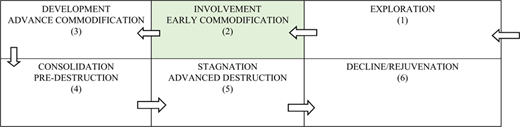
Matrix of tourism development in a post-colonial, post-conflict and post-disaster destination
Matrix of tourism development in a post-colonial, post-conflict and post-disaster destination
Haiti is at Stage 2 of the newly developed matrix. A more in-depth analysis based on Butler (2009) theory on the four changes of tourism (tourism dynamics; location of tourism; forms of tourism; and timing of tourism) reveals that the tourism industry in Haiti and particularly the hospitality sector is quite dynamic as a result of investment and planned renovation. As for the location of tourism, the Haitian diaspora (as tourists and investors) has proven to be a real asset for the tourism industry (Séraphin and Paul, 2015). As a form of tourism, diaspora tourism has been identified as a strong opportunity for Haiti (Séraphin and Paul, 2015). The post-earthquake period could be therefore considered as the starting point of the rejuvenation of the tourism industry in Haiti.
Step 2
Now that we have a clear understanding of where the tourism industry of Haiti is at, we can now identify the driving forces, trends, practices and factors that can positively or negatively impact on its future. For Visser (2015) changes will come from:
“Unlocking change through transformational leadership”.
Changes will only occur if leaders actually have the wellbeing of every single stakeholder at the heart of every single action they are undertaking. Their personal desire should not be part of the equation:
“Unlocking change through enterprise reform”.
Deep reform can only happen with the change of mission and culture of corporations:
“Unlocking change through technology innovation”.
For Visser, technology innovation is central to a sustainable development of the world. The current boom in technology innovation that can be compared to “another renaissance” can bring solutions in the agri-food sector/chemical sector, etc. The fact that sustainable technology is being applied by businesses shows that the current business model is no longer fit for purpose:
“Unlocking change through corporate transparency”.
Information has never been more readily available and technology plays an important part in this new paradigm:
“Unlocking change through stakeholders’ engagement”.
Social media (Facebook, LinkedIn, Twitter, Google+ and many others) have helped companies to build their brand, convey messages to interested parties and to augment their reputation, preservation and crisis communication function (Hudson and Hudson, 2013). At the same time, social media (crowdsourcing) are also putting pressure on companies to improve their performance:
“Unlocking change through social responsibility”.
CSR has broadly failed and it will continue to do unless it is reborn and rejuvenated. The other key point is the question concerning the need for a new CSR model that would not only contribute to the enrichment of shareholders and executives, but also improve the economic context in which corporates operate:
“Unlocking change through integrated value”.
Shared value has the ability to reshape capitalism and its relationship to society.
With the emergence of the diaspora in Haiti, we believe that all the changes suggested by Visser (2015) could be achieved on the long term. The key challenge for Haiti will be to avoid the commodification of its heritage/culture, as for Séraphin (2014b) this is a key factor of appeal for the destination. That said, with the emergence of the diaspora, Séraphin (2014a) reckoned that Haiti will develop a hybrid form of tourism due to the ambidextrous nature of the diaspora.
4. Discussion
4.1 Defining diaspora as an ambidextrous group
The diaspora is defined as a geographic dispersion of people belonging to the same community (Bordes-Benayoun, 2002). As for diasporans, they are “foreign born population and their off-springs maintaining relations to their country of origin”. This group contributes to the economy and social development of its country of origin mainly through remittance and social philanthropy (Minto-Coy, 2016). Whereas the focus on diaspora has tended to be on remittance and benevolence, there is emerging recognition of their economic impact via entrepreneurship, innovation and in international business with implications for firms in the home country (Minto-Coy, 2016). Diasporas are also noted as having access to critical resources, networks and knowledge not easily accessible in the country of origin and as such, they are important change agents and drivers of innovation (USAID, 2015). Minto-Coy and Elo (2017, p. 30), for instance, referred to diasporans who invest in their home country as “engaging heroic entrepreneurs”. In Haiti, diasporans as investors brought considerable changes in the hospitality sector (Séraphin and Paul, 2015). As a group, diaspora could be considered as ambidextrous by nature, also because it uses its presence in the host country to reinvent itself (socially, economically and sometimes politically) in order to become a transformative agent in its home country (Figure 2).
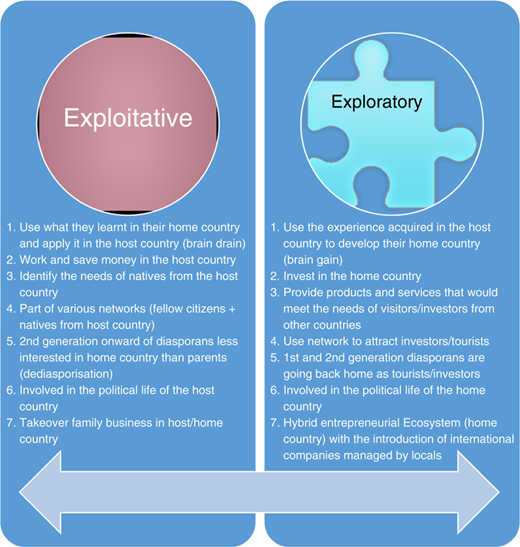
4.2 Reframing tourism development in Haiti
Tourism is not a prime vector for the alleviation of poverty. The socio-cultural and political context also play an important role in the alleviation of poverty. Indeed, Edgell and Swanson (2013, p. 270) acknowledged that “the more peaceful the world, the greater are the opportunities for helping to reduce poverty”. Page (2013) also added the fact that tourism only contributes to the reduction of poverty only if there is no barrier hindering it. Among the barriers, we can mention: the lack of education and skills of the population that stop them from identifying opportunities, the limited access to finance to create their own business, etc. Dupont (2009), who argued that there is a one-way direction between economic development and tourism development, also argued that there is a one-way direction between poverty alleviation and tourism development. Indeed, taking the example of Haiti, Dupont (2009) explained that it is the economic development of a country that triggers the tourism development of that country and not the other way round. Likewise, it is the alleviation of poverty that leads to the development of tourism and not the other way round. Based on the above, we can conclude that tourism is the result or the consequence of a set number of parameters and not at the starting point. (Séraphin, Gowreesunkar and Ambaye (2016) went a step further by arguing that PCCD destinations are not performing well as tourism destinations because primary needs of the population are not addressed. Equally important, they added that there is one-way relationship between the improvement of the wellbeing of the locals and the performance of the destination. In other words, it is the wellbeing of the locals that is going to contribute to the improvement of the tourism performance of the destination and not the other way round. Indeed, research in tourism provides evidence that tourism development almost happens naturally with the improvement of the standard of living of the local population (Merlin, 2001).
5. Conclusion
The turning point in the development of the tourism industry in Haiti has been the 2010 earthquake, which has triggered a will to provide quality products and service, specifically in the hospitality sector, the most dynamic sector of the tourism industry in Haiti. With the diaspora, Haiti has the potential to reclaim a positive image and a leading position in the Caribbean. That said, before performing at this level, the destination must first and foremost contribute to the wellbeing of it people as a sine qua non condition for the success of its tourism industry.
Many efforts have been put into tourism as a tool to alleviate poverty (Holden, 2013). However, all the efforts in place are direct strategies (with a focus on economic tool). In this paper, we are arguing that alleviation of poverty using tourism as a tool, in a PCCD context should be analysed, understood and approached from a human aspect point of view and perspective. Resilience that Hutton (2016) defined as the capacity of a group to strive and to reframe its relationship to its environment with limited economic means is for us what better describes the tourism industry and the locals in Haiti. Because of that we are also arguing that the tourism industry and local people in PCCD destinations (and in our case, Haiti) are neither passive nor powerless.
References
Further reading
Appendix