


While previous research examined metaverse applications, to date, no study has explored metaverse tourism futures in 2035 using explanatory, exploratory and interpretive futures methods. This study addresses this gap through a distinctive selection of foresight methods to analyse the paradigm-shifting potential of the metaverse and demonstrate the value of futures methodologies for interrogating contested technological trajectories.
This qualitative study applied Inayatullah's Six Pillars framework as an iterative, multi-method scaffold integrating nine foresight techniques, grounded in a critical realism paradigm. Online futures workshops facilitated collective sense-making and worldview surfacing, enabling participants to interrogate assumptions and paradigms shaping metaverse tourism futures. The study demonstrates how futures thinking cultivates anticipatory capacity, an essential competency given the paradigm shifts likely to redefine the sector.
The integrated foresight framework proved effective in building contextual depth across multiple layers of analysis. Four scenarios emerged from participants' worldviews, metaphors and archetypes: The Invisible Hand, A Promised Land, Fountain of Youth and Garden of Eden. The study surfaces a disruptive proposition: that under specific structural conditions, virtual tourism may constitute a viable substitute for “on-site” travel. The value of this approach lies not in prediction but in surfacing assumptions, exposing ideological tensions and expanding anticipatory capacity for tourism futures.
This study challenges the dominant framing of metaverse tourism as supplementary, proposing that under specific structural and ideological conditions, virtual tourism could become a viable substitute for “on-site” travel. The framework demonstrates transferable value for interrogating contested socio-technical phenomena, equipping practitioners and researchers with anticipatory tools to navigate paradigm-shifting futures.
1. Introduction
Tourism is often criticised for relying heavily on a flawed constant growth model, especially within a global economic system that prioritises profit. This model has contributed to problems such as overtourism, environmental degradation and loss of cultural diversity. The current discourse on the future of tourism advocates for a shift towards regenerative and transformative tourism, one that anticipates future social changes and technological advances to build responsible practices and policies (Go and Kang, 2023; Johri et al., 2024).
For decades, information and communication technologies have disrupted traditional tourism patterns, with virtual and immersive metaverse offerings challenging the necessity of physical travel (Buhalis et al., 2022, 2023). However, the broader implications of these shifts remain uncertain, especially within the unequal distribution of the temporal and technological territories in the digital revolution. This divide manifests geographically and generationally. Developed urban centres access immersive virtual tourism while many rural communities experience constrained connectivity. Similarly, younger, tech-savvy users adopt virtual worlds more readily while older cohorts tend to favour traditional travel (Mandal et al., 2024; Zhang et al., 2024). These gaps shape how tourists understand travel, presence and attachment to place and suggest the potential for significant disruption across various industries, including tourism, which relies heavily on place attachment and its associated social and natural ecosystems (Inversini et al., 2024; Oleksy et al., 2023).
The metaverse however does not compete with Internet Web 2.0; instead, it builds layers on it, including decentralisation of power, blockchain integration, cross-platform compatibility, interoperability and new forms of digital ownership (Fernandez and Hui, 2022; Mystakidis, 2022). As an immersive, three-dimensional digital ecosystem, users, embody the reality as avatars able to interact, transact and navigate experiences beyond physical boundaries (Zainal Abidin et al., 2025).
Metaverse architecture represents a convergence of emerging technologies, including virtual reality, augmented reality, mixed reality, artificial intelligence, blockchain, 5G, Internet of Things, spatial computing and 3D modelling. Each layer enhances the metaverse's experiential and commercial potential (Dwivedi et al., 2022; Gursoy et al., 2022; Koohang et al., 2023). However, the trajectory of metaverse development remains highly contested, as governments, big tech corporations and developers navigate competing visions, regulatory uncertainties and ethical tensions over control, access and governance (Dolata and Schwabe, 2023).
Even though the metaverse remains an abstract concept due to the pluralism of emerging technologies involved (Shi et al., 2023), its development trajectory suggests broader monetisation and mainstream adoption (Anderson and Rainie, 2022). Demonstrating this shift, Generation Z is already immersed in multiple interconnected virtual worlds with virtual identities, goods and currencies. Their ability to navigate augmented, virtual and hybrid environments embodies a blended reality and signals a redefinition of presence and interaction in both social and commercial contexts (Mandal et al., 2024; Zhang et al., 2024).
With virtual content, commerce and spaces becoming increasingly authentic, imaginative and controllable, tensions between physical and virtual worlds are expected to intensify over the next decade as boundaries become less distinct. First, advances in virtuality enable sensory-rich experiences that replicate or reimagine the sense of place and challenge the hedonistic allure of a tourist destination (Gursoy et al., 2022). Second, the digital integration of virtuality within the tourism ecosystem is transforming the tourism experience, management, marketing and service delivery within the tourism industry (Buhalis et al., 2019, 2022, 2023). Third, unsustainable tourism practices, such as mass overtourism, excessive carbon emissions from transportation and the exploitation of natural resources, are likely to undergo significant changes with impending global climate policy action (Go and Kang, 2023). While the long-term impact of the metaverse remains unclear, it is already shaping how tourism is imagined and practised (Buhalis et al., 2023; Dwivedi et al., 2023a).
Metaverse-enabled, blended reality tourism may evolve over the next decade and still requires exploration. This study explores the contested and uncertain trajectory of the metaverse as an emerging space shaped by competing interests, ethical tensions and rapid technological advancements. While current applications in tourism often frame the metaverse as supplementary, this study investigates its potential as a viable replacement for traditional “on-site” tourism (Volchek and Brysch, 2023). In doing so, it considers how immersive virtual environments might contribute to more sustainable and regenerative forms of tourism, with significant policy implications for governments and broader tourism ecosystems by challenging the status quo of the flawed constant growth model. Using the Six Pillars futures studies framework (Inayatullah, 2008), this participatory futures research interrogates the worldviews, assumptions and historical trajectories shaping the present to explore metaverse tourism in 2035. The ten-year horizon to 2035 reflects the convergence timeline of the enabling technologies underpinning the metaverse: immersive technologies, spatial computing, Web3 and artificial intelligence. The convergence of these technologies has not yet reached maturity (Damar, 2021; Dwivedi et al., 2022). In futures research, a ten-year horizon is considered appropriate for socio-technical phenomena at this stage of development, close enough to inform present-day decision-making, yet far enough to surface the structural shifts and paradigm-level disruptions that futures research is designed to interrogate (Melnikovas, 2018; Steinert et al., 2010).
By developing multiple future scenarios and a deeper exploration of a preferred, transformative future scenario, this study aims to contribute to developing more inclusive, anticipatory and responsible strategies for navigating the digital evolution of tourism futures (Hartman, 2018).
Section 2 examines the evolving pathways of the metaverse and the implications of virtual affordances on place attachment and “on-site” tourism. Section 3 outlines the Six Pillars futures framework and the nine futures techniques. Section 4 discusses the findings of each Pillar. Section 5 presents conclusions and recommendations for future research.
2. Literature review
The central proposition underpinning this study is that if virtual affordances can deliver sufficiently authentic and immersive experiences, they may constitute a viable substitute for physical tourism within the next decade, fundamentally challenging traditional “on-site” tourism paradigms (Jiang, 2025; Volchek and Brysch, 2023).
This literature review examines three interconnected domains that inform this proposition: the uncertain futures and contested trajectories of metaverse development (Section 2.1), the reimagination of place attachment through virtual affordances and their capacity to simulate meaningful tourism experiences (Section 2.2) and the potential for metaverse technologies to enable more sustainable tourism futures (Section 2.3).
Significant risks are identified in the literature including surveillance capitalism and data exploitation (Gössling, 2021), digital divides and unequal access to immersive technologies (Dwivedi et al., 2022), cultural commodification (Dwivedi et al., 2023b) and governance gaps (Fernandez and Hui, 2022). This review establishes the theoretical foundation for applying futures methodology to explore scenarios where virtual tourism could transition from supplementary to substitutional (Dwivedi et al., 2022).
Central to this exploration is the regenerative tourism paradigm, which transcends harm minimisation to actively restore social, cultural and ecological systems (Bellato and Pollock, 2025). More recent scholarship has expanded and refined this paradigm, critically reviewing its conceptualisation and application in tourism contexts (Bellato and Pollock, 2025; Iddawala and Lee, 2025).
2.1 Uncertain futures and risks of the metaverse
The developmental trajectory of the metaverse remains ambiguous. This lack of clarity complicates investment and strategic planning, as various stakeholders seek to shape its definition and scope in alignment with their interests, resulting in interpretative flexibility (Dolata and Schwabe, 2023). Some envision the metaverse as an emancipatory space, offering political and economic autonomy beyond traditional institutions (Girginova, 2024), while others warn that it can replicate existing hierarchies and power structures (Bojic, 2022; Stephens, 2022). Drawing on lessons from Internet history, scholars argue that the core principles of interoperability, decentralisation, openness and user rights must be foundational to the singular metaverse framework (Fernandez and Hui, 2022; Grover and Shalender, 2023). However, these principles face significant challenges. Weak regulatory oversight, inadequate data governance and jurisdictional fragmentation expose users to risks such as surveillance, exploitation and infringement of intellectual property and privacy rights (Fernandez and Hui, 2022). The emergence of the “darkverse” further raises ethical and legal concerns, including identity theft, harassment and illicit trade (Dwivedi et al., 2023b). The risks extend beyond governance into the biometric and behavioural data generated through immersive interaction. XR technologies enable the persistent tracking of users' physical and emotional responses such as heartbeat, facial reactions, bodily movement and spatial context creating data profiles that far exceed the surveillance capabilities of social media platforms (Dwivedi et al., 2023b; Fernandez and Hui, 2022). In tourism contexts specifically, the commercialisation of such data raises fundamental questions about autonomy, consent and the commodification of experience.
In tourism, virtual experiences can distort perceptions of authenticity and diminish satisfaction with physical travel (Saleh, 2024). These risks do not render the metaverse unviable for tourism but rather define the contested terrain within which its futures may be negotiated. Yet the tourism ecosystem increasingly recognises its interconnectedness with physical realities, positioning metaverse tourism technologies as integral to, rather than separate from the future of tourism (Mihalic, 2024; Zainal Abidin et al., 2025).
2.2 Virtual affordances and the reimagination of place
Despite metaverse development uncertainties, emerging virtual affordances demonstrate increasing capacity to simulate and potentially replace the experiential foundations of physical tourism (Buhalis et al., 2023). The reimagination of place attachment through immersive technologies challenges traditional assumptions about the necessity of physical presence for meaningful tourism experiences (Baroroh et al., 2023; Oleksy et al., 2023; Sharma et al., 2024). Understanding how cognitive, affective, virtual and technological affordances interact to create sense of place becomes critical for assessing the substitutional potential of virtual tourism (Calisto and Sarkar, 2024; Dincelli and Yayla, 2022).
Affordances are users' subjective interpretations of a technology's functionality, which are central to understanding the growing appeal of virtual tourism (Jo and Park, 2023). Figure 1 illustrates how cognitive, affective, virtual and technological affordances intersect to shape place attachment in virtual tourism environments. Each feature – presence, embodiment, immersion, identity construction and perceived usefulness – emerges at the boundary between affordances reflecting the interdependent nature of how users experience and interpret virtual spaces (Calisto and Sarkar, 2024; Dincelli and Yayla, 2022; Jo and Park, 2023).
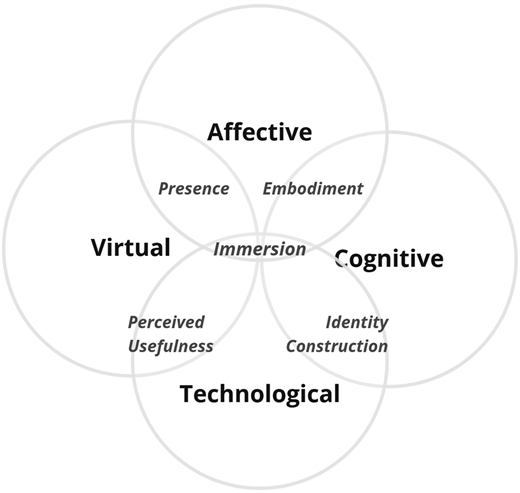
Critically, it is the convergence of these affordance types that determines the depth of virtual experience – no single affordance operates in isolation and it is the combined effect on presence, embodiment and perceived usefulness that shapes the substitutional potential of virtual tourism for physical travel (Jo and Park, 2023; Sharma et al., 2024).
Research suggests that the metaverse can simulate powerful sensory and emotional experiences through avatars and virtual spaces, enabling users to feel present and connected, influencing their intention to visit physical destinations (Tsai, 2022). Moreover, these highly sensorial virtual experiences can enhance place attachment by reimagining the emotional, cognitive and behavioural bonds typically formed in physical locations (Baroroh et al., 2023). As the desire for exploration increases, space takes on a new meaning as users migrate to multi-world metaverses (Mandal et al., 2024; Oleksy et al., 2023). These advancements have expanded tourism beyond its physical boundaries, appealing to new tourists and offering more personalised experiences (Monaco and Sacchi, 2023). However, as immersive technologies and the benefits of affordances become more transformative, they depend on intensified surveillance, data extraction and the erosion of user privacy, raising concerns about autonomy and equity in digital spaces (Gössling, 2021).
2.3 Metaverse as an enabler for sustainable tourism futures
The convergence of virtual affordance capabilities with continued sustainability pressures creates a compelling rationale for exploring metaverse tourism as a viable substitute for extractive physical travel (Buhalis et al., 2023; Go and Kang, 2023). Rather than viewing virtual experiences merely as marketing tools or supplements to traditional tourism, sustainability imperatives suggest the need to consider scenarios where immersive virtual tourism becomes the preferred and necessary alternative to carbon-intensive mobility patterns (European Commission, 2024; Go and Kang, 2023).
The metaverse enables sustainable tourism to address overconsumption, overtourism and ecological degradation (Martins et al., 2023). This encourages environmentally responsible consumption through immersive education and gamified digital experiences (Pellegrino et al., 2023). Virtual experiences of cultural and endangered sites enhance accessibility and inclusivity, while reducing carbon footprints and advancing sustainability goals (Johri et al., 2024; Kouroupi and Metaxas, 2023).
Recent scholarship has begun to reframe the metaverse not as a supplement to “on-site” travel but as a potential substitute for it. Jiang (2025) conceptualises metaverse tourism adoption as a behavioural intention to reduce “on-site” travel through virtual alternatives, demonstrating that positive attitudes towards immersive experiences, combined with social endorsement and platform accessibility, significantly shift preferences away from “on-site” travel. Go and Kang (2023) further this perspective by linking metaverse tourism development to the UNWTO Sustainable Development Goals, identifying virtual tourism as an alternative to reduce transport emissions and redistribute demand from popular destinations, particularly those facing overtourism. At the intersection of virtuality and regenerative approaches, Liu and Hao (2024) posit that avatar-mediated metaverse experiences can promote conservation behaviour and community engagement, indicating that the metaverse's potential goes beyond harm reduction to enhance the net-positive restoration characteristic of regenerative tourism (Bellato and Pollock, 2025). This represents an emerging conceptual shift. However, virtual tourism futures depend on different governance frameworks, energy infrastructure and equitable access, which remain structurally unresolved (Mihalic, 2024).
These three literature domains of metaverse uncertainty, virtual affordance potential and sustainability imperatives collectively establish both the possibility and necessity of exploring futures where virtual tourism transitions from supplementary to substitutional. The contested trajectories, technological capabilities and environmental pressures identified in this review create conditions where traditional tourism paradigms could face fundamental disruption within the next decade. This convergence of uncertainty, capability and necessity provides the foundation for applying futures methodology to explore multiple scenarios of metaverse tourism development in 2035.
3. Methodology
The metaverse, marked by its conceptual ambiguity and contested interpretations, challenges the traditional understanding of identity, space and social interaction, calling for new frameworks that can interrogate both emergence and structure (Mihalic, 2024). Tourism destinations themselves operate as dynamic and adaptive complex systems that are nonlinear, interdependent and continually evolving through feedback loops and external interactions (Hartman, 2018).
3.1 Philosophical framework
To address this complexity, this study is grounded in critical realism. At its core, critical realism holds that reality operates across three stratified domains: the real, which contains the underlying generative mechanisms and structures that drive change; the actual, which encompasses events and processes whether or not they are observed; and the empirical, which is limited to what can be directly experienced or measured (Bhaskar, 1975). The implication for research is significant in understanding a phenomenon that goes beyond describing what is visible to interrogating what is generating it.
Applied to social systems, it acknowledges that structural forces and human agency are both real and consequential. Structures (technological, regulatory, economic) shape what is possible while human actors, through foresight, policy innovation and collective action retain the capacity to transform those structures over time (Archer, 1995). Sayer (2000) argues that this combination of ontological realism and epistemological humility enables researchers to conduct theoretically grounded inquiry that identifies the specific mechanisms producing social phenomena.
In the context of this study, critical realism positions metaverse tourism futures as products of deep structural forces (governance regimes, economic logics, technological affordances and cultural paradigms) whose influence is not always apparent at the surface level of observable trends. This distinguishes the study's orientation from positivist forecasting, which tend to reduce inquiry to measurable regularities and from purely interpretivist approaches which confine meaning to subjective experience. Critical realism's explanatory depth makes it particularly well suited to scenario construction in contested and emerging domains such as metaverse tourism (Melnikovas, 2018; Thornhill et al., 2019).
3.2 Framework selection and structure
Given the exploratory and paradigm-shifting nature of this study, Inayatullah's Six Pillars framework was selected for its iterative, participatory and flexible design (Inayatullah, 2008), recognised for addressing sensitivity to social contexts, systemic resistance to change and the capacity to transform through epistemological depth (Inayatullah, 2006). The framework provided systematic progression from empirical mapping to transformational action through six interconnected Pillars:
Pillar 1: Mapping established empirical foundations by identifying driving forces, trends and emerging signals through evidence-based methods.
Pillar 2: Anticipating explored potential consequences and impacts through participatory examination of what might happen and how forces interconnect.
Pillar 3: Timing investigated temporal orientations, change patterns and participants' sense of agency regarding when and how transformation occurs.
Pillar 4: Deepening moved beyond surface phenomena to examine underlying worldviews, paradigms and structural forces through interpretive analysis.
Pillar 5: Creating alternatives developed multiple scenarios and alternative futures through exploratory methods.
Pillar 6: Transforming focused on preferred futures and strategic pathways to achieve them using normative methods.
3.3 Method selection and integration
The multi-method research design incorporated nine complementary techniques, which provided the depth and breadth to explore layered dimensions of change, challenge prevailing assumptions and generate transformative insights to explore metaverse tourism in 2035 (Popper, 2008).
Method selection was framework-driven rather than comprehensive, ensuring each method served a distinct purpose within the Six Pillars progression. Advisory methods were deliberately excluded in this study to prioritise democratised knowledge creation over expert validation. Given the metaverse's contested development trajectory (Dolata and Schwabe, 2023), expert knowledge risks privileging dominant technical or industry perspectives over diverse stakeholder experiences. This epistemological choice aligns with critical realism's emphasis on uncovering marginalised perspectives while recognising it limited technical feasibility assessment of scenarios. Figure 2 illustrates the selected Foresight Diamond method categories (Popper, 2008).
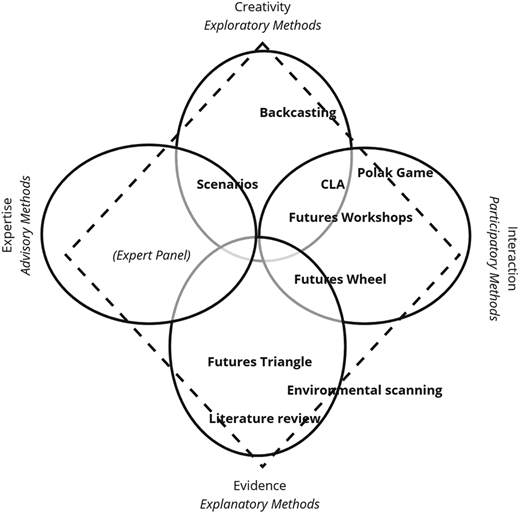
Adapted foresight diamond showing the nine selected methods. Source: Adapted from (Popper, 2008)
Adapted foresight diamond showing the nine selected methods. Source: Adapted from (Popper, 2008)
Table 1 translates the Foresight Diamond categories illustrated in Figure 2 into the specific methods applied across each Pillar, demonstrating how the multi-method design was structured to address the full progression from empirical mapping to transformational action and identifying the key output generated at each stage of the research process (Inayatullah, 2008; Popper, 2008).
Six pillars framework: methods and method categories
| Six pillars | Method | Method category | Key outputs |
|---|---|---|---|
| Pillar 1: Mapping | Literature review | Evidence-based | Critical synthesis of metaverse tourism literature; identification of key themes and signals |
| Pillar 1: Mapping | Environmental scanning | Evidence-based | STEEP-based drivers of change |
| Pillar 1: Mapping | Futures triangle | Evidence-based/Exploratory | Push, pull, and weight forces shaping metaverse tourism futures; 68 signals and factors |
| Pillar 2: Anticipating | Futures Wheel | Participatory | Consequence mapping of interconnected signals and second-order impacts |
| Pillar 3: Timing | Polak Game | Participatory | Surfacing of participants' futures consciousness and individual worldview orientations |
| Pillar 4: Deepening | Causal layered analysis | Interpretive | Worldviews, metaphors and archetypes underpinning metaverse tourism futures |
| Pillar 5: Creating Alternatives | Scenario construction | Creative | Four scenario archetypes: The Invisible Hand, A Promised Land, Fountain of Youth, Garden of Eden |
| Pillar 6: Transforming | Backcasting | Normative | Strategic actions and policy considerations for tourism stakeholders |
3.4 Research procedures
Pillar one applied three explanatory methods – literature review, environmental scanning (Choo, 1999) and Futures Triangle (Inayatullah, 2023) enabling the identification of drivers, barriers and competing narratives. The literature review was conducted across multiple search approaches including online academic databases, metasearch engines, peer-reviewed journal repositories, institutional repositories and grey literature sources such as policy documents, industry reports and government publications. Given the nascent and rapidly evolving state of metaverse tourism research, a critical evaluation checklist was applied to assess each source's purpose, contextual framing and relationship to emerging themes, ensuring the review was theoretically grounded rather than merely descriptive (Thornhill et al., 2019).
Environmental scanning was conducted across a global contextual environment using the STEEP framework – social, technological, economic, environmental and political dimensions (Choo, 1999; Conway, 2009, 2021). Four scanning modes were employed: undirected sensing across diverse accessible sources, conditioned sensemaking from known sources, informal learning on specific topics and formal structured scanning to strengthen the knowledge base for decision-making. An undirected sensing mode was additionally applied to identify weak signals and wild cards, with fringe and niche publications assessed using credibility indicators rather than conventional validity measures (Schultz, 2006). This process was conducted over five months, culminating in the synthesis of 68 signals and factors provided to participants as an information pack prior to the first workshop.
Pillars 2 through 6 were addressed using participatory action learning via two, half-day online futures workshops. Six participants were purposively selected using criterion sampling aligned with the methodological requirements of intensive futures workshops. Recruitment was through the researcher's professional network, targeting diverse stakeholders active in tourism development and destination management ecosystems. Participants were required to fulfil one or more of the following criteria: familiarity with tourism and technology from a destination development perspective; employment in a role requiring creativity such as content curation or brand management; and experience with online facilitated workshops. Table 2 presents the anonymised participant profiles.
Anonymised participant profiles
| Participant | Sector | Relevant expertise | Criterion met |
|---|---|---|---|
| P1 | Tourism destination development | Destination strategy and management | Tourism technology |
| P2 | Tourism technology | Digital innovation and metaverse platforms | Tourism technology |
| P3 | Creative industries | Content curation and brand storytelling | Creative content curation |
| P4 | Tourism destination development | Destination marketing and management | Tourism destination development |
| P5 | Tourism and hospitality | Technology adoption and guest experience | Tourism technology |
| P6 | Creative industries | Digital media and online facilitation | Creative content curation |
The selection criteria were designed to ensure participants could engage meaningfully with speculative futures scenarios involving contested emerging technologies. Tourism destination development expertise provided grounding in the structural realities of the sector; technology expertise enabled informed engagement with metaverse-specific scenarios; creative content curation experience supported the imaginative and narrative dimensions of scenario construction; and workshop competency ensured productive participation in the intensive online facilitated format. The requirement to fulfil only one criterion reflected the value of diverse perspectives within the small group, prioritising breadth of standpoint over convergent expertise (Inayatullah, 2008).
Given the exploratory nature of metaverse tourism research, comprehensive stakeholder representation was not considered necessary, instead selection prioritised participants capable of meaningful engagement with speculative scenarios using emerging technologies. This purposive approach reflected methodological trade-offs between participant expertise and broader representativeness. While limiting generalisability, the selection enabled intensive engagement with knowledgeable participants capable of navigating complex, speculative discussions about contested emerging technologies. The small sample size aligns with the Six Pillars framework's emphasis on deep participatory engagement rather than statistical representation, prioritising quality of insight over quantity of perspectives. These workshops facilitated the co-creation of knowledge through collective sense-making, meaning-making and worldview surfacing (Inayatullah, 2022).
Participation was voluntary, informed consent obtained and ethical clearance granted (Stellenbosch Business School Research Ethics Committee, project number 30642).
Two half-day online futures workshops were conducted via Zoom as closed sessions. The researcher served as sole facilitator, guiding participants through structured exercises using a shared digital workspace with pre-designed templates visible to all participants in real time. Workshop 1 ran for approximately five hours and progressed through: a brief introduction to futures thinking; the Polak Game to surface individual futures consciousness; a review of the Futures Triangle findings from Pillar 1; a Futures Wheel exercise mapping consequences of 68 signals identified; a CLA exercise deepening worldview and metaphor analysis; and a scenario mapping exercise.
Workshop 2 ran for approximately three hours and focused on the backcasting exercise, with participants discussing the preferred future scenario and identifying strategic actions and policy considerations for tourism stakeholders. Participants received preparatory materials electronically prior to each workshop: the literature review, environmental scanning outputs and Futures Triangle for Workshop 1; and the scenario document for Workshop 2.
Three participatory methods were applied in the futures workshops: the Polak Game (Hayward and Candy, 2017) stimulated participant's futures consciousness (Ahvenharju et al., 2021); the Futures Wheel mapped their interpretation of interconnected consequences of the 68 identified signals and factors identified in Pillar one (Inayatullah, 2008); and a Causal Layered Analysis (CLA) (Inayatullah, 2019) was selected as the method best suited to deepening futures inquiry beyond observable surface phenomena. CLA is a four-level sensemaking method that progressively works through successive layers of reality, each revealing the forces operating. At the litany level, trends and events are examined. The systemic level interrogates the social, institutional and structural drivers shaping those trends. The worldview level surfaces the ideological, cultural and value-based assumptions that determine what is considered possible. At the deepest level, the metaphorical layer uncovers the foundational narratives and archetypes through which a society understands itself and its future.
In addition, two exploratory methods were used. Scenario construction identified key themes, ranked by participants for their perceived impact and unpredictability over the next decade (Kosow and Gaßner, 2008), creating four creative-narrative scenario archetypes – preferred future, disowned future, integrated or transformative future and outlier futures. These scenarios provided the contextual foundation for backcasting, which explored the preferred transformative future in detail to identify strategic actions and policy considerations for tourism stakeholders in a metaverse-enabled future.
3.5 Data collection and analysis
Data analysis was conducted through two sequential phases within the Six Pillars framework structure. Phase one comprised systematic desk research encompassing the literature review, environmental scanning and Futures Triangle collectively constituting Pillar 1. Phase two comprised primary data collection and analysis through the two online futures workshops, addressing Pillars 2 through 6.
Critical realism shaped not only the philosophical framing of this study but also its analytical orientation. In participatory futures research, analysis risks remaining at the surface, cataloguing what participants said rather than interrogating what generated those perspectives. Data outputs after each Pillar therefore served not as findings in themselves but as entry points for deeper inquiry into the structural forces, worldviews and assumptions that made certain futures imaginable while rendering others inconceivable. Inayatullah (1998) posits that the value of CLA lies not in producing better categories but in creating authentic alternative futures through the integration of diverse ways of knowing across layers of analysis. In this study, the four scenario archetypes emerged not as researcher constructs but as expressions of the ideological tensions that participants surfaced through the layered process.
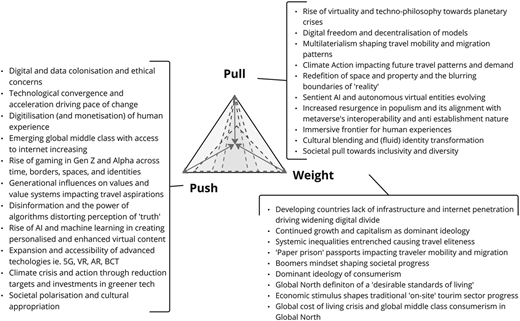
Secondary data comprising 68 signals identified through the literature review and environmental scanning was compiled and provided to participants as an information pack prior to the first workshop. The outputs of the literature review and environmental scanning, organised across STEEP dimensions, are presented in the mapping the future section of the findings. The Futures Triangle, constructed from these outputs prior to the workshops, is presented as Figure 3, illustrating the push, pull and weight forces shaping metaverse tourism futures.
Primary data was collected and analysed using the shared digital workspaces and structured templates from the two online workshops. Participants collectively ranked the 68 signals on two axes: perceived impact on metaverse tourism development; and degree of unpredictability over the next decade, using the shared digital workspace templates. This ranking process contextualised the structural terrain within which the scenario archetypes were developed. The four scenario archetypes emerged from the CLA process, specifically from the worldviews and metaphors surfaced through the layered analysis rather than directly from the signal ranking. The creative-narrative technique was then applied to develop each archetype as a richly imagined story of the future, using narrative construction to surface the underlying worldviews and ideological tensions identified through CLA (Kosow and Gaßner, 2008).
This provided for the systematic collection of visual mapping outputs and facilitated discussions. Post-workshop analysis involved the immediate transcription of audio recordings used only to verify anonymous contributions and resolve any analytical ambiguities. Each Pillar's outputs informed subsequent analysis building across multiple data sources and methodological perspectives.
All data storage followed institutional security and privacy protocols per ethical clearance requirements.
During manuscript preparation, an AI-assisted tool was used solely to refine language clarity. All conceptual and analytical content remains the author's own.
3.6 Limitations and boundary conditions
This methodology involves explicit choices creating specific boundary conditions for the findings.
First, advisory methods were deliberately excluded to prioritise democratised knowledge creation over expert validation. While epistemologically consistent with participatory futures approaches, this limits technical feasibility assessment of scenarios.
Second, the nine-method integration prioritised comprehensive coverage over analytical depth. This breadth was considered necessary for using the Six Pillars framework but may sacrifice the intensive analysis that fewer. More focused methods could provide.
Third, the small sample size (n = 6) enabled intensive participatory engagement while limiting broader representativity beyond this specific stakeholder representation.
These boundary conditions position the findings as exploratory foundations rather than definitive conclusions, establishing groundwork for subsequent validation studies with larger samples, expert consultation and cross-cultural replication.
4. Findings
The following findings present results from the systematic application of the Six Pillars framework, with each Pillar building analytical depth and insight.
4.1 Mapping the future
The first Pillar mapped the complex landscape of forces influencing the research domain, synthesising diverse inputs into a coherent understanding of present dynamics and future trajectories. This process revealed converging driving forces critical to metaverse tourism adoption and acceptance, providing the empirical groundwork for subsequent participatory exploration. Whilst the literature review focused exclusively on peer-reviewed and grey literature sources, the environmental scanning extended beyond academic sources to include industry reports, policy documents, news media and practitioner publications, ensuring the signal set reflected both scholarly and practitioner perspectives on emerging metaverse tourism dynamics. Table 3 summarises the key drivers of change identified across STEEP dimensions and their implications for metaverse tourism futures.
Environmental scanning drivers and implications
| STEEP dimension | Key drivers | Implication for metaverse tourism |
|---|---|---|
| Environmental | Climate change, biodiversity loss, planetary boundary breaches | Policy momentum towards low-carbon alternatives; virtual tourism as emissions reduction strategy |
| Technological | AI, AR, VR convergence outpacing governance | Promise of immersive tourism futures; governance and equity gaps persist |
| Economic | Geopolitical fragmentation, economic stagnation | Uneven investment and development trajectories; digital sovereignty tensions |
| Social | Demographic bifurcation; ageing populations vs youth-dominated Global South | Differentiated adoption pathways; mobile-first access patterns in emerging markets |
| Political | Passport privilege, mobility restrictions, governance inadequacy | Structural pressures for virtual alternatives; regulatory vacuum in metaverse governance |
| Cultural | Individualisation, identity fluidity, decentralised activism | Metaverse as arena for identity exploration; challenge to traditional tourism consumption |
Climate change, biodiversity loss and pollution have breached critical planetary boundaries, intensifying the discourse on environmental policy and legislative momentum (World Economic Forum, 2024). However, geopolitical fragmentation and uneven power deter unified global climate responses. Tourism sits at the nexus of this challenge as both vulnerable to and complicit in accelerating environmental degradation, contributing an estimated 10% to global greenhouse gas emissions. Initiatives such as the Glasgow Declaration signal ambition. However, current policy efforts remain voluntary and fragmented (European Commission, 2024).
Exponential technological advancement, particularly in artificial intelligence, augmented reality, virtual reality and other emerging technological convergences, continues to outpace governance and ethical alignment. The digital acceleration holds promise for immersive tourism futures while exacerbating nonparticipation, particularly across the Global South. The Global South is emphasised throughout this study because mobility restrictions, digital infrastructure gaps and demographic youth bulges create structurally distinct conditions for metaverse tourism adoption that differ fundamentally from developed economy contexts, making it a critical site for understanding the substitutional potential of virtual travel (GSMA, 2024; Van Houtum and Van Uden, 2021). The integration of AI national strategies highlights both geopolitical race conditions and the potential for digital sovereignty, while global governance frameworks are inadequate and unable to keep pace (Hankins et al., 2023).
Demographic bifurcation creates contrasting tourism futures globally. Ageing populations in developed economies with different mobility patterns, technology adoption and risk tolerances contrasted sharply with the youth-dominated regions such as Sub-Saharan Africa where approximately 60% of the population is under 25 and mobile connectivity is the primary means of Internet access and present structural demographic conditions for differentiated immersive technology adoption pathways, even as significant affordability and infrastructure constraints persist (GSMA, 2024). However, as mobility increases globally, passport privileges continue to entrench systemic injustice in access to global travel (Van Houtum and Van Uden, 2021) creating structural pressures for virtual alternatives in mobility-restricted contexts. Geopolitical tensions, economic stagnation, and civilisational shifts, including individualisation, identity fluidity and decentralised activism, signal deeper cultural transitions that influence how societies conceptualise tourism, mobility and a sense of societal belonging (OECD, 2021; World Economic Forum, 2024). These constraints intersect with individualisation, amplified by digitalisation, contribute to rising levels of loneliness and reshaping social bonds. Shifts towards post-binary gender identities and fluid digital self-representation in virtual spaces reflect broader civilisational changes, particularly resonating with younger demographics who navigate multiple virtual identities. Virtual environments, like the metaverse, have emerged as key arenas for affirming diverse identities and challenging established political and social structures (Inayatullah, 2023; Kuhn and Margellos, 2024; OECD, 2021), offering both ageing populations seeking accessible experiences and younger generations pursuing identity exploration as alternative pathways to traditional tourism consumption.
The Futures Triangle analysis reveals three competing dynamics: push forces driving technological acceleration towards virtual tourism economies, pull forces attracting towards sustainable and inclusive digital futures and weight forces constraining these ambitions through structural barriers and resistance to change.
The Futures Triangle framework and its three-force structure are adapted from Inayatullah (2023). The content comprising of the specific push, pull and weight forces identified is original to this study, derived from the synthesis of the literature review and environmental scanning outputs.
Figure 3 highlights the three competing dimensions and their tensions in the participants' push-pull dynamics, push-weight tensions and pull-weight interactions. The push for technological acceleration driven by artificial intelligence and immersive advancements has generated significant momentum towards a virtual tourism economy. A pull towards digital humanism and sustainability could signal societal aspirations for more inclusive and regenerative futures. This interplay suggests an emerging paradigm in which tourism is increasingly mediated by immersive experiences that transcend physical space, time and identity limits. However, these ambitions are constrained by push-weight tensions.
At a deeper level, pull-weight interactions reflect an ideological contest. While the dominant pull of technological optimism supports economic growth through virtual innovation, it is increasingly being challenged by a rising globalist ideology centred on equitable flows of capital, people and ideas. This tension underscores the need to reconcile transformative futures with structural reality. The underlying conditions may continue to limit access and participation, with metaverse potentially replicating insufficient governance models and policies.
4.2 Anticipating the future
Building on insights from the mapping phase, the Futures Wheel explored the first- and second-order consequences of the increased acceptance and adoption of metaverse tourism.
Participants explored five consequence categories: economic stimulus, attitudes towards power and control, creativity and value creation, inclusivity and climate (re)action.
The expansion of the gig economy suggested an acceleration of the digital divide as a consequence, particularly where digital infrastructure and skills are unequally distributed. Power and control shifts have introduced new legal and regulatory uncertainties, raising concerns about repeating the societal risks associated with Web 2.0, and indicating potential governance shifts in virtual rights and ethics. Creativity and value in tourism were seen as likely to transform, as services and offerings evolved into hybrid engagements and blended identities. This transformation could increase cultural misappropriation and erosion due to disinformation and the absence of clear content ownership frameworks. Inclusivity could be enhanced through the democratisation of travel, therefore providing broader access to virtual experiences and destinations. However, questions remain regarding increasing social detachment and changing consumption patterns as a result. Finally, climate (re)action could result in altered demand for physical travel, reducing overtourism and easing pressures on communities and preservation areas, enabling more sustainable or controlled tourism flows.
These exploratory outputs from the Futures Wheel generated further insights, refining the 68 factors into 12 thematic clusters that participants felt represented the key domains shaping future metaverse development. Participants evaluated each cluster based on its perceived impact in shaping metaverse trajectories and its uncertainty in how these influences could unfold over the next decade. The impact-uncertainty matrix methodology (Kosow and Gaßner, 2008) was used to assess which clusters participants felt represented high leverage intervention points (categorised as high impact) and those that constituted strategic uncertainties requiring scenario planning (categorised with high uncertainty). This process synthesised the key strategic uncertainties and critical leverage points and provided foundational variables for scenario construction. The participant assessments shown in Figure 4 revealed their collective judgement regarding the magnitude of influence each cluster could have on metaverse development and the degree of unpredictability related to the manifestation of each cluster in the future.
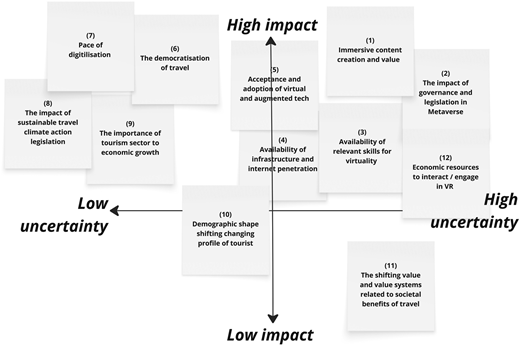
Participants perceived views on levels of impact and uncertainty from an online workshop. Source: Author
Participants perceived views on levels of impact and uncertainty from an online workshop. Source: Author
Figure 4 provides evidence of participants' perceptions of the levels of impact and uncertainty. At the core is a push-pull dynamic between rapid digital advancement and evolving societal aspirations for equity, sustainability and cultural inclusion.
A critical cluster of enablers, such as the adoption of immersive technologies (5), availability of infrastructure (4), digital skills (3), and economic resources (12), highlighted the potential and fragility of the metaverse tourism system. These factors were perceived as having high-impact and high uncertainty, particularly in the Global South, where push-weight tensions remain unresolved.
The pace of digitalisation (7), demographic shifts (10) and the changing value of travel (11) signalled potential deeper civilisational transformations. Younger generations are emerging as cultural drivers, reshaping what tourism means and moving towards blended, customisable and identity-affirming experiences. This shift intersects with rising expectations for democratised travel (6) and more immersive, inclusive modes of experiencing place and culture (1).
The absence of transparent governance in the metaverse (2) and the growing influence of climate legislation (8) highlighted the urgency for coordinated policy and regulatory innovation in a key economic stimulus sector (9).
The interplay of these clusters suggests a paradigmatic shift in the underlying logic of tourism towards a reimagined worldview grounded in decentralisation, immersive experiential value and regenerative virtuality potential.
4.3 Timing the future
The Polak Game was used as an introductory entry point for futures thinking, as participants shared their sense of agency, uncertainty, perceptions of future change and views on patterns of social change. Diverse perspectives emerged from some participants who expressed varying degrees of optimism and control, with some feeling disempowered and others feeling more confident in their ability to actively shape the future. There was broad agreement on the accelerating pace of technological change and a reflection on social change over the past 50 years, with most participants identifying exponential growth as the dominant pattern.
Social change was discussed as participants reflected the different models of change. Evolutionary changes were viewed as incremental and technology-led, often reinforcing the narratives of inevitable progress. In contrast, structural transformation highlighted the roles of disruption, resistance and competing interests. Alternative futures could be led beyond dominant techno-economic narratives and towards more regenerative, inclusive paradigms, making space for futures grounded in systemic reform.
4.4 Deepening the future
The CLA was facilitated as a structured exercise in the shared digital workspace. Participants moved through the four levels in turn, with the researcher posing probing questions at each stage to surface what lay beneath the responses given (Inayatullah, 2019). Working the layers in sequence allowed each level to deepen the next, opening the inquiry from observable surface to underlying structure.
The cultural-symbolic litany level surfaced a growing disconnect between the term metaverse and the lived reality of the digital experience. The results confirmed that artificial intelligence dominated public discourse, often using narratives of risk, however with its prominence in preparing the cultural ground for broader acceptance of virtuality. Gaming, virtual concerts, digital fashion, and virtual tours were normalised. The findings indicated that cultural adoption may precede conceptual clarity, and that metaverse tourism futures are already being shaped through incremental shifts in identity, experience, and consumption.
At the systemic level, the evolution of metaverse tourism is deeply intertwined with structural transformations across technology adoption, economic models, governance systems and cultural meaning-making. Emerging virtual infrastructures have disrupted traditional tourism value chains, challenged legacy investment and employment structures and exposed gaps in digital governance. Shifts in identity norms and the rise of digital cultural systems signal a redefinition of how tourism is socially constructed and economically organised in blended realities.
At the worldview level, participants surfaced multiple, often competing ideologies. Technological utopianism emerged as a dominant worldview, positioning emerging technologies as transformational tools capable of solving complex global challenges, including transhumanist aspirations with cognitive augmentation and digital immortality. In contrast, concerns around surveillance capitalism and data colonialism pointed to the fears of exploitation and loss of agency in digital spaces, generating tensions with rising tensions for digital libertarianism, user sovereignty and decentralised blockchain governance. The process also surfaced postmodern interpretations, where distinctions between real and virtual dissolved into hyperreality, reshaping how authenticity and experience could be understood by the users. These worldviews reflected deeper ideological tensions between collectivism and individualism, control and autonomy, and progress and resistance. Environmentalism also emerged as a potentially unifying lens, framing virtual tourism as a sustainable and inclusive alternative aligned with regenerative values and global solidarity. Together, these layered participant worldviews highlighted the ethical, political and philosophical terrain that underpins metaverse tourism futures.
Metaphors provided entry points for imagining multiple futures by adding emotional and imaginative stories and texture to scenario construction.
However, the CLA's use of metaphors highlights both its strengths and limitations. While the process surfaced underlying assumptions and competing ideologies, the transition from worldviews to metaphors risks methodological circularity, as metaphors may reinforce the same assumptions the CLA initially surfaced.
The value of CLA in this study lies less in the metaphors themselves and more in its capacity to reveal paradigmatic tensions between technological utopianism and surveillance capitalism, autonomy and control, progress and resistance that underpin divergent futures of metaverse tourism.
4.5 Creating alternatives
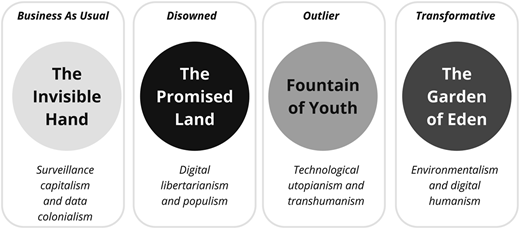
Building on each of the sensemaking Pillars, participants created four scenario archetypes using creative-narrative methods. Each scenario was anchored by a metaphor that symbolised its underlying worldview and thematic clusters, and a story of the future narrated through a main Global South character Mkho in 2035. The scenarios and their key features are presented in Figure 5.
4.5.1 Scenario 1: The invisible hand
Metaphor: “The invisible hand of ambition builds a used world of digital monopolies.”
Narrative: Corporate monopolies and algorithmic control dominate a fragmented, hyper-commercial metaverse ecosystem. Virtual labour has become the norm; however, economic disparities persist, reinforcing a digital class system structured by bandwidth and processing power. Physical tourism has faded under the weight of rising emissions, leaving virtual content production and cultural commodification as dominant tourism expressions.
Analysis: Prioritises the continuation of unsustainable capitalism and globalism. Non-state actors continue to take advantage of commercialising and monetising human experience through unregulated access to personal data that compromises citizen privacy and protection. The metaverses created barriers to equal access and a seamless experience, with virtual tourism marred by cultural misappropriation, given the stark inequalities in countries battling increasing access, Internet penetration and digital skills.
4.5.2 Scenario 2: A promised land
Metaphor: “The promised land where technology is my only hope to escape the real world and the problems we have created.”
Narrative: In Promised Land, Mkho navigates a decentralised metaverse. Freedom from state oversight enables individual radical autonomy. In this splintered virtual landscape, people float unregulated. Physical travel has largely been abandoned and replaced by curated ultra-realistic simulations. Although control is absolute, its meaning and connection are elusive.
Analysis: The disowned scenario, “A Promised Land” envisaged a digital domain “free” from unregulated, surveillance non-state powers, with users operating in faceless and untraceable spaces where individualism is valued higher than the community, and agents are lonely in their isolation. By its very nature, tourism is about shared connections, experiences and cultures, which would suffer in a highly decentralised and fractured society.
4.5.3 Scenario 3: Fountain of youth
Metaphor: “Virtually is like the fountain of youth where I can experiment with immortality.”
Narrative: Fountain of Youth is set in a world where technological singularity has arrived. Mkho observed how enhancements in biotech, neuro-interfaces and virtual embodiment have allowed elites to transcend physical limits. Tourism is now hyper-personalised, sensory-optimised and stripped of ecological consequences but also devoid of challenge or authenticity. Despite digital breathtaking experiences, the loss of grounding in the real world has led to mass disassociation and a growing inability to distinguish between what is real and what is designed. The body has become optional, meaning that it is more difficult to find.
Analysis: Elite society is modified through enhanced capacities and abilities that surpass biological constraints, increasing longevity, cognition and well-being. As a result, there are only a few benefits from it, and it lacks sufficient ethical and governance frameworks. Transhuman beings would experience tourism completely differently, overriding natural laws and losing human identity and cultural connections.
4.5.4 Scenario 4: Garden of Eden
Metaphor: “It is our Garden of Eden where I return to innocence and balance and create the world I want to live in.”
Narrative: The Garden of Eden presents a transformative future in which global climate emergency has catalysed a profound shift from extractive globalism to regenerative environmentalism. Multilateral action has intensified and reshaped governance, resource flows and tourism paradigms. The metaverse evolved from a fragmented, corporate-controlled space into a decentralised, interoperable platform designed to address global challenges, foster cultural preservation and democratise participation. Tourism was no longer about consumption and escape, but about contribution, education and connection, whether through immersive digital content, intentional real-world travel or conservation-linked rewilding initiatives. Mkho's role as a mentor and collaborator exemplifies a world in which technology, ethics and ecological stewardship intersect. Yet even in this seemingly balanced and hopeful world, cultural diversity and distinctiveness erosion prompt reflective questioning: Does a unified solution come at the cost of plurality?
Analysis: The scenario envisaged that a stronger and more unified multilateral governing body emerged in a world facing an existential climate crisis, eliciting more global participation towards climate action goals, and using the metaverse as an enabler. Inclusive development pathways could then be prioritised and aligned with greater environmental ideologies. The metaverse was created as a not-for-profit environment like the Internet, which could facilitate the widespread acceptance and adoption of immersive technologies. The metaverse was envisaged as powerful enough to democratise the availability and development of tech skills as a global collaboration and learning platform and create “spaces” for international partnerships to emerge in resolving the grand global challenges and SDG goals. There is a need for universal access to Web 3.0, Web 4.0 and a much-needed revolution in connectivity and computer processing power.
4.5.4.1 Summary of the scenarios
The four scenarios illustrated divergent metaverse tourism futures shaped by competing ideologies and exposed deeper structural tensions between technological potential, and the need to preserve human and ecological connection, positioning the metaverse as a mirror of existing inequalities and a space for transformative reimagining. By linking metaphors to underlying ideologies, the scenarios illustrated how futures are contested sites of meaning making. These scenarios can support tourism stakeholders in exploring multiple futures and building anticipatory and adaptive capacities to navigate future paradigm shifts.
4.6 Transforming the future
The preferred “Garden of Eden” scenario was used in a visioning process to explore future implications for the tourism industry.
Through the backcasting process, participants envisaged tourism evolving into a proactive force for system-level change over the next decade and transitioning from extractive consumption-based models towards those grounded in greater equity, digital embodiment and environmental stewardship.
Visioning surfaced the critical transitions required in climate governance, sustainable mobility legislation and green technology adoption, laying the groundwork for a reconfigured tourism ecosystem shaped by metaverse-enabled futures.
Further research could explore tourism's role in building climate-neutral, ethically aligned virtual futures, supported by inclusive governance models. Cross-sector task forces and participatory foresight platforms are required to align immersive innovation with societal goals. National and regional metaverse tourism strategies should integrate Web 4.0, which has cultural integrity and environmental purposes, to ensure an open, interoperable metaverse that protects digital rights and embeds cultural representation. This includes empowering local creators and digital custodians to co-create and steward virtual tourism narratives.
5. Discussion
This study makes two interconnected contributions. Theoretically, it advances futures research in tourism by demonstrating that critical realism and CLA together provide a methodologically rigorous framework for interrogating contested socio-technical phenomena, moving beyond scenario planning towards a structural inquiry into the conditions that shape certain futures. Substantively, it generates four scenario archetypes grounded in competing worldviews that capture the ideological terrain shaping whether the metaverse's substitutional potential may be realised.
Much of the existing literature frames the metaverse as supplementary: a pre-arrival marketing tool, a post-trip memory enhancer or a complement to physical travel (Buhalis et al., 2022, 2023). This study's participatory process surfaces a more disruptive proposition: that under specific structural conditions, virtual tourism could constitute a viable substitute for physical travel. This suggests that the convergence of climate imperatives, governance shifts and ideological change provide a deep structural argument that critical realism and CLA are designed to surface.
The four scenarios reveal that the future of metaverse tourism is not technologically determined but ideologically contested. Each scenario emerged from distinct and competing worldviews surfaced through the CLA process: technological utopianism, transhumanism, digital libertarianism and environmentalism. Dolata and Schwabe (2023) characterise the metaverse as a site of social construction shaped by competing interests, though their analysis is situated at the level of institutional discourse. This study extends that position by surfacing how competing constructions could emerge at the level of lived worldviews, and how, when interrogated through structured futures inquiry, they translate into materially divergent tourism futures.
The Garden of Eden scenario provides insight into a practical demonstration of regenerative tourism theory. Bellato and Pollock (2025) define regenerative tourism as transcending harm minimisation towards the active restoration of social, cultural and ecological systems. The Garden of Eden scenario operationalises this aspiration within a metaverse context. Participants envisaged the metaverse not as a commercial platform but as a not-for-profit, interoperable environment capable of democratising access, prioritising cultural preservation and enabling global climate collaboration. This scenario positioned virtual tourism as a lower-carbon alternative to physical travel and as a vehicle for regenerative value creation. Liu and Hao (2024) provide empirical support for this, demonstrating that avatar-mediated metaverse experiences can actively promote conservation behaviour and community engagement rather than simply reducing harm. These implications move the regenerative tourism agenda from aspiration to operational strategy, grounded in the structural conditions participants identified as necessary for the preferred future to materialise.
The implications for tourism practice, grounded in the study's backcasting process from the preferred scenario, centre on three interconnected shifts. The first concerns governance. Participants identified the absence of an open, interoperable metaverse platform with globally recognised standards as the most critical structural barrier constraining the realisation of the preferred future. Without frameworks that protect digital rights, indigenous knowledge and cultural representation in virtual content creation, the metaverse risks replicating the extractive dynamics of Web 2.0 and the trajectory embodied in the Invisible Hand scenario. This aligns with Mihalic's (2024) argument that metaversal sustainability is contingent on the governance conditions under which immersive technologies are deployed. For destination management organisations, this means engaging proactively with metaverse governance debates rather than treating them as peripheral to core tourism strategy.
Second, the tourism industry requires deliberate investment in metaverse literacy and capability. Participants identified digital reskilling, public–private innovation hubs and cross-sector collaboration with technology and creative industries as structural prerequisites for a viable metaverse tourism ecosystem. This extends Go and Kang's (2023) alignment of metaverse tourism with UNWTO Sustainable Development Goals by integrating this pathway in specific institutional actions rather than aspirational framing. Tourism practitioners and destination managers are compelled to build internal capabilities for virtual tourism futures in conjunction with the emerging metaverse environment.
Third, cultural integrity should be designed into virtual tourism from the outset. The backcasting process surfaced cultural homogeneity and the erosion of indigenous knowledge as significant risks even within the preferred scenario. The metaverse's democratising potential is therefore conditional, dependent on which actor creates virtual content, who owns it and whose cultural representations are rendered visible. This points towards the active empowerment of local communities and digital custodians as co-creators of virtual tourism narratives, rather than subjects of content produced by dominant platforms.
The interpretive scope of these findings should be understood within the study's boundary conditions. The small participant group and exclusion of advisory methods shape the scenarios as exploratory foundations rather than definitive conclusions. Cross-cultural replication with more diverse participant groups would strengthen their generalisability. Notwithstanding these limitations, the study offers a methodologically distinctive and theoretically grounded contribution to metaverse tourism futures research, advancing inquiry towards the paradigmatic assumptions and structural forces that may determine whether virtual tourism remains supplementary or becomes genuinely transformative.
6. Conclusion
This study demonstrates how metaverse-enabled technologies could offer viable alternatives for “on-site” tourism, through the systematic exploration of multiple metaverse-enabled tourism futures by 2035. This study demonstrated the practical application of established foresight methodologies and participatory action learning for tourism practitioners and policy stakeholders using anticipatory tools to interrogate and navigate emerging tourism paradigms.
Backcasting from the preferred Garden of Eden scenario surfaced actionable insights and strategic recommendations for tourism practitioners and policymakers seeking to navigate the transition towards more sustainable, equitable and metaverse-enabled tourism futures. Recognising metaverse-enabled tourism as a viable and compelling value proposition that replaces “on-site” tourism enables tourism strategists and stakeholders to advance regenerative tourism beyond traditional responsible tourism strategies and policies.
6.1 Limitations
Several limitations should be noted. The small participant group of six, while consistent with the Six Pillars framework's emphasis on depth over breadth, limits generalisability and cross-cultural representativeness. Participants were drawn from the researcher's professional network, with a concentration of destination-level tourism practitioners, which may have introduced sector bias into the worldviews surfaced. The deliberate exclusion of advisory methods prioritised democratised knowledge creation but limited technical feasibility assessment of the scenarios. The researcher's dual role as both study author and workshop facilitator, while methodologically transparent, cannot be entirely discounted as having influenced the synthesis of outputs. Finally, the cross-sectional design captures a specific moment in a rapidly evolving technological landscape. Longitudinal replication would strengthen the findings as the metaverse's structural conditions continue to develop.
6.2 Future research
Future research should pursue:
Different time horizons to explore longer term societal, cultural and technological shifts in virtuality and tourism.
More diverse participants to enhance representativeness and cross-cultural perspectives.
A dedicated inquiry into the moral and philosophical challenges of building open, secure and inclusive virtual spaces could provide valuable insights for policymaking and responsible design of tourism applications in the metaverse.
Gen Z's use of multiple identities, preference for immersive interactions and growing participation in persistent virtual worlds signals a shift in tourism behaviour. Research could investigate the evolving concept of “never-ending tourism” within metaverse environments and “always-on” identities and the implications for the tourism ecosystem regarding service and experience design, digital labour and destination management.

