


Microlearning has been considered as a promising topic in work-based learning. This paper aims to review the trends of microlearning in terms of related publications and Internet searches. Hopefully, the findings can serve as a reference for the education sector, government, business and academia to promote, design and use microlearning.
In this study, two sets of analysis were conducted. Firstly, the authors analysed the publication trend of microlearning. Second, the authors analysed the trend of Internet searches related to microlearning. More specifically, the authors analysed real-world data of 14 years obtained from Scopus and Google Trends for the purpose. These data include the first relevant publication found in the database.
In total, 476 relevant publications have been identified during 2006–2019. According to the findings from the analysis of the identified publications, microlearning is a relevantly new and emerging global topic involving authors, affiliations and funding sponsors from different countries. Moreover, many microlearning-related publications were conducted from perspectives of e-learning or mobile learning. Furthermore, the authors notice higher education was the most frequently mentioned education level in the identified publications. On the other hand, language learning (i.e. second language, vocabulary learning, etc.) had been mentioned more times in the titles and abstracts than other subject areas. Overall, the increasing trend of publications on “microlearning” (as a knowledge supply) is in line with the established increasing Internet searches of “microlearning” (as a practical demand) in recent years.
From the work-based learning perspective, microlearning has been considered as one of the key topics in talent development topics. Policymakers, educators, researchers and participators have the responsibility to explore how to promote, design and use microlearning to help people to learn in the right direction through valid knowledge with ethical consideration.
Although many works had been done on microlearning, there is a lack of comprehensive studies reviewing the trends of microlearning in terms of related publications and Internet searches. This study aims to fill this gap by analysing real-world data obtained from Scopus and Google Trends – these data include the first relevant publication found in the database. The authors believe this is the first time that a study has been conducted to comprehensively review the development trends of microlearning. Hopefully, this study can shed some light on related research.
1. Introduction
In recent years, microlearning has been considered as a promising topic in work-based learning. This paper aims to review the trends of microlearning in terms of related publications and Internet searches. The findings can serve as a reference for the education sector, government and academia to promote, design and use microlearning. Although there are many concepts and versions of microlearning (Hug, 2005), the common features of microlearning, as per Buchem and Hamelmann (2010), include microcontent, focussing on a single definable idea or topic and short learning time (i.e. no longer than 15 min).
In brief, the key benefits of using microlearning include (1) better retention of concepts (Giurgiu, 2017; Shail, 2019), (2) better engagement for learners (De Gagne et al., 2019a, b; Nikou, 2019; Liao and Zhu, 2012), (3) improving learners' motivation (Nikou and Economdies, 2018; Halbach and Solheim, 2018; Shail, 2019; Stronck, 1983), (4) engaging in collaborative learning (Reinhardt and Elwood, 2019; Zhang and Ren, 2011; Chang and Liu, 2015) and (5) improving learning ability and performance (Mohammed et al., 2018; Jomah et al., 2016).
Big data plays an important role in the development of microlearning. In the age of big data, human's attention span is decreasing. As per Hebert (1971), “what information consumes is rather obvious: it consumes the attention of its recipients. Hence a wealth of information creates a poverty of attention and a need to allocate that attention efficiently among the overabundance of information sources that might consume it” (p. 41). An example of short attention span in the age of big data can be found in the music industry, as per (Gauvin, 2017), the average time that passed before the audience would hear the vocals on any radio song was 23 s, today the average intro is just 5 s long. Wertz (2017) also suggested that 40% of users are likely to abandon a website if it does not load within three seconds or less. Furthermore, a survey (Gausby, 2015) conducted by Microsoft indicated that the average attention span of a human dropped from 12 to eight seconds, which means shorter than a goldfish. Given the average human attention span is decreasing, microlearning becomes more and more important because it emphasises short learning duration.
On the other hand, as per Wertz (2018), instant gratification has become an expectation since the emergence of the Internet and the immense growth of social media in the big data age. This expectation also affects how people view their time and how they learn. In comparison to the traditional approach that face-to-face study times are scheduled, it is now people expect to learn instantly anytime, anywhere. In the workplace, people are used to have information at their fingertips, finding the answers they need within minutes. This has dramatically changed people's expectations of workplace learning. Also, more and more employees are preferred to taking control of their own learning. A previous survey (Mazareanu, 2019) suggests that 80% of employees are learning when they need it. Accordingly, the need for on-demand training or just-in-time learning is growing (Brandenburg and Ellinger, 2003). This trend also facilitates the development of microlearning. As per Gabrielli et al. (2006), small chunks of the learning content can enable learners to access them more easily in specific moments and conditions of the day.
In fact, the applications of microlearning have been widely studied in different fields, such as in textiles (Buhu and Buhu, 2019), health professional education (De Gagne et al., 2019a,b), engineering (Said and Çavuş, 2018), language learning (Edge et al., 2011) and college physical education (Zhang and Zhang, 2017). Moreover, as per Florida (2002); Ogata and Yano (2003), microlearning is a research area that aims to explore new ways of responding to the growing need for lifelong learning or learning demand of knowledge workers. A similar view can also be found in other studies, such as Jomah et al. (2016).
From the work-based learning perspective, microlearning has been considered as one of the key topics in talent development (Moore, 2017). According to Emerson and Berge (2018), microlearning can facilitate knowledge acquisition in the workplace by engaging and motivating employees to communicate and apply what they have learned. On the other hand, Overton (2011) indicated that managers prefer on-demand learning and access to up-to-date information in a timely manner under the current competitive business environment. Madden and Govender (2020) further suggested that the learning and development departments of businesses are focussing on the emerging concept of microlearning to support the fast-paced, multitask-orientated and digitally savvy learners. Furthermore, Hesse et al. (2019) concluded that microlearning is effective at increasing the feelings of confidence and accuracy in the work of dairy personnel. In brief, we suggest that work-based learning needs digital transformations in order to meet today's fast-changing business environment in the big data age. This suggestion is similar to the viewpoints from Downes (2005); Chisholm (2005), they summarised that renewed and innovative ways of work-based learnings are required according to the ways we live, work and learn today.
Although many works have been done on microlearning, there is a lack of comprehensive studies reviewing the trends of microlearning in terms of related publications and Internet searches. This study aims to fill this gap by analysing real-world data obtained from Scopus and Google Trends – these data include the first relevant publication found in the database. Therefore, an extensive reading list with a good range of dates will be summarised in this paper.
The rest of this paper is organised as follows: we first explain the research designs and report the findings in the next section. Given we are reviewing two different trends (i.e. publications and Internet searches) based on two different data sets; therefore, the Research Design and Findings section is divided into two parts, respectively. Finally, discussion and suggestions are provided in the Conclusion section.
2. Research design and findings
In this study, two sets of analysis were conducted. Firstly, we analysed the publication trend of microlearning. Second, we analysed the trend of Internet searches related to microlearning.
In both analyses, we also explored the entire population of corresponding data sources. For the publication trend of microlearning, the data source refers to all the microlearning-related literature reviews in the Scopus database since the year 2006. For the trend of Internet searches related to microlearning, the data source refers to all the search activities in Google that relate to microlearning since the year 2006. Both analyses were started from 2006 because we found the first relevant publication in the Scopus database in this year. Although it is not possible to make statistical generalisations about the sample being studied, we can make analytical generalisations about the trends of microlearning by exploring the entire data sources. More specifically, this study can provide a comprehensive whole picture about the trends of microlearning in terms of related publications and Internet searches during the study period (i.e. 2006–2019). We also presented the corresponding trends of (1) e-learning and (2) learning for the comparison purpose. These two trends can be considered because microlearning is under the disciplines of e-learning and learning. More detail explanations about the analysis approaches are provided in the following sections.
2.1 Research design
2.1.1 Publication trends of microlearning
In order to understand the publication trend, data were collected from Scopus. Scopus (https://www.scopus.com/) is an abstract and citation database that covers nearly 36,377 titles (22,794 active and 13,583 inactive titles) from approximately 11,678 publishers, of which 34,346 are peer-reviewed journals in various subject fields.
Based on the collected data, we review the publication trend from seven different perspectives, which are as follows:
Thenumber of related publications over time
Distribution of authors by countries
Distribution of affiliations
Funding sponsors
Source types of publication
Word frequency analysis I: based on the titles
Word frequency analysis II: based on the abstracts
These seven perspectives are selected because we aim to include as many possible perspectives as in this study in order to provide more comprehensive and diverse views on the publication trends. In this regard, the seven selected perspectives were the most accessible types of information that the database (i.e. Scopus) can generate for the purpose. Given the approach being used in this study is directly repeatable; therefore, the findings are transparent and reproducible. As per the considerations suggested by Fisch and Block (2018), transparent and reproducible are two key features of the systematic literature review in business and management research. Moreover, similar approach has been applied in other studies, such as Wang and Chen (2010); Liao et al. (2017); White and McCain (1998).
2.1.2 Internet searches related to microlearning
In addition to analysing publication trends, we also conducted an Internet search analysis that could generate understanding on trends of information needs on related knowledge. In other words, we conducted the Internet search analysis with the aim to obtain an additional view in terms of how public interests on microlearning were changing during the period. The findings from the Internet search analysis can then serve as a reference for policymakers because the findings reflect the market needs.
In this study, we used a public-accessible online tool, Google Trends (www.google.com/trends/) to analyse the Internet searching trends of “microlearning”. In addition, two related search terms, “elearning” and “learning”, were also be used for the comparison purpose. A search term is a keyword that a user enters in the Google search engine to satisfy his or her information needs.
Google Trends is a free public web service developed by Google. It shows how often specific search terms have been queried over a specific period. In other words, Google Trends is a platform that summarises the popularity of top search queries in Google.
The data from Google Trends have widely been used by researchers for analysing human behaviour and user interests across various fields (Jun et al., 2018). One of the notable examples is that Ginsberg et al. (2009) published their findings in Nature and reported that they successfully used the data from Google Trends to predict the spread of influenza epidemics – even earlier than the Centers for Disease Control and Prevention. Other examples include, to name a few, Choi and Varian (2012) demonstrated how to use search engine data on Google to forecast near-term values of economic indicators, such as unemployment claims, consumer confidence, etc. Sung et al. (2020) studied the relationships between Google search activities and the finance education trend. The works of Durmusoglu (2017) demonstrated the uses of Google Trends data to assess public understanding of the environmental risks.
In this analysis, (1st January 2006 to 31st December 2019) search terms (i.e. keywords) data of 14 years were collected from Google Trends. This selected period is in line with the analysing period of publication conducted above, that is, from the first relevant publication found. The data collected refer to the search behaviour of Google search engine users, that is, what these users are looking for over a specified period. Moreover, we set the geographical location criterion in the Google Trends as “worldwide”; therefore, the results represent user behaviours from all over the world instead of any specific geographical location.
2.2 Findings
In this section, we shall report the findings of our analyses. These findings provide a comprehensive picture from different perspectives on the global trends of microlearning. Further discussions will be provided in the Conclusion section on the importance of microlearning in work-based learning.
2.2.1 Findings on analysing publication trends of microlearning
2.2.1.1 The number of related publications over time
By searching publications containing the term “microlearning” in all selected fields (i.e. article title, abstract, keywords, authors, source title, affiliation and funding information) in Scopus, we identified 476 related publications in total, including the first publication found in 2006. Moreover, as per Figure 1, an increasing trend from 2016 to 2019 is found.
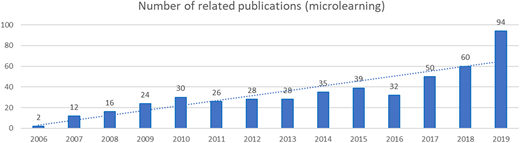
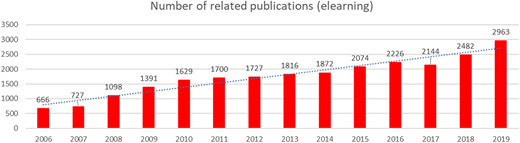
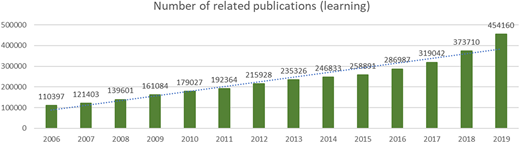
We further evaluated the publications containing the terms “elearning” and “learning” in Scopus for the same period (i.e. from 2016 to 2019). Both Figures 2 and 3 show similar increasing trends, although the increasing rates of the related publications were not as high as “microlearning”. More specifically, the number of publications related to “microlearning” has increased 47 times (i.e. from 2 to 94) from 2006 to 2019; however, numbers of publications related to “elearning” and “learning” have increased only 4.45 and 4.11 times, respectively, during the same period.
2.2.1.2 Distribution of authors by countries
The identified publications containing “microlearning” were contributed by scholars from 75 countries. Table 1 summarises the countries having ten or more publications during the period, for example, the table shows that 78 (i.e. 16.4%) publications involved scholars from the USA, this participation rate is the highest amongst all the countries.
2.2.1.3 Distribution of affiliations
As per Table 2, in total, 15 affiliations from different countries were involved in five or more publications during the period and the Delft University of Technology, The Netherlands, was ranked to the top, followed by the University of Glasgow, the UK.
Counts of affiliations
| Affiliation | Country | Counts |
|---|---|---|
| The Delft University of technology | The Netherlands | 10 |
| The University of Glasgow | The UK | 8 |
| Ionian Panepistimion | Greece | 7 |
| Ostravská Univerzita v Ostrave | The Czech Republic | 7 |
| Suleyman Demirel University, Kaskelen | Kazakhstan | 7 |
| Comenius University | Slovakia | 6 |
| Universitat Oberta de Catalunya | Spain | 6 |
| Norges Teknisk-Naturvitenskapelige Universitet | Norway | 6 |
| Universität Duisburg-Essen | Germany | 6 |
| Universität Stuttgart | Germany | 6 |
| Università della Calabria | Italy | 6 |
| Technische Universitat Graz | Austria | 5 |
| Università degli Studi di Firenze | Italy | 5 |
| Tallinn University | Estonia | 5 |
| Itä-Suomen yliopisto | Finland | 5 |
2.2.1.4 Funding sponsors
In total, 69 (14.5%) publications were funded by 51 identified sponsors, in which six of the identified sponsors involved two or more publications, as per Table 3.
Counts of funding sponsors
| Funding sponsor | Counts |
|---|---|
| The European Commission (EU) | 10 |
| The National Natural Science Foundation of China (China) | 5 |
| The Cultural and Educational Grant Agency (Slovakia) | 3 |
| The Federal Ministry of Education and Research (German) | 2 |
| The Japan Society for the Promotion of Science (Japan) | 2 |
| The National Science Foundation (USA) | 2 |
Overall, Tables 1–3 provide evidence that microlearning is a global topic. In summary, as per the findings, microlearning had become a global topic that involved researchers' contributions from different countries and affiliations. In addition, the topic had also successfully attracted funding from sponsors globally. In fact, we observed that many publications involved cross affiliations and cross-countries collaborations. These findings could provide an empirical reference to support future collaborative research directions.
2.2.1.5 Source types of publication
Table 4 and Figure 4 demonstrate that conference proceeding was the key source type of “microlearning”-related publication. Overall, 41% of the works were published as conference proceeding, 34% were published in journals. Table 4, Figure 5 and Figure 6 further show the distributions of source type of “elearning” and “learning”, respectively.
Counts of the source type
| Source type | Microlearning | E-learning | Learning |
|---|---|---|---|
| Journal | 160 | 10,531 | 2,121,602 |
| Conference proceeding | 193 | 9,599 | 729,932 |
| Book | 68 | 2,652 | 240,308 |
| Book series | 54 | 1,687 | 197,407 |
| Trade journal | 1 | 43 | 5,111 |
| Others | 0 | 3 | 393 |
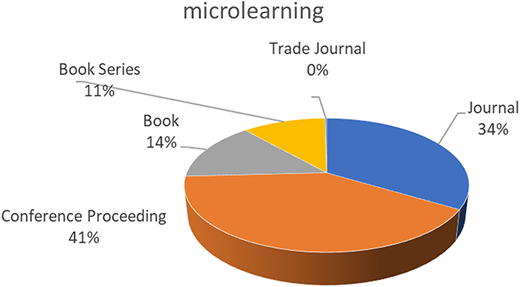
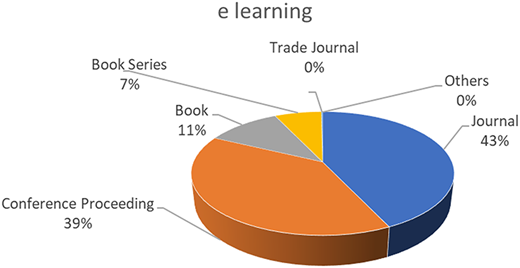
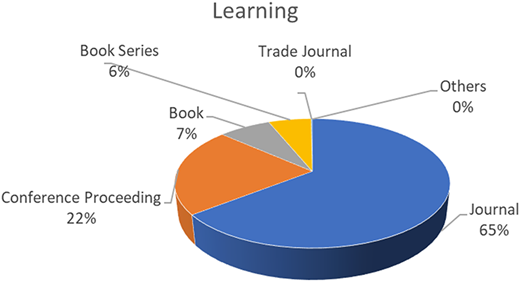
As per the figures, conference proceeding was the major source type of publication for “microlearning”, whereas journal was the major source type of publication for “elearning” and “learning”. We consider this finding reflecting that “microlearning” was a relatively new topic. This consideration is based on the general difference between conference proceeding and journal. In brief, a conference proceedings article is published in the proceedings of a conference, and it usually reflects an earlier-term research work (preliminary findings) or an innovative idea that has emerged in course of the research study. On the other hand, a journal paper tends to be a more comprehensive and in-depth research than a conference proceeding.
2.2.1.6 Word frequency analysis I: based on the titles
Given a title can be used to identify the main idea, work and the context of a publication, it also conveys a minimal summary of a publication's content; therefore, the frequency words found in the titles of the identified publications can indicate the trends of related research in the field of “microlearning”.
We conducted this analysis at different levels (i.e. from a single word to two-word phrases). Table 5 shows the top ten most frequent single words found in the titles.
Top ten most frequent single words found in the titles
| Rank | Single word | Counts |
|---|---|---|
| 1 | Learning | 248 |
| 2 | Mobile | 105 |
| 3 | Education | 60 |
| 4 | Microlearning | 50 |
| 5 | Based | 44 |
| 6 | Design | 36 |
| 7 | Micro | 32 |
| 8 | Language | 31 |
| 8 | Study | 31 |
| 10 | Social | 30 |
On top of reviewing single word in a title, we further extended the word frequency analysis to the two-word phrase level in order to obtain a more comprehensive view.
Table 6 shows the top ten most frequent two-word phrases found in the titles. More specifically, 11 phrases are listed in the table because four phrases are having the same counts. In the table, the phrases without meanings were excluded, such as “in the”, “of the” and “in higher”.
Top ten most frequent two-word phrases found in the titles
| Rank | Two-word phrase | Counts |
|---|---|---|
| 1 | Mobile learning | 34 |
| 2 | E-learning | 30 |
| 3 | Higher education | 24 |
| 4 | Microlearning | 23 |
| 5 | Case study | 15 |
| 6 | Learning environments | 14 |
| 7 | Language learning | 13 |
| 8–10 | Design of | 9 |
| 8–10 | Development of | 9 |
| 8–10 | Second language | 9 |
| 8–10 | Vocabulary learning | 9 |
We did not extend the analysis to three-word phrases because only two three-word phrases (i.e. “in higher education” and “a case study”) had ten or more counts, that is, the results are not representative.
In brief, according to the findings, the words or phrases related to e-learning or mobile learning (e.g. mobile, mobile learning and e-learning) are often found in the titles. Also, “language” is a frequently mentioned topic in the titles as well.
2.2.1.7 Word frequency analysis II: based on the abstracts
An abstract is a brief summary of a publication. Tables 7–9 show the top ten most frequent single words, two- and three-word phrases found in the abstracts, respectively. Similar to word frequency analysis I above, the phrases without meanings, such as “in the”, “the results of”, “this paper presents” or similar phrases were excluded.
Top ten most frequent single words found in the abstracts
| Rank | Single word | Counts |
|---|---|---|
| 1 | Learning | 1,477 |
| 2 | Mobile | 414 |
| 3 | Students | 371 |
| 4 | Paper | 290 |
| 5 | Education | 286 |
| 6 | Study | 249 |
| 7 | Based | 248 |
| 8 | Research | 245 |
| 8 | Use | 240 |
| 10 | Design | 207 |
Top ten most frequent two-word phrases found in the abstracts
| Rank | Two-word phrase | Counts |
|---|---|---|
| 1 | Mobile learning | 138 |
| 2 | E-learning | 105 |
| 3 | Microlearning | 92 |
| 4 | Higher education | 72 |
| 5 | Mobile devices | 68 |
| 6 | Development of | 55 |
| 7 | Language learning | 43 |
| 8 | Web 2 | 39 |
| 8 | Learning environment | 39 |
| 10 | M-learning | 37 |
Top ten most frequent three-word phrases found in the abstracts
| Rank | Three-word phrase | Counts |
|---|---|---|
| 1 | Teaching and learning | 40 |
| 2 | In higher education | 31 |
| 2 | The development of | 31 |
| 4 | Of e-learning | 29 |
| 5 | Of mobile learning | 24 |
| 6 | The effectiveness of | 22 |
| 6 | The design of | 22 |
| 8 | Use of mobile | 20 |
| 9 | Of mobile devices | 18 |
| 10 | Of higher education | 16 |
In brief, similar to the findings in the titles, the words or phrases related to e-learning or mobile learning (e.g. mobile, mobile learning and e-learning) are often found in the abstracts. Moreover, higher education is the most frequently mentioned education level in the abstracts.
2.2.2 Findings on analysing Internet searches related to microlearning
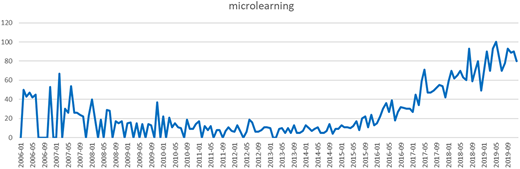
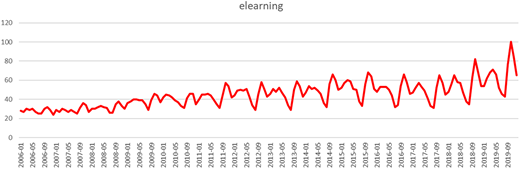
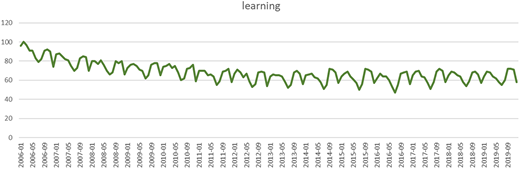
Figures 7–9 demonstrate the “search volume indexes” (from 1st January 2006 to 31st December 2019) of the terms “microlearning”, “elearning” and “learning”, respectively. For these Figures, the horizontal axis represents time and the number at the vertical axis is the “search volume index”. The index represents search interest relative to the highest point on the chart and time (i.e. from 1st January 2006 to 31st December 2019 in this study). A value of 100 is the peak popularity for the term, while a score of 0 means there was not any search for the term.
Thesearching trend of the term “microlearning” from January 2006 to December 2019
Thesearching trend of the term “microlearning” from January 2006 to December 2019
Thesearching trend of the term “elearning” from January 2006 to December 2019
Thesearching trend of the term “elearning” from January 2006 to December 2019
As per Figure 7, the search activities of the term “microlearning” fluctuate significantly during 2006–2010. It holds steady at a relatively low level from 2010 to 2015 and then an increasing trend is shown since 2015.
On the other hand, as per Figure 8, an increasing trend is found for the search term “elearning”. In contrast, the trend line “learning” (Figure 9) illustrates a slightly decreasing trend from left- (earlier in terms of timeline) to right-hand sides (more recent in terms of timeline) that means the overall search volume of term “learning” was decreasing during the same period.
Given previous studies have found a strong association between online searching behaviour and public interests on various social topics in the real world, such as flu prevention (Ginsberg et al., 2009), investor attention and initial public offering (IPO) anomalies (Song et al., 2011) and forecasting of cinema visits (Hand and Judge, 2012). Therefore, we suggest the increasing trend of the searching pattern of “microlearning” since 2015, as per Figure 7, reflects the growing interests in microlearning.
3. Conclusion
In this paper, we analysed real-world data of 14 years obtained from Scopus and Google Trends for the purpose. These data include the first relevant publication found in the database.
According to the findings from analysing the identified publications, microlearning is a relatively new and emerging global topic involving authors, affiliations and funding sponsors from different countries. On the other hand, the Internet searches of microlearning also increased during the period. Therefore, according to the findings of publication trends and Internet searches, we suggest that the microlearning could mature and develop into a critical mainstream issue in the future or become a major trend in its own right. As a result, researchers in the field should consider microlearning as a promising research direction. In addition, policymakers, funding sponsors and affiliations should consider to encourage research in microlearning-related topics as per the identified trends. Moreover, as per the results from the two “word frequency analyses”, many microlearning-related publications were conducted from perspectives of e-learning or mobile learning. This reflects technologies, particularly mobile technologies, playing an important role in the development of microlearning. Furthermore, we notice higher education was the most frequently mentioned education level in the identified publications. This could be explained by the different practices between higher education and lower levels of educations, more specifically, compared with lower levels of education, higher education students are more self-initiative, they need to identify their own needs and have to be responsible for own goals and progress, which is more suitable for using microlearning than lower-level educations by nature. On the other hand, language learning (i.e. second language and vocabulary learning) had been mentioned more times in the titles and abstracts than other subject areas. Overall, the increasing trend of publications on “microlearning” (as a knowledge supply) is in line with the established increasing Internet searches of “microlearning” (as a practical demand) in recent years.
As future works, cross-disciplinary research studies can help establish a more comprehensive theoretical framework for creating better understanding on how to effectively apply microlearning to support workplace learning and higher education in practice. Moreover, policymakers should reflect on how to promote, design and use microlearning to prepare people for digital transformation in the fast-changing world. Furthermore, given microlearning also plays an important role in self-learning, policymakers, educators, researchers and participators have the responsibility to explore how to promote, design and use microlearning to help work-based learners to learn in a right direction through valid knowledge ethically.
In summary, microlearning enables work-based learners to gain new knowledge or skills just in time to meet their immediate needs in this fast-changing world; in addition, microlearning can also help work-based learners to achieve a specific, actionable task. These benefits make microlearning in a work context particularly valuable. Moreover, many work-based learners who are constantly busy and have only limited time to learn new skills or refresh their memory in today's highly competitive business environment can efficiently utilise microlearning. As a result, we suggest that microlearning will become an even more important work-based learning topic in foreseeable future. We believe this is the first time that a study has been conducted to comprehensively review the development trends of microlearning. Hopefully, this study can shed some light on related research.

