


This research aims to examine the role of knowledge sharing (KS) as mediation in the relationship between transactional leadership (TSL) and organizational creativity (OC) among construction workers in Jakarta.
The population in this research was the construction workers working in Jakarta. The sample used in this research consisted of 210 respondents. The validity of the hypothesis model was analyzed using the structural equation modeling–partial least squares (SEM-PLS) approach with the help of SmartPLS 3.2.8.
TSL affects KS and OC. Another most important thing is that KS acts as a partial mediator for the relationship of TSL to OC.
Originality in this research is the use of variable KS to mediate the relationship between TSL and OC in the research conducted in the scope of construction in Jakarta. Other theoretical implications for TSL are added by this research. This research has never been conducted in the construction sector in Jakarta, Indonesia.
1. Introduction
The construction industry is a national economic sector associated with land preparation, construction, acceleration and repair of buildings (Hadihardaja, 2005; Pardede, 2000; Pheng and Hou, 2019; Suhartono, 2012). Continuous development of infrastructure emerges as part of the factors that increases the participation of the construction sector in the Indonesian economy, with a large percentage of gross domestic product (GDP) of 10.60% in the third quarter of 2020 and absorption of 1,121,092 workers (BPS, 2020). BPS data (2020) demonstrates that Jakarta has 9,350 construction companies registered on a commercial scale at the end of 2020 or in the top five nationally. The role of the construction sector can be viewed from the absorption of labor, investment, the number of infrastructure and construction projects, the reciprocal relationship with the support sectors and even the facilitation of the movement and growth of goods and services. As conveyed by Ratnaningsih et al. (2010), construction companies are estimated to have high competitiveness if they are grouped together on the basis of capital, expertise, technology and all the capacity needs of their resources so that they can be trusted to carry out large-scale, complex and long-term national construction projects.
A reliable and robust construction industry is needed to support the development of infrastructure in which it emerges as part of crucial factors for the growth of the national development cycle. One of the determinants of foreign investment interest is the availability, condition and adequacy of the infrastructure of a country. In addition to macroeconomic factors, effective policies and excellent performance in infrastructure development serve as the key to global competitive advantage. Dhurup et al. (2016) argued that the construction industry requires individuals with knowledge, experience, competence and expertise. Collaboration between individuals enhances the work of the team. As pointed out by Riaz et al. (2013), teamwork is a past building culture in the successful completion of projects.
In developing countries, the construction sector is too pivotal to ignore. The movement to encourage the construction industry was carried out by the Government of Indonesia by issuing a legal framework, namely the Construction Services Law (UUJK) issued in 1999. UUJK covers all aspects of the construction industry. UUJK describes the classification and requirements of construction services companies, such as contractors, engineering designs and supervisory consultants.
Raharjo et al. (2018) stated that Indonesia's construction sector, particularly construction services, is proliferating with the number of national and multinational companies. However, it should be pointed out that this rapid development has not been accompanied by sufficient quality of service, which is evident from the low and less competitive quality of products and services.
Innovation plays a crucial role as a critical factor in increasing company excellence within the construction industry (Gledson and Phoenix, 2017; Staniewski et al., 2016; Yusof et al., 2017). The construction industry, nonetheless, is not viewed as “progressive”, yet it is viewed as “conservative” (Hadihardaja, 2005; Havenvid, 2015), while project-based features constitute an innovation barrier (Davis et al., 2016; Hendrawan, 2018). Temporary project organizations are known as positive inventions (Slaughter, 2010). As far as the construction innovation process model (Hartmann, 2006; Ozorhon, 2013) is concerned, many factors have been described as related, such as individual variables such as clients (Tookey et al., 2011; Widhiawati et al., 2016) and leadership (Ding et al., 2017; Odusami et al., 2003; Ulfiyati and Utomo, 2015), followed by contextual variables such as strategy (Manley et al., 2009; Yunianto et al., 2015) and the environment (Chan et al., 2014; Triarman and Sekarsari, 2018). Furthermore, there are research results on the relationship of innovation or creativity to individual creativity (Choi, 2004). Individual attitudes arise because of the relationship or interaction between individuals and their environment or organization (Biggio and Cortese, 2013; Verquer et al., 2003). Specifically, the impacts and attributes of the project managers or professionals on the innovation process have been studied (Damanpour and Schneider, 2006; Gambatese and Hallowell, 2011). Owing to time constraints, unstable temporary organizations and diverse teams (Bakker, 2010; Maaninen-Olsson and Müllern, 2009), innovative approaches in project management are also required. In addition, leaders of temporary organizations (e.g. project-based organizations) should be capable of demonstrating innovation and creativity to team members (Budiyanto et al., 2014; Tyssen et al., 2014).
Leadership of a project manager or leader is considered a significant capacity to enhance and inspire workers to contribute and accomplish goals (Budiyanto et al., 2014; Tyssen et al., 2014). It is also part of the critical project management success factors (Aga et al., 2016; Radujković and Sjekavica, 2017; Riaz et al., 2013), and one of them is in the context of teamwork (Banks et al., 2016). For instance, Aga et al. (2016) examined the effect on project success of the project manager transformative and transactional leadership (TSL) style mechanism. One leadership style has many potential subsections (Lai et al., 2018). Also, worthy of note is the relationship between different leadership styles and a systematic evaluation of the suitability of leadership styles and organizational processes (Shao et al., 2016).
Leadership styles gained a lot of attention in the 1970s; they had numerous aspects of creativity in the 2000s, and today's knowledge-sharing (KS) behavior between employees and leaders emerges as the prominent theme in this research. However, the question that should be answered is, “are leaders ready to share knowledge to bring about organizational creativity (OC) within the organization?” Yes, transformational leadership behavior is a major theme in existing research (Siangchokyoo et al., 2020), and transactional behavioral leadership styles are largely overlooked for innovation and creativity, yet meta-analysis studies have powerfully made a prediction about TSL for employee motivation, effectiveness and leader contentment (Judge and Piccolo, 2004). TSL styles actively take part in strategic leadership for organizational effectiveness. In current organizations, TSL is more global than other supportive leadership behaviors (Waldman et al., 2001). This study is expanded to the existing leadership literature for TSL roles in OC through KS intentions.
Individuals come up with new notions, new ways to resolve problems, enter into negotiation or build communication, including collaboration, and these are frequently distributed within the organization and altered into shared practices and routines. Hence, the role of KS becomes important in an organization because behavior can affect aspects of creativity such as innovations, ideas and problem-solving (Amabile, 1988). Therefore, it is necessary for organization leaders to be inventive, and they should be capable of managing such atmosphere that generates inventiveness or invention in organizations (Sanda and Arthur, 2017). Organization leaders need to develop inventive ideas leading to services and products which are likely to generate inventiveness (Yuan and Woodman, 2010) and thus gain a competitive advantage over other organizations.
Amabile et al. (1996) defined creativity in the workplace as a process in which employees in an organization are capable of coming up with ideas that can be utilized to generate and make improvements or modifications in organizational products, including procedures or policies. It is possible for leaders to accomplish new ideas instantaneously; they can also seek certain objectives or seize initiative for innovation from subordinates. Accordingly, leadership styles are perceived as the most prominent factors of individual influence for innovation (Harborne and Johne, 2003). If organizations intend to advance and survive their industry development, they should consider corporate innovation through market orientation as a crucial aspect, which may assist them in developing their industry (Bello et al., 2004). Creativity generates innovation, which emerges as a predominant factor for the competition and success of the organizations (Eidizadeh et al., 2017; Lin and Chen, 2008). Today's economy demonstrates the prominence of knowledge in which Hargadon (1998) asserted that it is associated with a knowledge-based company, while Robertson (2002) affirmed that it refers to knowledge mapping. In organizational success, continual knowledge management plays a crucial and beneficial role in problem-solving, maintenance, deployment and knowledge placement (Alavi and Leidner, 2001). It is improbable that organizations will be capable of generating creativity without the contribution of their employees (Lahti and Beyerlein, 2000). The knowledge that the employees have is more beneficial or valuable than the data stored from the information system of the organization. The study accomplished by Bock et al. (2005) mentioned that the entire organizational units play a prominent role in supporting KS, which serves as a key process.
Our research explored the relationship between TSL and OC in the context of KS. Our understanding of innovation management came from the previous literature. Albeit knowing the fact that studies on TSL, KS and OC have been carried out, the literature reviews merely demonstrated a small proportion of leadership studies examined in the context of TSL. Additionally, numerous studies have been accomplished on more intensive leadership theories, such as transformational leadership theories (Al Harbi et al., 2019; Qu et al., 2015), democratic (Raelin, 2012), authentic (Imam et al., 2020), charismatic (Paulsen et al., 2009) and other or isolated leader behavior (Hussain et al., 2017).
This research is aimed at finding out the influence of TSL on the creativity of employee organizations mediated by KS attitudes to construction sector workers in Jakarta. The purpose of this research is to provide hypothetical models, to explain TSL relationships and OC, to know the causal relationships between variables affecting the level of OC and to examine the suitability between variables by using primary data gathered from respondents. This research is quite interesting because it has never been conducted in Jakarta. Hence, it gives the original impression.
2. Literature review and hypothesis development
In this section, detailed theoretical and empirical studies related to service innovation, company reputation and customer performance are reviewed, in which the relationship between these constructions is identified, on the basis of theoretical models and proposed hypotheses.
2.1 Transactional leadership (TSL) and organizational creativity (OC)
The creation of new products (innovations), ideas, services or procedures (problem-solving) performed by individuals working together in complex social systems is called OC (Amabile et al., 1996).
TSL behavior generates a pillar which is applied to determine expectations, negotiate contacts and clarify responsibilities. It also gives a reward and acknowledgment to reach the set goals, or it expects performance between subordinates and leaders (Bass et al., 2003; Hamstra et al., 2014). TSL style fulfills the wishes of subordinates indicated by recognizing or exchanging or rewarding after being able to achieve the goals of the duties and the goals agreed when something that the superiors have expected can ultimately be reached (Bass et al., 2003; Podsakoff et al., 1990). TSL style puts its emphasis on the exchanges between leaders and employees. Leaders having transactional behavior are commonly capable of fostering their employee commitments to new ideas by providing real recognition or rewards for growing initiatives and developing new ideas so that their value is communicated directly to employees about the existing programs. To understand organizations that focus on important ideas for employees, transactional leaders may be good at explaining targets and how to achieve them. It will make employees realize the prominence of self-competence when their goals can eventually be reached. Furthermore, a study accomplished by Jansen et al. (2009) mentioned that TSL styles are suitable for followers that need to be motivated so that they may be capable of showing their contribution and taking part in the organizational idea concerning building programs. TSL behavior encourages employee eminence and efficiency to follow an idea creation program where such programs provoke employees to provide advice to improve the company's existing services, procedures or products. In addition, leaders who have transactional behavior are probably proper for the idea program, where instead of dealing with old ideas, managing new ideas is carried out by giving its focus on the standardization and effectiveness in sifting, strengthening or benefiting from routines and corporate experience assets (Asif, 2019). Just as leaders behave “transformationally”, TSL can influence the idea of creativity with the help of employee idea programs. A study has been accomplished to examine creativity habits, and it assumed that the organizational environment can affect the frequency and level of creative behavior in which everyone can come up with inventive ideas, which are beneficial to the organization (Amabile et al., 1996), and initiate a vision for OC consisting of the encouragement of supervision in creativity in the workplace. It is sufficient to support employees and communicate clear goals and objectives to generate such an environment in which employees may encounter minimal fear of criticism, and they will be capable of giving supportive suggestions for organizational functions. Numerous empirical studies focus on the prominence of leadership styles in generating an environment encouraging employee creativity with supportive supervision (e.g. appreciation or recognition) (Shalley et al., 2004), and consistent supervision by supervisors of employees is found in various studies such as those conducted by Amabile et al. (2004).
The attitude of a job-oriented leader is considered necessary for the skills and skills of subordinates in assisting the task of completion of tasks (Amabile et al., 2004). Individual KS behavior is recognized and appreciated since it is considered to fit the TSL style because it is appropriate to bring a deeper understanding to the creativity of the organization (Masa'deh et al., 2016). Studies accomplished by Mumford et al. (2002) found that variables influencing creativity and innovation are leadership behaviors within the organization. Accordingly, it must result from dynamic interactions between leadership styles and creativity to encourage, support and energize employee behavior and perception. Based on previous library reviews, the hypothesis in this study is as follows:
TSL has a positive and significant effect on the OC.
2.2 Transactional leadership (TSL) and knowledge sharing (KS)
Leaders play a crucial role in managing organizational KS. Rewards and recognition of TSL encourage KS within the organization. Leadership style studies (transformational and transactional theory) discover how leaders grow knowledge in the organization (Masa'deh et al., 2016). In a dynamic economic state and aspects of competitive advantage, KS is essential in the organization (Foss and Pedersen, 2002). In today's business competition, organizations should consider transferring expertise and knowledge to new or novice employees in need from employees who have more experience (Hinds et al., 2001). KS within organizations, across teams and between employees enables organizations to exploit and capitalize on knowledge-based resources (Cabrera and Cabrera, 2005). Study conducted by Liao (2008) indicated that employees' perceptions of manager knowledge, experience and rewarding employees who practice KS are positively correlated. Studies conducted by Muhammed and Zaim (2020) involving 330 employees in various service companies in Turkey obtained data showing that employee attachment in the process of sharing knowledge between superiors and subordinates has a positive impact on the success of the organization's knowledge management where leadership support plays a prominent factor in KS behavior efforts. In social exchange theory, the influence of management support on KS is highly significant (Hussain et al., 2017). In the coordination process, transactional leaders have a more effective leadership style in which it can be seen that superiors work with employees to obtain awards, objectives and special assignments with the support of cooperation from leaders and employees. As the recognition system for achievement is introduced to improve the performance of KS by employees, TSL attitudes become an alternative to be applied in the organization. Research conducted by Rohim and Budhiasa (2019) on civil servants in Ternate showed that there is a significant link between KS and the award system. Research accomplished by Lin and Lo (2015) showed that lack of appreciation, incentives and recognition is considered barriers to KS. This is in line with the qualitative approach taken by Boateng and Agyemang (2016). Instinctively, employees will follow the direction of the leader to achieve the objectives of the group or organization (Hussain et al., 2017). Lu et al. (2006) revealed that leadership styles influenced choice, motivation and KS skills. KS describes explanations and knowledge exchange by using several media provided by leaders to improve efficiency, productivity and appreciation to employees (Hussain et al., 2017). Structure and systems that facilitate KS between employees and leaders can be hypothesized as follows:
TSL is positively associated with KS in the organization.
2.3 Knowledge sharing (KS) and organizational creativity (OC)
A study accomplished by Bhatti et al. (2021) on the pharmaceutical industry in Pakistan found that KS was positively correlated to employee creativity resulting in creativity in the organization. Shahzad et al. (2016) found that knowledge management processes significantly affected OC and organizational performance in Lahore. As conveyed by Giustiniano et al. (2016), individual learning orientation as well as the desire to share knowledge can increase the creativity of multinational corporate organizations in Tuscany, Italy. Grounded on the previous literature explanations, the following hypothesis can be developed.
KS has a positive influence on OC.
2.4 Mediating role of knowledge sharing (KS)
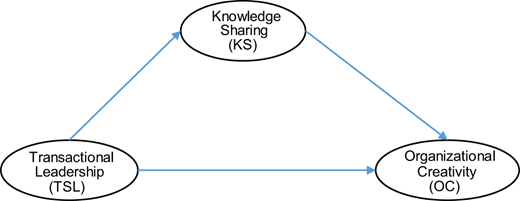
TSL has been hypothesized significantly and positively, and it is associated with OC and KS. KS has been hypothesized to be significantly and positively related to OC. There is a possibility demonstrating that KS mediates TSL against OC. A study on the relationship between TSL and OC has been accomplished by Hussain et al. (2017) involving 300 employees in private telecommunication firms in Pakistan. Besides, the study carried out by Al-Husseini et al. (2019) on 250 employees of higher education institutions in Iraq revealed that TSL gave an effect on organizational innovation through KS attitudes. Hence, it can be hypothesized as follows:
KS will mediate the relationship between TSL and OC.
Based on the descriptions of the previous literature, the hypothesized research model of this study is denoted in Figure 1.
3. Method
3.1 Respondents
The objects of this research were the organizations of construction companies that have been the members of BPD Gapensi association (Association of Construction Companies) at Jakarta, Indonesia. All the companies are registered in the Construction Services Development Board (LPJK). This research was conducted using a survey method. We distributed the questionnaire online using Google Form to a company's representative. During the survey, we instructed the participants to rate their TSL, KS and OC. This research was carried out from July to September 2020.
The analysis unit of this research was the construction organizations/fields presented by each of the experts working in the companies that have grade small to big qualifications and have become the members of Gapensi registered since 2015 and located in the territory of Jakarta, Indonesia. In this study, the respondents were the company leaders or the company's representatives or those representing them in the company, who become respondents and fill out the research questionnaire. The total amount of the population is 1,718 construction companies. The sample size was determined using the Isaac-Michael formula, collecting 315 valid responses. However, due to coronavirus disease 2019 (COVID-19) pandemic, 15 companies were closed; hence, the population was 300. The total distribution was 300 and the response rate comprised 210 (70%). In total, 210 respondents were in accordance with the sample requirements for structural equation modeling (SEM) analysis where a minimum sample size of no less than 100 was highly recommended (Hair et al., 2014).
3.2 Measures
TSL was measured using six statements developed by Bass et al. (2003). Employees were asked about a variety of behaviors related to leaders. All questions were measured in a five-point Likert-type scale ranging from 1 denoting “not at all” to 5 indicating “often, if not always”. An example of a statement to measure TSL was “I tell others what to do if they want to be rewarded for their work”.
KS behavior was measured through a scale developed by Bock and Kim (2002) and Cummings (2004) using six statements. An example of the statement for KS measurement was “there's a lot I can learn from colleagues in my workgroup”. The scale ranged from 1 showing “strongly disagree” to 5 denoting “strongly agree” using a five-point Likert-type scale.
Statements modified by Eisenberger and Aselage (2009) were utilized for OC measurement. The total number of the statements was six, such as “employees generate creative ideas”. A five-point Likert-type scale ranged from 1 showing “strongly disagree” and 5 interpreted as “strongly agree”.
4. Results
4.1 Measurement model
In convergent validity, as denoted in Table 1, AVE value that was higher than 0.50 was applied for all constructs such as TSL, KS and OC. Hereinafter, convergent validity was confirmed in this study. In addition, the analysis of convergent validity, loading and cross-loading in each construct was undertaken after eliminating one statement in OC and one statement in TSL. To sum up, the results of loading and cross-loading fulfilled the requirement. Table 2 denoted the data trend in loading construct and cross-loading value.
PLS measurement model
| Variable | Item | Deleted item | Indicator | Main loading | AVE | Composite reliability (CR) | R2 |
|---|---|---|---|---|---|---|---|
| Transactional leadership (TSL) | 6 | – | TSL1 | 0.812 | 0.592 | 0.897 | – |
| TSL2 | 0.806 | ||||||
| TSL3 | 0.722 | ||||||
| TSL4 | 0.722 | ||||||
| TSL5 | 0.796 | ||||||
| TSL6 | 0.751 | ||||||
| Knowledge sharing (KS) | 6 | KS1 | KS2 | 0.733 | 0.652 | 0.848 | 0.200 |
| KS5 | KS3 | 0.852 | |||||
| KS6 | KS4 | 0.833 | |||||
| Organizational creativity (OC) | 6 | OC4 | OC1 | 0.854 | 0.678 | 0.863 | 0.410 |
| OC5 | OC2 | 0.859 | |||||
| OC6 | OC3 | 0.754 |
The result of cross-loading
| KS | OC | TSL | |
|---|---|---|---|
| KS2 | 0.733 | 0.282 | 0.329 |
| KS3 | 0.852 | 0.488 | 0.404 |
| KS4 | 0.833 | 0.520 | 0.347 |
| OC1 | 0.516 | 0.854 | 0.536 |
| OC2 | 0.48 | 0.859 | 0.436 |
| OC3 | 0.328 | 0.754 | 0.322 |
| TSL1 | 0.391 | 0.444 | 0.812 |
| TSL2 | 0.300 | 0.419 | 0.806 |
| TSL3 | 0.202 | 0.396 | 0.722 |
| TSL4 | 0.419 | 0.384 | 0.722 |
| TSL5 | 0.374 | 0.477 | 0.796 |
| TSL6 | 0.338 | 0.355 | 0.751 |
In discriminant validity, as denoted in Table 3, the average variance extracted (AVE) value was higher than each construct compared to the other construct AVE values, and loading value were also higher than other construct loading values. In short, discriminant validity fulfilled the requirement. Besides, composite reliability value fulfilled the minimum requirement for data reliability and measurement as well, which comprised above 0.70.
4.2 Descriptive analysis
Table 4 described the variable data distribution focusing on mean and standard deviation (SD) for each part of construct. TSL, KS and OC had 3–5 point Likert scales.
Descriptive analysis for indicator
| Mean | Median | Min | Max | SD | Excess kurtosis | Skewness | |
|---|---|---|---|---|---|---|---|
| TSL1 | 3.995 | 4 | 1 | 5 | 0.908 | 0.597 | −0.837 |
| TSL2 | 4.076 | 4 | 1 | 5 | 0.886 | 0.74 | −0.937 |
| TSL3 | 4.186 | 4 | 1 | 5 | 0.78 | 0.98 | −0.885 |
| TSL4 | 4.086 | 4 | 1 | 5 | 0.794 | 0.785 | −0.787 |
| TSL5 | 4.086 | 4 | 1 | 5 | 0.794 | 0.441 | −0.672 |
| TSL6 | 4.167 | 4 | 2 | 5 | 0.747 | −0.166 | −0.559 |
| KS1 | 4.095 | 4 | 2 | 5 | 0.762 | 0.175 | −0.617 |
| KS2 | 3.995 | 4 | 1 | 5 | 0.892 | 1 | −0.965 |
| KS3 | 4.029 | 4 | 2 | 5 | 0.762 | 0.194 | −0.569 |
| KS4 | 4.124 | 4 | 1 | 5 | 0.847 | 1.003 | −0.949 |
| KS5 | 4.11 | 4 | 1 | 5 | 0.745 | 1.053 | −0.738 |
| KS6 | 3.871 | 4 | 1 | 5 | 0.975 | 0.694 | −0.92 |
| OC1 | 3.962 | 4 | 2 | 5 | 0.786 | 0.177 | −0.585 |
| OC2 | 4.029 | 4 | 1 | 5 | 0.872 | 1.047 | −0.922 |
| OC3 | 4.086 | 4 | 1 | 5 | 0.812 | 1.273 | −0.911 |
| OC4 | 4.052 | 4 | 1 | 5 | 0.732 | 0.408 | −0.449 |
| OC5 | 4.052 | 4 | 2 | 5 | 0.685 | −0.566 | −0.157 |
| OC6 | 3.848 | 4 | 2 | 5 | 0.918 | −0.557 | −0.472 |
4.3 Hypothesis evaluation
To test the hypotheses in this research, t-statistics value was utilized in each direct route effect partially. Figure 2 denoted the route diagram for the hypothesis testing.
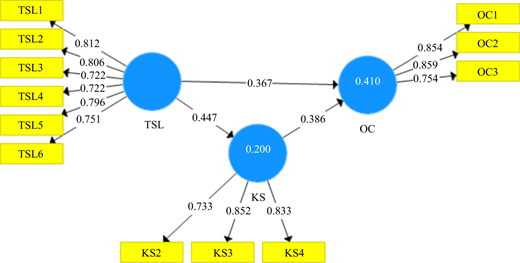
Based on the route diagram of hypothesis testing above, it can be stated that all indicators in each variable had t-statistics value that was higher than 1.65 (t-table). To test the correlation among variables (hypothesis testing), t-calculation value of SmartPLS 3.2.8 output was used and compared to t-table value. Table 5 provided the result of the correlation among the constructs.
As denoted by Table 5, TSL and KS had positive effects toward OC. Meanwhile, KS had effects toward OC. Hypotheses 1, 2, 3 and 4 were supported in this study. Mediation analysis (indirect effect test) was performed to confirm the mediation effects of KS among the dependence correlation of OC toward TSL. The mediation effects of KS were demonstrated in Table 5. In brief, KS mediated the effects of TSL toward OC.
5. Discussion
This research has revealed a nexus between TSL styles, KS and OC in the context of construction companies. The hypotheses were developed from the related literature studies and tested based on the data collected from the construction companies operating in Jakarta. Numerous previous studies have been accomplished in different leadership styles, but TSL is literally or rarely investigated. TSL styles can effectively coexist within the organization. This study examined whether and how TSL was mediated by KS. It had an indirect relationship with the creativity of the organization. The results demonstrated that TSL behavior had a significant effect on the OC; TSL had a significant relationship with KS behavior, and the same KS had a significant relationship with OC.
The first hypothesis was aimed at examining the effect between TSL and OC. As denoted by the test, TSL affects OC. The effect of TSL influence on OC is seen in the β coefficient of 0.367 (t = 4.432; p = 0.000). The results show that if TSL increases, the creativity of the organization will also increase. It is able to explain that when transactional leaders are able to give special influence to their employees and their organizations, the greater the level of creativity of the organization in the ongoing construction business. This current finding was supported by previous studies (Hussain et al., 2017; Tung, 2016) that conveying that TSL and OC denoted a positive relationship. Additionally, the current finding demonstrated that dimensions of TSL (Rowold, 2014) are directly related to OC.
The second hypothesis aimed to examine the effect between TSL and KS. As demonstrated by the test result, KS in affected by TSL. This finding was supported by the previous studies (Hussain et al., 2017; Rawung et al., 2015; Ugwu et al., 2020). If the perspectives of leadership of the employees are positive, they denote a greater commitment to KS. The way knowledge is shared within the company is greatly influenced by TSL. In short, TSL could stimulate encouragement to the employees to share, maintain and enhance their knowledge of organizational learning. This finding highlighted “the role of leaders in creating supportive work environments and strengthening the positive knowledge and learning outcomes of employees”. Additionally, KS is likely to be enhanced by the action undertaken by transactional leaders promoting careful problem-solving and giving personal attention to employees.
The third hypothesis was aimed at examining the effect between KS and OC. The test result demonstrated that KS affected OC. This finding was supported by the research carried out by (Akram et al., 2020; Elrehail et al., 2018; Pian et al., 2019; Vandavasi et al., 2020). An innovative attitude is required to work in the construction industry. Willingness to share knowledge in an organization is natural and should be undertaken for the organization's progress. Sharing knowledge can increase innovation capabilities by discovering new ideas, new operational methods and an increase in the number of new products or services in the market. Good cooperation among employees will make it easier to share knowledge, particularly in developing new solutions or methods in construction work. It is in line with the statement conveyed by Sáenz et al. (2012).
The fourth hypothesis aimed to examine the role of KS as a mediator between the links of TSL on OC. The test result demonstrated that KS mediated the link of TSL on OC. This finding was in line with the previous study (Hussain et al., 2017; Thahira et al., 2020). Leaders who apply TSL in their daily activities will be capable of triggering the comfort and motivation of employees in working both on projects and in the office. Employees will be free to convey their ideas since they trust and support the organizational leader. It is necessary to have the practice of KS possessed by leaders or employees so that the innovations carried out can run optimally to add and develop ideas that employees have. It can enhance creativity of an organization.
5.1 Theoretical implication
This research contributed to theory and practice. This research provided the evidence of the prominence of TSL behavior in OC. It is known that examining the role of TSL styles toward OC in the construction sector has not investigated yet. TSL denoted a positive effect in this study in which there were merely some previous research discussing it (Kahai et al., 2003). Experimental studies were found when merely applying TSL style variables (Al Harbi et al., 2019; Shin and Zhou, 2003). The findings of this research data were initially depicted among TSL behaviors when employees were motivated by giving a reward for the ideas they generated in the organization by sharing knowledge. Numerous studies have put their emphasis on the potential of TSL in varied contexts (Vecchio et al., 2008). Hence, at least in several contexts, TSL styles can probably emerge as an excellent way to give encouragement for employees by providing them proper or decent rewards, including clear guidance for pursuing or achieving goals. Grounded on the findings found by Judge and Piccolo (2004), it can be stated that “business leaders may be better able to reward followers in exchange for their efforts.”
The contribution that this research gives to the literature on TSL through knowledge management (e.g. KS) plays a crucial role in leadership styles. Goals and achievements emerge as two points prioritized by leaders having TSL behavior in which their employees are given appreciation and hope depicting their leaders' commitments (Bass, 1985). As mentioned in the literature, TSL behavior is mostly implemented in organizations such as the TSL behavior applied in manufacturing, telecommunications and software sectors. The commitments that the leaders give to their employees are associated with the goals that the organization intends to achieve. Receiving rewards, bonuses and commissions commonly serves as the manifestation of the appreciation shown by leaders due to appreciating their employees' performance. Besides the reciprocation between leaders and their employees, an environment involving knowledge management is built to generate creativity in an organization.
To sum up, this research affirmed that several points that are needed in OC encompass reward, hope, recognition and a climate of sharing, creation and exploitation of knowledge within the organization.
5.2 Managerial implication
As explained earlier, companies mostly utilize TSL styles. This research demonstrated that TSL style having knowledge management in an organization is effective due to the fact that sharing knowledge undertaken among the employees may lead them to pursue or reach the results expected by the organization. The results exhibited that the expected relationship involving reciprocation to the KS showed a positive effect, and it was in line with the studies accomplished by Bock et al. (2005) concerning “reciprocity on attitudes toward KS”. In short, the attitude toward KS is likely to be improved by the relationship with other members of the organization as presumed by employees. Milne (2007) conveyed that stimulating or encouraging eagerness to share knowledge and learn other beneficial stuff can be accomplished by giving awards and recognition to employees. As pointed out by Yilmaz and Hunt (2001), exchanging or sharing notions and knowledge is carried out by working together among the employees. Additionally, social recognition is beneficial compared to financial rewards for creativity (Cabrera and Cabrera, 2002). KS serves as a chance for employees to resolve a problem, share viewpoints, convey suggestions, notions and information (Afsar et al., 2019). Research accomplished by Fischer (2021) demonstrated that employees' intention toward KS in an organization is not always affected by appreciation and motivation.
This research encourages an understanding of the complexity of TSL involved in sharing knowledge with OC. TSL behavior is mostly applied in organizations, and the appreciation given to employees is commonly shown by giving them bonuses, commissions, rewards and recognition. Hence, knowledge management occurs in the organization; meanwhile, creativity occurs at the level of individuals, groups and organizations.
5.3 Social implication
There are numerous substantial social implications in this research. The key factors of this research are likely to develop creative behavior in organizations and significantly give implications to enhance OC and competition, including the social development of the organization. First, this research has investigated the characteristics of TSL styles needed for management effectiveness that enhances employees' creativity. Second, this research has explored the association of significant TSL styles (contingency awards) with OC and KS. Organizations applying TSL style should encourage management based on exceptions, empowerment and task-oriented behavior within the organization.
5.4 Limitations and further research
In this research, we collected the data from worker representatives in the construction sector in Jakarta. The generalization of this research is merely for the construction sector. Hence, this limitation gives indication for the future research in carrying out studies in different organizations. The data were collected from company representatives with minimal supervisory positions. Additionally, the data collection methods at different organizational levels can be utilized for the future research. Since KS is applied as a mediator for this research, other mediation mechanisms through leadership styles can also affect the creativity of the organization.
6. Conclusion
Based on the research that has been accomplished, it can be concluded that TSL and KS affect OC; KS affects OC and KS mediates the correlation between TSL and OC. Practically, this research provides a complete reason for every decision-maker to implement KS within the organization since it empirically proves a significant positive correlation between TSL and OC employees in the construction sector. KS is essential for effective performance in knowledge-intensive organizations, particularly in the construction sector.
The author thank to Sekolah Tinggi Manajemen Labora, DKI Jakarta, Indonesia for supporting this research.
Funding: This research received no specific grant from any funding agency in the public, commercial, or not‐for‐profit sectors.

