


The global economy is experiencing an expansion in knowledge-based businesses, which has compelled organizations to search for mechanisms of raising knowledge worker productivity. This study utilizes multiple theories to explain lessons learned from a positive story on how to raise the productivity of knowledge workers.
The study used a qualitative methodology of storytelling, a form of narrative inquiry about a phenomenon. In-depth interviews were carried out with information and communication technology (ICT) workers in Uganda.
Findings reveal that knowledge workers who communicate and mutually support each other are inclined to share knowledge and best practices that promote cost-effective utilization of resources. Additionally, knowledge workers with a behavior oriented toward the continuous exploration of innovative ideas are proactive in creating knowledge on how to render quality services.
The study was carried out in one country, which may limit generalization of results.
The study underscores the importance of continuously developing the human capital base and fostering a collaborative environment for knowledge workers. This nurtures the capacity and a shared responsibility to generate innovative ideas directed toward the effective utilization of resources. Moreover, the study advocates for the inclusion of social competencies, such as interpersonal skills, in the selection process of knowledge workers.
This study stands out from the existing literature since it uses a success story to document the real-life experiences of a knowledge worker who had to overcome numerous challenges to raise productivity in knowledge work.
1. Introduction
Globally, as the knowledge-based economy expands, organizations have turned to raising the productivity of knowledge workers to be an engine in driving the growth of businesses (Shujahat et al., 2019). In the 20th century, economies relied heavily on agriculture, trade and the manufacturing sector, which positioned manual workers as the main source of augmenting the quantity of output produced (Davenport, 2008; Drucker, 1999). However, as the world transitions into a predominantly service sector, knowledge has turned out to be a critical factor input not only in raising quantity but also the quality of services delivered (Moussa et al., 2017; Singh et al., 2022). This has positioned knowledge workers to be a workforce that will play an important role in enhancing the survival of businesses amidst a dynamic knowledge-based economy (Shujahat et al., 2019). Knowledge workers comprise a workforce that acquires, shares and generates new knowledge, which they utilize as the main factor input to produce new products/services (Moussa et al., 2017). Organizations will highly benefit from the services of knowledge workers if they accelerate knowledge worker productivity. Knowledge worker productivity refers to knowledge worker efficiency and effectiveness in optimizing knowledge work for knowledge-based output (Kianto et al., 2019).
Raising knowledge worker productivity has been documented by Drucker (1999) as the biggest challenge for organizations in the 21st century. As the search on how to accelerate the productivity of knowledge workers rages on, Langfred and Rockmann (2016) have observed that some organizations have resorted to routine surveillance of knowledge workers as they carry out tasks assigned to compel them to be productive. This may not yield the intended objective as argued by Langfred and Rockmann (2016), and Tapasco-Alzate et al. (2022), who noted that knowledge work is, in most cases, incalculable since it may not be easy to measure the quantity and quality of knowledge used or produced. Most studies on knowledge worker productivity have concentrated on utilizing survey methods to document alternative mechanisms of raising knowledge worker productivity (Khaksar et al., 2020; Kianto et al., 2019; Shujahat et al., 2019). Studies have paid less attention to exploiting in-depth interactions with knowledge workers to probe and utilize narrative accounts to explain alternative mechanisms of augmenting knowledge worker productivity. Since knowledge is inherently held and produced, the process of developing knowledge-based output cannot be observed or measured by another person other than the one who is actively involved in knowledge production and utilization (Kianto et al., 2019; Tapasco-Alzate et al., 2022). This explains the relevance of having in-depth discussions with knowledge workers to inquire and document the drivers of knowledge worker productivity.
In this study, a positive story from consultants offering information and communication technology (ICT) services is used whose success is attributed to the ability to generate quality ideas directed towards efficient and effective utilization of resources. Rossetti and Wall (2017) and Yost et al. (2015) have supported the use of success stories with the observation that they can be replicated to a wider context to serve as a basis for policy. The success story utilized in this study could be a benchmark for organizations to adopt alternative means to raise knowledge worker productivity. Multiple theories have been used in this study to explain the emerging patterns in the story. Shepherd and Suddaby (2017) have supported the use of multiple theories with the observation that theorizing necessitates merging concepts from different knowledge areas. Therefore, based on the story and multiple theories, the objective of this study was to identify the antecedents of knowledge worker productivity.
The rest of the article is organized into sections of literature review and theoretical perspectives, study methodology, study findings, discussion, conclusion, study implications, limitations and areas for further research.
2. Literature review and theoretical perspectives
The concept of knowledge worker productivity has its roots in the book, The Landmarks of Tomorrow, which was authored by Drucker (1959). According to Drucker (1959), the global economy was expected to transition from economic activities dominated by manual work to those dominated by knowledge utilization. Kianto et al. (2019) observed that while organizations need to utilize knowledge workers to add value to businesses, this can be achieved through knowledge worker productivity. Drucker (1999) observed that knowledge worker productivity can be augmented from six areas. The first requires organizations to clearly define tasks that are allocated to knowledge workers. Secondly, organizations need to give knowledge workers autonomy as they carry out tasks allocated to them. Thirdly, organizations need to consider innovation as a job requirement for knowledge workers. The fourth requirement is about fostering continued learning among knowledge workers. The fifth requirement is that knowledge workers should focus more on quality rather than quantity, and lastly, organizations should treat knowledge workers as assets rather than liabilities. Studies have documented that knowledge worker productivity involves the effective utilization of knowledge resources, which includes delivery of quality services, achieving task goals and enriching customer satisfaction (Khaksar et al., 2020; Kianto et al., 2019). Knowledge worker productivity also involves efficient utilization of resources, which includes minimizing resource wastage and cutting costs in service delivery (Khaksar et al., 2020). Knowledge worker productivity also involves meeting time demands, which include delivering services promptly (Tapasco-Alzate et al., 2022). To explain knowledge worker productivity, this study combines cultural historical activity theory (CHAT) (Engestrom, 1987) and human capital theory (HCT) (Becker, 1964), which were used to guide the study.
Human capital refers to intangible resources composed of skills, knowledge and intellectual abilities that a person may possess (Vidotto et al., 2017). Peers (2015) explained that human capital enriches labor productivity through the allocative, diffusion, worker and research effects. The allocative effect relates to how resources have been distributed to enrich the achievement of a desired goal. Akhvlediani and Cieślik (2020) explained that through the allocative effect, a workforce can use its knowledge to allocate resources cost-effectively. Knowledge empowers individual workers with the capacity to make better decisions that result in the efficient allocation of resources (Kianto et al., 2019). Peers (2015) observed that when workers possess relevant knowledge, they will be effective by using their competencies to enrich the realization of the organization’s goals. Akhvlediani and Cieślik (2020) noted that through the diffusion effect, workers endowed with knowledge will easily adjust to changes that may be introduced within the workplace environment. Research effect is concerned with the capacity of workers endowed with knowledge and skills to research and discover new knowledge that can be introduced to improve services rendered to clients (Peers, 2015). Knowledge, skills and cognitive abilities have been cited as critical resources that can explain variations in knowledge worker productivity (Kianto et al., 2019; Shujahat et al., 2019). Muzam (2023) and Tariq et al. (2024), explained that knowledge-based tasks are complex and dynamic, which requires knowledge workers to participate continuously in the acquisition, generation and utilization of new knowledge so as to be adaptive to emerging challenges. Knowledge empowers knowledge workers with the capacity to respond faster with innovative solutions to assigned tasks, which increases the quality of services and eventually generates revenue (Shujahat et al., 2019). Kianto et al. (2019) and Nezafati et al. (2023) observed that skills are equally important, especially with new technological developments that are continuously emerging. Acquiring new skills exposes knowledge workers to diverse methods that can be utilized to handle knowledge-based tasks effectively (Muzam, 2023; Tariq et al., 2024). However, HCT is concerned with individual abilities and pays less attention to the relevance of social practice in advancing worker productivity, which is the cornerstone of CHAT.
CHAT proposed by Engestrom (1987) observes that human activities are defined by the context in which they are carried out. The theory explains that perception, ideas and knowledge are not only shaped by the activity one engages in but also it is directly reflected in part by the social interaction a person has with the community, which in turn influences, regulates and determines the activity outcome (Burkitt, 2021). Furthermore, CHAT argues that knowledge is not discrete but rather changes as new ideas emerge from the continued interactions one has with the community, which eventually explains variations in the productive outcomes of an activity carried out (Batiibwe, 2019). As interactions occur, diverse views emerge, producing contradictions and contestations within the organization. Contradiction and contestation are grounds for reinventing innovative ideas relevant to changing demands (Burkitt, 2021). Therefore, social actions provide a platform for exploring and exploiting new knowledge collectively, which can be directed towards effective and efficient utilization of knowledge resources. Studies by Tariq et al. (2024) and Tubiana et al. (2022) have observed that collaborative actions can be alternative sources of enriching knowledge worker productivity. Tubiana et al. (2022) have argued that observational learning and peer influence emerge from social interactions, creating grounds for knowledge workers to adopt innovative behaviors from peers. Moreover, social action in the form of networking builds a foundation for participating collectively in searching, generation, sharing and utilizing new knowledge, which raises the productive competencies of knowledge workers (Tariq et al., 2024). Through social action, employees can be induced without force to accomplish a reciprocated obligation of participating fully in achieving a shared goal, generating innovative ideas, delivery of quality services and efficient utilization of resources (Tubiana et al., 2022). Therefore, by utilizing HCT and CHAT, it is considered justifiable to use a combination of theories to theoretically explain the emerging lessons from a success story that portrays manifestations of knowledge worker productivity.
3. Methodology
3.1 Study context
The study was carried out in Kampala, Uganda, and it focused on Mr. Musika (pseudonym), an ICT worker who owns a consultancy firm offering ICT services to clients. The reason as to why this study was centered on ICT workers is because the government of Uganda, under the National Development Plan (NDP) and Vision 2040, observed that the country aspires to have a predominantly knowledge-based economy by the year 2040, whose foundation is on ICT knowledge (NPA, 2013). Furthermore, the Ministry of ICT reiterated that as the world becomes a digital village, Uganda will enrich its competitiveness in the global economy by continuously generating new knowledge in ICT directed towards creating technologically-oriented innovations (MoICT, 2014). This has positioned ICT workers to be a workforce that will play a critical role in generating ICT knowledge, which will be a foundation for expanding Uganda’s knowledge-based economy (NPA, 2013). Empirical studies (Hartal et al., 2023; Kianto et al., 2019; Shujahat et al., 2019) have utilized ICT workers as a group representative of knowledge workers.
3.2 Research philosophy
Ontologically, this study utilized an interpretivism philosophical approach which observes that reality is unstructured due to the multiple interpretations that people have about a phenomenon. A phenomenon that is socially constructed will produce a variety of views that may be grounds for new insights offering opportunities for generating new knowledge. The study sought views from Mr. Musika and his employees at the company about how they overcame challenges and managed to become productive. To effectively collect as much information as possible, the researcher analyzed actions and events emerging from the discussions with the informants as recommended by Hirose et al. (2023). The study used a research methodology which is qualitative utilizing in-depth interviews to seek for knowledge about knowledge worker productivity.
3.3 Research design
Storytelling accompanied by a narrative inquiry rooted in qualitative methodology was used to generate the findings for this study. It has been explained by Liu et al. (2012) and Nalweyiso et al. (2023) that storytelling provides a foundation for understanding a phenomenon in detail.
3.4 Population and sample
The population utilized in this study included the proprietor and employees of Tech-hub, an ICT firm, offering ICT services in Uganda. While Mr. Musika, the proprietor of Tech-hub, was at the center of the story, we sought views from his employees to validate the information provided. Purposive sampling was used to identify informants who agreed to participate in the study. This method of sampling was used because it enables researchers to target informants who have knowledge about the phenomenon that is being studied (Creswell, 2013; Creswell and Cresswell, 2022). The informants targeted were those working with Tech-hub, with a minimum of a college degree in an ICT-related discipline and with experience of at least four years in the field. Guided by Braun and Clarke (2021) and Creswell and Cresswell (2022), the sample size was determined using the saturation point whereby more informants could only be included in the study if they were providing new information. Through the process of interaction with the participants, the saturation point reached at the seventh informant.
3.5 Data collection
Guided by Creswell and Cresswell (2022) and Nalweyiso et al. (2023), interviews were conducted with the aid of an interview guide based on the method of appreciative inquiry. Appreciative inquiry was suitable for this study because the approach promotes the collection of qualitative data from the field focusing on identifying and magnifying positive aspects of a system, context and situation (Tabala et al., 2024). Several visits to Tech-hub were made by the researcher aiming at having in-depth interviews with the informants. Seven interview sessions were conducted with seven informants from their workplaces. Guided by Nalweyiso et al. (2023) and Tabala et al. (2024), interviews were carried out punctuated with detailed responses and probing questions to elicit clear explanations from the informants. To obtain as much information as possible, the conversational interviews were carried out and lasted for a period between forty minutes and one hour. During these interviews, mechanisms of fostering knowledge worker productivity were identified, which can be replicated in other organizations. Interviews were carried out on different days and times with different informants to minimize the bias that comes with interviewing one person. Interviewing more than one informant resulted in documenting a coherent story based on reported consensus as recommended by Nwagbara (2020) and Saunders et al. (2012), which enriches the validity of the information provided. As interviews were taking place, the researcher kept on observing what was taking place at the company to confirm with the verbal information that was being given. To further enrich the reliability and validity of the results, field notes were captured and recorded to track the discussions with the participants.
3.6 Data analysis
Qualitative content analysis was used to analyze field notes and transcripts derived from the interviews with the informants. This was accompanied by discourse tracing methods, which were used in examining how participants perceive the manifestations of knowledge worker productivity. While analyzing information sourced from the participants, the researcher documented a coherent story based on themes that included context, actions, results and lessons learned as guided by Nalweyiso et al. (2023) and Tabala et al. (2024). Nalweyiso et al. (2023) and Tabala et al. (2024) observed that a story context provides information on the situation as it was, documenting the challenges agents faced. Action includes steps taken by agents to overcome the challenges faced (Tabala et al., 2024). The results section comprises the outcome of the actions that were taken by the agents (Nalweyiso et al., 2023). Finally, the lessons section is composed of what others can pick from the story which can be applied in similar contexts (Nalweyiso et al., 2023). Tabala et al. (2024) have explained that the above-mentioned themes are used as the unit of analysis, and with them, the researcher was able to document and analyze the perceptions, experiences and emotions of the informants about the determinants of knowledge worker productivity. Data sourced from informants was coded with the aim of making the analysis systematic to avoid biased conclusions. Guided by the recommendations of Strauss and Corbin (1990), the coding process was done by the researcher and later confirmed by the supervisors. This was intended to avoid premature conclusions and biases in coding. Common observations across all interviews with the informants were put together based on the coded themes to create a coherent story.
3.7 Ethical considerations
An introductory letter was obtained from the university, which identified the researcher as a student carrying out research for academic purposes. This letter was presented to all the study participants. Participants were informed about the academic and publishing intent of the research. The researcher sought consent from the participants in the study, and they were informed about their freedom to withdraw from the study in case they feel they no longer wanted to participate. The researcher sought consent from the participants to accept that the interviewsbe recorded. As suggested by Creswell (2013), the interviewer and the interviewees used pseudonyms to disguise participants in the interviews that were taking place. The institution approved the study to be conducted by granting a letter that introduced the researcher to the participants.
4. Findings
The findings of this study are presented in the form of a success story that showcases the mechanisms of enriching knowledge worker productivity. The success story is titled, optimizing resource utilization in knowledge work. Guided by Smith (2012) and Tabala et al. (2024), the story is structured into themes of context, actions, results and lessons. It has been observed by Tabala et al. (2024) that findings presented in the form of a story provide a detailed narrative account of the viewpoints of participants.
4.1 Optimizing resource utilization in knowledge work
4.1.1 Context
Musika is a graduate with qualifications in IT who, upon completion of his studies in 2010, started to offer consultancy services to the public. He started a company, Tech-hub, which offers IT services in Uganda. Being a fresh graduate from the university, he barely had practical knowledge specific to the projects his clients could assign him to work on. Occasionally, he turned down projects that seemed to be too technical for him to handle. One of the employees (EMP 2) “observed that for projects that he accepted to work on, he frequently worked at a low speed to avoid making errors”. Consequently, tasks could not be completed on time, resources were not optimally utilized, and the quality of services was poor. One of the employees (EMP 4) noted that “over time, Musika expanded on the services he was offering which increased the range of projects the company was contracted to work on”. Since he had limited capital and staff he was employing, whenever he had many projects, he could partner with other IT service providers to offer services on a part-time basis. However, the colleagues he partnered with worked independently and as a consequence, coordinating and monitoring activities became difficult, and on many occasions, they failed to attend to assigned projects successfully. Employee 3 (EMP 3) observed that “Musika worked in an environment where teamwork wasn’t practiced that he received less support from workmates”. With limited support, knowledge critical in carrying out his duties could not be shared easily and sometimes he became redundant, failing to achieve the objective of some of the projects he was assigned. In the early years of his career, information about some of the innovations he created was manually stored, and on many occasions, it was a challenge to access, refine and reuse knowledge that they had previously generated. This disempowered him from adequately tracking the quality of services his workmates were providing and also it became hard to follow up on customer feedback. This affected his reputation and that of the company, which eventually resulted in a drastic reduction in the client base.
4.1.2 Actions
To counter these challenges, he initiated a culture of holding weekly meetings with the staff and colleagues he was working with to share experiences from the services they offered. One of the employees (EMP 2) noted that “occasionally Musika visited clients to hear from them about the quality of services offered”. Visiting clients was also intended to seek views on how best they wished to be served. Employee 6 (EMP 6) observed that “occasionally Musika visited other firms to learn from them how they utilize hi-tech systems to render services to clients”. Employee 1 (EMP 1) revealed that “in 2014, a university assigned him a project to train staff on how to use an e-learning system to support online teaching”. Since the project was time-bound, he collaborated with other IT companies, which enabled him to deliver on time. In 2015, he teamed up with other IT workers and together they advanced ideas that resulted in developing an application that tracks, stores and transmits client feedback on services rendered. In 2017, he enrolled for online courses in computer programming to acquire knowledge of the new developments in the IT field. Employee 7 (EMP 7) observed that “with his ideas, Musika designed a digital application platform that was to be used to share knowledge generated”. By 2024, he had worked for fourteen years, from which he gained new knowledge, experience, and skills critical to attending to his duties.
4.1.3 Results
It was observed by Musika that “weekly meetings created an environment for sharing best practices on how to provide quality services to clients”. Collaborating with other IT companies was a foundation for promoting collaborative learning, which enabled him to freely explore, generate, and transfer ideas on how to utilize new knowledge generated. Online training and visiting other IT firms provided an opportunity for exposure to new knowledge that continuously emerges in the IT field, which empowered him to successfully handle projects that initially seemed to be too technical for him. The software application that he developed empowered him with the capacity to easily monitor services rendered but also to respond to customer complaints with the aim of enriching client satisfaction. A digital application platform for sharing knowledge eased on knowledge transfer, enabling him to easily carry out tasks at any time within and outside work premises. This enriched timely and cost-effective means of completing tasks. With fourteen years of working, he perfected on assigned projects enabling him to raise the working speed so that tasks could be completed on time with less resources utilized.
4.1.4 Lessons
There are lessons that we learn from the story. First, we learn that knowledge workers who communicate and mutually support each other are inclined to share best practices that promote efficient resource utilization. This is exhibited from the weekly meetings and partnerships that were initiated, which provided grounds for learning from each other how to render quality services. Secondly, we learn that continuous acquisition of knowledge and skills from training and practice empowers knowledge workers with abilities to raise quality at minimum cost. This is exhibited by the online training and fourteen years of experience which empowered Musika with knowledge that enabled him to make better decisions in the allocation and utilization of resources. The third lesson picked from the story is that social practice and knowledge-based skills empower knowledge workers with the capacity to explore and exploit innovative ideas that act as tools in creating solutions on how to render quality services.
5. Discussion
Study findings reveal that not only should the acquisition of knowledge be limited to attaining college education, but also participating in practice learning provides a foundation that enriches the acquisition of implicit knowledge. This is manifested in the story where it is shown that while Musika had acquired a college degree, he was always challenged whenever he encountered projects that were too technical to handle. This forced him to enroll for online training in computer programming. Furthermore, fourteen years of working was a foundation for learning through practice. Consistent with our findings, Shujahat et al. (2019) observed that knowledge workers who are constantly engaged in the acquisition and utilization of knowledge respond faster with solutions to client problems, which enriches the efficient utilization of resources. In line with our findings, Kianto et al. (2019) revealed that with the advancement in technology and the emerging changes in the working environment, knowledge-based skills have increasingly become a fundamental tenet for knowledge workers, and when skills have been put to good use, quality services are offered, which enrich knowledge worker productivity. This finding concurs with HCT which observes that intangible resources in the form of knowledge, skills, and experience empower a workforce with the capacity to maximize utilization of resources which enriches knowledge worker productivity.
Study findings also show that when knowledge workers communicate, collaborate and reciprocally support each other, they work as a team. This manifested in the story when Musika opted to collaborate with other IT companies on a project to train university staff on how to use an e-learning system to support online teaching. This suggests that when knowledge workers mutually support each other, they can easily influence each other’s actions, cooperate and collaborate to build a progressive work environment that encourages them to work collectively to produce quality output. In support of this, it has been explained by Bueno et al. (2018) that when employees create a workplace where they are reciprocally supportive, they will try to complement each other but also make an effort to engage in valuable discussions on how to handle tasks effectively. Additionally, Candela (2018) and Chi et al. (2017) agree with this finding with the view that by mutually supporting each other, peer influence among workers emerges, which may eventually lead to the adoption of constructive behaviors from peers that can enrich an individual worker’s productive capacity. Hernaus et al. (2021) observed that when agents coordinate their tasks within and between departments, forward and backward linkages in tasks are created, which quickens the process of service delivery. This finding is in line with CHAT which explains that communal interactions are grounds that promote social practices which compel workers to participate collectively towards achieving productive outcomes.
The study findings reveal that innovative behaviors manifest easily within an organization when knowledge workers are constantly interacting and collaborating among themselves. This implies that continuous communication and mutual support create grounds for the collective exploitation of innovative ideas (Razak et al., 2016; Rozkwitalska, 2019). Ideas are used as tools to create solutions that promote efficient utilization of resources. This is exhibited in the story when Musika collaborated with other IT companies, which was a foundation to engage collectively in exploring, generating, and transferring ideas on how to utilize the knowledge resources generated. It has been observed by Razak et al. (2016) that communicating ideas offers opportunities to improve them. Results have also confirmed that when knowledge workers collaborate in their activities, they create grounds for exposure to different innovative ideas. This aligns with observations made by Hernaus et al. (2021), who noted that task coordination provides a foundation for workers engaged in different tasks to interact and share ideas, which is a foundation for knowledge spillover. This is supported by CHAT which explains that innovative ideas emerge and are shaped by communal practices which are grounds for creating innovations (Burkitt, 2021).
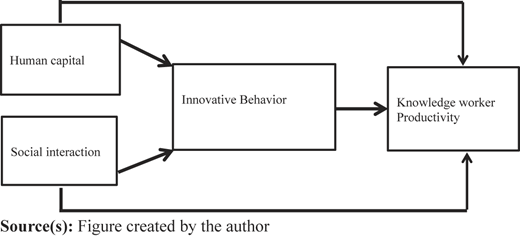
The findings also indicate that innovative behavior intercedes the relationship between human capital and knowledge worker productivity. This is exhibited in the story whereby the acquisition of knowledge from college in 2010, online training and fourteen years of practice empowered Musika with the capacity to craft ideas that were directed at offering quality services. Employee 7 (EMP 7) observed that with Musika’s ideas, he designed a digital application platform for sharing knowledge which eased on knowledge transfer, enabling him to easily carry out tasks at any time within and outside work premises. The findings also reveal that innovative behavior intercedes the relationship between social interaction and knowledge worker productivity. This is exhibited in the story whereby in 2015, Musika teamed up with other IT workers, and together, they advanced ideas that resulted in developing an application that tracks, stores and transmits client feedback, which provided grounds for improving the quality of services delivered. In support of these findings, HCT explains that human capital resources enable knowledge workers to be innovative and productive in a task. On the other hand, CHAT observes that social interaction creates a foundation for collective learning and sharing of ideas, which are grounds for creating shared ideas that promote cost-effective utilization of resources. While empirical literature exists showing how human capital, social interaction, and innovative behavior directly influence knowledge worker productivity (Bueno et al., 2018; Kianto et al., 2019; Salahat et al., 2024; Tubiana et al., 2022), studies are yet to be carried out to conceptualize and show the mediating role played by innovative behavior in this relationship. Utilizing multiple theories, this study has conceptualized a model to respond to this deficiency that exists in the empirical literature. Based on the preceding discussion, the researcher proposes a conceptual model captured in Figure 1 that explains the antecedents of knowledge worker productivity.
6. Conclusions and implications
6.1 Conclusions
This study aimed to theorize knowledge worker productivity using multiple theories. Based on in-depth interviews with ICT workers working with an ICT company, a positive story was generated from the views of informants on how to raise knowledge worker productivity. From the study findings, it emerged that HCT and CHAT provide possible explanations on how to promote knowledge worker productivity. Utilizing HCT and CHAT, a conceptual model has been generated showing the relationship between human capital, social interaction, innovative behavior, and knowledge worker productivity. Specifically, human capital was derived from HCT, while social interaction and innovative behavior were derived from CHAT. The study combines two theories to comprehensively explain the mechanisms of fostering knowledge worker productivity. This study has contributed to existing literature and theory development by explaining the determinants of knowledge worker productivity from multiple lenses. Methodologically, this study used a qualitative approach of storytelling to give a narrative account of the studied phenomenon. Utilizing success stories provides detailed information that documents the reality of a phenomenon. ICT workers were used as informants in this study and their experiences can offer lessons to a wider community of knowledge workers, especially in the context of emerging economies where the knowledge-based sector is gradually expanding.
6.2 Theoretical implications
Utilizing CHAT, this study documents the role social interaction plays in explaining variations in knowledge worker productivity. The study has shown that human activities and behavior of knowledge workers are constructed and shaped by the environment with which they interact. Through social interactions, knowledge workers acquire situated knowledge and learn new skills from their peers. Moreover, communal interactions are grounds for shaping the innovative ideas generated by knowledge workers. This agrees with the observations of Burkitt (2021), who explained that the quality of innovations and services produced by employees are shaped by the organization’s environment they are situated. Utilizing HCT, this study underpins the relevance of human capital resources as foundations in building the productive capacity of knowledge workers. The study has shown that when knowledge workers are endowed with relevant knowledge and skills, they can generate innovative ideas that promote efficient utilization of resources. This is consistent with the observations of Akhvlediani and Cieślik (2020), who argued that the innovative and productive capacity of employees is shaped by the level of human capital resources that they possess.
6.3 Practical implication
This study document recommendations that can be adopted by organizations intended to enrich knowledge worker productivity. First, organizations need to create an environment that encourages knowledge workers to continuously acquire knowledge and learn new skills from the workplace. This can be achieved through investing in training aligned to the business context and fostering a collaborative environment that provides opportunities for learning from peers. Secondly, the study advocates for the inclusion of social competencies, such as networking and interpersonal skills in the selection process of knowledge workers. Socially active knowledge workers participate collectively in the generation, discussion, and sharing of innovative ideas directed toward the effective utilization of resources Thirdly, organizations need to support knowledge workers, financially, socially and materially as they explore and exploit innovative ideas.
7. Study limitations and areas for further research
This study is prone to some limitations. First, the study informants were ICT workers from a medium enterprise company operating in a developing country- Uganda. Different findings could emerge from different contexts like developed countries, which future studies can undertake. Secondly, the study was purely qualitative utilizing storytelling to generate the findings of the study. It would be meaningful for future studies to attempt to utilize quantitative methods to test the conceptualized model. Despite the existing study limitations, the findings that have been documented remain relevant.

