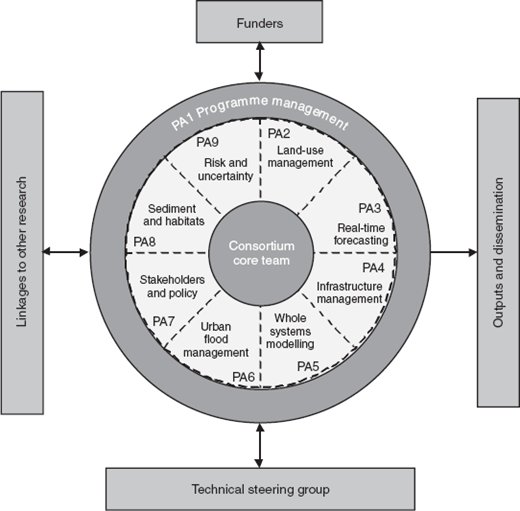
This paper reports on the formation of the Flood Risk Management Research Consortium and the research that is under way within the ‘towards whole systems modelling’ (WSM) priority area. Funding for the consortium is provided from a wide range of research funders in the UK including the national research councils, government departments and agencies with responsibility for flood risk management. The research portfolio has been formulated to address key research needs identified by the funders. This briefing note explains the relationship between the planned research in the WSM area and the UK Environment Agency's Strategy for Flood Risk Management. Additionally, it provides an introduction to the companion research papers in this issue by Villanueva and Wright, Hunter et al., Lin et al., and Néelz et al. The research reported in these companion papers focuses on flood inundation modelling and is an important subset of the work to be undertaken within WSM.
1. INTRODUCTION
Approaches to limit disruption and damage from flooding have changed significantly in recent years. Worldwide, there has been a significant move from a strategy of flood defence to one of flood risk management. This change in approach reflects the future uncertainties in flood prediction, arising from climate change, and recognition that continuing to strengthen defences against flooding is no longer tenable.
Flood risk management includes defence, where appropriate, but also that society learns to live with floods and develops resilience to their impact. The success of this approach requires integration of enhanced defence and warning systems with improved understanding of the causes of flooding linked to better governance, emergency planning and disaster management.
In each of these areas there are opportunities for improving individual tools and techniques that contribute to effective flood risk management through appropriate research and development. For example, better radar prediction of impending rainfall will increase flood warning lead times enabling effective implementation of mitigation measures, such as the construction of temporary defences or evacuation. The key to success is, however, integrating the technical methods for preventing, predicting and warning with the ability of communities and individuals to adapt and respond to flood risk. If the potential benefits of adopting an integrated approach are to be realised it is important that the process of integration begins at the research and development level. Recognising this, the UK research councils, government departments and agencies responsible for flood risk management in the UK have combined resources to fund the Flood Risk Management Research Consortium (FRMRC).1
2. FLOOD RISK MANAGEMENT RESEARCH CONSORTIUM
The innovative funding arrangement adopted by the FRMRC's sponsors allows it to combine the strengths of academic and commercial research organisations in a truly multi-disciplinary programme. Over 24 separate organisations, drawn from universities, government research establishments and private industry, are directly engaged in FRMRC activities. Many others are also involved through membership of steering groups, participation in meetings and workshops, and the developing connections with complementary research in progress or planned in future.
The FRMRC's aim is to improve flood risk management in an international context through undertaking original research, which results in the delivery of tools and techniques to reduce flood risk to people and property. This will be achieved by more accurate flood forecasting and warning, improved design of flood defence infrastructure, better understanding and communication of residual risk and effective emergency planning.
The research portfolio has been formulated to address key research issues in flood management in eight research priority areas, Fig. 1. These areas are consistent with the needs identified by the funders at flooding research workshops organised during 2002 and 2003. The FRMRC's commitment to an integrated programme of research is achieved through collaboration between priority areas with work package level research undertaken jointly by teams from more than one priority area. A list of work package titles for the full FRMRC research programme is provided in Table 1.
3. ‘TOWARDS WHOLE SYSTEMS MODELLING’ RESEARCH PRIORITY AREA
As mentioned previously, current FRMRC research activities in the ‘towards whole systems modelling’ (WSM) area were selected to map on to the highest priority needs of the funders. This work is being undertaken within four linked work packages as follows.
WP 5.1. This is a framework for WSM, which will define interfaces and software design guidelines for model integration taking into account future developments in computing technology and other similar initiatives.
WP 5.2. This involves exploitation of new data types, which will research and evaluate the merits and limitations of various survey and mapping techniques for the creation of digital surface models to support flood inundation modelling.
WP 5.3. This is next generation modelling for flood inundation prediction, which will develop new and enhance existing models to deliver improved modelling of flood inundation at a range of scales.
WP 5.4. This is uncertainty handling, the development of tools and techniques to support uncertainty estimation in the use of flood inundation models.
In addition to the research objectives of each work package there is an extensive programme of cross-cutting activities with most other priority areas; for example, the outcomes from WP 5.2 on the creation of digital surface models are directly relevant to the work in WP 6.1–the integrated urban flood model and decision support tool–as are some of the modelling advances that will be made in WP 5.3.
Although the broad areas of activity were defined at the funders’ workshops, an initial task for each priority area was to understand and develop the linkage between the planned activities and the needs of the Environment Agency, the principal UK end-user of the research. In the ‘towards WSM’ priority area this was achieved through cross-referencing with the Environment Agency's Strategy for Flood Risk Management.2 This strategy identifies areas of the Environment Agency's responsibility in flood risk management, all of which require modelling to support decision making. Areas of responsibility are listed below, together with a commentary on the related computer modelling activity (section numbers in brackets after each area refer to section numbers in the strategy).
Regulation (2.2). Modelling to support provision of high-quality advice to planning authorities and developers to control development at risk of flooding or that could increase flood risk to others.
Flood warning (2.3). Through real-time modelling to forecast river and sea levels to support the issuing of timely warnings and off-line modelling to inform the preparation of flood response plans.
Strategic planning (2.4). Through broad-scale modelling to support catchment scale assessment and management of flood risk, embedded within methodologies for flood risk assessment of flood defence systems and to inform the creation of indicative floodplains in flood mapping activities. This topic includes compliance with the Water Framework Directive (WFD) and the need to protect and improve wetland habitat.
Flood defence operations (2.5). Through analysis of the criticality of the operation of sluices, pumping stations and trash screens.
Flood defence improvements (2.6). Through modelling to support the design of flood defence infrastructure.
Table 2 summarises these responsibilities and the modelling tasks necessary to support them; also contained in this table is a further category of cross-cutting activities to support the modelling tasks. The third and fourth columns in the table provide an industry perspective3 on current research needs to improve the existing modelling methods used by the flood risk management community. A subset of the ongoing inundation modelling research activity to address these needs is contained within the companion papers in this volume.4–7
4. PRESENTLY AVAILABLE FLOOD INUNDATION MODELLING METHODOLOGIES
Before discussing the research programme it is first necessary to review flood modelling methods presently available. Table 3 provides a summary of the methods and indicates their range of appropriate application. These are a set of tiered methodologies, each appropriate for different tasks and applications over different scales. Those of greatest interest in the current discussion are referred to in Table 3 as 1D, 1D+, 2D− and 2D methodologies. These cover the majority of modelling applications necessary to support the development of flood risk management strategy in the UK.
In the 1D approach floodplain flow is part of the one-dimensional channel flow and simulation of inundation is an integral part of the solution of the St Venant equations. The technique has the disadvantage that floodplain flow is assumed to be in one direction parallel to the main channel, which is often not the case.
It is possible to enhance the approach using the panel method to compute cross-section conveyance; this separates the cross-section into a series of panels over each of which a separate conveyance calculation is performed. This takes better account of the variations of depth and velocity across the section. A recent development of the panel method is the conveyance estimation system.8 This technique builds upon research from the Flood Channel Facility in the UK and provides an enhanced means of estimating conveyance against water level relationships that account for turbulent momentum transfer and dissipation.
In the 1D+ approach, floodplains are modelled as storage reservoirs or floodplain storage cells (FSCs) with a horizontal water level over the storage cell surface. FSC geometry is defined using a water level versus plan area relationship. Floodplain water level in the FSC is linked to the levels in the main channel using so-called spill units that model the flow between the river and FSCs or between FSCs. Spill unit flows between the main channel and FSCs or between FSCs can be estimated using weir flow based discharge relationships. Water level in each FSC is then computed using volume conservation. Unlike the 1D approach the 1D+ does not assume that flow is parallel to the main channel; however, momentum is not conserved for the FSC calculation. This allows instantaneous transfer of water through an FSC, which can lead to modelling problems in some circumstances.
In Table 3, raster-based inundation models are classed as the 2D− approach. Such techniques have been developed specifically to take advantage of high-resolution topographic data sets. Typically, channel flow is modelled using a one-dimensional kinematic wave solution. During out-of-bank flow water is transferred to a two-dimensional floodplain grid across which a two-dimensional dynamic simulation is undertaken using a friction equation to compute flows between grid cells. The concept is similar to that adopted for the 1D+ approach, but with grid dimensions being considerably smaller that those of a typical FSC. As with the FSC approach, momentum is not conserved for the two-dimensional floodplain simulation.
Hydrodynamic models based on the two-dimensional shallow wave equations are classed here as 2D approaches and solve for water level and two perpendicular depth-averaged velocities. A solution to these equations can be obtained from a variety of numerical methods (e.g. finite difference, finite element or finite volume) and utilise different numerical grids (e.g. Cartesian or boundary fitted, structured or unstructured) all of which have advantages and disadvantages when it comes to floodplain modelling. The 2D approach conserves momentum for the floodplain simulation.
5. RESEARCH ACTIVITIES
Until relatively recently, most flood modelling in the UK was undertaken using 1D and 1D+ modelling methods. However, the increasing availability of remotely sensed digital elevation models (DEMs) of both rural and urban floodplains has resulted in an increased interest in the use of 2D modelling, or in some cases hybrid techniques where a 1D model for the river channel is linked to either 2D− or 2D floodplain models.9 This activity has raised a number of interesting research issues surrounding the creation of DEMs to support flood modelling and the 2D modelling techniques used to simulate floodplain flows.
5.1. Digital elevation models to support flood modelling
Many recent models of floodplains have been constructed using DEMs obtained from LiDAR data. LiDAR is an airborne mapping technique which uses a laser to measure the distance between the aircraft and the ground. This technique results in the generation of cost-effective DEMs with one point per 1 m2 density or greater and vertical route mean square (r.m.s.) errors of ∼ 15 cm. Such data are now routinely collected by the Environment Agency and other UK agencies for use in flood risk assessment. An evaluation of floodplain models created using this data source indicates that such models perform adequately in rural or undeveloped floodplains. However, there are indications that the quality of the DEM obtained may not be sufficient for modelling in the urban area.7 In order to further investigate these issues research is under way (within WP 5.2) to investigate the creation of high-quality digital surface models through the fusion of data from various sources, including LiDAR, digital aerial photography, ground-based surveying and Ordnance Survey data, such as Mastermap.
5.2. Improvement of two-dimensional modelling methods
This work is sufficiently advanced10 to suggest that high-quality DEMs of the urban area will be readily available at a reasonable cost in the not too distant future. In parallel with the work on DEM quality the FRMRC is undertaking a coordinated programme of research into the application and improvement of two-dimensional modelling methodologies. The strategy adopted is to investigate the utility of existing modelling packages while undertaking cutting-edge research to improve existing and develop new modelling methods. Both strands of this research will be brought together through application to common case study examples. The initial progress being made in this area is published in the companion papers within this volume.
6. CONCLUSIONS
The research activity of the FRMRC began around 1 August 2005. Since this time considerable progress has been made in mapping planned research activity on to end-user needs and in developing the team ethos necessary to deliver the integrated programme of research. Some of the research activities reported in the companion papers have reached a stage where their exposure to the wider flood risk management community is appropriate, hence the publication of these interrelated papers.
7. ACKNOWLEDGEMENTS
The FRMRC is support by grant GR/S76304 from the Engineering and Physical Sciences Research Council, in partnership with the Natural Environment Research Council, the DEFRA/EA Joint Research Programme on Flood and Coastal Defence, UKWIR, the Scottish Executive and the Rivers Agency (NI). This financial support is gratefully acknowledged.