

This paper aims to introduce the Empatia video reflection method, designed to enhance care workers’ awareness of empathic care. The method makes the quality of care visible, which is needed when digitalization efforts in elder care focus on the efficiency and adequacy of care work.
The Empatia method leans on previous studies of the interaction between care professionals and clients and elaborates further previous video reflection methods. In empathic care work, the care worker sees the client on their life continuum, rather than focusing on only medical treatments.
The empirical example demonstrates how a care worker gained awareness of their empathic interaction habits. Within the work community, the reflection process sparked discussions on values: the purpose of care work and how to conduct empathic care. Focusing on empathic relationships in care fosters both the client’s and the care worker’s well-being.
The strength of the Empatia method is that it makes empathy visible in interaction and something that is individually and collectively learnable. The Empatia includes an analytical tool for researchers to reveal empathy in client interaction. It can be developed further into a reflection tool for service work to learn how to be empathic in service encounters.
Compared to other video-stimulated recall methods, the Empatia involves contextual understanding of care work. Empowering positive interactions instead of detecting errors and solving problems is a novel concept and is scantily used in studies of organizational learning. The Empatia provides a detailed method description that allows for the replication of the method by anyone.
1. Introduction
The accelerating aging population in our societies has increased the need to organize elder care services in a cost-efficient way. Recent institutional research on elder care has examined how managerialism, along with New Public Management, has influenced how care work is seen and managed more through measurable data and results, such as time used with each client or number of clients served, than by recognizing the quality of care and its situational nature (Zechner et al., 2022; Henriksson and Wrede, 2008). ICT-based work-planning systems define work and its content as something standard, and as such, controllable by managers (Vuokko, 2008). However, what is neglected is the particularity and uniqueness of each care encounter. The interpersonal relationship between the care worker and the care recipient depends on the context and varies from one situation to another (Waerness, 2005; Islind and Lundh Snis, 2017), despite an agreed care service plan.
This tension between the situational logic of care (Mol, 2008) and the standardized logic of work (Bowker and Leigh Star, 1999) may cause moral distress at the employee level. Moral distress can arise from obstacles at work that prevent care professionals from acting according to their ethical principles, for example, being unable to provide sufficiently high-quality care due to the hectic pace of their work (McCarthy and Deady, 2008). According to one study of Finnish care workers in elder care, their moral distress was nearly double that of other health and social care service employees, and together with other stressors, jeopardized the work ability of elder care workers (Selander et al., 2022). Several qualitative studies have also examined how the time-saving technologies implemented in care work have focused on shortening the time spent on providing care and not on the quality of interaction, resulting in ethical tensions (Bergschöld, 2018; Ertner, 2019; Hämäläinen, 2020).
Discussion on workplace learning and employee-driven innovation (Ellström, 2010; Lemmetty and Billet, 2023) has considered employees as sources of valuable knowledge about challenges, deficiencies or everyday work that, through reflection and collaborative learning, can lead to innovative solutions. Public welfare organizations must continuously learn and adapt to the complex demands of modern society (MacArthur et al., 2011; Bunders et al., 2022) but also have opportunities to think about what elements are valuable and should be retained at work. The challenging situation faced in work calls for organizational-level changes and new ways of operating. Reflection without video-stimulation has long been used in organizations as a tool for co-learning, development or peer-support (Steen, 2004; Helyer, 2015). Video-stimulated reflection has been used as a means for individual learning for over two decades (Penny and Coe, 2004; Tripp and Rich, 2012), but less attention has been paid on its significance for organizational learning.
Technologizing work, which is originally based on human interaction, needs to be evaluated and reflected from the human point of view. Particularly in care work, what makes care work worth doing is the empathic reciprocal relationship that is built between the care worker and the client. Care theorists (Noddings, 2002; Gilligan, 1936/2003) have pointed out that empathy plays a significant role in igniting care. Empathy, in a broad sense, means being able to imagine oneself in another’s position and adopting their viewpoint (Piaget, 1932). To feel empathy, you need time, presence and proximity to another individual, which ultimately fosters connection, and caring actions (Hamington, 2018). Empathy and care require knowledge, for both perspective-taking and feeling concern for the other person, which in the elder care context means that the care worker should have enough knowledge of the elderly person’s life history, not only their medical record data. Good care includes supporting the client’s sense of self and personhood through relationship-based care, providing individualized activities and meaningful engagement and offering guidance for maintaining significant social relationships (Fazio et al., 2018). Creating well-being for the clients provide well-being for the care workers as well, if we understand well-being as a relational phenomenon, generated through relationships with other people, rather than an individual quality (Barnes et al., 2013; Taylor, 2011).
From the developmental point of view, an empathic relationship may be significant for how the elder client maintains their capability. Lev Vygotsky (1978, p. 86) defined the zone of proximal development as:
The distance between the actual developmental level as determined by independent problem solving and the level of potential development as determined through problem solving under adult guidance or in collaboration with more capable peers.
If we consider the care relationship between the care worker and the client whose capabilities are diminishing in the Vygotskian frame, we may assume that the elderly client can maintain their social contacts and activities and reach their full potential, if the care worker recognizes them in their life continuum in an empathic encounter.
To make empathic relationships and interaction more visible in elder care, we propose a new method called the “Empatia Video Reflection Method” (Empatia), which can help research, develop and empower professional elder care work. The method is currently needed by care workers and their work communities to be able to conduct ethically sustainable care instead of rigidly following its push for standardized, controllable and efficient performance.
2. Theoretical approach of the Empatia method
2.1 Taking learning from the individual level to the work community
Through Empatia, we aim to build a framework that follows the psychological tradition presented by Vygotsky (1978), i.e. allowing the participants, in our case care workers, to reflect on their experiences individually and collectively to develop the work itself. We extend the Clinic of Activity model presented by Clot (2009). We look at how opportunities for empathy occur in everyday work, how we can help the care worker recognize and learn from these situations and, finally, how empathic interactions can be enhanced by further sharing and developing the insights with the work community.
Unlike focusing on the problem-solving or error detection and correction (Robinson, 2001) that are usually used as levers in organizational learning, we use good practices as sources for learning. In terms of learning from individual-level practice as well as the collective level, the Empatia follows the framework of Mary Crossan et al. (1999) concerning the dynamics of organizational learning, which suggests that the learning on the individual and collective levels should take place through processes of intuiting, interpreting, integrating and institutionalizing. The Empatia includes a process of intuiting (Crossan et al., 1999), in which individual level actions that are not consciously conducted, are recognized by the observers and made an object of reflection.
As Clot and Kostulski (2011) emphasized in their research, which used the Clinic of Activity model, “the power to act at work is a keystone of health and efficacy” (p. 687). Well-being at work is connected to the ability to accomplish one’s work in an acceptable way (Clot and Kostulski, 2011). Therefore, we also emphasize well-being at work and the interaction situations in which empathy emerged or had the opportunity to emerge. The individual, fine-tuned, good practice is interpreted at the group level, which creates a shared understanding, and the practice may become embedded within the workgroup (Crossan et al., 1999, s. 529).
As we wanted to emphasize the positive aspects of video reflection, we used appreciative inquiry, a method that supports sensitive interactions between care workers and clients. Appreciative inquiry focuses on reinforcing good communication practices rather than seeking out errors, taking a positive approach to the social construction of reality (Cooperrider and Whitney, 2005, 2000). It complements research by facilitating engagement and open discussion, and has the flexibility to meet individual, unit-level or organizational needs in nursing (Richer et al., 2009; Trajkovski et al., 2013).
2.2 Reflection as a means for learning
Reflection is an integral part of care work, in which care workers assess and evaluate their experiences in different situations (Berterö, 2010). It involves critically examining background assumptions and can occur during action, after action or as part of self-knowledge (Schön, 1987; Berterö, 2010). Reflecting on care work is essential for understanding its complexity, sharing tacit knowledge and developing personal and professional skills (Johns and McCormack, 1998; Berterö, 2010; Polanyi, 1983).
Introduced by Dewey in the 1930s, reflection in the learning process has been emphasized as a problem-solving dialogue that prompts thought and prepares individuals for action (Kemmis, 1985). Gibbs (1988) introduced the Reflecting Cycle as a structured framework for learning from experience, and it has commonly been used in clinical practice (Lawrence, 2008; Powley, 2013; Husebø and O’Regan, 2015). However, some criticize it for lacking depth when applied superficially (Moon, 2007). What is more, the Reflecting Cycle relies on individual descriptions rather than using authentic or videorecorded interactions between clients and professionals.
Often, reflection methods concentrate on finding shortcomings and mistakes of workers (Bakker et al., 2008; Taris et al., 2008). However, by learning from positive aspects, the focus shifts from repairing problems to empowering positive qualities (Seligman and Csikszentmihalyi, 2000).
2.3 Video-stimulated reflection methods in workplace learning
Video-stimulated reflection methods are relatively widely used in, for example, teacher training and education as simulations to prepare students for their first real-life experiences (Hamel and Viau-Guay, 2019). Generally, this method that involves video-recording activities and then replaying the video for participant(s) for their reflection, is widely used across disciplines such as psychology, education, nursing or medicine (Huang, 2014). They are often complemented by other methods such as think-aloud strategies or questionaries (Gazdag et al., 2019). Video-reflection or video-assisted debriefing has also been widely used and studied in nursing education, nursing in general and clinical work (see Nursing Education Simulation: Jeffries, 2012; Hulkari and Mahlamäki‐Kultanen, 2008; Ha, 2014; Karlsen et al., 2017; MacLean et al., 2019). However, these video-stimulated recall methods have not been explicitly explained as methods, and they have not used observation from live situations at work. For example, in a study by Bunders et al. (2022), the video recordings were seen as data about the participants’ behavior for leaders. The video recordings were reflected by peers, not the person on the video. The study of Hamel and Viau-Guay (2019) was based on simulations and Gazdag et al. (2019) concentrated on individual development, not on collective learning.
The Empatia applies Clot’s Clinic of Activity (2009) model. This model is a video-assisted, three-phased method that starts with observation and ends with collective analysis and has various kinds of videorecorded material (sequences of the activity, simple auto-confrontation and crossed auto-confrontation) (Clot, 2009; Clot and Kostulski, 2011; Seppänen et al., 2016). During auto-confrontation, the participants view the video alone (simple) or with peers (crossed) and researchers, who prompt self-reflection and question their actions (Clot, 2009).
In the Clinic of Activity (Clot and Kostulski, 2011), reflecting on the material with a colleague led to resistance and the need to defend, which was not conducive to seeing the positive aspects. To foster a supportive environment, we conducted individual video reflections to encourage reflection without the fear of judgment from supervisors or colleagues. Later, we shared anonymized descriptions and reflections with the work community.
2.4 Analytical tool for identifying the quality of interaction between care worker and client
We developed an analytical tool that can identify and select such interactive episodes into the video reflection which include a moment of empathy. It is important to find positive and successful situations in each client encounter because the empathic way of interacting is often tacit knowledge (Polanyi, 1983) for care workers. In care work and client interaction, recognizing the need of the other person, whether it is physical discomfort or a social deprivation state, is central (Noddings, 1984).
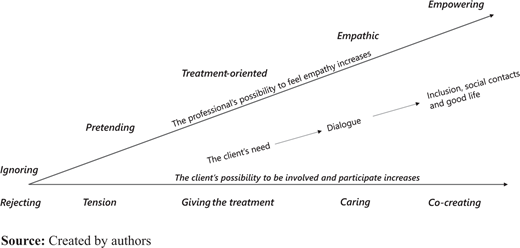
Previous empirical research on the interaction between the care worker and the client has focused on verbal and non-verbal actions, emotional atmosphere and the behavior of the care worker around the need or concern of the client (Hafskjöld et al., 2017; Fry et al., 2013; Martela, 2012). However, other kinds of literature have discussed empowering the clients’ own activity and creating circumstances for shared actions and decision-making (Thompson, 2007; Dewar and Nolan, 2013; Weiste et al., 2022). The premises have been identified from previous research, which includes observations of care situations as data. The research references as sources of the mode are expressed under each responsive mode. The professional care worker may respond to the need of the client in the following ways:
Rejective.
The professional rejects the client’s expression of concern (emotion) or hint of it by verbally refusing or postponing it to another time (Hafskjöld et al., 2017). In such cases, they may look serious and busy, have negative body language and move hurriedly (Fry et al., 2013).
Ignoring.
The professional does not give the client room to expand the concern or cue and does not respond to it with words or gestures (Hafskjöld et al., 2017). They bypass the client’s emotional state (Martela, 2012).
Pretending.
The professional’s body language is in conflict their words. They may act more friendly than they feel. There is a discrepancy between felt and expressed emotions, inauthenticity, a fake smile, which is a state called surface acting (Humphrey et al., 2015).
Tensioned.
There is a conflict between professional duties and personal emotions. The professional may defend the client’s interests by, for example, fighting to get them past the queue and prioritizing addressing the client’s concerns, even if it contradicts the protocols of the health-care system (Fry et al., 2013).
Treatment-oriented.
The professional prepares the client for their upcoming treatment with words, reassurance, anticipation of the treatment or humor (Fry et al., 2013). They try to make the treatment go smoothly.
Giving the treatment.
The professional gives the treatment. They focus on the medical treatment procedure, verbalizing it to the client. Their emotional state is not necessarily the same as that of the client (Fry et al., 2013).
Empathic.
The professional identifies the client’s emotional state (Martela, 2012). The professional asks and talks about everyday events before, during or after the treatment to calm the client and to help them relieve stress. The professional pays attention to the client’s emotion, they feel empathy (Fry et al., 2013). There is a state of shared understanding and presence between the professional and client. The professional appreciates who the client is and what is relevant to them in their circumstances and how the client wants to be cared for (Dewar and Nolan, 2013).
Caring.
The professional’s body language is positive, it includes eye contact and using a gentle voice when interacting with the client. They may gently touch the client. The professional has time to listen to the client and ask questions (Fry et al., 2013).
Empowering.
The professional supports the client’s agency, giving them tips, help, support and encouragement. The professional provides professionally oriented advice and the opportunity to participate in care planning (Thompson, 2007). The focus of the interaction is on well-being, social connections and a good life, rather than on ailments and illness (Dewar and Nolan, 2013).
Co-creating.
The professional and the client work and act together. The client is involved in shared decision-making, in the decisions concerning them in relation to care, their daily life and their future. Both the professional and the client are in a good mood and are present (Thompson, 2007; Dewar and Nolan, 2013; Martela, 2012).
Figure (1) summarizes the different responsiveness modes in the care worker–client interaction from the non-empathic emotional state to the empathic encounter, which create grounds for a more co-creational relationship and shared decision-making.
3. The phases of the Empatia method
The Empatia method was developed as part of More time for Empathy? Technology-based communication and well-being at work in nursing – research project which studied empathy in care worker–client encounters in technologizing elderly care. The research was conducted in two Finnish public organizations providing homecare services, and two private organizations offering residential care. The method was developed and tested as a part of the research project.
The research ethics of the Empatia derives from a relational research ethics perspective, in which the researcher values experiential knowledge, seeks dialogue with the participants from the early stages of the research and ensures that the participants receive the feedback on the research results (Pollock, 2012). In this type of relationship, the researchers also need to be able to empathize with participants and recognize the research as a collaborative effort in which they have a moral responsibility to share their observations with the participants (Costley et al., 2010, p. 43).
We began the development of the Empatia by searching previous empirical studies, which had identified features of behavior in care worker–client interactions, resulting as an analytical tool (see Figure 1). Second, we modified the learning and reflection phases from individual to collective level based on Clinic of Activity model (Clot, 2009). Third, we searched for an inquiry tool, which would support reflection in an encouraging manner. We adapted Cooperrider and Whitney’s (2000, 2005) Appreciative Inquiry method. We modified the Appreciative Inquiry interview method into three steps, the 3Ds: Discover, Dream and Develop.
In the following we present the Empatia method in detail. The Empatia consists of four phases:
observation;
selection;
reflection; and
learning (Figure 2).
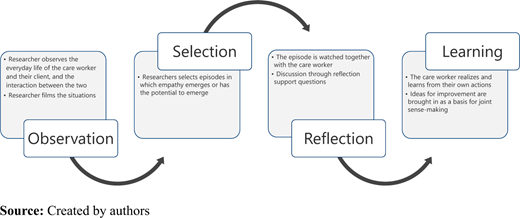
Observation and reflection begin at the individual level. The Empatia helps the care worker express emotions, reflect on their feelings and thoughts to identify the opportunities for empathic encounters and discuss how the well-being of the client is influenced in each encounter. The anonymized individual reflections are then brought to the work community level to enable everyone to learn from the elaborated and reflected practices.
3.1 Observation of care work
To guarantee ethical research practice, before the observation, all the participants, care workers, their colleagues and clients (in some cases also their relatives) should be informed of the forthcoming data collection dates and the purpose of the research. In our case, the care workers themselves collected their clients’ consents and informed them of the research, because they were motivated by the unique opportunity to learn from the videos.
A researcher shadows the care workers, documenting their interactions and recording videos of the care worker–client and care worker–professional interactions using discreet action cameras. These recordings are short clips (1–5 min). Meanwhile, another researcher observes from further away and takes handwritten notes.
3.2 Selection of interaction episodes for reflection
In this phase, the researchers go through all the videorecorded interaction episodes to find suitable episodes for the phase of reflection. The researchers choose the interactions in which empathic care or an opportunity for it emerges, according to and with the help of the analytical tool presented in Figure 1.
We used the analytical tool to help with the selection. We also presented it to the participating care workers whether it corresponded to their perception. The reactions were very positive. Some care workers proactively placed the reflected interaction situations on the continuum based on their perception.
3.3 Reflection between care worker and researcher
The Empatia enables care workers to reflect on their work behavior in an appreciative manner. During the reflection process, the care workers watch selected video episodes and explain their thoughts. The researcher’s presence is crucial for observing emotional changes and non-verbal communication. The client interaction videos are shown one at a time and are followed by reflection facilitated by the researcher. These discussions are recorded as research data. The reflection phase is a personal and sensitive situation involving only the care worker and the researchers, enabling independent reflection without peer pressure or supervision.
The researcher used the following 3Ds questions presented below, which were developed from the Appreciative Inquiry (Cooperrider and Whitney, 2005, 2000):
(1) Discover
What did you know about the client beforehand? (Knowledge)
What did you think the client needed/needed help with? (Understanding client)
How did they express what they needed/how did you know what they needed?
How did you respond to the need?
How did you interact with the client? (Communication/interaction)
How did you feel in the situation?
What do you think the client felt in the situation? (Empathy)
How was the client involved in the situation? In what ways did you involve the client? What made it easier for the client to participate? (Co-development, joint decision-making)
What worked well in the situation?
(2) Dream
Can you think of ways in which you could have done things differently?
What would a dream/ideal interaction with the client be and what kind of situation would this be?
(3) Develop
What would needed to happen for you to have acted in the way you described?
What kind of support would you need in the future to be able to act in the way you want/dream?
What advice would you give other care workers when they encounter this client (to transfer your good practice)?
First, the care worker describes the interaction situation from their own and the client’s point of view. Then, the care worker is encouraged to imagine what an ideal situation would look like. This enables them to realize and learn from their own actions. Finally, the care worker is enhanced to improve the situation further by thinking about what kind of support they would need or how they could teach their good practice to their colleagues. By using these 3Ds of Empatia, with a particular focus on the first D, the care worker is able to see the elderly person in their life continuum, which creates more empathy in the interaction.
3.4 Learning in the work community
In the learning phase, the work community discuss improvement ideas and good practices in workshops. The interaction episodes are written as short, anonymized descriptions that include an outline of the episode and insights from the reflection.
The following questions guide the workshop discussion:
What seemed to work well in the situation?
What kind of things created empathy between the care worker and the client in this situation?
What can we learn from the situation?
The workshop participants are divided into small groups, and the descriptions are read aloud and then discussed to explore the thoughts and comments prompted by the narratives. Finally, the small groups present their reflections to the entire workshop. This phase offers an opportunity for organizational learning in the work community by going through processes of intuiting, interpreting, integrating and institutionalizing (Crossan et al., 1999).
4. Demonstration of the Empatia method
We next demonstrate a case from the residential care home, using the Empatia method’s phases. It is taken from a collection of 11 video reflections of the elder care workers’ work shifts from four different sites in Finland. Its purpose is to make the method vivid and the researchers’ actions comprehensive for the reader. The analysis of the data collection will be reported elsewhere (Saari et al., 2022). The episode in question is one in which empathy has the opportunity to emerge and is manifested in the care workers’ personal habits in their interaction with the elderly client. The situation involves two care workers and one care assistant. They were working the morning shift in the department of a residential care center, caring for 11 aging residents.
4.1 Videoclip selected for reflection
It was lunchtime in the residential care center, and three of the residents were sitting around the same table having lunch together. The care worker was standing and leaning on the table. It was very noisy; a washing machine was on in the room and there were also many other noises. On the other table just next to this one, a resident with a memory disorder occasionally screamed something about cancer or their parents (Table 1). In the reflection phase, the care worker reflected on an interaction episode that had lasted about three minutes.
Transcription of videorecorded interaction in residential care case
| Speech turns | Actions |
|---|---|
| Care worker1: The model of 1928… how much must this have cost Resident2: a lot Care worker1: must have… | Four residents are sitting around the table Care worker 1 is leaning on the table, standing between two residents. Resident 2 has a magazine and Care worker 1 is reading it silently at the same time with the resident 2. Resident 1 is on the right side of Care worker 1, eating Care worker 3 is in the kitchen. Care worker 2 is on the other side of the table, helping two residents eat Care worker 1 sees a story about old automobiles and shows it to the residents eating on both sides of her |
| Resident1: It was… It was in Mustio Resident3 (talking to herself): Mum’s already home, dad’s got cancer Resident1: it came, the car came to… Care worker1: Where did it come? Resident1: To Mustio Care worker1: To the castle of Mustio? Resident3: There’s no money for food! Care worker2: There’s food now… Resident1: First car came to Mustio, to the Castle of Mustio Care worker1: Oh, was it just the 1920s or earlier? Resident1: It was… it w.. came, the car. That’s where the car came. With the driver! Care worker1: Oh, with a driver? Resident3: Mum’s at home and dad’s at work Care worker2 (laughing): Like with the car for free? Resident1: They didn’t understand cars here yet Care worker1: Yeah, it’s better that there was a driver Resident3: Virtanen, please leave! Care worker1: Did it come from United States? Resident1: No Care worker1: No? Resident1: No. From Holland Care worker1: Oh okay! Wow… | Care worker 1 continues reading Care worker 1 starts to listen, looking at Resident1 Resident 1’s voice is very weak, and he speaks very quietly A resident shouting nut using no words in another room, the shouting drowns out the discussion a little. Care worker 1 raises her gaze in the direction of the shouting, and then turns back to Resident 1 |
| Care worker1: They’re interesting, and beautiful! Resident3: Mum’s already at home, dad’s at work! Resident1: I got to drive it! Care worker1: You did? Resident1: Not the car, I got to drive the tr…tr… Care worker1: A tractor? An old one? Resident1: yeah, and I’ve seen… Care worker3: Here comes coffee! Care worker2: Great, coffee service | Care worker 1 turns her attention back to the magazine, reads something Resident 1 says something, Care worker 1 looks at him Care worker 3 comes from the kitchen with a tray filled with coffee mugs and puts the tray on the table The moment is interrupted. The attention turns to the coffee and Resident 1’s story is interrupted |
4.2 Reflection of the care worker and researchers
The reflection on the episode revealed that the care worker knew the resident’s background and life history. The male client had been highly active and physical earlier in his life, had participated in skiing competitions and worked on construction sites. But now he had speech and movement difficulties caused by Parkinson’s disease. The resident wanted to go biking and berry-picking but was no longer able to. The resident often told stories about his past. The care worker said that it had been difficult to hear what the resident was saying, but that the others were listening and interested in his story. When asked what could have been done differently, the care worker reflected:
I could have been sitting not standing. I looked like I was going somewhere.
The care worker said that these situations during or after lunch are the best time for interactions. Usually there is no more hustle or bustle; no rush. The care worker liked these moments, and they enabled them to learn about the residents and some of the stories about old times were also interesting. This is why she had taken the time to stop at the table and listen to the clients.
The care worker also noticed how fragile the situation was and vulnerable to interruptions. She thought she should have sat down and continued the discussion with the resident later. The care worker also reflected that the conversations at lunchtime were important and might also help the other residents tell stories. She realized that at lunchtime, it was the care workers’ role to facilitate the discussions by asking questions. It was moments like these that made the care worker and the resident experience something good, like being equals, not patient and nurse.
4.3 Reflection in the workplace
For reflection in the work community, we condensed the interaction episode and the related care worker reflection into an anonymous description of a situation, as follows:
A dining situation with three residents sitting around the same table. A care worker (mask and gloves) stands and leans on the table between the two residents. The care worker is reading a resident’s magazine and commenting on a story about historical cars. The resident sitting on the other side of the care worker begins to say that Finland’s first car was in Mustio (small village in Finland).
Care worker: Oh really? Was it in the 1920s or earlier?
Resident: It came to Finland with a driver too. People here didn’t understand cars yet.
The care worker laughs.
Care worker: Did it come from America?
Resident: From Holland.
Care worker: Oh, yeah. They are interesting. (looks at the pictures in the magazine)
Resident: I got to drive it.
Another care worker brings coffee to the table on a tray, and the moment is interrupted.
Reflection: the room is very noisy and required the care worker to be sensitive and stop to hear the resident’s conversation initiative. The care worker realized the importance of pausing and listening to the resident’s conversation. Usually, the best time to do this is just after lunch.
“I could have been sitting, not standing” was an insight into how posture plays a role in the development of a peer situation.
In the workshop, the participants recognized how delicate the interaction between the care worker and the resident could be. They agreed that this situation was empathic and sensitive. They criticized the care worker for not sitting down with the residents, but they were glad to notice that the care worker had realized the same thing. One participant commented:
Perhaps it could also foster a sense of equality in a way, that we were discussing a common topic.
The interruption by the other care worker was more strongly observed in the work community than in the individual reflection. They thought the assistant should have been more sensitive to interrupting a good conversation, but when rushing, it may be difficult to observe what is going on, especially when coming from another room. Sometimes, performing tasks efficiently and quickly might affect empathic interaction. One of the participants said:
Perhaps sometimes in everyday life, situation awareness gets a little blurred when you’re performing a task.
The workshop participants claimed that reflecting on and observing empathic situations had been valuable, and they had learned how tiny things, such as a physical position, or adding a question, can make a difference and build a good relationship with clients.
4.4 Summary
The residential care case indicates how subtle an interaction between the professional and the elderly person can be. Empathy lingers in small sensitive situations, eye contact, positioning and stopping and listening. The case also shows that recognizing the unique life history of the elderly person might help the care worker perform daily tasks in a more empathic manner. For example, in this case, eating was not just about nourishment but also a culturally colored situation in which people were used to interacting with each other. It offered an easy moment to have a conversation and for care workers to get to know the elderly people better. It was also clear that the residents wanted to be heard and to share their memories with others.
5. Discussion and conclusions
The Empatia video reflection method contributes workplace learning and reflection methods several ways. First, it makes visible the goodness that needs to be retained in the workplace and does not focus on fixing mistakes nor problems. Second, the Empatia elevates individual reflection to a collective level. Third, it provides a preliminary research-based analytical framework, particularly for developing interaction skills required in service work, where responding to the need of the customer is at the core. And fourthly, it provides a detailed method description, that ensures both replicability and further development. In the following, we explore the significance of this method for research, practitioners and society at large.
5.1 Theoretical and research perspectives
The Empatia can be seen as a method for employee-driven learning and opening an avenue for organizational level learning. Learning at workplace has been described as either adaptive, aiming at keeping “existing” practices or innovative learning, aiming at renewing and questioning these practices (Ellström, 2010; Lemmetty and Billet, 2023). In the context of care work, particularly in this era of digitalizing health care, technological solutions are considered as a prescription to scarce resources, even replacing client interactions with artificial intelligence-based solutions. Using Empatia for reflection provides organizations and its employees a possibility to both types of learning and ask; should we learn to adapt with the technologies, or should the development be questioned? The Empatia highlights existing, yet invisible, empathy that is valuable for both the care workers and the client’s well-being, and in such a way hinders it to disappear in the technologizing work environment.
In previous studies, video-stimulated reflection has been used for example by Bunders and their group (2022) as an intervention tool mainly in individual and peer level, not reaching learning in organization. The Empatia applied Clot’s (2009) Clinic of Activity model. Our contribution to the method was adding a developmental and contextual analytical tool to identify empathic episodes in everyday interaction and enhance care workers to become aware of good practices and care through appreciative questions instead of focusing on mistakes and errors.
Previous research has indicated that a fast-paced work environment can hinder the delivery of high-quality care, leading to moral distress (McCarthy and Deady, 2008). Valuing empathy in care work and making the empathic relationship more prominent can alleviate the moral distress experienced by care workers (McCarthy and Deady, 2008; Selander et al., 2022). Appreciative inquiry allows care workers to learn from the positive aspects of everyday care work, empowering them and facilitating organizational learning (Cooperrider and Whitney, 2005; Crossan et al., 1999). This is contrary to the basic mindset in the prevailing classic organizational learning theories such as Argyris and Schön’s single- and double-loop learning, which focus on problem-solving or error detection and correction (Robinson, 2001). By concentrating on empathic situations and caring interactions, these meaningful moments become more visible, despite their absence in ICT-based work planning systems. The aim of the Empatia is to make empathic moments of care work visible and for the care workers themselves to recognize them, intuiting (Crossan et al., 1999) them from unconscious to conscious knowledge. The process of individual intuiting (Crossan et al., 1999) and group-level interpretation make tacit knowledge more explicit. The collective discussions in workshops can be interpreted as samples of care workers’ good practices, serving as both illuminating reflections on the significance of elder care (how and why we do this work) and thought-provoking inquiries about the future direction of elder care (Saari et al., 2017).
The Empatia sees care workers as active agents who bring their own perspectives and potential criticisms to the interpretation (Pollock, 2012). Showing care workers the videoclips makes them co-interpreters, providing insights not captured through observation. Treating research participants as co-interpreters of the phenomenon under study rather than objects expands the scope of ethics to the entire research process and enables dialogue until the reporting of research findings (Kloetzer, in press; Costley et al., 2010).
5.2 Practical and societal views
The strength of the Empatia for practitioners is that it makes empathy visible in interaction and something that is learnable. Empathy is hidden in interactions and practices. It is also something that cannot be measured. Empathy is embedded into the care worker’s actions or what they choose to spend time on, how they anticipate the consequences of their actions, how they use space, touch, position themselves and initiate questions. Making good interaction practices visible can help care workers see the meaning of their work in their busy and hectic everyday lives. Sharing the practices makes tacit (Polanyi, 1983) knowledge more explicit and helps others learn from them. Learning from the “good” helps the practitioner develop at work (Seppänen et al., 2016; Kloetzer, in press).
The Empatia includes an analytical tool for researchers to reveal empathy in care work, which can be developed further into a self-reflection tool for care workers to use within the work community. In their video reflections, the care workers identified the different responsiveness modes in the care worker–client interaction, from the non-empathic emotional state to the empathic encounter. It can be developed further into a reflection tool for service work to learn how to be empathic in service encounters. The Empatia can also be modified for vocational training purposes. The prevalence of smartphones enables care work trainees to videorecord interactive situations if the client permits.
In western societies with their aging populations, politicians and managers often see technological solutions as providing more efficient elder care (Zechner et al., 2022; Henriksson and Wrede, 2008). The Empatia is a means to return the discussion to the purpose and quality of care. In terms of its societal significance, the Empatia raises questions about the original basic task of elder care: What are the values of care work? To respond to acute medical needs or to enhance the well-being and social connectedness of the elderly? The care workers’ reflections highlighted the need to discuss the purpose and values of elder care beyond resource measurement and efficiency.
5.3 Limitations and future research
In terms of limitations, the Empatia requires research ethics approval to videorecord sensitive care work situations, and this may hinder using it as a method for care worker’s self-evaluations without researchers.
When using video for data collection, the researcher must bear in mind that the camera might alter the behavior of the participants (Heath et al., 2010). The impact of the video camera and the presence of the researcher might change the interaction. The care worker might perform and act better than in a normal situation. However, this kind of surface acting or performing to the camera tends to diminish, as videorecording takes time: in our case, the entire work shift (O’Brien, 1993; Heath et al., 2010).
The emotional premises (Figure 1) reveal how time pressure, value conflicts and concentrating on medical treatment can prevent the emergence of empathic interaction. In the future, we will continue this research, using more data collected from 12 elder care worker’s videorecorded work shifts: Is empathy an avenue for co-creating with the client, as we suggest in line with Vygotsky? Empathy arises in various situations and contexts, depending on both the clients’ and practitioners’ agency; thus, the larger dataset provides an opportunity to delve into its dynamics in more depth.
It is important that the care worker and the client take discussions back to the basic task of care– how to create empathic relationships between care workers and clients in such a way as to guarantee the conditions for a good life for the elderly. This requires regarding well-being as a relational phenomenon (Barnes et al., 2013; Taylor, 2011) that occurs in relationships between people, not only in individual minds or bodies.
This article was born as a part of the research project carried out by the Finnish Institute of Occupational Health in 2020–2022: Enemmän aikaa empatialle? More time for empathy? The project was funded by the Finnish Institute of Occupational Health, the Finnish Work Environment Fund (project number 200101) and partner organizations City of Jyväskylä (services for the aged), City of Helsinki (services for the aged), Diakoniasäätiön Foibe sr and Viola-kotiyhdistys ry. The authors would like to express their gratitude to all the funders for their support.

