


A deep understanding of the impacts and risks associated with weather variability is crucial not only for assessing the economic repercussions of future climate change but also for planning effective policies and risk management strategies. Among the areas most exposed to these challenges are mountain regions, which are particularly vulnerable to the effects of climate change due to both their ecological fragility and their socio-economic dependence on seasonal tourism.
This study examines the implications of climate-induced transformations for Alpine ski resorts, focussing specifically on the Ubaye Valley in southeastern France. The aim of this research is to explore how ski destinations are adapting to the multifaceted challenges posed by climate change. In this context, the Ubaye Valley serves as a key example of place-based, multi-level responses that are increasingly critical as climate pressures intensify across the Alps.
The trend data, the opinions of key stakeholders, interviews and the collected opinions/impressions demonstrate how small settlements (small ski resorts), or “community” ski resorts, appear as parts of a system that opposes, with efficient resource allocations and the protection of environmental heritage, the urban model, as an alternative to the large “urban” alpine ski resorts.
The update and further development on the competition and competitiveness of the two sides of the Alpine arc, through the ongoing transformations in the winter tourism market, provides qualitative and quantitative information on scenarios and models that “come from the future” and indicate significant changes in the offering. These changes involve the continuous search for efficiency, but also for exclusivity and total customer satisfaction through a selective pricing process.
Introduction
Winter tourism is one of the economic sectors most sensitive to meteorological conditions. A deep understanding of the impacts and risks associated with weather variability is crucial not only for assessing the economic repercussions of future climate change but also for planning effective policies and risk management strategies. Among the areas most exposed to these challenges are mountain regions, which are particularly vulnerable to the effects of climate change due to both their ecological fragility and their socio-economic dependence on seasonal tourism.
The Alpine region will be up to three times more affected by global warming than the average of the Northern Hemisphere: it is expected that the effects of climate change will have a more significant impact on European Alpine tourism compared to other areas [1]. In a hundred years, snowfall in the Alps has decreased by more than a third. From a 23% less in the northern Alps to a decrease of almost 50% on the southwestern slopes: between 1920 and 2020, there is a markedly negative trend in terms of fresh snowfall in the Alps with an overall decrease of about 34%[2]. In this context, climate-induced changes in snowfall and snowpack dynamics have posed growing challenges to the viability of ski tourism, especially for small- and medium-sized ski resorts located at lower elevations. These resorts are disproportionately exposed to fluctuating snow reliability, as they often lack the financial resources and technological capacity to adapt at scale.
In particular, the increase in winter temperatures is expected to result in a shorter ski season [3] and a shift in the natural snow reliability line to higher altitudes. Lack of snow, reduced snow cover and increasingly unpredictable snow conditions – as seen in several recent winters [4] – could lead to fewer tourist arrivals and a decrease in revenue, with serious economic repercussions for many alpine destinations. At the same time, the demand for artificial snowmaking is expected to increase significantly in the Alps (between 50% and 110%) [5], far exceeding the investment levels made by lift operators between 2005 and 2016, which only accounted for 20% of total spending [6].
Snow is not only a foundational pillar of mountain-based recreational economies, but also a key component of Earth's climate and hydrological systems. Acting as a seasonal freshwater reservoir, snow stores a significant proportion of annual precipitation and supports downstream water flows during warmer months [2]. Its high reflectivity helps regulate regional energy balances, influencing temperature patterns and atmospheric dynamics. These functions are especially crucial in high mountain environments, where seasonal snow cover mediates land–atmosphere exchanges and sustains the winter tourism economy. A growing body of scientific literature has documented the significant impacts of global warming on snow cover dynamics. These changes have both immediate and long-term implications for the sustainability of winter tourism, particularly where artificial snowmaking cannot fully compensate for natural snow losses.
There are 76 abandoned ski resorts in Piedmont, some of which are in the Cuneo area. This is according to 2025 Legambiente's report “Neve diversa. Una montagna diversa è possibile?” [7], which notes that the number of “ghost facilities” is growing: in 2023, there were 70 in the region. This trend underscores the structural crisis of the traditional intensive ski model at lower altitudes. The dossier mentions the Granda in two parts. The first concerns abandoned facilities and mentions Monte Grosso in Garessio, where “significant elements of ski lifts and control cabins are still present”, as well as “Porta della Neve” in Viola, the Prazzo ski lift and the Aimoni facility in Ormea. The second describes the case of the Maira Valley, which, instead of building from scratch in pursuit of mass winter tourism, has focused on “authenticity, history, Occitan culture and incredible landscape attractions”. The result: an 88% increase in tourist numbers since 2019 and the transformation of the valley into “a safe haven in a period of crisis, where the impact of human presence on the environment is minimal” [8]. This case serves as an empirical validation of “non-predatory” [9] development, where the preservation of territorial capital becomes a driver for economic resilience rather than a limit to growth.
Moreover, recent critical perspectives – such as Ultima neve [10], published by Altreconomia, a journalistic investigation into ski-based development models in the Italian Apennines – have questioned the dominant assumption that mountain territories can only survive through continuous private investment supported by public funds. This narrative often overlooks the potential of alternative development models rooted in local knowledge, ecological stewardship and collective well-being. Reconceptualizing the mountain as a commons – a shared good sustained through public responsibility and community engagement – opens the door to more inclusive and sustainable forms of territorial governance [11].
Therefore, this study examines the implications of climate-induced transformations for Alpine ski resorts, focussing specifically on the Ubaye Valley in southeastern France. The aim of this research is to explore how ski destinations are adapting to the multifaceted challenges posed by climate change. In this context, the Ubaye Valley serves as a key example of place-based, multi-level responses that are increasingly critical as climate pressures intensify across the Alps. While no single solution can ensure the long-term resilience of winter tourism, a strategic combination of technological innovation, territorial diversification and collaborative governance offers a promising pathway for sustaining the viability of small ski resorts in an era of climate uncertainty.
This study is situated at the intersection of three theoretical frameworks. The first is tourism destination resilience theory [12], which conceptualizes mountain tourism systems as socio-ecological assemblages capable of persistence, adaptation, or transformation in response to external shocks. The second is the literature on sustainability transitions [13], which frames the shift from mass-skiing models toward multi-seasonal tourism as a systemic and path-dependent process. The third is territorial capital theory [14], which emphasizes the endogenous resources – environmental, cultural and relational – that distinguish community-based destinations from capital-intensive resorts.
The “innovability matrix” proposed herein is explicitly anchored in these three frameworks: it operationalizes resilience pathways through measurable indicators, situates the Sainte-Anne case study within a sustainability transition trajectory and utilizes the six dimensions of the matrix as proxies for territorial capital. The term “innovability” – a portmanteau of innovation and sustainability – refers to the systemic capacity of a territory to generate innovation in an ecologically sustainable and socially inclusive manner. Conversely, “sustainable residentiality” designates the long-term capacity to attract and retain residents and economic activities without depleting the local natural and cultural heritage.
Resilience in mountain tourism can be understood not merely as a set of adaptive measures but as a broader governance process that involves continuous learning, anticipation of future conditions and strategic diversification. In this perspective, the responses observed in the Ubaye Valley illustrate different stages along recognized resilience pathways, from persistence to adaptation and transformation. Situating these dynamics within the literature on sustainability transitions reveals whether the destination is engaging in incremental adjustments to maintain its current model or beginning to explore more transformative pathways capable of reshaping the long-term structure of its tourism system [15]. In this context, the proposed “innovability matrix” serves as a diagnostic tool to map these transitions, distinguishing between purely technological persistence and systemic innovation.
Snowpack decline and the climate challenge in alpine tourism
Seventy years after the development of Alpine tourism, the skiing industry generates annual earnings of more than 30 billion euros, significantly supporting local economies. However, profound changes have occurred in the ski industry in recent decades to adapt to new market demands, especially in response to the challenges posed by global climate change [16].
The idea that outdoor ski tourism may be at risk in a warming climate is evident, given that snow cover in most mountain areas is rapidly declining due to global warming. In fact, the skiing industry is often referred to as “the most directly and the most instantly affected sector” by climate change. On the other hand, the investment costs of ski resorts are directly influenced by the availability of snow, as input prices are significantly lower when snow resources are more abundant, such as with deeper snowpack and longer-lasting snow cover. Unfortunately, the duration of snowpack cover is rapidly decreasing in high-latitude and high-altitude areas, including the USA, Canada and most of the European mountain ranges, such as the Alps, Pyrenees, Apennines and Carpathians.
For instance, in the Alps, the duration of snow cover has decreased by 5.6% each decade over the past 50 years, significantly impacting an area where the economy and culture heavily rely on winter tourism. Overall, the pronounced decline in snowpack duration, regardless of the region and elevation, necessitates specific and rapid efforts by the ski industry to adapt to the changing climatic and socio-economic conditions. Recently, François et al. (2023) reported that in a warmed scenario of +2 °C and +4 °C, approximately 50% and 98% of European skiing resorts will be severely affected by low snow supply, respectively, and heavy snowmaking can only partially mitigate these risks. Furthermore, the rising economic costs of snowmaking and the need for a consistent water supply limit the potential of this system, putting the economic sustainability of this type of tourism at risk. As a result, economic collapse and the subsequent abandonment of ski resorts due to declining snow cover have been reported since the 1980s in the USA, as well as in the European Alps [17].
Therefore, climate change represents a growing threat to the sustainability of winter tourism in the European Alps, a region historically dependent on snow-related recreational activities. Recent studies, such as the one conducted by Bozzoli et al. (2024), highlight a significant decline in seasonal snowfall over the past century, with an average reduction of 34% from 1920 to 2020. This decrease has been particularly pronounced after the 1980s, reflecting broader patterns of climate change affecting snow reliability in the region [2].
The decline in snowfall has shown clear regional disparities. According to Bozzoli et al. (2024), the southwestern and southeastern parts of the Alps experienced snow loss rates of 4.9% and 3.8% per decade, respectively, while the northern Alps showed a more moderate decline of 2.3% per decade. These trends suggest that southern and lower-altitude regions are particularly vulnerable to the effects of global warming, posing severe risks to local economies and infrastructure reliant on consistent snow cover. As confirmed by the Intergovernmental Panel on Climate Change (IPCC), under moderate emissions scenarios, more than 70% of Alpine ski resorts could become “snow unreliable” by 2050 without artificial snowmaking [18].
As highlighted by Gössling et al. (2014), small ski resorts face pronounced economic fragilities due to their high fixed operational costs, limited economies of scale and strong dependence on local labour markets. In these contexts, tourism acts as a “double-edged sword” for development: the high capital intensity required for mountain infrastructures creates a “lock-in” effect that exacerbates vulnerability during climate-induced downturns. Therefore, diversification toward four-season tourism becomes essential to reduce exposure to climatic uncertainty. Climate modelling scenarios clearly show that rising temperatures and declining snow reliability undermine the long-term economic viability of low- and mid-altitude resorts [13], as evidenced by the 76 abandoned facilities recently surveyed in the southwestern Alps [8]. This situation reinforces global trends that call for a strategic, multi-seasonal repositioning.
To foster resilience, such a transition may require a shift toward community-based models or “club fields” which prioritize social capital and local governance over capital-intensive infrastructures. As argued by Innerhofer et al. (2018), resilience in “tricky regions” – those most exposed to structural or climatic changes – depends on the ability of local actors to move beyond top-down corporate management. By fostering collective ownership and shared responsibility, small-scale destinations can transform their vulnerability into a pathway for sustainable development, shifting the focus from the “guarantee of snow” to the “guarantee of place-based experiences” [12].
To address these challenges, resorts are adopting a range of adaptation strategies. Among them, artificial snowmaking remains the most widespread response, as it allows for the extension of ski seasons and the stabilization of tourist flows. However, snowmaking is highly energy- and water-intensive, raising significant sustainability concerns – particularly as rising temperatures demand ever greater volumes of artificial snow to ensure adequate coverage. This approach also tends to benefit larger, capital-intensive resorts, thereby widening the gap between major destinations and smaller ski areas. Today, snowmaking is regarded as an essential prerequisite for ski resort operations and, almost universally, as the default climate adaptation strategy across the outdoor ski industry. Nevertheless, it has faced mounting criticism and has been increasingly labelled as an unsustainable and maladaptive response to climate change [19].
Therefore, the decline of the “snow guarantee” not only challenges the branding of Alpine destinations but also compels a rethinking of the identity and long-term viability of mountain tourism. Climate change is not simply a background variable but a central force reshaping Alpine winter tourism. In this regard, a proactive approach is needed – one that underscores the urgency of shifting from short-term mitigation to long-term resilience planning to secure the future of mountain tourism.
Multi-stakeholder adaptation strategies for sustainable mountain tourism
The climate-related challenges faced by mountain tourism are inherently global in scope. Climate projections consistently indicate that the unprecedented rise in temperatures is the primary driver of change for outdoor ski resorts, with implications for an increasing range of climate risks. A recent study by Wei et al. (2025), which examines ski resorts in China, provides important comparative insights. Their findings underscore the significant reduction in the number of skiable days, particularly in low-altitude and low-latitude regions. This trend, which is emerging globally, is also observable in other mountain regions, including the French Alps, where the reliability of natural snowfall is diminishing, thereby threatening both the economic viability and environmental sustainability of mountain ski tourism.
As the ski industry is highly competitive and climate change risks continue to accelerate, the study's proposed Government-Operator-Skier (GOS) adaptation framework provides a useful perspective for reimagining collaborative resilience strategies that could be applied to the Alpine context. Effective adaptation to climate change in ski tourism requires coordinated action among three key stakeholders: governments, ski resort operators and skiers. This tripartite framework emphasizes the interdependent roles of each actor in building resilience and ensuring the sustainability of winter tourism. These three actors form a dynamic network, each contributing in distinct but complementary ways to the resilience and transformation of the ski industry. Governments serve as enablers and regulators, providing critical climate services such as weather forecasting, early warning systems and risk assessments to inform decision-making. Their role also includes promoting public participation in winter sports through education, infrastructure development and supportive policies.
Ski resort operators, central to the industry, are not only economic stakeholders but also frontline actors managing climate risks. Their adaptive strategies often include investments in snowmaking technologies, diversifying revenue streams beyond skiing, weather-based insurance schemes and developing indoor or small-scale seasonal facilities. These measures are vital for extending the operating season, maintaining visitor numbers and mitigating the impacts of unreliable snow conditions.
Skiers themselves are key agents in this framework, as their behaviour directly shapes demand. Adaptation at the individual level may involve adjusting travel times, choosing more snow-reliable destinations, or substituting skiing with other activities. Although skier responses are generally flexible, they are highly sensitive to factors such as cost, convenience and perceived enjoyment. The COVID-19 pandemic further highlighted the sector's vulnerability to sudden external shocks, underscoring the importance of adaptable and diversified tourism models (see Figure 1).
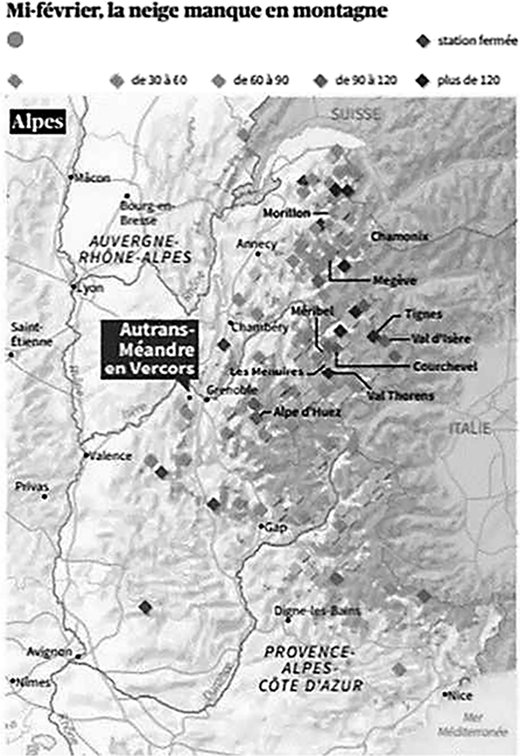
Snow measurement February 2024.“Mid-February: snow is lacking in the mountains”. Source: Le Figaro, February 14, 2024
Snow measurement February 2024.“Mid-February: snow is lacking in the mountains”. Source: Le Figaro, February 14, 2024
This tripartite framework reinforces the idea that effective adaptation to climate change in mountain tourism requires coordinated action across multiple levels. No single actor can secure long-term resilience in isolation; the future sustainability of winter tourism will depend on integrated strategies that combine governance, operator innovation and consumer responsiveness, as shown in Figure 2.
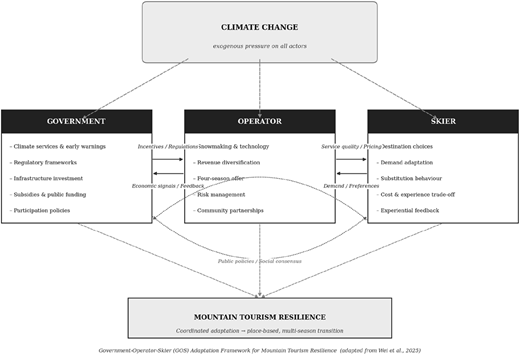
Government-operator-skier (GOS) Adaptation framework for winter tourism resilience. adapted from Wei et al. (2025)
Government-operator-skier (GOS) Adaptation framework for winter tourism resilience. adapted from Wei et al. (2025)
In addition to environmental measures, economic adaptation is therefore playing an increasingly central role in ensuring the sustainability of mountain tourism. The mountain and ski resorts market size is expected to see rapid growth in the next few years. It will grow to $25.26 billion in 2029 at a compound annual growth rate (CAGR) of 11.3% [20]. The growth in the forecast period can be attributed to climate change adaptation, growing health and wellness trends, personalized customer experiences, increased foreign tourism and a focus on sustainability. Major trends in the forecast period include the use of artificial intelligence, the rise of adventure tourism, virtual reality experiences, the expansion of non-ski activities and enhanced safety measures. These offerings are designed to extend the tourism season, attract broader demographic segments and reduce reliance on snow-based activities. Personalization and demographic targeting further characterize this new model of resilient tourism. By tailoring services to age-specific preferences and increasing the focus on domestic tourism, resorts are developing more adaptable business models capable of withstanding international travel fluctuations and seasonal uncertainty. This transformation highlights how climate change is not only shaping physical landscapes but also redefining the structural dynamics and strategic priorities of mountain tourism economies.
The vulnerability of low-altitude and community-operated ski resorts is well documented in comparative studies examining marginal snow regions. Research shows that these destinations face disproportionately higher exposure to warming trends, reduced snow reliability and shorter operational seasons. In the modelling-based analysis of ski tourism under climate change, it is possible to note how small and low-elevation resorts are particularly sensitive to even moderate temperature increases, which significantly constrain their long-term viability. Similar findings from studies on community-run “club fields” highlight how limited financial resources, dependence on natural snow and reduced adaptive capacity further exacerbate these vulnerabilities, positioning such resorts at the frontline of climate-induced transformations in mountain tourism [21]. This fragility underscores the necessity for a strategic transition where the “government” role, as defined in the GOS framework, shifts from simple regulation to the active support of territorial capital.
In response to increasing climate vulnerability, many mountain resorts are therefore beginning to diversify their service offerings. Initiatives include the promotion of summer tourism, nature-based experiences, wellness retreats and cultural events, all aimed at reducing dependence on the winter season and the declining reliability of snowfall. This strategic shift is reflected in the changing composition of the global mountain and ski resorts market. As shown in recent data by The Business Research Company [22], while skiing continues to play a central role, significant growth is projected in segments such as rides, trekking and “other services” between 2019 and 2034. These trends suggest a broadening of tourism models to include year-round, multi-experience approaches that are less vulnerable to climatic fluctuations (see Figure 3).
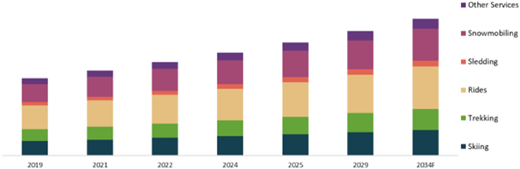
Global mountain and Ski resorts market, segmentation by services, historic and forecast. Source: The business research company. National statistics offices, UN Comtrade, TBRC analysis, TBRC Estimates, TBRC secondary
Global mountain and Ski resorts market, segmentation by services, historic and forecast. Source: The business research company. National statistics offices, UN Comtrade, TBRC analysis, TBRC Estimates, TBRC secondary
Technological innovation also plays a role in sustainability efforts. For instance, in March 2024, Vail Resorts Inc., a US-based mountain resort company, launched My Epic Assistant in the My Epic app. This feature provides 24/7 access to real-time information on snow conditions, dining, rentals and ski school schedules. It integrates recent AI advancements and expert knowledge to enhance guest services, with plans for proactive, personalized recommendations and continuous booking support. This innovation aims to offer efficient, real-time support to guests, reduce operational costs and demonstrate Vail Resorts' commitment to technological advancement and AI integration in the mountain and ski resorts [20].
Rethinking French Alpine tourism: from mass to sustainable models
The Alpine countries dominate the global ski industry across multiple indicators, confirming their status as the world's most significant ski destinations. They host 39% of the 1,945 ski resorts equipped with more than four lifts and operate 39% of the 25,093 lifts worldwide [23] – more than double the number found in the next largest region. Among the 52 major ski resorts globally, 79% are located in the Alps, underscoring their unmatched concentration of large-scale, well-equipped facilities. The Alps also capture the largest share of skier visits globally (40%), although this figure, based on a five-year average, shows a 3% decline due to pandemic-related restrictions. The second-largest destination is the Americas (mainly North America), with 23% of global skier visits. On a national level, France and Austria stand out not only for the quantity of ski infrastructure – each with around 3,000 lifts – but also for the number of high-traffic resorts: both countries have more than ten resorts exceeding one million skier visits per season [24] (see Figures 4 and 5).
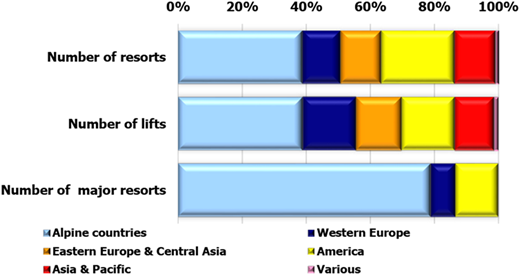
Regional weight of global ski resorts' offer. Source: 2022 international report on snow and mountain tourism
Regional weight of global ski resorts' offer. Source: 2022 international report on snow and mountain tourism
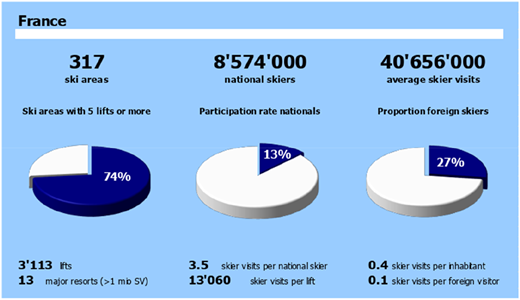
Ski tourism in France. Source: 2022 international report on snow and mountain tourism
Ski tourism in France. Source: 2022 international report on snow and mountain tourism
In this scenario, France holds a particularly prominent position in the global ski industry [25]. It shares with Italy the highest peak in the Alps – Mont Blanc, rising to 4,808 metres above sea level – and boasts 24 Alpine summits exceeding 4,000 metres. While the French Alps are home to the country's largest and most renowned ski resorts, such as La Plagne, Val Thorens and Les Arcs, ski areas are also found across other mountain ranges, including the Jura, the Pyrenees, the Massif Central, the Vosges and even on the island of Corsica.
This leadership is reinforced by the historical legacy of the Plan Neige [26] in the 1960s and 1970s, which saw the development of high-altitude, purpose-built ski towns – dense urban environments in the mountains designed to absorb a growing demand for winter sports.
However, climate uncertainty, shifts in consumer behaviour and land use constraints have further exposed the vulnerabilities of a model that remains largely volume-driven.
Mass tourism is, in fact, increasingly subject to critical scrutiny, as the pressures it imposes on local ecosystems – particularly regarding snow reliability, water consumption and urbanization – raise significant concerns about long-term sustainability. Resorts designed for high throughput and rapid turnover have contributed to environmental degradation, landscape fragmentation and uneven socio-economic development.
Against this backdrop, smaller ski resorts like Sainte-Anne La Condamine in the Ubaye Valley offer an alternative approach. Located in a less densely developed and environmentally preserved area, Sainte-Anne exemplifies a territorially embedded model of mountain tourism. Its minimal infrastructure, quiet surroundings and closer alignment with local identity and natural rhythms contrast sharply with the industrial logic of high-capacity resorts.
Crucially, Sainte-Anne operates outside the mainstream framework of mass visitation. The absence of large hotels, expansive parking lots and high-speed lift networks reduces pressure on land and resources, while enabling a more harmonious relationship between tourism and the environment. This community-integrated model fosters local stewardship, seasonal flexibility and diversified visitor experiences, including nature-based and cultural activities that go beyond skiing.
Sainte-Anne demonstrates that sustainable ski tourism does not require scale, but rather coherence between infrastructure, ecological limits and community values. It also illustrates how small-scale resorts can contribute to a more balanced and resilient mountain economy, especially in marginal areas where large-scale development is neither feasible nor desirable.
Ultimately, the case of France reflects both the strengths and limits of traditional ski tourism. While the Alpine infrastructure remains unparallelled, the path forward lies in transitioning from a centralized, volume-oriented model toward more diverse and locally rooted strategies. Small resorts like Sainte-Anne La Condamine serve not only as functional alternatives but as conceptual guides for rethinking what ski tourism can and should be in an era defined by environmental urgency and social change.
Methodology
The purpose of this study lies in the ongoing process of analysis (and comparative evaluation) of the “non-predatory” and efficient proposal of a French ski resort system (reachable from the province of Cuneo via the Colle della Maddalena) capable of promoting the development of the territory's innovative potential toward paths of accessibility and attractiveness (e.g. efficiency of offerings, tourism-cultural marketing, customer satisfaction). Considering the phenomenon in a holistic manner, the case-study [27] approach was adopted, with the help and testimonies from the project work contributors of the first four editions of the Executive Master in Management and Promotion of Mountain Systems - SAA-School of Management in Turin - COREP - UNCEM [28] - ANCIM [29]. The approach was used to present the most significant characteristics of the dynamics encountered, systematically investigating a ski resort and a small French ski station (1. Ubaye, 2. Sainte-Anne la Condamine), aimed at supporting the local economy (small businesses), including those on the Italian side.
In three phases (January-March 2023, January-March 2024, January-March 2025 ), semi-structured interviews [30] were conducted in person on-site (Sainte-Anne la Condamine ski resort, 92 km from Cuneo, 151 km from Nice, 787 km from Pau) and with visitors (passing customers) at the Agnello pastry shop in Demonte (CN), a well-known establishment frequented by skiers and mountaineers travelling through the Valle Stura (Italian side) to France, particularly toward the ski resorts of Ubaye and two rest points located on the resort slopes (La Renardière and La Resinière).
The target participants were selected through a sampling procedure among the staff of local businesses at the station, as well as skiers/tourists (encountered in the relevant areas and on the Italian side). The interview began with an introduction to present the project to the interviewee, followed by a conversation where key questions were asked. This was followed by an open section to gather any spontaneous input from the participants.
A subsequent phase of the research required the use of computational techniques, specifically Natural Language Processing (NLP) and text-mining, to retrieve and analyze 676 “digital” reviews of the Sainte-Anne la Condamine station from the Google Maps platform. In parallel, Google Analytics data were analyzed to obtain a deeper understanding of users' digital behaviour, including visitation patterns and online engagement with the resort's official platforms. The integration of these multi-source data – qualitative digital reviews, behavioural analytics and on-site interviews – allowed for a more comprehensive interpretation of visitor perceptions, expectations and usage trends, reinforcing the empirical robustness of the study and providing a holistic view of the destination's attractiveness and its potential for long-term resilience.
The 676 Google Maps reviews were extracted via a Python-based web scraping pipeline and pre-processed using the spaCy library for tokenization, lemmatization and stop-word removal. Sentiment classification was conducted at the sentence level using a multilingual BERT model (bert-base-multilingual-cased), selected to handle the multilingual corpus (French, Italian and English). Each review was assigned a sentiment polarity score (ranging from −1 to +1) and a thematic label based on a predefined coding scheme. This scheme was organized into six categories corresponding to the dimensions of the innovability matrix: Visione (shared vision), Progetto (project execution capability) and Squadra (team cohesion) for the accessibility axis; Giovani (youth engagement), Rete (network capacity) and Comunicazione (strategic communication) for the attractiveness axis.
A TF-IDF adjustment was applied to assign greater analytical weight to thematically distinctive reviews, thereby reducing the influence of generic positive or negative comments. Inter-rater reliability was assessed on a 10% random sub-sample, independently coded by two researchers (Cohen's kappa = 0.78, indicating substantial agreement). Finally, sentiment scores were normalized to the matrix's A–C scale (A = high alignment; B = moderate alignment; C = poor alignment).
The forty-one interviews (conducted during the winter seasons of January–March 2023, 2024 and 2025) [31] followed a protocol structured into four thematic blocks:
perceived attractiveness of the Sainte-Anne destination (landscape, services, value for money, uniqueness);
perceived accessibility of the territory (transport, information, digital presence, community hospitality);
adaptation behaviours and expectations regarding climate change;
attitudes toward sustainable residentiality and local investments.
The interviews, lasting 20–30 minutes each, were conducted in French and Italian. Transcriptions were analyzed thematically following Braun and Clarke's [32] six-phase procedure, involving independent double coding and the resolution of discrepancies through researcher triangulation. Analytical saturation was reached after approximately 35 interviews.
The environmental heritage of Ubaye
With nearly 54 million ski days per year, France is the second-largest ski destination in the world, following the United States. The operation of cable car systems alone generates a turnover of approximately 1.6 billion euros. The unique infrastructure and ability to differentiate its offerings have secured France's position as a global leader in skiing. The French ski resort cluster spans over 1,100 km2, with 357 ski resorts located across five mountain ranges (the Pyrenees, Massif Central, Alps, Jura and Vosges) [33].
Protecting a territory does not preclude the tourism industry from thriving and generating profitability. An example of this is the success of the French model, observable in the management and marketing strategies of the Ubaye Valley, a territorial system that, through its governance, has managed to make a tourist destination unique without losing its original and traditional characteristics. The French Valley represents a cluster of all sports and cultural activities. Its landscape offers unprecedented beauty: mountains crossed by the Ubaye River, which flows into the Serre-Ponçon Lake.
All products, from wellness services to the tourist offerings provided by local structures, are offered at affordable prices, as revealed in interviews. The decision to keep prices stable for products and services allows all types of tourists and visitors to explore the territory, thus preventing the valley from becoming an elitist destination. The construction of the Serre-Ponçon Dam in the 1950s, and later the ski resorts of Pra-Loup, Le Sauze and Sainte-Anne-de-la-Condamine, marked a turning point in the region's economy. The valley, which once relied on agro-pastoralism, now primarily thrives on tourism, both in summer and winter. In fact, the Ubaye Valley is also characterized by immense natural wealth associated with various environmental protection perimeters and biodiversity inventories, such as the Natura 2000 network and the Mercantour National Park, which contribute to the development of green tourism. Similarly, memory tourism is growing, thanks to visits to the Tournoux Fort [34].
In 2017, the Ubaye Tourism office met the criteria required for the national ministerial brand “Qualité Tourisme de France” thanks to the timeliness of information flow, integrating the high quality provided and the constant awareness and responsibility towards all local stakeholders. There is a reciprocal relationship between the increase in population and the rise in businesses opened or established, demonstrating the degree (see Table 1) of the area's “economic fertility” [35].
Sainte-Anne la Condamine
Ski resorts can be considered, although within a range of variability based on ownership structure, as true business organizations [36] subject to assessments of efficiency and customer satisfaction. These businesses, which, despite varying levels of specialization, are dedicated to winter sports, are facing new challenges related to the growing awareness of the impacts that mass skiing practices have on both the natural environment and the social balances of local communities. This is particularly evident in the alpine region due to the high level of human settlement in the mountain valleys, creating a significant difference compared to resorts (starting from the famous ski resorts in North America [37]) where isolation and the lack of inhabited settlements prevent conflicts over resource use and the evaluation of the impacts (including those non-economic) of the investments made.
In the heart of the Ubaye Valley, the small Sainte-Anne La Condamine ski resort [38] welcomes ski enthusiasts and lovers of wide-open spaces, nestled between environmental heritage and absolute tranquillity. Located between the Parc du Mercantour and the Parc du Queyras, Sainte-Anne offers, at an altitude of 1,830 metres, an incomparable natural environment where visitors can enjoy ski-in, ski-out vacations (daily ski pass at 22 euros). This destination is particularly accessible to families and young people, offering a non-predatory approach to the commercial ski offer, closely tied to a small network of local shops and businesses that provide just-in-time services and assistance, drawing on local experience and expertise. In this context, the model represented by this type of “community-based” offering is a significant element in the subalpine rural world, thanks to the principle of preserving agricultural and pastoral activities, the diversity of activities, land management and the dimensions and quality of the territorial system, which is in harmony with an unspoiled natural environment. Agriculture has not undergone any replacement process, as is common in many larger resorts. On the contrary, not only has it been preserved, but, alongside the inevitable reduction in the number of farms through consolidation, it has been strengthened and specialized.
Many farmers in the valley have reinvested their profits by diversifying into the tourism sector, managing small accommodations (refuges, hotels, bed and breakfasts) and service infrastructures supporting the ski offering, while many young residents have taken advantage of the tourism boom to start their own businesses, including hotels, guesthouses, shops and enterprises in painting, masonry and construction [16].
The “innovability” matrix (innovation and sustainability)
A SWOT analysis conducted through repeated field surveys and observations identifies as weaknesses the modest size of the activity perimeter (the ski area), the presumed obsolescence of the ski lifts and the risks related to vulnerability to climate crises.
At the same time, however, among the strengths appreciated by tourists, the family-run offering fosters “community-based” tourism through the involvement of local stakeholders and residents and by creating a sense of place. This is a three-dimensional concept in which people relate to each other and to the surrounding natural environment within a specific geographic space, fostering a connection that develops between nature, culture, traditions and relationships. This emerged from interviews with the selected sample but was also confirmed through significant digital data collection, with 676 reviews collected online (see Figure 6), which, overall, describe - still in an experimental phase – the following innovability matrix (innovation and sustainability), determined by the attractiveness of the territorial system [39].

The sense of place transcends social constructs, and as Stedman [40] emphasizes, the physical environment can contribute to the creation of a profound meaning tied to the place.
A sense of place characterizes a “special place” that is considered particularly valuable [41], but it also necessarily incorporates human activity, in terms of presence and action (e.g. the consulting and assistance provided by “Pascal”, the ski rental shop for adults and children), as well as the atmosphere, the social context and the bonds (and exchanges) that are created with the local community.
The matrix operates through a double-entry framework, mapping two strategic dimensions:
attractiveness: comprising Giovani (youth engagement), Rete (network capacity) and Comunicazione (strategic communication);
accessibility: comprising Visione (shared vision), Progetto (project execution capability) and Squadra (team cohesion).
This generates a 3x3 grid with nine strategic profiles (see Table 2). Territories can thus be evaluated not only on their current positioning but also on their movement over time within the matrix.
Innovability matrix (innovation and sustainability)
| Young | Net | Communication | |
|---|---|---|---|
| Vision | AC | BC | AA |
| Project | BB | BB | BA |
| Team | AB | AA | BA |
Each of the six parameters of the matrix was operationalized through a composite indicator derived from the triangulation of three convergent sources:
regional statistical data provided by the Agence de Développement des Alpes de Haute-Provence, used as quantitative benchmarks for economic fertility, new business creation and demographic dynamics, serving as proxies for the Giovani (youth engagement) and Rete (network capacity) dimensions;
weighted NLP sentiment analysis of the 676 Google Maps reviews, which generated specific scores for the Comunicazione (strategic communication), Visione (shared vision) and Squadra (team cohesion) dimensions;
thematic analysis of the forty-one semi-structured interviews, which provided the qualitative foundation for all six dimensions, with particular emphasis on Progetto (project execution capability) and Squadra (team cohesion).
The three sources were triangulated using a convergent mixed-methods approach [42]: concordant signals from two or more sources resulted in Grade A; conflicting signals resulted in Grade B; and concordant signals of absence or underdevelopment resulted in Grade C.
The (1) analysis and reworking of regional observation data provided by Agence de Développement des Alpes de Haute-Provence, (2) the weighted sentiment analysis of 676 Google Maps reviews and (3) semi-structured interviews (winters 2023, 2024, 2025) with a random sample of tourists intercepted at the station and at an important stopover point in the Stura Valley of Demonte, have made it possible to propose a first experimental version of the innovability matrix. This framework allows public decision-makers to better assess the territorial ecosystem in which to establish their economic activity (“professional horizon”) or where to activate new residentiality (“biographical horizon”). By integrating these multi-source data, the matrix serves as a strategic tool for evaluating territorial resilience and guiding sustainable investment.
For example, a municipality with strong communication and youth engagement but lacking internal governance may fall into the “Narrative Overload” quadrant. Conversely, areas with solid teamwork and vision but poor external communication may suffer from “Invisible Innovation”.
The optimal position is the top-right cell, representing territories high in both attractiveness and accessibility – what we call the Innovability Zone. Here, systemic synergy enables sustainable innovation, citizen engagement and competitive advantage.
The Innovability Matrix is underpinned by a formal model:
Where:
Y_ij: Innovability score for territorial unit i on axis j
X_i: aggregate score on attractiveness (youth, network, communication)
Z_j: aggregate score on accessibility (vision, project, team)
X_i × Z_j: interaction effect capturing systemic alignment
ε: error term
This model allows for econometric estimation using multivariate regression techniques. The interaction term is particularly relevant as it captures the synergistic effect of well-balanced strategic dimensions. Such a model also supports clustering, ranking and scenario forecasting when applied to municipal or regional data.
Pilot applications of the matrix have been undertaken in Italian rural contexts such as Cortona, Ostana and Samugheo. Indicators were drawn from ISTAT, Eurostat and regional development databases, with qualitative validation through stakeholder workshops.
Cortona, a Tuscan town with strong heritage capital and strategic communication initiatives, has recently advanced along both axes through targeted policies supporting youth and digital connectivity.
Samugheo, in Sardinia, illustrates a growing innovation ecosystem based on traditional textile clusters and new forms of social entrepreneurship, showing promise in both team dynamics and external networks.
Ostana in Piedmont, despite significant investment and media attention, remains a cautionary tale. Its limited youth presence and low attractiveness for new residents reveal a critical imbalance in the matrix.
These cases illustrate how the matrix not only diagnoses strategic misalignments but also reveals emergent opportunities. Cities and small towns alike can reposition themselves by targeting underdeveloped quadrants.
Effects of climate change on Sainte-Anne ski resort
Climate change has already led to a reduction in snow cover in mountain areas, mainly at low and medium elevations, with snow-scarce seasons becoming increasingly frequent and disrupting the operating conditions of many ski resorts. Continued warming over the coming decades will further reduce the reliability of natural snow cover. The decline is widespread, but the effects on the viability of ski areas vary according to local characteristics (elevation, aspect, slope) and the role played by artificial snow production [43].
In this context, a methodology named “ClimSnow” has been developed by a consortium including Météo-France, INRAE (Institut National de Recherche pour l’Agriculture, l’Alimentation et l’Environnement) and Abest-Dianeige (a consultancy company specialized in mountain tourism development). This methodology makes it possible (1) to quantify the effects of climate change on the evolution of snow and weather variables and on the reliability of snow cover in ski resorts, (2) to compare operating conditions up to 2050 (taking into account topography and snow management techniques) and (3) to define concrete elements to guide the operators in their investment choices and their strategies for diversifying tourism activities.
The main result of this approach is to quantify, at various timescales, the reliability of snow conditions, their variability and the capacity of each ski resort to keep its ski slopes open. In order to estimate the effects of climate change on snow conditions in ski resorts over the coming decades, ClimSnow uses state-of-the-art scientific research tools (climate predictions with greenhouse gas emission scenarios, physical modelling of changes in snow cover, including grooming and artificial snow, taking into account the local topography). A series of indicators is calculated and analyzed: snow reliability index, return rate of bad seasons, duration of the snow cover. For artificial snow, the study simulates the future evolution of the cold potential (depending on temperature, humidity and wind speed) and the volumes of water necessary for snow production.
Here we present the results of ClimSnow for the Sainte-Anne ski resort. Those results were obtained in 2021, during a larger-scale study covering all ski resorts located in the French Southern Alps. Figure 7 shows the general characteristics of the resort (ski slopes, ski lifts and snowmaking). With a surface area of about 50 ha, only 5 of which are covered with artificial snow production, Sante-Anne is considered a “small resort” according to the French classification provided by Domaines Skiables de France.
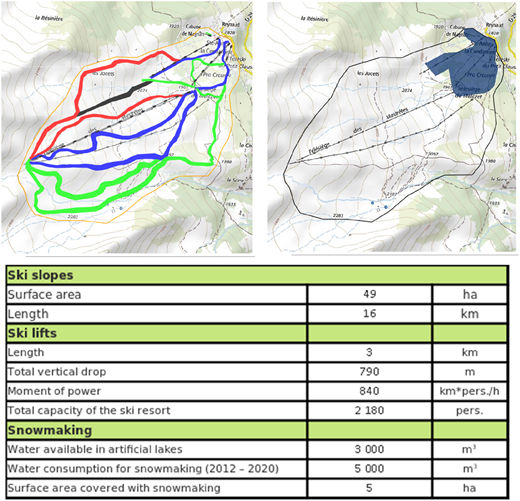
General characteristics of Sainte-Anne ski resort (ski slopes, ski lifts and snowmaking). The maps show the ski slopes with their difficulty level (top left) and the area covered with snowmaking (top right)
General characteristics of Sainte-Anne ski resort (ski slopes, ski lifts and snowmaking). The maps show the ski slopes with their difficulty level (top left) and the area covered with snowmaking (top right)
The main results of the study are presented in Figure 8 in terms of duration of the snow cover. The maps show the number of days with snow depth above a certain threshold (about 20 cm of packed snow, a quantity considered sufficient for skiing) for the RCP8.5 greenhouse gas emission scenario. Each year, the analyzed period runs from November to April, for a maximum of around 180 days. In analyzing this indicator, it should be emphasized that snow conditions will continue to vary greatly from year to year. Average values do not reflect the management difficulties associated with poor snow cover, as they can mask difficult operating conditions, compensated by a few years with particularly good snow conditions. In order to better understand how climate change will impact ski resorts' operating conditions, it is therefore necessary to take this variability into account. To this end, it is essential to study the snow cover duration during unfavourable years, to complement the view given by the analysis of the average annual snow cover.
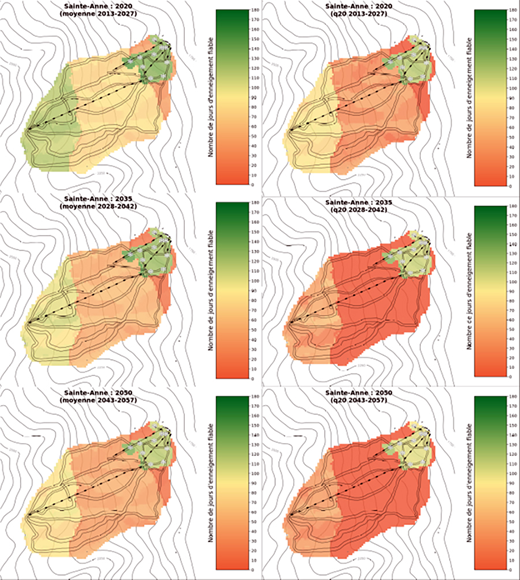
Number of days during which skiing will be possible, taking into account the RCP8.5 scenario and for different periods (from top to bottom: 15-year periods centred on 2020, 2035, 2050). The left-hand column shows snow conditions for average seasons (Q50) and the right-hand column shows snow conditions for unfavourable seasons (Q20)
Number of days during which skiing will be possible, taking into account the RCP8.5 scenario and for different periods (from top to bottom: 15-year periods centred on 2020, 2035, 2050). The left-hand column shows snow conditions for average seasons (Q50) and the right-hand column shows snow conditions for unfavourable seasons (Q20)
In addition to the evaluation of the spatial heterogeneity in the snow conditions within the resort (with, for instance, the South-Western, higher elevation sectors displaying longer seasons than the rest of the ski area), the maps allow to:
compare different time periods (2020, 2035 and 2050), each period representing the average of 15 years (for example, 2020 represents 2013–2027),
compare snow conditions corresponding to average seasons (median value, or quantile Q50) and unfavourable seasons (quantile Q20),
analyze how the resort will cope with the effects of climate change, depending on its equipment (in particular, the presence of artificial snow production).
Figure 8 enables identification of areas where snow conditions may remain adequate for skiing and shows that climate change will have a significant impact by 2050. Unfavourable seasons in terms of snow cover duration will become increasingly frequent and their conditions more difficult, with a deterioration in the reliability of the snow cover (natural + artificial). Only slopes equipped with artificial snow will guarantee more than 100 days of skiing by the middle of the century, provided that the resort still has the required amount of water to ensure such production. As a result of this trend towards more snow-scarce winter seasons, Sainte-Anne should, in the coming years, adapt and diversify its tourism offering.
Conclusion
The trend data, the opinions of key stakeholders, interviews and the collected opinions/impressions demonstrate how small settlements (small ski resorts), or “community” ski resorts, appear as resilient parts of a system that opposes, with efficient resource allocations and the protection of environmental heritage, the urban model, as an alternative to the large “urban” alpine ski resorts [44]. In this sense, the research addresses the “climate-induced economic shifts”, suggesting that the survival of small-scale resorts depends on their ability to overcome the “lock-in” effect of capital-intensive infrastructures.
The update and further development of a previous study [45] (still ongoing) on the competition and competitiveness of two sides of the Alpine arc, through the ongoing transformations in the winter tourism market, provides qualitative and quantitative information on scenarios that necessitate a “paradigm shift” in the mountain tourism offering. These changes involve the continuous search for efficiency, but also for exclusivity and total customer satisfaction through a selective pricing process [46]; and changes in demand, through the increase of immersive experiences in authentic contexts (lieux de travail) where gentrification dynamics no longer emerge, certainly facilitated by real estate speculation following the purely “architectural” recovery of villages and hamlets. The evidence gathered suggests that Sainte-Anne La Condamine represents a “non-predatory” tourism model, where the “guarantee of snow” is strategically replaced by a “guarantee of place-based experiences”, effectively mitigating the economic fragilities and high fixed costs typical of mid-altitude destinations.
Customer satisfaction is a heritage. It is an intangible asset on which companies and territorial systems invest, and for which they implement robust fundraising strategies. By looking at new indicators (see #visioneprogettosquadra) and experimentally determining a matrix equipped with a “dashboard” that describes the degree of innovability of a territory, even through hybrid strategies (not only digital), already described by the T2B (territory to business) and T2C (territory to customer) models [47]. The operationalization of the “innovability matrix” aims to provide a multidimensional diagnostic tool for mountain governance. By reconciling the “professional horizon” of investment attractiveness with the “biographical horizon” of residential sustainability, the matrix offers a scalable framework for assessing territorial resilience. This research contributes to the academic debate by shifting the focus from short-term adaptation to long-term strategic repositioning. Future policymaking in marginal Alpine areas could utilize such frameworks to prioritize public funding toward multi-seasonal diversification rather than unsustainable technological fixes. Ultimately, the study underscores that the preservation of territorial inhabitability in the face of irreversible climatic trends requires a transition from industrial-scale expansion to place-based, sustainable innovation.
Theoretical contributions, practical implications and future research directions
This study offers three distinct theoretical contributions. First, it advances the theory of destination resilience by empirically demonstrating that community-based ski resorts can follow a trajectory of transformative resilience – rather than mere persistence or decline – through the valorization of territorial capital and sense of place. Second, it contributes to the sustainability transition literature by providing a granular empirical case of a transition from the “snow-guarantee” paradigm toward a multi-seasonal, experience-based model. Third, it introduces the “innovability matrix” as an original, replicable diagnostic tool that connects resilience, territorial capital and innovation systems.
Regarding practical implications, the findings offer operational guidance for three distinct groups of stakeholders: (1) local administrators and regional authorities should prioritize investments in territorial identity, digital communication and community governance over the expansion of capital-intensive snowmaking infrastructure, (2) managers of low- to mid-altitude ski resorts can utilize the matrix as a diagnostic tool to identify strategic gaps and reposition their offerings toward multi-seasonal tourism and (3) national and EU policymakers should adjust rural development funds to support the transition of mountain economies toward place-based models, particularly in areas where snow reliability is projected to fall below viability thresholds by 2050.
As for limitations, this study relies on a single case, which restricts the generalizability of the findings; furthermore, the matrix remains in an experimental phase and the letter-based scoring system requires further statistical validation. Consequently, priority directions for future research include:
comparative applications of the matrix across multiple Alpine and non-Alpine resorts to test its discriminant and predictive capacity;
longitudinal monitoring of scores over successive seasons;
the integration of the matrix with participatory governance methodologies to assess its utility as a co-governance instrument, beyond its function as an analytical tool.
Notes
ELSASSER - MESSERLI (eds.), 2001, pp. 335–339.
SCOTT - MCBOYLE - MILLS (a c. di), 2003, pp. 171–181.
See Figure 1.
https://www.legambiente.it/. Last accessed: June 2023. The cited websites were verified between November 2022 and June 2023.
COGNARD - BERARD - CHENU - SCHAEFFER - FRANÇOIS (eds.), 2023, p. 1.
Translated as “Different Snow. Is a different mountain possible?”.
In this study, a “non-predatory” model is defined as a development strategy that prioritizes the enhancement of territorial capital over extractive practices based on short-term profit maximization. This approach aims to preserve the socio-ecological equilibrium of the local community, promoting sustainable residentiality and a diversification of the tourism offering to reduce structural dependence on ski-based infrastructures.
Translated as “Last Snow”.
INNERHOFER, FONTANARI, PECHLANER, 2018
GÖSSLING, HALL, SCOTT, 2014
GUMUCHIAN, PECQUEUR, 2007
HALL, PRAYAG, AMORE, 2017.
BONANOMI et al., 2024.
A notable example is the Viola St Grée in the Maritime Alps. This vast and multifunctional area, occupying more than 30 thousand square metres at an altitude of 1,200 m above sea level (a.s.l.), briefly thrived in the 1980s, hosting the World Ski Championships in 1981. However, due to a lack of snow, it was abandoned in 1997 (FERRARI, 2023).
IPCC, Sixth Assessment Report – Impacts, Adaptation and Vulnerability, 2023.
STEIGER, SCOTT, 2020.
See Figure 3.
See Figure 4.
International Report on Snow and Mountain Tourism, 2022.
See Figure 5.
The “Plan Neige” refers to a set of public policies implemented in France from 1964, aimed at promoting mass winter tourism in mountain regions. These policies led to the creation of large, integrated ski resorts, resulting in the construction of over 150,000 tourist beds between 1971 and 1975. The development process was largely driven by external actors, including real estate developers and state agencies, with minimal involvement from local communities. While the Plan Neige helped establish a winter sports industry in France and promoted international visibility for Alpine resorts, it also caused significant environmental and social impacts, particularly in fragile mountain ecosystems. The policy's rapid implementation and its focus on large-scale developments have been increasingly criticized, particularly in light of the contemporary need for more sustainable and community-centred mountain tourism.
Unione Nazionale Comuni ed Enti Montani (National Union of Mountain Municipalities and Entities).
Associazione Nazionale Comuni Isole Minori (National Association of Municipalities of Minor Islands).
During the two on-site terms, a total of forty-one interviews (no longer than 30 minutes each) were conducted with a randomly selected sample over several days of the week.
The results of the interviews conducted between 2023 and 2025 - on dates that can be verified through electronic payment records made on-site by Monge Filippo - were further corroborated by three additional field inspections at the study site (the Sainte-Anne ski resort). These inspections were carried out on February 1, 9 and 27, 2026, a period that coincides with an extended school holiday within the French academic calendar.
BRAUN, CLARKE, 2006
BARROS - BOTTI - GEORGE ASSAF - PEYPOCH - ROBINOT - SOLONANDRASANA (eds.), 2011, pp. 141–146.
At La Condamine-Châtelard stands the fortress of Tournoux, built in the first half of the 19th century and incorporated into the Maginot Line in 1940. The fortress, constructed to protect the intersection of the Ubaye Valley with the Ubayette Valley, extends along the mountain slope for about 700 metres. The barracks can be reached via a staircase carved into the rock or a cable car (now out of use), or by a trail from the village of Tournoux.
34% of the 171 new businesses established in 2022 belong to the wholesale and retail trade, transportation, accommodation and food service sectors.
In September 2023, Reed Hastings, co-founder and former CEO of Netflix, acquired a controlling stake in Powder Mountain, absorbing over 100 million dollars in debt. At the same time, he announced a business model never seen before in the ski industry: he would make 2,000 acres (about 800 hectares) of the mountain system in question private, accessible only to “clients” who owned homes in an exclusive enclave at the top of the mountain, willing to accept an annual membership fee ranging from 30,000 to 100,000 dollars per year. Hastings is not the only owner of a ski area with this strategy: in 2022, the owners of Homewood Mountain Resort in California announced plans to limit sales of season and day passes to selected homeowners in that “reserve”. After public protests, that plan was scrapped. The new owners of Windham Mountain Club, in New York, announced in October 2023 that they would charge a membership fee starting at 175,000 dollars, which would allow benefits such as access to exclusive time slots on designated slopes. According to Harris Sondak, former mayor of Alta, Utah and professor at the David Eccles School of Business at the University of Utah, more ski areas may adopt a public/private model to increase revenue (Megroz, 2024).
Opened on January 14, 1958, the management and operation of the resort were transferred in February 1991 to the Société d’Économie Mixte Haute Ubaye, which was liquidated in 1994. The resort was then taken over by the Communauté des Communes de la Vallée de l'Ubaye, which installed an artificial snowmaking system with low-pressure snow cannons and completed the work with an area equipped for children. In 2008, ten traditional chalets were built along the slopes, increasing the number of tourist accommodations at the resort. On January 30, 2013, the resort received the “Station Village des Alpes du Sud” label. By prefectural decree n. 2016–351–012 of December 16, 2016, on January 1, 2017, the “Vallée de l'Ubaye” (CCVU) and “Ubaye Serre-Ponçon” (CCUSP) communities of municipalities merged to create the new community of municipalities, “Vallée de l'Ubaye Serre-Ponçon” (CCVUSP).
Experimental tool presented by the author of the contribution at the SAA-COREP-UNCEM-Piedmont Region meeting on April 19, 2024. The values expressed in letters assign a ranking of the innovability of the territorial system.
STEDMAN, 2003, vol. 16, n. 8, pp. 671–685.
EISENHAUER - KRANNICH - BLAHNA (eds.), 2000, pp. 421–441.
CRESWELL, PLANO CLARK, 2018
https://www.economist.com/. See The Economics of Skiing in America, February 27, 2024.
MONGE - GERBALDO - BRUNO (eds.), 2002.

