


The study examines the critical success enablers (CSEs) for rural entrepreneurship to identify and rank hierarchically, which is essential for the success of rural enterprise (RE). The study mainly explores the influential relationships among the CSEs and assesses driving, dependence and linkage enablers for strategic decision-making.
The study follows a mixed-method research design, with a qualitative method of CSEs identification from the literature with theories, and confirming through experts' opinions. The quantitative analysis was through total interpretive structural modeling (TISM) and matrix of cross-impact multiplications applied to classification (MICMAC). The study links with institutional theory, resource-based view, sustainable livelihood framework, etc.
The results indicate that the institutional, policy, financial accessibility, and infrastructure support are the independent CSEs based on driving power, and the innovation and adaptability, and skill enhancement and training are the most dependent enablers.
The study contributes to the theory by proposing an interdisciplinary insight into RE and offering future research directions, with sustainable development goals (SDGs) in digital entrepreneurship, green entrepreneurship models, etc.
The study provides a practical contribution and policy interventions on credit affordability, microfinance options, less collateral loans, innovation hubs, etc. to solve the barriers for improving performance and innovation, with SDG 1 and SDG 8 by RE for income generation and reducing unemployment; SDG 9 by improving infrastructure and innovation; SDG 5 through promoting women REs; and SDG 10 through accelerating a more equitable environment.
The study is integrated research linking with TISM, MICMAC and ADO-based SDGs aligned framework for CSEs.
1. Introduction
Rural entrepreneurship is important for economic development, society's well-being and reducing specific social issues like poverty, unemployment, etc., in emerging economies (Gyimah and Lussier, 2021; Shao et al., 2024). The livelihood generation of the rural communities through opening employment opportunities by the small-scale enterprises located in rural communities (Eschker et al., 2017; Gyimah and Lussier, 2021). The usage of the resources by them is locally available, and developing innovation promotes rural development and developing sustainable communities (Müller and Korsgaard, 2018). Hence, there is importance for the development of the rural enterprises (REs) in the developing and underdeveloped countries that are still facing issues of poverty, employment, less developed advanced innovations and have a desire for equitable social and economic development (Baalbaki and El Khoury, 2025).
Apart from these opportunities, there are also challenges faced by REs. It includes the resource-based constraints, market accessibility hurdles, infrastructure issues, financial literacy deficiency, social and cultural mindset-related barriers, including gender dynamics in the case of rural women entrepreneurs (Rahman et al., 2023; Gyimah and Lussier, 2021). The sustainable livelihood framework (SLF) suggests that the success of RE is based on the economic, human, social, technological, psychological and physical resources and capitals (Tabares et al., 2022). This highlights that the current requirements for rural development are also linked with sustainability goals (Shao et al., 2024).
The examination of the critical success enablers (CSEs) for the RE is significant in the current scenario, aligning with the United Nations sustainable development goals (SDGs). Entrepreneurs are contributing to the different SDGs such as SDG 1 (No Poverty), SDG 8 (Decent Work and Economic Growth), SDG 9 (Industry, Innovation and Infrastructure) and SDG 10 (Reduced Inequalities), etc. (Alka et al., 2025c). Therefore, the study covers the most important contributions to sustainable rural development, developing an entrepreneurial ecosystem, and equitable economic growth.
Existing research analysed rural entrepreneurship through isolated elements or outcome-based models. When examining examples, Gyimah and Lussier (2021) highlighted that the RE performance leads to success through the major factors such as capital, experience, staffing and marketing skills, while Eschker et al. (2017) identified that economic and financial support and guidance systems. These studies provide a valuable understanding of the rural entrepreneurship success, and these insights are lacking in how these enablers interact, nor do they explain which are the most foundational or driving enablers or outcomes. Although Pato and Teixeira (2016) highlighted that the theory building is limited in rural entrepreneurship because most studies adopted descriptive or regression-based approaches that are not enough to provide prioritisation and policy sequencing guidance. Hence, this gap is filled in this research by providing the hierarchical level or priority model.
Recent contributions to the literature cover important understanding of specific dimensions of rural entrepreneurship, such as spatial context and resource bridging (Müller and Korsgaard, 2018), ecosystem components (Asmit et al., 2024), inequality and information access (Baalbaki and El Khoury, 2025) and sustainability-based evaluation mechanisms or systems (Shao et al., 2024). The qualitative study identified that there are critical barriers in the rural women-led enterprises (Rahman et al., 2023). However, this does not provide a model of the interdependencies among enablers, along with integrating multiple theoretical perspectives into a unified single explanatory framework to inform targeted interventions.
This study fills these gaps through offering theoretical as well as practical contributions through an integrated hierarchical framework of CSEs for rural entrepreneurship. The study explains not only what enablers are, but how they interact, relative influence and sequencing, helping both theory-building and policy relevance, and why particular enablers are coming as foundational drivers while others emerge as linkage or dependent enabler outcomes. Theoretically, linking with institutional theory, resource-based view (RBV), social capital theory (SCT), diffusion of innovation (DOI) theory and the SLF, the study explains, with total interpretive structural modeling (TISM) for identifying interrelationships and cross-impact matrix multiplication applied to classification (MICMAC) for classification of enablers based on the driving power and dependence analysis through co-evolve and condition one another rather than operating as isolated determinants and limiting only to the identification of success enablers to explain why enablers important for the success REs, how they interact and how they support to the sustainable rural development. For the comprehensive examination on how the interrelationship of CSEs for REs is formed (RQ 1) and what the driving and dependence are among the enablers (RQ 2). Hence, this study contributes to theory-building in a field that highly fragmented and empirically descriptive and practically, informing decision-making in rural entrepreneurship and provides actionable recommendations for policymakers and institutional practitioners to call for their interventions along with how institutional and resource-based enablers interventions should be prioritized and sequenced to maximize impact, which promotes and develops sustainable rural development and contributes to the achievement of the sustainable development goals and a basis for sustainability-oriented policy sequencing and design for rural entrepreneurial ecosystems that support inclusive and sustainable rural development.
The remainder of the paper is organised as follows. Section 2 of the study presents the relevant theoretical foundations and develops the integrated conceptual foundation linking rural entrepreneurship enablers with appropriate theories. Section 3 explains the research design and methodological procedures, including the expert selection, data collection and the what, why, how and rationale for the application of TISM and MICMAC. Section 4 reports the results on the hierarchical relationship of success enablers and their driving power-dependence classification, followed by Section 5, which discusses the findings compared with existing literature, theoretical lenses, etc. Section 6 describes the theoretical, practical, policy and societal implications of the research. Section 7 highlights the future research avenues, including how the limitations will become further research directions. The last section concludes the paper.
2. Theoretical foundations
This study adopts a multi-theoretical but integrated approach through a complementary analytical framework of interconnected elements. This is explained in this section. Institutional theory is one of the theories that covers the success enablers, elements of policy and regulatory environment. Another success enabler lens is captured by the RBV, covering firm-level resource capabilities. Likewise, the SCT focuses on community embeddedness, the DOI theory explains innovation adoption and flexible or adaptability stages, and the SLF combines these with a connection to the enterprise-level settings to long-term livelihood sustainability focus. Therefore, this integrated approach of these theories provides a foundation for the context on identifying, assessing, interpreting and hierarchically prioritizing the CSEs in RE, which cannot be adequately described by a single theoretical lens-based framework.
2.1 Institutional theory
Institutional theory examines how formal and informal rules, institutions and behaviors influence the firms (Balzano et al., 2025). The entrepreneurial operations are based on the resources and efficiency, but the institutional aspects, like the rules, policies, norms, laws and the execution within the society, which is rooted in culture, are also significant (Adom and Ackom, 2024). In this, the situations are creating opportunities, and at the same time, they are also drawing hurdles for the enterprises through the cumbersome process at the administrative level and the incentives (Suchman et al., 2001; Aldrich and Baker, 2001). The informal institutions include the elements of the norms, values, beliefs and the community-based entrepreneurial process for meeting the needs (Bruton et al., 2010). The strain from the regulatory bodies and government institutions is classified as coercive force, the desired expectation from society, and the professional is called normative, and the peer imitations are classified as mimetic forces that are impacting the enterprises (Yin et al., 2024).
In the case of CSEs in REs, the institutional theory is significant. Here, the actors, such as Institutional and Policy Support (E5), relate to the coercive pressures comprising the incentives, subsidies and flexible laws important for REs' success. Social Capital and Community Engagement (E6) comprises the informal or normative pressures, like norms, values, beliefs and trust, that affect the collaboration. Innovation and Adaptability (E7) is connected with the mimetic aspect because the REs will imitate the peers who are successful in effectively dealing with uncertainty. The other CSE Finance Accessibility (E1) and Infrastructure Support (E3) are also connecting with formal and informal institutional mechanisms, which are linked with institutional theory. Therefore, institutional theory is influencing the REs in the areas of resources, financial support and long-term sustainability of REs.
2.2 Resource-based view (RBV)
The RBV by Penrose (2009) and by Barney (1991) identified that the enterprises required different resources that are essential for success and competitive advantage. The resources include the human, non-human, organizational, technological, financial, etc., which are essential for the enterprises (Yang et al., 2025). The theory emphasizes that firms must strategically manage and develop these resources to maintain resource management is essential for the firm, resilience and sustainability. Agrawal et al. (2025) integration of the resources is also a difficult task, and there is a chance for problems for the economic issues, such as capital, human-related resources and the digitalization-linked resources. The RBV framework covers the resource acquisition and usage, which covers the adaptation to the changing environments (Agrawal et al., 2025). The enterprise's success is significant in relation to the strategic management of resources for innovation and exploiting opportunities, which is helping to enhance competitive advantage. RBV theory is connected with the Finance Accessibility (E1), Skill Development and Training (E4) and Infrastructure Support (E3). Finance accessibility consists of the economic resources called capital, which are essential for the commencement, operation and sustainability of the REs. Skill development and training come under the human capital resources, which are significant for the development of the learning culture and facilities, expanding knowledge, promoting skill development and enhancements and leading to an increase in competencies (Agrawal et al., 2025). Infrastructure support is linked with the organizational capital. Hence, the success of the REs is aligned with the effective usage of the resources, and it will lead to innovation development, skill development and the success of the REs.
Hence, RBV accompanies institutional theory by focusing on how REs change the opportunities or conditions into competitive capabilities by utilizing the resources in an effective manner.
2.3 Social capital theory
SCT explains community participation and the interactions will help the firm to achieve its objectives through valuable resources (Thomas and Gupta, 2021). According to Nahapiet and Ghoshal (1998), social capital includes the cognitive, relational and structural aspects. The structural includes the networks and the social interactions, whereas the relational includes the obligations which are mutually inclusive, the trust, the cognitive and the shared values. This social capital promotes the dissemination of information, promoting innovation and increasing the shared cooperation culture (Tsai and Ghoshal, 1998). The social capital not only creates social benefits, but it also provides economic advantages derived from the interrelations and mutual relationships with the community and cooperatives. The interrelationship between the community will help to solve social issues like poverty, unemployment or even calamities (Thomas and Gupta, 2021). Liu et al. (2024) applied this theory in the case of rural regions while examining the importance of social capital at the village level, promoting the farmers' innovation through entrepreneurship, which helps the development of the village or local area. The social capital is also involved in the dissemination of information among the financial institutions and the entrepreneurs, and increases the resilience, innovations and promotes the community's financial inclusion.
Here, in this research, the SCT is linked with the enablers Social Capital and Community Engagement (E6), Finance Accessibility (E1) and Skill Development and Training (E4). The high social networks, trust, connections and norms among the communities will help the REs to get the economic, market and resource access and sharing, which is actually informal structures (Hj Talip and Wasiuzzaman, 2024). Social capital also promotes collaboration and learning, which are essential for developing the expertise, knowledge, skills and overall capacity building enhancements in the entrepreneurial ventures. Peer learning is also effectively done through social capital. The social legitimacy is also developed through the cooperative and the integrated social involvements and the development of the social networks (Brogan and Dooley, 2024). The sustainability of the enterprise is related to the social capital, especially at the local level, aiming for the inclusive social and economic development (Liu et al., 2024). Thus, the social capital is one of the most important elements for promoting entrepreneurship at the local level, which is covered by the SCT angle. Therefore, this theory is strongly relevant here in the study of CSEs for the REs.
Social capital supports legitimacy, knowledge exchange and resilience, which are important for the meso-level with institutional and regulatory environments, along with enterprise-level outcomes.
2.4 Diffusion of innovation (DOI) theory
DOI by Rogers et al. (2014) explains the way in which ideas can be executed in the social system over a period of time. Patnaik and Bakkar (2024) highlighted diffusion as the circulation or propagation of the innovation through a particular mode of communication that has specific attributes. The major attributes for the adoption are split into five categories, such as “relative advantage”, “compatibility”, “complexity”, “trialability” and “observability”. These cover the individual or the firm's identification of the usefulness of the adopted idea, and even the new innovative technology option. The theory also covers the five major categories of adopters. They are at different levels of innovation and also the tolerances for risks. They are “innovators”, “early adopters”, “early majority”, “late majority” and “laggards” (Uzumcu and Acilmis, 2024). Diffusion is a multi-level process, and it includes different components such as the experience in the previous, some contextual elements, and threat levels mainly from the digital advancement (Xu et al., 2024). Hence, DOI theory is significant for the innovation levels lenses in the RE contexts.
The DOI theory links with Innovation and Adaptability (E7), Skill Development and Training (E4) and Institutional and Policy Support (E5). The DOI is essential in the entrepreneurial activities and elements like the adoption of innovative technologies, sustainable business models, based on the perceived benefits, covering the lens of relative advantage. The compatibility is covered through the organization of the activities and the ultimate aim for meeting the local level expectations and the needs, as well as traditions. Trialability is the process of experimenting and articulating the solution. The chance of uncertainty is high while adopting innovation. In this case, the policy support and the institutional assistance are essential elements for motivating entrepreneurs to go for innovation and its diffusion with understanding and training, and suitable and relevant tools or modes (Patnaik and Bakkar, 2024). Therefore, this theory is relevant here in the aspects of the REs innovation, which is a major element for their success and resilience in the event of high competition.
Thus, DOI further supports RBV and SCT through the adaptive and innovative mindset and behavior by utilizing the resources and social networks.
2.5 Sustainable livelihood framework (SLF)
The SLF relates to how the REs effectively manage their resources to contribute toward the livelihood sustainability in the presence of social issues. Tabares et al. (2022) highlight that SLF covers a resource-based dimension, which includes the importance of five types of capital, such as economic, physical, human, social and natural. Economic capital includes resources in monetary terms, including incentives, savings, loans and grants. Whereas the physical capital covers the better infrastructure, adoption tools and technology, which are important for production. Human capital is related to the human resources, such as expertise, skills and knowledge. The social capital covering the networks and relationships, and natural capital consists of the resources such as land, water and other environmental resources (Tabares et al., 2022). Another element is the psychological capital, covering the optimistic mindset and the resilience for entrepreneurial success (Tabares et al., 2022). Fahad et al. (2023) highlighted that the lack of any of these capitals in rural households resembles poverty. The proper understanding and management of these capital deficiencies is essential for adopting sustainable interventions for sustainable livelihoods in the rural areas. Hence, the SLF combines the capital enhancements, accessibility and use of resources, and sustainable innovations for the social outcomes.
Here, in the study focusing on CSEs in REs, the Finance Accessibility (E1), Infrastructure Support (E3), Skill Development and Training (E4) and Social Capital and Community Engagement (E6) are directly linked with SLF. Economic capital accessibility covers the financial capital lenses, such as grants, financial assistance by loans, etc., which are essential for the success of REs (E1), and the infrastructure (E3) comes under the physical capital for operations. Human capital is linked with development, knowledge and skills essential for entrepreneurial activities and innovation, linked with the identified enabler skill development and training (E4) (Tabares et al., 2022). Social capital, as per the SCT and also in SLF, there is importance of the trust, community networks and engagement (E6), which is also one of the bases for the entrepreneurial operations in REs, having impacts on the accessibility of the markets, availability and use of resources, and is essential for the sustainability in the long run in the REs. Hence, this theoretical framework is highly relevant and significant, and essential while exploring CSEs for the REs. The lining of the enterprise-development or growth goals with success enablers, SLF complements the institutional theory, RBV, SCT and DOI into a sustainability-oriented lens.
The integration of multiple theoretical perspectives (Figure 1) to cover the integrated nature of RE through institutional, resource, social and innovation dynamics is required. institutional theory covering how macro-level conditions, including the regularity and policy environment, show the structural or constraining entrepreneurial process or operations in a policy support lens. The RBV further supports this through showing the resources access, mobilization and the adoption of resources, which are in the form of men, material, machine, money, technological or infrastructural, will help to build competitive advantage, which indicates the success of RE from internal capabilities. SCT provides a community-level lens, which is essential for REs, indicating how trust, networks and participative engagement lead resources access, market access, and knowledge or innovation in rural regions. DOI provides a dynamic process lens perspective indicating that innovation and adaptability are developed by enhanced learning, experimentation and imitation in the face of uncertainty, too. Most importantly, the SLF combines these through institutional environments, resources, social networks and relations, and innovation and knowledge diffusion capabilities to long-term livelihood sustainability and development results or outcomes. These theories capture both the identification of CSEs and their hierarchical interpretation without parallel or non-connected explanations.
 The conceptual framework diagram is organized into five vertical columns arranged from left to right: “Macro Context (Why rural entrepreneurship is enabled or constrained)”, “Firm Capabilities (What enterprises can mobilize)”, “Community Embeddedness (How access is facilitated)”, “Dynamic Process (How change and learning occur)”, and “Integrated Outcomes (Why it matters)”. In the first column, a hexagon labeled “Institutional Theory” appears below the heading. Beneath it is an oval labeled “Formal and informal institutions”. Two boxes appear below, labeled “Policies, regulations, incentives” and “Norms, legitimacy, governance”. At the bottom are three arrow bars labeled “E 5: Institutional and Policy Support”, “E 1: Finance Connectivity”, and “E 2: Market Connectivity”. In the second column, a hexagon labeled “Resource-Based View” appears under the heading “Firm Capabilities”. Below it is an oval labeled “Strategic resource deployment”. Three boxes follow labeled “Financial capital”, “Human capital”, and “Infrastructure and technology”. At the bottom are arrow bars labeled “E 1: Finance Accessibility”, “E 3: Infrastructure Support”, and “E 4: Skill Development and Training”. In the third column, a hexagon labeled “Social Capital Theory” appears under the heading “Community Embeddedness”. Below it is an oval labeled “Networks and trust mechanisms”. Two boxes appear labeled “Community engagement” and “Social norms and cooperation”. At the bottom are arrow bars labeled “E 1: Finance Accessibility”, “E 2: Market Connectivity”, and “E 6: Social Capital and Community Engagement”. In the fourth column, a hexagon labeled “Diffusion of Innovation Theory” appears under the heading “Dynamic Process”. Below it is an oval labeled “Innovation adoption and adaptation”. Two boxes appear labeled “Learning and experimentation” and “Imitation and risk tolerance”. At the bottom are arrow bars labeled “E 2: Market Connectivity”, “E 4: Skill Development and Training”, and “E 7: Innovation and Adaptability”. In the fifth column, a hexagon labeled “Sustainable Livelihood Framework” appears under the heading “Integrated Outcomes”. Below it is an oval labeled “Integrated sustainability outcomes”. Two boxes appear labeled “Economic viability and Social inclusion” and “Capability enhancement and Long-term rural livelihoods”. At the bottom are arrow bars labeled “E 1: Finance Accessibility”, “E 3: Infrastructure Support”, “E 4: Skill Development and Training”, and “E 6: Social Capital and Community Engagement”.
Theoretical foundations. Source: Authors’ own work
The conceptual framework diagram is organized into five vertical columns arranged from left to right: “Macro Context (Why rural entrepreneurship is enabled or constrained)”, “Firm Capabilities (What enterprises can mobilize)”, “Community Embeddedness (How access is facilitated)”, “Dynamic Process (How change and learning occur)”, and “Integrated Outcomes (Why it matters)”. In the first column, a hexagon labeled “Institutional Theory” appears below the heading. Beneath it is an oval labeled “Formal and informal institutions”. Two boxes appear below, labeled “Policies, regulations, incentives” and “Norms, legitimacy, governance”. At the bottom are three arrow bars labeled “E 5: Institutional and Policy Support”, “E 1: Finance Connectivity”, and “E 2: Market Connectivity”. In the second column, a hexagon labeled “Resource-Based View” appears under the heading “Firm Capabilities”. Below it is an oval labeled “Strategic resource deployment”. Three boxes follow labeled “Financial capital”, “Human capital”, and “Infrastructure and technology”. At the bottom are arrow bars labeled “E 1: Finance Accessibility”, “E 3: Infrastructure Support”, and “E 4: Skill Development and Training”. In the third column, a hexagon labeled “Social Capital Theory” appears under the heading “Community Embeddedness”. Below it is an oval labeled “Networks and trust mechanisms”. Two boxes appear labeled “Community engagement” and “Social norms and cooperation”. At the bottom are arrow bars labeled “E 1: Finance Accessibility”, “E 2: Market Connectivity”, and “E 6: Social Capital and Community Engagement”. In the fourth column, a hexagon labeled “Diffusion of Innovation Theory” appears under the heading “Dynamic Process”. Below it is an oval labeled “Innovation adoption and adaptation”. Two boxes appear labeled “Learning and experimentation” and “Imitation and risk tolerance”. At the bottom are arrow bars labeled “E 2: Market Connectivity”, “E 4: Skill Development and Training”, and “E 7: Innovation and Adaptability”. In the fifth column, a hexagon labeled “Sustainable Livelihood Framework” appears under the heading “Integrated Outcomes”. Below it is an oval labeled “Integrated sustainability outcomes”. Two boxes appear labeled “Economic viability and Social inclusion” and “Capability enhancement and Long-term rural livelihoods”. At the bottom are arrow bars labeled “E 1: Finance Accessibility”, “E 3: Infrastructure Support”, “E 4: Skill Development and Training”, and “E 6: Social Capital and Community Engagement”.Theoretical foundations. Source: Authors’ own work
Table 1 shows the link between identified enablers and the theories.
Theories and enablers
| Theory | References | Enablers | Level of influence |
|---|---|---|---|
| Institutional theory (IT) | Adom and Ackom (2024), Balzano et al. (2025), Yin et al. (2024) | E5 (Institutional and Policy Support), E1 (Finance Accessibility) and E2 (Market Connectivity) | Macro (policy and regulatory environment) |
| Resource-based view (RBV) | Agrawal et al. (2025), Yang et al. (2025), Weigel and Hiebl (2023) | E1 (Finance Accessibility), E3 (Infrastructure Support) and E4 (Skill Development and Training) | Firm-level (organizational capabilities) |
| Social capital theory (SCT) | Liu et al. (2024), Brogan and Dooley (2024), Thomas and Gupta (2021) | E6 (Social Capital and Community Engagement), E2 (Market Connectivity) and E1 (Finance Accessibility) | Community and network level |
| Diffusion of innovation (DOI) theory | Patnaik and Bakkar (2024), Uzumcu and Acilmis (2024), Xu et al. (2024) | E7 (Innovation and Adaptability), E4 (Skill Development and Training) and E2 (Market Connectivity) | Process and dynamic level |
| Sustainable livelihood framework (SLF) | Tabares et al. (2022), Fahad et al. (2023) | E1 (Finance Accessibility), E3 (Infrastructure Support), E4 (Skill Development and Training) and E6 (Social Capital and Community Engagement) | Outcome and sustainability level |
3. Methods
The methods adopted in the study are explained below. The complete phases are presented in Figure 2.
 The flowchart presents the sequential research process used to identify critical success factors. The diagram begins on the left with a box labeled “Research problem”, followed by an arrow pointing to “R Q 1 and R Q 2”. An arrow then leads to “Systematic literature review”, from this box upward arrow points to the upward box “Preliminary identification of C S E s”. From this box “Preliminary identification of C S E s” to the next box is “Preliminary interview”. An arrow leads from “Systematic literature review” to the next box, which is “Preliminary interview”. The next arrow leads to “Experts opinion”. Above this stage, a box labeled “Literature confirmation” connects by an upward arrow to “Experts opinion” and then continues to “Final identification of the set of C S E s”. An arrow from this box leads to “Closed end questionnaire”. From the questionnaire stage, the process moves downward to “Selection of study participants”, which connects to a box labeled “Population: Indian rural entrepreneurs”. To the left of this stage, another box reads “Sampling method: Purposive and Snowball sampling”, which connects further left to “Structured interview: 12 experts”. The process then continues downward to “Data saturation”, followed by “Completion of interview”. The next step reads “Collected data is analysed with T I S M followed by M I C M A C”. This leads to “Checking for logical and technical errors”. The box labeled “Experts check” is below the path between the “checking for logical and technical errors” and “Confirming the hierarchical level of factors and relationships”. The upward arrow points from the “Experts check” to the path between the “checking for logical and technical errors” and “Confirming the hierarchical level of enablers and relationships”. The final step on the right side is “Future research directions”.
Research framework on CSEs in RE. Source: Authors’ own work
The flowchart presents the sequential research process used to identify critical success factors. The diagram begins on the left with a box labeled “Research problem”, followed by an arrow pointing to “R Q 1 and R Q 2”. An arrow then leads to “Systematic literature review”, from this box upward arrow points to the upward box “Preliminary identification of C S E s”. From this box “Preliminary identification of C S E s” to the next box is “Preliminary interview”. An arrow leads from “Systematic literature review” to the next box, which is “Preliminary interview”. The next arrow leads to “Experts opinion”. Above this stage, a box labeled “Literature confirmation” connects by an upward arrow to “Experts opinion” and then continues to “Final identification of the set of C S E s”. An arrow from this box leads to “Closed end questionnaire”. From the questionnaire stage, the process moves downward to “Selection of study participants”, which connects to a box labeled “Population: Indian rural entrepreneurs”. To the left of this stage, another box reads “Sampling method: Purposive and Snowball sampling”, which connects further left to “Structured interview: 12 experts”. The process then continues downward to “Data saturation”, followed by “Completion of interview”. The next step reads “Collected data is analysed with T I S M followed by M I C M A C”. This leads to “Checking for logical and technical errors”. The box labeled “Experts check” is below the path between the “checking for logical and technical errors” and “Confirming the hierarchical level of factors and relationships”. The upward arrow points from the “Experts check” to the path between the “checking for logical and technical errors” and “Confirming the hierarchical level of enablers and relationships”. The final step on the right side is “Future research directions”.Research framework on CSEs in RE. Source: Authors’ own work
3.1 Research design
The study employs a mixed-methods research approach through a sequential multi-stage process, which begins with a qualitative method for identifying enablers from the literature review and expert opinion. Quantitative analysis of the collected data is then conducted using quantitative methods, such as TISM and MICMAC. The experts' consensus is the most important element of the study. The literature-based enablers were finally selected through the avoidance of redundancy and the removal of duplicates through this iterative refinement. This process of combining overlapping constructs and clarifying through defining working definitions for each enabler ensures the theoretical and contextual validity. The existing studies adopted the approach by Agarwal et al. (2021), Sushil (2012), etc.
The next stage involves conducting a direct and online structured interview with 12 experts identified through purposive and snowball sampling, who practice RE activities across India through a closed-end questionnaire, which has questions relating to each set of enablers influencing the relationship, rated on a five-point Likert scale. After the data collection, the TISM and MICMAC analysis was carried out.
3.1.1 Identification nd Refinement of CSEs
The major CSEs were identified by conducting a systematic literature review of peer-reviewed studies on rural entrepreneurship, entrepreneurship and startup operations in rural areas, entrepreneurial ecosystems, institutional support, rural innovation, social capital, community-oriented ventures and sustainability-driven entrepreneurship. To ensure content validity and contextual appropriateness, these literature-based CSEs were filtered and confirmed through preliminary interviews with experts who run rural entrepreneurial ventures, followed by the approach suggested by Sushil (2012) and Agarwal et al. (2021).
Refinement of the filtration step is conducted by iterative feedback rounds by reducing the redundant and duplicated CSEs after removal, merging and providing a concrete working definition to each enabler according to the study context. These iterative steps were taken to select final set of CSEs which were theoretically relevant as per the existing literature and the empirical confirmation with preliminary interviews with rural entrepreneurs who are running the ventures for more than 10 years and who are directly involving the decision-making and the founders, and co-founders of the ventures and excluding the employees to ensure the clear entrepreneurs perception based CSEs from their experience (Sushil, 2018; Agarwal et al., 2021).
Each enabler and its working definition developed from the literature review and the experts' inputs are described below;
Financial Accessibility: The accessibility and the ability of rural entrepreneurs who perform rural entrepreneurial activities to get the necessary and adequate timely finance, financial means like loans, subsidies, credit, grants, etc. to establish, run and manage day-to-day operations for the survival and sustainability of the ventures. This will decide the success and failure of the REs (Gyimah and Lussier, 2021; Eschker et al., 2017; Baalbaki and El Khoury, 2025).
Market Connectivity: The access to the customers, market information, distribution channels and value-chain for reaching out to their products and selling their products or services to target groups. Less market accessibility is one of the major constraints in the rural entrepreneurship process (Eschker et al., 2017; Müller and Korsgaard, 2018; Asmit et al., 2024).
Infrastructure Support: The physical and digital infrastructure is required for the successful operations of the rural ventures. The availability of the quality infrastructure, which includes internet connection, manufacturing or production facilities, warehouses, transportation, machines, electricity, etc. is a core part of the activities and viability. Hence, this will be one of the major CSE (Shao et al., 2024; Asmit et al., 2024; Baalbaki and El Khoury, 2025).
Skill development and training: Skill development is one of the core aspects of the success of every entrepreneurial journey. The entrepreneurial, technical, managerial, decision-making, research ability, etc., are required for the opportunity identification, managing ventures, innovation and development, prototyping, etc. Skill shortages are one of the barriers that are commonly found in rural contexts (Gyimah and Lussier, 2021; Rahman et al., 2023; Shao et al., 2024).
Institutional and policy support: This helps to mitigate most of the barriers that act as constraints for the rural entrepreneurship growth. This included the supportive policies for innovation, regulatory simplification, incentives support, flexible and less complex institutional procedures, and elimination of red tapism, which are influencing rural entrepreneurial outcomes (Pato and Teixeira, 2016; Shao et al., 2024; Baalbaki and El Khoury, 2025).
Social capital and community engagement: The social capital includes the trust, networks, norms, community belongingness and relationships, etc., which ensure the smooth cooperation and informal assistance that is essential for the smooth conduct of rural entrepreneurial activities. This will help to overcome the resource and information hurdles (Müller and Korsgaard, 2018; Rahman et al., 2023; Baalbaki and El Khoury, 2025).
Innovation and adaptability: The innovation is determining the growth of rural entrepreneurial ventures. Continuous innovation and experimentation are required for success. This also included the ability to adopt new innovative technologies, sustainability practices and novel business models to effectively tap the dynamics in terms of the policy, institutional and environmental volatilities. This part covers the adaptability requirement of the REs, which is essential for developing sustainable rural entrepreneurship (Shao et al., 2024; Müller and Korsgaard, 2018; Gyimah and Lussier, 2021).
3.1.2 Expert selection and sampling strategy
Expert opinions and judgments are the core empirical input elements in this study. A total of 12 experts were selected through purposive and snowball sampling identified, which is suggested, recommended and adopted for expert-based interpretive research (Sreenivasan and Suresh, 2024; Alka et al., 2025a, b, c). Twelve experts are the rural entrepreneurs running small, micro, medium enterprises as per the MSME Act, 2006 classification identified from the Udyam portal and the Economic Census, conducted by the Ministry of Statistics and Programme Implementation (MoSPI), in which they are directly engaging in rural entrepreneurship activities, strategic, financial or operational decision-making, and having relevant practical experience for five to 20 years in rural entrepreneurial ecosystems. This helps to ensure high interpretive quality and avoids role bias, aligning with the expert selection process highlighted by Sushil (2012) and Alka et al. (2025a, c). The employees who are working without involving decision-making authority are not participating in the study.
3.1.3 Data collection and questionnaire design
Data were collected through structured interviews, taking 45–60 min. Each interview starts by providing the description of the study objectives and explaining each CSE along with standardised definitions to ensure conceptual consistency. A closed-ended questionnaire with 42 questions was framed in which respondents were required to provide opinions on pairwise influence relationships among CSEs using a five-point Likert scale (0 = no influence to 4 = very high influence) after evaluation with adequate explanations on what, why and how the relationship exists based on their experience.
3.1.4 Handling of disagreements and judgment consistency
The expert judgments were handled to ensure reliability and consistency. To start with, analysing each opinion independently carefully, then the diverged responses are identified by the researchers and clarified, and again re-checked with respondents through follow-up discussion, by further checking confirmation by explaining what, why and how of each relationship. Final relationships were retained only when the majority of experts agreed, confirmed, and each response was supported by clear interpretive justification. This ensures construct validity and logical richness, which is highlighted in prior interpretive studies that this is most important and it must be required (Alka et al., 2025a, b). While the core focus is on depth of the expertise, insights on the research problem rather than statistical representativeness (Alka et al., 2025b), the small sample size is used in these studies (e.g. Kaur et al., 2016; Dalvi-Esfahani et al., 2025; Kharb et al., 2024; Alka et al., 2025a, b, c). The theoretical saturation that is repeating the same set of influence relationships rather than identifying a novel one is a major criterion for limiting the sample size to 12. After the interview with the 12th expert, the responses became repetitive, and interviewing with further experts beyond this point did not provide any interpretive value or model validity, leading to the termination at this stage. This is the most important element for these kinds of studies.
3.1.5 Model development and validation
The validation of the opinions or judgements from the expert inputs was analysed using TISM to develop a hierarchical structure of the CSEs. Structural validity, logical consistency and transitivity checks were conducted to ensure through transitivity checks that indirect relationships were included along with direct relationships only when experts confidently confirmed their validity based on their experience (Alka et al., 2025a, b). MICMAC analysis was applied to classify CSEs based on their driving power and dependence. The combination of TISM hierarchy and MICMAC classification provides a clear understanding (Alka et al., 2025bc; Agarwal et al., 2021). Hence, the final validation was done through the re-verification with the respondents about the conformity of the relationship, excluding weak or tautological links, and also ensuring the mathematical as well as logical correctness.
The complete procedure in the methods adopted in this research, with a summary of the purpose they serve, is presented in Table 2.
Research methods, procedures and purposes
| Methodological aspect | Procedure adopted | Purpose | References |
|---|---|---|---|
| Enabler identification | Literature review + expert confirmation | Content validity | Alka et al. (2025b), Agarwal et al. (2021) |
| Expert selection | Purposive and snowball sampling with inclusion/exclusion criteria | Judgment quality | Alka et al. (2025a, b) |
| Data collection | Structured interviews | Consistency and depth | Alka et al. (2025a), Sreenivasan and Suresh (2024) |
| Questionnaire design | Pairwise comparison using a 5-point Likert scale | Reliability of judgments | Alka et al. (2025a, b, c) |
| Disagreement handling | Majority consensus and interpretive clarification | Judgment consistency | Alka et al. (2025b) |
| Sample size | 12 experts, based on saturation | Theoretical saturation | Alka et al. (2025c), Kaur et al. (2016), Dalvi-Esfahani et al. (2025), Kharb et al. (2024) |
| Model validation | Expert review + MICMAC classification | Structural understanding through confirmation | Alka et al. (2025a, b, c), Agarwal et al. (2021) |
3.2 TISM
TISM is one of the most effective methods for examining the relationship between enablers and identifying their interdependence. Here, in this study, the CSEs influencing by examining the hierarchical relationship are analyzed through TISM. The TISM has significant advantages over other multi-criteria decision-making (MCDM) methods, like ISM (interpretive structural modeling). ISM is a garbage-in-garbage-out process and does not consider the logical interpretation check, while comparing to TISM, and TISM considers both mathematical and logical checks and explains what, why and how the relationships exist (Alka et al., 2025a, c). Both transitive and significant transitive relationships are also considered in TISM (Singh et al., 2024; Sushil, 2012; Kharb et al., 2024). The major steps in TISM are (Figure 3): identification of enablers from the literature review and confirmation through experts' opinions. The iterative relationship enablers are analyzed through TSM, which starts with identifying the initial reachability matrix (IRM) (Table 3) having only “0” and “1”. In which “0” indicates no relationship, and “1” indicates having more than a 75% chance of influencing relationships among enablers under observations (Alka et al., 2025c; Suresh and Arun, 2020).
 The flowchart illustrates the process used to identify and analyze Critical Success Enablers in Rural Entrepreneurship using T I S M and M I C M A C methods. The diagram begins at the top with the box “Identify the list of Critical Success Enablers in Rural Entrepreneurship through literature review and experts opinion”. A side box labeled “Experts opinion” connects to this step and also to the next step. The next box reads “Identify the major Critical Success Enablers in Rural Entrepreneurship”. The flow continues downward to “Definition: Working definition in context of the Critical Success Enablers in Rural Entrepreneurship”. The next step is “Questionnaire Preparation: Pair-wise comparison of enablers”. The process then moves to “Develop Initial Reachability Matrix (I R M): Enabler-A strongly influencing Enabler-B?, then enter 1 in I R M; otherwise 0. Consensus of the responses is captured for each comparisons”. A side box labeled “Interview with respondents” connects to this step. The next step is “Develop Final Reachability Matrix (F R M): Perform transitivity check for all 0 entry in I R M. If transitivity is present then enter 1 asterisk in I R M; otherwise 0. Transitivity check 1 asterisk: If A equals B and B equals C, then A equals C”. From this box, an arrow points to a side box labeled “Driving power: Sum of 1 and 1 asterisk in each row. Dependence: Sum of 1 and 1 asterisk in each column”. The flow continues downward to “Partition of F R M: Reachability set: Row enablers in F R M. Antecedent set: Column enablers in F R M. Intersection set: Common enablers of row and column. Level-I: The intersection enablers are one and only present in the reachability set, these elements are removed from the set and designated as level-1. Then, go to next iteration: continue the repeated process until all the enablers are removed from the set”. The next step is “Interaction matrix: It is developed from F R M by translating the direct and significant transitive links”. The following step is “Digraph Creation: It is created using information from F R M and level partitions. First level enabler at the top of the Digraph and the last level enablers at the lowest level”. A decision diamond appears next reading “Is the T I S M Digraph valid?”. The right arrow is “No”, the process loops back to the box “Interview with respondents”. The downward arrow is “Yes”, the flow proceeds to “T I S M Model: In the Digraph links interpretations are articulated. Enabler-A how it is affecting Enabler-B?”. On the right side, the process continues downward from the driving power and dependence box to “M I C M A C analysis: Enablers are classified based on its driving power and dependence. Ranking the enabler”. The final box reads “M I C M A C Rank equals Driving power divided by dependence. First Rank: Crucial enabler. Last Rank: Least important enabler”.
Methodology-TISM. Source: Authors’ own work
The flowchart illustrates the process used to identify and analyze Critical Success Enablers in Rural Entrepreneurship using T I S M and M I C M A C methods. The diagram begins at the top with the box “Identify the list of Critical Success Enablers in Rural Entrepreneurship through literature review and experts opinion”. A side box labeled “Experts opinion” connects to this step and also to the next step. The next box reads “Identify the major Critical Success Enablers in Rural Entrepreneurship”. The flow continues downward to “Definition: Working definition in context of the Critical Success Enablers in Rural Entrepreneurship”. The next step is “Questionnaire Preparation: Pair-wise comparison of enablers”. The process then moves to “Develop Initial Reachability Matrix (I R M): Enabler-A strongly influencing Enabler-B?, then enter 1 in I R M; otherwise 0. Consensus of the responses is captured for each comparisons”. A side box labeled “Interview with respondents” connects to this step. The next step is “Develop Final Reachability Matrix (F R M): Perform transitivity check for all 0 entry in I R M. If transitivity is present then enter 1 asterisk in I R M; otherwise 0. Transitivity check 1 asterisk: If A equals B and B equals C, then A equals C”. From this box, an arrow points to a side box labeled “Driving power: Sum of 1 and 1 asterisk in each row. Dependence: Sum of 1 and 1 asterisk in each column”. The flow continues downward to “Partition of F R M: Reachability set: Row enablers in F R M. Antecedent set: Column enablers in F R M. Intersection set: Common enablers of row and column. Level-I: The intersection enablers are one and only present in the reachability set, these elements are removed from the set and designated as level-1. Then, go to next iteration: continue the repeated process until all the enablers are removed from the set”. The next step is “Interaction matrix: It is developed from F R M by translating the direct and significant transitive links”. The following step is “Digraph Creation: It is created using information from F R M and level partitions. First level enabler at the top of the Digraph and the last level enablers at the lowest level”. A decision diamond appears next reading “Is the T I S M Digraph valid?”. The right arrow is “No”, the process loops back to the box “Interview with respondents”. The downward arrow is “Yes”, the flow proceeds to “T I S M Model: In the Digraph links interpretations are articulated. Enabler-A how it is affecting Enabler-B?”. On the right side, the process continues downward from the driving power and dependence box to “M I C M A C analysis: Enablers are classified based on its driving power and dependence. Ranking the enabler”. The final box reads “M I C M A C Rank equals Driving power divided by dependence. First Rank: Crucial enabler. Last Rank: Least important enabler”.Methodology-TISM. Source: Authors’ own work
The final reachability matrix (FRM) is identified after the transitivity check by considering all the relationships, which are direct and indirect (transitive). The transitivity check is done for “0” in IRM. The transitivity means the indirect relationship among the enablers. “0” in the IRM will be used for the transitivity check (Suresh and Arun, 2020). In Table 4, the transitivity (if A = B, B=C, then A = C) represented as 1* is presented with an asterisk (Alka et al., 2025a; Kharb et al., 2024). In the next stage, the partition reachability matrix (PRM) is arrived at. The PRM is developed after FRM, considering the reachability set (influencing enablers) and the antecedent set (influencing enablers and their corresponding enablers in which it is influenced). Then, a two-set interaction is considered (Table 5). The different levels of influencing relations are derived to prepare the hierarchical framework, which contains the arrows that provide the influencing directions in various levels, which consist of direct arrows representing direct relationships and indirect arrows showing the transitive relationship.
3.3 MICMAC analysis
MICMAC analysis is used here to understand the driving power and dependence among the CSEs. MICMAC is helpful for decision-making (Zhao et al., 2024). The TISM with MICMAC is best for identifying and interpreting the connection among the set of CSEs. The MCMAC diagram has an X-axis (driving power) and a Y-axis showing the dependence (Alka et al., 2025c; Kharb et al., 2024). The MICMAC has benefits compared to other methods like ISM because it has less error chance, and it is apt here for resource allocation and decision-making (Ahmad, 2024). The quadrants in the MICMAC graph are classified into four. They are as follows:
Autonomous enablers: This quadrant has less driving power and dependence (Bianco et al., 2023; Arantes and Ferreira, 2024).
Dependent enablers: The enablers having high dependence and less driving power, and these enablers are affected by changes occurring in independent enablers, and they do not have any influence.
Linkage enablers: The linkage enablers have high driving power and dependent power, and they are categorized as connecting enablers (Alka et al., 2025c).
Driving enablers: In this zone, the enablers having high driving power will belong, and they are foundational or independent enablers.
4. Results
4.1 TISM
The results of TISM are presented in Figure 4, Table 3 (IRM), Table 4 (FRM) and Table 5 (interaction matrix).
 The conceptual path diagram presents a hierarchy labeled on the left as “Level-1”, “Level-2”, “Level-3”, “Level-4”, and “Level-5”. All nodes are rounded rectangular boxes, and the arrows point upward from lower levels to higher levels. At Level-5, the bottom rounded rectangular box is labeled “Institutional and Policy Support (E 5)”. A solid vertical arrow labeled “E 5 to E 1” points upward to the Level-4 box labeled “Financial Accessibility (E 1)”. From “Financial Accessibility (E 1)”, a solid vertical arrow labeled “E 1 to E 3” points upward to the Level-3 box labeled “Infrastructure Support (E 3)”. From “Infrastructure Support (E 3)”, three solid arrows extend upward toward Level-2: a solid diagonal left arrow labeled “E 3 to E 2” points to the box labeled “Market Connectivity (E 2)”, a solid vertical arrow labeled “E 3 to E 6” points to the box labeled “Social Capital and Community Engagement (E 6)”, and a solid diagonal right arrow labeled “E 3 to E 7” points to the box labeled “Innovation and Adaptability (E 7)”. At Level-2, a double-headed horizontal arrow connects “Market Connectivity (E 2)” and “Social Capital and Community Engagement (E 6)”, labeled “E 2 to E 6” in one direction and “E 6 to E 2” in the opposite direction. Another double-headed horizontal arrow connects “Social Capital and Community Engagement (E 6)” and “Innovation and Adaptability (E 7)”, labeled “E 6 to E 7” in one direction and “E 7 to E 6” in the opposite direction. From Level-2 to Level-1, three arrows point upward to the top box labeled “Skill Development and Training (E 4)”. A solid vertical arrow labeled “E 6 to E 4” runs from “Social Capital and Community Engagement (E 6)” to “Skill Development and Training (E 4)”. A solid diagonal left arrow labeled “E 7 to E 4” runs from “Innovation and Adaptability (E 7)” to “Skill Development and Training (E 4)”. A dashed diagonal right arrow labeled “E 2 to E 4” runs from “Market Connectivity (E 2)” to “Skill Development and Training (E 4)”. Along the left side of the diagram, a dashed boundary line runs upward from Level-3 toward Level-1, with a dashed horizontal arrow labeled “E 3 to E 4” pointing toward “Skill Development and Training (E 4)”.
TISM results. Source: Authors’ own work
The conceptual path diagram presents a hierarchy labeled on the left as “Level-1”, “Level-2”, “Level-3”, “Level-4”, and “Level-5”. All nodes are rounded rectangular boxes, and the arrows point upward from lower levels to higher levels. At Level-5, the bottom rounded rectangular box is labeled “Institutional and Policy Support (E 5)”. A solid vertical arrow labeled “E 5 to E 1” points upward to the Level-4 box labeled “Financial Accessibility (E 1)”. From “Financial Accessibility (E 1)”, a solid vertical arrow labeled “E 1 to E 3” points upward to the Level-3 box labeled “Infrastructure Support (E 3)”. From “Infrastructure Support (E 3)”, three solid arrows extend upward toward Level-2: a solid diagonal left arrow labeled “E 3 to E 2” points to the box labeled “Market Connectivity (E 2)”, a solid vertical arrow labeled “E 3 to E 6” points to the box labeled “Social Capital and Community Engagement (E 6)”, and a solid diagonal right arrow labeled “E 3 to E 7” points to the box labeled “Innovation and Adaptability (E 7)”. At Level-2, a double-headed horizontal arrow connects “Market Connectivity (E 2)” and “Social Capital and Community Engagement (E 6)”, labeled “E 2 to E 6” in one direction and “E 6 to E 2” in the opposite direction. Another double-headed horizontal arrow connects “Social Capital and Community Engagement (E 6)” and “Innovation and Adaptability (E 7)”, labeled “E 6 to E 7” in one direction and “E 7 to E 6” in the opposite direction. From Level-2 to Level-1, three arrows point upward to the top box labeled “Skill Development and Training (E 4)”. A solid vertical arrow labeled “E 6 to E 4” runs from “Social Capital and Community Engagement (E 6)” to “Skill Development and Training (E 4)”. A solid diagonal left arrow labeled “E 7 to E 4” runs from “Innovation and Adaptability (E 7)” to “Skill Development and Training (E 4)”. A dashed diagonal right arrow labeled “E 2 to E 4” runs from “Market Connectivity (E 2)” to “Skill Development and Training (E 4)”. Along the left side of the diagram, a dashed boundary line runs upward from Level-3 toward Level-1, with a dashed horizontal arrow labeled “E 3 to E 4” pointing toward “Skill Development and Training (E 4)”.TISM results. Source: Authors’ own work
4.1.1 Level V
4.1.1.1 Institutional and policy support (E5) → Finance Accessibility (E1)
Institutional and Policy Support (E5) includes the policy dynamics like policies, regulations, programmes of the government, incentives like subsidies, grants, tax reliefs, liberalization and simplification of the administrative process, which are for helping the REs. Finance Accessibility (E1) is the capacity and the ability of REs to access and avail the economic avenues and the credit facilities, microfinance options, investments, grants, etc., which are core elements in the entire lifecycle of REs, starting from the establishment, operations, growth and long-term sustainability of them. The lack of policy support, infrastructure, etc. will affect their operations and, in the long term, lead to the closure of their ventures. Therefore, institutional and policy support are the crucial elements for making REs a success. Hence, the targeted financial support and simplification of the procedures, proper mentorship from the policy level, and creating awareness on financial mechanisms or schemes will promote the rural entrepreneurs. The given supports microfinance institutions that align with government policy, offering loans with less interest and exclusive loans for promoting entrepreneurship in rural regions without requiring collateral, which will ensure financial access for the REs. The savings from the cooperative are also being issued as loans for the RE, which will help in financial inclusion, which is essential for sustainable and equitable development. Financial accessibility is an essential enabler, and the lack of this will prevent the ideas from being put into practice and developing viable entrepreneurship. Therefore, the policy support is the most independent driver for the RE success due to the systematic enabling conditions.
4.1.2 Level IV
4.1.2.1 Finance Accessibility (E1) → infrastructure support (E3)
Infrastructure Support (E3) in RE is the physical refers to physical facilities such as electricity, Internet, transport, warehouse, storage and market. Finance Accessibility (E1) provides the resources needed to build facilities, including the connectivity of electricity, Internet, and developing infrastructure. The lack of infrastructure due to less capital and the availability of financial support will influence the ability to meet the customer requirements. The investment in infrastructure is most important for the scaling of their operations. The investment in the logistics and supply chain, including transportation, will help to increase the marketing and wider reach of solutions. The infrastructure will change the financial resources into more productive entrepreneurial capacity development.
4.1.3 Level III
4.1.3.1 Infrastructure support (E3) → market connectivity (E2)
Market Connectivity (E2) is the enterprise's capacity to reach wider customers and make the extended applications of their solutions and also access suppliers and distribution channels, which are physical and digital-based. The geographic limitations, lack of proper transportation and limited digital technologies are impacting market access. The infrastructure development helps in the faster adoption. The internet facilities help in developing the e-commerce options. The physical and digital facilities help the rural entrepreneurs with marketability development.
4.1.3.2 Infrastructure support (E3) → social capital and community engagement (E6)
Social Capital (E6) includes the social values, customs and norms prevailing in the community in rural communities, which promote REs. The social capital can be developed through collective and collaborative efforts and actions. The infrastructure is essential for this. The community-based centres are the hubs for digital innovation with Internet penetration and the market infrastructure. The knowledge sharing, building trust and promoting networking. The infrastructure can be a tangible enabler for building social capital and a catalyst for innovation, which requires a participatory approach involving risk-sharing, managing uncertainty, reducing risks, promoting collaboration and enhancing community networks.
4.1.3.3 Infrastructure support (E3) → Innovation and adaptability (E7)
Innovation and adaptability (E7) is the RE's ability to develop innovations that are dynamic in nature to the changing technologies, adaptive business models and external forces. The REs' infrastructure will help to increase the innovation and adaptability to the dynamics. The lack of infrastructure significantly influences the low innovation and the lower adaptability, which is negatively affecting the resilience and long-term sustainability of the ventures. The inadequate elements of infrastructure, like internet, electricity, proper transportation, road connectivity and information support, will limit the experimentation of the REs. The innovation is enabled by the proper infrastructure, the power of experimentation and the resilience through adaptation. This will also increase the competitive advantage of the REs and create a position in the market.
4.1.3.4 Infrastructure support (E3) → skill development and training (E4)
Skill development and training (E4) is the essential element for building and enhancing the capacity-building of REs. The skill and capacity enhancement includes the development of technological, managerial, and knowledge and expertise in technical, managerial and digital skills. The infrastructure is a major enabler for training and skill development initiatives. The physical infrastructure, electricity, internet connectivity and transportation are required for the capacity-building initiative. Hence, the infrastructure is most important. The training centres and development of online-based learning initiatives require well-established infrastructure, which is accelerating the REs' competitiveness. The training inaccessibility is there in rural areas. But if there is good and adequate infrastructure, it will act as a bridge or channel for the initiatives. Therefore, the skill and development, and capacity building are essential components for the REs, and for this, the infrastructure is one of the critical enablers that lead to the success of REs.
4.1.4 Level II
4.1.4.1 Social capital and community engagement (E6) ↔ market connectivity (E2)
There is a parallel relationship between social capital and community engagement with market accessibility. The bidirectional relationship is mainly that market connectivity is linked with the networks, trust and collaborative innovation and cooperation, which helps in belonging to the community. The REs are relying more on the cooperatives for collaboration and the community ties. The cooperatives are promoting the REs through providing help to market the solutions and the responses in the markets, helping in the adaptation and the community-reliant innovations in REs. The mutual connection is significant, and building social capital will increase the market linkages as well as the market reach, which will also create trust among the community and empower the community through enhancing and developing social capital.
4.1.4.2 Social capital and community engagement (E6) ↔ Innovation and adaptability (E7)
The social capital increases learning and innovation in REs. The knowledge sharing and exchange, and enhancement of experimentation, which is for adaptability and resilience, is developed through social capital and the active involvement of the community. The support or the trust among the communities that will promote the REs and create the ability of the REs to take risks by adopting new technological innovations. The cooperatives and the small groups who are working for the well-being of the community provide support to the REs to trial their product and enhance the resources and the learning opportunities. The innovations are only possible where there is active participation of the community and the willingness to learning and expertise exchange for developing innovation through the social capital development for enhancing adaptability and sustainability, which leads to resilience. Hence, they are influencing each other.
4.1.4.3 Market connectivity (E2) → skill development and training (E4)
The market accessibility and linkage are influencing the capacity building and skill development through training. The market responses will help the firm to identify the areas where improvements are required and identify the skills needed to develop and enhance to capture a wider market. Hence, the filling of skill gaps for market reachability needs training and increases skill development initiatives for adaptability. The upgradation of skills and meeting the external demand required them to reach the wider market for the REs. Therefore, the skill development and training, and the market connectivity are simultaneously influencing the CSEs for the REs.
4.1.4.4 Social capital and community engagement (E6) → skill development and training (E4)
The social capital increases the learning and experimentation in the REs. Access to the training initiatives and the skill development programs required community acceptance. The local level groups can organize the training, which is developed according to how to meet customer requirements, and the REs can learn to know where the skill is more required to capture the market and satisfy the customers with their innovative solutions. The training participation and skill development are an essential part of RE to adapt to the changing customer demand. The social capital as a resource and the active involvement of the community help the REs to identify the weaknesses and enhance their ability enhancement to enhance their performance.
4.1.4.5 Innovation and adaptability (E7) → skill development and training (E4)
The innovation and the adoption are essential parts of every enterprise for enhancing the competitive advantage and also resilience. The REs need to develop their competencies through innovation. For innovation, the development of skills and training is essential. Hence, we can say that innovation and adaptability require proper development of skills and the exploitation of available opportunities as a part of capacity development. At the same time, the skill development and training are influencing the innovation and adaptability of the REs. Training programs help the REs to adapt innovations linked with technology or non-technology. For adopting digital trends, there must be proper training and skill development, and expertise is required. The skills development and training will enhance the competencies for innovation and make the REs adaptable, and at the same time, the proper skills and development of REs are mainly for innovations. Hence, the innovation and adaptability enhance the need for skill development and training. The skill and training can be considered as the link between the innovation and the enhancement of the competitive advantage of the REs.
4.1.5 Level I
4.1.5.1 Skill development and training (E4)
Skill development and training (E4) aims to improve the managerial, technological and operational skills for entrepreneurial innovations. The most dependent CSE is the E4. The skill development and training are influenced by the rest of the CSEs. The financial accessibility, adequate infrastructure availability for innovation, policy support, accessibility of the market, social capital and the innovation and adaptability objectives are influencing the skill development and training. The skill development is dependent on enablers that are only possible from the foundation or linking enablers. The outcome is the implementation by the above enablers, and the enabling resources are covering for the REs' sustainable growth through proper development of the skill and the training for converting prototypes into action and solution.
4.2 MICMAC
 The table represents a dependence–driving power matrix divided into four zones. The vertical axis on the left shows Driving power with values from 1 at the bottom to 7 at the top. The horizontal axis at the bottom shows Dependence with values from 1 to 7 from left to right. The grid is divided into four zones: Zone-roman numeral 1 in the lower left, Zone- roman numeral 2 in the lower right, Zone-roman numeral 3 in the upper right, and Zone-roman numeral 4 in the upper left. Row-wise details are given below. Driving power 7: Element E5 appears in Zone-roman numeral 4. Driving power 6: Element E1 appears in Zone-roman numeral 4. Driving power 5: Element E3 appears in Zone-roman numeral 4. Driving power 4: Elements E2, E6, and E7 appear in Zone-roman numeral 3. Driving power 3: No elements shown. Driving power 2: No elements shown. Driving power 1: Element E4 appears in Zone-roman numeral 2.
MICMAC analysis results. Source: Authors’ own work
The table represents a dependence–driving power matrix divided into four zones. The vertical axis on the left shows Driving power with values from 1 at the bottom to 7 at the top. The horizontal axis at the bottom shows Dependence with values from 1 to 7 from left to right. The grid is divided into four zones: Zone-roman numeral 1 in the lower left, Zone- roman numeral 2 in the lower right, Zone-roman numeral 3 in the upper right, and Zone-roman numeral 4 in the upper left. Row-wise details are given below. Driving power 7: Element E5 appears in Zone-roman numeral 4. Driving power 6: Element E1 appears in Zone-roman numeral 4. Driving power 5: Element E3 appears in Zone-roman numeral 4. Driving power 4: Elements E2, E6, and E7 appear in Zone-roman numeral 3. Driving power 3: No elements shown. Driving power 2: No elements shown. Driving power 1: Element E4 appears in Zone-roman numeral 2.MICMAC analysis results. Source: Authors’ own work
4.2.1 Autonomous enablers (Zone I)
There are no enablers to fall in this zone. Hence, we can say that there are no autonomous enablers here. This indicates that all enablers are interrelated and dependencies exist in the system due to the non-isolation of enablers.
4.2.2 Dependent enablers (Zone II)
Low driving power enablers and having high dependence belong to this zone. These are influenced by other enablers in the system and are considered the outcomes. Here, E4 is the most dependent enabler because it is influenced by other drivers and linkage enablers. Any change in the key drivers and the linkage enablers (Zones III and IV) will make a change in their dependent enablers, which rely on other enablers.
4.2.3 Linkage enablers (Zone III)
High driving power and high dependence enablers have come to this quadrant. These are not constant enablers because they are influencing other enablers and are also influenced by other enablers. Hence, these are connectors or linkers. Here, E2, E6 and E7 belong to this quadrant. This linkage enabler requires critical focus because of instability, and the focus needs to provide for them as CSEs act as the connecting bridge between Zone IV drivers and Zone II enablers.
4.2.4 Independent enablers (Zone IV)
5. Discussion
This research explains how the CSEs are hierarchically related and interpreted rather than merely identifying the CSEs without further analysis. The existing literature highlighted the success factors through correlational and regression-level analysis (Gyimah and Lussier, 2021; Eschker et al., 2017). These approaches have limited examination into causal structures and revealed systemic dependence between enablers. Here, the application of TISM-MICMAC, this research drew an integrated and theory-driven framework in rural entrepreneurship research, while comparing to the existing studies like Pato and Teixeira (2016).
The institutional and policy support is one of the CSEs that confirms existing findings that focus on the governance, policy consistency and regulatory support as important conditions (Asmit et al., 2024; Shao et al., 2024). The institutional factors are contextual variables in studies like Gyimah and Lussier (2021). This study further adds by highlighting, through institutional theory, that institutional support influences financial accessibility and market connectivity. Gyimah and Lussier (2021) found capital and skills as direct elements of success or failure; this is further extended by this research through the identification of the financial accessibility (E1), which is hierarchically dependent on institutional and policy support (E5). This highlights that the access to capital in rural contexts is institutionally mediated, supporting with institutional theory, and contributes to the lack of success-factor findings in the literature, other than the components of firm-level contribute to SDG 8 through enterprise viability and employment creation, and SDG 16 by accelerating the role of effective rural governance in entrepreneurial ecosystems.
Institutional and policy support (E5) is identified in this research as the key CSEs align with the findings by Pato and Teixeira (2016), who identified that measures of governance, policy and institutional frameworks are emerging, and it is a less theorized theme in rural entrepreneurship research. Here, the institutional support as a foundational driver aligns with SDG 8 for sustained capability development rather than short-term survival or a background condition, calls for theory building in the context of rural entrepreneurship as an additional contribution to the previous literature contexts and is a guide for further research.
Finance accessibility is a crucial CSE, highlighting capital as an inevitable factor in the success of RE (Halabí and Lussier, 2014; Baidoun et al., 2018; Gyimah and Lussier, 2021). However, this study provides a different finding by refining the existing body of literature by interpreting finance through the RBV with an emphasis on the enabling conditions, like the skills, infrastructure and innovation development capacity, align with SDG 9. This shows the transition from economic resources into rural entrepreneurial capability in a sustained way.
The role of social capital and community engagement (E6) adds to the findings by Müller and Korsgaard (2018), which highlighted the importance of spatial context, local embeddedness and relational resources in rural entrepreneurial processes in a micro-level view. However, this study highlights social capital functions as a meso-level because it mediates between institutional elements and enterprise-level related outcomes, further building on the SCT lens linked to SDG 8 (Decent Work and Economic Growth) through enterprise viability. This also extends the finding by Rahman et al. (2023), which highlighted that social norms, trust and cultural attitudes influence financial accessibility, skills and legitimacy in the marginalized rural context.
The skills, training and infrastructure are linked with existing studies on entrepreneurial competence, experience and capacity at the operational level (Eschker et al., 2017; Adeola et al., 2021). Financial resources and skills are impacted by both institutional measures and social capital, indicating that the RBV through the capacity development is influenced by the resources, and there is strong systematic resources accumulation and utilization, which is essential to align with SDG 4 and SDG 9, on how capacity-building interventions develop sustained rural entrepreneurial performance rather than individual-level accumulation.
In addition to this, the importance of social capital and community engagement supports the previous research, which found that the importance of trust, networks and family or community support in contexts of rural (Rahman et al., 2023; Eschker et al., 2017). Aligning with SCT, this study adds to earlier understanding of social capital as a bridge for access to markets, finance and knowledge, supplementing formal institutional mechanisms in resource-limited rural areas and supporting SDG 10 and SDG 1 by enhancing inclusive participation (Müller and Korsgaard, 2018).
Innovation and adaptability are identified as dependent enablers, influenced by institutional support, skills and networks. This provides another angle to the existing findings, mostly focused on the personal-level views of rural innovation, in which both individual traits and entrepreneurial orientation (Dunne et al., 2016) are considered. In the angle through DOI theory, the findings highlight that rural entrepreneurship innovation is system-based, focusing on learning, imitation and supportive conditions. Along with this, they fall under the intermediate level, and there is a presence of influence of institutional and financial enablers as a dependent outcome supporting SDG 9 and SDG 12 through context-based innovation routes. This challenges existing views by clearly highlighting that innovation diffusion in rural areas is contingent and is influenced by the ecosystem, showing the macro-level enabling condition.
The integrated hierarchical structure of CSEs, supports with ecosystem-based views by Asmit et al. (2024), highlights the differentiation between the key players or actors and non-actor components of rural entrepreneurial ecosystems. The present research operationalizes these through a causal interpretive analysis, empirically revealing a model. There are constraints in the financial, market access and infrastructure identified by Baalbaki and El Khoury (2025), which also influence institutional mechanisms requiring policy interventions in a collaborative and coordinated manner rather than isolated interventions. This integrated view on hierarchical and driving and dependence level assessment linking financial, human, social and physical CSEs supports the SLF and existing literature focuses on rural entrepreneurship, which helps to reduce poverty, unemployment and resilience challenges (Gyimah and Lussier, 2021; Fortunato, 2014), contributing to SDGs 1, 8 and 10. Other than focusing on the outcome-focused studies, this framework proposed in this research explains how sustainable livelihood outcomes are facilitated, and the theoretical linkage with rural entrepreneurship, ecosystem environments and the SDGs.
Therefore, this study confirms existing discussed success enablers, refines them by showing hierarchical interdependencies and provides a multi-theoretical framework and an SDG-driven framework. This fills the gap in the lack of theory integration in previous reviews of RE research (Pato and Teixeira, 2016) and policy-relevant guidance. This clearly highlights the original contribution of the study without limiting only to the identification of success enablers to explain why enablers are important for the success of REs, how they interact and how they support sustainable rural development.
6. Implications
6.1 Theoretical implications
This research examines the CSEs for RE through TISM and MICMAC analysis. The results show that Institutional and Policy Support (E5), Finance Accessibility (E1) and Infrastructure Support (E3) are the major drivers. This connects to the institutional theory, in which the policy support and institutional support belong to the coercive forces. Hence, it highlights that institutional and policy support is essential for the REs' success and for mitigating the challenges. The RBV lens is clear from the identification of the Finance Accessibility (E1) and Infrastructure Support (E3), which are critical for the success of REs, which are influencing other enablers. The influencing relation between capital, infrastructure and skills reveals the independence of resources, and the integration of this will create RE's competitiveness. The Skill Development and Training (E4), as the most influential enabler from the rest of the CSEs, shows that the capacity building and the skill enhancements and need for training for empowering the human capital in the REs, which is directly linked with the RBV.
The SCT is aligned with the influencing relationship that exists among the Social Capital and Community Engagement (E6) and Market Connectivity (E2), and between E6 and Innovation and Adaptability (E7). The importance of cognitive capital in the SCT is revealed here. The collaborative, trust and cooperative actions will increase the innovation and the success. Innovation and Adaptability (E7) is identified as a linkage enabler connecting with the DOI theory. This highlights that innovation diffusion is not only possible with the community networks and individual elements, but also that strong institutional and policy support acts as a mediator.
Likewise, five major types of capital coming under the SLF are also linked with the ideation of hierarchical and driving and dependent of enablers, such as which are covering the economic (E1), human (E4), physical (E3), institutional (E5) and social (E6). Therefore, this research not only empirically contributes to decision-making but also advances the existing theoretical landscape for the RE, innovation and institutional and policy dynamics in the accelerating entrepreneurship ecosystem, especially in the case of the RE. The study contributes to theory by presenting an integrative model where institutional, resource-based, social and innovation theories merge for rural entrepreneurial success.
6.2 Practical and policy implications
The study identified the importance of the policy and institutional support, which highlights the policy responsiveness toward the promotion of REs through support mechanisms, which is one of the CSEs. The driving power also highlights that the more support policymakers and the institutional actors provide for introducing the initiatives on increasing capital access, skill development and decentralized governance systems before expanding training or innovation programs, which actually reaches and benefits the REs. The programmes and support that address the SDG 8 and SDG 9 aim for industrialization enhancement in the rural areas, as the promotion of entrepreneurship culture, which will accelerate the opening up of more opportunities through employment creation, and subsequently, it will directly lead to the economic development and sustainable development of the nation.
The other driver is Finance Accessibility (E1), which also highlights the significance of the help of more support for financial capital through policymakers' actionable intervention and financial institutions support for offering microfinance support, credit, low-interest lending and collateral-less or free through cooperatives, etc., which helps to reduce the economic barriers and the enhances the chance of success rate of REs, contributing to SDG 1 and SDG 10 through reducing inequalities and promote inclusion. This provides light on the strategic importance that rural entrepreneurs must pay to ensure the financial accessibility as the core element of the success of their ventures. This directly influences infrastructure (E3), market connectivity (E2) and skill development (E4). This highlights that more economic support is required than stand-alone subsidies. Another key implication of this research is the infrastructure Support (E3) is identified as one of the prominent drivers for the REs success which needs to be carefully considered by the policymakers and there is a need for the development of the infrastructure particularly for enterprises by expanding the Internet, and digital connectivity and electricity connectivity, market access, transport and storage, supply chain, etc., which is covering the SDG 9 and SDG 11. Local authorities can adopt this hierarchy to prioritize infrastructure focus and decide where institutional and economic support is required to align with SDG 9. Financial institutions and cooperative banks must link the credit accessibility to the RE readiness and the support for infrastructure availability. Such sequencing supports enterprise success and survival, increasing resilience and directly contributes to SDG 1 (No Poverty) and SDG 8 (Decent Work and Economic Growth).
Skill Development and Training (E4) is the most dependent enabler, which also highlights the intervention from the policymakers for developing skills and providing training opportunities and enhancing the ongoing capacity-building initiatives. There is a need for the innovation platform through developing innovation hubs in rural settings, more collaboration for technology scaling, developing vocational skill platforms through opening centres and promoting technology-based learning and the upgrade to the trends that align with SDG 4. The study also suggests that training programs must be implemented after ensuring that entrepreneurs have financial accessibility (E1), infrastructure (E3) and markets (E2). The enhancement of the Social Capital (E6) also contributes to the SDGs 5, 10 and 17 by collective efforts, which also ensures the inclusion and encourages the participation of vulnerable groups like women, youth, etc., into REs, and the collaboration makes the high success rate of the REs through a cooperative and shared approach of resource exchange with local institutions.
Market Connectivity (E2) and Social Capital and Community Engagement (E6) are the most important linkage CSEs. This highlights that there is a call for intervention of non-governmental organisations (NGOs), community-level producer organisations and local institutions to focus on developing collective platforms like cooperatives, clusters and community marketing channels, improving information flow, trust and collaborative learning after finance and infrastructure access as a linkage enabler. Accelerating E2 and E6 together enhances information flow, trust and access, which develops REs. Likewise, Innovation and Adaptability (E7) is another linkage enabler influenced by institutional support, social capital and skills. This reveals that innovation is not a personal or isolated trait but an outcome of system-level support. NGOs and policymakers need to develop innovation hubs and technology diffusion programs with community networks, contributing to SDG 9 and SDG 12. This study provides a clear implementation order and decision-making to the rural entrepreneurs, starting from policy support (E5) to finance and infrastructure (E1, E3), leading to networks and markets (E6, E2), which contribute skills and innovation (E4, E7).
6.3 Societal implications
The research also provides implications for society. The CSE examination, which is in the context of REs, is essential for sustainable rural development. The REs' struggles to run the entrepreneurial ventures can be minimized through paying attention given more attention to the most important independent driving enablers and less attention to the dependent enablers, and giving significance to the hierarchical level. The study highlights the importance of financial, social capital, policy support and innovation, which are most critical for achieving success by the REs. Hence, the rural development through REs needs the interaction among CSEs for community empowerment. Hence, there is a need for more collaborations, network creation, community-focused demand identification and usage of resources in the right directions, which align with the goals of SDG 11 and SDG 12.
The minimization of the rural-urban divide is through accelerating more institutional and financial support, contributing to SDG 1, SDG 8 and SDG 10. The sustainable livelihood is also covered in the findings on the importance of skill development, training and improving the quality of life through employment, which will help to mitigate migration and empower and develop the communities that aim to promote sustainable rural development. Hence, RE success requires interaction of institutional, financial and social enablers rather than isolated individual-level capabilities. Focusing on high-driving enablers will help to minimize the enterprise vulnerability and enhance livelihood stability. The integrated influence of inclusion and participation results in the engagement of institutional Support (E5), Finance Accessibility (E1) and Social Capital (E6), which encourages the inclusion of women, youth and marginalised communities by mitigating entry challenges, aligning with SDG 5 and SDG 10. The hierarchical and structurally classified model indicates that sustainable livelihoods are achieved when skills and innovation are enhanced after the basic driving enablers. This supports job creation, mitigates distress migration and promotes balanced rural development aligned with SDG 8 and SDG 11. Hence, this study provides concrete guidance and calls for actionable interventions for designing rural entrepreneurship that are effective, inclusive and contribute to SDGs.
7. Future research avenues
The study calls for future research (Table 7). The identification of the policy and institutional support is one of the CSEs for the RE, indicating that there is more research that is required in the examination through comparative studies of how the cross-regional differences exist among the countries and comparing the effectiveness, governance systems and the focus toward developing infrastructure that can adopt the digital trends in the less developed areas, like rural contexts. This aligns with SDG 8 and SDG 10 through the examination of inclusion and the model's development, which aims to promote the development of the locality in a balanced manner.
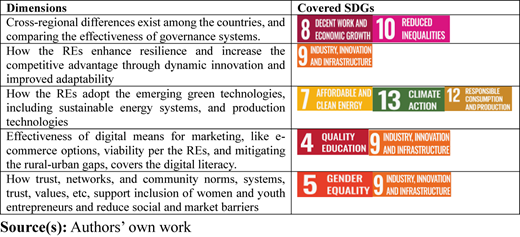
The dependent enabler innovation and adaptability (E7) has the future research scope on examining the changes in the policy and the technology, and its effect on the innovation and adaptability of REs, and how it will become a critical or a success. The dynamic interaction aspects are revealed here. The future research can also concentrate on how the REs enhance resilience and increase the competitive advantage through dynamic innovation and improved agility, covering SDG 9.
The importance of infrastructure (E3) and innovation (E7) in rural entrepreneurship is opening the further research on examining how the REs adopt the emerging green technologies, including sustainable energy systems, production technologies, which contribute to the SDG 12, SDG 7 and SDG 13, on how environmental sustainability is ensured by the performance of REs.
The effectiveness of digital means for marketing, like e-commerce options, viability per the REs, and how the financial accessibility is improved to REs which is essential success elements for their entrepreneurial journey and mitigating of the rural-urban gaps which is including the digital literacy (SDG 4) and the SDG 9 through the combining the technology adopting effectiveness in the entrepreneurship promotion in rural region.
The importance of trust, social networks, connections among the community, and their support are essential enablers for the success of REs. Future qualitative and mixed-method studies should explore how trust, networks and community norms, systems, values, etc., support inclusion of women and youth entrepreneurs and reduce social and market barriers covering the SDG 5 and SDG 10.
The dependence on the expert's opinion, the future research on validation of the framework proposed in this research is also required at the high-end level by complementary empirical techniques, including survey-based modeling and structural equation modeling (SEM), etc., with a larger sample size. Further research is also possible by linking the above further research on highlighting the direction and strength of the identified relationships among CSEs with a larger sample, with theoretical analysis through RBV, institutional theory, SCT, etc. and also the link with sustainable entrepreneurship theory and promoting interdisciplinary examination with SDG 17.
8. Conclusion
This research has identified the major influencing enablers for the success of the REs. This provides an idea to the REs on what needs prioritization and which is influenced by others that require less focus. The study also links with different existing theoretical frameworks like institutional theory, SCT, DOI, SLT, etc. Through TISM and MICMAC, the hierarchical influencing relationship through TISM shows that the institutional support influences the financial accessibility, and it will lead to infrastructure development, market access, skill development and social capital (RQ1). Institutional and Policy Support and Infrastructure Support are the major drivers, and Skill Development and Training is the most dependent enabler (RQ2). These connect with RBV on the importance of the management of resources along with policy and the social systems. The study identified future research directions and also integrates the social, economic, innovation diffusion, human capital and institutional dynamics, which provides broader and comprehensive coverage of the CSEs for the RE linking with multi-theoretical analysis. The study contribute sustainability-oriented frameworks such as Shao et al. (2024) by highlighting how economic and policy enablers is more important before the innovation and entrepreneurial outcomes in reality or practice, other than studies on inequality and gender (Rahman et al., 2023; Baalbaki and El Khoury, 2025) are extended through this research by indicating that social capital and institutional mechanisms as solution to the structural constraints in the SLF. By integrating these insights into a validated hierarchical framework, the study further contribute theory-building in rural entrepreneurship and provides actionable guidance for sequencing and design interventions beyond these isolated existing studies.
The study, with SDGs, proposes future research avenues, opening up for more interdisciplinary examination. The cross-region study (SDG 17), role of the green technology's adoption (SDG 9), rural women and your entrepreneurs' entry in the rural contests (SDG 5, SDG 10, etc.) are some of the future research avenues linked with SDGs. Hence, this research provides a theoretical contribution as well as a practical contribution. The importance of the institutional support highlighted by this research as a CSE calls for more actionable interventions for policymakers and institutions for developing new frameworks, policies and incentives to promote the REs. The credit affordability, microfinance options and less collateral loans will help to solve the financial barriers. The infrastructure development will promote innovations. There is a need for more specific actions that promote the RE ecosystem and reduce the urban–rural divides. The importance of the resources, networks, collaboration and technology transfer, which are essential for the scalability, sustainability, competitiveness and long-term resilience of the REs, requires the inclusive support of policymakers and practitioners. This will also create social inclusion and community development. Hence, this empirical examination based on multiple theoretical backgrounds for examining CSEs for the economic, social, resources, technological, etc. dimensions, which also provides the SDGs-oriented interventions that are essential for promoting and accelerating the RE ecosystem and contributing to sustainable development.
Author contributions statement
T.A. Alka: Conceptualization and data collection; T.A. Alka and M. Suresh: –writing – original draft; M. Suresh: –supervision; T.A. Alka and M. Suresh– writing – review and editing; and T.A. A and M. Suresh – methodology.
Ethics statement
The study acquired ethical approval from the institutional ethics board for conducting the research, and informed consent from the human subjects (study participants) involved in the study.
Data availability
All the data are available in the manuscript.
Consent to publish
All authors reviewed the manuscript. There is no issue regarding consent to publish.
The authors declare that there are no acknowledgements.

