Some wrong methods have emerged in the form of greenwashing while on the way to becoming a green and sustainable brand or business. Recently, it has been questioned whether businesses or brands act by their green image. This study aims to determine whether greenwashing practices represent a slow transition to sustainability or a rapid escape.
This study used secondary data sources and reviewed collected secondary sources. It was a qualitative study due to its methodology. The findings were mostly based on the author’s assumptions through review results.
As a result of the review of the literature and current sources, it was determined that there are two sides of greenwashing: a dark side and a white side. The dark side of greenwashing represented a rapid escape from sustainability and the white side of greenwashing represented a slow transition to sustainability. Positive and negative elements were summarized in the study and the study gave an original model showing two sides of greenwashing.
This study provides a viewpoint on greenwashing. This study is limited with its review results and used secondary data. Different approaches or different studies can explore different results for the related literature.
The purpose of this study is not to justify companies or brands employing greenwashing. However, for a sustainable future, the contribution of manufacturers, businesses and brands as the supply side has a vital value. Therefore, it is recommended to criticize greenwashing by encouraging brands and companies that are trying to take more positive steps in the transition to sustainability.
Policymakers and individuals can improve the dark side of greenwashing. The biggest motive for sustainable production is the demand for green consumers. Accordingly, firms and brands will be sustainable and green in the long term in a good way as consumers and policymakers guide them in a good way.
This study gives an alternative view of greenwashing by comparing the dark side with the white side. The literature mostly expressed that greenwashing had bad implications but this study tried to find the good sides of greenwashing.
Introduction
Earth scientists, who are aware that there will not be enough resources to correspond to the world’s population in the long term, despite the limitedness of natural resources, have been discussing the concept of sustainability in past decades (Yıldırım, Yıldırım, & Gedikli, 2016). In the literature, Meadows et al. (1972) study titled “The Limits to Grow” pointed out the importance of sustainability. In 1987, the United Nations published a report called “Our Common Future” (WCED, 1987) and it can be said that the term sustainability became a political issue at first (Yıldırım & Yıldırım, 2020). By the 21st century, both developed and developing countries have begun to attach more importance to the seriousness of the sustainability phenomenon. A report “Transforming Our World” was published by the United Nations in 2015 and the 2030 Agenda launched 17 basic goals for countries to achieve by 2030 (United Nations, 2015). The 2030 Sustainable Development Goals (SDGs) impose some roles and responsibilities on both individuals and institutions. A sustainable future is a goal that will be built as a result of the cooperation of individuals, states and private institutions (Yildirim, 2020). In this respect, the responsibility of private enterprises and institutions is mostly encountered in the consumption and production phase. Production and consumption activities are among the activities with the highest environmental damage. A great deal of damage is caused to the environment by the use of raw materials, energy, water and other resource use that starts at the production stage, and then by the consumption of the goods and services produced by the consumers. Goal 12 and Goal 9 are two main goals directly related to sustainable production and consumption. While Goal 12 addresses sustainable consumption and production (United Nations Department of Economic and Social Affairs Sustainable Development, n.d.a), Goal-9 addresses innovative approaches and technologies and targets for manufacturers’ transition to sustainable production. (United Nations Department of Economic and Social Affairs Sustainable Development, n.d.b).
Sustainable consumption and sustainable production are two interconnected activities. When sustainable consumption patterns are examined, it is seen that consumers buy and consume products that are called environmental, green or sustainable (Yıldırım & Candan, 2015). However, behaviors such as avoidance of excessive consumption, use of second-hand goods, waste reduction and an organic and healthy lifestyle are also included in sustainable consumption behavior (Yıldırım, 2021).
Consumers try to maintain ethical and responsible consumption behavior by paying attention to the sustainability of the products they will buy firsthand. At this point, sustainable production and businesses come into play. The production and mass release of green and sustainable products meet the demands of consumers for green and sustainable products. Therefore, it is thought that the increase in consumers’ demands for green and sustainable goods and services enables businesses and brands to experience sustainable transformation faster. When consumers go to markets or stores, they may encounter a large number of green and sustainable products. It is seen that more green and sustainable products are available in the 21st century than in the 20th century. As the organic and green product market emerged from the niche market and became a mass market, some discussions about the sustainability of these products came into play. The most discussed issue is the greenwashing implications. While some businesses are entering the market as sustainable and green brands, it is seen that many mature and luxury brands operating in the current market are undergoing sustainable transformation. The biggest problem faced by the brands that have transitioned to sustainable transformation is whether they do greenwash or not. Greenwashing seems as an attempt to benefit from the rising demand for green and sustainable products in the market (Hayes, 2022). When firms adopt greenwashing, they mislead consumers about their products and brands with a green image. The lack of having or producing green and sustainable products and competitive pressure may lead many firms and brands to adopt greenwashing in recent years (Delmas & Burbano, 2011). Greenwashing does not have so old history. However, the number of brands and firms which adopt greenwashing has been increasing recently (Junior, Martinez, Correa, Moura-Leite, & Da Silva, 2019).
The rise of green and environmental claims makes some confusion between sustainable marketing and greenwashing. At this point, governments began to prevent misleading green claims to protect consumers and producers. For example, European Union (EU) and the Organization for Economic Co-operation and Development (OECD) try to develop some regulations for eco-label and green claims for companies (OECD, 2010). When reviewing the literature, it is seen that many companies are accused of employing false green claims through greenwashing. Especially, fashion brands seem to be more close to greenwashing due to their huge green claims. Although using recycled materials for fashion products can contribute to the sustainable fashion industry positively (Yıldırım & Kantarcı, 2022), some brands may mislead their green activities in this industry (Hellweger, 2022). While regulations and laws have been launched in many developed countries, poor and developing countries are under attack of brands employing greenwashing in recent years. For example, the number of brands claiming green increased from 400 to 2300 in the last five years in Brazil. Then, there were higher level of green skepticism among Brazilian consumers (Kurzin, 2020).
This paper wonders about the truth of whether greenwashing is a rapid escape from sustainability or a kind of slow transition to sustainability in the long term. This study aims to explore two sides of greenwashing. Firstly, greenwashing will be studied as a rapid escape from sustainability. Secondly, greenwashing will be examined as a slow transition to sustainability. A review of current literature and available sources is aimed to give an alternative view of greenwashing. With the help of tables and figures, this study will give descriptive evidences exploring two sides of greenwashing for the literature. It is thought to examine the term of greenwashing and analyze implications of greenwashing to contribute sustainable development issues in the long term. In addition, this study will be one of prior studies that exploring two sides of greenwashing and giving some evidences for good sides of greenwashing in the literature.
Greenwashing: from the dark side to the white side
Greenwashing is a term that represents one type of fraud due to the usage of misleading information about its green image and green products in general (Runyon, 2022). The firstborn of greenwashing is based on a promotional event of one hotel that claimed towel reuse in the context of environmental corporate strategy (Becker-Olsen & Potucek, 2013; De Freitas Netto, Sobral, Ribeiro, & de Luz Soares, 2020). Thus, greenwashing has been perceived as a negative term in the literature for a long time. However, it should be noticed that many firms preferred to use greenwashing due to the lower cost of implementing when showing a green image in the short term (Delmas & Burbano, 2011; Becker-Olsen & Potucek, 2013). The accusation of implementing greenwashing is mostly based on firms that are not purely environmental corporations or producing purely green products in the market. Greenwashing expresses having a false green corporate image when considering the degree of being eco-friendly corporate (Seabrook, 2022). Many firms market their products through green images and promote their low-cost sustainable activities with exaggerated advertisements (Wallstreetmojo Editorial Team, n.d.). TerraChoice Environmental Marketing determined that the numbers of greenwashing increased to meet the demand of green consumers in the market. Unfortunately, the higher demand for green products spurs greenwashing, and also it is still expected to increase in the future (Dahl, 2010). Thus, policymakers and many scholars give some indicators for greenwashing to detect misleading attitudes of firms. There are some indicators for greenwashing presented in Table 1.
As seen in Table 1, this study showed seven sins of greenwashing adapted from TerraChoice Environmental Marketing (2007) and Prince (2019). When looking at examples, it can be seen how greenwashing works in general in Table 2.
Greenwashing is a polemical issue in recent years. Since major and luxury brands began to adopt greenwashing, risks of greenwashing have been investigated and many famous brands have been under suspicion. When looking at social media or Internet search machines, we meet many greenwashing examples. Some brands preferred to use greenwashing without any positive signal for sustainability. The most apparent usage of greenwashing can be seen in promotion campaigns or commercials of brands (Dean, 2020; Abolhasani, Liu, & Golrokhi, 2022; Nadig, 2022). Consumers usually see pictures of mountains or the natural environment on single-use water bottles or some firms use a label with CFC-free to prove their product’s sustainability although being CFC-free is a law and it does not belong to firms’ green image (Miller, n.d.). Firms do not say the truth about their production process or their products. Consumers only see labels such as 100% organic, 100% vegan, 100% recycled, etc. without any proof or real evidence. Brands usually cover their package or logo with green color and then they add some logos such as 100% natural, eco-friendly, green, etc. (Lola, 2022).
The worst implementation for greenwashing can be seen as “being a total lie” or “totally fraud” when expressing sustainable or green products and production processes. For example, many brands such as BMW, Fischer Future Heat were accused of greenwashing due to their “zero carbon emission ads”. Achieving zero carbon emission products or production processes should be proved by real evidence and consumers should not be misled by unclear claims (Dean, 2020).
On the other side, some scholars mentioned the positive sides of using greenwashing in the literature. According to a study published in the Stanford University's journal Psychological Science, it was claimed that greenwashing could influence individuals’ behavior positively due to the potential impact of the transition to sustainable consumption. In other words, greenwashing can encourage the adaptation of sustainable consumption in the long term. At this point, it can be said that greenwashing is the first step in the transition to sustainability (Basetti, 2020). Holmes (2017) gave an alternative view of greenwashing and she said that some outcomes of greenwashing could be a good sign for sustainability. For example, some products introduced as safer or greener in the market cannot be green but these alternative products can reduce the usage of plastics or waste in the short term. In addition, it can also help create green product awareness among more consumers (Holmes, 2017). Gerner (2020) suggested that greenwashing can be a beginner step for sustainability. She determined that firms and brands tried to find green solutions in the long term. But, each small green attempt was accused of employing greenwashing in the short term. At this point, time can help firms to get health adaptation for sustainability, and policymakers should separate small steps for sustainability and total fraud implications (Gerner, 2020). The concept of greenwashing includes false claims and also half-right claims. In other words, some green claims include exaggerated claims that some part of them is true but other parts are not (Kerner, 2022). In fact, firms should be honest in their sustainable policies and they should beware of claiming expressions such as 100% organic, 100% natural, etc., if their products are not totally green or sustainable. As suggested in this paper, maybe the white side of greenwashing can be seen as an optimistic step for achieving green future in the long term. According to Matusky (2008), greenwashing is a competitive tool in the context of marketing approach. On the other side, greenwashing may be a slow step for adopting sustainability for beginners (Matusky, 2008). Unfortunately, the financial benefits of employing greenwashing encourage more firms to prefer this way in practical (Bump, 2012; Korosec, 2012). Table 3 summarizes the positive and negative elements of greenwashing.
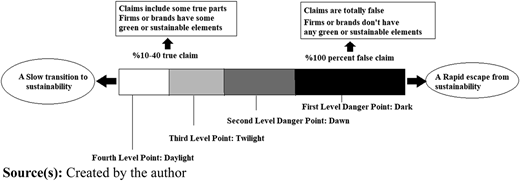
Figure 1 shows the degree of greenwashing and it can help policymakers, consumers and firms. As it is purposed, this study aims to explore whether employing greenwashing can give positive outcomes. In this point, this study categorized the degree of greenwashing as “first-level danger point, second-level danger level, third-level point and fourth-level point”. The first-level danger point represents dirty businesses and firms that do not have any green or sustainable elements in real and all claims are false. In the second-level danger point, firms claim false assumptions about having a green image. If firms show some practices based on indirect impact and cost savings as green practices, they are on the second-level danger point. Firms can give some claims about their green products or green production process with some missing parts (vagueness and irrelevance); it can be said that they are in the third-level point for greenwashing. In the fourth-level point of greenwashing, firms can provide alternative products or alternative production processes with lower costs in the context of sustainability. However, these alternatives cannot be totally sustainable in practice. This study assumes that firms aim to get a slow transition to sustainability when having lower-cost sustainable projects.
Conclusion and discussion
Climate change, global warming and environmental pollution are all global issues related to traditional production systems and over-consumption attitudes in the world. As pointed out by 2030 SDGs, sustainable consumption and sustainable production should be adopted immediately to reduce carbon emissions, waste and other environmental risks. Individuals are aware of environmental values in recent years and they want to change their usual consumption patterns into sustainable consumption patterns (Yıldırım & Yıldırım, 2020). Consumers can reduce the quantity of shopping, avoid unnecessary conspicuous consumption patterns and keep the 3R principle (reduce-reuse-recycle) (Yildirim, 2021) to achieve their responsibility in sustainable development. On the other side, buying first-hand or new product usually struggle consumers in the context of sustainable consumption patterns. To reduce waste, carbon emission and environmental damage, consumers seek green and sustainable products and prefer to buy products from firms with a green image.
It can be said that the higher numbers of implications of greenwashing mostly based on marketing motive. Greenwashing can be thought of as a marketing approach that misleadingly announces the environmental benefits associated with a product or brand to the consumer and the public (Coghlan, 2011). Greenwashing began with fraud promotion, campaigns and claims of firms and brands at first. Then, firms and brands began to adopt sustainability principles in their production process and products due to the pressure of green consumers by the time. At this point, firms and brands can be accused of being not totally or purely green in the context of greenwashing. When detecting greenwashing and accusing firms or brands of it, policymakers should be careful. This paper thinks that there is a thin line between greenwashing and adaptation of sustainability. In this study, it is not supported that firms and brands are in a good way with employing greenwashing. It is aimed to find some positive sides of employing greenwashing. Greenwashing can be a slow transition to sustainability in the short term. It is known that sustainable transformation is so hard for many firms and brands in the short term due to the lack of innovative and green technologies and green energy sources. In addition, there will always be waste after production and consumption. As a result of reviewing current sources about greenwashing, this study can suggest some recommendations for policymakers about greenwashing.
When detecting the dirty or dark side of greenwashing, policymakers should get global measures to accuse firms of employing dirty business.
There should be different measures for firms through their activities.
The intention of firms should be understood carefully and a slow transition to sustainability can be encouraged.
A rapid escape from sustainability should be accused.
Firms that employ greenwashing on the white side can be supported by policymakers to achieve efficient sustainable practices in the market.
Consumers can fall into green skepticism as a result of greenwashing. In this context, policymakers should guide consumers about green/sustainable products.
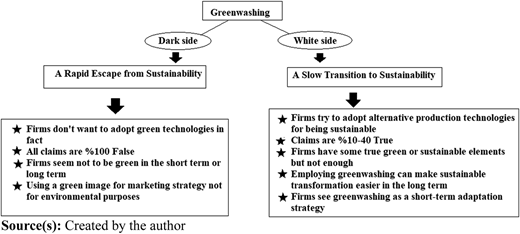
As seen in Figure 2, some firms prefer to be on the dark side of greenwashing and they employ greenwashing for a rapid escape from sustainability. Without doing anything or providing no sustainable products, firms give false claims and false advertisements. On the other side, some firms are thought to be on the white side of greenwashing. They try to adopt sustainability in the long term. Due to the higher cost, and the lack of efficient technology or innovation, these firms prefer to get a slow transition to sustainability. They launch alternative projects such as collecting recycled products, reducing carbon emissions, using energy-efficient production processes, etc.
While the effects of climate change and global warming continue globally, it should be considered that all kinds of sustainable practices will be beneficial under current conditions. Therefore, small low-cost contributions to sustainability can also be beneficial. The perception of companies with small contributions, both in the eyes of society and in the market, will yield better results in terms of 2030 SDGs targets compared to companies that have no sustainable contribution at all. In addition, it is seen that countries have made changes in their sustainability policies, as seen in crises with extraordinary global effects such as the COVID-19 crisis and the Ukraine–Russia war. For example, the fact that the use of masks became a priority for health reasons during the COVID-19 crisis has revealed the problem of waste (Dharmaraj et al., 2021; Trafton, 2021; Peng, Wu, Schartup, & Zhang, 2021). On the other hand, the situation of European countries turning to unsustainable energy sources (coal, etc.) as a result of the energy crisis (Şeker, 2022; Le Monde, 2022; Singh, Bernstien, & Hopton, 2022) shows that sustainability can be put into the background in major crises. It is a fact that sustainable development needs a balance between economic, social and environmental issues and firms also need a balance between their economic, social and environmental activities to survive in the long term. At this point, a white side of greenwashing can be seen in a slow transition to sustainability when considering the balance between economic, social and environmental activities of firms.