Skip to Main Content
Purpose

Despite the government’s efforts to reduce the gender gap in the labour market, women’s representation is much lower than men’s. Minimising the dearth of research elucidating factors contributing to the labour market disparity, the current study addresses the research gap by exploring factors impeding women dentists’ practice in India from a gender theory perspective. This study aims to advance the literature in the dental services industry, as there are not many studies that explain this gap.

Design/methodology/approach

The current research is a qualitative inquiry and utilises the case study method. In-depth interviews of women dental practitioners have enabled us to comprehend the challenging and motivating factors influencing their career advancement. The convenience sampling technique was used to choose the respondents for the study.

Findings

Study identifies that factors such as gender disparity, mothers’ gendered selves and childcare expectations from mothers constrain women from realising their full potential. However, knowledge and skill, family support and gender-inclusive men have been identified as motivating factors for running their clinics. Additionally, it has been observed that women are sensitive to patients and follow an altruistic approach at work.

Practical implications

The present study suggests that policymakers should start campaigning and promoting to curb gender-based remarks. There is a need to sensitise men regarding the shared responsibility of household and childcare. Additionally, future scholars can conduct studies to generalise the findings by testing the theory in the same context with a greater sample size.

Originality/value

Investigating the reason behind unequal access to dental care has received little attention from researchers so far. An increasing number of women dentists and the gap in access to dental care vindicate the unrealised potential of women dentists in dental services. This study’s contribution is enhanced by examining the factors that facilitate and hinder the professional advancement of women dentists.

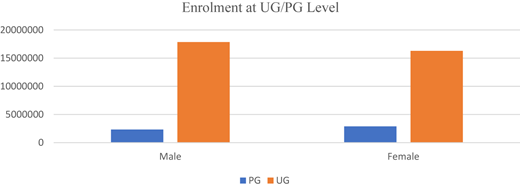
Social reformers’ initiative to increase education for women’s emancipation marked the foundation of working women in elite professions in India. Through various legislation and programs, the Indian government has been diligent in recent decades to promote women’s participation in the workforce (Prasad, 2022). Policymakers are concerned with empowering women to enhance the country’s overall potential to step higher on the ladder of a developed economy. Globally, it has been reported in the Global Entrepreneurship Monitor that women’s contribution to the economy and society has increased significantly. Women have stronger intentions to start their businesses than men (GEM, 2021). Additionally, the number of unicorn firms led by women approximately surged by five times during the COVID-19 crisis, going from 18 to 83 during one year, i.e. 2020–2021 (World Economic Forum, 2022). Thus, the question that captivates interest in conducting the present study is, can “women entrepreneurship” shape the future of a developing nation like India? Several growth indicators reflect the improved status of women. The gross enrolment ratio of women has substantially increased since 2013 (refer to Figure 1).

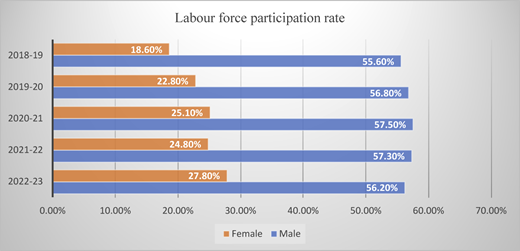
However, a substantial gap exists between men and women when discussing women’s participation in the workforce (refer to Figure 2). Despite the government initiatives to support women’s rights, several impediments hinder women’s empowerment (MoSPI, 2023).

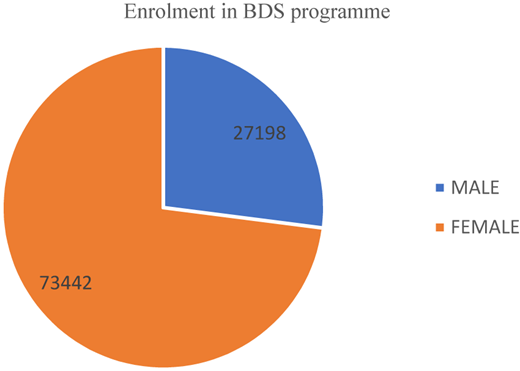
Social structure discriminating on gender is one major reason for hindrance in women’s empowerment. According to Risman (2004), gender is an important structure that explains individual actions and constrains their choices. Despite the identical entrepreneurial motivations, women often face disadvantages compared to men due to constraints imposed by gendered social structure. Emphasising hindrances in the context of “women entrepreneurship”, lack of family support, difficulty obtaining credit outside the family and competitive challenges are barriers, to name a few (Akehurst, Simarro, & Mas-Tur, 2012). There is a significant gap in existing literature exploring medical practitioners as entrepreneurs. Our paper distils information on women dentists who own clinics. In India, formally established in 1920, dental education has grown in terms of the annual production of dentists (Jaiswal, Srinivas, & Suresh, 2014). It is noteworthy that every year the number of women who enrol and pass out the Bachelor of Dental Surgery is greater than men (refer to Figure 3). The World Health Organisation (WHO) recommends an ideal ratio for dentists-to-population of 1:7,500, and India has achieved greater than that of 1:5,000 (Randhawa, 2021). Nevertheless, a sizable population in India has limited access to dental care (Vundavalli, 2014). The country is oversupplied with dentists, and they are disproportionately distributed.

Despite the abundance of dentists, the lack of access to oral healthcare in India is a sign of unequal planning or immobility among potential dentists for their career growth. Following the definitions of entrepreneurism, dentists are not true entrepreneurs (Levin, 2004), but potential growth lies in the field by enhancing the role of dentists from practitioners to innovative professionals (Sooampon & Sooampon, 2019). Dentists attain the characteristics of a business person due to the market mechanism of profit and loss in practice. However, the horizon of dentistry can be expanded through the integration of management and entrepreneurial training to enrich the field and utilise its full potential (Constantin & Kavoura, 2022). Due to their partial entrepreneurial traits and untapped potential, we selected women dentists as cases for the study. The potential for balancing unequal access to oral healthcare can be minimised by women dentists if the profession is made easy to pursue for them. Focusing on social structure to uplift the status of women in the dentistry profession is a novel idea. Thus, the present study aims to provide empirical evidence of gendered social structure constraining women dentists’ choices regarding careers. In the past studies, researchers have emphasised assessing the challenges of women in leadership roles, work-life balance among practitioners, students and interns and certainly the antecedents of choosing dentistry by students (Tandon, Kohli, & Bhalla, 2007; Nirupama, 2020; Aggarwal et al., 2012). The unique contribution of the current study is an exclusive focus on comprehending the challenges and opportunities of women entrepreneurs in dental services, which has been a limitation in the past literature. Sustainable development is a global as well as Indian concern (Anshima, Bhardwaj, Sharma, & Chand, 2024, Anshima, Sharma & Bhardwaj, 2025). Emphasising the significance of the current study, it is noteworthy that the contribution of the present study is significantly aligned with the objective of the 5th Sustainable Development Goal (SDR, 2024). The article is organised in the following order: (2) literature review, (3) methodology, (4) summary of cases, (5) analysis, (6) findings, (7) discussion, (8) implications and future scope and (9) conclusion.

Gender disparity: According to Risman (2004), gender is a social structure that explains human actions influenced by individual, interactional and institutional social processes. Factors underscored by theorists to create gender-based inequalities are “socialising children differently”, “distinct moral accountability” and “rigid institutional laws”. “Doing gender” is a social process that correlates biological sex categories with certain behaviours during interactions, which potentially produces consequences (West & Zimmerman, 1987). One oppressive consequence of discrimination based on gender is the “subordination of women” by men. Women have never been perceived as the main breadwinners, owners or controllers of property, and their opportunities are curbed by the responsibilities of their families (Chitsike, 2000). There are cases in India where women face discrimination during the allocation of work and decision-making (Kaushik & Pullen, 2018). They are dragged down from the professional ladder by family responsibility. It is gender-based discrimination in the workplace that motivates women to get into entrepreneurship rather than working in male-dominated organisations (Kephart & Schumacher, 2005).

Women entrepreneurship is centred on two major elements: the individual having enterprising skills and opportunities that can be converted into alluring profits (Shane & Venkataraman, 2000). Potential characteristics of an entrepreneur are innovative ideas in mind, the ability to raise funds to turn the idea into profits and a positive attitude towards entrepreneurship (Gedik, Miman, & Kesici, 2015). Women entrepreneurs may, however, have an array of drives for establishing their own business, as contrasted to being employed by other organisations. Scholars in the domain of women entrepreneurship argue that the glass ceiling at the corporate level is a significant factor pushing women towards entrepreneurship (Mattis, 2004). However, the gendered identities are deeply rooted among individuals; women who are switching to entrepreneurship to get rid of the corporate glass ceiling eventually land in a new labyrinth (Raghuvanshi, Agrawal, & Ghosh, 2017). According to existing literature, women who receive emotional support from their families for their businesses do well in the organisation (Neneh & Welsh, 2022). However, preconceived notions regarding gender roles affect their ability to balance work and family life. Additionally, a lack of social capital prevents women entrepreneurs from taking advantage of the opportunities that are available for male entrepreneurs in patriarchal societies like India (Shastri, Shastri, Pareek, & Sharma, 2022). Though women are choosing entrepreneurship as a career, they are lagging far behind men in the field. Women typically run smaller businesses with lower levels of funding and mediocre results (Jennings & Brush, 2013). Poor business, economic and political conditions, a lack of infrastructure assistance and personality-based restrictions pose difficulties for women entrepreneurs (Panda, 2018).

Challenges and opportunities for women entrepreneurs in India: Observations from past literature indicate the role of institutional factors in impacting the choices and development of women’s careers in India. For a long time, the government of India has been projecting inclusive growth for the holistic development of the nation. Subsequently, women in the present era have been sensitised to realise the significance of financial independence (Koneru, 2017). However, statistics related to India’s labour participation and women-run enterprises do not represent their aspirations for financial independence (Lenka & Agarwal, 2017). As a result, it is reasonable to suppose that other elements outside women’s ability additionally influence their empowerment. Furthermore, women’s growth in entrepreneurship is highly contingent on factors corresponding to supporting organisations, psychological support from family and skill-based knowledge (Agarwal & Lenka, 2016; Bhardwaj, Sharma, & Dhiman, 2023). Notably, social factors are critical to harnessing women’s potential for economic growth. It has been argued in the past that male-dominated Indian society is responsible for slowing down women’s economic empowerment (Sharma, 2013). However, there is a gap in the existing literature to shed light on gender identity as an impediment to their economic empowerment.

Dental entrepreneurship in India: Entrepreneurship in healthcare is slightly different from other fields. An entrepreneur in the healthcare sector is “someone willing to risk their finances, understand the healthcare market inside out, have a clear vision about the future of business and work hard for long hours to succeed” (Singh & Purohit, 2011). Several social, economic and professional factors influence students’ choice to join the dental profession. However, the ability to be their own boss and flexible work schedules are among the most prevalent (Aggarwal et al., 2012). A study by Nirupama et al. (2020) in the Indian context has observed the changing attitude among women regarding career growth in dentistry. The majority of young unmarried women in modern times do not feel family commitments as impediments to their professional lives. On the contrary, there is evidence that married women dentists find it challenging to sustain work-life balance (Sandhya, 2017). One possible reason for this contradiction arises from the fact that the gendered roles of married women and mothers significantly influence the professional advancement of women dentists (Nagda, 2015). Similar to the glass ceiling in the corporate environment, women dentists in leadership roles feel role conflicts (Bhardwaj & Sharma, 2024), family commitments and gender biases as impediments to their work performance (Tandon et al., 2007). Based on the risk associated with entrepreneurship and the long hourly commitment required for financial growth in dental practice, it would be interesting to look into the opportunities and challenges for women dentists in entrepreneurship.

RQ1.

What are the factors motivating women dentists to run their practices?

RQ2.

What are the factors constraining women practitioners’ advancement?

There are two broad approaches, i.e. quantitative and qualitative, for conducting any research. A qualitative approach is best suited for the in-depth understanding of concepts and navigating innovative means to address issues (Hlady-Rispal & Jouison-Laffitte, 2014). Qualitative sampling may involve fewer participants, provided they offer rich information sufficient for in-depth knowledge of the problem (Fossey, Harvey, McDermott, & Davidson, 2002). Several ways to collect data for qualitative research include observations, interviews and focus groups. Interviewing is the most popular means to collect data in qualitative research because it describes first-hand experiences from the lives of respondents appropriate for the study (Fossey et al., 2002). The present study aims to decipher the gender disparity experienced by women dental practitioners, followed by opportunities and challenges in the line of their professional growth. Four dental practitioners from Himachal Pradesh and Chandigarh agreed to the interview and offered rich information on their professional journey. We have followed the case study method in this research, knowing that it is the most valuable and popular type of qualitative research in practice-oriented fields (Starman, 2013). This method has been previously used by researchers in entrepreneurship studies (Lenka & Agarwal, 2017; Agarwal & Lenka, 2016, 2017). Refer to Appendix 1 for the questions used to conduct the interview.

We employed the open-ended interview technique to get insights from participants and delve further into the data. Several broad questions based on themes drawn from the literature study were written in advance to keep the focus on the objectives (Appendix 1). Having some broad questions prepared beforehand enables the interviewer to accomplish the goal and stay focused on the themes during the interview (Agarwal, Lenka, Singh, Agrawal, & Agrawal, 2020). The questionnaire was sent to the experts in the concerned subject for face validity and content validity (Taherdoost, 2016; Straub, Boudreau, & Gefen, 2004). Experts have been conducting the study in the area for several years. The instrument consists of questions that persuade respondents to express their opinion on gender disparity, challenges in travelling and relocating, motivational factors to run the clinic, the gendered mother role and a general question aimed at understanding the attitude of society toward women dentists. The content validity ratio (CVR) was 1 for 10 questions of the instrument, which means there was an absolute agreement on validity by experts (Ayre & Scally, 2014). However, the CVR value for the remaining questions remains similar, i.e. 0.5, and gives some assurance of the validity (Ayre & Scally, 2014). To keep the effectiveness of the questionnaire, these questions were revised as per the advice of experts.

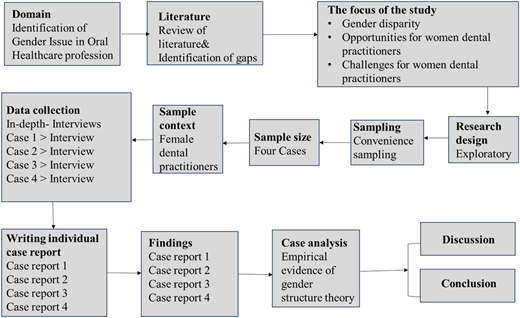
A convenience sampling technique was adopted to select the respondents for the study. The objective of the study has been to explore the opportunities and challenges of married women dentists towards professional advancement. In the absence of a sampling frame for classifying married women dentists, convenience sampling is the most suitable approach for the current research (Golzar, Noor, & Tajik, 2022; Stratton, 2021). This technique is best suited for identifying the appropriate respondents in terms of knowledge, availability of time and willingness to provide information in the qualitative survey (Etikan, Musa, & Alkassim, 2016). The following standards have been applied while screening responders: (1) clinic ownership, (2) a woman practitioner and (3) marital status. Both of the aforementioned conditions are pertinent to the context of the current study. Additionally, prior research has asserted that marriage and the ensuing family responsibilities are obstacles to business expansion; for this reason, a later condition has been introduced to further screen the respondents (Tundui & Tundui, 2021). We contacted around ten women on a convenience basis; however, there were only four women dentists who fulfilled the above-mentioned criteria and were willing to participate in the case study. Even one case is sufficient to illustrate the experience, which the researcher wants to demonstrate in a phenomenological study (Sandelowski, 1995). As a result, in order to complete the study, we focused our investigation on four cases. Interviews were undertaken face-to-face. Respondents were not willing to record the interview; therefore, only field notes were taken. To maintain the confidentiality of the respondents, they have been named Mrs. P, Mrs. Q, Mrs. R and Mrs. S (Agarwal et al., 2020). The analysis of the transcripts accompanied the suggestions made by Burnard (1991). The layout of the methodological approach has been presented in the diagram below (refer to Figure 4).

Mrs. P is a 38-year-old married mother of an 11-year-old who has been operating her clinic since 2009. Before commencing her enterprise, she had been practicing under a senior female practitioner in Chandigarh for 2 years. Additionally, the respondent has experience of a one-year job in a private hospital where she led dental surgeries. Respondent had been determined to own her clinic after struggling and learning in private jobs. It took six months after getting married to organise the infrastructure for the clinic with the support of the family. Respondent mentions the role of her father-in-law in renovating the space and shaping it into the clinic. However, negotiating with the vendor for chairs and other products was completely her decision, and travelling was accompanied by her husband for the same. Respondent’s family had two doctors in the family already (husband and father-in-law); therefore, she had a grand opening of her clinic. Discussing further about the beginning of her journey, she mentions that she wanted to become an MBBS doctor. But due to limited seats, she could not qualify for the merit.

I belonged to a very simple family. I was an elder child in my family, and my father didn’t want me to waste years in preparation for the test. The self-study was not sufficient, and coaching was expensive, so I accepted what I was receiving, and now I love what I am working on.

Respondent shares that her clinic is in the same building where she lives with her husband and child. Making an identity in society, passion for work, continuous improvement in skills and personal growth are the factors she mentions as motivations to establish and run the business.

My work ethic lies in the values of suggesting to my patients what is right for them, not for my financial gains, but attaining perfection in my work.

Narrating her passion for growing continuously in the field and learning new knowledge, she mentions her PG course, which she completed after a long span of a UG course. Further, she adds to the interview about her participation in conferences and other learning programs to improve dentistry practices. Admiring the beauty of feminism, the respondent dissolves the need for having a masculine attitude to own an enterprise. After posing a question of gender disparity, she shared an anecdote from her life reflecting the disguised benefits that male dentists receive due to gendered identity. Her words include,

One male dentist in the close vicinity to my workplace who was junior to me in terms of experience presented himself in the market as a dental surgeon for surgery, patients (including my loyal ones) started consulting him for surgery, assuming that I don’t do surgeries.

Adding to this, she narrates how patients during her job in hospitals were judgemental about her skills in surgery at first, and after taking the treatment, trust was built so well that patients are connected to date with her. Initially, it is difficult for women to build trust with patients.

In some cases, men try to overpower you, which requires tactics to handle the situation.

Additionally, obtaining family approval before making any decisions is a significant barrier for women.

Challenges are faced by single and married women equally, but in different forms. Whereas married women are restricted by social norms and childcare responsibilities, single women are judged for their character, and bad behaviour in the family, in case a woman is divorced, her working aspirations are held responsible for breaking home.

The respondent felt the challenges in running the business after becoming a mother. She had no direct support in raising kids from the family, but her family agreed with keeping a house help. Despite having an encouraging family to start a career, Mrs P feels she has paid the motherhood penalty in the trajectory of career advancement.

My journey was not short of struggle after becoming a mother. I sought help from my colleagues, house help, and whosoever I could call upon. Many times, I carried my baby in a pram to the clinic and one hand treating the patient and the other hand taking care of my child. All my patients remember my days of struggle and ask me about my son, laughingly she said.

Further, she adds about her solo travelling to attend conferences and workshops in distant places, carrying her child along.

In the beginning, my family tried to stop me from travelling alone with a child, but I was determined to keep going, and in the end, my mother-in-law offered her assistance to look after the child at home whenever I had to travel. Despite having conflicts and disagreements, family unites and doesn’t let you fall.

Further enquiring about the relaxation, if any, received from the government, banks and nongovernmental organisations to establish a clinic, the respondent reveals no additional benefits other than the exemption from tax. Answering societal notions, she adds

I was a bright student since childhood, so I always gained respect from society. After marriage, I was respected due to the goodwill of my In-laws in society as a professional. The change that I observed throughout my journey was confidence in the eyes of my patients. Earlier, they used to judge, but now patients wait for my appointments. Additionally, my in-laws used to feel bad about my popularity more than my husband's. My mother-in-law used to say Let your husband pay the expenses, why are you paying the bills?.

Mrs. P added that although her husband was always encouraging and opposed to patriarchal ideas, her in-laws eventually followed suit.

Though the life of women is changing, in some aspects, it remains the same. Despite having both parents educated, teaching a child is a responsibility of the mother, though husband and wife are both working, yet it is the responsibility of the wife to ensure cooking, school, and other family responsibilities.

These are also the factors that prevent women from relocating to distant places for the expansion of their business. However, conditions are not the same for men. Leaving a child in the care of a house helper does not work for the mother and the family.

I have reduced my working hours to look after my child, but it didn’t affect my earnings significantly. My patients adjust according to my availability, but sometimes I feel that if I had freedom like men, I could be more successful than I am today.

Adding to the limitations of dentistry as a course, she explains the lack of management, entrepreneurial and technical skills taught during the course. UG students of dentistry feel it is costly to establish their clinic, which drives them to change their profession or remain unemployed. It is not that difficult with the right knowledge of management.

Mrs. Q is a 49-year-old woman practicing dental services for 22 years. In addition to being the owner of a clinic, she is also a mother of two children.

I was determined to establish a clinic right from the beginning of my BDS. Within two months of completing my graduation, I got married, and it took nine months to set up the clinic.

Adding to this, she gives credit for her success to her husband and father-in-law for supporting her in arranging and establishing the infrastructure for it.

There was no female in the house, my father-in-law never bound me to the role of the daughter-in-law or mother only. He cooked, looked after my child, and allowed me to work till late at night. I was lucky to have this kind of support from him, and I’m sure neither my father nor my mother-in-law could do this for me.

Further, she discloses that her clinic was always in close vicinity to the residence. Revealing the motivating factors to set up their own business, she says that her intentions were never to earn money only.

I have done BDS and serving through practice was my ‘KARMA’. In addition to that, I feel to save the tooth.

Mrs. Q, remembering the time after commencing the clinic, adds to the information that the population in the surrounding area was deprived of education and awareness about oral health care. In their idea, the extraction of the tooth was the only solution for a toothache. She adds that the area was not well developed then, but due to foreign visitors and monks of the monastery, the respondent had a good number of patients visiting the clinic always. Questioning the need to have a masculine attitude to run a business, the respondent categorically disagreed and said women are way better than men in her style. Additionally, she says that women are more sensitive to pain than men.

My patient tells me that half the pain vanishes during the consultation with me.

Respondent believes that every woman does not receive the support she had from her family, and additional responsibilities do bind women to the role of caregiver only. However, single women have more chances of growth, she adds. Respondents disagree on relocating the business for greater profit and keeping the child in the care of the house help.

To a certain age, it is the only mother who can rear a child. If both parents are working and there is no one in the family to look after the kid, it is the mother only to leave work.

Adding to the knowledge about the increased number of unemployed dentists, she explains that the lack of government jobs in the field, heavy investments required to set up a clinic and the time required to make goodwill are constraining factors.

Mrs. R is a 32-year-old woman dentist, has a child of 3 years old and has been running a clinic for the past 6 years. Narrating her journey as a practitioner, she explains

I worked because my husband always stood by my side; otherwise, married women cannot work.

Further, she explains how marriage reduced her freedom and restricted her working hours.

My parents were open to women's education and work; therefore, I had the full support of my family during my studies of BDS. My father wanted me to become self-sufficient; therefore, a progressive environment in the family encouraged me to work hard and complete my course. Before completing my internship, I was married. I practised under a senior dentist for around six months, and then I had to leave the job. My in-laws were expecting me to stay at home and look after the family.

She further adds that her in-laws are rich in wealth; therefore, they do not realise the need for her to work, and financial gains are the only motivating factor in their minds to work. Highlighting the issues of gender differences, she mentions that families always stand by their sons to support them in their careers. A less productive son receives greater support than a more productive daughter-in-law. Continuing with the additional responsibilities of women, she said,

Real challenges came my way after becoming a mother. I had to take a break from my work for one year, I didn’t earn a penny, my motivation was also low, but I returned to work after some time.

Respondent mentions conflicts in the family and daily arguments on child care and motherhood. Speaking on the factors motivating the respondent to run the clinic, she emphasised the intention of continuing to work and living her dreams.

I often dream of travelling around the world, shopping as per my liking, and dining at restaurants. It is pathetic to wait for the husband to make plans, which rarely happens in families of traditional mindsets.

She explains her determination and fighter spirit, which consequently inspired other ladies (sisters-in-law) to become vocal about their rights and start their home-based small businesses. She closed the interview by citing older people’s backwards mindset and marriage as obstacles for career women.

Mrs S is a dentist. She had three years’ experience in the job before establishing her own business. She chose entrepreneurship because of the limited scope of government jobs in her field. She belongs to a family where all other members are well educated and independent and earn well. She has been into entrepreneurship for five to six months. She was hesitating to reveal how she arranged funds for the establishment of an enterprise. She was suspicious initially about the inquiry, so it took a little longer to build rapport with Mrs S. She was finding it difficult to understand the context in which the questions were asked. Sometimes questions were reframed, and examples were posed to make understanding easy for the participant. Mrs. S. is a confident woman with the support of her family. She adds,

I have always received push to become an independent woman in my family. I’m the only woman running a business in my locality. I've seen girls struggling to have education and careers because of a lack of exposure and education than other family members. Marriage is given undue weight in the life of a girl. Having a husband and child is considered to weigh more than having a successful career by a single woman. I treat both men and women in my clinic and do not bother about regressive notions against me, but if I get to know someone spoiling my clients and falsely bad-mouthing about my work, then I won’t tolerate them. People sometimes are rude and raise their voice to make a woman shut but we have to stand stiff.

Mrs. S was unable to recall any incident of gender differences she faced in her family. Still, yes, she informed me that every girl starts hearing about her marriage after completing graduation.

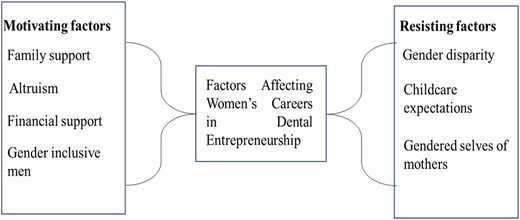
The present study emphasises illuminating the factors that motivate women’s dental entrepreneurs to run clinics and prevent them from growing in business. Several motivational factors among oral healthcare professionals include support from family and altruism. In contrast, gendered identity significantly creates hindrances to reaching the heights of the career ladder (refer to Figure 5). Lenka and Agarwal (2017) reported in their finding that family is a significant, socially driven motivational factor that leads to entrepreneurial competencies. In corroboration of previous findings, it has been observed in the present study that women dental practitioners began their practice with the help of family members. Discussing altruism, according to previous research, women should be assigned the responsibility of promoting ethics and altruism in the healthcare industry, breaking down the glass ceiling. Given that women are more likely than men to exhibit moral behaviour, moral judgement and altruism at work, this ought to be the case (Valentine, Godkin, Page, & Rittenburg, 2009). Empirical evidence has been found in the present study that altruism is a stronger factor among dental entrepreneurs than financial gains for practice. Moreover, society’s “doing gender” and people’s deeply ingrained “gendered selves” are the true concerns in the advancement of women. Through psychological and interactional mechanisms, gender lenses provide more power to men (Bem, 1994). Making remarks on gender in every conversation leads to the development of gendered selves among children. The social institution has been biased toward women for stratifying them as subordinate to men (Risman, 2004). In the past, women adapted to a subordinate identity for the benefit of the patronage they received for their children and themselves. However, the gendered strata developed then are still prevalent in Indian families. It is crucial to acknowledge that men are not evolving sufficiently to share child-rearing responsibilities, and society continues to make judgemental remarks based on gendered preconceptions, even though women have adapted to equal economic power in the modern day (refer to Table 1). Discerning the formation of structure, Giddens (1984) elucidates that it is not merely structure that shapes individuals, but individuals can also shape structure. West and Zimmerman (1987), in their research, summarise that gender is probably not who an individual is, but fundamentally it is what an individual does recurrently in interaction with others. There has been evidence that gender-inclusive men encourage women in careers, but women’s gendered mother identity constrains them from giving more attention to work (Table 1). Risman (2004) reported on men’s mothering and found that men who become primary parents had an altered identity from other men. Therefore, it can be inferred that to empower women, it is pertinent to alter men’s and women’s gendered identities by giving them different experiences than deep-rooted gendered identities.

Table 1

Factors motivating women’s entrepreneurship and resisting growth among dental practitioners

FactorsDescriptionEmpirical evidence
Family supportFamily support is one major factor in the beginning and establishment of clinics for women dentists“It took six months after getting married, to organise the clinic’s infrastructure with family support. Father-in-law has a great role in renovating the space and shaping it into the clinic”. “Husband travelled along while vising to negotiate with the vendor for chairs and other products” (Case 1). “Credit for success goes to the husband and father-in-law for supporting in arranging and establishing the infrastructure for it” (Case 2)
“I worked because my husband always stood by my side; otherwise married women cannot work”. (Case 3)
“I have always received push to become an independent woman from my family” (Case 4)
Altruism and financial independenceWomen dentists are sensitive to the pain of others, and altruism is a stronger factor alongside financial gains among women dentists“My work ethic lies in the values of suggesting to my patients what is right for them not for my financial gains, and attaining perfection in my work” (Case 1)
“I have done BDS and serving through practice was my “KARMA”. In addition to that I feel to save the tooth.” “My patient tells me that half the pain vanishes during the consultation with me” (Case 2)
“I often dream of travelling around the world, shopping as per my likes, and dining at restaurants. It is pathetic to wait for the husband to make plans which rarely happens in families of traditional mindsets” (Case 3)
Gendered selves of mothersIn parenting the women have internalised the great role of the mother in exchange for a subordinate gender identity“Leaving a child in the care of the house help does not work for me and my family”. “I have reduced my working hours to look after my child but it didn’t affect my earnings significantly. My patients adjust according to my availability but sometimes I feel if I had freedom like men, I could be more successful than I am today” (Case 1)
“To a certain age, it is the only mother who can rear a child. If both parents are working and there is no one in the family to look after the kid it is the mother only to leave working” (Case 2)
“Real challenges came to my way after becoming a mother. I had to take a break from my work for one year, I didn’t earn a penny, my motivation was also low but I returned to work after some time” (Case 3)
Gender inclusive memOne common support for dental practitioners is men in their lives are somewhat gender-neutral“My husband was always supportive and away from such deep-rooted patriarchal notions” (Case 1)
“There was no female in the house, my father-in-law never bound me to the role of the daughter-in-law or mother only. He cooked, looked after my child, and allowed me to work till late at night. I was lucky to have this kind of support from him and I’m sure neither my father nor my mother-in-law could do this for me”
“I worked because my husband always stood by my side; otherwise, married women cannot work.” (Case 3)
Gender disparityWomen are treated as the second gender in society“One male dentist in the close vicinity to my workplace who was junior to me in terms of experience presented himself in the market as a dental surgeon and for surgery, patients (including my loyal ones) started consulting only him for surgery assuming that I don’t do surgeries”. “In some cases, men try to overpower you, which require tactics to handle the situation” (Case 1). “My in-laws used to feel bad about my popularity more than my husband. My mother-in-law used to say Let your husband pay the expenses. why are you paying the bills? “Families always stand by their sons to support them in their careers. A less productive son receives greater support than a more productive daughter-in-law” (Case 3)
People sometimes are rude and raise their voice to make a woman shut but we have to stand stiff” (Case 4)
Childcare expectations from the motherOne major problem that affected the emergence of female dentists was the expectation that only women could take care of children“In the beginning, my family tried to stop me from travelling alone with a child”
“Though having a supportive family to begin my work later, I also received tags of “bad mother” for continuing work”. “Despite having both parents educated, teaching the child is a responsibility of the mother, though husband and wife are both working, yet it is the responsibility of the wife to ensure cooking, school, and other family responsibilities” (Case 1)
“Conflicts in the family and daily arguments on child care and motherhood are inevitable for working women” (Case 3)
“Having a husband and child is considered to weigh more than having a successful career by a single woman” (Case 4)

Source(s): Created by authors

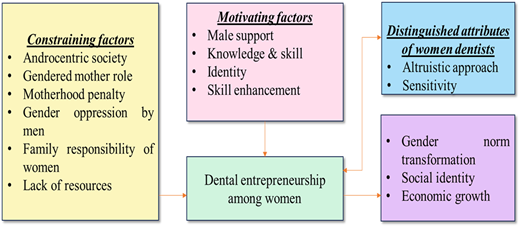
Women are evolving, but society hasn’t realised their potential to contribute to the development of society as a whole. The study aimed to explore factors motivating women dental practitioners to run clinics and factors constraining their growth. Although dentists have not been considered to be true entrepreneurs, their shared entrepreneurial tendencies and potential to become successful entrepreneurs sparked researchers’ interest in including them in the case study. Based on the research and findings from the study, it is clear that family obligations and gender disparity create barriers for women dental professionals, preventing them from realising their full potential to create money and provide services. In every case, the male support of the family for commencing the clinic is apparent; nevertheless, the family does not support mothers of young children with the same level of enthusiasm. Women who receive help from their families with child care are doing well in business. Societal tendencies to evaluate women as subordinate to men in professional capacity have been observed in the present study. Nonetheless, women are demonstrating their abilities and changing societal perceptions through perseverance and dedication. Figure 6 demonstrates the factors motivating and constraining the career advancement of women dentists. Consistent with the previous literature, beyond the gender discrimination, lack of financial resources remains a significant aspect impeding women from starting an enterprise (Samantroy & Tomar, 2018; Walker, 2022). The findings of the current study are consistent with the “World Value Survey,” which shows that cultural hurdles, lack of funding and gender inequality have a detrimental impact on the well-being gap between men and women (Love, Nikolaev, & Dhakal, 2024). Nonetheless, women are demonstrating their abilities and changing societal perceptions through perseverance and dedication. Educated women are capable of enhancing social empowerment through their knowledge and application of skills (Emon & Nipa, 2024). Thus, a greater concern of the policymakers is to empower women with the resources required to establish an enterprise and extend business towards the creation of jobs. Policymakers need to sensitise people about the repercussions of gendered identity built within the social structure through interactions. Our goals were strictly confined to issues of gender inequality and difficulties faced by women dentists due to gender identification. However, future scholars can expand the literature by addressing the limitations of the current study discussed in the following section.

Insights from qualitative surveys provide empirical evidence of gender as a structure constructed in society through interaction and psychological mechanisms. Policymakers and every individual who forms a social structure need to pay attention to overcoming gender-based remarks in their interactions. In the present era, social media can be a suitable platform to spread the message against gendered identity. Despite the great efforts by the government to empower women, it is difficult to harness their full potential to generate additional income. Since women receive less support from men in the additional responsibility of rearing children and household chores, they lag behind men at work and their gendered identity remains the same. Therefore, it is noteworthy to sensitise men about the shared responsibility of family as well as work. An important consideration regarding the current research includes four cases that comprise the sample of the study that have been used to conclude. The present study’s sample size limitation suggests that future researchers should further enhance the current study by using a mixed-methods strategy that includes a larger sample size. Additionally, it has been demonstrated in existing literature that marital status (single, married and divorced) influences the entrepreneurial behaviour of individuals (Ciobanu & Bărbulescu, 2025). Since the current study is focused on married women, it opens the avenue for future scholars to advance the literature by conducting a comprehensive study to analyse the comparative challenges and opportunities of women dentists in the healthcare profession. Additionally, future studies can be undertaken on contemporary issues related to women’s healthcare professionals, such as brain drain intentions or driving factors of brain drain of women (Bhardwaj, 2017; Bhardwaj & Sharma, 2023; Anshima & Bhardwaj, 2023; Kumar, Sharma, & Bhardwaj, 2025; Sharma, Bhardwaj, & Dhiman, 2023; Sharma, Salehi, Bhardwaj, Chand, & Salihy, 2024). Research related to the role of artificial intelligence in women’s empowerment and the role of investment decisions, green finance and digital literacy in the career growth of women can be undertaken for the advancement of literature in this domain (Jangid & Bhardwaj, 2024; Anshima & Bhardwaj, 2023). A systematic literature review is an effective approach for theoretical advancement (Anshima, Sharma, & Bhardwaj, 2025; Balkrishan, Bhardwaj, & Sharma, 2025). Therefore, a study can also be helpful for comprehending the theoretical, contextual and methodological dimensions of the glass ceiling in the oral healthcare sector.

The objective of the research is to explore the factors motivating women dentists to run clinics and the factors constraining their professional growth. In-depth interviews have been conducted with experienced practitioners to achieve the objective of the study. Unique factors identified as motivating factors among women dental practitioners are family support, knowledge and skill, social identity and gender-inclusive men, whereas gender disparity, the gendered mother role, the motherhood penalty and childcare expectations, family responsibility and lack of resources are factors creating hindrances to women’s professional growth. Spouse encouragement to support a career has been commonly mentioned by women in all cases. Major hindrances in women’s development are the least contribution of husbands in childcare responsibilities and hesitation in hiring full-time help for childcare. Inferences drawn are consistent with past literature that women are bound to the limitations of their gender identity (Wang, 2018). This study contributes to the literature on career advancement of women and enriches the comprehensive understanding of the lives of women dental entrepreneurs from the standpoint of gender theory. The study provides a formative basis and guidance for policymakers and researchers to assist women professionals in striving for equitable career advancement.

The supplementary material for this article can be found online.
Agarwal
,
S.
, &
Lenka
,
U.
(
2016
).
An exploratory study on the development of women entrepreneurs: Indian cases
.
Journal of Research in Marketing and Entrepreneurship
,
18
(
2
),
232
247
. doi: .
Agarwal
,
S.
, &
Lenka
,
U.
(
2017
).
Does growth of ventures depend on competencies? Selected cases from India
.
International Journal of Entrepreneurship and Small Business
,
31
(
2
),
227
243
. doi: .
Agarwal
,
S.
,
Lenka
,
U.
,
Singh
,
K.
,
Agrawal
,
V.
, &
Agrawal
,
A. M.
(
2020
).
A qualitative approach towards crucial factors for sustainable development of women social entrepreneurship: Indian cases
.
Journal of Cleaner Production
,
274
, 123135. doi: .
Aggarwal
,
A.
,
Mehta
,
S.
,
Gupta
,
D.
,
Sheikh
,
S.
,
Pallagatti
,
S.
,
Singh
,
R.
, &
Singla
,
I.
(
2012
).
Dental students’ motivations and perceptions of dental professional career in India
.
Journal of Dental Education
,
76
(
11
),
1532
1539
. doi: .
AISHE
(
2022
).
AISHE final report 2021-22
.
Department of Higher Education, Ministry of Education. Available from: AISHE | India
.
Akehurst
,
G.
,
Simarro
,
E.
, &
Mas-Tur
,
A.
(
2012
).
Women entrepreneurship in small service firms: motivations, barriers and performance
.
The Service Industries Journal
,
32
(
15
),
2489
2505
. doi: .
Anshima
, &
Bhardwaj
,
B.
(
2023
). Leveraging AI for the reinforcement of GHRM. In
AI and Emotional Intelligence for Modern Business Management
(pp. 
64
76
).
IGI Global
. doi: .
Anshima
,
Bhardwaj
,
B.
,
Sharma
,
D.
, &
Chand
,
M.
(
2024
).
Ensuring sustainability through green HRM practices: a review, synthesis and research avenues
.
Journal of Organizational Effectiveness: People and Performance
,
12
(
1
),
57
90
, doi: .
Anshima
,
Sharma
,
D.
, &
Bhardwaj
,
B.
(
2025
).
Green human resource management practices and sustainable development in India: a systematic literature review and future research agenda
.
Social Sciences and Humanities Open
,
11
, 101420. doi: .
Ayre
,
C.
, &
Scally
,
A. J.
(
2014
).
Critical values for Lawshe’s content validity ratio: revisiting the original methods of calculation
.
Measurement and Evaluation in Counseling and Development
,
47
(
1
),
79
86
. doi: .
Balkrishan
,
Bhardwaj
,
B.
, &
Sharma
,
D.
(
2025
).
The paradox of exploitation vs exploration: reconnoitring the unexplored dimensions of organizational ambidexterity for developing countries including India and China
.
Asia Pacific Business Review
,
1
39
. doi: .
Bem
,
S. L.
(
1994
).
Defending the lenses of gender
.
Psychological Inquiry
,
5
(
1
),
97
101
. doi: .
Bhardwaj
,
B.
(
2017
).
Migration vulnerability: role of digital media and internet in stimulating and inhibiting brain drain
.
International Journal of Advances in Management and Economics
,
6
(
6
),
24
32
.
Bhardwaj
,
B.
, &
Sharma
,
D.
(
2023
).
Migration of skilled professionals across the border: brain drain or brain gain?
.
European Management Journal
,
41
(
6
),
1021
1033
. doi: .
Bhardwaj
,
B.
, &
Sharma
,
D.
(
2024
).
Managing and negotiating disagreements: A contemporary approach for conflict resolution
( (1st) ed., pp.
1
198
).
Emerald Publishing
.
Bhardwaj
,
B.
,
Sharma
,
D.
, &
Dhiman
,
M.C.
(Eds.) (
2023
).
AI and emotional intelligence for modern business management
( (1st) ed.,
1
).
IGI
.
Burnard
,
P.
(
1991
).
A method of analysing interview transcripts in qualitative research
.
Nurse Education Today
,
11
(
6
),
461
466
. doi: .
Chitsike
,
C.
(
2000
).
Culture as a barrier to rural women’s entrepreneurship: experience from Zimbabwe
.
Gender and Development
,
8
(
1
),
71
77
. doi: .
Ciobanu
,
E.
, &
Bărbulescu
,
O.
(
2025
).
Beyond the bottom line: the role of personal characteristics in healthcare entrepreneurship
.
Administrative Sciences
,
15
(
1
),
28
. doi: .
Constantin
,
F.
, &
Kavoura
,
A.
(
2022
).
Digital entrepreneurship via sustainable online communication of dentistry profession, Oradea, Romania: a longitudinal analysis
.
Sustainability
,
14
(
2
),
802
. doi: .
Emon
,
M. M. H.
, &
Nipa
,
M. N.
(
2024
).
Exploring the gender dimension in entrepreneurship development: a systematic literature review in the context of Bangladesh
.
Westcliff International Journal of Applied Research
,
8
(
1
),
10
47670
,
SSRN. Available from:
 https://ssrn.com/abstract=5122782
Etikan
,
I.
,
Musa
,
S. A.
, &
Alkassim
,
R. S.
(
2016
).
Comparison of convenience sampling and purposive sampling
.
American Journal of Theoretical and Applied Statistics
,
5
(
1
),
1
4
, doi: .
Fossey
,
E.
,
Harvey
,
C.
,
McDermott
,
F.
, &
Davidson
,
L.
(
2002
).
Understanding and evaluating qualitative research
.
Australian and New Zealand Journal of Psychiatry
,
36
(
6
),
717
732
. doi: .
Gedik
,
Ş.
,
Miman
,
M.
, &
Kesici
,
M. S.
(
2015
).
Characteristics and attitudes of entrepreneurs towards entrepreneurship
.
Procedia - Social and Behavioral Sciences
,
195
,
1087
1096
. doi: .
GEM
(
2021
).
Global report
.
Global Entrepreneurship Monitor, Available from: GEM Global Entrepreneurship Monitor
.
Giddens
,
A.
(
1984
).
The constitution of society: outline of the theory of structuration
.
Polity
.
Golzar
,
J.
,
Noor
,
S.
, &
Tajik
,
O.
(
2022
).
Convenience sampling
.
International Journal of Education and Literacy Studies
,
1
(
2
),
72
77
. doi: .
Hlady-Rispal
,
M.
, &
Jouison-Laffitte
,
E.
(
2014
).
Qualitative research methods and epistemological frameworks: a review of publication trends in entrepreneurship
.
Journal of Small Business Management
,
52
(
4
),
594
614
. doi: .
Jaiswal
,
A. K.
,
Srinivas
,
P.
, &
Suresh
,
S.
(
2014
).
Dental manpower in India: Changing trends since 1920
.
International Dental Journal
,
64
(
4
),
213
218
, doi: .
Jangid
,
J.
, &
Bhardwaj
,
B.
(
2024
). Relationship between AI and green finance: Exploring the changing dynamics. In
Leveraging AI and Emotional Intelligence in Contemporary Business Organizations
(pp. 
211
218
).
IGI Global
.
Jennings
,
J. E.
, &
Brush
,
C. G.
(
2013
).
Research on women entrepreneurs: challenges to (and from) the broader entrepreneurship literature?
.
The Academy of Management Annals
,
7
(
1
),
663
715
. doi: .
Kaushik
,
G.
, &
Pullen
,
A.
(
2018
).
Study of gender as social practice and tokenism in an Indian IT company
.
Journal of International Women’s Studies
,
19
(
2
),
104
122
.
Kephart
,
P.
, &
Schumacher
,
L.
(
2005
).
Has the ‘glass ceiling’ cracked? An exploration of women entrepreneurship
.
Journal of Leadership and Organizational Studies
,
12
(
1
),
2
15
. doi: .
Koneru
,
K.
(
2017
).
Women entrepreneurship in India-problems and prospects
,
SSRN31103. Available from:
 https://ssrn.com/abstract=3110340
Kumar
,
G.
,
Sharma
,
D.
, &
Bhardwaj
,
B.
(
2025
).
The future of work and education in AI-driven innovative systems: A systematic literature review and lexicometric analysis
.
The International Journal of Management Education
,
23
(
3
),
101221
. doi:.
Lenka
,
U.
, &
Agarwal
,
S.
(
2017
).
Role of women entrepreneurs and NGOs in promoting entrepreneurship: case studies from Uttarakhand, India
.
Journal of Asia Business Studies
,
11
(
4
),
451
465
. doi: .
Levin
,
R.
(
2004
).
Is the dentist an entrepreneur? Yes and no
.
Journal of the American Dental Association (1939)
,
135
(
12
),
1733
1734
, doi: .
Love
,
I.
,
Nikolaev
,
B.
, &
Dhakal
,
C.
(
2024
).
The well-being of women entrepreneurs: the role of gender inequality and gender roles
.
Small Business Economics
,
62
(
1
),
325
352
. doi: .
Mattis
,
M. C.
(
2004
).
Women entrepreneurs: out from under the glass ceiling
.
Women in Management Review
,
19
(
3
),
154
163
. doi: .
MoSPI
(
2023
).
Women and men in India, 2023 | Ministry of statistics and program implementation | government of India
.
Nagda
,
S. J.
(
2015
).
Harmonizing professional, personal, and social responsibilities: Indian women dentists’ perspectives
.
Journal of Dental Education
,
79
(
S5
),
S23
S26
. doi: .
Neneh
,
B. N.
, &
Welsh
,
D. H. B.
(
2022
).
Family support and business performance of South African female technology entrepreneurs
.
International Journal of Entrepreneurial Behavior and Research
,
28
(
6
),
1631
1652
. doi: .
Nirupama
,
Y. S.
,
Boppana
,
N. K.
,
Vinnakota
,
N. R.
,
Thetakala
,
R. K.
,
Kallakuri
,
P.
, &
Karthik
,
B. K.
(
2020
).
Indian women dentists perspectives towards balancing professional, personal and social responsibilities
.
Indian Journal of Dental Research
,
31
(
3
),
358
362
, doi: .
Panda
,
S.
(
2018
).
Constraints faced by women entrepreneurs in developing countries: review and ranking
.
Gender in Management: An International Journal
,
33
(
4
),
315
331
. doi: .
Prasad
,
M.
(
2022
).
Evolution of working dynamics for women in India
.
Economics times
.
Raghuvanshi
,
J.
,
Agrawal
,
R.
, &
Ghosh
,
P. K.
(
2017
).
Analysis of barriers to women entrepreneurship: the DEMATEL approach
.
The Journal of Entrepreneurship
,
26
(
2
),
220
238
. doi: .
Randhawa
,
S.
, (
2021
).
Indian dentistry is in crisis- the new dental commission bill should step up
.
Available from:
 https://science.thewire.in/health/indian-dentistry-is-in-crisis-the-new-dental-commission-bill-should-step-up/ (
accessed
 16 September 2022).
Risman
,
B. J.
(
2004
).
Gender as a social structure: theory wrestling with activism
.
Gender and Society
,
18
(
4
),
429
450
. doi: .
Samantroy
,
E.
, &
Tomar
,
J. S.
(
2018
).
Women entrepreneurship in India: evidence from economic censuses
.
Social Change
,
48
(
2
),
188
207
. doi: .
Sandelowski
,
M.
,
Docherty
,
S.
, &
Emden
,
C.
(
1995
).
Focus on qualitative methods. Sample size in qualitative research
.
Research in Nursing and Health
,
18
,
179
183
.
Sandhya
,
J.
(
2017
).
Female dentists and work–family balance: challenges and strategies
.
International Dental and Medical Journal of Advanced Research
,
3
(
1
),
1
4
, doi: .
SDR
(
2024
).
Sustainable development report 2024: the SDGs and the UN summit of the future
.
Available from: Sustainable Development Report 2024
.
Shane
,
S.
, &
Venkataraman
,
S.
(
2000
).
The promise of entrepreneurship as a field of research
.
Academy of Management Review
,
25
(
1
),
217
226
. doi: .
Sharma
,
D.
,
Bhardwaj
,
B.
, &
Dhiman
,
M. C.
(Eds.) (
2023
).
Leveraging AI and emotional intelligence in contemporary business organizations
( (1st) ed.,
1
).
IGI Global
.
Retrieved from
 https://www.igi-global.com/book/leveraging-emotional-intelligence-contemporary-business/330675
Sharma
,
D.
,
Salehi
,
W.
,
Bhardwaj
,
B.
,
Chand
,
M.
, &
Salihy
,
H.
(
2024
).
Dovetailing the human resource management with the cloud computing in the era of industry 4.0: A review
.
Financial Metrics in Business
,
5
(
1
),
340
351
. doi:.
Sharma
,
Y.
(
2013
).
Women entrepreneur in India
.
IOSR Journal of Business and Management
,
15
(
3
),
9
14
, doi: .
Shastri
,
S.
,
Shastri
,
S.
,
Pareek
,
A.
, &
Sharma
,
R. S.
(
2022
).
Exploring women entrepreneurs’ motivations and challenges from an institutional perspective: evidences from a patriarchal state in India
.
Journal of Enterprising Communities: People and Places in the Global Economy
,
16
(
4
),
653
674
. doi: .
Singh
,
A.
, &
Purohit
,
B.
(
2011
).
Dental entrepreneurship–a transitional phase to generation next
.
Advances in Life Science and Technology
,
2
(
25
),
26
30
.
Available from:
 www.iiste.org.(Online)
Sooampon
,
S.
, &
Sooampon
,
S.
(
2019
).
Perception of Thai dental students on becoming innovative healthcare professionals
.
European Journal of Dental Education
,
24
(
1
),
95
102
. doi: .
Starman
,
A. B.
(
2013
).
The case study as a type of qualitative research
. Journal of Contemporary Educational Studies/Sodobna Pedagogika, 64(
1
), 28–47.
Stratton
,
S. J.
(
2021
).
Population research: convenience sampling strategies
.
Prehospital and Disaster Medicine
,
36
(
4
),
373
374
. doi: .
Straub
,
D.
,
Boudreau
,
M. C.
, &
Gefen
,
D.
(
2004
).
Validation guidelines for IS positivist research
.
Communications of the Association for Information Systems
,
13
(
1
),
24
, doi: .
Taherdoost
,
H.
(
2016
).
Validity and reliability of the research instrument; how to test the validation of a questionnaire/survey in a research
.
How to test the validation of a questionnaire/survey in a research (August 10, 2016)
. doi: .
Tandon
,
S.
,
Kohli
,
A.
, &
Bhalla
,
S.
(
2007
).
Barriers to leadership positions for Indian women in academic dentistry
.
International Dental Journal
,
57
(
5
),
331
337
. doi: .
Tundui
,
H. P.
, &
Tundui
,
C. S.
(
2021
).
Marriage and business performance: the case of women-owned micro and small businesses in Tanzania
.
Journal of Entrepreneurship in Emerging Economies
,
13
(
5
),
1287
1308
. doi: .
Valentine
,
S.
,
Godkin
,
L.
,
Page
,
K.
, &
Rittenburg
,
T.
(
2009
).
Gender and ethics: ethical judgments, ethical intentions, and altruism among healthcare professionals
.
Gender in Management: An International Journal
,
24
(
2
),
112
130
. doi: .
Vundavalli
,
S.
(
2014
).
Dental manpower planning in India: current scenario and future projections for the year 2020
.
International Dental Journal
,
64
(
2
),
62
67
. doi: .
Walker
,
B. L.
(
2022
).
A qualitative exploration of funding drivers for women entrepreneurs in health care
.
Doctoral dissertation, Johns Hopkins University
.
Wang
,
Q.
(
2018
).
Gender, race/ethnicity, and entrepreneurship: Women entrepreneurs in a US south city
.
International Journal of Entrepreneurial Behavior and Research
,
25
(
8
),
1766
1785
. doi: .
West
,
C.
, &
Zimmerman
,
D. H.
(
1987
).
Doing gender
.
Gender and Society
,
1
(
2
),
125
151
. doi: .
World Economic Forum
(
2022
).
Global gender gap report: 2022
.
Available from:
 https://www.weforum.org/reports/global-gender-gap-report-2022/ (
accessed
 11 September 2022).
Elam
,
A. B.
, &
College
,
B.
(
2021
).
Women’s entrepreneurship 2020/21: thriving through crisis
.
Available from:
 https://www.gemconsortium.org/reports/womens-entrepreneurship (
accessed
 5 September 2022).
Krieger
,
A.
,
Block
,
J.
,
Stuetzer
,
M.
,
Obschonka
,
M.
, &
Salmela-Aro
,
K.
(
2022
).
Closing the gender gap in entrepreneurship: the importance of skill variety
.
PLoS One
,
17
(
7
), e0270976. doi: .
Ministry of Education
(
2020
).
All India survey on higher education: 2019-2020
,
Available from:
 https://aishe.gov.in/aishe/gotoAisheReports (
accessed
 16 September 2022).
Orhan
,
M.
, &
Scott
,
D.
(
2001
).
Why women enter into entrepreneurship: an explanatory model
.
Women in Management Review
,
16
(
5
),
232
247
. doi: .
Ridgeway
,
C. L.
, &
Correll
,
S. J.
(
2004
).
Motherhood as a status characteristic
.
Journal of Social Issues
,
60
(
4
),
683
700
. doi: .
Risman
,
B. J.
(
2018
). Gender as a social structure. In
Handbook of the Sociology of Gender
(pp. 
19
43
).
Cham
:
Springer
. doi: .
United Nations
(
2016
).
Leave no one behind: a call to action for gender equality and women’s economic empowerment
.
Available from:
 https://www.empowerwomen.org/-/media/files/un%20women/empowerwomen/resources/hlp%20briefs/unhlp%20full%20report.pdf?la=en (
accessed
 15 September 2022).
Published in LBS Journal of Management & Research. Published by Emerald Publishing Limited. This article is published under the Creative Commons Attribution (CC BY 4.0) licence. Anyone may reproduce, distribute, translate and create derivative works of this article (for both commercial and non-commercial purposes), subject to full attribution to the original publication and authors. The full terms of this licence may be seen at Link to the terms of the CC BY 4.0 licence.

Supplementary data

Data & Figures

Figure 1
A grouped vertical bar graph compares the enrollments at the Undergraduate and the Postgraduate levels for males and females.The bar chart is titled “Enrolment at U G or P G level.” The vertical axis of the graph ranges from 0 to 20000000 in increments of 5000000 units. The horizontal axis displays two categories: “Male” and “Female.” Each category includes two vertical bars for U G and P G. A legend below the graph indicates the color codes used for “U G and “P G.” The data from the bars is as follows: For males: P G enrollment: 2325040; U G enrollment: 17854294. For females: P G enrollment: 2892713; U G enrollment: 16284939. Note: All numerical data values are approximated.

Total enrolment at undergraduate and postgraduate levels. Source: Ministry of Statistics and Program Implementation (MoSPI, 2023)

Figure 1
A grouped vertical bar graph compares the enrollments at the Undergraduate and the Postgraduate levels for males and females.The bar chart is titled “Enrolment at U G or P G level.” The vertical axis of the graph ranges from 0 to 20000000 in increments of 5000000 units. The horizontal axis displays two categories: “Male” and “Female.” Each category includes two vertical bars for U G and P G. A legend below the graph indicates the color codes used for “U G and “P G.” The data from the bars is as follows: For males: P G enrollment: 2325040; U G enrollment: 17854294. For females: P G enrollment: 2892713; U G enrollment: 16284939. Note: All numerical data values are approximated.

Total enrolment at undergraduate and postgraduate levels. Source: Ministry of Statistics and Program Implementation (MoSPI, 2023)

Close modal
Figure 2
A grouped horizontal bar chart showing male and female labour force participation rates from 2018 to 2019 to 2022 to 2023.The bar chart is titled “Labour force participation rate.” The horizontal axis ranges from 0.00 percent to 70.00 percent in increments of 10.00 percent. The vertical axis displays five categories from top to bottom as follows: “2018 to 2019,” “2019 to 2020,” “2020 to 2021,” “2021 to 2022,” and “2022 to 2023.” Each category includes two horizontal bars, one for “Female” and one for “Male.” A legend below the chart indicates the color codes used for “Female” and “Male.” The data from the bars is as follows: 2018 to 2019: Female: 18.60 percent, Male: 55.60 percent. 2019 to 2020: Female: 22.80 percent, Male: 56.80 percent. 2020 to 2021: Female: 25.10 percent, Male: 57.50 percent. 2021 to 2022: Female: 24.80 percent, Male: 57.30 percent. 2022 to 2023: Female: 27.80 percent, Male: 56.20 percent.

Labour force participation rate in India. Source: Ministry of Statistics and Program Implementation (MoSPI, 2023)

Figure 2
A grouped horizontal bar chart showing male and female labour force participation rates from 2018 to 2019 to 2022 to 2023.The bar chart is titled “Labour force participation rate.” The horizontal axis ranges from 0.00 percent to 70.00 percent in increments of 10.00 percent. The vertical axis displays five categories from top to bottom as follows: “2018 to 2019,” “2019 to 2020,” “2020 to 2021,” “2021 to 2022,” and “2022 to 2023.” Each category includes two horizontal bars, one for “Female” and one for “Male.” A legend below the chart indicates the color codes used for “Female” and “Male.” The data from the bars is as follows: 2018 to 2019: Female: 18.60 percent, Male: 55.60 percent. 2019 to 2020: Female: 22.80 percent, Male: 56.80 percent. 2020 to 2021: Female: 25.10 percent, Male: 57.50 percent. 2021 to 2022: Female: 24.80 percent, Male: 57.30 percent. 2022 to 2023: Female: 27.80 percent, Male: 56.20 percent.

Labour force participation rate in India. Source: Ministry of Statistics and Program Implementation (MoSPI, 2023)

Close modal
Figure 3
A pie chart shows the number of male and female studentns enrollment in B D S programme.The pie chart is titled “Enrollment in B D S programme.” The chart is divided into two segments, labeled “Male” and “Female,” as indicated by the legend on the right. The data in a clockwise sense is as follows: Male: 27198. Female: 73442.

Total enrolment in the bachelor of dental surgery program. Source: All India Survey on Higher Education (AISHE, 2022)

Figure 3
A pie chart shows the number of male and female studentns enrollment in B D S programme.The pie chart is titled “Enrollment in B D S programme.” The chart is divided into two segments, labeled “Male” and “Female,” as indicated by the legend on the right. The data in a clockwise sense is as follows: Male: 27198. Female: 73442.

Total enrolment in the bachelor of dental surgery program. Source: All India Survey on Higher Education (AISHE, 2022)

Close modal
Figure 4
A flowchart shows the steps of the research process involving gender issues in oral healthcare.The flowchart starts with the first text box on the top left titled “Domain,” containing the Subtext, “Identification of Gender Issue in Oral Healthcare profession.” A rightward arrow connects the first text box to the second text box titled “Literature.” The subtext in this text box reads, “Review of literature and Identification of gaps.” Another rightward arrow connects this text box to the third box on the right. It is titled “The focus of the study,” with three points written below it: “Gender disparity,” “Opportunities for women dental practitioners,” and “Challenges for women dental practitioners.” A downward arrow connects the third box to the fourth box titled “Research design” and contains the subtext “Exploratory.” A leftward arrow points from this box to the fifth box titled “Sampling” and contains the subtext, “Convenience sampling.” A leftward arrow then connects the fifth box to the sixth box, which is titled “Sample size” and contains the subtext “Four Cases. A leftward arrow connects the sixth box to the seventh box titled “Sample context” and containing the subtext “Female dental practitioners.” Then, a leftward arrow connects the seventh box to the eighth box titled “Data collection” with four cases written below it: Subtext: “In-depth Interviews” and “Case 1 > Interview,” “Case 2 > Interview,” “Case 3 > Interview,” and “Case 4 > Interview.” A downward arrow from this box leads to the ninth box titled “Writing individual case report,” with four case reports below it: “Case report 1,” “Case report 2,” “Case report 3,” and “Case report 4.” A rightward arrow connects this box to the tenth box titled “Findings,” with four case reports below it: “Case report 1,” “Case report 2,” “Case report 3,” and “Case report 4.” Another rightward arrow connects the tenth box to the eleventh box titled “Case analysis.” The subtext below the title reads, “Empirical evidence of gender structure theory.” The final rightward arrow from this box points to a vertical line that branches into two text boxes. The twelfth text box at the top is labeled “Discussion,” and the thirteenth text box at the bottom is labeled “Conclusion.”

Research methodology for the present work. Source: Authors’ creation

Figure 4
A flowchart shows the steps of the research process involving gender issues in oral healthcare.The flowchart starts with the first text box on the top left titled “Domain,” containing the Subtext, “Identification of Gender Issue in Oral Healthcare profession.” A rightward arrow connects the first text box to the second text box titled “Literature.” The subtext in this text box reads, “Review of literature and Identification of gaps.” Another rightward arrow connects this text box to the third box on the right. It is titled “The focus of the study,” with three points written below it: “Gender disparity,” “Opportunities for women dental practitioners,” and “Challenges for women dental practitioners.” A downward arrow connects the third box to the fourth box titled “Research design” and contains the subtext “Exploratory.” A leftward arrow points from this box to the fifth box titled “Sampling” and contains the subtext, “Convenience sampling.” A leftward arrow then connects the fifth box to the sixth box, which is titled “Sample size” and contains the subtext “Four Cases. A leftward arrow connects the sixth box to the seventh box titled “Sample context” and containing the subtext “Female dental practitioners.” Then, a leftward arrow connects the seventh box to the eighth box titled “Data collection” with four cases written below it: Subtext: “In-depth Interviews” and “Case 1 > Interview,” “Case 2 > Interview,” “Case 3 > Interview,” and “Case 4 > Interview.” A downward arrow from this box leads to the ninth box titled “Writing individual case report,” with four case reports below it: “Case report 1,” “Case report 2,” “Case report 3,” and “Case report 4.” A rightward arrow connects this box to the tenth box titled “Findings,” with four case reports below it: “Case report 1,” “Case report 2,” “Case report 3,” and “Case report 4.” Another rightward arrow connects the tenth box to the eleventh box titled “Case analysis.” The subtext below the title reads, “Empirical evidence of gender structure theory.” The final rightward arrow from this box points to a vertical line that branches into two text boxes. The twelfth text box at the top is labeled “Discussion,” and the thirteenth text box at the bottom is labeled “Conclusion.”

Research methodology for the present work. Source: Authors’ creation

Close modal
Figure 5
A figure showing factors that affect the entrepreneurship of female dental practitioners.The figure contains three text boxes arranged in a horizontal series. The central box is labeled: “Factors Affecting Women’s Careers in Dental Entrepreneurship.” The left box is labeled “Motivating factors” and lists four items: “Family support,” “Altruism,” “Financial support,” and “Gender inclusive men.” The right box is labeled “Resisting factors” and lists three items: “Gender disparity,” “Childcare expectations,” and “Gendered selves of mothers.” A closing curly bracket extends from the left box, with the central tip pointing to the central box. Similarly, an opening bracket extends from the right box, with the central tip pointing to the central box.

Mind map exhibiting factors affecting women dental practitioners’ career. Source: Created by authors

Figure 5
A figure showing factors that affect the entrepreneurship of female dental practitioners.The figure contains three text boxes arranged in a horizontal series. The central box is labeled: “Factors Affecting Women’s Careers in Dental Entrepreneurship.” The left box is labeled “Motivating factors” and lists four items: “Family support,” “Altruism,” “Financial support,” and “Gender inclusive men.” The right box is labeled “Resisting factors” and lists three items: “Gender disparity,” “Childcare expectations,” and “Gendered selves of mothers.” A closing curly bracket extends from the left box, with the central tip pointing to the central box. Similarly, an opening bracket extends from the right box, with the central tip pointing to the central box.

Mind map exhibiting factors affecting women dental practitioners’ career. Source: Created by authors

Close modal
Figure 6
A figure links constraints, motivators, and outcomes to women’s dental entrepreneurship.The figure contains five color-coded boxes connected by arrows. The first box on the left is titled “Constraining factors” and lists: “Androcentric society,” “Gendered mother role,” “Motherhood penalty,” “Gender oppression by men,” “Family responsibility of women,” and “Lack of resources.” The second box at the top center is titled “Motivating factors” and lists: “Male support,” “Knowledge and skill,” “Identity,” and “Skill enhancement.” A downward arrow from this box points to the third box at the bottom center labeled “Dental entrepreneurship among women.” A right-pointing arrow also connects the first text box on the left to the third text box. A double-headed arrow connects the third text box to the fourth text box, positioned at the top right. The fourth box is titled “Distinguished attributes of women dentists” and lists: “Altruistic approach” and “Sensitivity.” Finally, a right-pointing arrow connects the third text box to the fifth text box. The fifth box, positioned on the bottom right, lists: “Gender norm transformation,” “Social identity,” and “Economic growth.”

Conceptual framework. Source: Created by authors

Figure 6
A figure links constraints, motivators, and outcomes to women’s dental entrepreneurship.The figure contains five color-coded boxes connected by arrows. The first box on the left is titled “Constraining factors” and lists: “Androcentric society,” “Gendered mother role,” “Motherhood penalty,” “Gender oppression by men,” “Family responsibility of women,” and “Lack of resources.” The second box at the top center is titled “Motivating factors” and lists: “Male support,” “Knowledge and skill,” “Identity,” and “Skill enhancement.” A downward arrow from this box points to the third box at the bottom center labeled “Dental entrepreneurship among women.” A right-pointing arrow also connects the first text box on the left to the third text box. A double-headed arrow connects the third text box to the fourth text box, positioned at the top right. The fourth box is titled “Distinguished attributes of women dentists” and lists: “Altruistic approach” and “Sensitivity.” Finally, a right-pointing arrow connects the third text box to the fifth text box. The fifth box, positioned on the bottom right, lists: “Gender norm transformation,” “Social identity,” and “Economic growth.”

Conceptual framework. Source: Created by authors

Close modal
Table 1

Factors motivating women’s entrepreneurship and resisting growth among dental practitioners

FactorsDescriptionEmpirical evidence
Family supportFamily support is one major factor in the beginning and establishment of clinics for women dentists“It took six months after getting married, to organise the clinic’s infrastructure with family support. Father-in-law has a great role in renovating the space and shaping it into the clinic”. “Husband travelled along while vising to negotiate with the vendor for chairs and other products” (Case 1). “Credit for success goes to the husband and father-in-law for supporting in arranging and establishing the infrastructure for it” (Case 2)
“I worked because my husband always stood by my side; otherwise married women cannot work”. (Case 3)
“I have always received push to become an independent woman from my family” (Case 4)
Altruism and financial independenceWomen dentists are sensitive to the pain of others, and altruism is a stronger factor alongside financial gains among women dentists“My work ethic lies in the values of suggesting to my patients what is right for them not for my financial gains, and attaining perfection in my work” (Case 1)
“I have done BDS and serving through practice was my “KARMA”. In addition to that I feel to save the tooth.” “My patient tells me that half the pain vanishes during the consultation with me” (Case 2)
“I often dream of travelling around the world, shopping as per my likes, and dining at restaurants. It is pathetic to wait for the husband to make plans which rarely happens in families of traditional mindsets” (Case 3)
Gendered selves of mothersIn parenting the women have internalised the great role of the mother in exchange for a subordinate gender identity“Leaving a child in the care of the house help does not work for me and my family”. “I have reduced my working hours to look after my child but it didn’t affect my earnings significantly. My patients adjust according to my availability but sometimes I feel if I had freedom like men, I could be more successful than I am today” (Case 1)
“To a certain age, it is the only mother who can rear a child. If both parents are working and there is no one in the family to look after the kid it is the mother only to leave working” (Case 2)
“Real challenges came to my way after becoming a mother. I had to take a break from my work for one year, I didn’t earn a penny, my motivation was also low but I returned to work after some time” (Case 3)
Gender inclusive memOne common support for dental practitioners is men in their lives are somewhat gender-neutral“My husband was always supportive and away from such deep-rooted patriarchal notions” (Case 1)
“There was no female in the house, my father-in-law never bound me to the role of the daughter-in-law or mother only. He cooked, looked after my child, and allowed me to work till late at night. I was lucky to have this kind of support from him and I’m sure neither my father nor my mother-in-law could do this for me”
“I worked because my husband always stood by my side; otherwise, married women cannot work.” (Case 3)
Gender disparityWomen are treated as the second gender in society“One male dentist in the close vicinity to my workplace who was junior to me in terms of experience presented himself in the market as a dental surgeon and for surgery, patients (including my loyal ones) started consulting only him for surgery assuming that I don’t do surgeries”. “In some cases, men try to overpower you, which require tactics to handle the situation” (Case 1). “My in-laws used to feel bad about my popularity more than my husband. My mother-in-law used to say Let your husband pay the expenses. why are you paying the bills? “Families always stand by their sons to support them in their careers. A less productive son receives greater support than a more productive daughter-in-law” (Case 3)
People sometimes are rude and raise their voice to make a woman shut but we have to stand stiff” (Case 4)
Childcare expectations from the motherOne major problem that affected the emergence of female dentists was the expectation that only women could take care of children“In the beginning, my family tried to stop me from travelling alone with a child”
“Though having a supportive family to begin my work later, I also received tags of “bad mother” for continuing work”. “Despite having both parents educated, teaching the child is a responsibility of the mother, though husband and wife are both working, yet it is the responsibility of the wife to ensure cooking, school, and other family responsibilities” (Case 1)
“Conflicts in the family and daily arguments on child care and motherhood are inevitable for working women” (Case 3)
“Having a husband and child is considered to weigh more than having a successful career by a single woman” (Case 4)

Source(s): Created by authors

Supplements

Supplementary data

References

Agarwal
,
S.
, &
Lenka
,
U.
(
2016
).
An exploratory study on the development of women entrepreneurs: Indian cases
.
Journal of Research in Marketing and Entrepreneurship
,
18
(
2
),
232
247
. doi: .
Agarwal
,
S.
, &
Lenka
,
U.
(
2017
).
Does growth of ventures depend on competencies? Selected cases from India
.
International Journal of Entrepreneurship and Small Business
,
31
(
2
),
227
243
. doi: .
Agarwal
,
S.
,
Lenka
,
U.
,
Singh
,
K.
,
Agrawal
,
V.
, &
Agrawal
,
A. M.
(
2020
).
A qualitative approach towards crucial factors for sustainable development of women social entrepreneurship: Indian cases
.
Journal of Cleaner Production
,
274
, 123135. doi: .
Aggarwal
,
A.
,
Mehta
,
S.
,
Gupta
,
D.
,
Sheikh
,
S.
,
Pallagatti
,
S.
,
Singh
,
R.
, &
Singla
,
I.
(
2012
).
Dental students’ motivations and perceptions of dental professional career in India
.
Journal of Dental Education
,
76
(
11
),
1532
1539
. doi: .
AISHE
(
2022
).
AISHE final report 2021-22
.
Department of Higher Education, Ministry of Education. Available from: AISHE | India
.
Akehurst
,
G.
,
Simarro
,
E.
, &
Mas-Tur
,
A.
(
2012
).
Women entrepreneurship in small service firms: motivations, barriers and performance
.
The Service Industries Journal
,
32
(
15
),
2489
2505
. doi: .
Anshima
, &
Bhardwaj
,
B.
(
2023
). Leveraging AI for the reinforcement of GHRM. In
AI and Emotional Intelligence for Modern Business Management
(pp. 
64
76
).
IGI Global
. doi: .
Anshima
,
Bhardwaj
,
B.
,
Sharma
,
D.
, &
Chand
,
M.
(
2024
).
Ensuring sustainability through green HRM practices: a review, synthesis and research avenues
.
Journal of Organizational Effectiveness: People and Performance
,
12
(
1
),
57
90
, doi: .
Anshima
,
Sharma
,
D.
, &
Bhardwaj
,
B.
(
2025
).
Green human resource management practices and sustainable development in India: a systematic literature review and future research agenda
.
Social Sciences and Humanities Open
,
11
, 101420. doi: .
Ayre
,
C.
, &
Scally
,
A. J.
(
2014
).
Critical values for Lawshe’s content validity ratio: revisiting the original methods of calculation
.
Measurement and Evaluation in Counseling and Development
,
47
(
1
),
79
86
. doi: .
Balkrishan
,
Bhardwaj
,
B.
, &
Sharma
,
D.
(
2025
).
The paradox of exploitation vs exploration: reconnoitring the unexplored dimensions of organizational ambidexterity for developing countries including India and China
.
Asia Pacific Business Review
,
1
39
. doi: .
Bem
,
S. L.
(
1994
).
Defending the lenses of gender
.
Psychological Inquiry
,
5
(
1
),
97
101
. doi: .
Bhardwaj
,
B.
(
2017
).
Migration vulnerability: role of digital media and internet in stimulating and inhibiting brain drain
.
International Journal of Advances in Management and Economics
,
6
(
6
),
24
32
.
Bhardwaj
,
B.
, &
Sharma
,
D.
(
2023
).
Migration of skilled professionals across the border: brain drain or brain gain?
.
European Management Journal
,
41
(
6
),
1021
1033
. doi: .
Bhardwaj
,
B.
, &
Sharma
,
D.
(
2024
).
Managing and negotiating disagreements: A contemporary approach for conflict resolution
( (1st) ed., pp.
1
198
).
Emerald Publishing
.
Bhardwaj
,
B.
,
Sharma
,
D.
, &
Dhiman
,
M.C.
(Eds.) (
2023
).
AI and emotional intelligence for modern business management
( (1st) ed.,
1
).
IGI
.
Burnard
,
P.
(
1991
).
A method of analysing interview transcripts in qualitative research
.
Nurse Education Today
,
11
(
6
),
461
466
. doi: .
Chitsike
,
C.
(
2000
).
Culture as a barrier to rural women’s entrepreneurship: experience from Zimbabwe
.
Gender and Development
,
8
(
1
),
71
77
. doi: .
Ciobanu
,
E.
, &
Bărbulescu
,
O.
(
2025
).
Beyond the bottom line: the role of personal characteristics in healthcare entrepreneurship
.
Administrative Sciences
,
15
(
1
),
28
. doi: .
Constantin
,
F.
, &
Kavoura
,
A.
(
2022
).
Digital entrepreneurship via sustainable online communication of dentistry profession, Oradea, Romania: a longitudinal analysis
.
Sustainability
,
14
(
2
),
802
. doi: .
Emon
,
M. M. H.
, &
Nipa
,
M. N.
(
2024
).
Exploring the gender dimension in entrepreneurship development: a systematic literature review in the context of Bangladesh
.
Westcliff International Journal of Applied Research
,
8
(
1
),
10
47670
,
SSRN. Available from:
 https://ssrn.com/abstract=5122782
Etikan
,
I.
,
Musa
,
S. A.
, &
Alkassim
,
R. S.
(
2016
).
Comparison of convenience sampling and purposive sampling
.
American Journal of Theoretical and Applied Statistics
,
5
(
1
),
1
4
, doi: .
Fossey
,
E.
,
Harvey
,
C.
,
McDermott
,
F.
, &
Davidson
,
L.
(
2002
).
Understanding and evaluating qualitative research
.
Australian and New Zealand Journal of Psychiatry
,
36
(
6
),
717
732
. doi: .
Gedik
,
Ş.
,
Miman
,
M.
, &
Kesici
,
M. S.
(
2015
).
Characteristics and attitudes of entrepreneurs towards entrepreneurship
.
Procedia - Social and Behavioral Sciences
,
195
,
1087
1096
. doi: .
GEM
(
2021
).
Global report
.
Global Entrepreneurship Monitor, Available from: GEM Global Entrepreneurship Monitor
.
Giddens
,
A.
(
1984
).
The constitution of society: outline of the theory of structuration
.
Polity
.
Golzar
,
J.
,
Noor
,
S.
, &
Tajik
,
O.
(
2022
).
Convenience sampling
.
International Journal of Education and Literacy Studies
,
1
(
2
),
72
77
. doi: .
Hlady-Rispal
,
M.
, &
Jouison-Laffitte
,
E.
(
2014
).
Qualitative research methods and epistemological frameworks: a review of publication trends in entrepreneurship
.
Journal of Small Business Management
,
52
(
4
),
594
614
. doi: .
Jaiswal
,
A. K.
,
Srinivas
,
P.
, &
Suresh
,
S.
(
2014
).
Dental manpower in India: Changing trends since 1920
.
International Dental Journal
,
64
(
4
),
213
218
, doi: .
Jangid
,
J.
, &
Bhardwaj
,
B.
(
2024
). Relationship between AI and green finance: Exploring the changing dynamics. In
Leveraging AI and Emotional Intelligence in Contemporary Business Organizations
(pp. 
211
218
).
IGI Global
.
Jennings
,
J. E.
, &
Brush
,
C. G.
(
2013
).
Research on women entrepreneurs: challenges to (and from) the broader entrepreneurship literature?
.
The Academy of Management Annals
,
7
(
1
),
663
715
. doi: .
Kaushik
,
G.
, &
Pullen
,
A.
(
2018
).
Study of gender as social practice and tokenism in an Indian IT company
.
Journal of International Women’s Studies
,
19
(
2
),
104
122
.
Kephart
,
P.
, &
Schumacher
,
L.
(
2005
).
Has the ‘glass ceiling’ cracked? An exploration of women entrepreneurship
.
Journal of Leadership and Organizational Studies
,
12
(
1
),
2
15
. doi: .
Koneru
,
K.
(
2017
).
Women entrepreneurship in India-problems and prospects
,
SSRN31103. Available from:
 https://ssrn.com/abstract=3110340
Kumar
,
G.
,
Sharma
,
D.
, &
Bhardwaj
,
B.
(
2025
).
The future of work and education in AI-driven innovative systems: A systematic literature review and lexicometric analysis
.
The International Journal of Management Education
,
23
(
3
),
101221
. doi:.
Lenka
,
U.
, &
Agarwal
,
S.
(
2017
).
Role of women entrepreneurs and NGOs in promoting entrepreneurship: case studies from Uttarakhand, India
.
Journal of Asia Business Studies
,
11
(
4
),
451
465
. doi: .
Levin
,
R.
(
2004
).
Is the dentist an entrepreneur? Yes and no
.
Journal of the American Dental Association (1939)
,
135
(
12
),
1733
1734
, doi: .
Love
,
I.
,
Nikolaev
,
B.
, &
Dhakal
,
C.
(
2024
).
The well-being of women entrepreneurs: the role of gender inequality and gender roles
.
Small Business Economics
,
62
(
1
),
325
352
. doi: .
Mattis
,
M. C.
(
2004
).
Women entrepreneurs: out from under the glass ceiling
.
Women in Management Review
,
19
(
3
),
154
163
. doi: .
MoSPI
(
2023
).
Women and men in India, 2023 | Ministry of statistics and program implementation | government of India
.
Nagda
,
S. J.
(
2015
).
Harmonizing professional, personal, and social responsibilities: Indian women dentists’ perspectives
.
Journal of Dental Education
,
79
(
S5
),
S23
S26
. doi: .
Neneh
,
B. N.
, &
Welsh
,
D. H. B.
(
2022
).
Family support and business performance of South African female technology entrepreneurs
.
International Journal of Entrepreneurial Behavior and Research
,
28
(
6
),
1631
1652
. doi: .
Nirupama
,
Y. S.
,
Boppana
,
N. K.
,
Vinnakota
,
N. R.
,
Thetakala
,
R. K.
,
Kallakuri
,
P.
, &
Karthik
,
B. K.
(
2020
).
Indian women dentists perspectives towards balancing professional, personal and social responsibilities
.
Indian Journal of Dental Research
,
31
(
3
),
358
362
, doi: .
Panda
,
S.
(
2018
).
Constraints faced by women entrepreneurs in developing countries: review and ranking
.
Gender in Management: An International Journal
,
33
(
4
),
315
331
. doi: .
Prasad
,
M.
(
2022
).
Evolution of working dynamics for women in India
.
Economics times
.
Raghuvanshi
,
J.
,
Agrawal
,
R.
, &
Ghosh
,
P. K.
(
2017
).
Analysis of barriers to women entrepreneurship: the DEMATEL approach
.
The Journal of Entrepreneurship
,
26
(
2
),
220
238
. doi: .
Randhawa
,
S.
, (
2021
).
Indian dentistry is in crisis- the new dental commission bill should step up
.
Available from:
 https://science.thewire.in/health/indian-dentistry-is-in-crisis-the-new-dental-commission-bill-should-step-up/ (
accessed
 16 September 2022).
Risman
,
B. J.
(
2004
).
Gender as a social structure: theory wrestling with activism
.
Gender and Society
,
18
(
4
),
429
450
. doi: .
Samantroy
,
E.
, &
Tomar
,
J. S.
(
2018
).
Women entrepreneurship in India: evidence from economic censuses
.
Social Change
,
48
(
2
),
188
207
. doi: .
Sandelowski
,
M.
,
Docherty
,
S.
, &
Emden
,
C.
(
1995
).
Focus on qualitative methods. Sample size in qualitative research
.
Research in Nursing and Health
,
18
,
179
183
.
Sandhya
,
J.
(
2017
).
Female dentists and work–family balance: challenges and strategies
.
International Dental and Medical Journal of Advanced Research
,
3
(
1
),
1
4
, doi: .
SDR
(
2024
).
Sustainable development report 2024: the SDGs and the UN summit of the future
.
Available from: Sustainable Development Report 2024
.
Shane
,
S.
, &
Venkataraman
,
S.
(
2000
).
The promise of entrepreneurship as a field of research
.
Academy of Management Review
,
25
(
1
),
217
226
. doi: .
Sharma
,
D.
,
Bhardwaj
,
B.
, &
Dhiman
,
M. C.
(Eds.) (
2023
).
Leveraging AI and emotional intelligence in contemporary business organizations
( (1st) ed.,
1
).
IGI Global
.
Retrieved from
 https://www.igi-global.com/book/leveraging-emotional-intelligence-contemporary-business/330675
Sharma
,
D.
,
Salehi
,
W.
,
Bhardwaj
,
B.
,
Chand
,
M.
, &
Salihy
,
H.
(
2024
).
Dovetailing the human resource management with the cloud computing in the era of industry 4.0: A review
.
Financial Metrics in Business
,
5
(
1
),
340
351
. doi:.
Sharma
,
Y.
(
2013
).
Women entrepreneur in India
.
IOSR Journal of Business and Management
,
15
(
3
),
9
14
, doi: .
Shastri
,
S.
,
Shastri
,
S.
,
Pareek
,
A.
, &
Sharma
,
R. S.
(
2022
).
Exploring women entrepreneurs’ motivations and challenges from an institutional perspective: evidences from a patriarchal state in India
.
Journal of Enterprising Communities: People and Places in the Global Economy
,
16
(
4
),
653
674
. doi: .
Singh
,
A.
, &
Purohit
,
B.
(
2011
).
Dental entrepreneurship–a transitional phase to generation next
.
Advances in Life Science and Technology
,
2
(
25
),
26
30
.
Available from:
 www.iiste.org.(Online)
Sooampon
,
S.
, &
Sooampon
,
S.
(
2019
).
Perception of Thai dental students on becoming innovative healthcare professionals
.
European Journal of Dental Education
,
24
(
1
),
95
102
. doi: .
Starman
,
A. B.
(
2013
).
The case study as a type of qualitative research
. Journal of Contemporary Educational Studies/Sodobna Pedagogika, 64(
1
), 28–47.
Stratton
,
S. J.
(
2021
).
Population research: convenience sampling strategies
.
Prehospital and Disaster Medicine
,
36
(
4
),
373
374
. doi: .
Straub
,
D.
,
Boudreau
,
M. C.
, &
Gefen
,
D.
(
2004
).
Validation guidelines for IS positivist research
.
Communications of the Association for Information Systems
,
13
(
1
),
24
, doi: .
Taherdoost
,
H.
(
2016
).
Validity and reliability of the research instrument; how to test the validation of a questionnaire/survey in a research
.
How to test the validation of a questionnaire/survey in a research (August 10, 2016)
. doi: .
Tandon
,
S.
,
Kohli
,
A.
, &
Bhalla
,
S.
(
2007
).
Barriers to leadership positions for Indian women in academic dentistry
.
International Dental Journal
,
57
(
5
),
331
337
. doi: .
Tundui
,
H. P.
, &
Tundui
,
C. S.
(
2021
).
Marriage and business performance: the case of women-owned micro and small businesses in Tanzania
.
Journal of Entrepreneurship in Emerging Economies
,
13
(
5
),
1287
1308
. doi: .
Valentine
,
S.
,
Godkin
,
L.
,
Page
,
K.
, &
Rittenburg
,
T.
(
2009
).
Gender and ethics: ethical judgments, ethical intentions, and altruism among healthcare professionals
.
Gender in Management: An International Journal
,
24
(
2
),
112
130
. doi: .
Vundavalli
,
S.
(
2014
).
Dental manpower planning in India: current scenario and future projections for the year 2020
.
International Dental Journal
,
64
(
2
),
62
67
. doi: .
Walker
,
B. L.
(
2022
).
A qualitative exploration of funding drivers for women entrepreneurs in health care
.
Doctoral dissertation, Johns Hopkins University
.
Wang
,
Q.
(
2018
).
Gender, race/ethnicity, and entrepreneurship: Women entrepreneurs in a US south city
.
International Journal of Entrepreneurial Behavior and Research
,
25
(
8
),
1766
1785
. doi: .
West
,
C.
, &
Zimmerman
,
D. H.
(
1987
).
Doing gender
.
Gender and Society
,
1
(
2
),
125
151
. doi: .
World Economic Forum
(
2022
).
Global gender gap report: 2022
.
Available from:
 https://www.weforum.org/reports/global-gender-gap-report-2022/ (
accessed
 11 September 2022).
Elam
,
A. B.
, &
College
,
B.
(
2021
).
Women’s entrepreneurship 2020/21: thriving through crisis
.
Available from:
 https://www.gemconsortium.org/reports/womens-entrepreneurship (
accessed
 5 September 2022).
Krieger
,
A.
,
Block
,
J.
,
Stuetzer
,
M.
,
Obschonka
,
M.
, &
Salmela-Aro
,
K.
(
2022
).
Closing the gender gap in entrepreneurship: the importance of skill variety
.
PLoS One
,
17
(
7
), e0270976. doi: .
Ministry of Education
(
2020
).
All India survey on higher education: 2019-2020
,
Available from:
 https://aishe.gov.in/aishe/gotoAisheReports (
accessed
 16 September 2022).
Orhan
,
M.
, &
Scott
,
D.
(
2001
).
Why women enter into entrepreneurship: an explanatory model
.
Women in Management Review
,
16
(
5
),
232
247
. doi: .
Ridgeway
,
C. L.
, &
Correll
,
S. J.
(
2004
).
Motherhood as a status characteristic
.
Journal of Social Issues
,
60
(
4
),
683
700
. doi: .
Risman
,
B. J.
(
2018
). Gender as a social structure. In
Handbook of the Sociology of Gender
(pp. 
19
43
).
Cham
:
Springer
. doi: .
United Nations
(
2016
).
Leave no one behind: a call to action for gender equality and women’s economic empowerment
.
Available from:
 https://www.empowerwomen.org/-/media/files/un%20women/empowerwomen/resources/hlp%20briefs/unhlp%20full%20report.pdf?la=en (
accessed
 15 September 2022).

Languages

or Create an Account

Close Modal
Close Modal