

Although nowadays more women occupy leadership roles, they still are a minority. Because aspiration is a precursor of advancement, examining conditions fostering female leadership aspiration is important. A neglected perspective is the impact of organizational identification. Identification can be argued to foster leadership aspiration because the essence of leadership is the pursuit of collective interests, and identification motivates such pursuits. The paper aims to discuss these issues.
A cross-sectional survey design with an n=400 fulltime employed men and women, working for various organizations was selected.
The initial prediction was that identification is more important to women’s leadership aspiration to the extent that gender is associated with communal orientation, because women tend to have stronger communal orientation with associated greater affiliation needs, and organizational identification can be expected to cater to those needs. The communal orientation by organizational identification interactive influence on leadership aspiration was supported. Also, the indirect effect of gender on leadership aspiration via this interactive influence of communal orientation and organizational identification was supported.
Due to the selected survey approach the data are correlational and as a result no reference to matters of causality can be made. Thus (field) experimental data is needed to confirm these findings.
Within the paper the discussion focuses on the importance of creating an environment that is more conducive to organizational identification and as such speaks to the communal orientation – being more pronounced among women – to act in favor of the organization by aspiring leadership positions.
The presented results depict an important step toward understanding how organizational identification and communal orientation interact and how they interact with women’s leadership aspiration.
Today’s labor market remains characterized by a disparity between men and women occupying leadership positions. Although the percentage of women with a board position within the major listed EU companies has risen from 12 percent in 2010 to 23 percent in 2016 (European Commission, 2016), women clearly remain a minority. There are various factors linked to lower female leadership participation (cf. Carli and Eagly, 2016; Eagly and Carli, 2007; Heilman, 2001; Hoyt and Murphy, 2016; Rudman and Glick, 2001; Vial et al., 2016), however, here the focus will be exclusively on lower female leadership aspiration (cf. Gregor and O’Brien, 2015; Hoobler et al., 2014; Savery, 1990) as constituting an important yet not well understood factor. Aspiration is an important precursor of career attainment (Schoon and Polek, 2011), occupational status (Schoon et al., 2007) and hierarchical advancement (Tharenou, 2001) and therefore assessing factors stimulating female leadership aspiration is of importance.
Leadership aspiration is defined as the personal interest for reaching a leadership position and the will to accept the offer to take over such a position (Singer, 1991). Despite the fact that some studies have been conducted on female leadership aspiration (Boatwright and Egidio, 2003; Gregor and O’Brien, 2015; Litzky and Greenhaus, 2007; Savery, 1990; Singer, 1991) or related constructs such as managerial (Hoobler et al., 2014) or career aspiration or ambition (Dikkers et al., 2010; Gbadamosi et al., 2015; Morrison et al., 1987; Pas et al., 2008; Pas et al., 2014), moderating influences are not well understood. Scholars have paid attention to both individual factors as well as to the requirements of the leadership role itself that may diminish female aspiration. Studying the former, scholars have looked at factors such as self-efficacy (Gbadamosi et al., 2015; Hoyt, 2012; Litzky and Greenhaus, 2007; Singer, 1991; van Vianen and Keizer, 1996) or automatic negative personal gender stereotyping (Davies et al., 2002; Davies et al., 2005; Rudman and Phelan, 2010). Regarding the latter, scholars have assessed what individuals associated with being in a leadership role. Scholars have shown that women fear to not be able any longer to fulfill family demands (Cross, 2010; Ezzedeen et al., 2015) or to face relationship problems (Killeen et al., 2006; Lips, 2000, 2001). Not only internally, but also externally may women experience additional pressure in this regard because employed mothers, and particularly successful ones, are perceived as less capable as employees as well as less effective parents, whereas these negative perceptions do not occur for employed fathers (Heilman and Okimoto, 2008; Okimoto and Heilman, 2012; Vinkenburg et al., 2012).
Yet, scholars seem to have neglected the psychological linkage between the individual and the employing organization and in particular how this linkage may stimulate rather than diminish female leadership aspiration. Organizational identification, considered a “root construct in organizational studies” (Ashforth et al., 2008, p. 326), was specifically conceptualized to capture the psychological relationship of individuals with their employing organization, and is defined as “the perceived oneness with an organization and the experience of the organization’s successes and failures as one’s own” (Mael and Ashforth, 1992, p. 103). As shown in two meta-analyses by Riketta (2005) and Lee et al. (2015) organizational identification is positively related to various beneficial outcomes, such as attachment to one’s work group and occupation, job involvement, organizational commitment as well as job and organizational satisfaction, while also being related negatively to adverse outcomes such as intention to leave. Moreover, organizational identification is not just linked to general work motivation (Wegge et al., 2006; van Knippenberg and van Schie, 2000), but it is specifically associated with the motivation to behave in a way beneficial for the organization (van Knippenberg, 2000). It is argued that because of its link with the motivation to pursue collective interests, organizational identification is positively related to leadership aspiration, because leadership itself is targeted at collaboratively pursuing collective objectives (Bass and Stogdill, 1990; Burns, 1978). Moreover, speaking to the issue of gender and leadership aspiration, it is proposed that because women tend to have a stronger communal orientation than men (Bakan, 1966; Eagly, 1987; Lyness and Heilman, 2006), and identification can be assumed to cater to the communal need to belong (Ashforth and Mael, 1989; Ashforth, 2001; Ashforth et al., 2008), women’s leadership aspiration is more strongly influenced by organizational identification.
The contribution of this study lies in stressing the significance of the interplay between the individual and the organization in stimulating female leadership aspiration as it is shown how women’s greater communal orientation can be triggered by organizational identification to inspire leadership aspiration. These insights advance theory in gender and leadership by discussing how an employee’s psychological linkage to his or her organization leads to potential differences between male and female leadership aspiration.
Literature review and hypotheses
Communal orientation, organizational identification, and leadership aspiration
Women and men tend to have a different manifestation of certain gendered traits. Whereas men are considered to have a greater agentic orientation, women are disposed to a greater communal orientation (Bakan, 1966; Eagly, 1987). Agentic traits entail for instance being ambitious, competitive, and dominant (Gebauer et al., 2013; Lyness and Heilman, 2006), whereas communal attributes range from being affectionate, caring, compassionate, sensitive, and understanding (Gebauer et al., 2013) over being relationship oriented, considerate, and nice (Lyness and Heilman, 2006) to being courteous, helpful and sympathetic (Carli et al., 2016). This is not to say that these differences are innate; women are generally more communal than men due to the exposure to traditional roles of women within society, requiring more communal behaviors (Eagly, 1987). Whereas agentic individuals generally strive for differentiation and have the tendency to demonstrate leadership to differentiate themselves (Tepper, 1998), communal individuals tend to strive for assimilation with their surrounding environment (Gebauer et al., 2013). Individuals in general have the tendency to use group affiliation to fulfill their need to belong (Bowlby, 1969; Gabriel and Young, 2011; Tajfel, 1970) and particularly communal individuals seek for connection or identification (Bakan, 1966; Flum, 2001; Locke et al., 2012; Wiggins, 1991).
One specific kind of social identification is organizational identification, implying that individuals internalize the organization’s attributes as their own (Mael and Ashforth, 1995; Ashforth et al., 2008). Organizational identification is related to various positive outcomes, such as cooperative behavior (Dukerich et al., 2002; van Dick et al., 2006), increased intention to stay (Demir et al., 2015; van Dick et al., 2004), reduced employee burnout (Avanzi et al., 2015; Bosco et al., 2013), extra-role behavior (Tavares et al., 2015), work motivation (van Knippenberg and van Schie, 2000; Wegge et al., 2006), and to the motivation to act to the benefit of the organization (van Knippenberg, 2000; van Knippenberg and van Schie, 2000). Also for the individual organizational identification is highly relevant because it caters to the need to belong (Ashforth et al., 2008). Because the need to belong is particularly distinct among individuals with a higher communal orientation as communion is associated with “contact, connection, union, and a sense of being at one with others” (Flum, 2001, p. 1), it is predicted that organizational identification is particularly influential for communal individuals. In particular, it is expected that high organizational identification stimulates leadership aspiration of communal individuals, because identification is related to the motivation to serve the communal interest (van Knippenberg, 2000; van Knippenberg and van Schie, 2000) and because leadership itself is generally concerned with motivating employees to work toward shared successes (Bass and Stogdill, 1990; Burns, 1978):
The interaction of communal orientation and organizational identification is positively related to leadership aspiration.
Gender differences in communal orientation and leadership aspiration
In line with various other scholars (e.g. Bakan, 1966; Eagly, 1987; Feingold, 1994; Helgeson, 1994) Abele (2003, p. 769) states that women “consistently score higher on measures of communal traits.” By dint of a meta-analysis Donnelly and Twenge (2016) showed that women’s femininity scores, not being congruent with communion, but entailing similar elements, such as being gentle and warm, have decreased significantly in the last 20 years. Yet these communal elements continue to be more pronounced among women than among men (Donnelly and Twenge, 2016). In line with the communal traits, such as being relationship oriented, considerate, and caring (Gebauer et al., 2013; Lyness and Heilman, 2006) women seek “jobs that provide opportunities to work with people and help others” (Eagly and Carli, 2007, p. 60). Leadership, and consequently also leadership aspiration, is speaking to the notion of motivating and helping others to collaboratively pursue organizational objectives (e.g. Bass and Stogdill, 1990; Burns, 1978; van Knippenberg et al., 2004), hence to both aspects women value in jobs – cooperation and helping others. Yet, women might refrain from translating their communal motives into leadership aspiration as traditionally leadership is associated with agentic attributes, being more common among men (Carli and Eagly, 2016; Eagly and Karau, 2002; Heilman, 2001; Lyness and Heilman, 2006). However, in accordance with the trait activation model (Tett and Burnett, 2003; Tett and Guterman, 2000; Tett et al., 2013) it is expected that this translation of communal orientation into leadership aspiration can be activated by organizational identification. As organizational identification is linked to the need to belong (Ashforth, 2001; Ashforth et al., 2008) and as connectedness needs are associated with women’s leadership aspiration (Boatwright and Egidio, 2003), it is predicted that organizational identification is a particularly relevant cue to stimulate this translation of women’s communal orientation into leadership aspiration:
Gender has an indirect effect on leadership aspiration mediated by communal orientation and moderated by organizational identification. Women report higher leadership aspiration than men when they highly identify with their organization due to women’s greater communal orientation.
Method
Procedure
For the data collection, an online survey was employed, which was distributed by a British online panel provider. The participants were recruited out of the pool of the online panel provider’s respondents and had to meet certain criteria, such as being fulltime employed with a minimum of three years work and a minimum of one year job experience. Moreover, they had to work in a company with at least 20 employees. According to the online panel provider’s modus operandi respondents received a small monetary incentive after completing the survey. Although online surveys feature various advantages, they are also often faced with some criticism. They are for instance criticized for being regarded as spam as well as for technological malfunctioning and usability issues for people with insufficient online experience (Evans and Mathur, 2005). To overcome these disadvantages, some pre-survey measures were taken. First and foremost, the survey was only sent to people who had selected to participate in the online panel, hence being willing to answer questions and second the survey was tested in various browsers before its launch to ensure both readability as well as functionality. Moreover, as currently almost 90 percent of the adults within the UK possess internet access (UK Office for National Statistic, 2016), missing online experience is not considered to be an issue. Thus, the online data’s quality is expected to be adequate.
Participants
In total, 400 respondents answered the survey. Of these 400 respondents, 200 were male and 200 were female. The respondents were aged from 20 to 64 years (M=45.64, SD=10.30). More than half of the respondents had children (56.3 percent). With reference to the relationship status, 28.2 percent indicated that they were singles, 25.3 percent were within a relationship and 46.5 percent were married. Their work experience ranged from the required minimum of 3 to a maximum of 48 years (M=24.35, SD=10.96), their organizational tenure ranged from 1 to 43 years (M=11.68, SD=8.87) and their job tenure ranged from the required minimum of 1 to 41 years (M=8.07, SD=6.57). Their educational background was relatively homogeneously distributed between a non-academic (50.5 percent) and an academic background (49.5 percent). Of the former, 29.0 percent hold a high-school degree as their highest education and 21.5 percent an apprenticeship, whereas of the latter 32.3 percent possessed a bachelor’s and 17.3 percent possessed a master’s degree. The three most common occupational backgrounds were education (11.3 percent), administrative and support services (10.3 percent) and public administration (10.0 percent). The respondents’ hierarchical positioning within their respective companies, was distributed between 44.8 percent having a non-supervisory position, hence were not delegating work to others, 22.0 percent being employed within first level, 26.8 percent within middle, 4.0 percent within upper and the remaining 2.5 percent within senior management. Their cultural background was relatively homogeneous as 92.5 percent had a British, 3.5 percent a Continental European, 2.5 percent an Asian and the remaining 1.5 percent had an African background (a detailed overview by gender can be found in the Appendix).
Measures
Leadership aspiration
As the focus was on organizational identification as an organization-specific psychological state and its impact on leadership aspiration, leadership aspiration tied to the specific organization employees worked for, was measured. Leadership aspiration was operationalised by using a 17-item, five-point scale (1=strongly disagree to 5=strongly agree). It was designed in a way to measure both intentions and behavior because behavior is considered to be a more objective indicator than intentions only (Tharenou and Terry, 1998). With regards to the former, the “leadership and achievement scale” developed by Gray and O’Brien (2007) was employed. Further, also three more items were introduced to fulfill their request to enlarge the scale. To measure the organization-specific leadership aspiration, the items were slightly reworded to only ask respondents about their leadership intentions tied to the current organization they worked for. Sample items, such as “I hope to become a leader at the current organization I work for,” “When I am established at the current organization, I would like to train others” and “My aspirations for advancing in management positions within this organization are very high” were included in the scale measuring intentions. As previously mentioned, also self-reported behavior was measured because behavior as enacted aspiration is considered to be a more objective measure (Tharenou and Terry, 1998) – despite also being self-reported. These items were inspired by the work of Day and Allen (2004), adapted from London (1993) and Noe et al. (1990) as well as Tharenou and Terry (1998). Here again the items were made organization specific. Sample items were for instance “I have engaged in career path planning to determine my career path within this organization,” “I have discussed my aspirations with a senior person in the organization” or “I have requested to be considered for promotions at the current organization I work for” (see Appendix for the detailed scale).
Organizational identification
Organizational identification was measured using a six-item, five-point scale (1=strongly disagree to 5=strongly agree) which was initially developed by Mael and Ashforth (1992). In order to use the scale in a work context it was slightly reworded, as employed by other scholars, so that the “name of the school” was substituted with “my organization.” Sample items included e.g. “When someone criticizes my organization, it feels like a personal insult” or “When someone praises this organization, it feels like a personal compliment.” This scale was selected as it is considered to be superior to other scales when examining work behavior (Riketta, 2005) (see Appendix for the detailed scale).
Communal orientation
In order to measure communal orientation a ten-item, five-point scale (1=strongly disagree to 5=strongly agree) was used. The scale was initially developed by Gebauer et al. (2013) as a seven-point scale, however, for consistency across various variables, it was decided to use an adapted five-point scale. Respondents were asked how well each of the presented attributes generally described them. Sample items were “affectionate,” “caring,” and “understanding” (see Appendix for the detailed scale).
Gender
Obviously, gender was included in the design as a predictor variable.
Control variables
Taking the potential heterogeneity of the sample into consideration, it was decided to include some control variables as they are considered “as important as independent and dependent variables” (Becker, 2005, p. 275). In fact, control variables were selected that either covaried with gender or that had a strong theoretical basis for inclusion as suggested by Carlson and Wu (2012). First, men were more senior than women in all work, organizational and job experience. Thus, it was decided to include these tenure variables as controls. Although all three control variables do measure tenure, they measure different aspects of it and are therefore important to include. Whereas work experience measures the general work tenure (in years), organizational experience measures the tenure within the current organization (in years) one is employed at and lastly job experience measures the tenure regarding the current job or position one has (in years). Moreover, to understand whether having a higher educational academic background impacts leadership aspiration positively, the variable was dummy-coded 1=Master, 0=other. The female environment variable was inspired by Tharenou (2001), as she employed male hierarchy, which was composed of two sub-questions, directed at the gender ratio within the workforce and the exposure to female managers. To inquire whether the exposure to female managers has an impact on women’s leadership aspiration, only this respective question was employed and a corresponding interval variable was created. Regarding the occupational background, it was decided to control for occupations within the health sector as they are often considered not only to be an occupation, but also “a calling” and hence people employed in this sector may possess a higher identification with their profession. As employees having both high levels of organizational and professional identification “are likely to experience identity conflict” (Hekman et al., 2009, p. 1327), potentially organizational identification might be not as decisive for employees within the health sector for stimulating their leadership aspiration as for others. Consequently, the dummy-codes were 1= health background and 0=other. Eventually, regarding the hierarchical position, the assessment of Eagly and Karau (2002) that the misfit between being a leader while being female “might be somewhat lower for middle manager” (Eagly and Karau, 2002, p. 577) was taken into account. Consequently, to understand whether this hierarchical position features an impact on female leadership aspiration, two dummy-code variables – hierarchical level 1=middle manager and 0=other – were created.
Results
Means, standard deviations, and intercorrelations for all variables as well as reliabilities (Cronbach’s α) for leadership aspiration, organizational identification and communal orientation can be found in Table I.
Descriptive statistics and correlations
| Mean | SD | 1 | 2 | 3 | 4 | 5 | 6 | 7 | 8 | 9 | 10 | |
|---|---|---|---|---|---|---|---|---|---|---|---|---|
| 1. Leadership aspiration | 2.88 | 0.89 | (0.95) | |||||||||
| 2. Gender | n/a | n/a | 0.01 | |||||||||
| 3. Organizational identification | 3.36 | 0.82 | 0.49** | 0.11* | (0.89) | |||||||
| 4. Communal orientation | 3.89 | 0.54 | 0.23** | 0.22** | 0.34** | (0.89) | ||||||
| 5. Female environment | 3.21 | 1.65 | 0.03 | 0.17** | −0.01 | 0.09 | ||||||
| 6. Occupational background | n/a | n/a | −0.03 | 0.16** | 0.05 | 0.06 | 0.12* | |||||
| 7. Work experience | 24.35 | 10.96 | −0.29** | −0.18** | −0.10* | 0.01 | −0.02 | −0.07 | ||||
| 8. Organizational experience | 11.68 | 8.87 | −0.12* | −0.06 | −0.09 | 0.03 | 0.03 | −0.10* | 0.44** | |||
| 9. Job experience | 8.07 | 6.57 | −0.23** | −0.11* | −0.15** | −0.01 | 0.03 | −0.05 | 0.34** | 0.59** | ||
| 10. Educational background | n/a | n/a | 0.21** | 0.10* | 0.10 | 0.07 | 0.06 | 0.07 | −0.15** | −0.10* | −0.10* | |
| 11. Hierarchical level | n/a | n/a | 0.24** | −0.14** | 0.10* | −0.05 | 0.03 | −0.01 | −0.01 | 0.02 | −0.18** | 0.16** |
Notes: Gender (1=female; 0=male), occupational background (1=health, 0=other), educational background (1=master, 0=other) and hierarchical level (1=middle manager; 0=other), are dummy-coded variables. Coefficients α for each scale are given in parentheses in the diagonal. *p<0.05; **p<0.01
Regression analysis
To test the first hypothesis regarding the communal orientation and organizational identification interaction on leadership aspiration, a hierarchical regression analysis in which leadership aspiration was predicted by main effect terms (gender, organizational identification, communal orientation, and the before mentioned control variables) at step 1 and additionally the interaction term (communal orientation x organizational identification) at step 2 was conducted. Following Aiken and West (1991), the variables organizational identification and communal orientation were centered by subtracting the mean from each score. Hence, these two main effect terms as well as the interaction term of the two were based on this centered scored. Results are displayed in Table II.
Regression results for leadership aspiration
| Predictor | b | SE | β | t | p |
|---|---|---|---|---|---|
| Step 1 | |||||
| Constant | 3.31 | 0.13 | 26.15 | 0.00 | |
| Gender | −0.16 | 0.08 | −0.09 | −2.11 | 0.04 |
| Organizational identification | 0.45 | 0.05 | 0.41 | 9.44 | 0.00 |
| Communal orientation | 0.18 | 0.07 | 0.11 | 2.46 | 0.01 |
| Female environment | 0.02 | 0.02 | 0.04 | 0.85 | 0.40 |
| Occupational background | −0.21 | 0.13 | −0.07 | −1.63 | 0.10 |
| Work experience | −0.02 | 0.00 | −0.25 | −5.48 | 0.00 |
| Organizational experience | 0.01 | 0.01 | 0.09 | 1.73 | 0.08 |
| Job experience | −0.02 | 0.01 | −0.12 | −2.26 | 0.03 |
| Educational background | 0.26 | 0.10 | 0.11 | 2.64 | 0.01 |
| Hierarchical level | 0.30 | 0.09 | 0.15 | 3.49 | 0.00 |
| Step 2 | |||||
| Constant | 3.27 | 0.13 | 25.68 | 0.00 | |
| Gender | −0.16 | 0.08 | −0.09 | −2.04 | 0.04 |
| Organizational identification | 0.45 | 0.05 | 0.41 | 9.56 | 0.00 |
| Communal orientation | 0.20 | 0.07 | 0.12 | 2.78 | 0.01 |
| Female environment | 0.02 | 0.02 | 0.03 | 0.84 | 0.40 |
| Occupational background | −0.23 | 0.13 | −0.07 | −1.79 | 0.08 |
| Work experience | −0.02 | 0.00 | −0.24 | −5.31 | 0.00 |
| Organizational experience | 0.01 | 0.01 | 0.09 | 1.74 | 0.08 |
| Job experience | −0.02 | 0.01 | −0.12 | −2.28 | 0.02 |
| Educational background | 0.26 | 0.10 | 0.11 | 2.66 | 0.01 |
| Hierarchical level | 0.31 | 0.09 | 0.16 | 3.67 | 0.00 |
| Communal orientation X organizational identification | 0.12 | 0.06 | 0.08 | 2.03 | 0.04 |
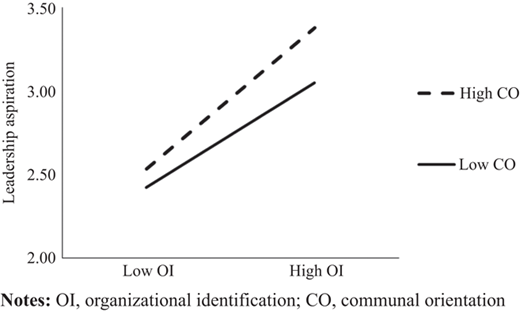
There were significant relationships for gender (negative), organizational identification (positive) and communal orientation (positive) that are all consistent with the conceptual analysis, but the more important finding here is the test of H1. Supporting H1, the interaction of communal orientation and organizational identification was significantly related to leadership aspiration (b=0.12, SE=0.06, p<0.05). To determine the nature of this interaction, subsequently a simple slope analysis according to Aiken and West (1991) was conducted. The analyses showed that whereas organizational identification was positively related to leadership aspiration for individuals with a high communal orientation (b=0.52, SE=0.06, p<0.01) as well as for individuals with a low communal orientation (b=0.38, SE=0.06, p<0.01), the slope was steeper for high communal orientation than for low communal orientation, supporting H1 (see Figure 1 for visualization).
Second stage moderation model
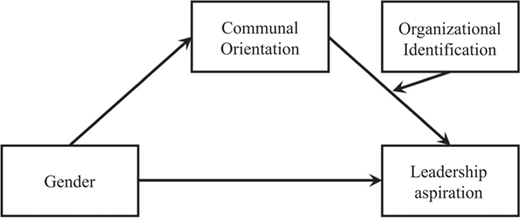
In line with previous findings (e.g. Abele, 2003; Bakan, 1966; Eagly, 1987; Feingold, 1994; Lyness and Heilman, 2006) these results confirm that communal orientation and the dummy variable for gender (i.e. where female is coded 1 and male 0) are significantly positively related (r=0.22, p<0.01), hence women do possess a greater communal orientation than men. Consequently, communal orientation may play an important role in mediating gender effects. In order to test the second hypothesis, a second stage moderation model (see Figure 2) was conducted by using a bootstrapping approach, employing 5,000 bootstrap samples for the bias corrected confidence intervals of 0.95. The analysis showed that the direct effect of gender on leadership aspiration was negative (b=−0.16, SE=0.08, LCI=−0.31 and UCI=−0.01). Thus, overall women have lower leadership aspiration than men. However, the conditional indirect effect of gender mediated by communion and moderated by organizational identification was positively related to leadership aspiration when organizational identification was high (mean +1 standard deviation) (b=0.07, SE=0.03, LCI=0.03 and UCI=0.13), but unrelated to leadership aspiration when organizational identification was low (mean –1 standard deviation) (b=0.02, SE=0.02, LCI=−0.01 and UCI =0.06), hence supporting H2.
Discussion
Barriers to women achieving leadership positions are well-documented (Carli and Eagly, 2016; Eagly and Carli, 2007; Rudman and Glick, 2001) and such barriers may presumably also discourage women’s leadership aspiration. The evidence generally also suggests that women indeed are more communal than men – a factor also argued to invite biases in others’ leadership perceptions in favor of male leadership (Eagly and Karau, 2002; Heilman, 2001; Lyness and Heilman, 2006). Importantly, however, the present study shows that communal orientation in and of itself does not discourage leadership aspiration. Indeed, with higher organizational identification it may stimulate leadership aspiration, and thus increase the leadership aspiration of women more than of men due to women’s greater communal orientation. The moderated mediation evidence that women show higher leader aspiration than men, mediated by communal orientation, when they highly identify with the organization, speaks to how the psychological linkage with the organization may inspire leadership aspiration. These findings have some clear implications for theory and practice.
Theoretical implications
Traditionally agentic traits, being linked to an augmented self-esteem (Wojciszke et al., 2011), to advancement within social hierarchies (Trapnell and Paulhus, 2012), and to career success (Abele, 2003), were considered to be more suitable for leadership (Eagly and Karau, 2002; Heilman, 2001; Rudman and Glick, 2001). Women’s more communal nature on the contrary was equated with inferior female performance within leadership roles (Eagly and Karau, 2002; Heilman, 2001; Lyness and Heilman, 2006).
However, meta-analytic evidence shows that this “masculine construal of leadership has decreased over time” (Koenig et al., 2011, p. 616) and people “begin acknowledging the essential communal elements of leadership” (Hoyt, 2010, p. 493) as leaders who also incorporate communal traits are more effective than purely agentic leaders (Gartzia and van Knippenberg, 2015; Kark et al., 2012). Meta-analytic evidence shows that women are as effective as men within leadership positions (Eagly et al., 1995; Paustian-Underdahl et al., 2014). In the present study, this work was complemented from yet another angle, not looking at others’ perceptions and stereotypic preconceptions (Eagly and Karau, 2002; Heilman, 2001; Lyness and Heilman, 2006) or evaluation of the evidence of gender and communal orientation’s influence on leadership effectiveness (Eagly et al., 1995; Gartzia and van Knippenberg, 2015), but studying the relationship between gender, communal orientation, and leadership aspiration. This is an important complementary perspective because neither the stereotyping perspective nor the leadership effectiveness perspective speaks to how gender and communal orientation may shape the ambition to become a leader, and such leadership aspiration is an integral part of the achievement of leadership positions.
By introducing organizational identification into the equation, we showed that a communal orientation may in fact inspire leadership aspiration for individuals strongly identifying with their employing organization. Particularly the link between organizational identity, capturing the “self-referential meaning” an organization attributes to itself (Corley et al., 2006, p. 87) and organizational identification may be important in this regard. As the overlap between personal identity and organizational identity is associated with greater organizational identification (Elsbach and Bhattacharya, 2001), future research may explore whether organizations, incorporating communal elements in their organizational identity, do activate the communal orientation of women to serve the collective and hence their leadership aspiration even to a greater extent. The findings regarding the positive impact of organizational identification on leadership aspiration further beg the question of whether other forms of identification can have a similar positive influence on women’s leadership aspiration. Studying various foci of identification is an interesting avenue for future research because “identities at different levels may be competing or simultaneously salient in motivating the same behavior” (He and Brown, 2013, p. 20). van Dick et al. (2008) have demonstrated the positive effect of both organizational and work group identification for positive employee outcomes, such as job satisfaction or extra role behavior. Future research may thus look at distinct types of identification within an organizational context (e.g. department or work group) and assess whether a greater identification, being linked to the motivation to act in favor of the collective (van Knippenberg, 2000; van Knippenberg and van Schie, 2000), at lower hierarchical levels (e.g. department or work group) equally activates the orientation of communal individuals to serve the collective by aspiring to serve this specific group as a leader.
In addition to studying the effect of identification among lower levels such as work groups, future research may fruitfully explore the impact of cooperative climate among close relationships, such as work groups. Such a cooperative or supportive climate, being characterized by cooperation and team spirit (Fisher, 2014; Koys and DeCotiis, 1991), may be particularly important for individuals with a communal orientation due to their greater orientation toward positive close relationships (Gebauer et al., 2013; Lyness and Heilman, 2006). As such future research may explore whether cooperative climate may comparably to organizational identification activate the communal orientation to serve the community by aspiring to become a leader of the respective community. Advancing research in the domain of organizational climate or more broadly speaking regarding the organizational context is decisive as “the impact of the organizational context on leadership is an under-researched area” (Porter and McLaughlin, 2006, p. 573).
Practical implications
These findings further comprise some practical implications in terms of creating an environment that is more conducive to organizational identification and as such speaks to the communal orientation – being more pronounced among women – to act in favor of the organization by aspiring leadership positions.
First and foremost, from a practical perspective it is worthwhile to understand “how leadership at different levels may differently affect employees’ organizational identification” (He and Brown, 2013, p. 19) and consequently stimulate women’s leadership aspiration. Supervisors or other more senior members could potentially serve as role models in terms of possessing and displaying organizational identification. Particularly for women the positive effect of female role models on leadership aspiration has been shown by various scholars (e.g. Asgari et al., 2012; Ely, 1994; Hoyt and Simon, 2012), therefore it is assumed that more senior women, showing organizational identification, may also have a positive impact on female organizational identification and eventually leadership aspiration. Moreover, as the organization’s perceived prestige, attractiveness as well as its external image are associated with greater organizational identification (Bergami and Bagozzi, 2000; Dukerich et al., 2002), organizations should consider investing time and effort in improving and aligning their external image through an adequate usage of PR as well as through developing, aligning and improving their employer branding.
Eventually, the human resource department should be empowered to work on a strategy improving organizational identification, including a clear roadmap and initiatives catalog. Part of the initiatives catalog should be the development of customized identity work tactics to create a good balance for employees between their individual and their identifications. Therefore employees should be trained about and encouraged to use identity work tactics according to their specific needs, ranging from differentiating tactics (e.g. separating role from identity) to integration tactics (e.g. merging role with identity) (Kreiner et al., 2006). Yet, as identification is also associated with potentially negative behaviors such as ingroup bias, including favoring ingroup members while discriminating outgroup members (Ashforth et al., 2008; van Leeuwen et al., 2003) it is essential to not only develop initiatives how to increase organizational identification but to also develop strategies to encounter these negative side-effects as otherwise women, having high leadership aspiration might not be selected for leadership roles simply due to ingroup bias, favoring, e.g. employees from the same department or work group.
Limitations and directions for future research
This study has some limitations that need to be mentioned. A first and obvious limitation is that this study is correlational and hence it cannot refer to matters of causality. Besides, this study contains percept-percept relationships for the mediator-moderator-to-outcome link that are a particular concern in this respect. Thus, the mediator-moderator-to-outcome relationships inevitably rely on methodologically weaker evidence, yet the independent variable (gender), however, is objective. Although the tested relationships are rooted in a detailed theoretical background, field experimental data are necessary to be able to speak to causality. Further, it would also be interesting for future research to also examine more objective outcomes such as leadership attainment. Although there clearly is an important relationship between aspiration and attainment (Tharenou, 2001; Schoon et al., 2007; Schoon and Polek, 2011), there may equally be other important factors influencing attainment. Consequently, it would be valuable to examine which other factors help to translate leadership aspirations into attainment.
Conclusion
Almost ten years ago Eagly and Carli (2007) informed the labyrinth metaphor for women aspiring to get to the top. According to their findings, women do not face a barrier to leadership positions per se, but rather have to follow a circuitous, demanding and entwined path. As this metaphor is still valid today (Carli and Eagly, 2016; Kark and Eagly, 2010), the outlook toward a complex path to the top may discourage leadership aspiration among women. As such, understanding factors that may stimulate female leadership aspiration is crucial. The presented results depict an important step toward understanding how organizational identification and communal orientation interact and how they interact with women’s leadership aspiration. Women express higher leadership aspiration, mediated by communal orientation, when they highly identify with the organization they work for. This speaks to the notion how the psychological linkage with the organization may in fact inspire leadership aspiration. These findings do emphasize interesting avenues for future research in terms of studying for instance the interplay between a communal organizational identity and organizational identification as well as different foci of identification and their respective impact on leadership aspiration. Likewise, relevant implications for practitioners, such as the importance of senior role models in displaying organizational identification and the significance of developing and implementing an encompassing HR strategy how to build organizational identification, are presented within this paper. These gained theoretical and practical insights should hopefully be beneficial for creating an organizational environment that stimulates rather than diminishes leadership aspiration among women.
References
Further reading
Appendix
Gender differences
| Women | Men | |||||
|---|---|---|---|---|---|---|
| Mean | SD | % | Mean | SD | % | |
| Demographics | ||||||
| Age | 43.78 | 10.78 | 47.51 | 9.47 | ||
| Children | 48.5 | 64.0 | ||||
| Single | 33.0 | 23.5 | ||||
| relationship | 24.0 | 26.5 | ||||
| Married | 43.0 | 50.0 | ||||
| Experience | ||||||
| Work experience | 22.33 | 11.18 | 26.37 | 10.45 | ||
| Organizational experience | 11.13 | 8.73 | 12.23 | 8.99 | ||
| Job experience | 7.34 | 5.80 | 8.81 | 7.19 | ||
| Hierarchical position | ||||||
| Non-supervisor | 49.5 | 40.0 | ||||
| First-level management | 23.5 | 20.5 | ||||
| Middle management | 20.5 | 33.0 | ||||
| Upper management | 3.5 | 4.5 | ||||
| Executive management | 3.0 | 2.0 | ||||
| Educational background | ||||||
| High-school | 30.5 | 27.5 | ||||
| Apprenticeship | 16.0 | 27.0 | ||||
| Bachelor | 32.5 | 32.0 | ||||
| Master | 21.0 | 13.5 | ||||
| Cultural background | ||||||
| British | 91.0 | 94.0 | ||||
| Continental European | 4.0 | 3.0 | ||||
| African | 2.5 | 0.5 | ||||
| American | 0.0 | 0.0 | ||||
| Asian | 2.5 | 2.5 | ||||
| Australian | 0.0 | 0.0 | ||||
Measurements scales
Leadership aspiration (five-point scale, 1=strongly disagree to 5=strongly agree)
Please indicate to which extent you agree with each statement:
I hope to become a leader at the current organization I work for.
When I am established in my career, I would like to manage other employees at the current organization I work for – not at a different one.
I do not plan on devoting energy to getting promoted in the organization I am working for (reverse).
When I am established at the current organization, I would like to train others.
I hope to move up through the organization I work for.
Attaining leadership status in this organization is not that important to me (reverse).
I would like to obtain a (higher) leadership position within the organization I work for.
I would like to be in a position of greater responsibility and influence in my organization.
My aspirations for advancing in management positions within this organization are very high.
I have sought feedback on my job performance at the current organization I work for.
I have discussed my career prospects with someone with more experience in this organization.
I have engaged in career path planning to determine my career path within this organization.
I have updated my skills in order to be more competitive for promotion within this organization.
I have discussed my aspirations with a senior person in the organization.
While working for the current organization, I have volunteered for activities other than my day-to-day work tasks, such as working parties and selection panels.
I have volunteered for important assignments with the intent of helping to further my advancement possibilities within this particular organization.
I have requested to be considered for promotions at the current organization I work for.
Communal orientation (five-point scale, 1=strongly disagree to 5=strongly agree)
How well does each of the following traits generally describes you?
Affectionate
Caring
Compassionate
Faithful
Honest
Kind
Patient
Sensitive
Trusting
Understanding
Organizational identification (five-point scale, 1=strongly disagree to 5=strongly agree)
Please answer the following statements:
When someone criticizes my organization, it feels like a personal insult.
I am very interested in what others think about my organization.
When I talk about this organization, I usually say “we” rather than “they”.
This organization’s successes are my successes.
When someone praises this organization, it feels like a personal compliment.
If a story in the media criticized the organization, I would feel embarrassed.
Female environment (five-point scale, see below)
Please answer the following statement:
How long have you worked closely with a women manager?
(1=not worked with a women manager; 2=less than 12 months; 3=1 up to 2 years; 4=2 up to 4 years; 5=4 or more years)
Notes: Leadership aspiration scale adapted from Gray and O’Brien (2007); Tharenou and Terry (1998); Day and Allen (2004) – being itself adapted from London (1993) and Noe et al. (1990). Communal orientation developed by Gebauer et al. (2013). Organizational identification adapted from Mael and Ashforth (1992). Female environment scale adapted from Tharenou et al. (1994).

