


The purpose of this study is to explore employers’ views on the current English communication skills of higher education institutions (HEIs) graduates in Oman and to identify the workplace communication challenges encountered by graduates of these institutions.
The study used a mixed-methods approach. In the first phase of the study, a questionnaire was distributed to 50 employers in different government and private sectors. In the second phase of the study, semi-structured interviews were conducted with 15 employers to get clarification on some of the issues that were raised in the questionnaire and get the employers’ opinions about how to improve the communication skills of Omani graduates and what initiatives HEIs can take to achieve that.
The study revealed that Omani graduates encounter many challenges in the workplace, including low proficiency in English, lack of research skills and persuasive skills and inappropriate use of language during meetings and events.
HEIs should foster a relationship with the job market through continuous meetings to seek their feedback on English courses so that they can improve them to cater to specific job requirements.
The higher education system in Oman has achieved substantial growth in terms of quantity, including the number of institutions, enrolled students, hired teachers and specialisations. This growth of HEIs highlights the necessity of preparing Omani citizens who are capable of participating in the ongoing development in Oman and to this end, English communication skills are critical.
Introduction
English is an important tool of communication in many countries around the world including Oman (Al Hajri, 2013; Al-Issa, 2015; Al-Azri, 2016; Al Hinai, 2018). Like the other Gulf States, Oman has attracted Western companies, especially from the USA and UK, to develop its oil and gas industry. These companies depend on expatriate manpower, whose language of communication is English making English communication skills important in the workplace (Al-Mahrooqi & Denman, 2016). In view of this, the Omani Government reformed the education system instituting English as the medium of instruction (EMI) at the tertiary education level since 1986 (Al-Mahrooqi & Tuzlukova, 2014). This resulted in a huge shift for Omani students who study English as a foreign language at school where Arabic is the medium of instruction and they learn in English when they join higher education institutions (HEIs). The large majority of the students (88%) who join tertiary education take English intensive programmes that prepare them for studying their undergraduate programmes in English (Baporikar & Shah, 2012). However, despite these English intensive programmes, there are major concerns over the deteriorating student English proficiency in HEIs in Oman, which can negatively affect students’ self-confidence when they communicate with others in English both at university and later on in the workplace.
Recent statistics from the National Center for Statistics and Information (NCSI) in Oman have shown that the number of unemployed graduates reached 50,000 (11%) in 2017. This figure is considered high in view of the many local job vacancies advertised daily and one of the reasons often mentioned by prospective employers is that Omani graduates are lacking the English communication skills required by many jobs, especially the ones in the private sector. This means that despite the fact that the Omani Government has invested millions of rials in the higher education sector for the Sultanate to achieve its Omanisation policies, “the huge investment has nowhere yielded the expected gains” (Al-Mahrooqi & Tuzlukova, 2014, p. 474). Increasing the number of graduates from HEIs is not enough to achieve Omanisation, while ensuring the high quality of these graduates is a crucial step for replacing expatriates with a competent Omani workforce. The present study sought to investigate how prepared are Omani students for the workplace in terms of their English communication skills.
Literature review
In recent years, many HEIs have started to focus on the employability of their graduates (Al-Azri, 2016; Al Hinai, 2018). However, the concept of employability seems to be a difficult one to define for employers, academics and students. Generally, employability includes “skills and attributes that enable fresh graduates to secure jobs and those who are already used to maintain or advance in their career” (Marzuki & Jerome, 2017, p. 316). Amongst these skills that are required by the job market is the ability to communicate in English or English communication skills (Al-Azri, 2016; Thomas, Piquette, & McMaster, 2016; Mourshed, Farrell, & Barton, 2013) which are the focus of this study.
Communication skills cover two areas of competency: linguistic skills and professional communication skills. Linguistic skills are further divided into receptive and productive skills (Bhatt & Lilian, 2016). Receptive skills include reading and listening. When using receptive skills, a person reads or listens to the language and then decodes its meaning. When using productive skills, the person uses language in a meaningful way to produce writing and speaking. Productive skills need both accuracy and fluency which means that the person should use correct grammar and speak or write fluently based on the context. Many studies have shown that receptive skills are easier to acquire than productive skills (Ambruster, Lehr, Ralph, Osborn, 2001; Bhatt & Lilian, 2016).
Regarding professional communication skills, studies have listed several skills that graduates need to obtain before they start work. For instance, Thomas et al. (2016) in their study about skills needed for the job market in the Gulf countries, listed the following skills:
Making presentations, taking part in technical discourse, confidently explaining and justifying actions, processes and decisions to co-workers and line-managers and communicating effectively across a multi-cultural/multi-national workforce (p. 2).
Similarly, Jackson (2010) highlighted that graduates need to be competent in oral communication skills including giving and receiving feedback and communicating in a clear and sensitive manner. In the same vein, Abdulla, Naser and Saeid (2014) stated that employers in Kuwait need graduates to be competent in expressing themselves verbally, having good presentation skills, listening and participating successfully in a meeting and responding to a conversation. Based on these studies, a framework of English communication skills for the workplace was developed (Figure 1).
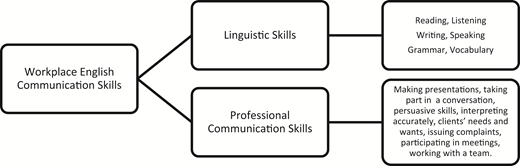
English communication skills needed in the workplace
English communication skills needed in the workplace
English communication skills of graduates
There have been many studies that have examined the English communication skills of university graduates. For instance, in Thailand, Pattanaoichet and Chinokul (2011) found that Thai graduates were not used in many sectors in Thailand due to their lack of confidence when communicating in English. In the Gulf, Thomas et al. (2016) investigated the employers’ perceptions of graduates’ English workplace communication skills in Bahrain and they found that employers were not satisfied with the graduates’ communications skills. Specifically, they stated that students need to be fluent in English and familiar with various writing genres such as emails, letters and taking minutes.
In Oman, Moody (2012) reported that English programmes in HEIs have failed to address the communication skills that are needed in the job market. Similarly, Al-Mahrooqi and Tuzlukova (2014) reported in their study that both pragmatic and communication skills were not highlighted in HEIs and asserted that “higher education graduates emerge weak in English, and thus with communication skills inadequate for the job market” (p. 474). Belwal, Priyadarshi and Al Fazari (2017) also reported that HEIs in Oman fail to prepare their graduates for the job market due to many reasons, including the absence of a comprehensive educational philosophy and inadequate educational programmes that tackle soft skills including English communication skills. They suggested that coordination between the different stakeholders is fundamental to develop graduates’ employability skills. Similarly, Mourshed et al. (2013) promoted more involvement for stakeholders, including the job market and students, which would ensure a better quality of education. In a more recent graduate study conducted by the Omani Ministry of Higher Education in 2016, it was shown that Omani graduates lack English language skills, communication skills, a good attitude and passion towards work. As a result, Al Hinai (2018) found that only 12% of HEIs graduates have been used in the private sector primarily due to their low level of English language proficiency.
Based on these findings, the aim of this study was to explore employers’ perceptions of the English communication skills of HEI graduates, identify the workplace communication challenges encountered by them, scrutinise what English communication skills need to be fostered at HEIs from the perspective of employers and develop a set of recommendations to enhance students’ English communication skills at HEIs.
The study
The study used a mixed-methods approach (Creswell & Plano Clark, 2007) to get a better understanding of the job market in terms of graduates’ English communication skills. In the first phase of the study, a questionnaire was distributed to employers in different government and private sectors. In the second phase of the study, semi-structured interviews were conducted with employers to elicit their opinions about how to improve the English communication skills of Omani graduates and what initiatives HEIs can take to achieve that.
Participants
In the first phase, a total of 50 employers in different government and private sectors responded to the questionnaire. In the second phase, 15 employers were interviewed. The sample included eight Omanis and seven expatriates and there were 10 men and five women whose ages ranged between 35 to 55 years old. The interviewees worked in different public and private sectors, such as an oil and gas company, the Ministry of Health, the Ministry of Education, the Ministry of Agriculture, the Ministry of Manpower, banks, an electricity company, a telecommunication company, an insurance company and a construction company. Table 1 shows the position of the interviewees and the business sector of their company.
Background information about the interview participants
| Participant code | Workplace | Position of the participant |
|---|---|---|
| P1 | Ministry of manpower | Human recourses head |
| P2 | Bank muscat | Regional manager |
| P3 | Insurance company | Chief marketing officer |
| P4 | Oil and gas company | Chief executive officer |
| P5 | Electricity company | Human capital business relationship executive |
| P6 | Ministry of health | Human resources head |
| P7 | Telecommunication company | Chief human capital officer |
| P8 | Oil and gas company | Chief operating officer |
| P9 | Construction company | Chief financial manager |
| P10 | Ministry of education | Human resources head |
| P11 | Telecommunication company | Marketing manager |
| P12 | Insurance company | Office manager |
| P13 | Ministry of agriculture | Human resources head |
| P14 | Oman national bank | Recruiting manager |
| P15 | Oil and gas company | Advanced specialist role –benefits and training |
Data collection instruments and procedure
The study used two data collection instruments: a questionnaire and an interview. In the first phase of the study, the questionnaire which comprised three parts was distributed. The first part included general questions, such as the type of organisation, qualifications required in the organisation and a general view of the English communication skills of graduates. The second part included 17 statements that focussed on the linguistic skills of graduates and participants were asked to indicate their level of agreement using a five-point Likert scale (from totally agree to totally disagree). The third part comprised 23 items that focussed on the professional communication skills of Omani graduates. Respondents were asked to indicate their level of agreement with each of the statements using a five-point Likert scale (from totally agree to totally disagree). The items included in the questionnaire were based on the pertinent literature.
The second phase of the study comprised semi-structured interviews with employers. The participants were selected from the pool of questionnaire respondents based on their willingness to be part of the interview as indicated at the end of the questionnaire.
The interviews were conducted in English and Arabic, depending on the preference of the participants and they were audio-taped. The interview questions related to the participants’ background, the importance of English communication skills in their organisations, their perceptions of Omani graduates’ English communication skills and the challenges the graduates encountered. Further, follow-up questions and prompts were also used based on the responses of the interviewees. Each interview lasted 30–45 min.
Data analysis
For the questionnaire data, descriptive statistics, including means and standard deviations, were calculated using SPSS. The interviews were recorded and then fully transcribed. The data were analysed inductively using a bottom-up approach (Ryan, 2006), where the codes were not predetermined but emerged from the data (Creswell, 2013).
Results and discussion
The findings are presented and discussed in terms of the employers’ perceptions of Omani graduates’ English communication skills and the themes that emerged from the interview data.
Employers’ perceptions of Omani graduates’ linguistic skills
None of the items in the questionnaire targeting employers’ perceptions of Omani graduates’ English language skills received a mean above 4. The mean value of the various items ranged between 3.9 and 2.1, indicating a moderate and low-level perception in terms of the language skills addressed in the questionnaire. These results indicate that employers perceived that the HEIs only somewhat equipped students with the linguistic skills needed in the workplace (Table 2).
Employers’ perceptions of Omani graduates’ English language skills (n = 50)
| Statement: Omani graduates are… | Mean | SD |
|---|---|---|
| 1) Proficient in English | 2.8 | 0.879 |
| 2) Able to write emails | 3.3 | 1.110 |
| 3) Capable of reading and understanding English texts independently | 3.8 | 0.839 |
| 4) Able to express opinions and ideas in writing | 2.4 | 1.078 |
| 5) Able to write letters | 3.7 | 1.081 |
| 6) Able to write brief notes | 2.7 | 1.215 |
| 7) Able to write reports, proposals, meeting agendas and minutes | 2.1 | 1.123 |
| 8) Easily understood by people from different backgrounds when speaking in English | 3.2 | 1.124 |
| 9) Able to ask questions for clarification | 3.5 | 1.170 |
| 10) Able to understand and use idiomatic expressions accurately | 2.8 | 1.063 |
| 11) Capable of summarising other people’s ideas | 3.0 | 1.120 |
| 12) Able to begin and end a conversation properly | 3.6 | 1.145 |
| 13) Capable of paraphrasing and restating other people’s opinions | 2.9 | 1.158 |
| 14) Able to compare and contrast ideas | 3.5 | 0.932 |
| 15) Able to describe people, places, objects and processes | 3.9 | 1.081 |
| 16) Able to listen and take notes while listening | 2.9 | 0.879 |
| 17) Able to distinguish between formal and informal language and use what is appropriate in a given situation | 3.4 | 1.124 |
| Overall | 3.15 | 1.021 |
Note:
1 = totally disagree to 5 = totally agree
Item #15 obtained the highest mean (M = 3.9), indicating that the employers think that Omani graduates are able to describe people, places, objects and processes. This could be attributed to the fact that in the English curriculum in most HEIs, describing people, places and objects is one of the learning outcomes. Also, these are considered low-level skills that students can master easily. This finding was further confirmed through the interviews with the employers. For example, one respondent said:
Omani graduates can perform lower thinking activities such as describing events, places and objects. They may lack the vocabulary needed to describe, but they could manage by checking a dictionary or with their colleagues. Actually, what I observed working closely with Omani graduates is that they lack vocabulary in English (P12).
Item #3 attained a considerably high mean as well (M = 3.8), showing that the employers thought Omani graduates are capable of reading and understanding English texts independently. This can be attributed to the fact that as EMI is implemented in all HEIs in Oman, students had to learn all of their courses in English, and therefore they were used to reading content in English. In addition, the availability of many online translation sites and apps nowadays enables Omani graduates to read and understand English text independently. During the interview, one of the respondents reported:
Whenever I asked the Omani employees to read anything in English, they are capable of understanding what they have read, but when you asked them to summarise or synthesise what they have read, they are not able to do so (P4).
The above interview extract also reveals that Omani graduates are not capable of summarising or synthesising what they read. This can be due to the fact that most of their studies at HEIs have been based on rote learning, where they are required to memorise items. This result verifies an earlier study by Al-Mahrooqi (2012), who found that HEIs seem to focus only on lower-order thinking and cognitive skills, in which students are not asked to summarise and synthesise and in most reading exercises, students are asked to simply answer comprehension questions.
Items #5 and #12 (with M = 3.7 and M = 3.6, respectively), showed that employers thought that graduates of HEIs can write letters in English and can begin and end conversations properly. These are considered basic skills that should be mastered even by school learners, let alone graduates of HEIs who have spent about 12 years studying English in school and four to five years in an EMI higher education context.
Item #11 attained a mean of M = 3.0, indicating moderate agreement amongst the employers that Omani graduates are capable of summarising other people’s ideas. Conversely, Items #1, #10 and #16 attained means just below M = 3.0 which indicates that the employers believed that Omani graduates are not that proficient in English. This is in line with earlier studies conducted in Oman (Al-Mahrooqi & Asante, 2010; Al-Issa, 2011; Al-Mahrooqi, 2012; Baporikar & Shah, 2012; Al Mamari, 2012), further indicating that the level of Omani graduates’ English language skills has remained unchanged over the past decade. Similarly, Items #4 and #6, which referred to graduates being able to express their opinions and ideas in writing, attained a mean of M = 2.4. This can be explained by the fact that most English curricula have not been sufficient in helping students to acquire the writing skills for expressing their opinions and ideas in English. In addition, writing being a productive skill requires students to consolidate their knowledge of grammar, vocabulary and organisation, making it a difficult skill to master. Omani students’ low level of writing skills can be attributed to the fact that most HEIs use foreign curricula and textbooks that do not meet the local workplace needs and required skills for employment. These international books are above students’ ability to understand and they are often perceived as boring. According to Al-Mahrooqi (2012, p. 266), “the topics covered are unimportant, inappropriate and uninteresting”. This further exacerbates students’ lack of motivation and positive attitude towards learning, which can have a negative impact on their learning experience and academic achievement. One of the interviewees explained:
Working closely with Omani graduates in my organisation, I observed that they have difficulties in writing; they lack basic knowledge of sentence structure and they needed vocabulary. We try to develop their skills via enrolling them in special courses for writing, so they can be equipped with the necessary skills to fulfil their work in the organisation (P15).
Item #7 attained the lowest mean (M = 2.1), which indicates that the employers thought that Omani graduates are unable to write reports, proposals, meeting agendas and minutes. Engaging in such tasks requires good writing skills and the ability to express ideas. Such tasks are not frequent in the English curriculum which is based on rote learning, traditional lectures and students memorising the course content (Baporikar & Shah, 2012). In addition, Al-Mahrooqi and Tuzlukova (2014) found in their study that Omani students have many serious issues with their writing skills not least due to the fact that Arabic has a different alphabet to English, the direction of writing is opposite and the rhetorical style in Arabic is different to English. During the interview, one respondent stated:
It seems that Omani graduates face a serious issue when they are asked to write reports including problems related to spelling, grammar, vocabulary and organisation. In our company, we need employees who can express their ideas and concerns clearly in their writing (P7).
Employers’ perceptions of Omani graduates’ professional communication skills
The results in the third part of the questionnaire that contained items about Omani graduates’ professional communication skills are summarised in Table 3. As can be seen, none of the items in this part had a mean above M = 4. The means of the different items ranged between M = 3.73 and M = 2.6, indicating moderate and low levels of employers’ perceptions in terms of the Omani graduates’ skills addressed in the different questions.
Employers’ perceptions of Omani graduates’ professional communication skills (n = 50)
| Statement: Omani graduates… | Mean | SD |
|---|---|---|
| 18) Are well prepared for the job market in terms of communication skills | 2.90 | 1.021 |
| 19) Can interact effectively in a job interview | 3.25 | 1.111 |
| 20) Can write an effective CV | 3.18 | 0.839 |
| 21) Have effective writing skills | 2.84 | 1.086 |
| 22) Can give negative feedback in a positive way | 3.33 | 1.024 |
| 23) Have oral communication skills | 2.94 | 0.809 |
| 24) Have verbal negotiation skills | 2.81 | 1.081 |
| 25) Are able to use different media (speaking on the phone, texting, voice messaging) | 3.55 | 1.105 |
| 26) Are able to communicate clearly with clients | 3.18 | 1.134 |
| 27) Are able to interpret clients’ needs and wants accurately | 2.89 | 1.092 |
| 28) Are capable of responding to complaints | 3.33 | 1.133 |
| 29) Have persuasive skills | 2.95 | 1.089 |
| 30) Can contribute effectively to discussions of important topics in their work place | 3.19 | 1.111 |
| 31) Are able to resolve a conflict or disagreement | 2.69 | 1.090 |
| 32) Can find other ways to communicate intention ideas or emotions when lacking words | 3.27 | 1.016 |
| 33) Know how to change the topic to redirect discussion or conversation to a new issue | 3.45 | 1.141 |
| 34) Are able to use appropriate gestures and body language when communicating with others | 3.66 | 1.215 |
| 35) Have effective presentation skills | 3.36 | 0.983 |
| 36) Are able to arrange meetings and workshops in their workplace | 3.52 | 1.012 |
| 37) Use polite language with others | 3.08 | 1.075 |
| 38) Know how to apologise after making a mistake | 3.11 | 0.896 |
| 39) Are capable of giving suggestions and making recommendations | 2.93 | 1.145 |
| 40) Work effectively in teams | 3.73 | 1.097 |
| Overall | 3.17 | 1.041 |
Note:
1 = totally disagree to 5 = totally agree
Table 3 shows that Item #40 obtained the highest mean (M = 3.73), indicating that the employers think that Omani graduates are able to work effectively in teams. The findings from the interviews confirmed this result. For example, one respondent said:
From my experience, I can tell you that Omani graduates can work well with others and they can complete any tasks they are assigned because most of them have positive attitudes and they want to learn (P13).
Items #25 and #36 (M = 3.55 and M = 3.52, respectively), showed that employers believed that graduates can use different media (such as speaking on the phone, texting or voice messaging) and they can arrange meetings and workshops in their workplace. These are everyday tasks that young people perform routinely. Also, many listening tasks and exams in the English curriculum are based on listening to conversations between clients and employees or listening to people who are arranging different events, so university students often perform these tasks as part of the curriculum. However, in the interviews, some of the respondents indicated that graduates lack the ability to respond to phone calls or messages, so they had to provide training courses that were designed to develop Omani graduates with the skills to fulfil the basic tasks required in the workplace. For instance, one of the respondents said:
In our company, we have two different jobs. We have technical jobs, where employees are dealing with machines and wires. I think Omani graduates have no problems with such jobs. However, in other jobs, they need to have immediate contact with customers. In this case, they have many linguistic and communicative issues. Therefore, we provide them with three or six months of intensive courses to enable them to perform their jobs (P11).
Items #33, #35 and #28 had relatively low means, but they were still above M = 3.0 indicating a moderate level of agreement. These three items were related to changing the topic to redirect a discussion or conversation to a new issue, having effective presentation skills and being capable of responding to complaints. Their mean scores were M = 3.45, M = 3.36 and M = 3.33, respectively. Item #31 attained the lowest mean (M = 2.69), indicating that the employers thought that Omani graduates are unable to resolve conflict or disagreement. This could be attributed to the fact that learning English is based on rote learning and traditional lectures rather than communication. During the interview, some respondents indicated the importance of dealing with conflict as follows:
It is not enough to be a fluent user of English, but the most important thing is whenever you are put in a conflicting situation, you might need to make your ideas clear and argue using reasons and convincing techniques, which most graduates lack, unfortunately (P14).
From the above results, it can be seen that employers rated professional communication skills (M = 3.17) only slightly higher than English communication skills (M = 3.15). This can be attributed to the fact that acquiring a second language like English in the form of listening, speaking, writing and reading is very complex (Mishra & Mishra, 2020). Additionally, many HEIs have started to realise the importance of soft skills such as working in teams, giving presentations and organizing events and such skills have been emphasised in the curriculum (Mousawa & Elyas, 2015; Al-Azri, 2016).
Employers’ perceptions of workplace communication challenges encountered by graduates of higher education institutions
Interviewees were asked questions about the challenges encountered by graduates in the workplace, such as inadequate language skills, lack of persuasive skills, lack of research skills and inappropriate language use in meetings and conversations. Each of these is explained below.
Inadequate language skills
During the interviews, one of the respondents, who was working in the private sector, stated:
Although we would like to use more Omani, so we can achieve the required percentage of Omanisation, we are not able to do so, as Omani graduates do not possess adequate English communication skills (P15).
HEIs have been criticised for producing graduates with low English skills and knowledge and the English General Foundation Programme, which students are required to take when they join the HEIs, has been found to contribute minimally to improving the English language proficiency required for academic studies (Baporikar & Shah, 2012; Al Mamari, 2012). Students were also found to lack basic academic skills such as being independent learners, enthusiastic to learn and hard-working, which are much-needed skills in the workplace.
Other employers thought that Omani graduates even lack the basic linguistic skills to perform various communication tasks in English, such as apologising, requesting, interrupting and complaining. One of them said:
Omani employees need more training in how to use English to perform basic tasks in daily work, including requesting, apologising, negotiating, complaining and responding to different customers’ requests (P2).
Lack of persuasive skills
According to the employers, one of the challenges encountered by Omani graduates is the lack of persuasive skills. For instance, one respondent said:
Sometimes we ask them to initiate solutions to some problem we encounter at work, but unfortunately, they lack the language to propose a solution and convince others about their ideas (P11).
This is in line with the work of Belwal et al. (2017), who found that graduates are not capable of handling high-level activities and their ability in using language to perform complex activities is limited. HEIs should focus more on higher-level skills (Belwal et al., 2017), whereby students are asked to take a stance and persuade others about their views. This can be done by involving students in problem-solving tasks, projects, debates and meaningful discussions.
Lack of research skills
Another challenge encountered by Omani graduates is using English to perform research, which is considered an essential part of any organisation to identify problems and find ways to solve them. For instance, as one of the respondents during the interview stated:
Research skills are amongst the necessary skills needed in any organisation. If we encounter any issue, we need to investigate and conduct a study, so we can find a solution. However, Omani graduates lack research skills, starting from writing proposals to collecting data and reaching results (P8).
HEIs need to revise their curricula and engage students in activities in which they are required to identify problems and follow research steps to find solutions. In addition, the infrastructure and equipment for staff and student research must be provided in HEIs, so that research skills can be fostered.
Inappropriate language use in meetings and conversations
Some of the interviewees identified the lack of appropriate language use during official meetings as one of the challenges encountered by Omani graduates. For instance, as one respondent illustrated:
Omani graduates are not able to use the right language during meetings and conversations. In other words, they do not use the right language, they do not take into consideration who they are talking to and approach them in a suitable way (P7).
This is in line with a study conducted in Bahrain that found that graduates of HEIs do not use the language register appropriately and they do not differentiate between formal and informal language (Thomas et al., 2016). This can be attributed to the fact that students have limited exposure to different language registers during their studies. This leads the employers to show a preference for graduates who have studied abroad because of their better command of English, although graduates from local HEIs have better subject knowledge. For instance, one respondent from a big oil company stated:
We did not recruit local university graduates because of their lack of confidence to communicate in English and we prefer graduates who studied abroad, as their English is better (P15).
Summary and recommendations
The findings of this study reveal that Omani graduates generally lack English communication skills and these findings echo those of earlier research studies conducted in Oman (Al-Issa & Al-Blushi, 2011; Al-Mahrooqi, 2012; Tanveer, 2013). The findings also showed that Omani graduates are capable of using the language to fulfill lower-order thinking tasks, but they lack the ability to use the language for high-order thinking such as summarising, synthesising and solving problems. Furthermore, the findings indicate that Omani graduates exhibit low proficiency in English, lack of research and persuasive skills and inappropriate use of language during meetings and events. Therefore, based on these findings and to develop Omani graduates’ English communication skills, HEIs need to improve their curriculum, pedagogy and infrastructure.
Curriculum
HEIs should concentrate more on English as a lingua franca (Jenkins, 2015; Al Hinai, 2018; Sung, 2018) rather than adhering to a native speaker model which focusses on accuracy and nativism (Buckingham, 2015; Moody, 2012). Curriculum designers should develop curricula whereby students acquire communicative ability, i.e. the “ability to function effectively in the language in real-life contexts” (Byrnes, 1984, p. 12). For instance, the course content should include tasks similar to the tasks performed in the workplace, so that students develop hands-on experience. In addition, HEIs should develop local curricula that “meet the local market needs, students’ understanding, learning abilities and required skills for employment” (Baporikar & Shah, 2010, p. 16). This can be achieved by appointing qualified curriculum designers to co-author the Omani syllabi with international experts. Different stakeholders, including employers, should be consulted and their feedback should be incorporated in the content of the GFP. The commercial books that are currently used in HEIs might not be suitable for preparing students to work in multicultural settings like most companies in Oman, where people who are not native speakers of English use English to communicate with others. The findings of this study show that Omani graduates lack the ability to use the English language critically. Thus, the curriculum should incorporate critical thinking, which can be defined as “creative skills to produce new ideas and solve problems through reasoning, interpret symbolic data and develop learning ways for active learning” (Al-Khoudary, 2015, p. 216). It has been found that when incorporating critical thinking in teaching English, Omani students become motivated, positive and enthusiastic to learn the language (Al-Khoudary, 2015).
Pedagogy
This study showed that Omani graduates have low English proficiency skills, specifically when it comes to speaking and writing skills. Therefore, it is important to reform the pedagogical practices, so that students’ English proficiency can be improved. For instance, lecturers should use more engaging tasks in which students become active learners rather than passive recipients of knowledge. Lecturers can also use technology in their teaching, which can increase students’ exposure to the language. For instance, teachers can use flipped classes, in which “students watch instructional videos outside the classroom and do assignments or engage in activities inside the classroom” (Basal, 2015, p. 28). Such a model of teaching will transform the class from teacher-centred to student-centred and allow students to speak and use the language more. In addition, implementing flipped classes will play a role in improving students’ learning experience and enriching their language proficiency as many studies have found (Whitley-Grassi & Baizer, 2010; Roehl, Reddy, & Shannon, 2013; Basal, 2015). Lecturers should also think about the classroom arrangement to foster persuasive skills. Ezzedeen (2006) elaborated on how U-shaped seating eases the teaching of persuasive skills, as it encourages students to interact and debate, as they are facing each other.
Infrastructure
In terms of infrastructure, many HEIs need to develop their services to provide graduates with the necessary skills needed for the job market. For instance, they need to have a counselling centre that is designed to provide students with appropriate training and guidance to help them benefit from their studies. These counselling centres could provide courses and training to raise students’ motivation to learn, develop positive attitudes towards learning and acquire skills for life-long learning.
This study showed that Omani graduates lack the basic research skills that would enable them to scrunitise the problems encountered in the job market. Therefore, it is important for HEIs to have a research centre where students can acquire the research skills needed for today’s job market. As most of the literature related to research is in English, it is very critical for these centres to help students acquire the necessary language that would enable them to conduct their research activities successfully. Needless to say, these research centres should include laboratories where students can conduct experiments and offer programmes related to the language used for describing experiments and reporting findings and recommendations.
One of the basic infrastructure items which is missing in many HEIs is a career centre. In some HEIs, the career centre is limited to one employee in the Student Affairs deanship who is often not qualified to provide students with the necessary advice and guidance. Therefore, it is fundamental for HEIs to rethink the role of a career and employment centre, so that they can deliver programmes that help students to develop their personal, academic and professional skills, including English communication skills. Such programmes will help students to transition successfully to the workplace. In addition, these centres should provide students with the necessary knowledge, resources, relationships and insights to be able to perform better in the job market. They should organise activities that help students prepare for job interviews and job fairs, etc. Such activities will make students realise the importance of English for the job market and raise their level of motivation.
Conclusion
This study explored employers’ views on the English communication skills of HEI’s graduates and the workplace communication challenges they encounter. A mixed-methods design using quantitative (questionnaire) and qualitative (semi-structured interviews) instruments were used to collect data. The findings revealed that Omani graduates lack English communication skills and, therefore, HEIs should work hard to enable Omani students to develop their English communication skills, so they can be competent enough to compete for jobs in an era characterised by high unemployment rate amongst Omanis.
This study is limited due to the relatively small number of participants and the usage of convenient sampling. Therefore, the study results cannot be readily generalised. Future research should include a larger number of employers from different sectors in Oman, to establish the basis from which to understand their perceptions of Omani graduates’ English communication skills.
While the study has been limited, it has made a valuable contribution to our understanding of the specific deficiencies that need to be addressed in the Omani HEIs and the existing literature related to employability, as well as the skills and knowledge needed in the job market, which is considered to be a relatively new phenomenon in the Arab region (Al-Azri, 2016, p. 25). It also contributes to the existing literature in Oman by investigating the perceptions of employers as many previous studies concentrated on the perceptions of academics, students and graduates (Al-Issa, 2015). The findings of this study revealed the gap between the English communication skills taught in HEIs and the expectations of employers and offered guidance on how to best prepare graduates for a competitive job market.
The author would like to thank her students Ali Al Amri and Mohammed Al Rumhi from the University of Technology and Applied Sciences-Ibra for their support during data collection and analysis.

