This study examines whether the adoption of green supply chain management (GSCM) practices in response to institutional pressures influences firms' relationships with key stakeholders and the resulting implications for environmental competitive advantage. In addition, it analyzes the moderating role of B2B market characteristics in the relationship between institutional pressures and GSCM adoption.
Theoretical argumentation and hipothesis developments. A sample was taken from the high performance manufacturing (HPM) project, which included 330 manufacturing plants across 16 countries. The partial least squares structural equation modelling (PLS-SEM) technique was used to test the hypotheses.
Empirical findings shows that supplier collaboration helps companies address institutional pressures and build legitimacy through reinforced stakeholder relationships, thereby gaining a competitive advantage. Although B2B market moderating effect varies by pressure and practice, achieving competitiveness through GSCM practices is independent of market segment.
The original contribution of this study lies in its comprehensive exploration of the interplay among institutional pressures, GSCM practices, and environmental competitive advantage, while considering how the B2B market context shapes this dynamic. Furthermore, incorporating stakeholder relationships as a mediator between GSCM practices and competitive advantage, this study offers evidence that building stakeholder relationships around environmental legitimacy serves as a key source of competitiveness.
1. Introduction
Global environmental concerns and the resulting increase in awareness about sustainability have intensified societal and regulatory emphasis on corporate responsibility for environmental and social impacts (Sun et al., 2025). Recent regional and national policy initiatives, such as the European Union's Corporate Sustainability Due Diligence Directive (CSDDD), reflect the institutionalization of these evolving expectations and reinforce institutional pressures on firms to extend sustainability-oriented practices beyond organizational boundaries and across supply chains (Bello-Pintado et al., 2023; Buttke et al., 2024). In business-to-business (B2B) markets in particular, such pressures are transmitted through complex stakeholder relationships involving buyers, suppliers, regulators and civil society actors, thus making green supply chain management (GSCM) practices a central organizational mechanism through which firms respond to sustainability expectations (Chabowski et al., 2022).
While firms such as Nike, Procter and Gamble, and H&M have launched environmental initiatives in response to stakeholder demands (Gutierrez et al., 2022), the coexistence of multiple institutional logics can generate tensions between environmental initiatives and other business priorities (Hahn et al., 2018), including those embedded in supply chain relationships (Geng et al., 2024). In these contexts – where firms' economic objectives intersect with ecological considerations – understanding how environmental strategies translate into competitive advantage is critical for long-term success (Zameer et al., 2020; Yadav et al., 2023).
Prior research has extensively examined how institutional pressures (DiMaggio and Powell, 1983), driven by stakeholder expectations, influence sustainable organizational behaviours, particularly through the adoption of GSCM practices (e.g. Andalib Ardakani et al., 2023; Wen et al., 2023; Wiredu et al., 2024; Rashid et al., 2025). At the same time, recent studies indicate that these pressures can generate unintended consequences (Geng et al., 2024), highlighting the importance of stakeholder management in translating institutional pressures into effective outcomes (Sun et al., 2025). Although organizational success is widely acknowledged to depend on stakeholder relationships (Awa et al., 2024), it remains unclear how pressure-driven GSCM practices enable companies to gain superior performance and competitive advantage (Fontoura and Coelho, 2022; Bhuiyan et al., 2023; Handoyo, 2024).
Prior research has increasingly recognized the role of contingency factors in GSCM, highlighting specific mechanisms such as executives' environmental awareness (Zhang et al., 2025), green technological innovation (Fianko et al., 2025), circular-oriented resource commitment (Liu et al., 2025), and digitalization (Zhang et al., 2026). At a broader level, meta-analytic evidence confirms that the effectiveness of GSCM is contingent upon contextual factors such as industry and geographical conditions (Li and Zhang, 2024), yet without explicating the underlying mechanisms through which these contingencies operate. However, this stream of research predominantly focuses on intra-firm mechanisms and aggregate contextual moderators, overlooking the role of market context, particularly in B2B settings (Al-Kwifi et al., 2023; Gogia et al., 2024). Market context fundamentally conditions how external pressures are perceived and translated into organizational actions. Unlike business-to-consumer (B2C) settings, B2B contexts are characterized by long-term, interdependent relationships and collaborative value creation (Anderson et al., 2022), where stakeholder expectations are transmitted and reinforced through ongoing interactions (Johnson et al., 2018). Prior research suggests that B2C firms receive greater external visibility and stakeholder scrutiny, while B2B firms remain less exposed to end-consumer attention and are comparatively underexplored in sustainability research (Johnson et al., 2018). Examining environmental sustainability in B2B markets is therefore essential to understand how firms respond to institutional pressures across supply chains and how these pressures are converted into competitive advantage through interorganizational mechanisms and relational contingencies embedded in buyer-supplier relationships (Chabowski et al., 2022; Huang et al., 2022).
Building on this gap, this study examines how GSCM adoption —driven by coercive and normative pressures—strengthens stakeholder relationships and, in turn, enhances environmental competitive advantage in a B2B context. Accordingly, two research questions are proposed: RQ1: Do pressure-driven GSCM practices enhance environmental competitive advantage? RQ2: How does the B2B market context moderate the relationship between institutional pressures and GSCM practices? The partial least squares structural equation modelling (PLS-SEM) technique was employed to test the hypothesized relationships based on data from 330 manufacturing plants, collected during the fourth round of the high-performance manufacturing (HPM) project.
This study contributes to the literature in several ways. First, by empirically examining the relationships between institutional pressures, GSCM practices and environmental competitive advantage, this study advances prior research in the GSCM literature. Second, grounded in stakeholder and institutional theories, the study sheds light on the mechanisms through which sustainability-driven institutional pressures are translated into competitive outcomes, thereby contributing to both theories. Third, by distinguishing between different GSCM practices – such as internal practices, supplier monitoring and supplier collaboration – our multidimensional approach provides additional insights into how green practices transform stakeholder relationship management. More specifically, it shifts the focus from internal or firm-level mechanisms to a relational perspective by conceptualizing stakeholder relationships as a strategic inter-organizational capability through which institutional pressures are translated into environmental competitive advantage. This perspective is particularly relevant in B2B market, where firms operate within highly interdependent networks and where sustainability expectations are embedded in ongoing relationships with key stakeholders. Finally, by incorporating B2B market type as a contingency factor, this study contributes to a more comprehensive understanding of how the relationship between institutional factors and sustainability adoption is shaped by market context.
The remainder of the paper is structured as follows: Section 2 explains the theoretical background and analyses the research gaps. Section 3 develops the model and hypotheses, Section 4 presents the methodology, Section 5 reports the analysis and Section 6 discusses the findings. Section 7 offers conclusions, implications and future research directions.
2. Theoretical background and research gap analysis
2.1 Theoretical background
GSCM integrates environmental sustainability into supply chain management practices (Hoejmose et al., 2012), and its practices are commonly categorized as internal and external (Zhu et al., 2013). Internal GSCM focuses on organizational processes, including environmental management systems and certifications (Ahmed et al., 2020). External GSCM targets supply chain partners and relies on monitoring activities such as audits and assessments, as well as collaborative mechanisms like training, communication and joint initiatives (Ahmadi-Gh and Bello-Pintado, 2022).
According to institutional theory, corporate GSCM adoption is influenced by institutional pressures originating from both internal and external stakeholders (Marculetiu et al., 2023). These pressures are commonly classified into coercive, normative, and mimetic forms (DiMaggio and Powell, 1983; Rashid et al., 2025). Recent evidence suggests that coercive and normative pressures exert the strongest influence on sustainability-oriented practices such as GSCM (Li and Zhang, 2024). Coercive pressures arise from political or regulatory forces (Agarwal et al., 2018), while normative pressures stem from expectations of socially appropriate behaviour (Bhuiyan et al., 2023). Together, these pressures drive firms towards isomorphism by aligning strategies with prevailing rules and norms (DiMaggio and Powell, 1983), thereby enhancing legitimacy (Glover et al., 2014) and supporting long-term competitiveness (Freudenreich et al., 2020).
However, institutional theory provides limited insight into the mechanisms through which stakeholders expectations are translated into organizational actions (Buttke et al., 2024). As a complementary perspective, stakeholder theory emphasizes the importance of aligning stakeholders' expectations and societal concerns with the company's values (Meixell and Luoma, 2015). Both theories are interconnected, as stakeholder expectations often generate institutional pressures that jointly shape the strategic decisions and actions of organizations (Marculetiu et al., 2023). For instance, government expectations regarding environmental compliance are often institutionalized through coercive regulatory frameworks (Sun et al., 2025).
According to stakeholder theory (Freeman, 1984), firms respond to stakeholders with varying levels of power, legitimacy and urgency. In the GSCM context, stakeholders' environmental expectations encourage firms to integrate sustainability across production and supply chain activities (Zameer et al., 2020). Such responses help build reciprocal and trust-based relationships (Harrison et al., 2010) while reinforcing legitimacy in strategies and practices (Gouda and Saranga, 2020). Institutional theory complements this view by explaining how stakeholder expectations translate into coercive and normative pressures that shape organizational behaviour. Accordingly, firms' responses to stakeholder pressures not only strengthen environmental management capabilities (Meixell and Luoma, 2015) but may also enhance performance outcomes (Yadav et al., 2023).
2.2 Research gaps
Building on institutional and stakeholder theories, prior research has attempted to explain the link between motives, GSCM practices and performance, but the empirical findings remain inconclusive (Agarwal et al., 2018; Kitsis and Chen, 2023; Sun et al., 2025; Wiredu et al., 2024). While several studies have reported positive effects of GSCM practices on environmental, operational and economic performance (Kitsis and Chen, 2020; Wen et al., 2023), other research has failed to confirm these relationships consistently across different GSCM dimensions (e.g. Ahmed et al., 2020; Li and Zhang, 2024), as well as for competitive advantage (e.g. Gouda and Saranga, 2020). These mixed findings suggest that the performance implications of pressure-driven GSCM adoption remain insufficiently understood, particularly with respect to competitive advantage (Yadav et al., 2023; Bhuiyan et al., 2023; Handoyo, 2024). This limitation is especially salient in B2B market settings, which have received comparatively limited empirical attention (Johnson et al., 2018; Chabowski et al., 2022; Huang et al., 2022).
Moreover, recent literature is increasingly conceptualizing competitiveness as extending beyond product differentiation towards the creation of shared value with key stakeholders (Fontoura and Coelho, 2022). From this perspective, stakeholder theory emphasizes that organizational success depends on the quality of stakeholder relationships (Freeman et al., 2010; Awa et al., 2024), and that competitive advantage relies on how effectively firms manage these relationships (Harrison et al., 2010). Nevertheless, empirical evidence remains scarce on whether and how stakeholder relationships function as a mechanism linking GSCM practices to environmental competitive advantage (Jones et al., 2018; Freudenreich et al., 2020; Góes et al., 2023).
Taken together, these gaps point to the need for an integrated framework that explains (1) how coercive and normative pressures drive different GSCM practices, (2) how these practices shape legitimacy-based stakeholder relationships and (3) how such relationships contribute to environmental competitive advantage, particularly within B2B market contexts characterized by strong stakeholder interdependencies. Addressing these gaps, this study positions legitimacy-driven stakeholder relationships as a strategic organizational capability through which pressure-induced GSCM practices are transformed into competitive advantage (Freeman et al., 2021).
3. Hypothesis development
3.1 Institutional pressures, GSCM practices and the moderating role of market type
From an institutional perspective, firms respond to coercive and normative pressures by seeking legitimacy from their societal stakeholders. However, the effectiveness of these pressures may be moderated by market characteristics which can either amplify or weaken their influence (Jazairy and von Haartman, 2020). The extant literature agrees that companies operating in B2C markets have greater incentives to engage in sustainability practices, particularly due to their proximity to end consumers and higher market visibility (Hoejmose et al., 2012). In contrast, opportunism is relatively higher in the B2B market, as business customers may leverage their power for issues unrelated to sustainability (Arıkan, 2020). Market uncertainty and the ambiguity surrounding sustainability may also be perceived more acutely in the B2B context than in the B2C market (Hoppmann et al., 2018; Chabowski et al., 2022).
Nevertheless, other scholars have stated that in contrast to B2C firms, B2B firms are embedded in relational networks characterized by long-term, interdependent exchange relationships with key stakeholders, particularly suppliers and business customers (Anderson et al., 2022). In such contexts, legitimacy and reputational judgements are continuously evaluated through ongoing interactions with key stakeholders (Gogia et al., 2024). In this view, business customers in B2B markets are often more concerned with the environmental reputation and sustainability performance of manufacturing companies, thereby exerting stronger normative pressures on focal firms to adopt GSCM practices (Johnson et al., 2018). This is because, in B2B markets, sustainability expectations are directly embedded in ongoing interactions with business partners, which strengthens normative pressures through repeated exchanges, mutual dependence and shared expectations across supply chain partners. Managers seek to build and maintain trust-based relationships with business customers (Al-Kwifi et al., 2023), while also preserving legitimacy with a broader set of stakeholders, which drives firms to enhance their sustainability position (Gogia et al., 2024).
B2B firms are also subject to coercive pressures from government regulations and industry standards that compel them to reduce their environmental footprints (Mariadoss et al., 2011). However, the effectiveness of such compliance-based mechanisms may be limited in B2B contexts, as they can conflict with the trust-based and collaborative nature of supplier–buyer relationships (Hoejmose et al., 2012). Accordingly, normative pressures are expected to exert a stronger influence on GSCM adoption in B2B contexts, whereas coercive pressures may exhibit weaker or even constrained effects due to relational tensions in collaborative supply chain environments. Therefore, we posit that:
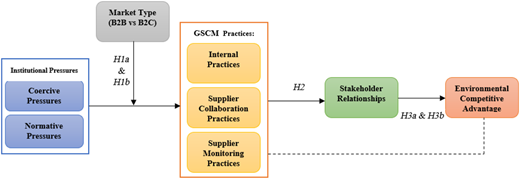
B2B market characteristics moderate the relationship between institutional pressures and GSCM practices.
3.2 GSCM practices and stakeholder relationships
According to institutional theory, legitimacy is a primary motivation for the adoption of environmental sustainability practices (Glover et al., 2014), as it leads to improved relationships with key stakeholders (Kitsis and Chen, 2020). The formulation and enactment of environmental strategies is a mechanism for managing institutional pressures (Wen et al., 2023) and responding to stakeholders' green demands (Adomako and Tran, 2022), thereby mitigating risks and uncertainties related to environmental issues (Góes et al., 2023). The adoption of internal GSCM practices, such as eco-design and internal environmental management, can also protect companies from the consequences of non-compliance imposed by external stakeholders, including governmental regulators, suppliers and customers (Agarwal et al., 2018). This, in turn, provides legitimacy to the company and enhances stakeholder endorsement, trust and loyalty (Baah et al., 2022). This facilitates the establishment of legitimized relationships with stakeholders based on trust, fairness and reciprocity, thereby strengthening connections with stakeholders (Harrison et al., 2010; Góes et al., 2023).
Focal companies are often held responsible for environmental misconduct occurring within their supply chain, especially those associated with suppliers (Ahmed and Shafiq, 2022). As a result, various stakeholders –including communities, NGOs, customers and suppliers –actively encourage supplier sustainability management (Lechler et al., 2020). Engaging in external GSCM practices with suppliers helps to transmit stakeholder environmental expectations to key suppliers (Ahmadi-Gh and Bello-Pintado, 2024) and protects firms from reputational damage arising from unsustainable behaviours by suppliers (Lechler et al., 2020). In particular, collaborative activities aimed at environmental improvement represent a strong signal to community stakeholders concerned with environmental impacts of industrial activities (Hofman et al., 2020). Such collaboration enhances stakeholder trust, suggesting that firms seeking legitimacy should integrate stakeholders (e.g. suppliers) into joint environmental initiatives (Baah et al., 2020). This strengthens stakeholder engagement and enhances relational ties, which in turn supports improved organizational legitimacy and performance outcomes (Adomako and Tran, 2022). Additionally, assessing and monitoring supplier compliance allows focal companies to identify and correct potential misconduct before it is perceived by external stakeholders (Ahmadi-Gh and Bello-Pintado, 2024). This also contributes to reputational protection and maintaining stakeholder confidence, which in turn, improve stakeholder relationships (Gogia et al., 2024). Considering these observations, we propose the following hypothesis:
Both internal and external GSCM practices are positively related to stakeholder relationships.
3.3 Stakeholder relationships and environmental competitive advantage
Creating a competitive edge through environmentally related activities is an outcome of a value creation strategy (Bhuiyan et al., 2023) centred on stakeholder relationships (Freeman et al., 2010; Freudenreich et al., 2020). This approach emphasizes how value is created within stakeholder relationships (Fobbe and Hilletofth, 2021).
Achieving competitive advantage relies on the ability of managers to address the environmental concerns of their diverse stakeholders (Kitsis and Chen, 2020), as stakeholders can provide essential benefits such as legitimization and a social licence to operate (Herremans et al., 2016). By leveraging stakeholder relationships around environmental issues, firms can develop unique capabilities, such as an enhanced environmental reputation, through the legitimacy gained by meeting stakeholders' environmental concerns (Baah et al., 2022). Gaining approval from key stakeholders not only signals the company's competence in environment sustainability, but it also demonstrates the company's commitment to the natural environment (Ahmed and Shafiq, 2022). Stakeholder relationships also help mitigate conflicts related to the firms' industrial activities, improve the corporate image, and foster a better understanding of societal expectations (Fontoura and Coelho, 2022). Such trust-based and legitimized stakeholder relationships are key competitive resources, because they are invaluable, rare and difficult for competitors to imitate (Freeman et al., 2021). We therefore propose:
Stakeholder relationships are positively related to environmental competitive advantage.
However, the relationship between environmental strategies and environmental competitive advantage is not straightforward. Prior evidence suggests that this link is often mediated by unique capabilities such as advanced manufacturing systems, (Ahmadi-Gh and Bello-Pintado, 2022), product innovation (Wen et al., 2023), or green brand image (Zameer et al., 2020). In this vein, stakeholder relationships represent a critical mediating mechanism, as they can enable firms to transform environmental practices into resources that generate competitive outcomes. Internal practices (e.g. emissions reduction, resource efficiency, or improved working conditions) reinforce legitimacy and reputation, build credibility with external stakeholders, and make subsequent collaborations more effective (Yadav et al., 2023). Collaborative external practices (e.g. supplier partnerships, joint eco-design, or shared environmental projects) extend these benefits by fostering mutual learning, knowledge exchange, and reciprocity, thereby strengthening stakeholder relationships (Yadav et al., 2023). As a result, they are effective in transforming environmental initiatives into relational capabilities that underpin competitive advantage (Jones et al., 2018; Kitsis and Chen, 2023). By contrast, external monitoring practices, focused merely on control mechanisms, are important for reducing reputational risk and protecting compliance. However, they do not deep stakeholders' engagement and create relational benefits (Ahmadi-Gh and Bello-Pintado, 2022). We therefore propose:
Stakeholder relationships mediate the relationship between GSCM practices and environmental competitive advantage, but only in the case of internal practices and collaborative external practices, not for external practices oriented toward monitoring.
The structural model is illustrated in Figure 1.
4. Methodology
4.1 Sample and data collection
The hypotheses were tested using data from the fourth round of the High Performance Manufacturing (HPM) project, collected between 2012 and 2017 (Anh et al., 2025). HPM is a large-scale, multi-country survey of manufacturing plants with at least 100 employees in industries such as mechanics, electronics and transportation equipment, conducted across 16 countries (Ahmadi-Gh and Bello-Pintado, 2022). These industries are characterized by rapid technological change and intense global competition (Morita et al., 2018). The project has been widely used to analyze GSCM in manufacturing (e.g. Danese et al., 2019; Bello-Pintado et al., 2023; Ahmadi-Gh and Bello-Pintado, 2024; Anh et al., 2025).
Plants were randomly selected from national lists recommended by local governments and universities. Surveys were administrated through site visits by HPM country teams, with questionnaires translated and back-translated to ensure reliability and validity (Danese et al., 2019). Respondents completed different sections depending on their expertise (e.g. environmental managers answered environmental scales; plant managers answered stakeholder and performance scales). The final sample included 330 plants across 16 regions, with an average response rate of 65% in each country. Following established practices in HPM-based studies, such a response rate is considered sufficiently high to mitigate concerns regarding non-response bias (Danese et al., 2019; Anh et al., 2025). In terms of firm size, 93 firms have 100–250 employees, 79 have 250–499, 52 have 500–999, and 56 have 1,000 or more. Table 1 reports the distribution by sector and country.
4.2 Measures
The HPM project developed its scales based on an extensive literature review run by experts in different subjects. These experts also reviewed the scales for content validity, and pilot tests confirmed their reliability, validity and internal consistency (Danese et al., 2019). For this study, the questionnaire started with scales for institutional pressures from stakeholders, by requesting the respondents to answer, “My plant's involvement in environmental initiatives has been motivated by”. According to institutional theory, two reflective constructs were developed: coercive pressures (CP), measured through regulatory requirements, and normative pressures (NP), reflecting norms and expectations from internal and external stakeholders (DiMaggio and Powell, 1983; Agarwal et al., 2018).
Second, respondents were requested to “please indicate the degree to which your plant is engaged in the following initiatives/practices”, by listing several environmental initiatives. Three reflective constructs were created for GSCM practices: internal practices (ISP), external collaboration (ESPc) and external monitoring (ESPm) (Danese et al., 2019; Ahmadi-Gh and Bello-Pintado, 2022). A description of the constructs and the items integrating them can be found in Table 2.
Likewise, the respondents were asked to indicate “As a result of undertaking environmental initiatives, firms have experienced”, by listing various sustainability outcomes as well as items for competitive advantage linked to sustainability. A formative construct (STR) was therefore created to measure the relationship with the various stakeholders with different level of sustainability-related interests and concerns including suppliers (as a supply chain stakeholder), the community (as a societal stakeholder) and investors (as a financial stakeholder). Together, these indicators represent the core stakeholder categories emphasized in stakeholder theory for manufacturing contexts and define the conceptual domain of sustainability-oriented stakeholder relationships (Freudenreich et al., 2020; Buttke et al., 2024). A reflective construct (ECA) for environmental competitive advantage also measured the extent to which environmental initiatives contributed to competitive outcomes (Zameer et al., 2020; Ahmadi-Gh and Bello-Pintado, 2022) (see Table 2).
The questionnaire also gathered information about the market type by asking respondents to indicate “What percent of this plant's sales is in each of the following categories”. Two possibilities were listed to respond to this question: B2B versus B2C. In accordance with the literature, these two items represent the market characteristics that are expected to influence the organization's adoption of sustainability practices (Huang et al., 2022). Because the two are interdependent (B2B = 100% − B2C), only the B2B percentage was entered into the analysis as a moderating variable. This approach allows for the interpretation of results for both market types, as the influence on sustainability practices can be inferred for B2C based on the B2B percentage. To ensure comparability of company profiles across B2B and B2C sectors, we performed statistical tests on specific characteristics such as company size, industry and regulatory environment. A t-test showed that the mean difference in company size between the two sectors was −0.1229, with a 95% confidence interval of −0.5484 to 0.3027, which includes zero. This result suggests no significant difference in size, as confirmed by a two-tailed p-value (p(T > t) = 0.5702), well above the 0.05 threshold, indicating no statistical significance at the 95% confidence level. Additionally, a chi-squared test found no statistically significant association between industry distribution and B2B/B2C grouping, further supporting the comparability of these groups across sectors (Pearson χ2(2) = 4.5953, p = 0.100). Finally, a two-sample t-test was conducted to compare the greenhouse gas emissions per capita reported by the World Bank for the year 2013 between the B2B and non-B2B groups. High emissions can indicate stricter regulations or a governmental focus on sustainability practices, which can affect how businesses operate in different sectors. The results showed no significant difference between the two groups (mean difference = −0.130, 95% CI [−0.486, 0.227], t = −0.7156, p = 0.475), which indicates that the regulatory environment is similar for both B2B and non-B2B sectors.
Finally, the dataset includes different countries and industries that could inherently lead to variation. To account for these differences, three control variables were used in this study: a logarithm of the gross domestic product per capita (GDPP) as a proxy for the level of development of the country in which the sample manufacturing firm is located (DVL); the logarithm of the number of people employed by the sample plant (Size); and the manufacturing sector to which a firm belongs (Ind1 for mechanics, Ind2 for electronics and Ind3 for transportation equipment).
5. Data analysis
PLS was employed to validate the measurement scales and test the hypotheses. This variance-based approach to SEM is suitable in hypothesized models (Peng and Lai, 2012; Hair et al., 2016) for (1) analyzing complex models with mediating and moderating effects – here, STR as mediator and B2B market type as moderator; (2) handling both reflective and formative constructs – ISP, ESPm, ESPc and ECA are reflective, while STR is formative because each of its dimensions (e.g. supplier relationships, community) contributes uniquely and cannot be substituted; and (3) working with relatively small subsamples, such as 104 B2B plants analyzed in the moderation model. PLS has been widely applied in operations management and GSCM studies (Agarwal et al., 2018; Ahmed et al., 2020; Gouda and Saranga, 2020; Gutierrez et al., 2022; Wiredu et al., 2024).
Several tests were conducted to assess the adequacy of the dataset. The Keiser–Meyer–Olkin statistic (KMO = 0.9103) and Bartlett's test of sphericity (χ2 = 739.96, p < 0.001), confirmed the suitability of the data for data-reduction techniques such as exploratory factor analysis (EFA). Harman's single-factor test explained 33.98% of the variance (below the 50% threshold), which indicates that common method variance was not a concern (Podsakoff et al., 2003). Variance inflation factor (VIF) values were all below the recommended threshold (max = 2.89), reinforcing the absence of common method bias (CMB) (Kock, 2017). To further address potential CMB, two market variables, both standardized, were introduced as controls in the models: the percentage of total sales exported (as a proxy for market orientation, labelled Export), and the sales value of production of the current year (in 1000 USD, as a benchmark for evaluating the effectiveness of the business strategies, labelled Sale). The results confirmed that the VIF values remained below the threshold, and no changes were observed in the path coefficients, directions or significance levels of the relationships in the model. This consistency suggests that the model's findings are robust, and that CMB is not a concern in this study (Hulland et al., 2018).
Next, EFA identified seven factors with eigenvalues above 1 (see Table 2). To further validate the measurement model, a confirmatory factor analysis (CFA) was conducted using covariance-based SEM. The results indicated an acceptable fit (χ2/df = 2.05; RMSEA = 0.069; SRMR = 0.065; CFI = 0.866; TLI = 0.853). All standardized factor loadings were significant and above the recommended threshold, supporting convergent validity. Finally, PLS-SEM was conducted to estimate the hypothesized models.
5.1 Measurement assessment
Because assessment criteria differ depending on the type of construct, reflective and formative constructs were evaluated separately. For reflective constructs, reliability and validity were confirmed. Composite reliability and Cronbach's alpha values exceeded the 0.7 threshold for all constructs (Hair et al., 2016) (see Table 2). Convergent validity was supported, as most item loadings were above 0.7 and significant at p < 0.001 (except ECA03 = 0.650, ECA08 = 0.667, ISP01 = 0.671, ISP05 = 0.695 and ESPM04 = 0.567), thus demonstrating that convergent validity is present at the indicator level (Peng and Lai, 2012). Indicators with item loading less than 0.7 (but higher than 0.4) were retained, because their removal did not improve reliability or alter path coefficients. Average variance extracted (AVE) values exceeded 0.5, thus confirming convergent validity at the construct level (Peng and Lai, 2012). Discriminant validity was supported using the Fornell–Larcker criterion, as the square root of each construct's AVE was higher than its correlation with other constructs (Hair et al., 2016) (see Table 3).
HTMT ratio analysis was also conducted to confirm discriminant validity among the constructs (see Table 4). Although the HTMT value between ESPc and ESPm slightly exceeded the recommended threshold, this is theoretically justified, as both constructs capture closely related dimensions of external environmental supply chain management practices. Prior studies have modelled these practices either as a single construct (Zhu et al., 2013; Longoni et al., 2018) or as distinct yet complementary constructs serving different managerial purposes (Danese et al., 2019; Ahmadi-Gh and Bello-Pintado, 2024). Consistent with the latter approach and our research objectives, ESPc and ESPm are therefore modelled as separate constructs.
Assessment for the formative construct (STR) focused on item weights (including weight, sign and magnitude) and collinearity. All item weights were positive and above the 0.10 benchmark (Andreev et al., 2009), and VIF values were below the 3.3 threshold (Shmueli et al., 2019), thus indicating no multicollinearity (see Table 4). At the construct level, discriminant validity was confirmed as the average of intra-construct correlations (0.593) exceeded the average of inter-construct correlations (0.415), following Peng and Lai (2012).
5.2 Structural model
The structural model was evaluated using PLS-SEM with 5,000 bootstrap resamples to test the significance, sign and magnitude of path coefficients (Hair et al., 2016). Multicollinearity was assessed through VIF values; all were below 3.3, which indicated no concerns (Shmueli et al., 2019). Two models were estimated: Model 1 tested the moderating role of market type on the relationships between institutional pressures and GSCM practices (H1), and Model 2 assessed the relationships between these practices and STR (H2), between STR and ECA (H3a), and the mediating role of STR between GSCM practices and ECA (H3b). Firm size, industry, country development, export share and sales were included as controls. The results are presented in Table 5.
For Model 1, B2B market setting negatively moderated the effect of CP on GSCM adoption, significant only for ESPm (β = −0.131, p < 0.05). In contrast, its moderating effect on the link between NP and GSCM was positive and significant for all three practices (ISP: β = 0.164, p < 0.05; ESPc: β = 0.150, p < 0.05; ESPm: β = 0.132, p < 0.05). This observation supports H1 and indicates that the B2B market context moderates the relationship between institutional pressures and GSCM practices; however, this moderation varies depending on the type of pressure. Estimation also showed that CP is positively related to ISP (β = 0.160, p < 0.01), and NP drives the adoption of all three bundles of GSCM practices (ISP: β = 0.559, p < 0.001; ESPc: β = 0.603, p < 0.001; ESPm: β = 0.640, p < 0.001).
In Model 2, ESPc was positively related to STR (β = 0.452, p < 0.001), while ISP and ESPm were not significant. This result demonstrates that not all GSCM practices enhance STR, partially supporting H2. It further shows that different GSCM practices have different contributions to stakeholder relationships, and these contributions are higher for external than for internal practices.
STR also exhibited a positive association with ECA (β = 0.184, p < 0.001), thus supporting H3a. The result also provides partial support for H3b, because STR was assumed to mediate the relationship between GSCM practices and ECA for both internal and external practices, and the mediation is significant only for ESPc (β = 0.083, p < 0.01).
Among the control variables, firm size (β = 0.185, p < 0.01) positively influenced competitiveness, while country development had a negative effect (β = −0.185, p < 0.001). Industry effects were only relevant only in B2B contexts. Export and sales were not significant (see Table 5).
Consistent with the percentile method, significance was ensured when confidence intervals included zero. All significant path coefficients in both models met this criterion. Effects size analysis (f2) (Cohen, 1988) indicated that the impact of STR on ECA was small compared to the stronger effect observed between institutional pressures and GSCM practices, as well as between ESPc and STR.
Although there are no established measures for goodness-of-fit in PLS-SEM, some scholars consider the ability to predict endogenous constructs as an indicator of its goodness-of-fit (Hair et al., 2014). Predictive power was assessed through R2 and Q2 values (Shmueli et al., 2019). The R2 values showed that substantial variance was explained by the variables ISP (44.30%), ESPc (38.60%), ESPm (40.30%) and STR (31.60%). Although the explanatory power for ECA (14.7%) was modest, this result is consistent with the multifaceted and distal nature of competitive outcomes, which are shaped by a broad set of strategic, market and organizational factors beyond the scope of the present model. All Stone–Geisser's Q2 values were positive (0.429, 0.373, 0.389, 0.160 and 0.074, respectively), thus confirming the predictive relevance of the models. Model fit was evaluated using the standardized root mean squared residual (SRMR) (Gutierrez et al., 2022), and the results indicated satisfactory fit for both models (Model 1 = 0.058; Model 2 = 0.060), well below the recommended threshold (0.08) (Benitez et al., 2020).
5.3 Interaction plots
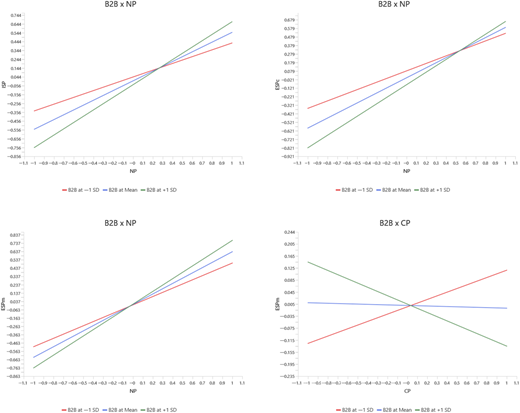
To further examine the moderating effect of market type (B2B), simple slope analyses and interaction plots were developed (see Figure 2). These plots illustrate the slopes of institutional pressures at low, medium and high levels of B2B, but only for statistically significant relationships. The first three plots show that as NP increases, the adoption of ISP, ESPc and ESPm also rises across different levels of B2B. The effect is stronger in B2B contexts, thus confirming that market type significantly moderates the positive relationship between NP and the adoption of internal and external GSCM practices. The fourth plot reveals that the relationship between CP and ESPm varies with B2B intensity. CP has a positive effect under low B2B conditions, but this becomes negative at higher B2B levels. This suggests that the impact of CP on the adoption of ESPm depends critically on the characteristics of the B2B market.
5.4 Robustness tests
We assessed the robustness of our research model through three additional analyses. First, the sample was divided into two groups – mature institutional context (N = 173) and emerging institutional context (N = 157) – to examine potential heterogeneity across subsamples. The results of re-estimating the model for each subgroup show that the main structural and theoretical relationships are stable across groups (i.e. the dominant roles of NP in driving GSCM practices and ESPc in building STR). This stability indicates that the proposed pressure–practice–outcome (stakeholder relationships) mechanism is robust to contextual heterogeneity. Nevertheless, our findings provide additional insights into the contextual differences between subgroups. While NP remains the dominant driver of GSCM adoption in both contexts, CP plays a more prominent role in emerging contexts, particularly for internal GSCM practices, which reflects a stronger reliance on formal compliance mechanisms in emerging contexts. In line with the full-sample results, the direct effects of B2B market settings on GSCM practices are weak, inconsistent and often negative; they are statistically significant only for ESPc in mature contexts. Moreover, when accounting for institutional context, the moderation effect of B2B disappears, which suggests that the moderation effect of B2B depends on institutional context and is not independently stable. Our findings reveal that institutional maturity, rather than customer segment per se, represents the dominant source of heterogeneity in how firms respond to sustainability pressures. Overall, B2B market characteristics exert a conditional, rather than universal, moderating role, further reinforcing the primacy of institutional conditions in shaping pressure-driven GSCM adoption and its performance implications.
Second, financial performance (FP) was included as an alternative outcome to ECA. The results showed that the hypotheses remained significant for the whole sample and both subsamples. STR had a strong positive direct effect on FP (whole sample: β = 0.470, p < 0.001; B2B: β = 0.475, p < 0.001; B2B − B2C: β = 0.490, p < 0.001). These results confirm the robustness of the findings and reinforce the role of ESPc as a tool to engage stakeholders in environmental strategies, and one that works alongside STR as organizational capabilities driving superior performance.
Third, the direct effects of institutional pressures (CP and NP) and GSCM practices on ECA were tested. Bootstrapping indicated significant positive relationships only for NP (β = 0.241, p < 0.001) and ESPc (β = 0.183, p < 0.05). These findings underscore the strategic importance of NP and ESPc for competitiveness (Gouda and Saranga, 2020), and they suggest the partial mediating role of STR in translating environmental practices into competitive advantages.
6. Discussion of the findings
Recent policy initiatives such as the EU CSDDD represent an intensification and formalization of institutional pressures that were already present during the period studied. The results of this study do not aim to assess compliance with specific regulatory requirements; rather, they examine how firms respond to institutional pressures prior to their formalization into binding regulations. In this sense, the study captures early stage behavioural and mechanisms through which firms anticipate, internalize and respond to emerging sustainability expectations. By considering the moderating role of B2B market type, this study paid particular attention to the organizational pathways – namely stakeholder relationships – through which pressure-driven GSCM practices operate and contribute to competitiveness in B2B contexts.
By distinguishing between internal and external GSCM practices, this study extends prior research and provides additional insights. While both CP and NP have a significant relationship with internal GSCM practices, only NP influences external GSCM practices. When faced with coercive pressures, manufacturing firms may perceive internal compliance as more manageable and within their immediate control, as well as more observable to close stakeholders. Consequently, they may prioritize regulatory compliance within their own operations to avoid penalties and legal issues, often at the expense of addressing suppliers' practices (Zhu et al., 2013).
Our estimation offers clear evidence regarding the moderating role of B2B market dynamics. As observed, the combination of B2B market setting and CP significantly diminishes the level of GSCM practices and, in particular, supplier monitoring. Although the magnitude of this moderating effect is moderate, it reveals an important shift in how firms respond to regulatory pressures in interdependent supply chain contexts. This suggests that in B2B contexts – where long-term relationships, interdependence and collaboration are critical (Anderson et al., 2022) – the direct influence of regulatory pressure becomes less salient as a driver of supplier-oriented GSCM practices. One explanation lies in the inherent nature of supplier monitoring practices, which often rely on mandatory requirements and audits that are less effective in improving suppliers' compliance performance (Huang et al., 2022). Instead, buying firms in B2B contexts may prefer approaches that enable trust-based, transparent and relational engagement with suppliers (Hoejmose et al., 2012). From a managerial perspective, this implies that relying solely on compliance-based mechanisms may be insufficient in B2B settings and should be complemented with relational approaches that foster cooperation and mutual commitment.
In contrast, the interaction between NP and B2B market setting significantly increases the adoption of all three bundles of GSCM practices. This finding supports the notion that business customers exert stronger environmental expectations across supply chains in B2B contexts (Al-Kwifi et al., 2023). The relatively stronger coefficients associated with normative pressures indicate that relational expectations, rather than formal regulations, are the primary drivers of sustainability engagement in B2B markets. This could be because the environmental performance of manufacturing firms and their key suppliers is more visible to business customers than to end consumers. B2B firms thus engage more in both internal and supplier-oriented environmental practices to maintain legitimacy and customer relationships (Lechler et al., 2020). These findings highlight the role of relational and stakeholder-based mechanisms in shaping proactive responses to regulatory transitions and help explain firms' differential readiness for emerging due-diligence regimes.
Complementarily, when examining the direct effect of B2B market characteristics on GSCM practices, we found a negative direct effect for ESPc. This indicates that manufacturing firms operating in B2B markets are less likely to engage in supplier collaboration practices, despite the relational nature of these markets. This may be attributed to the nature of manufacturing projects, where business customers with innovative environmental solutions prefer direct collaboration with focal firms rather than indirect engagement through suppliers. Such strategic decisions may also aim to mitigate the risk of supplier opportunism (Hofman et al., 2020). However, when considered together with the strong positive effect of ESPc on STR and competitive advantage, this finding reveals a critical managerial tension: while B2B manufacturing firms may be less inclined to collaborate with suppliers, such collaboration remains essential for achieving sustainability-driven competitiveness.
This study also provides new insights regarding the critical role of ESPc in fostering stakeholder relationships and competitive outcomes. Internal initiatives and control-oriented mechanisms, although necessary for compliance, do not directly translate into stronger stakeholder engagement or distinctive competitive advantage. Compliance-driven monitoring primarily addresses regulatory or social expectations without generating additional relational value (Longoni et al., 2018). While such practices may enhance operational efficiency (Ahmed et al., 2020), they contribute less to stakeholder trust, visibility and legitimacy (Hoejmose et al., 2012; Jazairy and von Haartman, 2020), thus limiting their role in differentiation (Ahmadi-Gh and Bello-Pintado, 2022). Prior research has underscored collaboration as a mechanism to translate pressures to GSCM outcomes (Ahmed et al., 2020; Andalib Ardakani et al., 2023) and enhance corporate legitimacy (Li and Zhang, 2024). This study advances that view by demonstrating that competitive advantage emerges when collaborative supplier practices strengthen legitimacy-based stakeholder relationships around environmental issues. Cooperative approaches with suppliers foster shared responsibility, commitment and supply chain transparency, thus enhancing stakeholder trust and supporting superior competitive positioning (Baah et al., 2022; Fontoura and Coelho, 2022). Notably, the strong effect size between ESPc and STR indicates that supplier collaboration plays a central role in shaping stakeholder engagement and relational outcomes.
The findings also indicate that GSCM practices contribute to environmental competitive advantage though the development of relational capabilities, reflected in stakeholder relationships. This confirms the need for mediation between practices and outcomes (Adomako and Tran, 2022; Ahmadi-Gh and Bello-Pintado, 2022) but also extends recent research by identifying a distinct mechanism. While prior studies have emphasized innovation- or resource commitment or awareness-based pathways (Fianko et al., 2025; Liu et al., 2025; Zhang et al., 2025), our results show that, in B2B contexts, competitive advantage is primarily achieved through intra-organizational relational capabilities that embed sustainability within stakeholder relationships. However, the effect size is relatively modest, suggesting that stakeholder relationships represent only one of several complementary mechanisms through which firms translate environmental practices into performance outcomes. The significant mediation (ESPc → STR → ECA: β = 0.088, p < 0.01) supports the view that firms can transform institutional sustainability pressures into competitive advantage by aligning internal norms with supplier cooperation and stakeholder expectations (Bhuiyan et al., 2023; Wen et al., 2023).
Finally, contrary to the argument that stakeholder relationships are contingent on market type (Góes et al., 2023), our findings show no moderating effect of customer dynamics on the relationship between GSCM practices, stakeholder relationships and environmental competitive advantage. While B2B market dynamics shape how institutional pressures translate into GSCM adoption, they do not fundamentally alter the performance outcomes of these practices. In other words, although customer pressure is a key determinant for engaging in GSCM practices throughout the supply chain (Chavez et al., 2016), the achievement of competitiveness through GSCM practices is independent of customer segment. For B2B firms, this underscores the importance of prioritizing institutional and stakeholder alignment over the customer-segment considerations typically emphasized in B2C settings.
Taken together, our findings suggest that in B2B contexts, relational mechanisms tend to outweigh purely regulatory mechanisms in shaping sustainability outcomes. Moreover, while firms may be less inclined to invest in supplier collaboration, our results indicate that such collaboration constitutes the primary pathway through which sustainability practices translate into competitive advantage.
7. Conclusions, implications and future research
7.1 Conclusions
In today's highly dynamic global market, managing stakeholders is increasingly challenging, as different stakeholders hold diverse and sometimes conflicting expectations regarding firms' environmental performance. While managers strive to remain competitive and profitable, they must also respond to growing sustainability demands. This study addresses this challenge by examining how institutional pressures shape the adoption of GSCM practices and how these practices translate into environmental competitive advantage. The empirical analysis showed that collaboratively addressing environmental issues with suppliers enhances competitive outcomes by fostering legitimacy-based relationships with key stakeholders, which constitute an important organizational capability. B2B market characteristics also moderate the relationship between institutional pressures and GSCM practices, particularly by strengthening the role of normative pressures while weakening the effect of coercive pressures on supplier-oriented practices. Overall, the results suggest that, regardless of customer segment, firms can achieve competitiveness from GSCM practices by developing legitimacy-driven relationships with key stakeholders through collaborative environmental initiatives with suppliers.
7.2 Implications
From an academic perspective, this study develops a multidimensional framework linking institutional pressures, GSCM practices, stakeholder relationships and environmental competitive advantage. By distinguishing between internal, monitoring and collaborative practices, it clarifies their differential role in shaping stakeholder relationships and competitive outcomes. Anchored in institutional and stakeholder theories, the findings advance their intersection by empirically demonstrating how firms can transform sustainability-driven pressures into competitive advantage through GSCM adoption. In particular, extending recent research, the study identifies relational capabilities—embedded in stakeholder relationships—as the key mechanism through which sustainability practices translate into competitive advantage, especially in B2B contexts. By conceptualizing stakeholder relationships as an outcome of GSCM practices, the study provides evidence that collaborative engagement with suppliers facilitates legitimacy-based relationships with key stakeholders, which can function as valuable and difficult-to-imitate relational resources. In this way, stakeholders emerge stakeholders emerge not only as sources of pressure, but also as sources of competitive advantage.
This study also contributes to the B2B literature by clarifying the role of market context in GSCM adoption and outcomes, an area that has received limited scholarly attention (Johnson et al., 2018; Gogia et al., 2024). While prior research has often reported higher environmental engagement in B2C contexts, our findings indicate that strong institutional pressures can offset adoption barriers in B2B contexts, particularly when firms pursue collaborative initiatives with suppliers. Thus, B2B market dynamics shape adoption mechanisms without fundamentally altering the performance outcomes of GSCM practices.
For managers, balancing the diverse expectations of multiple stakeholders while maintaining competitiveness remains a key challenge, particularly in B2B contexts characterized by interdependent supply chain relationships. This study provides actionable insights by identifying the specific mechanisms through which firms can translate sustainability efforts into competitive advantage. First, managers should move beyond a compliance-oriented view of sustainability and actively invest in collaborative environmental initiatives with key stakeholders. Practices such as joint environmental projects, supplier training programs, shared sustainability targets, and co-development of eco-innovations with suppliers enable firms to build trust-based relationships that strengthen stakeholder engagement. These relational capabilities, rather than internal or monitoring practices alone, are critical for achieving environmental competitive advantage. Second, the results indicate that normative pressures from business partners are more effective than coercive regulatory pressures in driving sustainability engagement in B2B markets. Managers should therefore focus on aligning with stakeholder expectations through transparency, communication, and continuous engagement with key partners around environmental goals. Third, the findings reveal a key strategic tension: although firms operating in B2B markets may be less inclined to engage in supplier collaboration, due to concerns such as opportunism or project complexity, our findings demonstrate that collaboration is the primary mechanism through which sustainability efforts translate into competitive advantage. Addressing this tension requires investing in long-term relationships, governance mechanisms, and trust-building practices with suppliers. Finally, in contexts of increasing regulatory pressure, managers should avoid relying exclusively on monitoring and control-based mechanisms, which are often insufficient to build stakeholder trust or differentiation. Instead, these approaches should be complemented with collaborative and relational strategies that promote shared responsibility across the supply chain. This is particularly relevant in light of emerging regulatory frameworks, where firms must move beyond compliance to actively manage sustainability across their supply chains.
7.3 Research limitations and future research
This study is not free of limitations. First, it relied on a cross-sectional, survey-based pre-CSDDD dataset, which limits the ability to capture how relationships evolve over time. Future research could replicate this model using post-CSDDD data to assess how formal due-diligence obligations affect institutional pressures. Moreover, future longitudinal research could provide deeper insights and better causal identification, particularly on how stakeholder relationship management influences competitive advantage in the long run. Second, the HPM database does not include information on mimetic pressures. Future research could extend our model by incorporating this type of pressure, thus enabling a more comprehensive examination of all three pillars of institutional pressures and ensuring the robustness of the result. Third, in B2B settings, other organizational attributes – such as top management commitment, corporate culture or leadership style – may also influence environmental engagement. Investigating their direct and indirect effects in B2B contexts would enrich our understanding of how firms adopt and implement sustainability practices. Finally, the study is based on manufacturing plants from specific industries and countries, which may limit the generalizability of the findings to other sectors or institutional contexts. Future research could examine whether the observed relationships hold in service industries or in less structured supply chain environments.