This article aims to investigate how artificial intelligence (AI) applications are transforming loyalty management in the retail sector, generating unprecedented potential benefits and challenges. The research applies the conceptual lens of socio-technical systems (STS) theory based on six blocks.
To pursue this objective, the article adopts a qualitative approach based on semi-structured interviews with loyalty managers from 39 grocery and nongrocery retailers. The interviews were analyzed using an abductive approach that combines the principles of grounded theory with the six-block STS conceptual model to identify new insights, coding each verbatim in the bright or dark side of AI in loyalty management.
The analysis showed how AI acts as a stressor within the typical tensions of loyalty management, intensifying certain conflicts between predictive analysis versus opacity, personalization versus privacy and excessive communication, and automation versus the erosion of human relationships. In particular, these tensions intensify when misalignments are created within STS blocks, failing to align the technological aspect with the organizational and human aspects in order to achieve loyalty goals.
Despite the disruptive impact of AI in various sectors, there is a scarcity of empirical studies on AI applications in retail and even fewer on context-specific loyalty management practices supported by AI. This research provides new insights to uncover the potential benefits and drawbacks related to AI-based loyalty management approaches.
1. Introduction
Customer loyalty is a vital challenge for profitable retail management (Belli et al., 2022; Castaldo, 2024; Watson et al., 2015). Oliver (1997, 1999) defines loyalty as a customer's commitment to repurchase and overcome obstacles to make intentions real, resulting in concrete transactional behavior. Customer loyalty has progressively become a fundamental aspect of every marketing strategy in retail (Cuesta-Valiño et al., 2023; Toufaily et al., 2013). Due to intense competitive dynamics that characterize retailing and the simultaneous presence of different channels and store formats, culminating in enhanced purchase alternatives for consumers (Ratchford et al., 2022), pursuing customer loyalty is not an optional strategic choice but an imperative to outperform competitors over time (Timoumi et al., 2022).
Recent technological advancements have provided retailers with opportunities to increase customer loyalty. In particular, the current literature outlines, among next-generation technologies, the potential of artificial intelligence (AI) (Grewal et al., 2025; Guha et al., 2021). AI is considered a “force of disruption” (Enholm et al., 2022, p. 1709), as it can generate value added in terms of enhanced revenue, increased business efficiency, and cost reduction (Mariani et al., 2023). In the retail sector, AI can increase the profitability of omnichannel and mobile shopping, enhance customized recommendations, improve customer service and customer relationship management (CRM), and optimize inventory (Guha et al., 2021; Li and Kang, 2025; Shankar, 2018).
From a loyalty perspective, retailers can use AI to develop more profitable CRM systems. AI functions as a virtual assistant capable of performing dynamic segmentation of customers based on spatial, temporal and channel-related information (Shankar, 2018). This approach culminates in an enhanced capacity for satisfying customer preferences through personalized offerings (Grewal et al., 2025). Illustrative industry evidence shows various fields of application for AI in loyalty management. Amazon uses AI-driven recommendation systems for end-to-end personalization of the customer journey and for anticipatory shipping (Shankar, 2018). Sephora leverages customer interaction data in its Beauty Insider loyalty program to build customer profiles evolving in real-time (Kumar and Venkatesan, 2021; Shankar, 2018). Retailers are adopting generative AI technologies to create textual, visual, and interactive marketing content (Kirk and Givi, 2025).
Despite the increasing number of studies on the transformational power of digital technologies, especially in retail (Grewal et al., 2025; Robertson et al., 2025; Santoro et al., 2019; Vhatkar et al., 2024), a clear picture of the AI applications and deployment for managing loyalty is missing in the literature. Research in this field mostly consists of conceptual studies on the role of emerging technologies in retail and the progressive digitalization of loyalty dynamics, including omnichannel strategies, big data analytics and customer-interfacing technologies (Cai and Lo, 2020; Grewal et al., 2025; Roggeveen and Sethuraman, 2020). However, there is still a lack of empirical studies that analyze how AI is deployed in a core retail function, such as loyalty management (Chen et al., 2021). In particular, there is a noticeable absence of qualitative studies that examine how AI should be implemented to effectively support loyalty practices. For example, while Robertson et al. (2025) address the important challenges of implementing AI in the retail supply chain context, they do not focus on loyalty management.
Adopting AI to stimulate customer loyalty also raises unprecedented and somewhat paradoxical challenges (Grewal et al., 2025). The literature refers to the privacy-personalization paradox as increased personalization through more intrusive technologies and communications comes at the expense of customer privacy (Aguirre et al., 2015). When adopting AI, retailers must also address human-AI interaction issues related to the need to project explainable and transparent AI systems, encourage trust among users, and lead to effective AI adoption and usage (Mahmud et al., 2022; Robertson et al., 2025). In the absence of empirical contributions on how to deploy AI for managing loyalty, retailers could struggle to understand how to use AI for retaining customers and building strong relationships with key stakeholders (Steinhoff et al., 2019).
Therefore, this study aims to investigate how AI applications are changing loyalty management practices in retail, generating both bright sides, in terms of potential benefits, and dark sides, in terms of emerging concerns and challenges (Grewal et al., 2021). To pursue the research aim, this study applies the overarching conceptual framework provided by the socio-technical systems (STS) theory (Appelbaum, 1997; Makarius et al., 2020; Robertson et al., 2025; Thomas, 2024), as it allows us to frame configurations and interdependencies in the debate on AI in loyalty management. The STS theory explains our theoretical position that the challenges associated with AI in loyalty management are not primarily technological, but relational, procedural and cultural in nature (Grewal et al., 2021; Kirk and Givi, 2025). AI does not operate in isolation; instead, its implementation requires complex reconfigurations of organizational processes, roles, expectations, norms and strategic objectives. At a deeper theoretical level, we believe that existing literature does not provide sufficient explanations of the reasons why AI applications in loyalty management can originate both positive and negative outcomes, nor under which organizational conditions these bright and dark effects emerge. While prior studies identify the potential benefits and risks of AI (Grewal et al., 2021; Guha et al., 2021; Huang and Rust, 2024; Mahmud et al., 2022), these outcomes are treated as isolated trade-offs rather than as the result of underlying socio-organizational configurations. It remains unclear how AI translates into concrete loyalty practices and why, in the presence of some organizational conditions, it strengthens customer–retailer relationships, whereas in others it undermines them. To address this aim, the study answers the following research questions: How are AI-enabled loyalty practices embedded within retailers' socio-technical systems? How do socio-technical alignments and misalignments give rise to the bright and dark sides of AI in loyalty management?
To pursue its aim, the present research employs a qualitative approach, analyzing case studies through semi-structured interviews with managers of Italian grocery and nongrocery retailers. Retail is an important sector in the Italian business landscape due to its intense competitive dynamics and significant turnover; the sector's capacity to generate data makes retail a fruitful field of study for analyzing AI (Guha et al., 2021; Kumar and Venkatesan, 2021; Santoro et al., 2019). The applied framework based on the STS theory can help us identify and logically organize the bright and dark sides of AI implementation in loyalty management (Sony and Naik, 2020).
By conceptualizing AI-driven loyalty management as a system of socio-technical tensions, this article provides different contributions to the current literature. First, we show that AI bright and dark sides do not manifest as isolated effects but as interdependent outcomes of how potentially conflicting elements are configured and balanced across STS dimensions. Second, our research reveals that AI is not only a technology for optimizing loyalty operations, but a mechanism that makes latent tensions in loyalty visible and more intense. Third, we contribute to enhancing our understanding of customer-facing contexts by demonstrating that social dimensions are decisive for an effective implementation of AI in loyalty management.
The article is structured as follows: Section 2 provides the theoretical background of the research; Section 3 explains the methodology adopted; Section 4 provides the findings of the analysis. Section 5 discusses the results obtained, and Section 6 ends with the article's implications, limitations and future research directions.
2. Theoretical background
2.1 Customer loyalty management
Oliver defines loyalty as “a deeply held commitment to rebuy or repatronize a preferred product/service consistently in the future, thereby causing repetitive same-brand or same brand-set purchasing, despite situational influences and marketing efforts having the potential to cause switching behavior” (1997, p. 392). Retailers invest in loyalty because it contributes to positive outcomes, leading to higher retention, visit frequency, customer lifetime value, reinforced relationships with customers and positive word-of-mouth (Chaudhuri and Holbrook, 2001; Srinivasan et al., 2002).
Customers become loyal at distinct phases following attitudinal-behavioral patterns (Oliver, 1999). In the attitudinal loyalty phases, customers can develop a preference for one brand over alternatives based on objective information or recent experience, an emotional attachment to the brand and a stable intention to repurchase (Wolter et al., 2022). The process of loyalty construction is completed with the stage of action (behavioral) loyalty, when the intention transforms into repeated purchase behavior, supported by a determination to overcome any obstacles (Oliver, 1999).
With the emergence of multiple channels and touchpoints enabled by digital technologies, the effectiveness of loyalty campaigns is related to the synergistic management of multiple digital technologies (Steinhoff et al., 2019). Therefore, retailers have to develop strategies to integrate omnichannel approaches into the customer purchase experience (Flacandji et al., 2024; Timoumi et al., 2022).
Among the most promising digital technologies, retailers are investing heavily in AI applications, defined as tools capable of performing human-like cognitive activities (Guha et al., 2021; Maroufkhani et al., 2022). Although AI, fueled by big data from omnichannel environments, can improve loyalty management (Grewal et al., 2025; Shankar, 2018), it also introduces new challenges that require careful governance to prevent undesired effects (Grewal et al., 2021).
2.2 Socio-technical systems (STS) theory
STS theory highlights the relevance of social and technical factors in explaining and driving organizational change (Appelbaum, 1997; Münch et al., 2022; Seidel et al., 2013). The introduction of new technologies redefines business processes and organizational configurations through evolving and mutually influencing sub-systems (Appelbaum, 1997).
Other established theories different from the STS theory have been applied to study technology adoption and implementation. For example, the Technology Acceptance Model and the Unified Theory of Acceptance and Use of Technology are useful to explain whether and why organizations or users adopt new technologies (Venkatesh and Bala, 2008; Venkatesh et al., 2012). However, they are less suited to capturing the complex organizational and relational dynamics that characterize AI-enabled loyalty management (Robertson et al., 2025), and risk to underrepresent critical dimensions that play a crucial role in shaping how AI-driven systems are integrated and enacted in practice. This limitation is particularly salient in the context of our study, as AI-driven value creation mechanisms rely on the alignment between multidimensional components, encompassing automated processes, human actors, organizational goals and structures, and relational expectations (Robertson et al., 2025; Thomas, 2024).
By conceptualizing AI as embedded within an interdependent system of social and technical elements, STS allows us to analyze how technological capabilities co-evolve with people, processes, structures, cultural values and strategic goals. This perspective is relevant for understanding why AI applications in loyalty management simultaneously give rise to bright and dark sides and for revealing the conditions under which configurations of socio-technical elements determine varying degrees of effectiveness of AI-driven loyalty practices.
Therefore, we decided to apply STS theory as a conceptual lens (Leavitt, 1965; Sony and Naik, 2020; Thomas, 2024) to examine how the bright and dark sides of AI in loyalty management manifest within STS. Previous contributions have applied the STS theory to AI. Makarius et al. (2020) focus on human–machine collaboration within organizations, conceptualizing socio-technical capital through the adoption of a micro-organizational perspective focused on the socialization dynamics within work processes. Robertson et al. (2025) adopt the four-dimensional configuration of STS theory based on Leavitt's model as a lens to analyze AI-driven organizational change in the retail value chain.
Unlike previous contributions, this research shifts the focus to loyalty and the relationship between retailer and customer. This research aims to highlight elements related to the strategic use of AI in loyalty, rather than solely as an operational component. AI-driven systems become valuable when they are synergistically integrated with a plethora of elements, such as reliable structures and processes, people, and an organizational culture.
2.3 The bright and dark sides of AI applications in loyalty management
Applying the STS theory lens, AI adoption in loyalty management can be understood as the result of dynamic interactions among six dimensions, i.e. technology, people, processes, infrastructures, culture and goals.
From a technology perspective, the literature shows that AI systems benefit from the retailers' big data. Collecting data from multiple sources, such as in-store and online transactional data, allows retailers to train AI systems to identify trends and customer preferences, predict future behaviors and advance in offering customization (Chen et al., 2021; Kumar and Venkatesan, 2021; Shankar, 2018).
At the same time, literature also unveils emerging challenges related to the technological dimension. Outdated systems, data fragmentation and inadequate infrastructure represent barriers to effective AI usage (Robertson et al., 2025). Moreover, the “black box” nature of many AI solutions exacerbates the sense of opacity in making decisions (Mahmud et al., 2022). In the customer segmentation, opaque algorithms can raise bias in the allocation of loyalty benefits and amplify the customers' perceived risk of being subjected to discriminatory treatment (Puntoni et al., 2021).
From a process perspective, AI enhances the retailers' ability to estimate price sensitivity, customize communications and coupons, and optimize decisions aimed at maximizing customer lifetime value (Huang and Rust, 2024). AI also improves the efficiency of the supply chain and logistics through demand forecasting and inventory planning (Grewal et al., 2021). AI has also impacted strategic decision-making processes (Shankar, 2018), leading to increased customer engagement, more stable customer–retailer relationships, and the expansion of the loyal customer cluster (Chen et al., 2021).
However, the adoption of generative AI in loyalty management also introduces unprecedented dark sides. When customers perceive marketing and loyalty communications as authored by generative AI rather than humans, they may evaluate such interactions as less authentic, especially when the content is emotionally framed (Kirk and Givi, 2025). Another relevant dark side of AI in the process dimension is the risk that AI applications remain confined to functional silos, with no real integration into end-to-end processes (Ciacci and Raimondi, 2024), limiting the translation of analytical insights into coordinated marketing actions.
From a structural perspective, AI enables rapid decision-making structures (Shrestha et al., 2019). Applying segmentation and personalization algorithms across multiple business units enhances structural consistency in customer management methods (Chandra et al., 2022; Huang and Rust, 2021), making the corporate structure more interdependent and collaborative.
However, AI applications can also generate new structure-related challenges (Grewal et al., 2021; Robertson et al., 2025). To overcome the exposure to data security issues, retailers have to develop ad-hoc organizational structures (Puntoni et al., 2021). Asymmetries in AI capabilities can raise challenges of power imbalances when dominant actors gain disproportionate access to consumer data (Grewal et al., 2021).
The fear that AI will analyze personal information in an overly intrusive manner can compromise the quality of customer relationships (Grewal et al., 2021; Puntoni et al., 2021). AI applications can give rise to trust-related concerns regarding data privacy and algorithmic bias, reducing participation in loyalty programs (Chen et al., 2021; Mahmud et al., 2022). Retailers must consider the trade-off between privacy protection and personalization (Aguirre et al., 2015) to not inhibit trust and maximize customer satisfaction. In addition, significant people-related challenges refer to the development of technical skills (Mikalef and Gupta, 2021). Without proper training, employees may fail to recognize the strategic value of AI and increase resistance to change due to perceptions of loss of control and job security (Mahmud et al., 2022). These critical issues can be compounded by the lack of change management strategies or leadership support (Grewal et al., 2021).
From the goals perspective, AI enables loyalty managers to increase KPIs through the definition of tailored reward schemes and communication strategies (Guha et al., 2021). However, the loyalty literature also highlights that these advantages go along with potential side effects. For example, automated customer retention activities may lead retailers to pursue short-term performance at the expense of long-term quality relationships and customer trust (Marchand and Marx, 2020).
3. Methodology
3.1 Research design and sampling
The study objectives led us to choose an exploratory qualitative research design based on semi-structured interviews conducted with loyalty experts in the retail sector. Qualitative methodologies are suited to the observation of complex phenomena in which multiple factors are at play (Corbin and Strauss, 2008).
The study focuses on the Italian context of grocery and nongrocery retailing. The Italian context is particularly interesting, considering the high degree of fragmentation, the coexistence of multiple formats and the high investment in the digitization of loyalty programs, in the face of institutional, cultural and regulatory constraints that can influence the adoption of AI (DM, 2025).
The relevance of the topic emerged from preliminary interactions with industry practitioners, including a focus group and a round table held in 2024. These exchanges highlighted the growing importance of AI in loyalty management and motivated the subsequent in-depth semi-structured interviews conducted between May and September 2025.
The study is founded on 39 semi-structured interviews, of which 32 with retailers from the grocery sector and 7 were with retailers from the nongrocery sector. This sample size is consistent with methodological guidance for qualitative research, where the adequacy of the sample is assessed in terms of theoretical saturation (Bouncken et al., 2025; Eisenhardt and Eisenhardt, 1989; Gioia et al., 2013). In line with prior qualitative studies in retail management (Butt and Ahmad, 2021; Robertson et al., 2025), this number of interviews allowed us to capture recurring patterns across empirical data while ensuring sufficient depth of analysis. The interviewees hold relevant positions such as CRM Loyalty and Digital Manager, Loyalty and Mobile App Manager, and Head of Loyalty, with several years of experience. According to Gioia et al. (2022), they can represent “knowledgeable” since “they have a good sense of what they're doing, how they're doing it, and why they're doing it” (p. 233). Table 1 shows a breakdown of the informants, their roles and the type of organization they work for.
3.2 Data collection
The study employed in-depth, semi-structured interviews, allowing researchers to gather participants' experiences and rich empirical insights for the development of theoretical contributions (Corley and Gioia, 2011; Gioia et al., 2013). Each interview lasted an average of 45 min to an hour and followed a pre-established protocol to reduce potential subjective influences from the research team. The interviews were conducted in Italian before being translated into English. Participants were informed of the study's objective. Confidentiality of information, anonymity and compliance with the GDPR's ethical standards were guaranteed (Castaldo et al., 2024). All interviews were recorded and analyzed, with the interviewee's consent. The interview protocol (included in the online Appendix) has been aimed at analyzing loyalty in its digital key to understand the favorable and hindering elements, paying particular attention to AI, considered a particularly impactful technology in the modern loyalty scenario.
3.3 Validity and reliability
The aforementioned points of contact with retail managers were the starting point to understand the most important topics to include in the questionnaire. The initial draft of the questionnaire was evaluated by loyalty and retail experts (both researchers N = 3, consultants N = 2 and business managers N = 5). According to other qualitative studies, the feedback received enabled the research team to identify and address potential issues, as well as to refine the wording of the questions, thereby enhancing the clarity and reliability of the interview protocol (Castaldo et al., 2026; Talwar et al., 2022). This procedure contributed to the assessment of face and content validity in relation to the research objectives, in line with qualitative research methodological guidelines (Agarwal et al., 2023; Bouncken et al., 2025). In designing the interview protocol, attention was also paid to eliminating leading questions and to using neutral and inclusive language, to reduce potential biases and encourage authentic responses (Annosi et al., 2023; Castaldo et al., 2024).
To ensure consistency and robustness of the responses, at the end of each thematic section of the interview, the interviewer summarized key points expressed by participants and asked them to confirm their general agreement (e.g. “Do you agree with this summary in general terms?”). This confirmatory probe allowed the research team to validate the internal coherence of the responses provided during the interview. To ensure methodological rigor and reproducibility, a double-coding approach was adopted, with discrepancies among coders discussed until full consensus was achieved.
We followed the Guba and Lincoln (1994) paradigm that was applied in several qualitative studies and methodological contributions (Butt and Ahmad, 2021; Naeem et al., 2023). Transferability was addressed by selecting a diverse sample and by providing detailed information on participants, firms and data collection procedures. Dependability was ensured through inter-coder comparison, which resulted in an acceptable level of agreement (87%). Confirmability was supported by the systematic use of data excerpts and continuous review of the analytical process to minimize researcher bias.
3.4 Procedure, data coding and analysis
This exploratory study adopted an abductive qualitative research approach, combining inductive data analysis with theory-informed interpretation. Drawing on grounded theory principles (Glaser and Strauss, 1967) and the Gioia methodology (Gioia et al., 2013, 2022; Magnani and Gioia, 2023), we conducted semi-structured interviews with managers. This approach enabled the identification of recurrent themes and their systematic organization within an established theoretical framework. The Gioia methodology facilitates the development of systematic and theory-driven insights and has been widely adopted in recent studies within retail and service research (e.g. Agarwal et al., 2023; Castaldo et al., 2026).
All interview transcripts were transcribed verbatim, cleaned and systematically organized to manage the large volume of qualitative material. Data were analyzed using a mixed abductive approach that combines grounded theory principles (Glaser and Strauss, 1967) with the STS framework, articulated in its six foundational blocks. The STS framework was employed as an analytical lens to organize and interpret findings, while allowing new categories and themes to emerge inductively from the data within each STS block (Robertson et al., 2025).
Specifically, the analysis of the 173 verbatim transcripts followed a structured and interactive coding process. First, open coding was applied to identify initial concepts emerging directly from participants' language. Subsequently, axial coding was used to group related categories into more abstract themes. Finally, selective coding allows the consolidation of core themes within the six STS blocks, explaining the main patterns observed in the data.
In parallel, the coding process addressed both the bright and dark sides of AI in loyalty management, without assigning these labels a priori, to capture their nuanced manifestation across socio-technical dimensions. The research team collaborated throughout the analysis, with tasks divided as follows: two researchers independently coded the data, while a third researcher reviewed and discussed discrepancies to ensure consistency and reliability. This process resulted in the identification of 35 first-order categories and 14 second-order themes.
The interactive analytical process followed three phases – first-order categories, second-order themes and aggregative dimensions (Gioia et al., 2013). Specifically, to generate the first-order categories, the authors reviewed the participants' responses to ensure that all viewpoints were accurately represented (Vinoi et al., 2025). In the subsequent phase, recurring patterns among the 35 first-order codes (categories) were identified and grouped into 14 second-order themes to capture the essence of the participants' responses. Considering the novelty of the theme, particular attention was paid to concepts that were either underexplored in literature or salient in this empirical context. This approach enabled the construction of a data structure, recognized in the literature as a methodological guarantee, since it enables clear tracing of how the raw data are transformed into theory (Gioia et al., 2013). NVivo 14 software was used to support data organization, coding and retrieval, enhancing transparency and rigor in the analytical process (Bazeley and Jackson, 2013). Table 2 reports the coding structure for each of the six blocks of the STS theory, also highlighting the division between the bright and dark sides of AI in loyalty management.
4. Findings
4.1 Technology
Within the “Technology” block, AI intensifies a central tension between enhanced analytical and predictive capabilities and reduced control over data governance. AI significantly expands retailers' ability to process loyalty-related data in real time, enabling faster, deeper and more accurate analyses, as supported by Informant 30, AI can “handle large amounts of complex data […] more precisely, faster, and with less errors than humans would do.” These capabilities translate into advanced predictive power, allowing retailers to anticipate customers' future behavior and purchases. AI makes it possible to anticipate “the customer's next purchase” (Informant 23) based on historical data, supporting highly personalization loyalty initiatives and more targeted assortment and promotional strategies.
However, the same depth and scale of data analysis that enable these benefits simultaneously intensify concerns related to data management, privacy and regulatory compliance. Informants highlighted that increasing analytical depth comes at the cost of greater opacity and dependence on data infrastructure that is not always fully controlled by firms, particularly when relying on third-party providers: “We need to understand the implications on the GDPR side […] how risky is it?” (Informant 27). This perception reflects a growing tension between exploiting AI's predictive potential and maintaining clear control of customer data governance.
Informants noted that AI requires a long learning curve for successful adoption and effective use. AI adoption requires time, experimentation and the development of new skills before its potential can be fully realized. AI “will take some time to understand how far we can go to experiment with this type of approach […] We are seeing that some areas of ChatGPT usage are precisely those areas of greatest efficiency, such as disclosure of commercial contracts, for comparing them with each other” (Informant 16). However, Informant 38 highlighted that AI output quality depends on “input data […] how to train AI by asking the right questions. If we talk about generative AI, this is an element that can still be considered a differentiating factor with respect to the output generated.”
Finally, high investment costs further limit organization's ability to scale AI applications in loyalty management, reinforcing selective adoption strategies. High initial investment cost for AI requires prioritization of projects: “We need to use AI in some projects; thus, we have already started with a collection of needs to define priorities. Today, AI is still very expensive, and we need to understand which projects deliver results and at what cost?” (Informant 8). Therefore, AI adoption in loyalty-related applications remains at an experimental stage. As Informant 11 summarized, while AI is expected to have “a greater impact on any field, loyalty is an issue on which we are exploring possible applications with our headquarters. But to date, there is nothing concrete and structured.”
4.2 Processes
The findings reveal a persistent tension between efficiency gains generated by AI and the difficulty of embedding these solutions into coherent, end-to-end loyalty processes. AI supports the automation and simplification of specific activities, but, on the other hand, these benefits often remain confined to isolated initiatives. Several informants described AI implementation in loyalty management as fragmented, with multiple pilot projects running in parallel but limited process integration. As explained by Informant 30, there are AI projects in progress but “not in a structured way […] we have installed ChatGPT on our company PCs, but we are still in an interlocutory phase. We are still trying to understand how to integrate it into daily working life.”
The importance of AI in the supply chain appears to be more advanced. AI is increasingly used in “assortment selection, shelf optimization and waste reduction, for example, with last-minute promotions on a product that is expiring, which the store assigns a sticker to develop an anti-waste promotion […] These are all solutions that also have a strong CSR connotation” (Informant 16). AI contributes to process streamlining and operational simplification, particularly in logistics-intensive activities.
AI also helps to better understand the churn rate thanks to improved prediction of consumer behavior and analysis of their past behavior. AI-driven marketing automation helps retailers anticipate churn and trigger retention: “We have already implemented an automation marketing system that analyzes customer behavior, and we have incorporated an algorithm that, when purchase frequency begins to decrease, the system can generate a discount coupon. This system tries to prevent customers from abandoning us and incentive them to return to their regular frequency” (Informant 29). Similarly, AI enables the analysis of unstructured feedback data to identify early warning signals of abandonment and implement corrective actions to avoid these risks: “Text clouds must be analyzed and can also be used as risk indicators, i.e. risk signals in abandonment prediction models” (Informant 16).
Finally, AI supports process efficiency in pricing and promotional management by enabling predictive pricing and data-driven optimization of promotional strategies. However, despite these advantages, AI-driven efficiency improvements are unevenly distributed across the organization and lack coordination across functional boundaries. As a result, process automation and simplification coexist with challenges related to integration and end-to-end process governance.
4.3 Structure
The findings highlight a potential conflict between AI-enabled acceleration of strategic decision-making and the need to preserve alignment with organizational strategy, value and contextual complexity. “AI can help us obtain results more quickly and make decisions not only in terms of newsletter CTR, but also in terms of how the user then converted and bought the product I suggested” (Informant 25). This enhances structural responsiveness through faster and more granular visibility. However, it may risk moving out of alignment with corporate values and strategy. Informants also stressed that AI-driven decision-making needs to remain aligned with broader corporate strategy and organizational values. Informant 33 supported that “there must be different technological facets that are seen in a unique way to support the strategy, which, in my opinion, is the biggest challenge. That is, don't just take AI, but integrate it into digitalization and corporate strategy. I would define the overall vision to push the strategy to be supported even more by digital channels.” These statements point to a structural tension between algorithmic speed and the need for strategic coherence and structure alignment.
Another structural limitation derived from AI's reduced ability to fully account the complexity and contextual variability of business environments. In particular, there may be variables that are difficult to predict and that could lead to errors in some assessments and decisions if overlooked: “The intersection between what happens in the store and everything that comes before and that is around, in a broader context, including territorial conditions, weather and traffic patterns” (Informant 9). The accuracy of AI can lead to suboptimal or misaligned decisions if not properly monitored. For this reason, it becomes crucial to improve AI systems: “I think AI can have an important development […] if it is possible to train it, verifying it as it progresses, and learning from mistakes. I think there may be room for new and more effective tools. The tool must be recalibrated from time to time for successive approximations” (Informant 38). AI can evolve into more effective decision-support tools only if organizations educate the system, verify outputs and adjust it over time through iterative processes. These findings suggest that while AI accelerates structural decision-making, its effectiveness depends on complementary governance mechanisms that ensure contextual sensitivity, strategic alignment and ongoing human supervision.
4.4 Culture
From a cultural perspective, the findings show a tension between AI's potential to support human resources and the difficulty of achieving widespread acceptance and trust within organizations. Informants highlighted that cultural readiness and employee training are critical for AI adoption in loyalty management: “Organizational culture and training are fundamental when you decide to start implementing AI” (Informant 8). Several informants pointed to the presence of internal resistance and skepticism toward AI-driven systems, often rooted in uncertainty and limited trust in the technology. While AI is recognized as a valuable tool, its acceptance is not automatic and depends on whether employees perceive AI as supporting rather than threatening. In this sense, learning-oriented cultures and continuous training were described as key mechanisms for reducing resistance and fostering more positive attitudes toward AI.
Beyond acceptance issues, informants also emphasized ethical concerns as a core cultural challenge associated with AI adoption. As Informant 26 explained, “The future is also part of ethical management. If you want AI data about customer service to be an issue that requires companies to act responsibly, then we must take action because we have the knowledge and can see the impacts, consequences, and opportunities behind it all.” Specifically, AI-driven customer service and data usage raise questions of ethical responsibility because organizations possess technical expertise to anticipate potential impact and consequences, while customers are often less aware of how AI systems operate. This asymmetry reinforces the need for culturally embedded ethical reflection and responsible governance practices.
4.5 People
AI adoption in loyalty management reveals a tension between AI-enabled service efficiency and the need to preserve the relational quality of human interactions that underpin effective loyalty management. AI significantly enhances service efficiency by accelerating customer support, feedback management, and recommendation processes: “AI is one more tool that allows you to manage all the feedback to be given to customer comments faster” (Informant 2). Informant 4 explains that AI can help employees improve tasks of “customer listening, in customer service with a first-level chatbot to respond to the main customer requests.” It even improves and speeds up the recommendations based on purchased products or potential complementary products that could be useful to the consumer.
However, AI cannot fully replace human capabilities in loyalty management. In particular, current AI applications present limitations in managing complex or sensitive customer interactions, leading to a potential erosion of human relations between the organization and the customer. Human relationships remain crucial to build strong customer relationships: “Today, AI is absolutely capable of performing operational activities, but it lacks the emotional side. For us, this is a very important point that we have to maintain because it is part of our approach to the customer” (Informant 12). Informant 1 also highlights that “the human brain is always necessary to read the results generated by AI systems.” So, despite the strong technological push in organizations, “also in the digital age, there is a factor at the base of the pyramid, i.e. human capital” (Informant 33). These insights highlight that human involvement in loyalty management is not merely a transitional necessity, but a deliberate strategic choice aimed at maintaining relationship quality, trust and empathy with customers.
4.6 Goals
The findings reveal a central debate around AI-enabled personalization and the risk of excessive and intrusive customer communication. Informants highlight AI's ability to assist organizational goals by deepening customer insights, more detailed segmentation and personalization. Informant 24 emphasizes that AI can allow retailers to reach “a customization detail that human intelligence cannot pursue […] AI can allow you to exponentially multiply personalized communications for thousands of customers.” Several managers described AI as a key driver of hyper-personalization, increasingly pushing loyalty strategies toward a one-to-one logic across sectors.
AI-driven personalization extends not only to messaging but also to reward structures better aligned with customer preferences, implying loyalty programs adaptively change based on different targets: “It's easier in terms of loyalty programs and increasingly targeted offers, also because the prize then becomes part of the catalog that you can have […] The model should change, we can decide to run a campaign based on the specific target we want to hit” (Informant 3). AI allow retailers to “provide personalized offers, content, and rewards based on behavior, interests, and context” (Informant 19 and 20). AI seems to be “going towards the one-to-one world” (Informant 6), allowing retailers to treat consumers with a more personal and unique approach.
AI can lead to an “advantage in content production” (Informant 37); this aspect “goes hand in hand with loyalty because, beyond any strategy, loyalty must be clearly communicated to the customers” (Informant 18). However, communication strategies intended to foster consumer loyalty can pose a critical issue, i.e. the risk of communicating excessively with consumers, which could ultimately generate counterproductive effects, such as intrusive communication: “We must put limits to the overload of personalized, pushed messages” (Informant 30).
AI can lead to maximizing performance of promotional campaigns through its higher predictive capacity: “By predicting the time of day when the consumer opens the email, we use this to send the email at the times when the customer usually looks at it. Therefore, we send the SMS to the customer who does not open the email” (Informant 23). However, informants also highlighted that these benefits depend on the firm's ability to manage AI-related challenges such as bias and errors embedded in training data. Biased AI outputs may distort loyalty strategies and influence how performance is evaluated, thereby amplifying the risk associated with overly aggressive or misaligned personalization.
5. Discussion
The results of this study show recurring patterns of socio-technical tensions that characterize AI-based loyalty management. Loyalty management emerges as a structurally ambivalent domain in which long-lasting tensions coexist and continuously interact. Tensions are further exacerbated by AI, as evidenced by the debate that has developed in marketing literature around the following pillars: personalization vs. perceived intrusiveness, CRM efficiency vs. relationship quality, behavioral loyalty vs. attitudinal loyalty (Aguirre et al., 2015; Marchand and Marx, 2020; Steinhoff et al., 2019).
The research findings highlight how the introduction of AI does not resolve these tensions but rather intensifies them. AI enters loyalty management as a stressor, an amplifier of existing tensions, transforming latent frictions into more visible and consequential issues. As AI-based systems expand companies' analytical, predictive and automation capabilities, long-standing tensions take on more dichotomous forms, including predictive and analytical capabilities versus algorithmic opacity, personalization versus privacy and automation versus less human connection (Mahmud et al., 2022).
From a socio-technical perspective, this amplification effect can be explained by the asynchronous evolution of STS dimensions. Findings show that technological capabilities and process efficiency may advance faster than cultural adaptation and relational norms, causing misalignments in the STS dimensions. Although AI enables faster decision-making, deeper personalization and efficiency gains, these advantages are not always accompanied by corresponding developments in organizational culture, governance structure and relational practices. This imbalance in turn intensifies existing tensions in loyalty management.
At the technological dimension, the analytical and predictive capabilities enabled by AI-driven loyalty data analysis improve companies' ability to personalize offers and anticipate customer behavior (Chandra et al., 2022), while facing less control over data, opacity, data management issues, transparency and compliance. At the process level, AI supports efficiency, automation and simplification in specific activities, such as logistics (Grewal et al., 2021). However, it often struggles to integrate into consistent, end-to-end processes, remaining limited to individual projects and activities rather than fully integrating into business routines. With regard to structure, AI accelerates strategic decision-making (Shrestha et al., 2019) but remains limited in its ability to fully consider contextual complexity, increasing the risk of decisions that are misaligned with the overall strategy and values of the organization. Culturally, the adoption of AI depends on learning, trust, and ethical reflection; where these elements are weak, resistance and skepticism tend to intensify (Makarius et al., 2020; Robertson et al., 2025). From the people dimension, AI improves the efficiency and scalability of services, but it cannot replace human judgment, empathy and relationships (Marchand and Marx, 2020). Finally, hyper-personalization and one-to-one communication can lead to the optimization of AI-driven loyalty campaigns that better adapt to and follow consumer preferences (Chandra et al., 2022; Guha et al., 2021) but, nevertheless, fuel the risk of communication overload and perceived intrusiveness, potentially undermining customer trust and long-term commitment. The results also suggest that the positive and negative aspects of AI in loyalty management are not intrinsic properties of the technology but emerge from the way AI applications are configured and governed within the broader STS.
The dark side tends to emerge when technological efficiency is prioritized in isolation, without sufficient attention to broader business strategy and values, integration into the business structure, cultural readiness of employees and their trust in AI systems. Under such conditions, the benefits and advantages of AI may not fully translate into positive outcomes for the organization and consumers. The organization may be less active in experimentation and learning. Customers may perceive AI-based personalization and communication as too intrusive and autonomous, eroding relationship quality and weakening loyalty outcomes.
Overall, this study contributes to the literature on loyalty by conceptualizing AI not as a deterministic factor of positive or negative outcomes, but as a socio-technical amplifier of existing tensions in loyalty management. AI-enabled loyalty management requires moving beyond efficiency-driven adoption toward a systemic perspective that recognizes and governs the trade-offs inherent in loyalty practices. Effective AI integration depends on the organizations' ability to synchronize the technological, organizational and human dimensions within the STS to achieve long-term loyalty goals.
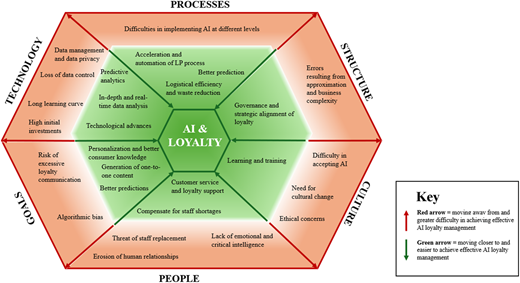
Figure 1 illustrates the conceptual framework that integrates these empirical results into the six-block STS model, showing how the bright and dark sides represent conflicting forces in the implementation of AI in loyalty management. For each component of the STS framework, Figure 1 highlights how dark elements, represented in the red area, fight against bright elements, represented in the green area, fueling ongoing tensions in the implementation of AI in loyalty management. In other words, these forces contribute to the alignment of the STS underlying the proper functioning of AI in loyalty management. The positive factors are closer to the center of the figure, indicating crucial elements in the construction of an AI-driven loyalty system. The red areas represent the hindering forces that cause socio-technical misalignments, conceived as shortcomings in the co-evolution between socio-technical dimensions.
Building on the socio-technical configuration illustrated in Figure 1 and the relationships identified in the findings, we develop some theoretical propositions to synthesize the core mechanisms through which AI shapes loyalty management. The mechanisms emerged from the empirical analysis act on three distinct levels, i.e. technology-process and the related operational output, socio-technical and the related organizational-strategic outcome, constraints (barriers). Therefore:
AI effectiveness in loyalty actions increases when predictive analytics and real-time data analysis are integrated into loyalty management processes, enabling enhanced personalization and deeper customer knowledge.
AI-driven loyalty initiatives generate stronger customer support and service outcomes when technological advances are aligned with governance mechanisms, strategic loyalty objectives and organizational learning processes.
The positive impact of AI on loyalty management is constrained when challenges related to data privacy, cultural resistance, ethical concerns and perceived loss of human relational value are not adequately addressed within the STS.
6. Conclusion, implications, limitations and future research agenda
This study examined how AI is reshaping loyalty management in the retail sector through the STS theory. By analyzing semi-structured interviews with Italian managers, the research mapped bright and dark sides of AI across the six dimensions of the STS theory. Overall, the results highlight that AI in loyalty management can lead to positive effects in terms of data analysis, predictive capabilities, and personalization of loyalty initiatives. At the same time, however, it can generate opposing effects, such as opacity, difficulty in data management and loss of human connection, creating dichotomous tensions. In particular, when the technological aspect is not aligned with organizational and human elements, significant risks and persistent tensions can arise.
From a theoretical perspective, the study extends the application of the STS theory to the realm of customer loyalty management. The study demonstrates that in AI-mediated systems, the balance between bright and dark sides depends on socio-technical alignment: the degree to which technology, human capital, culture and organizational architecture co-evolve coherently determines the success or failure of AI-based loyalty strategies. The availability of data and AI tools does not generate loyalty value unless AI is integrated end-to-end into processes, embraced with corporate culture, and complemented with authentic human and relational factors. The AI-driven approach to loyalty also requires specialization in terms of structural governance.
Empirical research results demonstrate that the prompting and data literacy skills required to support the effective application of AI must be complemented by a renewed investment in human capital (Makarius et al., 2020). Human actors are indispensable for customer listening and building relationships based on trust and empathy. This creates a socio-technical complementarity, whereby the quality of AI output in loyalty management depends on both technology and human skills. The research thus revives the perspective that the dimensions of STS theory are affected by a relationship of co-dependence (Gillani et al., 2024; Münch et al., 2022).
From a managerial perspective, several lessons emerge for retail professionals to successfully integrate AI into loyalty initiatives and programs. First, the findings underscore that cultural transformation is key to successful AI adoption and implementation, typical of organizational structures that invest in continuous training and improvement. Retailers must invest in digital education, employee training, and ethical awareness to overcome fear, resistance and uncertainty surrounding AI systems.
Second, organizations should leverage AI to improve process efficiency, using automation, forecasting and real-time analytics, while maintaining a clear strategic alignment with loyalty objectives such as personalization, customer lifetime value and engagement. Therefore, a system-level governance approach is needed to avoid isolating the technology in specific functions and instead ensure cross-functional coordination between marketing, IT and data units.
Finally, as humans remain crucial in AI-driven loyalty management, retailers should train the human workforce in a way that it can operate at relatively high levels of empathy, creativity and relational depth. Therefore, the ability to orchestrate the human role of staff with that of AI remains crucial to generating a concrete advantage and value in loyalty management.
However, the study is not without limitations. The specific context of the Italian market limits the generalizability of the results. Future research could test the conceptual model in different cultural contexts to verify whether similar or different socio-technical dynamics emerge depending on different cultures and levels of technological acceptance. Further studies could explore the topic through longitudinal analyses to capture the evolution of socio-technical alignment over time, highlighting whether cultural resistance can be reduced in more mature stages of AI integration into organizational loyalty management systems and whether other critical issues and relationships between the STS theory's blocks could arise over time.
The study also focuses primarily on managerial perspectives; integrating consumer opinions could clarify how AI-driven personalization and automation influence perceptions of fairness, trust and engagement in loyalty programs. Future studies could also understand how model alignment affects the effectiveness of AI adoption and integration in loyalty management to identify best practices for designing more resilient, ethical and human-centered AI strategies in the retail sector.
The supplementary material for this article can be found online.