Skip to article sections
Purpose

This paper aims to review and critique empirical research on risk disclosure (RD) in nonfinancial firms, develop insights into the current state of the field, and outline a future research agenda.

Design/methodology/approach

A structured literature review is conducted on 209 empirical papers published between 2000 and 2025 in journals indexed in Scopus and Web of Science. Eleven classification criteria are applied to provide a granular overview of prevailing trends in RD research and identify avenues for future development.

Findings

Empirical RD research has expanded significantly in volume, scope and analytical depth. Nonetheless, geographic and thematic imbalances persist, with studies concentrated in a few developed countries and several RD categories remaining underexplored. Methodologically, the field has evolved from positivist, volume-based approaches toward more interpretive and strategic analyses, increasingly supported by computational tools. Yet, qualitative and mixed-method designs remain underused. Research implications are frequently reiterated, particularly at the macro level and the potential for greater stakeholder relevance is considerable.

Originality/value

This study broadens the scope of existing RD literature reviews by mapping thematic and methodological developments. It offers a consolidated synthesis of research trajectories and highlights emerging analytical sophistication. By identifying neglected areas and advocating recalibrating research priorities, the review fosters a more integrated, context-sensitive understanding of RD, guiding future scholarship toward greater relevance and impact.

Since the early 2000s, the corporate risk landscape has shifted from a predominant focus on financial risks – such as credit and market risks – to a broader terrain increasingly shaped by nonfinancial risks (NFRs). Financial and macroeconomic crises have progressively given way to environmental, geopolitical and societal forces of global instability, as consistently highlighted by the World Economic Forum’s Global Risks Report (WEF, 2023). In parallel, surveys of business leaders – such as the Executive Perspectives on Top Risks Report by Protiviti and North Carolina State University’s Enterprise Risk Management Initiative – consistently identify NFRs, including cyberattacks, technological disruption, talent shortages and regulatory scrutiny, as top near-term concerns affecting profitability and strategic execution (Protiviti, and NC State University Enterprise Risk Management [ERM] Initiative, 2023). This convergence of strategic and operational nonfinancial threats confirms that NFRs are no longer peripheral but central to corporate stability and performance (WEF, 2025; Protiviti, and NC State University Enterprise Risk Management [ERM] Initiative, 2025).

The growing awareness of NFRs has reshaped stakeholders’ expectations for transparency and accountability. While traditional financial reporting was designed to address core business and financial risks primarily for shareholders (Kravet and Muslu, 2013), the imperative to manage and mitigate escalating NFRs has increasingly demanded a corresponding evolution in corporate risk disclosure (RD). The latter is now expected to reflect a broader risk landscape, encompassing sustainability-, geopolitical instability- and technological disruption-related exposures (Voeller, 2024). This broader risk landscape has been accompanied by growing demands for clearer, more comparable and decision-useful corporate risk reporting (Abraham and Shrives, 2014; Adam-Müller and Erkens, 2020).

The growing prominence of NFRs has led regulators and standard-setters across jurisdictions to strengthen corporate RD requirements. In the European Union (EU), the Nonfinancial Reporting Directive (NFRD; European Parliament and the Council of the European Union, 2014) marked a foundational step in institutionalizing nonfinancial disclosure, requiring large undertakings to report on their policies and performance concerning environmental protection, social responsibility, human rights and anticorruption. The subsequent Corporate Sustainability Reporting Directive (CSRD; European Parliament and the Council of the European Union, 2022a) expanded both the scope and depth of reporting and introduced the double materiality principle – requiring firms to disclose how sustainability-related risks, including climate impacts, affect financial performance and how their activities affect society and the environment. In the UK, amendments to the Companies Act (UK Department for Business, Energy & Industrial Strategy, 2022) introduced mandatory climate-related disclosures, covering governance arrangements, risk identification, strategic implications and key performance indicators. In the USA, the Securities and Exchange Commission’s proposed Climate Disclosure Rule (SEC, 2022) mandates reporting on greenhouse gas emissions, climate governance, risk management and scenario analysis. In China, the Shanghai Stock Exchange (SSE, 2024) issued guidelines mandating ESG-related RD across dimensions such as pollution control, resource utilization, supply chain management and employee rights. South Africa’s Johannesburg Stock Exchange released Sustainability Disclosure Guidelines (JSE, 2022), linking ESG risk reporting to long-term value creation. At the international level, the International Sustainability Standards Board introduced IFRS S1 and IFRS S2. While the former establishes a unified baseline for sustainability-related financial disclosures and encourages systematic reporting of material NFRs – including governance and social factors – the latter requires climate RD, reinforcing the shift toward standardized, decision-useful reporting of environmental exposures (IFRS Foundation, 2023a, 2023b).

Regulators have also strengthened requirements for disclosing information technology (IT) and cybersecurity risks. In the USA, the SEC adopted mandatory rules requiring companies to disclose cybersecurity risk management practices, incident response strategies and board oversight mechanisms in annual filings (SEC, 2023). In the EU, the Network and Information Systems (NIS) Directive (European Parliament and the Council of the European Union, 2016) established the first supervisory framework for cybersecurity across essential sectors, while the NIS2 Directive (European Parliament and the Council of the European Union, 2022b) significantly expanded supervisory and compliance obligations, including mandatory risk management systems and incident reporting to competent authorities. At the international level, IFRS S1 encourages disclosure of material IT-related risks and IFRS S2 situates cybersecurity within a broader sustainability reporting regime, reinforcing the shift toward integrated NFR reporting (IFRS Foundation, 2023a, 2023b).

Not only has the attention of stakeholders, regulators and standard-setters toward RD continued to grow since the early 2000s, but academic research in the field has also intensified, as evidenced by a series of literature reviews published over the past decade. Focusing on 42 studies published between 2004 and 2014 that examine firm-level characteristics influencing RD, Khlif and Hussainey (2016) found that size, leverage, profitability and risk are positively associated with RD. However, these relationships are moderated by the disclosure regime, legal system, cultural attitudes toward uncertainty, industry and the proxies used to measure explanatory variables. The authors especially called for further research on RD tone and cross-country studies aimed at examining how cultural dimensions may affect RD. Elshandidy et al. (2018) reviewed 32 empirical studies spanning 1997–2016 and highlighted significant divergence in the literature – especially regarding mandatory versus voluntary RD, manual versus automated content analysis, within-country versus cross-country variation and differences between financial and nonfinancial firms. They noted a tension between limited empirical support for the substantive benefits of RD regulation and claims that existing regulation could be improved, thus calling for further inquiry. Khandelwal et al. (2019) reviewed 61 articles published between 2000 and 2018. They identified a lack of studies linking financial RD to governance mechanisms, limited coverage of developing countries and a predominance of single-country or short-period data – shortcomings that future research should address. In their analysis of 127 articles published between 1998 and 2018, Wang (2021) highlighted the underrepresentation of emerging economies in the RD literature relative to their developed counterparts. They stressed the need to understand why, how and to what extent greater RD is offered in these distinct institutional contexts. They also observed that most studies rely on content analysis and fail to adopt a holistic view of RD – a concern echoed by Mbithi et al. (2022), who reviewed 59 articles published from 2004 to 2021 in AJG-listed journals and found that research on RD quality has long neglected its multidimensional nature and lacks a consistent basis for measurement. Ibrahim et al. (2022) conducted a comprehensive review of 104 articles published worldwide (1999–2019), also limited to AJG-listed journals, and revealed a notable increase in RD publications, with over half of the studies appearing in the past six years of the sample period. They offered a distinct analysis of RD categories, themes and theories and highlighted a strong focus on firm-level characteristics. They also developed a sectoral comparison between financial and nonfinancial institutions. Based on their findings, they suggest expanding empirical focus to underrepresented settings, such as developing economies, investigating institutional drivers of RD practices and diversifying methodological approaches to enhance explanatory power. To complete the overview, Bouteska et al. (2025) examined the types of risks addressed in RD research from 2000 to 2020 and found that none of the studies analyzed the effects of the NFRD. In turn, Mies (2024) conducted an extended review (2002–2021) of RD practices within the banking sector, thereby covering the financial industry through both qualitative (systematic) and quantitative (bibliometric) lenses.

Each of these literature reviews makes valuable contributions within its scope of analysis. However, that scope is often constrained – whether by the limited number of studies examined, narrow research questions, restricted geographical coverage or selective focus on specific types of RD. Several reviews also fail to explicitly disclose their methodological choices, raising concerns about reliability, validity and replicability, and ultimately hindering cumulative knowledge development. Moreover, the most recent review concludes with studies published up to 2021, leaving the last several years underexplored – a critical gap given the evolving risk landscape, rising demand for transparency and the recent emergence of stringent regulatory frameworks such as the CSRD, SEC cybersecurity rules and NIS2.

The present review addresses these limitations – thematic, methodological and temporal – by offering a more context- and regulation-aware, transparent and updated synthesis of RD literature. It analyzes 209 articles focused on RD published globally between 2000 and 2025 in Scopus- and Web of Science-indexed journals within the accounting, business and management fields – thus expanding prior reviews in geographic and temporal scope, and by drawing on multiple bibliographic data sources. Building on this broader evidence base, it adopts the structured literature review (SLR) approach (Massaro et al., 2016), which entails setting broad goals to trace the evolution of literature, provide critical insights into its development and identify emerging gaps and future directions for RD research. These goals are pursued through the development of an analytical framework encompassing eleven criteria. The framework first considers timeframe and location – the latter articulated by geography and economic development; it then examines risk type, RD regulation and RD dimension; it further assesses the research design, including research method, data source and data collection; and finally, it evaluates the article content, namely, the research question, research findings and practical implications. The analysis thereby incorporates several elements that, although occasionally addressed in prior studies, have not yet been systematically brought together. This allows the review to provide an insightful picture of how RD research has evolved across contexts, methodological approaches and disclosure dimensions. Moreover, the review includes all RD studies that provide empirical evidence on disclosures by nonfinancial companies, thereby complementing the recent bank-focused review by Mies (2024). Finally, as an SLR, this study adheres to a rigorous review protocol that ensures the assessment of research impact, reliability and validity, and strengthens replicability. Taken together, these elements position the review to capture recent shifts in RD research that address gaps identified by prior literature or open new avenues of inquiry. In doing so, the review contributes to scholarly understanding, supports informed decision-making by companies and stakeholders and enables evidence-based policymaking, while laying a stronger foundation for future research on RD.

The remainder of this paper is structured as follows. Section 2 outlines the methodology adopted, while Section 3 presents the findings. Section 4 offers a critique of the reviewed literature, identifies existing gaps and proposes directions for future research. Finally, Section 5 provides concluding remarks.

SLR is a systematic, transparent and reproducible approach to reviewing literature, originally designed in the medical field (Tranfield et al., 2003) and progressively adopted in accounting research over the past decade (Dumay et al., 2016; D’Arcy and Tarca, 2018; Awuah et al., 2024; Florio, 2024). It provides a rigorous synthesis of research findings on a specific topic through an explicit search strategy, predefined screening criteria and a structured analysis process (Leventis et al., 2024). Compared to traditional literature reviews, SLR offers two key advantages: it ensures a methodical and objective overview of the existing literature, enhancing analytical robustness; and it documents each step through a formal review protocol, thereby promoting transparency and enabling verification and reproducibility of results (Massaro et al., 2016). Following established SLR methodology, we developed this study through the following sequential procedures:

  • literature review protocol;

  • research questions;

  • literature search;

  • article impact;

  • analytical framework;

  • reliability and validity;

  • coding;

  • insights; and

  • future research paths.

Drawing on Massaro et al. (2016), we developed a protocol for reviewing articles aligned with the purpose of this study, as represented in Figure 1.

According to Massaro et al. (2016, p. 774), “[r]esearchers use SLR to map and assess existing knowledge domains to identify future research needs.” In line with this approach, this SLR is guided by three research questions (RQs), adapted to the specific topic of RD. RQ1How has empirical research on RD developed from 2000 to 2025? – aims to contextualize the literature by tracing its evolution and identifying how prior contributions have shaped the current state of knowledge. RQ2What is the focus and critique of empirical research on RD? – seeks to critically examine the thematic orientations, methodological choices and empirical evidence developed within the field. RQ3What is the future of RD empirical research? – aims to highlight emerging gaps and outline potential directions for future inquiry.

This review implemented a rigorous literature search process, as outlined in Table 1. The Scopus and Web of Science databases were selected due to their broad coverage and widespread use in academic research. In September 2025, literature published from 2000 – the start of the new Millennium – was retrieved using the following keywords: “risk discl*” OR “risk info*” OR “risk report*” OR “risk factor* discl*” OR “risk factor* info*” OR “risk factor* report*.” These terms were searched across the title, abstract and/or keywords of articles in the accounting, business and management subject areas.

This initial search yielded 1,342 articles, comprising 1,004 from Scopus and 338 from the Web of Science. After removing 211 articles that were duplicated, 1,131 remained and were subjected to a preliminary screening to exclude studies that were not classified as articles (23), were not accessible in full text (30) or had only the title and abstract written in English (3). Subsequently, the abstracts of the remaining 1,075 papers were systematically reviewed to verify their alignment with the purpose of the literature review. This step excluded 742 studies, including one commentary, five reviews (literature, regulation and historical), 13 conceptual and modeling studies and 723 articles that were outside the scope despite mentioning one or more keywords in the searched fields. We further excluded articles focusing on the financial sector for three main reasons: first, most accounting studies tend to examine financial and nonfinancial industries separately (Ibrahim et al., 2022); second, prior literature reviews in the field suggest that research findings tend to diverge between financial and nonfinancial firms (Elshandidy et al., 2018) and to become insignificant when researchers use samples that include both kinds of companies (Khlif and Hussainey, 2016); third, the recent literature review by Mies (2024) specifically addresses empirical research on banks’ RD. In total, 209 articles from 2000 to 2025 were identified for inclusion in this SLR.

2.4.1 Articles’ research impact: journal quality.

Table 2 shows that 209 studies were distributed across as many as 118 journals, spanning all ranking tiers defined by the Academic Journal Guide (AJG) published by the Chartered Association of Business Schools [Chartered Association of Business Schools (CABS), 2024]. Specifically, 17 studies (8%) were published in rank 4 or 4* journals, 40 studies (19%) in rank 3 journals, 90 studies (43%) in rank 2 journals and 32 studies (15%) in rank 1 journals. These figures imply that 27% of the reviewed studies (57) are from the top-ranked journals (AJG 4*, 4 and 3). At the journal level, the Managerial Auditing Journal had the highest number of publications (9), followed by the British Accounting Review and Journal of Applied Accounting Research with seven studies each. Contemporary Accounting Research contributed five studies. Collectively, these four journals accounted for 28 articles, representing 13% of the sampled studies. A similar percentage of studies (15%) were published in unranked journals.

2.4.2. Articles’ research impact: citations.

Beyond journal quality, citation patterns offer an additional perspective on the academic influence of RD research. Therefore, to assess the interest and impact of research on RD, we analyzed the cumulative number of citations (CNC) and the average number of citations per year (CPY) since the publication of each paper. Following Florio (2024), we used Publish or Perish 8 to query Google Scholar for citations of works. By October 2025, the overall number of citations for the selected articles was 19,594, with 23% of them coming from 17 articles published in journals ranked AJG 4* and 4. Overall, the 209 articles included in this SLR received 2,601 CPY. Regarding journal performance, the five articles published in the British Accounting Review (AJG 3) received the highest number of CPY, followed by the three articles in the Review of Accounting Studies (AJG 4).

Table 3 reports the top ten articles ranked by CNC (Panel A) and CPY (Panel B). The same articles appear in both lists, except that Amran et al. (2008) ranks in the top ten for CNC only, whereas Elshandidy and Neri (2015) appears exclusively in the CPY list. The citation metrics highlight a combination of foundational and more recent contributions that have shaped RD research across different regions and methodological traditions. The most cited articles since publication are classic works that established the conceptual and methodological foundations of RD (e.g. Beretta and Bozzolan, 2004; Linsley and Shrives, 2006), while the CPY ranking underscores the growing influence of newer studies – most notably Ilhan et al. (2023) – that reflect the focus on climate-related risks and investor-focused analyses. Across both panels, the top-ranked articles span multiple geographical contexts and regulatory environments, and collectively emphasize themes such as textual analysis, investor relevance and the determinants of corporate RD practices. Overall, the evidence confirms that empirical RD research remains highly relevant to the academic community.

This section defines the analytical framework, designed following Massaro et al. (2016) and tailored to our purpose and research focus. Eleven criteria were identified to highlight the characteristics of the selected empirical studies. Table 4 presents the criteria, their respective attributes, and a summary of the results.

The first two criteria are timeframe and location. By accounting for the distribution of articles published over time, the timeframe criterion enables us to trace the development of research across periods marked by relevant turning points in the economic, regulatory, technological and geopolitical backdrop. The first period, spanning from the early 2000s to 2011, follows high-profile corporate failures and the 9/11 attacks, which heightened corporate risk awareness of operational disruptions, security threats and geopolitical instability. It is marked by the 2008 global financial crisis (GFC) and by early discussions and preparatory efforts toward regulatory reforms in risk and sustainability reporting across jurisdictions such as the USA, the EU and China. These included draft directives, position papers and stock exchange guidelines, as well as preliminary consultations and worktables that laid the groundwork for later formal regulations. This phase also introduced digital transformation and cybersecurity as emerging themes, setting the stage for broader regulatory engagement in subsequent years. The second period, from 2012 to 2019, reflects the post-GFC regulatory landscape, characterized by a growing emphasis on nonfinancial disclosure requirements and increased transparency across jurisdictions (as mentioned in Section 1). It also coincides with increasing exposure to digital vulnerabilities (e.g. the 2013 Target breach, the 2017 Equifax breach) and geopolitical tensions (e.g. the 2016 UK Brexit referendum), which amplified concerns around cyber and political risk. The third period, spanning from 2020 to September 2025, is shaped by systemic disruption triggered by the COVID-19 pandemic, regulatory reforms in sustainability disclosure – particularly climate-related reporting (e.g. EU CSRD) – a surge in ransomware attacks (e.g. Colonial Pipeline 2021) and regulatory tightening (e.g. SEC cyber proposals, EU NIS2 Directive). This phase also reflects heightened geopolitical instability, including the Russia–Ukraine war (2022), the Israel–Hamas conflict (2023), Indo-Pacific tensions and evolving global sanctions regimes that have reshaped the political risk landscape.

By examining the regions covered by the sampled articles, the location criterion helps identify where corporate RD research has more or less developed. Information on the country or countries in which each study was conducted was collected. Subsequently, RD articles were classified into five geographic regions (Africa, the Americas, Asia-Pacific, Europe and the Middle East) and into developed or developing countries, based on the World Economic Outlook (International Monetary Fund [IMF], 2024) and following prior literature (Wang et al., 2023). For geographic classification, the attribute Multiple was used to capture cross-country or cross-regional studies. For classification by economic development, the attribute Both was applied when the study encompassed both developed and developing contexts.

The next three criteria capture the characteristics of RD by focusing on the risk type, RD regulation and RD dimension. Each article investigates RD with reference to one or more kinds of risks, which we classify into the following attributes: business risk, understood as exposure to strategic and operational uncertainties; financial risk, referring to threats to financial stability and performance; environmental risk, arising from ecological factors and climate change; social risk, linked to societal expectations, stakeholder relations, public health threats and political instability; governance risk, involving vulnerabilities in internal control, risk management and corporate oversight; and IT risk, associated with digital infrastructure, cybersecurity and technological disruption (Khandelwal et al., 2019). For each attribute, we noted the specific risk type whenever feasible. We also defined the attribute Overall to identify articles that refer to RD without providing details or that list risks spanning multiple attributes.

The RD regulation criterion assesses whether the article focuses on mandatory, voluntary or both forms of RD. Mandatory disclosure refers to legally or regulatorily required communication of specific information, while voluntary RD is provided at the company’s discretion, whether or not recommended by frameworks, guidelines or accounting standards (Elshandidy et al., 2018; Ibrahim et al., 2022).

Finally, the RD dimension criterion helps classify the articles according to the profile of RD they capture. Based on recurring dimensions used to assess disclosure quality and structure (e.g. Beattie et al., 2004; Elshandidy et al., 2018), we defined the following attributes: volume refers to whether RD is provided, how much or how frequently RD is provided; features focuses on the qualitative (textual) characteristics of RD; multidimensional index refers to the adoption of a holistic approach to RD by defining a composite index or score that encompasses multiple dimensions simultaneously. We also allowed for the Multiple attribute to account for papers that combine Volume with Features. Both Features and Multidimensional index attributes required the definition of subattributes to provide a more granular view of the literature, which we reported in the Supplementary Material. In alphabetical order, these subattributes are: Content (what theme RD focuses on), Coverage (how concentrated RD is on a given theme), Location (where RD appears within the source document), Nature (whether RD is quantitative/monetary or qualitative/nonmonetary), Readability (how easily RD can be understood), Similarity (how similar RD is over time, across locations or compared to other references), Specificity (how specific or detailed RD is), Time orientation (whether RD is backward- or forward-looking), Tone (what attitude or emotional framing RD conveys) and Other.

Next, a set of criteria referring to the research design of the articles. First, the research method criterion summarizes the analytical techniques adopted, classified into quantitative studies, qualitative studies, mixed-methods studies combining both approaches and experimental studies (Zattoni et al., 2020). Second, the data source criterion identifies the location in which RD is – or is expected to be – provided. Based on regulatory requirements or recommendations to disclose RD within specific sections of the annual report, we defined the attributes Annual Report, Other and Multiples. Third, the data collection criterion captures how RD data was gathered: manually, through software-enabled automated collection or via artificial intelligence (AI) tools (Elshandidy et al., 2018). We also included the attributes Other and Multiple to account for alternative or combined approaches.

The final set of criteria examines the content of the articles, focusing on the research question, findings and implications. The research question criterion identifies the core issue addressed by each article, categorized into three main attributes: RD choices, determinants and consequences. Articles classified under Choices investigate whether and how a company provides RD. In contrast, the Determinants and Consequences categories reflect attempts to identify, respectively, the factors that influence RD and the outcomes that RD generates. While the Choices attribute is self-explanatory and closely linked to the RD dimension analyzed, the Determinants and Consequences attributes are further subdivided to enable a more detailed and insightful analysis. For determinants, we consider both External and Internal factors. Referring to prior literature, external factors include the institutional environment, risk exposure and ownership structures (Beretta and Bozzolan, 2004). Internal factors include financial characteristics, corporate governance quality and sustainability performance (Bufarwa et al., 2020). Regarding consequences, we consider the effects on Capital markets, Operating outcomes, Accounting and auditing consequences, as well as Other relevant consequences (Elshandidy et al., 2018). Each of these attributes can also be further divided into subattributes to describe a specific research question; furthermore, we allowed for the Multiple attribute for both determinants and consequences.

The research finding criterion assesses the relationship identified between RD and its determinants or consequences. We capture whether the association between the elements under investigation is Positive, Negative or Neutral. We allowed for Multiple attributes to be assigned to each article, reflecting the multifaceted nature of RD research and avoiding oversimplification. We also noted whether the relationship is influenced by a third variable – either strengthening or weakening the association (moderation) or explaining the mechanism through which it occurs (mediation). As defined, this criterion does not apply to the Choices research question; therefore, we assign the Nonrelevant attribute in such cases.

Finally, the research implication criterion identifies and codes the real-world implications explicitly highlighted by the articles. Its purpose is to systematize scattered insights across the literature, support comparison and synthesis and assess how research outputs target different audiences. To this end, we adopt a micro-, meso- and macro-level analysis (Ali et al., 2022). The Microlevel applies when the study provides insights that may influence the behavior of the company’s decision-makers. The Mesolevel refers to interactions between an organization and its stakeholders (e.g. investors and customers). The Macrolevel situates the company within its broader context – economic, social, cultural, political, legal or environmental – and applies when recommendations are directed toward regulators, policymakers or standard setters.

We coded the selected articles according to the analytical framework, with the categorization and analysis results recorded in an MS Excel spreadsheet to ensure standardized data processing and traceability of subsequent analyses. Prior to coding, the research team extensively discussed the definitions of attributes and, where applicable, subattributes to ensure conceptual clarity and consistency. Coding was then conducted independently by two researchers, who compared their results to assess intercoder agreement and refine the classification criteria. To further validate the reliability of the coding process, a retest was performed on a subset of 50 articles, reclassified by a single researcher after a time interval. The high level of consistency observed confirms the robustness of the coding scheme and the reliability of the review. The Supplementary Material reports the coding results for each of the 209 studies for verification and transparency.

We ensured the validity of the findings in multiple ways (Massaro et al., 2016; Tsalavoutas et al., 2020). Internal validity (i.e. the comprehensiveness and appropriateness of the analytical framework and coding) was assessed through discussions with experienced researchers, who initially reviewed the list of criteria and subsequently tested 25 articles individually to refine the attributes and subattributes. External validity (i.e. the comprehensiveness of the selected sources) was initially established by running queries across two databases (Scopus and Web of Science) and then comparing the retrieved articles with those from prior literature reviews on RD. Since our sample articles equal or exceed those included in other literature reviews in the same timeframe, reasonable assurance is provided that our findings are generalizable. Finally, construct validity (i.e. the quality of the studies reviewed) was ensured by the databases queried, the fact that 80% of the journals considered appear in the AJG and the consistent number of individual and cumulative citations and CPY.

This section discusses the RD literature and answers the first two research questions, RQ1How has empirical research on RD developed from 2000 to 2025? and RQ2What is the focus and critique of empirical research on RD? The key features of the existing empirical literature are discussed in light of the eleven criteria described in the analytical framework. This classification helps identify trends and issues in how researchers define and measure RD studies. Table 4 presents the summary results, complemented by additional tables and figures that visually summarize the overall status of empirical research on RD.

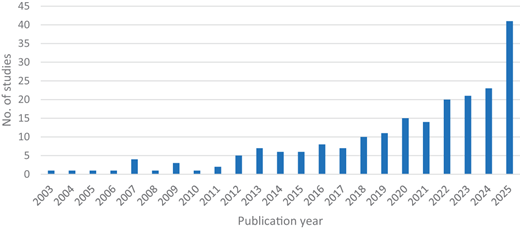
Analyzing the publication dates allows us to trace the evolution of scholarly interest in RD as a research topic. Figure 2 represents the number of RD studies by year. Between 2000 and 2025, the global literature on RD in nonfinancial corporations exhibits a clear upward trajectory. The period from 2000 to 2011 can be considered the nascent stage, with only 15 articles published. A notable expansion occurred between 2012 and 2019, with 60 publications and a visible increase in annual output. The years 2020 to 2025 represent a period of rapid growth, with a total of 134 articles. The acceleration in 2025 is particularly striking, with 41 papers published by September alone.

This sustained growth aligns with escalating macroeconomic uncertainty, high-impact risk events, evolving regulatory frameworks and mounting stakeholder demand for transparency – factors that have collectively amplified scholarly attention to RD.

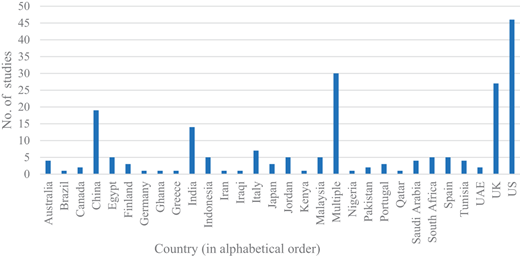
The location criterion helps understand the interest in RD in different geographic regions and implicitly highlights understudied areas. The RD literature encompasses 30 countries worldwide, as reported in Figure 3.

3.2.1. Location by geography.

Regarding the geographical distribution of the RD literature, Table 5 shows that Europe, Asia-Pacific and the Americas each contributed between 50 and 57 articles, confirming their leadership in the field. The Middle East (19/209) and Africa (13/209) remain underrepresented. Table 6 further reports 16 cross-national studies (8%), reflecting the growing globalization of research and addressing earlier concerns raised by Ibrahim et al. (2022) about the lack of cross-country RD analysis.

While RD research has expanded globally, notable regional concentrations persist. In Europe, the UK leads with 27 publications (47% of the region), including 19 between 2020 and 2025, indicating sustained academic interest. Italy (7), Spain (5), Portugal (3) and Finland (3) show moderate engagement, while other countries contribute sporadically. In the Asia-Pacific region, China dominates with 19 articles – 18 since 2020 – followed by India (14), Indonesia (5), Malaysia (5) and Australia (4). The Americas are overwhelmingly represented by the USA, with 46 articles (92% of the region), driven by its longstanding focus on corporate transparency and regulation; Canada (2) and Brazil (1) contribute sporadically, while no studies are retrieved in other countries. In the Middle East, contributions are fragmented, led by Jordan (5), Egypt (5) and Saudi Arabia (4). African research is similarly dispersed, with South Africa (5) and Tunisia (4) being the most active, though overall output remains limited.

3.2.2. Location by economic development.

When classified according to the World Economic Outlook (IMF, 2024), the RD studies in our sample are associated with 12 developed countries (31% of all developed economies) and 18 developing countries (12% of all developing economies). In quantitative terms, 114 studies (55%) were conducted in developed countries, while 81 studies (39%) focused on developing countries. An additional 14 studies included samples from both groups.

Overall, these figures on location highlight a persistent imbalance in RD research coverage, with developing economies remaining underrepresented, underscoring the need for more inclusive and context-sensitive RD scholarship.

This section presents the distribution of different risk types examined in RD research, illustrating how the focus of studies has evolved, as shown in Table 6.

Between 2000 and 2011, RD research predominantly addressed broad, undifferentiated risk categories (12/15), with only a few studies focusing specifically on financial risks (3/15). From 2012 to 2019, the research scope began to diversify, although overall RD remained dominant (53/60), alongside limited contributions on financial risks (2) and an emerging interest in business, environmental and IT-related risks. In the 2020–2025 period, overall RD is still prevalent (70/134), but the coverage expanded significantly to include more studies on specific risk types – namely, environmental (26), financial (12), IT (10), social (9), governance (3), business (3) and ESG (1). Notably, in 2025, environmental RD accounted for 46% of publications (19/41), marking a clear shift from overall and financial risk categories toward more targeted nonfinancial disclosures. This trend signals a growing analytical focus on distinct risk types rather than aggregated or generic reporting. However, studies on specific risks remain geographically concentrated, particularly in developed countries. A key example is IT-related RD, which is largely centered in the USA.

This section analyzes RD research by its focus on voluntary, mandatory or combined disclosure types. As shown in Table 4, voluntary RD accounts for the largest share (121/209 articles), followed by 28 studies focused on mandatory RD and 60 addressing both. These figures suggest that scholarly attention has primarily concentrated on voluntary RD, reflecting sustained interest in firm-initiated practices that may be encouraged by guidelines but not legally required. Voluntary and combined RD studies span all risk categories and geographic contexts, with voluntary RD consistently prevailing across timeframes. Nonetheless, interest in mandatory RD has grown, with 23 of 28 studies (82%) published since 2020. These focus exclusively on developed economies – particularly the USA (11 studies) – and predominantly address overall (10) and financial (8) RD, often in relation to recent regulatory frameworks, notably those issued by the US SEC. Some research explores the interaction between voluntary and mandatory disclosures (Cordazzo et al., 2017), offering insights into how firms balance compliance with strategic communication. Overall, the literature emphasizes voluntary RD, while mandatory and combined studies broaden the field by addressing regulatory and communicative dimensions.

This section analyzes scholarly attention to RD dimensions. Of the 209 studies, 97 (46.4%) focus on disclosure volume, typically assessed through checklists and dichotomous coding (present/absent). Another 31 studies (14.8%) examine one or more features of RD, while 74 (35.4%) combine volume and features. In the 2000–2011 period, nearly all studies (14/15) addressed volume – either alone (6) or combined with basic features such as content, coverage, location, nature, time orientation and tone (8). Between 2012 and 2019, 54 out of 60 studies focused on volume alone (27) or in combination with textual features (27), with expanded attention to readability, similarity and specificity. Since 2020, the number of studies has increased across nearly all dimensions, showing a balance between volume (64) and feature-oriented or combined approaches (65). This reflects a gradual shift from purely quantitative to more qualitative and linguistic analyses. Notably, readability, specificity and tone gained prominence. Still, the different textual features of RD are treated as standalone and used as substitutes for one another when developing cause-and-effect relationships. Overall, only seven studies (3.3%) attempted to construct composite indices combining multiple dimensions, mostly in the past period. Two 2025 studies further advanced this by aligning financial RD with firm-level risk (Safarzadeh and Derakhshan, 2025) and climate RD with the Task Force on Climate-related Financial Disclosures (TCFD, 2017) pillars (Zaman et al., 2025). Overall, the findings reveal a clear developmental trajectory – from basic volume metrics to multidimensional, linguistically informed approaches.

This section examines the research design of RD literature, focusing on research methods, data sources and data collection techniques. As shown in Table 4, quantitative research dominates the field, accounting for 190 of the 209 studies. Qualitative (9), experimental (7) and mixed-method (3) approaches are used more sparingly. Quantitative designs have grown alongside overall RD research and are especially prevalent in the USA, UK and cross-national studies. Only a few qualitative studies examine firms’ RD choices, particularly regarding volume and textual features. All seven experiments were conducted in the USA, mainly since 2020 (6). Two mixed-method studies began with qualitative development of RD measures, followed by quantitative validation (Beretta and Bozzolan, 2004; Ibrahim and Hussainey, 2019), while one reversed this sequence (Mbithi et al., 2023).

Regarding data sources, 171 studies rely on annual reports, confirming their centrality in RD research. Another 32 draw on alternative sources such as integrated, sustainability and governance reports, earnings call transcripts and databases. Six studies combine multiple sources. Within annual reports, some focus on specific sections – particularly Management Discussion and Analysis (10 studies) and risk factors (18 studies) – to extract targeted content.

In terms of data collection, 106 studies used manual coding, the only method used between 2000 and 2011. Since 2012, 62 studies have adopted automated tools, and 17 have combined manual and automated techniques, primarily using NVivo, Python and NUDIST 6 SQR for content analysis. In addition, 24 studies apply AI-based methods such as latent Dirichlet allocation, machine learning and natural language processing – especially for topic modeling. Notably, 21 of these studies were published since 2020, marking a clear methodological shift in RD research.

As defined in the analytical framework and shown in Table 4, RD research questions can be broadly categorized into three areas: RD choices, determinants of RD and consequences of RD, with an additional group of studies addressing multiple research questions. Research directly examining corporate RD practices totals 16 studies (7.7%), capturing volume and textual features to provide insight into companies’ disclosure behavior.

The largest body of literature focuses on RD determinants, with 83 of 209 studies (39.7%). Of these, 25 examine external factors such as institutional environments, risk exposure and ownership structures; 33 explore internal factors like financial characteristics, governance quality and sustainability performance; and 25 analyze both simultaneously. This focus prevailed throughout 2000–2019 and was often combined with studies on RD choices.

The second major stream concerns the consequences of RD, represented by 71 studies (34.0%). Most examine capital market effects (54), particularly equity markets (45), followed by debt markets (8) and dual-market studies (1). A smaller subset examines operating outcomes, such as inventory slack, operational efficiency and competition (7); accounting and auditing implications, including earnings management, internal control deficiencies and audit fees (4); and other consequences, including reputation and regulatory outcomes (6). This stream emerged in 2012 and gained prominence in 2020–2025, eventually surpassing studies on determinants in volume.

In addition, 39 studies (18.7%) cover multiple research questions, reflecting the field’s interdisciplinary and integrative nature. In 2000–2011, combinations mainly involved choices and determinants, while later studies increasingly integrated all three dimensions.

Overall, the existing literature shows a structured distribution of topics, with emphasis on RD determinants and capital market consequences.

This section categorizes studies based on whether the assessed relationship between RD and its determinants or consequences is positive, negative, neutral or conditional – i.e. mediated or moderated by other factors. For this analysis, 16 articles focusing exclusively on RD choices are intentionally excluded, as they do not investigate cause-and-effect relationships.

Only a small subset of papers (13/193) fails to identify a significant association, indicating that 93.3% of the literature reports effective determinants and/or consequences of RD. Neutral findings share recurring traits: they predominantly focus on overall RD (11), voluntary RD (7) or both voluntary and mandatory RD (5). In many cases (10), RD textual features – such as nature, readability and tone – are examined, either alone or alongside volume. These studies primarily investigate determinants (9), rather than consequences (4), and rely on quantitative methods (12). Promisingly, the share of neutral findings has declined – from 16.7% in 2000–2010 to 5.5% in 2020–2025 – indicating improvements in research design.

Among the 193 articles reviewed, 88 (45.6%) report positive findings. Their share rose from 31.5% in earlier periods to 54.3% in 2020–2025. Of these, 36 studies examine determinants, 44 consequences and eight address both. These consistently show that risk exposure drives climate, social and overall RD and that such disclosures benefit equity markets in China and Europe. External drivers include climate-conscious investors and high-risk contexts (e.g. GFC and entrepreneurial visibility), while internal drivers include firm size, board independence, gender diversity and financial expertise. Moreover, Chinese firms with strong sustainability ratings, digital maturity and authoritative managerial style are more active in climate RD (Au and Tan, 2025). RD effects include reduced loan spreads and default risk, as well as improved stock pricing in capital markets, operational efficiency, audit outcomes and reputation.

Only 19 articles (9.8%) report negative findings. These include climate RD contributing to stock price crashes (Epelbaum, 2025) and financial RD increasing perceived stock risk (Fortin and Berthelot, 2012). Most (13/19) explore moderating or mediating factors that shape adverse capital market effects. Five studies report negative associations between specific determinants and RD, offering insights into the role of co-opted directors (USA), delegated managerial power (China) and weak governance (UK). These studies increasingly clarify conditions under which negative effects intensify or weaken, especially post-2020.

Finally, 73 studies (37.8%) report mixed findings – either partially positive and negative (21), or a combination of positive, negative and neutral outcomes (16). These results lack consistent patterns across timeframes, risk types or RD dimensions. On the determinants side, broad research questions often yield multiple hypotheses (55 studies). On the consequences side, 12 studies examine capital market effects, frequently incorporating moderating and mediating variables.

Taken together, these patterns underscore the increasing methodological sophistication and thematic depth of RD research, while highlighting the need for continued refinement in capturing complex, conditional and multidimensional disclosure effects.

The research implication criterion helps systematize scattered insights by assessing how RD studies target different audiences – at the micro, meso and macro levels. Among the 209 reviewed articles, 80 present implications exclusively at the macro level, 14 at the micro level and 8 at the meso level. Several studies span multiple levels: 38 address both micro and macro levels, 18 cover meso and macro levels and 6 consider micro and meso levels. In addition, 29 articles present implications across all three levels, while 16 do not specify any.

Macrolevel implications dominate the field, appearing in 165 studies (78.9%) and consistently leading across timeframes. These studies target regulators, standard-setters and policymakers. The literature calls for clearer, enforceable RD guidelines to improve transparency, comparability and reliability – especially in climate risk, cybersecurity and fraud detection. Many advocate for international harmonization and stronger governance codes, though tensions persist between calls for standardization and concerns about rigidity and boilerplate disclosures. Despite these debates, the literature converges on the need for forward-looking, stakeholder-relevant RD supported by dynamic, context-sensitive regulation.

Mesolevel implications target investors, analysts and financial institutions who rely on RD to assess firm performance and risk. These studies urge stakeholders to engage with firms, scrutinize RD textual features (e.g. tone and specificity) and monitor compliance. RD volume alone is insufficient; substance and credibility matter. Investors are also cautioned against home bias. Evidence supports a more active, informed stakeholder role in promoting meaningful RD. Mesolevel recommendations appear in 23%–31.3% of studies across timeframes, peaking in 2020–2025.

Microlevel implications address corporate managers, board members and report preparers. The literature highlights the strategic value of clear, credible RD – especially in climate risk, governance and investor confidence. Firms are encouraged to strengthen board independence, promote gender diversity and align disclosures with stakeholder expectations. Strategic framing is key: both favorable and unfavorable RD can enhance firm value if perceived as credible. Microlevel relevance has grown, with 71 of 134 studies (52.9%) in 2020–2025 explicitly addressing this audience.

Two shortcomings persist across all levels: a flattening of insights, with many studies converging on similar recommendations without offering novel or theory-driven contributions; and a gap between analytical sophistication and practical relevance, as recent methodological advances – such as AI-based textual analysis – have yet to yield more actionable implications.

Building on the empirical insights into RD research from 2000 to 2025 presented in Section 3, we now critically examine the literature to identify key gaps and formulate recommendations for future research. This step aligns with the overarching purpose of the SLR and directly addresses RQ3 – What is the future of RD empirical research? Indeed, SLRs first “present the state of the art, creating order and availability from previous studies” and, following, “provide the ground on which researchers build new studies” (Massaro et al., 2016, p. 792). A comprehensive summary of the developed SLR is provided in Table 7.

This SLR shows that, although the number and geographic scope of publications have expanded over time, empirical evidence from many countries remains limited and fragmented. Notably, 35% of RD studies are concentrated in the USA and the UK, reflecting a high degree of research concentration. RD research questions often originate in a few developed countries before spreading elsewhere, leaving many developed and developing regions underrepresented – both in terms of topics and methodological approaches. Future research should broaden its geographic scope and prioritize neglected regions to address current imbalances and enhance the global relevance of RD scholarship. Cross-country comparisons and regional diversity are essential to capturing contextual differences in RD practices, particularly in relation to RD regulation. Scholars are encouraged to consider institutional settings and stakeholder priorities across regions, and to develop frameworks that clearly distinguish between voluntary and mandatory RD and measure them. Expanding in-depth case studies and comparative analyses across various regulatory environments will strengthen the explanatory power and contextual validity of RD findings, offering more effective guidance to firms, stakeholders and national and supranational policymakers. Expanding research across heterogeneous institutional settings would also allow scholars to test whether established findings – such as the influence of governance quality, regulatory pressure or investor sophistication – hold in contexts characterized by different legal systems, enforcement regimes or cultural attitudes toward uncertainty. For instance, climate or cybersecurity RD may respond differently to regulatory reforms in emerging economies than in mature markets. At the same time, political or social risks may be disclosed in distinct ways across countries with varying levels of media freedom or stakeholder activism. Such comparative designs would not only enhance external validity but also reveal context-specific dynamics that remain invisible in single-country studies, thereby clarifying when and why heterogeneity in settings generates theoretically meaningful variation rather than noise.

The SLR confirms that overall RD remains the dominant category; however, research has progressively diversified toward specific risk types, with increasing attention to NFRs – particularly ESG and IT-related RDs. Despite this shift, many specific risk categories still lack systematic investigation and regional concentration persists, especially in IT-related RD, which is largely centered on the USA and underrepresented in developing countries. Most studies examine the determinants of RD, considering both internal factors – such as financial characteristics, governance quality and sustainability performance – and external factors, such as institutional environments and firms’ risk exposure. However, only a limited number of studies directly explore corporate RD practices, despite their potential to clarify how firms navigate and prioritize different risk types. Research on the consequences of RD has primarily focused on capital market outcomes, particularly equity performance, with limited attention to operational, accounting and reputational effects. Future research should deepen analysis of specific risk categories and their interdependencies, expand the analysis of consequences beyond capital markets and address regional and sectoral gaps. A more balanced and diversified research agenda – across risk types and research questions – will be essential to advancing RD as a context-sensitive and strategically constructed practice.

Moreover, the evolution of RD research reflects a substantive methodological shift rather than a mere diversification of empirical techniques. Quantitative, positivist approaches dominated early studies that measured disclosure volume through manual content analysis and count-based metrics, typically applied to annual reports and financial filings. These studies used econometric models to examine the associations between RD volume and context- and firm-level variables, as well as between RD volume and market reactions. Overall, they laid a foundational empirical base for standard-setting but offered limited insight into RD as a dynamic and communicative process (Ibrahim et al., 2022). Over time, however, research has moved from detection to interpretation, with two key developments: first, quantitative designs have become more sophisticated, increasingly incorporating mediating and moderating variables to clarify causal relationships and reduce conflicting or neutral findings; second, qualitative and mixed-method approaches have emerged to examine how firms communicate risk – through tone, readability, narrative framing and forward-looking orientation – rather than simply whether they disclose. Future research should continue to advance both of these developments.

Technological advances and access to novel textual data sets have enabled this shift in research approaches and variety in RD dimensions. Researchers now apply natural language processing and machine learning tools – including topic modeling, sentiment analysis, semantic similarity and transformer-based models – to capture latent patterns, disclosure intent and qualitative attributes of corporate narratives. In parallel, RD sources have diversified beyond annual reports to include integrated reports, ESG disclosures, press releases and earnings calls, reflecting RD as a multichannel process embedded in broader stakeholder communication. Experimental research, though still limited and geographically concentrated, has begun to explore the causal mechanisms behind disclosure effectiveness. Future studies should expand experimental designs across institutional contexts to enhance external validity and support the internationalization of RD research. Mixed-method approaches remain underused but offer strong potential for triangulating computational findings with interpretive insights, especially in cross-cultural settings. Scholars are encouraged to broaden qualitative inquiry by capturing stakeholder perceptions – regulators, standard-setters, managers and investors – on RD practices and regulatory developments. This would enhance the practical relevance of RD research and strengthen its connection to policy design.

Importantly, methodological heterogeneity is not only valuable in itself but also enables researchers to capture different layers of the disclosure process. Quantitative approaches can identify systematic associations between RD and firm- or market-level variables. In contrast, qualitative and mixed-method designs can uncover the interpretive, organizational and communicative mechanisms through which risk information is constructed. For example, interviews with report preparers or regulators could illuminate how firms balance compliance requirements with strategic framing, while experimental studies could isolate how specific textual features – such as tone or forward-looking orientation – influence investor judgments in ways that archival data cannot capture. Such complementary methods would not only enhance explanatory depth but also reveal dynamics that remain invisible when relying on a single methodological tradition. Building on recent methodological advances, future research should therefore invest in multidimensional, context-sensitive approaches to advance a more holistic understanding of how and why firms construct their RD narratives.

Finally, the reviewed studies show that RD research implications – categorized into macro, meso and micro levels – are often interrelated and overlapping. Macrolevel recommendations dominate, targeting regulators, standard-setters and policymakers, and are frequently reiterated, especially regarding climate risk, cybersecurity and fraud detection. Mesolevel implications, increasingly visible since 2020, focus on investors and market participants, emphasizing the role of RD in improving decision-making and risk assessment and in reducing information asymmetry. Microlevel implications, also gaining traction, address corporate managers and RD preparers, urging improvements in clarity, credibility and strategic framing. This distribution reveals a structured yet uneven emphasis across audiences. Tensions persist around standard-setting: while some studies call for stricter frameworks, others warn against rigidity and boilerplate outcomes. Mesolevel research emphasizes scrutiny of RD textual features – such as tone and specificity – rather than volume alone. At the same time, microlevel studies highlight the influence of board independence, managerial awareness and stakeholder expectations. Despite these insights, the literature often reproduces established narratives and lacks theoretically grounded implications. The prevailing focus on regulatory and investor-oriented recommendations overlooks a key limitation: regulation cannot fully govern the qualitative dimensions of disclosure. As RD is shaped by managerial interpretation, communication practices and organizational culture, future research should better capture behavioral dynamics. Although AI-based textual analysis has enhanced efficiency and objectivity, it has yet to generate deeper theoretical or decision-oriented insights. These tools should be used not only for data extraction but to produce richer, context-sensitive interpretations that advance both academic understanding and stakeholder relevance.

Taken together, these avenues point to the need for a more context-aware, theoretically grounded and methodologically pluralistic research agenda. By integrating diverse analytical approaches and expanding empirical settings, future studies can capture the complexity of corporate RD and reveal dynamics that remain invisible when relying on a single method or context. Such progress will strengthen the explanatory power, external validity and practical relevance of RD scholarship, supporting both academic development and evidence-based policymaking.

This SLR comprehensively reviews empirical research on corporate RD published globally between 2000 and 2025 and focused on nonfinancial firms. Drawing from Scopus- and Web of Science-indexed journals in accounting, business and management, 209 studies were systematically coded using an analytical framework encompassing eleven criteria: timeframe, location, risk type, RD regulation, RD dimension, research method, data source, data collection, research question, research finding and research implication. A critique of the literature was also conducted to generate ideas for future research.

Compared to prior literature reviews, this study offers a more comprehensive and temporally extended analysis of RD literature. While earlier reviews included studies published only through 2021 (Mbithi et al., 2022), this SLR includes articles through September 2025. Moreover, unlike previous reviews that focused on specific regions (Wang et al., 2023), journal rankings (Ibrahim et al., 2022; Mbithi et al., 2022) or RD types (Bouteska et al., 2025; Khandelwal et al., 2019), our review includes global studies and covers all forms of RD – financial and nonfinancial, voluntary and mandatory – thus capturing the broadest scholarly developments in the field. In addition, while prior reviews often addressed narrow research questions (Elshandidy et al., 2018; Khlif and Hussainey, 2016), our SLR adopts broader research questions and integrates previously overlooked dimensions such as risk types, RD dimensions and empirical data sources and collection methods. This multidimensional approach enables a more systematic understanding of how RD research has evolved in both content and methodology.

The review reveals a field marked by geographic, thematic and methodological imbalances. RD research remains concentrated in a few developed countries, with limited representation from other regions and few cross-national studies exploring cultural influences. Although the literature has shifted from general RD to specific risk types – such as ESG and IT-related disclosures – many categories remain underexplored and regionally skewed. Most studies focus on determinants, especially firm-level and institutional factors, while research on disclosure practices and broader consequences is comparatively scarce.

Methodologically, the field has moved from positivist, volume-based analyses toward more interpretive and strategic perspectives, supported by computational linguistics and machine learning. Recent studies have responded to calls for examining RD tone and other textual features (Khlif and Hussainey, 2016; Wang et al., 2023) and quantitative research increasingly investigates moderating and mediating effects. However, qualitative and mixed-method approaches remain underused (Ibrahim et al., 2022). RD implications are unevenly distributed across macro, meso and micro levels, with a persistent emphasis on regulatory recommendations and limited theoretical innovation. These findings underscore the need for broader geographic coverage, deeper contextual analysis and more diversified methodological designs to enhance explanatory power and stakeholder relevance.

As with any literature review, limitations exist. The inclusion of low-ranked journals enhances comprehensiveness but may affect overall research rigor. The exclusion of non-English publications may have led to the omission of regionally significant findings. Finally, some degree of subjectivity in coding and interpretation may influence the generalizability of conclusions.

Despite these limitations, this literature review offers a structured synthesis of RD research that benefits both early-career and experienced scholars. It provides a foundation for identifying original research directions and methodological innovations. Moreover, its integration of research questions, methods and findings provides insights for preparers, users, regulators and standard-setters operating in diverse legal, cultural and economic contexts.

In sum, this study contributes to the RD literature by expanding the scope and depth of prior reviews, mapping the thematic and methodological evolution of the field and highlighting its growing analytical sophistication. It supports a more integrated understanding of RD dynamics and establishes a consolidated foundation for future investigations – guiding scholars toward underexplored areas and promoting greater relevance across academic and practical domains.

The authors are grateful to the guest editor, Marco Papa, for the attentive handling of the submission process and to the reviewers for their insightful comments, which substantially helped improve the paper.

[1.]

References are split into two sections: Primary sources refer to the 209 articles reviewed; Secondary sources refer to other materials consulted and cited in this study.

Abd-Elhaleim
,
A. H. M.
,
Elawadly
,
H. S. H.
,
Hikal
,
H. M. M.
and
Srour
,
A. A. E. I.
(
2025
), “
The moderating effect of corporate characteristics on the relationship between climate change risk disclosure and corporate value: evidence from Egypt
”,
Journal of Financial Reporting and Accounting.
Abdullah
,
M.
,
Abdul Shukor
,
Z.
,
Mohamed
,
Z.M.
and
Ahmad
,
A.
(
2015
), “
Risk management disclosure: a study on the effect of voluntary risk management disclosure toward firm value
”,
Journal of Applied Accounting Research
, Vol.
16
No.
3
, pp.
400
-
432
.
Abraham
,
S.
and
Cox
,
P.
(
2007
), “
Analysing the determinants of narrative risk information in UK FTSE 100 annual reports
”,
The British Accounting Review
, Vol.
39
No.
3
, pp.
227
-
248
.
Abraham
,
S.
and
Shrives
,
P.J.
(
2014
), “
Improving the relevance of risk factor disclosure in corporate annual reports
”,
The British Accounting Review
, Vol.
46
No.
1
, pp.
91
-
107
.
Abraham
,
S.
and
Slack
,
R.
(
2025
), “
Understanding fund manager readership of annual report risk disclosure
”,
Accounting Forum
, Vol.
49
No.
1
, pp.
156
-
180
.
Adam-Müller
,
A.F.
and
Erkens
,
M.H.
(
2020
), “
Risk disclosure noncompliance
”,
Journal of Accounting and Public Policy
, Vol.
39
No.
3
, p.
106739
.
Agyei-Mensah
,
B.K.
and
Buertey
,
S.
(
2019
), “
Do culture and governance structure influence extent of corporate risk disclosure?
”,
International Journal of Managerial Finance
, Vol.
15
No.
3
, pp.
315
-
334
.
Al-Dubai
,
S.A.A.
and
Alotaibi
,
K.O.
(
2023
), “
Examining the relationship between board characteristics and financial risk disclosure: a longitudinal analysis based on agency theory
”,
Corporate Governance and Organizational Behavior Review
, Vol.
7
No.
4
, pp.
137
-
151
.
Al-Refiay
,
H.A.N.
,
Barrak
,
J.I.
,
Isam Elaibi Al-Tameemi
,
A.
and
Pazhohi
,
M.
(
2025
), “
Tax Risk and Cost of Debt: The Role of Tax Avoidance–Evidence from the Iraqi Stock Market
”,
Risks
, Vol.
13
No.
2
, p.
29
.
Ali
,
M.M.
,
Bakar
,
R.A.
and
Ghani
,
E.K.
(
2018
), “
The effect of firm internal and external characteristics on risk reporting practices among Malaysian listed firms
”,
Indonesian Journal of Sustainability Accounting and Management
, Vol.
2
No.
2
, pp.
121
-
135
.
Allini
,
A.
,
Manes Rossi
,
F.
and
Hussainey
,
K.
(
2016
), “
The board’s role in risk disclosure: an exploratory study of Italian listed state-owned enterprises
”,
Public Money & Management
, Vol.
36
No.
2
, pp.
113
-
120
.
Alsadoun
,
A.A.
and
Albaz
,
M.M.
(
2025
), “
The impact of cybersecurity risk disclosure and governance on firm value and stock return volatility
”,
Journal of Governance and Regulation
, Vol.
14
No.
1
.
Alsahlawi
,
R.
,
Fifield
,
S.
and
Dunne
,
T.
(
2025
), “
Determinants of risk reporting practices in Saudi Arabia: an institutional perspective
”,
Journal of Accounting in Emerging Economies
, pp.
1
-
33
.
Alsheikh
,
A.H.
and
Alsheikh
,
W.H.
(
2023
), “
The level of climate risk reporting performance and firm characteristics: evidence from the Saudi Stock Exchange
”,
Investment Management & Financial Innovations
, Vol.
20
No.
4
, p.
360
.
Alshirah
,
M.
and
Alshira’h
,
A.
(
2024
), “
The impact of corporate ownership structure on corporate risk disclosure: evidence from an emerging economy
”,
Competitiveness Review: An International Business Journal
, Vol.
34
No.
2
, pp.
370
-
395
.
Alshirah
,
M.H.
,
Abdul Rahman
,
A.
and
Mustapa
,
I.R.
(
2019
), “
The role of foreign directors in corporate risk disclosure: empirical evidence from Jordan
”,
International Journal of Financial Research
, Vol.
10
No.
4
, p.
119
.
Alshirah
,
M.H.
,
Abdul Rahman
,
A.
and
Mustapa
,
I.R.
(
2020
), “
Board of directors’ characteristics and corporate risk disclosure: the moderating role of family ownership
”,
EuroMed Journal of Business
, Vol.
15
No.
2
, pp.
219
-
252
.
Alshirah
,
M.
,
Alshirah
,
A.
and
Lutfi
,
A.
(
2021
), “
Audit committee’s attributes, overlapping memberships on the audit committee and corporate risk disclosure: evidence from Jordan
”,
Accounting
, Vol.
7
No.
2
, pp.
423
-
440
.
Alshirah
,
M.H.
,
Alshira’h
,
A.F.
and
Lutfi
,
A.
(
2022
), “
Political connection, family ownership and corporate risk disclosure: empirical evidence from Jordan
”,
Meditari Accountancy Research
, Vol.
30
No.
5
, pp.
1241
-
1264
.
Amran
,
A.
,
Manaf Rosli Bin
,
A.
and
Che Haat Mohd Hassan
,
B.
(
2008
), “
Risk reporting: an exploratory study on risk management disclosure in Malaysian annual reports
”,
Managerial Auditing Journal
, Vol.
24
No.
1
, pp.
39
-
57
.
Amrin
,
A.
(
2019
), “
An empirical study: characteristics of business entities and corporate governance on risk disclosure practices
”,
Verslas: Teorija Ir Praktika
, Vol.
20
No.
1
, pp.
25
-
49
.
Appiagyei
,
K.
,
Boateng
,
C.A.
and
Onumah
,
J.M.
(
2016
), “
Risk disclosures in the annual reports of firms in Ghana
”,
International Journal of Management Practice
, Vol.
9
No.
2
, p.
142
.
Arena
,
C.
,
Bozzolan
,
S.
and
Imperatore
,
C.
(
2023
), “
The trade-off between mandatory and voluntary disclosure: evidence from oil companies’ risk reporting
”,
Journal of Accounting, Auditing & Finance
, Vol.
38
No.
4
, pp.
986
-
1008
.
Arora
,
N.
,
Saggar
,
R.
and
Singh
,
B.
(
2021
), “
Nexus between risk disclosure and corporate reputation: a longitudinal approach
”,
Journal of Strategy and Management
, Vol.
14
No.
4
, pp.
529
-
544
.
Au
,
S. Y.
and
Tan
,
H.
(
2025
), “
Too much of a good thing? Mandatory risk disclosure and corporate innovation
”,
Journal of Accounting and Public Policy
, Vol.
50
, p.
107292
.
Ayuningtyas
,
E.S.
and
Harymawan
,
I.
(
2022
), “
Risk management committee and textual risk disclosure
”,
Risks
, Vol.
10
No.
2
, p.
30
.
Bailey
,
C.
and
Filzen
,
J. J.
(
2025
), “
Reprint of: audit committee member busyness and risk factor disclosure
”,
The British Accounting Review
, Vol.
57
No.
1
, p.
101561
.
Bao
,
Y.
and
Datta
,
A.
(
2014
), “
Simultaneously discovering and quantifying risk types from textual risk disclosures
”,
Management Science
, Vol.
60
No.
6
, pp.
1371
-
1391
.
Ben-Amar
,
W.
,
Comyns
,
B.
and
Martinez
,
I.
(
2023
), “
The COVID-19 pandemic: opportunity or challenge for climate change risk disclosure?
”,
Accounting, Auditing & Accountability Journal
, Vol.
36
No.
2
, pp.
649
-
676
.
Beretta
,
S.
and
Bozzolan
,
S.
(
2004
), “
A framework for the analysis of firm risk communication
”,
The International Journal of Accounting
, Vol.
39
No.
3
, pp.
265
-
288
.
Bravo
,
F.
(
2017
), “
Are risk disclosures an effective tool to increase firm value?
”,
Managerial and Decision Economics
, Vol.
38
No.
8
, pp.
1116
-
1124
.
Bravo
,
F.
(
2018
), “
Does board diversity matter in the disclosure process? An analysis of the association between diversity and the disclosure of information on risks
”,
International Journal of Disclosure and Governance
, Vol.
15
No.
2
, pp.
104
-
114
.
Brown
,
S.V.
,
Tian
,
X.
and
Wu Tucker
,
J.
(
2018
), “
The spillover effect of SEC comment letters on qualitative corporate disclosure: evidence from the risk factor disclosure
”,
Contemporary Accounting Research
, Vol.
35
No.
2
, pp.
622
-
656
.
Bruwer
,
M.
,
Scholtz
,
S.E.
,
De Beer
,
L.T.
and
Rothmann
,
J.C.
(
2022
), “
The human capital risk reporting of listed South African companies: exploring a reporting framework to support corporate governance
”,
Administrative Sciences
, Vol.
12
No.
4
, p.
123
.
Bufarwa
,
I.M.
,
Elamer
,
A.A.
,
Ntim
,
C.G.
and
AlHares
,
A.
(
2020
), “
Gender diversity, corporate governance and financial risk disclosure in the UK
”,
International Journal of Law and Management
, Vol.
62
No.
6
, pp.
521
-
538
.
Burton
,
B.
,
Ahmad
,
M. I.
,
Battisti
,
E.
,
Naseem
,
M. A.
and
Liu
,
J.
(
2025
), “
Gender Diversity and Financial Risk Disclosure: investigating the Moderating Role of CEO Narcissism
”,
Corporate Social Responsibility and Environmental Management
, pp.
5088
-
5101
.
Calderon
,
T.G.
and
Gao
,
L.
(
2021
), “
Cybersecurity risks disclosure and implied audit risks: evidence from audit fees
”,
International Journal of Auditing
, Vol.
25
No.
1
, pp.
24
-
39
.
Calderon
,
T.G.
and
Gao
,
L.
(
2022
), “
Comparing the cybersecurity risk disclosures of US and foreign firms
”,
Journal of Emerging Technologies in Accounting
, Vol.
19
No.
2
, pp.
61
-
79
.
Campbell
,
J.L.
,
Chen
,
H.
,
Dhaliwal
,
D.S.
,
Lu
,
H.M.
and
Steele
,
L.B.
(
2014
), “
The information content of mandatory risk factor disclosures in corporate filings
”,
Review of Accounting Studies
, Vol.
19
, pp.
396
-
455
.
Carlon
,
S.
,
Loftus
,
J.A.
and
Miller
,
M.C.
(
2003
), “
The challenge of risk reporting: regulatory and corporate responses
”,
Australian Accounting Review
, Vol.
13
No.
31
, pp.
36
-
51
.
Cazier
,
R.A.
,
McMullin
,
J.L.
and
Treu
,
J.S.
(
2021
), “
Are lengthy and boilerplate risk factor disclosures inadequate? An examination of judicial and regulatory assessments of risk factor language
”,
The Accounting Review
, Vol.
96
No.
4
, pp.
131
-
155
.
Chiu
,
T.
,
Guan
,
Y.
and
Kim
,
J.
(
2018
), “
The effect of risk factor disclosures on the pricing of credit default swaps
”,
Contemporary Accounting Research
, Vol.
35
No.
4
, pp.
2191
-
2224
.
Chabot
,
M.
(
2025
), “
Textual and AI-based Analysis of Climate Disclosures: evidence from the European Energy Sector
”,
The British Accounting Review
, p.
101736
.
Chouaibi
,
J.
,
Benmansour
,
H.
,
Ben Fatma
,
H.
and
Zouari-Hadiji
,
R.
(
2024
), “
Does environmental, social, and governance performance affect financial risk disclosure? Evidence from European ESG companies
”,
Competitiveness Review: An International Business Journal
, Vol.
34
No.
6
, pp.
1057
-
1076
.
Cordazzo
,
M.
,
Papa
,
M.
and
Rossi
,
P.
(
2017
), “
The interaction between mandatory and voluntary risk disclosure: a comparative study
”,
Managerial Auditing Journal
, Vol.
32
No.
7
, pp.
682
-
714
.
Crovini
,
C.
,
Giunta
,
F.
,
Nielsen
,
C.
and
Simoni
,
L.
(
2024
), “
Market valuation of risk reporting: the role of business model disclosure
”,
Abacus
, Vol.
62
, pp.
1
-
49
.
Dai
,
L.
,
Landsman
,
W.R.
and
Peng
,
Z.
(
2024
), “
Private loan issuance and risk factor disclosure
”,
The Accounting Review
, Vol.
99
No.
4
, pp.
169
-
196
.
Dobler
,
M.
,
Lajili
,
K.
and
Zéghal
,
D.
(
2011
), “
Attributes of corporate risk disclosure: an international investigation in the manufacturing sector
”,
Journal of International Accounting Research
, Vol.
10
No.
2
, pp.
1
-
22
.
Dong
,
Y.
,
Sun
,
Z.
and
Zhou
,
Y.
(
2025
), “
Interactive power: individual investor climate activism and corporate climate risk disclosure
”,
Sustainability Accounting, Management and Policy Journal.
Dumrongwong
,
K.
and
Papangkorn
,
S.
(
2025
), “
Assessing firm-level climate risk disclosure and shareholder value in EU: insights from the Paris Agreement
”,
International Journal of Managerial Finance
, Vol.
21
No.
3
, pp.
792
-
810
.
Elgammal
,
M.M.
,
Hussainey
,
K.
and
Ahmed
,
F.
(
2018
), “
Corporate governance and voluntary risk and forward-looking disclosures
”,
Journal of Applied Accounting Research
, Vol.
19
No.
4
, pp.
592
-
607
.
Elmarzouky
,
M.
,
Hussainey
,
K.
,
Abdelfattah
,
T.
and
Karim
,
A.E.
(
2022
), “
Corporate risk disclosure and key audit matters: the egocentric theory
”,
International Journal of Accounting and Information Management
, Vol.
30
No.
2
, pp.
230
-
251
.
Elsayed
,
M.
and
Elshandidy
,
T.
(
2021
), “
Internal control effectiveness, textual risk disclosure, and their usefulness: US evidence
”,
Advances in Accounting
, Vol.
53
, p.
100531
.
Elsayed
,
N.
and
Hassanein
,
A.
(
2024
), “
Is voluntary risk disclosure informative? The role of UK firm-level governance
”,
International Journal of Productivity and Performance Management
, Vol.
73
No.
6
, pp.
1826
-
1855
.
Elshandidy
,
T.
and
Ahmed
,
Y.
(
2023
), “
Stock price informativeness of risk disclosure: does time orientation matter?
”,
The Quarterly Review of Economics and Finance
, Vol.
89
, pp.
149
-
162
.
Elshandidy
,
T.
and
Neri
,
L.
(
2015
), “
Corporate governance, risk disclosure practices, and market liquidity: comparative evidence from the UK and Italy
”,
Corporate Governance: An International Review
, Vol.
23
No.
4
, pp.
331
-
356
.
Elshandidy
,
T.
and
Shrives
,
P.J.
(
2016
), “
Environmental incentives for and usefulness of textual risk reporting: evidence from Germany
”,
The International Journal of Accounting
, Vol.
51
No.
4
, pp.
464
-
486
.
Elshandidy
,
T.
and
Zeng
,
C.
(
2022
), “
The value relevance of risk-related disclosure: does the tone of disclosure matter?
”,
Borsa Istanbul Review
, Vol.
22
No.
3
, pp.
498
-
514
.
Elshandidy
,
T.
,
Elmassri
,
M.
and
Elsayed
,
M.
(
2022
), “
Integrated reporting, textual risk disclosure and market value
”,
Corporate Governance: The International Journal of Business in Society
, Vol.
22
No.
1
, pp.
173
-
193
.
Elshandidy
,
T.
,
Fraser
,
I.
and
Hussainey
,
K.
(
2015
), “
What drives mandatory and voluntary risk reporting variations across Germany, UK and US?
”,
The British Accounting Review
, Vol.
47
No.
4
, pp.
376
-
394
.
Elshandidy
,
T.
,
Wieczorek-Kosmala
,
M.
and
Acheampong
,
A.
(
2025
), “
Risk preparedness strategies in European tourism firms: a textual analysis of risk disclosures with machine-learning
”,
Current Issues in Tourism
, pp.
1
-
22
.
Enslin
,
Z.
,
Du Toit
,
E.
and
Puane
,
M. F.
(
2025
), “
The readability and narrative tone of risk and risk management disclosures for South African listed companies
”,
Journal of Accounting in Emerging Economies
, Vol.
15
No.
1
, pp.
224
-
241
.
Epelbaum
,
N.
(
2025
), “
Investing in the crypto-asset environment: the effects of risk disclosures and the fear of missing out
”,
International Journal of Accounting & Information Management
, pp.
37
-
56
.
Eriandani
,
R.
,
Narsa
,
I.
and
Irwanto
,
A.
(
2019
), “
Environmental risk disclosure and cost of equity
”,
Polish Journal of Management Studies
, Vol.
19
No.
2
, pp.
124
-
131
.
Erin
,
O.
,
Okoh
,
J.I.
and
Okika
,
N.
(
2023
), “
Risk governance and risk disclosure quality: an empirical evidence
”,
Journal of Financial Reporting and Accounting
, Vol.
24
No.
1
, pp.
97
-
122
, doi: .
Firoz
,
M.
and
Dalal
,
S.
(
2023
), “
The effect of IFRS convergence on risk disclosure: an investigation into the Indian accounting system
”,
International Journal of Accounting & Information Management
, Vol.
31
No.
5
, pp.
864
-
886
.
Fortin
,
A.
and
Berthelot
,
S.
(
2012
), “
MD&A risk disclosures and nonprofessional investors’ perceptions and investment decisions
”,
Advances in Accounting Behavioral Research
, pp.
1
-
28
.
Fukukawa
,
H.
and
Kim
,
H.
(
2017
), “
Effects of audit partners on clients’ business risk disclosure
”,
Accounting and Business Research
, Vol.
47
No.
7
, pp.
780
-
809
.
Gao
,
L.
and
Calderon
,
T.G.
(
2023
), “
Climate change risk disclosures and audit fees: a text analytics assessment
”,
Journal of Emerging Technologies in Accounting
, Vol.
20
No.
2
, pp.
71
-
93
.
Gao
,
L.
,
Calderon
,
T.G.
and
Tang
,
F.
(
2020
), “
Public companies’ cybersecurity risk disclosures
”,
International Journal of Accounting Information Systems
, Vol.
38
, p.
100468
.
Ge
,
W.
,
Qi
,
Z.
,
Wu
,
Z.
and
Yu
,
L.
(
2025
), “
Abnormal temperatures, climate risk disclosures and bank loan pricing: international evidence
”,
British Journal of Management
, Vol.
36
No.
2
, pp.
726
-
744
.
Godewatta
,
N.
,
Phang
,
S. Y.
,
Prasad
,
A.
and
Xiao
,
X.
(
2024
), “
Investors’ reactions to cybersecurity incidents: the joint effects of disclosure tone, critical audit matters, and IT knowledge
”,
European Accounting Review
, pp.
1
-
26
.
Gonidakis
,
F.K.
,
Koutoupis
,
A.G.
,
Tsamis
,
A.D.
and
Agoraki
,
M.E.K.
(
2020
), “
Risk disclosure in listed Greek companies: the effects of the financial crisis
”,
Accounting Research Journal
, Vol.
33
Nos
4-5
, pp.
615
-
633
.
Gotti
,
G.
,
Liu
,
L.J.
,
Pérez
,
R.
and
Yin
,
X.
(
2024
), “
The impact of risk disclosure overlaps on auditor liability: evidence from China
”,
Journal of International Accounting Research
, Vol.
23
No.
1
, pp.
49
-
78
.
Greco
,
G.
(
2012
), “
The management’s reaction to new mandatory risk disclosure: a longitudinal study on Italian listed companies
”,
Corporate Communications: An International Journal
, Vol.
17
No.
2
, pp.
113
-
137
.
Gulko
,
N.
,
Hyde
,
C.
and
Seppala
,
N.
(
2017
), “
Disclosure of corporate risks and governance before, during and after the global financial crisis: case study in the UK construction industry in 2006–2009
”,
International Journal of Disclosure and Governance
, Vol.
14
, pp.
207
-
223
.
Gull
,
A.A.
,
Abid
,
A.
,
Hussainey
,
K.
,
Ahsan
,
T.
and
Haque
,
A.
(
2023
), “
Corporate governance reforms and risk disclosure quality: evidence from an emerging economy
”,
Journal of Accounting in Emerging Economies
, Vol.
13
No.
2
, pp.
331
-
354
.
Gull
,
A. A.
,
Atif
,
M.
and
Rind
,
A. A.
(
2025
), “
Do Women Directors Drive Firm's Climate Risk Disclosure? An International Evidence
”,
Business Strategy and the Environment
, pp.
57
-
83
.
Guo
,
W.
,
Mo
,
B.
,
Chen
,
Y.
and
Huang
,
Z.
(
2025
), “
Value-Enhancing Effect of Climate Change Risk Disclosure by Firms: empirical Evidence Based on Textual Analysis and Machine Learning
”,
Emerging Markets Finance and Trade
, Vol.
61
No.
2
, pp.
307
-
326
.
Guohong
,
Z.
,
Zhongwei
,
X.
,
Feng
,
H.
and
Zhongyi
,
X.
(
2025
), “
The audit committee’s IT expertise and its impact on the disclosure of cybersecurity risk
”,
Research in International Business and Finance
, Vol.
73
, p.
102542
.
Guthrie
,
J.
,
Manes
,
Rossi
,
F.
,
Orelli
,
R.L.
and
Nicolò
,
G.
(
2020
), “
Investigating risk disclosures in Italian integrated reports
”,
Meditari Accountancy Research
, Vol.
28
No.
6
, pp.
1149
-
1178
.
Haj-Salem
,
I.
,
Damak Ayadi
,
S.
and
Hussainey
,
K.
(
2020
), “
The joint effect of corporate risk disclosure and corporate governance on firm value
”,
International Journal of Disclosure and Governance
, Vol.
17
Nos
2-3
, pp.
123
-
140
.
Haj-Salem
,
I.
and
Hussainey
,
K.
(
2021a
), “
Does risk disclosure matter for trade credit?
”,
Journal of Risk and Financial Management
, Vol.
14
No.
3
, p.
133
.
Haj-Salem
,
I.
and
Hussainey
,
K.
(
2021b
), “
Risk disclosure and corporate cash holdings
”,
Journal of Risk and Financial Management
, Vol.
14
No.
7
, p.
328
.
Hao
,
Y.
and
Dong
,
B.
(
2022
), “
Determinants and consequences of risk disclosure: evidence from Chinese stock markets during the COVID-19 pandemic
”,
Emerging Markets Finance and Trade
, Vol.
58
No.
1
, pp.
35
-
55
.
Hassan
,
M.K.
(
2009
), “
UAE corporations‐specific characteristics and level of risk disclosure
”,
Managerial Auditing Journal
, Vol.
24
No.
7
, pp.
668
-
687
.
Hassanein
,
A.
(
2022
), “
Risk reporting and stock return in the UK: does market competition matter?
”,
The North American Journal of Economics and Finance
, Vol.
59
, p.
101574
.
Hassanein
,
A.
,
Abdelrasheed
,
H.
and
Elzahar
,
H.
(
2024
), “
Do overconfident CEOs add to corporate stock returns through their risk reporting practice?
”,
Journal of Financial Reporting and Accounting
, doi: .
Hassanein
,
A.
and
Elsayed
,
N.
(
2021
), “
Voluntary risk disclosure and values of FTSE350 firms: the role of an industry-based litigation risk
”,
International Journal of Managerial and Financial Accounting
, Vol.
13
No.
2
, pp.
110
-
132
.
He
,
X.
,
Wang
,
S.
,
Liu
,
H.
and
Liu
,
J.
(
2025
), “
Heterogeneous risk disclosure and earnings management motivation: evidence from China’s IPO market
”,
Nankai Business Review International
, Vol.
16
No.
1
, pp.
79
-
103
.
Hernández-Madrigal
,
M.
,
Guzmán
,
B.A.
and
Guzmán
,
C.A.
(
2015
), “
Determinants of corporate risk disclosure in large Spanish companies: a snapshot
”,
Contaduría y Administración
, Vol.
60
No.
4
, pp.
757
-
775
.
Hernández-Madrigal
,
M.
,
Blanco-Dopico
,
M.-I.
and
Aibar-Guzmán
,
B.
(
2012
), “
The influence of mandatory requirements on risk disclosure practices in Spain
”,
International Journal of Disclosure and Governance
, Vol.
9
No.
1
, pp.
78
-
99
.
Hope
,
O.K.
,
Hu
,
D.
and
Lu
,
H.
(
2016
), “
The benefits of specific risk-factor disclosures
”,
Review of Accounting Studies
, Vol.
21
, pp.
1005
-
1045
.
Hossain
,
A.T.
,
Masum
,
A.
,
Hasan
,
M.M.
,
Li
,
D.
and
Xu
,
J.
(
2024
), “
The disclosure perspective of firm‐specific political risk measure from conference calls
”,
Financial Management
, Vol.
53
No.
4
, pp.
749
-
793
.
Hu
,
F.
,
Wu
,
Y.
,
Liu
,
F.
and
Xu
,
X.
(
2025
), “
Climate risk disclosure and pricing efficiency: a textual analysis
”,
Emerging Markets Finance and Trade
, pp.
1
-
15
.
Ibrahim
,
A.E.A.
and
Aboud
,
A.
(
2024a
), “
Corporate risk disclosure and cost of capital: does measurement matter?
”,
International Journal of Finance & Economics
, Vol.
29
No.
4
, pp.
3967
-
3994
.
Ibrahim
,
A.E.A.
and
Aboud
,
A.
(
2024b
), “
Corporate risk disclosure and firm value: UK evidence
”,
International Journal of Finance & Economics
, Vol.
29
No.
4
, pp.
4225
-
4246
.
Ibrahim
,
A.E.A.
and
Hussainey
,
K.
(
2019
), “
Developing the narrative risk disclosure measurement
”,
International Review of Financial Analysis
, Vol.
64
, pp.
126
-
144
.
Ilhan
,
E.
,
Krueger
,
P.
,
Sautner
,
Z.
and
Starks
,
L.T.
(
2023
), “
Climate risk disclosure and institutional investors
”,
The Review of Financial Studies
, Vol.
36
No.
7
, pp.
2617
-
2650
.
Imerman
,
M. B.
,
Ye
,
X.
and
Zhao
,
R.
(
2025
), “
Voluntary disclosures and climate change uncertainty: evidence from CDS premiums
”,
Journal of Corporate Finance
, p.
102831
.
Jain
,
S.
and
Raithatha
,
M.
(
2022
), “
Risk disclosures and firm value: the role of governance in an emerging market
”,
International Journal of Productivity and Performance Management
, Vol.
71
No.
8
, pp.
3205
-
3227
.
Jain
,
S.
and
Raithatha
,
M.
(
2024
), “
Founder ownership concentration and risk disclosures: an emerging economy view
”,
Journal of Applied Accounting Research
, Vol.
25
No.
5
, pp.
1165
-
1182
.
Jia
,
J.
and
Li
,
Z.
(
2022
), “
Risk management committees and readability of risk management disclosure
”,
Journal of Contemporary Accounting & Economics
, Vol.
18
No.
3
, p.
100336
.
Jin
,
S.
,
Lee
,
H.W.
and
Xie
,
Y.A.
(
2024
), “
Risk disclosures in annual reports and firms’ default risk
”,
Journal of Corporate Accounting & Finance
, Vol.
35
No.
3
, pp.
192
-
212
.
Kamaruzaman
,
S.A.
,
Ali
,
M.M.
,
Ghani
,
E.K.
and
Gunardi
,
A.
(
2019
), “
Ownership structure, corporate risk disclosure and firm value: a Malaysian perspective
”,
International Journal of Managerial and Financial Accounting
, Vol.
11
No.
2
, p.
113
.
Kang
,
H.
and
Gray
,
S.J.
(
2019
), “
Country-specific risks and geographic disclosure aggregation: voluntary disclosure behaviour by British multinationals
”,
The British Accounting Review
, Vol.
51
No.
3
, pp.
259
-
276
.
Kapoor
,
N.
,
Singh
,
R.
and
Mishra
,
R.
(
2025
), “
Unveiling the nexus between board quality, firm innovation and climate risk disclosure: a study of Indian companies
”,
Indian Growth and Development Review
, Vol.
18
No.
1
, pp.
93
-
111
.
Khalil
,
A.
and
Maghraby
,
M.
(
2017
), “
The determinants of internet risk disclosure: empirical study of Egyptian listed companies
”,
Managerial Auditing Journal
, Vol.
32
No.
8
, pp.
746
-
767
.
Khandelwal
,
C.
,
Kumar
,
S.
,
Madhavan
,
V.
and
Pandey
,
N.
(
2020
), “
Do board characteristics impact corporate risk disclosures? The Indian experience
”,
Journal of Business Research
, Vol.
121
, pp.
103
-
111
.
Kim
,
H.
,
Harjoto
,
M. A.
and
Laksmana
,
I.
(
2025
), “
Does political risk disclosure signal CEO overconfidence, cost structure choice and firm performance?
”,
Review of Accounting and Finance.
Kim
,
H.
and
Yasuda
,
Y.
(
2018
), “
Business risk disclosure and firm risk: evidence from Japan
”,
Research in International Business and Finance
, Vol.
45
, pp.
413
-
426
.
Kohlbeck
,
M.
and
Luo
,
X.
(
2024
), “
The association of the qualitative informativeness of market risk disclosures with stock liquidity
”,
Journal of Accounting, Auditing & Finance
, Vol.
39
No.
4
, pp.
1173
-
1199
.
Konishi
,
N.
and
Ali
,
M.M.
(
2007
), “
Risk reporting of Japanese companies and its association with corporate characteristics
”,
International Journal of Accounting, Auditing and Performance Evaluation
, Vol.
4
No.
3
, p.
263
.
Kouloukoui
,
D.
,
Sant’Anna
,
Â.M.O.
,
Da Silva Gomes
,
S.M.
,
De Oliveira Marinho
,
M.M.
,
De Jong
,
P.
,
Kiperstok
,
A.
and
Torres
,
E.A.
(
2019
), “
Factors influencing the level of environmental disclosures in sustainability reports: case of climate risk disclosure by Brazilian companies
”,
Corporate Social Responsibility and Environmental Management
, Vol.
26
No.
4
, pp.
791
-
804
.
Kravet
,
T.
and
Muslu
,
V.
(
2013
), “
Textual risk disclosures and investors’ risk perceptions
”,
Review of Accounting Studies
, Vol.
18
No.
4
, pp.
1088
-
1122
.
Kroes
,
J. R.
,
Manikas
,
A. S.
,
Baig
,
A.
and
Land
,
A.
(
2025
), “
Supply chain risk disclosures in 10-K filings: implications for inventory slack and stock returns in unstable demand markets
”,
International Journal of Production Research
, pp.
1
-
19
.
Lajili
,
K.
,
Dobler
,
M.
,
Zéghal
,
D.
and
Bryan
,
M.J.
(
2021
), “
Risk reporting in financial crises: a tale of two countries
”,
International Journal of Accounting & Information Management
, Vol.
29
No.
2
, pp.
181
-
216
.
Lajili
,
K.
,
Li
,
T.M.
,
Chourou
,
L.
,
Dobler
,
M.
and
Zéghal
,
D.
(
2024
), “
Corporate risk disclosures in turbulent times: an international analysis in the global financial crisis
”,
Journal of International Financial Management & Accounting
, Vol.
35
No.
1
, pp.
261
-
289
.
Lajili
,
K.
and
Zéghal
,
D.
(
2005
), “
A content analysis of risk management disclosures in Canadian annual reports
”,
Canadian Journal of Administrative Sciences/Revue Canadienne des Sciences de l’Administration
, Vol.
22
No.
2
, pp.
125
-
142
.
Laksmana
,
I.
,
Harjoto
,
M.A.
and
Kim
,
H.
(
2023
), “
Managing disclosure of political risk: the case of socially responsible firms
”,
Journal of Business Research
, Vol.
154
, p.
113366
.
Lei
,
S.
,
Chen
,
Y.
and
Xia
,
D.
(
2025
), “
Does Climate Risk Disclosure Affect Stock Liquidity?
”,
Research in International Business and Finance
, p.
103130
.
Leopizzi
,
R.
,
Iazzi
,
A.
,
Venturelli
,
A.
and
Principale
,
S.
(
2020
), “
Nonfinancial risk disclosure: the ‘state of the art’ of Italian companies
”,
Corporate Social Responsibility and Environmental Management
, Vol.
27
No.
1
, pp.
358
-
368
.
Li
,
H.
,
No
,
W.G.
and
Wang
,
T.
(
2018
), “
SEC’s cybersecurity disclosure guidance and disclosed cybersecurity risk factors
”,
International Journal of Accounting Information Systems
, Vol.
30
, pp.
40
-
55
.
Li
,
X.
(
2024
), “
Entrepreneurs’ visibility, media attention and corporate climate risk disclosure–based on Chinese listed companies
”,
Journal of Organizational Change Management
, Vol.
37
No.
2
, pp.
283
-
303
.
Li
,
Y.
,
Goodell
,
J.W.
and
Shen
,
D.
(
2023
), “
Market reaction to climate risk report disclosures: the roles of investor attention and sentiment
”,
Finance Research Letters
, Vol.
58
, p.
104290
.
Li
,
Y.
,
He
,
J.
and
Chan
,
K.C.
(
2021
), “
Information transmission along supply chains: stock price reaction of suppliers upon a customer’s release of qualitative risk information
”,
International Journal of Production Economics
, Vol.
239
, p.
108189
.
Li
,
Y.
,
Wang
,
D.
,
Meng
,
D.
and
Hu
,
Y.
(
2024
), “
Peer effect on climate risk information disclosure
”,
China Journal of Accounting Research
, Vol.
17
No.
3
, p.
100375
.
Lim
,
C.Y.
and
Tan
,
P.M.-S.
(
2007
), “
Value relevance of value-at-risk disclosure
”,
Review of Quantitative Finance and Accounting
, Vol.
29
No.
4
, pp.
353
-
370
.
Linsley
,
P.M.
and
Lawrence
,
M.J.
(
2007
), “
Risk reporting by the largest UK companies: readability and lack of obfuscation
”,
Accounting, Auditing & Accountability Journal
, Vol.
20
No.
4
, pp.
620
-
627
.
Linsley
,
P.M.
and
Shrives
,
P.J.
(
2006
), “
Risk reporting: a study of risk disclosures in the annual reports of UK companies
”,
The British Accounting Review
, Vol.
38
No.
4
, pp.
387
-
404
.
Liu
,
A. Z.
,
Liu
,
A. X.
and
Zhao
,
K.
(
2025
), “
Disclosure of IT-related risk factors in corporate filings
”,
Decision Support Systems
, Vol.
190
, p.
114403
.
Lombardi
,
R.
,
Coluccia
,
D.
,
Russo
,
G.
and
Solimene
,
S.
(
2016
), “
Exploring financial risks from corporate disclosure: evidence from Italian listed companies
”,
Journal of the Knowledge Economy
, Vol.
7
, pp.
309
-
327
.
Ma
,
G.
,
Wang
,
Y.
,
Zhou
,
Y.
and
Su
,
X.
(
2025
), “
Does the annual reports risk information disclosure enhance corporate innovation? Evidence from China
”,
Technology Analysis & Strategic Management
, pp.
1
-
18
.
Maingot
,
M.
,
Quon
,
T.
and
Zéghal
,
D.
(
2012
), “
The effect of the financial crisis on enterprise risk management disclosures
”,
International Journal of Risk Assessment and Management
, Vol.
16
No.
4
, pp.
227
-
247
.
Maingot
,
M.
,
Quon
,
T.
and
Zéghal
,
D.
(
2014
), “
The effect of the financial crisis on risk disclosures: a comparative study of US and Canadian corporations
”,
Corporate Ownership and Control
, Vol.
11
No.
4
, p.
322
-
328
.
Martikainen
,
M.
,
Kinnunen
,
J.
,
Miihkinen
,
A.
and
Troberg
,
P.
(
2015
), “
Board’s financial incentives, competence, and firm risk disclosure: evidence from Finnish index listed companies
”,
Journal of Applied Accounting Research
, Vol.
16
No.
3
, pp.
333
-
358
.
Marzouk
,
M.
(
2016
), “
Risk reporting during a crisis: evidence from the Egyptian capital market
”,
Journal of Applied Accounting Research
, Vol.
17
No.
4
, pp.
378
-
396
.
Mbithi
,
E.
,
Moloi
,
T.
and
Wangombe
,
D.
(
2023
), “
An empirical examination of board-related and firm-specific drivers on risk disclosure by listed firms in Kenya: a mixed-methods approach
”,
Corporate Governance: The International Journal of Business in Society
, Vol.
23
No.
2
, pp.
298
-
322
.
Mcchlery
,
S.
and
Hussainey
,
K.
(
2021
), “
Risk disclosure behaviour: evidence from the UK extractive industry
”,
Journal of Applied Accounting Research
, Vol.
22
No.
3
, pp.
484
-
506
.
Mesa-Pérez
,
E.
,
Mateo-Márquez
,
A. J.
,
Carrión
,
E.
and
Antonini
,
C.
(
2025
), “
Corporate water risk reporting: the case of the CDP Water Security Questionnaire
”,
Sustainability Accounting, Management and Policy Journal.
Miihkinen
,
A.
(
2012
), “
What drives quality of firm risk disclosure?: The impact of a national disclosure standard and reporting incentives under IFRS
”,
The International Journal of Accounting
, Vol.
47
No.
4
, pp.
437
-
468
.
Miihkinen
,
A.
(
2013
), “
The usefulness of firm risk disclosures under different firm riskiness, investor-interest, and market conditions: new evidence from Finland
”,
Advances in Accounting
, Vol.
29
No.
2
, pp.
312
-
331
.
Mokhtar
,
E.S.
and
Mellett
,
H.
(
2013
), “
Competition, corporate governance, ownership structure and risk reporting
”,
Managerial Auditing Journal
, Vol.
28
No.
9
, pp.
838
-
865
.
Monjed
,
H.
and
Ibrahim
,
S.
(
2020
), “
Risk disclosure, income smoothing and firm risk
”,
Journal of Applied Accounting Research
, Vol.
21
No.
3
, pp.
517
-
533
.
Monjed
,
H.
,
Ibrahim
,
S.
and
Jørgensen
,
B.N.
(
2022
), “
Risk reporting and earnings smoothing: signaling or managerial opportunism?
”,
Review of Accounting and Finance
, Vol.
21
No.
5
, pp.
377
-
397
.
Moumen
,
N.
,
Othman
,
H.B.
and
Hussainey
,
K.
(
2015
), “
The value relevance of risk disclosure in annual reports: evidence from MENA emerging markets
”,
Research in International Business and Finance
, Vol.
34
, pp.
177
-
204
.
Moumen
,
N.
,
Othman
,
H.B.
and
Hussainey
,
K.
(
2016
), “
Board structure and the informativeness of risk disclosure: evidence from MENA emerging markets
”,
Advances in Accounting
, Vol.
35
, pp.
82
-
97
.
Moussa
,
A.S.
and
Elmarzouky
,
M.
(
2024
), “
Clarity in crisis: how UK firms communicated risks during COVID-19
”,
Journal of Risk and Financial Management
, Vol.
17
No.
10
, p.
449
.
Nagel
,
D.Y.
,
Fuhrmann
,
S.
,
Tietmeyer
,
R.
and
Guenther
,
T.W.
(
2022
), “
The perception of risk disclosure characteristics on the credit default swap market-an automated analysis
”,
Accounting Horizons
, Vol.
36
No.
4
, pp.
157
-
187
.
Ntim
,
C.G.
,
Lindop
,
S.
and
Thomas
,
D.A.
(
2013
), “
Corporate governance and risk reporting in South Africa: a study of corporate risk disclosures in the pre-and post-2007/2008 global financial crisis periods
”,
International Review of Financial Analysis
, Vol.
30
, pp.
363
-
383
.
Ojeyinka
,
T.A.
and
Matemane
,
R.
(
2025
).
Do Risk Committee Attributes Enhance Climate Risk Disclosure? Evidence From the Listed Mining Firms in South Africa
.
Corporate Social Responsibility and Environmental Management
, doi: .
Oliveira
,
J.
,
Lima Rodrigues
,
L.
and
Craig
,
R.
(
2011
), “
Risk‐related disclosures by non‐finance companies: Portuguese practices and disclosure characteristics
”,
Managerial Auditing Journal
, Vol.
26
No.
9
, pp.
817
-
839
.
Oliveira
,
J.
,
Serrasqueiro
,
R.
and
Mota
,
S.N.
(
2018
), “
Determinants of risk reporting by Portuguese and Spanish non-finance companies
”,
European Business Review
, Vol.
30
No.
3
, pp.
311
-
339
.
Oliveira
,
M.G.D.
,
Azevedo
,
G.
and
Oliveira
,
J.
(
2021
), “
The relationship between the company’s value and the tone of the risk-related narratives: the case of Portugal
”,
Economies
, Vol.
9
No.
2
, p.
70
.
Othman
,
R.
and
Ameer
,
R.
(
2009
), “
Market risk disclosure: evidence from Malaysian listed firms
”,
Journal of Financial Regulation and Compliance
, Vol.
17
No.
1
, pp.
57
-
69
.
Ott
,
C.
(
2020
), “
The risks of mergers and acquisitions-Analyzing the incentives for risk reporting in Item 1A of 10-K filings
”,
Journal of Business Research
, Vol.
106
, pp.
158
-
181
.
Penela
,
D.
and
Palma
,
M.
(
2023
), “
Risk factor disclosures in the US airline industry following the COVID-19 pandemic
”,
Risks
, Vol.
11
No.
2
, p.
34
.
Penela
,
D.
and
Serrasqueiro
,
R.M.
(
2019
), “
Identification of risk factors in the hospitality industry: evidence from risk factor disclosure
”,
Tourism Management Perspectives
, Vol.
32
, p.
100578
.
Phang
,
S. Y.
,
Dharmasiri
,
P.
and
Puspitasari
,
D.
(
2025
), “
Investor reactions to climate change disclosures: joint effects of disclosure focus and controllability
”,
Contemporary Accounting Research.
Probohudono
,
A. N.
,
Tower
,
G.
and
Rusmin
,
R.
(
2013a
), “
A risky tale of two countries
”,
Asian Review of Accounting
, Vol.
21
No.
3
, pp.
257
-
272
.
Probohudono
,
A. N.
,
Tower
,
G.
and
Rusmin
,
R.
(
2013b
), “
Risk disclosure during the global financial crisis
”,
Social Responsibility Journal
, Vol.
9
No.
1
, pp.
124
-
137
.
Raimo
,
N.
,
Nicolò
,
G.
,
Tartaglia Polcini
,
P.
and
Vitolla
,
F.
(
2022
), “
Corporate governance and risk disclosure: evidence from integrated reporting adopters
”,
Corporate Governance: The International Journal of Business in Society
, Vol.
22
No.
7
, pp.
1462
-
1490
.
Rajab
,
B.
and
Schachler
,
M.H.
(
2009
), “
Corporate risk disclosure by UK firms: trends and determinants
”,
World Review of Entrepreneurship, Management and Sustainable Development
, Vol.
5
No.
3
, p.
224
.
Ricca
,
B.
,
Loprevite
,
S.
,
Raucci
,
D.
and
Veltri
,
S.
(
2025
), “
Does consistent management of accounting and non-accounting information on environmental risks improve the relevance of environmental performance for investors?
”,
Business Process Management Journal
, Vol.
31
No.
8
, pp.
176
-
198
.
Romero
,
J. A.
and
Azmi Shabestari
,
M.
(
2025
), “
Risk disclosure tones and their effect on competition
”,
Management Decision.
Safarzadeh
,
M.H.
and
Derakhshan
,
M.
(
2025
), “
Risk disclosure quality assessment using hidden markov chain analysis of firms' risk state
”,
Computational Economics
, pp.
1
-
44
.
Saggar
,
R.
,
Arora
,
N.
and
Singh
,
B.
(
2022
), “
Gender diversity in corporate boardrooms and risk disclosure: Indian evidence
”,
Gender in Management: An International Journal
, Vol.
37
No.
2
, pp.
182
-
201
.
Saggar
,
R.
,
Arora
,
N.
and
Singh
,
B.
(
2023
), “
Financial performance and corporate risk disclosure: the moderating impact of board structure
”,
Global Business and Economics Review
, Vol.
28
No.
1
, p.
39
.
Saggar
,
R.
and
Singh
,
B.
(
2017
), “
Corporate governance and risk reporting: Indian evidence
”,
Managerial Auditing Journal
, Vol.
32
Nos
4-5
, pp.
378
-
405
.
Saggar
,
R.
and
Singh
,
B.
(
2019
), “
Drivers of corporate risk disclosure in Indian non-financial companies: a longitudinal approach
”,
Management and Labour Studies
, Vol.
44
No.
3
, pp.
303
-
325
.
Saleh
,
M. A. A.
and
Wu
,
D.
(
2024
), “
Corporate COVID-19 disclosure and stock price volatility: evidence from Egypt
”,
Journal of Financial Reporting and Accounting.
Salem
,
I.H.
,
Ayadi
,
S.D.
and
Hussainey
,
K.
(
2019
), “
Corporate governance and risk disclosure quality: Tunisian evidence
”,
Journal of Accounting in Emerging Economies
, Vol.
9
No.
4
, pp.
567
-
602
.
San
,
Z.
,
Wang
,
S.
,
Wu
,
Q.
and
Chen
,
X.
(
2025
), “
Peer MD&A risk information disclosure and corporate audit demand
”,
Managerial Auditing Journal.
Seebeck
,
A.
and
Vetter
,
J.
(
2022
), “
Not just a gender numbers game: how board gender diversity affects corporate risk disclosure
”,
Journal of Business Ethics
, Vol.
177
No.
2
, pp.
395
-
420
.
Semper
,
D.C.
and
Beltrán
,
J.M.T.
(
2014
), “
Risk disclosure and cost of equity: the Spanish case
”,
Contaduría y Administración
, Vol.
59
No.
4
, pp.
105
-
135
.
Serrasqueiro
,
R.M.
and
Mineiro
,
T.S.
(
2018
), “
Corporate risk reporting: analysis of risk disclosures in the interim reports of public Portuguese non-financial companies
”,
Contaduría y Administración
, Vol.
63
No.
SPE2
, pp.
991
-
1013
.
Serrasqueiro
,
R.
and
Oliveira
,
J.
(
2022
), “
Risk reporting: do country-level institutional forces really matter?
”,
Asian Review of Accounting
, Vol.
30
No.
2
, pp.
258
-
293
.
Shivaani
,
M.V.
(
2018
), “
Does regulatory flexibility affect risk disclosures in annual reports?
”,
Global Journal of Flexible Systems Management
, Vol.
19
No.
4
, pp.
321
-
336
.
Shivaani
,
M.V.
,
Jain
,
P.K.
and
Yadav
,
S.S.
(
2020
), “
Development of a risk disclosure index and its application in an Indian context
”,
Managerial Auditing Journal
, Vol.
35
No.
1
, pp.
1
-
23
.
Singh
,
H.
(
2025a
), “
Is corporate reputation associated with voluntary cybersecurity risk reporting?
”,
Meditari Accountancy Research
, Vol.
33
No.
1
, pp.
198
-
219
.
Singh
,
H.
(
2025b
), “
Voluntary cybersecurity risk disclosures and firms’ characteristics: the moderating role of the knowledge-intensive industry
”,
Asian Journal of Accounting Research
, Vol.
10
No.
2
, pp.
168
-
185
.
Sulistyawati
,
S.N.
and
Suryani
,
A.W.
(
2022
), “
Achieving operational efficiency through risk disclosure
”,
Asian Journal of Business and Accounting
, Vol.
15
No.
1
.
Sun
,
S.
and
Xiao
,
X.
(
2024
), “
Delegation of management authority and the level of corporate risk disclosure
”,
Finance Research Letters
, Vol.
63
, p.
105284
.
Svetlova
,
E.
(
2023
), “
Corporate risk reporting about Brexit as political communication
”,
Review of Social Economy
, Vol.
81
No.
3
, pp.
417
-
441
.
Tan
,
H.T.
and
Yeo
,
F.
(
2023
), “
You have been forewarned! The effects of risk management disclosures and disclosure tone on investors’ judgments
”,
Accounting, Organizations and Society
, Vol.
105
, p.
101400
.
Tan
,
Y.
,
Zeng
,
C.C.
and
Elshandidy
,
T.
(
2017
), “
Risk disclosures, international orientation, and share price informativeness: evidence from China
”,
Journal of International Accounting, Auditing and Taxation
, Vol.
29
, pp.
81
-
102
.
Taylor
,
G.
,
Tower
,
G.
and
Neilson
,
J.
(
2010
), “
Corporate communication of financial risk
”,
Accounting & Finance
, Vol.
50
No.
2
, pp.
417
-
446
.
Tilmann
,
L.
and
Walther
,
M.
(
2023
), “
The informativeness of risk factor disclosures: estimating the covariance matrix of stock returns using similarity measures
”,
Journal of Risk
, Vol.
25
No.
6
.
Tirado-Beltrán
,
J.M.
and
Cabedo-Semper
,
J.D.
(
2020
), “
Risk information disclosure and its impact on analyst forecast accuracy
”,
Estudios Gerenciales
, Vol.
36
No.
156
, pp.
314
-
324
.
Toerien
,
F.E.
and
du Toit
,
E.
(
2024
), “
Fighting through the Flesch and Fog: the readability of risk disclosures
”,
Accounting Research Journal
, Vol.
37
No.
1
, pp.
39
-
56
.
Trisnawati
,
R.
,
Mustikawati
,
S.
and
Sasongko
,
N.
(
2023
), “
Enterprise risk management disclosure and CEO characteristics: an empirical study of go public companies in Indonesia
”,
Business: Theory and Practice
, Vol.
24
No.
2
, pp.
379
-
391
.
Vasilescu
,
C.
and
Weir
,
K.H.
(
2023
), “
Brexit disclosure–companies’ honest or bogus perceptions of risk?
”,
Journal of Accounting and Public Policy
, Vol.
42
No.
3
, p.
107034
.
Veltri
,
S.
,
De Luca
,
F.
and
Phan
,
H.T.P.
(
2020
), “
Do investors value companies’ mandatory nonfinancial risk disclosure? An empirical analysis of the Italian context after the EU directive
”,
Business Strategy and the Environment
, Vol.
29
No.
6
, pp.
2226
-
2237
.
Vychytilova
,
J.
,
Nadirov
,
O.
,
Pavelkova
,
D.
and
Mikeska
,
M.
(
2020
), “
Risk reporting practices of listed companies: cross-country empirical evidence from the auto industry
”,
Journal of Competitiveness
, Vol.
12
No.
4
, pp.
161
-
179
.
Wahid ElKelish
,
W.
and
Kamal Hassan
,
M.
(
2014
), “
Organizational culture and corporate risk disclosure: an empirical investigation for United Arab Emirates listed companies
”,
International Journal of Commerce and Management
, Vol.
24
No.
4
, pp.
279
-
299
.
Wang
,
K.
(
2021
), “
Is the tone of risk disclosures in MD&As relevant to debt markets? Evidence from the pricing of credit default swaps
”,
Contemporary Accounting Research
, Vol.
38
No.
2
, pp.
1465
-
1501
.
Wang
,
S.
,
Wang
,
X.
and
Xu
,
L.
(
2023
), “
Debt maturity structure and the quality of risk disclosures
”,
Journal of Corporate Finance
, Vol.
83
, p.
102503
.
Weber
,
V.
and
Müßig
,
A.
(
2022
), “
The effect of business strategy on risk disclosure
”,
Accounting in Europe
, Vol.
19
No.
1
, pp.
190
-
225
.
Yan
,
Y.
,
Gong
,
C.
and
Zhang
,
H.
(
2025
), “
Corporate ESG Performance, Digital Transformation and Climate Risk Disclosure
”,
Sustainable Futures
, p.
100661
.
Yen
,
J.C.
,
Li
,
S.H.
and
Chen
,
K.T.
(
2016
), “
Product market competition and firms’ narrative disclosures: evidence from risk factor disclosures
”,
Asia-Pacific Journal of Accounting & Economics
, Vol.
23
No.
1
, pp.
43
-
74
.
Yeo
,
F.
(
2021
), “
Is framing more effective than regulating disclosures? The effects of risk disclosure frame and regime on managers’ disclosure choices
”,
Contemporary Accounting Research
, Vol.
38
No.
4
, pp.
2851
-
2870
.
Yoo
,
G. S.
and
Tan
,
H. T.
(
2025
), “
How causal focus and specificity in risk factor disclosures jointly affect investor judgments
”,
Management Science.
Zaman
,
R.
,
Fatima
,
U.
,
Farooq
,
M. B.
and
Kazemian
,
S.
(
2025
), “
Co-opted directors and corporate climate risk disclosure
”,
Meditari Accountancy Research
, Vol.
33
No.
7
, pp.
118
-
156
.
Zhang
,
L.
,
Fan
,
H.
,
Zhang
,
J.
,
Shan
,
Y. G.
and
Tang
,
Q.
(
2025
), “
Climate Risk and Stock Price Crash: the Role of Text‐Based Carbon Disclosure
”,
Accounting & Finance.
Zhang
,
X.
,
Taylor
,
D.
,
Qu
,
W.
and
Wise
,
V.
(
2013
), “
Institutional ownership, audit committee and risk disclosure–Evidence from Australian stock market
”,
Corporate Board: Role, Duties & Composition
, Vol.
9
No.
3
, pp.
66
-
81
.
Zhao
,
F.
,
Geng
,
S.
and
Xiao
,
H.
(
2025
), “
Corporate Climate Risk Disclosure and Institutional Investor Holdings
”,
International Journal of Finance & Economics.
Zhao
,
M.
,
Ke
,
Y.
and
Yi
,
Y.
(
2022
), “
The effects of risk factor disclosure on analysts’ earnings forecasts: evidence from Chinese IPOs
”,
Asia-Pacific Journal of Accounting & Economics
, Vol.
29
No.
4
, pp.
866
-
895
.
Zhu
,
J.
,
Hu
,
X.
,
Gao
,
J.
and
Tan
,
H.
(
2024
), “
Internal control risk disclosure, media coverage and stock price crash risk: evidence from China
”,
International Journal of Accounting Information Systems
, Vol.
55
, p.
100710
.
Zhu
,
X.
,
Wu
,
H.
,
Chang
,
Y.
and
Li
,
J.
(
2025
), “
Accounting fraud detection through textual risk disclosures in annual reports: from the perspective of SEC guidelines
”,
Accounting & Finance.
Ali
,
W.
,
Wilson
,
J.
and
Husnain
,
M.
(
2022
), “
Micro-, meso- and macro-level determinants of stock price crash risk: a systematic survey of literature
”,
Managerial Finance
, Vol.
48
No.
5
, pp.
784
-
804
.
Awuah
,
B.
,
Yazdifar
,
H.
and
Elbardan
,
H.
(
2024
), “
Corporate reporting on the Sustainable Development Goals: a structured literature review and research agenda
”,
Journal of Accounting & Organizational Change
, Vol.
20
No.
4
, pp.
617
-
646
.
Beattie
,
V.
,
McInnes
,
B.
and
Fearnley
,
S.
(
2004
), “
A methodology for analysing and evaluating narratives in annual reports: a comprehensive descriptive profile and metrics for disclosure quality attributes
”,
Accounting Forum
, Vol.
28
No.
3
, pp.
205
-
236
.
Bouteska
,
A.
,
Sharif
,
T.
and
Oueslati Ghouli
,
J.
(
2025
), “
Refining the literature on risk disclosure
”,
Management Research Review
, Vol.
48
No.
8
, pp.
1272
-
1289
.
Chartered Association of Business Schools (CABS)
. (
2024
), “
Academic journal guide 2024
”, available at: Link to the cited article.
D’Arcy
,
A.
and
Tarca
,
A.
(
2018
), “
Reviewing IFRS goodwill accounting research: implementation effects and cross-country differences
”,
The International Journal of Accounting
, Vol.
53
No.
3
, pp.
203
-
226
.
Dumay
,
J.
,
Bernardi
,
C.
,
Guthrie
,
J.
and
Demartini
,
P.
(
2016
), “
Integrated reporting: a structured literature review
”,
Accounting Forum
, Vol.
40
No.
3
, pp.
166
-
185
.
Elshandidy
,
T.
,
Shrives
,
P.J.
,
Bamber
,
M.
and
Abraham
,
S.
(
2018
), “
Risk reporting: a review of the literature and implications for future research
”,
Journal of Accounting Literature
, Vol.
40
No.
1
, pp.
54
-
82
.
European Parliament and the Council of the European Union
(
2014
),
“Directive 2014/95/EU of 22 October 2014 amending Directive 2013/34/EU as regards disclosure of non-financial and diversity information by certain large undertakings and groups”
, available at: Link to “Directive 2014/95/EU of 22 October 2014 amending Directive 2013/34/EU as regards disclosure of non-financial and diversity information by certain large undertakings and groups”Link to the cited article.
European Parliament and the Council of the European Union
(
2016
),
“Directive (EU) 2016/1148 of 6 July 2016 concerning measures for a high common level of security of network and information systems across the Union”
, available at: Link to “Directive (EU) 2016/1148 of 6 July 2016 concerning measures for a high common level of security of network and information systems across the Union”Link to the cited article.
European Parliament and the Council of the European Union
. (
2022a
), “
Directive 2022/2464/EU of 14 December 2022 amending Regulation (EU) No. 537/2014 and Directives 2004/109/EC, 2006/43/EC and 2013/34/EU as regards corporate sustainability reporting
”, available at: Link to the cited article.
European Parliament and the Council of the European Union
. (
2022b
), “
Directive (EU) 2022/2555 of 14 December 2022 on measures for a high common level of cybersecurity across the Union (NIS2 Directive)
”, available at: Link to the cited article.
Florio
,
C.
(
2024
), “
A structured literature review of empirical research on mandatory auditor rotation
”,
Journal of International Accounting, Auditing and Taxation
, p.
100623
.
Ibrahim
,
A.E.A.
,
Hussainey
,
K.
,
Nawaz
,
T.
,
Ntim
,
C.
and
Elamer
,
A.
(
2022
), “
A systematic literature review on risk disclosure research: state-of-the-art and future research agenda
”,
International Review of Financial Analysis
, Vol.
82
, p.
102217
.
IFRS Foundation.
(
2023a
).
IFRS S1 General Requirements for Disclosure of Sustainability-related Financial Information
.
International Sustainability Standards Board
, available at: Link to IFRS S1 General Requirements for Disclosure of Sustainability-related Financial InformationLink to the cited article.
IFRS Foundation
. (
2023b
),
IFRS S2 Climate-related Disclosures
,
International Sustainability Standards Board
, available at: Link to the cited article.
International Monetary Fund (IMF)
(
2024
),
World Economic Outlook: Policy Pivot, Rising Threats
,
International Monetary Fund
,
Washington, DC
.
Khlif
,
H.
and
Hussainey
,
K.
(
2016
), “
The association between risk disclosure and firm characteristics: a meta-analysis
”,
Journal of Risk Research
, Vol.
19
No.
2
, pp.
181
-
211
.
Khandelwal
,
C.
,
Kumar
,
S.
,
Verma
,
D.
and
Pratap Singh
,
H.
(
2019
), “
Financial risk reporting practices: systematic literature review and research agenda
”,
The Bottom Line
, Vol.
32
No.
3
, pp.
185
-
210
.
Leventis
,
S.
,
Kang
,
H.
and
Watson
,
L.
(
2024
), “
Literature reviews exploring international aspects of accounting, auditing, and taxation
”,
Journal of International Accounting, Auditing and Taxation
, Vol.
56
No.
C
.
Massaro
,
M.
,
Dumay
,
J.
and
Guthrie
,
J.
(
2016
), “
On the shoulders of giants: undertaking a structured literature review in accounting
”,
Accounting, Auditing & Accountability Journal
, Vol.
29
No.
5
, pp.
767
-
801
.
Mbithi
,
E.
,
Moloi
,
T.
and
Wangombe
,
D.
(
2022
), “
Corporate risk disclosure: a systematic literature review and future research agenda
”,
Cogent Business & Management
, Vol.
9
No.
1
, p.
2105569
.
Mies
,
M.
(
2024
), “
Empirical research on banks’ risk disclosure: systematic literature review, bibliometric analysis and future research agenda
”,
International Review of Financial Analysis
, p.
103357
.
Protiviti, & NC State University Enterprise Risk Management (ERM) Initiative.
(
2023
),
Executive perspectives on top risks for 2024 and 2034
, available at: Link to Executive perspectives on top risks for 2024 and 2034Link to the cited article.
Protiviti, & NC State University Enterprise Risk Management (ERM) Initiative.
(
2025
),
Executive perspectives on top risks for 2025 and beyond
, available at: Link to Executive perspectives on top risks for 2025 and beyondLink to the cited article.
Securities and Exchange Commission (SEC)
(
2022
), “
The enhancement and standardization of climate-related disclosures for investors
”,
Proposed Rule, Release No. 33-11042; 34-94478; File No. S7-10-22, SEC
, available at: Link to the cited article.
Securities and Exchange Commission (SEC)
(
2023
), “
Cybersecurity risk management, strategy, governance, and incident disclosure
”,
Release Nos. 33-11216; 34-97989; File No. S7-09-22, SEC
, available at: Link to the cited article.
Shanghai Stock Exchange (SSE)
(
2024
),
“Guidelines on self-regulation of listed companies – Sustainability Report (Trial)”
, available at: Link to “Guidelines on self-regulation of listed companies – Sustainability Report (Trial)”Link to a PDF of the cited article.
Task Force on Climate-related Financial Disclosures (TCFD, 2017)
Recommendations of the task force on climate-related financial disclosures
”, available at: Link to the cited article.
Tranfield
,
D.
,
Denyer
,
D.
and
Smart
,
P.
(
2003
), “
Towards a methodology for developing evidence‐informed management knowledge by means of systematic review
”,
British Journal of Management
, Vol.
14
No.
3
, pp.
207
-
222
.
Tsalavoutas
,
I.
,
Tsoligkas
,
F.
and
Evans
,
L.
(
2020
), “
Compliance with IFRS mandatory disclosure requirements: a structured literature review
”,
Journal of International Accounting, Auditing and Taxation
, Vol.
40
, p.
100338
.
UK Department for Business, Energy & Industrial Strategy (BEIS)
(
2022
), “
The Companies (Strategic Report) (Climate-related Financial Disclosure) Regulations 2022”, Statutory Instrument No. 31
, available at: Link to The Companies (Strategic Report) (Climate-related Financial Disclosure) Regulations 2022”, Statutory Instrument No. 31Link to a PDF of the cited article.
Voeller
,
D.
(
2024
), “
Managing, measuring, and reporting geopolitical risk exposure: new challenges and current evidence
”,
Journal of Accounting and Taxation
, Vol.
16
No.
1
, pp.
26
-
35
.
World Economic Forum.
(
2023
),
The global risks report 2023
, available at: Link to The global risks report 2023Link to the cited article.
World Economic Forum.
(
2025
),
The global risks report 2025
, available at: Link to The global risks report 2025Link to the cited article.
Zattoni
,
A.
,
Dedoulis
,
E.
,
Leventis
,
S.
and
Van Ees
,
H.
(
2020
), “
Corporate governance and institutions—a review and research agenda
”,
Corporate Governance: An International Review
, Vol.
28
No.
6
, pp.
465
-
487
.

The supplementary material for this article can be found online.
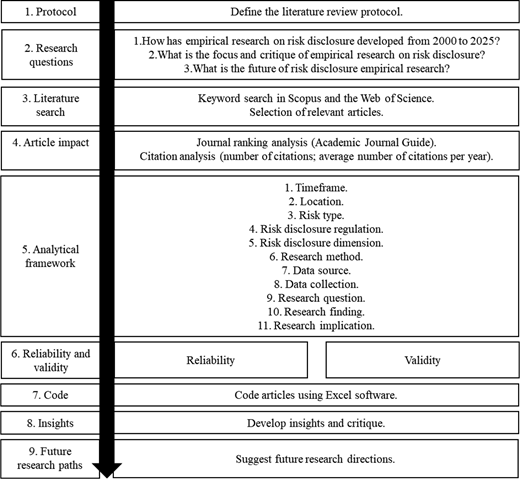
Published by Emerald Publishing Limited. This article is published under the Creative Commons Attribution (CC BY 4.0) licence. Anyone may reproduce, distribute, translate and create derivative works of this article (for both commercial and non-commercial purposes), subject to full attribution to the original publication and authors. The full terms of this licence maybe seen at Link to the terms of the CC BY 4.0 licenceLink to the terms of the CC BY 4.0 licence.

Supplementary data

Data & Figures

Figure 1.
A flowchart outlines the literature review process steps from protocol definition to future research paths, including research questions, analysis, reliability, coding, and insights.The structured flowchart presents nine steps of a literature review process. Step 1 defines the protocol. Step 2 lists research questions about development, focus, critique, and future of risk disclosure research from 2000 to 2025. Step 3 describes literature search using Scopus and Web of Science with article selection. Step 4 outlines article impact through journal ranking and citation analysis. Step 5 lists analytical framework elements, including timeframe, location, risk type, regulation, dimension, method, data source, data collection, research question, research finding, and research implication. Step 6 includes reliability and validity. Step 7 involves coding articles using Excel software. Step 8 develops insights and critique. Step 9 suggests future research directions.

Structured literature review process

Note(s): This figure illustrates the sequential steps of the structured literature review protocol, from defining the review scope to identifying research gaps and future research paths

Source: Authors’ own work

Figure 1.
A flowchart outlines the literature review process steps from protocol definition to future research paths, including research questions, analysis, reliability, coding, and insights.The structured flowchart presents nine steps of a literature review process. Step 1 defines the protocol. Step 2 lists research questions about development, focus, critique, and future of risk disclosure research from 2000 to 2025. Step 3 describes literature search using Scopus and Web of Science with article selection. Step 4 outlines article impact through journal ranking and citation analysis. Step 5 lists analytical framework elements, including timeframe, location, risk type, regulation, dimension, method, data source, data collection, research question, research finding, and research implication. Step 6 includes reliability and validity. Step 7 involves coding articles using Excel software. Step 8 develops insights and critique. Step 9 suggests future research directions.

Structured literature review process

Note(s): This figure illustrates the sequential steps of the structured literature review protocol, from defining the review scope to identifying research gaps and future research paths

Source: Authors’ own work

Close modal
Figure 2.
A bar chart of the number of studies by publication year from 2003 to 2025 shows an overall increasing trend with notable growth after 2018.The bar chart displays number of studies on the vertical axis and publication year from 2003 to 2025 on the horizontal axis. The number of studies remains low in early years with small increases and fluctuations until around 2011. From 2012 onwards, the values gradually increase with minor variations. After 2018, the number of studies rises more sharply. The highest value appears in 2025, indicating a continued upward trend over time.

Literature development over time

Note(s): This figure shows the annual distribution of the 209 empirical RD studies published between 2003 and 2025

Source: Authors’ own work

Figure 2.
A bar chart of the number of studies by publication year from 2003 to 2025 shows an overall increasing trend with notable growth after 2018.The bar chart displays number of studies on the vertical axis and publication year from 2003 to 2025 on the horizontal axis. The number of studies remains low in early years with small increases and fluctuations until around 2011. From 2012 onwards, the values gradually increase with minor variations. After 2018, the number of studies rises more sharply. The highest value appears in 2025, indicating a continued upward trend over time.

Literature development over time

Note(s): This figure shows the annual distribution of the 209 empirical RD studies published between 2003 and 2025

Source: Authors’ own work

Close modal
Figure 3.
A bar chart of the number of studies by country shows higher counts for the U S, U K, China, and multiple country studies compared to others.The bar chart displays number of studies on the vertical axis and countries in alphabetical order on the horizontal axis. Several countries have low counts with small variations. China and India show relatively higher counts among individual countries. A category labelled multiple has a high count. The United Kingdom shows a high value. The United States has the highest number of studies. Overall, the distribution varies across countries, with a few categories showing notably higher values.

Articles distribution by country

Note(s): This figure presents the geographical distribution of the 209 RD studies across 30 countries

Source: Authors’ own work

Figure 3.
A bar chart of the number of studies by country shows higher counts for the U S, U K, China, and multiple country studies compared to others.The bar chart displays number of studies on the vertical axis and countries in alphabetical order on the horizontal axis. Several countries have low counts with small variations. China and India show relatively higher counts among individual countries. A category labelled multiple has a high count. The United Kingdom shows a high value. The United States has the highest number of studies. Overall, the distribution varies across countries, with a few categories showing notably higher values.

Articles distribution by country

Note(s): This figure presents the geographical distribution of the 209 RD studies across 30 countries

Source: Authors’ own work

Close modal
Table 1.

Literature search process and number of articles identified

Query in ScopusQuery in Web of Science
TITLE-ABS-KEY(“risk discl*”) OR TITLE-ABS-KEY (“risk info*”) OR TITLE-ABS-KEY (“risk report*”) OR TITLE-ABS-KEY(“risk factor* discl*”) OR TITLE-ABS-KEY (“risk factor* report*”) OR TITLE-ABS-KEY (“risk factor* info*”) AND PUBYEAR > 1999 AND PUBYEAR < 2026 AND (LIMIT-TO (DOCTYPE, “ar”)) AND [LIMIT-TO (SUBJAREA, “BUSI”)] AND [LIMIT-TO (LANGUAGE, “English”)]TS = (“risk discl*” OR “risk infor*” OR “risk report*” OR “risk factor* discl*” OR “risk factor* report*” OR “risk factor* info*”) AND LA = (English) AND WC = (“Business” OR “Management”) AND DT = (“Article” OR “Early Access”)
Publication date: 2000-01-01 to 2025-09-30
1,004338
No. of articles after merging the queries’ output1,342
Less: Duplicated articles–211
No. of articles after the initial search1,131
Less: Studies that are not classified as articles–23
Less: Articles not accessible in full text–30
Less: Articles not written in the English language–3
No. of articles after preliminary screening1,075
Less: Commentary–1
Less: Literature, regulation and historical reviews–5
Less: Conceptual and modeling studies–13
Less: Articles out of scope despite mentioning the selected keywords in the searched fields–723
Less: Articles on financial firms as a sample–124
No. of articles reviewed in this study209
Note(s):

This table summarizes the multistep screening and selection process used to identify the 209 empirical RD articles included in the review

Source(s): Authors’ own work
Table 2.

Research impact by journal ranking

No.Journals ranked according to the AJG 2024Articles
No.%
1Accounting Review21.0
2Accounting, Organizations and Society10.5
3Management Science21.0
4Review of Financial Studies10.5
Journals ranked as 4*62.9
5British Journal of Management10.5
6Contemporary Accounting Research52.4
7Journal of Corporate Finance21.0
8Review of Accounting Studies31.4
Journals ranked as 4115.3
9Abacus10.5
10Accounting and Business Research10.5
11Accounting Forum10.5
12Accounting Horizons10.5
13Accounting, Auditing and Accountability Journal21.0
14British Accounting Review73.3
15Business Strategy and the Environment21.0
16Corporate Governance: An International Review10.5
17Decision Support Systems10.5
18European Accounting Review10.5
19Financial Management10.5
20International Journal of Accounting31.4
21International Journal of Finance and Economics31.4
22International Journal of Production Economics10.5
23International Journal of Production Research10.5
24International Review of Financial Analysis21.0
25Journal of Accounting and Public Policy31.4
26Journal of Accounting, Auditing and Finance21.0
27Journal of Business Ethics10.5
28Journal of Business Research31.4
29Journal of International Accounting, Auditing and Taxation10.5
30Review of Quantitative Finance and Accounting10.5
Journals ranked as 34019.1
31Accounting and Finance31.4
32Accounting in Europe10.5
33Accounting Research Journal21.0
34Advances in Accounting31.4
35Advances in Accounting Behavioral Research10.5
36Asian Review of Accounting21.0
37Asia-Pacific Journal of Accounting and Economics21.0
38Australian Accounting Review10.5
39Business Process Management Journal10.5
40Canadian Journal of Administrative Sciences10.5
41China Journal of Accounting Research10.5
42Corporate Governance (Bingley)31.4
43Current Issues in Tourism10.5
44Emerging Markets Finance and Trade31.4
45EuroMed Journal of Business10.5
46European Business Review10.5
47Finance Research Letters21.0
48International Journal of Accounting and Information Management41.9
49International Journal of Accounting Information Systems31.4
50International Journal of Accounting, Auditing and Performance Evaluation10.5
51International Journal of Auditing10.5
52International Journal of Disclosure and Governance41.9
53International Journal of Managerial and Financial Accounting21.0
54International Journal of Managerial Finance21.0
55Journal of Accounting in Emerging Economies41.9
56Journal of Applied Accounting Research73.3
57Journal of Competitiveness10.5
58Journal of Contemporary Accounting and Economics10.5
59Journal of International Accounting Research21.0
60Journal of International Financial Management and Accounting10.5
61Journal of Organizational Change Management10.5
62Journal of Risk10.5
63Management Decision10.5
64Managerial and Decision Economics10.5
65Managerial Auditing Journal94.3
66North American Journal of Economics and Finance10.5
67Public Money and Management10.5
68Quarterly Review of Economics and Finance10.5
69Research in International Business and Finance41.9
70Review of Accounting and Finance21.0
71Review of Social Economy10.5
72Sustainability Accounting, Management and Policy Journal21.0
73Technology Analysis and Strategic Management10.5
74Tourism Management Perspectives10.5
75Global Journal of Flexible Systems Management10.5
Journals ranked as 29043.1
76Asian Journal of Accounting Research10.5
77Competitiveness Review21.0
78Computational Economics10.5
79Corporate Social Responsibility and Environmental Management41.9
80Economies10.5
81Global Business and Economics Review10.5
82International Journal of Management Practice10.5
83International Journal of Productivity and Performance Management21.0
84Investment Management and Financial Innovations10.5
85Journal of Emerging Technologies in Accounting21.0
86Journal of Financial Regulation and Compliance10.5
87Journal of Financial Reporting and Accounting41.9
88Journal of Strategy and Management10.5
89Journal of the Knowledge Economy10.5
90Management and Labour Studies10.5
91Meditari Accountancy Research41.9
92Social Responsibility Journal10.5
93Sustainable Futures10.5
94World Review of Entrepreneurship, Management and Sustainable Development10.5
95Gender in Management: An International Journal10.5
Journals ranked as 13215.3
96Accounting10.5
97Administrative Sciences10.5
98Asian Journal of Business and Accounting10.5
99Borsa Istanbul Review10.5
100Business: Theory and Practice21.0
101Contaduria y Administracion31.4
102Corporate Board: Role, Duties and Composition10.5
103Corporate Communications10.5
104Corporate Governance and Organizational Behavior Review10.5
105Corporate Ownership and Control10.5
106Estudios Gerenciales10.5
107Indian Growth and Development Review10.5
108Indonesian Journal of Sustainability Accounting and Management10.5
109International Journal of Commerce and Management10.5
110International Journal of Financial Research10.5
111International Journal of Law and Management10.5
112International Journal of Risk Assessment and Management10.5
113Journal of Corporate Accounting and Finance10.5
114Journal of Governance and Regulation10.5
115Journal of Risk and Financial Management31.4
116Nankai Business Review International10.5
117Polish Journal of Management Studies10.5
118Risks31.4
Unranked journals3014.4
Total209100
Note(s):

This table reports the distribution of the 209 RD articles across journals, classified according to the AJG 2024 ranking, highlighting the spread of contributions from top-tier to unranked outlets

Source(s): Authors’ own work
Table 3.

Top ten articles by citation metrics

Panel A. Top ten articles by cumulative number of citations since publication date
Cumulative number of citations
RankNo.Authors (Year)Title
1st1,331Linsley and Shrives (2006) Risk reporting: a study of risk disclosures in the annual reports of UK companies
2nd1,132Beretta and Bozzolan (2004) A framework for the analysis of firm risk communication
3rd1,129Campbell et al. (2014) The information content of mandatory risk factor disclosures in corporate filing
4th959Abraham and Cox (2007) Analysing the determinants of narrative risk information in UK FTSE 100 annual reports
5th779Kravet and Muslu (2013) Textual risk disclosures and investors’ risk perceptions
6th748Amran et al. (2008) Risk reporting: an exploratory study on risk management disclosure in Malaysian annual reports
7th648Ilhan et al. (2023) Climate risk disclosure and institutional investors
8th612Ntim et al. (2013) Corporate governance and risk reporting in South Africa: a study of corporate risk disclosures in the pre- and post-2007/2008 global financial crisis periods
9th604Hope et al. (2016) The benefits of specific risk-factor disclosures
10th596Bao and Datta (2014) Simultaneously discovering and quantifying risk types from textual risk disclosures
Panel B. Top ten articles by number of citations per year
Citations per year
RankNo.Authors (Year)Title
1st324Ilhan et al. (2023) Climate risk disclosure and institutional investors
2nd103Campbell et al. (2014) The information content of mandatory risk factor disclosures in corporate filing
3rd70Linsley and Shrives (2006) Risk reporting: a study of risk disclosures in the annual reports of UK companies
4th67Hope et al. (2016) The benefits of specific risk-factor disclosures
5th65Kravet and Muslu (2013) Textual risk disclosures and investors’ risk perceptions
6th54Bao and Datta (2014) Simultaneously discovering and quantifying risk types from textual risk disclosures
7th54Beretta and Bozzolan (2004) A framework for the analysis of firm risk communication
8th53Abraham and Cox (2007) Analysing the determinants of narrative risk information in UK FTSE 100 annual reports
9th51Ntim et al. (2013) Corporate governance and risk reporting in South Africa: A study of corporate risk disclosures in the pre- and post-2007/2008 global financial crisis periods
10th45Elshandidy and Neri (2015) Corporate governance, risk disclosure practices and market liquidity: comparative evidence from the UK and Italy
Note(s):

This table presents the most influential RD articles, ranked by total citations (Panel A) and citations per year (Panel B), along with their authors (year) and title

Source(s): Authors’ own work
Table 4.

Analytical framework and results from the analysis

CriteriaNo.
Timeframe
2003 to 201115
2012 to 201960
2020 to 2025134
Total209
Location
By geography
Africa13
Asia-Pacific54
Europe57
Middle East19
The Americas50
Multiple9
Worldwide7
Total209
By economic development
Developed countries114
Developing countries81
Multiple14
Total209
Risk type
Business5
Financial17
ESG: Overall1
ESG: Environmental28
ESG: Social9
ESG: Governance3
IT11
Overall135
Total209
RD regulation
Mandatory28
Voluntary121
Both60
Total209
RD dimension
Volume97
Feature31
Multiple74
Multidimensional index7
Total209
Research method
Experimental7
Mixed3
Qualitative9
Quantitative190
Total209
Data source
Annual report171
Other32
Multiple6
Total209
Data collection
Manually106
Automated62
AI tools24
Multiple17
Total209
Research question
RD choices16
Determinants83
External25
Internal33
Multiple25
Consequences71
Capital markets54
Operating outcomes7
Accounting and auditing4
Others3
Multiple3
Multiple questions39
Total209
Research finding
Positive87
Negative20
Neutral13
Mixed73
Not relevant16
Total209
Research implication
Micro14
Meso8
Macro80
Multiple91
N/A16
Total209
Note(s):

This table outlines the analytical framework and shows how the 209 RD studies are distributed across key criteria, including timeframe, location (by geography and economic development), risk type, RD regulation, RD dimension, research method, data source, data collection, research question, research finding and research implication

Source(s): Authors’ own work
Table 5.

Distribution of articles by location and timeframe

LocationTimeframeTotal%
2000-20112012-20192020-2025
Finland03035
Germany01012
Greece00112
Italy133712
Portugal11135
Spain04159
UK44192747
Multiple0191018
Europe6173457100
Australia21147
China01181935
India03111426
Indonesia02359
Japan12036
Malaysia23059
Pakistan00224
Multiple02024
Asia-Pacific5143554100
Brazil01012
Canada11024
USA112334692
Multiple01012
The Americas2153350100
Egypt032526
Iran00115
Iraq00115
Jordan014526
Qatar01015
Saudi Arabia004421
UAE110211
Middle East161219100
Ghana01018
Kenya00118
Nigeria00118
South Africa014538
Tunisia013431
Multiple01018
Africa04913100
Multiple across different regions141116100
Total1560134209
%72964100
Note(s):

This table displays the geographical and temporal distribution of the 209 RD studies, distinguishing countries, regions and periods from 2000 to 2025. Legend of abbreviations in alphabetical order: UAE = United Arab Emirates; UK = United Kingdom; USA = United States of America

Source(s): Authors’ own work
Table 6.

Distribution of articles by risk type

Risk typeTimeframeTotal
2000-20112012-20192020-2025
Business0235
Financial321217
ESG: Overall0011
ESG: Environmental022628
ESG: Social0099
ESG: Governance0033
IT011011
Overall125370135
Total1560134209
Note(s):

This table reports how the 209 RD studies are allocated across overall and specific risk types (business, financial, ESG and IT) over the three timeframes

Source(s): Authors’ own work
Table 7.

Summary of key findings across the three research questions

Criteria1. How has empirical research on RD developed from 2000 to 2025?2. What is the focus and critique of the empirical research on RD?3. What is the future of RD empirical research?
TimeframeConsistent upward trend in the number of studies, with a notable peak in 2025Academic interest in RD amplified by high-impact risk events, macroeconomic uncertainty, evolving regulations and stakeholder demand for transparencyEnhanced risk awareness and strengthened regulations expected to drive increased attention to RD, especially environmental and IT RD
LocationSteady geographical expansion to cover 30 countriesSteady concentration in developed economies and a few dominant countries (the USA and the UK)Expand geographic scope, prioritizing neglected regions
Output leadership from Europe, Asia-Pacific and the Americas, while developing countries underrepresentedMany developed and developing countries underexploredFocus on comparative and cross-regional designs to capture contextual differences in RD practices
Rising number of cross-national studies, especially post-2020Scarce cross-regional comparative research, uncertain generalizability across different institutional contexts
Risk typeDominant focus on overall RD throughout the periodEarly research lacked granularity, with most studies addressing undifferentiated risk categoriesFurther deepen the analysis of specific risk categories (ESG- and IT-related risks) and explore their interdependencies in relation to policy and market forces, driven by strong practical significance
Extension of the scope of RD research from overall to specific risk typesGradual research diversification, yet still lacking a systematic investigation to date
Recent marked shift from financial RD toward nonfinancial RD, especially environmental RDRegional concentration of studies on specific risks – IT RD in the USA, lacking in developing countries
RD regulationMainly voluntary RD across timeframes, with a notable rise in mandatory RD since 2020Prevailing interest in firm-initiated voluntary RD, often overlooking regulatory contextsExpand comparative research across regulatory environments to address geographic gaps and strengthen the contextual validity of RD findings
Mandatory RD remains underexplored and regionally concentrated in developed countries
RD dimensionDominant research focus on RD volume over timeEvolving trend in RD research toward content-based analysis to provide more granular insights on RDDevelop integrated metrics and explore the interplay between volume and textual features
Gradual increase and differentiation of textual analyses of RD, with a focus on readability, time orientation and toneRD dimensions mainly treated as isolated, alternative metrics in cause-and-effect designsGreater emphasis on multidimensional and context-sensitive analysis to enhance explanatory power
Scarce multidimensional approaches, yet gaining momentum recentlyRare composite approach to RD measurement
Research methodDominant quantitative methods, growing steadily, especially in the USA, UK and cross-national studiesLimited diversification, with prevailing and increasingly analytical quantitative approachesOpt for methodological pluralism for a better understanding of RD practices
Recent rise of experimental designs, especially in the USA since 2020Qualitative and mixed-method contributions primarily focused on exploring RD textual featuresExpand experimental RD research geographically and cross-country replication for higher external validity
Qualitative and mixed-method approaches underrepresentedExperimental studies geographically concentrated and rarely replicated across regions
Data sourceAnnual reports as the primary data sourceLimited scope of RD exploration, with strong anchorage to the annual report and specific sections thereinExpand to include other disclosure channels (e.g. social media)
Modest diversification recently, with growing use of sustainability and governance reports and other sourcesAlternative sources underusedGreater use of multisource data for enhancing completeness, granularity and comparability of RD assessments
Gradually increasing use of multichannel dataRestricted depth of empirical insights, with few attempts to triangulate multiple sources
Data collectionPrevailing manual data collection, with a shift to automated software-based collection, or a combination of both, since 2012Although manual coding still prevailing in number, evolution to automated data collectionLeverage advanced AI tools for integration of multisource RD data and comparability
Recent employment of AI to explore textual featuresShift to AI technologies in connection with the shift from RD volume to text-feature-based analysis
Research questionEvolution from a focus on RD determinants to more differentiated focus including consequences and multiple research questionsRD determinants most researched topic, investigating both internal and external factorsDeepen the analysis of RD behavior and expand consequences categories beyond capital markets
Limited research on RD choices per se along the entire periodRD consequences main focus on capital market outcomes, yet increasing attention to operating outcomes recentlyIntegrative designs that connect choices, drivers and outcomes for enhancing knowledge and practical relevance
Research findingSignificant associations prevail, with positive findings increasing over timeEmphasis on positive effects of RD, especially on capital marketsDeepen conditional analysis and clarify mechanisms behind mixed or adverse outcomes
Decline in neutral findings over timeNegative and mixed findings reveal underexplored complexities tied to governance, managerial power or textual featuresExpand beyond firm-level effects to institutional and behavioral dynamics to enhance explanatory depth
Increased conditional analyses since 2020
Research implicationImplications expanded across micro, meso and macro levels, with the latter consistently dominantEmphasized macrolevel recommendations, often reiterating similar regulatory suggestionsBridge the gap between analytical depth and practical relevance, especially by translating advanced methods into stakeholder-oriented insights
Mesolevel peaking in 2020-2025, alongside growing microlevel relevanceGrowing meso- and micro-level implicationsDevelop more context-sensitive implications across all levels
Practical insights lag behind methodological innovation
Note(s):

This table synthesizes the main findings of the SLR by mapping each criterion to the three research questions on RD development, focus and critique and future research directions

Source(s): Authors’ own work

Supplements

Supplementary data

References

Abd-Elhaleim
,
A. H. M.
,
Elawadly
,
H. S. H.
,
Hikal
,
H. M. M.
and
Srour
,
A. A. E. I.
(
2025
), “
The moderating effect of corporate characteristics on the relationship between climate change risk disclosure and corporate value: evidence from Egypt
”,
Journal of Financial Reporting and Accounting.
Abdullah
,
M.
,
Abdul Shukor
,
Z.
,
Mohamed
,
Z.M.
and
Ahmad
,
A.
(
2015
), “
Risk management disclosure: a study on the effect of voluntary risk management disclosure toward firm value
”,
Journal of Applied Accounting Research
, Vol.
16
No.
3
, pp.
400
-
432
.
Abraham
,
S.
and
Cox
,
P.
(
2007
), “
Analysing the determinants of narrative risk information in UK FTSE 100 annual reports
”,
The British Accounting Review
, Vol.
39
No.
3
, pp.
227
-
248
.
Abraham
,
S.
and
Shrives
,
P.J.
(
2014
), “
Improving the relevance of risk factor disclosure in corporate annual reports
”,
The British Accounting Review
, Vol.
46
No.
1
, pp.
91
-
107
.
Abraham
,
S.
and
Slack
,
R.
(
2025
), “
Understanding fund manager readership of annual report risk disclosure
”,
Accounting Forum
, Vol.
49
No.
1
, pp.
156
-
180
.
Adam-Müller
,
A.F.
and
Erkens
,
M.H.
(
2020
), “
Risk disclosure noncompliance
”,
Journal of Accounting and Public Policy
, Vol.
39
No.
3
, p.
106739
.
Agyei-Mensah
,
B.K.
and
Buertey
,
S.
(
2019
), “
Do culture and governance structure influence extent of corporate risk disclosure?
”,
International Journal of Managerial Finance
, Vol.
15
No.
3
, pp.
315
-
334
.
Al-Dubai
,
S.A.A.
and
Alotaibi
,
K.O.
(
2023
), “
Examining the relationship between board characteristics and financial risk disclosure: a longitudinal analysis based on agency theory
”,
Corporate Governance and Organizational Behavior Review
, Vol.
7
No.
4
, pp.
137
-
151
.
Al-Refiay
,
H.A.N.
,
Barrak
,
J.I.
,
Isam Elaibi Al-Tameemi
,
A.
and
Pazhohi
,
M.
(
2025
), “
Tax Risk and Cost of Debt: The Role of Tax Avoidance–Evidence from the Iraqi Stock Market
”,
Risks
, Vol.
13
No.
2
, p.
29
.
Ali
,
M.M.
,
Bakar
,
R.A.
and
Ghani
,
E.K.
(
2018
), “
The effect of firm internal and external characteristics on risk reporting practices among Malaysian listed firms
”,
Indonesian Journal of Sustainability Accounting and Management
, Vol.
2
No.
2
, pp.
121
-
135
.
Allini
,
A.
,
Manes Rossi
,
F.
and
Hussainey
,
K.
(
2016
), “
The board’s role in risk disclosure: an exploratory study of Italian listed state-owned enterprises
”,
Public Money & Management
, Vol.
36
No.
2
, pp.
113
-
120
.
Alsadoun
,
A.A.
and
Albaz
,
M.M.
(
2025
), “
The impact of cybersecurity risk disclosure and governance on firm value and stock return volatility
”,
Journal of Governance and Regulation
, Vol.
14
No.
1
.
Alsahlawi
,
R.
,
Fifield
,
S.
and
Dunne
,
T.
(
2025
), “
Determinants of risk reporting practices in Saudi Arabia: an institutional perspective
”,
Journal of Accounting in Emerging Economies
, pp.
1
-
33
.
Alsheikh
,
A.H.
and
Alsheikh
,
W.H.
(
2023
), “
The level of climate risk reporting performance and firm characteristics: evidence from the Saudi Stock Exchange
”,
Investment Management & Financial Innovations
, Vol.
20
No.
4
, p.
360
.
Alshirah
,
M.
and
Alshira’h
,
A.
(
2024
), “
The impact of corporate ownership structure on corporate risk disclosure: evidence from an emerging economy
”,
Competitiveness Review: An International Business Journal
, Vol.
34
No.
2
, pp.
370
-
395
.
Alshirah
,
M.H.
,
Abdul Rahman
,
A.
and
Mustapa
,
I.R.
(
2019
), “
The role of foreign directors in corporate risk disclosure: empirical evidence from Jordan
”,
International Journal of Financial Research
, Vol.
10
No.
4
, p.
119
.
Alshirah
,
M.H.
,
Abdul Rahman
,
A.
and
Mustapa
,
I.R.
(
2020
), “
Board of directors’ characteristics and corporate risk disclosure: the moderating role of family ownership
”,
EuroMed Journal of Business
, Vol.
15
No.
2
, pp.
219
-
252
.
Alshirah
,
M.
,
Alshirah
,
A.
and
Lutfi
,
A.
(
2021
), “
Audit committee’s attributes, overlapping memberships on the audit committee and corporate risk disclosure: evidence from Jordan
”,
Accounting
, Vol.
7
No.
2
, pp.
423
-
440
.
Alshirah
,
M.H.
,
Alshira’h
,
A.F.
and
Lutfi
,
A.
(
2022
), “
Political connection, family ownership and corporate risk disclosure: empirical evidence from Jordan
”,
Meditari Accountancy Research
, Vol.
30
No.
5
, pp.
1241
-
1264
.
Amran
,
A.
,
Manaf Rosli Bin
,
A.
and
Che Haat Mohd Hassan
,
B.
(
2008
), “
Risk reporting: an exploratory study on risk management disclosure in Malaysian annual reports
”,
Managerial Auditing Journal
, Vol.
24
No.
1
, pp.
39
-
57
.
Amrin
,
A.
(
2019
), “
An empirical study: characteristics of business entities and corporate governance on risk disclosure practices
”,
Verslas: Teorija Ir Praktika
, Vol.
20
No.
1
, pp.
25
-
49
.
Appiagyei
,
K.
,
Boateng
,
C.A.
and
Onumah
,
J.M.
(
2016
), “
Risk disclosures in the annual reports of firms in Ghana
”,
International Journal of Management Practice
, Vol.
9
No.
2
, p.
142
.
Arena
,
C.
,
Bozzolan
,
S.
and
Imperatore
,
C.
(
2023
), “
The trade-off between mandatory and voluntary disclosure: evidence from oil companies’ risk reporting
”,
Journal of Accounting, Auditing & Finance
, Vol.
38
No.
4
, pp.
986
-
1008
.
Arora
,
N.
,
Saggar
,
R.
and
Singh
,
B.
(
2021
), “
Nexus between risk disclosure and corporate reputation: a longitudinal approach
”,
Journal of Strategy and Management
, Vol.
14
No.
4
, pp.
529
-
544
.
Au
,
S. Y.
and
Tan
,
H.
(
2025
), “
Too much of a good thing? Mandatory risk disclosure and corporate innovation
”,
Journal of Accounting and Public Policy
, Vol.
50
, p.
107292
.
Ayuningtyas
,
E.S.
and
Harymawan
,
I.
(
2022
), “
Risk management committee and textual risk disclosure
”,
Risks
, Vol.
10
No.
2
, p.
30
.
Bailey
,
C.
and
Filzen
,
J. J.
(
2025
), “
Reprint of: audit committee member busyness and risk factor disclosure
”,
The British Accounting Review
, Vol.
57
No.
1
, p.
101561
.
Bao
,
Y.
and
Datta
,
A.
(
2014
), “
Simultaneously discovering and quantifying risk types from textual risk disclosures
”,
Management Science
, Vol.
60
No.
6
, pp.
1371
-
1391
.
Ben-Amar
,
W.
,
Comyns
,
B.
and
Martinez
,
I.
(
2023
), “
The COVID-19 pandemic: opportunity or challenge for climate change risk disclosure?
”,
Accounting, Auditing & Accountability Journal
, Vol.
36
No.
2
, pp.
649
-
676
.
Beretta
,
S.
and
Bozzolan
,
S.
(
2004
), “
A framework for the analysis of firm risk communication
”,
The International Journal of Accounting
, Vol.
39
No.
3
, pp.
265
-
288
.
Bravo
,
F.
(
2017
), “
Are risk disclosures an effective tool to increase firm value?
”,
Managerial and Decision Economics
, Vol.
38
No.
8
, pp.
1116
-
1124
.
Bravo
,
F.
(
2018
), “
Does board diversity matter in the disclosure process? An analysis of the association between diversity and the disclosure of information on risks
”,
International Journal of Disclosure and Governance
, Vol.
15
No.
2
, pp.
104
-
114
.
Brown
,
S.V.
,
Tian
,
X.
and
Wu Tucker
,
J.
(
2018
), “
The spillover effect of SEC comment letters on qualitative corporate disclosure: evidence from the risk factor disclosure
”,
Contemporary Accounting Research
, Vol.
35
No.
2
, pp.
622
-
656
.
Bruwer
,
M.
,
Scholtz
,
S.E.
,
De Beer
,
L.T.
and
Rothmann
,
J.C.
(
2022
), “
The human capital risk reporting of listed South African companies: exploring a reporting framework to support corporate governance
”,
Administrative Sciences
, Vol.
12
No.
4
, p.
123
.
Bufarwa
,
I.M.
,
Elamer
,
A.A.
,
Ntim
,
C.G.
and
AlHares
,
A.
(
2020
), “
Gender diversity, corporate governance and financial risk disclosure in the UK
”,
International Journal of Law and Management
, Vol.
62
No.
6
, pp.
521
-
538
.
Burton
,
B.
,
Ahmad
,
M. I.
,
Battisti
,
E.
,
Naseem
,
M. A.
and
Liu
,
J.
(
2025
), “
Gender Diversity and Financial Risk Disclosure: investigating the Moderating Role of CEO Narcissism
”,
Corporate Social Responsibility and Environmental Management
, pp.
5088
-
5101
.
Calderon
,
T.G.
and
Gao
,
L.
(
2021
), “
Cybersecurity risks disclosure and implied audit risks: evidence from audit fees
”,
International Journal of Auditing
, Vol.
25
No.
1
, pp.
24
-
39
.
Calderon
,
T.G.
and
Gao
,
L.
(
2022
), “
Comparing the cybersecurity risk disclosures of US and foreign firms
”,
Journal of Emerging Technologies in Accounting
, Vol.
19
No.
2
, pp.
61
-
79
.
Campbell
,
J.L.
,
Chen
,
H.
,
Dhaliwal
,
D.S.
,
Lu
,
H.M.
and
Steele
,
L.B.
(
2014
), “
The information content of mandatory risk factor disclosures in corporate filings
”,
Review of Accounting Studies
, Vol.
19
, pp.
396
-
455
.
Carlon
,
S.
,
Loftus
,
J.A.
and
Miller
,
M.C.
(
2003
), “
The challenge of risk reporting: regulatory and corporate responses
”,
Australian Accounting Review
, Vol.
13
No.
31
, pp.
36
-
51
.
Cazier
,
R.A.
,
McMullin
,
J.L.
and
Treu
,
J.S.
(
2021
), “
Are lengthy and boilerplate risk factor disclosures inadequate? An examination of judicial and regulatory assessments of risk factor language
”,
The Accounting Review
, Vol.
96
No.
4
, pp.
131
-
155
.
Chiu
,
T.
,
Guan
,
Y.
and
Kim
,
J.
(
2018
), “
The effect of risk factor disclosures on the pricing of credit default swaps
”,
Contemporary Accounting Research
, Vol.
35
No.
4
, pp.
2191
-
2224
.
Chabot
,
M.
(
2025
), “
Textual and AI-based Analysis of Climate Disclosures: evidence from the European Energy Sector
”,
The British Accounting Review
, p.
101736
.
Chouaibi
,
J.
,
Benmansour
,
H.
,
Ben Fatma
,
H.
and
Zouari-Hadiji
,
R.
(
2024
), “
Does environmental, social, and governance performance affect financial risk disclosure? Evidence from European ESG companies
”,
Competitiveness Review: An International Business Journal
, Vol.
34
No.
6
, pp.
1057
-
1076
.
Cordazzo
,
M.
,
Papa
,
M.
and
Rossi
,
P.
(
2017
), “
The interaction between mandatory and voluntary risk disclosure: a comparative study
”,
Managerial Auditing Journal
, Vol.
32
No.
7
, pp.
682
-
714
.
Crovini
,
C.
,
Giunta
,
F.
,
Nielsen
,
C.
and
Simoni
,
L.
(
2024
), “
Market valuation of risk reporting: the role of business model disclosure
”,
Abacus
, Vol.
62
, pp.
1
-
49
.
Dai
,
L.
,
Landsman
,
W.R.
and
Peng
,
Z.
(
2024
), “
Private loan issuance and risk factor disclosure
”,
The Accounting Review
, Vol.
99
No.
4
, pp.
169
-
196
.
Dobler
,
M.
,
Lajili
,
K.
and
Zéghal
,
D.
(
2011
), “
Attributes of corporate risk disclosure: an international investigation in the manufacturing sector
”,
Journal of International Accounting Research
, Vol.
10
No.
2
, pp.
1
-
22
.
Dong
,
Y.
,
Sun
,
Z.
and
Zhou
,
Y.
(
2025
), “
Interactive power: individual investor climate activism and corporate climate risk disclosure
”,
Sustainability Accounting, Management and Policy Journal.
Dumrongwong
,
K.
and
Papangkorn
,
S.
(
2025
), “
Assessing firm-level climate risk disclosure and shareholder value in EU: insights from the Paris Agreement
”,
International Journal of Managerial Finance
, Vol.
21
No.
3
, pp.
792
-
810
.
Elgammal
,
M.M.
,
Hussainey
,
K.
and
Ahmed
,
F.
(
2018
), “
Corporate governance and voluntary risk and forward-looking disclosures
”,
Journal of Applied Accounting Research
, Vol.
19
No.
4
, pp.
592
-
607
.
Elmarzouky
,
M.
,
Hussainey
,
K.
,
Abdelfattah
,
T.
and
Karim
,
A.E.
(
2022
), “
Corporate risk disclosure and key audit matters: the egocentric theory
”,
International Journal of Accounting and Information Management
, Vol.
30
No.
2
, pp.
230
-
251
.
Elsayed
,
M.
and
Elshandidy
,
T.
(
2021
), “
Internal control effectiveness, textual risk disclosure, and their usefulness: US evidence
”,
Advances in Accounting
, Vol.
53
, p.
100531
.
Elsayed
,
N.
and
Hassanein
,
A.
(
2024
), “
Is voluntary risk disclosure informative? The role of UK firm-level governance
”,
International Journal of Productivity and Performance Management
, Vol.
73
No.
6
, pp.
1826
-
1855
.
Elshandidy
,
T.
and
Ahmed
,
Y.
(
2023
), “
Stock price informativeness of risk disclosure: does time orientation matter?
”,
The Quarterly Review of Economics and Finance
, Vol.
89
, pp.
149
-
162
.
Elshandidy
,
T.
and
Neri
,
L.
(
2015
), “
Corporate governance, risk disclosure practices, and market liquidity: comparative evidence from the UK and Italy
”,
Corporate Governance: An International Review
, Vol.
23
No.
4
, pp.
331
-
356
.
Elshandidy
,
T.
and
Shrives
,
P.J.
(
2016
), “
Environmental incentives for and usefulness of textual risk reporting: evidence from Germany
”,
The International Journal of Accounting
, Vol.
51
No.
4
, pp.
464
-
486
.
Elshandidy
,
T.
and
Zeng
,
C.
(
2022
), “
The value relevance of risk-related disclosure: does the tone of disclosure matter?
”,
Borsa Istanbul Review
, Vol.
22
No.
3
, pp.
498
-
514
.
Elshandidy
,
T.
,
Elmassri
,
M.
and
Elsayed
,
M.
(
2022
), “
Integrated reporting, textual risk disclosure and market value
”,
Corporate Governance: The International Journal of Business in Society
, Vol.
22
No.
1
, pp.
173
-
193
.
Elshandidy
,
T.
,
Fraser
,
I.
and
Hussainey
,
K.
(
2015
), “
What drives mandatory and voluntary risk reporting variations across Germany, UK and US?
”,
The British Accounting Review
, Vol.
47
No.
4
, pp.
376
-
394
.
Elshandidy
,
T.
,
Wieczorek-Kosmala
,
M.
and
Acheampong
,
A.
(
2025
), “
Risk preparedness strategies in European tourism firms: a textual analysis of risk disclosures with machine-learning
”,
Current Issues in Tourism
, pp.
1
-
22
.
Enslin
,
Z.
,
Du Toit
,
E.
and
Puane
,
M. F.
(
2025
), “
The readability and narrative tone of risk and risk management disclosures for South African listed companies
”,
Journal of Accounting in Emerging Economies
, Vol.
15
No.
1
, pp.
224
-
241
.
Epelbaum
,
N.
(
2025
), “
Investing in the crypto-asset environment: the effects of risk disclosures and the fear of missing out
”,
International Journal of Accounting & Information Management
, pp.
37
-
56
.
Eriandani
,
R.
,
Narsa
,
I.
and
Irwanto
,
A.
(
2019
), “
Environmental risk disclosure and cost of equity
”,
Polish Journal of Management Studies
, Vol.
19
No.
2
, pp.
124
-
131
.
Erin
,
O.
,
Okoh
,
J.I.
and
Okika
,
N.
(
2023
), “
Risk governance and risk disclosure quality: an empirical evidence
”,
Journal of Financial Reporting and Accounting
, Vol.
24
No.
1
, pp.
97
-
122
, doi: .
Firoz
,
M.
and
Dalal
,
S.
(
2023
), “
The effect of IFRS convergence on risk disclosure: an investigation into the Indian accounting system
”,
International Journal of Accounting & Information Management
, Vol.
31
No.
5
, pp.
864
-
886
.
Fortin
,
A.
and
Berthelot
,
S.
(
2012
), “
MD&A risk disclosures and nonprofessional investors’ perceptions and investment decisions
”,
Advances in Accounting Behavioral Research
, pp.
1
-
28
.
Fukukawa
,
H.
and
Kim
,
H.
(
2017
), “
Effects of audit partners on clients’ business risk disclosure
”,
Accounting and Business Research
, Vol.
47
No.
7
, pp.
780
-
809
.
Gao
,
L.
and
Calderon
,
T.G.
(
2023
), “
Climate change risk disclosures and audit fees: a text analytics assessment
”,
Journal of Emerging Technologies in Accounting
, Vol.
20
No.
2
, pp.
71
-
93
.
Gao
,
L.
,
Calderon
,
T.G.
and
Tang
,
F.
(
2020
), “
Public companies’ cybersecurity risk disclosures
”,
International Journal of Accounting Information Systems
, Vol.
38
, p.
100468
.
Ge
,
W.
,
Qi
,
Z.
,
Wu
,
Z.
and
Yu
,
L.
(
2025
), “
Abnormal temperatures, climate risk disclosures and bank loan pricing: international evidence
”,
British Journal of Management
, Vol.
36
No.
2
, pp.
726
-
744
.
Godewatta
,
N.
,
Phang
,
S. Y.
,
Prasad
,
A.
and
Xiao
,
X.
(
2024
), “
Investors’ reactions to cybersecurity incidents: the joint effects of disclosure tone, critical audit matters, and IT knowledge
”,
European Accounting Review
, pp.
1
-
26
.
Gonidakis
,
F.K.
,
Koutoupis
,
A.G.
,
Tsamis
,
A.D.
and
Agoraki
,
M.E.K.
(
2020
), “
Risk disclosure in listed Greek companies: the effects of the financial crisis
”,
Accounting Research Journal
, Vol.
33
Nos
4-5
, pp.
615
-
633
.
Gotti
,
G.
,
Liu
,
L.J.
,
Pérez
,
R.
and
Yin
,
X.
(
2024
), “
The impact of risk disclosure overlaps on auditor liability: evidence from China
”,
Journal of International Accounting Research
, Vol.
23
No.
1
, pp.
49
-
78
.
Greco
,
G.
(
2012
), “
The management’s reaction to new mandatory risk disclosure: a longitudinal study on Italian listed companies
”,
Corporate Communications: An International Journal
, Vol.
17
No.
2
, pp.
113
-
137
.
Gulko
,
N.
,
Hyde
,
C.
and
Seppala
,
N.
(
2017
), “
Disclosure of corporate risks and governance before, during and after the global financial crisis: case study in the UK construction industry in 2006–2009
”,
International Journal of Disclosure and Governance
, Vol.
14
, pp.
207
-
223
.
Gull
,
A.A.
,
Abid
,
A.
,
Hussainey
,
K.
,
Ahsan
,
T.
and
Haque
,
A.
(
2023
), “
Corporate governance reforms and risk disclosure quality: evidence from an emerging economy
”,
Journal of Accounting in Emerging Economies
, Vol.
13
No.
2
, pp.
331
-
354
.
Gull
,
A. A.
,
Atif
,
M.
and
Rind
,
A. A.
(
2025
), “
Do Women Directors Drive Firm's Climate Risk Disclosure? An International Evidence
”,
Business Strategy and the Environment
, pp.
57
-
83
.
Guo
,
W.
,
Mo
,
B.
,
Chen
,
Y.
and
Huang
,
Z.
(
2025
), “
Value-Enhancing Effect of Climate Change Risk Disclosure by Firms: empirical Evidence Based on Textual Analysis and Machine Learning
”,
Emerging Markets Finance and Trade
, Vol.
61
No.
2
, pp.
307
-
326
.
Guohong
,
Z.
,
Zhongwei
,
X.
,
Feng
,
H.
and
Zhongyi
,
X.
(
2025
), “
The audit committee’s IT expertise and its impact on the disclosure of cybersecurity risk
”,
Research in International Business and Finance
, Vol.
73
, p.
102542
.
Guthrie
,
J.
,
Manes
,
Rossi
,
F.
,
Orelli
,
R.L.
and
Nicolò
,
G.
(
2020
), “
Investigating risk disclosures in Italian integrated reports
”,
Meditari Accountancy Research
, Vol.
28
No.
6
, pp.
1149
-
1178
.
Haj-Salem
,
I.
,
Damak Ayadi
,
S.
and
Hussainey
,
K.
(
2020
), “
The joint effect of corporate risk disclosure and corporate governance on firm value
”,
International Journal of Disclosure and Governance
, Vol.
17
Nos
2-3
, pp.
123
-
140
.
Haj-Salem
,
I.
and
Hussainey
,
K.
(
2021a
), “
Does risk disclosure matter for trade credit?
”,
Journal of Risk and Financial Management
, Vol.
14
No.
3
, p.
133
.
Haj-Salem
,
I.
and
Hussainey
,
K.
(
2021b
), “
Risk disclosure and corporate cash holdings
”,
Journal of Risk and Financial Management
, Vol.
14
No.
7
, p.
328
.
Hao
,
Y.
and
Dong
,
B.
(
2022
), “
Determinants and consequences of risk disclosure: evidence from Chinese stock markets during the COVID-19 pandemic
”,
Emerging Markets Finance and Trade
, Vol.
58
No.
1
, pp.
35
-
55
.
Hassan
,
M.K.
(
2009
), “
UAE corporations‐specific characteristics and level of risk disclosure
”,
Managerial Auditing Journal
, Vol.
24
No.
7
, pp.
668
-
687
.
Hassanein
,
A.
(
2022
), “
Risk reporting and stock return in the UK: does market competition matter?
”,
The North American Journal of Economics and Finance
, Vol.
59
, p.
101574
.
Hassanein
,
A.
,
Abdelrasheed
,
H.
and
Elzahar
,
H.
(
2024
), “
Do overconfident CEOs add to corporate stock returns through their risk reporting practice?
”,
Journal of Financial Reporting and Accounting
, doi: .
Hassanein
,
A.
and
Elsayed
,
N.
(
2021
), “
Voluntary risk disclosure and values of FTSE350 firms: the role of an industry-based litigation risk
”,
International Journal of Managerial and Financial Accounting
, Vol.
13
No.
2
, pp.
110
-
132
.
He
,
X.
,
Wang
,
S.
,
Liu
,
H.
and
Liu
,
J.
(
2025
), “
Heterogeneous risk disclosure and earnings management motivation: evidence from China’s IPO market
”,
Nankai Business Review International
, Vol.
16
No.
1
, pp.
79
-
103
.
Hernández-Madrigal
,
M.
,
Guzmán
,
B.A.
and
Guzmán
,
C.A.
(
2015
), “
Determinants of corporate risk disclosure in large Spanish companies: a snapshot
”,
Contaduría y Administración
, Vol.
60
No.
4
, pp.
757
-
775
.
Hernández-Madrigal
,
M.
,
Blanco-Dopico
,
M.-I.
and
Aibar-Guzmán
,
B.
(
2012
), “
The influence of mandatory requirements on risk disclosure practices in Spain
”,
International Journal of Disclosure and Governance
, Vol.
9
No.
1
, pp.
78
-
99
.
Hope
,
O.K.
,
Hu
,
D.
and
Lu
,
H.
(
2016
), “
The benefits of specific risk-factor disclosures
”,
Review of Accounting Studies
, Vol.
21
, pp.
1005
-
1045
.
Hossain
,
A.T.
,
Masum
,
A.
,
Hasan
,
M.M.
,
Li
,
D.
and
Xu
,
J.
(
2024
), “
The disclosure perspective of firm‐specific political risk measure from conference calls
”,
Financial Management
, Vol.
53
No.
4
, pp.
749
-
793
.
Hu
,
F.
,
Wu
,
Y.
,
Liu
,
F.
and
Xu
,
X.
(
2025
), “
Climate risk disclosure and pricing efficiency: a textual analysis
”,
Emerging Markets Finance and Trade
, pp.
1
-
15
.
Ibrahim
,
A.E.A.
and
Aboud
,
A.
(
2024a
), “
Corporate risk disclosure and cost of capital: does measurement matter?
”,
International Journal of Finance & Economics
, Vol.
29
No.
4
, pp.
3967
-
3994
.
Ibrahim
,
A.E.A.
and
Aboud
,
A.
(
2024b
), “
Corporate risk disclosure and firm value: UK evidence
”,
International Journal of Finance & Economics
, Vol.
29
No.
4
, pp.
4225
-
4246
.
Ibrahim
,
A.E.A.
and
Hussainey
,
K.
(
2019
), “
Developing the narrative risk disclosure measurement
”,
International Review of Financial Analysis
, Vol.
64
, pp.
126
-
144
.
Ilhan
,
E.
,
Krueger
,
P.
,
Sautner
,
Z.
and
Starks
,
L.T.
(
2023
), “
Climate risk disclosure and institutional investors
”,
The Review of Financial Studies
, Vol.
36
No.
7
, pp.
2617
-
2650
.
Imerman
,
M. B.
,
Ye
,
X.
and
Zhao
,
R.
(
2025
), “
Voluntary disclosures and climate change uncertainty: evidence from CDS premiums
”,
Journal of Corporate Finance
, p.
102831
.
Jain
,
S.
and
Raithatha
,
M.
(
2022
), “
Risk disclosures and firm value: the role of governance in an emerging market
”,
International Journal of Productivity and Performance Management
, Vol.
71
No.
8
, pp.
3205
-
3227
.
Jain
,
S.
and
Raithatha
,
M.
(
2024
), “
Founder ownership concentration and risk disclosures: an emerging economy view
”,
Journal of Applied Accounting Research
, Vol.
25
No.
5
, pp.
1165
-
1182
.
Jia
,
J.
and
Li
,
Z.
(
2022
), “
Risk management committees and readability of risk management disclosure
”,
Journal of Contemporary Accounting & Economics
, Vol.
18
No.
3
, p.
100336
.
Jin
,
S.
,
Lee
,
H.W.
and
Xie
,
Y.A.
(
2024
), “
Risk disclosures in annual reports and firms’ default risk
”,
Journal of Corporate Accounting & Finance
, Vol.
35
No.
3
, pp.
192
-
212
.
Kamaruzaman
,
S.A.
,
Ali
,
M.M.
,
Ghani
,
E.K.
and
Gunardi
,
A.
(
2019
), “
Ownership structure, corporate risk disclosure and firm value: a Malaysian perspective
”,
International Journal of Managerial and Financial Accounting
, Vol.
11
No.
2
, p.
113
.
Kang
,
H.
and
Gray
,
S.J.
(
2019
), “
Country-specific risks and geographic disclosure aggregation: voluntary disclosure behaviour by British multinationals
”,
The British Accounting Review
, Vol.
51
No.
3
, pp.
259
-
276
.
Kapoor
,
N.
,
Singh
,
R.
and
Mishra
,
R.
(
2025
), “
Unveiling the nexus between board quality, firm innovation and climate risk disclosure: a study of Indian companies
”,
Indian Growth and Development Review
, Vol.
18
No.
1
, pp.
93
-
111
.
Khalil
,
A.
and
Maghraby
,
M.
(
2017
), “
The determinants of internet risk disclosure: empirical study of Egyptian listed companies
”,
Managerial Auditing Journal
, Vol.
32
No.
8
, pp.
746
-
767
.
Khandelwal
,
C.
,
Kumar
,
S.
,
Madhavan
,
V.
and
Pandey
,
N.
(
2020
), “
Do board characteristics impact corporate risk disclosures? The Indian experience
”,
Journal of Business Research
, Vol.
121
, pp.
103
-
111
.
Kim
,
H.
,
Harjoto
,
M. A.
and
Laksmana
,
I.
(
2025
), “
Does political risk disclosure signal CEO overconfidence, cost structure choice and firm performance?
”,
Review of Accounting and Finance.
Kim
,
H.
and
Yasuda
,
Y.
(
2018
), “
Business risk disclosure and firm risk: evidence from Japan
”,
Research in International Business and Finance
, Vol.
45
, pp.
413
-
426
.
Kohlbeck
,
M.
and
Luo
,
X.
(
2024
), “
The association of the qualitative informativeness of market risk disclosures with stock liquidity
”,
Journal of Accounting, Auditing & Finance
, Vol.
39
No.
4
, pp.
1173
-
1199
.
Konishi
,
N.
and
Ali
,
M.M.
(
2007
), “
Risk reporting of Japanese companies and its association with corporate characteristics
”,
International Journal of Accounting, Auditing and Performance Evaluation
, Vol.
4
No.
3
, p.
263
.
Kouloukoui
,
D.
,
Sant’Anna
,
Â.M.O.
,
Da Silva Gomes
,
S.M.
,
De Oliveira Marinho
,
M.M.
,
De Jong
,
P.
,
Kiperstok
,
A.
and
Torres
,
E.A.
(
2019
), “
Factors influencing the level of environmental disclosures in sustainability reports: case of climate risk disclosure by Brazilian companies
”,
Corporate Social Responsibility and Environmental Management
, Vol.
26
No.
4
, pp.
791
-
804
.
Kravet
,
T.
and
Muslu
,
V.
(
2013
), “
Textual risk disclosures and investors’ risk perceptions
”,
Review of Accounting Studies
, Vol.
18
No.
4
, pp.
1088
-
1122
.
Kroes
,
J. R.
,
Manikas
,
A. S.
,
Baig
,
A.
and
Land
,
A.
(
2025
), “
Supply chain risk disclosures in 10-K filings: implications for inventory slack and stock returns in unstable demand markets
”,
International Journal of Production Research
, pp.
1
-
19
.
Lajili
,
K.
,
Dobler
,
M.
,
Zéghal
,
D.
and
Bryan
,
M.J.
(
2021
), “
Risk reporting in financial crises: a tale of two countries
”,
International Journal of Accounting & Information Management
, Vol.
29
No.
2
, pp.
181
-
216
.
Lajili
,
K.
,
Li
,
T.M.
,
Chourou
,
L.
,
Dobler
,
M.
and
Zéghal
,
D.
(
2024
), “
Corporate risk disclosures in turbulent times: an international analysis in the global financial crisis
”,
Journal of International Financial Management & Accounting
, Vol.
35
No.
1
, pp.
261
-
289
.
Lajili
,
K.
and
Zéghal
,
D.
(
2005
), “
A content analysis of risk management disclosures in Canadian annual reports
”,
Canadian Journal of Administrative Sciences/Revue Canadienne des Sciences de l’Administration
, Vol.
22
No.
2
, pp.
125
-
142
.
Laksmana
,
I.
,
Harjoto
,
M.A.
and
Kim
,
H.
(
2023
), “
Managing disclosure of political risk: the case of socially responsible firms
”,
Journal of Business Research
, Vol.
154
, p.
113366
.
Lei
,
S.
,
Chen
,
Y.
and
Xia
,
D.
(
2025
), “
Does Climate Risk Disclosure Affect Stock Liquidity?
”,
Research in International Business and Finance
, p.
103130
.
Leopizzi
,
R.
,
Iazzi
,
A.
,
Venturelli
,
A.
and
Principale
,
S.
(
2020
), “
Nonfinancial risk disclosure: the ‘state of the art’ of Italian companies
”,
Corporate Social Responsibility and Environmental Management
, Vol.
27
No.
1
, pp.
358
-
368
.
Li
,
H.
,
No
,
W.G.
and
Wang
,
T.
(
2018
), “
SEC’s cybersecurity disclosure guidance and disclosed cybersecurity risk factors
”,
International Journal of Accounting Information Systems
, Vol.
30
, pp.
40
-
55
.
Li
,
X.
(
2024
), “
Entrepreneurs’ visibility, media attention and corporate climate risk disclosure–based on Chinese listed companies
”,
Journal of Organizational Change Management
, Vol.
37
No.
2
, pp.
283
-
303
.
Li
,
Y.
,
Goodell
,
J.W.
and
Shen
,
D.
(
2023
), “
Market reaction to climate risk report disclosures: the roles of investor attention and sentiment
”,
Finance Research Letters
, Vol.
58
, p.
104290
.
Li
,
Y.
,
He
,
J.
and
Chan
,
K.C.
(
2021
), “
Information transmission along supply chains: stock price reaction of suppliers upon a customer’s release of qualitative risk information
”,
International Journal of Production Economics
, Vol.
239
, p.
108189
.
Li
,
Y.
,
Wang
,
D.
,
Meng
,
D.
and
Hu
,
Y.
(
2024
), “
Peer effect on climate risk information disclosure
”,
China Journal of Accounting Research
, Vol.
17
No.
3
, p.
100375
.
Lim
,
C.Y.
and
Tan
,
P.M.-S.
(
2007
), “
Value relevance of value-at-risk disclosure
”,
Review of Quantitative Finance and Accounting
, Vol.
29
No.
4
, pp.
353
-
370
.
Linsley
,
P.M.
and
Lawrence
,
M.J.
(
2007
), “
Risk reporting by the largest UK companies: readability and lack of obfuscation
”,
Accounting, Auditing & Accountability Journal
, Vol.
20
No.
4
, pp.
620
-
627
.
Linsley
,
P.M.
and
Shrives
,
P.J.
(
2006
), “
Risk reporting: a study of risk disclosures in the annual reports of UK companies
”,
The British Accounting Review
, Vol.
38
No.
4
, pp.
387
-
404
.
Liu
,
A. Z.
,
Liu
,
A. X.
and
Zhao
,
K.
(
2025
), “
Disclosure of IT-related risk factors in corporate filings
”,
Decision Support Systems
, Vol.
190
, p.
114403
.
Lombardi
,
R.
,
Coluccia
,
D.
,
Russo
,
G.
and
Solimene
,
S.
(
2016
), “
Exploring financial risks from corporate disclosure: evidence from Italian listed companies
”,
Journal of the Knowledge Economy
, Vol.
7
, pp.
309
-
327
.
Ma
,
G.
,
Wang
,
Y.
,
Zhou
,
Y.
and
Su
,
X.
(
2025
), “
Does the annual reports risk information disclosure enhance corporate innovation? Evidence from China
”,
Technology Analysis & Strategic Management
, pp.
1
-
18
.
Maingot
,
M.
,
Quon
,
T.
and
Zéghal
,
D.
(
2012
), “
The effect of the financial crisis on enterprise risk management disclosures
”,
International Journal of Risk Assessment and Management
, Vol.
16
No.
4
, pp.
227
-
247
.
Maingot
,
M.
,
Quon
,
T.
and
Zéghal
,
D.
(
2014
), “
The effect of the financial crisis on risk disclosures: a comparative study of US and Canadian corporations
”,
Corporate Ownership and Control
, Vol.
11
No.
4
, p.
322
-
328
.
Martikainen
,
M.
,
Kinnunen
,
J.
,
Miihkinen
,
A.
and
Troberg
,
P.
(
2015
), “
Board’s financial incentives, competence, and firm risk disclosure: evidence from Finnish index listed companies
”,
Journal of Applied Accounting Research
, Vol.
16
No.
3
, pp.
333
-
358
.
Marzouk
,
M.
(
2016
), “
Risk reporting during a crisis: evidence from the Egyptian capital market
”,
Journal of Applied Accounting Research
, Vol.
17
No.
4
, pp.
378
-
396
.
Mbithi
,
E.
,
Moloi
,
T.
and
Wangombe
,
D.
(
2023
), “
An empirical examination of board-related and firm-specific drivers on risk disclosure by listed firms in Kenya: a mixed-methods approach
”,
Corporate Governance: The International Journal of Business in Society
, Vol.
23
No.
2
, pp.
298
-
322
.
Mcchlery
,
S.
and
Hussainey
,
K.
(
2021
), “
Risk disclosure behaviour: evidence from the UK extractive industry
”,
Journal of Applied Accounting Research
, Vol.
22
No.
3
, pp.
484
-
506
.
Mesa-Pérez
,
E.
,
Mateo-Márquez
,
A. J.
,
Carrión
,
E.
and
Antonini
,
C.
(
2025
), “
Corporate water risk reporting: the case of the CDP Water Security Questionnaire
”,
Sustainability Accounting, Management and Policy Journal.
Miihkinen
,
A.
(
2012
), “
What drives quality of firm risk disclosure?: The impact of a national disclosure standard and reporting incentives under IFRS
”,
The International Journal of Accounting
, Vol.
47
No.
4
, pp.
437
-
468
.
Miihkinen
,
A.
(
2013
), “
The usefulness of firm risk disclosures under different firm riskiness, investor-interest, and market conditions: new evidence from Finland
”,
Advances in Accounting
, Vol.
29
No.
2
, pp.
312
-
331
.
Mokhtar
,
E.S.
and
Mellett
,
H.
(
2013
), “
Competition, corporate governance, ownership structure and risk reporting
”,
Managerial Auditing Journal
, Vol.
28
No.
9
, pp.
838
-
865
.
Monjed
,
H.
and
Ibrahim
,
S.
(
2020
), “
Risk disclosure, income smoothing and firm risk
”,
Journal of Applied Accounting Research
, Vol.
21
No.
3
, pp.
517
-
533
.
Monjed
,
H.
,
Ibrahim
,
S.
and
Jørgensen
,
B.N.
(
2022
), “
Risk reporting and earnings smoothing: signaling or managerial opportunism?
”,
Review of Accounting and Finance
, Vol.
21
No.
5
, pp.
377
-
397
.
Moumen
,
N.
,
Othman
,
H.B.
and
Hussainey
,
K.
(
2015
), “
The value relevance of risk disclosure in annual reports: evidence from MENA emerging markets
”,
Research in International Business and Finance
, Vol.
34
, pp.
177
-
204
.
Moumen
,
N.
,
Othman
,
H.B.
and
Hussainey
,
K.
(
2016
), “
Board structure and the informativeness of risk disclosure: evidence from MENA emerging markets
”,
Advances in Accounting
, Vol.
35
, pp.
82
-
97
.
Moussa
,
A.S.
and
Elmarzouky
,
M.
(
2024
), “
Clarity in crisis: how UK firms communicated risks during COVID-19
”,
Journal of Risk and Financial Management
, Vol.
17
No.
10
, p.
449
.
Nagel
,
D.Y.
,
Fuhrmann
,
S.
,
Tietmeyer
,
R.
and
Guenther
,
T.W.
(
2022
), “
The perception of risk disclosure characteristics on the credit default swap market-an automated analysis
”,
Accounting Horizons
, Vol.
36
No.
4
, pp.
157
-
187
.
Ntim
,
C.G.
,
Lindop
,
S.
and
Thomas
,
D.A.
(
2013
), “
Corporate governance and risk reporting in South Africa: a study of corporate risk disclosures in the pre-and post-2007/2008 global financial crisis periods
”,
International Review of Financial Analysis
, Vol.
30
, pp.
363
-
383
.
Ojeyinka
,
T.A.
and
Matemane
,
R.
(
2025
).
Do Risk Committee Attributes Enhance Climate Risk Disclosure? Evidence From the Listed Mining Firms in South Africa
.
Corporate Social Responsibility and Environmental Management
, doi: .
Oliveira
,
J.
,
Lima Rodrigues
,
L.
and
Craig
,
R.
(
2011
), “
Risk‐related disclosures by non‐finance companies: Portuguese practices and disclosure characteristics
”,
Managerial Auditing Journal
, Vol.
26
No.
9
, pp.
817
-
839
.
Oliveira
,
J.
,
Serrasqueiro
,
R.
and
Mota
,
S.N.
(
2018
), “
Determinants of risk reporting by Portuguese and Spanish non-finance companies
”,
European Business Review
, Vol.
30
No.
3
, pp.
311
-
339
.
Oliveira
,
M.G.D.
,
Azevedo
,
G.
and
Oliveira
,
J.
(
2021
), “
The relationship between the company’s value and the tone of the risk-related narratives: the case of Portugal
”,
Economies
, Vol.
9
No.
2
, p.
70
.
Othman
,
R.
and
Ameer
,
R.
(
2009
), “
Market risk disclosure: evidence from Malaysian listed firms
”,
Journal of Financial Regulation and Compliance
, Vol.
17
No.
1
, pp.
57
-
69
.
Ott
,
C.
(
2020
), “
The risks of mergers and acquisitions-Analyzing the incentives for risk reporting in Item 1A of 10-K filings
”,
Journal of Business Research
, Vol.
106
, pp.
158
-
181
.
Penela
,
D.
and
Palma
,
M.
(
2023
), “
Risk factor disclosures in the US airline industry following the COVID-19 pandemic
”,
Risks
, Vol.
11
No.
2
, p.
34
.
Penela
,
D.
and
Serrasqueiro
,
R.M.
(
2019
), “
Identification of risk factors in the hospitality industry: evidence from risk factor disclosure
”,
Tourism Management Perspectives
, Vol.
32
, p.
100578
.
Phang
,
S. Y.
,
Dharmasiri
,
P.
and
Puspitasari
,
D.
(
2025
), “
Investor reactions to climate change disclosures: joint effects of disclosure focus and controllability
”,
Contemporary Accounting Research.
Probohudono
,
A. N.
,
Tower
,
G.
and
Rusmin
,
R.
(
2013a
), “
A risky tale of two countries
”,
Asian Review of Accounting
, Vol.
21
No.
3
, pp.
257
-
272
.
Probohudono
,
A. N.
,
Tower
,
G.
and
Rusmin
,
R.
(
2013b
), “
Risk disclosure during the global financial crisis
”,
Social Responsibility Journal
, Vol.
9
No.
1
, pp.
124
-
137
.
Raimo
,
N.
,
Nicolò
,
G.
,
Tartaglia Polcini
,
P.
and
Vitolla
,
F.
(
2022
), “
Corporate governance and risk disclosure: evidence from integrated reporting adopters
”,
Corporate Governance: The International Journal of Business in Society
, Vol.
22
No.
7
, pp.
1462
-
1490
.
Rajab
,
B.
and
Schachler
,
M.H.
(
2009
), “
Corporate risk disclosure by UK firms: trends and determinants
”,
World Review of Entrepreneurship, Management and Sustainable Development
, Vol.
5
No.
3
, p.
224
.
Ricca
,
B.
,
Loprevite
,
S.
,
Raucci
,
D.
and
Veltri
,
S.
(
2025
), “
Does consistent management of accounting and non-accounting information on environmental risks improve the relevance of environmental performance for investors?
”,
Business Process Management Journal
, Vol.
31
No.
8
, pp.
176
-
198
.
Romero
,
J. A.
and
Azmi Shabestari
,
M.
(
2025
), “
Risk disclosure tones and their effect on competition
”,
Management Decision.
Safarzadeh
,
M.H.
and
Derakhshan
,
M.
(
2025
), “
Risk disclosure quality assessment using hidden markov chain analysis of firms' risk state
”,
Computational Economics
, pp.
1
-
44
.
Saggar
,
R.
,
Arora
,
N.
and
Singh
,
B.
(
2022
), “
Gender diversity in corporate boardrooms and risk disclosure: Indian evidence
”,
Gender in Management: An International Journal
, Vol.
37
No.
2
, pp.
182
-
201
.
Saggar
,
R.
,
Arora
,
N.
and
Singh
,
B.
(
2023
), “
Financial performance and corporate risk disclosure: the moderating impact of board structure
”,
Global Business and Economics Review
, Vol.
28
No.
1
, p.
39
.
Saggar
,
R.
and
Singh
,
B.
(
2017
), “
Corporate governance and risk reporting: Indian evidence
”,
Managerial Auditing Journal
, Vol.
32
Nos
4-5
, pp.
378
-
405
.
Saggar
,
R.
and
Singh
,
B.
(
2019
), “
Drivers of corporate risk disclosure in Indian non-financial companies: a longitudinal approach
”,
Management and Labour Studies
, Vol.
44
No.
3
, pp.
303
-
325
.
Saleh
,
M. A. A.
and
Wu
,
D.
(
2024
), “
Corporate COVID-19 disclosure and stock price volatility: evidence from Egypt
”,
Journal of Financial Reporting and Accounting.
Salem
,
I.H.
,
Ayadi
,
S.D.
and
Hussainey
,
K.
(
2019
), “
Corporate governance and risk disclosure quality: Tunisian evidence
”,
Journal of Accounting in Emerging Economies
, Vol.
9
No.
4
, pp.
567
-
602
.
San
,
Z.
,
Wang
,
S.
,
Wu
,
Q.
and
Chen
,
X.
(
2025
), “
Peer MD&A risk information disclosure and corporate audit demand
”,
Managerial Auditing Journal.
Seebeck
,
A.
and
Vetter
,
J.
(
2022
), “
Not just a gender numbers game: how board gender diversity affects corporate risk disclosure
”,
Journal of Business Ethics
, Vol.
177
No.
2
, pp.
395
-
420
.
Semper
,
D.C.
and
Beltrán
,
J.M.T.
(
2014
), “
Risk disclosure and cost of equity: the Spanish case
”,
Contaduría y Administración
, Vol.
59
No.
4
, pp.
105
-
135
.
Serrasqueiro
,
R.M.
and
Mineiro
,
T.S.
(
2018
), “
Corporate risk reporting: analysis of risk disclosures in the interim reports of public Portuguese non-financial companies
”,
Contaduría y Administración
, Vol.
63
No.
SPE2
, pp.
991
-
1013
.
Serrasqueiro
,
R.
and
Oliveira
,
J.
(
2022
), “
Risk reporting: do country-level institutional forces really matter?
”,
Asian Review of Accounting
, Vol.
30
No.
2
, pp.
258
-
293
.
Shivaani
,
M.V.
(
2018
), “
Does regulatory flexibility affect risk disclosures in annual reports?
”,
Global Journal of Flexible Systems Management
, Vol.
19
No.
4
, pp.
321
-
336
.
Shivaani
,
M.V.
,
Jain
,
P.K.
and
Yadav
,
S.S.
(
2020
), “
Development of a risk disclosure index and its application in an Indian context
”,
Managerial Auditing Journal
, Vol.
35
No.
1
, pp.
1
-
23
.
Singh
,
H.
(
2025a
), “
Is corporate reputation associated with voluntary cybersecurity risk reporting?
”,
Meditari Accountancy Research
, Vol.
33
No.
1
, pp.
198
-
219
.
Singh
,
H.
(
2025b
), “
Voluntary cybersecurity risk disclosures and firms’ characteristics: the moderating role of the knowledge-intensive industry
”,
Asian Journal of Accounting Research
, Vol.
10
No.
2
, pp.
168
-
185
.
Sulistyawati
,
S.N.
and
Suryani
,
A.W.
(
2022
), “
Achieving operational efficiency through risk disclosure
”,
Asian Journal of Business and Accounting
, Vol.
15
No.
1
.
Sun
,
S.
and
Xiao
,
X.
(
2024
), “
Delegation of management authority and the level of corporate risk disclosure
”,
Finance Research Letters
, Vol.
63
, p.
105284
.
Svetlova
,
E.
(
2023
), “
Corporate risk reporting about Brexit as political communication
”,
Review of Social Economy
, Vol.
81
No.
3
, pp.
417
-
441
.
Tan
,
H.T.
and
Yeo
,
F.
(
2023
), “
You have been forewarned! The effects of risk management disclosures and disclosure tone on investors’ judgments
”,
Accounting, Organizations and Society
, Vol.
105
, p.
101400
.
Tan
,
Y.
,
Zeng
,
C.C.
and
Elshandidy
,
T.
(
2017
), “
Risk disclosures, international orientation, and share price informativeness: evidence from China
”,
Journal of International Accounting, Auditing and Taxation
, Vol.
29
, pp.
81
-
102
.
Taylor
,
G.
,
Tower
,
G.
and
Neilson
,
J.
(
2010
), “
Corporate communication of financial risk
”,
Accounting & Finance
, Vol.
50
No.
2
, pp.
417
-
446
.
Tilmann
,
L.
and
Walther
,
M.
(
2023
), “
The informativeness of risk factor disclosures: estimating the covariance matrix of stock returns using similarity measures
”,
Journal of Risk
, Vol.
25
No.
6
.
Tirado-Beltrán
,
J.M.
and
Cabedo-Semper
,
J.D.
(
2020
), “
Risk information disclosure and its impact on analyst forecast accuracy
”,
Estudios Gerenciales
, Vol.
36
No.
156
, pp.
314
-
324
.
Toerien
,
F.E.
and
du Toit
,
E.
(
2024
), “
Fighting through the Flesch and Fog: the readability of risk disclosures
”,
Accounting Research Journal
, Vol.
37
No.
1
, pp.
39
-
56
.
Trisnawati
,
R.
,
Mustikawati
,
S.
and
Sasongko
,
N.
(
2023
), “
Enterprise risk management disclosure and CEO characteristics: an empirical study of go public companies in Indonesia
”,
Business: Theory and Practice
, Vol.
24
No.
2
, pp.
379
-
391
.
Vasilescu
,
C.
and
Weir
,
K.H.
(
2023
), “
Brexit disclosure–companies’ honest or bogus perceptions of risk?
”,
Journal of Accounting and Public Policy
, Vol.
42
No.
3
, p.
107034
.
Veltri
,
S.
,
De Luca
,
F.
and
Phan
,
H.T.P.
(
2020
), “
Do investors value companies’ mandatory nonfinancial risk disclosure? An empirical analysis of the Italian context after the EU directive
”,
Business Strategy and the Environment
, Vol.
29
No.
6
, pp.
2226
-
2237
.
Vychytilova
,
J.
,
Nadirov
,
O.
,
Pavelkova
,
D.
and
Mikeska
,
M.
(
2020
), “
Risk reporting practices of listed companies: cross-country empirical evidence from the auto industry
”,
Journal of Competitiveness
, Vol.
12
No.
4
, pp.
161
-
179
.
Wahid ElKelish
,
W.
and
Kamal Hassan
,
M.
(
2014
), “
Organizational culture and corporate risk disclosure: an empirical investigation for United Arab Emirates listed companies
”,
International Journal of Commerce and Management
, Vol.
24
No.
4
, pp.
279
-
299
.
Wang
,
K.
(
2021
), “
Is the tone of risk disclosures in MD&As relevant to debt markets? Evidence from the pricing of credit default swaps
”,
Contemporary Accounting Research
, Vol.
38
No.
2
, pp.
1465
-
1501
.
Wang
,
S.
,
Wang
,
X.
and
Xu
,
L.
(
2023
), “
Debt maturity structure and the quality of risk disclosures
”,
Journal of Corporate Finance
, Vol.
83
, p.
102503
.
Weber
,
V.
and
Müßig
,
A.
(
2022
), “
The effect of business strategy on risk disclosure
”,
Accounting in Europe
, Vol.
19
No.
1
, pp.
190
-
225
.
Yan
,
Y.
,
Gong
,
C.
and
Zhang
,
H.
(
2025
), “
Corporate ESG Performance, Digital Transformation and Climate Risk Disclosure
”,
Sustainable Futures
, p.
100661
.
Yen
,
J.C.
,
Li
,
S.H.
and
Chen
,
K.T.
(
2016
), “
Product market competition and firms’ narrative disclosures: evidence from risk factor disclosures
”,
Asia-Pacific Journal of Accounting & Economics
, Vol.
23
No.
1
, pp.
43
-
74
.
Yeo
,
F.
(
2021
), “
Is framing more effective than regulating disclosures? The effects of risk disclosure frame and regime on managers’ disclosure choices
”,
Contemporary Accounting Research
, Vol.
38
No.
4
, pp.
2851
-
2870
.
Yoo
,
G. S.
and
Tan
,
H. T.
(
2025
), “
How causal focus and specificity in risk factor disclosures jointly affect investor judgments
”,
Management Science.
Zaman
,
R.
,
Fatima
,
U.
,
Farooq
,
M. B.
and
Kazemian
,
S.
(
2025
), “
Co-opted directors and corporate climate risk disclosure
”,
Meditari Accountancy Research
, Vol.
33
No.
7
, pp.
118
-
156
.
Zhang
,
L.
,
Fan
,
H.
,
Zhang
,
J.
,
Shan
,
Y. G.
and
Tang
,
Q.
(
2025
), “
Climate Risk and Stock Price Crash: the Role of Text‐Based Carbon Disclosure
”,
Accounting & Finance.
Zhang
,
X.
,
Taylor
,
D.
,
Qu
,
W.
and
Wise
,
V.
(
2013
), “
Institutional ownership, audit committee and risk disclosure–Evidence from Australian stock market
”,
Corporate Board: Role, Duties & Composition
, Vol.
9
No.
3
, pp.
66
-
81
.
Zhao
,
F.
,
Geng
,
S.
and
Xiao
,
H.
(
2025
), “
Corporate Climate Risk Disclosure and Institutional Investor Holdings
”,
International Journal of Finance & Economics.
Zhao
,
M.
,
Ke
,
Y.
and
Yi
,
Y.
(
2022
), “
The effects of risk factor disclosure on analysts’ earnings forecasts: evidence from Chinese IPOs
”,
Asia-Pacific Journal of Accounting & Economics
, Vol.
29
No.
4
, pp.
866
-
895
.
Zhu
,
J.
,
Hu
,
X.
,
Gao
,
J.
and
Tan
,
H.
(
2024
), “
Internal control risk disclosure, media coverage and stock price crash risk: evidence from China
”,
International Journal of Accounting Information Systems
, Vol.
55
, p.
100710
.
Zhu
,
X.
,
Wu
,
H.
,
Chang
,
Y.
and
Li
,
J.
(
2025
), “
Accounting fraud detection through textual risk disclosures in annual reports: from the perspective of SEC guidelines
”,
Accounting & Finance.
Ali
,
W.
,
Wilson
,
J.
and
Husnain
,
M.
(
2022
), “
Micro-, meso- and macro-level determinants of stock price crash risk: a systematic survey of literature
”,
Managerial Finance
, Vol.
48
No.
5
, pp.
784
-
804
.
Awuah
,
B.
,
Yazdifar
,
H.
and
Elbardan
,
H.
(
2024
), “
Corporate reporting on the Sustainable Development Goals: a structured literature review and research agenda
”,
Journal of Accounting & Organizational Change
, Vol.
20
No.
4
, pp.
617
-
646
.
Beattie
,
V.
,
McInnes
,
B.
and
Fearnley
,
S.
(
2004
), “
A methodology for analysing and evaluating narratives in annual reports: a comprehensive descriptive profile and metrics for disclosure quality attributes
”,
Accounting Forum
, Vol.
28
No.
3
, pp.
205
-
236
.
Bouteska
,
A.
,
Sharif
,
T.
and
Oueslati Ghouli
,
J.
(
2025
), “
Refining the literature on risk disclosure
”,
Management Research Review
, Vol.
48
No.
8
, pp.
1272
-
1289
.
Chartered Association of Business Schools (CABS)
. (
2024
), “
Academic journal guide 2024
”, available at: Link to the cited article.
D’Arcy
,
A.
and
Tarca
,
A.
(
2018
), “
Reviewing IFRS goodwill accounting research: implementation effects and cross-country differences
”,
The International Journal of Accounting
, Vol.
53
No.
3
, pp.
203
-
226
.
Dumay
,
J.
,
Bernardi
,
C.
,
Guthrie
,
J.
and
Demartini
,
P.
(
2016
), “
Integrated reporting: a structured literature review
”,
Accounting Forum
, Vol.
40
No.
3
, pp.
166
-
185
.
Elshandidy
,
T.
,
Shrives
,
P.J.
,
Bamber
,
M.
and
Abraham
,
S.
(
2018
), “
Risk reporting: a review of the literature and implications for future research
”,
Journal of Accounting Literature
, Vol.
40
No.
1
, pp.
54
-
82
.
European Parliament and the Council of the European Union
(
2014
),
“Directive 2014/95/EU of 22 October 2014 amending Directive 2013/34/EU as regards disclosure of non-financial and diversity information by certain large undertakings and groups”
, available at: Link to “Directive 2014/95/EU of 22 October 2014 amending Directive 2013/34/EU as regards disclosure of non-financial and diversity information by certain large undertakings and groups”Link to the cited article.
European Parliament and the Council of the European Union
(
2016
),
“Directive (EU) 2016/1148 of 6 July 2016 concerning measures for a high common level of security of network and information systems across the Union”
, available at: Link to “Directive (EU) 2016/1148 of 6 July 2016 concerning measures for a high common level of security of network and information systems across the Union”Link to the cited article.
European Parliament and the Council of the European Union
. (
2022a
), “
Directive 2022/2464/EU of 14 December 2022 amending Regulation (EU) No. 537/2014 and Directives 2004/109/EC, 2006/43/EC and 2013/34/EU as regards corporate sustainability reporting
”, available at: Link to the cited article.
European Parliament and the Council of the European Union
. (
2022b
), “
Directive (EU) 2022/2555 of 14 December 2022 on measures for a high common level of cybersecurity across the Union (NIS2 Directive)
”, available at: Link to the cited article.
Florio
,
C.
(
2024
), “
A structured literature review of empirical research on mandatory auditor rotation
”,
Journal of International Accounting, Auditing and Taxation
, p.
100623
.
Ibrahim
,
A.E.A.
,
Hussainey
,
K.
,
Nawaz
,
T.
,
Ntim
,
C.
and
Elamer
,
A.
(
2022
), “
A systematic literature review on risk disclosure research: state-of-the-art and future research agenda
”,
International Review of Financial Analysis
, Vol.
82
, p.
102217
.
IFRS Foundation.
(
2023a
).
IFRS S1 General Requirements for Disclosure of Sustainability-related Financial Information
.
International Sustainability Standards Board
, available at: Link to IFRS S1 General Requirements for Disclosure of Sustainability-related Financial InformationLink to the cited article.
IFRS Foundation
. (
2023b
),
IFRS S2 Climate-related Disclosures
,
International Sustainability Standards Board
, available at: Link to the cited article.
International Monetary Fund (IMF)
(
2024
),
World Economic Outlook: Policy Pivot, Rising Threats
,
International Monetary Fund
,
Washington, DC
.
Khlif
,
H.
and
Hussainey
,
K.
(
2016
), “
The association between risk disclosure and firm characteristics: a meta-analysis
”,
Journal of Risk Research
, Vol.
19
No.
2
, pp.
181
-
211
.
Khandelwal
,
C.
,
Kumar
,
S.
,
Verma
,
D.
and
Pratap Singh
,
H.
(
2019
), “
Financial risk reporting practices: systematic literature review and research agenda
”,
The Bottom Line
, Vol.
32
No.
3
, pp.
185
-
210
.
Leventis
,
S.
,
Kang
,
H.
and
Watson
,
L.
(
2024
), “
Literature reviews exploring international aspects of accounting, auditing, and taxation
”,
Journal of International Accounting, Auditing and Taxation
, Vol.
56
No.
C
.
Massaro
,
M.
,
Dumay
,
J.
and
Guthrie
,
J.
(
2016
), “
On the shoulders of giants: undertaking a structured literature review in accounting
”,
Accounting, Auditing & Accountability Journal
, Vol.
29
No.
5
, pp.
767
-
801
.
Mbithi
,
E.
,
Moloi
,
T.
and
Wangombe
,
D.
(
2022
), “
Corporate risk disclosure: a systematic literature review and future research agenda
”,
Cogent Business & Management
, Vol.
9
No.
1
, p.
2105569
.
Mies
,
M.
(
2024
), “
Empirical research on banks’ risk disclosure: systematic literature review, bibliometric analysis and future research agenda
”,
International Review of Financial Analysis
, p.
103357
.
Protiviti, & NC State University Enterprise Risk Management (ERM) Initiative.
(
2023
),
Executive perspectives on top risks for 2024 and 2034
, available at: Link to Executive perspectives on top risks for 2024 and 2034Link to the cited article.
Protiviti, & NC State University Enterprise Risk Management (ERM) Initiative.
(
2025
),
Executive perspectives on top risks for 2025 and beyond
, available at: Link to Executive perspectives on top risks for 2025 and beyondLink to the cited article.
Securities and Exchange Commission (SEC)
(
2022
), “
The enhancement and standardization of climate-related disclosures for investors
”,
Proposed Rule, Release No. 33-11042; 34-94478; File No. S7-10-22, SEC
, available at: Link to the cited article.
Securities and Exchange Commission (SEC)
(
2023
), “
Cybersecurity risk management, strategy, governance, and incident disclosure
”,
Release Nos. 33-11216; 34-97989; File No. S7-09-22, SEC
, available at: Link to the cited article.
Shanghai Stock Exchange (SSE)
(
2024
),
“Guidelines on self-regulation of listed companies – Sustainability Report (Trial)”
, available at: Link to “Guidelines on self-regulation of listed companies – Sustainability Report (Trial)”Link to a PDF of the cited article.
Task Force on Climate-related Financial Disclosures (TCFD, 2017)
Recommendations of the task force on climate-related financial disclosures
”, available at: Link to the cited article.
Tranfield
,
D.
,
Denyer
,
D.
and
Smart
,
P.
(
2003
), “
Towards a methodology for developing evidence‐informed management knowledge by means of systematic review
”,
British Journal of Management
, Vol.
14
No.
3
, pp.
207
-
222
.
Tsalavoutas
,
I.
,
Tsoligkas
,
F.
and
Evans
,
L.
(
2020
), “
Compliance with IFRS mandatory disclosure requirements: a structured literature review
”,
Journal of International Accounting, Auditing and Taxation
, Vol.
40
, p.
100338
.
UK Department for Business, Energy & Industrial Strategy (BEIS)
(
2022
), “
The Companies (Strategic Report) (Climate-related Financial Disclosure) Regulations 2022”, Statutory Instrument No. 31
, available at: Link to The Companies (Strategic Report) (Climate-related Financial Disclosure) Regulations 2022”, Statutory Instrument No. 31Link to a PDF of the cited article.
Voeller
,
D.
(
2024
), “
Managing, measuring, and reporting geopolitical risk exposure: new challenges and current evidence
”,
Journal of Accounting and Taxation
, Vol.
16
No.
1
, pp.
26
-
35
.
World Economic Forum.
(
2023
),
The global risks report 2023
, available at: Link to The global risks report 2023Link to the cited article.
World Economic Forum.
(
2025
),
The global risks report 2025
, available at: Link to The global risks report 2025Link to the cited article.
Zattoni
,
A.
,
Dedoulis
,
E.
,
Leventis
,
S.
and
Van Ees
,
H.
(
2020
), “
Corporate governance and institutions—a review and research agenda
”,
Corporate Governance: An International Review
, Vol.
28
No.
6
, pp.
465
-
487
.

Languages

or Create an Account

Close Modal
Close Modal