Concrete, with its huge quantities produced daily, comprises crucial raw materials such as gypsum, limestone, clay and others in small proportions. Given the global challenges we face, finding a solution to mitigate the environmental impact associated with the production of each kilogram of cement is deemed imperative. Therefore, the purpose of this article is to explore the potential integration of a conventional cement factory and a gasification plant capable of generating energy and heat through the partial oxidation of municipal solid waste.
To assess the changes in environmental impacts between conventional cement production and the upgraded process, the adopted approach was based on a life cycle assessment (LCA) conducted employing SimaPro software v. 9.5 with the Ecoinvent 3.9.1 database. To standardize the comparison of the processes to a specific market, the study was contextualized in Latvia (LV), specifically in the city of Riga, as it hosts the only cement plant supplying this country.
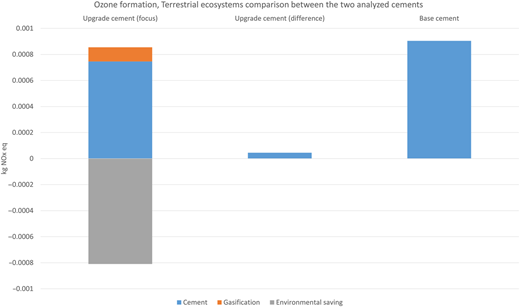
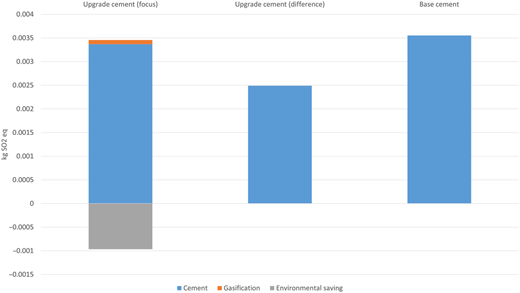
The findings reveal a significant reduction in various environmental indicators between the baseline and upgraded cement production methods. A 45% decrease in global warming potential (expressed in kgCO2eq) was assessed. Moreover, the calculations pointed out a 94.96% reduction in ozone formation on human health (expressed in kgNOxeq). Advantages were found also in terms of a decrease in fine particulate matter formation, a decline in ozone formation on the terrestrial ecosystem and a decrease in terrestrial acidification.
The context of LV was taken into account according to the present scenario of waste management: municipal solid waste composition is the one official. Trends in its characteristics will be analyzed in future works.
Cement factories are responsible for an environmental impact surely not negligible. Conventional waste-to-energy plants (combustion-based) are difficult to be accepted locally even if the sector evolved towards modern technologies. The proposed integration can contribute to a new paradigm allowing a lower environmental impact.
Despite the scarcity of literature on LCA applied to cement factories integrated with waste gasification, the obtained results show that this approach can be an interesting alternative to conventional processes. The integration of modular gasification and cement production is original also for another reason: the modularity of the gasification technology taken into account allows a full-scale design calibrated to the requirement of the cement facility.
1. Introduction
Gasification of waste is increasingly considered a viable alternative to combustion from different points of view (Rahim et al., 2024; Mostafa et al., 2024; Ebrahimzadeh Sarvestani and Di Maria, 2023; Kandasamy et al., 2022; Ragazzi et al., 2022; Cocarta et al., 2009), in particular, regarding the optimization of the environmental impact (Tubino et al., 2022; Adami et al., 2020). An analysis of the Scopus® database reveals a significant uptick in annual international scientific publications on gasification over the past. This increase could be attributed to innovative proposals capitalizing on certain characteristics of this process.
An initiative jointly undertaken by Switzerland and Italy aims to advance scientific knowledge in this area, resulting in the establishment of a small-scale modular plant in the north of Italy. Authorized by the local Environmental Protection Agency, this experimental facility seeks to facilitate a comprehensive exploration of the technology’s features (APPA, 2024). A key aspect of the gasification process lies in its modularity, integrated within post-combustion modules. Gasification is conducted using a batch approach at relatively low temperatures and with a characteristic extended retention time of waste in the reactor to maximize the conversion of volatile solids into syngas. One potential integration to consider is incorporating such gasification plants within cement factories, exploiting their modularity to fit the design case by case.
Cement, characterized by its fine powdered form, exhibits strong adhesive properties when combined with water and aggregates. Derived from limestone, clay and sand, these raw materials yield essential components such as lime, silica, alumina and iron. Cement production encompasses three primary phases: raw material preparation, clinker production and cement preparation. Initially, raw materials like limestone, clay and other constituents are extracted from quarries or mines and transported to manufacturing facilities, where they undergo crushing and milling processes. These materials are then meticulously mixed to achieve the desired composition, tailored to the quality and specifications of the intended cement product. Subsequently, the prepared composition is introduced into a kiln, typically following a pre-heating stage, where it is subjected to temperatures reaching up to 1,450 °C (Wolde et al., 2024; Yin et al., 2024; Gebreslassie et al., 2023). This thermal treatment instigates chemical and physical transformations, converting the raw mixture into clinker. This phase, known as clinkerization, constitutes the most energy-intensive aspect of the production process. The resultant clinker is further blended and ground with additives and supplementary mineral components like gypsum, slag and flyash, which confer the requisite properties to the final product.
The rationale behind this idea stems from the significant environmental demands exerted by cement factories, both in terms of resource consumption and their impact on the environment and human health. Cement manufacturing entails extensive utilization of raw materials and energy resources, with the production process contributing significantly to global anthropogenic CO2 emissions, estimated at around 5%, as highlighted by many authors (Hendrik et al., 2002; Rada et al., 2014; Huang et al., 2024; Shadhar et al., 2023; Supriya Chaudhury et al., 2023; Ravi and Murugesan, 2023; Martínez-Martínez et al., 2023).
Urbanization has fueled a substantial surge in cement, placing considerable strain on natural resources such as waste, water, gravel, sand and crushed rock (Chen et al., 2014; Mefteh et al., 2013; Rada, 2023; Marey et al., 2024; Nehdi et al., 2024). Prior to the industrial era, atmospheric CO2 concentrations were relatively stable, fluctuating between 200 and 280 ppm, with projections suggesting a potential increase to over 800 ppm by the century’s end (Freely et al., 2004). The environmental impact of cement production extends beyond atmospheric emissions to encompass land quality degradation, primarily attributable to activities such as quarrying, waste disposal, material storage and atmospheric deposition (Al-Dadi et al., 2014; Barbhuioya et al., 2023; Ige et al., 2024). Furthermore, acidification, a significant environmental concern, is primarily driven by emissions of sulfur dioxide and nitrogen oxides (NOx), with its severity influenced by the clinker content of cement (Heidari-Maleni et al., 2024; Kim et al., 2021; Fowlera et al., 1992).
In this frame, it is imperative to actively seek and implement solutions aimed at curtailing escalating raw material consumption and mitigating adverse environmental effects associated with cement production under a circular economy view. Life cycle assessment (LCA) became one of the most interesting tools to be used to understand the environmental impact but also to help to comply with the new Ecodesign for Sustainable Products Regulation (ESPR) (EU, 2009).
2. Materials and methods
2.1 Gasification process
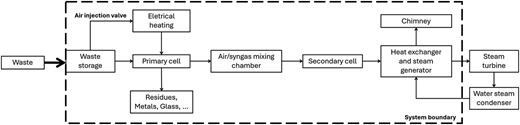
This process is a partial oxidation with an oxidizing agent in an amount less than the one stoichiometrically required for a combustible material, in our case, waste, but suitable for guaranteeing exothermic reactions (Monteiro et al., 2024; Islam et al., 2020). The particularity of this process is to convert all the organic parts of the material, hence carbon-bound molecules, into synthesis gas (also known as syngas). Another characteristic of this plant is its layout; more precisely, it is a combination of batch and continuous feeding. Batch feeding is present in the initial part of the plant where, after an initial electric pre-heating, partial combustion of the waste occurs inside one of the two parallel primary cells, resulting in the production of the synthesis gas, while continuous feeding is employed in a secondary cell. To form syngas within the primary cell, it is necessary for the waste to remain inside for a sufficiently long residence time, typically several hours, because of the chosen relatively low temperatures. Conversely, for syngas combustion within the secondary cell, where residence time is very short, typically a few seconds, temperatures are significantly high. At full scale, the subsequently burned syngas allows to generate energy, heat (in the case of cogeneration) and potentially cooling (in the case of trigeneration). Moreover, at full scale, the number of primary and secondary cells varies depending on the specific needs of the design. The only impacts present in the plant are emissions into the atmosphere from the stack and bottom ashes remaining after the primary cell process, which, as it will be seen later, can be reused to establish a circular economy principle. Figure 1 presents a flowchart to better understand the layout of the gasification plant.
2.2 Integration of the gasifier into a cement factory
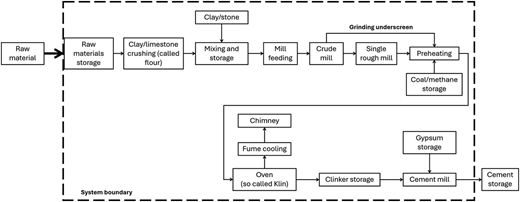
As is well known, the production of 1 kilogram of cement requires several raw materials, such as clay and limestone, as well as heat to complete the production process (Georgiopoulou and Lyberatos, 2018; Chatziaras et al., 2016). The concept of integration arises from the need to reduce the use of valuable raw materials and to make energy consumption as self-sufficient as possible. Regarding heat and electricity, there are no issues, as they are directly generated by the gasification plant, while screening can be utilized to separate the residues remaining after the partial oxidation process in the primary cell. Through screening, it is possible to separate glass and metal (the amount, not the source separated) from the rest of the bottom ashes. These ashes can be used as secondary material to replace raw materials, as also declared by the European Directive 2000/76/EC (EU, 2000). Assimilating them to bottom ashes derived from the incineration process, many studies can be found demonstrating the effectiveness of incorporating such ashes in the cement production (Clavier et al., 2021; Kleib et al., 2021; Elkhaldi et al., 2023; Pels et al., 2005). No variations have been observed in the cement strength class, nor any other significant differences compared to ordinary cement. Figure 2 illustrates the flow diagram of the conventional Portland cement plant (Becciu, 2017).
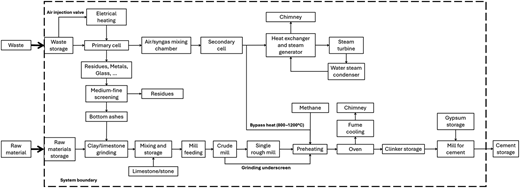
Figure 3 depicts the flow diagram of the cement plant integrated with the gasification plant, representing the combination of the plants shown in Figures 1 and 2.
2.3 Life cycle assessments
To quantify the difference in environmental impact between conventional cement production within a cement plant and cement production with the integration of a gasifier within the process chain, an LCA of the product was implemented. To achieve this, the SimaPro software was utilized (SimaPro, 2023), a globally recognized tool for LCA studies, employing the Ecoinvent 3.9.1 - allocation, cut-off by classification–unit database (Ecoinvent, 2023). As further elaborated in the results section, two types of assessment methods were employed. The first involves a comprehensive evaluation of impacts, yielding single scores and utilizes the Endpoint (H) World H/A method (Huijbregts et al., 2016). The second method involves an intermediate assessment providing direct impacts such as global warming, terrestrial acidification and others. This method employs the Midpoint (H) World H approach (Huijbregts et al., 2016).
The ISO14040-14044 series outlines four steps for conducting LCA: defining the goal and scope, conducting inventory analysis, performing impact assessment and interpreting the results.
The goal is to generate a quantitative environmental profile for two types of cement: one manufactured using the traditional cement mixture and the other formulated with a blend containing fewer raw materials supplemented with additional bottom ashes obtained from the gasifier. The necessary electricity and heating are directly supplied by the gasification plant.
To delineate the scope, it is crucial to define the functional unit under scrutiny. In this context, the functional unit is represented by the kilogram of cement produced, which applies to both the standard and enhanced scenarios. During this phase, data inputs and outputs are gathered, and an inventory of environmentally and resource-related inputs and outputs is compiled.
The flowchart presented in Figure 3 facilitates the comprehension of the processes required to produce 1 kilogram of the final product under examination. Below, the processes for both considered supply chains are delineated.
Base cement:
Clinker;
Gypsum crushed;
Limestone crushed;
Ethylene glycol;
Steel, low-alloyed;
Electricity, medium voltage and local network.
Upgrade cement with bottom ashes:
Clinker with bottom ashes;
Gypsum crushed;
Limestone crushed;
Ethylene glycol;
Steel, low-alloyed;
Electricity and medium voltage, generated by gasifier.
Table 1 shows the data related to the process of clinker production pertaining to an LCA conducted on Portland cement by Olangunju and Olanrewaju (2021). Some of the processes were not included in the database; therefore, they needed to be defined (Tables 2-4).
To standardize the comparison to a specific market, it was decided to contextualize the study in Latvia (LV), specifically in the city of Riga, as it hosts the only cement plant supplying the entire nation. Therefore, when inputting data into the SimaPro model, it was necessary to specify the market as LV. Consequently, it was necessary to know the fractions composing the waste matrix inserted into the gasifier to enable cogeneration. That was made by data available in the study conducted by the European Environmental Agency (EEA, 2022), which reports the composition for the waste matrix in LV (Table 5).
For privacy reasons associated with the company that owns the gasification plant, data and emissions concerning the gasifier were withheld. It was possible to define the process for producing 1 kilogram of clinker with bottom ashes, thus reducing the use of raw materials, in conjunction with the heat and electricity derived from the gasifier (Table 6).
The objective of the LCA phase is to comprehend and evaluate the magnitude and significance of potential environmental impacts linked to a product system throughout its life cycle and also helps to understand the circular economy and ESPR concepts. This process broadly involves associating inventory data with specific environmental impact categories and indicators. The life cycle impact assessment provides insights for interpreting the life cycle, ensuring the economic viability, social equity and environmental sustainability of projects, programs and policies.
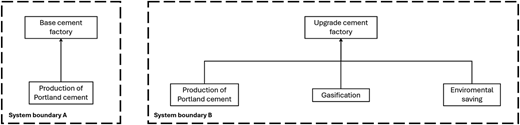
First and foremost, it was necessary to establish the models. As previously mentioned, the aim was to compare the environmental impact attributable to the production of 1 kilogram of Portland cement with that of 1 kilogram of Portland cement incorporating bottom ashes, electricity and heat generated by the gasifier. Naturally, a cement plant produces various types of cement, but to simplify the comparison, it was decided to focus solely on Portland cement production. To facilitate an effective comparison, the model was to be structured using what are termed production blocks. That is, if we consider the cement plant as the entirety of production, it was imperative to determine the impact of conventional cement production compared to cement production with bottom ashes. In the upgrade scenario, additional production blocks such as gasification and environmental savings were required. The latter pertains to all environmental damage saved between one supply chain and another, such as electricity generation. These concepts are further elucidated in Figure 4.
It should be noted that for the sake of simplicity in representation, only the final production blocks constituting the entire cement plant chain are depicted in Figure 4: the basic cement constitutes a single production block, specifically referring to the production of standard Portland cement. It was determined to utilize the data presented in the LCA compiled by Olangunju and Olanrewaju (2021). The dataset reported in Table 7 describes the production of 1 kilogram of Portland cement through the conventional cement plant used for the model.
For this model, the approach mirrors that used for the basic cement, with the distinction that in this case, there is less raw material involved due to the utilization of bottom ashes from the gasifier and both electricity and heat are derived from the gasifier as well. The environmental savings block encompasses excess electrical energy produced and fed into the grid, whereas the gasification block encompasses the entire process required to obtain the necessary syngas for heat and energy production. In the following Tables 8, 9 and 10, there are the production blocks highlighted in Figure 4 that were considered for creating the model of the analyzed layout.
3. Results and discussion
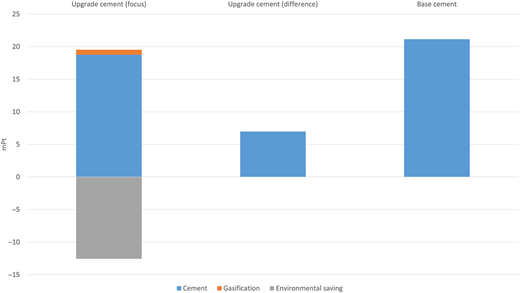
As previously mentioned, the endpoint simulation yields dimensionless results, as it involves the normalization and weighting of all the different impact categories considered by the software. It was considered essential to present the single score results obtained for the various production blocks of the cement plant in both the base and upgraded scenarios for impact categories related to human health, ecosystem and resources. These results are collectively represented in Figure 5 and Table 11.
In the central column, values pertaining to the traditional production of Portland cement are indicated, whereas in the near column, the results of producing the same cement with the integration of the gasification plant are reported, subdivided according to the impact attributed to individual production blocks. Finally, the remaining column depicts the net difference in contributions from various production blocks in the implementation of the gasifier, thus highlighting the variation compared to the baseline scenario.
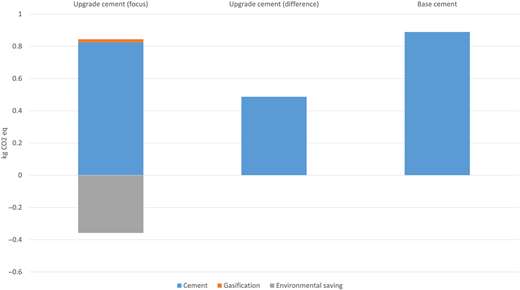
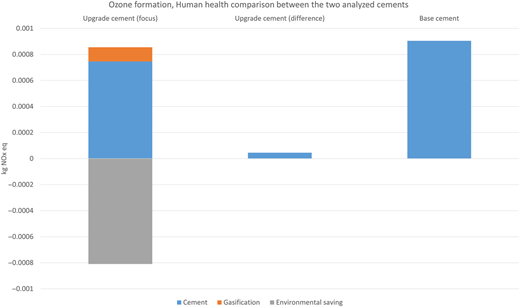
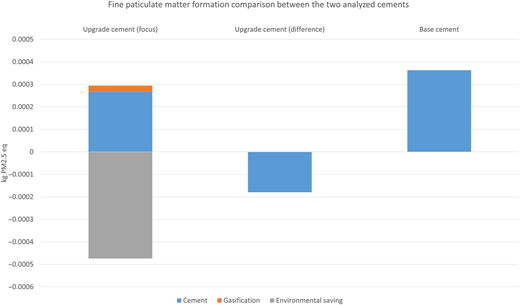
Unlike what is provided with the endpoint simulation, the midpoint provides results directly related to the impact category, such as in the case of global warming, where results are expressed in kgCO2eq. To represent the outcomes of this simulation, the same approach described previously for Figure 5 was adopted. Among the various environmental impacts calculated by the SimaPro software, it was deemed crucial to highlight the key impacts associated with this supply chain and considered those of greater significance. These impacts include global warming, ozone formation on human health, fine particulate matter formation, ozone formation on the terrestrial ecosystem and terrestrial acidification. The results of the analyzed categories are presented both in general (Figures 6 - 10) and in detail (Table 12). Advantages from the integration of the processes are clear. Indeed, the proposed integration allows reducing the consumption of a fossil fuel, methane, at the cement plant by a partial substitution through syngas that comes from the treatment of residual municipal solid waste, which is partially renewable (about two-thirds in weight, according to data in Table 5). Moreover, gasification is known as a process emitting lower amounts of NOx compared to other industrial plants thanks to the characteristics of the generated syngas (Ragazzi and Rada, 2012). It also opens to the quantified effect of reduction of ozone formation and terrestrial acidification as NOx plays a role in the reactions of interest.
Recent LCA studies on cement plants point out the need to explore more sustainable solutions for this sector (Huang et al., 2025) and to enhance the deepness of the assessments (Rihner et al., 2025); the present study is in line with these requests coming from the sector.
For a real-scale adoption, the proposed strategy should deepen case by case the local context of waste management, as gasification must be compatible with the regional plans.
The socio-economic impact of the proposed integration is potentially favorable even if the opposition could not fully understand the advantages, as the opposition to this kind of plants is often if conditioned first by the context (Enkin and Bambang, 2021) and secondly by the characteristics of the proposal.
4. Conclusions
A cement plant was analyzed by an LCA in two cases: alone and coupling a gasification system within the cement production systems. This integrated approach could be successfully seen as an option in addition to the pre-existing practice of employing incinerator bottom ashes in clinker production, thereby decreasing the demand for raw materials.
A significant reduction in the single score assigned to the upgraded plant compared to the conventional one was observed. The base cement plant was assigned a single score of 21.145 mPt, whereas the upgraded one achieved a value of 6.977 mPt, corresponding to a favorable 67% difference. It is noteworthy that the single score value was determined during an endpoint simulation.
Regarding the midpoint simulation, the improved layout consistently outperforms the conventional layout across all impact categories, as illustrated in Figures 6–8. Specifically, there is a 45.24% decrease in global warming potential (expressed in kgCO2eq) and a 94.96% reduction in ozone formation on human health (expressed in kgNOxeq). Advantages were found also in terms of decrease in fine particulate matter formation, decline in ozone formation on the terrestrial ecosystem and decrease in terrestrial acidification.
This outcome aligns with the initial hypotheses presented at the onset of this study. Despite the scarcity of literature on these subjects, it is apparent that the gasification process complements the principles of the circular economy, integrated solid waste management and sustainable development. Nevertheless, to reinforce this viewpoint, further research is required.