The purpose of this short-term longitudinal quantitative study was to gain a comprehensive understanding of the influence of teacher autonomy support and structure on young adolescents’ academic motivation, classroom engagement, school belonging, and achievement. Middle school students (N = 209, 61% female) selfreported perceptions of teacher support (choice, respect, relevance), teacher structure (monitoring, expectations, help), academic motivation (intrinsic value), engagement (involved and disruptive behavior), school belonging, and semester grades in the fall and spring of the school year. Hierarchical regression findings indicated teacher support and structure influenced young adolescents’ school functioning after controlling for prior adjustment, and that gender moderated associations. Teacher respect was related with involved behavior, and expectations were related with intrinsic value, belonging, and achievement. As expected, high levels of perceived support and structure were associated with higher levels of intrinsic value, involved behavior, and school belonging. Boys who perceived high levels of teacher respect and monitoring reported the lowest disruptive behavior and the highest semester grades. Boys who perceived high levels of teacher respect and help reported the lowest semester grades. Implications for middle grades educational research and practice are discussed.
Academic motivation, engagement, school belonging, and achievement are shaped by teacher behaviors (Patrick, Ryan, & Kaplan, 2007; Turner, Christensen, Kackar-Cam, Trucano, & Fulmer, 2014; Wang & Eccles, 2013) and are central to understanding youths’ experiences in school. Teachers who provide autonomy support (e.g., promotion of choice, respect, and relevance) may help students to develop a sense of personal control in their learning (Stroet, Opdenakker, & Minnaert, 2013). Teachers who structure learning experiences (e.g., monitor learning, communicate expectations, and provide help) may allow students to gain information about how to be successful in the classroom (Jang, Reeve, & Deci, 2010; Skinner & Belmont, 1993). Together, teacher autonomy support and structure are useful in promoting a developmentally responsive environment and supporting young adolescents’ learning and adjustment (Eccles & Roeser, 2011; National Middle School Association, 2010; Ryan & Deci, 2000). Research has examined associations of teacher support and structure with adolescents’ school functioning (Stroet et al., 2013; Wang & Eccles, 2013). However, the combined influence of autonomy support (choice, respect, relevance) and structure (monitoring, expectations, help) on student adjustment is understudied (Jang et al., 2010; Sierens, Vansteenkiste, Goossens, Soenens, & Dochy, 2009; Vansteenkiste et al., 2012) and research has been conducted primarily at the high school level. It is important to investigate the potential implications for adolescent adjustment during the middle grades.
The present study provided a unique contribution to the field via its focus on specific types of teacher support and structure on students’ academic motivation, engagement, belonging, and achievement in middle school. Most research has examined general constructs rather than specific types of support and structure (Katz, Kaplan, & Guetta, 2010), and the interactive influences of teacher behaviors have been rarely studied (Wentzel, 2012). Previous studies have investigated the role of teacher support and structure for student motivation and engagement (Jang et al., 2010; Sierens et al., 2009; Vansteenkiste et al., 2012), yet other aspects of adjustment are under examined, including school belonging and achievement.
A body of research exists that suggests boys and girls may experience autonomy support and structure differently. Girls are more likely to perceive and respond to teacher support whereas boys perceive and respond more to teacher criticism (den Brok, Fisher, Rickards, & Bull, 2006; Goodenow, 1993; Wentzel, Battle, Russell, & Looney, 2010). Further, girls are more likely to be motivated and engaged than boys (Vansteenkiste et al., 2012; Wang & Eccles, 2012). However, it is unclear as to whether gender moderates associations of teacher support with motivation and engagement. Hence, it is necessary to further examine teacher support and structure and their implications for adolescents in urban, diverse middle schools (Wallace & Chhuon, 2014) in order to help educators provide developmentally responsive learning environments and promote student success (Balfanz, Herzog, & Mac Iver, 2007; Jackson & Davis, 2000).
The present study had two main aims: (a) to examine associations of student perceptions of teacher autonomy support and structure with academic motivation, engagement, belonging, and achievement in an urban, ethnically diverse middle school, and (b) to explore gender as a moderator of associations between teacher support and structure with student adjustment across the school year. Given that students often experience negative changes in teacher instruction and declines in motivation, engagement, and achievement during the middle school years, and that this differs by gender (Anderman, Maehr, & Midgley, 1999; Balfanz et al., 2007; Eccles & Roeser, 2011), research on the relationships among these constructs during early adolescence is critical (Jang et al., 2010).
Associations of Teacher Autonomy Support and Structure With Student Adjustment
Stage-environment fit theory and self-determination theory provide an integrated theoretical framework to examine the role of teacher support and structure in promoting positive student adjustment in middle school. Stageenvironment fit theory maintains that teachers can promote optimal adjustment by being responsive to adolescents’ unique and developing cognitive, social, personal, and emotional needs (Eccles et al., 1993; Eccles & Roeser, 2011). Self-determination theory asserts that teachers’ support of students’ basic psychological needs for autonomy (sense of personal control and direction), competence (sense of efficacy), and relatedness (sense of connectedness) promotes intrinsic motivation and high-quality learning (Deci & Ryan, 2000; Ryan & Deci, 2000). Providing autonomy support and structure allows teachers to be sensitive to students’ needs (Connell & Wellborn, 1991; Zimmer-Gembeck, Chipuer, Hanisch, Creed, & McGregor, 2006) and support students’ motivation and success (Reeve, Jang, Carrell, Jeon, & Barch, 2004; Wang & Eccles, 2013).
Teacher autonomy support allows students to feel self-directed and develop a sense of personal control in their learning experiences (Stroet et al., 2013). Students perceive greater control over their learning when teachers incorporate student needs and interests into the classroom (Reeve, 2006; Reeve et al., 2004). Autonomy supportive teaching, which includes attention to students’ choice, respect, and relevance in learning (Assor & Kaplan, 2001; Reeve et al., 2004), is particularly important during early adolescence when independence and identity development are salient (Eccles & Roeser, 2011; National Middle School Association, 2010). Adolescents can differentiate between multiple types of autonomy support, and these supports have unique implications for adjustment (Assor, Kaplan, & Roth, 2002). Promotion of choice (i.e., providing students with meaningful options to learn and do their schoolwork) is associated with an autonomy supportive environment that promotes student academic engagement and achievement (see Núñez & León, 2015, for a review). However, youth may not view choice as necessary for experiencing autonomy support (Assor et al., 2002). They may instead perceive respect and relevance as more central to promoting motivation, engagement, and belonging (Kiefer, Alley, & Ellerbrock, 2015). In fact, respect in learning (i.e., when the teacher is fair and open to the students and their ideas) has been shown to be positively related to student efficacy, self-regulated learning, and on-task behavior (Patrick et al., 2007; Ryan & Patrick, 2001).
Teachers may promote respect by use of informational language and constructive feedback (Assor & Kaplan, 2001; Belmont, Skinner, Wellborn, & Connell, 1992; Stroet et al., 2013). Relevance in learning (i.e., what is taught connects to the student’s life and future goals) is related to student engagement (Assor et al., 2002) and is fostered by teachers communicating the value and meaning of lessons and activities (Assor & Kaplan, 2001; Reeve et al., 2004). Although relevance and respect are related to motivation and engagement (Stroet et al., 2013), these factors have rarely been investigated in tandem (see Kiefer et al., 2015, as an exception) and may have unique implications for adjustment. Thus, we expected that autonomy support will be positively related to later adaptive school functioning (motivation, engagement, belonging, achievement) and that the strength of these relationships would vary according to the type of support (choice, respect, and relevance).
Teacher provision of structure aims to enhance students’ need for competence, mastery, and challenge (Stroet et al., 2013). Research has focused primarily on the implications of structure for motivation and engagement (Stroet et al., 2013), whereas belonging and achievement are relatively understudied. Teacher structure, including monitoring, expectations, and help (Belmont et al., 1992; Jang et al., 2010; Stroet et al., 2013), is important during the middle grades when academic expectations are changing and performance has increasingly long term implications (Balfantz et al., 2007). Teacher monitoring of student learning (i.e., providing guidance when needed) provides students with scaffolding to initiate and maintain effort necessary to achieve their learning goals and outcomes (Jang et al., 2010; Sierens et al., 2009). However, adjustment may be hindered if students perceive monitoring as diminishing their autonomy or competence (Deci & Ryan, 1985).
Teacher expectations (i.e., teacher expression of belief in students’ ability to perform to their potential) serve to foster motivation and achievement (Brophy, 2004), especially for students in high needs, urban school settings (Corbett, Wilson, & Williams, 2002). Student perceptions of high teacher expectations regarding academic work are associated with increased student engagement (Wentzel et al., 2010). However, when teacher expectations are too high or unrealistic, decreased student motivation and engagement follows (Daniels & Arapostathis, 2005; Wallace & Chhuon, 2014). Teacher provision of help is also of significance. This includes providing information, experiences, advice, or resources that aid student learning as well as modeling adaptive beliefs and behaviors (Stroet et al., 2013; Wentzel et al., 2010). Provision of help is related to positive social and academic motivation during middle school (Wentzel et al., 2010). We expected types of teacher structure to be positively related to later adaptive school functioning, and that the strength of these relations will vary according to the type of structure (monitoring, expectations, and help).
Although autonomy support and structure have implications for student adjustment, most research has examined these constructs generally rather than assessing specific types (autonomy support includes choice, respect, and relevance; structure includes monitoring, expectations, and help), which may obscure variations in their influence on student adjustment. Further, interactive influences of specific types of teacher support and structure are understudied (Jang et al., 2010). Research indicates links among multiple types of teacher support and structure with high school students’ self-regulated learning, engagement, and problem behavior (Jang et al., 2010; Sierens et al., 2009; Vansteenkiste et al., 2012), although it is unclear as to whether support and structure have synergistic influences for middle school youth’s school functioning. Although motivation and engagement have been examined, support and structure may have implications for additional outcomes at the middle level, such as school belonging and achievement. Examining the influence of multiple types of support and structure on a comprehensive set of outcomes may provide insights into how teachers can best meet the needs of young adolescents. Teaching that supports students in one area of need may not compensate for a lack of support in another (Stroet et al., 2013); balanced need satisfaction is important for well-being (Sheldon & Neimiec, 2006). We expected teacher support and structure to influence students’ adjustment, and that high levels of perceived support and structure will relate to positive school adjustment.
Gender as a Moderator
In the present study, we examined gender as moderating associations of teacher support and structure with student adjustment. Social cognitive theory suggests characteristics and roles promoted for boys and girls are influenced by student experiences and guide gender-linked behavior (Rose & Rudolph, 2006; Ruble, Martin, & Berenbaum, 2006). Survey-based research indicates perceptions of teacher support differ by gender, with girls more likely to perceive higher levels of teacher support compared to boys, and boys more likely to perceive higher levels of teacher criticism than girls (den Brok et al., 2006; Wentzel et al., 2010). Further, girls are may perceive higher levels of motivation, involved behavior, and achievement compared to boys, whereas boys may perceive higher levels of disruptive behavior than girls (Vansteenkiste et al., 2012; Wang & Eccles, 2012). These findings are consistent with gender normative social perceptions and behaviors (Rose & Rudolph, 2006; Ruble et al., 2006). However, little is known regarding whether relations of support and structure with adjustment may differ by gender. If a type of teacher support or structure is viewed as more normative for a particular group, will it have a stronger or weaker influence on students’ school adjustment? For example, boys may perceive teacher monitoring or help as more controlling than girls and experience less adaptive adjustment (Assor, Kaplan, Kanat-Maymon, & Roth, 2005). Given the lack of prior research, no specific hypotheses were made and gender as a moderator was examined on an exploratory basis.
The Present Study
The present study examined the influence of teacher autonomy support (choice, respect, relevance) and structure (monitoring, expectations, help) on young adolescents’ academic motivation (intrinsic value), engagement (involved, disruptive behavior), school belonging, and achievement in a large, diverse, urban middle school, and explored gender as a moderator.
Method
Procedure
Data were collected during the fall and spring of the school year as part of a larger longitudinal study that examined student motivation and adjustment during middle school (Grades 6–8). The participating school served a large, ethnically diverse urban community. The average rate of eligibility for free or reduced fee lunch was 56%. Active parental consent and participant assent were obtained prior to data collection. The average consent rate was 67%. Participants were representative of demographics within the school and the overall school district. Participants were recruited from 15 classrooms across the three grades (5 classrooms in each grade; average class size was 23 students). Surveys were administered during school hours in the fall and spring of the school year, with approximately 6 months between time points. Instructions and items were read aloud while students responded. Students were told that the purpose of the survey was to learn about their motivation and adjustment in school, that participation was voluntary, and that information would be kept confidential. We visited the school one additional day in the fall and spring to administer make-ups for students who were absent on the initial day of survey administration.
Participants
Students who participated in both the fall and spring were included in analyses. Students who only completed the survey in the fall only (9%) were dropped, yielding a sample of 209 students (61% females). The sample was 36% White, 39% Latino, 13% Multiracial/Other, 6% African American, and 6% Asian American. We conducted t tests on continuous variables and chi-square tests on demographic variables to see if students who participated in the study differed from those who participated in the larger longitudinal study. Students who were not included in the study did not report significantly lower levels of variables in the fall compared to students who participated in the study, and did not differ significantly on demographic variables.
Measures
All items were positively worded and rated on a continuous scale ranging from 1 (not at all true) to 5 (very true) except for academic motivation, which used a 4-point continuous scale. Alpha coefficients reported are from the present study and reflect strong psychometric properties similar to previous studies that utilized the measures.
Autonomy Support and Structure. Student perceptions of teacher autonomy support and structure were measured with the Teacher as Social Context Questionnaire (Belmont et al., 1988). This measure has two main components, each with three subscales consisting of four items. Autonomy support subscales include promotion of choice, respect, and relevance in learning. Choice focuses on the degree to which the teacher is perceived to allow students to make choices regarding their learning and schoolwork within the classroom context (e.g., My teacher gives me a lot of choices about how I do my schoolwork; α = .72). Respect involves the perception that the teacher is fair and open to the student and his/ her ideas (e.g., My teacher listens to my ideas; α = .82). Relevance in learning focuses on the perception that what is taught connects to the student’s life and future goals (e.g., My teacher talks about how I can use the things we learn in class; α = .76). Structure subscales include monitoring, expectations, and help. Monitoring involves the perception that the teacher checks for student understanding before moving to new material (e.g., My teacher makes sure I understand before he/she goes on; α = .76). Teacher expectations include perceptions that the teacher expresses belief in the student’s abilities to perform to his/her potential (e.g., My teacher believes I can do well in class; α = .92). Help focuses on the perception that the teacher provides the student with assistance in his/her learning (e.g., If I can’t solve a problem, my teacher shows me different way to try to; α = .71). Research indicates young adolescents can reliably report on teacher autonomy support and structure (Jang et al., 2010)and that these constructs have implications for motivation and engagement (Stroet et al., 2013). This measure has yielded reliable and valid scores across different samples of adolescents (Kiefer et al., 2015; Vansteenkiste et al., 2012).
Academic Motivation. We measured academic motivation using the “intrinsic value measure” (Midgley, Feldlaufer, & Eccles, 1989). The six items on this scale focus on the importance and usefulness of academics, as well as engaging in academics because the student finds it to be inherently enjoyable (e.g., In general, how useful is what you learn in school?, and I enjoy the work we do in school; α = .79). Previous research has shown evidence for strong construct validity for data collected on adolescent samples, as well as positive correlations between scale scores and measures of other motivational constructs and teacher support (Dietrich, Dicke, Kracke, & Noack, 2015).
Classroom Engagement. Students reported on two facets of classroom engagement: involved and disruptive behavior. Items from the Rochester Assessment of Intellectual and Social Engagement were used to assess involved behavior (Miserandino, 1996; Skinner & Belmont, 1993). Involved behavior (4 items) focuses on perceptions that the student engages in on-task classroom behaviors (e.g., I listen carefully in class; α = .84). Disruptive behavior (4 items; Kaplan & Maehr, 1999) focuses on perceptions that the student engages in off-task classroom behaviors (e.g., I sometimes get into trouble in this class; α = .77). This measure has been found to yield valid data, and scores have correlated in appropriate directions with adolescent and teacher reports of student engagement (Fredricks, Blumenfeld, & Paris, 2004; Skinner & Belmont, 1993).
School Belonging. We measured school belonging using the Psychological Sense of School Membership scale (Goodenow, 1993). Thirteen items focused on students’ sense of personal belonging in school (e.g., I feel a real part of my school, and I can really be myself at this school; a = 86). Scores on this measure have been found to be valid in prior research for demonstrating associations with student academic motivation and learning (Goodenow & Grady, 1993).
Academic Achievement. Students selfreported their academic achievement (GPA) for their core academic classes during the fall and spring semester of the academic school year. Students indicated having a GPA of 4.0 or higher (A), 3.0–3.9 (B), 2.0–2.9 (C), 1.0–1.9 (D), or less than 1.0 (F). In our sample, 31% of students reported a semester GPA of an “A,” 59% reported a “B,” 9% reported a “C,” and 1% reported a “D” in the spring. There were no statistically significant gender differences. Although there is caution in using self-reported grades, especially for low-performing students, evidence is limited for middle grades students, and previous research indicates only a moderate discrepancy between self-reported achievement and school records. For example, a recent study using data from the National Longitudinal Study of Adolescent Health, a nationally representative sample of youth, indicated self-reported achievement was approximately one-half letter grade greater than official transcript scores in high school (Schwartz & Beaver, 2015).
Results
Preliminary Analyses
Zero-order correlations, means, and standard errors are reported in Table 1. The overall pattern of associations supported hypotheses, as teacher support and structure were positively associated with motivation, involved behavior, belonging, and achievement; and negatively associated with disruptive behavior.
Associations of Teacher Support and Structure With Student Adjustment
Separate hierarchical regression analyses were conducted to examine relations of teacher support and structure in the fall with student adjustment (motivation, engagement, belonging, and achievement) in the spring, and to examine gender as a moderator.1 Gender was entered at Step 1 as a dichotomous variable (1 = female, 0 = male). Baseline levels of adjustment were entered as control variables at Step 1. Teacher support (choice, respect, relevance) and structure (monitoring, expectations, help) in the fall were entered at Step 2. Gender was entered as a moderator at Step 3. Interactions among teacher support and structure were entered at Step 4. Lastly, three-way interactions among teacher support, structure, and gender were entered at Step 5. We used procedures outlined by Aiken and West (1991) to test and interpret interactions. Findings were considered statistically significant at p = .05. Additional findings that were not statistically significant at this p value but were significant at p ≤ .10 are reported for follow-up simple slopes analyses that decomposed statistically significant interactions.
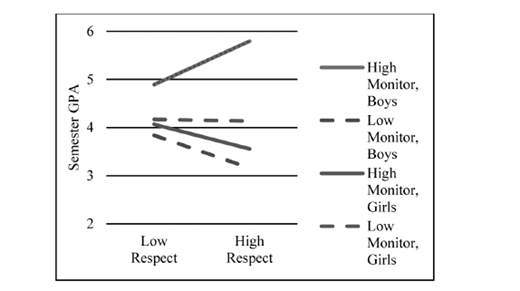
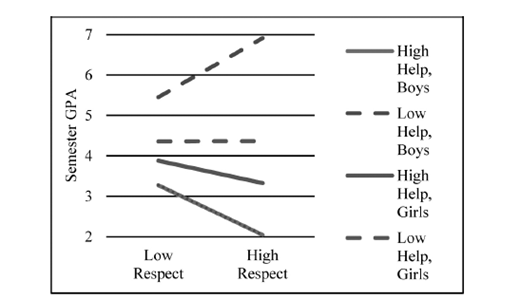
Main effect terms were standardized before computing interaction terms to avoid multicollinearity and aid interpretation of beta coefficients. Significance of interactions was determined if the R2 increased by a statistically significant amount and if the beta coefficient for the interaction term was statistically significant. Only statistically significant interaction terms were retained (final models varied for dependent variables; see Table 2). To interpret statistically significant interactions, we calculated the predicted values with unstandardized regression coefficients and conducted simple slope tests (see Figures 1–6). Graphs were created for the predicted values of outcome variables (motivation, engagement, belonging, achievement) using teacher support and structure scores one standard deviation above and below the mean. As expected, types of teacher support and structure in the fall influenced student adjustment in the spring, after controlling for gender and prior adjustment. Gender moderated associations of teacher support and structure with student adjustment.
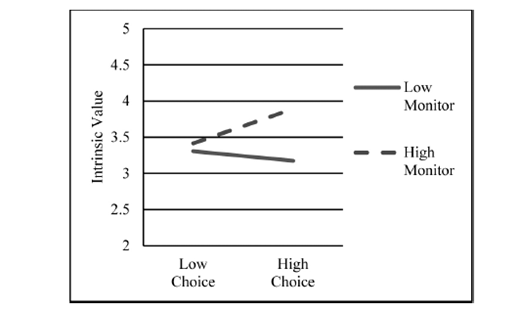
Academic Motivation. The final regression model for intrinsic value was statistically significant, F = 12.24 (13, 191), p < .001 (see Table 2). Intrinsic value in the fall was statistically significant at Step 1. At Step 2, expectations was statistically significant and positively related to subsequent intrinsic value. There were no statistically significant gender interactions at Step 3. At Step 4, there was a statistically significant Choice × Monitor interaction, indicating students who reported high levels of choice and monitoring tended to have the highest levels of intrinsic value (Figure 1). Follow up simple slopes analysis indicated a marginally significant positive relation between choice and intrinsic value for students with high levels of monitoring (β = .16, t = 1.77, p = .079) and a statistically nonsignificant relation for students with low levels of monitoring (β = −.13, t = −1.21, p = .226). Similar to the Choice × Monitor interaction, there was a statistically significant Choice × Help interaction, indicating students who reported high levels of choice and help had the highest levels of intrinsic value. Simple slopes analysis revealed a statistically significant positive relation between choice and intrinsic value for students with high levels of help (β = .39, t = 3.70, p < .001) and a marginally significant relation for students with low levels of help (β = .16, t = 1.77, p = .079). There was a statistically significant Respect × Monitor interaction, indicating students who reported high levels of respect and monitoring tended to have the highest levels of intrinsic value. Simple slopes analyses revealed a marginally significant positive relation between respect and intrinsic value for students with high levels of monitoring (β = .12, t = 1.04, p = .099) and a statistically nonsignificant relation for students with low levels of monitoring (β = −.03, t = 0.37, p = .713). Thus, teacher support and structure explained appreciable variance in motivation beyond prior adjustment and gender.
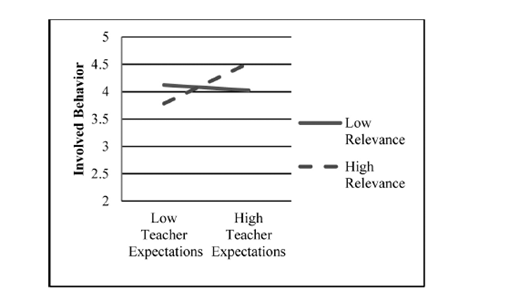
Classroom Engagement. The final regression model for involved behavior was statistically significant, F = 9.72 (9, 193), p < .001. Involved behavior in the fall was statistically significant at Step 1. At Step 2, respect was positively related to subsequent involved behavior. There were no statistically significant gender interactions at Step 3. At Step 4, there was a statistically significant Relevance × Teacher Expectations interaction, indicating students who reported high levels of relevance and expectations were likely to report higher levels of involved behavior (Figure 2). Simple slopes analysis indicated a statistically significant positive relation between relevance and involved behavior for students with high levels of expectations (β = .17, t = 1.97, p < .05) and a statistically nonsignificant relation for students with low levels of expectations (β = −.12, t = −1.10, p = .312).
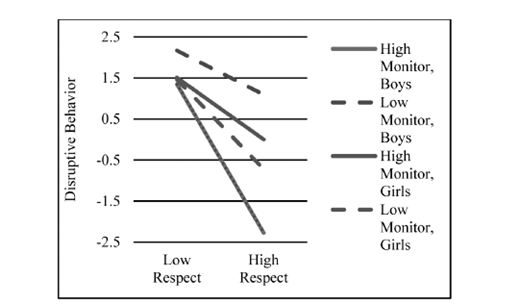
The final regression model for disruptive behavior was statistically significant, F = 9.46 (12, 193), p < .001. Disruptive behavior in the fall was statistically significant at Step 1. Gender was also statistically significant, indicating girls reported lower levels of disruptive behavior than boys. There were no statistically significant gender interactions at Step 3. At Step 4,there was a statistically significant Respect × Monitor interaction, which was followed-up with a statistically significant Respect × Monitor × Gender interaction in Step 5 (Figure 3). This three-way interaction indicated boys who reported high levels of respect and monitoring reported the lowest levels of disruptive behavior. Simple slopes analysis indicated a statistically significant negative relationship between respect and disruptive behavior for boys with high levels of monitoring (β = −.91, t = −4.37, p < .001), and a marginally significant negative relation for boys with low levels of monitoring (β = −.27, t = −1.77, p = .079). There was a statistically significant negative relationship between respect and disruptive behavior for girls with high and low levels of monitoring (β = −.38, t = −2.66, p < .01 and β = −.55, t = −3.86, p < .001, respectively). Thus, teacher support and structure explained significant variance in engagement (involved, disruptive) and this was moderated by gender for disruptive behavior.
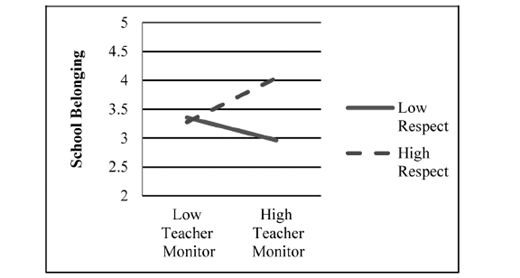
School Belonging. The final regression model for school belonging was statistically significant, F = 12.80(9, 189), p < .001. School belonging in the fall was statistically significant at Step 1. At Step 2, teacher expectations was positively related to subsequent belonging. There were no statistically significant gender interactions at Step 3. At Step 4, there was a statistically significant Respect × Monitor interaction (Figure 4). Simple slopes analysis revealed a statistically significant positive relationship between monitoring and belonging for students who reported high levels of teacher respect (β = .47, t = 6.08, p < .001), and a statistically significant negative relation for students who reported low levels of teacher respect (β = −.32, t = −5.71, p < .01). Thus, autonomy support and structure explained variance in belonging.
Achievement. The final regression model for achievement (GPA) was statistically significant, F = 10.51(16, 193), p < .001. GPA in the fall was statistically significant at Step 1. At Step 2, there was a statistically significant positive association between expectations and later GPA. At Step 3, there was a statistically significant Choice × Gender interaction. Simple slopes analysis indicated a statistically significant positive relationship between choice and GPA for boys (β = .25, t = 2.62, p < .01) but not for girls (β = −.01, t = 0.09, p = .925). At Step 5, there was a statistically significant Respect × Monitor × Gender interaction, indicating boys who reported high levels of respect and monitoring reported the highest achievement (Figure 5). Simple slopes analysis indicated respect was positively related to achievement for boys with high levels of monitoring (β = .30, t = 2.13, p < .05) and negatively related for boys with low levels of monitoring (β = −.17, t = 1.90, p < .05). There were no statistically significant relations for girls with high and low levels of monitoring (β = −.23, t = −1.59, p = .113 and β = −.01, t = −0.11, p = .913, respectively). There was a statistically significant Respect × Help × Gender interaction, indicating boys who reported low levels of help and high levels of respect reported the highest achievement (Figure 6). Simple slopes analysis indicated respect was positively related to achievement for boys with low levels of help (β = .49, t = 3.20, p < .001) and negatively related for boys with high levels of help (β = −.41, t = 2.19, p < .05). There were no statistically significant relationships for girls with high and low levels of help (β = −.19, t = −1.34, p = .181 and β = .00, t = 0.04, p = .971, respectively). Thus, teacher support and structure explained significant variance in GPA and this was moderated by gender.
Discussion
The present study aligns with and extends prior research examining associations of teacher autonomy support and structure with adjustment during early adolescence (e.g., Jang et al., 2010; Patrick et al., 2007; Wang & Eccles, 2013). We extend this literature by investigating associations of multiple types of support (choice, respect, relevance) and structure (monitoring, expectations, help) with adolescents’ academic motivation, classroom engagement, school belonging, and achievement during the middle grades. The findings indicated unique and joint associations of support and structure with adjustment and that gender moderated these relations, and provide insight into factors that meet adolescents’ needs and shape their adjustment (Deci & Ryan, 2000; Eccles & Roeser, 2011). Implications for middle grades educational research and practice, with a focus on understanding the role of support and structure on student adjustment in urban, diverse middle schools are discussed.
Associations of Teacher Autonomy Support and Structure With Student Adjustment
As expected, teacher promotion of respect was positively related to later involved behavior. These findings extend prior research indicating respect is associated with student efficacy, self-regulated learning, and engagement (Patrick et al., 2007; Ryan & Patrick, 2001). Teacher expectations were positively related with later intrinsic value, belonging, and achievement, aligning with and extending prior cross-sectional variable- and person-centered analyses as well as qualitative research demonstrating teacher expectations are related to adaptive student outcomes (Daniels & Arapostathis, 2005; Kiefer, Ellerbrock, & Alley, 2014; Wentzel et al., 2010). The findings provide further evidence that high teacher expectations are desirable, especially for youth in urban school settings (Corbett et al., 2002; Matsumura, Slater, & Crosson, 2008).
Teacher autonomy support and structure influenced student outcomes after controlling for prior adjustment. Students who perceived high levels of teacher support and structure (i.e., choice and monitoring, choice and help, or respect and monitoring) reported high levels of subsequent intrinsic value. The findings align with research indicating that providing students with choice can help to meet their developmental needs and foster motivation and engagement (Patall, Cooper, & Wynn, 2010; Williams, Wallace, & Sung, 2015). Teachers can monitor individual and whole-class learning, as well as employ other strategies to create supportive learning environments (Anderman, Andrzejewski, & Allen, 2011)and promote student motivation (Jang et al., 2010; Skinner & Belmont, 1993). Students who perceived high levels of relevance and teacher expectations reported higher levels of later involved behavior. The findings extend research by demonstrating a joint influence of teacher behavior on adjustment and reinforces relations of perceived teacher support and expectations with adaptive student motivation and learning (Vansteenkiste et al., 2012).
As expected, gender moderated associations of support and structure with student adjustment. Boys who perceived high levels of teacher respect and monitoring had the lowest subsequent disruptive behavior and the highest achievement. Similarly, students who perceived high levels of teacher respect and monitoring had high levels of later intrinsic value and school belonging. Results suggest promotion of respect may serve as a protective factor when coupled with appropriate levels of teacher guidance and monitoring of learning, especially for boys. The findings align with research indicating that respect and monitoring are key characteristics of learner-centered classrooms (McCombs & Whisler, 1997) and that students have higher engagement when they perceive teachers using learner-centered practices (Meece, 2003). Shared respect and guidelines for appropriate behavior and learning in the classroom may be especially important to the academic success and positive outcomes for ethnically diverse, urban adolescents (McHugh, Horner, Colditz, & Wallace, 2013; Ozer, Wolf, & Kong, 2008).
Boys who perceived high levels of teacher respect and help had the lowest levels of later achievement. Although teacher respect and monitoring may serve as protective factors, help from teachers who promote respect was related to lower achievement for boys. Although not expected, this finding corresponds with research indicating help from peers negatively predicts student interest (Wentzel et al., 2010). The findings suggest that boys who need direct help may be lower performing, or that receiving help as a boy may be stigmatized if it goes against gender norms (Rose & Rudolph, 2006). This aligns with prior research indicating that boys often have higher levels of avoidance of help seeking from teachers and peers than girls, and that this negatively influences their learning and achievement (Ryan, Pintrich, & Midgley, 2001; Ryan et al., 2005). Middle grades educators may consider ways to promote a classroom climate supportive of help-seeking (Shim, Kiefer, & Wang, 2013) to foster learning and adjustment, especially for boys. Gender moderated relations of support and structure for engagement and achievement. This finding suggests behavioral aspects of adjustment may be more susceptible to the influence of gender norms and behaviors (Rose & Rudolph, 2006; Ruble et al., 2006) compared to motivation and belonging, although additional research is needed. Results highlighting gender as a moderator align with gender normative perceptions and behaviors (Rose & Rudolph, 2006; Ruble et al., 2006) and lend support to examining the role of gender in urban, ethnically diverse youth’s experiences in middle school (Wallace & Chhuon, 2014).
Collectively, the findings indicate that high levels of teacher support and structure are related to positive adjustment (except for teacher respect and help for boys’ GPA), and that high levels in one aspect are not sufficient for optimal adjustment (Sheldon & Niemiec, 2006). Results indicate support and structure are complementary factors and that teachers engage students when they offer high levels of both (Jang et al., 2010; Reeve, 2006). Results extend middle grades research by demonstrating relations of teacher support and structure with adjustment and underscore that early adolescence is a key developmental period for examining the role of teacher practices in promoting student learning (Jackson & Davis, 2000; Kiefer et al., 2014).
Implications, Limitations, and Future Directions
This study has implications for continued investigation and support of early adolescent adjustment during a time characterized by changes in perceived teacher instructional styles and declines in motivation, engagement, and achievement (Anderman et al., 1999; Balfanz et al., 2007; Eccles & Roeser, 2011). The findings highlight the need to investigate types of teacher support and structure in order to gain a more nuanced understanding of their influence on adolescents’ school adjustment. Results suggest teachers can purposefully use support and structure to foster positive student adjustment (Jang et al., 2010; Sheldon & Niemiec, 2006) and consider how this may differ for boys and girls. Results suggest boys may be more susceptible to the influence of teacher support and structure compared to girls. Results may inform how teachers utilize instructional practices (Anderman et al., 2011) and aid in the development of responsive school and classroom-based interventions to support young adolescent motivation, engagement, belonging, and academic success (Turner et al., 2014; Wentzel & Wigfield, 2007). Results may also inform content-specific interventions grounded in self-determination theory that promote positive teacher beliefs and behaviors regarding autonomy support and structure (Aelterman et al., 2014) and help teachers to effectively implement these beliefs and behaviors in the middle grades classroom.
Results should be understood within the context of limitations and future directions. The results regarding associations of teacher autonomy support and structure with student adjustment warrant further research and likely involve complex classroom-based processes (Reeve, 2006; Reeve et al., 2004). Observational and qualitative research is needed to further investigate student and teacher perceptions of support and structure and their influence on adjustment (Anderman et al., 2011; Jang et al., 2010), especially in ethnically diverse, urban schools (Wallace & Chhuon, 2014; Wallace & Sung, 2016). Using a person-centered approach to interpreting quantitative data may provide insight into the unique student profiles regarding the influence of teacher support and structure on adjustment (Vansteenkiste et al., 2012). Utilizing multiple methods may also help to more accurately capture teacher beliefs and behaviors rather than relying solely on student self-reports, which may have shared-source variance. The current study utilized a modest sample size for the hierarchical model analyzed which could contribute to familywise Type I error; future research replicating the methods of this study utilizing larger samples is recommended. The use of self-reported achievement and should be interpreted with caution in the present study; future studies could use school or teacher-reported grades for more accurate assessments of achievement. Future studies might also examine differences in adjustment among students within autonomy-supportive classrooms (Wallace, Sung, & Williams, 2014) and for students with differing levels of adjustment, such as engagement (Cooper, 2014; Turner et al., 2014). Future research can use three or more time points to investigate potential developmental trends, trajectories, and bidirectional relations of teacher support and structure with student adjustment. Additional research is needed to examine such processes and associations in diverse, urban middle school contexts and among students who may be at risk of school failure and in need of learning supports (e.g., Balfanz et al., 2007).
Despite its limitations, this study contributes to middle grades research and practice by documenting meaningful relations of teacher autonomy support and structure with adolescent adjustment in a large, diverse, urban middle school. The findings highlight the influences of teacher support and structure on student motivation, engagement, belonging, and achievement, and indicate the need for educators to purposefully implement multiple types of support and structure in order to promote optimal student functioning during middle school.
Note
We utilized intraclass correlation coefficients (ICCs) to determine whether to use multilevel modeling analyses. ICCs indicate the proportion of total variance that can be attributed to between-class differences. The average ICCs was .08 (ranging from 0.05–0.15). Although there are no firm guidelines, multilevel analysis is often considered when ICCs are greater than .10 (i.e., at least 10% of total outcome variance lies between level-2 units; Hox, 2002). Thus, we could consider multilevel analyses for some variables but opted to conduct hierarchical linear regression for all variables.