The purpose of this study was to investigate the ways middle school students utilized visual photographing literacies during a participatory action research project as they jointly investigated factors that support and/or hinder students’ academic success. Research questions included: (a) How do Sage Middle School (pseudonym) students perceive what supports or hinders students’ academic success in school; and, (b) In what ways do Sage Middle School students engage in visual photographing literacies to express and reflect on the factors that support or hinder students’ academic success? Analysis indicated students felt their own attitudes and hard work, their teachers, other students, and appropriate and ample instructional resources could support or hinder their academic success. Findings from this research can be used by educators and educational researchers to aid in the development of interventions to improve students’ perceptions of their learning environment; in particular, what they believe supports and hinders their academic success.
Youth face a critical transition in their developmental and academic trajectory during their late childhood and early adolescent years. Moreover, this is a time when they often experience an increase in academic disengagement. Participatory action research (PAR) projects can promote adolescents’ sense of meaningful engagement in school and provide a sense of efficacy, which can be particularly powerful during the challenges encountered at this stage. PAR has been depicted as a “theoretical standpoint and collaborative methodology that is designed to ensure those who are affected by the research project have a voice in that project” (Langh-
out & Thomas, 2010, p. 60). The PAR
approach is more commonly used today in P-12 educational research, though it has been a longstanding practice in research studies in educational psychology, public health, and adult education as a means of engaging marginalized populations in projects that address conditions of oppression (e.g., Freire, 1973/ 2002; Schensul & Berg, 2004).
A hallmark of the PAR techniques is that nonprofessional community members are trained as researchers and change agents within a cooperative, iterative process of research and action. Further, decision-making is shared among all partners in the collaboration, within all phases of the research (Israel, Checkoway, Schulz, & Zimmerman, 1994). PAR provides opportunities for typically marginalized community members to work together to solve problems, to develop relevant skills, to increase their understanding of their environment, and to create mutual support systems (Israel et al., 1994). Photography has also been used as a PAR method to understand youths’ perspectives on their school, home, or community-based experiences (McTaggart, 1997; Selener, 1997).
In this study, I sought to examine the ways middle school students utilized visual photographing literacies during a PAR project as the students and I jointly investigated factors that supported and/or hindered students’ academic success. Research questions guiding this inquiry included: (a) How do Sage Middle School (pseudonym) students perceive what supports or hinders students’ academic success in school; and, (b) In what ways do Sage Middle School students engage in visual photographing literacies to express and reflecting on the factors that support or hinder students’ academic success?
Literature Review
During late childhood and early adolescence, school settings are intricately related to key developmental milestones, including academic achievement, peer relationships, and prosocial conduct (Eccles & Roeser, 2003). Findings across multiple research studies have described the types of interaction between youth and their environments that are associated with positive development (e.g., Eccles & Wigfield, 2002; Granger, 2002). These attributes are captured by the following features: feeling safe, both physically and psychologically; having appropriate structure; encouraging relationships; feeling a sense of belonging; supporting self-efficacy; providing opportunities for skill building; and integrating family, school and community efforts. Conducting PAR with youth in middle school is a process that could potentially target all of these attributes of positive development.
PAR explicitly addresses the following attributes: opportunities for developmentally appropriate and meaningful participation; support for self-efficacy; development of relevant skills; and supportive relationships. Thus, PAR may be an excellent avenue to engage students during the middle grades transition, a period associated with declines in academic motivation and achievement for some students (Eccles et al., 1993), as well as increases in depression and other psychological problems (Galaif, Sussman, Newcomb, & Locke, 2007). Research completed by Eccles and colleagues (1993) posits there may be a developmental mismatch occurring during middle grades transition, suggesting that a poor person-environment fit may lead to decrease in motivation and engagement youth experience. PAR interventions may serve to help reduce developmental mismatch and to promote students’ positive identity development.
In this digital age where images can quickly be globally shared, photo-elicitation techniques have emerged as an important research tool (Litner, 2005; Serriere, 2010). Research indicates photographs can be used with students as a platform of social understanding (Litner, 2005). Photographs have also been used in public health education and community development to inspire change by connecting participants to their community (Downey, Anyaegbunam, & Scutchfield, 2009; Morgan et al., 2010). For example, one team of researchers explored rural Appalachia people’s understandings of and barriers to public health in an effort to improve access to resources (Downey et al., 2009).
The use of photography as a research/ instructional tool in education has been limited, but recent research indicates photography can provide insight into students’ understanding and perceptions, as well as giving students a voice (e.g., Cook & Buck, 2010; Furman & Calabrese Barton, 2006; Quigley, Rodriguez, Cook, & Buck, 2010). Research indicates photography can be used not only as a tool to discuss content, but also as a way to uncover student and teacher thinking (Quigley et al., 2010). In recent research, “photovoice” has been used as a pedagogical tool to empower students to take action in their community (Cook & Buck, 2010). Photovoice asks students to document their perceptions, using photographs, about issues that impact their lives, and to support students’ discussion about these issues with people in a position to potentially activate change. Students’ photographs and narratives provide insight into their thinking and inspire them to engage as change agents.
Photovoice, as a research method, involves putting cameras in the hands of research participants to capture their perspectives, which might not be obtained through discussion alone. This method asks participants to photograph a concept within a context, allowing them to define that concept as opposed to having the concept defined by the researcher. The method supports the coconstructive process of data collection and initial analysis because participants select the way they will picture the concept, and they interpret their own photographs (Moran & Tegano, 2005). Moran and Tegano (2005) described the language of photography as structural, communicative and generative. Photographs are invaluable tools to stimulate discussion considering they can be analyzed in a series or coupled with discussions to yield more specific interpretations of students’ conceptualizations.
Theoretical Framework
Social cognitive theory, as conceptualized by Bandura (1986, 1997), is a learning theory that stresses the interaction between a person, his or her behavior, and the environment. In his triadic model of reciprocal causation, Bandura illustrated a three-way interplay of influences: a person, which includes his or her characteristics; behavior; and the environment, which includes social interactions (Bandura, 1986). Bandura explained that in social cognitive theory, people are not just products of their environment; they are also producers of their environment. As producers of their environment, people have control of their actions, but their actions are strongly influenced by their beliefs about their abilities to act, or their self-efficacy (Alderman, 2004). Bandura (1986) explained, “Among the types of thoughts that affect action, none is more central or pervasive than people’s judgments of their capabilities” (p. 21). Self-efficacy can greatly influence a person’s behavior, which in turn influences the outcome of that behavior.
Methods
In a middle school context, I set out to understand whether photovoice might illuminate ideas for ways to foster students’ academic achievement that might not have been identified had I relied on more traditional methods.
Participants and Context
This study was undertaken in a suburban middle school in the southeastern United States. I collected the data for this study from a convenience sampling (Patton, 2002) of middle school students, enrolled in a multimedia production class. Ten middle school students volunteered to participate in the study (see Table 1). Students in the class (n = 16) were asked to participate in a student consultation and photovoice activity. The project was explained during a class meeting and interested students took an information packet home, including parental consent and student assent forms. The 10 participants in this study are the students who volunteered and returned the required forms. University institutional review board and district research approva requirements were met.
Procedures
Photovoice (Hubbard, 1994; Wang, 1999) and photo elicitation (Ziller, 1990) methods within a PAR framework provided a means to investigate middle school students’ perceptions of what supports or hinders students’ academic success. Photovoice is designed to give research design and interpretive control to the photographer and is a research tool used in both PAR and with youth researchers. Photo elicitation uses photographs to promp response similar to stimulated recall in that the prompt is selected from data produced by the participant. The combination of photography with photo elicitation in the photovoice forma supported a qualitative, participatory approach to explore participants’ perspectives; giving students a voice by allowing control over the images selected and the sharing of their perceptions through visual, written, and ora reflection.
The photovoice method includes three stages (Nic Gabhainn & Sixsmith, 2006) During the first stage, the participants are trained in basic photography skills, discuss ethics of the project, and receive instruction or how to view photographs. Sessions with participants are necessary to explain the research process and distribute cameras. Following this, the actual photography skill instruction begins, followed by having participants take photographs. In the second phase, participants discuss the photographs, categorize and create themes when viewing the photographs, and omit photographs unrelated to the collective conceptualization they are building. The third phase includes research that involves other stakeholders, such as community leaders and policy makers, with whom the student researchers share findings and receive feedback.
In the present study, photovoice was used following the first two stages in this process. The first step in this study entailed teaching the students about imagery and photography. Photographic images were presented to the students and they were asked to interpret them and discuss the contexts of the images. This generated discussion about images and allowed me to model for students how to tell stories about their photographs. Images can mean different things to different people, so the words and stories placed alongside an image are important and extremely subjective. I demonstrated the use of personal narrative processes and applied meaning to photo graphic images as I modeled this process for the students.
I also used Gillian Rose’s (2016) Visual Methodologies as a foundation to teach students to apply visual analysis to photographs. Rose noted, “photos are particularly good at capturing the ‘texture’ of places … partly because photos can carry so much visual information; they can show us details in a moment that it would take pages of writing to describe” (2016, p. 247). I had students select photographs they liked and disliked from magazines to practice these skills. Afterward, each student wrote an explanation for liking or disliking the images they selected. This allowed students to think about imagery and link words and meaning to their images. When students understood how to apply visual analysis to images, I taught them about photography and how to operate the digital cameras.
Introducing the digital cameras was extremely motivating for the students and led to an increase in student engagement. After students were assigned a camera, they took them outside and were allowed to take as many photographs as possible within a given time frame. The immediate use of the cameras allowed students to discover the camera’s features in a constructivist approach; students supported each other as they discovered what their cameras could do. I circulated during this process, making sure all students understood the basic operation of their camera, as well as basic photography skills. This initial excitement about using the digital cameras faded within a few class periods but was replaced by more goal-oriented activities as students worked to complete the project.
When students returned to the classroom, they were asked to download their images to their laptop and clear the camera memory. The class discussed photography, including the ideas that its use as a tool is no different from using a pencil and paper to capture ideas. Images exist within a context, which is defined by the person who has control over the frame and image. I also discussed ethics of this project with the students, including being mindful of the rights of others and whether they agreed to be depicted in photographs (if students were planning to take pictures that included people). We talked about the importance of gaining consent from each individual they might want to photograph prior to taking their picture, whether they were alone or in a group.
Students were next introduced to the project directions, including taking pictures representing their perceptions in response to questions, and interpreting and reflecting on the images taken. Students took pictures to answer the following inquiry questions: (a) What do you think supports students’ academic success at Sage Middle School; and, (b) What do you think hinders (conflicts with) students’ academic success at Sage Middle School? First, students reflected on how they wanted to answer these questions in their journals, creating a list of pictures they felt might capture a photographic response to each question. Students brainstormed multiple picture ideas (10+) in response to each question. Next, students took their pictures, recording information in their journal as they took each picture, including location, date/time, reason for selecting the depiction, name and consent information if picturing a human subject, and so forth.
After taking pictures, students wrote about their choices in their journals, sharing why and how each picture represented their response to each question. When reflecting on their photographs, students were asked to consider the following reflective questions: what is the picture about to you? What do you see? What is in this photograph, and what is not in the photograph? Would someone else look at this and see something different? After reviewing their photographs, field notes, and all reflections, students selected three photographs for each question that they felt best represented their responses, for a total of six photographs. Students then submitted these final six photographs, with the accompanying reflections and field notes.
I then conducted one-on-one interviews with each student to review their images, including discussing why specific images were taken in particular contexts. Students were interviewed individually, using their photographs within a photographic elicitation technique to discuss their selected photographs as responses to the research questions. These interviews were audio recorded and later transcribed for data analysis. I employed semi-structured interviews, using the following statements to begin each conversation:
What is this picture about to you?
What do you see?
What is in this photograph, and what is not in this photograph?
Would someone else look at this and see something different from what you are describing?
Are there things in the environment that only certain people see/feel/perceive?
Data Sources and Analysis
Three primary data sources were used: transcripts of the interviews during which students showed and explained their photographs, the corresponding photographs themselves, and students’ reflections and field notes for each photograph. Transcripts, notes and corresponding photographs (electronic format) were uploaded into Atlas.ti qualitative data analysis software, which allowed me to link text and graphic files, as well as to highlight and code text and create research memos. First-order, thematic codes were assigned to parts of data to represent categories or ideas, which were then used to develop lists of quotations or images by code in new documents. These quotation and image documents were then recoded with second-order codes that represented patterns and themes evident in the group of quotations or images (Saldarla, 2013). I identified categories within the data, and used analytic memo writing when searching for patterns and themes to gain a deeper understanding.
The study’s rigor was enhanced by processes such as triangulation of data sources, checking potential findings with participants
(Patton, 2002), and an independent audit of the data collection and analysis activities by a colleague. The students and I were coresearchers investigating their perceptions. I recognized the influence I had as their teacher and guarded against this influence by assuring students our conversations and their data would be confidential and not identified by name, and that students would not be graded for this project (this was considered skill practice in the course). I kept a researcher journal to promote my own self-awareness and reflect on my potential biases and predispositions throughout this project as well.
Findings
Four themes emerged during the coding of collected data regarding what students believed could support or hinder their academic success. Students frequently indicated that their own attitude, including a positive mindset and hard work, was supportive of success; however, they also stated that a negative mindset and bad attitude were equally as likely to hinder their academic success. Students also shared that both their teachers and other students could either support or hinder their academic success. Students also indicated that appropriate and ample instructional resources would support their academic success.
Though analysis of the students’ photographs and the ensuing discussions did not yield any new ideas related to the factors influencing students’ academic success at the middle school level, the use of photovoice in a PAR framework empowered and enabled students to express their own thoughts about academic success. Students have not often been engaged in the research process as coresearch-ers, and student voices are not a large part of the body of knowledge on student academic success. Findings are significant in that students’ perspectives may appropriately influence the way educators construct instruction and environments.
Appropriate and Ample Instructional Resources
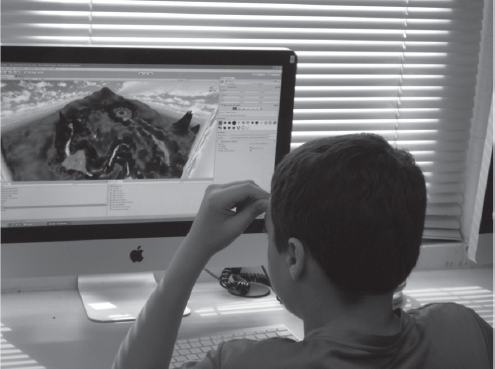
Four students shared in both photographs and during our discussions that they had access to appropriate and ample resources, which supported their academic success. However, based on students’ comments regarding their photographs, it is unclear whether they chose to picture “resources” because they were easy things to capture in photographs, or if they captured these images because they realized the importance of adequate resources in supporting student academic achievement. When I asked one student how the resources in his photograph was a support for his academic success, he replied, “We have a new computer lab with scanners, printers, and other technology that we can use when we are completing projects in class” (Figure 1). He further shared he was able to use the computer lab for several projects in the past school year across multiple classes (e.g., language arts, science and social studies), since his teachers scheduled the lab for class use. He did not have all this equipment at home, so he enjoyed using the computer lab to complete these projects for class. Additionally, he shared:
I think I did better on these projects because they were fun…. I liked using the lab and creating the presentations and movies for class. I got to show I understood things by creating something instead of just answering questions or writing an essay, which I don’t like as much.
According to this student, using the technology in the lab was motivating, and he felt he “This picture shows a student in our computer lab. He is working on a project for a class. Having this lab is a good resource that supports student academic achievement. I don’t have all the equipment at my house that we have in the new computer lab, so I can do more at school because I can use this. I think that this picture also shows hard work and determination amounting in a good-looking project on the computer. I chose this picture because part of how we can be successful in school is working hard, but we also need to be able to have skills with technology—be able to use computers and know how to use the software—so we are successful. Hard work in school can lead to success in the future with jobs and you will be a valuable employee to whoever you work for if you have good skills. This picture shows a student who is successful with a computer project he is working hard to finish. I think I am better at work when I get to use the technology myself. It makes me want to work harder. I like using technology more than answering questions and writing essays to show what I know in classes. It isn’t boring.” worked harder on the projects in his classes to “make it [his product] as good as I could get it,” which resulted in a better outcome academically.
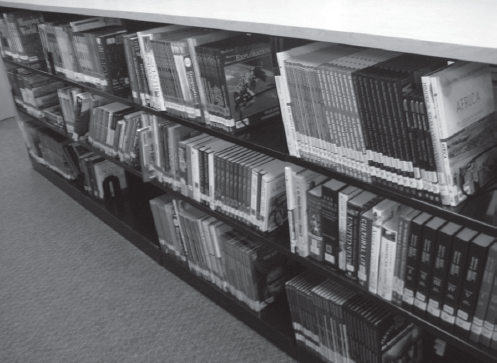
In contrast, when I asked Student C about the books she had pictured in the school library (Figure 2), her response was not as directly connected to supporting students’ academic achievement. She stated the library “had a lot of books I can check out,” and that her language arts teacher also had “a lot of books in his classroom library I can borrow any time I want.” Student C also mentioned she shared books and resources with her friends from personal collections. In this instance, she did not make explicit statements that connected these books to support of academic success; she just stated students had a lot of choices and reading material.
When I asked in follow up how she thought the books supported academic success, she answered, “We have to read for our language arts class. Mr. Z requires us to read a book and take the AR [Accelerated Reader] quiz, and we are graded for it in his class. If I don’t read I won’t get a good grade in his class.” Although she was able to share a connection between the requirement to read and take an AR quiz in her language arts class with the books she pictured in her photograph, there was not a clear connection between reading and supporting students’ academic success. When asked if she thought reading supported students academically, she responded, “reading helps you learn.”
Students’ Attitudes
One of the most striking findings identified via analysis of both the photographs and transcripts of the discussions with students was their understanding of how much their own hard work and effort were responsible for their academic achievement. Students recognized they were in charge of their fate academically. Though they shared other factors that could “This picture shows books in the library. We also have lots of books in our language arts teachers classroom libraries, and we share books with our friends from our personal collections at home. We can check out the books from the library and from our teacher any time we want. In language arts, we have to read books and take AR [Accelerated Reader] tests to get grades in class. If we don’t read and take these tests then we don’t get a good grade in class. Reading can help us in life so it supports our academic achievement.” definitely influence their success, for better or worse, when it came to taking responsibility, they stated unequivocally that they were ultimately in charge.
Students also indicated in this same vein that their own attitudes towards learning impacted their academic success. Though no pictures were shared depicting attitudes towards learning, in interviews with three students (A, D, and J), it was clear that at least in some cases a student’s own attitude might influence his or her academic success in school (e.g., not liking a teacher or a subject, issues with classmates, feeling distracted, being unhappy). For example, students talked about not liking a teacher or a subject, and how that sometimes made them not want to participate or do their work, which would hinder their academic success. However, students also stated that ultimately it was that student’s own fault if he or she was not academically successful. Further, students indicated if they were having issues with classmates and got in a fight with someone, or if they were unhappy, then their attitude might keep them from paying attention and participating, which would negatively impact their success academically.
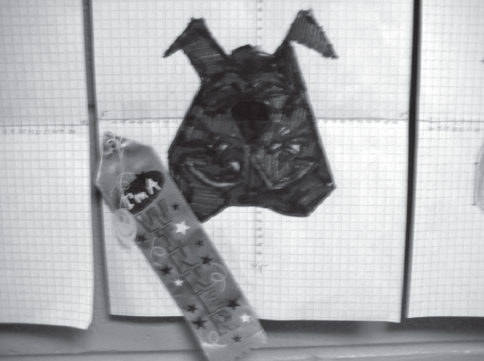
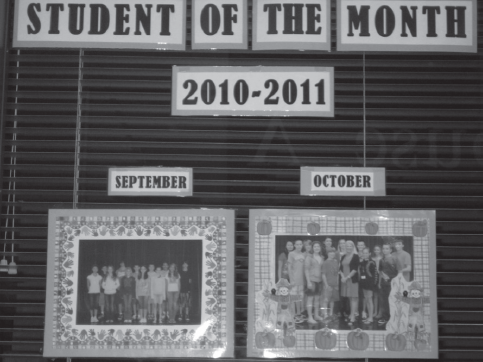
A few of the students’ pictures identified school activities that could have an effect on motivation, attitude, and academic achievement. For example, Student B photographed a student’s work posted on a wall outside a classroom (Figure 3). He shared, “This picture shows a student’s work being rewarded with a first-place ribbon. This student won a small achievement that will help make him determined to try hard and earn more awards.” Another picture depicted the student of the month display in the main hallway (Figure 4). Student F took this picture, sharing, “I think that becoming student of the month is a good goal to have. I have won student of the month twice, and it was a great accomplishment for me. I had to work hard in all of my classes for my teachers to recommend me for this award.” Student F believed students had to have a good attitude to work this hard and receive this award.
The Teacher
Another interesting finding was that students indicated teachers were a factor that could have either a positive or negative effect. Five photographs selected by students depicted teachers in the midst of teaching a class, with notes that indicated good teaching was the biggest factor in supporting students’ academic success. Students felt a teacher was much more likely to have a positive influence on the academic success of their students if they: (a) were friendly, (b) had a good relationship with their students, (c) knew their students personally, and (d) were interested in their students. Students also indicated in written reflections that accompanied their photography they would be more likely to listen to and work hard for a teacher who possessed these qualities.
Interestingly, no photographs depicted a teacher with notes stating how a teacher could hinder students’ academic success, but, during interviews, students stated that a teacher could hinder students’ success if they were not nice or did not treat their students fairly. Students also stated teachers who did not seem to care about them, who were not “good” teachers, and who did not seem to know their content well were not supportive of students’ academic success. Students said they were less likely to work hard for this type of teacher, and they indicated they were not particularly motivated to make this kind of teacher proud or happy.
One picture that was shared and connected to an instructor at the school depicted the school library. In her reflection, student G discussed resources available as a support for students’ academic achievement. However, when we talked about that photograph student G realized that it was not the library itself and the book resources, but the school librarian who was the resource she should have depicted in the photograph. When asked if something beyond the library and the books supported student achievement, student G responded:
The books are important but so is Mrs. X. I was working on a project for science fair the other day and having a hard time. She helped me to think about how to find information on my topic—to understand my topic better so I could find the information. I guess it’s really Mrs. X I wanted to share who supported academic achievement. I don’t think I would have done as well on those projects without her help.
Other Students
Six students also indicated they felt that other students could both support and hinder a student’s academic success, depending on their interactions. In particular, friends were cited as being a group that often held the potential to hinder academic success by distracting a student from concentrating on schoolwork outside of school. For example, Student H shared a photograph of a cell phone and stated:
I took this picture because I think that talking on your cell phone can be a good and bad thing. When I am texting, and ignoring my homework and what I have to do, that is bad, but if my friends are helping me and answering questions, that can be good.
Students also stated that friends, if they were good students themselves and hard-working, could potentially increase another student’s academic achievement by encouraging them to do their work and get it turned in on time. Several students mentioned that friends often challenge each other to be successful by trying to outperform each other in classes. As Student B stated, the goal was “To get the best grade.” Student A took a photograph of two boys working together at a table on a class project. He shared they were collaborating and helping each other do classwork. “Collaborating can benefit both students in this situation. The student doing the homework learns how to do the work … [and] the other student benefits by also learning things along the way.” This type of collaboration with friends, according to Student A, supports students both mentally and socially.
Sadly, a few students both talked about and depicted bullying in photographs, sharing how academic success could be hindered when he or she was a target of bullying (Figure 5). Student C shared, “Bullying is something that makes it hard for us to learn and to be successful. When people are mad at me, I can’t focus. I can’t learn because I am worried about what is happening and why that person is mad at me.” Student C worried her friends would stop talking to her, or that she might get “beat up.” She added further, “It makes it impossible for me to care if I am doing okay in school or not.”
Overall, results from the semistructured interview, which were also supported by the qualitative analysis of students’ field notes and reflections, indicated students enjoyed taking pictures. In fact, 9 out of 10 students stated they enjoyed taking photographs and wanted to take more. Students enjoyed writing about their photographs as well (n = 8), and most (n = 7) felt they had taken pictures that accurately reflected supports of students’ academic achievement. However, fewer students (n = 5) felt they were able to accurately depict in photographs the things that hindered students’ academic achievement. Finally, all 10 students were supportive about using this type of method in future multimodal projects.
Discussion and Implications
Getting youth involved in research about their own environment and how it affects them was a bit more challenging than I originally anticipated, but very well worth the effort. Some students took pictures quickly, not putting much consideration into the context they were capturing and why they selected it beyond a sur-face level. Other students were more cognitively engaged in the assignment, thinking carefully as they used the photovoice and elicitation techniques to think more deeply in response to the questions they were trying to answer with the photographs. There were a few glitches with the technology that proved frustrating and distracting for some students as well (e.g., camera issues, forgetting to save or delete photographs).
At the beginning of this project, most students were primarily interested in taking pictures and having fun with the cameras. However, over time they began to use the opportunity to capture images of school related assets and deficits that connected to students’ academic achievement. I observed some students were more reflective than others with their photographs as the project unfolded; they became more introspective and serious about the photographs they chose to take, evident in shared reflections and our conversations. In our interviews, these students indicated photographing challenged them to find the “perfect” way to depict what they wanted to say. As well, when observing the selected context in the students’ photographs and their reflections, I noticed a little more than half (n = 6) of the students were more apt to personally identify with the photographs they were taking and why they were taking them. In this context, photographs appeared to fall into two categories: those that were more personal in nature for the students, and those that were “community” oriented, with fewer personal ties.
Students who took pictures to which they were more personally connected seemed to be more involved in the learning process, compared with students who quickly took pictures and could neither clearly identify why they took those pictures, nor clearly articulate what connection those pictures had to the topic being explored. Students who struggled later during the reflection and writing phases had, earlier in the process, had difficulty making concrete connections between the pictures they took and how those pictures were responses to the prompts. When asked why they chose to depict something with a certain photograph during the interview phase, these students would say they did not know or that they could not remember. When these same students were asked to consult their notes to think about it, they had recorded few notes in their journal attached to the photographs in question.
One thing that may have negatively impacted some students’ ability to be as engaged in the project was the way photovoice was used, namely not including the group discussion that is typically a part of the methodology. Group discussion is an important aspect of the photovoice process, and not holding class group discussions hindered opportunities for participants to inspire each other to take better and more informative pictures. Although I did engage students in one-to-one discussions about their photographs, I believe group discussion might have benefited those individuals who were less apt to discuss their choices with me and may have felt more comfortable talking with peers in a group setting instead. Regardless, evidence gleaned from interviews, field notes, and reflection, as well as my observation of students during the entire process confirmed that the project was in some ways very empowering for these students.
Findings from the present study may be useful to educators and researchers developing interventions to improve students’ perceptions of their learning environment and teachers’ instruction. Moreover, the present study may be informative due to the combination of methods employed. Photographs as used herein not only represented students’ perceptions on questions asked by the researcher, but also stimulated students’ reflection on other things they choose to write and speak about related to the topic. Student selected photographs used in conjunction with the photographic elicitation technique enhanced the interview process, allowing a richer perspective to emerge. Future researchers may wish to build on these techniques as a way to give greater voice to middle grade research participants.
After completing this project, the student participants and I discussed what they had learned and how I might conduct similar projects using these techniques in the future. Some of the issues that we encountered in the project could have been overcome more easily with a little more practice with the technology before we began—more time playing in the sandbox with the technology before it had to be used for a purpose. Organizing a detailed timeline for the project is also highly recommended, but flexibility during the process will still be needed. In retrospect, I did not provide enough guidance for some of the students. Providing students with a few exemplars and discussing as a group initial photographs taken by the class would have been supportive in helping some students develop skills for this project. Students also expressed an interest in examining other factors outside of the school setting that they felt influenced students’ academic achievement. In particular, they expressed interest in family and community factors that might support or hinder success. Expanding the project to include these additional factors could be useful in demonstrating other advantages of the photovoice process.
Conclusion
Photovoice projects with youth are popular in terms of their ability to document social change and serve as a promising means for including young people as coresearchers (Strack, Magill, & McDonaugh, 2004; Wilson et al., 2007). In that sense, this project is not unique. However, my observations that photovoice gives students a forum and a voice to explore and to weigh in on factors contributing to their own academic success is important. The advantages of photovoice are that it is a fast, inexpensive, and evocative method for capturing students’ experience. Using photovoice had the added advantage of linking specific factors students pictured to reasons those factors might support or hinder students’ academic success. While promising, these findings are limited due to the exploratory nature of the present study, as well as the small sample employed. Considering that most photovoice projects have been completed with a very small number of students, further research with larger, diverse samples is warranted.