By integrating scenario-based interviews with measures of teacher burnout, this study aims to provide a nuanced understanding of how teachers respond to students exhibiting challenging behaviors both during and after instructional periods. Consequently, this study sought to address the following research questions: RQ1: How do middle-school teachers with varying levels of burnout describe their approaches to managing student misbehavior and maintaining classroom discipline? RQ2: How does burnout influence middle-school teachers' willingness or ability to adapt pedagogical strategies in response to student disengagement or behavioral challenges?
Methodology Research Design Although this study was primarily qualitative, quantitative data were also collected, specifically measures of teacher burnout levels, to complement the qualitative exploration of teachers' responses in the scenario-based interviews. The quantitative component assessed burnout levels using a standardized questionnaire, while the qualitative component involved semi-structured interviews in which teachers were presented with a hypothetical student scenario. This design allowed for a nuanced understanding of how burnout may have influenced teachers' decision-making processes in real classroom situations. To enhance trustworthiness, attention was given to researcher positionality and analytic verification. The researcher maintained a reflexive stance throughout the study by acknowledging personal perspectives and potential biases related to teaching and education, ensuring that interpretations were grounded in the data rather than prior assumptions. In addition, the developed categories.
Results revealed that teachers with high or moderate burnout tended to adopt avoidant or punitive strategies, focusing on maintaining classroom order and limiting emotional involvement. Conversely, low-burnout teachers employed supportive and adaptive approaches, emphasizing dialogue, reflection, and flexible instructional strategies. Differences in practical decisions were observed both during classroom incidents and in post-class engagement, highlighting the impact of burnout on relational and pedagogical practices.
While this study provides valuable insights into how burnout influences the behavioral responses of middle school teachers, several limitations must be acknowledged. First, the data collection relied on a scenario-based approach and self-reported measures. While scenarios allow for a standardized comparison of teacher decision-making, they may not fully capture the real-time emotional intensity and environmental pressures of an actual classroom incident. Additionally, it is important to note that the scenario-based design captures teachers' intended or reflective responses rather than their real-time practices, which unfold under immediate emotional, cognitive, and environmental pressures. In actual classroom situations, teachers must respond instantaneously to dynamic student behaviors, which may lead to reactions that differ from those articulated in a structured interview context. Teachers' professed strategies in an interview context may be influenced by social desirability bias, reflecting how they believe they should act rather than their instinctive reactions during a high-stress encounter with a young adolescent. Second, the participant pool consisted of 62 middle school teachers from specific urban and suburban contexts in Thailand. While this sample size provided rich qualitative depth, the findings may not be universally generalizable to all middle-level education settings, particularly those in different cultural or socio-economic environments. Furthermore, the cross-sectional nature of the study prevents the establishment of a causal relationship between burnout levels and specific management orientations. Given these limitations, several avenues for future research are recommended. Most importantly, future studies should employ quantitative research designs to strengthen and validate these findings. Large-scale longitudinal surveys could examine whether the four categories identified in this study (avoidant, referral, punitive and supportive) remain consistent across a broader, more diverse demographic of educators. Quantitative modeling, such as Structural Equation Modeling (SEM), could be used to measure the statistical strength of the relationship between specific dimensions of burnout, such as disengagement and exhaustion, and the likelihood of adopting punitive versus supportive orientations. Additionally, future research should incorporate objective observational data, such as classroom video analysis, to triangulate self-reported data with actual behavioral outcomes. Investigating the impact of these teacher responses on middle-level learners' academic engagement and emotional well-being would also provide a more holistic understanding of the burnout-management cycle. Finally, intervention studies are needed to determine if specific professional development programs focused on relational pedagogy and emotional regulation can effectively shift teachers from avoidant or punitive stances toward more supportive, developmentally responsive approaches.
The findings of this study underscore that teacher burnout is not only a matter of individual well-being but a critical determinant of classroom dynamics, disciplinary orientation, and student–teacher relationships (Jennings and Greenberg, 2009; Madigan and Kim, 2021). As burnout increases, teachers' behavioral management strategies shift from relational and supportive engagement toward procedural, punitive, or avoidant practices. This progression suggests that burnout diminishes teachers' emotional and cognitive resources, leading to reduced empathy, lower pedagogical adaptability, and weakened relational connections with students. Conversely, teachers with low burnout demonstrate greater emotional resilience, reflective capacity, and willingness to engage constructively with challenging student behaviors, thereby fostering a more inclusive and supportive classroom climate (Jennings and Greenberg, 2009). Collectively, these findings imply that addressing teacher burnout is essential not only for sustaining educator health but also for promoting positive student outcomes (Madigan and Kim, 2021). Institutional efforts to mitigate burnout, through workload management, emotional support systems, and professional development focused on relational and reflective teaching, may enhance teachers' capacity for adaptive classroom management and preserve the quality of student engagement. In essence, preventing and alleviating burnout is integral to sustaining both teacher effectiveness and the relational fabric of educational environments. Building on these insights, schools can translate relational pedagogy into actionable structures and daily practices. For example, middle grades teams may adopt advisory models in which a small group of students meets regularly with a designated teacher to build trust, monitor well-being, and provide consistent emotional support. Interdisciplinary team structures can further enable shared responsibility for student development, allowing teachers to collaboratively address behavioral and emotional needs rather than relying solely on individual classroom management. In practice, relational pedagogy may involve strategies such as daily check-ins, restorative conversations following conflicts, co-constructing classroom norms with students, and integrating social-emotional learning (SEL) into academic instruction through reflective discussions and perspective-taking activities. Professional development that models these practices, alongside opportunities for teacher collaboration and reflection, can help educators operationalize relational approaches in ways that are both sustainable and responsive to the complexities of middle grades classrooms. Although this study focuses on the Thai educational context, its findings align with international research on middle grades education, which consistently emphasizes the importance of strong teacher–student relationships during early adolescence. At this stage, students are particularly sensitive to the social and emotional climate of their classrooms. As a result, when teacher burnout weakens relational teaching practices, it poses a significant risk to students' academic progress and overall development across different contexts. Therefore, addressing teacher burnout is not only a local concern but also a global priority for ensuring the core goals of middle grades education are achieved.
These findings suggest that teacher burnout constrains emotional and cognitive resources, reducing empathy and adaptability, while lower burnout fosters resilience and constructive student interactions. Institutional interventions, including workload management, emotional support and professional development in relational pedagogy, may mitigate burnout and enhance both teacher effectiveness and student outcomes.
Introduction
Teacher burnout has become an increasingly important concern in educational research and practice, reflecting the emotional, cognitive, and behavioral strain educators experience due to chronic job demands (Brouwers, Tomic, & Boluijt, 2011; Collie, 2023; Khan, Yusoff, & Khan, 2014; Nicuț;ă et al., 2023; Skaalvik & Skaalvik, 2020). Beyond its impact on teachers' well-being, burnout can influence classroom management, instructional decisions, and relationships with students (Bermejo-Toro, Prieto-Ursúa, & Hernández, 2016; Madigan & Kim, 2021). These impacts are particularly pronounced in middle-level education, which is distinct in its focus on young adolescents (ages 10–15) undergoing significant neurological, social, and emotional transitions (Chung & McBride, 2015; Main, Bouton, Pendergast, & Whitaker, 2025). Middle school teachers also operate within a uniquely complex professional context, often teaching multiple classes across subject areas, managing diverse student needs, and balancing academic instruction with significant responsibilities for students' socio-emotional development. Effective teaching at this level requires developmentally responsive practices, whereby educators must balance academic rigor with substantial emotional support and relational pedagogy (ibid.). However, the sustained emotional labor involved in cultivating such relationships may place middle school teachers at heightened risk of burnout, potentially undermining the warm and inclusive classroom environments essential for this developmental stage (Madigan & Kim, 2021).
A substantial body of research has explored the relationship between teacher burnout and their mindsets, attitudes, and classroom behaviors (Costa, Pirchio, Shevchuk, & Glock, 2023; Dubbeld, Hoog, den Brok, & de Laat, 2019; Kadi, Beytekin, & Arslan, 2015; Klusmann, Kunter, Trautwein, Lüdtke, & Baumert, 2008; Zilka, Nussbaum, & Bogler, 2023). These studies provide a valuable understanding of general patterns but often rely on surveys or broad observations, leaving questions about how burnout actually influences teachers' decision-making in real classroom situations, especially in the context of middle school education. Therefore, the present study aims to address this gap by examining teachers' responses to a hypothetical student scenario involving academic, behavioral, or emotional difficulties. By integrating scenario-based interviews with measures of teacher burnout, this study aims to provide a nuanced understanding of how teachers respond to students exhibiting challenging behaviors both during and after instructional periods. Consequently, this study sought to address the following research questions:
How do middle-school teachers with varying levels of burnout describe their approaches to managing student misbehavior and maintaining classroom discipline?
How does burnout influence middle-school teachers' willingness or ability to adapt pedagogical strategies in response to student disengagement or behavioral challenges?
Literature review
Conceptualizing teacher burnout
Burnout is conceptualized as a multidimensional construct comprising emotional exhaustion, depersonalization, and reduced personal accomplishment (Maslach & Jackson, 1981; Rumschlag, 2017; Shih, Jiang, Klein, & Wang, 2013; Whittington, Shaw, McKinnies, & Collins, 2021). Emotional exhaustion reflects feelings of fatigue and depletion resulting from chronic occupational demands, representing a state in which individuals perceive their cognitive and emotional resources as depleted and feel unable to give psychologically to others (Hu & Yeo, 2020; Qin, Yao, & Guo, 2023; Schwendimann, Dhaini, Ausserhofer, Engberg, & Zúñiga, 2016; Wullur & Werang, 2020; Zhai et al., 2025). This dimension lies at the core of burnout, capturing the experience of being emotionally overextended and exhausted (ibid.). Depersonalization involves the development of negative, cynical attitudes and emotional distancing from students, colleagues, or professional responsibilities (Bulatevych, 2017; Maslach & Leiter, 2016; McCarthy & Frieze, 1999). Finally, reduced personal accomplishment refers to negative evaluations of one's own performance and feelings of incompetence, reflecting diminished professional efficacy (Fu, Tang, Xue, Li, & Shan, 2021; Kuok, Teixeira, Forlin, Monteiro, & Correia, 2022; Tony & Lilian, 2002). Collectively, these dimensions shape teachers' classroom interactions, instructional strategies, and engagement with students.
Teacher burnout, classroom stressors, and methodological approaches
Teaching is widely recognized as a stressful profession (Farley & Chamberlain, 2021), with work environment factors, such as workload (Easthope & Easthope, 2000; Selwood & Pilkington, 2005), time pressure (Maas et al., 2021; Rajaleid, Brolin Låftman, & Modin, 2020), classroom organization (Pakarinen et al., 2010), and behavioral challenges of students (Malmqvist, 2018; Wettstein et al., 2023), identified as primary contributors to burnout. Students' misbehavior in particular, including inattention, lack of motivation, and disruptive actions, significantly increases teachers' stress and contributes to emotional exhaustion (Eddy et al., 2020; Kollerová, Květon, Zábrodská, & Janošová, 2023; van den Brink, Vollmann, & Tick, 2025; Wettstein et al., 2023). Despite extensive research on the correlates of burnout, most studies rely on quantitative measures or general observations, offering limited insight into how teachers respond to specific classroom challenges. Scenario-based approaches, such as case analyses and semi-structured interviews, allow for a deeper investigation of practical decision-making (Bardach et al., 2021; Klassen et al., 2021, 2023), capturing the nuanced ways in which burnout influences both cognitive and emotional responses in real-world classroom contexts. The present study builds on this notion by combining burnout assessments with scenario-based interviews, providing a detailed understanding of how emotional exhaustion, depersonalization, and professional efficacy manifest in teachers' practical responses to challenging student behavior. By integrating quantitative and qualitative approaches, this research not only captures the measurable dimensions of teacher burnout but also explores the nuanced, context-dependent ways educators interpret and react to student misbehavior. This dual perspective allows for a more comprehensive portrayal of teachers' emotional and cognitive processes, shedding light on how stress and coping mechanisms interact in real classroom situations.
Methodology
Research design
Although this study was primarily qualitative, quantitative data were also collected, specifically measures of teacher burnout levels, to complement the qualitative exploration of teachers' responses in the scenario-based interviews. The quantitative component assessed burnout levels using a standardized questionnaire, while the qualitative component involved semi-structured interviews in which teachers were presented with a hypothetical student scenario. This design allowed for a nuanced understanding of how burnout may have influenced teachers' decision-making processes in real classroom situations. To enhance trustworthiness, attention was given to researcher positionality and analytic verification. The researcher maintained a reflexive stance throughout the study by acknowledging personal perspectives and potential biases related to teaching and education, ensuring that interpretations were grounded in the data rather than prior assumptions. In addition, the developed categories of teachers' approaches (see Table 1) were reviewed by other professionals with relevant expertise. Their feedback was used to refine and validate the categorization, strengthening the credibility of the analysis.
Participants
The participants consisted of sixty-two middle school teachers (n = 62) teaching Grades 7 and 8 across a range of school contexts from urban and suburban schools in Thailand. Participants were purposively targeted to include teachers with no less than five years of teaching experience. This criterion was applied to ensure that participants had sufficient professional exposure to sustained instructional demands, institutional pressures, and workload intensification, which are commonly associated with the development of teacher burnout over time. Focusing on this group allowed the study to capture teachers' experiences after the initial adjustment period, when routine practices are established and longer-term coping strategies in response to occupational stress are more evident. The participants' ages ranged from 29 to 53 years, with approximately 38 female teachers (61%) and 24 male teachers (39%). While age and gender characteristics are reported to provide contextual background, these variables were not considered for comparison or analytical purposes in this study, as the research adopted a qualitative design rather than a quantitative approach. Participation in this study required teachers' informed consent for both the questionnaire and interview components. Part-time or substitute teachers, as well as those who were currently on leave for medical or personal reasons, were excluded from the research.
Research instruments
Oldenburg Burnout Inventory (OLBI)
In the present study, teacher burnout was assessed using the English version of the OLBI (Demerouti, Mostert, & Bakker, 2010), a widely validated instrument comprising 16 items rated on a 4-point Likert scale. The OLBI evaluated two core dimensions of burnout, emotional exhaustion and disengagement (Halbesleben & Demerouti, 2005), providing a comprehensive measure of teachers' occupational stress and overall burnout levels. According to Halbesleben and Demerouti, “exhaustion stems from job demands while disengagement is the result of a lack of job resources” (2005, p. 211). For instance, the disengagement subscale included items such as “I always find new and interesting aspects in my work,” while the exhaustion subscale featured items like “There are days when I feel tired before I arrive at work”. This instrument allowed for a systematic assessment of how burnout manifested in educators' professional experiences and facilitated the investigation of its potential influence on their responses to student-related challenges. Additionally, no item wording was substantially modified in this study, as the OLBI was administered in its original English version provided by Demerouti et al. (2010) to preserve construct validity across the broader scope of teachers' work, which extends beyond classroom teaching to include various professional responsibilities.
Scenario-based interviews
To explore teachers' response patterns, semi-structured interviews presented teachers with a hypothetical student scenario involving academic, behavioral, or emotional difficulties. Teachers were asked to describe how they would respond in each scenario. The interviews were recorded, transcribed, and coded for response patterns (see Appendix A). The interview responses provided nuanced insights into how teachers with differing burnout levels managed student behavioral incidents. Consistent with Appendix A, Question 1 focused on teachers' immediate and subsequent responses to instances of physical aggression, whereas Question 2 investigated their approaches to addressing student disengagement during classroom instruction.
Procedure
All participants were recruited through school administration emails and professional networks. Participants were eligible if they were currently employed as middle school teachers with at least one year of teaching experience and direct responsibility for classroom instruction; individuals not actively teaching or working outside the middle school level were excluded. Teachers who agreed to participate provided informed consent prior to data collection. Initially, participants completed the Oldenburg Burnout Inventory (OLBI), either online or in paper format, to assess their levels of emotional exhaustion and disengagement. Within two weeks of completing the questionnaire, teachers participated in semi-structured interviews, conducted either face-to-face or via video call, during which they were presented with a hypothetical classroom scenario (see Appendix A) involving students experiencing academic, behavioral, or emotional difficulties. Participants were asked to describe in detail how they would respond to each scenario, allowing the researcher to capture a range of practical strategies and decision-making processes. All interviews were audio-recorded with participants' consent, transcribed verbatim, and anonymized to ensure confidentiality. The data were securely stored and used solely for research purposes.
Data analysis
Quantitative data from the OLBI were first analyzed to calculate total and subscale burnout scores for each participant. Qualitative data from the scenario-based interviews underwent thematic analysis, with transcripts coded to identify patterns in teachers' responses. The data were transcribed verbatim and analyzed using inductive thematic analysis, following the framework proposed by Braun and Clarke (2006). The coding process comprised three sequential phases: initial familiarization with the transcripts, generation of initial codes, and the systematic mapping of these codes into overarching categories. The distribution of each response type was then analyzed in relation to participants' burnout levels, enabling an integrated understanding of how teachers' emotional states influenced their decision-making in classroom situations.
Results
Burnout scale summary
Because the burnout scale is continuous, the data were categorized into three levels: low, moderate, and high, to facilitate clearer interpretation and enable comparison across groups. The 16-item scale yields scores ranging from 16 to 64, with higher scores indicating greater burnout. Based on the total score, burnout was classified as low (16–31), moderate (32–47), or high (48–64). Using this classification, eight participants (n = 8) exhibited low burnout, thirty-three (n = 33) showed moderate burnout, and twenty-one (n = 21) demonstrated high burnout levels. These groupings provided the basis for examining variations in teachers' behavioral management strategies and emotional engagement in the subsequent qualitative analyses.
Interview data
According to responses to Question 1, participants across all burnout levels consistently indicated that they would intervene immediately to halt a physical altercation. However, subsequent disciplinary actions varied notably according to burnout level. Teachers experiencing high and moderate burnout most frequently reported removing Kai from the classroom, either by sending him to the principal's office or requiring him to stand outside. Their rationales emphasized maintaining order and minimizing disruption: for instance, “he is a problem and should be removed to maintain overall classroom atmosphere” (P42) or “to prevent potential recurrence of disruptive behavior” (P61). Several participants articulated similar reasoning, highlighting the need for swift containment rather than dialogue. For example, one teacher remarked, “I would stop the fight and send him out immediately; I can't let one student ruin the class” (P19), while another stated, “There is no time to deal with such behavior; the principal can handle it better” (P33). Others echoed the desire to protect classroom order, explaining, “Once they get violent, I just remove them; otherwise, the rest of the students lose focus” (P48) and “I would separate the students and then continue teaching. That is the only way to keep order” (P15). One participant summarized this pragmatic stance succinctly: “My first priority is to protect others and keep the lesson moving; talking can come later” (P8). Collectively, these statements reflect a procedural rather than relational approach to discipline among teachers experiencing higher burnout.
In contrast, participants with moderate to low burnout were more inclined to manage the incident through dialogue and retain Kai in the classroom, emphasizing that continued participation, under supervision, would benefit both the student and the class's cohesion. One teacher explained, “I would calm everyone down first, then ask Kai to explain what happened” (P04), while another shared, “Instead of sending him out, I would assign him a small classroom role to regain focus” (P27). Several respondents expressed that removal could exacerbate the problem rather than resolve it, stating, “It's better to keep him inside and let him understand his mistake among peers” (P12) and “Removing him might make things worse; staying allows him to reflect immediately” (P29). Another added, “I think discipline should be educational, not punitive. Let him stay but under close watch” (P30). These responses illustrate a tendency among lower-burnout teachers to approach misbehavior as an opportunity for reflection and reintegration rather than exclusion.
Outside the classroom context, burnout level again shaped the teachers' willingness to engage. Teachers experiencing high burnout tended to display avoidance or detachment, describing the incident as beyond their professional scope, such as “they do not hire me for this” (P42) or “my salary is too low; it is not worth getting involved” (P13). Additional statements reinforced this emotional withdrawal: “I have stopped getting involved; it always backfires on me” (P22), “it's not my problem after class ends” (P08), and “The counselors are paid for this; I'm here to teach, not manage their emotions” (P56). As one participant noted, “After so many years, I've learned to protect myself, I step back” (P37), while another reflected, “It's too draining. I prefer to hand the issue over to administration” (P36). These remarks collectively suggest that high burnout diminishes teachers' emotional capacity and willingness to provide individualized behavioral support, fostering a sense of professional detachment.
Teachers with moderate or low burnout, though occasionally reluctant to engage directly, showed more variation in their approaches. Some relied on personalized, behavior-based punishments, such as assigning collaborative tasks or symbolic corrective actions. For instance, one participant explained,
I would tie the hands of Kai and another peer involved so they would spend the rest of the day together, returning to the teachers at the end of the day to be untied, with the act of untying themselves serving as a reflection of failure in the class (P09).
Others preferred to refer the case to school professionals, citing uncertainty or workload as justifications, such as “I do not know how to deal with his behavior” (P25) or “I have too much work already; I would suggest they speak to professionals” (P55). This referral tendency was echoed by several teachers who emphasized formal procedures: “It is better to let the counsellor handle this; they're trained for it” (P16), “I would document the case and inform the guidance office” (P47), “If I try to solve everything myself, I'll burn out too” (P62), and “I would follow school protocol and escalate it formally” (P50). Another participant suggested a more collaborative approach, stating, “Sometimes it's best to involve the parents through the counseling team” (P11). Interestingly, although referrals were more common among those with lower burnout, some high-burnout participants (e.g. P17, P36) also adopted this approach, perhaps as a means of emotional withdrawal. Participants with low burnout were the only group who consistently expressed a willingness to personally engage and communicate with Kai before considering referral. For example, one teacher said,
I would like to talk to them first because, based on my experience, students like this often have no one to talk to. Just talking about their feelings can help, and sometimes the reason for their behavior is small and easy to fix (P05).
Other participants in the same burnout level echoed similar sentiments of empathy and proactive engagement, noting, “I think listening can solve more than punishment ever will” (P23), “He might just need someone to notice him” (P53), and “I would make time after class to understand what triggered his reaction” (P38). Another participant added, “If I can show him that I care, he might respond differently next time” (P45). These statements highlight that low-burnout teachers tend to sustain emotional investment and perceive behavioral issues as relational challenges rather than disruptions.
When responding to Question 2, which addressed student disengagement rather than aggression, the same general trend emerged. Teachers with high and moderate burnout often chose to ignore Kai or avoid further involvement, generally citing exhaustion, limited energy, or the view that behavioral management was outside their professional remit. In contrast, low-burnout teachers showed adaptive and proactive behaviors, such as modifying instruction (“I might change my teaching strategies from traditional lectures to activity-based learning,” P02) or offering emotional support (“I would encourage him to participate by offering praise or comforting words,” P45). Additional comments reflected pedagogical flexibility and empathy: “If he's not engaged, maybe the lesson needs to be more interactive” (P30), “I'd try to link the topic to something he's interested in” (P59), and “Sometimes just giving a small responsibility can make a big difference” (P02). These findings suggest that teachers' burnout levels influence not only their immediate disciplinary choices but also their broader orientation toward student relationships, engagement, and instructional strategies. High and moderate burnout appear to constrain teachers' capacity to invest in relational and pedagogical interventions, leading to more avoidant or procedural responses that prioritize classroom management over individualized student support. Conversely, low-burnout teachers are more likely to adopt adaptive, proactive approaches that reflect both empathy and pedagogical flexibility, indicating a willingness to modify instruction, provide emotional support, and foster meaningful connections with students.
Categorization of response patterns
Drawing on these patterns, participants' responses were categorized into four overarching approaches to student behavior (see Table 1). The avoidant approach is characterized by emotional withdrawal and minimal engagement, where teachers tend to distance themselves from challenging situations and may limit their interactions with students to essential tasks only. The referral approach involves directing behavioral management responsibilities to other professionals, such as counselors or administrators, often relying on external support rather than addressing issues directly in the classroom. The punitive approach emphasizes discipline and control, frequently using rules, consequences, or corrective measures to manage student behavior, and in some cases, incorporating unconventional or strict strategies to enforce compliance. The supportive approach is marked by empathy, reflection, and adaptive pedagogy, where teachers actively seek to understand students' perspectives, respond to individual needs, and implement strategies that promote positive behavioral and emotional outcomes. These categories reflect a continuum from emotional detachment to proactive, empathetic engagement and provide the foundation for the subsequent analysis of teachers' behavioral responses.
In this study, Kai's behaviors were categorized into two main types: (1) violent behaviors and (2) disengagement from classroom activities. Correspondingly, teachers' responses were classified into two temporal dimensions: responses during the lesson and responses after the lesson. This classification enabled a more systematic examination of how teacher burnout levels may influence behavioral management strategies.
With regard to violent behaviors during classroom instruction, teachers exhibiting a high level of burnout predominantly opted for exclusionary responses. Specifically, eighteen participants (n = 18) in this group reported removing Kai from the classroom, citing intentions to maintain a positive classroom atmosphere and to prevent further incidents under their supervision. In contrast, three participants (n = 3) with similarly high burnout levels permitted Kai and other students involved in the incident to remain in the classroom, reasoning that instructional continuity should take precedence and that disciplinary interventions could be deferred until after class.
Among teachers with a moderate level of burnout, nineteen participants (n = 19) also favored removing Kai from the classroom, whereas fourteen participants (n = 14) chose to retain him in class, providing comparable justifications centered on prioritizing the learning process. By comparison, participants with low levels of burnout demonstrated a more inclusive and observational approach: all eight participants (n = 8) reported that they would not remove Kai from the classroom, and two (n = 2) indicated that they would instead closely monitor his behavior throughout the lesson.
A similar pattern emerged in relation to disengagement behaviors. Among the high-burnout group, nineteen participants (n = 19) reported that they would refrain from responding to Kai's disengagement either during or after class, reflecting a pattern of withdrawal potentially associated with emotional exhaustion. However, two participants (n = 2) in this group stated that they would initially attempt to engage Kai through questioning or interactive activities; nevertheless, if these efforts failed, they too would disengage from further interaction.
Teachers with moderate burnout levels exhibited a more divided response. Seventeen participants (n = 17) indicated that they would ignore Kai's disengagement both during and after the lesson, whereas fifteen (n = 15) reported that they would modify their teaching strategies and/or provide additional support after class in an attempt to re-engage him. In the low-burnout group, six participants (n = 6) reported adapting their teaching approaches during the lesson and offering supplementary assistance afterwards. Two additional participants (n = 2) described similar post-class interventions but also noted that they might refer Kai's disengagement to guidance teachers, delegating responsibility rather than addressing the issue independently.
Discussion
The findings of this study reveal clear associations between teachers' burnout levels and their behavioral management strategies, reflecting distinct orientations toward classroom discipline and student engagement. Teachers experiencing higher burnout tended to adopt exclusionary and avoidant approaches, prioritizing classroom order and emotional self-protection over individualized intervention. Conversely, teachers with lower burnout demonstrated more relational and supportive strategies, emphasizing communication, reflection, and pedagogical adaptation. These trends align with existing literature on teacher burnout, which posits that emotional exhaustion diminishes teachers' capacity for empathy and responsiveness, fostering procedural rather than relational management styles.
Burnout and disciplinary orientation
Consistent with previous research, teachers exhibiting high burnout levels predominantly relied on punitive or avoidant responses when managing student aggression. The inclination to remove disruptive students or delegate responsibility to administrative staff reflects a desire to preserve classroom stability and personal emotional boundaries. This pattern parallels findings by Aldabbour et al. (2025), Cairns, Isham, and Zachariae (2024), Maslach and Jackson (1981), and Hillert, Albrecht, and Voderholzer (2020), who observed that burnout is often associated with depersonalization, thereby reducing teachers' inclination to engage with challenging students (Kollerová et al., 2023; Shen et al., 2015). In this study, statements such as “it's not my problem after class ends” (P08) and “I have stopped getting involved; it always backfires on me” (P22) illustrate a self-protective detachment that prioritizes efficiency over relational repair. Such strategies may momentarily maintain classroom order but risk reinforcing negative student–teacher dynamics and perpetuating behavioral issues. In contrast, low-burnout teachers demonstrated a markedly different orientation toward behavioral incidents, favoring communication, reflection, and restorative engagement. Their emphasis on dialogue (“I would calm everyone down first, then ask Kai to explain what happened,” P04) and empathy (“He might just need someone to notice him,” P53) exemplifies a relational and humanistic pedagogical stance. These teachers appeared to perceive misbehavior as an opportunity for emotional growth rather than mere disruption, reflecting emotionally intelligent teaching (Garner, Bender, & Fedor, 2018; Sutton & Wheatley, 2003). These findings highlight that teacher burnout extends beyond personal exhaustion, influencing disciplinary approaches in ways that can either sustain or erode constructive student–teacher relationships.
Burnout and emotional engagement
Beyond disciplinary responses, burnout levels also shaped teachers' emotional engagement with students outside of immediate classroom management. High-burnout teachers frequently described feelings of professional alienation, echoing the “emotional distancing” characteristic of the depersonalization dimension of burnout (Aldabbour et al., 2025; Cairns et al., 2024; Hillert et al., 2020; Maslach & Jackson, 1981). Phrases such as “they do not hire me for this” (P42) and “my salary is too low; it is not worth getting involved” (P13) reflect both emotional exhaustion (Tuxford & Bradley, 2015) and perceived misalignment between job demands and rewards (Colvin & Boswell, 2007; Siegrist et al., 2004; Van Vegchel, De Jonge, Bosma, & Schaufeli, 2005). By contrast, teachers with low levels of burnout appeared more willing to maintain a sense of emotional investment, framing behavioral issues as opportunities for relational engagement. Their willingness to initiate dialogue and provide emotional support suggests higher levels of professional resilience and intrinsic motivation. Statements like “I would make time after class to understand what triggered his reaction” (P38) indicate not only empathy but also reflective practice (Galea, 2012; Jay & Johnson, 2002; Sellars, 2012), a hallmark of effective teaching. These findings reinforce the notion that burnout attenuates teachers' emotional bandwidth (Kariou, Koutsimani, Montgomery, & Lainidi, 2021; Keller, Chang, Becker, Goetz, & Frenzel, 2014; Maslach & Jackson, 1981; Zaghini et al., 2020), thereby constraining their capacity for relational engagement and adaptive pedagogy.
Burnout and pedagogical adaptation
Differences in responses to student disengagement further underscore the influence of burnout on pedagogical flexibility. Teachers with high burnout were more likely to ignore disengaged students or to regard re-engagement as beyond their role. Such avoidance aligns with the emotional exhaustion and depersonalization dimensions of burnout, which reduce teachers' capacity to invest in individualized student support (Aloe, Amo, & Shanahan, 2014; Chang, 2009; Klusmann et al., 2008; Maslach & Jackson, 1981) Conversely, low-burnout teachers exhibited proactive adaptability, adjusting instructional strategies (“I might change my teaching strategies from traditional lectures to activity-based learning,” P02) or employing motivational techniques (“I'd try to link the topic to something he's interested in,” P59). These behaviors demonstrate both self-efficacy and pedagogical responsiveness, suggesting that lower burnout facilitates the emotional and cognitive flexibility (Feuerhahn, Stamov-Roßnagel, Wolfram, Bellingrath, & Kudielka, 2013; Harel, Hemi, & Levy-Gigi, 2025; Lemonaki, Xanthopoulou, Bardos, Karademas, & Simos, 2021; May et al., 2015; Xu et al., 2021) required for differentiated instruction.
Continuum of behavioral approaches
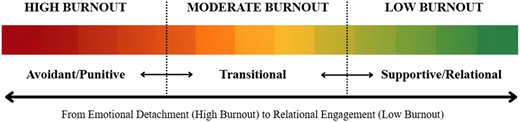
In this study, the four emergent categories, avoidant, referral, punitive, and supportive, reflect a continuum from emotional detachment to relational engagement.
Figure 1 indicates that high-burnout teachers predominantly occupied the avoidant and punitive ends of this spectrum, whereas low-burnout teachers clustered around the supportive approach. Interestingly, moderate-burnout teachers exhibited a transitional profile, displaying both procedural control (e.g. removal from class) and tentative relational efforts (e.g. dialogue or referral). This gradation suggests that burnout may not produce binary behavioral outcomes but rather modulate teachers' positions along a continuum of engagement. Such an interpretation aligns with recent multidimensional models of teacher burnout that emphasize fluidity across cognitive, emotional, and behavioral domains (Angelini et al., 2024; Carrard et al., 2022; Urbanowicz et al., 2023).
Burnout and the developmental mismatch in middle school
The impact of teacher burnout is particularly detrimental within the middle school context, where students are navigating a critical developmental stage characterized by a heightened need for autonomy and relatedness (Brinegar & Caskey, 2022; Eccles & Roeser, 2011). Adolescents in this age group are highly sensitive to social evaluation and adult authority, requiring a stage-environment fit that balances structure with emotional warmth (Wang & Eccles, 2013). However, our findings suggest that high-burnout teachers, who favor punitive and avoidant strategies, inadvertently create a developmental mismatch. By withdrawing emotional support and relying on controlling behaviors to maintain order, these teachers thwart the adolescent's fundamental psychological need for autonomy support (Aelterman et al., 2019; Reeve, 2009). The findings of our research also indicate that while younger children may comply with authoritarian management, middle school students are more likely to respond to coercive control with disengagement or reactance, fueling a cycle of conflict that further exhausts the teacher. Consequently, the depersonalization observed in this study is not merely a professional deficit but a significant barrier to adolescent social-emotional development, as it deprives students of the co-regulatory support necessary for navigating the turbulence of early adolescence (Madigan & Kim, 2021; Rosen, Hudson, Rotermund, Roberts, & Mackey, 2022).
Implications for practice and policy
The findings of this study underscore that teacher burnout is not only a matter of individual well-being but a critical determinant of classroom dynamics, disciplinary orientation, and student–teacher relationships (Jennings & Greenberg, 2009; Madigan & Kim, 2021). As burnout increases, teachers' behavioral management strategies shift from relational and supportive engagement toward procedural, punitive, or avoidant practices. This progression suggests that burnout diminishes teachers' emotional and cognitive resources, leading to reduced empathy, lower pedagogical adaptability, and weakened relational connections with students. Conversely, teachers with low burnout demonstrate greater emotional resilience, reflective capacity, and willingness to engage constructively with challenging student behaviors, thereby fostering a more inclusive and supportive classroom climate (Jennings & Greenberg, 2009). Collectively, these findings imply that addressing teacher burnout is essential not only for sustaining educator health but also for promoting positive student outcomes (Madigan & Kim, 2021). Institutional efforts to mitigate burnout, through workload management, emotional support systems, and professional development focused on relational and reflective teaching, may enhance teachers' capacity for adaptive classroom management and preserve the quality of student engagement. In essence, preventing and alleviating burnout is integral to sustaining both teacher effectiveness and the relational fabric of educational environments.
Building on these insights, schools can translate relational pedagogy into actionable structures and daily practices. For example, middle grades teams may adopt advisory models in which a small group of students meets regularly with a designated teacher to build trust, monitor well-being, and provide consistent emotional support. Interdisciplinary team structures can further enable shared responsibility for student development, allowing teachers to collaboratively address behavioral and emotional needs rather than relying solely on individual classroom management. In practice, relational pedagogy may involve strategies such as daily check-ins, restorative conversations following conflicts, co-constructing classroom norms with students, and integrating social-emotional learning (SEL) into academic instruction through reflective discussions and perspective-taking activities. Professional development that models these practices, alongside opportunities for teacher collaboration and reflection, can help educators operationalize relational approaches in ways that are both sustainable and responsive to the complexities of middle grades classrooms.
Although this study focuses on the Thai educational context, its findings align with international research on middle grades education, which consistently emphasizes the importance of strong teacher–student relationships during early adolescence. At this stage, students are particularly sensitive to the social and emotional climate of their classrooms. As a result, when teacher burnout weakens relational teaching practices, it poses a significant risk to students' academic progress and overall development across different contexts. Therefore, addressing teacher burnout is not only a local concern but also a global priority for ensuring the core goals of middle grades education are achieved.
Conclusion
This study provides in-depth insights into how teacher burnout shapes decision-making in response to students exhibiting challenging behaviors. As burnout levels increase, teachers are more likely to adopt punitive or avoidant strategies, emphasizing control and classroom management over relational engagement. In contrast, teachers with low burnout demonstrate greater empathy, reflective capacity, and pedagogical flexibility, approaching student behavior through supportive and relationally attuned strategies. These findings not only support that burnout undermines teachers' decisions regarding students but also provide in-depth insight into how it shapes their professional judgments and affects the quality of student–teacher interactions. Addressing teacher burnout is therefore essential for sustaining both emotional resilience and instructional effectiveness. Institutional interventions, such as providing emotional support, ensuring manageable workloads, and offering professional development in relational and reflective pedagogy, can enhance teachers' capacity for constructive engagement, thereby promoting positive student outcomes and fostering a healthier school environment.
Limitations and recommendations for future research
While this study provides valuable insights into how burnout influences the behavioral responses of middle school teachers, several limitations must be acknowledged. First, the data collection relied on a scenario-based approach and self-reported measures. While scenarios allow for a standardized comparison of teacher decision-making, they may not fully capture the real-time emotional intensity and environmental pressures of an actual classroom incident. Additionally, it is important to note that the scenario-based design captures teachers' intended or reflective responses rather than their real-time practices, which unfold under immediate emotional, cognitive, and environmental pressures. In actual classroom situations, teachers must respond instantaneously to dynamic student behaviors, which may lead to reactions that differ from those articulated in a structured interview context. Teachers' professed strategies in an interview context may be influenced by social desirability bias, reflecting how they believe they should act rather than their instinctive reactions during a high-stress encounter with a young adolescent. Second, the participant pool consisted of 62 middle school teachers from specific urban and suburban contexts in Thailand. While this sample size provided rich qualitative depth, the findings may not be universally generalizable to all middle-level education settings, particularly those in different cultural or socio-economic environments. Furthermore, the cross-sectional nature of the study prevents the establishment of a causal relationship between burnout levels and specific management orientations.
Given these limitations, several avenues for future research are recommended. Most importantly, future studies should employ quantitative research designs to strengthen and validate these findings. Large-scale longitudinal surveys could examine whether the four categories identified in this study (Avoidant, Referral, Punitive, and Supportive) remain consistent across a broader, more diverse demographic of educators. Quantitative modeling, such as Structural Equation Modeling (SEM), could be used to measure the statistical strength of the relationship between specific dimensions of burnout, such as disengagement and exhaustion, and the likelihood of adopting punitive versus supportive orientations. Additionally, future research should incorporate objective observational data, such as classroom video analysis, to triangulate self-reported data with actual behavioral outcomes. Investigating the impact of these teacher responses on middle-level learners' academic engagement and emotional well-being would also provide a more holistic understanding of the burnout-management cycle. Finally, intervention studies are needed to determine if specific professional development programs focused on relational pedagogy and emotional regulation can effectively shift teachers from avoidant or punitive stances toward more supportive, developmentally responsive approaches.
The supplementary material for this article can be found online.