From the age of 11-13, children start to spend increasingly more time on learning from texts. The need arises to support them in dealing with this text information and engaging them in self-regulated learning (SRL). This study is embedded within the cognitive component of SRL and focuses on mind mapping as a promising organizational learning strategy. Notwithstanding the fact that mind map skills are already important in middle grades, few studies have specifically addressed this concern. The following research questions were addressed: What is the impact of a 10-week intervention on students’ (1) application of mind map rules and (2) processing of textual information? Data were collected by means of a repeated measures design (pretest, intermediate test, and posttest) in fifth- and sixth-grade classes (N = 62 students). The results reveal a significant evolution in students’ application of mind map rules. Further, students improve significantly in processing the content of textual information in a mind map in a structured and relevant way. The findings of the present study demonstrate that fifth- and sixth-grade students are able to learn to process informative texts by means of an explicit mind map training intervention of 10 successive weeks. Based on these findings, suggestions for future research are discussed.
INTRODUCTION
Currently, students are continuously being challenged by the exponential knowledge increase in our information society. As such, skills and strategies are required for realizing efficient and effective processing and acquisition of information (Crick, 2007; Seyihoglu & Kartal, 2010). To support students in this domain, education should develop active learners, learning independently and constructively (Boekaerts, Pintrich, & Zeidner, 2000; Cornford, 2002). In this respect, the concept of self-regulated learning (SRL) has recently played an important role in educational research, illuminating the learner’s ongoing learning processes (Black, McCormick, James, & Pedder, 2006). SRL can be defined as a planned and cyclical way of regulating thoughts, feelings, and actions to meet personal goals (Boekaerts et al., 2000; Zimmerman & Schunk, 2001) and includes a motivational, metacognitive, and cognitive component (Winne & Perry, 2000). The motivational component concerns students’ reasons for performing a task, whereas the metacognitive component refers to strategies for planning (e.g., setting goals), monitoring (e.g., monitoring comprehension), and modifying cognition (e.g., rereading text when comprehension fails) (Pintrich, 2004). The cognitive component of SRL encompasses learning strategies and tactics students can apply to effectively process and acquire new information (Perels, Gürthler, & Schmitz, 2005; Pintrich, 2004). The development of learning strategies can facilitate the process of learning from texts and can help students to select, organize, integrate, and recall subject matter (Warr & Downing, 2000; Weinstein & Mayer, 1986). These strategies become increasingly important, especially from the age of 11-13, when students have to spend more time independently on learning from texts and obtain information from them (Bakken & Whedon, 2002; Rawson, 2000). As a result, the focus at this age shifts from learning how to read and early reading skills to ‘reading to learn’ (Bakken & Whedon, 2002; Harlaar, Dale, & Plomin, 2007). In this respect, researchers call for approaches supporting children in learning texts, starting with processing those texts in a structured way by structuring and summarizing the large amount of text information (e.g., indicating keywords, marking and outlining main ideas) (Guastello, Beasley, & Sinatra, 2000; Novak, 2002). Therefore, the present study is embedded within the cognitive component of SRL, focusing on how we can help students in processing textual information.
Using Graphic Organizers as an Organizational Learning Strategy
Generally, the basic learning strategies reported in the literature are rehearsal, elaboration, and organization strategies (Weinstein, Husman & Dierking, 2000; Weinstein & Mayer, 1986). A specific organizational strategy to help students process, structure, and acquire textual information is working with graphic organizers (GO) (Dansereau & Simpson, 2009; Vekiri, 2002). Stull and Mayer (2007) specify graphic organizers as spatial arrangements of words (or word clusters) to represent the conceptual organization of a text. They can clarify the relationship between important concepts in a text and illuminate big ideas (Banikowski, 1999; Crawford & Carnine, 2000). In this way, they can help students deal with the large amounts of information they are confronted with.
Several general theories underpin the use of GO. The dual coding theory (Paivio, 1991) builds upon two sets of independent and separate systems for processing and storing information: a verbal and a nonverbal system. By using GO, the learner is capable of making associations between the visual and verbal material which facilitates information recall. A second important theory underpinning the use of GO is the cognitive load theory (Sweller & Chandler, 1994; Sweller, van Merriënboer, & Paas, 1998). Here, a distinction is made between the limited working memory and an effective long-term memory in which large amounts of information can be stored. The load of the working memory can be reduced by adding GO to texts. Third, Waller’s visual argument hypothesis (as cited in Vekiri, 2002, p. 281) assumes that the benefits of visual representations result from the spatial characteristics of a map. Those characteristics communicate the complex text content more efficiently because the processing of a map requires less mental efforts in working memory. In sum, these theories point to advantages of both verbal and spatial storage of subject matter, decrease of cognitive load, and simplification of complex relationships and ideas in texts by using GO.
Mind Maps as a Specific Type of GO
A type of GO enclosing all the key components of the definition of Stull and Mayer (2007) is a mind map (Buzan, 1974, 2005), which is the focus in the present study. In a mind map, one key concept, often represented as an image, is located at the middle of the page. From this central topic, several related main topics are radiated out in the shape of thick branches. Attached to these main branches, other smaller branches represent related concepts. In this way, related words are associated through curved main and subbranches. Mind maps can be further enriched by colors, images, codes, and dimension to reflect personal interest and individuality (Buzan, 2005).
The (effectiveness of) the specific characteristics of a mind map are grounded in and supported by research findings from both educational as well as brain research. The characteristics are based upon research investigating and supporting the advantages of the use of association (Budd, 2004; Haber, 1970; Mento, Martinelli, & Jones, 1999) and the effectiveness of connecting images to words and using color (Anderson & Hidde, 1971). The latter also stimulates creativity (Mento et al., 1999; Michalko, 2003) instead of working in a traditional way (e.g., linear thinking, taking notes in one color on lined paper). Furthermore, mind maps also incorporate the gestalt principles “equality” (visual nearness of information by using colors and shapes) and “proximity” (grouping of related elements) which promotes the faster identifying, processing, and storing of information (O’Donnell, Dansereau, & Hall, 2002; Wallace, West, Ware & Dansereau, 1998). All these findings are translated in a set of mind map rules (e.g., promoting association by using curved lines, thicker and thinner branches, capitals and small letters, incorporating colors, shapes and images, grouping associated key words) which should be carefully respected since they reflect the basic characteristics determining the effectiveness of mind mapping (Buzan, 2005).
Mind Mapping and Text Processing
Both the specific characteristics of mind maps as the previously mentioned theories underpinning the use of GO give reason to believe that mind maps can help students in processing and learning those large amounts of information they meet in textbooks. At present, several studies indicate that mind maps are effective in helping students structure and summarize subject matter (Brinkmann, 2003; Farrand, Hussain, & Hennessy, 2002; Mento et al., 1999) and consequently in stimulating the cognitive component of self-regulated learning. Consequently, mind mapping as an organizational strategy seems promising in processing and schematizing texts. There are however several shortcomings in previously conducted research, we especially want to address in the current study.
First, few studies have investigated the effectiveness of mind mapping in middle grades. Research on GO and mind maps generally focuses on secondary and higher education, although the importance of the acquisition of processing skills in earlier grades is frequently stressed (Guastello et al., 2000; Rawson, 2000). Furthermore, in regard to other studies on graphic organizers (e.g., concept mapping), studies on mind mapping have received far less recognition (Eppler, 2006).
Second, when studying the effectiveness of mind mapping in middle grades, it is a prerequisite to know whether children of this age group are already capable of making mind maps from an informative text. Are they already able to draw a mind map applying the mind map rules, to select the most important and relevant key words from a text and associate them in a correct manner? Almost no information is available about the mind map skills of middle grade children. Notwithstanding the fact that those skills are already important in middle grades, few studies have specifically addressed this concern.
This brings us to the third important concern about how to gradually learn children to mind map an informative text. Researchers within the existing literature are concerned about the training of mapping skills, which can be very time consuming (Hilbert & Renkl, 2008; McCagg & Dansereau, 1991). There is still little research information available, however, how to gradually learn children the efficiently and effectively structural processing of informative texts with mind maps in classroom practices. Further, special attention in the training has to be drawn explicitly to take into account the specific characteristics of mind maps, which have often been neglected in the limited number of mind map studies available. This can lead to a biased view on the effectiveness of mind mapping.
Research Questions
Based on the promising role of mind mapping in supporting children in processing and schematizing texts and the different concerns regarding actual mind mapping research, two main research questions are addressed in the present study:
What is the impact of a mind mapping intervention on students’ application of the mind map rules?
What is the impact of the intervention on students’ processing of textual information (i.e. selecting relevant key words and making meaningful associations reflecting the complete text content) by using mind mapping?
With the first research question, we focus on whether mind mapping can be learned by middle grades students in a relatively short period of time by means of a 10-week intervention. We investigate whether children improve significantly in making a good mind map of an informative text by applying the mind map rules (Buzan, 2005). The second research question may shed a light on whether mind mapping can be considered as a potential organizational learning strategy to support middlegrades school children in efficient and effective text processing and thus optimizing the cognitive component of SRL.
METHOD
Design
A repeated measures design (pretest, intermediate test, and posttest) was applied to evaluate the impact of a 10-week mind mapping intervention in authentic classes. The three tests were administered at the beginning, middle and end of the first semester at the end of each lesson in Week 1, Week 6 and Week 10 of the intervention.
Participants
A total of 62 middle grades students of fifth (n = 29) and sixth grade (n = 33) from the Flemish speaking part of Belgium participated in the study (4 classes from 2 different middleclass elementary schools). All students were native speakers of Dutch (the instructional language in Flanders). The sample consisted of 31 girls and 31 boys. All participants were between 10 and 12 years.
Intervention
Even though a training or instruction in the use of maps is a key factor in producing positive outcomes (O’Donnell et al., 2002), there is still no effective longitudinal training method available, especially none combining mind mapping and text processing for middle grades students. Therefore, a 10-session mind map training was developed based on theoretical and practical insights and existing publications (Buzan, 2004, 2005; Hoffman, 2001). In each training session the aim was to make a mind map of an informational text (through the deliberate selection of main ideas and related sub topics and presenting the relationships between them in a meaningful way). Texts from the regular school books were therefore used and adjusted. Whereas the first three lessons were dedicated to getting to know mind maps and completing unfinished mind maps with relevant key words and images, the following lessons students learned gradually to construct a mind map themselves by applying a step-by-step plan. In this way, the importance of the active construction, manipulation, and transformation of textual information into a mind map (Farrand et al., 2002; Guastello et al., 2000) was respected. In each lesson, mind map rules (e.g., using curved lines, thicker and thinner branches, capitals and small letters, colors, shapes and images) were emphasized and applied (Buzan, 2005). Each session focused on one specific facet of constructing mind maps from an informational text (e.g., visualizing relationships between key words from different branches). Finally, the last session was dedicated to exploring other mind map possibilities: making a mind map for homework planning, using a mind map in other subject areas (e.g., mathematics) or for preparing a school talk. Table 1 presents an overview of the mind map training and the specific focus during each session.
In line with the social cognitive theory of Bandura (Snowman & Biehler, 2003), the first lessons (getting to know mind mapping) were primarily dominated by modeling by the teacher and observation and imitation by the students. Further, during the construction of mind maps individual work, group work, and class discussions were implemented during the sessions. The sessions focusing on the making of mind maps demanded active involvement of the students (analyzing, revising, and working with the text) which stimulated the internalization of the mind map instruction. Regarding the procedure, the intervention was preceded by a formal meeting to inform school leaders and all involved teachers. The intervention took place during 10 successive weeks (one lesson of 50 minutes per week given by the researcher in the presence of the teacher). All lessons took place during regular school hours in the regular classrooms during the lessons on social studies and science and reading comprehension.
Instruments
The pretest, intermediate test, and posttest consisted of independently making a mind map of an informative text within 30 minutes.
Overview of the Mind Map Training
| Week | ||||||||||
|---|---|---|---|---|---|---|---|---|---|---|
| 1 | 2 | 3 | 4 | 5 | 6 | 7 | 8 | 9 | 10 | |
| Getting to Know Mind Mapping | ||||||||||
| •Mindmaprules | x | x | x | x | x | x | x | x | x | x |
| • Reading a mind map and completing a mind map with relevant key words | x | x | x | x | x | x | x | x | x | |
| • Practising the use of images, figures, and abbreviations within a mind map | x | x | x | x | x | x | x | x | ||
| Making Mind Maps | ||||||||||
| •Applyingastep-by-stepplantobuildupamindmap | x | x | x | x | x | x | x | |||
| • Making a good mind map within a marked out time span, clustering associated key words, visualizing relationships between keywords in different branches by means of arrows and connectors | x | x | x | x | x | |||||
| • Finding main branches, limit irrelevant information in the mind map, readability of the mind map | x | x | x | x | ||||||
| • Mind mapping in other situations | x | x | ||||||||
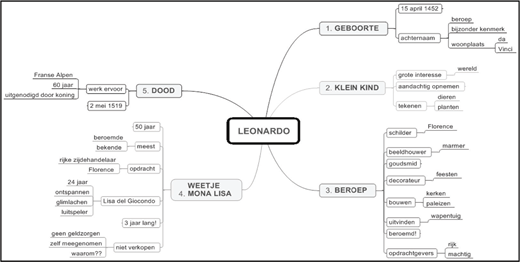
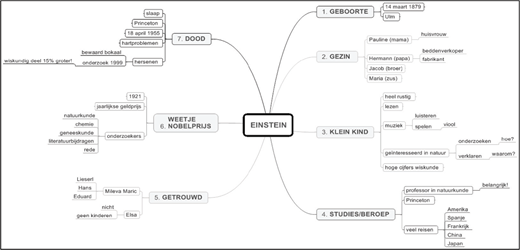
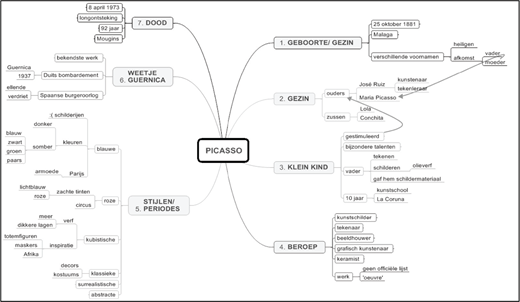
For each measurement occasion a text of about 350 words was used. The texts were different as to the topic (respectively about the work and life of Leonardo da Vinci, Albert Einstein, and Pablo Picasso), but equivalent as to the structure and length. Texts were presented in the same order for every class. As the focus was on students’ mind mapping skills, text comprehension problems were clarified by the teacher or researcher to reduce individual differences in text understanding. At the end of the intervention period and after the complete data collection (pretest, intermediate test, and posttest), the characteristics and quality of students’ mind maps were scored in random order.
Since reliable scoring methods for mind maps in elementary education are very scarce, an analytic scoring rubric based on research literature on scoring GO was developed (Hilbert & Renkl, 2008; Lee & Nelson, 2005; Meier, Rich, & Cady, 2006; Nitko & Brookhart, 2007; Taricani & Clariana, 2006). In the rubric, the different components of a good mind map were identified and scored on a 4-point scale (Meier et al., 2006; Taricani & Clariana, 2006). Hereafter, the developed rubric was presented to experts on SRL, text processing, reading comprehension and mind mapping on the one hand and elementary school teachers on the other hand to evaluate the developed rubric from an academic as well as a practice-based point of view. Based on their comments, the rubric was slightly modified. The final mind map scoring rubric (MMSR) ( Appendix A) contains two broad categories (“shape and organization” and “content”). The subcategories in the category “shape and organization” were identified based on the mind map rules (e.g., using a radial structure). By means of these subcategories, it is verified whether mind map rules are respected and which specific elements (e.g., images, colors, arrows, connectors) are integrated into the map. Within the main category “content,” relevant content elements (e.g., relevance of key words) are specified. These subcategories evaluate how much relevant key information is represented and linked to each other in the map.
In addition to the use of the MMSR, students’ mind maps were compared to an expert map, based on a consensus among several experts, to verify whether students’ mind maps covered the text content adequately. An overall score (between 0 and 10) was assigned to each mind map to represent the general quality of the mind map. Further, the number of relevant clusters (the encircling of large associated main and subbranches) and the number of relevant main branches (i.e. main branches with a relevant and covering key word) were counted.
Data Analysis
A total of 186 mind maps (3 measurement occasions for 62 participants) were scored by two independent trained coders by means of the MMSR. The second coder double scored respectively 24 mind maps per measurement occasion and was not aware of the order in which the texts were presented to the students. In this respect, 72 rubrics (39%) were double coded to check interrater reliability by means of Krippendorff’s alpha (Hayes & Krippendorff, 2007). Krippendorff’s alpha is a reliability coefficient that accounts for chance agreement. Krippendorff’s alpha further takes into account the magnitude of the misses, adjusting for whether the variable is measured as nominal, ordinal, interval, or ratio. Inter rater reliability is determined by calculating the proportion of observed and expected disagreements between the raters. Table 2 presents the Krippendorff’s alpha (α) interrater reliability coefficients of all subscales in the MMSR. Krippendorff’s alpha ranged from .67 to 1, indicating good to excellent agreement.
The scores on the rubric were analyzed quantitatively by means of one-way repeated-measures analyses of variance. Additionally, post hoc pairwise tests with Bonferroni correction were conducted to specify the differences between de measurement moments. All statistics reported in this study were calculated using SPSS version 17.0.
Overview of the Krippendorff’s Alpha Interrater Reliability Coefficients
| Subscale | α |
|---|---|
| Shape and Organization | |
| • Thick main branches and thin subbranches | 1 |
| • Capitals on main branches and small letters on subbranches | .85 |
| • Use of color | .84 |
| • Use of symbols, images, and abbreviations | .79 |
| • Use of arrows and connectors | .76 |
| • Readability | .75 |
| • Position of key words | .80 |
| • Radial structure | .83 |
| Content | |
| • Choice of key words | .73 |
| • Content coverage | .72 |
| • Associations | .67 |
| • Word choice on the main branch | .70 |
| Additional Characteristics | |
| • Number of relevant clusters | .84 |
| • Number of main branches | .94 |
| • Number of relevant main branches | .87 |
| • Overall score (ranging from 0 to 10) | .80 |
RESULTS
Table 3 presents the average scores on the different subcomponents in the MMSR for each measurement occasion. Post Hoc pairwise comparison tests revealed significant differences between the measurement moments. These results are presented in Table 4.
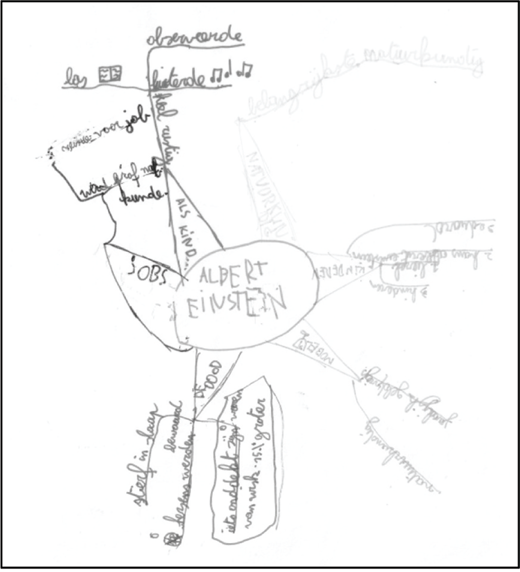
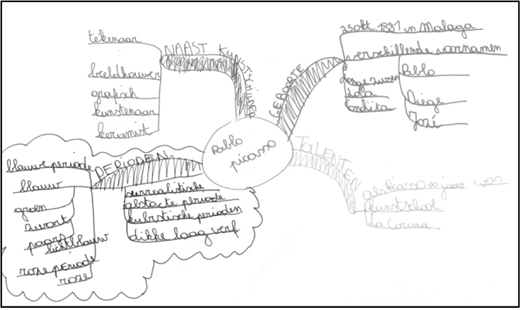
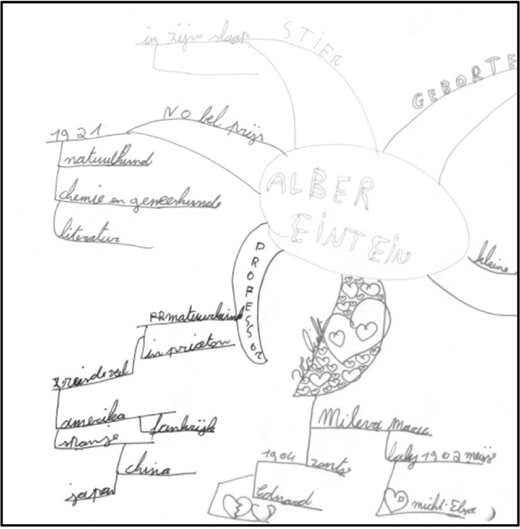
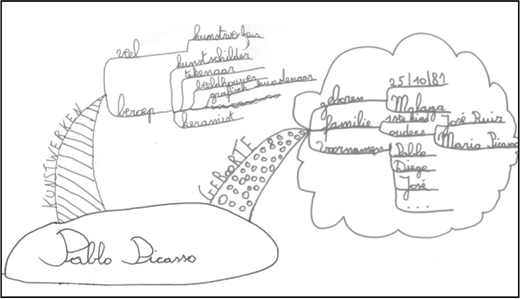
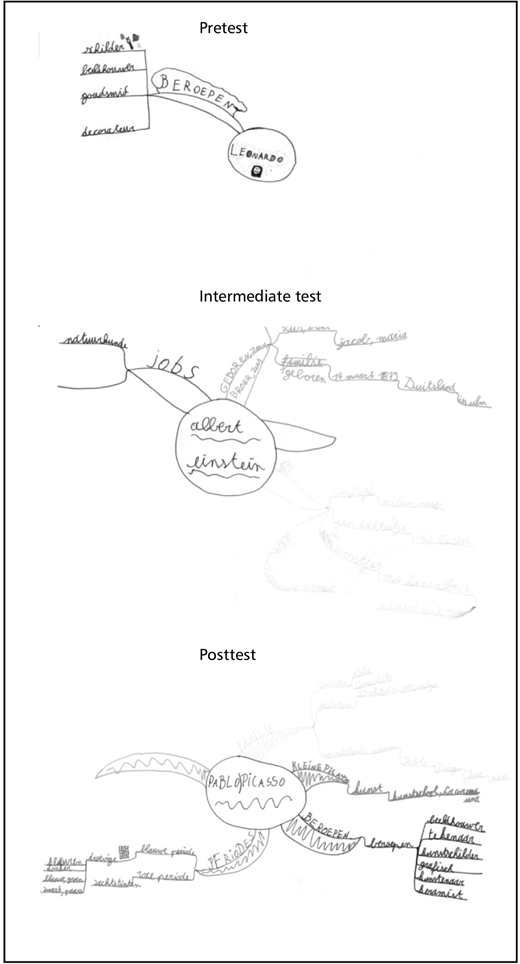
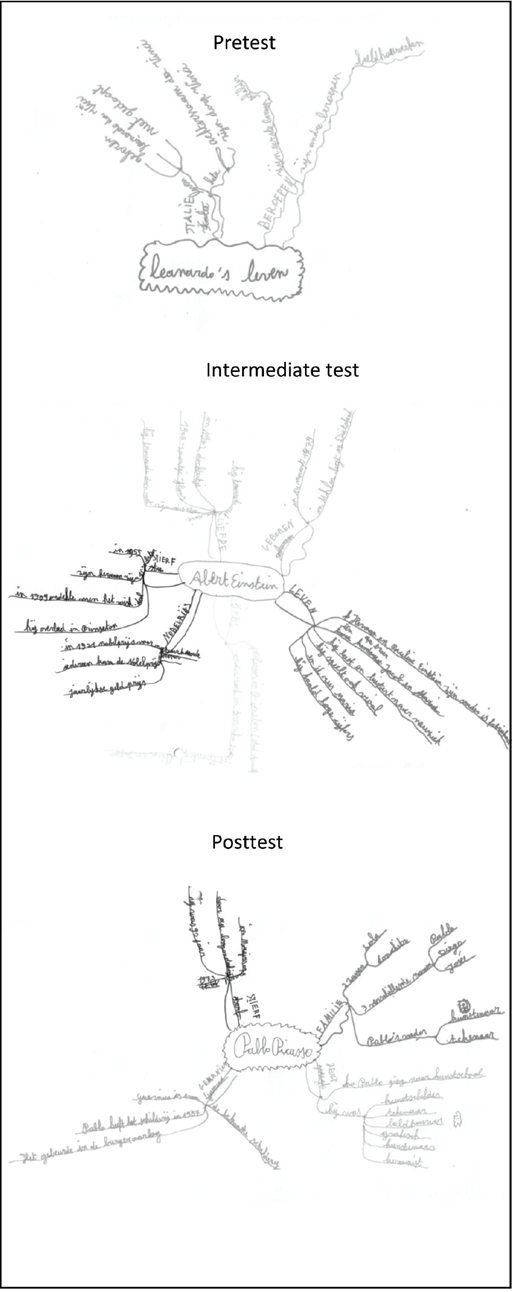
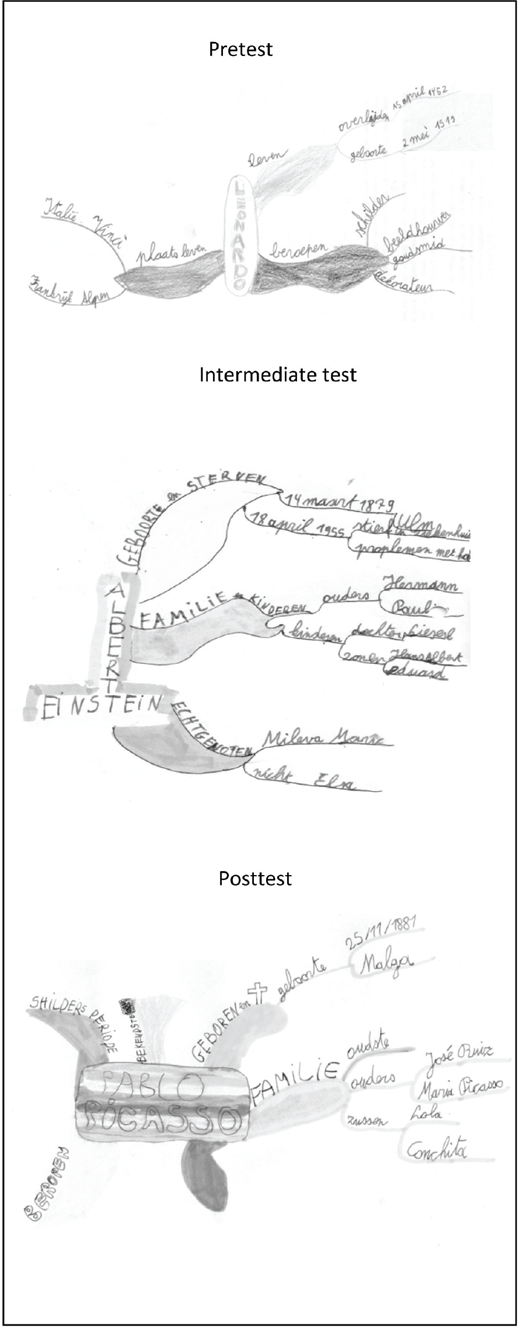
The first aim of the study was to investigate whether children improve their mind mapping skills throughout the intervention. No significant evolution in the use of thin and thicker branches (F(2, 58) = 1.1851, p = 0.166) and the use of symbols, images and abbreviations (F(2, 58) = 2.450, p = 0.095) was observed. The results reveal several significant evolutions in using capitals on the main branches and small letters on the other branches (F(2, 58) = 8.754, p < 0.001) and in the use of color (F(2, 58) = 5.609, p = 0.006). Concerning the use of capitals and small letters, there is no significant evolution to any further extent between the intermediate and the posttest. Regarding the use of color, significant differences were found between posttest and pretest and between posttest and intermediate test. This was also the case for the readability of the mind map, the position of key words and the use of clusters and arrows to group and link information. The readability was significantly better at the end of the intervention (F(2, 58) = 6.314, p = 0.003). In this respect, Figure 1 and 2 illustrate a poorly and well readable mind map (see the readability and clearness criterion in the rubric in Appendix A). Further, at the end of the intervention, keywords were more placed on the branches instead of next to the branches (F(2, 58) = 3.281, p = 0.045) and children made significantly more clusters (F(2, 58) = 5.979, p = 0.004). An example of a cluster can be found in Figure 2 where the main branch “perioden” and the subbranches related to it are enclosed. In addition, more arrows were used to link information (F(2.58) = 4.216, p = 0.020). Finally, the radial structure of the mind map was also better respected (F(2, 58) = 11.238, p < 0.001). Significant differences are revealed between all measurement moments. Figure 4 shows a mind map wherein the radial structure is respected, which is not the case in Figure 3 (see the mind map structure criterion in the rubric in Appendix A).
Average Scores on the MMSR
| Pretest | Intermediate Test | Posttest | F | P | |
|---|---|---|---|---|---|
| Shape and Organization | |||||
| Thick main branches and thin subbranches | 3.83 | 3.98 | 3.98 | 1.185 | 0.166 |
| Capitals on main branches and small letters on subbranches | 3.07 | 3.52 | 3.58 | 8.754 | 0.000*** |
| Use of color | 3.82 | 3.62 | 3.98 | 5.609 | 0.006** |
| Use of symbols, images, and abbreviations | 1.80 | 2.03 | 2.27 | 2.450 | 0.095 |
| Use of arrows and connectors | 1.07 | 1.02 | 1.27 | 4.216 | 0.020* |
| Readability | 3.03 | 3.28 | 3.57 | 6.314 | 0.003** |
| Position of key words | 3.58 | 3.62 | 3.78 | 3.281 | 0.045* |
| Radial structure | 2.85 | 3.17 | 3.48 | 11.238 | 0.000*** |
| Content | |||||
| Choice of key words | 3.12 | 3.43 | 3.63 | 14.397 | 0.000*** |
| Content coverage | 1.22 | 2.32 | 2.37 | 82.990 | 0.000*** |
| Associations | 2.95 | 3.28 | 3.42 | 10.390 | 0.000*** |
| Word choice on the main branch | 2.67 | 2.97 | 3.40 | 14.397 | 0.000*** |
| Additional Characteristics | |||||
| Number of relevant clusters | 0.05 | 0.08 | 0.40 | 5.979 | 0.004** |
| Number of main branches | 3.43 | 4.75 | 4.25 | 15.451 | 0.000*** |
| Number of relevant main branches | 2.25 | 4.07 | 3.88 | 46.298 | 0.000*** |
| •verall score (ranging from 0 to 10) | 2.72 | 5.59 | 6.38 | 125.468 | 0.000*** |
Note: *p < .05.**p < .01.***p < .001.
The second aim of this study was to investigate whether children make significant progress in processing textual information by using mind mapping. Children used more textual information in the mind map (F(2, 58) = 82.990, p < 0.001), as illustrated in Figure 5. Further, they chose more relevant key words on the subbranches (F(2, 58) = 14.397, p < 0.001), which are generally nouns and verbs.
As a result, the length of the branches stayed relatively short (Figure 6). The words within a branch were better matched and associated (F(2, 58) = 10.390, p < 0.001). The selection of key words on the main branches was significantly better (F(2, 58) = 14.397, p < 0.001) as well. Moreover, the selected key words on those main branches were more relevant and covering (Figure 7).
Concerning the choice of key words on the subbranches and main branches, significant differences were found between all measurement moments. As to content coverage and the association of words within a main branch, no significant evolution was found between the intermediate and the posttest. The number of relevant main branches raised significantly (F(2, 58) = 46.298, p < 0.001) and the children got better overall scores on their mind maps (F(2, 58) = 125.468, p < 0.001).
Results of the Post Hoc Pairwise Comparisons on the MMSR
| Intermediate Test-Pretest p | PosttestPretest p | Posttest - Intermediate Test p | |
|---|---|---|---|
| Shape and Organization | |||
| Thick main branches and thin sub-branches | n.s. | n.s. | n.s. |
| Capitals on main branches and small letters on subbranches | 0.000*** | 0.000*** | n.s. |
| Use of color | n.s. | 0.040* | 0.003** |
| Use of symbols, images and abbreviations, | n.s. | n.s. | n.s. |
| Use of arrows and connectors | n.s. | 0.033* | 0.006** |
| Readability | n.s. | 0.001** | 0.008** |
| Position of key words | n.s. | 0.045* | 0.024* |
| Radial structure | 0.017* | 0.000*** | 0.002** |
| Content | |||
| Choice of key words | 0.011* | 0.000*** | 0.004** |
| Content coverage | 0.000*** | 0.000*** | n.s. |
| Associations | 0.004** | 0.000*** | n.s. |
| Word choice on the main branch | 0.000*** | 0.000*** | 0.001** |
| Additional Characteristics | |||
| Number of relevant clusters | n.s. | 0.001** | 0.003** |
| Number of main branches | 0.000*** | 0.000*** | 0.027* |
| Number of relevant main branches | 0.000*** | 0.000*** | n.s. |
| Overall score (ranging from 0 to 10) | 0.000*** | 0.000*** | 0.000*** |
Note: *p<.05.**p<.01,***p<.001.
DISCUSSION
The present study focused on text processing by means of mind mapping in middle grades. This study has investigated the impact of a 10-weeks mind mapping intervention on students’ (1) application of mind map rules and (2) processing of textual information by using mind mapping.
Regarding the first research question, the present study reveals that on the majority of the subcategories of “shape and organization” students progress significantly (i.e., using capitals on main branches and small letters on subbranches, the use of color, arrows and connectors, readability, position of key words, radial structure). This is important taken into account the demonstrated effectiveness of the use of correctly made associations (Haber, 1970; Mento et al., 1999), dimension (Budd, 2004), color and images (Anderson & Hidde, 1971; Banikowski, 1999) and gestalt principles (O’Donnell, Dansereau, & Hall, 2002). Two concerns however, should be taken into account. First, it is important to consider the fact that applying the mind map rules might provoke extra unnecessary cognitive load (Stull & Mayer, 2007), which can hinder deeper cognitive processing of the text and consequently meaningful learning (Novak, 2002). Second, it is important to draw attention to the significant difference that was found in using arrows and connectors within the mind maps, since the children evolve from “no use” to rather “incorrect use.” Although understanding the relationships between ideas in a text is an advantage of using graphic organizers (Robinson & Skinner, 1996), the results of the present study indicate that it is not obvious for middle grades students to make these relationships explicit by themselves. Further, even though using images and symbols can stimulate the creativity and learning potential of the students (Crick, 2007; Mento et al., 1999; Michalko, 2003), the use of these elements was hardly observed in students’ mind maps. Therefore, one should pay attention to the fact that when learning to mind map, this is not limited to learning to apply the mind map rules, whereby the search for connections and the critical reflection on ideas in a text becomes neglected (D’Antoni, Zipp, Olson, & Cahill 2010; Rawson, 2000).
As to the second research question, the results indicate that participants evolve significantly in processing a text in a mind map. The students choose better and shorter key words on the subbranches, use more textual information in the mind map (content coverage), improve in making associations between words, and choose more relevant and covering key words on the main branches. These findings corroborate the results of previous studies (Farrand et al., 2002; Guastello et al., 2000) and point to the fact that students can learn to process texts on a deeper level by means of an active practice within 10 weeks. Students choose better associated and more relevant and covering key words, which shows that they had internalized the instruction and practice during the mind map training. In this way, the independently constructed mind maps reflect the growth in their text processing skills.With regard to the content coverage of the text information in the mind map and the association between key words, no significant evolution was found between the intermediate test and the posttest. Possibly, students need more time to practice these text processing skills. Acquiring these skills is time consumable and has to be persistently encouraged and followed up (Eppler, 2006; Goodnough & Woods, 2002) As a result, it can be expected that a consequent, systematic, and stimulating supervision of mind map skills will be necessary to avoid the fading out of the positive outcomes of the intervention. Furthermore, an important question that can be addressed in further research is if and how students, who received the training, apply the mind mapping technique to enhance their learning without explicit instructional direction, prompting or supervision.
Although the main conclusion points to a positive effect of mind mapping in stimulating text schematizing and processing, some limitations and suggestions for future research have to be noted.
First, the research data were collected quantitatively and no information was gathered about the experiences and motivational beliefs of students and teachers although those could have an effect on the use of mind maps (Budd, 2004; Treviño, 2005). Second, a larger number of participants is clearly necessary to determine the effects more robustly. This implies an intervention on a larger scale over a longer period of time to map the effects more longitudinally, which is also recommended by D’Antoni et al. (2010). Finally, though it was not in the scope of this research to make a comparison between the text processing and schematizing skills of children who do and do not mind map, the inclusion of comparable conditions would be particularly interesting. It must be noted that in this study, children make a remarkable progress not only in mind map skills but also in processing a text in a structured way by means of mind mapping. This shows evidence for the effectiveness of the developed mind map intervention. By including a comparison or control condition without the mind map intervention, in a more experimental design, future research could reveal whether children in the mind map intervention process, schematize, recall and understand subject matter better and more by using mind mapping than children who do not participate in the intervention. As clarified earlier, the main purpose of this study was examining the mind maps skills of middle grades students, that is, are they already capable from this age on to make a mind map of an informative text, with regard to the specific characteristics of the map and reflecting the text content in a meaningful way. Finding an answer to this question is a prerequisite for further studies on mind mapping in middle grades. The findings of this study confirm that middle grades students are indeed capable of making mind maps from informative texts in a meaningful way. By including additional text recall and text comprehension measures (e.g., from the sampled text topics), future research should extend beyond the making of mind maps to revealing if and how working with mind maps stimulates the conceptual understanding and ability to recall the information they mapped.
Findings from the present research can be situated within and related to intervention studies in the wider field of studies on self-regulated learning and learning strategy research. Since there is only limited research specifically investigating the role of mind mapping in schematizing informational texts and processing and learning those texts by middle grades students, three concrete suggestions for future research next to those mentioned above could be recommended. First, it would be interesting to compare whether working with studentgenerated mind maps is more effective than working with author-provided mind maps in processing and learning informative texts (Lee & Nelson, 2005; Stull & Mayer, 2007). Second, also general learning factors other than the intervention (e.g., learner characteristics, specific learning [disabilities) should be taken into account when investigating the impact of a mind map intervention, since we can assume that they play a major role in the effect mind maps can bring about (Vekiri, 2002). Third, a complementary qualitative study would be an added value for interpreting the findings resulting from this study and inspiring future research (Fox, 2009; Scott, 2008). Using a thinking aloud procedure while constructing mind maps from an informative text with a writing pen would be very interesting in this respect. In this way, everything the students say and gradually write down is captured and can be analyzed in depth. This can shed a light on the interplay between children’s ongoing text processing, mind mapping and learning from text.
CONCLUSION
As to the relevance for educational practice, the findings of the present study demonstrate that middle grades students are able to learn to process informative texts by means of an explicit mind map training intervention within a consequent, systematic, and stimulating environment. In this way, a more clear view is presented on how mind maps can be used in stimulating the cognitive component of SRL in classroom practices, a combination which has been rarely studied so far. As to the relevance for research, the study works on the existing gap in the current literature regarding effective approaches for supporting middle grades students to process and learn textual information in a structured way. In this respect, the study enters upon an undeveloped and unexplored research domain for this age group and might inspire other educational researchers to investigate the use of mind maps in middle grades more thoroughly.
REFERENCES
APPENDIX 1 MIND MAP SCORING RUBRIC (MMSR)
Name student: Mind map identification number: Rater:
| Shape and Organization | 1 | 2 | 3 | 4 | Total |
|---|---|---|---|---|---|
| The main branches are thicker than the subbranches | Not respected | Generally not respected | Mainly respected | Respected | |
| On the main branches capitals are used, on the subbranches small letters are used | Not respected: use of capitals and small letters is mixed up | Generally not respected: main branches mainly in small letters, subbranches mainly in capitals | Mainly respected | Respected | |
| Use of different colors for every branch | No use of color | Use of different colors within a branch | Mainly correct color use or mind map temporally made in pencil to color afterwards | Every main branch and associated subbranches are drawn in the same color | |
| Use of symbols, images and abbreviations | No use | Irrelevant or unclear use | Correct and creative use, not always relevant | Correct, creative, and relevant use | |
| Use of arrows, connectors | No use | Incorrect use | Mainly correct and relevant use | Correct and relevant use | |
| Readability & clearness | MM is not readable without turning the page | MM is only partly readable without turning the page | The content of the MM is mainly readable without turning the page | The MM is readable without turning the page | |
| Position of key words | None of the key words are placed on the branches | On occasion, key words are placed on the branches | Key words are mainly positioned on the branches | All key words are positioned on the branches | |
| Mind map structure | Radial structure is not respected | Radial structure is generally not respected | Radial structure is mainly respected | Radial structure is respected | |
| Content | 1 | 2 | 3 | 4 | Total |
| Choice of key words on sub-branches | Sentences are completely copied / long branches | Sentences are mainly copied, too many key words on a branch or irrelevant key words | Key words are mainly relevant and are most of the time nouns and verbs | Key words are relevant, exist of nouns and verbs, good length of the branches | |
| Content coverage (see expert maps on the next page) | No or little content coverage | Average content coverage | Good content coverage | Almost complete content coverage | |
| Associations | Words in a branch do not match | Words in a branch do not really match and/ or are wrongly associated | Words in a branches match and are mainly well associated | Words in a branch match and are correctly associated | |
| Choice of key words on main branches | Key words are not relevant or not general enough | Key words are mainly not relevant or not general enough | Key words are mainly relevant and general enough | Key words are relevant and general enough |
Relevant use of clusters? Pretest: yes o no o Intermediate test yes o no o Posttest: yes o no o Number of relevant clusters? Pretest: _____ Intermediate test: _____ Posttest: _____
Number of main branches - relevant main branches: ___-___ Overall score: ___/10
Number of main branches - relevant main branches: ___-___ Overall score: ___/10
Number of main branches - relevant main branches: ___-___ Overall score: ___/10
Content coverage—Expert maps (not colored)