
IMAPS Europe '99 Harrogate
IMAPS Europe '99 Harrogate
Keyword: IMAPS


After much preparation on behalf of the organisers and much speculation on the choice of venue, this biennial European event was held on 7-9 June in the Yorkshire spa town of Harrogate. It was generally agreed that Harrogate was a good choice with no traffic harassment, hotels just an easy stroll away from the Conference Centre,an excellent exhibition area and friendly local people. In fact, the opening song in the gala night cabaret put it into perspective "At Copenhagen the tent was too cold, at Venice Lido the tent was too hot. At Harrogate then what have you got? A purpose built building that's got the lot".
There were, of course,disappointments, the most significant of which was the good old English weather that brought out the umbrellas and held back the flowers which all the pre-show publicity had promised would adorn the town. The lack of sunshine did not give visitors the chance to appreciate the natural beauty of the area. Second, the numbers attending were low, certainly compared to 1987 when the UK last hosted the event. There were 239 full delegates plus of course the officials of other chapters and invited speakers.
COMPETE, the European organisation for cross-fertilisation and technical co-operation, who ran two sessions, failed to bring numbers up to those needed to make much more than just an acceptable profit, so important for financing the preparation stage of the following event. Nevertheless, with an increasing choice of conferences,symposia and exhibitions, not only is the visitor cake in smaller slices, but it has to compete with the Internet, which is an attractive time saver and questions the need for face to face communication, certainly at the "make contact" stage.
 Plate 1The refreshments in between sessions
 Plate 2Mr Goldie at the Microelectronics International stand
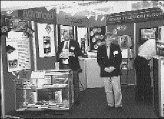
Plate 3Multicore's stand winner of the best stand award. Martin Bartholomew at the launch of his new book
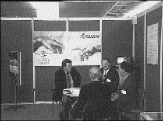
Plate 4Christopher Peece (MD of Laser Cutting) and Simon Roe meeting clients
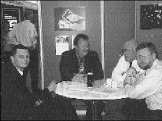
Plate 5Gerhard Cölner (left) and colleagues from Ceramtec in discussion with Peter Wilhelm form IMAPS Germany
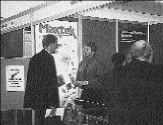
Plate 6"Ex-pat" Simon Hawksworth selling the virtues of US products
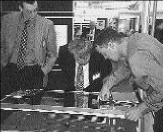
Plate 7Interested customers visiting the Batten Allen stand
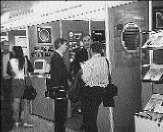
Plate 8Steve Muckett extolling the virtues of his Hibridas technology
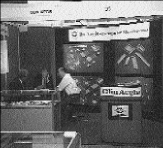
Plate 9Dave Tuffield entertaining customers on the Olin Aegis stand
More than 60 exhibitors took advantage of the airy, uniformly laid out facility which had deliberately been planned to ensure delegates had to pass through the area as well as take coffee breaks there, lunch being taken in an adjoining area (Plates 1-9). Of course, exhibitors too would have liked to see more people but it is gratifying to note that over 100 came just to visit the exhibition. A wide range of products and services were included with an actual author (Martin Bartholomew)signing copies of his book on the Multicore Stand. Paste manufacturers were there in strength, Du Pont needing to completely rebuild the provided shell scheme to meet their requirement. Manufacturing of the final product will always provide a draw to the technical public and also the press. It was disappointing,therefore, to find C-Mac was the only manufacturer from the UK; and a pleasure to see the only other manufacturer Hightec from Switzerland. Ceramics,equipment, packages, new materials, up and coming processes, and more, all were there, providing this vital role in making the event a focal point for the industry so where were the visitors?
The conference was attended by some 250 delegates from around the world, with strong representations from the USA and Japan. The technical programme achieved the difficult balance of technical excellence and global contributions. The technical programme consisted of more than 90 leading technical papers on topics highly relevant to the electronics community. A strong theme throughout the conference was Green (environmentally friendly) Electronics. The parallel Oral and Display Presentation Sessions also spanned:
design;
sensor technologies;
flip chip;
packaging and interconnection;
adhesives and soldering technologies;
circuits on ceramics;
HF RF and wireless;
quality and reliability;
defence and aerospace;
automotive and systems solutions.
The programme was delivered in up to three parallel sessions in the professional conference facilities of the Harrogate International Centre, which itself was located in the heart of one of England's most beautiful counties Yorkshire.
The plenary opening session started with an invited paper from Guillaume d'Eyssautier of IBM,entitled "Interconnection market directions" which emphasised the ever increasing pace of change and the motivation caused by the regular reduction in price of semiconductor chips with a complementary improvement in performance. Applications for microelectronic technology would undoubtedly expand; that, in turn, will result in interconnection techniques having to respond to increasing demand. This was followed by "An analysis of technology trends within the electronics industry" by David Williams of Loughborough University, which in particular focused on the influence on advancement due to requirements for"smart" technology.
Paul van Loan, the incoming president of IMAPS-US then presented "The current status of the ceramic substrate and interconnect roadmap" stressing the significance of interconnection on ceramic on the future growth of the industry. State-of-the-art technologies were also reviewed. There was some discussion after the presentation concerning availability of this information and similar material, which was considered vital if growth was to be sustained.
The final paper in the plenary session was given on behalf of COMPETE by Jorge Vleira da Silva entitled"Networking packaging and interconnection linking R&D with industry and start-ups in Europe". The aims and organisation of this EC supported facility that has so far attracted more than 50 members who are major players in packaging and interconnection research were explained. It also explained how it fitted alongside Netpack and Pidea. Thereafter, followed 85 excellent presentations in two (and ocassionally three) parallel sessions, all of which had merit and in many cases offered difficult choices between sessions. Consequently, it would be an assumption perhaps to highlight any specific papers in these pages. The overall programme of subjects covered was excellent and once again those who did not think attendance was worthwhile are the losers and may have to be content in purchasing the proceedings in book or CD-ROM format.
One of the innovative features of the conference was the "Display and presentation" sessions. The displays comprised clearly constructed posters and the presentations were precise ten-minute slots in which the authors (there could be more than one, and indeed more than one author did speak to a single paper) would orally present the work to a standing audience which had been forewarned of the timetable of presentations. As with any oral paper, the audience had the freedom to attend or drift away. With some display presentations the audience was eight deep and added up to about 66 people. There was active interest and many papers elicited many questions. After each presentation, the authors had the opportunity to continue the discussion with interested attendees, and an active dialogue could be heard. The great benefit was that there were well defined opportunities for authors to present their papers and real interest was activated in the audience,with some authors handing out samples of their developments. The risk was worthwhile, and the event was a success. For my part (Nihal Sinnadurai) I have disapproved of poster papers in the past because they tied the authors to the"posters" for a whole session and did not guarantee an interested audience hence this experiment. The solution for the future is the display and presentation session.
The Best Paper Awards were as follows:
- 1.
Best Prize Student Display and Presentations:
Sonia Delmas (France), "A new methodology for characterisation of signal integrity in deep submicron CMOS".
Jaroslaw Kita (Poland), "Pulse durability of polymer, cermet and LTCC thick-film resistors".
- 2.
Best Oral Paper: P. Coskina et al., "Creating solder bumps for CSPs and BGAs using stencil printing technology".
- 3.
Best Display and Presentation Paper: R.F. Milsom, "Efficient computer model of RF MCM including electromagnetic and non-linear effects".
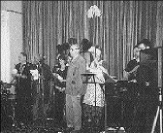
Plate 10Brian Waterfield and cohorts provided a memorable evening of entertainment
The inclement weather most affected those who signed up for the companions programme. It was necessary to substitute the walk along the historic walks of York with a visit to the,nevertheless very interesting, Castle Museum that originated as a private collection of a physician who would accept payment for selected items that interested him. The second day's visits to the magnificent Harewood House with its priceless paintings and exquisite furniture was contrasted by a pub lunch at the foot of the Yorkshire Vales at Pateley Bridge. Rain also stopped play for the planned cricket match between staff of the Conference Centre and IMAPS,whose team included some notable visitors from the USA. This didn't, however,stop consumption of the traditional cricket tea, swilled down with beer behind the exhibition area.
The conference was honoured to be given a Civic Reception on the Sunday night by His Worship, the Mayor of Harrogate, councillor George Crowther and his wife Joan. They enjoyed meeting this international gathering so much that, rather than be contained within the 25min. stay allotted them, they were almost the last to leave! The bright uniforms and tasteful playing of the brass band that graced the stage of the Royal Hall aided the digestion of the ample supply of food and drink available.
Finally there was the Gala Dinner attended by around 260 and held in the Majestic Hotel. The dinner was much enjoyed and there was plenty of ad-hocing in the home-made cabaret which, at one stage, featured lookalikes from the TV series Last of the Summer Wine (Plate 10). The highlight was undoubtedly when young Judit Ruszinko from Hungary moved to the piano to give a clear and sensitive rendering of Liebestraum, which silenced even the most boisterous revellers. It was indeed a real IMAPS family party.
This event marks a change in the routine in that next year, Prague will host a Technical Symposium with table top displays with Belgium, France and Germany working together to present a full Conference and Exhibition at Strasbourg in 2001. Again, there will be a lot of hard work for the organisers and we hope there will be many visitors to both events. We wish them the best of luck!
Brian WaterfieldNihal Sinnadurai


