This study aims to systematically analyse the state of knowledge on happiness management and workplace well-being in Ibero–America during 2021–2025, within a context shaped by the post-pandemic period, accelerated digitalisation and the advance of technologies based on artificial intelligence.
A systematic review was conducted following preferred reporting items for systematic reviews and meta-analyses guidelines. The search was carried out in Web of Science using a bilingual search equation focused on happiness management, workplace happiness, emotional salary and workplace well-being. Inclusion and exclusion criteria were applied (period 2021–2025; journal papers; English, Spanish and Portuguese; Ibero–American context; and full-text availability), along with an additional criterion of geographical balance. The final sample comprised 15 papers, which were analysed from both bibliometric and thematic perspectives.
The evidence indicates that the field in Ibero–America is in a process of consolidation, with a concentration of scholarly output in Mexico, Spain and Portugal, and a predominance of cross-sectional quantitative studies using surveys and Likert-type scales, alongside a growing use of multivariate techniques (e.g. structural equation modelling). Thematically, the studies focus on determinants of workplace well-being and happiness and their relationship with performance, innovation and retention; and the integration of happiness management as a managerial approach linked to intangible resources (emotional salary, organisational justice and mental health). Regional, methodological (scarcity of longitudinal designs and mixed methods) and theoretical integration gaps persist.
It provides an up-to-date regional synthesis (2021–2025) that identifies patterns, thematic cores and gaps, and proposes a future agenda featuring emerging constructs such as “happy salary” and “digital happiness”, as well as the need for culturally adapted instruments for Ibero–American contexts.
1. Introduction
Recent years have been characterised by accelerated digital transformation, which has radically reshaped work and social environments (Rodríguez-Reyes and Pasillas, 2025). Following the COVID-19 pandemic, traditional ways of working were altered, encouraging the intensive integration of digital technologies into organisational processes and everyday life (Rangel-Lyne and Salazar-Altamirano, 2025). Added to this process is the emergence of artificial intelligence (AI), which has triggered a series of structural changes across multiple domains, particularly in the world of work (Amorós et al., 2023). In this regard, Galvan-Vela et al. (2024) note that AI is rapidly transforming the labour landscape, generating both opportunities and challenges related to employment, job quality and the dynamics of organisational settings.
In this context of accelerated transformation, human talent management faces increasingly complex challenges. As noted by Martínez-Arvizu et al. (2025a), talent retention and the reduction of work-related stress have become key challenges in contemporary organisational management. In response, happiness management has emerged as a strategic approach to addressing persistent issues such as employee turnover, emotional exhaustion and organisational disengagement, while simultaneously fostering healthier and more sustainable work environments (Ravina-Ripoll et al., 2024a). Complementarily, Salazar-Altamirano et al. (2025a) emphasise that the diversity of contexts and approaches through which workplace happiness has been examined highlights its theoretical and empirical relevance, as well as its direct influence on productivity, engagement and workplace well-being. Along the same lines, Castro-Martínez et al. (2024) argue that promoting organisational happiness and employee well-being is essential not only to ensure an adequate quality of working life but also to strengthen the long-term sustainability of the productive system.
Although workplace happiness and employee well-being have been widely studied at the international level, there remains a need to deepen their analysis in diverse sociocultural contexts. Deroncele-Acosta et al. (2025) warn that, while workplace well-being has been extensively examined in Europe, North America and Asia, a significant gap in scientific output persists in Latin America, limiting the ability to develop a comprehensive understanding of the phenomenon in the region. From this perspective, it is pertinent to examine workplace happiness and well-being in socio-economic realities different from those traditionally studied, particularly within the Ibero–American context (De Urbina Criado et al., 2023). In this regard, Salazar-Altamirano et al. (2025b) note that the USA concentrates the majority of studies related to happiness management and workplace well-being, followed by countries such as Australia and Spain, thereby highlighting a structural gap in the scientific literature concerning the Ibero–American context. This shortcoming becomes even more evident in the analysis of small- and medium-sized enterprises (SMEs) in emerging economies such as Mexico, where empirical evidence remains limited (Martínez-Arvizu et al., 2025b).
Following this line of argument, the problem that gives rise to this study lies precisely in the existing knowledge gap regarding the evolution of happiness management and workplace well-being in Ibero–America over the past five years. This period is particularly relevant, as it has been marked by unprecedented transformations in work environments resulting from the COVID-19 pandemic, accelerated digitalisation and the increasing adoption of technologies based on AI (Hernández-Arteaga et al., 2025). These changes have substantially altered the way individuals relate to their work, generating new working conditions that directly affect employee well-being. Nevertheless, the scientific literature available for the Ibero–American context remains incipient and fragmented (Salazar-Altamirano et al., 2025c).
Although empirical evidence suggests that the incorporation of digital technologies has contributed to improving workforce productivity, it has also intensified mental workload, cognitive fatigue and adverse effects on workers’ mental health and well-being. In this regard, Supriyadi et al. (2025) indicate that the excessive use of digital resources leads to mental exhaustion, reduced job performance and increased stress levels. Against this backdrop, Valentim et al. (2025) emphasise that organisations aspiring to have happier and more productive employees must prioritise the promotion of mental health in the workplace as a strategic pillar of management.
Although countries such as Mexico, Spain, Portugal, Colombia and Brazil have begun to incorporate practices related to happiness management, scientific output in this field remains limited. Quintanilla et al. (2022) point out that the scarcity of studies on happiness in business and corporate organisations in Ibero–America highlights the need to strengthen this line of research, both from theoretical and empirical perspectives, to understand its regional specificities.
While recent reviews (Quintanilla et al., 2022; Rando-cueto et al., 2023; Salazar-Altamirano et al., 2025a) have substantially contributed to consolidating the field of happiness management and identifying its thematic evolution, there remains a need for a regionally grounded and context-sensitive synthesis that integrates empirical findings, methodological patterns and contemporary organisational transformations shaping happiness management within Ibero–American environments. Most existing reviews adopt broader bibliometric or global perspectives, which, although valuable, do not fully capture how workplace happiness has been conceptualised, operationalised and empirically examined in Ibero–American organisations during the post-pandemic period marked by accelerated digital transformation and growing incorporation of AI. This omission is theoretically relevant, as contextual variables such as labour market structures, levels of informality, organisational maturity and sociocultural dimensions may significantly influence the determinants, manifestations and managerial implications of workplace well-being and happiness. Accordingly, a systematic review of literature published between 2021 and 2025 was conducted.
In this context, AI is not approached merely as a technological backdrop but as a transversal analytical lens through which contemporary organisational transformations can be interpreted. Even when not directly operationalised in empirical models, AI increasingly shapes managerial processes, decision-support systems and human–technology interaction patterns within digitally transforming environments. Therefore, examining happiness management in Ibero–American organisations during the 2021–2025 period necessarily entails situating workplace well-being within the broader reconfiguration of work structures influenced by AI.
In light of this background, the present study addresses this gap by conducting a systematic review of the literature on happiness management and workplace well-being in Ibero–America during the period 2021–2025, following the preferred reporting items for systematic reviews and meta-analyses (PRISMA) methodology offering a regional synthesis of trends, gaps and future research opportunities that contributes to a more contextualised and analytically robust understanding of happiness management in Ibero–America. The main objective is to analyse the state of knowledge on happiness management and workplace well-being in the Ibero–American context in the post-pandemic stage, identifying recent advances, the main research gaps and the implications that technological transformation and the adoption of AI pose for the future of work. Based on this purpose, the following research questions are proposed:
What has been studied regarding happiness management and workplace well-being in Ibero–America?
Which methodological designs predominate in research conducted within this context?
What have been the main findings reported in studies on happiness management and workplace well-being in Ibero–America?
What are the main gaps and limitations identified in the existing literature?
How do the post-pandemic stage and the adoption of artificial intelligence influence happiness management and workplace well-being?
Finally, the article is organised as follows. Section 2 provides the conceptual and empirical foundations of happiness management and workplace well-being within the Ibero–American context. This is followed by Section 3, which outlines the systematic literature review procedure, including the search strategy, inclusion and exclusion criteria and analytical approach adopted. Section 4 then presents the main bibliometric and thematic findings derived from the analysed studies. Subsequently, Section 5 critically examines these results in relation to previous research and considers their relevance, considering post-pandemic transformations and the increasing adoption of AI in work environments. Section 6 summarises the principal insights of the study, followed by Section 7 outlining the theoretical, practical and social implications for organisational management. Finally, Section 8 acknowledges its limitations and identifies directions and research gaps for future studies on happiness management and workplace well-being in Ibero–America.
2. Literature review
2.1 Happiness management and workplace well-being
The post-pandemic period marked a turning point in work environments (Mercader et al., 2025a, 2025b). Organisations were faced with the need to rapidly integrate new technologies and work modalities, such as hybrid and remote arrangements, which have significantly redefined the labour dynamics of human talent (Salazar-Altamirano et al., 2024). Within this context of continuous change, the search for management approaches oriented not only towards organisational efficiency but also towards strengthening workplace well-being and the adaptive capacity of organisational members has gained particular relevance (Ravina-Ripoll et al., 2023). In this regard, Calderón et al. (2024) define workplace well-being as the set of conditions and practices present in the work environment that contribute to employees’ physical and mental health, satisfaction and productivity. From a broader perspective, Arrieta-Valderrama et al. (2019) conceptualise workplace well-being as a programme composed of activities or strategies aimed at addressing employees’ real needs, generating benefits within the organisation and extending to the family and the community in which individuals operate, thereby highlighting its comprehensive and multidimensional nature.
Based on these definitions, workplace well-being can be understood as a construct that transcends the immediate organisational space and incorporates social and community dimensions (Colenberg et al., 2020). However, alongside the development of this approach, recent literature has begun to pay greater attention to happiness at work as a specific dimension of subjective well-being in the labour context (Salazar-Altamirano et al., 2025d). In this respect, Sánchez and Veliz (2024) define happiness at work as a state of mind among employees in which aspects extending beyond economic considerations are enhanced. Complementarily, happiness management is defined as the techniques and practices used by organisations to foster a positive emotional climate among their employees, thereby improving overall well-being and productivity (Ravina-Ripoll et al., 2022). These conceptual approaches make it possible to distinguish between workplace well-being, understood as a broad framework of organisational conditions and policies and happiness management, which focuses more specifically on the emotional and psychological domain of the worker (Manzoor et al., 2025).
Thus, while workplace well-being adopts a holistic perspective that integrates organisational, social and personal factors, happiness management is primarily oriented towards strengthening positive emotional states within the work environment (Martínez-Arvizu et al., 2025c). This distinction does not imply a rigid conceptual separation, but rather a complementary relationship, insofar as both approaches converge in the creation of work environments that foster performance, satisfaction and organisational commitment.
From an ethical and cultural perspective, some authors argue that happiness management transcends its instrumental dimension and should be understood as an organisational approach aimed at promoting subjective well-being through responsible and socially committed practices. In this sense, happiness management is conceived as a framework that raises organisational awareness of the need to develop strategies that foster personal and collective happiness as a foundation of organisational well-being (Zambrano et al., 2021). Likewise, from a social standpoint, Jiménez-Marín et al. (2020) point out that happiness management enables organisational and communicative practices to be oriented towards social well-being objectives, integrating principles of social marketing and collective responsibility. Consistently, within the university sphere it is recognised that the relevance and social responsibility of organisations constitute a means of promoting quality of life, human progress and sustainable development, reinforcing their social function beyond academic performance (Hernández-Arteaga et al., 2025). Taken together, these approaches allow happiness management to be understood as a management philosophy that integrates organisational strategies and social marketing aimed at sustainability and well-being, contributing to the development of more prosperous and socially responsible organisations (Gutiérrez-Rodríguez et al., 2024).
From a historical perspective, the origins of happiness management can be traced to positive psychology, studies on quality of working life and theories of human motivation (Núñez-Barriopedro et al., 2019). Nevertheless, its consolidation as an organisational management approach is relatively recent and has been driven by empirical evidence that consistently links employee well-being with job performance (Andrade et al., 2024). In line with this, Torres-Flórez et al. (2023) note that in recent years, happiness at work has become a topic of growing relevance for organisations, due to the multiple benefits associated with having employees who are satisfied both professionally and personally.
Moreover, recent literature highlights that happiness management has gained particular relevance in the context of SMEs. Núñez-Sánchez et al. (2025) indicate that, at a global level, SMEs have begun to incorporate this approach as a strategy to promote employee well-being, increase productivity and stimulate innovation. From this perspective, happiness can be understood as an intangible resource that helps to reduce resistance to change in the face of contemporary technological, business and social challenges, thereby facilitating processes of organisational adaptation and transformation (Abellán-Sevilla et al., 2024).
Consequently, strengthening workplace well-being not only improves employees’ health but also increases their level of organisational commitment, demonstrating its positive impact on performance and organisational sustainability (Cáceres-Lozano et al., 2023). In this vein, other studies conducted within the field of organisational management and sustainability show that certain business strategies can actively contribute to the generation of well-being and happiness experiences. In particular, it has been noted that specific organisational practices oriented towards customer experience design can stimulate the creation of an atmosphere of pleasure and happiness during interactions with organisations’ physical environments (Jiménez-Marín et al., 2021).
Within this conceptual framework, it is pertinent to systematically analyse how happiness management and workplace well-being have been addressed in recent scientific literature, particularly in the Ibero–American context (Amorós et al., 2020). Accordingly, the following section presents a structured review of the main studies published during the period 2021–2025, with the aim of identifying trends, methodological approaches and research gaps that may guide the future development of the field.
2.2 Artificial intelligence and organisational transformation
The contemporary organisational landscape is increasingly shaped by accelerated digital transformation and progressive integration of AI into managerial, operational and strategic processes. To ensure conceptual clarity within this study, it is necessary to delimit the notion of AI adopted herein and to distinguish it from broader concepts such as digitalisation or technological transformation.
According to the Organisation for Economic Co-operation and Development (OECD) definition, an AI system is a machine-based system that, for explicit or implicit objectives, infers, from the input it receives, how to generate outputs such as predictions, content, recommendations or decisions that can influence physical or virtual environments, with systems varying in their levels of autonomy and adaptiveness after deployment (OECD, 2024). This definition highlights two essential elements: firstly, AI systems operate through inference mechanisms that transform data into outputs with practical consequences; secondly, they may function with varying degrees of autonomy, thereby potentially altering decision-making structures within organisations.
From an organisational perspective, AI is not merely a technological tool but a transformative force that can reshape management practices, leadership dynamics, performance evaluation systems and human–technology interaction. Recent scholarship emphasises that AI increasingly influences how information is processed, how strategic and operational decisions are made and how employees experience cognitive demands and workload within digital work environments (Ravina-Ripoll et al., 2024a; Amorós et al., 2023). Consequently, AI contributes to redefining the structural and psychosocial conditions under which workplace well-being and happiness are constructed.
Within the scope of this study, AI is conceptualised as a structural contextual factor embedded in the post-pandemic organisational environment, rather than as an individual-level adoption variable. Although AI is not always directly operationalised in the empirical studies included in this review, it constitutes a critical background condition shaping contemporary work contexts characterised by hybrid models, algorithmic decision-support systems, data-driven management and increased technological interdependence. These transformations may indirectly affect employees’ perceptions of autonomy, organisational justice, stress, creativity and overall workplace well-being.
By framing AI as a component of the organisational digital ecosystem that influences managerial processes and work experiences, this study aligns its theoretical positioning with broader discussions of how post-pandemic digital environments reconfigure the determinants and manifestations of happiness management in Ibero–American organisations.
3. Methodology
The purpose of the present study was to comprehensively examine the state of knowledge on happiness management and workplace well-being in the Ibero–American context, with the aim of identifying research trends, prevailing theoretical frameworks and existing gaps in the literature. To achieve this objective, a systematic literature review approach was adopted, following the PRISMA guidelines proposed by Moher et al. (2009), which are widely recognised for their contribution to transparency, traceability and methodological rigour in the identification, selection and synthesis of scientific evidence.
In accordance with the structure established by the PRISMA guideline and its most recent update (Page et al., 2021), the review process was conducted in three sequential stages: identification, screening and final selection of studies. During the identification stage, an exhaustive search was carried out in the Web of Science database, selected for its international relevance and for concentrating high-quality scientific output from a wide range of countries and disciplines. This database enabled a systematic exploration of research related to happiness management and workplace well-being in the Ibero–American context.
The search period covered the past five years, in response to the paradigm shift generated by the COVID-19 pandemic and the accelerated incorporation of digital technologies and AI in work environments. To retrieve the studies, the following search equation was designed: “happiness management” OR “happiness at work” OR “workplace happiness” OR “gestión de la felicidad” OR “felicidad laboral” OR “salario emocional” OR “emotional wage” OR “well-being at work”. To minimise the risk of bias and ensure the relevance of the included studies, inclusion and exclusion criteria were defined in advance.
The inclusion criteria considered full-text documents that directly addressed the variables under study, published as open-access scientific journal articles, focused on the Ibero–American context and indexed in the Web of Science Core Collection. The exclusion criteria comprised studies published prior to 2021, works written in languages other than English, Spanish or Portuguese, documents that were not scientific journal articles (such as books, theses or book chapters), as well as research conducted outside the Ibero–American countries considered in this study, specifically Colombia, Spain, Mexico, Ecuador, Portugal, Brazil, Chile, Peru, Costa Rica, Cuba, Nicaragua and Venezuela.
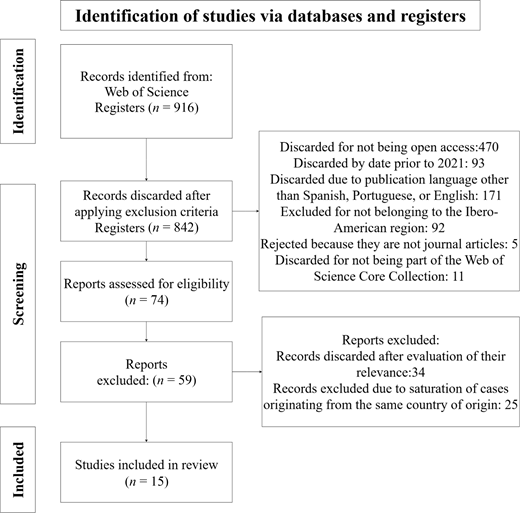
After applying the initial inclusion and exclusion criteria, 40 studies with high thematic relevance in the Ibero–American context were identified. However, a refinement process was undertaken to construct a final analytical sample of 15 articles. This refinement was guided by three criteria; 1) geographical balance across Ibero–American countries to avoid over-representation of specific national contexts; 2) thematic complementarity, prioritising studies that address different dimensions of happiness management and workplace well-being rather than duplicating similar analytical models; and 3) methodological robustness, favouring studies with clear research designs, transparent data collection procedures and coherent analytical frameworks.
In cases where multiple studies originated from the same country, particularly Spain, which showed a higher concentration of publications, priority was given to those offering distinctive theoretical contributions, diverse sectoral contexts or advanced analytical techniques. This procedure ensured regional representativeness and analytical depth while maintaining conceptual diversity within the review.
Although 40 studies met the initial eligibility criteria, the final sample was intentionally refined to 15 articles to ensure regional representativeness and analytical depth. This decision also reflects the emerging and still consolidating nature of happiness management research in Ibero–America, where the volume of indexed publications remains limited and concentrated in specific academic clusters. Therefore, this delimitation was guided by the need to avoid over-representation of specific national contexts and research clusters, thereby strengthening the contextual balance of the review. Rather than aiming at exhaustive numerical coverage, the review prioritised conceptual relevance, geographical diversity and interpretative coherence. This methodological choice is acknowledged as having implications for the scope of generalisation, favouring contextual sensitivity and analytical robustness over statistical comprehensiveness.
Additionally, a basic quality appraisal was conducted for the studies included in the final sample. This assessment considered criteria such as clarity of research objectives, methodological transparency, adequacy of sample description and consistency between research design and reported conclusions. Given that all selected studies were peer-reviewed articles indexed in the Web of Science Core Collection, they met minimum standards of scientific rigour.
Figure 1 presents the document selection process. In the first stage, records retrieved from the Web of Science database were identified. In the second stage, the inclusion and exclusion criteria were applied to discard documents that did not meet the established requirements. Finally, in the third stage, the studies that passed the screening were assessed in full text, thereby constituting the final sample of 15 articles included in the systematic review.
4. Results
The results of the systematic review make it possible to identify the main characteristics, trends and patterns that define recent scientific production on happiness management and workplace well-being in Ibero–America during the period 2021–2025. After applying the identification, screening and selection process described in the methodological section, 15 articles were included, offering relevant contributions to addressing the proposed research questions. Taken together, these studies provide a structured overview of the current state of the field, as well as its conceptual, methodological and thematic evolution in the Ibero–American context.
Overall, the results indicate that research on happiness management and workplace well-being in Ibero–America is in a phase of consolidation, characterised by growing empirical interest, a progressive diversification of analytical approaches and the emergence of academic clusters with sustained and high regional impact output. In this regard, the contributions led by Ravina–Ripoll, Salazar-Altamirano, Martínez-Arvizu and Galvan-Vela stand out recurrently, as their research articulates a substantial part of the conceptual and empirical advances identified in the analysed sample.
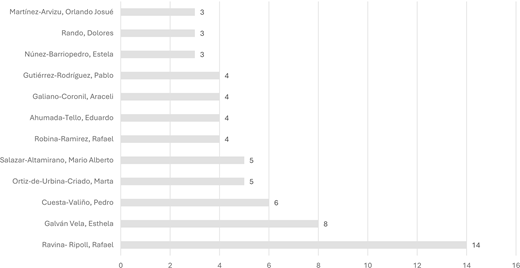
To complement the analysis of scientific production and to contextualise the findings of the systematic review, a descriptive bibliometric analysis was conducted using the Web of Science platform, focusing on the Ibero–American context and on publications from the past three years. This analysis made it possible to identify the authors with the highest recent productivity in the field of happiness management, offering a panoramic view of academic leadership and the concentration of research during the period considered. Figure 2 presents the main authors identified under these criteria, serving as contextual support that is not limited exclusively to the studies included in the final sample of the review.
As can be observed, scientific production is concentrated among a relatively small number of authors. Rafael Ravina–Ripoll stands out prominently, leading the field with the highest number of contributions, followed by Esthela Galván Vela (eight publications) and Pedro Cuesta-Valiño (six publications). In addition, a group of authors with an intermediate level of output is identified, such as Ortiz de Urbina Criado (5) and Salazar-Altamirano (5), who have contributed steadily to the development of the field. They are followed by a cluster of authors with four publications each (Robina-Ramírez, Ahumada-Tello, Galiano-Coronil and Gutiérrez-Rodríguez). This distribution suggests the presence of consolidated academic leadership alongside emerging researchers such as Martínez–Arvizu (3), Rando (3) and Núñez–Barriopedro (3), who collectively strengthen the theoretical and empirical expansion of happiness management.
Table 1 presents the general characteristics of the included studies, enabling a systematic comparison of bibliographic and contextual information. With regard to geographical distribution, a significant concentration of research can be observed in Mexico, Spain and Portugal, which act as key hubs of scientific production in the field of Ibero–American happiness management. Mexico accounts for four studies (Articles 1, 4, 11 and 14), particularly highlighting the contributions of Salazar-Altamirano, Martínez-Arvizu and Galván-Vela, focused on the analysis of workplace well-being, innovation, organisational justice and turnover intention in educational and business contexts. Portugal and Spain each contribute three studies, with a strong presence of Ravina–Ripoll in research linking happiness management to strategic variables such as emotional salary, brand orientation and organisational sustainability. Brazil contributes two studies, while Costa Rica, Colombia and Ecuador each contribute one study, reinforcing the need to expand scientific production in other countries across the region.
The concentration of scientific production in Mexico, Spain and Portugal may be associated with the consolidation of specific academic networks and research groups that have actively promoted happiness management as a managerial approach. Additionally, these countries have experienced a significant post-pandemic organisational restructuring process and digital transformation initiatives, which may have stimulated scholarly interest in workplace well-being and managerial innovation.
Table 2 summarises the methodological characteristics of the analysed studies and reveals a clear predominance of the quantitative approach, present in 12 of the 15 articles. These studies predominantly use cross-sectional, non-experimental, descriptive, correlational and causal designs, in several cases complemented by advanced analytical techniques such as structural equation modelling (SEM) and exploratory and confirmatory factor analysis. In this regard, the studies by Martínez-Arvizu et al. (2025c) and Galvan-Vela et al. (2024) stand out for their rigorous use of structural equation models and multigroup analysis, which contribute to strengthening the methodological robustness of the field within the Ibero–American context.
The predominance of quantitative, cross-sectional designs may reflect an effort to legitimise the field through statistically robust explanatory models, particularly in a research domain still undergoing consolidation. SEM and multivariate techniques enable the testing of complex relational frameworks linking happiness management to organisational variables such as performance, innovation and turn over intention. However, this methodological orientation may also indicate a relative underdevelopment of longitudinal and qualitative approaches capable of capturing contextual and processual dynamics in greater depth.
Studies adopting mixed-methods approaches incorporate narrative analysis, automated sentiment analysis and logical reasoning, as in the cases of Sender et al. (2021) and Ruiz-Rodríguez et al. (2023), while purely qualitative approaches appear only marginally, being limited to a single study based on semi-structured interviews. With respect to sampling, non-probabilistic convenience sampling predominates, although some studies incorporate simple random sampling, highlighting a clear opportunity to strengthen the generalisability of results in future research.
Regarding data collection techniques, the majority of studies use structured questionnaires administered online through Likert-type scales. Among the most frequently used instruments are the Positive Mental Health Questionnaire (PMHQ), the Happiness at Work Scale, the Shortened Happiness at Work Scale (SHAW) and the Questionnaire of Quality of Work Life, Job Satisfaction and Workplace Happiness, reflecting a trend towards the standardisation of the measurement of workplace well-being and happiness.
Table 3 summarises the objectives and main findings of the included studies, making it possible to identify the thematic lines that guide recent scientific production. Transversally, research objectives focus on analysing the determinants of happiness at work, exploring organisational factors associated with well-being, validating explanatory and relational models through multivariate techniques and examining new theoretical approaches such as neuroleadership, emotional salary and hybrid measurement models. Within this framework, the studies by Ravina-Ripoll et al. (2021, 2024) and Salazar-Altamirano et al. (2025a) play a central role by integrating strategic, cultural and sustainability dimensions into the analysis of happiness management.
Regarding the findings, the studies converge in recognising that workplace well-being and happiness management are closely linked to organisational functioning, individual and collective performance and critical variables such as organisational justice, work-related stress, creativity, innovation and turnover intention. In particular, the works by Martínez-Arvizu et al. (2025b) and Galvan-Vela et al. (2024) provide robust empirical evidence on the mediating and moderating roles of these variables across different sectors, reinforcing the understanding of happiness management as a complex and relational phenomenon.
Finally, Table 4 presents the main knowledge gaps and future research lines identified by the analysed studies. Consistently, the authors agree in pointing out the scarcity of research integrating happiness management and workplace well-being with variables such as organisational justice, emotional salary, mental health and productivity through longitudinal and mixed-methods approaches. Likewise, the need to broaden study contexts, diversify economic sectors and strengthen comparative analysis among Ibero–American countries is emphasised. These gaps reinforce the relevance of the research agendas promoted by authors such as Ravina-Ripoll, Salazar-Altamirano, Martínez-Arvizu and Galván-Vela, who have made significant contributions to the consolidation of the field and to the identification of new paths for theoretical and empirical development.
The visible concentration of publications among a limited number of authors suggests the existence of consolidated research clusters driving the development of the field in Ibero–America. While this academic leadership contributes to theoretical continuity and cumulative knowledge building, it may also influence thematic convergence and methodological homogeneity within the region. This pattern is not uncommon in emerging research domains, where early institutionalisation often depends on specialised networks that later diversify as the field matures.
5. Discussion
This section interprets the results of the systematic review in light of the study’s objective and the existing literature, with the aim of explaining their meaning, justifying their relevance and clearly showing how the findings address the research questions. Overall, the synthesised evidence suggests that research on happiness management and workplace well-being in Ibero–America (2021–2025) is in a phase of consolidation, with visible advances in quantitative modelling and a thematic agenda increasingly connected to contemporary organisational challenges, although regional asymmetries and methodological limitations persist.
The findings are discussed below according to the research questions posed.
With regard to RQ1:
What has been investigated about happiness management and workplace well-being in Ibero–America?
The results show that recent Ibero–American scientific production has focused on two dominant lines. Firstly, a set of studies aimed at identifying determinants of workplace well-being and happiness (e.g. leadership, organisational culture, autonomy and positive mental health), as well as their relationship with performance and productivity indicators. Secondly, research that conceptualises happiness management as a management approach that can be integrated into organisational practices and intangible resources, such as emotional salary, organisational justice and corporate sustainability. This reading converges with literature emphasising the strategic relevance of well-being and happiness in organisations (Castro-Martínez et al., 2024) and aligns with the argument that the Ibero–American field requires the consolidation of culturally situated evidence (Deroncele-Acosta et al., 2025).
Within this framework, authors such as Ravina-Ripoll, Salazar-Altamirano, Martínez-Arvizu and Galvan-Vela are observed to act as thematic articulation nodes. Their work connects well-being with critical organisational variables (justice, innovation, turnover intention and stress), contributing to greater conceptual density and managerial applicability within the field:
Which methodological designs predominate in studies conducted in this context?
The evidence reveals a clear predominance of the quantitative paradigm, mainly supported by cross-sectional and non-experimental designs (descriptive, correlational and causal), with frequent use of online surveys and Likert-type scales. This pattern is consistent with that reported in regional reviews, which highlight the hegemony of quantitative approaches and the recurrent use of variables such as engagement and job satisfaction to operationalise happiness and well-being. In addition, an increasing use of multivariate techniques and SEM is observed, which strengthens the explanatory capacity of the field in the Ibero–American environment.
However, although there are contributions using mixed and qualitative approaches, their presence remains marginal. For example, Sender et al. (2021) propose measurements that seek to capture the complexity of the work experience beyond traditional instruments, and Ruiz-Rodríguez et al. (2023) explore emerging approaches such as neuroleadership linked to happiness at work. Taken together, these findings suggest that the field has advanced in quantitative robustness, but still requires greater methodological diversity to capture post-pandemic dynamics (Hernández-Arteaga et al., 2025) and processes associated with digital transformation (Rangel-Lyne and Salazar-Altamirano, 2025):
What have been the main findings reported in studies on happiness management and workplace well-being in Ibero–America?
The analysed studies converge on a key finding: workplace well-being and happiness at work are consistently linked to relevant organisational outcomes, such as perceived productivity, performance, innovation and retention. Valentim et al. (2025), for example, report positive associations between positive mental health, domains of organisational and functional happiness and perceived productivity, as well as statistically significant predictors of workplace happiness. In the case of SMEs, Barbosa et al. (2023) argue that employee happiness is associated with improvements in performance, motivation, creativity, engagement and productivity, in addition to positive effects on the employee–customer relationship.
Furthermore, the results highlight relational findings that reinforce a systemic understanding of the phenomenon. For instance, Ravina-Ripoll et al. (2024a, 2024b) show that emotional salary has a positive impact on happiness at work and acts as a mediator between organisational justice and happiness. Complementarily, contextual relationships are identified that nuance these effects. The relationship between happiness management, stress and turnover intention differs according to the public or private sector in multigroup analyses, and the effect of digital innovation and innovation culture on happiness at work is stronger in medium-sized SMEs than in micro and small firms. From a discussion standpoint, this suggests that happiness management in Ibero–America is increasingly being studied as a contingent phenomenon, dependent on organisational and sectoral conditions, which enhances its practical usefulness:
What are the main gaps and limitations identified in the existing literature?
The synthesised evidence allows the identification of structural gaps at three levels. Firstly, a geographical and contextual gap due to the concentration of studies in a small number of countries and the limited representation of other Ibero–American contexts. Secondly, a methodological gap arising from the predominance of cross-sectional designs and non-probabilistic sampling, which restricts causal inference and generalisability. Thirdly, a theoretical and integrative gap, as the systematic integration of variables such as organisational justice, emotional salary, mental health and productivity into comparable and regionally replicable models remains insufficient.
These gaps are consistent with the need identified in the literature to strengthen the empirical development of the field in Ibero–America (Quintanilla et al., 2022; Deroncele-Acosta et al., 2025). At the same time, the results of the review indicate that part of the emerging agenda is already oriented towards addressing these gaps, particularly through multivariate models and mediation and moderation analyses, contributing to the progressive consolidation of the field.
Finally:
How do the post-pandemic stage and the adoption of artificial intelligence affect happiness management and workplace well-being?
It is important to clarify that the reviewed studies do not directly operationalise human–AI interaction as a primary analytical variable. However, the findings consistently reflect organisational contexts characterised by accelerated digital transformation and increasing reliance on data-driven management systems. Within this broader technological environment, AI can be understood as a contextual element embedded in post-pandemic organisational restructuring processes. In this sense, while AI is not empirically measured in most of the reviewed models, the evidence suggests a growing emphasis on human-centred management approaches aimed at mitigating stress, strengthening mental health and fostering organisational justice in digitally transforming environments. This is consistent with evidence linking intensive use of digital resources to mental exhaustion, lower performance and increased stress (Supriyadi et al., 2025), as well as with the idea that promoting mental health is central to sustaining productivity and well-being (Valentim et al., 2025). Moreover, the results suggest that in scenarios of technological change, happiness functions as an intangible resource that can facilitate organisational adaptation and reduce resistance to change, particularly in SMEs and sectors exposed to accelerated innovation. In this sense, AI operates as a structuring dimension of the contemporary organisational environment, indirectly influencing the psychosocial conditions under which happiness management strategies are designed and implemented.
Taken together, the evidence reviewed suggests that happiness management in the Ibero–American context can be conceptualised not merely as a set of isolated well-being initiatives, but a strategic organisational resource embedded within digitally transforming environments. In this context, characterised by accelerated technological change, hybrid work structures and data-driven governance, happiness management appears to function as a mediating and adaptive mechanism that supports organisational resilience, innovation capacity and talent retention. From a broader theoretical perspective, this positioning aligns with resource-based views of the firm, which recognise intangible assets as sources of sustained competitive advantage. Simultaneously, it resonates with human-centred management approaches that emphasise the centrality of psychological safety, organisational justice and meaningful work in shaping sustainable performance.
6. Conclusion
The purpose of the present study was to systematically analyse the state of knowledge on happiness management and workplace well-being in Ibero–America during the period 2021–2025, within a context marked by transformations derived from the post-pandemic stage, accelerated digitalisation and the growing incorporation of AI-based technologies. Based on the review conducted, the results allow for the extraction of relevant conclusions that contribute both to the academic understanding of the phenomenon and to its future projection within the field of organisational management.
Firstly, the findings confirm that happiness management and workplace well-being have moved beyond being peripheral concepts to progressively consolidate as strategic axes of organisational analysis in Ibero–America. Although scientific production still displays an uneven distribution across countries, the reviewed evidence shows a clear evolution towards more robust explanatory models, in which happiness at work is systematically linked to organisational variables such as organisational justice, innovation, mental health, turnover intention and performance. This progress reflects a transition from descriptive approaches towards analytical perspectives with greater explanatory capacity and practical usefulness.
Secondly, the study shows that recent Ibero–American literature has prioritised the use of quantitative methodologies and multivariate models, which have helped to strengthen the empirical validity of the field. However, this methodological consolidation coexists with persistent limitations associated with the predominance of cross-sectional designs and non-probabilistic sampling. Consequently, one of the central contributions of this work lies in systematising these methodological trends, providing a reference framework that makes it possible to identify both the advances achieved and the opportunities for improvement required for the future development of the area.
Moreover, the results reveal that the post-pandemic context has acted as a conceptual accelerator in the study of workplace well-being and happiness at work. The reviewed evidence suggests that the intensification of digital technology use and the reconfiguration of work environments have increased the relevance of variables related to mental health, emotional management and adaptation to change. In this sense, happiness management emerges not only as an approach oriented towards subjective well-being but also as an organisational resource that can help to mitigate the adverse effects of cognitive overload, work-related stress and uncertainty associated with technological transformation.
From an integrative perspective, this study provides a structured and up-to-date overview of the field in Ibero–America by identifying recurring thematic cores, dominant methodological patterns and unresolved research gaps. Unlike previous reviews with a more global scope or focused on specific contexts, the added value of this research lies in its regional approach, which makes it possible to highlight the sociocultural, organisational and economic particularities that influence how happiness at work is conceptualised and managed in Ibero–American countries.
Finally, the conclusions of this study lay the foundations for advancing towards a more coherent, comparative and context-sensitive research agenda, in which happiness management and workplace well-being are addressed as dynamic, interrelated and strategic phenomena. This justifies the need, in the following sections, to examine the theoretical, practical and social implications derived from the findings, as well as to acknowledge the study’s limitations and the future research gaps that must be addressed to strengthen the scientific maturity of the field in Ibero–America.
7. Implications: theoretical, practical and social
The findings of this systematic review generate a set of relevant implications that go beyond a mere description of the state of the art and contribute to strengthening the future development of happiness management and workplace well-being in Ibero–America. The main theoretical, practical (including managerial) and social implications are presented below, articulated coherently with the results and the preceding discussion.
7.1 Theoretical implications
Drawing on the empirical patterns identified in the results, particularly the predominance of quantitative explanatory models, the concentration of research in specific national contexts and emerging integration of variables such as organisational justice and emotional salary, this study offers several theoretical implications for the advancement of happiness management research in Ibero–America. The reviewed evidence supports the view that happiness at work should not be interpreted solely as an individual affective state, but rather as a relational and systemic construct influenced by specific organisational, cultural and technological conditions. In this regard, the results support integrative approaches that link positive psychology with contemporary organisational theories, such as social exchange theory, organisational justice and job demands–resources models.
Furthermore, the review highlights the need to move towards multicausal and contingent theoretical models capable of explaining how happiness management interacts with variables such as innovation, mental health and turnover intention across different organisational contexts. This theoretical orientation makes it possible to overcome reductionist perspectives and fosters the construction of analytical frameworks that are more sensitive to post-pandemic transformations of work and the increasing incorporation of AI-based technologies. Consequently, the study opens up the possibility of developing middle-range theories that integrate emotional, structural and technological dimensions in the analysis of workplace well-being.
7.2 Practical and managerial implications
Based on the reviewed evidence demonstrating consistent associations between workplace well-being, organisational justice, innovation and turnover intention, several practical and managerial implications can be derived for organisations operating in digitally transforming environments. The results suggest that happiness management can become a strategic management tool, particularly in organisations operating in environments characterised by high uncertainty, accelerated digitalisation and competitive pressure. Beyond isolated well-being initiatives, the evidence indicates that happiness management needs to be integrated transversally into human resource policies, leadership practices and organisational design.
From a managerial perspective, organisations can translate these findings into concrete actions, such as the design of emotional salary systems aligned with perceptions of justice, the promotion of empathetic and transformational leadership and the implementation of practices that foster autonomy, creativity and innovation. Likewise, in contexts involving the adoption of digital technologies and AI, happiness management can function as a mechanism to mitigate stress and cognitive overload, facilitating processes of adaptation to change and reducing organisational resistance.
In the case of SMEs, which are particularly relevant within the Ibero–American productive fabric, these implications acquire additional strategic value. The reviewed literature suggests that, even with limited resources, SMEs can obtain significant benefits by incorporating well-being and happiness practices, improving not only internal performance but also the quality of relationships with customers and other stakeholders. In this way, happiness management is positioned as a lever for sustainable competitiveness rather than as an additional cost for the organisation.
7.3 Social implications
Considering the findings that link workplace well-being to mental health, organisational sustainability and broader socio-economic conditions within Ibero–American contexts, important social implications emerge from this reviewed. The results of this study reinforce the idea that workplace well-being and happiness at work have impacts that extend beyond the organisational sphere. The evidence suggests that healthy work environments contribute to improving workers’ quality of life, strengthening their mental health and generating positive effects within their family and community contexts. In Ibero–American societies characterised by high levels of labour informality, inequality and precariousness, these implications acquire particular relevance.
From this perspective, happiness management can be understood as an instrument of organisational social responsibility, aligned with broader objectives of sustainability and human development. Promoting workplace well-being not only responds to business interests, but can also help to reduce social tensions, enhance social cohesion and foster more dignified and humanised models of work within a scenario of accelerated technological transformation.
Taken together, the theoretical, practical and social implications derived from this study underscore the need to conceive happiness management as an integral, strategic and context-sensitive approach. This vision makes it possible to move towards management models that harmonise efficiency, well-being and sustainability, thereby laying the foundations for a critical analysis of the study’s limitations and future research gaps, which are addressed in the following section.
8. Limitations and future lines of research
Despite the contributions, the present study presents several methodological and conceptual limitations that warrant explicit consideration to delimit the interpretative scope of the findings.
Firstly, a limitation inherent to the adopted design lies in the bibliometric and systematic nature of the review. While this approach makes it possible to offer a structured, comparative and replicable overview of the state of knowledge, it also entails reliance on the quality, availability and focus of previously published studies. In this regard, the review was restricted to articles indexed in Web of Science, which may have excluded relevant research published in other databases, grey literature or applied studies conducted by organisations and consultancies that are not always disseminated through academic journals.
Secondly, although a geographical balance criterion was applied to avoid the over-representation of certain countries, the final sample still reflects a concentration of scientific output in a limited number of national contexts. This situation constrains the generalisability of the findings to the entire Ibero–American region and highlights the need to expand research to countries and productive sectors that remain underexplored, particularly in emerging economies and work environments characterised by informality, precariousness or high turnover.
From a methodological perspective, the review shows that recent literature continues to be dominated by cross-sectional designs and quantitative approaches, which limits the ability to capture temporal dynamics, adaptation processes and cumulative effects of happiness management and workplace well-being. Consequently, a priority line for future research lies in the development of longitudinal studies and quasi-experimental designs that allow for the analysis of how happiness and well-being at work evolve over time, particularly in scenarios of continuous technological transformation.
Beyond these limitations, the main prospective value of the study lies in the identification of emerging and innovative research lines that have not yet been systematically explored in the Ibero–American literature. Firstly, the study proposes advancing towards the analysis of the “happy salary”, understood not merely as an extension of emotional salary, but as a multidimensional construct integrating fair economic compensation, temporal flexibility, personalised benefits and perceptions of equity. Empirically examining how happy salary interacts with organisational justice, productivity and talent retention represents a high-impact theoretical and practical opportunity.
Secondly, there is a strong emerging need to conceptualise and operationalise digital happiness in work environments. This construct would make it possible to analyse how everyday interaction with digital technologies, remote working platforms and AI influences workers’ emotions, motivation and well-being. Future research could explore digital happiness as a mediating or moderating variable between AI adoption, cognitive load, technostress and job performance, opening up a largely unexplored field within organisational literature.
In addition, a significant gap is identified in the development and validation of measurement instruments adapted to the Ibero–American context. Although internationally consolidated scales exist, there is a need to design and validate hybrid instruments that integrate hedonic, eudaimonic and digital dimensions of workplace well-being, incorporating variables such as digital happiness, happy salary, technological trust and enjoyment in human–AI interaction. Such instruments would enable more refined, culturally sensitive measurements aligned with the challenges of contemporary work.
A particularly relevant avenue for future research concerns the need for empirical studies that directly examine the interaction between AI systems and workplace happiness. While AI has been framed in this study as a contextual driver within digitally transforming organisational environments, there remains a significant gap in empirical research explicitly analysing human–AI interaction, algorithmic management systems, technostress, digital autonomy and their potential effects on well-being. Addressing this gap would allow for a more precise understanding of how technological transformation reshapes the psychosocial foundations of happiness at work.
Finally, a disruptive line of research is proposed that approaches happiness management from an ecosystem perspective, considering not only the organisation and the individual but also their impact on customers, communities and territories. Within this approach, 360-degree workplace happiness could be linked to concepts such as extended organisational happiness, collective well-being and social sustainability, integrating economic, social and emotional metrics within a single analytical framework.
In sum, although the present study presents limitations inherent to its design and scope, these same limitations open up clear opportunities for the development of a more ambitious, innovative and context-sensitive research agenda. Exploring emerging constructs such as happy salary and digital happiness, developing new measurement instruments and adopting longitudinal and ecosystem-based approaches will not only strengthen the scientific maturity of happiness management but also position Ibero–American research as an international benchmark in the study of workplace well-being and happiness.
The authors would like to thank the participants who generously contributed their time to this study, as well as the anonymous reviewers whose valuable insights helped to improve the quality of this manuscript.
Funding
This research did not receive any specific grant from funding agencies in the public, commercial, or not-for-profit sectors.