Skip to article sections
Purpose

This study aims to explore the role of innovation in driving financial performance in innovative small and medium-sized enterprises (SMEs), distinguishing between female-led and non-female-led firms. It aims to examine which combination of R&D investment, qualified human capital and intellectual property rights contributes to higher profitability, and whether gender influences this relationship.

Design/methodology/approach

Using fuzzy-set qualitative comparative analysis (fsQCA), the study analyses a sample of 2,635 Italian innovative SMEs over a ten-year period (2013–2022). This approach allows for the identification of different innovation pathways that lead to high financial performance, considering both female-led and non-female-led SMEs.

Findings

Results highlight that R&D and highly qualified teams are more critical predictors of profitability than legal protection mechanisms. While female-led SMEs exhibit higher levels of innovation-related resources, the study finds no substantial differences in the specific innovation strategies leading to financial success between female-led and non-female-led SMEs. Moreover, when access to and control over resources is equitable, the impact of innovative practices on profitability appears to be gender-neutral.

Originality/value

This study contributes to the academic debate on innovation in SMEs. By integrating a gender perspective, it advances the understanding of innovation-driven financial performance in these firms and suggests a gender-neutral dimension of innovation. The findings provide empirical insights into the key innovation pathways for high-performing SMEs, offering valuable implications for managers and policymakers aiming to foster innovation, gender equality and competitiveness.

Small and medium-sized enterprises (SMEs) constitute the backbone of most global economies, accounting for more than 99% of all business in the European Union and playing a critical role in employment, value creation, and innovation (Gorgels et al., 2022; OECD, 2021; Schulze et al., 2025). Although the management literature has extensively explored the ability of SMEs to promote economic growth, through local employment, profit development and innovation (Audretsch et al., 2023; Owalla et al., 2022), the low survival rate of SMEs, the incidence of their innovations and the resource constraints of these firms remain widespread phenomena that require further investigation (Anwar et al., 2025; Kumar et al., 2012; Woschke et al., 2017). Prior literature considers innovation, especially digital innovation, a key source of SMEs’ performance (Arcuri et al., 2023; Hassan et al., 2024; Zhang et al., 2023) and competitiveness (Garzoni et al., 2020) in a dynamic landscape (Aldieri et al., 2019; Sebuwufu and Timilsina, 2023; Troise et al., 2022; Zhang et al., 2022). This current debate is particularly relevant in the context of innovative SMEs, defined as a subset of SMEs that have efforts in strategic digitalization, active in technological advancement and in R&D investments (Alegre and Pasamar, 2018; Merín-Rodrigáñez et al., 2024; OECD, 2019). While traditional SMEs often struggle to develop or sustain innovation due to structural and financial constraints (Anwar et al., 2025), innovative SMEs embody formalized innovation strategy (Merín-Rodrigáñez et al., 2025) and are characterized by agility and flexibility (Levy and Powell, 1998; Sawers et al., 2008) making them to facilitate the development of innovation patterns. For instance, this subset often includes technology-based ventures, where innovation is not incidental but a part of a continuous strategic process (Merín-Rodrigáñez et al., 2024). SMEs can succeed in innovation and digital transformation by developing adaptive knowledge and skills (Albis Salas et al., 2023) to counter large companies, while developing and capitalizing internal resources mainly related to intangible assets (Albis Salas et al., 2023; Hidayat and Pok, 2025). Specific intangible resources devoted to innovation activities, like R&D investments (Haddoud et al., 2023; Revilla and Fernández, 2012; Vrontis et al., 2021) and intellectual property (Liu et al., 2023; Ostrovsky and Picot, 2021; Sinadinos, 2022), are widely considered as innovation drivers for innovative SMEs. In this context, researchers agree that qualified human capital is another distinctive factor that is positively associated with firms’ earnings, profitability and operational efficiency (Xu and Li, 2019). Human capital and technology make SMEs competitive and attractive, helping them overcome the barriers linked to limited resources and scarce funding (Protogerou et al., 2017). However, many studies explore SMEs as a homogeneous group, thus limiting a deeper understanding of their innovation pathways. It overlooks the different strategic commitment and usages of resource portfolios that SMEs allocate to innovation initiatives (Merín-Rodrigáñez et al., 2025). Additionally, the systemic interaction between these factors remains underexplored in innovative SMEs literature, leaving a significant gap especially as innovative SMEs are important to economic advancement of any territory (Abubakar et al., 2019).

Focusing on human capital, many studies unveil that gender diversity at the top management team improves innovation (Adams et al., 2016; Dohse et al., 2019; Foss et al., 2022; García-Meca et al., 2024; Lee and Chung, 2022; Xie et al., 2020) and firm performance (Cox and Blake, 1991; Gordini and Rancati, 2017; Jeong and Harrison, 2017; Talke et al., 2010; Usman et al., 2019; Vo et al., 2021). Nevertheless, some studies highlight that women entrepreneurs are less innovative than men (Henry et al., 2016), take fewer risky investments (Yang et al., 2019), and that, in firms with a top management team mainly composed of female directors, the innovations achieved generate less impact in the business environment (Lee and Chung, 2022). Few studies have explored the interplay between multiple intangible resources, such as female leadership, R&D investments and intellectual property, in innovative SMEs (Arcuri et al., 2023).

Our study, adopting the resource-based view (RBV), the complex theory, the configurational approach and the critical mass theory (Dahlerup, 1988; García-Meca et al., 2024; Kanter, 2006; Di Paola et al., 2025) aims to contribute to the academic debate on the factors affecting innovation and the performance of female-led firms, through the observation of the interplay between women’s leadership, skilled human capital, financial performance and internal intangible resources linked to innovative initiatives within SMEs. We attempt to explore what combination of innovative resources generates greater performance in innovative SMEs over time, comparing female-led firms and non-female led-firms and using the fuzzy-set qualitative analysis method (fsQCA). The fsQCA approach examines whether the presence or absence of certain conditions is necessary to achieve high level of outcomes, and which specific combinations of conditions are sufficient to generate superior performance. This approach allows for identifying multiple, equifinal configurations of innovation drivers that lead to financial success. This technique is useful to observe causal complexity in situations “in which an outcome may follow from several different combinations of conditions” (Ragin, 2008, p. 23), and it can identify “which combinations are more (or less) important than others” (Pappas and Woodside, 2021, p. 2).

By investigating multiple innovation drivers, this study poses the following research questions:

RQ1.

Which combinations of innovation resources are relevant for achieving higher profitability in innovative SMEs?

RQ2.

Are there differences in these combinations between female-led innovative SMEs and other innovative SMEs?

RQ3.

Does female representation in decision-making positions positively influence the financial performance in innovative SMEs?

To answer our research questions, this study explores a data set of 2.635 Italian innovative SMEs within a 10 years’ time frame (2013–2022). We explore SMEs included in the Italian Register of Innovative SMEs. Italy is a relevant setting since the dominance of SMEs in its economy and the regulation of innovative SMEs, like in most of European countries (i.e. Spain, France, the Netherlands) and the ongoing debate on these firms (Kraus et al., 2012; Martin-Rios et al., 2022; Merín-Rodrigáñez et al., 2024, 2025; Schifilliti and La Rocca, 2024). The relevance of innovative SMEs in economic development, the growing involvement in innovation and digital transformation (DESI Index 2022) and the institutional alignment with European Union innovation policies make Italy a suitable setting to examine innovation-performance relationship in innovative SME landscape. We are going to find out if strategic investments in R&D, skilled human capital, female leadership and intellectual property can alone strengthen the potential of the profitability of innovative SMEs and how different combinations of innovation drivers push profitability, unveiling gender differences between female-led and non-female-led enterprises.

Our study attempts to contribute to the broader discourse on innovation, SMEs and gender, by introducing new insight into the interplay between innovation drivers, corporate governance attributes and performance (Lee and Chung, 2022) to provide a foundation for informed policymaking and supporting the top management team in planning strategies within SMEs. In particular, by comparing female-led and non-female led SMEs and focusing on a specific subgroup of SMEs, related to innovative ones, we aim to test whether the female directors significantly influence the way innovation inputs are transformed into financial performance, thus challenging prevailing assumptions about gender-based managerial differences. Furthermore, adopting the fsQCA method, we attempt to improve the understanding of the complexity of entrepreneurial phenomena, as suggested by literature (Latifi et al., 2021). While traditional statistical methods estimate the individual net effects of variables, fsQCA explores how combinations of complex conditions can lead to outcomes (Ragin, 2008). Understanding how SMEs strategically combine innovation-related resources is therefore essential not only for academic research but also for shaping effective policy frameworks at national and international levels.

This study explores this phenomenon by combining the theoretical lens of the RBV (Barney, 1991), complexity theory (Woodside, 2013, 2014) and critical mass theory (Dahlerup, 1988). RBV suggests that the combination of firm-specific strategic resources leads to sustainable competitive advantage (Barney, 1991). Extant literature on innovation confirms that SMEs, which are more flexible than larger firms, are better able in combining and reconfiguring their resources to create innovations (Hassan et al., 2024; O’Regan and Ghobadian, 2005). According to Yeh‐Yun Lin and Yi‐Ching Chen (2007), the literature on innovation includes many strands of research that explore the types of innovation, antecedents and impacts of innovation. Our study aims to contribute to those strands of literature that focus on both the determinants and consequences of this phenomenon, based on the assumption that organizational performance achieved through innovation may differ depending on different combinations of innovation drivers, including gender as a dimension.

Innovation is affected by the intensity of R&D (Haddoud et al., 2023; Revilla and Fernández, 2012; Vrontis et al., 2021), by the legal protection of innovation (Liu et al., 2023; Ostrovsky and Picot, 2021; Sinadinos, 2022; Zhang et al., 2022) and by the quality of human capital (Xu and Li, 2019). However, financial and technical constraints limit the ability of SMEs to obtain and managing patents (Ben Arfi et al., 2018) or stimulating impactful innovation (Woschke et al., 2017). Despite the entrepreneurship literature stating that innovation is a relevant driver for business growth and profitability (Crossan and Apaydin, 2010; Hassan et al., 2024), there are ambiguous findings about the relation between innovation and financial performance within the innovative SME’ setting. Some analyses confirms this positive influence of innovation (Aleksić et al., 2021), while others show a negative impact due to the costs and the risk of innovative activities (Artz et al., 2010), or no impacts under different conditions (Kusa et al., 2021). Other studies confirm the ambiguous impacts of innovation on SMEs performance, suggesting that further examination is needed (Kusa et al., 2021). Many studies have shown that the positive role of innovation on performance is mediated by the age of the firm, by industry, by the type of innovation (Jaaffar et al., 2017; Yeh‐Yun Lin and Yi‐Ching Chen, 2007), by digital capabilities (Borah et al., 2022), by strategic orientation (Aragón-Sánchez and Sánchez-Marín, 2005) and by the intellectual capital (Agostini et al., 2017). However, few studies explore innovative SMEs and their relationship with financial performance (Alegre and Pasamar, 2018; Merín-Rodrigáñez et al., 2024, 2025). For example, Merín-Rodrigáñez et al. (2024) examined the context of Spanish innovative SMEs in the relationship with digital transformation and financial performance, showing a positive effect mediated by business model innovation and offering a valuable context for analyzing the mechanisms between innovation drivers and financial outcomes.

Therefore, stand-alone innovation is not enough to foster performance, which is instead shaped by the dynamic interaction between multiple innovation drivers (Sok et al., 2013). Those studies that have applied the fsQCA method and the configurational approach have shown that innovative SMEs take different pathways to improve their performance when innovation is changing their processes, combining several resource allocation strategies and business model changes (Bouwman et al., 2019). While many theoretical frameworks rely on symmetric and linear reasoning to explore innovation drivers, the configurational approach posits that innovation emerges from diverse, asymmetric and non-linear combinations of factors, each capable of leading to specific outcome (Di Paola et al., 2025; Zoppelletto and Bullini Orlandi, 2022).

Therefore, we hypothesize that:

H1.

Innovative SMEs that integrate R&D investment, qualified human capital and intellectual property achieve superior financial performance.

Prior literature reveals that gender significantly influences the innovation strategies, patent development (Adams et al., 2016; Dohse et al., 2019; Foss et al., 2022; García-Meca et al., 2024; Lee and Chung, 2022; Wang et al., 2022; Xie et al., 2020) and the firm performance (Jeong and Harrison, 2017; Schifilliti and La Rocca, 2024; Talke et al., 2010; Usman et al., 2019; Vo et al., 2021). Gender studies unveil that female leaders stimulate innovation for many reasons: they adopt more collaborative and inclusive management approaches, which lead participation and the exchange of knowledge, ideas, solutions (Tate and Yang, 2015); they stimulate cognitive diversity which enhances problem‐detection and problem‐solving capabilities (Foss et al., 2022) and the rapid recognition of innovative solutions (Wuchty et al., 2007); they devise more innovative ideas to overcome some discriminatory practices within organizations (Jones and Clifton, 2018; Wang et al., 2022) and to protect the environment (Javed et al., 2023; Nadeem et al., 2020); they are more concerned with long-term nonfinancial performance rather than short-term financial performance (Nair, 2020). Furthermore, to compensate their limited access to power, women engage alliances and social networks, intercepting multiple experiences which stimulate innovative solutions (Foss et al., 2022). Nevertheless, some studies confirm that the legal enforcement of female board quota may generate tensions within the board or fail to improve the financial performance (Gordini and Rancati, 2017; Mazza et al., 2024). This finding supports a critical examination of structural inequality and power relations in private companies, encouraging a gender sensitive analysis of innovative entrepreneurship. Corporate governance literature and gender studies adopt the critical mass theory to describe the number of critical factors that generate a collective and innovative actions in the social context (Dahlerup, 1988; García-Meca et al., 2024; Kanter, 2006). According to this idea, to stimulate a substantial influence on strategic decision-making, the corporate board of directors must include at least three women directors to avoid conforming to the requirements of majority. This perspective considers the women directors as the minority subgroup, and the groups with gender and demographic diversity could stimulate divergent thinking, many strategic alternatives, a wide range of problem solutions, original approaches to decision-making (Torchia et al., 2011).

However, other studies show controversial results. Some studies reveal that women directors take fewer risks than men and higher conservative policy, reducing the propensity for radical innovation (Guizani and Abdalkrim, 2023; Jianakoplos and Bernasek, 1998; Yang et al., 2019). Similarly, Lee and Chung (2022) show that firms with more women in the board of directors generate fewer cumulative and impactful innovations in the world. Accordingly, we hypothesize that:

H2.

Configuration of almost two of R&D investment, qualified human capital and intellectual property is more likely to lead to superior financial performance when innovative SMEs are female led.

The impact on performance is controversial. Although some studies confirm the positive relationships between profitability and the proportion of female directors (Brahma et al., 2021; Carter et al., 2003; Erhardt et al., 2003), other studies find negative relationships (Adams and Ferreira, 2009; Cox and Blake, 1991; Dobbin and Jung, 2011) or no significant relationships (Mínguez-Vera and Martin, 2011; Du Rietz and Henrekson, 2000; Smith et al., 2006). Recent studies unveil that when women exercise substantial control over the resources under their responsibility and actively participate in decision-making processes, they can achieve outcomes comparable to those of male-led enterprises (Akter et al., 2017). Although female-led SMEs may develop distinct innovation pathways, these findings seem to suggest that innovation outputs may be gender-neutral. Observing Italian firms, Gordini and Rancati (2017) unveil that the gender equality in the board of directors of listed companies improve the financial performance more than the presence of female directors per se. Many of these studies explored listed or large companies and these different findings suggest further investigation within the SMEs setting. Additionally, few studies examined the role of female in innovative SMEs like previous work of Schifilliti and La Rocca (2024) that examined the relationship between female representation and financial performance in innovative SMEs showing a negative effect. This leaves an open and emerging debate on gender and performance in SMEs, especially high-tech ones.

Accordingly, we hypothesize that:

H3.

The presence of critical mass of female directors significantly reduces the financial performance disparity between innovative female-led innovative SMEs and their non-female led counterparts.

We performed an empirical analysis through the fuzzy-set qualitative comparative analysis (fsQCA) method, based on complexity theory and configurational approach (Di Paola et al., 2025; Ragin, 2008; Schneider and Wagemann, 2012; Subramanian et al., 2022; Zoppelletto and Bullini Orlandi, 2022) using the software fsQCA 4.1. This technique differs from conventional statistical methods (Ragin, 2008; Woodside, 2013) by investigating how various causal combinations of factors can lead to a specific outcome. However, due to the principle of asymmetry, this approach assumes that the absence of the condition does not imply the absence of the outcome and that different nonexclusive combinations of conditions can lead to the same outcome (Ragin, 2008). It emphasizes that the outcome depends on the combination of causal characteristics, rather than on the isolated values (Ragin, 2008) and it is suitable to explore phenomena that are not binary but emerge from different scenarios. Complex theory assumes that «within the same set of data X relates to Y positively, negatively and not at all. Thus, reporting how X relates positively to Y with and without additional terms in multiple regression models ignores important information available in a data set» (Woodside, 2014, p. 1). Using complex theory and using Boolean algebra to identify combinations of conditions (input) that may be sufficient and/or necessary for the outcome, the fsQCA allows for the comparison of different case combinations, while excluding irrelevant features. In this logic, fsQCA first evaluates whether individual conditions are necessary (they must be present for the outcome to occur) and subsequently identifies sufficient combinations of conditions that jointly lead to high performance (Ragin, 2008). Contrasting to regression-based methods, it does not test the magnitude or direction of effects among variables but focuses on how different conditions coexist to produce the superior outcome. For these reasons, this method enables researchers to identify a concise set of technological innovation factors that significantly impact the financial performance as outcome. Accordingly, in this study, R&D investment, qualified human capital and intellectual property are conceptualized as antecedent innovation drivers. Rather than exhibiting isolated causal effects on financial performance, these drivers interact as complementary and interdependent conditions. Distinct configurations of these factors can jointly generate superior financial performance among innovative SMEs.

Unlike traditional models that rely on binary variables, fsQCA offers a more refined approach by allowing variables to take on any value between 0 and 1, providing a more realistic representation of complex causal relationships (Pappas and Woodside, 2021). Due to this attribute, the fs-QCA approach is best suited to analyze combinations of firm-level conditions that are non-adaptive and nonlinear (Pappas and Woodside, 2021). According to Ragin (2008, 2017), performing an fs-QCA analysis requires three main steps:

  1. calibration of conditions;

  2. determination of necessary conditions; and

  3. analysis of sufficient conditions and construction of the truth table.

Our analysis explores a sample of Italian innovative SMEs for these reasons. While SMEs are structurally under-resourced compared to large companies, they account for the majority of firms in most economies, especially in Europe and play a pivotal role in the national innovation ecosystem (OECD, 2021). Italy is a relevant test case since 99% [1] of national enterprises are SMEs located across the country, both in well and less-developed regions (Arcuri et al., 2023; Matricano, 2023). Our sample included SMEs collected by the special section of National Register of Italian Enterprises at 31.12.2022, which represents the most recent national observation (Arcuri et al., 2023; Cavallo et al., 2020; Matricano, 2023). Data on innovative SMEs are systematically reported, ensuring the reliability and comparability of the data set. Additionally, by using innovative SMEs allow to control for the regulatory environment, thereby allowing to focus on internal factors that would impact organizational performance. The legal definition of innovative SMEs settled in Italy and in other countries (i.e. Spain) (Merín-Rodrigáñez et al., 2024, 2025; OECD, 2018) introduces a unique and objective institutional framework that formalizes eligibility criteria based on innovation-related inputs. This regulatory environment, combined with structural resource constraints typical of SMEs, offers an insightful lens through which examine what different combinations of innovation drivers, treated as antecedent innovation conditions, lead to financial outcomes and helps extend the generalizability on findings to most European countries. Moreover, this institutional setting provides an analysis between comparable groups in objective manner, in term of “innovative firm” concept. Italy, in line with other European countries has invested substantial resources in innovation development through EU-funded programs, supporting the overall innovation ecosystem. Moreover, while general SMEs can also undertake innovative activities, their innovation inputs are often less structured and less consistently documented. For these reasons, our research focuses on this sample of innovative SMEs allow for more precise identification of the resource configurations (inputs) that drive financial performance (outcome), verifying which configurations are essential and which are peripheral, in line with the methodological approach of fsQCA. We gathered financial data and the corporate governance profile of the sample through AIDA Bureau van Dijk’s database.

Our final sample consists of 2.635 Italian innovative SMEs with a 10 years’ time frame (2013–2022) to understand the changes in performance and internal resources over the years. Moreover, Italy’s gender equality index shows pronounced inequality in the work domain and greater growth in the domain of power [2]. Many efforts have been made by the government to improve female participation in decision-making positions within companies, especially through the mandatory 40% quota of female directors required of listed companies by Laws No. 120 / 2011 and No. 160 / 2019. The European 2024 gender equality index report reveals that 44% of listed companies comply with the mandatory quota on the board of directors. However, the impact of innovation on profitability in those firms with increased engagement of women in executive committees or leadership positions outside this mandatory quota has not been well explored.

According to the theoretical framework, SMEs were divided into female-led and non-female-led innovative SMEs to achieve a 'comparison’ effect, based on the average presence of women in the ownership structure and on the board of directors. Female prevalence is measured as the mean value between the percentage of SMEs’ capital owned by women and the percentage of female managers in the board of directors. This ratio is calculated using the data provided by each SME at the time of data extraction (Arcuri et al., 2023; Del Bosco et al., 2021). The outputs have four values: “No” if this ratio was lower than 50%; “Majority” if it was above 50%; “Strong” above 66% and “Exclusive” if the ratio was equal to 100% [3]. To evaluate both female and non-female Innovative SMEs, we use a dummy, equal to 0 if they have a ratio lower than 50% and 1 when SMEs have this condition equal to or above 50% (Arcuri et al., 2023).

3.2.1 Outcome.

We selected the ROS (return on sale) ratio as our outcome related to financial performance. On the one hand, ROS is widely used in academic research as a measure of firms’ performance, as it reflects both internal efficiency and the new operating cash flow generated by sales (Arcuri et al., 2023; Lu and Beamish, 2006). On the other hand, ROS is the most appropriate metric to evaluate the growth of SMEs (Somohano-Rodríguez and Madrid-Guijarro, 2022; Taghizadeh et al., 2024) that suffer from limited resources (Borah et al., 2022; Hervas-Oliver et al., 2021).

3.2.2 Inputs.

In our model, the role of strategic intangible resources in affecting innovation performance is measured through these input variables: expenditures on R&D (Haddoud et al., 2023; Kirner et al., 2009), presence of qualified team (Martínez-Martínez et al., 2023; Vaisman et al., 2022) and intellectual property rights (Doh and Kim, 2014; Jafari-Sadeghi et al., 2021; Lee and Chung, 2022; Rodríguez-Pose and Crescenzi, 2008). To qualify an Italian SMEs as innovative, it must fulfill almost two of the following conditions:

(a) the volume of expenditure on R&D and innovation to an extent of at least 3% of the greater amount between the cost and total value of the SME's production innovation; (b) employment as employees or contractors in any title, in a ratio of at least equal to 1/5 of the total workforce, of personnel holding a Ph.D. degree or who are pursuing a Ph.D. degree at an Italian or foreign university, or in possession of a bachelor’s degree and who have carried out, for at least three years, certified research activities at public or private, in Italy or abroad, or, in a share at least equal to 1/3 of the total manpower, of personnel having a master’s degree; (c) ownership, including as a depositary or licensee, of at least one industrial design, relating to an industrial, biotechnological, topographical, semiconductor or new plant variety product or ownership of the rights to an original computer program registered with the Special Public Register for Computer Programs, provided that such design is directly related to the corporate purpose and business activity (art. 4, DL 3/2015) [4].

To measure R&D investments we use the percentage of R&D assets to total assets per each SMEs with a 10-years’ time frame (Liu et al., 2023). Qualified Team (QT) is measured through a dummy variable (Albis Salas et al., 2023; Martínez-Martínez et al., 2023; Peón and Martínez-Filgueira, 2020; Vaisman et al., 2022), where 1 is associated to the condition “b” stated above for innovative SME status, 0 otherwise. Intellectual property (IP) is measured through a dummy variable (Hervas-Oliver et al., 2021; Jafari-Sadeghi et al., 2023; Rodríguez-Pose and Crescenzi, 2008; Yoo et al., 2023), where 1 is associated if the SME has the condition “c” above stated, 0 otherwise.

This allows us to examine which of these three factors, individually or in combination, are necessary and/or sufficient to achieve higher performance, and whether these configurations differ between female-led and male-led innovative SMEs. Table 1 shows the descriptive analysis of outcome and input conditions.

3.3.1 Data calibration.

The first step in fsQCA involves “data calibration”, specifically referring calibrating raw variables into fuzzy-set membership scores that range between 0 and 1. In this context, conditions and outcome were framed within fuzzy sets, where the assigned values indicate the degree to which a case belongs to a particular condition or outcome category. In this phase, we adopted the direct method of calibration outlined by Ragin (2008) and widely used in main research on fsQCA in Business and Management literature of this method (Pappas and Woodside, 2021; Ragin, 2008, 2017; Woodside, 2013), which requires setting three qualitative anchors: full membership (1.0); full non membership (0.0) and a crossover point (0.5) that represent the maximum ambiguity point.

To ensure consistency and robustness, the empirical maximum, mean and minimum values of each variable are used as anchors for calibration (Ragin, 2017). This approach was adopted for both continuous variables (ROS and R&D) and binary variables (QT and IP). Specifically, the maximum value in the data set for each variable was used as the threshold for full membership (i.e. maximum ROS for Female Innovative SMEs = 29.96 and maximum ROS for Non-female Innovative SMEs = 30.00), the mean as the crossover point (i.e. mean R&D for Female Innovative SMEs = 0.215 and mean R&D for Non-female Innovative SMEs = 0.228) and the minimum as the threshold for full non-membership (i.e. minimum QT for Female Innovative SMEs = 0.000 and minimum QT for Non-female Innovative SMEs = 0.000). This calibration strategy is consistent with prior fsQCA studies involving binary conditions and large samples (Llach et al., 2023; Pappas and Woodside, 2021). Calibration was performed using the “calibrate” function in fsQCA 4.1. This method reflects the actual empirical distribution of each variable and is particularly suited to large-N studies involving heterogeneous organizational configurations (Llach et al., 2023; Pappas and Woodside, 2021; Ragin, 2017).

The descriptive analysis (Table 1) shows that all the mean values for variables selected are greater in female cluster than male cluster. Although the mean value of profitability is low, female-lead firms show higher ROS than male-lead firms, suggesting a more efficient conversion of revenue into profit despite potential structural challenges. Similarly, the female-cluster exhibits higher levels of qualified human capital, R&D investments and IPRs ownership. These findings indicate that female-led SMEs tend to prioritize innovation-oriented resources, potentially reflecting a strategic approach aimed at long-term competitive advantage.

3.3.2 Analysis of necessary conditions.

The second step of fs-QCA, following the best practice outlined by Schneider and Wagemann (2010) was the analysis of necessary conditions. This step assesses whether any conditions are indispensable for the outcome. To evaluate whether combinations of variables are necessary and/or sufficient to influence outcomes, the fsQCA analyzes all the antecedents and uses a membership function to express the relationships between combinations and outcomes (Huang and Huarng, 2015; Huang et al., 2016). Analyzing necessary conditions allows us to test whether membership (or non-membership) is in the set of conditions. For example, the set of SMEs with positive R&D, is associated with membership (or non-membership) in the set of outcomes, while the set of innovative SMEs is associated with a high degree of performance.

Therefore, the analysis of necessary conditions tests whether the presence or absence (labeled with a tilde ∼) of a condition is necessary for the presence (ROS) of the outcome. Following established methodological standards, we considered a condition to be necessary when its consistency score exceeded 0.90, in line with the criteria proposed by Schneider and Wagemann (2010) and widely adopted in recent fsQCA applications (Cheng and Wang, 2022; Jia et al., 2024; Llach et al., 2023; Subramanian et al., 2022; Zoppelletto and Bullini Orlandi, 2022). This threshold reflects the idea that a necessary condition must be present in almost all cases in which the outcome is observed. Consistency values close or above 0.90 indicate that the condition is indispensable for the outcome, even if it does not guarantee it on its own. Conditions with consistency scores below this threshold are considered not necessary in configurational terms. In the present study, we employed necessary conditions tables for both female-led SMEs and non-female-led SMEs. Table 2 presents the outcome of all necessary conditions analyses to achieve a high-level of financial performance for the two clusters.

Given that the highest consistency value of any condition were 0.834 for the absence of R&D investment and 0.701 for the presence of intellectual property when the outcome was financial performance in female SMEs, and the same for non-female SMEs (0.847 for the absence of R&D investment and 0.702 for the presence of intellectual property), no single condition alone can predict the outcomes, nor is any condition necessary to achieve a high level of ROS at the firm level. It appears that neither the presence nor absence of any conditions significantly distinguishes between female and non-female SMEs. None of the conditions allow us to assert that female firms are more likely to have high performance through innovation investments. Thus, it can be assumed that the presence of women in high-level positions does not significantly affect the firm’s innovation choices or financial performance.

3.3.3 Analysis of sufficient conditions.

Although no single condition is necessary for any cluster of SMEs to achieve high performance levels (ROS), fs-QCA enables us to investigate whether combinations of conditions can be sufficient for SMEs to be inside the outcome set (Ragin, 2008; Schneider and Wagemann, 2012). In line with the best practices in fsQCA (Ragin, 2008), we applied a raw consistency thresholds of 0.80 to identify sufficient combinations of conditions associated with high ROS (Schneider and Wagemann, 2010). A combination is considered sufficient when, in most of the cases where it occurs, the outcome is also observed. The threshold of 0.80 is widely accepted in fsQCA literature as a reliable cutoff to claim sufficiency, especially in firm-level studies where causal complexity is expected (Greckhamer et al., 2018; Llach et al., 2023; Di Paola et al., 2025; Torres and Augusto, 2020). Additionally, we ensured that each solution exceeded the recommended consistency (>0.75) and coverage (>0.25) benchmarks for meaningful empirical relevance (Pappas and Woodside, 2021). This procedure strengthens the interpretability and robustness of our configurational findings. Best practices in fs-QCA analysis provide some guidelines for sufficient condition analysis, particularly to report the truth table (Tables 3 and 4) to transparently display which combinations of conditions are present in the empirical data and which are absent (Greckhamer et al., 2018; Torres and Augusto, 2020; Zoppelletto and Bullini Orlandi, 2022) across both samples. This approach is suitable for effectively representing data patterns (Cheng and Wang, 2022; Llach et al., 2023; Llopis-Albert et al., 2021; Porfírio et al., 2021; Yin and Yu, 2022; Zoppelletto and Bullini Orlandi, 2022), and it allows for the inclusion of possible logical combinations of conditions that do not empirically exist in the data set. Combinations associated with the outcome’s presence are labeled as 1, conversely with 0.

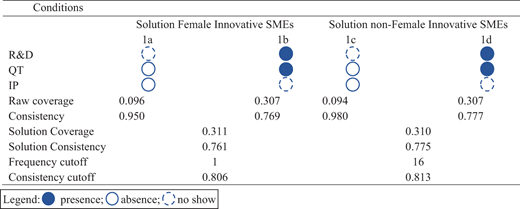
Figure 1 shows the intermediate solution that is superior to other solutions (complex solution, parsimonious solution) because it does not allow the removal of necessary conditions (Ragin, 2008), and it is widely used in literature and academic research (Jiao et al., 2020; Llach et al., 2023; Poorkavoos et al., 2016; Vizcaíno and Chousa, 2016). Black circles “●” represent the presence of the causal condition, white circles “○” represent the absence of causal conditions, and the dashed line represents “doesn’t matter” conditions. In both solutions, the solution coverage and consistency values exceed the recommended minimum values of 0.25 and 0.75, respectively (Pappas and Woodside, 2021).

3.3.4 Robustness analysis.

Following the best practices in fs-QCA (Di Paola et al., 2025), we conducted a series of robustness checks to ensure the stability and validity of our configurational results. First, we re-estimated the fsQCA models using alternative calibration thresholds to the sensitivity of our findings to variations in set membership criteria (Skaaning, 2011). Specifically, we adopted two recalibration criteria:

  1. one based on the 90th, 50th and 10th percentiles of each variable for each cluster of Female Innovative SMEs and Non-female Innovative SMEs (Guedes et al., 2016); and

  2. one based on the 95th, 50th and 5th percentiles (Llach et al., 2023; Pappas and Woodside, 2021; Woodside, 2013) for full membership, crossover point and full non-membership, respectively following the best practices in fsQCA Management and Business field (Di Paola et al., 2025; Zoppelletto and Bullini Orlandi, 2022).

These more restrictive thresholds allow for a stricter definition of high and low levels of the conditions and outcome, thus testing the consistency of the solutions under more conservative assumptions (Huang et al., 2016; Jia et al., 2024; Nijssen and Ordanini, 2020; Subramanian et al., 2022). The results remained qualitatively stable across both calibration schemes. Second, we conducted an analysis of the absence of the outcome (i.e. low financial performance) using the sufficient conditions analysis and intermediate solution approach following prior research (Greckhamer et al., 2018; Zoppelletto and Bullini Orlandi, 2022). These types of reverse analysis allow us to assess whether the configurations associated with the absence of the outcome are asymmetrical to those explaining its presence (Zoppelletto and Bullini Orlandi, 2022). In line with the principal causal asymmetry (Ragin, 2008), the findings confirm that the causal configurations leading to low performance differ from those leading to high performance, thereby supporting the analytical distinctiveness of the two pathways. Third, we examined internal consistency of each sufficient configuration by ensuring that the product of raw consistency and PRI exceeded the stablished threshold of 0.6, following the recommendation in the literature (Grofman and Schneider, 2009; Schneider and Wagemann, 2010, 2012) This dual criterion ensures that each solution is not only empirically consistent but also not contradicted by deviant cases. These robustness checks strengthen the reliability and consistency of our findings demonstrating that the observed configurations are not sensitive to alternative calibration.

The results of the sufficient conditions analysis (Figure 1) seem to partially support our hypotheses for both female-led and non-female-led innovative SMEs. To obtain acceptable results, we set the cutoffs for both clusters at 0.8, following established practices (Cheng and Wang, 2022; Kyrdoda et al., 2023; Pappas and Woodside, 2021; Porfírio et al., 2021; Ragin, 2008; Valaei et al., 2017; Wang and Esperança, 2023; Woodside, 2013; Zoppelletto and Bullini Orlandi, 2022). According to the literature, a consistency level of 0.75 is considered significant (Ragin, 2008; Woodside, 2013) along with a coverage level of 0.3 (Cheng and Wang, 2022; Guedes et al., 2016; Woodside, 2013). In our case, the overall solution coverage and consistency exceed this minimum level of acceptance. Specifically, the non-female subset exhibited a consistency of 0.775 and a coverage of 0.310, while the female subset showed a slightly lower consistency but higher coverage, still meeting the acceptance criteria (consistency of 0.761 and coverage of 0.311).

We identified two configurations for each cluster of sufficient conditions to promote a high level of financial performance as reported in Figure 1. Contrary to our initial hypotheses (H1 and H2), not all strategic intangible resources are necessary to achieve higher profitability, and the two clusters exhibit minimal differences, both in overall values (solution coverage and consistency) and in individual paths. The results are essentially equivalent, differing only in the frequency cutoff point due to the smaller sample size of female firms compared to the total number of firms and the sample of non-female firms. The established cutoff allows us to analyze the two samples of firms heterogeneously while accounting for their differences, which do not affect the overall outcome. This is evident when examining the consistency cutoff, which is similar for both groups (0.806 for women-led SMEs and 0.813 for non-women-led SMEs). Regarding solution coverage and consistency, innovative women-led SMEs have an overall coverage of 31.1% and consistency of 76.1%. whereas non-women-led SMEs have values of 31.0% and 77.5%, respectively.

There are four configurations that constitute sufficient conditions to enhance financial performance (ROS). R&D emerges as a core condition that, when combined with others, leads to high performance levels in innovative SMEs. Among the four configurations, Configuration #3 stands out with the highest consistency score among the four configurations (0.980) but conversely has the lowest raw coverage (0.094). In this configuration, no core conditions are identified, and R&D is considered a peripheral condition since it is not mentioned. Configurations #2 and #4 are noteworthy because they are identical. This suggests that the presence of R&D and a Qualified Team are sufficient conditions to achieve successful financial performance, while patents are not essential. Moreover, we do not observe significant differences in financial performance between female-led and male-led SMEs across the identified innovation pathways, thus confirming H3.

Our configurational analysis offers novel insights into the relationship between intangible resources and financial performance in innovative SMEs, with a particular focus on gender structure of the board of directors. Our findings reveal that not all intangible resources legally required to obtain innovative SMEs status contribute equally to profitability. Although R&D serves as a fundamental and consistent driver for achieving superior financial performance within SMEs, aligning with the literature and academic debate (Albis Salas et al., 2023; Rodríguez-Pose and Crescenzi, 2008), only the combination of R&D and QT appears to stimulate higher performance in innovative SMEs. Nonetheless, our findings reveal no significant differences between female-led SMEs and their counterparts in combining effective innovation resources or achieving higher profitability. This suggests that a critical mass of female representation on the boards of innovative SMEs substantially reduces differences in innovation outcomes, thereby supporting the notion of a gender-neutral dimension in innovation (Sundermeier and Mahlert, 2023).

Specifically, both women-led SMEs (1 b) and non-women-led SMEs (1d) show similar results in coverage and consistency, and they exhibit equifinal pathways to high financial performance, characterized by the combination of R&D and QT, despite the absence of IP. This suggests that these dynamic intangible resources represent a strategic configuration that supports profitability regardless of gender. The symmetry between configurations 1 b and 1d indicates that a critical mass of female representation in decision-making positions does not alter how innovation resources affect financial outcomes, at least when SMEs have equal access to innovation levers. While structural gender disparities may still exist in areas such as access to finance or social capital, our findings show that, when institutional settings mitigate resource-based inequalities, and when women have decision-making authority and access to resources comparable to their male counterparts, the influence of gender on innovation and entrepreneurial outcomes becomes negligible (Akter et al., 2017). This challenges stereotypical assumptions regarding gender-based differences in risk-taking and innovation strategy (Bannò and Filippi, 2024; Lee and Chung, 2022; Yang et al., 2019) and supports more inclusive views of entrepreneurial effectiveness (Foss et al., 2022; Wang et al., 2022).

Conversely, configurations 1a and 1c, where both QT and IP are absent, display high consistency but low coverage, indicating that these combinations are rare and may reflect context-specific or exceptional strategies within SMEs. The absence of IP in these configurations raises issues about the strategic relevance of formal IP in SMEs compared to rapid innovation and the introduction of new products and services. This aligns with emerging literature suggesting that SMEs often deprioritize formal IP protection due to limited resources, time constraints and doubts about its cost-benefit ratio (Ben Arfi et al., 2018; Doh and Kim, 2014; Jafari-Sadeghi et al., 2021).

The absence of necessary conditions for either female-led or non-female-led SMEs further confirms the value of a configurational approach to understanding innovation in SMEs. This aligns with the theoretical premise of causal complexity and equifinality (Ragin, 2008; Woodside, 2013), recently systematized by Di Paola et al. (2025) which suggests that innovation outcomes are often the result of complex interactions among multiple factors rather than isolated variables and investments, underscoring that no single resource or managerial characteristic is universally required to achieve financial success. Different firms can attain the same outcome through multiple, non-exclusive paths, depending on how internal resources are combined and leveraged. Finally, this study offers empirical evidence that the pathways to financial success through innovation are largely gender-neutral in the SME context. Adopting critical mass theory and observing innovative female-led Innovative SMEs, our results suggest that gender does not influence per se the effectiveness of innovation on financial performance in those firms, challenging prior literature on gender studies. While previous research has demonstrated that gender diversity at the board level can influence strategic innovation (García-Meca et al., 2024; Lee and Chung, 2022; Yang et al., 2019), our results suggest that once innovation inputs are equally available and control over those resources is significant, both male and female leaders exhibit similar capabilities in converting those inputs into performance. This supports the notion that, in the context of SMEs, female leaders and male leaders are equally capable of leveraging innovation inputs to achieve greater profitability, challenging stereotypical views of gender-based managerial differences (Foss et al., 2022; Wang et al., 2022). These conceptual insights also lays the foundation for developing inclusive innovation strategies that focus on leadership effectiveness rather than identity-based assumptions.

This study contributes in three ways to the ongoing debate on gender, innovation and SMEs, by providing new evidence on how different configurations of intangible resources, especially R&D, human capital, and intellectual property, can lead to high financial performance, regardless of the gender composition of top management teams. First, we extend literature on SMEs (Aldieri et al., 2019; Arcuri et al., 2023; Hassan et al., 2024; Sebuwufu and Timilsina, 2023; Troise et al., 2022; Zhang et al., 2023, 2022), focusing on innovative SMEs, showing that these firms represent a distinct and under investigated subset of SMEs but valuable to provide a deeper understanding of innovation drivers, to test the relationship between specific innovation drivers, performance in line with Merín-Rodrigáñez et al. (2024, 2025) and gender issue (Schifilliti and La Rocca, 2024).

Second, theoretically, this work supports the dynamic evolution of the RBV, by showing that it is not the presence of a single static resource (i.e. IP), but the specific recombination of dynamic intangibles that matters most for achieving sustainable competitive advantage (Barney, 1991; Haddoud et al., 2023; Di Paola et al., 2025).

Third, by using a recent methodology as fuzzy-set qualitative comparative analysis (fs-QCA), we embrace a configurational approach to theorizing firm performance, which complements and expands traditional RBV assumptions, demonstrating that the fsQCA method moves beyond the traditional cause-effect relationship between innovation drivers and performance, embracing a systemic view of innovation. As Di Paola et al. (2025) emphasized, fsQCA is particularly suited for exploring causal complexity, asymmetry and equifinality in business and management research. It allows for the identification of multiple equifinal paths leading to the same outcome, acknowledging that SMEs can achieve high performance through different combinations of resources (Ragin, 2008; Woodside, 2013). Our findings empirically validate these principles, revealing that multiple pathways can lead to financial success in SMEs, and that no single condition is necessary across the board. This reinforces the view that innovation outcomes are shaped by interdependent bundles of resources, rather than isolated variables (Arcuri et al., 2023; Haddoud et al., 2023; Di Paola et al., 2025).

Fourth, our study contributes to the literature on corporate governance and gender in innovation by examining whether the significant presence of women in decision-making positions alters the relationship between innovation inputs and firm performance. While previous studies have explored gender diversity as a simple variable that can influence innovation strategy and environmental outcomes (Adams and Ferreira, 2009; Arcuri et al., 2023; García-Meca et al., 2024; Schifilliti and La Rocca, 2024), our results suggest that gender is a social construct created by practices and may generate different impacts depending on the contextual factors. Profitability does not significantly differ between male-led and female-led innovative SMEs when women possess equal access to strategic resources and exercise decision-making power equivalent to that of their male counterparts. Rather than reinforcing the narrative of women as subordinate entrepreneurs or innovators, this analysis supports the recent discourse suggesting that women can strategically navigate and manage the constraints imposed by gender stereotypes in the context of innovation (Sundermeier and Mahlert, 2023). This challenges long-standing gendered assumptions about leadership and strategic behavior (Lee and Chung, 2022; Yang et al., 2019) and adds support to the idea that female leaders are equally capable of translating innovation investments into financial performance (Cheng and Wang, 2022; Foss et al., 2022; Javed et al., 2023). By integrating critical mass theory, we further contextualize the neutrality of gender not merely as an absence of difference, but as a reflection of parity in managerial capability once female representation reaches a significant threshold. Moreover, this study bridges distinct theoretical domains such as RBV, the configurational approach and gender governance, offering a richer and more integrative understanding of how innovative SMEs can leverage intangible assets for financial success.

The findings of this study provide several implications for SME managers, policymakers and institutions supporting business innovation as well. First, the results indicate that strategic investments in R&D and skilled human capital are more critical than formal intellectual property protection in driving financial performance among Innovative SMEs. Managers should prioritize the development of dynamic innovation capabilities, invest strategically in R&D and enhance both the technical and creative competencies of employees. These practices are particularly valuable in resource-constrained environments, where agility and rapid adaptation often matter more than codified protection.

Second, the configurational nature of our results highlights that there is no single path to success. Innovation strategies should therefore be tailored to each firm’s internal structure and competitive context, with a focus on complementarities among resources rather than on imitation of best practices. This implies that SME managers need to adopt a systemic and context-sensitive approach to innovation management.

Third, our findings highlight the need for policymakers to ensure and enhance equitable access to innovation-related resources to reduce gender disparities in achieving financial success. Furthermore, for managers and business owners of SMEs, these findings emphasize the critical role of maintaining organizational control, articulating a strategic vision and ensuring adequate resource allocation to address and reduce gender bias in innovation outcomes. It also suggests the need to foster an inclusive culture and individual empowerment both in innovation systems and within organizations, where both women and men in upper management roles are equally empowered to lead innovation initiatives. In this sense, innovation strategy should aim to capitalize on diversity in skills and perspectives, not to segment roles based on gender. The evidence from our study supports a managerial approach rooted in equity, inclusion and strategic alignment, where innovation stems from the quality of resource configurations rather than the profile of individual decision-makers.

Fourth, in line with this perspective, public support programs should avoid reinforcing gender stereotypes or focusing exclusively on traditionally female sectors (i.e. social care or education). Instead, they should promote equal access to resources, networks, and innovation opportunities across all industries. This requires going beyond numeric representation and actively support women’s strategic roles in innovation-oriented leadership.

Fifth, the consistently marginal role of IP in high-performing configurations suggests a potential misalignment between the formal innovation policy framework and the operational realities for SMEs. Policymakers, especially in the contexts like Europe, where SMEs constitute the backbone of the economy, should reconsider how IP-related incentives are designed and delivered. More effective support could include for simplifying IP procedures, offering customized advisory services or creating alternative mechanisms to protect and leverage innovation such as fast-track grants, open innovation platforms or collaborative protection models.

This study has several limitations that also open promising avenues for future research. First, our analysis focuses on a single country-setting (Italy), which while rich in innovative SMEs and highly relevant due to the weight of SMEs in its economic fabric (Arcuri et al., 2023; European Commission, 2021), may limit the generalizability of the findings to non-European institutional environments (i.e. China). However, Italy represents a suitable test case for Europe, where similar institutional frameworks for innovative SME exist (i.e. Spain, France, the Netherlands) context allows for objective comparison between innovative SMEs across European countries. Future studies could incorporate institutional and regulatory variables to better understand how national context shape the relationship between innovation inputs and financial performance, extending the analysis to non-European settings.

Second, although we focus on three key innovation drivers (R&D, QT, IP), we acknowledge that industry characteristics, such as sector specificities (i.e. manufacturing vs service), regulatory pressure or individual leadership traits, may shape the effectiveness of these inputs. Future research could stratify the analysis by industry or include moderating variables such as firm age, internationalization, digital maturity or leadership profile to assess how they interact with innovation pathways.

Third, while, our data set spans a ten-year period, the research does not fully exploit the temporal dimension of innovation strategies. Longitudinal studies could enrich this analysis by evaluating the interaction between variables and the degree of the impact on performance, offering richer insight into the evolution of configurations over time, and highlighting whether and how the combination of intangible resources that lead to performance may shift during periods of crisis, growth or transition. This would deepen our understanding of causal complexity and temporal equifinality in innovation.

This study focuses on a subset of SMEs, which have specific characteristics. Future research could explore whether the same configurations of innovation drivers hold among the overall SMEs, or whether their impact varies across sectors with different technological intensities. Additionally, future research may expand sample by including academic spin-offs and innovative startups and by comparing them with innovative SMEs.

Future research could explore how managers’ perceptions of intersecting stereotypes, such as gender, race and age, influence their ability to recognize, mobilize and prioritize innovation-related assets, particularly within the innovation pipeline. Additionally, incorporating further corporate governance attributes, including age, educational background, cultural diversity and international experience, may enrich the analysis of leadership’s impact on innovation performance. Moreover, while fsQCA is particularly suited for uncovering causal complexity and pathways, its reliance on calibration thresholds and the dichotomous interpretation of combinations may limit the granularity of variance captured in the data. Future research might complement the configurational approach with mixed methods, combining QCA with ethnographic research or longitudinal quantitative study to deepen the understanding of mechanisms underlying the configurations identified. Additionally, future studies could further explore the direct and moderating effects of R&D investment, qualified human capital and intellectual property, or other innovation drivers such as inter-firm collaborations and strategic orientation on financial performance. Testing these relationships empirically through alternative methodological approaches would provide a complementary perspective to the configurational approach adopted in this study, enhancing the granular understanding of how these drivers affect financial performance in innovative SMEs.

[1.]

Eurostat SME Performance Review 2024 – Italy country sheet

[2.]

Gender Equality Index – Italy

[3.]

startup.registrodelleimprese.it

Abubakar
,
Y.A.
,
Hand
,
C.
,
Smallbone
,
D.
and
Saridakis
,
G.
(
2019
), “
What specific modes of internationalization influence SME innovation in Sub-Saharan least developed countries (LDCs)?
”,
Technovation,
Elsevier Ltd, Vol.
79
, pp.
56
-
70
, doi: .
Adams
,
R.B.
and
Ferreira
,
D.
(
2009
), “
Women in the boardroom and their impact on governance and performance
”,
Journal of Financial Economics
, Vol.
94
No.
2
, pp.
291
-
309
, doi: .
Adams
,
R.
,
Jeanrenaud
,
S.
,
Bessant
,
J.
,
Denyer
,
D.
and
Overy
,
P.
(
2016
), “
Sustainability-oriented innovation: a systematic review
”,
International Journal of Management Reviews
, Vol.
18
No.
2
, pp.
180
-
205
, doi: .
Agostini
,
L.
,
Nosella
,
A.
and
Filippini
,
R.
(
2017
), “
Does intellectual capital allow improving innovation performance? A quantitative analysis in the SME context
”,
Journal of Intellectual Capital
, Vol.
18
No.
2
, pp.
400
-
418
, doi: .
Akter
,
S.
,
Rutsaert
,
P.
,
Luis
,
J.
,
Htwe
,
N.M.
,
San
,
S.S.
,
Raharjo
,
B.
and
Pustika
,
A.
(
2017
), “
Women’s empowerment and gender equity in agriculture: a different perspective from Southeast Asia
”,
Food Policy, The Authors
, Vol.
69
, pp.
270
-
279
, doi: .
Albis Salas
,
N.
,
Mora Holguin
,
H.
,
Lucio-Arias
,
D.
,
Sánchez
,
E.C.
and
Villarreal
,
N.
(
2023
), “
Innovation and productivity in small and medium-sized enterprises: evidence from the Colombian manufacturing sector
”,
Journal of Small Business and Enterprise Development
, Vol.
30
No.
5
, pp.
1011
-
1034
, doi: .
Aldieri
,
L.
,
Carlucci
,
F.
,
Vinci
,
C.P.
and
Yigitcanlar
,
T.
(
2019
), “
Environmental innovation, knowledge spillovers and policy implications: a systematic review of the economic effects literature
”,
Journal of Cleaner Production
, Vol.
239
, p.
118051
, doi: .
Alegre
,
J.
and
Pasamar
,
S.
(
2018
), “
Firm innovativeness and work-life balance
”,
Technology Analysis and Strategic Management
, Vol.
30
No.
4
, pp.
421
-
433
, doi: .
Aleksić
,
D.
,
Rangus
,
K.
and
Slavec Gomezel
,
A.
(
2021
), “
Microfoundations of SME open innovation: the role of help, knowledge sharing and hiding
”,
European Journal of Innovation Management
, Vol.
25
No.
6
, pp.
178
-
203
, doi: .
Anwar
,
J.
,
Butt
,
I.
and
Ahmad
,
N.
(
2025
), “
SMEs’ strategic orientation through miles and snow typology: a synthesis of literature and future directions
”,
Management Research Review
, Vol.
48
No.
2
, pp.
258
-
286
, doi: .
Aragón-Sánchez
,
A.
and
Sánchez-Marín
,
G.
(
2005
), “
Strategic orientation, management characteristics, and performance: a study of Spanish SMEs
”,
Journal of Small Business Management
, Vol.
43
No.
3
, pp.
287
-
308
, doi: .
Arcuri
,
M.C.
,
Gandolfi
,
G.
and
Russo
,
I.
(
2023
), “
Exploring the impact of innovation intensity on the growth of female-led entrepreneurial firms
”,
Journal of Small Business and Enterprise Development
, Vol.
30
No.
5
, pp.
947
-
966
, doi: .
Artz
,
K.W.
,
Norman
,
P.M.
,
Hatfield
,
D.E.
and
Cardinal
,
L.B.
(
2010
), “
A longitudinal study of the impact of R&D, patents, and product innovation on firm performance
”,
Journal of Product Innovation Management
, Vol.
27
No.
5
, pp.
725
-
740
, doi: .
Audretsch
,
D.B.
,
Belitski
,
M.
,
Caiazza
,
R.
and
Phan
,
P.
(
2023
), “
Collaboration strategies and SME innovation performance
”,
Journal of Business Research
, Vol.
164
, p.
114018
, doi: .
Bannò
,
M.
and
Filippi
,
E.
(
2024
), “
Women in top echelon positions and firm internationalisation strategies: what do We know? How do We know? Where should We Be heading?
”,
Journal of Management and Governance
, Vol.
28
No.
4
, pp.
1257
-
1302
, doi: .
Barney
,
J.
(
1991
), “
Firm resources and sustained competitive advantage
”,
Journal of Management
, Vol.
17
No.
1
.
Ben Arfi
,
W.
,
Hikkerova
,
L.
and
Sahut
,
J.M.
(
2018
), “
External knowledge sources, green innovation and performance
”,
Technological Forecasting and Social Change
, Vol.
129
, pp.
210
-
220
, doi: .
Borah
,
P.S.
,
Iqbal
,
S.
and
Akhtar
,
S.
(
2022
), “
Linking social media usage and SME’s sustainable performance: the role of digital leadership and innovation capabilities
”,
Technology in Society
, Elsevier Ltd, Vol.
68
, p.
101900
, doi: .
Bouwman
,
H.
,
Nikou
,
S.
and
de Reuver
,
M.
(
2019
), “
Digitalization, business models, and SMEs: how do business model innovation practices improve performance of digitalizing SMEs?
”,
Telecommunications Policy
, Vol.
43
No.
9
, p.
101828
, doi: .
Brahma
,
S.
,
Nwafor
,
C.
and
Boateng
,
A.
(
2021
), “
Board gender diversity and firm performance: the UK evidence
”,
International Journal of Finance and Economics
, Vol.
26
No.
4
, pp.
5704
-
5719
, doi: .
Carter
,
D.A.
,
Simkins
,
B.J.
and
Simpson
,
W.G.
(
2003
), “
Corporate governance, board diversity, and firm value
”,
Financial Review
, Vol.
38
No.
1
, pp.
33
-
53
, doi: .
Cavallo
,
A.
,
Ghezzi
,
A.
,
Colombelli
,
A.
and
Casali
,
G.L.
(
2020
), “
Agglomeration dynamics of innovative start-ups in Italy beyond the industrial district era
”,
International Entrepreneurship and Management Journal, International Entrepreneurship and Management Journal
, Vol.
16
No.
1
, pp.
239
-
262
, doi: .
Cheng
,
C.
and
Wang
,
L.
(
2022
), “
How companies configure digital innovation attributes for business model innovation? A configurational view
”,
Technovation
, Vol.
112
, p.
102398
, doi: .
Cox
,
T.H.
and
Blake
,
S.
(
1991
), “
Managing cultural diversity: implications for organizational competitiveness
”,
Academy of Management Perspectives
, Vol.
5
No.
3
, pp.
45
-
56
, doi: .
Crossan
,
M.M.
and
Apaydin
,
M.
(
2010
), “
A multi-dimensional framework of organizational innovation: a systematic review of the literature
”,
Journal of Management Studies
, Vol.
47
No.
6
, pp.
1154
-
1191
, doi: .
Dahlerup
,
D.
(
1988
), “
From a small to a large minority: women in Scandinavian Politics
”,
Scandinavian Political Studies
, Vol.
11
No.
4
, pp.
275
-
298
, doi: .
Del Bosco
,
B.
,
Mazzucchelli
,
A.
,
Chierici
,
R.
and
Di Gregorio
,
A.
(
2021
), “
Innovative startup creation: the effect of local factors and demographic characteristics of entrepreneurs
”,
International Entrepreneurship and Management Journal, International Entrepreneurship and Management Journal
, Vol.
17
No.
1
, pp.
145
-
164
, doi: .
Dobbin
,
F.
and
Jung
,
J.
(
2011
), “
Corporate board gender diversity and stock performance: the competence GAP or institutional investor bias?
”,
North Carolina Law Review
, Vol.
89
, pp.
809
-
838
.
Doh
,
S.
and
Kim
,
B.
(
2014
), “
Government support for SME innovations in the regional industries: the case of government financial support program in South Korea
”,
Research Policy
, Vol.
43
No.
9
, pp.
1557
-
1569
, doi: .
Dohse
,
D.
,
Goel
,
R.K.
and
Nelson
,
M.A.
(
2019
), “
Female owners versus female managers: who is better at introducing innovations?
”,
The Journal of Technology Transfer
, Vol.
44
No.
2
, pp.
520
-
539
, doi: .
Erhardt
,
N.L.
,
Werbel
,
J.D.
and
Shrader
,
C.B.
(
2003
), “
Board of director diversity and firm financial performance
”,
Corporate Governance: An International Review
, Vol.
11
No.
2
, pp.
102
-
111
, doi: .
European Commission
(
2021
), “
European regional innovation scoreboard 2022 – Italy
”.
Foss
,
N.
,
Lee
,
P.M.
,
Murtinu
,
S.
and
Scalera
,
V.G.
(
2022
), “
The XX factor: female managers and innovation in a cross-country setting
”,
The Leadership Quarterly
, Vol.
33
No.
3
, doi: .
García-Meca
,
E.
,
Ramón-Llorens
,
M.C.
and
Martínez-Ferrero
,
J.
(
2024
), “
Feminine expertise on board and environmental innovation: the role of critical mass
”,
Review of Managerial Science
, Vol.
18
No.
8
, pp.
2255
-
2286
, doi: .
Garzoni
,
A.
,
De Turi
,
I.
,
Secundo
,
G.
and
Del Vecchio
,
P.
(
2020
), “
Fostering digital transformation of SMEs: a four levels approach
”,
Management Decision
, Vol.
58
No.
8
, pp.
1543
-
1562
, doi: .
Gordini
,
N.
and
Rancati
,
E.
(
2017
), “
Gender diversity in the Italian boardroom and firm financial performance
”,
Management Research Review
, Vol.
40
No.
1
, pp.
75
-
94
, doi: .
Gorgels
,
S.
,
Priem
,
M.
,
Blagoeva
,
T.
,
Martinelle
,
A.
and
Milanesi
,
G.
(
2022
),
Annual Report on European SMEs: SMEs and Environmental Sustainability Background Document
,
European Commission
.
Greckhamer
,
T.
,
Furnari
,
S.
,
Fiss
,
P.C.
and
Aguilera
,
R.V.
(
2018
), “
Studying configurations with qualitative comparative analysis: best practices in strategy and organization research
”,
Strategic Organization
, Vol.
16
No.
4
, pp.
482
-
495
, doi: .
Grofman
,
B.
and
Schneider
,
C.Q.
(
2009
), “
An introduction to crisp set QCA, with a comparison to binary logistic regression
”,
Political Research Quarterly
, Vol.
62
No.
4
, pp.
662
-
672
, doi: .
Guedes
,
M.J.
,
da Conceição Gonçalves
,
V.
,
Soares
,
N.
and
Valente
,
M.
(
2016
), “
UK evidence for the determinants of R&D intensity from a panel fsQCA
”,
Journal of Business Research
, Vol.
69
No.
11
, pp.
5431
-
5436
, doi: .
Guizani
,
M.
and
Abdalkrim
,
G.
(
2023
), “
Female directors and working capital management: aggressive vs. conservative strategy
”,
Management Research Review
, Vol.
46
No.
7
, pp.
976
-
995
, doi: .
Haddoud
,
M.Y.
,
Kock
,
N.
,
Onjewu
,
A.K.E.
,
Jafari-Sadeghi
,
V.
and
Jones
,
P.
(
2023
), “
Technology, innovation and SMEs’ export intensity: evidence from Morocco
”,
Technological Forecasting and Social Change
, Vol.
191
, p.
122475
, doi: .
Hassan
,
S.S.
,
Meisner
,
K.
,
Krause
,
K.
,
Bzhalava
,
L.
and
Moog
,
P.
(
2024
), “
Is digitalization a source of innovation? Exploring the role of digital diffusion in SME innovation performance
”,
Small Business Economics
, Vol.
62
No.
4
, pp.
1469
-
1491
, doi: .
Henry
,
C.
,
Foss
,
L.
and
Ahl
,
H.
(
2016
), “
Gender and entrepreneurship research: a review of methodological approaches
”,
International Small Business Journal: Researching Entrepreneurship
, Vol.
34
No.
3
, pp.
217
-
241
, doi: .
Hervas-Oliver
,
J.L.
,
Sempere-Ripoll
,
F.
and
Boronat-Moll
,
C.
(
2021
), “
Technological innovation typologies and open innovation in SMEs: beyond internal and external sources of knowledge
”,
Technological Forecasting and Social Change
, Vol.
162
, p.
120338
, doi: .
Hidayat
,
A.S.
and
Pok
,
W.C.
(
2025
), “
Empowering SMEs innovation through intangible factors
”,
Journal of Innovation and Entrepreneurship
, Vol.
14
No.
1
, p.
1
, doi: .
Huang
,
C.W.
and
Huarng
,
K.H.
(
2015
), “
Evaluating the performance of biotechnology companies by causal recipes
”,
Journal of Business Research
, Vol.
68
No.
4
, pp.
851
-
856
, doi: .
Huang
,
K.E.
,
Wu
,
J.H.
,
Lu
,
S.Y.
and
Lin
,
Y.C.
(
2016
), “
Innovation and technology creation effects on organizational performance
”,
Journal of Business Research
, Vol.
69
No.
6
, pp.
2187
-
2192
, doi: .
Jaaffar
,
A.R.
,
Baharom
,
N.
,
Zaini
,
A.F.A.
and
Ahmed
,
S.
(
2017
), “
The interaction effect of entrepreneurial orientation on the relationship between innovation and SME performance
”,
International Journal of Economic Research
, Vol.
14
No.
19
, pp.
371
-
380
.
Jafari-Sadeghi
,
V.
,
Amoozad Mahdiraji
,
H.
,
Alam
,
G.M.
and
Mazzoleni
,
A.
(
2023
), “
Entrepreneurs as strategic transformation managers: exploring micro-foundations of digital transformation in small and medium internationalisers
”,
Journal of Business Research
, Vol.
154
, p.
113287
, doi: .
Jafari-Sadeghi
,
V.
,
Garcia-Perez
,
A.
,
Candelo
,
E.
and
Couturier
,
J.
(
2021
), “
Exploring the impact of digital transformation on technology entrepreneurship and technological market expansion: the role of technology readiness, exploration and exploitation
”,
Journal of Business Research
, Vol.
124
, pp.
100
-
111
, doi: .
Javed
,
M.
,
Wang
,
F.
,
Usman
,
M.
,
Ali Gull
,
A.
and
Uz Zaman
,
Q.
(
2023
), “
Female CEOs and green innovation
”,
Journal of Business Research
, Vol.
157
, p.
113515
, doi: .
Jeong
,
S.-H.
and
Harrison
,
D.A.
(
2017
), “
Glass breaking, strategy making, and value creating: meta-Analytic outcomes of women as CEOs and TMT members
”,
Academy of Management Journal
, Vol.
60
No.
4
, pp.
1219
-
1252
, doi: .
Jia
,
J.
,
Xu
,
Y.
and
Li
,
W.
(
2024
), “
A study on the strategic momentum of SMEs’ digital transformation: evidence from China
”,
Technological Forecasting and Social Change
, Vol.
200
, doi: .
Jianakoplos
,
N.A.
and
Bernasek
,
A.
(
1998
), “
Are women more risk averse?
”,
Economic Inquiry
, Vol.
36
No.
4
, pp.
620
-
630
, doi: .
Jiao
,
J. L.
,
Zhang
,
X. L.
and
Tang
,
Y. S
(
2020
), “
What factors determine the survival of green innovative enterprises in China? – a method based on fsQCA
”,
Technology in Society
, Vol.
62
, p.
101314
, doi: .
Jones
,
K.
and
Clifton
,
J.
(
2018
), “
Rendering sexism invisible in workplace narratives. A narrative analysis of female entrepreneurs’ stories of not being talked to by men
”,
Gender, Work and Organization
, Vol.
25
No.
5
, pp.
557
-
574
, doi: .
Kanter
,
R.M.
(
2006
), “
Some effects of proportions on group life: skewed sex ratios and responses to token women
”,
Small Groups: Key Readings
, Vol.
82
No.
5
, pp.
37
-
54
, doi: .
Kirner
,
E.
,
Kinkel
,
S.
and
Jaeger
,
A.
(
2009
), “
Innovation paths and the innovation performance of low-technology firms-An empirical analysis of German industry
”,
Research Policy
, Vol.
38
No.
3
, pp.
447
-
458
, doi: .
Kraus
,
S.
,
Rigtering
,
J.P.C.
,
Hughes
,
M.
and
Hosman
,
V.
(
2012
), “
Entrepreneurial orientation and the business performance of SMEs: a quantitative study from The Netherlands
”,
Review of Managerial Science
, Vol.
6
No.
2
, pp.
161
-
182
, doi: .
Kumar
,
K.
,
Boesso
,
G.
,
Favotto
,
F.
and
Menini
,
A.
(
2012
), “
Strategic orientation, innovation patterns and performances of SMEs and large companies
”,
Journal of Small Business and Enterprise Development
, Vol.
19
No.
1
, pp.
132
-
145
, doi: .
Kusa
,
R.
,
Duda
,
J.
and
Suder
,
M.
(
2021
), “
Explaining SME performance with fsQCA: the role of entrepreneurial orientation, entrepreneur motivation, and opportunity perception
”,
Journal of Innovation and Knowledge
, Vol.
6
No.
4
, pp.
234
-
245
, doi: .
Kyrdoda
,
Y.
,
Balzano
,
M.
and
Marzi
,
G.
(
2023
), “
Learn to survive crises: the role of firm resilience, innovation capabilities and environmental dynamism
”,
Technology in Society
, Vol.
74
, p.
102285
, doi: .
Latifi
,
M.-A.
,
Nikou
,
S.
and
Bouwman
,
H.
(
2021
), “
Business model innovation and firm performance: exploring causal mechanisms in SMEs
”,
Technovation
, Vol.
107
, p.
102274
, doi: .
Lee
,
J.
and
Chung
,
J.
(
2022
), “
Women in top management teams and their impact on innovation
”,
Technological Forecasting and Social Change
, Vol.
183
, p.
121883
, doi: .
Levy
,
M.
and
Powell
,
P.
(
1998
), “
SME flexibility and the role of information systems
”,
Small Business Economics
, Vol.
11
No.
2
, pp.
183
-
196
, doi: .
Liu
,
Y.
,
Dong
,
J.
,
Mei
,
L.
and
Shen
,
R.
(
2023
), “
Digital innovation and performance of manufacturing firms: an affordance perspective
”, “p”,
Technovation
, Vol.
119
, p.
102458
, doi: .
Llach
,
J.
,
Sanchez-Famoso
,
V.
and
Danes
,
S.M.
(
2023
), “
Unmasking nonfamily employees’ complex contribution to family business performance: a place identity theory approach
”,
Journal of Family Business Strategy
, Vol.
14
No.
4
, p.
100593
, doi: .
Llopis-Albert
,
C.
,
Rubio
,
F.
and
Valero
,
F.
(
2021
), “
Impact of digital transformation on the automotive industry
”,
Technological Forecasting and Social Change
, Vol.
162
, p.
120343
, doi: .
Lu
,
J.W.
and
Beamish
,
P.W.
(
2006
), “
SME internationalization and performance: growth vs. profitability
”,
Journal of International Entrepreneurship
, Vol.
4
No.
1
, pp.
27
-
48
, doi: .
Martin-Rios
,
C.
,
Erhardt
,
N.L.
and
Manev
,
I.M.
(
2022
), “
Interfirm collaboration for knowledge resources interaction among small innovative firms
”,
Journal of Business Research
, Vol.
153
, pp.
206
-
215
, doi: .
Martínez-Martínez
,
A.
,
Cegarra-Navarro
,
J.-G.
,
Garcia-Perez
,
A.
and
De Valon
,
T.
(
2023
), “
Active listening to customers: eco-innovation through value co-creation in the textile industry
”,
Journal of Knowledge Management
, Vol.
27
No.
7
, pp.
1810
-
1829
, doi: .
Matricano
,
D.
(
2023
), “
Designing policy based on entrepreneurial venture type: the effects of innovation, hiring practices and patent ownership on enterprise development
”,
Journal of Small Business and Enterprise Development
, Vol.
30
No.
7
, pp.
1377
-
1395
, doi: .
Mazza
,
T.
,
Furlotti
,
K.
,
Medioli
,
A.
and
Tibiletti
,
V.
(
2024
), “
Mandatory gender quotas: the impact on board and committee meetings
”,
Management Research Review
, Vol.
47
No.
1
, pp.
45
-
63
, doi: .
Merín-Rodrigáñez
,
J.
,
Dasí
,
À.
and
Alegre
,
J.
(
2024
), “
Digital transformation and firm performance in innovative SMEs: the mediating role of business model innovation
”,
Technovation
, Vol.
134
, doi: .
Merín-Rodrigáñez
,
J.
,
Dasí
,
À.
,
Alegre
,
J.
and
Hughes
,
M.
(
2025
), “
Dynamic managerial capabilities for digital transformation in innovative SMEs: what are the effects on new product development performance?
”,
Journal of Business Research
, Vol.
201
, p.
115709
, doi: .
Mínguez-Vera
,
A.
and
Martin
,
A.
(
2011
), “
Gender and management on Spanish SMEs: an empirical analysis
”,
The International Journal of Human Resource Management
, Vol.
22
No.
14
, pp.
2852
-
2873
, doi: .
Nadeem
,
M.
,
Bahadar
,
S.
,
Gull
,
A.A.
and
Iqbal
,
U.
(
2020
), “
Are women eco-friendly? Board gender diversity and environmental innovation
”,
Business Strategy and the Environment
, Vol.
29
No.
8
, pp.
3146
-
3161
, doi: .
Nair
,
S.R.
(
2020
), “
The link between women entrepreneurship, innovation and stakeholder engagement: a review
”,
Journal of Business Research
, Vol.
119
, pp.
283
-
290
, doi: .
Nijssen
,
E.J.
and
Ordanini
,
A.
(
2020
), “
How important is alignment of social media use and R&D–marketing cooperation for innovation success?
”,
Journal of Business Research
, Vol.
116
, pp.
1
-
12
, doi: .
O’Regan
,
N.
and
Ghobadian
,
A.
(
2005
), “
Innovation in SMEs: the impact of strategic orientation and environmental perceptions
”,
International Journal of Productivity and Performance Management
, Vol.
54
No.
2
, pp.
81
-
97
, doi: .
OECD
(
2018
), “
Oslo manual 2018: guidelines for collecting, reporting and using data on innovation
”, (4th Edition) ,
The Measurement of Scientific, Technological and Innovation Activities, OECD Publishing, Paris/Eurostat, Luxembourg
, doi:
OECD
(
2019
),
Measuring the Digital Transformation: A Roadmap for the Future
,
OECD Publishing
,
Paris
, doi: .
OECD
(
2021
),
OECD SME and Entrepreneurship Outlook 2021
,
OECD Publishing
,
Paris
, doi: .
Ostrovsky
,
Y.
and
Picot
,
G.
(
2021
), “
Innovation in immigrant-owned firms
”,
Small Business Economics, Small Business Economics
, Vol.
57
No.
4
, pp.
1857
-
1874
, doi: .
Owalla
,
B.
,
Gherhes
,
C.
,
Vorley
,
T.
and
Brooks
,
C.
(
2022
), “
Mapping SME productivity research: a systematic review of empirical evidence and future research agenda
”,
Small Business Economics
, Vol.
58
No.
3
, pp.
1285
-
1307
, doi: .
Di Paola
,
N.
,
Chari
,
S.
,
Iannacci
,
F.
and
Kraus
,
S.
(
2025
), “
Configurational theory in business and management research: status quo and guidelines for the application of qualitative comparative analysis (QCA)
”,
Technological Forecasting and Social Change
, Vol.
211
, p.
123907
, doi: .
Pappas
,
I.O.
and
Woodside
,
A.G.
(
2021
), “
Fuzzy-set qualitative comparative analysis (fsQCA): guidelines for research practice in information systems and marketing
”,
International Journal of Information Management
, Vol.
58
, p.
102310
, doi: .
Peón
,
D.
and
Martínez-Filgueira
,
X.
(
2020
), “
Determinants of investing in innovative activities by Agri-food and KIBS firms in rural areas: an exploratory analysis
”,
Journal of Small Business Management
, Vol.
58
No.
6
, pp.
1155
-
1186
, doi: .
Poorkavoos
,
M.
,
Duan
,
Y.
,
Edwards
,
J.S.
and
Ramanathan
,
R.
(
2016
), “
Identifying the configurational paths to innovation in SMEs: a fuzzy-set qualitative comparative analysis
”,
Journal of Business Research
, Vol.
69
No.
12
, pp.
5843
-
5854
, doi: .
Porfírio
,
J.A.
,
Carrilho
,
T.
,
Felício
,
J.A.
and
Jardim
,
J.
(
2021
), “
Leadership characteristics and digital transformation
”,
Journal of Business Research
, Vol.
124
, pp.
610
-
619
, doi: .
Protogerou
,
A.
,
Caloghirou
,
Y.
and
Vonortas
,
N.S.
(
2017
), “
Determinants of young firms’ innovative performance: empirical evidence from Europe
”,
Research Policy
, Vol.
46
No.
7
, pp.
1312
-
1326
, doi: .
Ragin
,
C.C.
(
2008
), “
Redesigning Social Inquiry: Fuzzy Sets and beyond
”,
University of Chicago Press
,
Chicago
.
Ragin
,
C.C.
(
2017
), “
User’s guide to Fuzzy-Set/qualitative comparative analysis. Manual based on fsQCA 3.0
”, No. July, p.
62
.
Revilla
,
A.J.
and
Fernández
,
Z.
(
2012
), “
The relation between firm size and R&D productivity in different technological regimes
”,
Technovation
, Vol.
32
No.
11
, pp.
609
-
623
, doi: .
Du Rietz
,
A.
and
Henrekson
,
M.
(
2000
), “
Testing the female underperformance hypothesis
”,
Small Business Economics
, Vol.
14
No.
1
, pp.
1
-
10
, doi: .
Rodríguez-Pose
,
A.
and
Crescenzi
,
R.
(
2008
), “
Research and development, spillovers, innovation systems, and the genesis of regional growth in Europe
”,
Regional Studies
, Vol.
42
No.
1
, pp.
51
-
67
, doi: .
Sawers
,
J.L.
,
Pretorius
,
M.W.
and
Oerlemans
,
L.A.G.
(
2008
), “
Safeguarding SMEs dynamic capabilities in technology innovative SME-large company partnerships in South Africa
”,
Technovation
, Vol.
28
No.
4
, pp.
171
-
182
, doi: .
Schifilliti
,
V.
and
La Rocca
,
E.T.
(
2024
), “
Board gender diversity in innovative SMEs: an investigation across industrial sectors
”,
European Journal of Innovation Management
, Vol.
27
No.
9
, pp.
461
-
486
, doi: .
Schneider
,
C.Q.
and
Wagemann
,
C.
(
2010
), “
Standards of good practice in qualitative comparative analysis (QCA) and fuzzy-sets
”,
Comparative Sociology
, Vol.
9
No.
3
, pp.
397
-
418
, doi: .
Schneider
,
C.Q.
and
Wagemann
,
C.
(
2012
),
Set-Theoretic Methods for the Social Sciences: A Guide to Qualitative Comparative Analysis
,
Cambridge University Press, United States of America, New York
, doi: .
Schulze
,
B.P.
,
Katsinis
,
A.
,
Lagüera González
,
J.
,
Di Bella
,
L.
,
Odenthal
,
L.
,
Hell
,
M.
,
Lozar
,
B.
and
Secades
,
C.B.
(
2025
),
Annual Report on European SMEs 2024/2025, SME Performance Review
,
European Union
,
Luxemburg
, doi: .
Sebuwufu
,
J.A.
and
Timilsina
,
B.
(
2023
), “
The key factors of SMEs’ resilience based on organisational behaviour theory
”,
International Journal of Innovation and Learning
, Vol.
34
No.
3
, pp.
223
-
247
, doi: .
Sinadinos
,
C.
(
2022
), “
Cyclical IPR-public grant engine driving R&D innovation in small research-intensive private enterprises
”,
Journal of Innovation Management
, Vol.
10
No.
1
, pp.
I
-
X
, doi: .
Skaaning
,
S.E.
(
2011
), “
Assessing the robustness of crisp-set and fuzzy-set QCA results
”,
Sociological Methods and Research
, Vol.
40
No.
2
, pp.
391
-
408
, doi: .
Smith
,
N.
,
Smith
,
V.
and
Verner
,
M.
(
2006
), “
Do women in top management affect firm performance? A panel study of 2500 danish firms
”,
International Journal of Productivity and Performance Management
, Vol.
55
No.
7
, pp.
569
-
593
.
Sok
,
P.
,
O’Cass
,
A.
and
Sok
,
K.M.
(
2013
), “
Achieving superior SME performance: overarching role of marketing, innovation, and learning capabilities
”,
Australasian Marketing Journal
, Vol.
21
No.
3
, pp.
161
-
167
, doi: .
Somohano-Rodríguez
,
F.M.
and
Madrid-Guijarro
,
A.
(
2022
), “
Do industry 4.0 technologies improve Cantabrian manufacturing smes performance? The role played by industry competition
”,
Technology in Society
, Vol.
70
, p.
102019
, doi: .
Subramanian
,
A.M.
,
Nishant
,
R.
,
Van De Vrande
,
V.
and
Hang
,
C.C.
(
2022
), “
Technology transfer from public research institutes to SMEs: a configurational approach to studying reverse knowledge flow benefits
”,
Research Policy
, Vol.
51
No.
10
, p.
104602
, doi: .
Sundermeier
,
J.
and
Mahlert
,
N.
(
2023
), “
Entrepreneurial team diversity – a systematic review and research agenda; entrepreneurial team diversity
”,
European Management Journal
, Vol.
41
No.
6
, pp.
972
-
984
, doi: .
Taghizadeh
,
S.K.
,
Rahman
,
S.A.
,
Nikbin
,
D.
,
Radomska
,
M.
and
Maleki Far
,
S.
(
2024
), “
Dynamic capabilities of the SMEs for sustainable innovation performance: role of environmental turbulence
”,
Journal of Organizational Effectiveness: People and Performance
, Vol.
11
No.
4
, pp.
767
-
787
, doi: .
Talke
,
K.
,
Salomo
,
S.
and
Rost
,
K.
(
2010
), “
How top management team diversity affects innovativeness and performance via the strategic choice to focus on innovation fields
”,
Research Policy
, Vol.
39
No.
7
, pp.
907
-
918
, doi: .
Tate
,
G.
and
Yang
,
L.
(
2015
), “
Female leadership and gender equity: evidence from plant closure
”,
Journal of Financial Economics
, Vol.
117
No.
1
, pp.
77
-
97
, doi: .
Torchia
,
M.
,
Calabrò
,
A.
and
Huse
,
M.
(
2011
), “
Women directors on corporate boards: from tokenism to critical mass
”,
Journal of Business Ethics
, Vol.
102
No.
2
, pp.
299
-
317
, doi: .
Torres
,
P.
and
Augusto
,
M.
(
2020
), “
Digitalisation, social entrepreneurship and national well-being
”,
Technological Forecasting and Social Change
, Elsevier, Vol.
161
, p.
120279
, doi: .
Troise
,
C.
,
Corvello
,
V.
,
Ghobadian
,
A.
and
O’Regan
,
N.
(
2022
), “
How can SMEs successfully navigate VUCA environment: the role of agility in the digital transformation era
”,
Technological Forecasting and Social Change
, Vol.
174
, p.
121227
, doi: .
Usman
,
M.
,
Farooq
,
M.U.
,
Zhang
,
J.
,
Dong
,
N.
and
Makki
,
M.A.M.
(
2019
), “
Women on boards and CEO pay-performance link
”,
International Journal of Manpower
, Vol.
40
No.
7
, pp.
1171
-
1200
, doi: .
Vaisman
,
E.D.
,
Podshivalova
,
M.V.
and
Alola
,
A.A.
(
2022
), “
Examining the interaction of sustainable innovation activity and the life cycle of small high-tech enterprises
”,
Business Strategy and the Environment
, Vol.
31
No.
3
, pp.
1018
-
1029
, doi: .
Valaei
,
N.
,
Rezaei
,
S.
and
Ismail
,
W.K.W.
(
2017
), “
Examining learning strategies, creativity, and innovation at SMEs using fuzzy set qualitative comparative analysis and PLS path modeling
”,
Journal of Business Research
, Vol.
70
, pp.
224
-
233
, doi: .
Vizcaíno
,
M.
and
Chousa
,
J.P.
(
2016
), “
Analyzing the influence of the funds’ support on Tobin’s q using SEM and fsQCA
”,
Journal of Business Research
, Vol.
69
No.
6
, pp.
2118
-
2124
, doi: .
Vo
,
L.
,
Van
,
Nguyen
,
H.T.H.
and
Le
,
H.T.T.
(
2021
), “
Do female CEOs make a difference in firm operations? Evidence from Vietnam
”,
Accounting and Finance
, Vol.
61
No.
S1
, pp.
1489
-
1516
, doi: .
Vrontis
,
D.
,
Morea
,
D.
,
Basile
,
G.
,
Bonacci
,
I.
and
Mazzitelli
,
A.
(
2021
), “
Consequences of technology and social innovation on traditional business model
”,
Technological Forecasting and Social Change
, Vol.
170
, p.
120877
, doi: .
Wang
,
S.
and
Esperança
,
J.P.
(
2023
), “
Can digital transformation improve market and ESG performance? Evidence from chinese SMEs
”,
Journal of Cleaner Production
, Vol.
419
, doi: .
Wang
,
J.
,
Reilly
,
C.V.
and
Fatema
,
K.
(
2022
), “
Gender bias, institutional predicaments and innovativeness of CEOs in China
”,
Journal of Developmental Entrepreneurship
, Vol.
27
No.
1
, doi: .
Woodside
,
A.G.
(
2013
), “
Moving beyond multiple regression analysis to algorithms: calling for adoption of a paradigm shift from symmetric to asymmetric thinking in data analysis and crafting theory
”,
Journal of Business Research
, Vol.
66
No.
4
, pp.
463
-
472
, doi: .
Woodside
,
A.G.
(
2014
), “
Embrace erform model: complexity theory, contrarian case analysis, and multiple realities
”,
Journal of Business Research
, Vol.
67
No.
12
, pp.
2495
-
2503
, doi: .
Woschke
,
T.
,
Haase
,
H.
and
Kratzer
,
J.
(
2017
), “
Resource scarcity in SMEs: effects on incremental and radical innovations
”,
Management Research Review
, Vol.
40
No.
2
, pp.
195
-
217
, doi: .
Wuchty
,
S.
,
Jones
,
B.F.
and
Uzzi
,
B.
(
2007
), “
The increasing dominance of teams in production of knowledge
”,
Science
, Vol.
316
No.
5827
, pp.
1036
-
1039
, doi: .
Xie
,
L.
,
Zhou
,
J.
,
Zong
,
Q.
and
Lu
,
Q.
(
2020
), “
Gender diversity in R&D teams and innovation efficiency: role of the innovation context✰
”,
Research Policy
, Vol.
49
No.
1
, doi: .
Xu
,
J.
and
Li
,
J.
(
2019
), “
The impact of intellectual capital on SMEs’ performance in China: empirical evidence from non-high-tech vs. high-tech SMEs
”,
Journal of Intellectual Capital
, Vol.
20
No.
4
, pp.
488
-
509
, doi: .
Yang
,
P.
,
Riepe
,
J.
,
Moser
,
K.
,
Pull
,
K.
and
Terjesen
,
S.
(
2019
), “
Women directors, firm performance, and firm risk: a causal perspective
”,
The Leadership Quarterly
, Vol.
30
No.
5
, p.
101297
, doi: .
Yeh‐Yun Lin
,
C.
and
Yi‐Ching Chen
,
M.
(
2007
), “
Does innovation lead to performance? An empirical study of SMEs in Taiwan
”,
Management Research News
, Vol.
30
No.
2
, pp.
115
-
132
, doi: .
Yin
,
S.
and
Yu
,
Y.
(
2022
), “
An adoption-implementation framework of digital green knowledge to improve the performance of digital green innovation practices for industry 5.0
”,
Journal of Cleaner Production
, Elsevier Ltd, Vol.
363
, p.
132608
, doi: .
Yoo
,
H.S.
,
Jung
,
Y.L.
and
Jun
,
S.P.
(
2023
), “
The effects of SMEs’ R&D team diversity on project-level performances: evidence from South Korea’s R&D subsidy program
”,
R&D Management
, Vol.
53
No.
3
, pp.
391
-
407
, doi: .
Zhang
,
X. e.
,
Teng
,
X.
,
Le
,
Y.
and
Li
,
Y.
(
2023
), “
Strategic orientations and responsible innovation in SMEs: the moderating effects of environmental turbulence
”,
Business Strategy and the Environment
, Vol.
32
No.
4
, pp.
2522
-
2539
, doi: .
Zhang
,
Z.
,
Zhu
,
H.
,
Zhou
,
Z.
and
Zou
,
K.
(
2022
), “
How does innovation matter for sustainable performance? Evidence from small and medium-sized enterprises
”,
Journal of Business Research
, Vol.
153
, pp.
251
-
265
, doi: .
Zoppelletto
,
A.
and
Bullini Orlandi
,
L.
(
2022
), “
Cultural and digital collaboration infrastructures as sustainability enhancing factors: a configurational approach
”,
Technological Forecasting and Social Change
, Vol.
179
, p.
121645
, doi: .
Published by Emerald Publishing Limited. This article is published under the Creative Commons Attribution (CC BY 4.0) licence. Anyone may reproduce, distribute, translate and create derivative works of this article (for both commercial and non-commercial purposes), subject to full attribution to the original publication and authors. The full terms of this licence maybe seen at Link to the terms of the CC BY 4.0 licenceLink to the terms of the CC BY 4.0 licence.

Data & Figures

Figure 1.
A configuration table shows presence, absence, and no show of R and D, Q T, and I P across four solutions for female and non-female innovative S M E s.The figure presents a table comparing four solution configurations labelled one a, one b, one c, and one d, under two headings for female innovative S M E s and non-female innovative S M E s. Three conditions appear on the left: R and D, Q T, and I P. Each solution column shows a filled circle for presence, an empty circle for absence, or a dashed circle for no show. Additional rows list raw coverage, consistency, solution coverage, solution consistency, frequency cutoff, and consistency cutoff. Values include zero point zero nine six, zero point three zero seven, zero point zero nine four, zero point nine five zero, zero point seven six nine, zero point nine eight zero, and zero point seven seven seven. A legend states presence, absence, and no show.

Sufficient conditions – intermediate solution

Source(s): Created by authors

Figure 1.
A configuration table shows presence, absence, and no show of R and D, Q T, and I P across four solutions for female and non-female innovative S M E s.The figure presents a table comparing four solution configurations labelled one a, one b, one c, and one d, under two headings for female innovative S M E s and non-female innovative S M E s. Three conditions appear on the left: R and D, Q T, and I P. Each solution column shows a filled circle for presence, an empty circle for absence, or a dashed circle for no show. Additional rows list raw coverage, consistency, solution coverage, solution consistency, frequency cutoff, and consistency cutoff. Values include zero point zero nine six, zero point three zero seven, zero point zero nine four, zero point nine five zero, zero point seven six nine, zero point nine eight zero, and zero point seven seven seven. A legend states presence, absence, and no show.

Sufficient conditions – intermediate solution

Source(s): Created by authors

Close Figure 1.
Table 1.

Descriptive analysis

Female innovative SMEsNon-female innovative SMEs
Variable Obs.MeanSDMin.Max.Obs.MeanSDMin.Max.
Outcome
ROS1.8623.39010.926−49.4729.9624.4882.05710.554−49.9930
Conditions
R&D1.7240.2150.2410120.9100.2010.22801
QT1.8620.5940.4910126.4880.5100.50001
IP 1.8620.6560.4750126.4880.5600.49601
Source(s): Created by authors
Table 2.

Necessary conditions

Female innovative SMEsNon-female innovative SMEs
ConditionsCons.Conv.Cons.Conv.
R&D0.4720.7400.4670.753
∼R&D0.8340.6950.8470.704
QT0.6450.5880.6500.593
∼QT0.4470.6040.4400.606
IP0.7010.5820.7020.583
∼IP0.3910.6170.3890.628
Note(s):

Outcome: ROS; ∼ represents the absence of a condition

Source(s): Created by authors
Table 3.

Truth table female innovative SMEs

R&DQTIPNumberROSRaw consist.PRI consist.SYM consist
000110.99355400
100810.9696920.1028930.188235
11115210.8182690.3803280.606947
11018310.8063010.2958580.477093
10128000.7831750.2833970.452008
00138100.7574650.4247680.815557
01036300.7374530.4155890.765646
01133300.7067350.3611020.656582
Source(s): Created by authors
Table 4.

Truth table non-female innovative SMEs

R&DQTIPNumberROSRaw consist.PRI consist.SYM consist
1001610.9985720.5205490.725521
0004410.9906470.5345360.937261
1102,31010.8250570.3461030.520387
1112,08610.8127010.2957950.480431
1013,24900.7930790.3155750.494204
0014,69700.7482950.4199170.759449
0104,28200.7462880.4376870.780288
0113,97500.732440.3973360.736516
Source(s): Created by authors

Supplements

References

Abubakar
,
Y.A.
,
Hand
,
C.
,
Smallbone
,
D.
and
Saridakis
,
G.
(
2019
), “
What specific modes of internationalization influence SME innovation in Sub-Saharan least developed countries (LDCs)?
”,
Technovation,
Elsevier Ltd, Vol.
79
, pp.
56
-
70
, doi: .
Adams
,
R.B.
and
Ferreira
,
D.
(
2009
), “
Women in the boardroom and their impact on governance and performance
”,
Journal of Financial Economics
, Vol.
94
No.
2
, pp.
291
-
309
, doi: .
Adams
,
R.
,
Jeanrenaud
,
S.
,
Bessant
,
J.
,
Denyer
,
D.
and
Overy
,
P.
(
2016
), “
Sustainability-oriented innovation: a systematic review
”,
International Journal of Management Reviews
, Vol.
18
No.
2
, pp.
180
-
205
, doi: .
Agostini
,
L.
,
Nosella
,
A.
and
Filippini
,
R.
(
2017
), “
Does intellectual capital allow improving innovation performance? A quantitative analysis in the SME context
”,
Journal of Intellectual Capital
, Vol.
18
No.
2
, pp.
400
-
418
, doi: .
Akter
,
S.
,
Rutsaert
,
P.
,
Luis
,
J.
,
Htwe
,
N.M.
,
San
,
S.S.
,
Raharjo
,
B.
and
Pustika
,
A.
(
2017
), “
Women’s empowerment and gender equity in agriculture: a different perspective from Southeast Asia
”,
Food Policy, The Authors
, Vol.
69
, pp.
270
-
279
, doi: .
Albis Salas
,
N.
,
Mora Holguin
,
H.
,
Lucio-Arias
,
D.
,
Sánchez
,
E.C.
and
Villarreal
,
N.
(
2023
), “
Innovation and productivity in small and medium-sized enterprises: evidence from the Colombian manufacturing sector
”,
Journal of Small Business and Enterprise Development
, Vol.
30
No.
5
, pp.
1011
-
1034
, doi: .
Aldieri
,
L.
,
Carlucci
,
F.
,
Vinci
,
C.P.
and
Yigitcanlar
,
T.
(
2019
), “
Environmental innovation, knowledge spillovers and policy implications: a systematic review of the economic effects literature
”,
Journal of Cleaner Production
, Vol.
239
, p.
118051
, doi: .
Alegre
,
J.
and
Pasamar
,
S.
(
2018
), “
Firm innovativeness and work-life balance
”,
Technology Analysis and Strategic Management
, Vol.
30
No.
4
, pp.
421
-
433
, doi: .
Aleksić
,
D.
,
Rangus
,
K.
and
Slavec Gomezel
,
A.
(
2021
), “
Microfoundations of SME open innovation: the role of help, knowledge sharing and hiding
”,
European Journal of Innovation Management
, Vol.
25
No.
6
, pp.
178
-
203
, doi: .
Anwar
,
J.
,
Butt
,
I.
and
Ahmad
,
N.
(
2025
), “
SMEs’ strategic orientation through miles and snow typology: a synthesis of literature and future directions
”,
Management Research Review
, Vol.
48
No.
2
, pp.
258
-
286
, doi: .
Aragón-Sánchez
,
A.
and
Sánchez-Marín
,
G.
(
2005
), “
Strategic orientation, management characteristics, and performance: a study of Spanish SMEs
”,
Journal of Small Business Management
, Vol.
43
No.
3
, pp.
287
-
308
, doi: .
Arcuri
,
M.C.
,
Gandolfi
,
G.
and
Russo
,
I.
(
2023
), “
Exploring the impact of innovation intensity on the growth of female-led entrepreneurial firms
”,
Journal of Small Business and Enterprise Development
, Vol.
30
No.
5
, pp.
947
-
966
, doi: .
Artz
,
K.W.
,
Norman
,
P.M.
,
Hatfield
,
D.E.
and
Cardinal
,
L.B.
(
2010
), “
A longitudinal study of the impact of R&D, patents, and product innovation on firm performance
”,
Journal of Product Innovation Management
, Vol.
27
No.
5
, pp.
725
-
740
, doi: .
Audretsch
,
D.B.
,
Belitski
,
M.
,
Caiazza
,
R.
and
Phan
,
P.
(
2023
), “
Collaboration strategies and SME innovation performance
”,
Journal of Business Research
, Vol.
164
, p.
114018
, doi: .
Bannò
,
M.
and
Filippi
,
E.
(
2024
), “
Women in top echelon positions and firm internationalisation strategies: what do We know? How do We know? Where should We Be heading?
”,
Journal of Management and Governance
, Vol.
28
No.
4
, pp.
1257
-
1302
, doi: .
Barney
,
J.
(
1991
), “
Firm resources and sustained competitive advantage
”,
Journal of Management
, Vol.
17
No.
1
.
Ben Arfi
,
W.
,
Hikkerova
,
L.
and
Sahut
,
J.M.
(
2018
), “
External knowledge sources, green innovation and performance
”,
Technological Forecasting and Social Change
, Vol.
129
, pp.
210
-
220
, doi: .
Borah
,
P.S.
,
Iqbal
,
S.
and
Akhtar
,
S.
(
2022
), “
Linking social media usage and SME’s sustainable performance: the role of digital leadership and innovation capabilities
”,
Technology in Society
, Elsevier Ltd, Vol.
68
, p.
101900
, doi: .
Bouwman
,
H.
,
Nikou
,
S.
and
de Reuver
,
M.
(
2019
), “
Digitalization, business models, and SMEs: how do business model innovation practices improve performance of digitalizing SMEs?
”,
Telecommunications Policy
, Vol.
43
No.
9
, p.
101828
, doi: .
Brahma
,
S.
,
Nwafor
,
C.
and
Boateng
,
A.
(
2021
), “
Board gender diversity and firm performance: the UK evidence
”,
International Journal of Finance and Economics
, Vol.
26
No.
4
, pp.
5704
-
5719
, doi: .
Carter
,
D.A.
,
Simkins
,
B.J.
and
Simpson
,
W.G.
(
2003
), “
Corporate governance, board diversity, and firm value
”,
Financial Review
, Vol.
38
No.
1
, pp.
33
-
53
, doi: .
Cavallo
,
A.
,
Ghezzi
,
A.
,
Colombelli
,
A.
and
Casali
,
G.L.
(
2020
), “
Agglomeration dynamics of innovative start-ups in Italy beyond the industrial district era
”,
International Entrepreneurship and Management Journal, International Entrepreneurship and Management Journal
, Vol.
16
No.
1
, pp.
239
-
262
, doi: .
Cheng
,
C.
and
Wang
,
L.
(
2022
), “
How companies configure digital innovation attributes for business model innovation? A configurational view
”,
Technovation
, Vol.
112
, p.
102398
, doi: .
Cox
,
T.H.
and
Blake
,
S.
(
1991
), “
Managing cultural diversity: implications for organizational competitiveness
”,
Academy of Management Perspectives
, Vol.
5
No.
3
, pp.
45
-
56
, doi: .
Crossan
,
M.M.
and
Apaydin
,
M.
(
2010
), “
A multi-dimensional framework of organizational innovation: a systematic review of the literature
”,
Journal of Management Studies
, Vol.
47
No.
6
, pp.
1154
-
1191
, doi: .
Dahlerup
,
D.
(
1988
), “
From a small to a large minority: women in Scandinavian Politics
”,
Scandinavian Political Studies
, Vol.
11
No.
4
, pp.
275
-
298
, doi: .
Del Bosco
,
B.
,
Mazzucchelli
,
A.
,
Chierici
,
R.
and
Di Gregorio
,
A.
(
2021
), “
Innovative startup creation: the effect of local factors and demographic characteristics of entrepreneurs
”,
International Entrepreneurship and Management Journal, International Entrepreneurship and Management Journal
, Vol.
17
No.
1
, pp.
145
-
164
, doi: .
Dobbin
,
F.
and
Jung
,
J.
(
2011
), “
Corporate board gender diversity and stock performance: the competence GAP or institutional investor bias?
”,
North Carolina Law Review
, Vol.
89
, pp.
809
-
838
.
Doh
,
S.
and
Kim
,
B.
(
2014
), “
Government support for SME innovations in the regional industries: the case of government financial support program in South Korea
”,
Research Policy
, Vol.
43
No.
9
, pp.
1557
-
1569
, doi: .
Dohse
,
D.
,
Goel
,
R.K.
and
Nelson
,
M.A.
(
2019
), “
Female owners versus female managers: who is better at introducing innovations?
”,
The Journal of Technology Transfer
, Vol.
44
No.
2
, pp.
520
-
539
, doi: .
Erhardt
,
N.L.
,
Werbel
,
J.D.
and
Shrader
,
C.B.
(
2003
), “
Board of director diversity and firm financial performance
”,
Corporate Governance: An International Review
, Vol.
11
No.
2
, pp.
102
-
111
, doi: .
European Commission
(
2021
), “
European regional innovation scoreboard 2022 – Italy
”.
Foss
,
N.
,
Lee
,
P.M.
,
Murtinu
,
S.
and
Scalera
,
V.G.
(
2022
), “
The XX factor: female managers and innovation in a cross-country setting
”,
The Leadership Quarterly
, Vol.
33
No.
3
, doi: .
García-Meca
,
E.
,
Ramón-Llorens
,
M.C.
and
Martínez-Ferrero
,
J.
(
2024
), “
Feminine expertise on board and environmental innovation: the role of critical mass
”,
Review of Managerial Science
, Vol.
18
No.
8
, pp.
2255
-
2286
, doi: .
Garzoni
,
A.
,
De Turi
,
I.
,
Secundo
,
G.
and
Del Vecchio
,
P.
(
2020
), “
Fostering digital transformation of SMEs: a four levels approach
”,
Management Decision
, Vol.
58
No.
8
, pp.
1543
-
1562
, doi: .
Gordini
,
N.
and
Rancati
,
E.
(
2017
), “
Gender diversity in the Italian boardroom and firm financial performance
”,
Management Research Review
, Vol.
40
No.
1
, pp.
75
-
94
, doi: .
Gorgels
,
S.
,
Priem
,
M.
,
Blagoeva
,
T.
,
Martinelle
,
A.
and
Milanesi
,
G.
(
2022
),
Annual Report on European SMEs: SMEs and Environmental Sustainability Background Document
,
European Commission
.
Greckhamer
,
T.
,
Furnari
,
S.
,
Fiss
,
P.C.
and
Aguilera
,
R.V.
(
2018
), “
Studying configurations with qualitative comparative analysis: best practices in strategy and organization research
”,
Strategic Organization
, Vol.
16
No.
4
, pp.
482
-
495
, doi: .
Grofman
,
B.
and
Schneider
,
C.Q.
(
2009
), “
An introduction to crisp set QCA, with a comparison to binary logistic regression
”,
Political Research Quarterly
, Vol.
62
No.
4
, pp.
662
-
672
, doi: .
Guedes
,
M.J.
,
da Conceição Gonçalves
,
V.
,
Soares
,
N.
and
Valente
,
M.
(
2016
), “
UK evidence for the determinants of R&D intensity from a panel fsQCA
”,
Journal of Business Research
, Vol.
69
No.
11
, pp.
5431
-
5436
, doi: .
Guizani
,
M.
and
Abdalkrim
,
G.
(
2023
), “
Female directors and working capital management: aggressive vs. conservative strategy
”,
Management Research Review
, Vol.
46
No.
7
, pp.
976
-
995
, doi: .
Haddoud
,
M.Y.
,
Kock
,
N.
,
Onjewu
,
A.K.E.
,
Jafari-Sadeghi
,
V.
and
Jones
,
P.
(
2023
), “
Technology, innovation and SMEs’ export intensity: evidence from Morocco
”,
Technological Forecasting and Social Change
, Vol.
191
, p.
122475
, doi: .
Hassan
,
S.S.
,
Meisner
,
K.
,
Krause
,
K.
,
Bzhalava
,
L.
and
Moog
,
P.
(
2024
), “
Is digitalization a source of innovation? Exploring the role of digital diffusion in SME innovation performance
”,
Small Business Economics
, Vol.
62
No.
4
, pp.
1469
-
1491
, doi: .
Henry
,
C.
,
Foss
,
L.
and
Ahl
,
H.
(
2016
), “
Gender and entrepreneurship research: a review of methodological approaches
”,
International Small Business Journal: Researching Entrepreneurship
, Vol.
34
No.
3
, pp.
217
-
241
, doi: .
Hervas-Oliver
,
J.L.
,
Sempere-Ripoll
,
F.
and
Boronat-Moll
,
C.
(
2021
), “
Technological innovation typologies and open innovation in SMEs: beyond internal and external sources of knowledge
”,
Technological Forecasting and Social Change
, Vol.
162
, p.
120338
, doi: .
Hidayat
,
A.S.
and
Pok
,
W.C.
(
2025
), “
Empowering SMEs innovation through intangible factors
”,
Journal of Innovation and Entrepreneurship
, Vol.
14
No.
1
, p.
1
, doi: .
Huang
,
C.W.
and
Huarng
,
K.H.
(
2015
), “
Evaluating the performance of biotechnology companies by causal recipes
”,
Journal of Business Research
, Vol.
68
No.
4
, pp.
851
-
856
, doi: .
Huang
,
K.E.
,
Wu
,
J.H.
,
Lu
,
S.Y.
and
Lin
,
Y.C.
(
2016
), “
Innovation and technology creation effects on organizational performance
”,
Journal of Business Research
, Vol.
69
No.
6
, pp.
2187
-
2192
, doi: .
Jaaffar
,
A.R.
,
Baharom
,
N.
,
Zaini
,
A.F.A.
and
Ahmed
,
S.
(
2017
), “
The interaction effect of entrepreneurial orientation on the relationship between innovation and SME performance
”,
International Journal of Economic Research
, Vol.
14
No.
19
, pp.
371
-
380
.
Jafari-Sadeghi
,
V.
,
Amoozad Mahdiraji
,
H.
,
Alam
,
G.M.
and
Mazzoleni
,
A.
(
2023
), “
Entrepreneurs as strategic transformation managers: exploring micro-foundations of digital transformation in small and medium internationalisers
”,
Journal of Business Research
, Vol.
154
, p.
113287
, doi: .
Jafari-Sadeghi
,
V.
,
Garcia-Perez
,
A.
,
Candelo
,
E.
and
Couturier
,
J.
(
2021
), “
Exploring the impact of digital transformation on technology entrepreneurship and technological market expansion: the role of technology readiness, exploration and exploitation
”,
Journal of Business Research
, Vol.
124
, pp.
100
-
111
, doi: .
Javed
,
M.
,
Wang
,
F.
,
Usman
,
M.
,
Ali Gull
,
A.
and
Uz Zaman
,
Q.
(
2023
), “
Female CEOs and green innovation
”,
Journal of Business Research
, Vol.
157
, p.
113515
, doi: .
Jeong
,
S.-H.
and
Harrison
,
D.A.
(
2017
), “
Glass breaking, strategy making, and value creating: meta-Analytic outcomes of women as CEOs and TMT members
”,
Academy of Management Journal
, Vol.
60
No.
4
, pp.
1219
-
1252
, doi: .
Jia
,
J.
,
Xu
,
Y.
and
Li
,
W.
(
2024
), “
A study on the strategic momentum of SMEs’ digital transformation: evidence from China
”,
Technological Forecasting and Social Change
, Vol.
200
, doi: .
Jianakoplos
,
N.A.
and
Bernasek
,
A.
(
1998
), “
Are women more risk averse?
”,
Economic Inquiry
, Vol.
36
No.
4
, pp.
620
-
630
, doi: .
Jiao
,
J. L.
,
Zhang
,
X. L.
and
Tang
,
Y. S
(
2020
), “
What factors determine the survival of green innovative enterprises in China? – a method based on fsQCA
”,
Technology in Society
, Vol.
62
, p.
101314
, doi: .
Jones
,
K.
and
Clifton
,
J.
(
2018
), “
Rendering sexism invisible in workplace narratives. A narrative analysis of female entrepreneurs’ stories of not being talked to by men
”,
Gender, Work and Organization
, Vol.
25
No.
5
, pp.
557
-
574
, doi: .
Kanter
,
R.M.
(
2006
), “
Some effects of proportions on group life: skewed sex ratios and responses to token women
”,
Small Groups: Key Readings
, Vol.
82
No.
5
, pp.
37
-
54
, doi: .
Kirner
,
E.
,
Kinkel
,
S.
and
Jaeger
,
A.
(
2009
), “
Innovation paths and the innovation performance of low-technology firms-An empirical analysis of German industry
”,
Research Policy
, Vol.
38
No.
3
, pp.
447
-
458
, doi: .
Kraus
,
S.
,
Rigtering
,
J.P.C.
,
Hughes
,
M.
and
Hosman
,
V.
(
2012
), “
Entrepreneurial orientation and the business performance of SMEs: a quantitative study from The Netherlands
”,
Review of Managerial Science
, Vol.
6
No.
2
, pp.
161
-
182
, doi: .
Kumar
,
K.
,
Boesso
,
G.
,
Favotto
,
F.
and
Menini
,
A.
(
2012
), “
Strategic orientation, innovation patterns and performances of SMEs and large companies
”,
Journal of Small Business and Enterprise Development
, Vol.
19
No.
1
, pp.
132
-
145
, doi: .
Kusa
,
R.
,
Duda
,
J.
and
Suder
,
M.
(
2021
), “
Explaining SME performance with fsQCA: the role of entrepreneurial orientation, entrepreneur motivation, and opportunity perception
”,
Journal of Innovation and Knowledge
, Vol.
6
No.
4
, pp.
234
-
245
, doi: .
Kyrdoda
,
Y.
,
Balzano
,
M.
and
Marzi
,
G.
(
2023
), “
Learn to survive crises: the role of firm resilience, innovation capabilities and environmental dynamism
”,
Technology in Society
, Vol.
74
, p.
102285
, doi: .
Latifi
,
M.-A.
,
Nikou
,
S.
and
Bouwman
,
H.
(
2021
), “
Business model innovation and firm performance: exploring causal mechanisms in SMEs
”,
Technovation
, Vol.
107
, p.
102274
, doi: .
Lee
,
J.
and
Chung
,
J.
(
2022
), “
Women in top management teams and their impact on innovation
”,
Technological Forecasting and Social Change
, Vol.
183
, p.
121883
, doi: .
Levy
,
M.
and
Powell
,
P.
(
1998
), “
SME flexibility and the role of information systems
”,
Small Business Economics
, Vol.
11
No.
2
, pp.
183
-
196
, doi: .
Liu
,
Y.
,
Dong
,
J.
,
Mei
,
L.
and
Shen
,
R.
(
2023
), “
Digital innovation and performance of manufacturing firms: an affordance perspective
”, “p”,
Technovation
, Vol.
119
, p.
102458
, doi: .
Llach
,
J.
,
Sanchez-Famoso
,
V.
and
Danes
,
S.M.
(
2023
), “
Unmasking nonfamily employees’ complex contribution to family business performance: a place identity theory approach
”,
Journal of Family Business Strategy
, Vol.
14
No.
4
, p.
100593
, doi: .
Llopis-Albert
,
C.
,
Rubio
,
F.
and
Valero
,
F.
(
2021
), “
Impact of digital transformation on the automotive industry
”,
Technological Forecasting and Social Change
, Vol.
162
, p.
120343
, doi: .
Lu
,
J.W.
and
Beamish
,
P.W.
(
2006
), “
SME internationalization and performance: growth vs. profitability
”,
Journal of International Entrepreneurship
, Vol.
4
No.
1
, pp.
27
-
48
, doi: .
Martin-Rios
,
C.
,
Erhardt
,
N.L.
and
Manev
,
I.M.
(
2022
), “
Interfirm collaboration for knowledge resources interaction among small innovative firms
”,
Journal of Business Research
, Vol.
153
, pp.
206
-
215
, doi: .
Martínez-Martínez
,
A.
,
Cegarra-Navarro
,
J.-G.
,
Garcia-Perez
,
A.
and
De Valon
,
T.
(
2023
), “
Active listening to customers: eco-innovation through value co-creation in the textile industry
”,
Journal of Knowledge Management
, Vol.
27
No.
7
, pp.
1810
-
1829
, doi: .
Matricano
,
D.
(
2023
), “
Designing policy based on entrepreneurial venture type: the effects of innovation, hiring practices and patent ownership on enterprise development
”,
Journal of Small Business and Enterprise Development
, Vol.
30
No.
7
, pp.
1377
-
1395
, doi: .
Mazza
,
T.
,
Furlotti
,
K.
,
Medioli
,
A.
and
Tibiletti
,
V.
(
2024
), “
Mandatory gender quotas: the impact on board and committee meetings
”,
Management Research Review
, Vol.
47
No.
1
, pp.
45
-
63
, doi: .
Merín-Rodrigáñez
,
J.
,
Dasí
,
À.
and
Alegre
,
J.
(
2024
), “
Digital transformation and firm performance in innovative SMEs: the mediating role of business model innovation
”,
Technovation
, Vol.
134
, doi: .
Merín-Rodrigáñez
,
J.
,
Dasí
,
À.
,
Alegre
,
J.
and
Hughes
,
M.
(
2025
), “
Dynamic managerial capabilities for digital transformation in innovative SMEs: what are the effects on new product development performance?
”,
Journal of Business Research
, Vol.
201
, p.
115709
, doi: .
Mínguez-Vera
,
A.
and
Martin
,
A.
(
2011
), “
Gender and management on Spanish SMEs: an empirical analysis
”,
The International Journal of Human Resource Management
, Vol.
22
No.
14
, pp.
2852
-
2873
, doi: .
Nadeem
,
M.
,
Bahadar
,
S.
,
Gull
,
A.A.
and
Iqbal
,
U.
(
2020
), “
Are women eco-friendly? Board gender diversity and environmental innovation
”,
Business Strategy and the Environment
, Vol.
29
No.
8
, pp.
3146
-
3161
, doi: .
Nair
,
S.R.
(
2020
), “
The link between women entrepreneurship, innovation and stakeholder engagement: a review
”,
Journal of Business Research
, Vol.
119
, pp.
283
-
290
, doi: .
Nijssen
,
E.J.
and
Ordanini
,
A.
(
2020
), “
How important is alignment of social media use and R&D–marketing cooperation for innovation success?
”,
Journal of Business Research
, Vol.
116
, pp.
1
-
12
, doi: .
O’Regan
,
N.
and
Ghobadian
,
A.
(
2005
), “
Innovation in SMEs: the impact of strategic orientation and environmental perceptions
”,
International Journal of Productivity and Performance Management
, Vol.
54
No.
2
, pp.
81
-
97
, doi: .
OECD
(
2018
), “
Oslo manual 2018: guidelines for collecting, reporting and using data on innovation
”, (4th Edition) ,
The Measurement of Scientific, Technological and Innovation Activities, OECD Publishing, Paris/Eurostat, Luxembourg
, doi:
OECD
(
2019
),
Measuring the Digital Transformation: A Roadmap for the Future
,
OECD Publishing
,
Paris
, doi: .
OECD
(
2021
),
OECD SME and Entrepreneurship Outlook 2021
,
OECD Publishing
,
Paris
, doi: .
Ostrovsky
,
Y.
and
Picot
,
G.
(
2021
), “
Innovation in immigrant-owned firms
”,
Small Business Economics, Small Business Economics
, Vol.
57
No.
4
, pp.
1857
-
1874
, doi: .
Owalla
,
B.
,
Gherhes
,
C.
,
Vorley
,
T.
and
Brooks
,
C.
(
2022
), “
Mapping SME productivity research: a systematic review of empirical evidence and future research agenda
”,
Small Business Economics
, Vol.
58
No.
3
, pp.
1285
-
1307
, doi: .
Di Paola
,
N.
,
Chari
,
S.
,
Iannacci
,
F.
and
Kraus
,
S.
(
2025
), “
Configurational theory in business and management research: status quo and guidelines for the application of qualitative comparative analysis (QCA)
”,
Technological Forecasting and Social Change
, Vol.
211
, p.
123907
, doi: .
Pappas
,
I.O.
and
Woodside
,
A.G.
(
2021
), “
Fuzzy-set qualitative comparative analysis (fsQCA): guidelines for research practice in information systems and marketing
”,
International Journal of Information Management
, Vol.
58
, p.
102310
, doi: .
Peón
,
D.
and
Martínez-Filgueira
,
X.
(
2020
), “
Determinants of investing in innovative activities by Agri-food and KIBS firms in rural areas: an exploratory analysis
”,
Journal of Small Business Management
, Vol.
58
No.
6
, pp.
1155
-
1186
, doi: .
Poorkavoos
,
M.
,
Duan
,
Y.
,
Edwards
,
J.S.
and
Ramanathan
,
R.
(
2016
), “
Identifying the configurational paths to innovation in SMEs: a fuzzy-set qualitative comparative analysis
”,
Journal of Business Research
, Vol.
69
No.
12
, pp.
5843
-
5854
, doi: .
Porfírio
,
J.A.
,
Carrilho
,
T.
,
Felício
,
J.A.
and
Jardim
,
J.
(
2021
), “
Leadership characteristics and digital transformation
”,
Journal of Business Research
, Vol.
124
, pp.
610
-
619
, doi: .
Protogerou
,
A.
,
Caloghirou
,
Y.
and
Vonortas
,
N.S.
(
2017
), “
Determinants of young firms’ innovative performance: empirical evidence from Europe
”,
Research Policy
, Vol.
46
No.
7
, pp.
1312
-
1326
, doi: .
Ragin
,
C.C.
(
2008
), “
Redesigning Social Inquiry: Fuzzy Sets and beyond
”,
University of Chicago Press
,
Chicago
.
Ragin
,
C.C.
(
2017
), “
User’s guide to Fuzzy-Set/qualitative comparative analysis. Manual based on fsQCA 3.0
”, No. July, p.
62
.
Revilla
,
A.J.
and
Fernández
,
Z.
(
2012
), “
The relation between firm size and R&D productivity in different technological regimes
”,
Technovation
, Vol.
32
No.
11
, pp.
609
-
623
, doi: .
Du Rietz
,
A.
and
Henrekson
,
M.
(
2000
), “
Testing the female underperformance hypothesis
”,
Small Business Economics
, Vol.
14
No.
1
, pp.
1
-
10
, doi: .
Rodríguez-Pose
,
A.
and
Crescenzi
,
R.
(
2008
), “
Research and development, spillovers, innovation systems, and the genesis of regional growth in Europe
”,
Regional Studies
, Vol.
42
No.
1
, pp.
51
-
67
, doi: .
Sawers
,
J.L.
,
Pretorius
,
M.W.
and
Oerlemans
,
L.A.G.
(
2008
), “
Safeguarding SMEs dynamic capabilities in technology innovative SME-large company partnerships in South Africa
”,
Technovation
, Vol.
28
No.
4
, pp.
171
-
182
, doi: .
Schifilliti
,
V.
and
La Rocca
,
E.T.
(
2024
), “
Board gender diversity in innovative SMEs: an investigation across industrial sectors
”,
European Journal of Innovation Management
, Vol.
27
No.
9
, pp.
461
-
486
, doi: .
Schneider
,
C.Q.
and
Wagemann
,
C.
(
2010
), “
Standards of good practice in qualitative comparative analysis (QCA) and fuzzy-sets
”,
Comparative Sociology
, Vol.
9
No.
3
, pp.
397
-
418
, doi: .
Schneider
,
C.Q.
and
Wagemann
,
C.
(
2012
),
Set-Theoretic Methods for the Social Sciences: A Guide to Qualitative Comparative Analysis
,
Cambridge University Press, United States of America, New York
, doi: .
Schulze
,
B.P.
,
Katsinis
,
A.
,
Lagüera González
,
J.
,
Di Bella
,
L.
,
Odenthal
,
L.
,
Hell
,
M.
,
Lozar
,
B.
and
Secades
,
C.B.
(
2025
),
Annual Report on European SMEs 2024/2025, SME Performance Review
,
European Union
,
Luxemburg
, doi: .
Sebuwufu
,
J.A.
and
Timilsina
,
B.
(
2023
), “
The key factors of SMEs’ resilience based on organisational behaviour theory
”,
International Journal of Innovation and Learning
, Vol.
34
No.
3
, pp.
223
-
247
, doi: .
Sinadinos
,
C.
(
2022
), “
Cyclical IPR-public grant engine driving R&D innovation in small research-intensive private enterprises
”,
Journal of Innovation Management
, Vol.
10
No.
1
, pp.
I
-
X
, doi: .
Skaaning
,
S.E.
(
2011
), “
Assessing the robustness of crisp-set and fuzzy-set QCA results
”,
Sociological Methods and Research
, Vol.
40
No.
2
, pp.
391
-
408
, doi: .
Smith
,
N.
,
Smith
,
V.
and
Verner
,
M.
(
2006
), “
Do women in top management affect firm performance? A panel study of 2500 danish firms
”,
International Journal of Productivity and Performance Management
, Vol.
55
No.
7
, pp.
569
-
593
.
Sok
,
P.
,
O’Cass
,
A.
and
Sok
,
K.M.
(
2013
), “
Achieving superior SME performance: overarching role of marketing, innovation, and learning capabilities
”,
Australasian Marketing Journal
, Vol.
21
No.
3
, pp.
161
-
167
, doi: .
Somohano-Rodríguez
,
F.M.
and
Madrid-Guijarro
,
A.
(
2022
), “
Do industry 4.0 technologies improve Cantabrian manufacturing smes performance? The role played by industry competition
”,
Technology in Society
, Vol.
70
, p.
102019
, doi: .
Subramanian
,
A.M.
,
Nishant
,
R.
,
Van De Vrande
,
V.
and
Hang
,
C.C.
(
2022
), “
Technology transfer from public research institutes to SMEs: a configurational approach to studying reverse knowledge flow benefits
”,
Research Policy
, Vol.
51
No.
10
, p.
104602
, doi: .
Sundermeier
,
J.
and
Mahlert
,
N.
(
2023
), “
Entrepreneurial team diversity – a systematic review and research agenda; entrepreneurial team diversity
”,
European Management Journal
, Vol.
41
No.
6
, pp.
972
-
984
, doi: .
Taghizadeh
,
S.K.
,
Rahman
,
S.A.
,
Nikbin
,
D.
,
Radomska
,
M.
and
Maleki Far
,
S.
(
2024
), “
Dynamic capabilities of the SMEs for sustainable innovation performance: role of environmental turbulence
”,
Journal of Organizational Effectiveness: People and Performance
, Vol.
11
No.
4
, pp.
767
-
787
, doi: .
Talke
,
K.
,
Salomo
,
S.
and
Rost
,
K.
(
2010
), “
How top management team diversity affects innovativeness and performance via the strategic choice to focus on innovation fields
”,
Research Policy
, Vol.
39
No.
7
, pp.
907
-
918
, doi: .
Tate
,
G.
and
Yang
,
L.
(
2015
), “
Female leadership and gender equity: evidence from plant closure
”,
Journal of Financial Economics
, Vol.
117
No.
1
, pp.
77
-
97
, doi: .
Torchia
,
M.
,
Calabrò
,
A.
and
Huse
,
M.
(
2011
), “
Women directors on corporate boards: from tokenism to critical mass
”,
Journal of Business Ethics
, Vol.
102
No.
2
, pp.
299
-
317
, doi: .
Torres
,
P.
and
Augusto
,
M.
(
2020
), “
Digitalisation, social entrepreneurship and national well-being
”,
Technological Forecasting and Social Change
, Elsevier, Vol.
161
, p.
120279
, doi: .
Troise
,
C.
,
Corvello
,
V.
,
Ghobadian
,
A.
and
O’Regan
,
N.
(
2022
), “
How can SMEs successfully navigate VUCA environment: the role of agility in the digital transformation era
”,
Technological Forecasting and Social Change
, Vol.
174
, p.
121227
, doi: .
Usman
,
M.
,
Farooq
,
M.U.
,
Zhang
,
J.
,
Dong
,
N.
and
Makki
,
M.A.M.
(
2019
), “
Women on boards and CEO pay-performance link
”,
International Journal of Manpower
, Vol.
40
No.
7
, pp.
1171
-
1200
, doi: .
Vaisman
,
E.D.
,
Podshivalova
,
M.V.
and
Alola
,
A.A.
(
2022
), “
Examining the interaction of sustainable innovation activity and the life cycle of small high-tech enterprises
”,
Business Strategy and the Environment
, Vol.
31
No.
3
, pp.
1018
-
1029
, doi: .
Valaei
,
N.
,
Rezaei
,
S.
and
Ismail
,
W.K.W.
(
2017
), “
Examining learning strategies, creativity, and innovation at SMEs using fuzzy set qualitative comparative analysis and PLS path modeling
”,
Journal of Business Research
, Vol.
70
, pp.
224
-
233
, doi: .
Vizcaíno
,
M.
and
Chousa
,
J.P.
(
2016
), “
Analyzing the influence of the funds’ support on Tobin’s q using SEM and fsQCA
”,
Journal of Business Research
, Vol.
69
No.
6
, pp.
2118
-
2124
, doi: .
Vo
,
L.
,
Van
,
Nguyen
,
H.T.H.
and
Le
,
H.T.T.
(
2021
), “
Do female CEOs make a difference in firm operations? Evidence from Vietnam
”,
Accounting and Finance
, Vol.
61
No.
S1
, pp.
1489
-
1516
, doi: .
Vrontis
,
D.
,
Morea
,
D.
,
Basile
,
G.
,
Bonacci
,
I.
and
Mazzitelli
,
A.
(
2021
), “
Consequences of technology and social innovation on traditional business model
”,
Technological Forecasting and Social Change
, Vol.
170
, p.
120877
, doi: .
Wang
,
S.
and
Esperança
,
J.P.
(
2023
), “
Can digital transformation improve market and ESG performance? Evidence from chinese SMEs
”,
Journal of Cleaner Production
, Vol.
419
, doi: .
Wang
,
J.
,
Reilly
,
C.V.
and
Fatema
,
K.
(
2022
), “
Gender bias, institutional predicaments and innovativeness of CEOs in China
”,
Journal of Developmental Entrepreneurship
, Vol.
27
No.
1
, doi: .
Woodside
,
A.G.
(
2013
), “
Moving beyond multiple regression analysis to algorithms: calling for adoption of a paradigm shift from symmetric to asymmetric thinking in data analysis and crafting theory
”,
Journal of Business Research
, Vol.
66
No.
4
, pp.
463
-
472
, doi: .
Woodside
,
A.G.
(
2014
), “
Embrace erform model: complexity theory, contrarian case analysis, and multiple realities
”,
Journal of Business Research
, Vol.
67
No.
12
, pp.
2495
-
2503
, doi: .
Woschke
,
T.
,
Haase
,
H.
and
Kratzer
,
J.
(
2017
), “
Resource scarcity in SMEs: effects on incremental and radical innovations
”,
Management Research Review
, Vol.
40
No.
2
, pp.
195
-
217
, doi: .
Wuchty
,
S.
,
Jones
,
B.F.
and
Uzzi
,
B.
(
2007
), “
The increasing dominance of teams in production of knowledge
”,
Science
, Vol.
316
No.
5827
, pp.
1036
-
1039
, doi: .
Xie
,
L.
,
Zhou
,
J.
,
Zong
,
Q.
and
Lu
,
Q.
(
2020
), “
Gender diversity in R&D teams and innovation efficiency: role of the innovation context✰
”,
Research Policy
, Vol.
49
No.
1
, doi: .
Xu
,
J.
and
Li
,
J.
(
2019
), “
The impact of intellectual capital on SMEs’ performance in China: empirical evidence from non-high-tech vs. high-tech SMEs
”,
Journal of Intellectual Capital
, Vol.
20
No.
4
, pp.
488
-
509
, doi: .
Yang
,
P.
,
Riepe
,
J.
,
Moser
,
K.
,
Pull
,
K.
and
Terjesen
,
S.
(
2019
), “
Women directors, firm performance, and firm risk: a causal perspective
”,
The Leadership Quarterly
, Vol.
30
No.
5
, p.
101297
, doi: .
Yeh‐Yun Lin
,
C.
and
Yi‐Ching Chen
,
M.
(
2007
), “
Does innovation lead to performance? An empirical study of SMEs in Taiwan
”,
Management Research News
, Vol.
30
No.
2
, pp.
115
-
132
, doi: .
Yin
,
S.
and
Yu
,
Y.
(
2022
), “
An adoption-implementation framework of digital green knowledge to improve the performance of digital green innovation practices for industry 5.0
”,
Journal of Cleaner Production
, Elsevier Ltd, Vol.
363
, p.
132608
, doi: .
Yoo
,
H.S.
,
Jung
,
Y.L.
and
Jun
,
S.P.
(
2023
), “
The effects of SMEs’ R&D team diversity on project-level performances: evidence from South Korea’s R&D subsidy program
”,
R&D Management
, Vol.
53
No.
3
, pp.
391
-
407
, doi: .
Zhang
,
X. e.
,
Teng
,
X.
,
Le
,
Y.
and
Li
,
Y.
(
2023
), “
Strategic orientations and responsible innovation in SMEs: the moderating effects of environmental turbulence
”,
Business Strategy and the Environment
, Vol.
32
No.
4
, pp.
2522
-
2539
, doi: .
Zhang
,
Z.
,
Zhu
,
H.
,
Zhou
,
Z.
and
Zou
,
K.
(
2022
), “
How does innovation matter for sustainable performance? Evidence from small and medium-sized enterprises
”,
Journal of Business Research
, Vol.
153
, pp.
251
-
265
, doi: .
Zoppelletto
,
A.
and
Bullini Orlandi
,
L.
(
2022
), “
Cultural and digital collaboration infrastructures as sustainability enhancing factors: a configurational approach
”,
Technological Forecasting and Social Change
, Vol.
179
, p.
121645
, doi: .

Languages

or Create an Account

Close subscription notice
Close access options