This study examines the relationship between operational supply chain transparency (OSCT) and sustainable supply chains using business regulatory compliance (BRC) as a moderator and supply chain complexity (SCC) as the mediator in manufacturing firms in Greater Kumasi, Ashanti region.
The survey used 200 of 223 manufacturing firms from Greater Kumasi. Both direct, mediating and moderating effects among the research variables were analyzed using partial least squares structural equation modeling and SPSS.
The findings indicate that BRC and OSCT significantly enhance sustainable supply chains. OSCT has a direct effect on the sustainable supply chain. Again, SCC did not support a sustainable supply chain, and SCC does not mediate this relationship either. However, BRC strengthens the effect of OSCT on sustainable supply chains.
This study gives manufacturing firm managers evidence-backed guidance on matching their operations with regulatory standards. The study also provides insights on how to use transparency and compliance together to boost sustainability results, which helps inform decisions in complex supply chain settings.
By integrating BRC and OSCT into a single model, this study breaks new ground in understanding how these variables jointly affect sustainable supply chains. The study offers a fresh viewpoint by exploring the ways these two elements work together, an area that has been largely overlooked by scholars.
1. Introduction
Complex supply chains have posed a significant challenge for many networks in recent years, leading to issues across internal, downstream, and upstream processes (Guntuka et al., 2024; Al Doghan and Mirzaliev, 2024). However, these challenges stem from both known and unknown causes, such as long supplier lead times, demand fluctuations, operational inefficiencies, raw material shortages, price volatility, and technical problems (Al Doghan and Mirzaliev, 2024). The COVID-19 pandemic exposed global supply chain vulnerabilities, causing annual losses of $50 billion in the hospitality industry (Banker et al., 2022), while governance failures over the past 2 decades have heightened risks of reputational damage, unethical behavior, and regulatory noncompliance (Iftikhar et al., 2023). Factors such as product variety, rapid technological change, and stricter stakeholder demands further strain supply chains (Dong et al., 2025). In response, operational supply chain transparency (OSCT) has emerged as a strategic solution, providing accurate information on sourcing, manufacturing, and logistics (Bai and Sarkis, 2020; Zhu et al., 2018). Transparency helps reduce operational risks, ease stakeholder pressure, and improve compliance, thereby enhancing efficiency, reputation, and trust across the supply chain (Zheng et al., 2024; Budler et al., 2024). Several studies caution that OSCT can bring drawbacks, including higher exposure risks, inefficiencies, selective disclosure, and mistrust among partners (Montecchi et al., 2021). This positions transparency as a double-edged sword with complex effects. While some research finds a positive link between transparency and sustainability (Mallikarathna and Silva, 2019; Qorri et al., 2021; Kraft et al., 2023), others report negative associations (Khan et al., 2022; Garcia-Torres et al., 2022). Transparency can support sustainability, particularly under external pressures like non-governmental organizations (NGO) oversight, but governance weaknesses and power imbalances often constrain these benefits (Chen et al., 2019; Gardner et al., 2019). Additionally, there are few and conflicting studies from emerging economies, with most data coming from developed countries (Novikasari et al., 2021; Attatsi, 2022). In emerging economies such as Ghana, sustainability is often perceived as a cost rather than a strategic asset, making it important to understand how operational supply chain transparency (OSCT) influences sustainable supply chains. Empirical evidence in the Ghanaian context remains limited, and existing studies report mixed findings. Prior research has examined moderators such as firm size, industry type, and supply chain complexity (SCC), as well as mediators including collaboration, trust, and culture, with inconclusive results (Kraemer, 2010; Kumar and Raj, 2025; Nazir et al., 2025; Zhang and Wang, 2025). Addressing this gap, the present study examines business regulatory compliance (BRC) as a moderator and SCC as a mediator in the OSCT–SSC relationship. This study uses Regulatory Focus Theory (Higgins, 2012) and the natural resource-based view (NRBV) (Hart, 1995) to explain how OSCT affects sustainable supply chains. Regulatory Focus Theory highlights how regulatory and institutional pressures shape firms' compliance and transparency decisions, whether proactive or reactive. The NRBV frames transparency as a strategic capability that enhances environmental and social performance by improving impact identification, resource efficiency, and coordination with supply chain partners. Together, these theories capture both external drivers and internal mechanisms through which transparency strengthens sustainability outcomes. This study provides empirical evidence from 223 manufacturing firms in Greater Kumasi, Ashanti region, examining how OSCT affects sustainable supply chains, the role of SCC, and the moderating influence of BRC. By integrating complexity and compliance, it offers insights for firms in emerging markets and advances supply chain research. The paper is organized as follows: Section 2 reviews the literature, Section 3 outlines the methodology, Section 4 presents the findings, and Section 5 discusses conclusions, contributions, limitations, and implications.
2. Literature review and hypotheses development
2.1 Operational supply chain transparency
OSCT refers to the open sharing of operational information across sourcing, production, and distribution, enabling supply chain actors to understand and coordinate activities upstream and downstream (Bai and Sarkis, 2020; Zhu et al., 2018). Unlike visibility, which focuses on real-time information, or traceability, which tracks products, OSCT emphasizes accessible, detailed operational data that supports informed decision-making (Roy, 2021; Hao et al., 2025). By improving information relevance and usability, OSCT enhances coordination, reduces uncertainty, and is increasingly facilitated by digital technologies (Bray, 2023; Cui et al., 2024).
2.2 Business regulatory compliance
BRC encompasses adherence to both formal laws and informal standards, including industry norms and ethical codes (Dlamini et al., 2024). It extends beyond legal conformity, translating regulatory requirements into practical organizational actions while requiring continuous monitoring and adaptive responses to deviations (Nandan Prasad, 2024; Novikasari et al., 2021; Pererva et al., 2021; Emeihe et al., 2024). BRC thus represents a balance between external accountability and organizational autonomy, with mandatory frameworks reinforcing consistent compliance where voluntary measures may fall short (Mashiringwane and Roongtawanreongsri, 2024; Samakao et al., 2024).
2.3 Sustainable supply chain
As Khan et al. (2022) note, a sustainable supply chain aims to improve long-term economic performance across the network by aligning social, environmental, and economic goals with business activities among organizations. Khan et al. (2024) highlighted that this involves incorporating sustainability objectives into every stage of operations, from sourcing to distribution. In this study, a sustainable supply chain ensures social responsibility, minimizes environmental impact, and maintains economic viability (Ranjbari et al., 2021).
2.4 Supply chain complexity
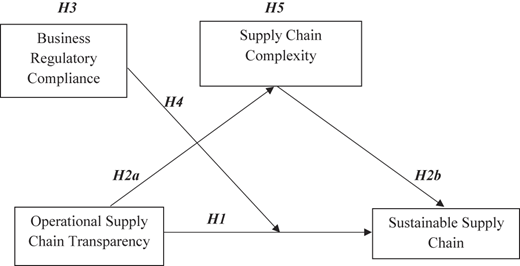
SCC poses a major challenge in Industry 4.0 and digital supply chain contexts, reducing organizational performance and resilience (Wang et al., 2023). It undermines transparency and traceability as global networks expand (Razak et al., 2023). Key drivers of SCC include longer supply chains from offshoring and outsourcing (Levi et al., 2020), higher product variety and customization (Kim et al., 2022), and the combined pressures of globalization, technology, and evolving customer demands (Loku and Loku, 2025). Strategies to mitigate SCC include simplifying the supply chain, modularizing components to enhance flexibility, and improving supplier collaboration to strengthen coordination and information flow (Choi, 2019). Figure 1 is the theoretical framework of the study showing the relationship among the constructs.
2.4.1 Operational supply chain transparency and sustainable supply chain
OSCT enhances a sustainable supply chain by making sourcing, production, and logistics information accessible across the supply chain. The NRBV explains this effect by viewing transparency as a capability that helps firms manage environmental and resource challenges more effectively than competitors. Through improved visibility, firms can monitor operations, enforce environmental standards, coordinate with responsible suppliers, and respond to disruptions (Ekechukwu, 2024). Although transparency may initially increase data demands, it strengthens routines that support waste reduction, pollution prevention, and sustainable sourcing (Ekechukwu, 2024; Villena and Dhanorkar, 2020). When embedded in daily operations, transparency also reduces compliance and reputational risks while improving consistency and stakeholder trust (Akinsola, 2025). Supported by digital tools such as enterprise resource planning (ERP) systems or blockchain, transparency helps firms manage complexity and build resilience. From an NRBV perspective, these transparency-driven routines evolve into firm-specific capabilities that contribute to sustained competitive advantage. This reasoning supports the hypothesis that:
Operational supply chain transparency is positively and significantly linked to sustainable supply chain.
2.4.2 Operational supply chain transparency and supply chain complexity
The NRBV explains how OSCT supports a sustainable supply chain by enabling firms to develop capabilities that address environmental and resource challenges. These capabilities include pollution prevention, responsible resource management, and routines that integrate sustainability into daily operations (Siagian et al., 2022). However, in complex supply chains, marked by multiple suppliers, product variety, and regulatory diversity, sustainability efforts are often constrained by uncertainty and coordination problems (Kelling et al., 2021). Ezeh et al. (2024) highlighted that OSCT helps mitigate these challenges by providing real-time visibility into processes, material flows, and supplier practices. In addition, transparency normally increases data volume, but it also allows firms to monitor compliance, identify inefficiencies, and take timely corrective action (Udeh et al., 2024). In accordance, as transparency becomes embedded in operations, it strengthens coordination, responsiveness, and consistency in supplier performance (Liu et al., 2024; Villena and Dhanorkar, 2020), and as supported by digital tools such as ERP systems and blockchain, these practices help enhance resilience and reduce sustainability risks (Morawiec and Sołtysik-Piorunkiewicz, 2022). As viewed from an NRBV perspective, OSCT develops firm-specific capabilities that transform SCC into a source of sustainable value creation. The study hypothesizes that:
Operational supply chain transparency is positively and significantly related to supply chain complexity.
2.4.3 Supply chain complexity and sustainable supply chain
The relationship between SCC and sustainable supply chain performance is often challenging. High complexity driven by multiple suppliers, diverse products, and varying regulations can reduce visibility, increase coordination difficulties, and heighten the risk of noncompliance, which undermines sustainability outcomes (Venkatesh et al., 2024; Junaid et al., 2023). Drawing from NRBV theory, firms achieve sustained competitive advantage by developing capabilities that enable them to manage environmental and operational pressures effectively. However, high SCC can strain these capabilities, limiting the firm's ability to embed sustainable routines, enforce standards, and coordinate processes across the network (Ahmed et al., 2024). Even with investments in digital tools, adaptive governance, or supplier partnerships, high complexity can overwhelm operational capacity, leading to inefficiencies, environmental risks, and inconsistent supplier compliance (Rahman et al., 2025). Consequently, when complexity exceeds a firm's capability to manage it, a sustainable supply chain is negatively affected, as the firm struggles to transform environmental and operational pressures into strategic advantage (Ning and Yao, 2023). From this logic, the study proposed this hypothesis:
Supply chain complexity insignificantly affects sustainable supply chain.
2.4.4 Moderating role of regulatory compliance
BRC can enhance the effectiveness of OSCT in promoting a sustainable supply chain. According to Regulatory Compliance Theory, firms adjust their behavior in response to legal and institutional pressures, which compel them to act on disclosed information (D'Arcy and Basoglu, 2022). In contexts of high regulatory compliance, transparency initiatives such as carbon reporting, supplier audits, and sustainability tracking are more likely to be implemented rigorously, ensuring that visibility leads to tangible improvements in environmental and social performance (Aragón-Correa et al., 2023; Efunniyi et al., 2024). From the perspective of the NRBV, regulatory compliance also strengthens the firm's capability development, embedding routines and operational processes that transform transparency into strategic resources for pollution prevention, resource stewardship, and supplier accountability. Conversely, in weak regulatory environments, transparency alone may be symbolic, producing limited improvements (Liu et al., 2024; Huq and Stevenson, 2020). Compliance mechanisms, such as contractual sustainability clauses or formal monitoring systems, further reinforce the positive effect by institutionalizing accountability and operational follow-through (Lausberg, 2023; Jimenez Castillo et al., 2024). It is on this premise that the study proposes this hypothesis:
Business regulatory compliance positively and substantially moderates the relationship between operational supply chain transparency and sustainable supply chain performance.
2.4.5 Regulatory compliance and sustainable supply chains
Regulatory compliance enhances sustainability by both enforcing environmental and labor standards and encouraging firms to develop internal capabilities for continuous improvement. According to Kazancoglu et al. (2023), legal and institutional frameworks often require operational adjustments, such as adopting cleaner technologies and implementing responsible sourcing practices. Drawing from the NRBV, these adjustments can evolve into strategic capabilities that improve long-term competitiveness, as they embed routines and processes that are valuable, rare, and difficult for competitors to imitate (Siagian et al., 2022). That notwithstanding, firms that treat compliance strategically are more likely to pursue innovation, strengthen operational efficiency, and build trust with stakeholders (Omidvar et al., 2025; Nazir et al., 2024). In contrast, firms that view compliance transactionally tend to implement only minimal, reactive measures, limiting the development of capabilities that support sustained environmental and social performance (Solaimani, 2024; Khan et al., 2024). Lastly, transforming regulatory pressures into internal strengths and strategic compliance will enable firms to convert external requirements into enduring, sustainable supply chain advantages. The study proposed this hypothesis.
Business regulatory compliance has a positive and significant impact on sustainable supply chains.
2.4.6 Mediating role of supply chain complexity
OSCT affects sustainable supply chain performance, as it enables firms to monitor processes, enforce sustainability standards, and coordinate activities across the supply chain (Morgan et al., 2023). According to the NRBV, sustained competitive advantage arises from firm-specific capabilities that allow effective management of environmental and resource challenges (Hart, 1995). Studies revealed that SCC is often suggested as a mediator, but empirical evidence indicates that its mediating role is not consistent. For instance, meta-analytic findings show that complexity does not uniformly explain performance outcomes and may operate independently depending on how it is measured (Ates et al., 2022). Similarly, Inman et al. (2024) found that complexity can directly influence operational outcomes without functioning as an intermediary. Consistent with these insights, this study finds that SCC does not significantly affect the transparency–sustainability relationship (Chand et al., 2022). This suggests that transparency alone is sufficient to enhance sustainable supply chain outcomes. Drawing from the NRBV theory, suggest that well-developed, and firm-specific capabilities, not operational complexities, are the primary drivers of both competitive and sustainability advantages. It is based on this logical sense that the study proposed this hypothesis:
Supply chain complexity did not mediate the baseline (operational supply chain transparency and sustainable supply chain).
3. Materials and methods
3.1 Research design and philosophy
This study adopts a positivist research philosophy, assuming that reality is objective and can be measured empirically. A quantitative approach was used to examine the effect of OSCT on sustainable supply chain, considering the mediating role of SCC and the moderating effect of BRC. A cross-sectional survey design was employed, which is suitable for testing theoretical relationships within a defined population at a single point in time.
3.2 Population and sampling
The study surveyed 223 manufacturing firms in Greater Kumasi, Ghana, covering sectors such as food and beverage, textiles, chemicals, wood processing, and metal fabrication. Two hundred firms responded, yielding a 90% response rate. Most respondents were supply chain managers, procurement officers, and operations supervisors with an average of eight years' experience, ensuring informed insights. The high response rate enhances reliability, and the 10% non-response is unlikely to have biased the results.
3.3 Data collection
Structured questionnaires were administered in person, resulting in about a 90% response rate and 10% non-response rate, providing greater control over data collection compared to online surveys (Harrison et al., 2023). To reduce bias, the authors implemented respondent anonymity, used neutral wording for items, randomized question order, and relied on voluntary participation (Podsakoff et al., 2024). This led the researchers to obtain ethical approval and secure informed consent from all participants.
3.4 Measurement of constructs
The study adapted existing scales for the Ghanaian manufacturing context. OSCT was measured via information sharing and visibility, tailored to local practices (Emon and Khan, 2024). Sustainable Supply Chain Performance used economic, environmental, and social indicators (Seuring and Müller, 2008). SCC covered supplier, product, demand, and process/network dimensions (Bozarth et al., 2009), while BRC assessed adherence to local laws and regulations (Nugiantari, 2025). All items used a seven-point Likert scale and were pretested with local managers to ensure clarity, relevance, and cultural suitability.
3.5 Data analysis
Construct validity was assessed using exploratory factor analysis (Dabbagh et al., 2023), and internal consistency was evaluated with Cronbach's alpha, composite reliability, and Average variance extracted (AVE). Common method bias was tested with Harman's single-factor test (Howard et al., 2024). Data analysis employed partial least squares structural equation modeling in SmartPLS, suitable for complex models with multiple latent constructs and moderate sample sizes (Hair et al., 2019). Mediation effects were examined using the PROCESS macro in SPSS with 5,000 bootstrap resamples and confidence intervals to assess indirect effects of OSCT on SSC via SCC (Hayes, 2018).
4. Data and results
From Table 1, the sample comprised 200 respondents, of whom 65.5% were male, and 34.5% were female. Most respondents were between 24 and 35 years of age, indicating an active working population. In terms of education, the majority held a bachelor's degree (76.0%), followed by a master's degree (21.5%) and a doctorate (2.5%), which aligns with their professional roles. All respondents had substantial work experience, with over half reporting 8–10 years with their firms and the remainder having 11–15 years of experience. Regarding job roles, 50.0% were procurement officers, 30.0% were supply chain managers, and 20.0% were operations supervisors. These positions are directly involved in supply chain activities, supporting the reliability and relevance of the data collected.
Descriptive analysis revealed varied perspectives across key supply chain areas. According to Table 2, Regulatory compliance scored relatively high (M = 5.03) but showed variability (SD ≈ 1) and negative kurtosis, indicating mixed views on its operational impact. OSCT had a moderate average (M = 4.28) with notable variability (SD = 1.7–1.8), reflecting inconsistent implementation. Sustainable supply chain performance was rated highest (M = 5.31) with low variability (SD ≈ 1) and a leptokurtic, slightly positively skewed distribution, indicating broad agreement on its importance. Overall, sustainability and complexity emerge as priorities, while transparency and regulatory compliance show more diverse opinions, suggesting areas needing managerial attention.
Using Harman's single-factor test, the results from Table 3 showed that it was not a significant concern, since the first factor accounted for 49.1% of the variation, which is below the 50% cutoff (Hair et al., 2019). Conversely, the study's validity was strengthened, and potential bias was further reduced by procedural steps such as respondent anonymity, a clear item design, and different question formats.
Multicollinearity was assessed in Table 4. All data indicated modest multicollinearity, remaining below the critical threshold of 5 (Gujarati, 2009; Hair et al., 2010). This confirmed that factors such as SCC, operational transparency, and regulatory compliance do not influence the regression outcomes. Also, the unique contribution of each variable to sustainability is thus easily identifiable, supporting managers in making informed decisions and helping researchers better understand the main performance factors.
In Table 5, the constructs (SCC, operational transparency, regulatory compliance, and sustainable supply chain) were analyzed using explanatory factor analysis EFA. The study identified a clear and well-defined factor structure. While SCC emerged as a separate factor, items related to sustainability, transparency, and compliance were grouped into three distinct yet interconnected factors. The construct validity of the measurement scales was confirmed by the fact that all factor loadings exceeded the recommended cutoff of 0.4 (Tabachnick and Fidell, 2013).
4.1 EFA (exploratory factor analysis)
The study employed Bartlett's Test of Sphericity and the Kaiser–Meyer–Olkin (KMO) metric to evaluate whether the data were suitable for factor analysis. Table 6 revealed that the KMO value of 0.899 indicates excellent sample adequacy (Hutcheson and Sofroniou, 1999). The correlations among the items were strong enough for factor extraction, as shown by the highly significant Bartlett's Test (χ2 = 3119.045, df = 136, p < 0.001) (Field, 2000; Pallant, 2013). These results confirm that the sample of 200 respondents is adequate and that the data are appropriate for identifying meaningful factor structures.
Convergent validity was assessed using AVE, Cronbach's alpha, and composite reliability (rhoa and rho_c) as seen in Table 7. AVE values ranged from 0.716 to 0.798, exceeding the 0.50 threshold, indicating that the constructs explained a substantial portion of the variance in their indicators. Strong internal consistency was confirmed, with all Cronbach's alpha and composite reliability values above 0.70. These results from Table 7 support the validity and reliability of the study's measurement approach.
The cross-loading matrix is shown in Table 8, which displays the correlation coefficient between the factors and items. The table's values show how strongly each item and the factor are related to one another. It is evident from Table 8 that the items are loaded on the anticipated factors, suggesting strong convergent validity.
Discriminant validity was assessed using the heterotrait-monotrait (HTMT) ratio and the Fornell–Larcker criterion in Table 9. The outcome from Table 9 shows that the SCS HTMT value (0.929) slightly exceeded the 0.90 threshold (Henseler et al., 2015), suggesting a strong association between the constructs. However, an examination of indicator loadings and cross-loadings showed no problematic overlap, indicating that the association reflects conceptual closeness rather than measurement flaws. In addition, the bootstrapped HTMT confidence intervals did not include 1.0, supporting acceptable discriminant validity. As noted by Henseler et al. (2015) and Hair et al. (2021), minor HTMT exceedances are acceptable when constructs are theoretically distinct. The Fornell–Larcker results further confirm discriminant validity, as the square root of each construct's AVE exceeded its correlations with other constructs. For example, OSCT recorded a square root AVE of 0.853, which is higher than its strongest correlation of 0.810 with SCS. Overall, the evidence from Table 9 reveals that the constructs are empirically distinct and are appropriately retained in the model.
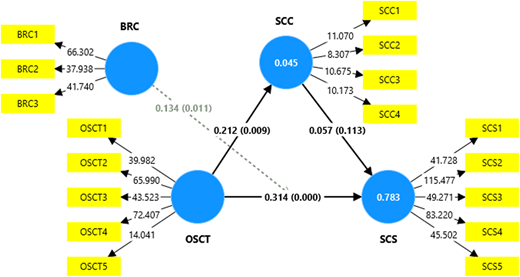
The Stone–Geisser Q2 statistic was used to assess the model's predictive relevance, while R2 and adjusted R2 measured its explanatory power. SCS demonstrated strong explanatory power (R2 = 0.783, adjusted R2 = 0.779) and excellent predictive relevance (Q2 = 0.760). In contrast, SCC exhibited very low predictive relevance (Q2 = 0.027) and weak explanatory power (R2 = 0.045, adjusted R2 = 0.040). These results from Table 10 support context-dependent interpretations of R2 and Q2 standards, indicating that the model predicts sustainability outcomes well but has limited ability to explain changes in SCC.
The measurement model showed strong validity and reliability. From Table 11, structural analysis revealed that BRC (β = 0.511) and OSCT (β = 0.314) significantly enhance sustainability, while SCC alone is not significant (β = 0.057). The interaction between transparency and compliance (β = 0.134) indicates that compliance strengthens the impact of transparency on sustainability.
Figure 2 below shows the structural and measurement paths of the constructs.
5. Conclusion
This study examines the relationships among OSCT, SCC, BRC, and sustainable supply chain performance. The findings show that regulatory compliance plays a critical role in shaping sustainability outcomes, as transparency is most effective when supported by strong institutional and regulatory enforcement. In such contexts, transparency enables firms to translate disclosed information into concrete sustainability actions. OSCT also improves sustainability outcomes by reducing information asymmetries and supporting coordination in complex supply networks. However, its effectiveness depends on firms' ability to integrate transparency into operational routines and decision-making processes rather than treating it as a reporting exercise. The results further indicate that SCC does not mediate the relationship between transparency and sustainable performance, suggesting that complexity operates as a parallel condition rather than an intervening mechanism. Based on these findings, supply chain simplification should focus on practical actions, such as rationalizing supplier bases, standardizing product designs, and improving information system integration, rather than indiscriminately reducing complexity. Overall, the study highlights that transparency contributes most strongly to sustainable supply chains when combined with effective regulatory compliance and deliberate operational alignment.
5.1 Theoretical contribution
The study contributes to supply chain and institutional theory by showing that regulatory compliance acts as an enabling pressure that shapes sustainable supply chain outcomes. It also extends the NRBV by identifying operational transparency as a strategic capability for sustainability. The insignificant mediating role of SCC suggests the need for further theoretical inquiry, while the observed moderating effect supports regulatory focus theory by highlighting the influence of regulatory context on the effectiveness of supply chain practices.
5.2 Practical contribution
These results emphasize the importance for companies, especially those in the manufacturing sector, to prioritize regulatory compliance in their sustainability strategies. Businesses should focus on increasing transparency in their supply chains by sharing data with partners at all levels, promoting cooperation, trust, and environmentally friendly practices. Managers of manufacturing organizations should consider simplifying the supply chain as part of their broader efforts to optimize operations, even if this does not directly enhance sustainability.
5.3 Limitations and suggestions for further studies
This study has several limitations. The cross-sectional design limits causal interpretation, and longitudinal studies could provide stronger insights. The sample is confined to manufacturing firms in one region of Ghana, which restricts the generalizability of the findings to other sectors and locations, despite the high response rate. Self-reported data may be affected by social desirability bias, and firm characteristics such as age and size were not controlled. Future research should extend the study across industries and regions, adopt longitudinal designs, and explore additional mechanisms such as dynamic capabilities or supply chain resilience, and firm size or industry type.
Appendix 1 comprises the measurement items for the constructs in this study, as shown below in table, showcasing the lists of questions addressing these constructs.
The authors would like to thank ChatGPT (OpenAI, San Francisco, CA), QuillBot and Grammarly for helping improve the clarity and readability of the manuscript. These tools were only used for language refinement and did not influence the study's data analysis, results or conclusions. The authors take full responsibility for all content presented.
The supplementary material for this article can be found online.