This paper shares the experience of developing and designing two adjacent projects, Patch22 and Top-Up, in Amsterdam using Open Building principles. It discusses the architectural, technical and legal challenges and opportunities encountered, as well as the influence of economic and legal factors on future adaptability.
By analyzing and comparing Patch22 and Top-Up, this paper identifies the principles necessary for implementing Open Building in practice.
The adaptability of buildings to future uses largely depends on legally ensuring flexible principles before the initial delivery and sale. While technical Open Building principles are relatively easy to integrate, this paper offers technical and architectural recommendations for their implementation.
Since the designers of the buildings are also the initiators and real-estate developers of the buildings, this paper provides insights into the technical, architectural, legal and economic conditions for successfully implementing Open Building principles.
Patch22 and Top-Up exemplify the revival of Open Building principles in the Netherlands (2010–2020), demonstrating the ambition of a multidisciplinary team to create reusable buildings. This paper shares the successes and challenges faced in contemporary building practice.
1. Introduction
Patch22 [1] and Top-Up [2] are two buildings based on John Habraken’s “Open Building” principles (Habraken, 1961), designed by FRANTZEN et al. and developed and realized by Lemniskade BV in the Buiksloterham district, a former industrial area in the northern port of Amsterdam in the Netherlands, during the period 2009–2020.
Lemniskade BV was founded in 2009 by building manager Claus Oussoren and architect Tom Frantzen out of frustration with the fact that, in the first decade of this century, investors and developers hardly initiated any projects in which integral sustainability was the starting point. During the 2008–2014 credit crunch, clients in the Netherlands became even more conservative and affordability became the most important criterion. In response, Oussoren and Frantzen decided to take matters into their own hands, founding project development company Lemniskade Projecten and to participate in a tender from the City of Amsterdam for the construction of a sustainable residential building. This eventually became Patch22. During the construction of Patch22, Lemniskade also managed to acquire the adjacent lot, on which Top-Up was completed in 2020.
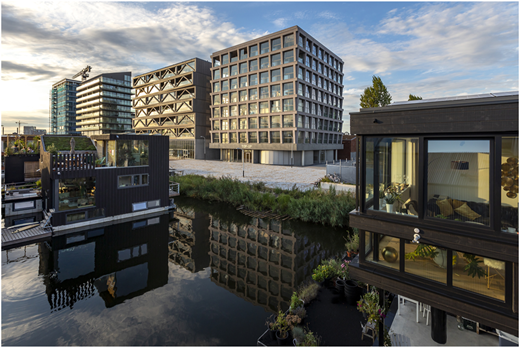
Patch22 and Top-Up (Figure 1) are right next to each other on the shore of the Johan van Hasselt canal and have the same program; commercial spaces on the first floor with live-work apartments on top. The buildings also share great similarities in size and materials; both buildings have an area of about 5,000 m2 and have a hybrid wood–concrete load-bearing structure. The facades of both buildings consist of the same material palette; pre-grayed and preserved softwood combined with wood-aluminum window frames and coarse concrete stucco. Architecturally, both buildings consist of a plinth layer of concrete with a loose stack of wooden volumes on top. FRANTZEN et al. often describe Patch22 and Top-Up as a “married couple”; two inseparable individuals with different DNA (storey heights, dimensions and proportions), with similar standards and values (flexibility and durability) and over time the same gray colors.
The floors of both buildings are divided into more legal units – condominium rights – than there are apartments, where owners could combine a single or several condominium rights into an apartment of the desired size. Both buildings offer many spatial and technical possibilities to make adjustments within their own apartments: the floorplan layout, the installations and the drainage pipes are all flexible. Yet, in addition to the many similarities, there are also major technical, architectural and legal differences.
2. Context
2.1 Economic context
The context (time, economy, society) in which the buildings were designed and realized shows great differences. This is remarkable, to say the least, since the buildings were developed almost sequentially. Patch22’s development began in 2009; Top-Up’s in 2014 (while the construction of Patch22 was in progress). To get a grip on the influence of economic conditions (and subsequent legal implications) on the development of both buildings, the development trajectory of both buildings is described in chronology.
2.2 Intellectual context: different roads leading to open building
Habraken’s primary motivation was to enhance inhabitant involvement in the design and realization of their homes and living environments. His Open Building principles were applied on a large scale in 1977 by architect Frans van der Werf in the Molenvliet housing project in Papendrecht, where 123 dwellings were developed according to Habraken’s “support and infill” concept.
“Molenvliet was developed through a participatory, bottom-up process in which Van der Werf held consultation sessions with all stakeholders, including each future inhabitant, to discuss individual wishes and housing needs. These conversations were incorporated into the final design, resulting in no two dwellings being exactly the same (Manuela, 2023).”
This project drew the attention of Frank Bijdendijk (Bijdendijk, 2006), a young developer who became director of the Amsterdam housing association Het Oosten in 1982. Bijdendijk observed that, although housing associations typically built standardized dwellings, inhabitants frequently modified them during occupancy. This revealed a fundamental need to adapt living spaces to personal lifestyles rather than conform lifestyles to fixed architectural typologies. He recognized this phenomenon in the Molenvliet project, where variation among units was intrinsic to the design. His conviction that inhabitants could take responsibility for their own “infill” was further reinforced in 1987 when Het Oosten acquired the Tetterode complex, occupied by squatters at the time. While the corporation refurbished the building’s exterior, it deliberately left the interior design and construction to the new tenants, thereby formalizing their autonomous approach to living.
In 2011, Bijdendijk implemented these ideas in two “Solid” buildings in Amsterdam, designed by Tony Fretton and Baumschlager Eberle (Mensink, 2013). In the “Solids,” the separation between “support” and “infill” was implemented in a particularly clear and deliberate manner. Het Oosten built the support structure while inhabitants could decide how much space to rent, how to program that space, build the infill themselves and even influence rental prices through a competitive bidding process.
Whereas Habraken arrived at the “support–infill” distinction through a critique of the technocratic logic of Mass Housing, Bijdendijk arrived at a similar conclusion from a user-centered perspective, grounded in his real-life observation of how inhabitants continuously adapted their living environments.
Architect Tom Frantzen arrived at the same “support–infill” principle in the development of Patch22 and Top-Up. His motivation, however, was not rooted in critique of contemporary mass housing production nor in inhabitant empowerment but primarily in the pursuit of sustainability. Frantzen observed that, starting in the 1990s, large-scale housing projects in Amsterdam were being demolished because their limited usage possibilities no longer aligned with contemporary needs (The Bijlmer housing project as an example). He realized that a truly sustainable building would never meet the fate of demolition. To create buildings that can last forever, Frantzen designed his projects as buildings with a built-in capacity for change: incorporating the ability to adapt to unknown functions and unknown future inhabitants, allowing for continuous transformation over time.
In doing so, Frantzen aligned closely with Stephen Kendall’s concept of Open Building as an approach to sustainable architecture (Kendall, 1999). Kendall emphasized that this requires more than a shift in the architect’s attitude and skill set; it also necessitates changes to legal, regulatory and financial frameworks. The projects Patch22 and Top-Up offer concrete examples of how legal, regulatory, technical and financial frameworks have directly influenced the way Open Building principles were implemented.
3. Development process
3.1 Patch22
Patch22 was designed in the period 2009–2013 and built in the period December 2014–January 2016. The plot on which Patch22 was built was offered to the market by the municipality through a tender in which market parties were invited to make a proposal for the site. The special feature of this tender was that selection was not based on the financial bidding by market parties but on the sustainability scores of the design. The leasehold of the lot was fixed as a “lump sum” with no financial corrections based on the actually realized or alternative future program.
Normally, Amsterdam corrects the leasehold when the program changes. This is because Amsterdam owns most of the land within the municipality and applies a “leasehold system” in which the user of the plot pays the municipality a rental fee based on functional use for the land while the building is developed and built at the developer’s expense and risk and the real estate property remains in private ownership.
Municipal leasehold prices vary based on functional use, with residential functions typically costing more than commercial ones in recent decades. When a building’s function changes, the leasehold is adjusted accordingly, which can create a financial barrier for future reuse of the building.
This was not the case with Patch22. In the tender submission for the lot, Lemniskade BV and FRANTZEN et al. designed a highly energy-efficient building that achieved top sustainability scores, winning the tender. Additionally, FRANTZEN et al. made sure the building could easily adapt in the future, allowing floors to switch between housing and office use. Because this flexibility was integral to the tender, it was contractually stipulated that future changes in use would not affect the leasehold, which was set at a lump sum of €1,900,000 in the tender.
In Patch22, all future uses allowed by the zoning plan can be realized without adjusting the leasehold. The tender entry did not specify which functions would go where in the building, but rather how uses could change over time. Normally in the Netherlands, buildings are divided into separate condominium rights with specific functions. However, Patch22 contractually established that each condominium right can accommodate multiple functions, both residential and commercial, ensuring flexible use in the future.
In addition to the fact that a lump sum was set for the leasehold and a flexible programmatic layout was an integral part of the tender submission, it was crucial for the success of the design’s flexible layout that the building was developed during the economic credit crunch of 2008–2014.
During this period, very few buildings were developed in Amsterdam, which gave the involved municipal officials plenty of time to work with Lemniskade and FRANTZEN et al. to figure out how to contractually establish the desired flexibility in layout, both for the present and the future, in the division deed and the leasehold contract. As briefly mentioned above, this was not typical for the municipality of Amsterdam.
3.2 Top-up
Top-Up was designed between 2014 and 2018 and built from November 2018 to February 2020. After 2014, the Dutch economy quickly recovered from the previous economic crisis. The Amsterdam housing market changed rapidly and projects sprung up everywhere. Developers seized every opportunity to acquire sites, and contractors worked overtime to meet demand, causing both housing prices and construction costs to skyrocket.
In 2014, the municipality of Amsterdam lacked sufficient staff to intensively manage every development initiative. Therefore, municipal officials were reluctant to make extra efforts when drafting the necessary leasehold contracts and division deeds and deviating contract forms were rejected. This meant that projects had to be designed as “normally” as possible, and the flexibility and adaptability of buildings were no longer seen as a desirable extra sustainability quality but as an unwanted administrative burden.
The leasehold negotiations for Top-Up also differed from Patch22. While Patch22 was a public tender with a fixed leasehold lumpsum, Top-Up was a private transformation project. During the construction of Patch22, Lemniskade managed to acquire the adjacent plot and building from the previous owner. The site contained an industrial building, once a storage and testing facility for the national telephone company PTT, where trans-Atlantic telephone cables were tested before being loaded onto ships and installed on the seafloor.
When purchasing the building, Lemniskade also acquired the right and obligation to lease the underlying plot from the municipality. The lease at the time of purchase was based on the building’s previous function. Lemniskade then developed a transformation proposal in which the existing building was partially demolished and topped up (hence the name Top-Up) with seven floors of mixed-use apartments. This required the leasehold to be adjusted from €483.000, to €4.864.000, as the use of the plot would change due to the transformation. Due to under-staffing in municipal services, officials insisted that this be done in the most “normal” (and thus time-saving) way, without incorporating future flexibility into the renewed leasehold contract.
However, due to Lemniskade’s and FRANTZEN et al.'s sustainability ambitions, there was a desire to make Top-Up suitable for an unknown future use. While this was an integral part of the sustainability vision that helped win the tender for Patch22, this desire for future adaptability had to be achieved without the cooperation of the municipal government for Top-Up.
4. Extending the cradle to cradle loop
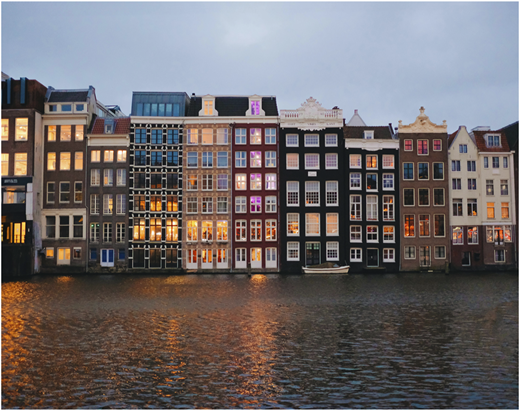
The book Cradle to Cradle (McDonough and Braungart, 2002) advocates for eliminating waste by closing the material “loop,” ensuring that products are continuously reused rather than discarded. It inspired the circular design of Patch22 and Top-Up, where wood as a renewable building material is central. Wood grows back during the building’s lifespan, contributing to a circular system. However, sustainability goes beyond energy efficiency, which Patch22 was evaluated on in the tender, and circular material choice: Buildings that are easily adaptable – like the 450-year-old canal houses in the heart of Amsterdam (Figure 2) – tend to remain in use for much longer. As a result, the turnover time of their building materials within the cradle to(ooooooooooooooo) cradle loop is significantly extended. In a similar spirit, Patch22 and Top-Up have been designed with flexible drainage and installation systems that allow for easy replacement or adjustment. This adaptability supports a longer functional lifespan and contributes to a durable circular built environment.
5. Floors and shafts (important)
5.1 Patch22
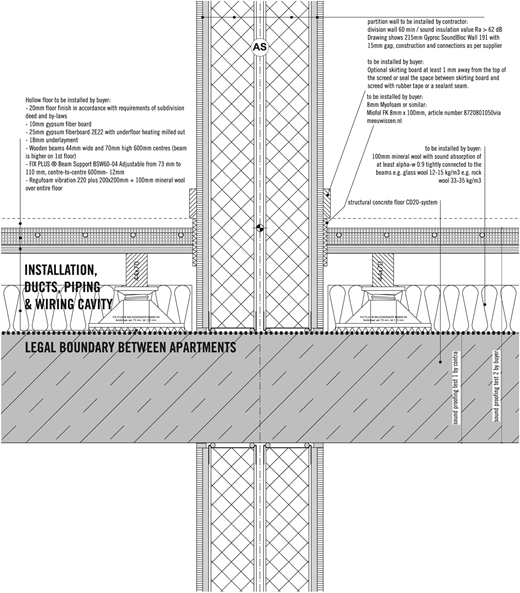
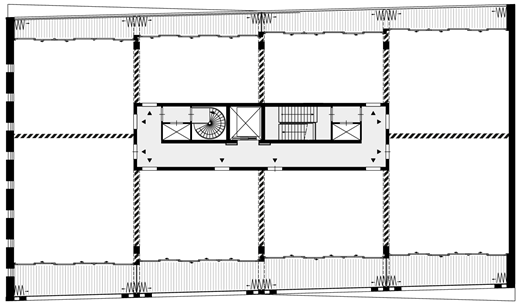
The Slimline floor [3] on a laminated wood post-beam structure with CLT side walls and a concrete stability core (Figure 3).
In Patch22, no vertical shafts are placed in the residential apartments. The vertical shafts are located in the common central core of the building. To reach the vertical shaft from every position in each apartment with the required toilet drainage, a significant sloping angle (0.5 cm/m) is needed (in the Netherlands, a natural slope is typically used for drainage systems and pressurized systems are uncommon). In a conventional floor structure in the Netherlands, these pipes would be embedded in a (very inflexible!) concrete floor, which would become inefficiently high due to the required internal sloping angle of the drains.
Therefore, Patch22 opted for the Slimline floor, developed at the Eindhoven University of Technology. It is a combination of an 8 cm thick concrete slab topped with 36 cm high perforated steel beams. Drains and wiring can be installed between and through these beams.
The floor is sealed with a Lewis sheet, a folded steel sheet, with an 8 cm thick screed layer in which water-based radiant heating pipes are embedded. Because it is easy to saw holes in the screed and the Lewis sheet, and because these can also be easily repaired (both now and in the future, as it is not a complex construction system), changes to the piping system in the floor are easy to implement. This allows for easy future alterations to the floor plan layout.
However, this floor construction also had an unexpected disadvantage in legal terms. In an apartment building, the floor serves as both a structural and legal boundary between two apartments. According to building regulations, the floor must provide a certain level of soundproofing between apartments located one above the other. However, since the floor contains a hollow space with accessible drains and wiring, the question arises as to where the legal boundary is located inside the floor and which part of the floor the soundproofing requirements apply to.
The hollow Slimline floor creates a legal gray area, as it is unclear who is responsible in case of soundproofing problems. Due to the lack of mass in the floor, this system is also prone to soundproofing problems if construction errors are made at the joints between floors and walls. These two issues led to different choices being made for the floor design in Top-Up.
5.2 Top-up
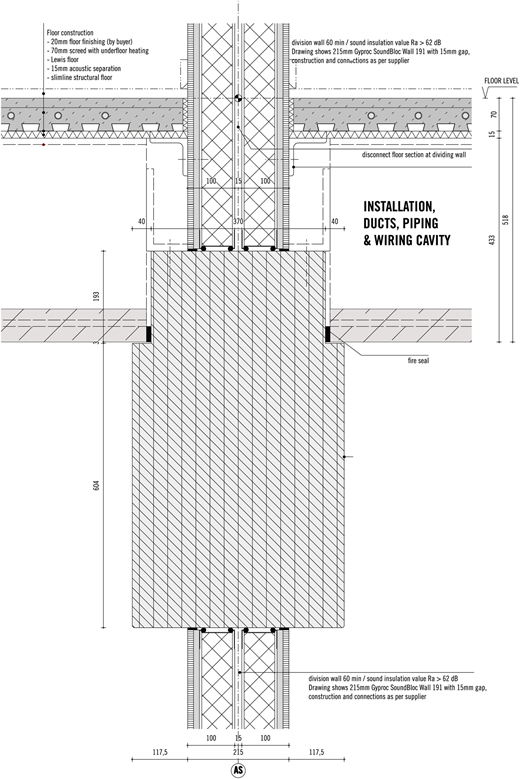
In Top-Up, the vertical shafts are also located in the common central core of the building, not in the apartments. Due to the sensitivity to construction errors and the legal uncertainty of the Slimline floors, Lemniskade opted for a more traditional floor construction in Top-Up, based on the CD20 construction system. This system is a prefab concrete system that is assembled with steel joints. The 6.6 × 3.3 m concrete floor elements are reinforced in two directions, eliminating the need for beams.
The 23 cm high concrete slabs rest directly on the columns at their corners. Normally, these columns would be made of concrete, but in Top-Up, they are made of GLULAM (laminated wood). On top of these concrete slabs, the users/owners themselves created a raised floor using a dry construction method, with a total height of 27 cm where the drains and wiring are installed.
The cavity for drainage slopes and wiring is shallower than in Patch22, making it impossible to place toilets within 2.5 meters of the facade, far from the central core’s vertical shaft. However, since demand for this option was minimal in Patch22 layouts, this was not considered a major limitation for Top-Up. The combination of the 23 cm high concrete floor and the raised floor is intended to provide the required soundproofing.
To ensure that each floor would meet the legal requirements, a manual was written on how the floor should be constructed, and two soundproofing tests were planned. The first test was taken after the concrete floor was completed, and the second after the raised floor was added.
After the first test, it was found that the prefab concrete floor performed better than the sound calculations had predicted. The concrete floor already met the legal requirements, thus forming a legally clear separation between the apartments. As a result, the added soundproofing of the raised floor was no longer necessary to meet legal standards, though it did improve comfort.
An important design principle for the raised floor was the desire to assemble and disassemble it using low-tech equipment: a drill, jigsaw and miter saw. This is equipment that any DIY handyman can use, both now and in the future when drains and wiring might need to be adjusted in the floor. In the Netherlands, modifying or renovating a home or apartment is not typically the domain of professional contractors with specialized equipment and procurement departments, but rather the domain of handymen or handy relatives who buy materials at local hardware stores.
6. Walls (easy)
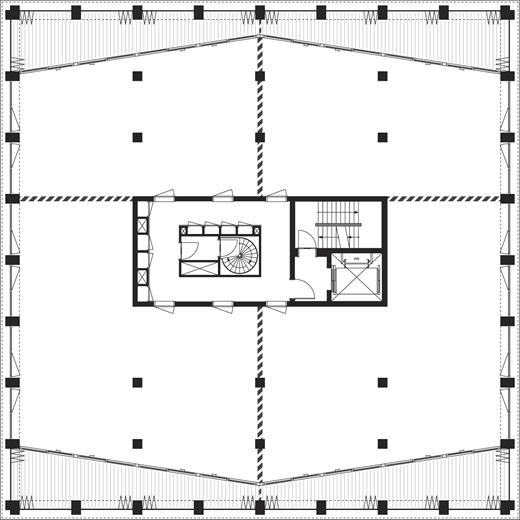
In both Patch22 and Top-Up, the non-load-bearing apartment partition walls consist of a standard Gyproc/Metal-Stud double-wall system [5], which is dry-mounted between the wooden beams (Patch22) (Figure 3) or the concrete floor slabs (Top-Up) (Figure 4). The walls do not contain installations, electrical wiring or ventilation ducts, except for a switch for the loggia lighting. An important consideration during construction is sealing the gaps between the walls and the beams or floor slabs. If gaps remain, the structure becomes susceptible to sound transfer between apartments through airborne noise.
Another consideration is the position of the loggia lighting switch in the partition walls. These must never be mounted in the same position on both sides of the wall but should be offset by at least 60 cm to prevent sound transmission through the electrical sockets.
7. Installations (important)
Both Patch22 (Figure 5) and Top-Up (Figure 6) are equipped with water-based radiant heating. In Patch22, the pipes are laid in a wet-applied screed layer. When designing the radiant heating systems, consideration was given to the position of future partition walls. The areas where partition walls could be created were kept free of radiant heating pipes so that the top layer in these zones could easily be removed to place a new partition wall between the supporting wooden beams.
In Patch22, balanced heat exchanger systems were used to ventilate the apartments, as they positively influenced the building’s energy demand calculation. These systems were placed above the loggia ceilings, where they do not impose any restrictions on the interior layout. On paper, a heat exchanger is an excellent solution, but in practice, it proved more challenging. Since each apartment has a unique layout determined by the residents, the ventilation duct design differs in each apartment.
A double duct system is a direct result of the need to balance the system. This takes up a lot of space and requires significant engineering to prevent duct crossings. Moreover, the different interiors were designed by different interior contractors or sometimes even by the owners/users themselves. In practice, it became difficult to balance the ventilation system for the different spaces, resulting in the heat exchanger not functioning optimally and producing excessive noise. Over time, many residents turn off the heat exchanger and revert to the traditional method of ventilation, opening facade windows, thus sacrificing the apartment’s energy efficiency.
For Top-Up, based on the experiences at Patch22, a more straightforward system was selected. In the installation cabinet associated with the apartment in the common corridor, a CO2-controlled extraction system was installed that maintains a negative pressure in the apartment. Fresh air is drawn in naturally through facade vents.
Although this ventilation method is theoretically less energy-efficient than the system used in Patch22, it proves much more adaptable to the varying interior layouts of the apartments. It also requires far less material, as there is no double duct system and only a few extraction nozzles near the communal core are necessary.
In both Patch22 and Top-Up, the official meter cabinets for electricity, water and heating connections are located outside the apartment, in the communal corridor (Top-Up) or in a shared meter room on the ground floor (Patch22). Empty conduits were laid from these external meter cabinets to the interior of the apartments during construction. When building the interiors, the meters can be connected via these conduits. These meters would be an obstacle to layout freedom if they were placed inside the apartments.
In the Netherlands, energy suppliers are private companies with strict requirements. For electricity meters, strict rules apply to the position; in an apartment building, all meter cabinets must be positioned directly above each other, and a door must be present between the meter cabinet and the living room. However, for both Patch22 and Top-Up, it was unknown where the living room would be located, as the apartments were intended to be fully flexible in layout both when they were first built and in the future. Therefore, both buildings’ apartments have been kept free of obstructive obstacles and are designed without vertical shafts, installations or meter cabinets inside the apartment.
8. Elevator (easy)
In both Patch22 and Top-Up, the elevators are much larger than those in typical residential projects in the Netherlands. For instance, the elevator in Patch22 can accommodate 21 people, and the one in Top-Up can hold 16 people. Of course, such a large number of people would never actually enter the elevator at the same time, so the capacity doesn’t matter. However, the dimensions of the cage and the weight capacity are important. If apartments need to be adapted in the future, it should be possible to transport large (for example, standard plywood 1.22 × 2.44 m) and heavy construction materials in the elevator. Therefore, in open buildings, it is necessary to design the elevator with larger dimensions and a higher load capacity. Additionally, the size of the elevator was an important “unique selling point” during the sale of Patch22. Lemniskade enticed buyers by highlighting that the elevator and adjacent corridor were spacious enough to accommodate a Harley Davidson Sportster motorcycle, allowing owners to park it inside their apartment if they wished.
9. Designing empty floorplans (challenging)
The sales brochure floor plans for both Patch22 and Top-Up appear deceptively simple, showing nothing more than a completely open space that is freely configurable. However, the design process for creating a “blank floor plan,” a shell apartment, was much more intensive than for designing a “once-only layout.” To create a blank floor plan, 24 different apartment layouts were designed for apartments of various sizes and for different imaginary households, for both Patch22 and Top-Up. Using scenario thinking, layouts were devised for Empty Nesters, DINKYs (Double Income No Kids), families with teenagers, families with young children, families with in-laws, single-parent families, separated households living next to each other with shared children’s rooms, singles and many other variations. These layouts were tested to ensure that they could actually be realized technically within the shell apartments. It was also demonstrated to the authorities for obtaining building permits that the empty shell apartments could be formatted in a way that complies with the Dutch building code. These sample layouts were provided as sample designs in the sales brochures for buyers/users.
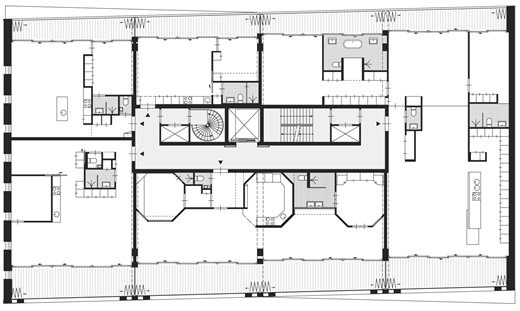
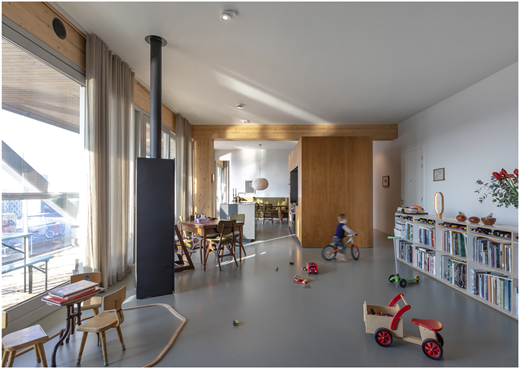
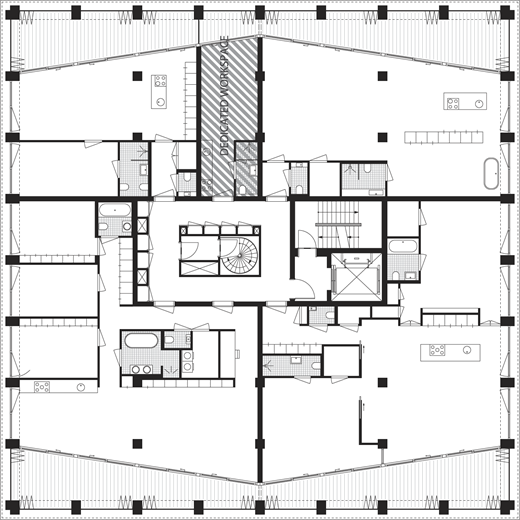
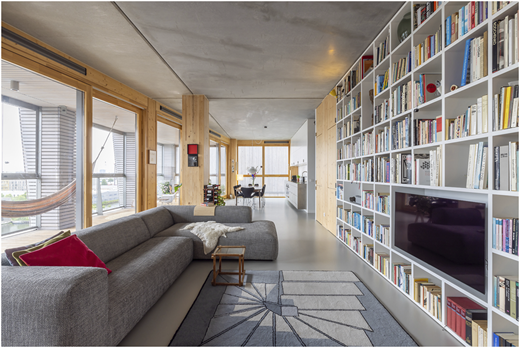
As the architect of the building, FRANTZEN et al. did not promote themselves to design layouts for individual buyers; instead, buyers were required to design the apartment layouts with their own personal architect and interior designer. After completion, a survey of the actual layouts in both Patch22 (Figures 7 and 8) and Top-Up (Figures 9 and 10) revealed that none of the sample layouts had been used. Since the buyers had complete freedom and opportunities to design their interiors based on their own needs and preferences with their own architect, the actual floor plans turned out to be much more specific than FRANTZEN et al. had conceived in the sample layouts.
10. Embedding of flexibility in legal contracts (challenging)
The subdivision drawing is probably the least inspiring drawing of a building but perhaps also the most important. This drawing establishes the property rights within a building, as specified in the division deed. It is also the document that determines the functional use and layout possibilities throughout the entire lifespan of the building.
When a buyer takes out a mortgage to finance the purchase, the subdivision drawing is the document that secures the collateral for the lending bank. Because banks are risk-averse institutions, bank employees are always cautious about allowing changes later on in how the collateral is defined. Therefore, it is important to already incorporate potential future changes in the initial division deed and the associated subdivision drawing.
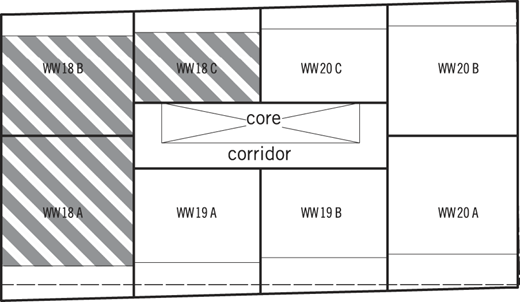
At Patch22 (Figure 11), each floor is divided into 8 condominium rights, ranging from 40 to approximately 80 m2. By combining condominium rights, potential buyers could determine the size of their apartment. For example, several buyers created a 200 m2 apartment by combining three smaller condominium rights. Each condominium right was provided with the option to create an access door. Some buyers even installed multiple entrances, such as a door to the residential area and a door to a separate home-office area. This setup allows owners to potentially split off parts of their apartments in the future and sell them to their neighbors, making it possible for apartments to expand or shrink or to create a new apartment for a newcomer within the building.
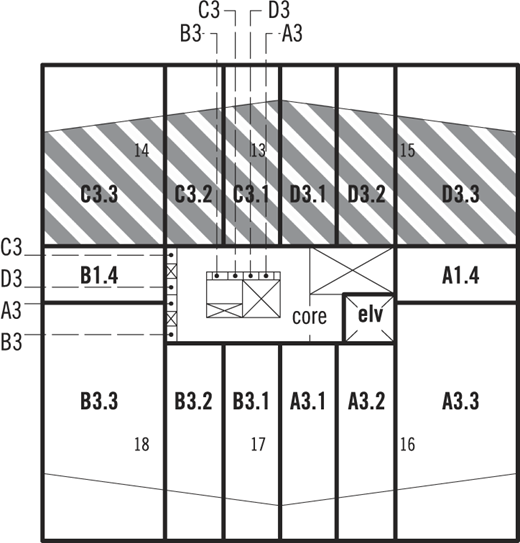
At Top-Up (Figure 12), Lemniskade and FRANTZEN et al. intended to divide the floors into even more condominium rights than at Patch22, including creating condominium rights without an access door. These condominium rights could only be sold in combination with other condominium rights that did have an access door. The advantage would be that the building could be subdivided even more diverse, and relatively small units could change ownership between neighbors.
As previously explained, the Municipality of Amsterdam refused to cooperate with this subdivision strategy for Top-Up, even though this kind of subdivision was allowed under Dutch law. The municipality insisted that each apartment consisted of just one condominium right so that they would only need to send a single leasehold invoice per apartment, reducing administrative burdens. Furthermore, the municipality required that each functional use be separately recorded as distinct condominium rights.
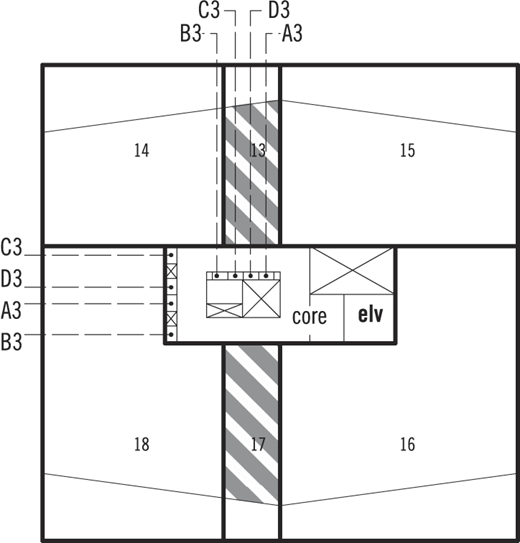
While at Patch22, the functions of living and working could still be combined within a single condominium right, this was no longer the case at Top-Up (Figure 13). A live-work apartment at Top-Up thus consists of two separate condominium rights with different leasehold functions—one for the living space and another for the working space. These condominium rights are fixed in position within the building and have different leasehold costs. The consequence is that the work condominium rights create barriers between the residential condominium rights, making it impossible to combine apartments on the same floor logically, as there is now a zone between them that can only be used for work.
A technical consequence of this legal requirement from the Municipality of Amsterdam is that a 60-min fire-resistant partition wall had to be built between the residential and working parts of an apartment, as the Dutch Building Code now considered them to be two separate functional condominium rights rather than a single multifunctional unit.
Due to the mandatory subdivision into condominium rights, double usage was also no longer allowed in the parking calculation. At Patch22, one parking space per live-work apartment was sufficient, while at Top-Up, parking had to be calculated separately for each residential and work condominium right. This resulted in 49 parking spaces for Top-Up, compared to 32 at Patch22, despite similar building sizes.
As a result, at Patch22, there was enough space to create the parking spaces at ground level, but at Top-Up, the higher number of parking spaces necessitated the construction of a two-level parking garage. Due to the different legal frameworks for ownership and usage, Top-Up is harder to adapt in the future than Patch22, even though Top-Up’s improved floor design makes it easier to adapt technically. Additionally, extra partition walls and a parking garage are needed to accommodate the other legal setup. It goes without saying that adding extra physical material and limiting future usage possibilities does not benefit the sustainability of the building.
11. Architectural expression of open buildings (important)
Because there are no installations, shafts, electrical, heating or water meters within the apartment, both Patch22 and Top-Up offer complete flexibility in the interior layout of the apartments. Lemniskade and FRANTZEN et al. deliberately chose not to show these individual atmospheres on the exterior of the buildings so that the architecture of the buildings expresses the collective nature of the building, rather than being the incidental result of a sum of individual apartments.
Lemniskade and FRANTZEN et al. aimed to give the Patch22 and Top-Up buildings their own unique “architectural address,” a formal characteristic by which the building can be identified in the city, allowing the highly individualized owners/buyers to feel part of the collective that inhabits and maintains the building.
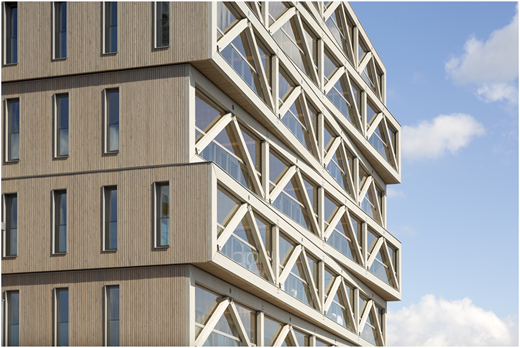
At Patch22, the “architectural address” can be identified in the loosely stacked floors or the diagonals in the facade, which refer to the construction of harbor cranes, characteristic of the port area where Patch22 is located (Figure 14).
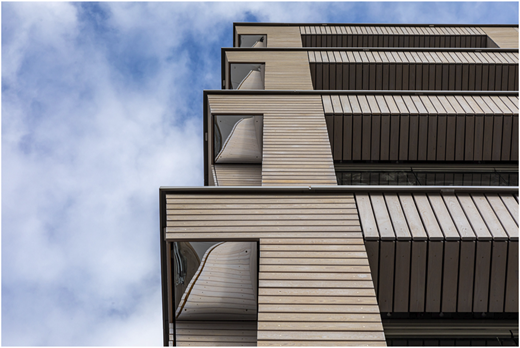
At Top-Up, the floors are also recognizable as separate volumes, but now, through the stacking of tapered facades, they resemble the trunk of a palm tree. The facades are made up of a grid of square windows, nearly identical on every facade. At the building’s corners, the tapered facades meet with mirrored ceiling panels in a distinctive way (Figure 15). This allows residents to address their building as “that building with the mirrors in the corners.”
12. Loggia as an intermediary between the individual apartment and the collective building (easy)
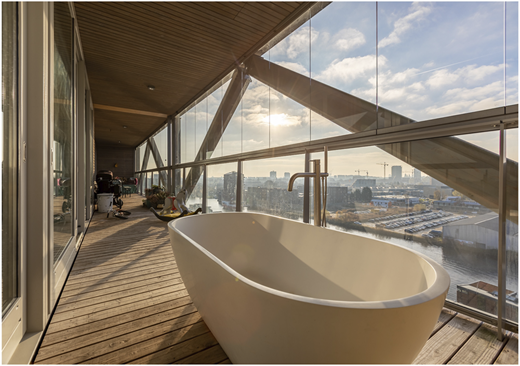
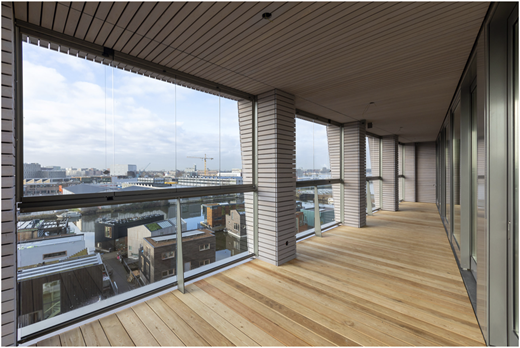
In the tension between individual and collective architectural expression, the loggias play a crucial role in both Patch22 (Figure 16) and Top-Up (Figure 17). The loggias, enclosed balconies that are 1.5–3 m deep, are spacious and form a buffer zone along the entire front and rear facades, separating the individual interior from the public exterior of the building. Unlike the apartments, these loggias are fully and expertly finished with wooden cladding.
The loggias are not owned by the individual owners/users but are legally under the jurisdiction of the building’s homeowners' association. Individual owners/users are allowed to use these spaces as they wish, adding “accessories” like lighting fixtures, furniture or even bathtubs, but they may not paint the loggias in different colors or cover them with alternative cladding.
The single-glazed balcony glazing that encloses the loggias not only protects against the strong southwest winds at this site but also, through its reflective glass, serves as an additional filter between the collective city and the individual interior. In this way, the loggias ensure that the individual interiors are scarcely visible in the facades, allowing the buildings to present themselves to the city in a self-aware manner as Patch22 and Top-Up.
13. Conclusion
On planet Earth, with its finite and limited resources, extending the lifespan of buildings, building components and building materials is of paramount importance. To achieve this technically in an Open Building is relatively easy. By following Stewart Brand’s principle of shearing layers – which advocates for separating elements that change at different rates – and not integrating pipes, drains, ducts, installations and separating walls into the structural components of the building but instead placing them in separate raised floors and partition walls, initially more material is used than in buildings optimized for a single use. However, in the future, it will be easier to preserve and reuse most of the material - the material that remains in the unaltered structural shell – without degradation.
For the architect, designing a building that can be adapted in the future is more intensive than a conventional commission based on precisely defined target groups. The architect’s challenge – potentially aided by AI tools – is to envision and test a wide range of use scenarios without knowing the future inhabitants. By exploring diverse spatial possibilities through sample floor plans, the design first embraces this variety. Only after all infills are removed from the floor plans does the true empty shell emerge; one capable of accommodating any future layout. The architect’s key challenge, therefore, is the fundamental understanding that the user must be regarded as unknown.
However, designing an empty shell does not mean designing an architecturally neutral building. When the building’s exterior is architecturally expressive, individual owners/users – since an Open Building attracts residents interested in creating their own interiors – can also feel part of a larger collective that inhabits a shared building, an architectural address in the city. Loggias can play an important role as a filter between the collective exterior and the individual interior.
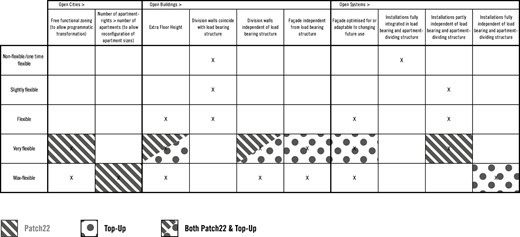
Although Patch22 and Top-Up are architecturally very similar and technically easy to adapt to changing uses in the future, the way in which the current use and future adaptability potential are established in legal documents, such as the division deed and the mortgage deeds that govern ownership and authority distribution, is crucial for the actual adaptive capacity of a building (Figure 18). It is therefore important to design building details that are technically easily adaptable while still defining the legal boundaries clearly.
With existing contract forms, creative “workarounds” are needed to legally safeguard future functional flexibility. Exploring legal frameworks that enable, rather than restrict, evolving uses is strongly recommended.
Notes
Notes by author on AI: ChatGPT.com and deepl.com were used to translate and improve language and readability.