


This study aims to review the variety of smart city development projects in Guangdong-Hong Kong, Macao, and Shenzhen of the Greater Bay Area (GBA) of China, based on social, economic, and political factors.
A comparative and actor-focused political-economic method is applied to explore project-level smart city implementation models (SCIMs). A framework is first constructed to assess the state-market-community relationships of smart city projects. Subsequently, the array of smart city projects is examined, along with the explanations of how social, economic, and political factors influence these cities against the backdrop of the ‘One Country, Two Systems’ principle.
The findings show four varieties of SCIMs that highlighted proactive government support for smart city development, with place-specific strategies and pathways. With the state-market-community background and engagement of mega-technology firms, a variety of smart cities were found to exist and thrive.
This study reviews the political-economic framework of smart cities under the ‘One Country, Two Systems’ principle. Different SCIMs are examined and investigated, and the locally adopted pathway for smart city development are identified.
Introduction
Smart cities are at the frontier of urban development exploration. The UN Habitat’s World Cities Report 2022 (UN-Habitat, 2022) expects that by 2030, 5.167 billion people, or 60.4 percent of the world’s population will live in cities. Because of the smartness of digital technology, including real-time data collection, integration, processing, and analysis, efficient information transmission, and the coordination of multiple urban systems without delay, the integration of technology with urban development can effectively improve cities’ governance and offer more convenience to their citizens (Batty, 2013a).
Three main research paths can be identified from the existing literature on smart cities development. First, the technological path highlights how digital and smart technologies can contribute to effective city governance and improve citizens’ lives (Batty, 2013b; Janssen et al., 2012). Second, there is a critical path that sharply captures the neoliberal nature of smart city development, and reveals the power play of international tech firms and their coalitions with local governments (Meijer, 2018; Grossi and Pianezzi, 2017). Finally, the political-economic path reveals the complex relationships between new and traditional stakeholders involved in smart city decision-making, infrastructure development, and operational processes (Jirón et al., 2020; Drapalova and Wegrich, 2020).
The research adopts and develops the political economic approach and takes a project-focused perspective to explore how multiple actors interact to deliver smart city functions. Implementation of smart city technology creates an arena of local government, technology firms, normal enterprises, and citizens (Meijer, 2018). First, the heavy investment is a controversial issue for decision-makers and taxpayers. Second, technologies, such as blockchain, e-government, and online community engagement, change the way of governance and create a new round of adaptation and rule-setting (Meijer, 2018; Shorey and Howard, 2016). Finally, the rising importance of technology firms could cause political challenges and damage public interest. For example, research has found that in cities like Prague, technology provides an opportunity for the expansion and penetration of large tech firms’ power into urban affairs and civil society (Drapalova and Wegrich, 2020).
In different conditions, these complex dynamics could result in expansion of technocracy and existing hegemony and, if harnessed properly, empower civil society. Nevertheless, they have not been well examined and existing research mainly focuses on city level instead of project level. In this research, the authors highlight the concept of ‘smart city implementation models’ (SCIMs), which reflects how multiple actors conduct smart city projects through cooperation and effective resource configuration.
This study focuses on the Guangdong-Hong Kong-Macao Greater Bay Area (GBA), an economic agglomeration hotspot and the most urbanised area in the world (Figure 1). Given the region’s worldwide importance, the interactions between the smart city strategies of these cities and their local backgrounds under the ‘One Country, Two Systems’ policy have not been adequately explored. Hong Kong, Macao, and Shenzhen are selected for further analysis, which all view digital technologies as the core direction for future development. Hong Kong’s blueprint depicts an integration of smart mobility, living, environment, people, government, and economy. Shenzhen’s strategy is shaped by the strong local technological capacity and government leadership. Macao then emphasises the participation of local research institutions and tech firms from mainland China.
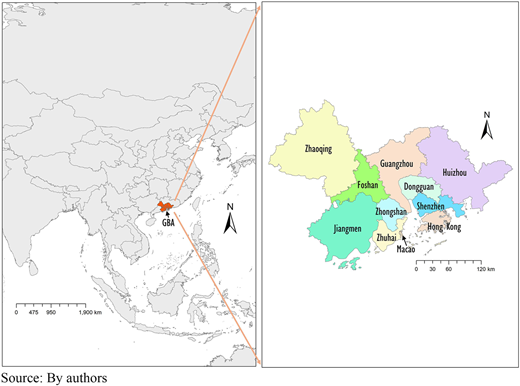
To address the research gap on the varieties and determinants of SCIMs, and GBA cities’ smart city development, the research questions are as follows:
What are the state-market-community relationships reflected in smart city projects in the GBA, and what are the factors influence them?
What lessons does the variety of the GBA’s smart city development offer for future local and global smart city developments?
The remainder of this paper is organised as follows. First, the literature on the political-economic analysis of smart cities is reviewed, and a comparative and actor-focused analytical framework for SCIMs is established. Thereafter the smart city development of Hong Kong, Macao, and Shenzhen is analysed based on 15 project cases selected based on the following three criteria: the project should be more attuned to public interest, thus more connected with the government, and representing local characteristics appropriately. The paper finally analyses the variety and determinants of the smart city development approaches in these three cities, and discusses the contributions and implications.
Political economy and the state-market-community relations of smart cities
A comparative and actor-focused approach to smart city research
In contrast to the first and second research paths on smart cities, the path of political economy focuses on the political relationships of actors (Meijer, 2018; Drapalova and Wegrich, 2020). The methodology of political economic research experienced a transition from a theory-driven one highlighting ‘best practice’ to a relational one, which emphasizes ‘varieties of capitalism’ (Hall and Soskice, 2001). Scholars began to pay more attention to the power of political and economic agents, and various contextual configurations (Brenner et al., 2010). This gradually became a major task in political-economy research (Drapalova and Wegrich, 2020).
The literature on the political economy of smart cities also shows a development trend from traditional to comparative and actor-focused approaches. Earlier explorations were dedicated to revealing general theoretical models of how data influences existing social, political, economic, and governance processes (Meijer, 2018; Kitchin and Dodge, 2019; Kitchin, 2015). For example, in theorising data politics (Shorey and Howard, 2016) and ‘datapolis’ (Meijer, 2018), researchers showed that the political-economic impact of data is realized through the multiple arenas it creates, such as data storage, usage, and security, based on ‘best practice’ case analyses. However, the heterogeneity of technology and its implementation mechanisms determined that the smart city should not be examined through a ‘one-size fits all’ narrative (Kitchin, 2015). Many varieties are being encountered, and their strategies, pathways, and failures (Drapalova and Wegrich, 2020) require further research.
State, market, and community in smart city development
A classic state-market-community trichotomy is adopted to examine the roles of multiple actors. Studies focusing on state actors have found that smart cities incorporate factors such as managerial incentives, political performance, funding, technology availability, and city branding practices (Araral, 2020; Drapalova and Wegrich, 2020). The role of the state in technology-empowered governance has also been explored, especially during the COVID-19 pandemic (Guo et al., 2022; Wu et al., 2020). Most research on market actors highlights the power of technology firms (Drapalova and Wegrich, 2020). State-market relationships shape value propositions, budgets, public interest, and data management policies in smart city development (Grossi and Pianezzi, 2017; Timeus et al., 2020; Drapalova and Wegrich, 2020). For communities, technology acceptance is an important issue connected to trust, decision-making processes, and local backgrounds (Guo et al., 2022; Kundu, 2019; Habib et al., 2020; Sepasgozar et al., 2019).
Smart city models
‘Smart city model’ reflects the overall configuration of actors’ relationships revealed in smart city developments in a specific city, and describes the overall typology of the development strategy, path, and outcomes. Current literature primarily focuses on the evaluation of cases, aiming at summarising good practices in technology innovation (Ahn et al., 2020) and power geometries (Miller et al., 2021). Cases also reveal unique local strategies, experiences, and risks in cities like Dubai, Barcelona, and Santiago (Breslow, 2020; Jirón et al., 2020; Charnock et al., 2021). However, studies on the determinants of the models are rare.
In an early work on the factors influencing smart city models, Drapalova and Wegrich (2020) developed a typology of smart cities based on political involvement and civil society engagement, exploring how these factors influenced the development outcomes (Figure 2). In this study, large technology companies seek opportunities to maximise their power and economic returns, while governments and civil societies confront forces that aim to harness technology. Based on cases in four European cities, Drapalova and Wegrich (2020) found that strong political leadership and civil society activism could limit large tech firms’ influences, allowing them to play a supportive role for public interest. Conversely, when civil society is weak, the state-business coalition will emerge. Weak political leadership and strong civil society will lead to patchy implementation, while a ‘double-weak’ situation will grant the power to tech firms.
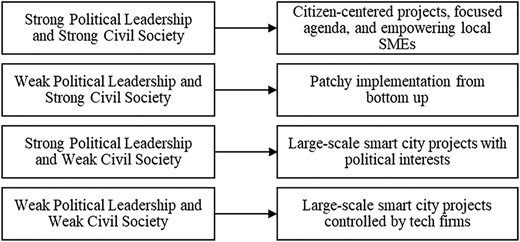
City-level political configuration and smart city development outcomes. (Source: Modified from Drapalova and Wegrich (2020))
City-level political configuration and smart city development outcomes. (Source: Modified from Drapalova and Wegrich (2020))
However, a detailed examination of smart city projects may not fully confirm the framework. First, different state-market-community participation models typically coexist in the same city, particularly in different fields and scenarios. Second, viewing large tech firms as the only sources of technology and aggressive power seems unrealistic; this overlooks the digital transformation of the public and private sectors. Third, the linkage is not decisive, and financial and technological capacity limits are usually overlooked. Finally, the identification of smart city outcomes is incomplete.
In summary, research on smart city strategies and models is in its inception stage; therefore, to fill this gap, this study engages in a comparative and actor-focused approach, develops an analytical framework of SCIMs at the project-level, and attempts to connect the varieties with the unique roles of the state, market, and community in the local context.
Types of smart city implementation models
Identifying SCIMs: a state-market-community framework
This study defines SCIM as a model of how smart cities are realised in a certain project. It can be described as the sum of the integrated relationships between actors that maintain the existence and functioning of the project. In SCIMs, state, market, and community actors interact to allocate resources, realise human, financial, and material investments, and meet their needs. Analysis of SCIMs combines the evaluation of actors’ features and relationships and the findings of previous research. Thus, the potential roles of state, market, and community actors were collected, as shown in Table 1.
Roles of State, Market, and Community in Smart City Implementation
| State | Market | Community | |
|---|---|---|---|
| Demand | City Competitiveness, Comprehensive Development, Voters’ Support, Government Performance | Economic Returns, Commercial Environment | Governance effectiveness, Participation, Responsiveness, Privacy |
| Capacities | Leadership, Initiatives, Coordination, Planning, Smart City Strategy, State Investment, Administration, Regulations, Technology | Technology (Integrated and Distributed), Financial Investment, Project Development and Operation | Public Participation, Content Production, Consumption, Technology |
Sources: Factors identified by Araral, 2020; Drapalova and Wegrich, 2020; Guo et al., 2022; Wu et al., 2020; Grossi and Pianezzi, 2017; Shrivastava, 2023; Kundu, 2019; Habib et al., 2020; Sepasgozar et al., 2019.
By assembling the demand and capacities of these actors, the following models were identified that presented the common types of state-market-community interactions:
State-centred Implementation and Purchase of Services: In some projects, especially those related to digital governance, smart city functions are managed by the government itself. The government can also purchase a smart-city solution and then operate it within the bureaucratic system.
Strategic Partnership: It is common for governments to build strategic partnerships with large tech firms to create digital platforms and related infrastructures in multiple areas; this usually requires significant technological inputs and in-depth coalition.
Public-Private Partnership: By allowing a certain range of commercial practices to be conducted in smart city services, public-private partnerships could help the government provide services at lower costs.
Public Initiative: The government could use a limited budget to establish and manage a coordination office, although the actual digitalisation is accomplished by the initiative’s participants and partners.
In the above discussion, the state-market-community relationships serve as a prism to reveal the SCIM in each project: matching of demands and capacities shapes the SCIMs, and state-market-community relationships then influence this process. However, SCIMs differ between cities and projects, and similar smart city functions could be achieved via different models. As a result, the capacity of cities to make suitable decisions based on their needs and endowments is important.
Spectrum of SCIMs
Instead of building a strict taxonomy of SCIMs, the research visualizes the spectrum of SCIMs based on the relevance and participation of state, market and community actors. In Figure 3, adapted from McPhearson et al. (2022), a pyramid-shaped diagram with state, market, and community placed at the three vertices was developed. Then, smart city functions and detailed models can be located on the figure according to the involvement level of the three types of actors. For example, digitalisation of the production process is usually a business decision (top of the pyramid). Similarly, digital government is more related to state actors, and technological input and public participation are also important; therefore, it locates near the vertex of the state, and extends to the others. Each function (and respective SCIMs) matches an area in the figure instead of an accurate point because SCIMs have elasticity, and the degree of actor involvement can vary over time.
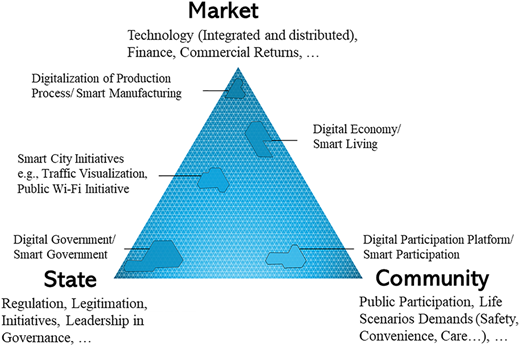
Locating SCIMs in the state-market-community pyramid. (Source: Adapted from McPhearson et al. (2022))
Locating SCIMs in the state-market-community pyramid. (Source: Adapted from McPhearson et al. (2022))
Finally, this study applied a three-step framework to evaluate the varieties of SCIMs in three important cities in the GBA:
Analyse how the demands and inputs of multiple stakeholders combine to create specific SCIMs in each case.
Reveal how typical SCIMs can solve critical problems or meet critical demands, and their respective costs.
Connect the choice of SCIMs with the state-market-community conditions and the cities’ social context and technological background.
Smart City Development in the GBA under ‘One Country, Two Systems’
Research method
Hong Kong, Macao, and Shenzhen are selected for case study because of their special representativeness. Social, political, economic, and cultural heterogeneity caused by ‘One Country, Two Systems’ is a central concern for involving Hong Kong and Macao. The reason for not choosing other mainland cities is that their political background and SCIMs are similar. Shenzhen is the largest city in GBA and a technology center, and also represents smart city’s frontline. Meanwhile, choosing Shenzhen is also helpful for comparison with Hong Kong, as the two cities are closely adjacent. Furthermore, although differences exist between mainland GBA cities regarding sizes, economic roles, and political scales, these dynamics are evaluated as not directly relevant for this research highlighting the ‘One Country, Two Systems’ context.
The data for this study were drawn from policy documents, research reports, smart city development plans, news, and academic research on smart city developments. First, the basic urban and smart city development status in three cities was obtained and analysed through keyword search. In this process, representative smart city projects were also identified. Then, project cases were selected and evaluated (Figure 4). To verify the results, there is cross-checking from official records such as original policy documents, Legislative Council Records (for Hong Kong), planning documents, and news reports related to bidding and outsourcing.
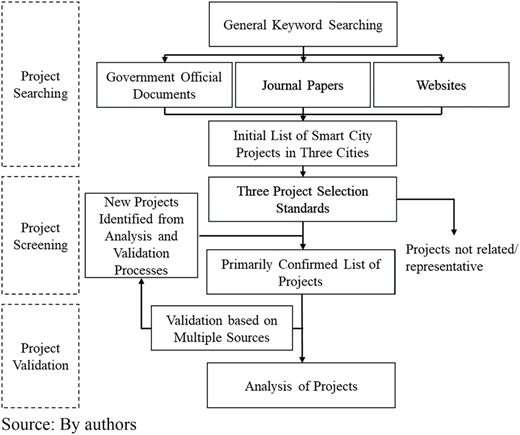
Case selection followed a three-step purposeful sampling and screening process (Figure 4). The first step was a keyword search using Google and Bing.com. The keywords included the cities’ names, ‘smart city’, and common smart city functions, such as ‘smart transportation’ and ‘smart government’. The results, mainly government documents, journal papers, news, and online media articles, were manually analysed to identify the projects. Second, in the project screening stage, the projects were primarily evaluated according to three standards: higher public influence, public interest, and local representativeness. Similar projects in the same city were also avoided to prevent information repetition, leading to a list of primarily confirmed list of projects. Finally, in the project validation stage, a focused search was conducted on these projects to collect and verify detailed information. During the process, additional projects could be identified. For example, when verifying primarily enlisted projects, sources such as government tendering websites, planning documents, and company websites sometimes referred to additional projects. In the end, a final list of 15 projects (five in each city) was confirmed to better represent the features of each city and avoid involving too many cases.
One Country, Two Systems
In Hong Kong and Macao, three major features were found to influence state-business-community relationships and SCIMs. First, major decisions need to be vetted by Legislative Council and Legislative Assembly, thus facing more substantive doubts and objections. This could influence large-scale projects particularly. Second, owing to the separation of powers, the government’s ability to collude with enterprises is lower. Finally, the existence of electoral and district council systems has cultivated active citizens and a political tradition of empowering participation. Comparatively, in Shenzhen, the government can establish large-scale projects through direct administrative orders and state-led investment, and maintain a close coalition with technology firms.
Market environments are also important. Macao’s economic structure is relatively homogeneous and lacks local technological capabilities, while Hong Kong market is more open to international IT companies. Shenzhen is a frontier city in mainland China’s reform and has a strong technology capacity. All three cities have strong financial capacities; therefore, differences in technological resources may be more influential than financial limits. Based on these features, the following is a detailed analysis of these three cities.
Hong Kong: distributed implementation highlighting civil society
Hong Kong’s smart city development could be dated back to the early days of Hong Kong’s return to China in 1997. Faced with an economic crisis, Hong Kong first released its Digital 21 Strategy in 1998 and offered annual updates in subsequent years. Mainly through a method of outsourcing (Hong Kong Legislative Council, 2008), the Hong Kong SAR Government established its first public service website ‘ESD’ in 2000, and then developed its current e-government platform GovHK in 2007.
Current smart city development in Hong Kong was marked by the Hong Kong Smart City Blueprint 1.0 in 2017, which included 76 measures covering six phases of smart city construction (Hong Kong SAR Government, 2017). In 2020, Blueprint 2.0 proposed over 60 extra measures (Hong Kong SAR Government, 2020). These blueprints forwarded a comprehensive agenda and included a variety of delivery methods other than outsourcing and purchasing services. Table 2 lists the Smart City projects explored in Hong Kong.
Smart city projects implemented in Hong Kong
| No. | Project Name | SCIM | Major Stakeholders | Field |
|---|---|---|---|---|
| 1 | Wi-Fi.HK | Government-led initiative. Managed by government and strategic partners and participated by private sector participants | Government, communication companies, private sector participants | Internet infrastructure |
| 2 | Faster Payment System (FPS) | Proposed by the Hong Kong Monetary Authority, operated by Hong Kong Interbank Clearing Limited, participated by payment service providers | Government, operator company, payment service providers | Fast payment |
| 3 | GovHK | Establishment: government procurement Operation: government | Government, project developer | Smart government |
| 4 | Energizing Kowloon East | Smart-city-involved urban regeneration scheme. A laboratory of smart city opened to multiple social actors. | Government, developers, academia, research institutions, citizens | Urban regeneration and smart living |
| 5 | Data.gov.hk | Developed and supported by the Office of the Government Chief Information Officer. Opening data from the government, public and private organisations for analysis, research, and further implementation | Government operators, data sources, academia, citizens, analysts, start-ups | Open data platform |
Source: By authors
The first feature of these projects is the government’s proactive role. Early smart city projects primarily focused on public services and government affairs. The FPS, an important fast payment and bank transfer method, is also led by government instead of commercial institutions. The second feature is the use of government initiatives to facilitate multiparty collaboration and reduce costs. For example, in the digital infrastructure project Wi-Fi.HK, the government project management team and its collaborators established a unified standard for Wi-Fi access and designed a mobile app (Wi-Fi.HK), and then called on the private sector to join. For public venues, the public-private partnership model was adopted to cover the cost. Third, unlike the other two cities, Hong Kong does not have a centralised government cloud platform. Projects are operated more independently and involve less system complexity. Finally, some projects show a strong desire to engage with civil society. For example, Energising Kowloon East is a revitalisation project highlighting smart city functions. The government is attempting to make the regeneration process a public laboratory in which multiple stakeholders such as developers, firms, academia, and citizens explore a future city.
These features could relate to the city’s prevailing state-market-community relationship and economic background. Features such as the small size, lack of centralised digital platforms, and civil society involvement are common with a ‘patchy implementation’ model in some European cities (Drapalova and Wegrich, 2020). However, patchy implementation is often viewed as an outcome of weak governments (Figure 2); and Hong Kong SAR Government still actively leads the smart city agenda through procurement and initiatives. Then, the reason of the ‘patchy implementation’ may more profoundly relate to the social context and local tech capacity. The democratic decision-making process can be an obstacle for large-scale projects, and the community context makes data privacy a sensitive issue. Meanwhile, a lack of local technological capacity may hinder the development of large-scale projects.
Macao: making use of local and ‘One Country, Two Systems’ opportunities
Macao’s smart-city development began relatively late. As early as 2005, Macao legislated to confirm the validity of electronic signatures and protection of personal data; however, further implementation of e-government did not follow immediately. At the end of 2015, Macao’s government enacted the Master Plan for Macao Special Administrative Region e-Government 2015–2019, and began to focus on digitalisation and smart cities (Chui, 2016). Then, flagship projects of Macao were engined by a 4-year strategic partnership between the Macao government and Alibaba since August 4, 2017, covering smart government, transportation, tourism, and healthcare. In 2019, the e-government system ‘Macao One Account’ was released. In Macao’s Second Five-Year Plan for Economic and Social Development (2021–2025), the government continued to emphasise the integration of smart cities and digital technology into multiple fields.
Table 3 shows selected projects in Macao. The first feature is the cross-border strategic partnership with mainland China’s tech firms. Not only Alibaba, but later Baidu also joined the smart city scheme to involve AI technology in tourism. These technology sources helped build more integrated smart city systems and achieve rapid technology implementation, but also raised data security concerns. The second feature was the participation of public utilities and state-owned enterprises which eased coordination with market actors. The largest company in Macao, Nam Kwong (Group) Company Limited, is a state-owned enterprise which manages major smart city projects such as smart parking spaces and natural gas systems. CEM, the public utility for electricity supply, operates the Smart Streetlight project along with the University of Macao. Meanwhile, these projects also focused on providing local opportunities and building local technical capabilities. In the agreement between Macao and Alibaba, cultivating local talents in smart city technology was an important clause.
Smart city projects implemented in Macao
| No. | Project Name | Project Implementation Approach | Major Stakeholders | Field |
|---|---|---|---|---|
| 1 | Smart Streetlight | Government initiative, private implementation (Companhia de Electricidade de Macau, CEM), and academic participation | Government, project developer company, University of Macao | Smart infrastructure |
| 2 | Smart Government, Smart Transportation, Smart Healthcare | Government procurement and strategic partnership between Macao Government and Alibaba | Government, cross-border project developer | Smart government, smart transportation, smart healthcare |
| 3 | Smart parking space management | State-owned-enterprise-led implementation | Government, state-owned enterprise | Smart transportation |
| 4 | Smart Tourism | Government procurement and strategic partnership between Macao Government and Alibaba, then Baidu joined for AI implementation | Government, cross-border project developer | Smart tourism |
| 5 | State Key Laboratory of Internet of Things for Smart City | A scientific research institution jointly supported by the state and Macao, established in the University of Macao. The research direction focuses on large-scale platform and network applications | Ministry of Science and Technology of China, Macao Government, University of Macao | Smart city technology development |
Source: By authors
Connections can also be observed between SCIMs and local state-market-community backgrounds. Macao’s simple economic structures and the existence of dominant state-owned enterprises allow government to maintain close relationships with major firms, making it easier to achieve development coalitions. Consequently, large cloud-computing-based smart city projects and rapid development could be achieved. Meanwhile, Macao citizens have a high sense of political identification with the government and the ‘One Country, Two Systems’ policy, which also makes it easier to involve cross-border tech firms and establish large-scale projects. In this context, Macao also demonstrates a liberal ideological tradition, and built stricter data protection rules by adopting EU and US security standards. Finally, Macao could be identified as a city flexibly making use of the opportunities provided by ‘One Country, Two Systems’ to achieve urban transformation.
Shenzhen: state-led technocratic mega projects and a vibrant digital industry
China’s smart city industry is led by Ping An, Alibaba, Tencent, and Huawei, or often referred to as ‘PATH’, and Shenzhen is home to three of them (except Alibaba). Strong technical capacity and active government leadership have made Shenzhen a pioneer in the application of smart city technologies, especially large-scale platforms and models that can collect and process huge volumes of data and automatically regulate the operation of multiple urban fields.
Table 4 shows that most flagship projects have been conducted under government leadership. A representative feature of Shenzhen’s model is large-scale projects with high levels of digital integration and smartness. For example, the Shenzhen Transportation Integrated Smart Platform connects sensors, cameras, traffic lights, and real-time data of transport industry vehicles; this provides the ability to model the city’s transportation network and simulate the travel behaviour of more than 800,000 vehicles. The Government Management Service Command Centre system provides a real-time analysis function of street video monitoring data and public reports to identify anomalous events such as brawls and pollution incidents. Through the ‘i Shenzhen’ mobile app, the government provides convenient public and administrative services. The platform links 43 municipal government departments and over 15,000 types of government, public, and enterprise-related services (https://isz-open.sz.gov.cn/iszhom).
Smart city projects implemented in Shenzhen
| No. | Project Name | Project Implementation Approach | Major Stakeholders | Field |
|---|---|---|---|---|
| 1 | Shenzhen Transportation Integrated Smart Platform | Government procurement, managed and operated by government. | Government, tech firms | Smart transportation |
| 2 | Shenzhen Smart City Group | Not a single project. It is a Shenzhen’s state-owned technology enterprise focusing on smartness in real estate, environmental protection, planning, and property management. | Government and firms of respective fields | Smart real estate, environmental protection, and property management |
| 3 | Government Management Service Command Center (City Brain) | Constructed via government procurement (Huawei) and operated by government departments | Government, tech firm, all citizens and market actors in urban governance | “City brain” and smart urban governance |
| 4 | Government data opening platform of Shenzhen Municipality | Constructed via government procurement and operated by government-affiliated public institutions, involving data from some regulated firms. | Government, project developers, data sources, citizens, data users | Open data platform |
| 5 | i Shenzhen | Constructed via government procurement (Ping An) and operated by government departments. | Government, tech firm, and citizens. | Mobile public service platform |
Source: By authors
The government-led SCIM is representative. Two types of state-market relationships are involved. For projects with high technical requirements, the government mainly contracts with private tech companies such as Huawei and Ping An, as shown in Table 4. The government also participates in smart city projects through state-owned technology enterprises, such as the Shenzhen Smart City Group, in areas with fewer technological requirements. Additionally, along with the high level of system integration, Shenzhen’s SCIM places residents and urban spaces in a managed position and may face certain data risks (Guo et al., 2022). The government information system involves detailed personal data, such as an individual’s name, occupation, and place of work, and the video monitoring system covers urban spaces all-around to supervise sanitation, travel, and other behaviours. Citizens’ participation in the decision-making process is indirect; they express their opinions by posting on the respective departments’ platforms and monitoring their living environments.
Discussion
Determinants of Smart City’s Varieties
Compared to existing theories of smart city development (Meijer, 2018; Kitchin, 2015; Shorey and Howard, 2016; Drapalova and Wegrich, 2020), the first contribution of the research is enriching the understanding of smart cities by revealing multiple SCIMs. By exploring the actors’ interactions in actual construction, the research provides another perspective to understand the political economic issues of smart cities in addition to theoretical construction and city-level analysis, which is closer to on-site practices.
Furthermore, in terms of determinants of smart city’s varieties, this study corroborated some previous findings (Drapalova and Wegrich, 2020) and contributed new observations. These new findings also drive future research to further explore the causal influences of local political economic backgrounds on smart city development. For example, Hong Kong’s social-political background of proactive government and active community is closer to the ‘Strong Government and Strong Civil Society’ model (Figure 2). Nevertheless, the development of digital platforms and smart city systems have been relatively slow. Thus, there may be limitations that render the city’s smart city build up as a ‘patchy implementation’, as evidenced in considerations of data security, slower decision-making processes, and lack of local technology capacity (Araral, 2020). Therefore, political background and traditions are not the only factors affecting SCIMs. Ultimately, this study describes Hong Kong’s smart city implementation as proactive and distributed.
Based on the Macao case, we argue that geographical factors should not be overlooked in the political economies of smart cities. As observed in the projects, Macao’s model is not predicted by Drapalova and Wegrich’s (2020) research, and the city can make use of geopolitical and geo-economic opportunities to boost smart city development and cultivate local talent and technological capacity. Tension between cross-border technology flow and local digital security is also involved and may be a critical theme. Based on the findings, future research could involve the lenses of geopolitics and geo-economics (Flint and Zhu, 2019; Porto Gomez, 2018), city diplomacy (Lauermann, 2016), and global production networks (Henderson et al., 2002) to understand next-generation smart urban development.
For Shenzhen, the findings partly confirm the prediction of the current theory that a strong government, strong tech firms, and weak awareness of the community lead to a large-scale centralised implementation model (Drapalova and Wegrich, 2020). During the COVID-19 pandemic, cyber control powerfully supported social distancing measures but also revealed insufficient consideration of the community (Guo et al., 2022; Wu et al., 2020). Nonetheless, this study shows that in the ‘Strong Government and Weak Civil Society’ model, there remains diversity in SCIMs, such as procurement, state-owned enterprises, and the government’s deeper alliance and control over enterprises. Simultaneously, this case also prompts us to think about the paradox between technology development and social governance: higher governance technology capabilities often require a more centralised political environment; however, this potentially threatens the government-market-community balance in governance.
Enriching smart city strategies based on the political-economic perspective and SCIMs
Furthermore, this study also aims to provide a roadmap and toolkit that contributes to future smart city development (the second research question). Existing studies tend to focus more on how technology solves problems (Janssen et al., 2012), how technology causes social risks and challenges (Shayan and Kim, 2023; Grossi and Pianezzi, 2017; Wu et al., 2020), and the diverse applications and influencing factors of technology implementation (Timeus et al., 2020; Drapalova and Wegrich, 2020) but fail to fully discuss how a ‘good’ smart city development is achieved via actors’ interactions. Then, these interactions are the focus of this study, and we argue that smart city development should be reviewed via dynamic political-economic relations.
Based on the findings, it is suggested that representatives of local public interest should build up a capacity to harness smart development and learn from the varieties. The first step is analysing existing SCIMs based on actors’ relationships and identifying a bunch of situated strategies. Second, decision-makers should enrich available SCIMs at hand and learn to appropriately use them in typical contexts. Practically, this requires building smart-city-related decision-making support mechanisms, such as special committees and expert consultations, and establishing participation mechanisms for the communication and collaboration of key actors. As a result, local actors could use flexible strategies to involve and regulate technological forces, ensure public participation, and realise harmonious cooperation with technology providers. As shown in the cases of GBA, cities could learn from Hong Kong about ways to promote smart city projects via government-led initiatives and how active community participation can revitalise urban or rural areas.
Finally, through the Market-State-Community Pyramid (Figure 3), this study provided a potential pathway to locally adaptive smart city strategy: if all SCIMs used in a city are drawn on a pyramid (Figure 3), the overall picture would show a range of strategic options for a city. It then visualizes the capacity of a city to effectively balance state, market, and community forces to achieve different types of smart city functions. One hypothesis is that a city with more skills and choices to achieve better solutions when developing a typical function will have advantages. Then, increasing these strategic choices and model flexibility could be a way to explore better smart city implementation.
Conclusion
This study examines the development of smart cities in three GBA cities from the political economic perspective. The contribution is three-fold. First, the analysis of the smart city political-economy was advanced from the city- to the project-level and we proposed an analytical method for SCIMs based on state-market-community relationships. Second, it is found that existing city-level research does not anticipate the dynamics of smart cities and the diversity of SCIMs in these cities. The influences of local political tradition, geopolitical and geoeconomic situation, and local technology capacity are shown. Finally, for future smart city construction, this study identified a variety of SCIMs and proposed that cities should learn from each other and establish mechanisms to enhance smart city implementation capacity. The study’s results could then contribute to the understanding of the development of the GBA, the ‘One Country, Two Systems’ policy, and smart city development and governance. In addition, we acknowledge the limitations of the research in theoretical depth and providing more detailed guidelines. Instead, more future directions are proposed. Broader evidence and deeper examinations are necessary to validate the factors identified and develop comprehensive theories and guidelines.
This paper forms part of a special section “Special Issue on Guangdong-Hong Kong-Macao Greater Bay Area (GBA) in China: building a world-class finance, innovation and technology hub”, guest edited by Prof Roger C.K. Chan, Prof Peter K.W. Fong and Dr Alice Y.C. Te.
Funding: Supported by the Key Program of National Natural Science Foundation of China (NSFC, No. 72434003), “Research on the Governance Paradigm Transformation Driven by Digital Government”.

