This paper explores how collaborative leadership in school-university partnerships (SUPs) cultivates a sense of belonging and creates engaged learning communities. By connecting collaborative leadership dynamics with musical metaphors, the paper introduces the collaborative leadership through musical elements (CLME) model as a framework for effective collaboration in SUPs.
The paper synthesizes literature on SUPs and collaborative leadership practices while developing connections to musical elements. The conceptual synthesis method examines jazz ensemble dynamics and popular music themes to illuminate collaborative leadership processes. This framework bridges theoretical foundations with accessible metaphors to enhance understanding of complex collaborative dynamics in educational partnerships.
The CLME model proposes that SUPs may benefit from structured communication (rhythm), aligned institutional goals (harmony) and adaptability to changing circumstances (improvisation). Practical applications include rhythmic frameworks with integrated communication cycles and feedback loops, harmonic alignment through shared goal creation and cross-institutional bridge-building and improvisational capacity via innovation sessions and pilot programs. These elements translate to student experiences through participation opportunities, mentoring, curriculum enhancement and collaborative leadership modeling. This approach aims to create environments where all stakeholders experience belonging while supporting both individual growth and collective achievement.
The paper offers an innovative approach by using musical analogies from both popular music themes and jazz ensemble dynamics to illustrate collaborative leadership practices in educational partnerships. Our original CLME model presents insights that may inform the development and sustaining of partnerships that foster belonging in SUPs.
School-University Partnerships (SUPs) represent a promising yet complex educational collaborative initiative. Research confirms that collaboration among multiple stakeholders is the essence of SUPs (Tsui et al., 2009). Effective partnerships contribute to congenial, engaged communities (Bakioglu & Kirisci-Sarikaya, 2024), enhancing institutional and student outcomes by creating opportunities for professional development, research application, and educational innovation (Darling-Hammond, 2006; Kruger, Davies, Eckersley, Newell, & Cherednichenko, 2009). When successful, these partnerships create vibrant learning communities where university faculty, school administrators, teachers, and students all experience a profound sense of belonging. However, achieving this level of collaboration requires collaborative leadership that can navigate the intricate dynamics among institutional cultures, priorities, and stakeholders.
Researchers have found that collaborative leadership in educational settings positively impacts student achievement, staff retention, school climate, and capacity for school improvement (Hallinger & Heck, 2010a, b; Sebastian, Huang, & Allensworth, 2017; Torres, 2019). Yet understanding how collaborative leadership actually fosters belonging in the complex context of SUPs remains challenging. This paper explores how musical elements, specifically rhythm, harmony, and improvisation, present an innovative conceptual framework for examining how collaborative leadership creates belonging in SUPs. Music offers rich metaphors that illuminate the subtle dynamics of effective collaboration while providing practical insights for partnership development and sustainability.
The authors of this paper have partnered for many years to combine their expertise in teaching and learning, educational leadership, and promoting belonging in schools and organizations. They also have a shared love of music: one author was a band director for 40 years and the other served as a principal for almost two decades, advocating for music (and other fine arts) as essential for a holistic education. This conceptual research grew out of these experiences and their love for attending live music events where bands cultivate a feeling among the audience members that they, too, are part of the performance experience.
Building on this experience, we developed a framework that connects musical elements to leadership practices in SUPs. Our model proposes that principles observed in jazz ensembles and popular music, where individual contributions unite toward collective excellence, may parallel educational partnerships dynamics to foster belonging among all stakeholders. Like a skilled musical ensemble, this framework suggests that effective SUPs may benefit from rhythm, harmony, and improvisation working in concert. When leaders establish strong rhythmic structures to create unity and collective action, harmonize by cultivating mutual support and trust, and encourage resilience and adaptive improvisation, they might be able to better create the conditions where all stakeholders experience belonging. This approach aims to move stakeholders from passive recipients to valued contributors of a shared educational mission. To understand how these musical elements inform SUP practices, we first examine the foundational characteristics of collaborative leadership in educational partnerships and the connection to belonging.
Collaborative leadership in SUPs: the foundation for belonging
The diverse voices that come together in musical collaboration create something greater than individual performances. Similarly, SUPs bring together different stakeholders to achieve shared educational goals. Understanding how musical elements relate to collaborative leadership and belonging requires clarity about what this means in the specific context of SUPs.
The nature of collaborative leadership in educational partnerships
Collaborative leadership in SUPs operates through three key characteristics that distinguish it from other leadership approaches. First, it emphasizes shared authority rather than individual control, creating space for multiple voices to shape direction and decision-making (Lawrence, 2017; Morrill, 2013). School administrators, university faculty, teachers, and sometimes students all contribute leadership within their areas of expertise while remaining accountable to collective goals. Second, collaborative leadership prioritizes relationship-building as the foundation for all partnership activities. Trust among educators serves as the cornerstone for strong collaboration (Supovitz & Tognatta, 2013) and is particularly crucial in the collaborative context of SUPs (Coleman, 2012). These trust-based environments enable diverse stakeholders to share knowledge and resources, creating adaptive networks that build resilience for responding to challenges while sustaining continuous improvement (Benoliel & Schechter, 2023). Third, this leadership style embraces adaptive capacity to respond creatively to emerging challenges, changing circumstances, and unexpected opportunities.
Effective SUPs are characterized by mutual benefits, structured collaboration, clear communication, and shared goals (Lefever-Davis, Johnson, & Pearman, 2007; Patrick, 2022), while functioning as long-term collaborations that promote continuous improvement (Coburn, Penuel, & Geil, 2013). Successful partnerships benefit from co-creation by participants who bring different expertise, priorities, and institutional cultures. Rather than relying on predetermined plans and top-down direction, collaborative leaders cultivate flexibility while maintaining focus on core partnership objectives. These leadership practices can create the conditions necessary for stakeholders to experience genuine belonging within the partnership.
The connection to belonging
The relationship between collaborative leadership and belonging in SUPs is both profound and practical. When stakeholders experience genuine collaboration, where their expertise is valued, their voices are heard, and their contributions matter, they develop a sense of investment in the partnership's success. This investment creates belonging, not as an abstract feeling, but as a tangible experience of being essential to something meaningful.
Research confirms that environments fostering belonging lead to improved student outcomes, enhanced well-being, and greater organizational commitment (Allen, Kern, Vella-Brodrick, Hattie, & Waters, 2018). These approaches enhance the outcomes through improved academic achievement, staff retention, school climate, and capacity for school improvement (Hallinger & Heck, 2010a, b; Samrangjit et al., 2016; Sebastian et al., 2017; Torres, 2019), particularly when supported by dedicated planning time and strong professional climates (Patrick, 2022). In SUPs, belonging serves as both a process and an outcome as these leadership practices create belonging, which in turn strengthens the partnership's capacity for sustained engagement and impact.
Eady and Green (2024) stress that stakeholders build and sustain SUPs through collaborative relationships, flexible structures, and reciprocal connections to create a shared sense of belonging. They identify five key dynamics that support belonging: trust and mutual commitment; professional learning; innovation through adaptability; continuous evaluation, reflection, and improvement; and transformative change at individual and organizational levels. Cunningham and Rainville (2022) add that SUPs must create “pathways and opportunities for all members to participate, engage, and feel a shared sense of belonging” (p. 7) as this is needed to provide students with similar experiences.
Musical metaphors as a framework for understanding collaborative leadership
Music inherently involves multiple participants creating something greater than the sum of individual contributions. Musical collaboration requires both structure and flexibility, individual excellence and collective harmony, planned coordination and spontaneous adaptation. These same qualities define the most effective SUPs, making musical elements a natural framework for understanding collaborative leadership in educational partnerships.
To deepen our understanding of how collaborative leadership creates belonging in SUPs, we explore this musical lens in greater detail. Arts-based approaches in education have demonstrated effectiveness in fostering collaborative learning and developing understanding of complex concepts. These methodologies communicate research findings to a broad audience, expanding knowledge about daily life and common lived experiences (Finley, 2008). Such methods can be powerful platforms for research that gives participants more of a voice in collaborative processes (Cahnmann-Taylor & Siegesmund, 2008).
The connection between musical and collaborative dynamics extends beyond musical metaphor and is supported by recent neuroscience research. Research indicates that music activates brain regions crucial for emotional processing, communication, and collective action, with group musical activities particularly enhancing trust, coordination, and social connection (Weinstein, Launay, Pearce, Dunbar, & Stewart, 2016; Zaatar, Alhakim, Enayeh, & Tamer, 2024). While these neurological findings suggest potential connections between musical and collaborative processes, the specific application of musical frameworks to educational partnership dynamics represents an innovative conceptual application. Structural elements of music (rhythm, harmony, and improvisation) provide frameworks for understanding complex social processes while simultaneously engaging both cognitive and emotional learning pathways (Koelsch, 2014). This neurological foundation supports the use of musical elements as more than mere metaphor; they represent parallel processes that our brains naturally recognize and respond to in collaborative settings.
The collaborative leadership through musical elements (CLME) model
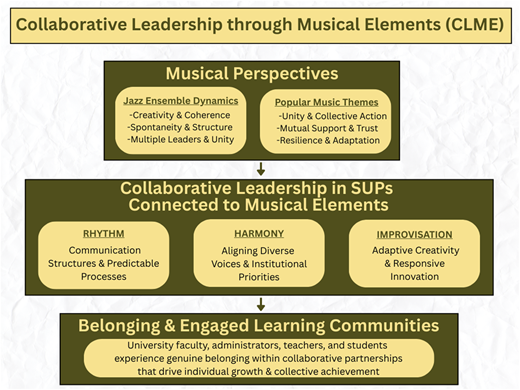
The power of musical metaphors lies not in surface-level analogies, but in deep structural parallels between musical collaboration and educational partnership dynamics. Our (CLME) model examines partnerships through two complementary perspectives. First, jazz ensemble dynamics provide sophisticated insights into how collaborative leadership operates through creativity and coherence, spontaneity and structure, and multiple leaders and unity. Second, popular music themes make these concepts accessible through familiar cultural references, including unity and collective action, mutual support and trust, and resilience and adaption. Jazz provides the structural understanding while popular music offers memorable accessibility. These perspectives are connected to collaborative leadership in SUPs to create a comprehensive framework with three core components (rhythm, harmony, and improvisation). Figure 1 presents the CLME model, demonstrating how this dual approach informs the core components, capturing the essential dimensions of how collaborative leadership may create belonging in SUPs.
Rhythm: the foundation of communication structures
In music, rhythm creates the temporal foundation that enables multiple musicians to perform together coherently. Without shared rhythm, individual musicians may each play beautifully, but their combined efforts create chaos rather than music.
Musical understanding of rhythm
Rhythm provides the fundamental pulse while skilled musicians navigate variations that create interest without losing coherence. In jazz ensembles particularly, rhythm serves as both constraint and enabler by providing structure that allows for creative expression while ensuring all participants remain connected to the collective performance. Great rhythm sections create the groove that invites other musicians to contribute their best work, establishing reliable yet dynamic patterns that provide stability and remain responsive to the musical moment. This rhythmic foundation creates psychological safety for musicians to take risks, knowing they have solid ground beneath their creative explorations (Berg, Fischer, Hamilton, & Houghton, 2005; Friberg & Andreas, 2002).
Rhythm as collaborative leadership practice
In SUPs, collaborative leadership manifests through rhythmic structures: regular, predictable communication patterns that provide the basis for all other collaborative activities and reflect the shared authority characteristic of effective partnerships. This element captures how diverse institutional goals and priorities align to create coherent, mutually beneficial outcomes through unity and collective action. Popular music reinforces this concept through themes of unity found in Bob Marley's “One Love” (Marley & The Wailers, 1977) and shared empowerment in Michael Jackson and Lionel Richie's “We Are the World” (Jackson & Richie, 1985), where diverse voices unite around common goals. This rhythmic foundation translates into specific collaborative practices:
Structured Communication Systems: Effective partnerships create predictable opportunities for stakeholders to come together through regular dialogs that maintain partnership momentum and connection (Farah, 2019; Lawrence, 2017). Partnership communication requires multiple rhythms operating at different temporal scales: daily informal check-ins, weekly team meetings, monthly steering committee gatherings, and annual strategic planning sessions. Each level serves different purposes while contributing to overall coherence.
Systematic Feedback Mechanisms: Collaborative leaders establish regular feedback mechanisms that allow for real-time adjustments while maintaining overall partnership direction (Carreno, 2024). These mechanisms might include regular survey cycles, focus group sessions, and reflection protocols that enable stake holders to respond to changing circumstances while preserving collaborative principles.
Creating belonging through rhythm
When collaborative leaders establish strong rhythmic structures, they create predictability and reliability that may enable stakeholders to feel secure in their partnership participation. Patrick (2022) confirms that collaborative leadership is particularly effective when supported by dedicated planning time and strong professional climates. Stakeholders understand when and how they can contribute, when they'll receive information, and how decisions will be made. This predictability provides a stable foundation that can support creative collaboration. Students may benefit when adults in SUPs operate with clear rhythmic structures, potentially experiencing more consistent support, predictable opportunities for enrichment, and reliable pathways for engagement. The rhythmic foundation in collaborative leadership could influence student experiences, helping them feel they belong in an organized, purposeful learning community (Darling-Hammond, 2006; Kruger et al., 2009).
Harmony: aligning diverse voices and vision
Musical harmony emerges when different notes combine to create something more beautiful than any single note alone. However, harmony isn't uniformity; it requires difference to create richness and depth. The art lies in combining distinct elements in ways that complement and strengthen each other rather than competing or clashing.
Musical understanding of harmony
In musical harmony, individual voices maintain their distinct characteristics while contributing to a larger sonic landscape. Musicians must understand not only their own parts but how their contributions fit within the larger harmonic structure. Effective harmony requires both individual competence and collective awareness, with each musician paying skillfully and remaining attentive to how their contribution affects the whole. The most compelling harmonies often involve tension and resolution, creating moments of dissonance that provide forward momentum toward satisfying harmonic resolutions (McGowan, 2011).
Harmony as collaborative leadership practice
In SUPs, harmonic collaborative leadership involves strategies that reflect the relationship-building foundation of effective partnerships. Harmony embodies environments where mutual support and trust create conditions for growth and collaboration. The themes of mutual support and trust are found in Bill Withers’ “Lean on Me” (Withers, 1972) and Ben E. King's “Stand by Me” (King, Leiber, & Stoller, 1961), reflecting how these environments foster community and serve as the foundation for mutual success. This harmonic approach translates into several key practices:
Building Mutual Respect and Shared Understanding: SUPs require clearly demonstrated mutual respect where classroom teachers respect the theoretical positions of university professors, professors respect the practical expertise of those in the classroom, and administrators from both sectors model two-way respect. Students at all levels must receive clear messages of unity and be encouraged to value the knowledge and abilities of all participants. Academics and practitioners often use different terminology and frameworks for similar concepts, yet both possess valuable expertise. Harmonic leadership develops common vocabularies and shared frameworks that allow for meaningful communication across institutional boundaries (Lefever-Davis et al., 2007). Educational partnerships must integrate scholarly and practical ways of knowing through patient, intentional bridge-building between professional cultures.
Aligning Institutional Goals: Universities and K-12 schools have different priorities, timelines, and measures of success (Coburn et al., 2013). Collaborative leaders help stakeholders identify areas of mutual benefit while respecting institutional differences.
Leveraging Collective Expertise: The true potential for exponential growth in SUPs comes from the ability to share knowledge from different perspectives and use the collective strengths of members. One school district might have teachers with high levels of specialized education, while a university might have faculty conducting cutting-edge research on particular teaching strategies. When partnerships inventory these strengths and share knowledge as a way to build capacity within the team, they maximize impact (Coburn et al., 2013).
Managing Tension and Balancing Needs: Partnership harmony involves stakeholders making strategic compromises that serve the larger purpose while still honoring individual institutional needs (Patrick, 2022). This balance is essential for maintaining long-term partnership sustainability. Partnership tensions often signal opportunities for deeper collaboration. Skilled collaborative leaders help stakeholders work through disagreements toward solutions that incorporate diverse perspectives rather than avoiding or suppressing conflict (Benoliel & Schechter, 2023).
Creating belonging through harmony
When collaborative leaders successfully create harmony among diverse institutional voices, stakeholders experience their differences as strengths rather than obstacles. Teachers see how their practical expertise complements university research perspectives. University faculty appreciate how practitioner insights enhance their scholarly work. Students benefit from the rich educational opportunities that emerge when different institutional strengths combine effectively. This harmonic belonging doesn't require everyone to agree on everything; instead, it creates space for respectful disagreement within a framework of mutual support and shared commitment to student success. As Eady and Green (2024) emphasize, effective partnerships create transformative change at both individual and organizational levels through this kind of harmonious collaboration.
Improvisation: adaptive creativity within structure
Musical improvisation represents the highest form of collaborative creativity; the ability to respond spontaneously to changing circumstances while maintaining coherence with other performers and fidelity to underlying musical structures. Jazz improvisation particularly demonstrates how individual creativity and collective collaboration can enhance each other when supported by strong foundational structures.
Musical understanding of improvisation
Effective musical improvisation isn't random creativity; it's disciplined spontaneity grounded in deep musical knowledge and attentive listening. Jazz musicians develop extensive vocabularies of scales, chord progressions, and rhythmic patterns that they can draw upon spontaneously. They also cultivate the ability to listen deeply to other musicians and respond creatively to what they hear. The best improvised music balances individual expression with collective coherence (Audretsch, Belitski, & Herzig, 2025; Bishop, 2018).
Improvisation as collaborative leadership practice
In SUPs, improvisational collaborative leadership encompasses the adaptive capacity characteristic of effective partnerships; the ability to respond creatively to emerging challenges while maintaining partnership coherence. Popular music reinforces these themes through songs of resilience and adaptation: Chumbawamba's (1977) “Tubthumping” embodies persistence through setbacks, The Rolling Stones' “You Can't Always Get What You Want” (Jagger & Richards, 1969) reflects adaptive flexibility, while Kelly Clarkson's “Breakaway” (Lavigne, Benenate, & Gerrard, 2004) and Josh Groban's “You Raise Me Up” (Løvland & Graham, 2003) capture the spirit of growth through creative adaptation and mutual empowerment. These improvisational principles translate into specific collaborative practices:
Professional Learning and Innovation through Adaptability: Successful SUPs thrive when knowledge is shared between partner agencies. Universities traditionally hold theoretical knowledge while schools possess practical knowledge. Research on educational partnerships demonstrates that practitioners bring deep understanding of local classroom dynamics and student needs, while researchers contribute theoretical frameworks and learning science principles (Sjölund, Lindvall, Larsson, & Ryve, 2022). When practitioners learn the theories behind their successful practices and theorists gain practical perspectives, immediate application can provide new insights to both. The greatest innovation results from leaders with broad experiences, deep knowledge, and respect for multiple perspectives.
Strategic Adaptation: Collaborative leaders help partnerships navigate changing circumstances such as new funding opportunities, policy shifts, personnel changes, or unexpected challenges while keeping core objectives at the center of their work (Heifetz & Linsky, 1994). Rather than viewing challenges as threats, SUPs treat them as opportunities for learning and growth, encouraging calculated risk-taking and continuous improvement while building adaptive capacity needed for long-term partnership success (Allen et al., 2018).
Creative Problem-Solving: Rather than relying on predetermined solutions, improvisational leadership encourages stakeholders to generate novel approaches that draw on diverse expertise and perspectives. SUPs often require innovative solutions that emerge from collaborative thinking rather than top-down directives (Lawrence, 2017).
Distributed Innovation: Effective SUPs create opportunities for different stakeholders to lead innovation initiatives within their areas of expertise. These strategies leverage the diverse strengths within partnerships while maintaining overall coherence (Morrill, 2013).
Creating belonging through improvisation
When collaborative leaders cultivate improvisational capacity, stakeholders experience agency and creativity within the partnership structure. They feel valued not just for following predetermined roles but for contributing their unique insights and innovations to collective problem-solving. This creates a sense of ownership and investment that deepens belonging. Students particularly benefit from partnerships that embrace improvisation. They experience learning environments that are responsive to their needs and interests, where adults model creative problem-solving and adaptive thinking. This creates belonging through engagement; students feel they belong because their learning community is alive, responsive, and continuously evolving to serve their growth and development.
Practical applications
Translating the theoretical insights of rhythm, harmony, and improvisation into actionable strategies requires deliberate implementation approaches that foster belonging in SUPs. The following applications demonstrate how collaborative leaders can operationalize each musical element to create environments where all stakeholders experience genuine inclusion and shared purpose.
Establishing rhythmic structures
Creating belonging through rhythmic collaborative leadership requires intentional establishment of communication patterns that provide security and predictability for all partnership participants (Lefever-Davis et al., 2007; Coburn et al., 2013). Partnerships can establish integrated calendars with monthly steering committee meetings and weekly check-ins between key personnel, while aligning university and school schedules to recognize the different temporal patterns of these institutions (Patrick, 2022). Clear documentation and communication protocols establish reliable foundations that enable collaborative belonging to flourish (Supovitz & Tognatta, 2013). Regular structured dialogs fulfill specific purposes beyond information sharing, including quarterly strategic planning sessions, monthly progress reviews, and weekly implementation meetings. Each level of rhythm addresses different SUP functions and maintains overall coherence (Cunningham & Rainville, 2022). Systematic feedback loops create predictable communication through regular survey cycles, focus group sessions, and reflection protocols that allow for real-time adjustments while maintaining overall direction (Carreno, 2024). These rhythmic feedback structures are designed to help stakeholders feel heard and valued. (Patrick, 2022).
Creating harmonic alignment
Fostering belonging through harmonic collaborative leadership focuses on creating unity among diverse voices while preserving the institutional differences that make partnerships valuable (Eady & Green, 2024; Coburn et al., 2013). Co-creation of shared goals involves facilitated processes where university and K-12 stakeholders identify overlapping interests and develop mutually beneficial objectives (Lefever-Davis et al., 2007). This process requires skilled facilitation that honors different institutional cultures and finds common ground. Building bridges across institutional differences requires developing common language and frameworks that enable meaningful communication without eliminating beneficial diversity (Lefever-Davis et al., 2007). SUPs can invest time in creating glossaries, shared rubrics, and common frameworks that enable communication across institutional boundaries and preserve unique institutional strengths. Professional learning can benefit both university faculty and school personnel, creating mutual value through co-teaching opportunities, collaborative research projects, and joint professional development that addresses multiple institutional priorities simultaneously (Sjölund et al., 2022). Regular harmonic reviews help partnerships adjust strategies and maintain focus on mutual benefits and shared outcomes (Eady & Green, 2024; Patrick, 2022).
Fostering improvisational capacity
Cultivating belonging through improvisational collaborative leadership builds adaptive capacity that may empowers stakeholders to contribute creatively to partnership problem-solving (Lawrence, 2017). Innovation brainstorming sessions can create dedicated time and space for creative problem-solving, encouraging stakeholders to propose novel solutions to emerging challenges while ensuring all voices are heard and valued (Morrill, 2013). Developing adaptive capacity through pilot program development allows partnerships to test innovative approaches and manage risk effectively (Allen et al., 2018). This approach enables learning and adaptation as successful pilots can be scaled up, with unsuccessful ones providing valuable learning opportunities that may strengthen partnership resilience (Benoliel & Schechter, 2023). Cross-institutional collaborative teams bring together diverse expertise and perspectives to tackle specific challenges. These teams operate with clear mandates but flexible approaches, modeling the principle of structure with creative freedom. Emergency response protocols enable SUPs to adapt quickly to unexpected circumstances and maintain collaborative principles through decision-making frameworks that allow for quick response and shared accountability (Lawrence, 2017; Sjölund et al., 2022).
Translating partnership benefits to student experiences
The ultimate measure of collaborative leadership success lies in creating belonging experiences that extend from adult partnerships to student learning environments. Student voice and participation structures ensure that students have meaningful input into SUP activities and decision-making processes through student advisory councils, focus groups, and direct participation in partnership planning (Cunningham & Rainville, 2022). Direct connection opportunities link university students with K-12 students through mentoring and enrichment programs, creating pathways for knowledge sharing and inspiration. These programs can benefit both student populations and demonstrate tangible partnership value that reinforces adult commitment to collaborative leadership.
Curriculum enhancement through partnership resources creates immediate learning benefits through guest lectures, laboratory access, research opportunities, and collaborative projects that enhance student learning experiences (Darling-Hammond, 2006; Kruger et al., 2009). Visible modeling occurs when teacher and faculty collaboration extends into classroom settings, demonstrating partnership impact through improved instruction and innovative teaching approaches. When students see their teachers learning and growing through partnership activities, they experience collaborative leadership values firsthand and develop their own capacity for collaborative belonging. Accountability to student outcomes through comprehensive assessment and feedback systems captures student perspectives on partnership impacts, ensuring partnerships remain focused on their ultimate purpose (Hallinger & Heck, 2010a, 2010b; Sebastian et al., 2017; Torres, 2019). Regular student surveys, focus groups, and outcome assessments can help SUPs maintain focus on student success and belonging while providing evidence of collaborative leadership effectiveness.
Conclusion
Collaborative leadership fosters a culture of belonging, enhancing organizational performance and individual success (Powers, 2020). This research insight may be particularly relevant to SUPs, where effective leadership, like great music, appears to require both structure and artistry, technical skill and individual excellence, collective harmony and adaptive improvisation. The musical framework presented in this paper offers theoretical insights and suggests practical applications for understanding collaborative leadership that cultivates belonging. We propose that when educational partnerships establish strong rhythmic communication structures, harmonize diverse institutional voices and goals, and cultivate improvisational capacity to adapt creatively to emerging challenges, they can create environments where university faculty, administrators, teachers, and students experience genuine belonging within engaged learning communities. This approach also addresses how adult belonging might influence student experiences through modeling and improved learning environments.
This conceptual framework has several important limitations. The CLME model lacks empirical validation in SUPs. While the musical metaphors provide accessible insights, they may oversimplify complex organizational dynamics and could be less applicable in contexts where musical analogies do not resonate culturally. Future research should empirically test the model's effectiveness and compare its utility against other collaborative leadership frameworks.
As educational challenges become increasingly complex, the need for effective SUPs that create belonging becomes more urgent. The musical framework proposes a lens for conceptualizing SUPs that integrates technical requirements and collaborative dynamics. The Beatles' “With a Little Help from my Friends” (Lennon & McCartney, 1967) offers a final reminder that belonging emerges through the mutual support and collaborative spirit found in well-orchestrated SUPs.