


This study aims to explore the influence of police officer gender on public perceptions during an interaction between an officer and a citizen suspected of driving under the influence.
Using an experimental survey with a sample of 1,193 USA adults, participants were randomly assigned to read a hypothetical news story in which the officer’s gender was manipulated (Control: no gender, T1: male, and T2: female). The study sought to determine whether officer gender affected evaluations of the officer’s conduct, including appropriateness, reasonableness, the need for backup, and the potential for de-escalation.
While no significant differences were found for most evaluations, respondents were significantly more likely to recommend that a female officer call for backup, indicating that gendered expectations may shape perceptions of when additional support is needed during conflict. The findings suggest that officer gender does not significantly affect broader evaluations of police conduct in less contentious scenarios.
Manipulation checks of officer gender should be analyzed as misidentification may reveal patterns of gender biases in policing perceptions.
Police training and policy should address gender biases in perceptions of officers and promote greater diversity and inclusion, especially as officer gender may not significantly shape public perceptions of police-citizen interactions.
Media portrayals may reinforce perceptions of women officers needing greater assistance in handling situations.
The study relies on a nationally representative sample, testing public perceptions of a different but everyday police-citizen interaction, specifically a traffic stop scenario, to assess whether officer gender influences evaluations of procedural justice and decision-making. Further, the study examines respondents who misidentified the officer’s gender to uncover patterns in these misidentifications.
Introduction
Excessive police force can delegitimize the organization and raise questions about the benefits of having women officers (Fine et al., 2024; Hale and Wyland, 1993; Reny and Newman, 2021) [1]. This includes how they might be publicly evaluated differently from their male counterparts, making the study of perceptions of women officers critical, especially as reforms consider the implications of such policies. This research takes on even greater urgency in the current political climate, as recent federal efforts threaten to scale back affirmative action initiatives that historically opened patrol positions to women. Despite knowing how public attitudes toward law enforcement are shaped by factors such as sociodemographics, political attitudes, and personal experiences (Bloch and Anderson, 1974; Breci, 1997; Bull et al., 2021; Golden, 1981; Hansen and Navarro, 2023a, b; Koenig, 1978; Leger, 1997; Navarro and Hansen, 2023), the role of officer gender in shaping public opinion of police conduct depicted in vignette research is a burgeoning scholarship (Brown and Reisig, 2019; Den Houter and Chatterjee, 2021; Hellwege et al., 2022; Salerno and Sanchez, 2020; Stanek et al., 2023). Therefore, we seek to explore how the gender of a police officer impacts public evaluations of their conduct, particularly in scenarios that commonly involve a potential conflict, such as the ubiquitous traffic stop.
Although public attitudes regarding women in policing consistently suggest an accepted presence in a traditionally male-dominated occupation (Bloch and Anderson, 1974; Breci, 1997; Bull et al., 2021; Golden, 1981; Leger, 1997; see Koenig, 1978), their representation is concentrated at the lowest levels of the police hierarchy, with limited access to leadership roles (Goodison, 2022). Role congruity theory provides a framework for understanding these patterns (Eagly and Karau, 2002). It posits that individuals who deviate from stereotypical gender roles, such as women police officers, face biases that hinder their advancement (and legitimacy). In tow, the public also perceives women officers as more effective in handling certain cases such as child abuse, domestic violence, family disputes, and stalking (Breci, 1997; Bull et al., 2021; Stanek et al., 2023), with these beliefs shaping opportunities available to women in policing and the expectations placed upon them, according to role theory (Eagly, 1987). While women officers are perceived as possessing greater communal and empathy skills, making them suited for certain policing tasks, these same traits may be perceived as (or become) liabilities in high-stake scenarios (Bazley et al., 2007; Boehme et al., 2022; Breci, 1997; Bull et al., 2021; Carlan et al., 2011; Deller and Deller, 2019; however, see Paoline and Terrill, 2005; also see Salerno and Sanchez, 2020). Overall, public attitudes toward women in policing are shaped by gendered expectations of police conduct, reinforcing the perception that policing is inherently masculine. Yet, situational circumstances may influence how women officers are evaluated in specific contexts.
We explore this contextual dynamic through an experimental survey, where participants read a hypothetical news story about an interaction between a police officer and a male citizen suspected of driving under the influence. Participants were randomly assigned to one of three groups where the gender of the officer was either unspecified (control), male (T1), or female (T2). We investigated how officer gender influences public perceptions of their appropriateness in handling the situation, their reasonableness in conducting the stop, the need for backup, and the possibility of de-escalating the conflict. The study found that officer gender had little effect on respondents’ evaluations of police decision-making and procedural judgments. However, respondents were significantly more likely to recommend that a female officer call for backup compared to a male officer, suggesting that gendered expectations may be shaping perceptions of when additional support is needed during potential conflict within a police-citizen interaction. Additionally, systematic misidentification of officer gender suggests that perceptions may be influenced by implicit gender biases, reinforcing the belief that officers are predominantly men, aligning with gender-role congruity expectations.
Theoretical framework
Individuals who align with the stereotypical expectations of their roles are evaluated more positively, while those who deviate from these societal stereotypes face bias and discrimination per role congruity theory (Eagly and Karau, 2002). Consider how professional success is often judged based on gendered traits: masculine (or agentic) qualities are attributed to aggression, competitiveness, physical strength, and problem-solving, with feminine (or communal) qualities attributed to being petite, nurturing, warm, and verbally skilled (Cejka and Eagly, 1999; see Salerno and Sanchez, 2020). Whereas role congruity theory emphasizes leadership, role theory similarly explores societal expectations but focuses on how social roles are defined and maintained within institutions, like policing, that are historically male-dominated, creating structural barriers for women by reinforcing traditional gender roles, leading to increased bias, resistance, and scrutiny (Eagly, 1987). In the context of the workplace, if a woman employee is perceived as too assertive or authoritative, they may be penalized for not aligning with the traditional female role of being cooperative or nurturing. Meanwhile, a man exhibiting these assertive behaviors may be viewed positively as a strong leader because such behaviors align with traditional male roles.
Role congruity theory and role theory are relevant theories within this line of inquiry of how women officers struggle for respect because their authority conflicts with feminine gender norms (Brown and Reisig, 2019; Hellwege et al., 2022; Salerno and Sanchez, 2020). Within the traditionally male-dominated field of policing, these theories buttress findings that indicate men officers would be favored for their physical prowess, while women officers may face evaluative penalties when their behavior aligns with traditionally male behaviors as this is incongruent with their expected role. The presence of women officers challenges traditional gender roles by undermining men officers’ perceived physical superiority, disrupting work group solidarity, and exposing the emotional and interpersonal aspects of policing (Martin, 1993). For instance, athletics and (heavy) drinking are bonding rituals that reinforce the police occupational identity, but these emotional and social outlets create barriers for women to integrate (fully into the fraternity of police) as these activities invite defeminization and social criticism for women officers (Martin, 1999).
Thus, women officers face cross-pressures between adopting a masculine persona as a policewoman (or role incongruity), embracing the stereotypical law enforcement policing orientation, or embracing a feminine identity as a policewoman (or role congruity), adopting a service-oriented perspective (Martin, 1979). Subsequent research suggested that the policewoman-policewoman dichotomy of how women engage in police work was oversimplified; rather, they simultaneously manage both identities as officers (Morash and Haarr, 2012; Rabe-Hemp, 2009). Overall, women in policing face structural barriers from the outset, as they often lack anticipatory socialization experiences like military service or firearms training, encounter training academy practices that exacerbate physical differences and undermine group loyalty, and miss opportunities to develop interpersonal skills, leading to reputational challenges and limited career growth due to restrictive assignments and overprotection (Martin, 1993).
These theories, in combination, are apt for how we remember and perceive individuals who stand out in non-traditional occupational roles that are incongruent with gender-based stereotypes. For instance, women in traditionally male-dominant occupations like policing are incongruent with gender role expectations, which may make them more memorable amid a cognitive struggle to reconcile a woman in a masculine role. As a “token” performing under pronounced visibility, anonymity is difficult as their actions are constantly observed, amplifying mistakes, with their performance extending to represent the entire group (Kanter, 1977). This increased memorability may accompany heightened scrutiny and harsher judgments, and any mistakes may reinforce negative gender stereotypes about her abilities. Conversely, any successes by women occupying male-dominant spaces will be attributed to being an exception to the stereotype (see Eagly and Sczesny, 2008); because a male officer fits the cultural stereotype of an officer, he is less likely to evoke the same level of scrutiny or cognitive conflict and possibly be less memorable because his role aligns with traditional expectations.
A short history of women police officers
A historical discussion of women in policing illustrates their trajectory into roles that align with traditional gender expectations. In 1893, Mrs. Marie Owens became the earliest known policewoman when she was appointed as a “patrolman” in Chicago (Higgins, 1951). Owens was followed by Mrs. Lola Baldwin in Portland, Oregon, in 1905, who was granted police powers to protect young women. Mrs. Alice Stebbins Wells, in 1910, became the first officially recognized policewoman (in Los Angeles), who enforced public recreation laws and advocated for women in policing. During World War I, women served in quasi-police roles around military training camps, leading to a rise in policewomen in over 200 American cities by 1920. Some women were appointed as sheriffs, often as placeholders for their husbands due to term limits (Schulz, 2004).
The civil rights and women’s liberation movements of the 1960s advanced gender equality in policing through a series of federal actions (Koenig, 1978). Executive Orders No. 10925 (1961), No. 11246 (1965), and No. 11375 (1967) laid the groundwork for non-discriminatory hiring and were later extended to federal agencies through Executive Order No. 11478 (1969). The Equal Pay Act of 1963 mandated equal pay for equal work, and Title VII of the Civil Rights Act of 1964, amended by the Equal Employment Opportunity Act (EEOA) of 1972, broadened anti-discrimination protections. Additional legislation, including the Crime Control Act of 1973 and the State and Local Government Fiscal Assistance Act of 1976, tied federal funding to compliance with equal employment opportunity requirements. These affirmative action measures contributed to the recruitment, selection, and promotion of women officers (Martin, 1991; Nam, 2024). Still, women remain underrepresented in law enforcement, with only about 18% of academy graduates and 13.5% of full-time sworn officers identifying as women (Buehler, 2023; Goodison, 2022). Despite early progress and federal involvement that prioritized gender equality in the workplace, the proportion of women in policing has plateaued in recent decades, highlighting persistent structural barriers in recruitment, advancement, and workplace culture that continue to limit women’s representation in policing (Cordner and Cordner, 2011).
Perceptions towards women officers and their gender performance and evaluation
The bona fide occupational qualification language of the 1972 EEOA prompted studies on public evaluations of women as patrol officers. One early study of Washington, D.C. residents found general approval, with no reported differences except skepticism about their ability to handle violent encounters (Bloch and Anderson, 1974). A subsequent study suggested this skepticism of women officers’ capacity to physically and emotionally handle patrol work persisted into the 1980s, but these feelings attenuated with age (Golden, 1981).
Telephone surveys conducted in the 1990s among randomly selected adults residing in Kentucky and Minnesota similarly found general support for women in policing, with respondents believing that they would be just as effective as men officers; however, attitudes varied by sociodemographic subgroups like age, education, and income (Breci, 1997; Leger, 1997). While gender did not influence perceptions of officer effectiveness overall, younger respondents and those with higher educational attainment and income levels were more likely to view men and women officers as equally effective in handling certain police calls (Breci, 1997). By contrast, older respondents were more disapproving of women’s competence in emergency situations, rating male officers as more effective in armed robberies and bar fights, a sentiment also shared by those with high school education or less. Income had little effect in most situations, except that higher-income respondents were more likely to rate men and women officers as equally effective in handling traffic violations (Leger, 1997).
Despite concerns about biological gender differences among officers, physicality in policing, while sometimes necessary, primarily involves sedentary tasks (e.g. desk work, driving) and emotional labor, particularly in critical incidents (Anderson et al., 2001, 2002). Further challenging that force is an inherent occupational expectation, men and women officers have fitness profiles comparable to the general population (Marins et al., 2019). Although role allocation may differ, police use-of-force encounters generally unfolded similarly regardless of officer gender (Boehme et al., 2022), with research indicating that women officers used less force (possibly mitigating violent encounters), while men officers employed a wider range of force (possibly due to facing greater resistance) (Bazley et al., 2007). However, both genders exhibited proportional use of verbal and physical coercion, challenging the notion that force is essential to policing (Paoline and Terrill, 2005).
While officer gender does not alter public attitudes about procedural justice or legitimacy, situational factors of a police-citizen interaction influence the intensity of these attitudes, suggesting that gendered expectations shape evaluations of police behavior in nuanced ways (Brown and Reisig, 2019; Den Houter and Chatterjee, 2021; Hellwege et al., 2022; Salerno and Sanchez, 2020). For instance, after reading a first-person account of a stalking incident, women officers evoking procedurally just behaviors were rated as less antagonistic by men and women (surveyed via Amazon Mechanical Turk [MTurk]), with a more pronounced effect among men (Hellwege et al., 2022). Conversely, procedurally unjust officers were rated negatively, and these gender-incongruent behaviors yielded much lower ratings for women officers than men officers. In a similar vein, women officers were rated as more effective and trustworthy than men officers after MTurk respondents viewed a video portraying the officer using physical force toward a person acting disorderly, benefiting from a gender-incongruent behavior (Salerno and Sanchez, 2020). Despite these differences, in other cases, such as those showing no force was used, officers were perceived similarly, irrespective of gender (Brown and Reisig, 2019; Den Houter and Chatterjee, 2021; Hellwege et al., 2022; Salerno and Sanchez, 2020). Building on prior research recommendations, we expand this line of inquiry by exploring public responses to police-citizen interactions involving officers of different genders, using the common traffic scenario and a nationally representative sample from an alternative survey firm to gain further insight (Hellwege et al., 2022; see Den Houter and Chatterjee, 2021). Specifically, we ask whether women officers are perceived similarly to men in decision-making and procedural judgment. Therefore, we hypothesize that officer gender will impact how respondents view the officer’s ability to navigate and ultimately de-escalate within the depicted scenario with a citizen.
Data
This study collected responses from 1,193 adults living in the United States. The focus is on public opinions about an interaction between a police officer and a citizen. Data collection occurred on July 18, 2024. Participants were provided informed consent and were able to skip questions or exit the survey at any point. The sample was drawn from an online panel representative of U.S. adults aged 18 and older through Prolific. Respondents undergo a rigorous recruitment process, which can take several months, requiring verification of identity, proof of residency, and confirmation of key sociodemographic characteristics. Compensation for their time averaged approximately $10.00 per hour. On average, respondents took 13 min and 34 s to finish the survey, accounting for any pauses and resumptions. The institutional review board (IRB) at Sam Houston State University approved the study.
The sampling method employed stratified sampling to acquire a sample that closely aligns with the sociodemographic characteristics of the U.S. population, including factors such as age, gender, education, and income. One limitation of Prolific is the potential for unrepresentative samples; however, we paid an additional fee to ensure a stratified, demographically representative sample. Given the heightened political polarization among Americans toward policing (Fine et al., 2024; Reny and Newman, 2021; see Vanderbei, 2024), the sample includes a balanced distribution of political affiliations. To ensure data quality, we cross-referenced responses to sociodemographic questions with pre-existing data from the survey recruitment firm, verifying that all matches were exact. After presenting descriptive statistics and conducting binary statistical tests, we proceeded with regression model estimations.
Experimental design
To assess how police officer gender impacts perceptions towards conflict involving citizens, this study implements an experimental survey design. The experiment was pre-registered through the Center for Open Science: https://osf.io/nw629 (Hansen and Navarro, 2024). The experiment was formally registered on March 18, 2024, before any data were collected. The survey presented respondents with a hypothetical news story about an interaction between a citizen and a police officer. The interaction occurred after the officer had suspicion to believe the citizen was driving under the influence. The vignette was crafted to resemble the style and length commonly seen in local news stories (Navarro and Hansen, 2025). Respondents were first presented with the following prompt before reading the article:
We will present you with a story conveying a recent interaction between a police officer and a citizen during a traffic stop. We would like you to please read the story closely and answer the questions related to the story, which includes assessments of the situation as well as questions about details in the story.
To ensure comprehension, respondents were then asked to confirm their understanding of the instructions, with all indicating that they had understood. Following this, they were randomly assigned to one of three experimental conditions (see Figure 1). The story remained the same across all three conditions except the gender of the officer. In the control group, no gender was specified for the officer in the story. This baseline condition allows us to assess whether specifying the officer’s gender affects respondents’ perceptions. In Treatment 1 (T1), the officer was identified as male. In Treatment 2 (T2), the officer was identified as female.
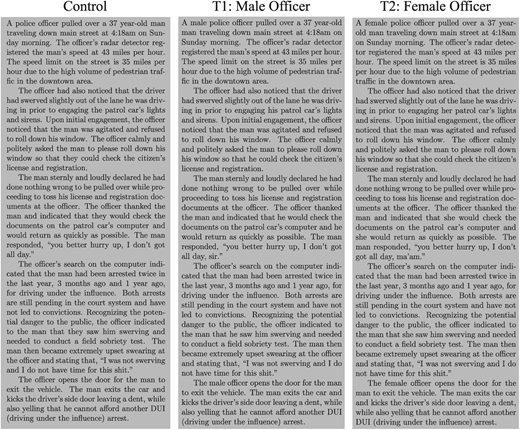
Experiment – Stories involving a citizen and officer interaction. Source(s): Authors’ own work
Experiment – Stories involving a citizen and officer interaction. Source(s): Authors’ own work
We build on prior work by analyzing the respondents who misidentified the officer’s gender to understand why the misidentifications occurred and whether these dropped cases reveal meaningful patterns. Past studies dropped roughly seven and 19% of cases, respectively, from their analysis because respondents failed the manipulation check by incorrectly identifying the officer’s gender in the depicted scenario (Salerno and Sanchez, 2020; Stanek et al., 2023). Given our understanding of gender-role congruity expectations of the policing occupation, were the misidentifications systematic, in that respondents misidentified officer gender in a particular direction? Did misidentification occur due to the vignette’s clarity, suggesting that gender cues or text engagement (e.g. length) should be more explicit? Was the misidentification influenced by the description of the officer’s actions, such as the use of force employed within the vignette? The current study, respondents read a relatively neutral officer-citizen interaction consisting of 329 words, where the officer’s gender (i.e. female/male, she/he, ma’am/sir) was explicitly stated eight times in the treatment conditions [2].
To ensure data accuracy, a manipulation check was included after the story-related questions, asking respondents to recall the officer’s gender. In particular, respondents were provided a multiple-choice question with three options: no gender was provided, male, or female. Approximately 23% (n = 280) of respondents failed this manipulation check. Among those who answered incorrectly, 61% (n = 171) reported that no gender was mentioned; of these respondents, 95% (n = 162) had received the story featuring the male officer. In other words, nearly all respondents who incorrectly claimed that no gender was mentioned had received the story featuring the male officer. In addition, 37% (n = 103) of the individuals failing the manipulation check mistakenly identified the officer as male when receiving the control condition. Interestingly, very few respondents incorrectly identified the officer as female when that was not the case (less than two percent – 6 respondents). These patterns suggest that manipulation failure was not random but systematically biased toward assuming the officer was male, consistent with prior work on information equivalence and respondent inference in experimental settings (Dafoe et al., 2018; Stantcheva, 2023). Respondents who failed the manipulation check were excluded from the final analysis, reducing the sample size to 915 from 1,193 respondents.
Dependent variables
There are four questions representing the dependent variables. After the module containing the news story, respondents were asked questions about their perceptions of the officer’s interaction with the citizen. The next survey page began with: “Please answer the following four questions pertaining to the local news story on a scale from 0 = greatly disagree to 10 = greatly agree (note: 5 = neutral).” Respondents were then provided with four statements related to the story that they were to provide their level of agreement with: (1) the officer handled the situation appropriately up until the end of the story; (2) the officer is acting reasonably by checking the citizen for drunk driving; (3) the next step the officer should take is calling for backup/assistance; (4) it is still possible for the officer to de-escalate the situation at this point. The first two items focus on retrospective evaluations of officer behavior, while the third and fourth items reflect expectations about next steps or future outcomes.
Method
Since these items used a continuous (dis)agreement response scale ranging from 0 to 10, we treated them as interval-level outcomes. We began by presenting descriptive statistics and conducting bivariate regression models to examine initial differences across the treatment conditions (we also ran ANOVA and t-tests as robustness checks, which yielded consistent results). We then estimated ordinary least squares (OLS) regression models to assess how the officer’s gender and key individual-level predictors shaped evaluations across each of the four dependent variables [3].
Independent variables
Descriptive statistics and bivariate tests provide initial insights into perceptions towards the officer-citizen interaction. To further examine the impact of officer gender on perceptions, models were estimated to incorporate key individual-level predictors that may affect responses, along with a nominal-level variable representing the experimental manipulation. The empirical analysis includes several predictor variables with either established relationships to perceptions toward the police or that are commonly controlled for in American attitudinal studies. Specifically, the multiple regression analysis accounts for sociodemographic variables such as age, gender, income, education, and race.
The analysis also includes two attitudinal variables. First, respondents’ self-reported political ideology on a left-right scale is examined. It is expected, based on previous research, that liberals may be more critical of the officer’s behavior and conservatives more willing to defer to the officer’s authority (Fine et al., 2024; Hansen and Navarro, 2023a, b; Navarro and Hansen, 2023; Reny and Newman, 2021). Second, partisan identification is considered as a predictor variable. Partisanship has become a significant predictor of attitudes on various issues in the U.S., including views on policing. Generally, it is expected that if partisan gaps are present, they will be the result of Democrats’ greater criticism of police. In this analysis, respondents who selected that they lean towards a party were coded as partisan identifiers of that party. This choice was made to not overinflate the impact of partisanship by only having strong identifiers coded as partisans. Variable coding and descriptive statistics for all variables utilized in the analysis here are presented in Appendix 1 and 2.4,5
Results
Descriptive statistics – views on the story
Table 1 displays the mean responses and standard deviations for respondents’ evaluations of an officer’s actions, with respondents randomly assigned to different groups based on the officer’s gender: no gender identified (control), male officer (T1), and female officer (T2). We estimated bivariate regression models, treating the treatment condition as a categorical predictor, to assess statistical significance across groups. The first question asked whether respondents believed the officer handled the situation appropriately until the end of the story. The responses were quite similar across all groups, with the control group averaging an agreement rating of 8.46, T1 (male officer) at 8.43, and T2 (female officer) slightly higher at 8.77. However, the differences between these means were not statistically significant, indicating that respondents viewed the officer’s actions similarly, regardless of gender.
Mean (Standard deviation) responses by treatment
| Question | Control | T1: Male | T2: Female |
|---|---|---|---|
| The officer handled the situation appropriately up until the end of the story | 8.46 (2.41) | 8.43 (2.40) | 8.77 (2.10) |
| The officer is acting reasonably by checking the citizen for drunk driving | 9.07 (1.55) | 9.04 (1.63) | 9.24 (1.42) |
| The next step the officer should take is calling for backup/assistance | 7.46 (2.35) | 7.47 (2.32) | 7.93* (2.25) |
| It is still possible for the officer to de-escalate the situation at this point | 6.22 (2.38) | 6.36 (2.40) | 6.26 (2.48) |
Note(s): *statistically significant from control at p < 0.01
Source(s): Authors’ own work
The second question assessed whether respondents thought the officer acted reasonably by checking the citizen for drunk driving. Once again, the responses were consistent across groups, with the control group reporting an agreement mean of 9.07, the male officer group (T1) at 9.04, and the female officer group (T2) at 9.24. These differences were also not statistically significant, indicating that neither gender was perceived as more reasonable.
When asked whether the officer should call for backup or assistance, a statistically significant difference was found between the groups. The group who read about the female officer (T2) reported a higher mean response (7.93) compared to both the control group (7.46) and the group that received the story with a male officer (T1, 7.47). The differences were statistically significant at the p < 0.01 level, indicating that respondents were more likely to recommend that the female officer call for backup than they were for either the male officer or the officer in the control condition, where no gender was specified.
It is worth noting that, in the control group, respondents may have subconsciously imagined a male officer when no gender was identified, given societal norms and implicit biases and expectations of role congruity about law enforcement (Hellwege et al., 2022; Salerno and Sanchez, 2020; see Cejka and Eagly, 1999; see Eagly and Karau, 2002). This possibility could explain why the control group’s mean response was closer to the male officer condition (T1) rather than the female officer condition (T2). Thus, the significant difference in the response for the female officer suggests that respondents might hold distinct expectations for female officers, particularly regarding the need for backup, which may reflect underlying gendered perceptions of policing roles.
Lastly, respondents were asked whether it was still possible for the officer to de-escalate the situation at the end of the story. The responses in agreement were very similar across all groups, with the control group averaging 6.22, the male officer group (T1) at 6.36, and the female officer group (T2) at 6.26. The results provide no clear pattern regarding the officer’s ability to de-escalate based on gender.
Regression analyses – predicting views on the story
Table 2 presents the regression output predicting responses to the four questions with the control and treatment variables. For the control variables, age is a consistent predictor, significantly influencing perceptions of three of the four evaluations of the officer: how appropriately the officer handled the situation, the reasonableness of the officer’s actions, and the recommendation to call for backup. In all these cases, older respondents were more likely to provide positive evaluations of the officer’s actions. Education was a factor in predicting backup recommendations, with more educated respondents being less likely to suggest the officer should call for assistance. Conversely, gender significantly predicted the recommendation to call for backup, with women reporting a stronger agreement that backup is needed. Political ideology also plays an important role, particularly in the decision to recommend backup, with more conservative respondents being more likely to endorse this action. Additionally, conservatives had a lower belief in the possibility of de-escalation, but there were no differences between liberals’ and conservatives’ evaluations of officer appropriateness and reasonableness.
Models predicting evaluations of officer
| Appropriately handling | Acting reasonably | Officer backup | Possible de-escalation | |
|---|---|---|---|---|
| Constant | 7.84** | 8.54** | 5.49** | 6.55** |
| (0.38) | (0.25) | (0.37) | (0.41) | |
| Age | 0.03** | 0.01* | 0.03** | 0.00 |
| (0.01) | (0.00) | (0.00) | (0.01) | |
| Woman | −0.14 | 0.06 | 0.31* | −0.18 |
| (0.15) | (0.10) | (0.15) | (0.16) | |
| Race – White | −0.27 | 0.20 | 0.09 | 0.17 |
| (0.17) | (0.12) | (0.17) | (0.19) | |
| Education | −0.05 | −0.09 | −0.18* | 0.04 |
| (0.09) | (0.06) | (0.08) | (0.09) | |
| Income | −0.01 | 0.01 | 0.02 | −0.01 |
| (0.02) | (0.02) | (0.02) | (0.03) | |
| Political Ideology | −0.00 | 0.04 | 0.15** | −0.09* |
| (0.04) | (0.03) | (0.04) | (0.04) | |
| Party ID – Independent | −0.15 | 0.03 | −0.20 | 0.15 |
| (0.21) | (0.14) | (0.21) | (0.23) | |
| Party ID – Republican | −0.08 | −0.02 | −0.21 | −0.08 |
| (0.27) | (0.18) | (0.27) | (0.30) | |
| T1 – Male | 0.01 | 0.03 | 0.15 | 0.16 |
| (0.20) | (0.13) | (0.19) | (0.21) | |
| T2 – Female | 0.30 | 0.20 | 0.51** | 0.05 |
| (0.18) | (0.12) | (0.17) | (0.19) | |
| Observations | 915 | 915 | 915 | 915 |
| R2 | 0.04 | 0.03 | 0.11 | 0.02 |
| Adjusted R2 | 0.03 | 0.02 | 0.10 | 0.01 |
Note(s): *p < 0.05. **p < 0.01. Standard error in parentheses; unstandardized coefficients
Source(s): Authors’ own work
Turning to the effect of the treatment variable, which manipulated the officer’s gender, there was only one significant finding. Respondents who read the scenario featuring a female officer (T2) were significantly more likely to recommend that the officer call for backup compared to the control group. The result suggests that the officer’s gender influenced respondents’ perceptions of the need for additional support while controlling for other factors. Substantively, the outcome reinforces the notion that gendered expectations may shape how people evaluate policing actions by conveying that women need greater assistance in handling its occupational situations. However, the officer’s gender did not significantly impact responses for the other three dependent variables: whether respondents felt the officer handled the situation appropriately, acted reasonably by checking for drunk driving, or had the potential to de-escalate the situation. In these instances, respondents’ evaluations were similar across all conditions, regardless of whether the officer was male, female, or unspecified (control).
Regression analysis – predicting those who incorrectly identified officer gender
As previously mentioned, nearly one-fourth of the respondents misidentified the gender of the officer in the news story. Given the relatively high proportion of incorrect responses, we conducted an additional analysis to explore the predictors of accurate identification of officer gender. Although this analysis is not part of the primary test of treatment effects, it provides theoretically relevant insight into how respondents process or overlook gender cues in the news story. A logistic regression model was used to predict correct responses (coded as 1) versus incorrect responses (coded as 0). The results, presented in Table 3, help contextualize instances of manipulation failure and offer evidence that assumptions about officer gender may be more common in the control and male officer conditions.
Predicting correctly identifying the officer’s gender
| Correct response | |
|---|---|
| Constant | 0.81* |
| (0.36) | |
| Age | 0.01* |
| (0.00) | |
| Woman | 0.08 |
| (0.15) | |
| Race – White | −0.14 |
| (0.17) | |
| Education | −0.03 |
| (0.09) | |
| Income | 0.00 |
| (0.02) | |
| Political Ideology | −0.04 |
| (0.04) | |
| Party ID – Independent | 0.15 |
| (0.21) | |
| Party ID – Republican | 0.14 |
| (0.28) | |
| T1 – Male | −0.75** |
| (0.16) | |
| T2 – Female | 2.39** |
| (0.32) | |
| Observations | 1,193 |
| Log Likelihood | −546.33 |
| Akaike Inf. Crit | 1114.65 |
Note(s): *p < 0.05. **p < 0.01. Standard error in parentheses; unstandardized coefficients
Source(s): Authors’ own work
Age has a small but statistically significant effect on correctly identifying the officer’s gender, suggesting that older respondents were slightly more likely to accurately recall the officer’s gender. However, other sociodemographic variables such as gender, race, education, and income do not have significant effects on correct identification, indicating that these factors do not strongly predict whether respondents accurately identified the officer’s gender. In addition, political ideology and party identification (Republican or Independent) also do not show statistically significant effects.
Notably, the experimental treatment variables played a significant role in predicting correct responses. Respondents in the male officer condition (T1) were significantly less likely to correctly identify the officer’s gender, commonly indicating no gender. Conversely, respondents assigned in the female officer condition (T2) were much more likely to provide correct responses. The findings suggest that respondents had greater difficulty recalling the male officer’s gender and were more accurate when the officer was identified as female. The result may reflect stronger attentiveness to or memory of the officer’s gender when it was female, perhaps because it was seen as more noteworthy or unexpected, given societal norms and role incongruity within the traditionally male-dominated nature of law enforcement. The presence of a female officer in the news story could have stood out as a distinctive detail, prompting respondents to pay closer attention and retain that information more effectively.
Discussion
This study explored how the gender of a police officer impacts public perceptions of an interaction between an officer and a citizen. Respondents were presented with a hypothetical news story using an experimental survey design and asked to evaluate the officer’s actions. The officer’s gender was manipulated across three conditions: male, female, or unspecified (control). The study sought to determine whether the officer’s gender influenced perceptions of their appropriate behavior, reasonableness, need for backup, and effectiveness to de-escalate the interaction involving a citizen suspected of driving under the influence.
The results show that the officer’s gender had little effect on most respondent evaluations of the officers’ decision-making and procedural judgments. Specifically, respondents did not significantly differ in their assessments of whether the officer handled a drunk driving situation appropriately, acted reasonably, or had the capacity for de-escalation. However, a key finding was that respondents were significantly more likely to recommend that the female officer call for backup compared to a male officer or the officer within the unspecified group, suggesting that gendered expectations might shape perceptions of when additional support is needed when describing a police-citizen interaction.
Another compelling result of a methodological nature addresses the common practice in policing research of removing respondents who failed the manipulation check question identifying the officer’s gender after engaging with the scenario (Salerno and Sanchez, 2020; Stanek et al., 2023). Our analysis revealed no significant sociodemographic differences between respondents who correctly recalled the officer’s gender and those who did not, with the exception of age; those who correctly identified the officer’s gender were significantly more likely to recall the female officer. Given that women officers work in a male-dominated occupation, this heightened recall may reflect the public’s stronger memory of gender-incongruent roles. In cases where the officer’s gender was unspecified, respondents tended to identify the officer as male, aligning with social psychological research suggesting that the term officer is intuitively associated with masculinity. Future research could assess reaction time in responses to an officer gender manipulation check to further investigate implicit gender biases in recall. Overall, this finding has implications for how officers are portrayed and perceived in media coverage. Since women officers are relatively rare, their actions may be more memorable; when officers are referred to anonymously in news reports, it may lead to the automatic assumption that the officer is male and, therefore, more susceptible to criticism.
While the study offers important insights, it also has some limitations. First, the scenario used in the news story reflects a relatively routine and non-contentious police-citizen interaction, which may limit generalizability to more intense or ambiguous scenarios. Second, while the gender manipulation was intentionally subtle to mimic real-world cues, this may have made the treatment effect harder to detect. Third, although the use of single-item dependent variable measures is consistent with theory-driven designs, future research could explore whether these findings hold when using alternative measurement strategies.
Future research
The absence of perceived gender differences in officer behavior is not unexpected and suggests that officer actions are broadly perceived as gender-blind (Brown and Reisig, 2019; Den Houter and Chatterjee, 2021; Hellwege et al., 2022; Salerno and Sanchez, 2020), with exception that women officers needed to call for backup/assistance. While Nivette et al. (2024) recommended neutral scenario designs of police-citizen interactions to avoid introducing potential confounders and threats to internal validity, one explanation for the lack of gender-based differences in the majority of the study’s evaluations is that the news story scenario presented was not contentious enough to elicit strong or varied reactions. The neutral nature of the study’s police-citizen interaction may not have generated enough variance in respondents’ perceptions to detect differences across the experimental conditions.
Only when action was implied through the terms “backup” and “assistance” did differences emerge, showing greater agreement among respondents for the women officer to call for backup/assistance. These terms may carry an agentic quality, implicitly activating gendered expectations of physicality, masculinity, and perceived capability in what could become, although not explicitly stated, a high-stakes situation, reinforcing the paternalistic perception that women officers require protection due to the perceived threat (see Martin, 1993). Similar to previous work suggesting that women officers simultaneously manage policewomen and policewomen identities (Morash and Haarr, 2012; Rabe-Hemp, 2009), does the public actively shift across this spectrum for women officers based on context?
The current findings raise several key questions for future research on the role of gender in policing. First, future studies should examine additional scenarios, particularly high-stakes situations where the use of force is incrementally introduced to understand how context shapes perceptions of women officers. One study suggests that women officers benefitted from engaging in gender-incongruent behavior, as their use of force may have been perceived as situationally necessary (Salerno and Sanchez, 2020). Second, whereas the study used a male citizen in the scenario, would a paternalistic response emerge in an interaction between a woman officer and a female suspect? Women officers lack the double-status superiority of male officers; thus, they must navigate the cross-pressures of being both authoritative and communal (see Martin, 1993). Third, how does a mixed-gender policing interaction shape public perceptions of both the woman and male officer? Fourth, rather than focus solely on perceived gender differences among officers, future work should explore how women contribute to policing, particularly in scenarios where they are stereotypically expected to excel to identify how deeply these beliefs are entrenched. Fifth and finally, research suggests that race and gender intersect in shaping perceptions of femininity and policing (Martin, 1979; Morash and Haarr, 2012). Thus, it would be valuable to investigate whether backup is selectively granted based on the race/ethnicity of the women officer. These inquiries could advance further if agencies systematically collected data on police-citizen interactions by gender to assess the pervasiveness and persistence of gender-based stereotypes in policing.
Conclusion
The study’s findings raise several key questions about when and how gender cues shape public responses to police officers. In particular, they suggest that officer gender alone may not heavily influence perceptions of routine interactions, especially when no force is used and the situation remains relatively non-confrontational. These results invite further investigation into the conditions under which gender matters most in shaping public perceptions of authority and procedural fairness. These findings highlight the persistence of gendered expectations in policing while also suggesting that, in routine scenarios, officer behavior may be judged more on conduct than identity, which is an insight with meaningful implications for recruitment, training, and public trust.
Authors are listed in reverse alphabetical order and contributed equally. The authors would like to thank the editors of Policing, with special thanks to Dr. Wesley Jennings, as well as the two anonymous reviewers.
Notes
In the experimental news stories, we use the terms female and male to align with how news coverage typically frames gender. The academic literature more commonly uses woman and man. Accordingly, we use female and male when referring to the experimental treatments and woman and man when discussing broader implications. Additionally, because we examine gendered differences in perceptions of police officers, we use gendered pronouns for clarity, as gender-neutral language in this context could create ambiguity.
The news story was pretested on a sample of undergraduates to assess clarity, engagement, and length. Feedback indicated the scenario was understandable and appropriate in length. In addition, the final news story length (329 words) aligns with recent studies of realistic and detailed police-citizen interactions (e.g. Navarro and Hansen, 2025), falling well within the typical range of roughly 200 to 1,000 words used in experimental vignette research on the topic (Nivette et al., 2024).
Since the distribution of responses leaned heavily towards agreement, we conducted robustness tests to account for issues of non-linearity. Generalized linear models with a Gamma distribution were estimated to check issues of non-normality in the data, which are suitable for positive, continuous data that are not normally distributed. The results from this approach were substantively consistent with the findings presented here (see Appendix 3).
Ethics approval – Research involving human participants and/or animals: The questionnaire and methodology for this study were approved by the Institutional Review Board of Sam Houston State University (#2024–96).
Informed consent: Informed consent was obtained from all individual participants included in the study.
Declaration of conflicting interests: The authors report that there are no competing interests to declare.
Funding: This work was supported by the Field Impact Grant from the College of Criminal Justice and Criminology at Sam Houston State University.
References
Appendix 1 Variable coding
Age – continuous, respondent’s age.
Gender – binary, 0 = man; 1 = woman.
Race – binary, White = 1; Other races = 0.
Education – continuous, 0 = did not graduate from high school; 1 = high school graduate/GED; 2 = some college, but no degree (yet); 3 = 2-year college degree; 4 = 4-year college degree; 5 = postgraduate degree; 6 = doctorate.
Income – continuous, 0 = Less than $10,000; 1 = $10,001 - $20,000; 2 = $20,001 - $30,000; 3 = $30,001 - $40,000; 4 = $40,001 - $50,000; 5 = $50,001 - $60,000; 6 = $60,001 - $70,000; 7 = $70,001 - $80,000; 8 = $80,001 - $90,000; 9 = $90,001- $100,000; 10 = $10,001 - $150,000; 11 = greater than $150,001.
Partisan Identification – nominal, Democrat; Independent; Republican; leaners coded as partisans.
Political Ideology – continuous 10-point scale, 0 = very liberal to 10 = very conservative.
Source(s): Authors’ own work
Appendix 2 Descriptive statistics
Appendix 3 Robustness check – Models accounting for nonlinearity
Regression models – Gamma distribution
| Appropriately handling | Acting reasonably | Officer backup | Possible de-escalation | |
|---|---|---|---|---|
| Constant | 2.18** | 2.26** | 1.89** | 2.02** |
| (0.04) | (0.03) | (0.04) | (0.06) | |
| Age | 0.00** | 0.00* | 0.00** | 0.00 |
| (0.00) | (0.00) | (0.00) | (0.00) | |
| Woman | −0.02 | 0.01 | 0.03 | −0.02 |
| (0.02) | (0.01) | (0.02) | (0.02) | |
| Race – White | −0.03 | 0.02 | 0.01 | 0.02 |
| (0.02) | (0.01) | (0.02) | (0.03) | |
| Education | −0.01 | −0.01 | −0.02 | 0.00 |
| (0.01) | (0.01) | (0.01) | (0.01) | |
| Income | −0.00 | 0.00 | 0.00 | −0.00 |
| (0.00) | (0.00) | (0.00) | (0.00) | |
| Political Ideology | −0.00 | 0.00 | 0.02** | −0.01* |
| (0.00) | (0.00) | (0.00) | (0.01) | |
| Party ID – Independent | −0.02 | 0.00 | −0.02 | 0.02 |
| (0.02) | (0.01) | (0.02) | (0.03) | |
| Party ID – Republican | −0.01 | −0.00 | −0.03 | −0.01 |
| (0.03) | (0.02) | (0.03) | (0.04) | |
| T1 – Male | 0.00 | 0.00 | 0.02 | 0.02 |
| (0.02) | (0.01) | (0.02) | (0.03) | |
| T2 – Female | 0.03 | 0.02 | 0.06** | 0.01 |
| (0.02) | (0.01) | (0.02) | (0.03) | |
| Observations | 915 | 915 | 915 | 915 |
| Log Likelihood | −2342.03 | −1908.91 | −2174.28 | −2183.31 |
| Akaike Inf. Crit | 4706.06 | 3839.81 | 4370.55 | 4388.62 |
Note(s): *p < 0.05. **p < 0.01. Standard error in parentheses
Source(s): Authors’ own work

