In Ethiopia, students’ performance in Grade 12 national exams has been consistently low, raising questions about the effectiveness of secondary education. Previous research has focused on specific factors affecting examination performance, with little consideration given to how the interaction of these factors influences student performance. In this study, the relationships between teacher competence, curriculum examination alignment, psychological stress, language barriers, school leadership capacity and outcomes of Grade 12 examinations are examined, guided by general systems theory.
This study adopted a quantitative cross-sectional survey design where the data were obtained from 455 Grade 12 students in five university-based examination centers in Ethiopia. The direct, mediating and moderating relationships among the study constructs were analyzed using SPSS and partial least squares structural equation modeling (PLS-SEM).
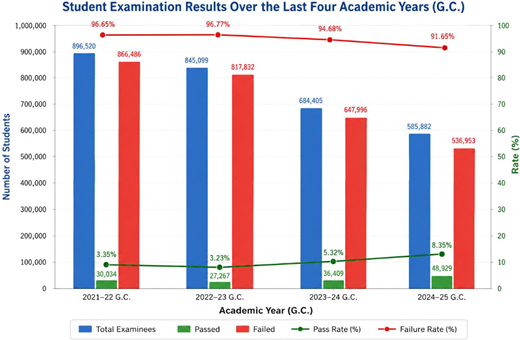
The findings suggest that teacher competence is positively associated with curriculum examination alignment and psychological stress. Language barriers are exacerbated by curriculum misalignment and psychological stress, and negatively impact examination results. The moderating effect of school leadership capacity on the relationship between language barriers and examination outcomes was not statistically significant, whereas it was statistically significant in educational processes. According to recent data, only 10% of students were successful in exams between 2022 and 2025. The results indicate that low examination performance should be considered a symptom of systemic issues that are interconnected rather than a reflection of individual student shortcomings.
However, the authors must consider some weaknesses associated with this study. To begin with, the data were collected during national examinations, when most pupils were under immense pressure and stress. It is possible that this environment affected the respondents’ views, especially regarding psychological and structural aspects, Second, the research design used in the paper is that of a cross-section. This kind of design makes it impossible to identify the causation among the various variables. While PLS-SEM enables the identification of relationships between different constructs, a longitudinal approach would be more helpful in this regard.
This study’s findings can be very useful for enhancing the quality of the educational process in the context of high-stakes testing. Given the significant contribution of teacher skill levels and the alignment between the curriculum and exam syllabus.
This study contributes to the literature by bringing together several educational, psychological and institutional factors in one systems approach. It focuses on the conditions of education rather than explanations at the student level, and thus can provide evidence for designing a holistic educational reform that would improve the quality of students’ learning and examination results in Ethiopia and other developing country.
1. Introduction
Access to education is considered a basic right that plays an integral role in achieving sustainable development, as recognized by the universal declaration of human right (UDHR 1948) (Alfredsson and Eide, 2023; MacNaughton and Koutsioumpas, 2016; Nyitray, 2024). While education is essential for ensuring social mobility, enhancing competitiveness and promoting continuous growth, quality education remains unattainable for many individuals. In sub-Saharan Africa, structural barriers impede equitable access to education and limit attainment (Malik et al., 2025; Nsabayezu et al., 2025; Zickafoose et al., 2024).
Ethiopia has a secondary education system (Grades 9–12) that serves as an important transitional stage with significant implications for students’ educational pathways and career development. After completing two years at the general secondary school, students then choose to pursue either natural or social science subjects at Grades 11 and 12. The passing of the national exam at grade 12 is key in helping learners determine whether to take part in the university program and greatly impacts learning experiences, pedagogy and other life opportunities (Areri, 2025; Ayenalem et al., 2022; BAO and Cho, 2022; Yongbo, 2020).
The examination system is critical in Ethiopia since it affects the quality of education provided. However, the examination system has encountered various unresolved challenges. These challenges include the high student failure rates and examination malpractice, which have cast doubts on the credibility of examinations. One must be aware that in 2023, up to 43% of schools had all their students fail the Ethiopian general secondary education certificate examination (EGSECE), and about 96% of students had failed the same exam consecutively for four years (Bezie et al., 2025; Hood, 2023).
The Ministry of Education of Ethiopia has proposed several measures to improve education and ensure fair testing. For example, the School Improvement Program encourages cooperation, institutional accountability and parental involvement (Abraham et al., 2022; Araya et al., 2025; Melesse and Belay, 2022). Likewise, transferring Grade 12 examinations to universities, where students will be supervised by university teachers, is another effort by policymakers to address corruption and improve the validity of test results (Jibat et al., 2024; Tadesse and Wale, 2025).
Despite the significant contributions that previous studies of the quality of education in sub-Saharan Africa have made, they have often been defined by their fragmented approach, since most of these studies are inclined towards analyzing each variable separately, such as limited resources, poor teaching staff or flawed policy implementation (UNESCO, 2022; Zickafoose et al., 2024). This perspective fails to recognize the complexity of educational systems. Specifically, it ignores the significance of institutions, curricula, school policy, languages, pedagogy and psychology in terms of academic success during exams.
The following research adopts a systems perspective to examine critical factors influencing the performance of Grade 12 students on their national exams in Ethiopia. This study will identify the characteristics of the teachers (teaching ability and professional development), the curriculum-exam fit, language problems and the psychological and situational environments of the students.
The novelty of this study is that it intentionally challenges the prevailing narrative on the Grade 12 national examination crisis in Ethiopia, which focuses on the students’ conceptual shortcomings. The study challenges the individual failure interpretation of poor examination performance and instead takes a systemic perspective, suggesting that this is an emergent structural and institutional failure within the wider education system. It does this by promoting a mental model that moves from a blame game to diagnostic thinking about students to system thinking about the system. This reframing provides a new, theoretically sound perspective on existing interpretations and provides a stronger evidentiary foundation for designing system-level, transformative educational interventions and a series of progressive’s solutions.
2. Literature review
Although several studies have examined the major factors determining students’ academic success, such as effective teaching, curriculum mismatch, students’ language proficiency and psychological factors, these factors are mostly studied separately, leading to incomplete results regarding educational outcomes. The recent findings show that the major reason for the negative consequences of curriculum mismatch is a reduction in motivation, coherent instruction and the validity of assessments (Bull, 2025).
The empirical research shows that teacher preparation shortages lead to poor instructional quality, which, in turn, results in lower student achievement and a negative educational experience (Imran et al., 2024). In the multilingual education settings, language differences constitute another challenge, as they limit students’ understanding and engagement and, thus, affect their exam achievements (Okoli and Nweke, 2025). In research findings from the international scene indicate that factors such as instructional limitations and language barriers are significantly associated with poor academic performance among students (Teig et al., 2024). Nonetheless, it remains evident that, although numerous advancements have been made in previous research, one key shortcoming in many findings is the reliance on linear models, which tend to overlook the complexity of the education sector.
2.1 Examination performance
Quality education is a complex process with multiple dimensions that interact with institutions, instruction and contexts (Rodríguez et al., 2022). Within the academic success dimension, for example, performance not only refers to learners’ cognitive processes but also to the learning environment as a whole (Eccles and Wigfield, 2020). As mentioned, academic achievement is the product of the ongoing process between students and their immediate environment, including teachers, peers and family structures (Wang and Degol, 2016). This view is consistent with the rest of the educational research, which shows that student achievement in national examinations depends not only on internal school-related factors but also on external ones, such as motivation, emotional stability and access to learning resources (Camacho-Morles et al., 2021). On the other hand, the previous literature tends to analyze these factors separately without paying attention to their systemic interrelations that determine the creation of learning results. The matter is especially evident in important exams, when, alongside students’ work, the role of institutional management becomes significant (Davey et al., 2007).
2.2 Examination and malpractice systematic dysfunction
Examination malpractice is now perceived as a systematic practice involving of individuals in the educational system, such as students, invigilators, institutions, and not as an issue affecting a single student (Agwu et al., 2022). Acts of malpractice may include corruption, collusion and the use of electronic devices to cheat, among other practices, which affect test credibility and render any certification invalid. Examination malpractice facilitates the advancement of unqualified students within the educational system (Agwu et al., 2022).
2.3 Teacher competence and professional development
Teacher effectiveness remains the most important factor affecting learner performance, yet most studies focus on teacher personal qualities rather than system-level issues (Rehman et al., 2025). Although subject expertise, teaching skills and continued teacher development remain vital, it is increasingly evident that systemic factors, such as policies and organizational structures, also play an equally important role in teacher effectiveness (Darling-Hammond, 2017; Kraft et al., 2018). The lack of opportunities for professional growth and limited instructional support in difficult circumstances could undermine learners’ preparation for national standardized tests, ultimately affecting their performance and success on these assessments. Both aspects require attention to improve teacher effectiveness.
2.4 Curriculum examination alignment
Curriculum alignment with examination criteria is important for effective assessment, but there have been cases where alignment has not occurred (Atuhurra and Kaffenberger, 2022). The lack of alignment in education may lead to biased assessments and, in turn, unfair assessment processes, ultimately affecting students’ academic performance and future opportunities. Although the problem has received attention recently, there is limited empirical work in developing nations, hindering understanding of the specific challenges and solutions related to curriculum alignment in these contexts (Marope et al., 2017).
2.5 Language barrier in assessment
Instruction and assessment are delivered and communicated in a language that affects student learning and achievement. Researchers have demonstrated that the absence of linguistic competence poses cognitive limitations for students to interpret and express information when assessing (Gan et al., 2025). Language barriers go beyond the individual to institutional inequality (Nakamura et al., 2023).
2.6 Psychological and emotional factor
Students’ performance during important exams significantly influences their psychological and emotional states, particularly test anxiety, stress and academic self-efficacy. There is increasing evidence that test anxiety adversely affects cognition and lowers performance results (Von Der Embse et al., 2018). All these aspects tend to be perceived individually rather than in relation to institutional processes, leading to test anxiety and a lack of appropriate psychosocial support (Putwain, 2007).
2.7 Theoretical framework
This study is based on general systems theory (GST) developed by Von Bertalanffy (1972) which views organizations as open systems, outcomes that arise from the dynamic interaction of the interdependent subsystems. In learning, GST implies that there is no single cause of learning achievement. Rather, it is the product of the interplay of curriculum design, assessment, governance, teacher effectiveness and learner attributes.
Feedback loops can occur when a failure in one subsystem, example: poor curriculum-exam alignment, and insufficient teacher preparation can cascade through other subsystems, impacting exam performance. The GST thus raises the issue of coordination and feedback regulation as pivotal to the system’s effectiveness. In the scope of this research, school leadership capacity is used as a regulatory mechanism, good leadership is used to align the subsystems, enhance the quality of instruction and reduce negative feedback, while poor leadership is used to enhance systemic dysfunction.
While there is increasing understanding of individual factors that can hinder students’ success, the current literature is conceptually fragmented and methodologically underdeveloped in its ability to represent the cumulative effects of these factors on students’ performance on high-stakes examinations. Few empirical studies have been carried out in Ethiopia that have considered the teacher’s competence, curriculum examinations, psychological stress, language problems and school management in a single systems model framework, even though the pass rates for Grade 12 national examinations have been very low. This absence negatively affects the ability to develop coherent, system-level educational reforms and to develop a theoretical understanding of the causal pathways leading to poor performance.
3. Methodology
In this study, a quantitative cross-sectional survey design was used to examine the relationships among systemic factors and the outcome of the Grade 12 national examination in Ethiopia. To explore relationships among several latent constructs within a large population at a single point in time, cross-sectional designs are suitable (Maier et al., 2023). With GST, outcomes in education are viewed as products of interactions among interrelated subsystems rather than isolated factors. As a result, the competencies of teachers, professional development, alignment of curriculum and examinations, language barriers, psychological and emotional stress, and the capacity of school leadership were identified as interrelated components of the educational system. While dynamic and reciprocal interaction between subsystems is acknowledged in GST, this study aims to test statistically derived associations among these subsystems using partial least squares structural equation modeling (PLS-SEM). The results are interpreted as relationships, correlations and not as cause and effect.
The Ethiopian National School Leaving Examination (NSE) 2025 was conducted for all Grade 12 students 585,882 (Figure 1), participating in the examination as reported by the Ethiopian Ministry of Education. According to Krejcie and Morgan (1970), the procedure for sample size determination for a finite population was used to choose the minimum sample size of 384 respondents. The final sample was expanded to 455 participants to boost the statistical power of the results and to make up for possible nonresponse or missing questionnaires.
Purposive sampling of five university-based examination centers, Kebri Dehar, Jigjiga, Dire Dawa, Haramaya and Samara University, was conducted to represent the major examination centers serving large number of grade 12 students in the eastern and northeastern parts of Ethiopia. Eligible students are defined as students who are registered for Grade 12 exams and actively enrolled at the respective centers for the national exams in 2025. In each of the centers, the students were selected by simple random sampling from the list of registered students as provided by the examination administrators.
Data collection was conducted to select examination centers immediately after the examination sessions were finished, with a view to minimizing disruption to the official examination sessions. The questionnaires were administered by trained research assistants, and standardized instructions were given to the respondents. Participation was voluntary, with anonymity maintained throughout. Common method bias was minimized by explaining that the responses would be anonymous and would not impact their exam status. Common method variance was not a major concern because less than 40% of the variance was explained by the first factor in Harman’s single-factor test.
A structured questionnaire was used to gather data and comprised six latent constructs, each measured on a five-point Likert scale ranging from strongly disagree (1) to strongly agree (5). The items of the questionnaire were adapted from existing educational and assessment literature and adapted to the examination context in Ethiopia.
Data were sorted and edited in SPSS version 20, thereafter, Smart PLS 3 was used to estimate the measurement and structural models. A PLS-SEM analysis is suitable for the analysis of complex relationships among latent constructs and it is robust enough to be applied to predictive and exploratory research models. The measurement model was analyzed using indicator loadings (>0.70), Cronbach’s alpha (>0.70), composite reliability (>0.70), average variance extracted (AVE > 0.50) and the heterotrait–monotrait ratio (HTMT < 0.90) (Hair and Alamer, 2022; Henseler et al., 2015). The analysis of structural models involved path coefficients (β), coefficient of determination (R2), effect size (f2), predictive relevance (Q2) and bootstrapping with 5,000 resamples for statistical significance (Hair et al., 2017).
Pilot study: A pilot study was conducted to assess the clarity, reliability and contextuality of the instrument prior to the main investigation with 30 students who sat for the Grade 12 examination during the 2024/25 academic year. The national examination was administered over several days with strict time management to ensure that the candidates were available for the examination; therefore, current examinees were not part of the pilot.
Table 1 presents the operational definitions of all study constructs and their corresponding measurement dimensions.
3.1 Ethical consideration
Ethics were strictly followed during the research. The research process involved participants who volunteered freely. Confidentiality was guaranteed to all participants in the research. They were assured that their names would not be revealed at any point during the research. The research strictly adhered to the established ethical guidelines.
3.2 Hypothesis development
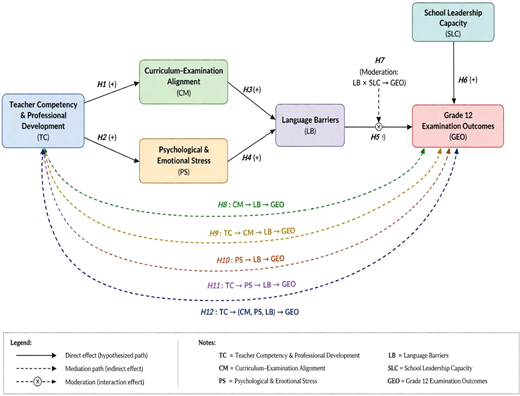
Teacher competency and professional development positively influence curriculum examination alignment.
Teacher competency and professional development positively influence psychological and emotional stress.
Curriculum examination misalignment exacerbates language barriers.
Psychological and emotional stress positively influences language barriers.
Language barriers were significantly associate with grade 12 examination outcomes.
School leadership capacity positively influences grade 12 examination outcomes.
School leadership capacity moderates the relationship between language barriers and grade 12 examination outcomes.
Mediation effects:
Language barriers mediate the effect of curriculum examination alignment on grade 12 examination outcomes.
Curriculum examination alignment and language barriers sequentially mediate the relationship between teacher competency and grade 12 examination outcomes.
Language barriers mediate the relationship between psychological and emotional stress and grade 12 examination outcomes.
Psychological and emotional stress and language barriers sequentially mediate the relationship between teacher competence and grade 12 examination outcomes.
Integrated system hypothesis:
Teacher competency indirectly influences grade 12 examination outcomes through curriculum examination alignment, psychological stress and language barriers.
Curriculum examination alignment mediates the relationship between teacher competence and grade 12 examination outcomes.
Psychological and emotional stress mediates the relationship between teacher competence and grade 12 examination outcomes.
Language barriers mediate the relationship between teacher competence and grade 12 examination outcomes.
Based on the theoretical framework and literature review, the proposed conceptual model and research hypotheses are presented in Figure 2. The conceptual framework illustrates the relationships among teacher competence and professional development (TC), curriculum examination misalignment (CEA), psychological and emotional stress (PES), language barriers (LB), School Leadership Capacity (SLC) and grade 12 examination outcomes (GEO).
4. Results
Table 2 contains the demographic information of the respondents (n = 455). More than three-quarters of the sample are males (76%), and majority of participants (85.5%) were aged 19 years and below, which corresponds to the typical age range for grade 12 students in Ethiopia, the remaining 17.5% were aged 20 years and above, indicating differences in school entry age. Most respondents come from urban areas (86.8%), suggesting an urban bias in the sample and potentially different access to learning and examination centers between urban and rural areas. Regarding academic background, the majority (60.9%) of respondents were in the natural sciences, whereas the remaining 39.1% were in the social sciences, indicating that more science learners were in the sample. Regarding examination center distribution, most students attended Haramaya University (37.8%), followed by Jigjiga University (27.3%), Dire Dawa University (13.6%), Kebri Dehar University (13.0%) and Samara University (8.4%).
Table 3 presents the measurement model used to assess the reflective construct. All indicator loading values exceed the 0.70 benchmark, indicating adequate reliability. The reliability criterion is fulfilled since the Cronbach’s alpha, rho_A and composite reliability values are more than 0.70 for all constructs. The convergent validity criterion is satisfied, as all AVEs exceed 0.50, indicating that each construct accounts for a significant portion of its indicators’ variance (Hair and Alamer, 2022), recommend using interaction variables to investigate moderating roles in the context of PLS-SEM. However, the outer loading value for the interaction variable is problematic, as it can suggest multicollinearity or model misspecification, since interaction terms typically do not load as highly as the main effect.
Tables 4 and 5 determine discriminant validity by using HTMT and Fornell–Larcker criteria. The HTMT is more sensitive and valid compared to the conventional approaches used for determining discriminant validity problems. According to Henseler et al. (2015), an HTMT value below 0.85 (or 0.90 in relaxed circumstances) indicates that the constructs are dissimilar. Based on Table 4, all the HTMT ratios are within the acceptable range, and thus discriminant validity is achieved. Some constructs, like psychological stress and language barrier, are quite close to 0.90 but are still under the specified level. Another piece of evidence supporting discriminant validity is Fornell–Larcker’s criterion. In Table 5, it can be observed that the square root of the AVE of each construct surpasses the correlation of this construct to all other constructs. This meets the criterion set by Fornell and Larcker which is a measure of the extent to which each construct shares more variance within itself than with other constructs (Ab Hamid et al., 2017).
5. Structural equation model
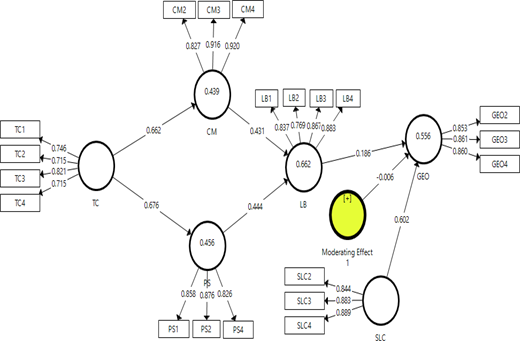
The structural equation modeling based on PLS-SEM is depicted in Figure 3, showing the relationships among the research variables in terms of their measurement and structural models. This structural equation model reveals that the research model’s explanatory power is moderate to high, with R2 values of 0.662 for language barriers, 0.456 for psychological stress and 0.556 for Grade 12 examination results. Do Valle and Assaker (2016) state that 0.67, 0.33 and 0.19 values of R2 correspond to substantial, moderate and weak explanatory power, respectively.
Tables 6 and 7 present the findings from the structural models, including both direct and mediated effects. First, according to Table 6, which presents the results of the direct path analyses, all hypotheses were found to be statistically significant and supported. Thus, curriculum misalignment was significantly associated with language barriers (β = 0.431, p < 0.001), while language barriers were significantly associated with Grade 12 examination results (β = 0.186, p < 0.001). Psychological stress (β = 0.444, p < 0.001) and school leadership capability (β = 0.602, p < 0.001) were found to have a significant positive impact on the dependent variable, examination results. Also, teacher competence was significantly associated with curriculum misalignment (β = 0.662, p < 0.001) and psychological stress (β = 0.676, p < 0.001). Nevertheless, there was no significant mediating effect of school leadership capability on the association of language barriers and examination results (β = −0.006, p = 0.754).
There are also some indirect effects in the mediation analysis (a method that examines whether a relationship between two variables is explained by a third variable; see Table 7). For instance, the mismatch between the curriculum and examinations influences test performance indirectly through linguistic differences (β = 0.080, p = 0.001), while the teacher’s competency has an indirect effect via curriculum alignment and stress. All the findings in this study are consistent with the mediation approach proposed by Wang et al. (2023), in which intervening variables or mediators play a critical role in explaining causal links. Moreover, this study findings confirm Hayes’ (2017) conclusion that the presence of indirect effects is necessary for analyzing such phenomena, as well as Nitzl et al.’s (2016) guidelines for mediation analysis in PLS-SEM, a statistical technique used to study complex variable relationships.
Table 8 presents the results of the moderation analysis. Finding indicated that the interaction effect between language barriers and school leadership capacity on the Grade 12 examination results was not statistically significant, β = −0.01, t = 0.313, p = 0.754. Therefore, H7 was not supported. The results indicate that the school leadership capacity has little impact on the relationship between language barriers and examination results (Becker et al., 2023; Memon et al., 2026). The present study did not support the role of school leadership as a moderator of examination outcomes, although it did have a significant direct effect (Nguyen and Nguyen, 2025).
6. Discussion
The findings indicate a relationship between certain systemic factors and Grade 12 exam results in Ethiopia. Specifically, there are positive associations between teacher competence and curriculum alignment (β = 0.662) and psychological stress (β = 0.676). Students who perceive their teachers as more competent are also more likely to say that the curriculum taught corresponds well with the examination content. The latter is more alarming, as teacher competence is similarly associated with psychological stress (β = 0.676). This association may be part of students increased academic aspirations and heightened awareness of the demands of examinations, resulting from being taught by highly competent teachers, which can increase the pressure on examinations.
Language barriers and psychological stress are positively associated with curriculum misalignment (β = 0.431 and β = 0.444, respectively). This indicates that if the student feels there is a difference between what he or she was taught in class and what he or she has to do on the national examination, or if he or she is stressed, he or she is more likely to report that language interfered with performance.
There are positive associations between examination outcomes and language barriers (β = 0.186) and school leadership capacity (β = 0.602). Given the strong relationship between leadership and outcomes, effective school management is one of the strongest direct factors influencing students’ exam perceptions. The moderation effect of school leadership on the relationship between language barriers and examination results was not statistically significant (β = −0.006, p = 0.754). This suggests that school leadership does not moderate the language barrier impact on exam results, but it impacts the results directly rather than buffering or amplifying the language barrier effect.
It is important to note that these associations are not causal effects. This cross-sectional study design does not allow for establishing the direction of the relationship, and other interpretations are possible. For instance, it is also possible that students who have had positive exam experiences have more positive views of their teachers, teachers are more competent, or that positive exam experiences lead to more positive views of the teacher and school leadership. In addition, the study’s findings are not generalizable. The majority of the sample comprises males (76%), urban students (86.8%) and students from university examination centers. These traits may not be typical of rural, female and university-test-center students.
The Grade 12 national examination has been a focal point of the education system in previous research and has been seen as a vital instrument for selecting students for higher education and enhancing the quality of education (Ayenalem et al., 2022; Mosisa et al., 2024; Yongbo, 2020). In fact, previous studies suggested that most students met the criteria for university entry, making the examination a viable avenue for university admission (Belay and Ayalew, 2022; Worku et al., 2025). Previous educational reforms, especially the General Education Quality Improvement Program, have been linked to greater learning progress and educational access, but not necessarily to better learning outcomes (Araya et al., 2025; Belina et al., 2025; Rolleston et al., 2025). Most students fail to meet the required grade for university entry (Tareke et al., 2024).
The results from the recent study of the national examination conducted at Grade 12 indicated a significant drop in the performance of the students over the last four years, with declining pass rates and a high percentage of schools with no successful candidates for the past four years (Tadesse and Wale, 2025). This trend is happening, and there may be a more systemic problem in the educational system (Belina et al., 2025). To support this notion, the current study proposes the following factors: teacher competence, congruence between the curriculum and examination, psychological stress, language barriers and school leadership capacity.
Despite these constraints, the results are generally consistent with the literature from other countries and regions. Studies have shown that curriculum assessment misalignment is a major factor affecting students’ academic performance (Zhao et al., 2023), and that teacher competence is one of the most important factors influencing students’ learning (Atasoy and Çoban, 2021; Jerrim and Sims, 2019), as well as that school leadership skills have a positive impact on learning outcomes (Gumus et al., 2018; Liu and Hallinger, 2018). The results also align with recent evidence suggesting that ongoing teacher professional learning and system-level support mechanisms are crucial to improving the quality of instruction and student learning (Rehman et al., 2025). The language barrier data also corroborates existing data on bilingual education (Domke and Cerrato, 2026; Mlachila and Moeletsi, 2019). The results emphasize the need for effective management skills on the part of the school administrator to realize educational objectives.
The educational manager should coordinate the work of the teacher, curriculum developer and tester to ensure educational aims are achieved and students’ learning overall is enhanced. Training in instructional leadership, strategic planning, teacher motivation, professional development and performance evaluation is necessary for school administration. Education authorities also need to develop an information-based decision-making framework. This study contributes to educational research by using GST to explain how exams emerge from interactions within subsystems. The study also shows that it is necessary to examine mediator paths to understand the relationships among variables and how system factors affect outcomes.
6.1 Recommendation
The results of the study indicate the following policy/practice interventions to address the systemic factors affecting national examination performance of Grade 12 students in Ethiopia. First, teacher competence should be strengthened through continuous teacher development to improve subject knowledge, pedagogical skills related to learner-centered learning, assessment skills and classroom management. Increasing teachers’ instructional capacity can improve the quality of teaching and learning, as well as student readiness.
Second, better alignment between curriculum and the national exam system is crucial. The content of assessment should align with intended learning outcomes as a result of regular curriculum and examination reviews. Moreover, including continuous and school-based assessments alongside the national examination facilitate a broader assessment of student achievement. Thirdly, early diagnostic assessments and targeted remedial/bridging activities should be used to detect and correct learning gaps prior to Grade 12. These interventions can help raise the academic readiness of at-risk and unsuccessful students.
Developing school leadership capacity in instructional leadership, planning and school resource management is essential to fostering a supportive school environment and enhancing school effectiveness. Finally, schools should expand access to counseling and psychosocial support to help students cope with exam stress. As examination outcomes are influenced by the interplay between structural and institutional factors, coordinated actions among policymakers, schools, teachers, parents and communities are needed to sustain improvement. It is therefore important to adopt a system-wide reform approach to enhance educational quality and build Ethiopia’s long-term human capital development.
7. Conclusion
This study investigates the systems perspective on educational quality concerning the Grade 12 national examinations conducted in Ethiopia using PLS-SEM based on GST. Indeed, the exam outcomes cannot be explained by a single factor; they depend on the relationships among various subsystems, such as teacher effectiveness, curriculum fit, language issues, learners’ psychological states and effective school management. Teacher effectiveness was identified as a critical component of curriculum fit and learners’ psychological state, while school effectiveness significantly and directly influenced exam results. The trends in the examinations over the last four years are indicative of these issues. According to recent data, only 10% of students were successful in exams between 2022 and 2025. This has just become a minimal increase when compared to previous years. It is clear that the issue of examinations cannot be resolved by focusing on students’ weaknesses; rather, it can only be addressed by rectifying the structural flaws in the examination system. For this purpose, drastic changes are necessary across the educational system as a whole, from curriculum to teacher training and resource allocation.
8. Limitations and future research direction
This study has some weaknesses that need to be recognized. The first limitation of the research is that a cross-sectional design was used, which meant the researcher could only capture perceptions at a single point in time and was therefore unable to make causal inferences between the constructs investigated. Second, the data were gathered during the national examination period, when students are under a lot of academic stress-related pressure, which could affect their responses, especially their perceptions of stress and systemic issues. Thirdly, the study’s sample comprised participants from various examination centers, predominantly university-based centers, and may not fully reflect the variety of educational settings in Ethiopia, particularly outside major urbanized areas where educational access is limited.
Longitudinal and mixed-methods research is suggested to be conducted in the future to better understand the full process of investigating the influence of systemic factors. The classroom observation and the interviews with students, teachers and school administrators helped provide more information about the lived experience of the examination. In addition, girls’ education should be better studied, as there may be differences in their experiences due to various social and organizational factors. Finally, it is necessary to conduct a national study that includes all parts of Ethiopia to generalize the results.
Funding
The author did not receive any financial support for the research, authorship or publication of this article.
Declaration of artificial intelligence statement
An artificial intelligence tool was used to enhance language clarity and fluency. The authors conducted grammar, interpretation, analysis, discussion, conclusion and references.