This paper aims to provide a longitudinal examination of New Zealand (NZ) universities’ use of annual reports, sustainability reports, strategy reports and vision statements to disclose information about vulnerable staff and students over the period 2017–2021.
This study’s sample included all NZ universities. A total of 62 reports/statements covering the period 2017–2021 were content analysed to see how NZ universities disclose information on their vulnerable staff and students.
This study’s findings reveal that NZ universities are selective in their disclosures, choose to prioritise some groups over others and fail to provide clear KPIs, targets, goals and strategies for promoting vulnerable groups’ participation, engagement and achievement. In addition to the general lack of disclosures on vulnerable groups by NZ universities, this study also observed a failure by NZ universities to increase their disclosures across time.
To the best of the authors’ knowledge, this is the first study to systematically investigate both historical reports such as annual and sustainability reports and forward-looking strategic disclosures published by NZ universities on vulnerable staff and students. These findings have implications for universities, university staff, university students, student unions, staff unions, government and policymakers for assessing the NZ university sector’s accountability for and performance associated with reporting on vulnerable groups. Policymakers can use the present research to gauge the extent to which organisations are currently recognising their accountability towards individuals belonging to vulnerable groups, as embodied in the publicly available disclosures these organisations make. Such understanding will assist in the formulation of future policymaking, including the potential adoption of regulation. Finally, practitioners can use the present research to benchmark their own annual disclosure practices relating to vulnerable groups.
1. Introduction
Equality depends crucially on the recognition and realisation of the rights of workers, women, children, indigenous peoples and other groups that have historically been oppressed, exploited and marginalised (Utting, 2007, p. 701).
Both COVID-19 and the ongoing climate crisis have increased social inequalities, especially those experienced by vulnerable groups, producing ever-widening societal gulfs in economic opportunities and health outcomes. The United Nations Department of Economic and Social Affairs (2022) reports that entrenched inequities in education worsened during the pandemic, noting how universities have a major role to play in addressing social inequality by transforming vulnerable people’s lives through education. The United Nations Sustainable Development Goal 4 – “Quality Education” – calls for ensuring inclusive and equitable quality education and promoting lifelong learning opportunities for all (United Nations, 2023).
As part of helping to reduce the structural and institutional inequities experienced by vulnerable groups, experts have long called for tertiary education institutions to take responsibility for bettering the lives of disadvantaged groups. For example, the 1988 Report of the Working Group on Post Compulsory Education and Training in New Zealand (NZ) (commonly known as the “Hawke Report”) states:
[Tertiary] institutions have a responsibility not only for attracting disadvantaged groups but also for ensuring that the services they find are ones to which they can relate. There should be a supportive environment for learning, and attitudes and teaching styles which do not constitute barriers to people of a particular gender or from other than the majority culture […] (Hawke, 1988, p.23).
Vulnerable groups are commonly referred to as minorities, disadvantaged groups or sometimes marginalised groups. The Icelandic Human Rights Centre (IHRC) (2015) defines vulnerable groups as, “Groups that are structurally discriminated against, like women and groups that have difficulties defending themselves and are therefore in need of special protection”. The IHRC proceeds to identify 13 vulnerable groups: women and girls; children; refugees; internally displaced workers; stateless persons; national minorities; indigenous people; migrant workers; disabled persons; elderly persons; Roma/Gypsy/Sinti, lesbian, gay and transgender people; and HIV-positive people and AIDS victims. The choice to adopt the terminology vulnerable groups in this study is consistent with the use of this term for disadvantaged groups by global organisations such as UNESCO (2023) and IHRC (2015).
Sustainability is a multidimensional concept and sustainability accounting researchers have investigated various dimensions of sustainability-related disclosures such as waste management (Adler, Mansi and Pandey, 2022), biodiversity (Adler, Mansi and Pandey, 2018), climate change (Pellegrino and Lodhia, 2012) and diversity and equity (Ghauri, Mansi and Pandey, 2021), published by different types of organisations. Surprisingly, very little attention has been paid by the sustainability accounting researchers to investigate organisations’ disclosure practices relating to vulnerable groups. In fact, other than a handful of UK-based studies that are focused on commercial organisations, research exploring organisations’ disclosure practices relating to vulnerable groups has been absent (Adams, Coutts and Harte, 1995; Duff, Ferguson and Gilmore, 2007; Duff and Ferguson, 2007; Duff, 2016). No studies have assessed disclosures published by universities on their accountabilities towards disadvantaged groups. This fact is unfortunate, as universities have a vital responsibility to ensure inclusive and equitable quality education (UNESCO, 2023; Hawke, 1988).
In NZ, the Education and Training Act (2020) requires tertiary education providers to “respond to the needs of learners, interested persons or bodies, and the nation, to foster a skilled and knowledgeable population over time” [para 252, Section 1 (c)]. The Act proceeds to specify that a tertiary education institution “[…] must operate in a way that allows it to meet the needs of all of its learners, in particular those who are under-served by the education system, including (without limitation) Māori, Pacific, and disabled learners.” [Schedule 13. Clause 4 (f)].
The present study seeks to understand how NZ universities are performing on their accountability toward people from vulnerable groups. In particular, this study seeks to explore NZ universities’ disclosures on their responsibilities towards a broad range of vulnerable groups (e.g. women, Māori, Pacific people, migrants and disabled), comprising both staff and students.
There are several reasons for conducting this research. First, the limited research that has been conducted on organisations’ accountability toward vulnerable groups shows minimal disclosures are being made. A second reason for conducting the present study relates to the impact universities have on individuals’ ability to realise their potential (Chankseliani, Qoraboyev and Gimranova, 2021), as one of the 17 SDGs (United Nations, 2023), quality education is seen as an important vehicle for helping people out of poverty and fostering worldwide peace and prosperity. NZ supports this aim and the process for achieving it. The country’s tertiary education strategy 2014–2019 specifically calls upon its universities to ensure that all individuals from all backgrounds realise their potential through university education (Ministry of Business, Innovation and Employment, 2014).
The selection of NZ and universities as the sample is made for several reasons. The choice of NZ is partly premised on the presence of sizeable numbers of indigenous and Pacific people constituting NZ’s population. Māori, the country’s indigenous people, comprise 17.4% of the NZ population (Statistics New Zealand, 2022). According to the New Zealand Foreign Affairs and Trade (2023) website (2023), more than 8% of NZ’s population identifies as being of Pacific origin. Māori and Pacific people are often discriminated against. Daldy et al. (2013) claim discrimination at work is widespread in NZ, and employers are unwilling to employ migrants. The NZ Human Rights Commission, the UN monitoring bodies and the UN Committee on Economic, Social and Cultural Rights have identified structural discrimination in NZ and have urged the NZ Government to address this problem. In addition to the presence of significant minorities of Māori and Pacific people, NZ has a large number of disabled people (i.e. the NZ Government’s Budget 2021 shows that 25% of NZ’s population is disabled; Budget 2021 Factsheet, 2021).
The choice of universities is premised on both the educational barriers experienced by vulnerable groups in NZ and the potential salubrious effects universities can have on students’ educational attainment and economic outcomes. Regarding the former, international and national newspapers have reported deeply ingrained and endemic racial discrimination against indigenous students and teaching staff at NZ universities (The Guardian, 2020; NZ Herald, 2020) and have called for a national review of the sector. Regarding the latter, NZ’s Tertiary Education Commission has reported low completion rates and inequitable outcomes experienced by Māori and Pacific students, leading to the NZ Tertiary Education Strategy 2014–2019 to require universities to ensure all individuals from all backgrounds can realise their potential through university education (Ministry of Business, Innovation and Employment, 2014). In addressing these calls for greater accountability, universities will need to report on the initiatives and strategies they are using to improve the outcomes experienced by disadvantaged students and staff, as well as provide longitudinal measures of success to evidence the initiatives’ and strategies’ effectiveness.
The research undertaken provides insights into how NZ universities are executing their respective accountabilities toward these vulnerable groups. This research is guided by two main research questions:
How have New Zealand universities’ disclosures on vulnerable groups changed by type and amount over time?
What goals, plans and actions are included in New Zealand universities’ strategic plans, visions and reports for promoting equal study/work opportunities for vulnerable groups?
The first research question investigates disclosures on vulnerable groups in published documents by NZ universities. The second research question provides what Edgley, Jones and Atkins (2015, p. 8) call a forward-looking approach “[…] involving judgements about meaningful data and corporate ethicality”. It focuses on issues that matter, or could matter in the future, in the interaction and engagement between organisations and society. This approach is unique and can be differentiated from prior studies which only investigate annual reports and sustainability reports. The present study not only assesses the actions and initiatives universities disclose in their annual reporting but also goes beyond this initial understanding by analysing a variety of university strategic documents (e.g. vision and mission statements, diversity strategy and action plan documents and strategic framework documents) to ascertain the universities’ stated visions and espoused strategies for supporting vulnerable groups.
Thus, this study contributes to the current literature on vulnerable groups by investigating NZ universities’ disclosures about what they are doing to create an inclusive and supportive environment for disadvantaged groups.
The remainder of this paper is organised as follows. Section 2 reviews the literature and, in particular, the business and accounting literature that examines organisations’ disclosures on vulnerable groups. Section 3 presents the study’s research sample and methods, while Section 4 presents the results. This paper’s discussion, conclusion and implications are provided in the final section.
2. Literature review
Corporate social responsibility is a complex, multidimensional concept (Rao and Tilt, 2016), and researchers have investigated its various social and environmental dimensions from different perspectives. Human rights is one important dimension of CSR, although it has been described as an underexplored area of research (Gray and Gray, 2011; Islam and McPhail, 2011), which has gained increasing attention from business academics (Gray and Gray, 2011) following a long period of neglect. Prior literature on human rights disclosures has examined practices in businesses and multinational corporations (Preuss and Brown, 2012; Hamann et al., 2009; Islam and McPhail, 2011), foreign investments and human rights in developing countries (Sikka, 2011), human rights in respect to health and safety practices (Cooper, Coulson and Taylor, 2011) and the incorporation of human rights frameworks in the professional disciplinary system (Paisey and Paisey, 2012). However, social accounting researchers have largely disregarded the role of accounting in holding organisations responsible and accountable for their human rights impacts (Pianezzi and Cinquini, 2016). Consequently, there have been calls for further scholarship and practical engagement in this area of research (McPhail and Ferguson, 2016; Pianezzi and Cinquini, 2016).
Organisations are obligated to respect and protect the human rights of people from vulnerable groups (UN, 2011; OECD, 2011). These organisational responsibilities include being accountable for their actions toward vulnerable groups, including communicating the impact of their actions and strategies developed for reducing discrimination and promoting diversity. Although no mandatory reporting requirements exist in many countries similar to NZ, generalised, societal expectations about organisational accountability prevail. In the same manner that societal expectations have coalesced around the need for organisations to report on environmental sustainability, similar expectations exist around organisations’ accountability for respecting and protecting vulnerable people.
Annual reports are used by organisations to communicate (Adams, Hill and Roberts, 1998; Neimark, 1992) and provide information about the performance of the organisation (Deegan, Rankin and Tobin, 2002) to their stakeholders. This information can be financial and non-financial. The preparation and dissemination of financial statements comprise the main way organisations communicate their financial performance. The communication of non-financial performance – which is associated with organisational activities spanning intellectual capital, environmental sustainability, governance control and social accountability – relies on the production of strategic frameworks, sustainability reports and voluntary disclosures.
Research that examines organisations’ accountabilities to vulnerable groups is meagre, with only a handful of studies existing. The earliest study, by Adams et al. (1995), examined the annual reports of the top 100 British firms in 1991. The researchers were looking for disclosures about equal opportunities for workers, regardless of their disability, race, ethnic origin, age and sex. They find a very low level of corporate reporting (both mandatory and voluntary) on minority groups and conclude that corporate reporting on this issue is limited to mainly disclosing policies.
Kamal and Deegan (2013) used content analysis to investigate social and environment-related disclosures, including human rights and labour practices, in Bangladesh’s textile and garment industry. These scholars chose to focus on this specific industry in the belief that years of media attention documenting the industry’s dangerous working conditions and predation on vulnerable women and children would have jeopardised the industry’s social license to operate. It was expected that these companies would have adopted legitimacy-enhancing tactics, such as the use of voluntary disclosures, to salvage their legitimacy. Contrary to these expectations, the researchers observe a low level of human rights disclosure.
Most of the earlier research examining organisations’ accountabilities toward vulnerable groups was conducted by Duff and his colleagues (Duff and Ferguson, 2007; and Duff et al., 2007). Duff and Ferguson (2007) explore UK accounting firms’ human resource practices toward disabled people. Adopting a mixed method approach (involving content analysis and surveys), this study examines UK accounting firms’ attitudes towards employing disabled people. The researchers find that the firms display minimal understanding of disability and employ a low proportion of disabled employees. They also find that Big Four accounting firms pay limited attention to issues of disability in their personnel policies.
Duff and Ferguson (2012) examine UK accounting firms’ attitudes toward employing disabled people. The study uses oral history accounts of 12 disabled accountants’ employment experiences. Accountants report perceptions of discrimination based on their organisations’ lack of knowledge about disability, limited professional development and promotion opportunities and a general lack of consideration of their needs.
Duff (2016) examines UK public accounting firms’ corporate social responsibility reporting, including disclosures on disabled people across six categories: environmental, energy, client, community, human resources and ethics. Duff finds that most disclosures are associated with human resources recruitment and training. Very few disclosures are made in the other categories. As an example, “diversity” accounted for only 6% of disclosures and “parents and carers” only 1% of disclosures. Duff concludes that the issue of disability is not a significant component of firms’ personnel policies and that accounting firms lag behind other organisations in their attitudes to disability.
As previously mentioned, the IHRC identifies 13 vulnerable groups. Several of these groups are either absent from or have a minimal presence in NZ. Accordingly, the five groups examined in this paper are: Māori, Pacific people, women, disabled persons and people identifying as Lesbian, gay, Bisexual, Transgender, Intersex, Queer/Questioning and plus (LGBTIQ+). Significant NZ institutional oversight and legislation exist to protect the rights of these vulnerable groups’ members.
On average, members of the five vulnerable groups face measurable disadvantages in housing, income and health. Māori are NZ’s indigenous people. Their minority position and the long-standing discrimination they have suffered have resulted in economic, health and social outcomes that lag all other NZ groups except Pacific people (Ministry of Health, 2024). Meanwhile, the latter three groups face their own set of systemic obstacles that impinge on their economic, health and social outcomes (Ministry for Women, 2025; Stats New Zealand, 2023; New Zealand Productivity Commission, 2023).
The NZ Human Rights Commission (HRC) serves as NZ’s main institution for protecting individuals from discrimination and advocating for vulnerable groups, including Māori, Pacific people, women, disabled people and rainbow communities. The HRC acts proactively and reactively. It publicly advocates for peoples’ rights in employment, health care and housing and provides dispute resolution and legal support for people experiencing discrimination.
NZ’s Tertiary Education Commission (TEC) exerts further pressure on the NZ university sector to uphold its responsibilities for respecting and protecting the rights of vulnerable groups. In particular, the TEC requires each university to maintain updated strategies outlining how they will ensure members of vulnerable groups are protected and not disadvantaged. For example, the TEC’s (2021) The Education (Pastoral Care of Tertiary and International Learners) Code of Practice requires universities to provide safe, inclusive environments that meet the needs of diverse learners. The TEC further requires universities to develop and monitor strategies that will assist with achieving their goals. As one example, each university must have a current disability action plan that demonstrates how they are proactively improving outcomes for disabled learners. These strategic documents are included as part of each university’s annual funding request. The TEC has the power to withhold funding from a university that does not have a TEC-approved strategic plan relating to vulnerable groups or is failing to meet its goals.
The proactive influence and disciplinary powers of the HRC and TEC provide significant societal pressures on NZ universities to respect and protect the rights of vulnerable groups. Accordingly, similar to the approach taken by other researchers who examine social and environmental reporting (Duff, 2016; Belal and Owen, 2015; O'Dwyer, 2003; Gray, Kouhy and Lavers, 1995; Gray, Owen, and Maunders, 1987), the present study uses legitimacy theory to explore NZ universities’ accountability toward vulnerable groups. Legitimacy theory is used in this study, as it seeks to analyse voluntary disclosures on vulnerable groups by NZ universities. As noted by Dowling and Pfeffer (1975, p.131):
The concept of legitimacy is important in analysing the relationships between organisations and their environments. Legitimacy provides a linkage between the organisational and societal level of analysis. Legitimacy and social norms and values constrain the actions taken by individual organisations.
While other theoretical perspectives, such as institutional theory and stakeholder theory, have also been used in prior literature to explain social and environmental disclosures, legitimacy theory is considered appropriate in the present research context. In particular, voluntary disclosure by universities about their actions toward vulnerable groups is consistent with the theory’s premise that universities need to demonstrate their alignment with prevailing societal expectations and norms. Workplace discrimination is fundamentally a societal issue and, or so it is the case in NZ through the work of the NZ Human Rights Commission, is accompanied by strong societal expectations that organisations will respect and protect the rights of vulnerable people.
Legitimacy theory derives from the broader theory of political economy (Gray, Owen and Adams, 1996). The core premise of legitimacy theory is that organisations need to justify their actions and meet the norms of the society in which they operate. According to this theory, organisations seek to achieve society’s forbearance by making disclosures about significant activities (e.g. environmental, employee and community involvement) in its annual reports and other formal organisational documents (Preston and Post, 1975; Lindblom, 1994). By doing so, an organisation demonstrates that it is a good corporate citizen that is worthy of society’s continued support (Guthrie and Parker, 1989).
Legitimacy theory recognises that organisational survival requires much more than being financially successful. This recognition is the reason that organisational legitimacy is often divided into economic and social legitimacy. The former is obtained from the financial markets, while the latter is conferred by society more generally. In particular, under social legitimacy, organisations are further required to uphold their social contracts with society or what some scholars refer to as a community-derived licence to operate (Du and Vieira, 2012). An organisation effectively secures society’s acceptance when “a generalised perception or assumption [exists] that the actions of an entity are desirable, proper, or appropriate within some socially constructed system of norms, values, beliefs, and definitions” (Suchman, 1995, p. 574).
Suchman (1995) formulates three forms of legitimacy: pragmatic, moral and cognitive. The first focuses on satisfying the needs of key, immediate stakeholders. This form of legitimacy is intertwined with resource dependence theory (Dowling and Pfeffer, 1975; Pfeffer and Salancik, 1977) and stakeholder theory (Freeman, 1984). Pragmatic legitimacy allows organisations to gain/retain valuable organisational “resources” (Dowling and Pfeffer, 1975; O'Donovan, 2002). Moral legitimacy hinges on an organisation’s ability to convince its wider constituency and in particular the society in which it operates, that its actions are sufficiently just and honourable to allow society’s continued support for the organisation’s social license to operate. Cognitive legitimacy is based on a society’s acceptance of an organisation’s necessity and/or inevitability. Islam and Deegan (2008) note that while organisations continually try to project the narrative that they are operating within the bounds and norms of society, these bounds and norms are subject to change over time and require organisations to be responsive to the moral environment in which they operate (Brown and Deegan, 1998). In a country like NZ, which has a long history of human rights activism – including its lobbying for the 1945 UN Charter to include the protection of human rights as a core UN purpose, its nuclear-free stance, its distinction as the first self-governing country in the world to grant all women the right to vote in national elections, its early adoption of such LGBTQ+ rights as the legalisation of homosexuality in 1986 and the allowance of same-sex marriage through the passing of the 2013 Marriage Amendment Act and its being among the first countries to establish a welfare state that provided old-age pensions – an organisation’s ability to demonstrate moral legitimacy is paramount.
In summary, despite various calls for further exploration of organisational accountabilities for human rights, the social accounting literature has largely overlooked researching organisational responsibility and accountability towards vulnerable groups. Furthermore, no prior studies have systematically investigated organisational disclosures for a broader set of society’s vulnerable people, simultaneously analysing the current reporting practices alongside future plans and strategies. This paper makes a valuable contribution to the existing sustainability literature by examining NZ universities’ current and historical disclosures, as well as their future strategies for disclosing information related to vulnerable staff and students. This paper argues that NZ universities, in their pursuit of moral legitimacy, will want to recognise, respect and protect the human rights of members of vulnerable groups (Cho, 2009; Cho and Patten, 2007). Belal and Owen (2015, p. 1169) contend that organisations’ attempts to gain threshold level moral legitimacy leads them “[…] to be seen as attempting to address societal concerns”, an undertaking which would include reporting on vulnerable groups. As such, and in accordance with Sonpar, Pazzaglia and Kornijenko (2010), an organisation’s management of its legitimacy will not only be a reaction to pressures it feels it must conform to but will also be undertaken as a strategic, instrumental and proactive approach.
3. Sample and research methodology
The sample comprises NZ’s eight universities, all of which are public organisations, and are, therefore, obliged to publish annual reports. In all, 40 annual reports were produced during the five-year study period (2017–2021). These annual reports ranged from 56 pages to 148 pages. A further 21 of the respective universities’ latest strategic documents were collected. They comprised vision and mission statements, strategic plans, strategies for diversity, academic/learning plans and various strategic frameworks (e.g. Māori, Pasifika, etc.). Finally, the sole sustainability report produced by one of the universities, the University of Waikato in 2021, was also included.
The five-year study period was specifically chosen to capture NZ universities’ reporting practices following the release of the NZ Tertiary Education Strategy 2010–2015 (Ministry of Education, 2010). This strategy calls for universities to create an inclusive environment and greater opportunity for students coming from diverse backgrounds, a call for action that is further energised by the New Zealand Productivity Commission (2017) finding that the tertiary education system in NZ fails to cater for diverse students. The financial year ended 31 December 2021 was used as the cut-off period for this research, as 2021 annual reports were the last data source available when data collection was started for this research. Table 1 provides information about the universities included in the sample.
The eight universities used a variety of names to refer to their respective strategic plans. These names included “University Strategy 2022–2024”, “Vision 2040” and “Strategic Vision 2020–2030”. Furthermore, these plans ranged in length from three to 36 pages. Some universities published additional strategy documents (e.g. Auckland University of Technology’s “Māori Advancement Plan 2022–2026” and the University of Waikato’s “Diversity Strategy and Action Plan”).
Moving beyond simply studying the eight universities’ formally presented annual reports, strategic plans and strategy documents, this study further examined all eight universities’ websites to search for additional strategy and strategy-related documents. These other documents were discovered by conducting a search on each university’s website that used the keywords of “strategy”, “vision”, “strategic framework”, “strategic goals” and “action plan”. This internet search was conducted during January 2023 and led to the latest available documents being downloaded for content analysis. Table 2 provides a list of the documents that were content analysed.
According to Krippendorff (1980, p.18), content analysis is a technique which involves making “replicable and valid inferences from the texts to the contexts of their use”. Content analysis “involves codifying qualitative and quantitative information into predefined categories to derive patterns in the presentation and reporting of information” (Guthrie et al., 2004, p.287). Content analysis has been used by prior studies examining organisational disclosures related to the human rights of vulnerable groups (Adams et al., 1995; Adams and Harte, 1998; Adams and McPhail, 2004; Duff and Ferguson, 2007; Grosser and Moon, 2008; Duff, 2016).
In the initial analysis, which addressed RQ1, the 2017–2021 annual reports of NZ universities were content analysed. Analysing annual reports is consistent with prior studies which have suggested that annual reports are appropriate to use to study organisational disclosures (Burchell, Clubb, Hopwood, Hughes and Nahapiet, 1980; Neimark, 1992; Adams et al., 1995).
A comprehensive compilation of the 2017–2021 annual reports of the NZ universities produced approximately 3,939 pages of content in pdf format. This content became the basis for the ensuing content analysis, which focused on the five categories of women, Māori, Pacific people, disabled persons and people identifying as Lesbian, gay, Bisexual, Transgender, Intersex, Queer/Questioning and plus (LGBTIQ+). To systematically content analyse the annual report information on vulnerable groups, a 38-item index ( Appendix) was specifically created to score each university’s set of disclosures. We searched the whole annual report as the universities’ disclosures about vulnerable groups are typically scattered throughout the annual report under such headings as “Vice Chancellor’s letter”, “Chancellor’s letter”, “people”, “human resources”, “equal opportunity”, “diversity” and/or “corporate governance”.
According to legitimacy theory, organisations, in an effort to maintain the support of their stakeholders, will choose to strategically disclose information deemed relevant to their stakeholders. As the aim of the present research is to understand how NZ universities are performing on their accountability toward people from vulnerable groups, a goal that has assumed greater saliency with the passage of NZ’s Education and Training Act, 2020, its ratification of UNESCO Convention against Discrimination in Education and its commitment to the United Nations High Commissioner for Refugees (UNHCR) resettlement programme, meeting these accountabilities forms an important aspect of moral legitimacy. This focus led to the development of the 38-item index.
Appendix Items 1 and 2 are general, but the rest of the items refer to specific vulnerable groups. Each university was scored against each of the 38 items, with a score of “1” awarded if the university made at least one disclosure on the given index item. The absence of disclosure on a given index item led to a score of “0” being awarded. This scoring method meant that a university’s disclosure score could range from 0 to 38. The adopted approach is in line with the existing disclosure studies (Cho and Patten, 2007; Haque and Deegan, 2010; Adler, Mansi, Pandey and Stringer, 2017), the exploration of presence and absence of a particular disclosure item is considered legitimate to address the research question. Unlike, Adler, Mansi and Pandey (2018), this study does not examine the quality of disclosures, as Research Question1 focuses only on the type and number of disclosures.
A research assistant initially read the 61 reports, with the explicit instruction to look for the following keywords: “diversity”, “vulnerable”, “women”, “girls”, “indigenous”, “Pacific people”, “disabled”, “lesbian”, “gay”, “transgender”, “LGBTIQ” and “Māori”. Using the 38-item disclosure index, the research assistant recorded the presence and absence of information for each of the 38 items, applying the scoring technique outlined above. The research assistant double-checked their work by rereading each annual report to ensure no errors had occurred.
To enhance the study’s reliability, and in particular to heed the advice of Milne and Adler (1999, p.242) to ensure “that the same sentences are coded in the same way by each and every coder”, one of the authors independently coded the 2017–2021 annual reports published by one university. The author and research assistant met three times to exchange and discuss their codings. During the first meeting, line-by-line annual report codings were compared. Both coders noted how some of the discrepancies in coding were the result of different interpretations of the terminology being used in annual reports versus what was listed in the index. For example, disadvantaged groups were commonly referred to in the annual reports using such terms as “disadvantaged”, “marginalised” and “vulnerable”. Using ReCal for two coders to measure the percentage agreement between the coders produced an agreement of 86.8% (Cohen’s Kappa = 0.734).
The two coders met a second time to discuss issues associated with Index Items 4, 6, 12, 19, 26 and 33, as it was noticed that some of the inconsistent codings arose from universities using the words “senior” and “leadership” interchangeably to represent the proportion of staff from a particular group in “senior positions” and “leadership positions”. Accordingly, these index items were modified to include both senior and leadership terms. After the second meeting, the coders independently coded the same annual report that was randomly selected by year and university. The coders subsequently met to make a line-by-line comparison of their codings. A 100% agreement was achieved (Cohen’s Kappa = 1), and from this point onwards, the research assistant coded the remaining reports.
In the second research phase, which was undertaken to address RQ2, strategies, strategic plans and sustainability reports were examined for references to vulnerable groups. These documents were downloaded from the respective universities’ websites and compiled into a single pdf file producing a total of 446 pages. This content was read by two of the authors, and information relating to vulnerable groups was copied and pasted to a Word document to assess the vision, planning and strategies used by NZ universities to support vulnerable groups in the future. This forward-looking approach informed the study’s investigation into NZ universities’ priorities for vulnerable groups. Similar to the content analysis used to explore RQ1, the documents comprising the study’s second research phase were perused for all references to a university’s interactions with and plans for vulnerable groups.
4. Results
The first results section begins by answering RQ1, which explores how NZ universities’ disclosures about vulnerable groups have changed over time. Table 3 provides data for each of the eight universities on each of the 38 index items. The results reveal that only two universities, The University of Auckland and AUT, included information on vulnerable groups in their Chancellors’ accompanying statements to their 2020 and 2021 annual reports (Item 1). The Vice Chancellors’ statements from only four universities (i.e. University of Otago Annual Report 2018, University of Auckland Annual Reports 2018 and 2021, AUT Annual Reports 2020 and 2021 and University of Waikato Annual Reports 2019 and 2021) included information on disadvantaged, under-represented or vulnerable groups (Item 2).
Table 3 presents the average index item scores for NZ universities. It also includes a column showing the average of the yearly index score averages from 2017 to 2021. Index Items 3 (women staff), 8 (women students), 15 (Māori students), 16 (support for Māori students), 22 (Pacific students), 23 (support for Pacific students) and 30 (support for disabled students) were the most reported on items. Meanwhile, Index Items 1 (Chancellor refers to vulnerable groups), 10 (KPIs for women students), 25 (staff with disabilities), 26 (disabled staff in leadership), 27 (support for disabled staff), 28 (KPIs for disabled staff), 33 (LGBTIQ+ staff in leadership), 34 (support for LGBTIQ+ staff), 35 (KPIs for LGBTIQ+ staff) and 38 (KPIs for LGBTIQ+ students) are the least reported on items. Reasons for this uneven reporting across vulnerable groups will be discussed later.
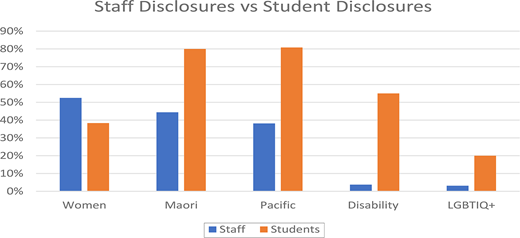
Table 4 compares universities’ reporting on staff and students belonging to the five vulnerable groups by summarising Table 3 results. The table shows that, based on the annual number of times universities did report on the index items comprising each vulnerable group as a percent of the total number of times they could have done so, universities’ primary focus was on Māori (44% for Māori staff and 80% for Māori students), Pacific people (38% for Pacific staff and 81% for Pacific students) and women (53% for women staff and 38% for women students). Although universities’ reporting on disabled students was 55%, their reporting on disabled staff was only 4%. Finally, reporting on LGBTIQ+ was the lowest, with 3% for staff and 20% for students. The paper’s discussion and conclusion explore factors that likely account for this uneven reporting.
The following paragraphs present the results organised by each of the five vulnerable groups, starting with the most disclosed vulnerable group and progressing down to the least disclosed vulnerable group. A fuller discussion and connection of the results with the literature and theory is provided in the paper’s discussion and conclusion section.
Disclosures on Māori and Pacific staff and students
Māori and Pacific students and staff received the most reporting. Table 3 shows high percentages for reporting on index items related to Māori staff representation (83%) (Item 11), Māori student representation (90%) (Item 15), Pacific student representation (95%) (Item 22), Māori student support (95%) (Item 16) and Pacific student support (90%) (Item 23). Reporting related to Māori and Pacific students was more or less consistent for all the universities as most of the NZ universities included information on support available to Māori and Pacific students, KPIs to support Māori and Pacific student participation, and achievement and representation of Māori and Pacific students. In some instances, NZ universities also reported on increases in Māori and Pacific students’ enrolments. For example, the Vice Chancellor’s review in the University of Otago’s 2021 annual report states:
In 2021 our Māori enrolment numbers increased to a record of 2,532 enrolled, up 10.7% on 2020 numbers, while our Pacific enrolments increased by 13.2% to 1,302 students. We also had a record 46 Māori and Pacific students begin doctorates, and a record number of Māori graduates, including more than 100 Māori graduates from the Health Sciences professional programmes including more than 60 new Māori Medical doctors (p.14).
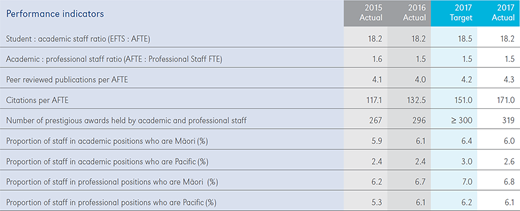
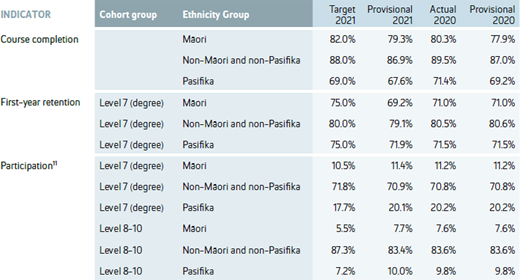
Despite universities making statements about increasing the representation of Māori and Pacific staff, only the University of Auckland and AUT provided statistics or set goals for doing so. Figure 1 provides an example of the University of Auckland’s reporting on Māori and Pacific staff across the three-year period 2015–2017. Several universities – the University of Auckland, Waikato University, AUT and University of Wellington – provide KPIs relating to support for Māori and Pacific students’ participation rates and performance. For example, AUT provides course completion rates, course participation rates and first-year retention rates for Māori and Pacific students in their 2021 annual report (Figure 2).
However, it was noticed that KPIs and other disclosures related to Māori and Pacific staff members were not as extensive and systematic as student-related disclosures. For example, there were low disclosures on Māori staff (44%) compared to Māori students (80%). Similarly, NZ universities disclosed less information on Pacific staff (39%) compared to Pacific students (81%) (Table 4 and Figure 3).
Disclosures on women staff and students
Most of the universities reported on women. As shown in Table 3, index items related to women staff representation (98%) (Item 3) and women student representation (93%) (Item 8) were highly reported on. Disclosures about women in leadership positions were also quite high at 75% (Item 4). However, very few universities disclosed information on goals related to the representation of women on staff (20%) (Item 5) and the representation of women in leadership positions (33%) (Item 6). Unlike Māori and Pacific disclosures that exclusively mention the support available to Māori and Pacific staff members and students, the majority of NZ universities do not disclose information on support available to women staff and students. Universities that disclosed information on support available to women staff mainly provided information about the support available for women employees regarding academic promotions.
Unlike Māori and Pacific groups, where student-related disclosures were greater than staff-related disclosures, Table 4 shows that disclosures on women staff (53%) were greater than women students (38%). In terms of women student disclosures, all universities provided information on female student representation (93%), but only some universities provided information on the support available to women students (20%) (Item 9) and KPIs to support women student participation and achievement (3%) (Item 10). This paper’s discussion and conclusion explore why NZ universities report more about women staff than women students.
Disclosures on disabled staff and students
NZ universities made relatively few disclosures about disabled staff and students compared with the disclosures made about Māori, Pacific and women groups. Table 4 indicates the reporting percentage for NZ universities on disabled groups is 26%. However, the majority of this reporting concentrates on students with disabilities (55%) rather than staff (4%).
Table 3 shows that reporting on index items related to the support available to disabled students is the highest (93%) (Item 30). There is also significant reporting about KPIs to support disabled student participation and engagement (53%) (Item 31). Unlike Pacific and Māori groups, where all universities included information on the Pacific and Māori students’ representation, only four universities (University of Otago, University of Auckland, AUT and University of Canterbury) included information on the number of students with a disability in their annual reports. Furthermore, the University of Otago was the only university to disclose information on the number of students with a disability throughout the 2017–2021 period of this study. As an illustration, the University of Otago’s 2021 Annual Report included the following statement:
In 2021, the University enrolled 2,004 students who identified as having a disability affecting study, which was a massive increase on the 1,699 students who identified in 2020. Support in the form of learning assistance and/or specialised equipment requiring a specific financial commitment was provided to 1,034 students with disabilities in 2021 (2020: 784). 2,228 instances of support were provided in the form of notetaking, assistance with examinations, tutoring, and transcription or typing (2020: 1,734), along with many hours of individual consultations provided by a team of trained advisors (p. 40).
NZ universities’ reporting on staff with a disability was scant. Table 3 shows 8% reporting for Items 25 (reporting on staff with a disability) and 27 (support available for disabled staff). Meanwhile, no university reported on disabled staff in senior/leadership positions or provided KPIs relating to increasing the representation of disabled staff.
Disclosures on staff and students belonging to LGBTIQ+ community
The NZ universities paid little attention to LGBTIQ+ or gender-diverse groups in their annual reports. Table 4 shows that the overall reporting percentage for this group was 10%, which is the lowest of all vulnerable groups. The index items with the most reporting were Items 36 (LGBTIQ+ student representation) and 37 (support available to LGBTIQ+ students). No NZ universities reported on LGBTIQ+ staff in senior/leadership positions (Item 33), KPIs to increase LGBTIQ+ staff representation (Item 35) and KPIs on LGBTIQ+ participation and achievement (Item 38).
Trend analysis and disclosures in addition to annual reports
Table 3 reports the average index item scores for all NZ universities in the five-year period, 2017–2021. The total of the average scores for NZ universities’ for each year is available at the bottom of Table 3. This average is relatively stable. It rises modestly from 14.25 in 2017 to 15.00 in 2020 and then drops slightly to 14.88 in 2021. A repeated measures ANOVA shows that the amount of reporting by any individual university, as well as by the entire set of NZ universities, has not changed over time (Tables not included because the results were not significant).
NZ universities’ vision and strategies for vulnerable groups
RQ2 of this study examines the goals, plans and actions NZ universities are using to promote equal study/work opportunities for vulnerable groups. Because of the forward-looking nature of this research question, a search of the eight universities’ websites for strategic, future-oriented documents was conducted. This search culminated in the collection of 22 separate documents including vision statements, mission statements, strategic plans, academic plans, diversity reports, sustainability reports and a wide range of strategic framework documents (e.g. equity and diversity strategic framework, Māori strategic framework and Pacific strategic framework) (Table 2).
Although all eight universities published vision statements, there was a significant variety in how they were presented. The University of Canterbury, for example, included its mission and vision statements as a part of its Strategic Vision 2020–2030 document. The University of Waikato and AUT used a bullet-point format for their vision statements. Meanwhile, five universities published mission statements (i.e. Auckland University of Technology, Massey University, University of Canterbury, University of Otago and University of Waikato). The Lincoln University, University of Auckland and Victoria University of Wellington did not.
Furthermore, this study found that the specific mention of vulnerable groups rarely featured in the universities’ vision and mission statements. In other words, the forward-looking documents reveal a similar lack of attention to vulnerable groups as the annual reports do. The University of Canterbury and the University of Otago were the only two universities that made any connections to vulnerable groups in their vision and mission statements, for example, using such words as “gender” and “Māori”. The University of Otago’s mission statement made further general references to its commitment to partnership with mana whenua (Māori rights) and upholding Te Tiriti o Waitangi (The Treaty of Waitangi). The University of Canterbury’s combined mission and vision statement made a passing, oblique reference to women and minorities when stating its commitment to “[…] accessible higher education, service to the community, and the encouragement of talent without barriers of distance, wealth, class, gender or ethnicity” (University of Canterbury, 2020, p.12).
A content analysis of the eight universities’ further set of strategic documents (i.e. strategic plans, academic plans, diversity reports, sustainability reports and strategic framework documents) was next undertaken. Table 5 lists each university’s key strategic planning reports and the frequency with which the vulnerable groups are addressed in the reports.
Auckland University of Technology, under its strategic document OUR Directions to 2025 – Theme 5, calls for being an inclusive community that welcomes “people of all ethnicities, genders, sexual orientations, religious and political beliefs, socioeconomic situations, and accessibility needs” (AUT, 2026) Our Directions to 2025, p. 2. AUT’s Diversity and Strategy Action Plan identifies groups toward which urgent action with measurable outcomes are required. These groups are Māori students and staff, Pacific students and staff, women in areas where they are underrepresented, students and staff with disabilities and LGBTIQ+. The plan includes actions related to increasing the percentage of Māori and Pacific undergraduate and postgraduate students, increasing scholarships for qualified applicants from vulnerable groups, increasing the percentage of Māori, Pacific and women senior academic staff, educating hiring committees on diversity issues, setting targets for vulnerable groups’ recruitment and expanding services and supporting staff with disabilities.
Lincoln University’s strategy document Lincoln University Strategy 2019–2028 simply calls for increasing the number of Māori and Pacific students, including postgraduate students. There is no mention of Māori and Pacific staff. Also, there is no mention of learning and teaching-related support available to Māori and Pacific students. This finding reinforces the observed focus by NZ universities on Māori and Pacific students, but not other vulnerable groups.
Massey University’s Strategy 2022–2027 includes a research priority aimed at supporting Māori academic staff research and Māori staff and students’ career development, as well as championing indigenous knowledge development and leadership. Massey’s Learning and Teaching Priority 3 calls for embedding a culture of safety and inclusion to address the diverse needs of its students and removing institutional barriers to support the success of learners from diverse backgrounds, including those with disabilities. Learning and Teaching Priority 4 focuses on Māori student success, Māori learner support and reducing barriers to Māori access, participation and success. Massey University does not specify a strategy to support Pacific students and staff. Furthermore, the university’s strategy does not have any information about increasing the number of Māori students and staff. However, the strategy does call for supporting Māori leadership and targeting proportional representation in key decision-making bodies and processes to improve culture as one of its priorities.
The University of Auckland’s strategy in the document Vision 2030 and Strategic Plan 2025 commits to ensuring a sustainable, fair and equitable society and meeting its responsibilities to Māori and Pacific students. However, the university’s strategic documents fail to mention vulnerable groups in the documents’ sections on “Our Education and student experience Priorities” and “Research and Innovation Priorities”. Additionally, there is no mention of wanting to increase the number of Māori and Pacific staff members in the “People and Culture” section. There are, however, a number of statements scattered throughout other elements of the university’s Vision 2030 and Strategic Plan 2025 that refer to Māori and Pacific students and staff. There are also references to developing targeted recruitment and career programmes for students, albeit without specific details being provided (i.e. actual targets and performance measures).
The University of Otago’s Vision 2040 discloses strategic aspirations of becoming a preferred university for Māori and Pacific students and academics, with a focus on diversity that would be expressed across all levels of the university including its senior leadership. The university believes in supporting and promoting the guiding principles of equity, inclusivity, diversity and reciprocity as a demonstration of its social accountability. The university’s Vision 2040 (University of Otago, 2025) expressly states its focus on Māori and Pacific students and staff. For example, in the section “Our Place in the World”, (p.16) the university states its desire to become a university for Pacific students and support the development of Pacific academic capability. In the section “Transformative student Experiences” (p. 17), the university states its commitment to providing an environment where Māori thrive and succeed as Māori and supporting the needs and aspirations of its Pacific students. In the “Our People and Culture” section, the university states that special attention will be paid to significantly increasing the number of Māori and Pacific staff at all levels.
The University of Otago was only one of two universities, along with Auckland University of Technology, to publish equity and diversity frameworks and diversity and strategy action plans on their websites, and only one of three universities, along with the Massey University and University of Waikato, to publish Māori and Pacific strategies on their websites. The University of Otago’s Equity and Diversity Framework states its “government-mandated” responsibility for boosting the achievement among learners from priority groups such as people with disabilities, refugees and migrant learners in addition to detailing how universities are boosting achievements of Māori and Pacific students. Meanwhile, the University of Otago’s Māori Strategic Framework 2022 ’s Goal 5 focuses on increasing Māori student success by creating an environment that is conducive to Māori student recruitment, retention and achievement. The framework also emphasises growing Māori staff numbers and supporting these staff members’ professional and cultural development. However, the Māori Strategic Framework does not have any goals relating to increasing Māori representation in top leadership positions. The university’s Pacific Strategic Framework’s Goal 1 clearly outlines leadership training and support for more Pacific staff, as part of a plan to transition these staff into leadership positions. In addition, Goal 2 focuses on strengthening targeted support to increase the participation, retention rates and graduation numbers of Pacific students. In other words, the strategic, forward-looking documents of the University of Otago have a Māori and Pacific student and staff focus, but other vulnerable groups do not feature.
The University of Waikato’s Strategic Goals 2022–2024 has a focus on student recruitment, research excellence, supporting academic development and advancing its sustainable development goals. There is no specific mention of any strategy to support any given vulnerable group. However, the university’s Academic Plan includes objectives and targets for increasing its efforts to recruit and retain Māori and Pacific academic staff, design culturally specific learner development programmes for Māori and Pacific students, empower individuals with impairment and use data-informed initiatives to enhance Māori and Pacific student achievement.
The University of Waikato’s Māori Advancement Plan clearly articulates the need for the university to recruit, retain and actively increase the number of Māori staff. Furthermore, it calls for supporting their progression to senior levels, including providing pathways for high performing Māori students into academic positions, with the goal of “having a Māori staffing profile that represents the same proportionality as Māori students by 2030” (University of Waikato, 2022, p. 5). The Plan also includes information on steps the university will be taking to achieve the Plan. Similarly, the university’s Pacific Strategy Plan aims to raise the number of Pacific staff in leadership roles and enhance Pacific student achievement. More specifically, the Plan has seven objectives: growing leadership on Pacific success, promoting Pacific learner success, delivering substantive outcomes for Pacific learners, ensuring high quality teaching and learning support for Pacific students, growing and attracting Pacific staff, growing Pacific researchers and fostering research excellence. As was noted above for both the University of Auckland and the University of Otago, the University of Waikato’s forward looking strategic documents emphasise Māori and Pacific students and staff, with other vulnerable groups not featuring.
Victoria University of Wellington, in its Strategic Plan 2020–2024, states that by 2025, the composition of its students, staff and leaders will fully reflect the gender, ethnic and cultural diversity of NZ. The plan also reflects on its commitment to increase the number of Māori and Pacific students and staff, with specific performance percentage targets being set. Victoria University’s Disability Action Plan 2018–2020 states that it was the first NZ university to endorse Kia Orite, Achieving Equity: NZ Code of Practice for an inclusive Tertiary Education Environment for students with Impairments. Victoria University’s Disability Action Plan has five objectives including awareness of support and engagement, support and development, disability awareness, inclusive environment and practices and support for staff with disabilities. Unlike the targets it has set for increasing Māori and Pacific students and staff representation, Victoria University of Wellington has not disclosed any targets related to students and staff with disabilities.
Overall, the content analysis of NZ universities’ forward-looking strategic documents mirrors the findings from the content analysis of the universities’ annual reports. In particular, the same set of vague references to “equity, inclusivity, diversity and reciprocity” exists, with superficial mentioning of targets and KPIs. Waikato University and Victoria University of Wellington were the marginal exceptions, at least in relation to the targets set for Māori and Pacific staff and students. For example, Waikato University specifically set the goal of having a Māori staff profile that is proportional to its Māori student body. This specific target merely reinforces the findings from the annual report content analysis, which showed a reporting emphasis on Māori, Pacific and disabled student vulnerable groups. Meanwhile, women students and staff, disabled staff, LGBTIQ+ students and staff languish as low priorities in the forward-looking documents. It is likely, therefore, that these latter vulnerable groups will remain neglected in annual reports.
5. Discussion and conclusion
Universities have a responsibility to provide equitable access to education, including for vulnerable people. This is an important issue globally because in modern society people’s background, social and personal circumstances should not create obstacles that prevent them from enhancing their professional skills and achieving their educational potential. As part of their societal obligations, universities have a responsibility to be accountable to the societies they seek to contribute to. This accountability, which is addressed in legitimacy theory, includes reporting on the vulnerable groups with which universities interact.
Counter to the expectations of legitimacy theory, this study finds that NZ universities make limited disclosures on vulnerable groups, especially women students, disabled staff and LGBTIQ+ staff and students. Such a finding runs counter to what legitimacy theory would suggest. In particular, moral legitimacy would require universities, especially because they are publicly funded, to disclose on issues that are deemed important by the society where they operate.
Alongside NZ universities’ failure to report on vulnerable groups was their failure to produce annual reports and strategic documents that clearly stated and addressed their policies, actions and performance toward vulnerable groups. The opaque nature of the universities’ reports and documents makes it difficult for the reader to understand what the universities are trying to do, how serious and genuine they are being, and what they have accomplished. These problems could be partly ameliorated if universities provided a dedicated sustainability report like the lone 2021 report which Waikato University published. This report included a section on how its strategic planning, strategies and policies are meant to help safeguard vulnerable groups. Future research could explore why NZ universities generally do not publish sustainability reports and what policies and incentives might help overcome this failure.
It is important to note that while there is a general lack of reporting by universities on vulnerable groups, significant differences in reporting between vulnerable groups exist. In particular, Māori and Pacific groups receive the lion’s share of reporting. Women, disabled people and members of the rainbow community receive considerably less attention.
The general dearth of reporting on vulnerable groups, although not consistent with legitimacy theory, is consistent with other empirical findings (Adams and McPhail, 2004; Duff and Ferguson, 2007; Adams and Harte, 2000; Adams et al., 1995). For example, Adams et al. (1995) find that British Telecommunications Plc made only a passing reference to disabled employees. Duff and Ferguson (2007) observe a similar dearth of reporting on disabled people by UK accounting firms. Meanwhile, Adams and Harte (2000, p. 64) conclude that equal opportunity reporting in the UK is “[…] very limited, consisting of only a statement of policies, with some limited reference to initiatives and membership of organisations”.
A second key finding of the present study is the failure by universities to lift their reporting on vulnerable groups over time, a finding which again runs counter to legitimacy theory. Instead of enhancing their reporting over time, the universities applied what can best be described as a perfunctory approach to their reporting. In many cases, the disclosures seemed to comprise a copy-and-paste from the previous year. This mechanical approach was accompanied by a general failure to provide targets and KPIs for the vulnerable groups. The few targets and KPIs that were reported on emphasised domestic and international student enrolments and revenue. Furthermore, on the limited occasions when targets and KPIs were provided for vulnerable groups, there was a failure to offer a comparison of the current year’s performance against a target. The copy-and-paste approach of repeating the same information across multiple years, together with the lack of targets and KPIs, offered little opportunity for the universities to enunciate long-term visions on which they could subsequently report.
The twin findings of NZ universities’ general lack of reporting and failure to lift their reporting over time is inconsistent with legitimacy theory. As noted in the literature review, pressure on NZ universities to seek moral legitimacy comes from a variety of sources. Indirect pressure exists from institutions such as the NZ Human Rights Commission (HRC) (2012) and other relevant international bodies in which NZ participates (e.g. UNESCO Convention against Discrimination in Education). Both sets of organisations have recognised the vulnerability of the five groups studied here. Meanwhile, a more direct form of pressure on universities is applied by the NZ TEC. The Tertiary Education Strategy 2025–2030 (Ministry of Education, 2025) emphasises the importance of access to education irrespective of background and circumstances. This strategy specifically mentions Māori, Pacific People, disabled people and those from low-income backgrounds. The NZEducation and Training Act (2020) also emphasises the need to ensure inclusivity for all learners. Moreover, the TEC’s equity fund provides targeted funding to tertiary education providers in NZ to support Māori, Pacific and Disabled learners.
Although the purpose of the present paper is not to identify or examine the factors associated with NZ universities’ meagre and selective reporting on vulnerable groups, we do offer some general remarks that seek to provide preliminary advice and may hopefully steer future research. First, for moral legitimacy to work, the amount of moral pressure exerted must be sufficient to trigger an organisation’s legitimacy-seeking behaviour. Despite the presence of NZ institutions that are capable of exerting moral pressure on universities, with the HRC being a prime example, it is possible that the amount of moral pressure they exert is inadequate. This possibility is specifically alluded to by Guthrie and Parker (1989), who observe how internal dimensions such as managerial discretion, strategy and internal priorities, together with managers’ perceptions of social expectations, can moderate organisations’ CSR disclosures (Campbell, Craven and Shrives, 2003). Guthrie and Parker (1989) use this understanding to argue how insufficient societal pressure may account for what they term as their case organisation’s “impervious” attitude toward proving its social values are aligned with social norms.
Perhaps, the same phenomenon that Guthrie and Parker (1989) observed at BHP is also occurring at NZ universities. More specifically, the pressure that an organisation like the HRC exerts on universities, which includes advocacy and disciplinary mechanisms, may be insufficient to trigger universities’ legitimacy-seeking behaviours. Instead, perhaps it is the combined effect of the HRC’s and TEC’s pressure on universities that causes the latter to disclose about some of the vulnerable groups. In particular, the TEC’s focus on student achievement, as opposed to university staff, might explain the significantly higher disclosures universities make on student versus staff for the vulnerable groups of Māori, Pacific, disabled and LGBTIQ+. It must be remembered that the TEC has the power to withhold portions of a university’s funding if the university is deemed not to be meeting its responsibilities. Of course, this idea that there is a minimum cumulative moral pressure needed to trigger a university to report on vulnerable groups does not appear to hold for woman students. The study’s findings show only a modest amount of reporting on women students, with the amount being less than what is reported for women staff. Furthermore, this meagre reporting is occurring despite the fact that TEC has an education strategy for increasing women’s representation in several STEM (Science, Technology, Engineering and Mathematics)-related fields.
A second possible explanation for NZ universities’ limited and selective reporting on vulnerable groups can be found in the theorising of de Villiers and van Staden (2006), Belal and Owen (2015) and Tilling and Tilt (2010). These scholars argue that legitimacy theory can still explain situations in which organisations reduce or even cease their disclosures. For example, de Villiers and van Staden (2006) posit seven reasons, all being consistent with legitimacy theory, for why an organisation might reduce its disclosures. These reasons range from a decrease in societal concern about the organisation’s activities to a change in societal perceptions about what constitutes a vulnerable group to the organisation’s senior managers perceiving that the disclosures are useless to their legitimation efforts (Tilling and Tilt, 2010). As an illustration, de Villiers and van Staden (2006) associate the finding of a decrease in voluntary disclosures made by their sample of more than 140 companies listed on the Johannesburg Securities Exchange during the period 1994–2002 to a change in societal expectations, which permitted the reduced reporting to occur without a loss in the organisations’ legitimacy.
Just like what de Villiers and van Staden (2006) observe in their sample, perhaps the NZ universities were similarly motivated. Namely, the universities concluded that their disclosures on vulnerable groups, or at least the groups not specifically mentioned by the TEC, were unnecessary and unneeded for maintaining moral legitimacy. The TEC has explicit strategies for and has developed an equity fund to support Māori, Pacific and disabled students (Ministry of Education New Zealand, 2023a, 2023b; Tertiary Education Commission, 2024a, 2024b). The equity fund aims to help cover the costs of any additional support some learners may need, with this funding being directly provided to the university. Both the TEC’s equity fund and its education strategies for Māori, Pacific and students with disabilities require universities to report on their performance in supporting Māori, Pacific and disabled students. In other words, regulatory requirements, and the implicit prioritising of Māori, Pacific and disabled students, may be signalling the irrelevance of reporting on other vulnerable groups. Support for this idea comes from studies which show that disclosures are largely a function of legislative requirements (Guthrie and Farneti, 2008; Adams and Harte, 1998), although these findings are derived from research studying listed companies.
A third possible reason for the findings being inconsistent with legitimacy theory may relate to the compositions of NZ university councils, which are the governing bodies of the universities. These councils mostly comprise businesspeople. Since 2017, all NZ Stock Exchange-listed companies must report on their gender diversity (NZX, 2023). This requirement includes the formulation and operation of a diversity policy with measurable objectives that allow the annual assessment of progress against these objectives, as well as the annual reporting of the numbers of women and men at board level, senior management level and across the entire organisation. The businesspeople that serve on NZ university councils, and who commonly are also on the boards of listed NZ companies, would be familiar with the NZX’s diversity policy and disclosure requirements. Being ultimately responsible for their universities’ annual reports, it is understandable that universities’ reporting on women staff, who are employees and, therefore, meet the requirements of the NZX regulation, would match these councillors’ expectations.
The present research should help policymakers gauge and compare against benchmarks the extent to which NZ universities are currently recognising and assisting individuals belonging to vulnerable groups. Such an understanding will assist in the formulation of future policymaking and the potential adoption of regulation about expected standards of organisational reporting. This study also assists universities in planning appropriate support for students belonging to vulnerable groups by incentivising their enrolments, fostering an inclusive culture that discourages and penalises any form of discrimination and establishing a system that tracks the performance of students from vulnerable groups while providing continuous support throughout their studies. This study also highlights the importance of clear policies, strategies and KPIs for measuring outcomes such as enrolments, attrition, course completion and employment support and how these indicators can be improved by providing better support. In relation to vulnerable staff members, universities should develop clear policies and strategies to ensure adequate representation of staff from vulnerable groups, provide support for career progression, facilitate their representation in senior leadership teams and offer flexible working arrangements to accommodate their needs. Similar to vulnerable students, the use of clear policies, KPIs and continuous reporting in annual reports can help demonstrate accountability towards vulnerable groups and a commitment to providing adequate support for booth staff and students.
The present research should also benefit scholars, especially those who research in the area of equality, organisational accountability and sustainability. These researchers will find the present study offers opportunities for further informing and operationalising organisations’ interactions with stakeholders who belong to vulnerable groups. And finally, the present research should prove helpful for practitioners. They will be able to use the present research findings to benchmark their own annual disclosure practices relating to vulnerable groups.
The usual set of limitations and caveats apply to the present study. This study was undertaken for exploratory purposes, and whether the findings apply to universities elsewhere cannot be ascertained. Also, the strategy-related documents content analysed in this study were the documents, irrespective of their dates, available on the NZ universities’ websites. Another limitation is that this research focusses only on universities; therefore, its findings may not be applicable to other organisations.
Despite the possible limitations, this study successfully begins the process of addressing organisations’ obligations for and reporting of their practices and policies on vulnerable groups. Future research could usefully build upon this study by examining a wider set of organisations and including a further range of data collection techniques. This study used content analysis to examine type and number of disclosures. Future studies can examine the quality of disclosures by following the disclosure quality measurement approach followed by Adler, Mansi and Pandey (2018). In fact, a case study approach that includes interviews with the organisational decision-makers responsible for the disclosures their organisations make and with various stakeholders who influence these organisations’ reporting would likely help inform the legitimacy strategies organisations use to deal with the societal pressures they face (Reast, Maon, Lindgreen and Vanhamme, 2013; Belal and Owen, 2015).
The actions organisations are taking to respect and protect the rights of vulnerable groups continues to be an important and central societal issue. This study addresses the issue to make regulators, practitioners, policymakers and organisations aware of these vulnerable groups and their rights, as well as to help offer an indication of the further efforts required of NZ organisations to reach the NZ Human Rights Commission’s ambition of “A fair go for all”:
The notion of everyone getting a fair go is a deep-rooted principle of New Zealand society. This perhaps arose from New Zealand’s migrant origins in seeking a better life, and certainly finding early expression in the Treaty of Waitangi’s promise of an equal entitlement to the rights and privileges of British subjects. But do all New Zealanders, regardless of the colour of their skin, ethnicity or national origin, get the same opportunity for good health, a good education, decent work and an adequate standard of living? The figures clearly say no, and the question to ask is what are the barriers to people of different ethnicities and cultures getting the same start in life, having the same opportunities, and collectively having broadly similar outcomes (New Zealand Human Rights Commission, 2012, p.2).