This mixed-method study investigates distance education students’ desire to interact and the support for community building available to them at a department-wide level in a graduate-level instructional systems technology program. Distance education students’ interactions are compared to those of the department's residential students. A modified version of Rovai's Classroom Community Scale (Rovai, 2002) for measuring program-level sense of community is piloted. Levels of student interactions with others in the department are compared to students’ reported satisfaction with courses and the program as a whole. Student suggestions for changes or additional opportunities for interactions within the program are discussed.
Introduction
This study is set in an instructional technology department within a large Midwestern university. In addition to a residential master's and PhD program, the department also offers fully online distance master's and certificate programs. This study investigates students’ perceived sense of community, whether students have a desire to interact at a program- or department-wide level, and how students perceive the program supports these types of interactions. Student suggestions for changes or additional opportunities for interactions within the program will also be discussed. A modified version of Rovai's Classroom Community Scale (2002b) for measuring program-level sense of community was piloted.
Theoretical Framework
Distance education has been traditionally seen as primarily involving communication between an instructor and individual students, frequently separated by both geographic distance and by time. However, as Web-based technologies mature and distance courses are used to teach more diverse subject matter, the definition of distance education is being expanded to include interactive, two-way communication (Gunawardena & McIsaac, 2004).
Retention issues are a particular concern for universities supporting distance education options. The dropout rate in distance education programs has been cited as anywhere between 10 and 50 percent in various studies (Berge & Huang, 2004; Ludwig-Hardman & Dunlap, 2003; Raven, 2000; Rovai, 2002a, 2002c; Tyler-Smith, 2006), and is generally assumed to be 10-20% higher than in traditional programs (Rovai, 2002c; Tyler-Smith, 2006). Reasons for retention issues are complex and include the students’ backgrounds and student support available at the university level, as well as interaction and sense of community (Berge & Huang, 2004; Rovai, 2002c; Tyler-Smith, 2006). Literature reviewed suggests that a sense of community supports student retention and success (Dawson, 2006; Shea, Sau Li, & Pickett, 2006).
McMillan and Chavis (1986) defined community as “a feeling that members have of belonging, a feeling that matter to one another and to the group, and a shared faith that members’ needs will be met through their commitment to be together” (p. 9) Based on a review of previous literature, Rovai (2002a) supports this view and theorizes that there are four main components of classroom community: a sense of membership in the community and feelings of friendship between members of the learning community (“spirit”); a perception that community members can be trusted and relied upon to be genuinely interested in one another's welfare and supportive of one another's learning (“trust”); a sense of mutual benefit from interactions both in supporting specific tasks and in fulfilling social or emotional needs (“interaction”); and a transformative interactive learning process through which students meet their common learning goals (“common expectations: learning”). Wilson (2001) argues that this sense of community “can be designed for, supported, and assessed as a learning outcome, instrumental in meeting other individual and group learning objectives,” and goes on to recommend a number of ways that technology can support sense of community in a distance education setting.
A number of studies investigate sense of community among students at the course level within distance education programs. For example, Rovai (2002d) conducted a study of 27 online courses examining whether sense of community was related to perceived cognitive learning and persistence in online courses. He found that sense of community has an impact on both dropout rate and perceived cognitive learning, which are important factors in program-level success. Ludwig-Hardman and Dunlap (2003) conducted a case study about the impact of learner support services for online students. Although the scaffolding described in their study focuses on building course-level sense of community, similar scaffolds might be useful at a program level.
Models for developing quality distance education programs frequently mention the importance of program-level sense of community (Council of Regional Accrediting Commissions, 2001b; Ludwig-Hardman & Dunlap, 2003; The Faculty Initiative, 1998; Wilson, 2001). The Council of Regional Accrediting Commissions (2001a) includes in its best practice some recommendations “including off-campus students in institutional publications and events, including these students in definitions of the academic community through such mechanisms as student government representation, invitations to campus events including graduation ceremonies, and similar strategies of inclusion” (p. 12). Wilson (2001) suggests offering “extended opportunities for collaboration … user-friendly communication tools … [and] tools for organizing, evaluating, and publishing knowledge, available to all group members with expectations for use” (p. 4). However, based on our review of the literature, there appears to be little empirical information on the relationship between program-level sense of community and student satisfaction or success in distance programs.
In an earlier evaluation of the distance education program examined in this study, investigators found tentative evidence to indicate that students felt a connection with individuals (including peers and instructors) in courses they were currently taking, but little sense of community at a program level (Bichelmeyer et al., in press). This study was designed to take a closer look at the ways students typically interact with other members of the program, and how their interactions impact their own sense of community and satisfaction with courses and the program as a whole. A mixed-methods approach was used to gain a deeper understanding of the issue. Data from residential students enrolled in the same program were used as a baseline for comparison to understand student levels of interaction and “sense of community.” Research questions included:
Does the degree of sense of community felt by distance students differ between distance and residential students enrolled in this program?
Do the levels of interaction with other individuals in the program differ between distance and residential students enrolled in this program?
What factors influence distance education students’ desire for sense of community within this program?
What contributes to distance education students’ sense of community within this program?
How do students feel their sense of community can be improved within this program?
Method
Setting
This study focuses on an instructional technology program in a large Midwestern university. The program includes the following options: distance master's, distance certificate, residential master's, and residential PhD. This study focuses on the distance options. Residential master's students were also surveyed to allow the researchers to compare distance students to a comparable population. Both the distance master's and distance Certificate programs include largely the same courses as the residential master's program. However, the residential students have more options within both IST courses and elective courses. Most residential courses require group work for completing course assignments. As is typical in residential programs, residential students have many opportunities to interact within and outside of class, especially within a common computer lab area reserved for graduate students in this program, which is often an area in which students eat lunch, work together on projects, or work individually between classes.
There are 10 IST courses offered in the distance education program. Four “core” courses, which are mandatory for all residential and distance Master's students, are each designed to include a number of group and individual projects, focusing on analysis, design, development, production, and/or evaluation. Additionally, students are to engage in whole-class discussions in all of the core courses. Three of the core courses require students to work in groups and/or give feedback on each other's work. The amount of whole-class discussion and group discussions or assignments in other courses depends on the individual instructor. In a previous study of this population, it was noted that techniques used vary widely between instructors and between courses taught by individual instructors (Bichelmeyer, et al., in press). The most commonly reported techniques used by faculty include: having students do real life projects with real clients, having student-led weekly asynchronous discussions on readings or the topic of the week, chat, group projects, and reading articles.
Participants
Approximately 100 students are active in the distance education program, although not all students are enrolled each semester. The 87 students enrolled at the time of the study were invited to participate. Twenty-nine participated in a survey. Of those who completed the survey, 76% are enrolled in the master's program and 24% in the certificate program. Eighty percent currently work full time, and 16% work part-time, most in education-related fields. Sixty-four percent are female and 36% are male. One hundred percent are U.S. citizens who currently live in the United States, although only 24% live in the state in which the university is located. Twelve percent are in the first year of their program, while 64% have been in the program for 2 to 4 years. Seven of the distance students agreed to participate in follow-up interviews. Five were females and two were males.
Data were collected from the program's residential students. All nine residential master's students participated in the survey. Only one student currently works full time, while 6 (67%) work part time and 2 (22%) are not currently employed. Five (55%) are female and 4 (44%) are male. Four (44%) are U.S. citizens and five (56%) are not. All but one are in the first year of their master's program.
Data Sources
All distance education students (including both master's and certificate students) and all residential master's students in the department were sent an e-mail invitation to participate in an online survey. The survey collected three types of data. The first set of questions replicated and expanded upon questions used in the earlier study of this population (Bichelmeyer, et al., in press). These questions were designed to measure how frequently students interacted in various ways with peers and faculty within their classes, peers and faculty outside of their classes, and others in the program. The second set of questions were modified from Rovai's Classroom Community Scale (Rovai, 2002b) to address program-level sense of community (for example, the item “I feel that I can rely on others in this course” was modified to read “I feel I can rely on others in the department”). The third set of questions addressed students’ level of satisfaction with the amount of interaction they had with individuals in the department, their satisfaction with courses, and their overall satisfaction with the program. Most items consisted of sets of closed-ended, Likertscale questions. An additional open-ended question asked students for suggestions for improving the sense of community in the department. Data from an earlier survey administered to the same population (which made part of a larger study) were also used to triangulate student suggestions. Finally, students were asked a number of demographic questions. Those who were willing to participate in interviews were asked to provide an e-mail address.
Seven distance students participated in semi-structured interviews designed to gain a deeper understanding of how students define “sense of community” and what impacts their feeling of community within the program.
Data Analysis
T tests were performed to compare responses of distance education and residential students on survey items relating to sense of community. Mann-Whitney median tests (nonparametric independent two-group comparisons) were performed to compare responses of distance education and residential students on time spent interacting with various parties. Based on the findings from the survey responses, the third, fourth, and fifth research questions were refined. In order to answer these questions, the open-ended survey item and interview transcripts were analyzed using constant comparative method (Lincoln & Guba, 1984) to explore the third, fourth, and fifth research questions. Emergent themes illuminated results found in the quantitative data and suggest where further analysis is needed.
Limitations
This study addresses the experiences of students within one particular graduate distance program. Most students in this population are already working professionals and have both support systems and significant responsibilities at home and at the workplace. The findings of this study may not apply directly to other programs, such as undergraduate programs or programs in which students are required to attend some courses or some course sessions on campus.
A total of 29 distance students (over 25% of the distance population) and 9 residential students (100% of the residential population) participated in the study. Due to the small sample size, the possibility of sampling error was high. Demographic data were obtained for distance education students enrolled in the program during the following school year, and compared to the data for the students who participated in this study. Within the population of actively enrolled students from the following year, 58% were female and 45% were male (compared with 64% female and 36% male in the sample for the survey). Within the population of actively enrolled students, 97% are U.S. citizens. One hundred percent of survey participants were U.S. citizens. These two comparisons may indicate that the survey participants were fairly representative of the overall student body.
Seven distance students (about 28% of survey respondents accounting for 7% of the overall distance population) were interviewed. Although it is possible that less engaged students were less likely to participate, interview findings did show a range of views about the balance between academic and non-academic life and a range of feelings about the concept of sense of community.
Findings
How does distance students’ sense of community compare to residential students’ sense of community?
Students surveyed responded to a ten-item Sense of Community measure (modified from Rovai's Classroom Community Scale). On average, distance students scored 21.75 out of 50 possible, while residential students scored 21.89. The mean score was not significantly different between distance and residential students.
Students were also directly asked “Overall, how connected do you feel to the IU IST community?” (with a 6-point likert-like scale ranging between “very satisfied” (3) and “very dissatisfied” (−3)). Once again, there was no significant difference between distance and residential student averages. The average score for distance students was 0.46, very close to neutral. The majority of distance students (17/ 28) indicated that they felt “somewhat connected” while six (of 28) indicated they felt “somewhat disconnected.” Only three felt “connected” or “very connected”, while two felt “disconnected” or “very disconnected.” In comparison, residential students averaged 1.33, between “somewhat connected” and “connected.” Six of nine residential students felt “connected,” with 2 feeling “somewhat connected” and 1 feeling “disconnected.”
How does distance students’ level of interaction compare to residential students’?
Residential and distance students interacted with others within their classes to varying degrees. Mann-Whitney U tests were performed to determine whether there was a significant difference in the frequency of interactions with various groups between the distance and residential students.
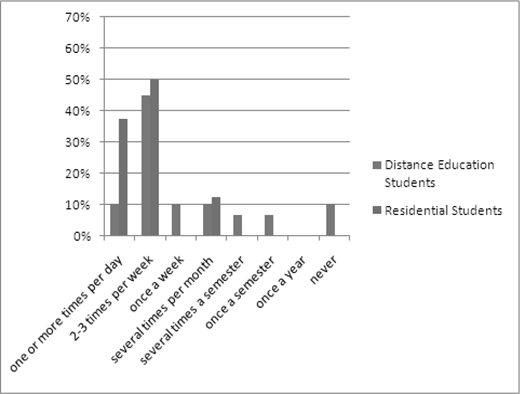
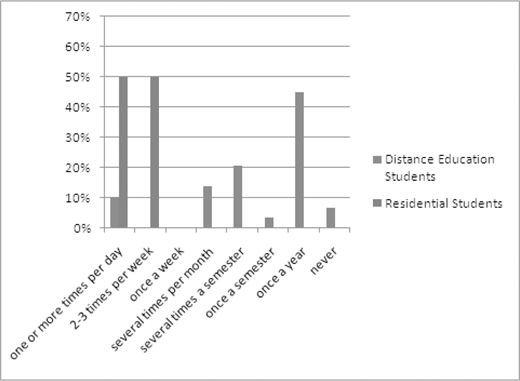
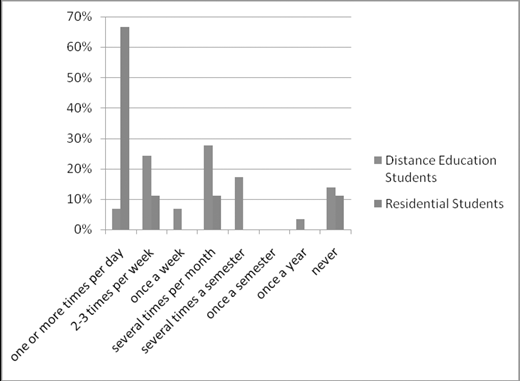
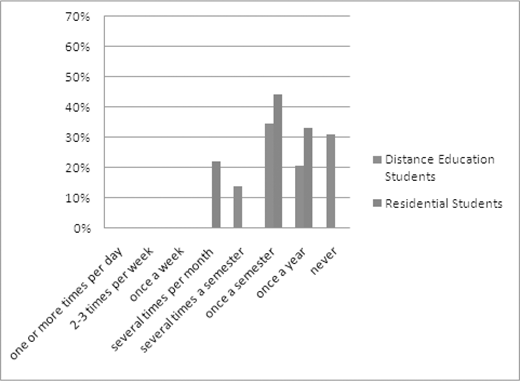
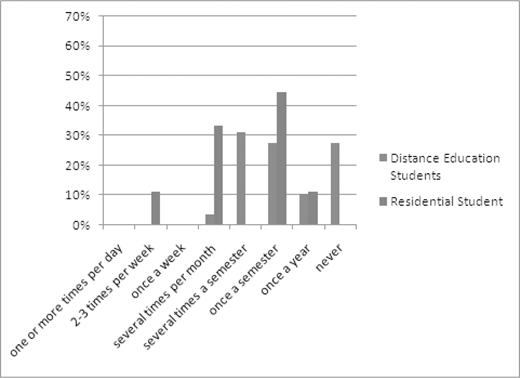
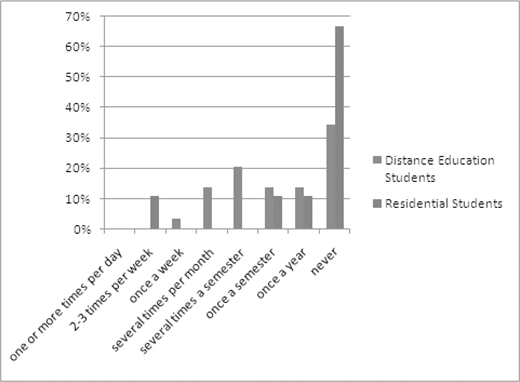
A significant difference was found between distance and residential students in whole-class interaction (U + 63.0, p < 0.05), small-group interaction (U + 38.0, p < 0.01), and one-on-one with other students currently enrolled in their classes (U + 53.5, p < 0.01). This is not very surprising, since residential students typically meet one or more times a week as a whole class. They also frequently participate in in-class small group activities within this program, as well as having many opportunities to interact with one another on campus outside of formal class sessions. As can be seen in Figure 1, nearly all residential students interacted with the entire class several times a week. In comparison, about 25% of distance students interacted at a class level infrequently or not at all. Similarly, as seen in Figure 2, residential students participate in small-group activities several times a week or even daily—unsurprisingly, due to the nature of the residential “core” courses as described in the setting section above. Distance student interactions with small groups vary much more significantly, with many students interacting with small groups only once a year or a few times a semester. This is likely due to the fact that many distance students are only enrolled in one course at a time and not all courses include group work. Unsurprisingly, residential students interact frequently with individual peers, while distance students have less frequent interactions, as seen in Figure 3. However, 83% of distance students do have some interaction with individual peers at least several times a semester, and only 14% indicated that they never contact other individuals in their courses.
No significant difference was found between the time spent interacting with course instructors or assistant instructors, indicating that instructors and assistant instructors are giving individual residential and distance students equal time in this program.
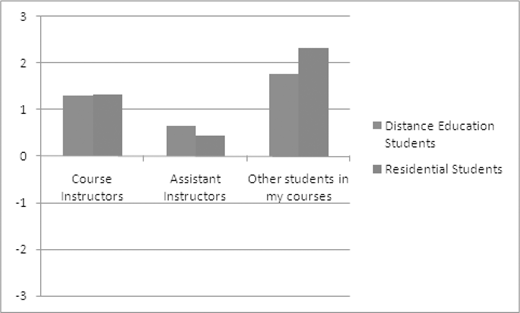
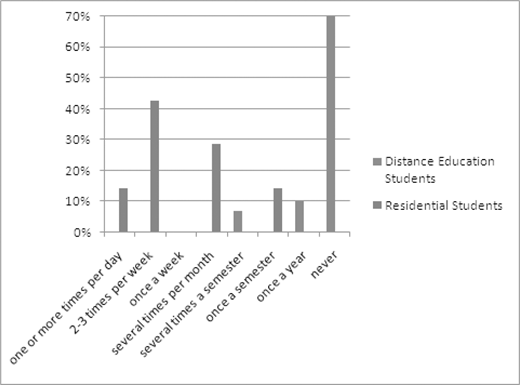
Figure 4 illustrates levels of satisfaction with instructors and other students enrolled in courses. There is no significant difference between residential and distance students in levels of satisfaction with instructors, assistant instructors, or other students. Both groups are satisfied with their interactions with instructors and students. Neutral levels of satisfaction with assistant instructors are likely due to the absence of assistant instructors in some graduate classes.
As seen in Figure 5, although the average level of interaction with a student's advisor was not found to be significantly different, dis tance students appear to have had quite different experiences with their advisor. Nine (of 28) distance students have never interacted with their advisor, while six interact with their advisor once a year and 10 once a semester. In contrast, all of the residential students interact with their advisor at least once a year, and two (of nine) interact with their advisor several times a month. Similarly, 8 (28%) of distance students have never had a communication with faculty not currently teaching their courses, and the great majority of those who have had any communications have not had very much (see Figure 6).
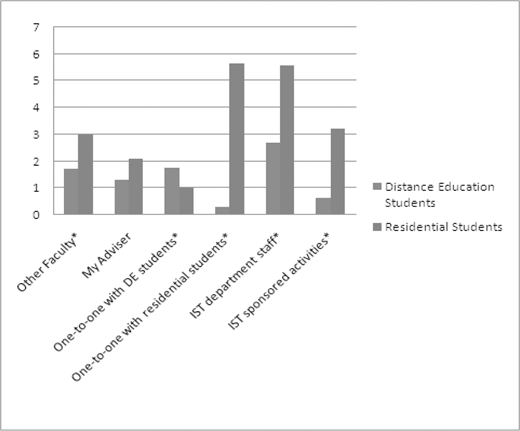
Although there were significant differences in the level of interactions with residential students not enrolled in classes (U + 2.0, p < 0.01), this is not surprising, since distance students may not have many opportunities to interact with residential students (See Figure 7). More notably, neither distance nor residential students interact much with distance education students not currently in their classes (See Figure 8). On average, distance education students communicate with their peers between once a year and once a semester. However, on closer look it is clear that distance students vary quite a bit in their levels of interaction with one another. Ten of 28 distance students never interact with their peers outside of their classes, while five of 28 interact with peers once a week. The majority (17 of 28) interact with peers infrequently—between once a year and several times a month.
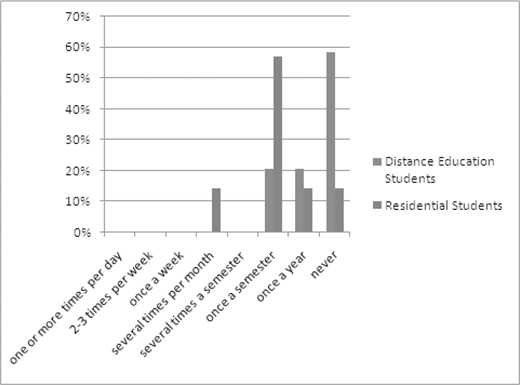
Mann-Whitney U tests indicate that distance students participate less frequently in departmental activities (U + 41.5, p < 0.01). As seen in Figure 9, although neither group participates extremely frequently in departmental activities, these are much more available to residential students, the majority of which participate at least once a semester in such activities. In contrast, 59% (17 or 29) of distance students have never participated in these department-wide activities.
Figure 10 summarizes student satisfaction with their interactions with individuals outside of their classes. Distance education students show significantly more satisfaction in their interactions with other distance students when compared with residential students (t(35) = 2.569, p < 0.05) and residential students show significantly more satisfaction with their interactions with other residential students (t(35) = −2.745, p < 0.05). Distance students are divided in their level of satisfaction with interactions with other distance students. Nine (of 28) indicate that interaction with other distance students outside of their classes is “not applicable,” while 11 are satisfied or very satisfied and 3 are somewhat or completely dissatisfied. Surprisingly, the majority of residential students (5/9) indicated that they were dissatisfied or very dissatisfied with their interactions with distance students outside of classes, perhaps indicating that they had hoped for more interactions. Once again, distance students were split in their feelings about their interactions with residential students outside of their classes. Fifteen distance students indicated that interaction with these residential students was “not applicable” to them, while six (of 28) showed some level of dissatisfaction and seven showed some level of satisfaction with their interactions with residential students. These findings would seem to indicate that some students are interested in contact with their distance and residential peers outside of classes while others are not interested in these types of interactions. These factors are discussed further in the following sections.
What factors influence distance education students’ desire for program-level sense of community?
Although the analysis of the numerical data discussed above indicated that distance education students feel a similar level of sense of community to residential students in this program, it is possible that distance students’ desires and expectations regarding sense of community differ from the classical definitions of sense of community. Therefore, interview data were used to gain an understanding of students’ definitions of sense of community, as well as other factors that impact their desire for connection to a community.
Of the seven students interviewed, four gave their own definition of what they believed “sense of community” entails. Two defined it in terms of knowing others. One said “It's getting a level of familiarity or fraternity … where you know a person well enough to converse with them informally, know what their interests are, and you can be friendly.” Further interview findings (discussed in more detail below) indicate that the majority of students interviewed have some desire for a feeling of friendship with their peers, and that the feeling of being recognized and remembered was important to them. Students also frequently expressed their desire to feel known by professors, expressing disappointment that they did not get to know many of the faculty well, particularly those they had not had as instructors.
Two of the students who provided a definition of sense of community referred to the feeling of being part of a group which has “goals, objectives, and you understand them and are a part of them, and you contribute to the development and success and reaching those goals.” The survey data discussed earlier indicated that students generally participate in some level of small-group interaction. Four out of seven students interviewed indicated that they were satisfied with their interaction with classmates, indicating some level of interaction with groups formed at the course level. However, this may fall short of students’ desire to feel part of a group. One student specifically indicated that she had expected to have more interactions when she joined that program, but found that most of her peers did not share her expectations or the belief in the value of social interactions within the program. This is likely due to students’ own backgrounds and constraints.
Although student backgrounds varied, the majority of students surveyed (80%) work full time and only 4% (one student) does not work at all. Six out of seven students interviewed indicated that work, family, and geographic constraints were important factors in their decision to enroll in a distance program. Five interviewees specifically mentioned work and home constraints as a factor in their decisions to participate in extracurricular interactions with peers or others in the program. One stressed that “any free time I have, I want to be with my family.” Another explained more explicitly that interacting with the community outside of school-work was “nice to have,” but that “after you eat, commute to work, the facts of life, it can be hard to fit that time in, mak[ing] exploring things with the community in IST beyond the assignment for the week really optional.” He explained that support from this community wasn't necessary for him, because “being in a large corporate environment for a number of years… I am busy and challenged and have developed my own network locally for some support.” This is likely in contrast to residential students, most of whom moved to campus to attend the program and do not work full-time.
However, six out of seven students interviewed expressed a desire for some level of interaction with the community. One student indicated that when she joined the program she “was very much looking for opportunities to become involved with other people” outside of her course-work. She was disappointed to find that many of her peers did not seem to be similarly interested in engaging with her outside of course work. Although other students were not as disappointed as she was in the current level of interactions, four others indicated they would enjoy increased opportunities to interact with their peers, faculty members, and the larger IST community more frequently than they currently do. Three students indicated that participating in this program was part of a move to a new career, and indicated that interaction with the department was important in helping them learn about their new field. One explained that she felt that this community was replacing the role of membership in professional organizations related to her previous career. Another said “you don't go to college just for a degree—some people do, but I didn't. I want to learn more about the industry and the field. So establishing these relationships [was] kind of important to me.” Two students also anticipated that their peers would be valuable resources for professional networking in the future. Only one student indicated he had no desire for a feeling of community or interaction with his peers or others in the program. He explained, “I take one class a semester and it challenges me. It's exactly what I need. The other parts, community, and all that … I'm an old fart, that's just not what I need in my life.”
What factors contribute to distance education students’ program-level sense of community?
Students interviewed mentioned a number of areas in which they were satisfied with their levels of interactions with individuals in the program. Five (of seven) students interviewed described positive interactions with faculty members. Four students discussed positive interactions with classmates, which sometimes lead to friendships with a small number of individual students. Where possible, they kept these friendships up through e-mails, phone calls, and face-to-face meetings. Many of these relationships appear to have grown between members of groups who worked on class projects together.
Students indicated that some instructors were particularly good at facilitating interaction in their classes, using technologies including videos (recordings of classes or individualized feedback from professors), teleconferencing, voice over IP, chat sessions, discussion forums, and e-mail. Students stressed that the techniques used by faculty members were very important, and gave specific examples of professors who did a good job at facilitating interaction and responding to students, and those who did not. Students indicated their belief that the instructors’ comfort level with the technologies available was a major factor in how well instructors were able to provide meaningful interactions within their courses.
However, students do not appear to have many opportunities for connecting to the larger community outside of what is provided in individual courses. Students felt that they did not generally have any way to connect to faculty who do not teach their courses, especially full-time professors on campus. One indicated that she wondered if professors she had had courses with would remember her. “It seems you need a face to remember people…. So I don't feel I would be remembered—because I haven't. You ask a professor something and you think they will remember you, but they don't.” She went on to wonder whether this could be helped, or whether it is “just the nature of a distance program.” Two students also stated that they felt that the adjunct professors themselves were disconnected from the campus community. Other than friendships that had formed with a small number of peers, students generally did not describe many interactions with other distance students outside of their classes. Interviewees also mentioned a lack of connection with residential students. Two mentioned that the residential and distance students seemed to form two distinct communities without much chance to interact. Students appeared to put a lower value on meeting residential students than on meeting their distance peers, but they did express curiosity about residential students and their research interests.
Five out of seven students discussed the impact of face-to-face contact (or lack thereof). One noted “Some of [the residential students] … I know [their] names, but not that I [would] know [them] if we passed the street.” She went on to explain that there are a few students she felt she could e-mail if she had a question, but went on to say “I feel like a distance student. I am sure a residential student would feel very different. But that's just the way things are.” Others mentioned their delight in having met one or more of their peers face-to-face. In reference to her first face-to-face meeting with one of her peers, one said “you have to understand that for me to meet [her] … was really a big deal…here's a person I'd taken 3 classes with, and I didn't know what she looked like!” Interestingly, one of the students who indicated he felt a low need for interaction outside of what was necessary for coursework indicated that he had promised himself to visit the campus at least once before graduation, as well as planning to graduate on campus. He went on to say that he specifically planned to meet a full-time faculty member he admired and wanted to meet other faculty members and residential students as well. However, one-time campus visits did not always meet students’ expectations. One student described her own experience of dropping in on a colloquium lecture when in town on one occasion. She explained “it was ok but socially awkward… one of those situations where a new person came off the street and they didn't know who I was. I should've worn a ‘who am I’ tag.” It was clear that such unplanned opportunities do not necessarily help students interact with the community.
Three of the students interviewed visited the campus for an on-campus event that was designed to bring together distance and residential students in a small conference setting. These students indicated that they were excited by the opportunity to meet and interact with the professors outside of classes, or with faculty members who did not teach their classes. One said, “as a distance student, I never get the opportunity to meet any of the professors. So it was really exciting for me to attend the session with [an emeritus professor].” Several were pleased to have met their advisor for the first time during the same event. Students were also excited to meet their peers. One said that the evening reception was her favorite part of the event, because it allowed her an informal opportunity to meet people. Students also enjoyed learning more about the research done by faculty members, residential students, and distance education peers. Another student who attended the same event remotely via teleconferencing software said that presentations by her classmates were useful to her, and that she came to respect her classmates’ level of knowledge after this event.
Students indicated that they understood that they shared the responsibility for creating a sense of community for themselves and their peers. One said “I understand that I also have to reach out to the community.” Another believed that there are two distinct groups of distance students: those who share her desire for participation in a larger community, and those who do not. She felt that she could only connect with the first group.
Four of the interviewees were members of a committee related to the on-campus event. These students indicated that their role as volunteer was a good way for them to connect with the larger departmental community. One said “It was a great experience. It was fun to meet the other people in the committee. I felt part of the committee even though I was a distance ed [sic] student and wasn't in any of the face to face meetings.” This opportunity allowed students to work towards a shared goal. As one explained, the event was “something very specific that people were working toward, and I felt very much part of the community and putting that together.” Students indicated that they appreciated the opportunity to contribute to the community. One said “I felt it was important to give back to the community and to the student organization. Not only to feel a part of it, but also to contribute to it as part of the community.” However, she lamented that after the event she felt she had lost some of the sense of connection she had gained before and during the event. She said “I think I accomplished as much as I could and as much as I can as a distance student. But at the end of the day, I don't live there, I can't go to lunch with people, I can't have the kind of interactions you can when you are physically together.”
Distance Education Student Suggestions for Improving Sense of Community Within the Program
An open-ended survey question asked students “What are three things the IU IST program could do to make you feel more connected?” Twenty-two students made 51 individual responses in an earlier survey, and 9 students made 24 individual responses in this survey. Students interviewed made additional suggestions.
A number of students suggested the desire for additional opportunities for distance education students to connect. Students suggested the use of social networking sites (such as Facebook, MySpace, or a Web site specific to the program with discussion forums and/or blogs, and opportunities for students to post descriptions of themselves). A large number of student comments related to real-time face-to-face or remote gatherings. One student suggested a teleconference session with each class to “kick off the semester.” Others suggested larger gatherings online, and requested that they be invited to participate in on-campus activities through “webconferencing.” Students also suggested on-campus (or off-campus) events that incorporated social, academic, and networking features. Students recommended a range of types of events, from a tailgate party to 3-day or weeklong seminar or special summer course. When questioned about their likelihood to attend such events, students interviewed were excited by the idea. The interviewees explained that they were primarily interested in the social benefits of the events, specifically the opportunity to meet and meaningfully interact with faculty and peers face-to-face. However, they indicated that they and their peers would be much more likely to attend if they could receive course credit for the events (which would allow them to take time off of work to attend).
Students surveyed used the open-ended comment area as an opportunity to address ways that technology could be used to allow for more interactions at the course level. They suggested increased use of teleconferencing for “more effective and more frequent opportunities to see, and hear classmates and professor.” Others requested more chat sessions or streaming real-time courses. Some students surveyed mentioned specific professors who did a good job of facilitating interactions in their classes, and specific courses in which not much interaction took place, which they believed could be improved through the addition of opportunities for interaction.
A number of suggestions related to opportunities to interact with residential students. Students indicated they would like more opportunities to take part in blended classes (including both distance and residential students). One student suggested developing larger projects including both residential and distance students. Another suggested a peer mentoring system which would match distance students with residential students.
Students suggested the improvement or addition of a number of other activities. These included regular e-mail newsletters, online colloquia, teleconferenced workshops, and a virtual orientation session. Student comments indicated that some students did not know who their advisor is, or that they wanted more frequent contact with and feedback from their advisor. Finally, despite the fact that several of the professors who were specifically cited as being good at fostering interaction were adjuncts, a few students requested that more courses be offered with residential faculty as instructors. As one said “The program is too reliant on adjunct faculty so we don't get to learn from [the program's] IST luminaries!”
Discussion
Previous research suggests the importance of sense of community in distance programs, but there is not much research into ways to provide a sense of community at a program level. Literature reviewed appears to imply an assumption that participants in distance education programs will experience a lower sense of community than students in comparable residential programs (Council of Regional Accrediting Commissions, 2001a; Rovai, 2002a; Wilson, 2001). Our findings do not reflect this. Although lack of significant statistical findings may be due to the relatively small sample size (especially in the residential student group), it is noteworthy that within this sample there was no meaningful difference between the perceived level of sense of community between distance students and residential students. As was illustrated by interview data, distance education students may not expect a high level of interaction outside of classes (or may indeed not be particularly interested in or have time for a large amount of extra-curricular interaction). Interactions seem to primarily consist of direct contact with faculty, contact with classmates for course assignments, and a small number of peers with whom they have formed closer friendships. Therefore, it is possible that distance students mean something different from residential students when they indicate that they are satisfied with the “sense of community” in the program. However, the items in the modified Classroom Community Scale address sense of community through responses to statements such as “I feel that students in the IU IST community care about each other” and “I feel I can rely on others in the IU IST community.” It is unclear what students are thinking as they answer these questions. It could be that students are referring mainly to their interactions with a small number of their peers on course-related tasks. Students interviewed did not seem to feel a high degree of connection with peers or others outside of their classes and did not have many social interactions within the program.
However, students surveyed indicated a high overall satisfaction level with both classes and the program as a whole (comparable to the satisfaction level of the residential student group). Even those distance education students who were not completely satisfied with the level of social interaction within the program were very satisfied with their academic experiences within the program. Furthermore, even the students who did not crave social interactions indicated they benefited from interactions with their peers and faculty members during activities directly related to course materials, and several mentioned the possibility of utilizing their distance education peer group for professional networking purposes. Although the findings of this small study do not generalize to other programs, they indicate the need to further investigate the role of sense of community in distance education settings. It is possible that for many students, particularly students similar to those studied here (working adults returning for a professional Master's degree), interaction may play a different or more restricted role than it does in traditional residential programs.
Findings from this study indicate a number of implications for distance education programs. Students indicated that instructors’ level of proficiency with technologies and techniques used to foster communication at a distance was very important to their ability to communicate usefully with their peers as well as the instructors. Students also suggested a number of ways to foster program-level sense of community, including the use of a Web site with social networking features, opportunities to meet face-to-face or via teleconferencing for social, academic, and networking-related events at various points throughout the year, and the use of blended classes or other mechanisms which would allow them to interact more with residential students and faculty. Students made it clear that these opportunities should not be made mandatory, both because of lack of interest in some students, and because of practical constraints such as geographic distance and work and family obligations.