This study investigated 28 graduate students' knowledge construction and attitudes toward online synchronous videoconferencing collaborative learning environments. These students took an online course, selfselected 3 or 4 group members to form groups, and worked on projects across 16 weeks. Each group utilized Elluminate Live! for the synchronous small-group discussions. A quantitative research design was used to analyze 3 data sources including synchronous small-group discussions, a teamwork attitude survey, and a learning environment attitude survey. The findings revealed that online synchronous videoconferencing collaborative small-group discussions promoted students' knowledge construction. However, more messages were generated at Phase 1 (sharing and comparing of information) than other four phases in the interaction analysis model. Additionally, students generally had positive attitudes toward the online synchronous videoconferencing collaborative learning environment.
Introduction
Over the past decade, online education has become a fast-growing delivery method in the United States (Dunlap, Sobel, & Sands, 2007). The growth of online education has created new opportunities and challenges for both the learners and the instructors. Learners can benefit from the independence afforded by online classes since they are able to learn at convenient times and in preferred locations (Goodyear, 2006) but they often experience feelings of isolation and loneliness in these types of classes (Rovai, 2002). Instructors also experience both the benefits and the challenges of online education. For example, instructors enjoy more flexible teaching schedules but they must bridge the distance gap as their tone of voice, questions, and other verbal and nonverbal behaviors that learners can hear and see in the context of a face-to-face lesson are absent (Lahaie, 2007).
Moore (1993) and Iverson (2004) discuss four types of interactions in online education: learner-interface interaction, learner-content interaction, learner-instructor interaction, and learner-learner interaction. The learner-interface interaction is a process of manipulating tools to accomplish a task. This interaction provides learners' access to the instruction and allows learners to participate in other course activities. The learner-content interaction is the interaction between the individual learner and the course materials that facilitate the personal knowledge construction of the learner. The learner-instructor interaction is the communication between the learner and instructor who prepared the course materials. Finally, the learner-learner interaction is the communication among learners in group settings. The interaction is primarily group discussions where learners exchange ideas and engagement with all group members.
Th e collaborative learning method allows learners to work in groups and promote learner-learner interactions in a learning environment. The use of collaborative learning in higher education courses has been found to cultivate higher level reasoning, facilitate generation of more ideas and solutions, and produce greater transfer of learning than individual or competitive learning strategies (Johnson, Johnson, & Smith, 1991). In addition, the nature of the workplace and the requirements of employees have changed over the past decade. Today's working conditions have required learners to come to a job equipped with skills to think critically and make clever decisions. Therefore, an important challenge for today's higher education is to implement instructional practices that will assist students to cultivate higher order thinking and problem-solving skills along with the ability to work effectively within a group (Uden & Beaumont, 2006).
As online education is changing the face of traditional classrooms with the integration of new technology, synchronous and asynchronous communication tools have appeared as optional forms of online communication in teaching and learning (C. C. Chen & Shaw, 2006). In asynchronous online classes, students can access and work on their projects by communicating with their instructors or other students via e-mail, newsgroups, or discussion boards, as students are not required to communicate at the same time (Jolliffe, Ritter, & Stevens, 2001; Tallent-Runnels et al., 2006). The asynchronous discussion board allows students to have sufficient time to read, to reflect, and to reply to other students' postings as well as to participate whenever students wish to do so (Poole, 2000). Conversely, in synchronous online classes, students are communicating at the same time but not necessarily in the same place (Jolliffe et al., 2001). Students can communicate by using online text chat, audioconferencing, or videoconferencing (Chen, Chen, & Tsai, 2009).
Problem-based learning is an instructional practice in which a problem is used as a starting point for students to discuss and share ideas with each other. In response to the expansion of online learning, educators have been exploring the use of the problem-based learning approach in online environments (Hou, Chang, & Sung, 2008; Koh, Herring, & Hew, 2010; Şendağ & Odabaşi, 2009). However, some aspects of the online environment might not be suitable for problem-based learning. For example, the asynchronous computer-mediated communication in online environments lacks audio and visual cues so students take more time to complete tasks when using asynchronous communication tools (Vrasidas & McIsaac, 2000). In addition, using text-based asynchronous computer-mediated communication could be overwhelming to students because of the large number of messages students need to read and answer (Wooley, 1998).
Distance education technologies are paramount to an online learner's success. Videoconferencing is synchronous communication in real time via audio, video, and data between two or more distant locations (Simonson, Smaldino, Albright, & Zvacek, 2009). According Saw et al. (2008), the videoconferencing feature enhances communication, collaboration, and interaction between the learner and the educator. Since videoconferencing utilizes similar characteristics as real-time conferencing, it has a potential for facilitating online collaborative learning arrangements successfully. However, the effectiveness of using an online synchronous videoconferencing tool in the problem-based learning environment has not been explored.
Most recent studies of online learning have only focused on the content analysis of asynchronous threaded discussions and synchronous chat room discussions (Hewitt, 2005; Hou, 2011; Hou et al., 2008; Koh et al., 2010; Luebeck & Bice, 2005; Osman & Herring, 2007; Sing & Khine, 2006; Thompson & Ku, 2006, 2010) but not on students' discussions in the online synchronous videoconferencing collaborative environments nor their attitudes toward such learning environments. The purpose of the current study was to understand students' knowledge construction process during small group discussions with a synchronous videoconferencing tool. The interaction analysis model developed by Gunawardena, Lowe, and Anderson (1997) was applied to evaluate students' level of knowledge construction during their synchronous online discussions. In addition, students' attitudes toward the online synchronous collaborative small-group discussions with videoconferencing were also examined. The following research questions were investigated in this study:
How did students construct knowledge in the online synchronous collaborative small group discussions with videoconferencing based on the interaction analysis model?
What were students' attitudes toward the online synchronous collaborative small-group discussions with videoconferencing?
Method
Participants
Twenty-eight students who were pursuing their master's degree in mathematical education at two universities in the Rocky Mountain region of the United States participated in this study. These participants represented a purposeful and convenient sample from an online mathematical modeling class. Among these 28 participants, 13 were females and 15 were males. Participants' ages were between 25 to 55 years old.
Online Course Format
The Mathematics Modeling class was designed to teach students how to apply mathematics to situations in the real world and to make recommendations and predictions. This class integrated the use of asynchronous and synchronous online learning tools. An asynchronous threaded discussion board on an online course management system Blackboard was used to facilitate online students' discussions. In addition, Elluminate Live! version 10, a synchronous virtual platform, which includes text-based chat discussions and videoconferencing, was used to facilitate online students' interactions and communications.
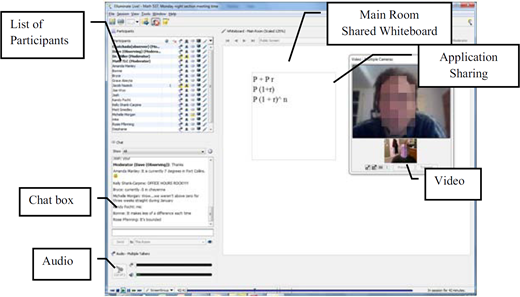
The major components of Elluminate Live! consist of two-way audio, multipoint video, chat, shared whiteboards with application sharing, interactive recording, and breakout rooms (see Figure 1). The audio function of Elluminate Live! allows an instructor and students to participate in conversations during real-time chat sessions by using a microphone and speakers via voice over Internet protocol. The video feature of Elluminate Live! enables an instructor and students to transmit up to five videos broadcast to others in an Elluminate Live! session. The chat tool allows an instructor and students to send text messages to everyone or to selected participants within a session.
The whiteboard displays the main presentation window in Elluminate Live!, which is used as a working area by an instructor and students to write texts or draw images. In addition, the application sharing function of Elluminate Live! allows an instructor and students to share multiple applications and windows with others in the class simultaneously. Moreover, all activities that occur in the main room of the session can be recorded by Elluminate Live!. Furthermore, an instructor can create breakout rooms in an Elluminate Live! session. Similarly to the main room, the breakout room can be used to facilitate small group activities. Each breakout room has its own audio, video, whiteboard, and application sharing features. Therefore, students can see their group members while they are working together in the same breakout room. An instructor can generate any number of breakout rooms at any time during a session.
As part of the online mathematics modeling class, students were required to “attend” the class via Elluminate Live! for 90 minutes (7:00-8:30 P.M.) on Mondays each week. One of the requirements for the course was to participate in group projects. To start working on the group project, students were introduced to the new modeling problems and then familiarized to the possible ways of solving the problem in the synchronous whole-class session for approximately 45 minutes (from 7:00-7:45 P.M.). Subsequently, students were required to work on these problems with their selfselected group members in the synchronous small-group discussion session for another 45 minutes (from 7:45-8:30 P.M.) during class meeting time throughout the semester.
Through collaborative problem-based learning, students compiled resources from the instructor's presentation delivered during the synchronous whole-class session and then discussed ideas with their group members to propose and share possible solutions. Students' participation was evaluated based on their weekly discussions in both the synchronous whole-class and small-group sessions via Elluminate Live!.
Materials
Three data sources were used: synchronous small-group discussions, a teamwork attitude survey, and a learning environment attitude survey.
Synchronous Small-Group Discussions. Participants were instructed to utilize Elluminate Live! for a small group discussion during their synchronous meeting time. Each group member was able to communicate with his or her group members to work on the group project and brainstorm solutions. Due to the large number of messages that were generated in the synchronous small-group discussion sessions throughout the semester, the researchers were unable to record and collect all discussions from all groups. Therefore, it was necessary to filter the data by randomly selecting groups to record students' discussions during their synchronous group meetings for each of the group projects. We decided only to focus on four synchronous small-group discussions across 3 different weeks to investigate how participants construct their knowledge while communicating with their group members. Therefore, a total of 12 synchronous small-group discussions were collected during project 5 in Week 8, project 6 in Week 10, and project 7 in Week 12.
Teamwork Attitude Survey. We adapted 10 survey items based on Tseng, Wang, Ku, and Sun's (2009) study to measure students' working experiences with their group members during synchronous small group activities on Elluminate Live!. These 10 survey items were measured on a 5-point Likert-type scale, ranging from 1 (strongly disagree) to 5 (strongly agree). Among the survey items were “I like working in a collaborative group with my teammates”; “I enjoy the experience of collaborative learning with my teammates”; and “I gain online collaboration skills from the teamwork processes.” The Cronbach's alpha reliability for the total scores on the survey was .95 in the current sample.
Learning Environment Attitude Survey. To measure students' attitudes with the technology supported synchronous collaborative small group environment via Elluminate Live!, we adapted and developed survey items based on Lin's (2004) and Wu and Hiltz's (2004) studies.
There are three sections in the Learning Environment Attitude Survey. The first section of the survey consisted of three demographic questions including name, gender, and age. The second section of the survey consisted of a 21 Likert-type survey items in which students rated their level of attitude on synchronous small-group sessions and activities that supported learning in this course. Participants rated their attitude on a 5-point scale, ranging from 1 (strongly disagree) to 5 (strongly agree). The Cronbach's alpha reliability for the total scores on the 21 item-attitude survey was .94 in the current sample.
The third section of the survey asked participants to respond to three open-ended questions to reflect on their synchronous small group discussion experiences. These questions were: (1) What did you like best about the synchronous small-group discussions through videoconferencing in this course?, (2) What did you like least about the synchronous small-group discussions through videoconferencing in this course?, and (3) How did the synchronous small-group discussions through videoconferencing facilitate or hinder your learning in this course?
Procedures
Week 1 to Week 7. During Week 1, the instructor informed students how and where they could access course materials such as course syllabi, contacts, tools, and the Elluminate Live! link via e-mail. The instructor also asked participants to attend a class orientation on a synchronous whole-class meeting via Elluminate Live!. During the class orientation, the participants asked questions regarding the course and formed their own groups with three or four students per group. During Week 2 through Week 7, the participants worked collaboratively with their group members on the first four group projects.
Week 8 to Week 12. The participants worked with their group members on Project 5, project 6, and project 7 in Week 8, Week 10, and Week 12, respectively. Each participant communicated with his or her group members via Elluminate Live! to work on these group projects and brainstorm solutions. Four randomly selected synchronous small-group discussions were observed and recorded for each of these three projects, resulting in a total of 12 synchronous small-group discussions. In addition, the participants were asked to complete and submit the Teamwork Attitude Survey regarding his or her working experiences with his or her group members on projects 5, 6, and 7 at the end of Weeks 8, 10, and 12, respectively.
Week 13 to Week 16. The participants worked collaboratively on Project 8 in Week 13 and Project 9 in Week 14. During Week 15, the Learning Environment Attitude Survey assessing students' attitudes with the technology supported synchronous collaborative small-group environment was distributed to participants via an e-mail. They were asked to complete this survey by the end of Week 16.
Data Analysis
To answer research question one, the synchronous small-group discussions of 12 groups (four small-group discussions in Weeks 8, 10, and 12) were transcribed and coded using the interaction analysis model developed by Gunawardena et al. (1997). Each complete thought was categorized to Phase 1, Phase 2, Phase 3, Phase 4, or Phase 5 of the cognitive learning process. The descriptions each category in of the interaction analysis model are presented in Table 1.
To analyze the synchronous small-group transcriptions, first, two coders coded all synchronous small-group discussions independently. One coder was the first author of the current study and the other coder was a doctoral student majoring in mathematics. Second, both coders began by reading and analyzing the number of messages that each group discussed during the synchronous small-group discussions in Weeks 8, 10, and 12. Instead of coding the messages line-by-line or using word count, the coders looked for complete thoughts. Then, both coders met and discussed differences in their coding until consensus was reached. After completing the content analysis, the total number of messages coded and corresponding percentage at each phase of the interaction analysis model across 3 different weeks were analyzed.
To respond to research question two, the total scores on the 10 items of the Teamwork Attitude Survey collected during Weeks 8, 10, and 12 and across these 3 weeks were calculated by using descriptive statistics. In addition, students' responses to the 21 Likert-type survey items of the Learning Environment Attitude Survey were summed and ranked. Furthermore, students' responses to the three open-ended questions were analyzed to identify themes and patterns.
Results
Students' Knowledge Construction
A total of 452, 234, and 301 messages generated by participants in Week 8, Week 10, and Week 12 were coded using the interaction analysis model developed by Gunawardena et al. (1997). The findings indicated that participants contributed the largest number of messages in Phase 1 and the smallest number of messages in Phase 5 in each of these 3 weeks. In addition, the corresponding percentages at each phase of the interaction analysis model did not differ much across these 3 weeks.
Overall, a total of 987 messages were coded using the interaction analysis model across 3 weeks. The findings showed that participants provided 519 of 987 (53%) messages of sharing and comparing information in Phase 1 during their synchronous small-group discussions with videoconferencing. Moreover, participants contributed 150 of 987 (15%) messages of the discovery and exploration of dissonance or inconsistency among their ideas in Phase 2. In addition, 142 of 987 (14%) messages represented participants who were engaged in negotiating meaning and constructing knowledge in Phase 3. Furthermore, 120 of 987 (12%) messages revealed the testing and modification of proposed synthesis in Phase 4, and 56 of 987 (6%) messages indicated the agreement and application of newly constructed meaning in Phase 5. The total number of messages coded and its corresponding percentage at each phase across 3 weeks is presented in Table 2.
Students' Attitudes
Teamwork Attitude Survey. All the participants filled out the Teamwork Attitude Survey in Week 8, Week 10, and Week 12. The overall mean scores of the Teamwork Attitude Survey were 4.27 (SD = .71) in Week 8, 3.86 (SD = 1.27) in Week 10, and 4.24 (SD = .96) in Week 12. In addition, an overall mean of 4.12 (SD = .82) was found across these 3 weeks, which indicates that participants had positive teamwork experiences with their group members during synchronous small group activities via videoconferencing.
Learning Environment Attitude Survey. During Week 15, a Learning Environment Attitude Survey was distributed to students via e-mail and a total of 15 participants (response rate = 54%) completed the survey. The overall mean score of the 21 survey items were 4.13 (SD = .75). This rating indicated that students had positive attitudes with the technology supported synchronous collaborative small-group environment via Elluminate Live!.
Across the 21 Learning Environment Attitude Survey items, the three most positive responses on the survey were, participants believed that they understood the content better because they collaborated with peers for discussion (M = 4.53, SD = 64), they felt that synchronous small group discussions in the class related directly to their coursework (M = 4.40, SD = 51), and they considered that synchronous small group discussions in the class facilitated their learning (M = 4.40, SD = 63). In contrast, the three statements that had the least positive responses were “Synchronous technology in the class supported my developing a productive relationship with the course instructor” (M = 3.67, SD = .90), “Synchronous small group discussions in the class were an efficient use of class time” (M = 3.80, SD = 1.21), and “Synchronous small group discussions in the class were enjoyable for me (M = 3.87, SD = .99). The Learning Environment Attitude Survey results are summarized in Table 3.
Favorable Experiences. The first open-ended question of the Learning Environment Attitude Survey asked participants to illustrate what they liked best about the synchronous small-group discussion through videoconferencing in the course. Primarily, nine participants liked the synchronous small-group discussion through videoconferencing because these discussions allowed them to brainstorm ideas, share possible solutions among group members, and gain better understanding of concepts or problems. Some representative comments included: “I liked getting to bounce my ideas off of other people and talk through the solution to the models we were creating” and “These groups allowed me to see other problem solving ideas that I had not considered.”
In addition, six participants agreed that the synchronous small-group discussions through videoconferencing have helped them to enhance and maintain a sense of community by allowing them to get to know other students personally and by having comfortable communication while working together. Some representative comments included: “They [discussions through videoconferencing] are more personal” and “They [synchronous small-group discussions through videoconferencing] definitely helped me get to know other students better, and to feel a greater connection to them.” Similarly, another participant mentioned:
They [synchronous small-group discussions through videoconferencing] have allowed us to work together, but also to discuss general frustrations and successes. Without these small group discussions, we would have felt as if we were all alone in this class … just us as individuals and the professor. With them, we feel as though we are all in this together.
Least Favorable Experiences. Subsequently, the second open-ended question of the Learning Environment Attitude Survey asked participants to illustrate what they liked least about the synchronous small-group discussion through videoconferencing in the mathematical modeling course. Four participants did not provide any example of what they liked least about the synchronous small-group discussion through videoconferencing. Three participants noted that the limitations of technology were the least favorable experiences, as one participant stated: “Sometimes it seemed like one person was working and the rest of us were just watching. It would have been great to all [of us] working and sharing ideas at the same time.”
In addition, three participants were concerned about unprepared group members. They mentioned that some of their group members did not contribute much to the group project or engage in the discussions. Three other participants preferred to have more group rotation in order to increase chances to be able to communicate with everyone in the class. Furthermore, two participants considered that the time assigned to participate in synchronous small-group discussions via videoconferencing was too short. They would have liked to have had more time for small-group discussions.
Learning Facilitations. For the last open-ended question of the Learning Environment Attitude Survey, participants were asked to explain how the synchronous small-group discussions through videoconferencing facilitated or hindered their learning in the course. Thirteen participants expressed that the synchronous small-group discussions through videoconferencing facilitated their learning; for example, by helping their thinking process, communicating and sharing ideas among group members, and assisting them in overcoming some obstacles. Some representative comments included: “I benefited from being able to share my thoughts with my classmates. They were able to correct me, share their own insights, and to help me develop my overall understanding of the material”; “Small group discussions enable me to process and brainstorm possible solutions to modeling problems before working on the problem on my own”; and
The small-groups set up through Elluminate (videoconferencing) provided a secure feeling and an environment where I felt like I could be open with my struggles without the intimidation of the whole-group setting. This was very beneficial for helping me overcome some of the obstacles I ran into.
However, two participants expressed that the synchronous small-group discussions through videoconferencing facilitated their learning but felt it was difficult to contribute things sometimes due to the limitations of technology as well as lack of group working dynamics.
Discussion
Students' Knowledge Construction
Across Weeks 8, 10, and 12, the coding results from 12 synchronous small-group discussions via videoconferencing in the mathematical modeling course revealed that students generated more messages involving the sharing and comparing of information at Phase 1 (53%) than any of the other phases. According to Gunawardena et al. (1997), messages generated at Phase 1 are considered the lowest level of knowledge construction. When considering the nature of a mathematical modeling course with problem-based learning activities, it is not surprising the results of this study revealed that the participants engaged in more of their discussions at Phase 1 than other phases. One possible explanation is that the participants might lack adequate reflection time to provide clarifications and thoughts on assigned problems immediately in the synchronous environment (Branon & Essex, 2001; Veerman & Veldhuis-Diermanse, 2006). Therefore, participants might ask more questions among their group members before working on their problems.
Furthermore, across Weeks 8, 10, and 12, the overall messages generated at Phase 2, Phase 3, and Phase 4 did not differ much from week to week. Participants generated a total of 150 (15%) messages at Phase 2, 142 (14%) messages at Phase 3, and 120 (12%) messages at Phase 4 across 3 weeks. In contrast to the 53% of messages that students generated at Phase 1, students only generated 6% of messages at Phase 5, which was considered the highest level of cognitive activity in the interaction analysis model. One possible explanation might be due to the insufficient group working time in the class. Through the responses to the second open-ended questions, participants mentioned that they were unable to complete each project within the allocated time frame, but they were able to continue working on the assigned problems with their group members after the session. As a result, most discussions at the level of Phase 5 might take place after the discussion sessions outside of the class.
Another interesting finding is that although many researchers applied the Interaction Analysis Model to analyze students' discussions (Gunawardena et al., 1997; Hou et al., 2008; Luebeck & Bice, 2005; Osman & Herring, 2007), only Osman and Herring's (2007) study attempted to analyze transcripts of students' discussions in synchronous chat in the online educational setting. The results from Osman and Herring's (2007) study revealed that their participants only generated 1% of Phase 5 messages while utilizing the synchronous chat as the primary communication tool in the online instructional administrator training program. In the current study, participants generated 6% of Phase 5 messages, which far exceeded 1% of Phase 5 messages in Osman and Herring's (2007) study. One possible explanation of such finding may be due to the benefit of videoconferencing, which might facilitate students to contribute more discussions at Phase 5.
Students' Attitudes
In terms of students' attitudes toward the online synchronous collaborative small-group discussions with videoconferencing, participants generally had optimistic working experiences with their group members (overall mean = 4.12) as well as positive attitudes toward the technology supported synchronous collaborative small-group environment through videoconferencing (overall mean = 4.13). These results were consistent with several studies that employed videoconferencing as a tool to facilitate class activities (Dal Bello, Knowlton, & Chaffin, 2007; Choi & Johnson, 2007; Gillies, 2008; Li, Moorman, & Dyjur, 2010).
For participants' favorable experiences, we found that a sense of community was an important element for online collaborative synchronous small-group discussions through videoconferencing. Participants believed the synchronous small-group discussions through videoconferencing effectively established and maintained their sense of community by allowing them to get to know other students, feel connected, and have comfortable real-time communication. Consistent with previous research studies (Gunawardena & McIsaac, 2004; Hrastinski, 2008; Murphy & Ciszewska-Carr, 2007), this finding reveals that synchronous computer-mediated communication technologies could reduce feelings of isolation among students as well as support the pedagogical aspect and social facet of learning in online courses.
For participants' least favorable experiences, we found the limitations of technology can be one major drawback when participants discuss projects with group members through videoconferencing at a distance. Other studies on the usage of videoconferencing for small groups revealed similar results, thus emphasizing the importance of the quality of the audio transmission (Allen, Sargeant, Mann, Fleming, & Premi, 2003; Angiolillo, Blanchard, Israelski, & Mané, 1997). Allen et al. (2003) correspondingly addressed issues that muting microphones, video quality, audio quality, and audio lag could hinder discussions. The delays in the transmission of video and audio at times caused some overlaps and interruptions in the dialog construction (Angiolillo et al., 1997).
In addition, unprepared group members represented another of participants' least favorable experiences when working as a group in the synchronous small-group discussion learning environment. Some participants addressed the issue that when they came to groups, some group members were not ready to discuss group projects, which in turn produced ineffective group discussions. According to Goold, Augar, and Farmer (2006), students would become frustrated when their group members did not participate in or contribute much to group discussions. This finding aligned with Tseng's (2008) study that low levels of individual accountability and lack of communication were negative factors of their teamwork experiences.
When participants responded to the last open-ended question, most of them expressed that the synchronous small-group discussions through videoconferencing facilitated their learning. Participants liked learning in their online collaborative synchronous small-group setting because such an environment allowed them to be able to share ideas, facilitated them toward a better understanding of the concepts, and helped them to work successfully as groups. Similar to Goold et al.'s (2006) findings, students enjoyed collaborating with their groups and reasoned that the process facilitated greater course content comprehension. The collaboration environment also improved learner performance regarding higher order thinking activities when learners discussed the problems, brainstormed potential solutions, and arrived at final solutions (Mergendoller, Bellisimo, & Maxwell, 2000).
The findings of this study were limited in three ways. First, the subjects used for the study were students from a graduate-level online course in mathematics education; the sample could not be considered as a representative of the general population or even of all college students. Second, we only focused on the use of Elluminate Live! during the class schedule time and were not able to observe and record participants' discussions when they had meetings outside of classes via Elluminate Live! or other tools. Third, the response rate on the Learning Environment Attitude Survey was lower than expected (54%) which might affect the accuracy of survey results.
Finally, we provide the following two suggestions for future research. Further research could investigate students' knowledge construction in online collaboration by utilizing other videoconferencing tools, such as Wimba, Skype, or Google Talk. Further research could also examine whether having group rotations prior to the beginning of every new project would influence the students' knowledge construction more effectively than not having group rotations.
Acknowledgment: This research was supported by the Mathematics Teacher Leadership Center grant from the National Science Foundation (NSF Award # DUE-0832026).