The technology adoption process model (TAPM) is applied to a new synchronous conference technology with 27 asynchronous courses involving 520 participants and 17 instructors. The TAPM resulted from a qualitative study reviewing webcam conference technology adoption. The TAPM is now tested using self-efficacy as the dependent variable. The independent variables from the TAPM were authenticity, distraction, and the technology acceptance model (TAM) perceived ease of use and perceived usefulness (Davis, 1989). The TAPM explains 26% of the increased student self-efficacy. The dominant independent variable, TAM explains 80% of the variance. Distraction and authenticity were secondary influences. Technology transience is addressed.
Introduction
The research builds on a foundation created by previous exploratory qualitative research (Olson, Appunn, McAllister, Walters, & Grinnell, 2014) that sought to understand the experience of an existing virtual team with the addition of webcams resulting in the technology adoption process model (TAPM). The model was applied to updated synchronous conferencing facilities embedded within asynchronous courses using partial least squares (PLS) to test the interactive relationships between the variables with self-efficacy as the ultimate dependent variable.
Self-efficacy was the center of Bandura's social cognitive theory emphasizing observational learning and social experience. Individual action and cognitive processes are influenced by what they see in others. Self-efficacy is also about perception of external social factors (Bandura, 1977, 1988). Thus, self-efficacy is both individually and socially experienced.
This study reviewed the impact of technology adoption on both individual and social factors that affect self-efficacy. On an individual level, technology adoption could diminish individual success diminishing self-efficacy. There could be a reduction of personal mastery. Technology adoption could also have a personal physiological impact caused by increased stress levels. On a social level, technology adoption could diminish group success causing individual self-efficacy to drop. Modeling and vicarious learning would diminish. A technology adoption could also affect social communication with an increase in negative messages that could also reduce individual self-efficacy. Social persuasion could be reduced. Teleologically, individuals and groups could perceive technology adoption as a distraction to a personal or group goal. The new technology becomes the focus, instead of a personal or group goal, thus reducing self-efficacy.
There would be additional value in better understanding specifically what it was about technology adoption that affected self-efficacy. Technology adoption could effect self-efficacy due to reduced success individually and socially or negative social messages and changed goals, but what are the components of that effect? Are changes in individual self-efficacy in groups experiencing technical adoption shaped by technology acceptance, perceptions of authenticity or increased distraction? This study attempted to better understand these possible components that could affect the impact of technology adoption on individual self-efficacy.
This work provides a quantitative approach to understand the impact of technology adoption on individual self-efficacy by studying the results of an adoption of a new conferencing tool that would include video, voice, and a shared screen for the faculty member and students. The TAPM presented in this paper considers independent variables technology acceptance, authenticity, and distraction. The results on the dependent variable, self-efficacy, are tested across multiple classes and courses attended by undergraduate and graduate students in a distance education setting. The dependent variable, self-efficacy, was chosen in preference to effectiveness so that students could capture individual experiences and how they benefited from the specific delivery mode. The research gathered input from 520 participants, 264 who were exposed to the new technology and 256 who continued to use the original technology tools. The technology change relates to the influence of synchronous access of sound and video by faculty and students, hoping to foster stronger interaction and learning through a richer a communication channel.
Technology transience—that is, its utility lifespan (Amirault & Visser, 2015)—is another feature of this study. Technology continues to change, as does its use and application, resulting in a continuous stream of change. The adoption of new technology is difficult for many users and risks might be high if one is not confident of technology choices that result in net benefits at a reasonable cost. This leads to a need to understand benefits and the processes that surround new technology adoption, including improve technology selection and adoption approaches. It would also be valuable to predict selection and adoption technology outcomes.
Literature
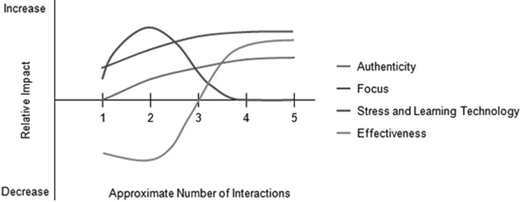
A qualitative study (Olson et al., 2014) explored the factors that might influence the results of the introduction of new technology to an existing virtual group resulting in the TAPM (see Figure 1). Data were collected by way of transcripts from five virtual members of a group over 5 consecutive weeks. The research used a pair of research groups, one pair of researchers used constant content analysis, the other used content analysis. The content analysis team tried to recognize different types of trust, best represented by Sarker, Valacich, and Sarker (2003). Further elements used in the content analysis approach were perceived effectiveness for satisfaction, performance, execution, and outcome that were best summarized by Lurey and Raisinghani (2001). The constant comparative method team, using ATLAS.ti, established four key outcomes. Read together, the outcome of the two research approaches (Olson et al., 2014), found limited support for changes in trust, while stress and learning from technology, effectiveness, focus, and authenticity were important. In addition, significant changes over the adoption period of 5 weeks highlighted that one needs to avoid ill-timed datagathering points during deployment phases. Olson et al. (2014) provided a model, Figure 1, that summarized the results. Notice the strong but opposite changes in technology and effectiveness, highlighting the initial issues relating to technology adoption.
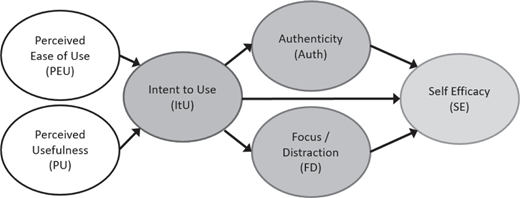
Once the TAPM had been identified through qualitative research, the next step was to test the model quantitatively. The study used the technology acceptance model (Davis, 1989), authenticity and distraction as the independent variables. The dependent variable was self-efficacy.
The addition of sound and video, often identified as the use of webcams or videoconferencing facilities, has been found to positively impact self-efficacy. Akarasriworn and Ku (2013) found that graduate students appreciated synchronous conferencing tools for collaborative learning and improved their ability to learn when using the new technology. In a qualitative study with graduate nursing students, Foronda and Lippincott (2014) found that synchronous sound and video improved learning to the extent that many students preferred synchronous remote learning to face-to-face learning in classrooms.
Self-efficacy has been theoretically understood from a variety of perspectives. Before 1960, learning was understood to be about classic conditioning, psychoanalytic drives, and operant conditioning (Bandura, 1972). Social learning theory emerged as a means extending a behavioral reinforcement learning emphasis to include social factors (Bandura, 1977). This was further developed with the social cognitive theory emphasizing observational learning and social experience (Bandura, 1977). Another approach to understanding self-efficacy is the self concept theory, which addresses how individuals perceive and interpret external sources related to selfunderstanding. Self-concept is learned, organized and dynamic in relation to individual and social experience (McAdam, 1986). Attribution theory has also been used to understand self-efficacy. Emphasis is given to how individuals attribute events and how those attributions affect self-perception. It addresses the processes individuals use to explain behavior and events related to self-perception (Heider, 1958).
One subclassication of self-efficacy is academic self-efficacy. Academic self-efficacy describes the individual belief that a person can be successful in completing specific academic tasks (Bong & Skaalivik, 2003). Academic tasks include assignments, grade point average, graduation, and coursing outcomes. Rushi (2007) has done some work to empirically measure academic self-efficacy.
Social self-efficacy is another subclassification of self-efficacy. Smith and Betz (2000) defined social self-efficacy as a person's confidence that they can engage in social task situations that are required to start and maintain interpersonal relationships. Smith and Betz (2000) identified six domains in social self-efficacy: romantic relationships, social assertiveness, public performance and support, making friends, and performance in groups.
Another subclassification of self-efficacy is technological self-efficacy (McDonald & Siegall, 1992). Self-efficacy is domain specific, that is, individual strength of belief attached to specific tasks, not all tasks. Thus, individual strength of belief related to technology tasks is technological self-efficacy. Technological self-efficacy is not understood in terms of specific technological tasks, it is intentionally vague. Its intent is to describe self-efficacy related to general feelings related to the adaption of new technologies. Technological self-efficacy has been further differentiated to computer self-efficacy (Compeau & Higgins, 1995), Internet self-efficacy (Joo, Bong, & Choi, 2000) and information technology self-efficacy (Staples, Hulland, & Higgins, 1999).
Wang, Shannon, and Ross (2013) included technology self-efficacy as a variable in their study of course outcomes in online learning. Their study found that students with high levels of technology self-efficacy ultimately achieved higher grades in their online class. This substantiated the work of previous researchers (Joo et al., 2000; Wang & Newlin, 2002). Wang, Shannon, and Ross (2013, p. 304) also found conflicting results in the literature. DeTure (2004) and Puzziferro (2008) both reported that technology self-efficacy was not a good predictor of student satisfaction and performance.
Technology self-efficacy has also been observed to be a possible factor with teacher utilization of educational technology (Holden & Rada, 2011). Holden and Rada (2011) connected the technology acceptance model to teachers’ acceptance and use of educational technology. They found that teacher's technology self-efficacy influenced the technology acceptance model (TAM) to a greater extent than their computer self-efficacy.
Self-efficacy has been found to play an essential role in Internet-based learning. Tsai, Chuang, Liang, and Tsai (2011) reviewed 46 papers from 1999 to 2009 regarding research on self-efficacy and Internet-based learning environments. They distinguished between three types of self-efficacy (a) the self-efficacy related to execution, skills to navigate, and confidence in using Internet technology, (b) the interaction between an individual's abilities for Internet learning and general academic self-efficacy, and (c) self-efficacy related to their confidence when interacting with Internet learning and the anticipation of a favorable outcome (Tsai et al., 2011, p. 223). Of particular interest to the current study is the research on Internet-based learning self-efficacy (IBLSE). Tsai et al. (2011) found that most of the research on IBLSE involved the framework of the technology acceptance model. Their research suggested that ease of use was important to increase participants’ IBLSE. Other research was focused on using IBLSE to predict a learning outcome.
Self-efficacy is also related to online learner-centered instruction (Tseng, Gardner, & Yeh, 2016). Students reported that their online course met learner-centered criteria. This return of learning responsibility to the online students led to increased self-efficacy. Students developed their own learning strategies building upon previous learning successes.
Information technology has provided significant benefits to efficiency and efficacy in the last decades; however, technology includes several challenges (Fuller, Hardin, & Davison, 2006). The adoption of new technology can derail benefits and often starts with an initial negative influence (King & He, 2006; Mathieson, 1991). The relevance of technology acceptance has also been demonstrated in diverse fields, with various users, and across multiple technologies (King & He, 2006; Lee, Kozar, & Larsen, 2003). More recently, transience of technology in education has received significant attention (Akarasriworn & Ku, 2013; Amirault, 2015; Baiyun, 2009; Gao & Wu, 2015; Juarez Collazo, Wu, Elen, & Clarebout, 2014; Morrison, 2010; Peterson-Karlan, 2015).
From 1980 to 2010, multiple approaches were used to measure potential adoption or predict technology adoption. The TAM from Davis (1989) is cited frequently, although the theory of planned behavior (Ajzen, 1991) is another important contender. The integration and extension of approaches have provided diverse enhancements that provide some value in different situations (Ahmad, 2015; Venkatesh, Morris, Davis, & Davis, 2003; Yi, Jackson, Park, & Probst, 2006). A particularly ambitious approach, the unified theory of acceptance and use of technology (Venkatesh et al., 2003) combined research results across eight related models. The research highlighted the interest and value of understanding the use of technology, as evidenced by 742 articles citing the source according to one research database. The Venkatesh et al. (2003) synthesis identified additional variables and improved the predictability of a technology model; however, it also introduced more complexity.
For the general measurement of the use and acceptance of technology, the simpler TAM approach by Davis (1989) allows for the combination of other variables without overloading participants during data collection. The approach does not sacrifice significant accuracy. The simplified approach remains the key basis for work in this arena because the reduced complexity allows for its combination with other variables. There are numerous recent examples where TAM represents the influence of technology and the implications of use in diverse areas (Ahmad, 2015; Cheng, Wang, Moormann, Olaniran, & Chen, 2012; L.-S. Huang & Lai, 2014; T. C.-K. Huang, Liu, & Chang, 2012; Maruping & Magni, 2012; Nikas & Argyropoulou, 2014; Saeed, 2012; Schott, 2013). TAM, as devised by Davis (1989), uses survey questions to establish three variables, (a) perceived usefulness (PU), (b) perceived ease-of-use (PEU), and (c) the dependent variable, intent to use the technology. TAM not only provides a view of current use, it provides important predictive values for future use.
The results from the various approaches measuring and predicting the adoption of new technology indicate that most approaches can explain most of the adoption levels of new technology. TAM (Davis, 1989) could predict current use (r = .63) and future use (r = .85). unified theory of acceptance and use of technology (Venkatesh et al., 2003) tested various approaches, finding the ability to predict outcomes up to r2 = .7. Taken together with the breadth of applicability found in diverse sources, the models also exhibited good validity and reliability for their scales.
The foundation of TAM (Davis, 1989) also provides a flexible approach to allow the expansion of the model. Diverse studies have used PLS to support the addition of further variables without the need very large groups of participants (Gefen, Karahanna, & Straub, 2003; King & He, 2006; Peterson et al., 2010; Wang, Chung, Park, McLaughlin, & Fulk, 2012). Most of these sources extended TAM to apply the concepts to other specific areas, while some enhanced the level of prediction of TAM. For this research, the objective is not to refine TAM, but to consider alternate influences that may provide specific insights relevant to this research when technology changes on the dependent variable.
When considering the use of technology to improve communication and self-efficacy, it is crucial to note the longitudinal influence relating to the use of technology. Olson et al. (2012) found that the benefits within an established group required at least four weeks for the adoption influences to subside. Similarly, Drouin, Hile, Vartanian, and Webb (2013) found that undergraduate students preferred the use of sound and video; however, this preference correlated to prior exposure to similar formats. Peer tutors also found benefits from exposure to synchronous sound and audio to benefit from improved effectiveness and relevance for online learning (Dvorak & Roessger, 2012).
Next, authenticity has been difficult to define and understood in a variety of ways (Satici, Kayis, & Akin, 2013). Kernis stated that, “authenticity can be characterized as reflecting the unobstructed operation one's true self, or core, self in one's daily enterprise” (2003, p. 13). Others have described authenticity as a process involving personal awareness of an individual's potential and acting upon that potential (Starr, 2008), or as being an essential characteristic for good psychological wellbeing (Deci & Ryan, 2000; Rogers, 1961).
There is a lack of literature consensus regarding authenticity; however, there appear to be three perspectives: existential, communitarian, and critical (Kreber & Klampfleitner, 2013). Of the three, the communitarian approach most closely approximates this study because of the social factors involved in self-efficacy. The communitarian view states that authenticity is not attained independently of an individual's social context. It is not a narcissistic private endeavor (Potter, 2010, Varga, 2011). Authenticity occurs when individuals recognize their social connection. We are shaped by the norms, values, and ideals that surround us (Taylor, 1989, 1991). Thus, authenticity is about the contextualization of individual reflection and process within a larger context. Authenticity has value when it is linked to our social connections (Taylor, 1989, 1991).
A critical feature of computer-mediated communication is authenticity (Slater, 2002). Computer mediated communication combines features of face-to-face and virtual interaction, which complicates authenticity. It can be difficult to determine the authenticity of actors involved in this communication (Fuchs, 2004), with authenticity being subjectively determined by the involved actors (Gilpen, Palazolla, & Brody, 2010). Authenticity is related to actor perceptions of authority, identity, engagement, and transparency (Goffman, 1981; Scannell, 2001; van Leeuwen, 2001). Gilpen et al. (2010) integrated this research in a model of socially mediated authenticity involving genuine-performative identity, low-high legitimacy authority, obstructive-open transparency, and low-high interactivity engagement.
Olson et al. (2014) conducted a qualitative phenomenological study describing the introduction of video on the experience of a virtual team. The study suggested a relationship between video and authenticity related to team effectiveness. While authenticity and focus increased weekly throughout the study, the introduction of a new technology initially resulted in an increase of stress and decrease of effectiveness. After the third weekly meeting, the positive impact of increased authenticity and focus supported a significant increase in effectiveness. The introduction of video with its increasing experience of authenticity and focus appeared to support a reduction in stress and increase in team effectiveness.
Studies indicate that individuals with higher degrees of authenticity are more likely to have higher degrees of self-efficacy (Goldman & Kernis, 2002). Several other researchers have found the same (Caprara & Steca, 2005; Connolly, 1989; Herman & Betz, 2004, 2006). Those individuals who know themselves best and can be consistent in emerging, changing situations tend to have the confidence and drive to be successful in those situations.
Snape and Fox-Turnbull (2013) reviewed authenticity in the context of education technology. While their study focused on authentic pedagogy, teachers, learners, and activities, they also described a relationship between authenticity and self-efficacy. In a context of constructivist educational theory, self-authenticity is a key step towards self-efficacy.
Riggs and Gholar (2009) proposed a conative domain related to learning. Learning is more than cognition. It also involves the conative, the role students play in learning achievement. Student drive, determination and motivation are essential. The conative process focuses on two objectives. Knowing what to do and doing it. The “doing it” component of the conative domain has also been referred to as self-efficacy (Kreber, Klampfleitner, McCune, Bayne, & Knottenbelt, 2007; Tessmer & Richey, 1997).
Satici et al. (2013) proposed a predictive relationship between social self-efficacy and authenticity, that social self-efficacy was a significant predictor of authenticity. Social self-efficacy addresses the self-assessment of an individual's ability to negotiate social situations with positive social outcomes. Social efficacy is about an individual's social confidence. Individuals with high social self-efficacy are less likely to accept external influence and more likely to be true to themselves.
Research on social facilitation has addressed the impact of distraction in groups. Triplett (1898) was the initial researcher in social facilitation with his observation that cyclists were faster in groups than alone, which led him to suggest that the presence of others increases individual performance. Allport (1924) first used the term “social facilitation” to describe the increased performance of individuals in groups. Allport understood this phenomenon to be about increased performance when surrounded by others doing the same thing.
Zajonc (1965) used drive theory to understand social facilitation and his development of activation theory. The presence of others increases arousal, but only to a point. When arousal becomes too high, performance diminishes. Individual motivation and performance is high for simple tasks, or familiar tasks, and lower for more complex, or unfamiliar tasks. The presence of others does increase motivation and performance; however, the same applies. Social presence sometimes results in increased performance: increased performance for simple tasks, but diminished performance for complex tasks.
Following Zajonc's (1965) initial work on activation and generalized drive hypothesis, there were several related activation approaches to understand social facilitation. Each looked at factors other than arousal to explain social facilitation. Cottrell, Wack, Serkerak, and Rittle (1968) proposed an “evaluation apprehension approach” and supported by Henchy and Glass (1968). It was the fear of evaluation that limited performance. Guerin and Innes (1982) proposed the “monitoring hypothesis.” It was the characteristics of the relationships between the group and the individual that limited performance. The more familiar the individual was with the group, the less the impact on performance. Arousal is a limiting factor only if the group is unknown.
Social facilitation research moved from activation to attention. It is the attentional conflict between multiple stimuli that results in arousal. Technology adaptation could increase attentional conflict. Sanders, Baron, and Moore (1978) suggested the distraction-conflict hypothesis linking performance to the number of environmental distractions. Baron (1986) built upon the distraction-conflict hypothesis with his overload hypothesis by framing the level of activation in terms of attention capacity. The presence of others is a distraction (distraction-conflict hypothesis), which overloads cognitive capacity expressed as attention capacity overload and diminished performance (Strauss, 2002).
Related attention theories are the feedback-loop model (Carver & Scheier, 1981) and the capacity model (Manstead & Semin, 1980). The feedback-loop model reviews social facilitation arousal in terms of anxiety or “stage fright” with a diminished impact over time (feedback-loops). The capacity model focuses on types of information processing. If the information processing is automatic, or simple, audiences increase performance. If not, audiences diminish performance (Strausss, 2002).
Tesch, Coelho, and Drozdenko (2011a) conducted an attentional distraction study from a student's perspective, looking at both technical (such as laptops and cell phones) and non-technical (such as whispering) in an educational classroom. The focus of the study was whether distraction due to external events happening to the student were different than internal (self-induced) events. The study assumed an attentional distraction-conflict model (Sanders et al., 1978). The study indicated that the most significant external factor was the professor's instruction. Classmates’ dress, tattoos, piercings, hair, and sleeping were minimally distracting. Classmates’ utilization of technology (Internet, texting, and eating/drinking) were somewhat distracting. All these were much more distracting to the professor. The personal hygiene of their classmates distracted students.
Kahn, Wolfe, Quinn, and Snoek (1964) described role overload as the perception that a role demand exceeds available resources resulting in stress and distraction. Brown, Joines, and Leigh (2005) pointed out that self-efficacy was a person's confidence that his or her skills and resources could address a specific situation. This would include the individual perception of the organization's supporting resources. Brown et al. (2005) proposed that role overload would affect antecedent experiences on self-efficacy.
Method
This study tested a previous model, the TAPM (Olson et al., 2014), depicted in Figure 1. The model was the result of a qualitative study using constant comparative analysis and content analysis, which suggested key features of an existing virtual team's experience of webcam conference technology adoption. The model identified effectiveness, authenticity, focus, and stress of learning as relevant. This quantitative paper takes the model a step further by identifying self-efficacy as a dependent variable that could be substituted for other dependent variables. The study evaluates the model by applying it to updated synchronous conferencing facilities embedded within asynchronous courses. It uses a quasi-experimental approach together with PLS to test the interactive relationships between the variables.
The different method and specific environment implied the need to make minor adjustments to the variable to extract results with improved validity and reliability. Efficacy in the initial model considered team outcomes, while this the quantitative model used self-efficacy because the online classroom did not reflect one unified team. Focus in the small team was adjusted to be distraction because of the larger group and support from the literature in a learning environment. Finally, stress of learning relates to the established and strongly supported technology acceptance model (Davis, 1989). By transferring to the quantitative approach, this paper intends to contribute to the implications of ongoing technology change, or the transience of technology.
Olson et al.’s (2014) qualitative study appeared to identify a potential relationship between multiple variables. The technology acceptance model also explores relationships between multiple variables using a quantitative method that combines correlation with the integrated influence of independent variables providing correlation and some support for grouped causal elements (Davis, 1989). PLS was selected because if its predictive capability (Carrión, Henseler, Ringle, & Roldán, 2016). There is a rich history of technology acceptance using PLS and closely related techniques to extend technology relevance to other areas. There are a number of recent examples that use the techniques outlined above (Al-Azawei & Linqvist, 2015; Evans & Le Roux, 2015; Nikas & Argyropoulou, 2014).
The research questions seek to understand the self-efficacy of students related to technology, authenticity, and focus. In reviewing focus within a learning and technology arena, a close-opposite, distraction has shown promise (Tesch, Coelho, & Drozdenko, 2011b) and it is adopted here.
Question 1. Is there a relationship between authenticity (Auth) and self-efficacy (SE)?
Question 2. Is there a relationship between distraction (FD) and self-efficacy (SE)?
Question 3. Is there a relationship between intent to use (ItU) and self-efficacy (SE)?
TAM measures perceived of use (PEU) and perceived usefulness (PU) in determining the intent to use a technology. To provide further depth, the following two questions seek to discover the constituents of intent to use and bolster the ability for predictive use of the model devised by Davis (1989).
Question 4. Is there a relationship between perceived ease of use (PEU) and the intent to use (ItU) technology?
Question 5. Is there a relationship between perceived usefulness (PU) and the intent to use (ItU) technology?
An indirect relevance of technology acceptance may be important in determining how technology might influence the outcome through one of the other variables. Hence, two further questions might provide relevant insights.
Question 6. Is there a relationship between he intent to use technology (ItU) and distraction (FD)?
Question 7. Is there a relationship between he intent to use technology (ItU) and authenticity (Auth)?
Figure 2 provides a representation of the variables and the model state in terms of the quantitative approach. The research also reviewed differences between intent to use and actual use of technology. One can achieve this by segmenting data, selecting only those participants that use all the new features or the entire group. The benefit of this approach is the ability to test the model while also integrating the predictive capabilities of the proposed model.
Implied in the transformation into an image representation of a model includes not only the relationships between variables representing the hypotheses as arrows. PLS also allows the integration of separate relationships on the final dependent variable, self-efficacy.
The sample consisted of students at a large online distance education school within the United States where a new video conferencing tool was under consideration. The new video conferencing introduced interactive video and voice capabilities to the online classroom. The study involved 520 participants in 9 undergraduate and 18 graduate courses with 17 unique instructors. The instructors were required to complete training related to the updated synchronous conference technology and were required to use the updated technology. Students were given the opportunity to complete this training, but were not required. Data collection occurred by and with the permission of the internal research body. Participants were offered the ability to respond to a range of questions that included the data needed to measure the variables in this project. Other data collected from and about the participants was not consulted for this study. This study required between 60 and 163 participants with early expectations set at 10 participants per formative relationship (Chin, 1998) to improved quality with path modeling considering the number of variables (Vinzi, Chin, Henseler, & Wang, 2010).
To support validity and reliability, the survey questions came from proven instruments. TAM (Davis, 1989) contributes perceived ease of use, perceived usefulness, and intent to use. Authenticity uses work from Lemay and Dudley (2009), while distraction was devised by Tesch et al. (2011b). Finally, the last dependent variable, self-efficacy, results from the consolidation completed by Miltiadou and Yu (2000). There are many types and measures of self-efficacy. This study utilized the Online Technologies Self-Efficacy scale developed and validated by Miltiadou and Yu. Analysis of the data used SmartPLS 3 (SmartPLS GmbH., 2015), a tool that analyzed more than 1,000 academic papers in the last few years.
Findings
The findings are based on 520 participants with 264 using the new technology, which exceeded the higher level of required participants set at 163. A control group of 256 participants continued to use the previous technology without the new multimedia options. The participants were split between a bachelor's management degree and a business master's degree. The details are presented in Table 1. Participants were mostly female, close to 70%; this approximates the institution's population for business degrees. Ages ranged from 18 to more than 60, with an average in the low 30s.
Faculty using the new system were provided a guide regarding the use of the tool and expectations that they would use specific minimum features including video and audio. Students who were exposed to the new system received a communication about the new system a week before use detailing the system and offering additional information. Students using the new system had multiple opportunities to use the system and attended these sessions more frequently than those who continued with the original system. All students had an alternative option to attending live sessions.
The survey was administered after the last use of the technology tool. It used a 7-point Likert scale from strongly disagree to strongly agree for all questions relating to the model. Of the responses, 38 responses were removed because they had not answered more than four questions, yielding 520 usable responses. Of the usable responses, 0.87% had no response to specific questions and a mean was substituted. Table 2 provides the questions and codes.
Table 3 provides a review of the responses. The first data segment consists of the control group, where there was no change to the tool used for student interaction. The second segment lists the same details for responses where students had access to share and receive video and audio content. Within the listing, find the mean, standard deviation (SD), and Cronbach's alpha (α). authenticity (Auth) and Distraction (FD) have a preferred outcome for lower rating while the others would be better with a higher rating. FD1 and FD2 have relatively high ratings, indicating that there may be an issue and they also have a higher deviation. These same questions yielded low values for Cronbach's alpha α < .7, indicating that the data should be questioned. Similarly, PEU2 has some concerns and it also has a less favorable implication with a lower mean.
Results
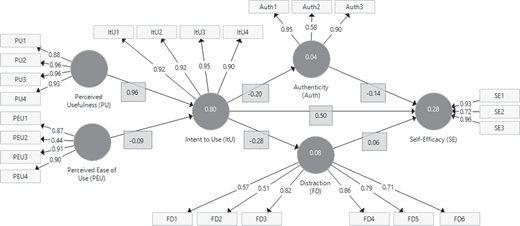
The data were loaded into SmartPLS3 (SmartPLS GmbH., 2015) to establish the ability to explain the variance in self-efficacy. The tool could analyze the path model to determine influences on the outcome, self-efficacy. First, when considering the students on the new solution, the path results in explaining 28% of the changes in self-efficacy (SE). This represents the R2 values from the related path weights, ItU at 0.5, FD at 0.06, and authenticity (Auth) at −0.14. See Figure 3 that highlights the strong influence of intent to use (ItU) from TAM, with minor contributions from the other areas. Looking further back in the model, the coefficient weight of ItU is −0.28 to FD and −0.2 to Auth. The strength of the explanation of FD at 0.08 and Auth of 0.04 are also very low. Conversely, the original TAM model has R2 = 0.8, in other words, 80% of its variance predicted by PU and PEU.
As part of the 256 control participants, those not part of the new technology adoption, that continued to use the old tool, similar outcomes support that technology forms the cornerstone of results. The explanation of SE was R2 = .26 because of a path weight of −0.17 from Auth and no significant influence from FD. Intent to use achieved a 76% explanation because of PU and PEU.
Reverting to the research questions, one must highlight that path modeling, like multiple regression, does not compartmentalize the influence of individual path coefficients. One cannot isolate separate components, although one can point to significant contributions. Therefore, as depicted in Figure 3, one can state that there is strong support for Question 3, ItU to influence SE. There is less relevance for FD and Auth, representing Questions 1 and 2 respectively. ItU has a limited influence on FD, Question 6, and Auth, Question 7. The data provided limited explanation of these factors. However, for Question 5 PU had a strong influence over ItU, while the influence from Question 5’s PEU was muted.
Similarly, by reviewing all participants and participants that use the earlier technology, Questions 3 and 5 find strong support, although one must avoid relying on individual linkages in isolation. The intent to use technology is explained close to 80%, while self-efficacy is explained between 26% and 28% for those that adopted new technology or remained the original technology respectively.
Discussion
It cannot be assumed that new technology improves distance education. This study quantitatively tested the TAPM defined in a qualitative study Olson et al. (2014). The findings across 264 participants experiencing technology adoption support a significant relationship between technology adoption and self-efficacy. The new data also supported the same relationship for existing technology used for conferencing and webcam use. This highlights that technology usefulness and ease of use are key to benefiting from any technology. Between the two studies, data show an emphasis on technology adoption, but the similar influence in the control data highlights that any deployment of technology must be coupled with user perceptions if one hopes to establish a benefit.
One might find varying advantages from the deployment of technology; however, these benefits will be muted should there be user concern regarding perceived usefulness or ease of use. Technology acceptance become a precursor to success. The implications for practice should highlight that one should not only focus on technical functionality, but acceptance. By not including acceptance, good systems might not achieve their true value and any deployment should pay particular attention to aiding perceptions and adoption.
Within an education setting, there are continuous streams of new students. Thus, while technology might not change, the change in the user population would imply an ongoing need to attend to perceptions and the intent to use technology. User training often focuses on the functional capabilities of users; limited time might not allow for comfort or positive perceptions of technology.
Data, using a control for persons that believed that they had the opportunity to use advanced functions, showed increased influence of technology. Of the 84 participants who reported actual ability to use, use, or some value from the technology, the support for increased self-efficacy increased from 26% to 57%. There is therefore strong support for improving user capabilities and especially perceptions of usefulness and ease of use. One needs to convince users of the value of a solution, not only teach its functions.
Throughout all analyses of the participant data, a consistent focus remains the role of technology. It overshadowed the role of authenticity and distraction, although the analysis depends on a consolidated view, strong influences should be noted. However, regular evaluation leaves a further 70% or more to be explained for self-efficacy. For a classroom setting, one should consider other factors that could aid in explaining further changes in outcomes.
The introduction of new technology highlights the need to prepare users. For this research study, there were controls; however, variations could occur because some instructors are less comfortable with technology. The exact nature and level of competence after limited training might imply an important variance that could shape student perceptions. In addition, students might benefit from more training, even if they are not prepared to invest more time. It follows that education setting might benefit from a skillful approach to improved preparations and there is a need to measure the level of preparation.
These factors contribute to concerns related to technology transience. The TAPM suggests how to improve technology adoption and extend technology transience. Successful adoption will lead to longer transience. Transience can be prolonged with attention to the perceived of ease of technology and usefulness for both teachers and students. These are larger factors in the technology adoption process than authenticity or distraction.
The study also sheds additional light in understanding technological self-efficacy, the individual strength of belief related to specific technology tasks (McDonald & Siegell, 1992). More specifically, technology self-efficacy describes individual general feelings related to technology adoption (Compeau & Higgins, 1995). Wang et al. (2013) associated increased student level of technological self-efficacy with increased academic success. This study provides additional definition to technological self-efficacy. The TAPM suggests that self-efficacy is the product of elements of technology acceptance, distraction, and authenticity. Technological self-efficacy can be increased by intentionally addressing elements of technology acceptance, distraction, and authenticity.
Conclusions and Future Research
Technology use by new users or new technology releases have a significant reliance on perceived ease of use and especially perceived usefulness. While organizations often rush to complete a new release or add users to technology solutions, this research highlights the high priority of preparations and attending to perceptions. Self-efficacy has a significant reliance on technology acceptance, overshadowing authenticity, and distraction. Both qualitative and quantitative approaches highlight a strong relationship between these two factors, leading to a need for increased preparation for practitioners.
The technology adoption model also provides addition detail related to the social external experience of Bandura's (1977, 1988) emphasis on self-efficacy. Distraction and authenticity could be experienced as external social self-efficacy factors. While they were not the most significant factors in subject self-efficacy, they did play a part. The larger impact on subject self-efficacy was the subject perceived ease of use and perceived usefulness related to subject intent to use the new technology. More work could be done to determine whether these components of intended utilization of technology are driven by individual or social experiences.
Future research should carefully document specific preparations and the attention to technical capabilities and especially efforts to address perceived usefulness plus ease of use. Understanding elements that increase perceive usefulness and ease of use will lead to faster and better adoption and self-efficacy. The degree of experience with a technology is also indicated as important. The addition of new users, even if there is no technology change, and the added use of existing features are further indications of user obstacles that need to be considered. A longitudinal study might add important insights, especially when controlled for changes in the use of technology. There are other factors that influence self-efficacy. Extending research to consider other sources that can indicate changes in self-efficacy would provide a useful contribution to this area.