


Today’s technologies come and go at an alarming rate, and the length of time any one technology, either software or hardware, exists before being supplanted by a newer technology is growing ever shorter. For anyone working within the field of instructional technology, this rapid replacement rate of technologies can hold immense implications for both the development and delivery of educational systems. We here define the concept of technology transience, contextualize the concept over the historical time frame, and present schemas for the measurement of technology transience. We conclude by describing how technology transience is impacting the field of instructional design, the specification of 21st century skills, and the 21st century’s model of education. Open questions for additional research into technology transience are provided.
A Historical Context for Today’s Perspectives on Technology
Technology has stood the test of time. Or has it? Does technology endure, or is it rapidly replaced? This question is in part one of semantics: disagreements as to the meaning and scope of the term technology have long ago forced the educational world to develop definitions for derivative terms such as “educational technology” and “instructional technology.” Beyond these semantics, though, it is of note that both terms—each unfortunately often imprecisely interpreted—play an important enough role to employ the word (“technology”) to help convey their meaning. In the modern vernacular, the term technology typically refers to hardware and software (most frequently, programs, hardware, and communications systems associated with computers, television, and mobile technology). However, it remains important to remember that the word technology originally arose from the Greek word τέχνη (“technē,” an applied art or craft), combined with λόγια (“logia,” meaning the study or use of). Τέχνη and λόγια thus join together to refer to a systematized treatment of some type that expands beyond hardware and software (Amirault & Branson, 2006). History provides us with many examples of the early and evolving understanding of the concept of technology. In the High Middle Ages, for example, the term “technology” might easily have referred to the systematic approach used to integrate one component of the university curriculum (e.g., the portion of the trivium covering the art of grammar within the larger curriculum based on the Seven Liberal Arts.1 Dasgupta (1996) has said that technology contains both a “psychology” and a “logic” representing a “conceiving, shaping, and using [of] artifacts from as far back as the early stone age … as much concerned with conceiving of artifactural forms as with their actual making … [and] is, thus, a cognitive activity” (p. 3). Understanding therefore the lexical roots of the word technology provides the basis for understanding that educational and instructional technology are not confined to today’s electronic, computerized components, but rather encompass a more expansive view of systematic and systemic paradigms for education, instruction, and learning. Today’s major professional associations are therefore inclined to use a more encompassing meaning of technology in their officially sanctioned definitions and scholarly and policy publications.2
Enter Technology “Transience”
The term “technology transience,” however, differs from such terms as “instructional technology” in that it indeed does refer to hardware and software components, and more specifically, the nature and length of the lifespans these technologies experience. When technology transience is considered, we are looking at how specific incarnations of technology come and go, the length of time they are in existence, and their use within a given historical context. And because education has historically been so closely intertwined with technology, it becomes an investigation into not only education (cf. Babbitt, Kahhat, Williams, & Barbitt, 2009), but also lifespan development, societal adaptation, and a myriad of other factors in which technology is involved.
It is perhaps obvious to state that some technologies are more durable than others. Technological durability is not, however, necessarily positively correlated with level of technical sophistication. In fact, the two are often negatively correlated due to a number of characteristics that factor into a given technology’s useful lifespan. It can be shown, for example, that simple technologies, such as the candle, the quill pen, and the printed book (codex) are highly durable because their usage has withstood not merely years, decades, or centuries, but millennia of time.3
Durable technologies, too, are often simple in nature, at least by comparison with technologies of our modern era, and frequently defy replacement, even in the presence of more sophisticated substitutes. For example, the light emitting diode, or LED light bulb, popular due to its high level of light output coupled with low levels of electrical usage, has not moved the common candle into extinction; the candle remains an affordable and accessible form of lighting for millions of people across the world because it is easy to manufacture, to store, and requires no electricity for its use. The emergence of a technologically superior innovation therefore often only marginally impacts the lifespan of a more simplistic variant, due to affordability, accessibility, and ease of use. But it is equally important to point out that the so-called “durable” technologies are insufficient in number to impact the broader general trends of technology transience, as we shall see later in this article.
Phases for Technology in Education (“Periodization”)
One helpful approach for studying technology transience is periodization. Periodization is the attempt to break the stream of narrative history into digestible chunks (periods) by which we can more easily manipulate historical information, as well as better contextualize historical events for the purpose of examination. We can think of periodization in much the same way that the educational and psychological fields think of operationalized variables: they are imperfect descriptors that provide a central frame of reference facilitating meaningful discussion. Periodization schemas can also help us identify trends across extended historical eras.4
We propose the following periodization schema for technology and education:
the era of rudimentary technologies (prehistory to antiquity)—such as, pebbles, quill pens, et cetera; the earliest attempts at using technology to support learning;
the era of recognition (early to late antiquity)—such as, wax tablets, carved stones, et cetera; technology as tools to support instruction;
the era of systematized methods of instruction (early middle ages through high middle ages)—such as, formalized, systematized instructional methods such as the scholastic and disputational methods within the medieval university in Paris and Bologna; technology as systematized instruction5;
the era of mechanically based technologies for grade school education (late 19th through mid 20th centuries)—such as, blackboards, standardized desks, the hornbook, “magic lantern” slide projectors, et cetera; technology as classroom support tools;
the era of electronic, digital computing technology (midto late 20th century)— such as, the personal computer, the electronic calculator, et cetera; technology to help develop new learning cognitive learning processes];
the era of breakout digital technology and smartphone apps (early 21st century)— encompasses wireless, mobile, and, now, wearable computational devices; “disruptive” technology removed from geographical limitations; and
the era of computational and brain-based synergetic learning (mid 21st century, estimated)—such as, physical linkage of the human brain with computational devices to transfer skills and knowledge; technology physiologically merged with the human body.
One key trend emerges from this periodization scheme: the length of time specific technologies exist has been steadily decreasing over time. The earliest technologies (e.g., using pebbles to improve speech and diction, small stones for counting, etc.), have been in use for millennia, and sometimes remain in use today. As history progressed, ever more slightly sophisticated variants of technologies incrementally supplanted older technologies (e.g., wax tablets), but began to exhibit shortened lifespans compared to their ancient predecessors because of increased rate of technological innovation. By the medieval and early modern periods, a growing number of new technologies emerged (cf. Plimpton, 1916), but with even shorter historical lifespans (e.g., the trebuchet, the wind-powered grinding mill, the astrolabe, the Dutchdesigned fluytschip cargo vessel, etc.). The Industrial Revolution (Wengenroth, 2000) shortened technology lifespan further via introduction of technologies that would endure only a century before retirement (e.g., steam powered locomotives, hand-driven milling machines, the incandescent light bulb, steam engines, etc.). The 20th century brought extensive innovations in science and technology that need not be chronicled: automated production of combustion-engine automobiles, the telephone, the digital computer, commercial refrigeration, and many more all changed life for many people living in technologically advanced regions. But although many 20th century innovations remain in use at the beginning of the 21st century, nearly every one is already in contention for obsolescence: the combustion-engine (replaced by electric cars); the wired telephone (replaced by satellite and cell-based mobile systems); the digital computer (while not technically replaced, per se, is undergoing such rapid and deep shifts in its capabilities that the current models seem less and less connected to their ENIAC forbearers); are but a few examples.
But of greatest importance to our discussion is not only the amount of today’s technical innovation, but the increasing brevity of these innovations as they are replaced by improved and/or new variants. One supply chain specialist, for example, stated “one of the most profound changes in the last decade is the dramatic shrinkage of product life cycles” (Horn, 2012, para. 1). A recent example is Google Glass, developed only in 2013, and already said to be discontinued by Google as of January 2015 (Curtis, 2015).6 And although not a perfectly consistent finding because of the relatively few “durable” technologies, the overall historical record of technology transience has been one that has experienced steadily decreasing lifespans over the historical time frame. The ultimate realization of this process is today’s setting, where technological innovations—particularly software—are being introduced and replaced at dizzying rates, resulting in a volume of product releases that has become extraordinarily difficult to manage. This key characteristic of technology transience is the origin of many issues faced by educational technology today, where technology replacements result in instructional revision, alteration of instructional methods, modification and/or recreation of instructional materials, and, sometimes, reconceptualization of entire instructional programs.
How May Technological Transience be Described, Measured, and Quantified?
One method for estimating the lifespan of current technology is based users’ perceptual estimations of technology longevity. One recent review conducted by the Consumer Electronics Associates (cited in Ely, 2014) examined the life expectancy of products based on the estimates of consumers (n = 1,013), finding that consumers’ perceptions on electronics lifespans included: flat panel TVs (7.4 years); digital cameras (6.5 years); desktop computers (5.9 years); notebooks, netbooks, or laptop computers (5.5 years); and smartphones (4.6 years). And while this is not a precise measure of a given technology’s actual lifespan, it easily provides evidence that today’s technologies are experiencing a “replacement rate” far exceeding those of the previous century. Individuals in the 1950s, for example, leased a corded phone from the phone company with the expectation that the phone would last decades. Today, people routinely switch out their cell phones every 24 months, a process driven by relentless competition as well as short-cycle provider contracts. The same could be said for a whole array of technologies, leading some to call our current time “the disposable era.”7
Technology transience is not limited to hardware devices.8 In fact, the greatest impact of technology transience today might be experienced within the software domain, where an immense number of updates and replacements routinely occur. To get a sense of its magnitude, as of July 2014, there were 1.3 million available apps for the Android platform, and over 1.2 million apps for the iOS platform (Statista, 2014). In a recent study by Arthur (2013) analyzing the lifespan of some 39 Google tools and services, it was discovered that the longest lived Google service was iGoogle (3,106 days, or about 8½ years), the shortest was Lively (175 days, or about ½ year), and the mean life for Google services was only 1,459 days (about 4 years). Another review of over 26,000 mobile apps using a half-life approach (Gordon, 2014) found that about half of all apps lose one half of their peak user numbers in only three months.
Digital content, too, is subject to the effects of technology transience. With the average lifespan of a web page averaging only some 100 days, the impact of “reference rot” (the combination of “link rot,” when a URL no longer functions, and “content drift,” when digital content is relocated to a new URL), has impacted nearly every field of study, including legal cases (Lepore, 2015). This has prompted efforts such as The Wayback Machine, an automated robot trawler that attempts to capture as many web pages as possible for archiving purposes before pages are permanently lost. As of December 2014, The Wayback Machine had captured some nine petabytes of data (or more than four hundred and thirty billion web pages) at a rate of some 20 terabytes per week (The Internet Archive, 2015). Even digital file formats, such as .jpg, .doc, .pdf, et cetera, have become areas of concern for librarians and digital archivists as they ponder how long these file formats will remain readable before being replaced by applications that no longer support them (Jackson, 2012). Organizations such as the National Digital Stewardship Alliance (U.S. Library of Congress, 2015) and other national library systems are currently attempting to find solutions to the issue of long-term digital content readability and accessibility.
Nevertheless, technology transience does not follow a perfectly consistent trending line. There are always technology “holdouts” as products move into obsolescence. A review (Piltch, 2013) conducted by Laptop Magazine for example, found that, as of 2013, more than 10 million people still access the web at 56.6 kb/s or slower, approximately 20,000 dot matrix printers were purchased, some 4.6 million vinyl records were sold (versus 118 million digital albums), and the US still possesses some 300,000 corded, public pay phones. But rather than providing evidence of technological durability, these numbers equally reflect technology transience (i.e., consider the recent invention dates for each of these technologies, and compare how few “holdouts” for each are reflected in these numbers).
Technology Innovation and Transience Models
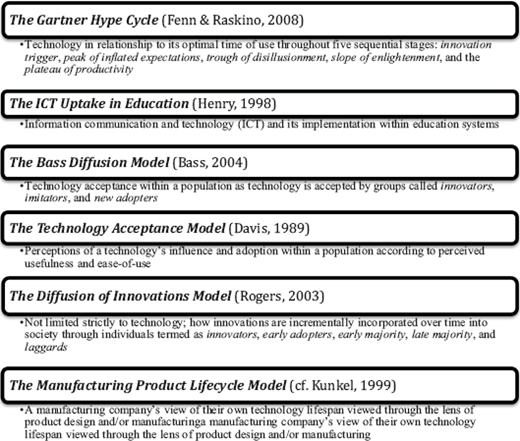
Although the most basic conception of technology transience is the phenomenon whereby technologies come and go, a “lifespan” that marks the time frame of a technology’s use, the concept is also differentially viewed between groups, based on the specific concerns of each group. Businesses, for example, tend to look at the lifespan of specific technologies that they produce from a profitability standpoint (Mahajan, Muller, & Srivastava, 1990). Ethnologists tend to look at technologies from an adoption and/or acceptance viewpoint across a cultural group (cf. Bendix, 2002). Economists tend to view technology lifespans in terms of their impact on, say, a country’s GDP or job markets (“Q3 Technology Quarterly,” 2014). Educators tend to view technology lifespan from the standpoint of their usefulness and feasibility for achieving educational outcomes within the constraints of a school’s financial and instructional usability factors (Henry, 1998). This implies, then, that to fully understand technology transience and its impact, we must consider how these different domains describe the phenomenon from their unique vantage point. This has driven the development of multiple technology innovation models, summarized in Figure 1.
Although in educational circles it is much more common to discuss Rogers’ Diffusion of Innovations model,9 we propose here to use the manufacturing process model to highlight the concept of technology transience. One excellent example is Sony’s Sunrise/Sunset Product Model (Kunkel, 1999), which depicts technology product lifespans across an “arc” of four stages with two steps each:
Market Creation
“Sunrise”—a new technology product is first envisioned
“Early Morning”—product viability is determined; followed by
Market Penetration
3. “Late Morning”—the essence of a product is determined
4. “Noon”—the product reaches the apogee of its essential development; followed by
Market Expansion
5. “Early Afternoon”—product differentiation begins
6. “Late Afternoon”—extreme differential versions of the product are made to keep the product line going; and, finally,
Market Saturation
7. “Sunset”—the market becomes saturated and is at maximum size
8. “Perpetual Sunset”—final iterations before total product obsolescence
Sony’s own MiniDisc technology is an excellent case for illustrating this technology process model. Originally conceived in the early 1990s through research into “psychoacoustic encoding,”10 Sony combined their background in miniaturized electronics and optical disc technology with software algorithms to condense the size of digital audio data for portable digital audio players using rewritable optical discs. Like many innovations, the technology was ahead of its time, and the broader public had difficulty understanding the technology and its benefits over analog recording technology, including the vinyl LP album, and even other digital technologies, such as the CD-ROM which, ironically, Sony codeveloped with the Philips Corporation (Nathan, 1999). MiniDisc technology was never widely adopted outside Japan and Europe; the last MiniDisc unit was shipped by Sony in March, 2013, leaving a total technology lifespan from “sunrise” to “permanent sunset” of only 22 years (Condliffe, 2013).
The case of the MiniDisc is but an epitome of nearly all recent technological innovation in terms of its abbreviated lifespan.11 These increasingly shortened technology product lifespans have been driven by relentless and increasing waves of scientific innovation, a highly competitive technology sector, and public thirst for new and better tools for nearly every aspect of life.12
How Might Technological Transience Impact Traditional Education?
The changes precipitated by today’s highly transient technologies have created a promise/ threat duality upon traditional educational structures via potential large-scale change through advanced computer-based technology. This is certainly true of the world of distance education, a modality often dependent on modern computer technology, but this is far from the only aspect of education feeling the impact of rapid technological change.13 Modern technology innovations have spawned an entire cottage industry of books forecasting all types of educational upheavals (cf. Carey, 2015; Christensen & Eyring, 2011; Craig, 2015; DeMillo, 2011; Stevens & Kirst, 2015), increasing pressure on educational leaders to consider and prepare for the effects of large scale, and unpredictable, technology-driven change.
Some have said, for example, that the rise of MOOCs14 heralds a new age of education liberated not only from the constraints of geography, but of class size, student entry requirements, and admittance to formal degree programs (cf. Haber, 2014). Others have predicted that the interactions between learners and the educational content they “consume” will be altered from its current, static, paperbased format to interactive electronically based content (Fang, 2014). Still others predict that the manner in which educators will teach content will be permanently changed from an instructor-to-student orientation in favor of an interconnected network of learners with instructors as facilitators of the learning process, rather than as content providers (Arah, 2012; Ferster, 2014). The former president of Harvard University, Derek Bok, reflects this view: “Technology is gradually causing a number of professors to reexamine the way they teach, away from a passive form of learning to a more interesting, and active form” (“Special report: Universities,” 2015, para. 4). Others have gone so far as to make the bold claim that “brick and mortar” educational institutions will cease to exist in their current form before the end of the current century (cf. Hardan, 2012).
Although the purpose of this article is not to focus on any one of these claims, it is beneficial to note that these predictions are predicated in conjunction with today’s era of technologically transient innovations, which will undoubtedly continue to generate unpredictable outcomes for the educational world. This is all the more true because the lifespan of these innovations is ever shorter, characterized by large innovation but with simultaneously short life spans.15 We next illustrate such possible effects within three select educational areas: the field of instructional design; the specification of 21st century skills frameworks; and the nature and structure of higher education institutions.
Technology Transience and Instructional Design: Collision or Collaboration?
Systematic instructional design has always relied on a foundation of consistent, stable learning principles upon which the methodology is built.16 Indeed, the use of the word “system” within instructional systems design implies an orderly, consistent, and uniform approach to the instructional task. Many of these precepts arose from the pioneering efforts of 19th century psychologists who sought to uncover the psychological principles underlying all learning processes (Boring, 1950; Lagemann, 2000). As instructional design arose from an applied military-based need in the mid-20th century, its approach applied these principles to achieve reliable, reproducible, and measurable learning outcomes (Miller, 1962; Ramsberger, 2001). The instructional design approach remains successful to this day for a variety of reasons: an empirically based research foundation; the ability to quantify learning so that it can be more consistently achieved and studied; reliable, reproducible, and measurable outcomes; and methods for teaching the approach to others so that they may apply these techniques to a wide range of learning settings (Gagné, 1965, 1966, 1989). It is also of interest to note that a series of technical innovations—spurred by the space race—helped give birth to the field of instructional design (Reiser & Dempsey, 2012).
As the 20th century came to a close, a debate within the instructional design field emerged in regard to technology and its use in education, again driven as it had been earlier in that century by the rise of technological innovation. Much of this debate focused on the role of technology in learning, and often drew instructional designers into opposing camps (Clark, 2001). Some viewed the psychological principles underlying instructional design as inviolate: the presence or absence of technology was simply of secondary (or even tertiary) concern (Clark, 1994). Others felt that technology afforded new possibilities for learning, though still unchangingly based upon the traditional learning paradigms discovered by the 19th century psychologists (Kozma, 1991). Others—and this became particularly true as the nature and level of technological sophistication exponentially grew at the close of the 20th century—argued that new paradigms of learning, if not already present, were about to emerge as a function of the capabilities brought about by sophisticated computerbased technologies (Brown, 2005). Technology transience seems to logically imply that rates of technological innovation must impact both learning and instructional design. To take a simple example, when designing instruction to teach the use of a given piece of hardware or software of limited lifespan, is the time and effort inherent in the development of such instruction worth its financial cost? How can this factor be reliably calculated? And how can an instructional design best anticipate changes, upgrades, updates, and replacements for such technology?
More complex issues regarding technology transience apply to instructional design at the program and institutional level. How should programs be designed for resilience within a technology transient setting to minimize constant program revision? How should decisions be made on the choice of technologies to include both as the subject of instruction and as a delivery mechanism for instruction? How does an institution keep ahead of the technology curve, ensuring that the design of courses keeps students’ skills current? How are costs kept under control during technological change? And how does an institution best predict if the next technology innovation (e.g., wearable computers) genuinely presages changes in how tomorrow’s learners will learn and interact with subject matter content, or simply be a passing fad?
Clearly, instructional design must address an entire set of implications generated from technology transience. Not the least of them, the development of students equipped to be successful within the work context in which they will operate, leads to the next item: “21st century skills.”
Technology Transience and “21st Century Skills”: A State of Continuous Revision?
In recent years, attention has been turned to the development of “21st century skills” frameworks describing the knowledge, skills, and abilities needed for today’s learners to be successful in today’s work setting (Dwyer, Hogan, & Stewart, 2014; O’Connell, 2014; Rotherham & Willingham, 2009). Much of this work is predicated on an acknowledgment that teaching, learning, and working is undergoing fundamental transformation as a result of intense technical innovation (cf. The University of Houston, 2015). But the notion of rapidly changing technology with everdecreasing lifespans—a different consideration than mere technological innovation alone—creates further strains on such skills schema, leaving us with new questions as we seek to understand what it means to have students be prepared to interact in a technologically transient setting.
Such challenges can be evidenced even in such basic tasks as selecting technologies to teach learners for future use. With the proliferation and replacement of many technologies, any such skills training can become quickly outdated. What technology skills will learners be required to possess? What expectations might students have in regard to the use of technology within the classroom? What technology should be provided in the learning setting to reach desired instructional outcomes? Which technologies will provide the most enduring and useful learning outcomes? And what technology skills best equip learners for ongoing success in a technologically fluid work setting?
Furthermore, the 21st century skills schemas are often predicated on the assumption of advanced computer-based technologies as facilitators for transitioning learners toward higher order thinking skills (Robin, 2008). But if that very technology is in a state of constant change, what are the ramifications for achieving these higher order learning outcomes? Can rapid changes in technology partly “unravel” these presumed benefits of 21st century skills?
In the presence of rapidly changing and rapidly outdated and/or replaced technologies, it can be argued more persuasively than ever before that the most important technology skill for learners to possess is simply not knowing the ins and outs of a variety of specific technologies, but rather, the ability to successfully interact in a rapidly changing technological world where skills must be learned “just-intime,” often without the aid of an instructor, or even a collaborator. In a highly technologically transient setting, such self-awareness, confidence, and aptitude in ascertaining what needs to be learned (and locating such information) can be argued to be the ultimate “technology skill,” one that will not only yield the greatest benefit, but also serve over the longest period of time. Any meaningful 21st century skills framework must therefore explicitly incorporate within its specification the reality that technology is in a constant state of change, with ever-new capabilities, and presenting changing implications for the educational preparedness of learners. This leads to the third area for discussion: the impact of technology transience on higher education institutions themselves.
Technology Transience and the 21st Century University: A New Model of Education?
The overall type, extent, and transient nature of today’s technology innovation has led a number of observers to predict that traditional educational structures will be completely changed in the 21st century (Amirault, 2012). Indeed, we are barely 2 decades into the century, and any cursory review of publications will provide evidence of the sheer growth of such claims (cf. Fleischmann, 2013; Soares, Eaton, & Smith, 2013; Staley & Trinkle, 2011). The ability of today’s technology to completely revolutionize delivery of educational content is but one aspect of this scenario: the manner in which students interact with subject matter, how assessment is conducted, and the tools supporting communication between educational participants will all play an important role in the reenvisioning of future education. Some have labeled this the “democratization” of education (Acemoglu, Laibson, & List, 2014), some “the democratization of study” (Ferguson, 2007), and others have similarly argued that subject matter content, once a protected and sheltered domain of specialists, is now open to all, often at no cost (Amirault, 2012). A recent example of the spirited debate surrounding such issues can be found in Anglin’s (2012) “Considering the Future of Brick and Mortar Universities,” with opposing views depicted in Mazoué’s (2012) “The Deconstructed Campus” and Shrock’s (2012) “A Reaction to Mazoué’s Deconstructed Campus.”
As in the case of instructional design, which is based on a set of fixed principles, the foundation of higher education institutions is based on an even longer historical time frame, now surpassing some eight centuries, of enduring assumptions about the nature and character of education.17 Moreover, in spite of the university’s ability to adapt and evolve over nearly a millennium of its history, its essential model remains predicated on a series of systems, techniques, and structures that have often barely changed during its extensive lifetime (de Ridder-Symoens, 2003–2010; Eagleton, 2015; Furruolo, 1985; Rait, 2009).18
In a 21st century characterized by deep and constantly changing technology (Amirault & Visser, 2009, 2011), how will the ancient institution of the university maintain its essential nature and character? What features of university classroom life will be changed, and how long will such changes last before they themselves are replaced? Some studies have shown that technology adoption by faculty is connected with self-efficacy (Buchanan, Sainter, & Saunders, 2013), and sometimes only adopted in a slow and inconsistent fashion across postsecondary disciplines (Hora & Holden, 2013). Other studies have provided insight into the differential reasons for why individuals select one technology over another, regardless of a technology’s novelty (Hodges & Prater, 2014). How will the role of the faculty member be altered within this technology-enabled and technology-rich context, and what new demands will students make on educational systems in terms of technology expectations, content delivery, communication demands, and learning opportunities? Will subject matter experts, the traditional role of university faculty, come under permanent threat? Will higher education institutions, facing budgetary shortfalls and uncertain economic circumstances, increasingly turn to instructional outsourcing, employing technology-mediated delivery systems that bypass traditional models?19 And to what extent will traditional higher education institutions shift their programs into the online modality, drawing students without regard to geographic limitations?
Predicting the model that higher education institutions will eventually settle upon is no simple matter, because technology transience continues to bring new ideas to the table, challenging institutions to consider new approaches to education. For example, one recent idea that has been proposed in contradiction to the more common MOOC concept involves the Small Private Online Course (SPOC) concept, where a small number of students, each focusing on a specific topic of study, take the online course for credit; Harvard’s Kennedy School of Government, for example already runs such a course on American Security Policy (Technology and universities, 2015). But regardless of the model upon which higher education eventually settles, the question of how technology transience will affect the entire higher education enterprise remains one of the greatest in the history of education.
How May the Impact of Technology Transience be Researched?
If we are to fully understand and prepare for the technology transience of the 21st century setting, we must more carefully quantify and measure the phenomenon, documenting data on the impact already experienced in both formal and informal educational settings. This includes:
Technology Lifespans:
What are the most common technologies being used in primary, secondary, and university contexts?
What are the rationales for the choices to use one technology over another?
Who makes technology selections?
When were these technologies first introduced?
Why do they continue to be used?
What technologies are not being used, and why?
Financial Costs of Instructor Preparedness:
What types of technology training are used to maintain instructors’ technology skills?
What is the cost of such training?
Who bears such cost?
How frequently is instructor training updated?
Instructional Revision:
How frequently must individual courses and programs be revised to maintain relevance as technology changes?
Are these course and program revisions substantively changing the nature and outcomes of their educational goals and objectives?
Are these courses and programs training learners in new ways as a result of new technological capabilities?
What Open Questions Regarding Technology Transience Require Discussion?
We conclude by posing key open questions regarding technology transience in education. We divide these by topical area aligned with the previous discussions:
Instructional Design:
Will new ID models be required in order to maintain the field’s relevancy in a highly technologically transient world?
Can uniform, meaningful instructional design approaches be developed for addressing technology transience for a given instructional context, or does the very nature of transience make this an unobtainable goal?
Are today’s changes in technology occurring so rapidly and dramatically that they are overpowering established, systematic principles of education, or do these principles remain relevant and inviolable, regardless of technology transience?
Are the foundations of the field of instructional design being changed as a result of technology transience? Should they be?
Is instructional design a “static” field, or is it a “living” field that can continue to evolve over time in relation to issues posed by technology transience?
Should educators allow technology transience to drive technology’s educational application, or should educators drive this process in an a priori manner?
21st Century Skills Frameworks:
Has technology transience changed what it now means to be considered “technologically literate?”
Should all 21st century skills frameworks directly reference the issue of technology transience?
Has “just in time” learning been handed new relevancy and potency in the world of technology transience?
What is the most important technology skill for learners to possess within the 21st century work context?
Higher Education Structures:
How quickly should educational organizations respond to technology innovations? Should institutions attempt to stay at the forefront of all technological innovation, or should they hold a “wait and see” attitude toward technology innovations?
How can educational institutions best prepare and insulate themselves from changes in technology without becoming stagnant in their educational practice?
How can educational institutions most effectively control costs while maintaining an up-to-date technology infrastructure?
What are the best approaches for traditional institutions moving into online learning? Should new approaches, including degree sharing and unique partnerships, be explored?
Much work must still be done if the educational world is to be properly prepared for, and be able to effectively manage, the technological transience that is almost certainly destined to increase over this century. It is not an issue that can be avoided: technology transience will continue to thrust itself upon the educational world. If the educational world does not first assume a proactive mindset that recognizes both the reality and the implications of dynamic, large-scale, and unpredictable technological change, it may surrender any opportunity to successfully shape that change.
Education has employed technology from the earliest times of history. To shirk the issue of technology transience in today’s technology-enabled context would be akin to discarding millennia of experiential work in educational technology. With issues more complex than ever, technology transience offers as many challenges to the educational setting as it does new opportunities for learning. Educators cannot afford to disregard this dynamic change process, but instead must come to understand and maximize its potential for education.
Notes
Those readers with a greater interest in the history of the university, and the role of technology in that context, will be interested to note the case of the systematic implementation of Scholastic disputation in the 13th century (Novikoff, 2013). The approach was introduced into the medieval university at its birth in medieval France, subsequently utilized in its classrooms for some 300 years, and culminated in the public quodlibetal debates of the period (Daileader, 2001). It was, in its time an “instructional technology;” the approach was a systematic, rule-based instructional method that all students within both the trivium and the quadrivium were required to master before completion of a university degree (RidderSymoens, 1992). The Scholastic Movement eventually became associated with the “Renaissance of the 12th Century” (Haskins, 1927), initiating the worldwide university movement and becoming indelibly connected with systematized formal educational approaches that easily fall under the broad rubric of “educational technology” (cf. Daileader, 2004).
Printed books continue in wide use today (“Papyrus to pixels: The digital transformation has just begun,” 2014), in spite of seeming endless predictions of their imminent demise due to e-readers and tablet computers.
We here propose an abbreviated periodization schema that encompasses our modern era. A more detailed technology periodization schema can be found in Saettler (2004), although, unfortunately, that schema reaches only to the 1990s, omitting today’s highly advanced technology setting.
This would include the development in France after the French Revolution of the école normale (normal school) for public servants (Edwards, 1991), called Normaliens (i.e., those who are trained to “norms.”). Later, when the curriculum added preparation for primary school teachers, the word supérieure was added. The movement was reflected in the Normal Schools Movement of the United States, still retained in the names of many U.S. locations and schools. Normal, Illinois, for example, where Illinois State Normal University (now Illinois State University) was founded, was the first Illinois public institution of higher education for teacher education. Abraham Lincoln acted as the attorney to draw up the school’s original financial bond (Illinois State University, 2015).
Sony almost immediately announced a competitor product (Newcomb, 2015).
As early in the 20th century it was posited that “planned obsolescence” could help put an end to the Great Depression (London, 1932), but even this prescient notion could not have conceived of a time as ours when so many technologies are so rapidly replaced.
Even business lifespans are shrinking due to technology innovation; a recent report (Foster, 2012) found that firms once averaging a 61year lifespan in 1958 are down to 18 years, and at the current rate, 75% of S&P firms may be replaced by 2027.
Rogers proposed that innovations were more likely to succeed if they possess low complexity, observability, “try-ability” (i.e., the ability for individuals to try them), compatibility, and high relative advantage (Ferster, 2014).
Technical specifications for various psychoacoustic encoding algorithms are found in Painter and Spanias (2000) and Maes (1996). Digital data representing the entire range of recording points, including frequency, volume, etc., are compared with a model of what the human ear is able to perceive; only perceptually meaningful data is retained. Sony’s original implementation of the approach, called “ATRAC” (Adaptive Transform Acoustic Encoding) was coupled with optical write/ rewrite technology, and the “MiniDisc” was born in 1992.
VHS video tape, BetaMax, reel-to-reel audio tape, and other technologies experienced a similar pattern, though each, ultimately, had a slightly different lifespan, and with differing public acceptance. None of these technologies, however, will exceed a 100-year lifespan.
Competition between companies can result in technology products with no apparent initial educational use. Sometimes a technology’s educational application grows organically, over time; other times, it never materializes. The “retrofitting” of technology to education has increasingly become a part of todays educational context, in contrast to earlier times, when technology might have been first envisioned before development as an educationally relevant tool (cf. Pressey, 1926). Ferster (2014) has argued that today’s educational technologies are generally dependent on the broader technology climate, since a technology’s use within educational settings is generally insufficient in scale to recoup development costs.
Technological innovation is not the only major issue facing higher education. Student loan debt, dwindling endowments, drops in governmental financing, and even basic infrastructure issues are all having significant impact on higher education (cf. Marie-Laure & Céline, 1997; “Special Report,” 2015).
Ironically, and underscoring the notion of technology transience, MOOCs, introduced to great acclaim only in 2008 (Parr, 2012), may have already begun to crest in interest within certain higher education institutions (Kolowich, 2015).
In the preface of this QRDE special issue, we referred to this as “high frequency, high amplitude” technology transience, where “frequency” represents the pace at which specific technologies come and go, and “amplitude” the intensity of a technology’s impact.
The question of inviolate, underlying principles of learning and education go as far back as Plato (428–328BC), who envisioned reality through the lens of other-worldly “forms” of unchanging nature in which all reality was reflected through specific incarnations of those forms (Morgan, 2006). But are inviolate, unchanging views of learning rather simply transient manifestations, reflecting only current understandings of learning and bounded by the current state of technological advancement? This is an intriguing question with both practical and theoretical connotations.
With a lifespan (8 centuries) that dwarfs that of instructional design, a mere 7 decades (Reiser & Dempsey, 2012).
To illustrate, one could argue that, with some exceptions, a person today could walk into the 13th century university classroom and still feel largely “at home” due to the similarities present within the approach and configuration of today’s traditional university classrooms.

