One of the challenges facing undergraduate science programs is keeping students interested in science and minimizing attrition from their discipline. Prior research shows that showcasing real-life applicability of science is one way to keep students interested. In this exploratory study using secondary data from 2 undergraduate science courses, we examined the impact of science mobile apps on students’ interest and learning. The results show empirically that students think science mobile apps do help increase their interest in science. Furthermore, the ubiquitous mobile phone allows 24/7 access to these science apps, enabling enhanced learning and mastery of scientific concept.
Introduction
Current science curricula across educational institutions face a pressing need to reevaluate the instructional systems available for students with increasing academic loads. Among the major challenges to K–20 STEM education are increasing students’
interest in subjects related to science, technology, engineering, and mathematics (STEM). In addition, prevention of student attrition in STEM higher education programs is critical to drive the graduates into STEM careers. Therefore, sustaining and even increasing their interest in science is critical to ensuring their successful completion and entry into graduate programs in STEM disciplines.
One of the main drivers of students’ interest in science courses is the availability and accessibility of tools that allow them hands-on experience of real-life scientific applications or science addressing real-world problems, dissolving the boundaries of formal learning (Waycott & Kennedy, 2009). Mobile apps (mobile applications) enable contextualized learning experiences and connections across areas within STEM to achieve this, as the smartphone and mobile apps have become an integral part of our daily lives, especially among students.
Mobile Learning in Higher Education
Mobile learning has transformed traditional classrooms by allowing greater interaction and stimulating the learner’s interest (Shen et al., 2008). Utilization of the mobile phone that students currently use in their daily lives, as part of pedagogical approaches, significantly adds to their motivation (Hsu & Ching, 2013; Hwang & Wu, 2014; Schmitz et al., 2012).
A case study conducted on first-year students of a large, undergraduate chemistry course showed the educational merit of socially common mobile technologies in situated learning through reflection of everyday, real-world experiences of the concepts taught (Waycott & Kennedy, 2009).
Another paper proposed a mobile augmented reality framework for education to examine perceived student learning, self-efficacy and satisfaction, showing that learning outcome would be impacted by high motivation and understanding in the learning process (Jamali et al., 2014). It suggested that studentcentered learning in higher education could be empowered via implementation of mobile augmented reality learning.
Pedagogical Use of Mobile Apps at the College Level
Strategies of pedagogical learning harnessed in mobile educational environments were reported in a review that surveyed relevant recent researches to investigate the addon effect of mobile apps in learning methods (Jeng et al., 2010). The model highlighted development of a situated classroom emphasizing on learning strategies, mobile users, and virtual team awareness, and incorporating key mobile app features of ubiquitous computing, mobility, and portability to facilitate the learning process.
Usage of smartphones and a specific subject-app at the Spanish National University of Distance Education were undertaken to assess the app’s didactic potential to facilitate student learning of university subjects within ubiquitous environments and developing generic competencies per the European Higher Education Area (Vázquez-Cano, 2014). This was achieved by creating and validating a scale to detect these factors depending on participation of 388 students in the “curriculum design and innovation” class, a part of the “university degree in pedagogy” program. Students valued the use of apps specifically designed to grasp university courses as a new format supporting and strengthening learning strategies. At the same time, they felt equipped with further opportunities to provide interrelationships among their subjects as well as to promote collaborative effort among instructors and students, given the didactic usage of the app.
Pedagogical Use of Science Mobile Apps in College
A qualitative content meta-analysis of articles published between 2007 and 2014 reviewed science mobile app research for its design of mobile apps, relevant theoretical foundations, and measured outcomes among students (Zydney & Warner, 2016).
According to this investigation, a variety of similar design features were offered by science learning mobile apps, ranging from technology-based scaffolding, audio/visual demonstrations, and location-aware functionality, to mechanisms of sharing digital knowledge, tools to construct digital knowledge, and differentiated functionalities.
Fundamental scientific knowledge or comprehension of concepts was the most common measured outcome. The underlying theories need to be better aligned with measured outcomes, along with a requirement of more studies to evaluate skill-based or higher level cognitive outcomes, and cognitive load. The review recommended more research to unravel how to tap into science mobile apps offering more diverse science topics as well as audiences.
A 3-year research project executed in a neuroanatomy practical class provided evidence that students extensively utilized apps on preconfigured devices, found the devices to benefit their learning, and felt them to be easy to use with minimal training and support (Morris et al., 2016). Among the students, a significant rise in ownership of touch-screen devices during the trial period as well as their usage of academic study devices was noted. Additionally, a statistically significant improvement in performance on neuroanatomy questions was observed upon the incorporation of tablet devices.
An app was developed for better student engagement in lecture content and used to directly post content-based, multiple-choice quizzes to students’ personal mobile devices as pretutorial and following lecture (Pechenkina et al., 2017). Introduction of the app led to greater rates of academic performance and student retention, coupled with a positive correlation between students’ securing high scores on the app and earning better academic grades.
Another project involving a class of 91 undergraduate students aimed at assessing whether mobile technology improves fieldbased learning, using the capability of identification of birds used as the study metric (Thomas & Fellowes, 2017). Although students did not feel that mobile apps added to their capacity of identifying birds, they expressed a positive impact of handling their own smartphones for learning, indicating that those made pertinent information more accessible beyond scheduled teaching times.
A mobile app named NutriBiochem was developed for a group of second year biochemistry and metabolism course students, and accessed via computers, tablets, and smartphones (Teri et al., 2014). Surveying these students indicated that the app enhanced their learning experience, was an important and pertinent learning strategy amid current pressures in college education, and was recommended by students with regards to integration of such technological tools within education.
Methodology
Purpose
The purpose of this exploratory study was to identify the main reasons undergraduate science students express regarding their interest in science, and to explore the impact of using science mobile apps in learning science at the undergraduate level.
The following research questions were addressed.
What factors had led students in undergraduate science programs to become interested in science?
What are the science mobile apps used by these students in undergraduate science programs?
What do these students in undergraduate science programs perceive as the impact of science mobile apps on their interest in science?
What do these students in undergraduate science programs perceive as the impact of science mobile apps on their learning (grades) in science?
Context
The data had been collected in two undergraduate-level science courses in the winter term of 2020 at a large university in South Florida. The courses were BIOL 3320 (Anatomy and Physiology I with lab) and BIO 3330 (Anatomy and Physiology II with lab) and taught by the same instructor. Due to the COVID-19 pandemic, these courses were transitioned from a face-to-face class environment to fully online learning midway in the term. The students completed an optional, extracredit assignment at the end of the term, which serves as the raw dataset for this study.
Participants
Sixty-one students completed the extracredit activity, with 41 students from BIOL 3320 and 20 students from BIO 3330, representing 100% of the students in these two courses. Student responses were deidentified and served as the dataset for this analysis. Table 1 shows the demographics of the respondents.
Dataset
Students responded to a set of six open-ended questions aimed at eliciting information on their level of interest in science, reasons for this level of interest, their use of science mobile apps, and perceptions of the impact of those apps on their interest and learning of science. The questions also invited students to share their frequency and extent of usage of science mobile apps in the face-to-face environment at the beginning of the term versus later, when they were entirely remote (online).
Data Analysis
The dataset included quantitative as well as qualitative data. Microsoft Excel was used to conduct simple, descriptive quantitative analysis, while MAXQDA, a qualitative data analysis software (http://www.maxqda.com) was used to conduct generic qualitative data analysis of the textual responses to the open-ended questions.
Results
Current Level of Interest in Science
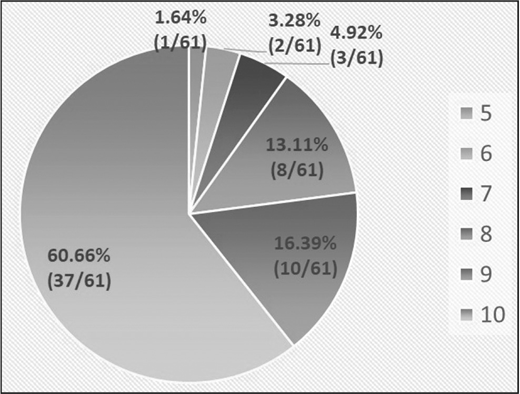
Since all the student participants in this study were enrolled in science programs, we expected high levels of interest in science. Figure 1 shows their interest on a scale of 1 (least) to 10 (highest). More than 90% of the students indicated that their level of interest in science was 8 or higher, while 60% put it at a 10, stating that it was their most favored subject.
Reasons for Students’ Interest in Science
Table 2 shows that students cited a number of reasons for their high levels of interest in science. The main reason given by 43 (70.5%) out of the 61 students was that they had a career goal in science. The second most-frequently cited reason was the real-life applicability of science as a field of study (41.0% of students), and the third most frequently cited reason was that they enjoyed learning science (29.5% of students). As noted in Table 2, the career goal reason by far outweigh the other reasons cited and is clearly a significant factor that has brought this group of students to science programs at the undergraduate level.
Science Mobile Apps’ Usage Among Students
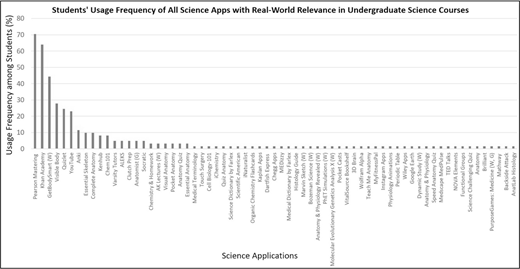
Sixty out of 61 students (98.3%) reported having used science mobile apps in undergraduate science courses, whether on their own or recommended by the instructors. They identified a total of 67 science apps, of which 57 were mobile apps available on smart phones, eight web-based apps that were only available on a web-based platform (computers, laptops, iPads, etc.), and two gamified apps. See Appendix 1 for a complete list of these science apps. Table 3 shows the main science apps in the three categories that are used by at least 10% of the students. The data clearly illustrates that science mobile apps were used by majority of these students.
Impact of Science Mobile Apps on Student Interest
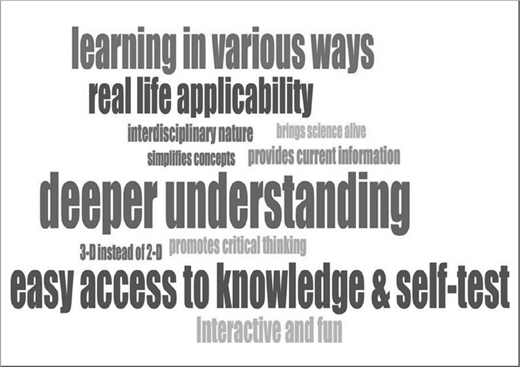
Forty-two (68.9%) of the 61 students indicated that science mobile apps either maintained or increased their interest in science, whereas the rest (31.1%) did not feel science mobile apps had an impact on their interest. The word cloud graphic in Figure 2 created by the qualitative data analysis software, MAX-QDA shows the factors, perceived by students, underlying how science mobile apps positively influenced their interest in science. The size of the word/phrase in the word cloud graphic reflects the number of students who identified that factor – bigger the number, the larger the text. A total of 11 factors were identified, and students were able to list more than one factor. The word cloud in Figure 2 shows four main factors. These were stated by 30% or more of the students. See Appendix 2 for the quantitative results that resulted in the word cloud graphic of Figure 2.
The biggest impact of the science mobile apps in maintaining or increasing student interest in science was by aiding and enabling a deeper understanding of the topic. The next was that science mobile apps are available 24/ 7, providing easy access to knowledge about science topics, in addition to permitting students to self-test, master the content, and build their self-confidence in the subject matter. The third most prominent factor was that science mobile apps present material in many different ways, providing students with multiple perspectives of learning the same material, thereby catering to various learning styles. The fourth major factor identified was that many of the science mobile apps showed real-life applications of science in the world, which helped maintain or further increase the students’ interest in science.
Impact of Science Mobile Apps on Student Learning
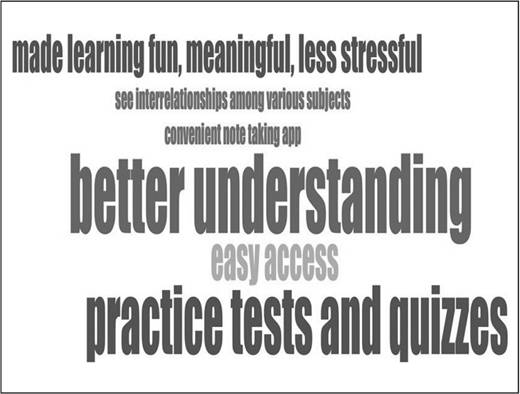
Forty-six (75.4%) of the 61 students indicated that science mobile apps increased their learning, whereas the rest (24.6%) did not feel science mobile apps had an impact on their learning. This broad term, learning was intentionally used to allow students to interpret it in the way that applied to them, either as resulting in better performance (grades) or feeling more confident about the material covered, as student perceptions was the focus of this study. The word cloud graphic in Figure 3 shows a total of six factors of how students perceived science mobile apps positively impacting their learning in science. Out of these, there were two methods identified by about 50% or more of the students. Thirty-six (59.0%) students stated that science mobile apps boosted their learning in science by facilitating a better of the material that was covered in class. Thirty (49.2%) students commented that the practice tests and quizzes on the apps were key to enhancing their science learning.
The next two factors fell into the second tier and were listed by 20–25% of the students. The first factor was that science mobile apps were easily accessible to them; something they could easily reach out to at any time to clarify doubts or reinforce learning. The second factor was that some of these science mobile apps were able to make science learning fun yet meaningful, and some were interactive. Hence, it was less stressful for students, and they were encouraged to spend extended periods of time interacting with science content. See Appendix 2 for the quantitative results that resulted in the word cloud graphic of Figure 3.
Usage of Science Mobile Apps After Transitioning to Online Learning
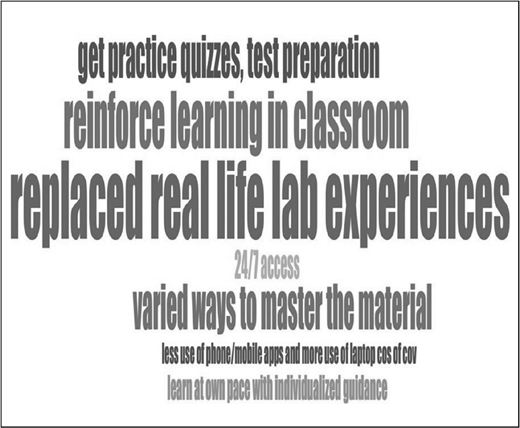
Forty-seven (77.0%) of the 61 students indicated that their usage of science mobile apps increased when they transitioned to fully online learning. The rest of the students (23.0%) either did not notice a discernible difference or reported that their usage rather decreased because of disruption of their normal routine. The word cloud graphic in Figure 4 shows a total of seven ways in which science mobile apps supported students when they transitioned from a fully on-site, face-to-face environment to a fully online environment. Among these, four of the practices were identified by 20% or more of the students. The most common practice (identified by 45.9% of the students) was the usage of science mobile apps to replace the real-life lab experiences that students no longer had access to in fully online learning. The second major change (reported by 31.1% of the students) was that they relied more heavily on science mobile apps to reinforce their learning, after transitioning to an online environment. The two other major changes in students’ usage were, an even greater dependence on the multifaceted ways of learning using science mobile apps, especially when the students struggled to learn in an online format (21.3% of the students) and the ability to take practice quizzes and tests at their convenience (19.7% of the students). See Appendix 2 for the quantitative results that resulted in the word cloud graphic of Figure 4.
Discussion
STEM attrition in college was investigated by tracking a group of high-performing undergraduate freshmen students, based on data from the 2004/09 Beginning Postsecondary Students Longitudinal Study (Chen, 2015). The report highlighted the association of student participation and performance in undergraduate STEM coursework with students’ quitting STEM disciplines. Many STEM entrants switch to non-STEM majors eventually, underperform, and/or drop out of college before achieving any academic degree; among the main deterrents is student motivation (Sithole et al., 2017). Attrition from a STEM discipline may be due to factors unrelated to intellectual capacity of a student, and could be addressed through institutional upliftment (Emekalam, 2019).
Recent analyses have identified multifaceted barriers and potential drivers of change in contemporary college STEM education in terms of the three key stakeholders—students, faculty, and higher educational institutions (Arguello et al., 2020; De & Arguello, 2020). To address the challenges, besides novel and user-friendly mobile apps, other relevant and creative methods of augmenting student engagement, learning, and assessment are being designed to ascertain active, experiential education among college students, such as virtual classrooms (De & Cavanaugh, 2020) and peer-video/blog assessments (Luyegu & De, 2020). Such approaches could be considered for adoption in college science curricula to meet the rising demands of maintaining the rigor and quality of distance learning in higher education, despite the challenges.
The empirical findings analyzed via descriptive statistics in this exploratory study demonstrate that the use of science mobile apps with real-world relevance boosted students’ interest and enhanced their learning and performance in undergraduate science courses. We believe the article would be pertinent to all science educators, including K–12, who are interested in the use of mobile technology to foster an integrated STEM curriculum and enhance student engagement and retention. Implications of the study in K–12 and higher education range from improving science-related career goals and addressing real-world scientific problems, to accommodating e-pedagogy as one of the diverse learning styles of making STEM education more interactive, easily accessible, interesting, and fun. Furthermore, since the courses concerned were taken by majority of girls as shown by the student demographics, the results suggest that such mobile apps could be used to reduce the existing gender gap in science. Earlier, we proposed the use of free/low-cost mobile apps with real-life, sociobiological relevance as a strategy to attract teenage girls to STEM fields at the middle and high school levels (Nethi & De, 2019) and had recently presented the current work as a foundation for this paper (Nethi & De, 2020). Recommended future directions could involve a greater focus on science apps that are exclusively mobile apps. In addition, faculty perspectives on the pedagogical impact of science mobile apps, as well as students’ perceptions of the benefits of such apps in science learning and interest during hybrid/ blended or other modern instructional modes, should be explored. The hope is that more graduates from undergraduate science programs will enter the job market to meet the increasingly high demand for STEM workforce.
Conclusions
In this study, we explored the reasons for the high level of interest in science among a group of students in two undergraduate-level biology courses. We also explored self-reports of their use of science mobile apps and their perceptions of the impact of these apps on their interest in science, and their science learning or academic performance. Given the unprecedented pandemic situation that forced these students in a completely face-to-face learning environment to transition midway through the term to a fully online learning platform, we also explored the changes, if any, in the way they used science mobile apps in the new learning environment. Table 4 summarizes the findings of the study.
The findings of this small study are important in revealing that two of the three main factors that determine students’ interest in science, namely, seeing the real-life applicability of science and enjoying the experience of learning science, were also identified by the students as characteristics of science mobile apps and their reasons for using these mobile apps. As indicated in Table 4, science mobile apps stepped in to fulfill a core function when classes transitioned from face to face to fully online learning by enabling students to learn science topics related to real-life applications that would otherwise require physical laboratory settings. An additional factor that was not mentioned by students as a reason for their interest in science but was identified as a vital characteristic of the science mobile app that contributed to student interest as well as student learning was the 24/7 accessibility to the science materials. There is a need for further research to explore the impact of subject-specific mobile apps on students’ interest and learning in other STEM disciplines at the undergraduate level.
Implications for the School-to-College STEM Pipeline
Based on the findings of this study, we recommend that the three factors that were identified as leading to students’ interest in science be integrated into science teaching in the middle and high school levels. One way to attract students at these levels to science and maintain their interest to strengthen the school-to-college STEM pipeline is to incorporate the following elements into science curricula and instruction.
Expose students to STEM careers and motivate them to develop a career goal in STEM fields.
Show students the real-life applications of STEM in all aspects of our lives whether man-made or natural. Provide them with opportunities to use science to think about solving real-life problems like droughts, global warming, food shortage, lack of clean water, et cetera.
Most importantly, make science interesting, fun, and interactive. This study has shown that suitable science mobile apps on the topics being taught can help achieve this.
Teachers can recommend suitable science mobile apps for students to accommodate their different learning styles, to show them real-life applications of STEM, and to make science fun and interactive, besides serving as a resource that is accessible to them 24/7 and would help build a deeper understanding of the concepts covered.