The coronavirus pandemic that occurred during spring semester 2020 led to the sudden termination of conventional in-class learning systems. Online distance learning (ODL) has been employed as an alternative tool. The purpose of this study is to determine the effects of utilizing the ODL on the students’ knowledge acquisition skills; taking the cases of two courses offered for second-year students studying architectural history at the Hashemite University, Jordan. Courses were taught by the same instructors and were organized utilizing both systems of conventional and ODL. Data were collected from students enrolled in both courses. Findings indicate that ODL does not necessarily compromise students’ skills in acquiring knowledge. It advances the architectural history curricular paradigm positively while developing active learning methods.
Introduction:Challenges And Problems
Conventional means of teaching have been challenged by the sudden advent of the coronavirus pandemic that started during the spring semester of the academic year 2019/2020. Teaching systems all over the world have been oriented toward online distance learning (ODL). Jordan is no exception. Nevertheless, the situation remains critical in this country due to a lack of experience in crisis management, especially in the governmental sectors administering higher education in universities, colleges, and institutes (i.e., the Jordan’s Ministry of Higher Education’s institutions). Adding to that, higher education systems relied mainly on conventional teaching systems. The Dean of Student Affairs at theUniversity of Jordan indicated that the Jordanian Ministry of Higher Education had issue adecision years ago that 25% of the courses could be offered using distance learning (Alnuaimat, 2021). The coronavirus pandemic that started in 2019 encouraged Jordan, like many other countries in the World, to restructure its teaching and education systems at all levels. Decisionmakers were supposed to adopt and adapt to new policies that ensure the continuity of the teaching systems; one of which is theutilization of ODL.
Considering its limited experience in this realm, Jordan’s education system tended to benefit from ODL practices taking place on regional and international levels. Nevertheless, and due to its long experience in utilizing conventional methods of teaching and learning at the higher education level, Jordan’s government did not entirely grasp and advocate the remote systems because, as declared by a former minister during the Nabd Al-Balad program “Distance learning is a distance from learning” (Roya, 2020). He called on the government to reopen schools and universities immediately. He problematized the ODL and its efficiency in delivering student learning objectives (SLOs) in a matter akin to that acquired in conventional in-class systems. The situation was exacerbated when he declared this ‘disappointing’ statement without offering alternative solutions that ensure the sustainability of the education systems in Jordan during the COVID-19 pandemic period. Nonetheless, the academic sector in Jordan was left with new epistemological challenges that intensify existing difficulties associated with ODL applications; including the lack of online student discipline, the lack of tolerance and faculty acceptance of ODL, and high costs associated with the development and delivery of an online system (I.E. Allen & Seaman, 2007). Fortunately, local universities and their academic staff started to invoke new methods and techniques for advancing the ODL and prove its efficiency as an active surrogate to conventional learning techniques.
This article explores advanced computer technologies and their use in the pedagogy of architecture. ODL is examined when employed in teaching courses of the history of architecture. It is examined against its capability of advancing students’ skills in acquiring knowledge. The results should be used to introduce a new pedagogic distance-based learning system that supports (or surrogates) conventional teaching methods whenever needed. The paper starts by outlining its theoretical context. It refers to existing literature tackling ODL and learning of the history of architecture. It then introduces the case of the Hashemite University and its approach in teaching history of architecture during normal and pandemic times. Methodology for data collection and sampling using quantitative methods (questionnaire) are also explained. Data analysis and discussion of results are shown in order to draw conclusions for enhancing ODL which is a much-needed outcome for advancing ODL in the field of architecture education in Jordan.
Iltera Ture Review
Online Distance Learning
Distance education is defined as a learning environment in which students and teachers are geographically separated by distance and sometimes by time (Dede, 1996; Moore et al., 2011; Moore & Kearsley, 1996; Moore, 1989). It incorporates different forms of learning, such as online, e-learning, mediated learning, online collaborative learning, virtual learning, web-based learning, et cetera (Conrad, 2002). Online learning is a process by which students and teachers use internet technologies to communicate and interact with each other during the learning process (Curran, 2008). Almost 80% of the course should be delivered using internet technologies in order to classify it as an online course (Simonson et al., 2009). Online learning is an improved version of distance learning (Benson, 2002; Conrad, 2002). This study uses the notion of ODL to represent distance learning practiced using online-based technologies.
ODL does not necessarily compromise levels of student’s satisfaction and their achievements during the course of their learning process. In fact, the use of technology has not only created new opportunities within the conventional classroom but has also served to expand learning experiences beyond the standard patterns of classrooms (M. Allen et al., 2002; Anderson, 1993; Duck & Parente, 2008; Kim & Frick, 2011; Lawrence & Maulsby 2014; Wegner et al., 1999; Yu & Richardson, 2015). Based on previous studies, M. Allen maintains that online classes do not essentially reduce the level of student achievement when compared with conventional in-class classes (M. Allen et al., 2002); if not even better. After all, ODL has been established as an effective mechanism in the higher education system (Duck & Parente, 2008; Kanuka, 2011; Kim & Frick, 2011; Yu & Richardson, 2014). As it improves students’ access to education, encourages student’s involvement because of the acceptance of advanced technologies (and its applications) by a wider community of the young generation (I.E. Allen & Seaman, 2007, 2013, 2016), and, most importantly, because it allows better attainment of Student Learning Objectives (M. Allen et al., 2002; Anderson 1993; Barry & Runyan, 1995; Carey, 2001; Cheng et al., 1991; Russell 1999; Moore et al., 1990; Murdock & Williams, 2011; Robertson et al., 2005). Bernard et al. (2004) point out that many applications of online classes could prove more effective than in-class systems. It depends on the norms used for structuring the courses; including setting the learning objectives and outcomes, defining the target audience, suggesting means of communication and interaction (physical, virtual, and/or both), and identifying the main addressed topics. All these factors establish the learning environment within which students’ skill for acquiring knowledge is attained.
ODL is usually accompanied by other difficulties and challenges associated with the university’s governance systems, including the absence of related strategies, insufficient human and financial supporting resources, and lack of experience. Still, and considering its benefits and traits, ODL methods have been tested in many disciplines categorized as applied science, such as medical-related disciplines (see, e.g., Barrows & Tamblyn, 1980; Whitten et al., 2005) and geology and soil sciences; both of which require training in laboratories and real-life fields (Reuter, 2009). They tend to compare in-class conventional learning methods with distance learning offered through videos and online programs. They found that distance learning could be satisfactorily incorporated into these kinds of studies while achieving better learning outcomes for building students’ knowledge and skills.
Architectural History Learning
Development in architecture discipline does not occur in a vacuum. Its past and present history has always been affected by complex and myriad factors, involving aesthetic, ethical, technical, scientific, economic, cultural, social, political, and functional factors. Learning from precedents and historic experiences is a fundamental outcome in architecture and design education (Hein & van Dooren, 2020; Keyva- nian, 2000; 2011; Manfredo, 1981, 1987c; Utaberta et al., 2013). For example, Hein and van Dooren (2020) suggest that historical precedents played an important role in architectural design education at leading institutions such as the Ecole des Beaux-Arts in Paris in the 19th and early 20th centuries. Other scholars advocate an early introduction of history-based courses in architecture education because it contributes to building the student’s knowledge and enhances their understanding of architecture language and its vocabularies. It also enhances their design skills because, as suggested by Keyvanian (2011), it facilitates the use of “visual strategies” in their design projects. Furthermore, it fosters creativity and innovation in design thinking because it develops students’ analytical skills and increases their recognition of the architectural styles and forms generated by previous civilizations (Hein & van Dooren, 2020). In fact, Cima- domo (2014) comprehends the history of architecture as a backbone and essential background for building the present and future knowledge of architecture. Past experiences provide solid models upon which students build the profile of future architecture. This is supported by our lead modern architect Le- Corbusier who stated, “today I am accused of being a revolutionary, yet I confess to having had only one master: the past; and only one discipline: the study of the past.” Similarly, for Norman Foster, and as an architect, “you design for the present, with an awareness of the past, for a future which is essentially unknown” (as quoted in Hein & van Dooren, 2020; Hokstad et al., 2016, Keyvanian, 2000, 2011; Sagdic & Kosova, 2013). In their turn, Hein and van Dooren (2020, p. 862) state that “the relation between learning to design in the design studio and the role of history in all its aspects should be made more explicit, cultivating a ’designerly’ way of thinking.”
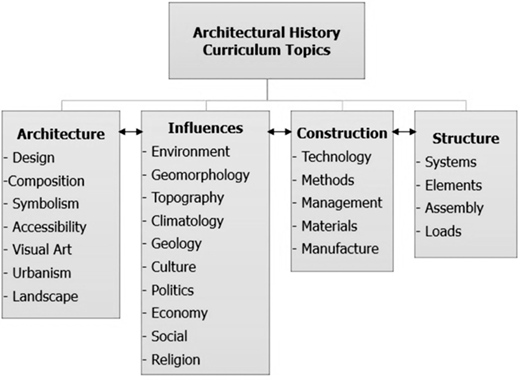
Architecture remains a complex and highly interdisciplinaryknowledge domain (Buchanan, 2012; Hokstad et al., 2016). Education of the history of architecture faces a number of pedagogical challenges and constraints that accompany this interdisciplinary. It is involved in diverse matters including arts, sciences, humanities, and technologies. It thus covers issues related to modes of manufacture, assembly, materials and construction technologies, communities, socioeconomics, pictorial and sculptural arts in addition to studies of the prevalent culture, geography, and politics of the time (see Figure 1). Thus, history-oriented courses in architecture are usually structured to address the evolution of architectural achievements but more importantly the predominant factors and their influence on constructing architecture as philosophy, theory, construction and building science, art, technology, and/ or practice. This is noticed during the second half of the last century when the architectural design was perceived by researchers as a scientific discipline that acts through a systematic process of analysis and synthesis (Hein & van Dooren, 2020; Schoonderbeek 2017; Wasson, 2005).
The seco nd challenge is that education of history and theory of architecture introduces students to the development of architecture; focusing exclusively on specific periods of past civilizations. Main theories and practices for each period are introduced and illustrated through resembling landmark buildings and structures. They are analyzed and compared with those located in other geographical, geological, spatial, temporal, political, and sociocultural contexts. Similarities and differences between these diverse contexts are highlighted in order to expand history education beyond the limits of descriptive studies and teach students the art of critical analysis, synthesis, and historical research (Hein & van Dooren, 2020). It is imperative to incorporate these learning outcomes in architectural history because history forms the theoretical connection between social reality and its direct architectural and urban contexts. Students, through connecting history and theory, are thus capable of identifying social problems and solve them from different possible perspectives (Xiong et al., 2017).
A third challenge associated with Architecture education is cultural differences aligned with creating ’isolated’ educational practices in which each region develops its appropriate educational activities that reflect its specific cultural environment and social needs (Xiong et al., 2017). It barely recognizes other cultures or builds knowledge about their main architectural events and achievements (Hokstad et al., 2016; Xiong et al., 2017). Such a limited approach is not necessarily advocated in academic environments because architecture education is based on cross-cultural communication and cross-regional learnings. Architectural history education also requires educational frameworks that openly and comprehensively acknowledge local, regional and global perspectives. Such frameworks should be innovative in order to be able to cope with new demands and changes associated with emerging architectural education systems (Xiong et al., 2017).
The above-mentioned challenges foster a paradigm shift in architecture education and learning practices (Clark, 1993; Hokstad et al., 2016; Mezirow & Taylor, 2009). Interaction between instructors and students should be improved through the introduction of advanced teaching ideologies, methods, and techniques that allows innovative education. Hence, architecture history could not be passively delivered through a transmission perspective that uproots architecture from its real spatial, temporal, and cultural contexts. For example, the Egyptian pyramids-built with the most advanced ancient construction techniques; designed with very deep philosophy and rich symbolism; and executed with minimal functionalism and perfect formation- could not be addressed to students solely as a historical structure built in ancient Egypt. Such a passive approach is burdensome to students, insufficient, and contributes to obfuscating their learning process (Xiong et al., 2017).
History of architecture is a core component in any architecture education. It is the cornerstone for building design knowledge and theories; provided that it is contextualized in social, economic, and technological systems of human history (Kostof, 1995; see Figure 1). Besides, it should employ recent advancements in category positioning, learning media, and assessment mode (Xiong et al., 2017). Creating an interactive learning environment that invests in virtual laboratories combined with hard knowledge extracted from textbooks and practices of precedents is also instrumental for advancing architecture learning. All these
measures should be collectively considered, especially when ODL emerges as the sole solution during pandemic periods.
Theoretical Framework
Learning Processes
This study focuses on factors affecting the students’ skills in acquiring knowledge, specifically in the context of synchronous ODL environments. Borrowing from the study of Sloan Consortium Report to the Nation (2002) and (Kanuka, 2011) three types of factors affect student’s effectiveness in the online education environment, specifically those related to instructors, students, and institutions. These factors are addressed in the current study considering that learning processes should remain student-centered while supporting interactive, processual, inclusive, stimulating, participatory, and collaborative learning environments. In this means, the Sloan Consortium report (2002) identifies five elements for quality assurance of online education, including student satisfaction, learning effectiveness, access, and institutional cost-effectiveness (Sloan Consortium Report to the Nation, 2002). The five elements are approached as the values, principles, and goals of both asynchronous and synchronous learning networks. In either case, they should be regularly assessed and monitored. In particular, faculty satisfaction should be closely examined in cases of utilizing online education because it is influenced by dynamic factors related to “rate of adaptation,” “learner’s expectations,” “and level of support” (Sloan Consortium Report to the Nation, 2002). Students’ satisfaction is also paramount. Their coping with the use of synchronous ODL is the core of this study.
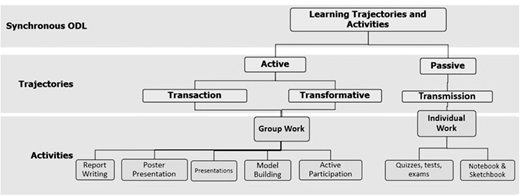
There are three common views of what constitutes teaching and learning processes: teaching as transmission, teaching as transaction, and teaching as transformation (Johnson, 2010; Miller, 1996; see Figure 2). “Transmission” perceives teaching as an act of transmitting knowledge from the instructor to students. It is an objectivist and instructional pedagogy in which instructors practice the unidirectional method of knowledge transmission; relying on a fixed curriculum developed solely by the instructor. The instructor is entitled as the sole source of knowledge, the authority of truth, and the ultimate examiner of learning achievement. According to this perspective, standardized tests are organized for measuring student learning objectives (SLOs). Although there are specific instances when this approach is useful, Johnson proclaims that “little research support for this as a general approach to teaching and learning” (Johnson, 2010). It remains passive and reflexive. Alternative mechanisms of “transaction” and “transformation” are better advanced in learning mechanisms, especially that they could be structured to cope with the ODL-the focus of this study.
Transaction learning theory perceives learning by means of constructing knowledge and moving away from the passively received methods that characterize transmission teaching and learning. Instructors adopting transaction learning assist learners to construct new and meaningful knowledge with reference to already established information. In distance education, transaction learning occurs through a physically separated environment; yet, learning should remain active and dynamic in a manner that accepts and adjusts to different experiences and modes of mental perception (Kurt, 2011; Moore, 1989, 1997). In other words, transaction theory should operate within an interactive learning environment that allows students to comprehend established knowledge but also to construct new knowledge through active interaction and practice (Santrock, 2004). Essentially, learning as constructivism allows building new knowledge through engaging the person in mental activities and processing them in accordance with accumulated experiences (Kurt, 2011). The mind perceives (as opposed to receiving) this knowledge to create new mental models (Duffy & Cunningham, 1996; Jonassen, 1991; Merriam & Caffarella, 1999; Schwartz, 2017) that enhances the student’s ability to solve real-world problems or to openly comprehend problems in their different contexts and cultures.
The transformation learning theory perceives learning as a complex process involving changes in the way a person views a problem and how expectations affect his way of thinking, feeling, and acting. For Johnson (2010), transformation creates conditions that transform the learner on different dimensions, such as intellectual, artistic, moral, cognitive, emotional, social, intuitive, creative, spiritual, psychological, physical, aesthetic, creative, spiritual, and many others. It is a holistic educational philosophy (Miller, 1996) that allows the interaction between all these dimensions and within every single person. The academic achievement of students is a matter of selfactualization. They use knowledge to discover and develop their unique and optimal talents and capabilities. Despite their benefits, transformative (and transaction) learning methodologies could be problematic in distance online learning environments (Figure 2). Considerations should be given to (1) creating a safe environment; (2) encouraging students to think about their experiences, beliefs, and biases; (3) using teaching strategies that promote student engagement and participation; (4) introducing real-world problems that address societal inequalities; and (5) assisting students to implement action-oriented solutions (Meyers, 2008; Mezirow & Taylor 2009).
ODL and Students’ Skills for Acquiring Knowledge
Constructing knowledge through ODL for history of architecture courses is approached through the transaction and transformative learning mechanisms; with considering different measures involved in different education phases (Figure 2). The first is understanding existing knowledge. This is approached by introducing the students to existing theories and concepts produced by each civilization. The technique used here is interactive electronic lectures delivered in a PowerPoint format with an open discussion between the instructor and the students. As a supportive mechanism in this stage, architectural vocabularies, sketches, and drawings were communicated to students through the “editing onscreen” option presented in conjunction with PowerPoint slides. This mechanism assists in comprehending architecture as theoretical knowledge but also acts as a tool of verbal and visual expression and communication. Both “hard skills of knowledge” and “soft skills of communication” were further improved through activating open discussion and online interaction. The second phase involves experiencing knowledge and building critical thinking. This is approached through establishing student teams to collaboratively work through the distance online environment to critically analyze selected examples and discuss them with their peers and instructors during online class lectures. Students utilize diverse means of presentation and visual techniques to present complex themes and concepts. For example, students use a photograph of an original drawing of Athenian Agora held in an archival collection in London supported by a digital reconstruction image. In some cases, a live webcam from a restoration work is incorporated as the example of Abu Simble rock-cut temple in Upper Egypt. This assists in presenting a richer, more complex, and live imagery of architectural monuments, even for those located in remote areas. This supports the existing claim that education of architecture history possesses malleability in ever-changing circumstances (Xiong et al., 2017).
More importantly, it creates an interactive and engaging distance learning environment that invests in two-way methods of “dialoguing and conversation.” Students and their instructor(s) are openly and directly discussing ideas, concepts, questions, concerns, and inquiries related to the history of architecture.
It is taken into consideration that SLOs could not be used as the sole indicator for assessing the quality of ODL. Students’ skills for acquiring knowledge and attaining SLOs are equally important. They are envisaged through creating an activity-based course that incorporates the student as an active participant in the ODL process. Thus, the courses are constructed to involve activities that could be undertaken as group work or individual effort. Group works are approached for building hard and soft skills (i.e., architecture knowledge and visual and verbal communication skills). Individual activities are incorporated in the form of short quizzes, tests, and exams. Online courses are structured utilizing online applications such as Zoom and Microsoft Teams.
Other social media (such as Messenger and WhatsApp applications) are also incorporated in order to facilitate the distribution of class announcements, instructions, and other requirements.
Model A: Group Work
Small groups of four students are oriented to research certain monuments designated as landmark architecture and representing specific historic periods or civilizations. The monument is analyzed from different perspectives. For example, a group working on the Roman Pantheon tackles it by considering its architectural and geometric configuration; its constructional materials; its structural systems; and its constructional technique. The group work is allocated 55% of the entire course work, distributed on the following subactivities:
PowerPoint Presentation: Students prepare a set of slides that systematically introduce the monument; describing its historic features and analyzing its main architectural, structural, constructional, and geometrical properties that are subject to other environmental, geomorphological, topographical, climatological, geological, cultural, political, economic, social, and religious influences (Figure 1). The group performs an online oral presentation that allows the students to verbally communicate the knowledge they acquired in this phase with their instructors and peers. Such activity should also assist the students to correlate historical thinking, spatial learning, and their own individual experience (Hein & van Dooren, 2020; Keyvanian, 2011). A percentage of 15% of the total mark is allocated for this activity.
Report Writing: The teamwork should allow a comprehensive understanding of the selected monument, especially after the group members discuss their work with their classmates and then organize it in the form of a short report that expres
sively explains their acquired knowledge on the selected monument. 10% of the total weight is assigned for this activity.
Poster Presentation: Information collected about the monument in the first two phases (PowerPoint presentation and report writing) is converted into an organized poster that demonstrates the students’ skill to visually communicate their ideas, thoughts, and attained knowledge. A percentage of 10% of the total weight is assigned for this activity.
Model Building: Models (in the form of physical or digital models) for the selected monument are made on a scale of 1:100. Other scaled models are made for specific architectural, structural, or constructional details; using the scale of 1:50 or 1:20. Such activity allows the students to practically understand the constructional dimension of the building process and its relation with other design ideologies. A percentage of 15% of the total score is assigned for this activity.
Active Participation: Encouraging students’ engagement with online lectures is advanced through allowing chatting, open question and answer sessions, and also sharing information through supportive social media (such as Messenger, WhatsApp, etc.) exclusively established for this course. A percentage of 5% of the total mark is allocated for this activity.
Model B: Individual Work
This is assigned 45% of course load distributed on three main activities:
Online Quizzes, Tests, and Exams; Online quizzes are conducted occasionally in order to stimulate students’ attention and attendance but also to construct architecture knowledge and its related expressive language (written and imaged). Tests and exams are organized to assess their attainment of knowledge as introduced by their instructor, by their own group work, and by their colleagues’ work. Tests contain two types of assessment tools: multiple choice questions and essay questions (for defining important architectural terminologies or analyzing certain spatial, architectural, structural, or constructional treatment as it represents certain historic period or as it evolved throughout different time periods). This type of assessment holds 40% of the course activity load. Online tests are secured through using LockDown Browser and a webcam. LockDown Browser prevents departing the test system before finalizing and submitting it. It also avoids accessibility to other websites or applications during the test time. Nevertheless, usage of LockDown Browser requires specific settings that should be installed to students’ computers- a case that could not be always secured especially during pandemic periods and curfews.
Note-taking and sketchbook preparation: Students are trained to build theirown sketchbook that includes terminologies, ideas, thoughts, sketches, notes, and reflexes. Training the students on this activity is recommended because the role of cognitive psychology in the understanding and production of texts is to analyze not only the result of these activities but also the activity itself (Boch & Piolat, 2005; Piolat et al., 2005). This activity is assigned 5% of the total grade.
The participatory approach, through group- based and individual-based activities, should assist architecture students to gradually construct their knowledge in the history of architecture; using ODL.
Methodology
Effectiveness in employing OLD for achieving effective learning processes and SLOs during the coronavirus pandemic period is assessed; using two interrelated courses of History of Architecture (1 and 2) offered by the Department of Architecture at Hashemite University during the successive Spring and Summer semesters of the academic year 2019/2020. History of Architecture (1) focuses on the architectural heritage of ancient civilizations, including Egyptian, Mesopotamian, Greek, and Roman periods; whereas History of Architecture (2) covers the periods starting from the early Christian, Byzantine, Romanesque, Gothic, Renaissance, Classical Revival, until the late Baroque and Rococo periods. Both courses are instructed by the same academic staff (the authors) and the study plans were orchestrated to correspond with SLOs of building the students’ knowledge in regards of historic terminologies, key themes, and theories; enhancing their analytical skills through drawing similarities and/or differences between the diverse theories and histories; comprehending architecture as an applied discipline that corresponds with people’s temporal needs (SpaceTime theory); comprehending ancient architecture as a dynamic discipline that evolves in new styles, patterns, construction materials, building techniques, and aesthetic values; and understanding ancient architecture as resilient styles that could be revived in new forms and contexts (Figure 1). Such SLOs should correspond with student performance criteria outlined by the National Architecture Accreditation Board (2020); including A3. investigative skills, A4. architectural design skills, A7. the historical and global culture, A8. cultural diversity and social equity, B5. structural systems, B6. Environmental systems and B8. Building materials and assemblies (see Conditions for Accreditation by the National Architecture Accreditation Board, 2020 Edition). Activities, in the form of group work and individual work, have been employed in conventional and online courses (History 1 and 2) for enhancing the students’ skills in building their knowledge.
Study Sample
The study sample included 44 undergraduate students registered in History of Architecture (1) with three credit hours and offered in spring 2020, and 55 students registered in History of Architecture (2) with three credit hours offered in summer 2020. Spring semester is composed of 16 weeks and summer semester is 8 weeks only. Two questionnaires are prepared for two groups. The first is distributed to students (around 39) who registered in online courses of History (1) and History (2) in the two successive spring and summer semesters of 2020. The questionnaire was organized to gather information about the students’ reflections on the norms of acquiring knowledge and skills; using an online, group-based learning system. Findings are then compared with data collected from former students (about 46 students) who registered in the two courses (History 1 and History 2) offered in the regular times of fall 2019 and spring 2019. It is important to mention that this sample experience ODL in other relevant courses (ancient construction techniques) taught by the same instructors during summer 2020. However, the two sample groups were subject to the same course structure (Models A and B) and taught by the same instructors.
Data Collection and Analysis
Questionnaires were distributed toward the end of each semester and as an online questionnaire. It is not intended to assess main learning outcomes (in terms of knowledge and skills-hard and soft) through relying on the student’s results and final grades. Rather, questionnaires are designed to ask students about their experience in acquiring knowledge and skills through both conventional learning methods for students of fall and spring of 2019 and ODL for students of spring and summer of 2020. Questionnaires are organized to ask the students’ opinion about main five ’skill building’ domains, including (1) establishment of knowledge, (2) sources for acquiring knowledge (3) method for acquiring knowledge,(4) activity for acquiring knowledge, and(5) communication of acquired knowledge. The questions are multiple choice, closed-ended, and on a 3-point scale (very much, often, very little). The average time for finishing the questionnaire is 20 minutes. The questionnaire was conducted on a Microsoft Forms application that provides an analysis of the number of respondents and the percentage of answers to each question.
The synthesized data was inserted into an Excel program Software. Each similar question from the two questionnaires was merged on a separate table. This provides the possibility of comparing the percentages between the two questionnaires for the same question.
Findings
The effectiveness of ODL and students’ skills for acquiring knowledge could be described as follows.
Establishment of Knowledge
Questions are formulated to measure the students’ usage of their mental activities; categorized as memorizing of information; analyzing and synthesizing ideas, information, or theories; making judgments; and transforming results to new contexts. The results asshown in (Table 1) indicates that establishing knowledge through in-class courses could be compared with those of online courses: indicated by a percentage of 39% (for in-class) to 26% (for online) relying on memorizing activities; 72% (in-class) to 72% (online) for analyzing and synthesizing; 41% (for in-class) to 33% (for online) for making judgments; and 50% (for in-class) to 49% (for online) for transforming results to new contexts. This suggests that using a group-based style of learning could be an effective means for establishing knowledge; employing an in-class or online learning style of education. Using synchronous ODL does not compromise the cognitive processes of students (Hartikainen et al., 2019).
Sources for Acquiring Knowledge
Questions are structured to assess the students’ usage of the diverse sources for establishing their knowledge, classified as libraries; Internet; lectures; and scientific research published on the Internet. The results as shown in (Table 2) indicate that acquiring knowledge during the pandemic is not necessarily compromised; mainly because these sources could be equally accessed; either during conventional times or during pandemic periods. The finding is realized through the ratio calculated using different sources for in-class and online courses distributed as follows: libraries with 26% (for in-class) to 21% (for online); Internet with 70% (for in-class) to 67% (for online); Lectures with 67% (for in-class) to 72% (for online); and scientific research with 31% (for in-class) to 46% (for online). Availability of relevant resources facilitates the online education process.
Methods for Acquiring Knowledge
Questions address the main methods that are used by the students to acquire knowledge, involving: attending lectures; preparing notebooks; working on joint projects; and preparing for tests and exams. The results as shown in (Table 3) indicate that students’ attempts to use certain sources of knowledge could be influenced when employing online systems. For example, attending lectures and delivering group projects through PowerPoint presentations are not necessarily affected by means of in-class or online education systems. However, other activities are negatively influenced, such as preparing notebooks that drop from 43% (for in-class) to 28% (for online); working on visual “posters” that shift from 65% (for inclass) to 49% (for online). Most notable is the decrease in the students’ willingness to conduct individual-based activities, specifically studying for tests and exams (48% for in-class) and 33% for online). Students’ intention to participate in group-based means of learning remains valuable in learning history of architecture; both in regular times and during pandemic periods.
Activities for Acquiring Knowledge
Questions are structured to assess the type of activities that are preferred by the students to acquire knowledge; ranging from asking questions; peer education; and discussions. The results as presented in (Table 4) indicate that the respondents’ ratio is relatively similar for in-class and online education systems. For example, asking questions in in-class format is 26% and 33% for online; peer education is 61% in in-class and 64% in online; and 43% in in-class and 49% in online. The results could be justified since the courses in both formats (in-class and online) are mainly structured based on group work that encourages interactive activities between (and within) the students and their instructors. Using other supportive social media could have attributed to creating an interactive learning environment because it opens direct communication during and outside lecture hours.
Communication of Acquired Knowledge
Questions are formulated to measure the students’ skills in communicating acquired knowledge in different means: expressively (through writing); verbally (through PowerPoint presentation); visually (through poster) and practically (through model making). The results are demonstrated in (Table 5) where the students’ writing skills are specifically enhanced through online education (59%) in comparison with 28% through in-class education. This is reflected in the essays and reports that the students delivered for their group project. Other skills are relatively similar such as the verbal communication skills that are expressed through PowerPoint presentation of students’ group work 57% (for in-class) and 51% (for online); the poster preparation that allows the student to visually communicate their acquired knowledge (76% for in-class and 74% for online); and the digital model making that familiarizes the students with a scaled and practical application of the selected monuments (59% for in-class and 59% for online).
Findings should respond to the purpose of the study and be presented systematically. They should be supported with sufficient and relevant quotations, examples, tables and diagrams. Findings should be discussed with a reference to relevant and recent literature.
Discussions And Conclusion
Until recently, ODL remained a secondary mode in learning systems, especially in Middle Eastern countries. Coronavirus pandemic encouraged these countries to employ ODL that nevertheless remains a “challenging” method; driven mainly by a concern to endure the learning process. Mostly, this method is blamed for its ability to achieve learning outcomes comparable to those acquired through conventional in-class methods. This study finds that the effectiveness of learning outcomes could be influenced by the student’s skills for acquiring knowledge, that is, the establishment of knowledge, sources for acquiring knowledge, methods for acquiring knowledge, activities for acquiring knowledge, and communication of acquired knowledge. Learning technique that relies on group work is applied in both in-class and online learning systems.
Many students have significantly developed their basic skills, their ability to express themselves, also their confidence in themselves. This could be related to the active learning environment that puts the student at the center of the learning process and knowledge acquisition. Students’ active learning environment contributes to building hard skills (knowledge related to history of architecture and its expected SLOs such as architectural design skills, historical and global culture, cultural diversity and social equity, structural systems, environmental systems, and building materials and assemblies). More importantly, it activates soft skills of collaboration, communication, investigative skills, analytical thinking, and knowledge organization.
This paper shows the positive impact of an active teaching approach over the traditional, or passive teaching style on student cognitive outcomes. The findings might not correspond with earlier studies advocating traditional learning styles (see, i.e., Michel et al., 2009). The active learning approach enabled through ODL, transforms students from passive receptors (as used to be in in-class courses), to active participants (Figure 2). This is facilitated through involving the students as active stakeholders in the learning process, involving them in identifying the topics of the course, encouraging them to activate their analytical skills, and providing different means for demonstrating and communicating their acquired knowledge. Thus, the achievement of students in this course could not be assessed based on students’ final grades.
It was found that online learning encourages students’ dedication and commitment to learning; due mainly to activities of discussions, seminars, poster preparation, essay writing, and presentations. Within this active environment, both instructors and students invested additional time and work for attaining SLOs. They actively and constructively collaborate to build knowledge; utilizing the most advanced technologies in the learning process. Such an approach could safely support/replace conventional in-class learning systems during regular as well as pandemic times.
Acknowledgments: The authors are thankful to the students of the architectural history courses this paper covered for their contributions and support. Great thanks are also due to the anonymous reviewers whose comments helped improve and clarify this manuscript.