Editors' Note: Case 1 contains a description of a blended introductory instructional design course that was evaluated, revised, and re-evaluated. The case is particularly valuable as an example of how a faculty member teaching a blended course must constantly determine the balance between face-to-face and online components. In this case the online component is arguably rich enough to stand on its own as a distance course with no face-to-face contact, but the evaluation showed in spite of the richness of the online resources, students preferred to meet twice rather than only once per week.
A central question in designing blended courses is, “What is the optimal balance between online and face-to-face instruction?” (see Smith, 2001; Valiathan, 2002; Young, 2002). This article presents a participant-observational case study tracing my decisions about the balance between online and face-to-face instruction while designing, testing, and implementing an introductory instructional design course at Brigham Young University (BYU). First I outline the background of the course design, addressing the need, the stakeholders, and choice of pedagogical approach for the course. Next I describe the basic design of the course and the rationale underlying this design. Then I outline the blend between online and face-to-face components for the first two implementations of the new course: Pilot 1 (a seven-week course) and Pilot 2 (a fifteen-week course). I describe the data gathered and the conclusions drawn from each pilot. And finally, I discuss the implications of the findings for educational practice and for future research.
Background
The introductory instructional design course is part of BYU's Instructional Psychology & Technology (IP&T) Department's core offering for all its graduate students. This course has no required prerequisites. Frequently, undergraduates and graduates from other departments, as well as non-degree-seeking students, matriculate in the course. Consequently, the course design had to meet this diversity of goals and backgrounds.
The main stakeholders for this course included the department chair (who also teaches this course) as well as other course instructors. Through interviews with these stakeholders, I also determined that the course would have to be customizable, so that different instructors could easily modify or adjust the online offerings as well as the blend of online and offline instruction to fit their particular styles and needs.
Pedagogy
As part of a needs assessment, I reviewed course offerings and determined that the main pedagogical approach used with the current course included:
Reading about instructional design concepts and principles in the course textbook,
Completing related course assignments or participating in online discussions of key ideas.
Synthesizing course learning by completing a course project.
For the new course, rather than having students proceed through a standard curriculum before completing a course project, I thought it would be more effective to try to customize the curriculum to fit the project. Thus, the course project would drive each student's personal curricular agenda throughout the course. What I needed to find was a way of having the course adapt to each student's unique problem. This strategy is consistent with constructivist approaches that advocate creating learning environments situated within the larger context of personally relevant, authentic goals or projects (Jonassen & Land, 2000; Savery & Duffy, 1995; Schank, Fano, Bell & Jona; 1993/1994; Wilson, 1997). Constructivist models also stress the importance of “learning by doing” and “just-in-time” instruction where the need to seek and acquire skills or knowledge is driven by demands of the situation—where students first perceive a need to know something to accomplish their goals and thus are more “hungry” to seek out useful, relevant information.
To provide a guiding metaphor for the design of the new course, I defined instructional design as a special form of problem solving—instructional problem solving. And, thus, constructivist practices seemed particularly suited to support this type of curricular agenda. Specifically, Driscoll (2000) summarizes the following conditions for promoting this type of learning:
1. Embed learning in complex, realistic, and relevant environments … 2. Provide for social negotiation as an integral part of the learning … 3. Support multiple perspectives and the use of multiple modes of representation … 4. Encourage ownership of learning … 5. Nurture self-knowledge of the knowledge construction process. (p. 382)
I then asked myself, “What does using a constructivist pedagogy suggest about the role of the online and offline components of the course?” I gleaned clues to address this question by considering the aspects of constructivist pedagogy that are most difficult and challenging to implement in the classroom. In an article called “Constructivist Cautions,” Airasian and Walsh (1997) warn of the following challenges teachers must face when implementing constructivist practices:
Teachers will have to change their roles from telling to guiding, and create rich environments to provide opportunities for students to make their own meanings.
Students will also have to change their roles and learn to think for themselves instead of waiting for teachers to tell them what to do.
Teachers will have to be able to work with general goals and cope with more diverse, idiosyncratic student outcomes, thus spending more time responding to individual student constructions.
In a recent review of constructivist practices, Windschitl (2002) corroborates these cautions by observing, “Even among experienced educators, this type of instruction is difficult to put into practice.”(p. 144) But, Windschitl also advocates taking advantage of resources available on the Internet as means of overcoming some the difficulties of implementing a constructivist pedagogy.
My response to these cautions was to identify the following three roles I wanted the online component to play:
Provide a rich and diverse set of resources to support students in finding solutions for a potentially diverse set of instructional problems.
Help students make decisions about what resources and tools to use for their own purposes.
Help the instructor manage and respond too many idiosyncratic constructions.
A central design decision related to the constructivist pedagogy centered on whether to allow students to choose their own projects or to assign them to project teams and have the teams choose the projects. After weighing arguments on both sides, I decided to focus on individual projects, because many students (especially those from other disciplines) take this course specifically to learn how to address content or topics that they already have interest in pursuing. Having projects that are personally meaningful and relevant was my paramount priority.
The Basic Course Design
To create the Web-based learning environment for the IP&T 564 course, I asked students to do the following:
Design a solution to an instructional problem and create a prototype or storyboards for a typical component or lesson.
Compile a personal instructional design (ID) handbook by creating an annotated list of articles, examples, design tools, or other resources they thought would be important and useful as a reference tool in the future.
Then I defined a set of fourteen assignments to provide the scaffolding to guide students in achieving the course goals. Assignments were expressed in terms of basic questions. The assignments and outcomes are listed in Table 1.
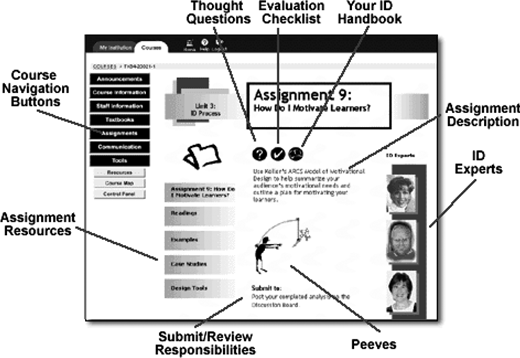
The major features and types of resources available for each online assignment are illustrated in Figure 1. In addition to a brief description of the assignment, the main screen for each assignment displays all the resources available to students online to guide them in completing the assignment. From the assignment screen, students can access the following: a set of thought questions to guide their thinking when seeking information to help with the assignment; an evaluation checklist detailing how they will be assessed on the assignment; guidelines for preparing their own ID Handbook; relevant comments and tips from practicing ID experts; submission guidelines for posting their work and reviewing peer work; useful assignment resources, including design tools, case studies, examples, and readings; and comments from Peeves, a student with an attitude.
Students can navigate to different assignments using the course navigation buttons. In addition, they can access the discussion board where they can post their assignments, make comments or participate in discussion forums, and access and review instructor comments on their work. Students can also choose to see their progress at any time by viewing scores posted by the instructor.
Table 2 summarizes how the course addressed the conditions for constructivist learning outlined by Driscoll (2000).
Pilot 1: Seven-Week Course
Method
The first pilot of the course occurred during the seven-week Spring Term 2002. I team-taught this first implementation with the department chair. Eleven students enrolled. One student took the course as a distance student interacting exclusively via e-mail and the online discussion board. The other 10 students met as a class with the course instructors once a week for approximately 90 minutes.
Students would typically meet in class for 6 hours per week during spring or summer terms. So, students and faculty were spending a quarter of the time usually spent in class. The department chair was particularly interested in seeing if students were able to achieve course goals after spending less time in class. Table 3 shows the blend of face-to-face and online instruction during Pilot 1.
During the first pilot of the new course, data were gathered from the following sources:
Instructors' perceptions and notes from the course.
Students' responses on a formative evaluation questionnaire administered at the end of the course.
Students' assignments, projects, and online comments made during the course.
Although all students submitted a formative evaluation questionnaire electronically at the end of the course, the authors received only eight due to a problem with the electronic mail system at the time of submission.
Results and Findings
Overall, students appeared to think the course was valuable and effective. On a five-point Likert scale (1 = strongly disagree to 5 = strongly agree), 100% of the respondents marked agree or strongly agree when asked to rate the following statements: “I found the course to be interesting and motivating; I would recommend the course to others; the course helped increase my confidence in my ability to solve instructional problems; and, the course was relevant and useful for helping me achieve my personal goals.”
When students were asked if they found the course projects meaningful in achieving their personal goals, all but one student marked either agree or strongly agree. Students' free-response data corroborated this finding as 50% of the students specifically mentioned one or both projects being one of their favorite parts of the course. One student commented: “I was excited to have an assignment that gave me the opportunity to work on an idea that I have felt the need to develop for about six years. Also, I was going to create a personalized ID handbook even if it wasn't assigned.”
When students were asked if they thought the time spent on the computer was worthwhile, 100% of the students responding agreed or strongly agreed with this statement. Free-response comments such as the following supported these findings: “I loved the quantity of readings available to us, and very much appreciated the approach of letting us read and study the articles and resources that interested us. Bravo.”
Although all students seemed to appreciate the rich set of resources available online, instructors sensed an undercurrent of frustration in terms of helping students manage the limited time available for the course. One student's comment reflected this perception:
Sometimes I had a lot of time to read, and at others only a little. At those times I often wished to have some of the long list of articles listed as “recommended” or even “required”, so that I didn't spend the little time I had reading articles or websites that were nice, but missing the really important ones. Perhaps that sounds lazy, but when a student is in a pinch, it's common. Bottom line: more direction in the readings.”
Compared to the responses for the online instruction, there was more ambivalence when querying students about the face-to-face component of the course. When students were asked if there was about the right amount of time spent in class, there was a greater divergence of responses ranging from disagree to strongly agree. Interestingly, the only strongly-agree response was from the distance student who never attended class; approximately 62% marked agree; and the others responded with no opinion or disagree. About half the students made specific comments regarding class time. All but two of these comments expressed the opinion that there should be more class time or that time in class could be spent more productively.
With regard to the mix between face-to-face and online instruction, only one student commented directly that he thought there was a good balance. Another student asked that class time be reduced, but time for individual help be increased. When asked if they thought they had received useful feedback from the instructors, 75% responded strongly agree and the other 25% marked agree.
The strategy used for peer review drew the most criticism in the free-response comments; 75% of respondents made one or more negative comments about this strategy. Comments ranged from: “I really think that the peer review could have been more productive. Maybe it was because there was so much to do and so many peer reviews to make for each assignment.” In summary, students generally liked the course and the use of both face-to-face and online components.
Students appreciated the online components that made their work more efficient, particularly posting assignments online and receiving online feedback from the instructor. The major issues they had with the blend of face-to-face and online instruction seemed to center on issues of efficiency given the time constraints of the course. The investment required by the current peer review strategy required too much time. Thus, it may be that many students decided having more in-class time would be beneficial to reap the benefits of peer and instructor comments more efficiently than interacting online.
Pilot 2: 15-Week Course
Method
The second pilot of the course was implemented during the fifteen-week Fall 2002 semester. I was the sole instructor for this course. Seventeen students enrolled in the three-credit-hour course, and all students were able to attend the face-to-face class sessions. Everyone completed the course except one student who opted to take an incomplete in the course midway through the semester due to personal reasons. Based on my experience with the first pilot, I made the following modifications in this implementation of the course:
Added star-ratings for the online resources and readings.
Increased the number of personal consultations with each student to two per semester and the amount of face-to-face time to two hours per week.
Replaced online peer review with face-to-face discussions in class.
Added an online case-study discussion forum and asked students to share at least one comment or insight from a case study associated with each of the eight course assignments.
Allowed students to collaborate on course design projects.
To evaluate the effectiveness of the changes, I relied on data from the following sources:
My perceptions and notes from the course.
Students' responses on an anonymous course evaluation questionnaire.
Students' work on assignments and projects and their online comments made during the course.
Student responses on the online course evaluation were voluntary; the response rate for this questionnaire was 59%. I used this data to readdress the same basic questions asked for Pilot 1. Table 4 summarizes students' overall ratings of the course effectiveness on the course evaluation. Student ratings were based on an 8-point Likert scale where a rating of 1 was very strongly disagree and 8 was very strongly agree.
The course ratings in Table 4 indicate that students generally thought the course was valuable and effective. On the same questionnaire, 80% of the students gave the course an overall rating of either very good or exceptionally good on an 8-point Likert scale where a rating of 1 was exceptionally poor and a rating of 8 was exceptionally good. When asked what percent of the in-class time was valuable to their learning, students' mean response was 82%. When asked what percent of time spent out of class was valuable to their learning, students' mean response was 94%. Students reported spending an average of 5.9 hours out of class per week. In general, students felt positive about the value and blend of in-class and online time.
Conclusion and Implications
Finding the right blend of online and face-to-face instruction is a balancing act for both instructors and students. In the present course, there was greater potential for instruction and interaction via both the face-to-face and online forums than there was time to actually use this instructional potential. The challenge, then, is to fine-tune the blend of strategies through successive iterations to minimize frustration and wasted time and effort for students so they can use both forums for instruction optimally.
Using a blended solution appears to be an effective strategy when trying to implement a constructivist pedagogy. The particular goals targeted from the initial course design were addressed, at least in part, by the blended solution created for the IP&T 564 course. Students generally appreciated the rich resource knowledge base provided online. The use of the discussion board for submitting course assignments helped me manage and respond to the weekly assignments. Even with some of the efficiencies gained from this practice, however, responding to individual students required a serious investment of my time. Some of this time was recouped, though, through the time saved by reducing the in-class time.
So far, my attempts to refine the blend of face-to-face and online instruction have focused on achieving greater effectiveness more efficiently for students. But successfully implementing a constructivist pedagogy via blended solutions will only succeed if one can also find ways to support and ease some of the instructional burden placed on the instructor. What can be done to help the instructor become more efficient and effective in teaching and managing through blended solutions? Also, what needs to be done to adapt this course for other implementations, say, for distance use? How do you best compensate for efficiencies gained through face-to-face interactions and still maintain the same course load and general requirements? These and other questions await future iterations of this course.