


This qualitative research project was conducted to investigate the self-regulation strategies of learners in an asynchronous college-level math course. Seven students participated in the study, which was conducted at a large state university in the mid-Atlantic region of the United States. Transcripts of face-to-face interviews, electronic journal entries, and artifacts were collected during the spring 2006 semester. A follow-up electronic journal entry was collected in 2007. Findings include the identification of a general learning strategy employed by the participants and improved learner confidence. Self-regulation strategies were identified and are compared to self-regulation strategies documented for more traditional learning environments.
In recent years a new model of course design has emerged, the “emporium model” (Twigg, 2003, p. 34). Synchronous class meetings do not exist for courses using this model. Learners choose from a selection of online materials and one-on-one assistance in a computer lab. Some online activities may be accessed from any computer with access to the Internet, and some activities, like tests, are restricted to access only from a central computer lab.
This study was conducted to address a lack of research on emporium-designed courses, and the need for self-regulation research called for in recent publications (e.g. Hartley & Bendixen, 2001; Hodges, 2005; van Gog, Ericsson, Rikers, & Paas, 2005; Whipp & Chiarelli, 2004). The research question guiding this investigation was, “What strategies do learners use to regulate their learning in an emporium-designed mathematics course?”
Academic Self-Regulation
Academic self-regulation is defined by Zimmerman (1989) as the degree to which learners are “metacognitively, motivationally, and behaviorally active participants in their own learning process” (p. 329). A complete review of the research is beyond the scope of the present article. In general, students’ use of self-regulated learning behaviors is highly correlated with academic achievement (e.g. Zimmerman & Martinez-Pons, 1986, 1988) and recent research has shown positive relationships to mathematics achievement (Nota, Soresi, & Zimmerman, 2004). Interested readers should consult three current articles by Zimmerman, Hodges, and Artino for additional background information. Zimmerman (2008) summarizes the historical development of the study of self-regulated learning and predicts it to be a continued area of research interest, especially in terms of online learners and new technological methods for data gathering. Hodges (2005) provides a literature review of self-regulated learning in the context of Web-based courses, and Artino (2008) suggests implementation strategies for instructors of online courses to address learners’ self-regulatory needs.
Participants
Seven individuals (4 female, 3 male) participated in this study conducted mostly during the spring 2006 semester at a large, mid-Atlantic university. All of the participants identified their ethnicity as White or Caucasian and their academic level as freshman. The average age of the participants was 18.1 years. The learners were enrolled in an emporium-designed, fresh-man-level, matrix algebra course. One participant was a mathematics major and the others were engineering majors. Participants were recruited via e-mail and no extra credit or other compensation was offered for participation. Two participants had previously taken an online course.
Research Design, Data Collection, and Procedures
This research was conducted as what Merriam (1998) refers to as a “basic qualitative study” (p. 11). It is a partial replication of a study by Whipp and Chiarelli (2004) involving learners in a Web-based course. Data were collected through guided journal entries, one-on-one interviews, and artifact collection during the spring 2006 semester. Additional data were collected for this study in early 2007 also.
Participants were asked to complete guided journal entries during the first, sixth, ninth, and twelfth weeks of the 15-week semester. The journal entries were typed responses to specific questions supplied by the researcher. Journal questions were distributed in e-mail notes, and completed journal entries were returned to the researcher via reply e-mail. One-to-one interviews also were conducted. The interviews were conducted during the third, seventh, and thirteenth weeks of the study in the computer lab used for some of the course activities. An interview guide technique (Patton, 2002, p. 343) was used to ensure a consistent line of questioning across the interviews. The audio portion of the interviews was recorded and transcribed for analysis. Artifacts were collected from two participants. One participant provided snapshots of his computer screen showing his method of scheduling his studies and another provided copies of a self-gen-erated study guide. The researcher's field notes, taken during the interviews, were a secondary data source. Participants also were asked to complete a follow-up guided journal entry in early 2007.
Data Analysis and Findings
The interview and journal data were analyzed using a general data reduction technique (Creswell, 1998; Merriam, 1998). Themes identified in the analysis are displayed in Table 1.
Themes Identified
| Course Difficulty | Learner Behavior in Emporium-Designed Course | Study Strategies |
|---|---|---|
| Course is not difficult (6 responses) | Setting a goal of getting a good grade | Taking notes |
| Course difficult (1 response) | Watching week-to-week grade progress | Reading online lesson page |
| Note that the participant indicating tha the course would be difficult was taking the course of a second time. | Rewarding completed work with leisure activities (friends, games, reading) | |
| Asking friends assistance | ||
| Reviewing notes |
With the exception of the participant who was repeating the course, participants did not anticipate any difficulty with the mathematical content of this course at the beginning of the semester. Most had heard from peers that the course was “not bad.” By early February the participants were reporting that they felt they could be successful in the course. Some participants had grown to appreciate the varied resources available for the course, but managing their time to complete required assignments in the computer lab was still a concern.
Participants used various resources in the course, but common strategies across all learners were observed. Participants worked multiple practice quizzes and used the online lesson pages to support their work either before or after taking practice quizzes. A general learning strategy used weekly was to begin studying no later than Wednesday before a 4:00 P.M., Friday deadline. Most participants chose to study for this course in their dorm rooms. Assistance from other students was not typically necessary, but when help was needed, learners chose to ask friends rather than the Instructional Assistants available at the computer lab. The lab is located off-campus, and traveling to the lab from campus was perceived as a burden.
Individual participants took varied numbers of practice quizzes, but a trend of taking practice quizzes until 3 to 5 consecutive practice quizzes were completed with scores of 100% was observed. For some, only 3 to 4 practice quizzes were needed to achieve this level of proficiency, while some reported taking as many as 15. This core strategy was used consistently throughout the semester. The learning strategy is shown in Figure 1.
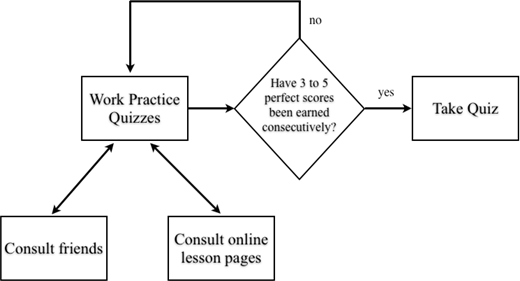
Observed Learning Strategy Used by Participants
Observed Learning Strategy Used by Participants
At the end of the study, the majority (5 of 7) of participants felt that they were at least as successful in this course as they would have been in a traditional face-to-face course. One participant commented that the format of the course “forces you to work and schedule yourself” and another felt “a sense of accomplishment” in this course, since he was responsible for the learning in the course.
Participants made use of various self-regulation strategies; of particular note were the goal setting and self-evaluating strategies. All participants set goals related to earning a good grade in the course. A good grade ranged from passing the course (1) to earning no lower than a B, but most considered a good grade to be an A. Most students tracked their progress week-to-week using the online quiz and test system to monitor their progress.
Five of the seven participants completed follow-up journal entries in early 2007. An analysis of the final journal entries confirmed the findings from the earlier data sources. The general strategy shown in Figure 1 was still reflected in the final journal entries. Two participants indicated in their final journal entries that their experience in the course changed their study habits in other courses. Those participants listed improved organization and time scheduling as benefits of taking the course. When asked if their experience in the course affected their opinion of online courses, four of the five participants completing the final journal entries indicated that they had better opinions of online courses after completing this course. The better opinions, however, were usually qualified with the fact that this was an introductory course and they felt that more difficult courses should not be offered in a similar format. When asked if the experience in the course had any impact on their confidence as a learner, participants responded in the affirmative. Two participants indicated that they were confident in their academic abilities before enrolling in the course and that the experience in the course reinforced that confidence. Three of the five participants completing the final journal entries commented that their confidence as learners had improved after completing the course. One participant commented, “I feel that I am able to learn in different settings. I'm not afraid to teach a class to myself anymore.”
Conclusions
This research study was conducted to investigate the question, “What strategies do learners use to regulate their learning in an emporium-designed mathematics course?” Self-regulation strategies were identified that correspond to self-regulation activities previously determined. The strategies found in this study are analogous to traditional behaviors as shown in Table 2.
Self-Regulation Strategies Identified in an Emporium-Designed Math Course
| Learner Behavior in Emporium-Designed Course | Traditional Self-Regulation Behaviora |
|---|---|
| Working practices quizzes until 3 to 5 perfect scores in a row | Self-evaluating |
| Taking notes | Organizing and transforming |
| Setting a goal of getting a good grade | Goal Setting and planning |
| Watching week-to-week grade progress | Keeping records and monitoring |
| Rewarding completed work with leisure activities (friends, games, reading) | Self-consequating |
| Asking friends assistance | Seeking social assistance |
| Reviewing notes | Reviewing records |
Source: aZimmerman (1989, p. 337). Copyright © 1989 by the American Psychological Association.
Designers using an emporium-model for their courses should carefully consider how these strategies can be supported for, or implemented by, their learners. In addition to identifying the self-regulation strategies used by learners in the course, unintended, yet positive outcomes were observed. Participants felt that their confidence as learners was increased as a result of participating in the course. The majority of participants also held better opinions of online learning after completing the course.
It should be noted that participants in this study were in math-intensive majors and most felt that the course content was not difficult. Participants cautioned that the emporiumdesign format may not be appropriate for courses with content perceived by the target audience as difficult.
The author thanks Ms. Jerri England and the participants who made this research possible.

