


The need for online education continues to grow in many fields and disciplines driven by convenience and public health and safety concerns. Little is known about how online doctoral education affects the readiness of future faculty members to work and teach in university settings. This autoethnographic study explores the intentional socialization and training of one online doctoral student for a faculty career and the role of online education in acquiring skills required in future faculty workforce. It uses an emerging framework of entropy and negentropy from thermodynamics to understand how energy loss occurs in online education and what deliberate actions can be undertaken to restore energy loss. A three-phase model of online doctoral preparation for a faculty career is proposed with implications for matching students and advisers, creating consistent forms of interaction, and designing intentional learning experiences to complement doctoral education.
Introduction
As the COVID-19 pandemic hit the spring of 2020, a consistent theme emerged in the experiences of doctoral students whose campuses had been shuttered and who were required to continue their academic work from a distance. One doctoral candidate summed it up as being “slapped in the face with the hard reality” that doctoral work requires a community that is difficult to recreate from home (Krieger, 2020, para. 5). Some even speculated that should the trend of online learning continue, graduate students may need to add an extra year or 2 to their studies to compensate for lost social and informal learning (Lederman, 2020, comments).
The sudden switch to online learning during the pandemic has raised plenty of questions about how postsecondary students can be adequately prepared for their careers while removed from campus. How does mentoring and socialization with faculty members occur? How do important peer networks continue to form? How do cocurricular experiences take place? These questions apply to students in all career fields. However, they are especially relevant to doctoral students preparing for a faculty career dependent on the socialization and mentored learning typical of doctoral education.
These concerns rang true to me because I had already faced similar questions. For the previous 2 years, I studied as an online doctoral student for a faculty career in one of the few programs in my field offering this option. This autoethnographic study explores my experiences as an online doctoral student before and during COVID-19, the unique obstacles online doctoral students face, and the creative forms of energy required to meet these challenges. My experience may offer a unique perspective to these questions and ultimately help program designers better understand how online doctoral education can be improved for students preparing for a faculty career.
Background And Historical Context
Until a few decades ago, most students in doctoral programs in the United States were generally young, White, male, childless, and “singularly devoted” to their area of study (Offerman, 2011, p. 25). Now, at least half of all doctoral students are working professionals who study part time due to work or other commitments and represent an increasingly broad demographic (Gardner, 2008). As rising numbers of practitioners have taken up doctoral work, traditional degree outcomes have come under criticism for being too narrow. Efforts to “modernize” the doctorate, such as the Carnegie Project on the Education Doctorate (2014) in the United States, have emphasized practice over research, knowledge transfer as well as knowledge creation, and alternative forms of assessment (Lee, 2018). Many new online, hybrid, and limited-residency options have opened for students, including options that deviate from traditional advisor-advisee relationships through a model of disaggregation and standardized curriculum (Wergin & Alexandre, 2016).
Nevertheless, while program options have significantly increased for practitioner students, the doctoral model for students preparing to be faculty members has remained little changed. This model includes students residing at or near universities, taking part in teaching and research assistantships on campus to gain faculty skills (and pay the bills), and having near-daily contact with faculty, peers, and thought leaders in a rich academic community (Offerman, 2011). Data on the educational backgrounds of new full-time faculty at 4-year institutions are scarce. However, evidence suggests most aspiring faculty members continue to be trained via traditional, residence-based programs. For example, a recent study suggested that 70% of new faculty of education at R1 schools come from top-ranked programs (Freeman & DiRamio, 2016). These programs are more likely to follow traditional in-residence models (DiRamio et al., 2009).
Simultaneously, faculty life and expectations have changed dramatically in the last two decades due to intensifying research, publication, and resource generation (Wilson, 2010). There have been growing calls to broaden the skill set of incoming faculty to respond to 21st century needs in activities such as developing and teaching online programs, obtaining grant funding, developing industry partnerships, marketing and recruiting of students, and conducting community outreach on behalf of their institutions (Lawrence et al., 2012; Romano & Connell, 2015). However, faculty’s doctoral training has been slow to catch up with these aims, and the question of how to develop future faculty for their new set of duties has received little attention (Manzo & Mitchell, 2018). Given that most doctoral candidates aspiring for faculty positions will land at less prestigious institutions using a different education model than their training institutions (Flaherty, 2018), the lack of experience in online teaching and learning is a potential cause for concern.
Current events in COVID-19 may provide a tipping point in both these trends. Although online learning has been occurring for decades, the rapid shutdown of campuses and the resulting massive unplanned experiments in online higher education has exposed more doctoral students to a different model of interaction with their faculty and peers, and it has further accelerated the need for experience in online course building, online teaching, and digital collaboration among faculty. Arguably, more digital transformation and online capacity building have occurred through one season of virus wildfire than decades of controlled burning in online experimentation. However, COVID-19 also raises critical questions about the effectiveness of online learning, particularly for career fields like academia, where informal learning and socialization are an essential part of preparation (Lederman, 2020). Online doctoral programs have come under scrutiny before. Scholars have lamented the lack of research skills training, learning communities, and on-campus mentoring opportunities in online or limited-residency environments (Kumar & Johnson, 2019). Rourke and Kanuka (2012) explored how socialization occurred in one online, limitedresidency doctoral program and found that student-faculty interaction and participation in scholarly activities were seriously lacking. They recommended that these students be given more opportunities to participate in scholarly experiences such as writing grants, submitting conference papers, and authoring reports. They also called for methods to increase genuine student-faculty interaction.
The current crisis highlights how little is known about successfully translating a rich residence-based learning experience into a robust online program with the type and quality of socialization that are the hallmarks of research-based doctoral programs for aspiring faculty. Given these challenges, the question remains what concrete steps online students and faculty can take to bridge the skills and socialization gaps inherent in these programs.
Theoretical Framework
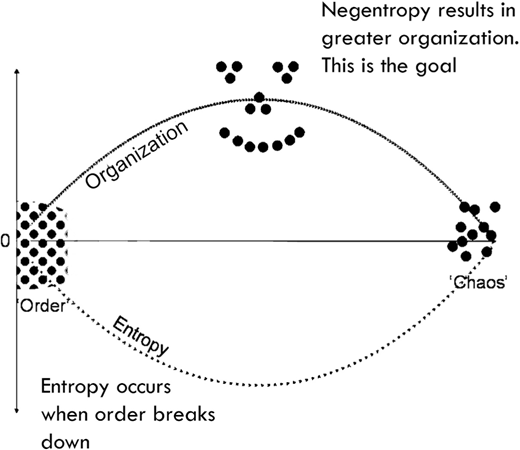
To understand how my online doctoral experience prepared me for a future faculty position, I draw from the principles of energy loss and gain in thermodynamics. Entropy is a concept closely tied to the second law of thermodynamics, which states that energy in a closed system disperses to equilibrium and becomes unusable if no other force acts upon it. All living systems experience entropy when order breaks down, and energy becomes dispersed, such as ice melting in water or air escaping from a tire.
Not only do physical systems experience entropy, but organizational systems and relationships have entropic characteristics as well. Processes, rules, discipline, and general order in all organizations break down without constant tending, much like discipline in an elementary classroom falters without the effective control of a teacher. In online education, entropy is especially abundant. Online students experience rampant isolation (Kumar & Coe, 2017), numerous distractions (Lederman, 2019), and difficulty networking and building social capital (Fisher, 2020; Morton, 2016). Consequently, many online students struggle to reap the full benefits of a flexible online education due to inherent energy loss.
Fortunately, entropy has an antithesis process that injects energy into and rejuvenates a system. Negentropy is focused energy that counteracts the forces of entropy, or decay, within all living systems and organizations (Carr-Chellman et al., 2019). Figure 1 depicts this process. It occurs when negentropic actors introduce energy back into the system to restore order (Heckman & Montera, 2009). Negentropy has been adapted as a theoretical construct to higher education institutions having difficulties in funding, enrollment, governance, and other factors (Carr-Chellman et al., 2019; Freeman et al., 2018). University leaders have been encouraged to find and support the work of negentropic actors such as individual faculty members whose new ideas, knowledge,and activities insert energy into the system (Carr-Chellman et al., 2019).
Negentropy in Social Systems
Negentropy in Social Systems
Negentropy can also be applied to the deliberate energy online doctoral students, and their faculty need to combat entropic forces in online education. The relationship between a student and adviser is one such example. An online student may develop a relationship with their adviser through periodic advising or review sessions. However, without more frequent contact or informal and unplanned “collisions” (Waber et al., 2014), the relationship can stall and deteriorate through no fault of either party. Either the student or the faculty member must inject energy into the relationship through new forms of contact or shared experiences, or the relationship will succumb to entropy (Burt, 2000). The same occurs with other learning experiences. The framing of negentropy allows me to analyze where the sources of entropy and negentropy occurred in my education and what organizational elements of my doctoral program helped or hindered my preparation for a faculty career.
Methods
My purpose for using autoethnography as a methodology is that some experiences are best understood from the inside out. Ellis (2004) compared the process of autoethnographic research to going “into the woods without a compass” and recommended one should take time to “wander around a bit and [get] the lay of the land” (p. 120). Some have criticized autoethnography as overly artful and not accountable to criteria applied to traditional ethnographies or research studies (Ellis et al., 2010). However, this form of research can be rigorous, credible, and in line with educational research standards, such as those of the American Education Research Association and other organizations (Atkinson, 2006; Hughes et al., 2012). I followed a process advocated by Hughes and Pennington (2017) involving a review of the literature, developing selfquestions, responding to these questions, comparing the responses with the literature, and creating themes and findings. To add depth to my findings, I also gathered and reviewed 4 years of personal documentary data, such as journal entries, personal notes, and written assignments (Duncan, 2004). I used textual analysis to analyze my personal responses and documentary data and develop themes for my findings.
Quality, Trustworthiness, and Limitations
As both the researcher and subject for this study, I had an obligation to establish quality and trustworthiness in the research process (LeCompte & Goetz, 1982). This obligation prompted me to triangulate my written responses with documentary data such as journal entries, personal notes, and previously written work to provide evidence for claims (Duncan, 2004). It also led me to discuss my findings with family, friends, and mentors close to me who were familiar with my experience as a doctoral student and provided feedback to me. “Rich” and “dense” descriptions of the data were used where possible to allow the reader to determine how credible and dependable the findings are (Trochim, 2006).
Several limitations of this study exist. The written product reflects only my experiences and may not generalize to a larger doctoral student population. However, I wrote with the needs of this population in mind so my audience may recognize linkages to common issues or challenges. Second, memory is fallible, and certain events are impossible to reconstruct fully. Thus, I begin with the assumption that our memories, just like the meaning we ascribe to objects or events, change over time but still hold significance in how we see the world. Finally, there is a need to be concerned about misrepresenting others (Wall, 2008). Thus, I have discussed these responses with those reasonably identified from my story and provided an opportunity to contribute their feedback.
Positionality
Sharing my positionality also strengthens trustworthiness in qualitative research (Savin- Baden & Major, 2013). I am a White male who recently completed a PhD in education with a research agenda focused on innovation in higher education organizations. Previously, I worked as an academic administrator organizing both online and resident education. I began my doctoral program as a part-time online student and then transitioned out of full-time work to be a full-time online student. In making this transition, I was fortunate to have support from my immediate and extended family to make full-time study possible. I acknowledge that all who pursue doctoral studies do not hold these advantages.
Findings
I share the first three themes in story form to illustrate many of the “entropic” challenges online students face. The remaining five themes are not chronological but span my time as a full-time online student to highlight possible “negentropic” actions online students and their advisers can take to improve doctoral learning.
Looking for a Unicorn
When I decided to return to school for a doctorate, I wanted a more flexible and family- conducive alternative to my previous degree programs. In my master’s program, I crossed a large Eastern U.S. city 2 nights a week after work to attend class, not making it home until 10 o’clock at night to a young family. The thought of repeating this process 6 years later with three small children at home held little appeal. Thus, after deciding to return to school for a terminal degree, I recorded four criteria in my journal:
July 2016: Criteria for further education: (1) PhD if possible, not EdD-more liberating than limiting; (2) Online or flexible delivery.(3) Research-based; (4) Focus on leadership and organizational studies.
Despite wanting my program to be online, I also strongly desired a traditional doctoral experience grounded in research, with a conventional advisee-adviser relationship at an established research institution. As I began researching programs, I realized I was looking for a unicorn. Most online doctoral programs led to an EdD degree for practitioners or were PhD programs offered by online-only institutions. I could find only one PhD program in my field at an established public research institution with the option for online curriculum delivery. We considered this a major blessing because it also happened to be in the state where my spouse was raised and where we had considered eventually raising our family. I applied and was accepted.
From Exhaustion to Exhilaration
I intended to continue working full time while completing classes online. At first, it seemed the flexibility of online study would allow our routines to carry on as usual, but the reality was different. My approach to merging work and study quickly burned up our nights, weekends, and holidays and began straining our family. I should have felt fulfilled by the end of the first year, yet I only felt exhaustion and a sense that something was missing in my experience as a doctoral student. I mentally plotted my future trajectory and saw that following this course would not provide the growth I envisioned at the outset of my studies. Part way through that spring semester, I wrote:
March 25, 2018: I have experienced a wakeup call of sorts this spring for school. I am taking a six-credit part-time load, and it has stretched me to the limit. I have never been in a position of being so far behind on school despite my best efforts to not procrastinate, and I simply do not have the time in my schedule to do my best work in school. Lack of time has caused a serious evaluation of future priorities for us.
We knew a significant change was needed, and my wife eventually suggested we quit work and try online school full-time for a while in a place more conducive for our family. I was initially hesitant, but the idea felt more and more inspired. Six weeks later, we had completed our move, and we are now living with family members on a small farm in the Western United States—in the same state as my institution but still nearly a day’s drive from campus.
The second year in the program was monumentally different from the first. With an infusion of time and freedom, I began savoring the reading, exploring my interests, and picking up side research projects, none of which were possible during my first year. I felt the exhilaration of new writing ideas popping into my head and acceptance letters from journals. I saw that I enjoyed the work and had the skills to contribute. Slowly, I began to view my doctoral work as the beginning of a new career path, a path that would lead through academia.
Knowledge Rich, Relationship Poor
I was initially thrilled with my new career vector. However, I soon encountered the harsh reality of my prospects for success as a faculty member. My preparation for a faculty position would differ critically from most other peers pursuing the professoriate. I would not have the opportunities on campus with teaching or research assistantships, or service the creative collisions between faculty or peers that seed ideas for new projects or collaborations. Moreover, I would miss the chance to observe the life of faculty members beyond an artificial peek once a week over Zoom. These concerns appeared to loom over me as I reflected on our family’s transition 1 year later:
August 19, 2019: It has been almost exactly 1 year since we arrived. Looking back, I see the move has been good, even essential. Continuing my schooling would have been extremely hard on our family, and coming around to my new goal of serving as a faculty member may never have happened. Still, I am anxious about the future, about finding a good job that will be personally fulfilling and adequate for supporting a large family. I am not going about the PhD the usual route.
Thus, while online learning had so many benefits, I was also grappling with its downsides. I knew it put me outside the strike zone for essential experiences and networking that could aid my socialization and improve my prospects for employment. I could call myself a “doctor” but have limited experience doing the work of faculty I hoped to do for the rest of my career. I could end the program with a degree in hand, but no social capital collected (Morton, 2016). I could be knowledge rich but be relationship poor. I needed a plan of action.
Saying “Yes” and Asking for More: The Essential Role of Adviser
I knew the most natural place to begin was with my doctoral adviser. The adviser-advisee relationship has been compared to an apprenticeship (Blessinger & Stockley, 2016). Fortunately, my adviser was comfortable working with me from a distance and shared a philosophy that forming a relationship took deliberate work and energy. He invited me to work on my first research project with him and to help develop a grant proposal. I enjoyed the creative collaboration, and it made me realize there were many more of these opportunities available if I asked. Our relationship began to click, and I planned a campus visit to meet face to face for the first time.
His advising philosophy was to hold his residential and online students to the same high goals and push us to accept new opportunities.
Saying yes to these opportunities-and asking for them where they did not exist-proved essential for my growth and was exemplified in an experience during my first year with a writing competition:
At the end of our first year, he emailed his advisees about several national writing competitions he wanted us to participate in either as reviewers or submitters. I thought these were far-fetched possibilities for me in my current state because I had no time to write or review, and I did not think my work was of that quality yet. However, after taking the plunge to full-time online school, I decided my philosophy would be to always say “yes” to opportunities he presented unless I had a compelling reason not to do the work. So, I inquired about being a reviewer for one competition, but my adviser encouraged me to submit instead a paper we had developed together. I submitted it, and to my surprise, it won the competition. This effort led to several other doors opening for writing opportunities and caused me to think more seriously about pursuing a faculty career.
Saying yes to opportunities was not always easy or comfortable. Some of the opportunities my adviser opened to me led to topics that were not initially appealing but later became formative in my growth. Early on, my adviser showed me a list of potential research topics and invited me to contribute to any interest. I initially selected a few that were familiar, but then I revised my answers to include some in which I had little experience, such as race in higher education. This change led to working together on several research projects related to race, diversity, and higher education leadership, including interviewing Black provosts around the United States for a national research project. Shared experiences like these helped our relationship grow beyond typical faculty-student connections and opened other sociocultural topics for discussion, such as the role of faith and family life as a scholar, subjects deeply important to me in considering a faculty career. As we jointly explored these topics, my identity as a future faculty member grew, and I felt I was gaining otherwise inaccessible knowledge. These were the kind of “critical interactions” (Rourke & Kanuka, 2012) and experiences I hoped to have as a doctoral student.
Designing Intentional Learning Experiences
Given what I knew about the faculty path, I also understood other core faculty skills I needed to develop. Along with research, I needed more experience in grant writing, publishing, online teaching, and various forms of faculty service around the university. With some creative thinking, my adviser created ways for me to be involved in each of these tasks from a distance. He brought me in early on outside research projects I could complete from home and matched me with colleagues who needed writing support. He also invited me to participate as a lead writer for a major grant application with another faculty member. About this experience, I wrote:
I saw how the scope of a project transforms during multiple rounds of submission and how certain promising ideas at the beginning change due to the feasibility of a study. I saw the behind-the-scenes maneuvering needed to gain support from many corners of the university. Furthermore, I had the time-honored experience of staying up late the night before the deadline number crunching in a shared spreadsheet and fixing errors in the application.
Teaching was another critical area where I wanted more development since I could not do a teaching assistantship on campus. I cotaught with my adviser an online class I had taken the previous year and found my experience as an online student gave a fresh perspective on how the course could be improved for the other online students. I also found a part-time teaching role at a school in my local area. Finally, I sought opportunities to join university committees, which I did virtually from my home,sometimes as the only remote participant in the room.
Working for a Network as an Online Student
I knew networking with peers, and other faculty would be vital for my experience, not to mention landing a job, but it was extremely challenging as an online student. There were few mechanisms in my program to create a peer network outside of class. I began deliberately reaching out to classmates offline, finding those with similar research interests, offering to provide feedback on their papers, and arranging to meet a few in person when they were in my area. I found that most other online students wanted these communities as well but did not have time to devote to reaching out and making initial connections. From this outreach, several friends emerged in various parts of the country who were also completing their degrees online, leading to multiple writing and publishing opportunities together.
I also wanted to build relationships with other faculty members and my adviser. When I planned a campus visit early in the program, I lined up meetings with each faculty member and later set up online meetings with faculty outside of class to learn more about their research. This intentional network building helped when it came time to build my doctoral committee. Without intending to do so, I had already established a relationship with each of my committee members.
Lastly, I felt my exposure to my external field and colleagues still sorely lagged as an online student. I was no more geographically removed from these networks than students on campus, but the distance felt greater due to limited access to information, networks, and funding opportunities. During one of our goalsetting sessions, I voiced some of these concerns to my adviser. He invited me to cowrite two conference proposals with him for the national conference in our field and asked me to serve with his journal that met annually at this conference. We attended the conference and presented together. This first academic conference had an outsized impact on my socialization as an online student. I recounted,
Participating in this conference was like 2 years of professional development packed into 4 days. I filled my schedule with early career seminars, research workshops, and other sessions, and my adviser also guided me to networking opportunities, including journal board meetings and appointments with publishers. However, the space between sessions to talk and connect with my adviser and others proved to be most valuable.
These conferences became an essential part of learning the unspoken areas of faculty work, such as pitching a book project to a publisher, networking with the industry professionals in attendance, and volunteering for external service work. Many new opportunities opened as a result.
“Kitchen Counter Test” and Other Benefits of Online Education
While I have mainly discussed the drawbacks of online education, I also realized some key benefits of being an online student in preparing for a faculty career. Because I did not have a contractual teaching or research commitment on campus, I had time to dedicate to special projects such as grant proposals, journal editing, and outside teaching and writing in targeted areas of interest. Second, I focused on developing skills becoming more in-demand in the professoriate, including online teaching, digital communication, and virtual collaboration (Carr-Chellman, 2017). During the COVID-19 shutdown, I used these skills to create a training website for helping other teachers to migrate their classrooms to the virtual space.
Another benefit of the online study was less direct but had a noticeable impact on my studies. Studying from home and being ensconced in a family, neighborhood, and city where virtually no one else worked in my field, I had to seriously evaluate how my academic work was perceived as relevant to those around me. One simple but critical example is the language I used in my research:
After working on my computer for long stretches, I often interacted with my family, who asked what I was working on. Words like “faculty commitment,” “noncognitive skills,” or “negentropy” seemed to land with a thud on the countertop. I knew I needed a new way of describing my work and why it mattered. I saw my ability to explain my research in everyday terms to those around me as a measure of how impactful those studies would be outside academic circles. This opportunity became my “kitchen counter test.”
The quest to simplify and clarify language became a program-long effort. Participating in events like the Three-Minute Thesis competition from a distance was especially helpful. It forced me to explain to a nonspecialist audience the main points of my research. I may have been less committed to simplifying my communication without studying online.
Identity as Online Doctoral Student
Lastly, my online doctoral student experience reshaped whom I wanted to be as a faculty member. For some long time, I hedged about being an “online student” because of its negative connotation with a rigorous and quality education (see, for example, Mandelbaum, 2014). In a way, this mindset became a selffulfilling prophecy. My first year as an online student was not highly impactful because my schooling always received the last of my time, energy, and priority. However, after taking a leap of faith to full-time online school, my perspective changed. Online has become a rich, rewarding, flexible, and efficient way to learn, and my studies no longer got the leftovers.
During the latter part of my program, my identity shifted toward fully embracing my status as an online student, appreciating its benefits and acknowledging its drawbacks.
COVID-19 has accelerated this shift, to be sure, now that studying online (at the time of this writing) has become the new normal. However, this transition started well before the pandemic when I had opportunities to research and write about online learning and talk with many people considering a similar path. I now view myself as more than a recent graduate who happened to go to an online-based program. I am also an experienced online educator who understands the unique affordances of virtual learning and what is required for online students to achieve their goals. I am hopeful that leaning into this identity will aid me as a future faculty member in designing more impactful online learning experiences for my students.
Discussion
Entropy is a fact of life in online education, and we need not look far to see how energy loss occurred in my experience. Like other online students, I struggled with feeling isolated from peers and faculty and removed from developmental experiences offered on campus. Entropy also appeared in the distraction and disorder I experienced while doing academic work at home—first as a part-time student with both family and work commitments and later as a full-time student. Many online students like me experience a wake-up call about their ability to balance their responsibilities and have a meaningful learning experience (Krieger, 2020). Finally, entropy appeared in an online student’s lack of external ties, networks, and relationship opportunities. I learned early on that new networks or opportunities would not generally find me; I had to seek them out.
Gratefully, there is ample room for negen- tropic actions that can be taken by a student, adviser, or other actors to reverse the course of decay. Table 1 summarizes some possible sources of entropy and counteracting negentro- pic actions taken by students, advisers, or other actors. It is critical for online students to become their negentropic actors. They must clear space in their lives to release this energy, even if it requires tough decisions on work, hobbies, or other activities to forego. They must also minimize energy loss by avoiding discouragement, maintaining personal health, and seeking the support of close family and friends. However, they also need negentropic actors from within the organization working on their behalf, most especially engaged faculty advisers. Selecting the right faculty adviser is paramount because other sustained strong relationships with other faculty members are unlikely to form. Advisers help online students craft intentional learning experiences within their circumstances to develop specific career skills such as teaching, research, grantwriting, publishing, and service. They also create opportunities for “critical interactions” (Rourke & Kanuka, 2012) that engender learning and enable holistic growth in students. Because it can be difficult for many online students to develop a level of familiarity with their adviser at a distance, constant communication is critical, along with prioritizing participation in in-person meetups at conferences or campus visits where possible.
These findings are largely consistent with what we know about energy release and learning within organizations, namely that more energy is released through more interactions. Pentland (2012) used movement trackers to identify how employees spend their time and their interactions around the office in a study of workplace productivity. Pentland found that “the best predictors of productivity were a team’s energy and engagement outside formal meetings. Together, those two factors explained one third of the variations in dollar productivity among groups” (para. 6). Other social scientists have found that “face-to-face interactions are by far the most important activity in an office” (Waber et al., 2014, para. 5). Simple as it seems, releasing energy often means increasing the amount and intensity of interactions in an organization, even if these cannot occur in the same physical location. These increased interactions between my adviser, other students, outside mentors, and I released more energy into my personal “system.”
Sources of Entropy and Negentropy in Online Education
| Source of Entropy | Negentropic Action |
|---|---|
Adviser relationship
|
|
Teaching experience
|
|
Research experience
|
|
Service opportunities
|
|
Peer and faculty networking
|
|
External networking
|
|
Home life
|
|
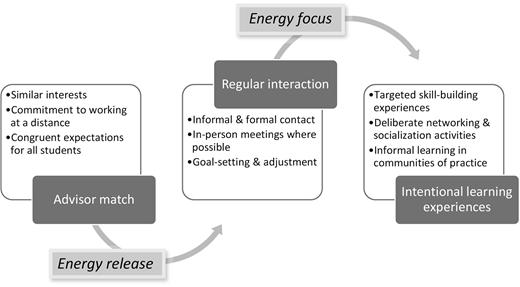
However, releasing energy is not enough; energy must also be focused on specific actions. For me, this included targeting specific research, teaching, grant writing, conference, service, and networking opportunities I needed from a distance. Some experiences were proposed by my adviser, and others were requested. In either case, they were undergirded by focused goal-setting conversations and accountability in an adviser-advisee relationship marked by “mutual respect and collaborative learning” (Blessinger & Stockley, 2016, p. 11). Focused energy is powerful, but it requires consistent work to keep from dispersing. Figure 2 represents a possible model of how online doctoral students can harness their online experience to prepare to become a faculty member. The essential building blocks include having (a) a solid adviser match, (b) regular interaction, both formal and informal, and (c) intentional learning experiences targeted at areas of growth.
Online Versus Traditional Doctoral Education
This analysis begs an inevitable question. Does online education provide an equally effective way to prepare for a faculty career? Said another way, can negentropic actions fully balance out or outgain the entropic losses in online education? After all, nearly every action in Table 1.1 other than conference and campus visits can be completed off campus while preserving the flexibility of online learning. While it may be tempting to answer this question outright, it depends largely on one’s personal needs, values at the time of studying, and future goals. I had specific priorities for my schooling based on my family needs and preferences as a student. I also hope to include online learning in my future research agenda and identity as a scholar and possibly to teach online in my career. Thus, for me, online was the “better” option, and I believe there was a net gain from having experienced it over the traditional model. However, many others will not feel the same given their set of circumstances.
Online Education for Faculty Career Preparation
Online Education for Faculty Career Preparation
Implications For Policy And Practice
I conclude with some recommendations for policy and practice relevant to an audience ofdoctoral students and faculty members. As online learning continues to spread, and world events like COVID-19 cause remote learning and work to be more necessary, there are likely to be increased numbers of students needing an alternative path for their education. Whether or not they become mainstream, online doctoral programs can be improved in several ways now.
First, students should be encouraged to consider more options than simply studying fulltime on-campus or part-time remote online or remotely. Being a full-time remote student brought increased focus and opportunities to my studies. Other hybrid arrangements are possible where students transition from part time to full time depending on the intensity of that phase of the program. The earlier a student makes a course correction to the right study situation, the better the outcomes. Early checkpoints between advisers and students to assess progress can facilitate these decisions and assess students’ “joy meter” with their overall experience. Many doctoral students burn out in the long trek through the degree, and a lack of joy may indicate a need to rebalance time and priorities.
Second, programs should encourage online students to visit campus early in their programs and not only during the dissertation phase. These personal touch points are crucial in personalizing the relationship with advisers and faculty. Visits need not be formal residency sessions but individual visits tailored to the schedule and interests of the students. Similarly, conferences are essential to the overall development of faculty-oriented PhD students—perhaps especially so for online students. Making travel funding available to online and part-time students while encouraging them to get support from their employers is one way to encourage this.
Third, increasing the experiential learning opportunities of online students is critical (Thacker, 2020). Online students may not initially see the value of cocurricular experiences like outside research projects, teaching opportunities, conference preparation, and service and leadership, but enabling or requiring these learning experiences will cement learning as no other method can. These experiences may require some “collaboration, creativity, and institutional flexibility” on the part of the institution (Ford et al., 2016, p. 111). For instance, Ford and colleagues (2016) described a doctoral teaching fellows program in which PhD students teach up to two online classes under the tutelage of a faculty member, and the university’s distance education office provides funding in exchange for more of the department’s classes going online. However, it is important to understand the mindset of online students in taking advantage of opportunities like joining communities, attending conferences, and participating in competitions. Making online students aware of opportunities is often insufficient, and information must be coupled with an invitation, encouragement, or a nudge from a trusted source. An online student may assume a program or opportunity does not apply to them, and they have fewer chances to vet these opportunities informally with peers and faculty. Advisers and faculty members can help online students establish some “early wins“ in their program to build confidence and gain momentum. For example, the institution could perhaps host an online conference for first-year students where students can present their ongoing research projects.
Fourth, vibrant learning communities are needed among students, faculty, and colleagues to accelerate online doctoral students’ socialization and identity-forming process. One example is a research apprenticeship course recently started at my current institution for new doctoral cohorts. Doctoral students, most of whom are remote, collaborate with multiple faculty and peers in a semester-long research community in which they conduct joint research projects and regularly share knowledge on research and faculty life. By participating in the community, students begin to adopt the shared norms and identity of the faculty leading the group while learning essential skills.
Conclusion
Whether by choice or out of concern for public health and safety, doctoral students are now being prepared online for faculty careers at a higher rate than before. At the same time, they are preparing to join a faculty where expectations for teaching online and working remotely have never been greater. These changes present unique challenges and new opportunities for individual students with faculty aspirations to be trained and socialized into a faculty career. The strategies presented here can help students and faculty advisers take concrete steps to counteract the energy loss occurring in online education and create a more transformative and empowering experience for online students.

