


Virtual teams are increasingly being utilized by organizations to connect employees across geographical boundaries and promote collaboration through communication technologies. The COVID-19 pandemic forced organizations to shift their employees to hybrid and remote settings. However, little is known about the use of virtual teams in educational settings. This scoping review aims to provide a comprehensive overview of relevant research and identify trends in virtual teams in education. Through a systematic search, 23 articles were selected as relevant to the research topic and questions. The findings indicate that the majority of virtual team research in education has mostly focused on students enrolled in business courses. Additionally, virtual teams have primarily been used for connecting students across the classroom and supporting global teamwork to simulate real-world working contexts.
Virtual teams exist across a variety of disciplines and often share common characteristics. Most of the interdisciplinary literature on virtual teams provides definitions that include members dispersed across time and space using communication technologies to work toward a common purpose (Barry, 2002; Bell & Kozlowski, 2002; Gillam & Oppenheim, 2006; Handke et al. 2019; Lin et al., 2008; Lilian 2014). Virtual team research is not a brand- new field. Research on virtual teams exists over the last 10 years, and results provided insights into the virtual team experience. A review conducted by Gilson et al. (2015) found common virtual team challenges around technology, culture, and personality type or affect.
Even though many researchers agree on a common definition of virtual teams and have found patterns in results, the ‘virtual’ component of virtual teams varies. Gibbs et al. (2019) made an important distinction about virtuality in that there is not an “on-and-off switch” but instead virtuality should be seen as a “continuum ranging from low to high” (p. 8). In this way, virtual teams could include some online learning modalities such as asynchronous, synchronous, and hybrid approaches. Furthermore, according to Martin and Martin (2021), “telecommunication in the global economy has brought new partners and ways of working to millions of people” (p. 390). In sum, virtual teams and virtuality look different across contexts.
Virtual teams are frequently used across businesses, especially those that have employees spread out globally (Dulebohn & Hoch, 2017). However, despite virtual teams growing popularity, very little has been written about virtual teams in the field of education, particularly for teachers (Charteris et al., 2021; Rolando, et al., 2014). Moreover, faculty members across several disciplines recognize the importance of preparing their students to work effectively in cross-disciplinary virtual teams (Cleary et al., 2019). Even though research on virtual teams in education is sparse, some researchers believe that there is more to learn about how virtual teams can maximize their impact in the field of education (Charteris et al., 2021). In fact, educational organizations and training programs are increasingly relying on virtual teams to perform tasks (Darbin, 2021). Furthermore, virtual teams are currently perceived as the next stage of organizational evolution (Martin & Martin, 2021). Even if this were not the current perception, many organizations have shifted semi-permanently to virtual team models after their experiences with the COVID-19 pandemic (“How has the Pandemic,” 2020).
The COVID-19 pandemic forced many people to change not only the way they live but the way that they work. Employees turned their homes into virtual workspaces as many of them were forced to run their businesses and organizations remotely (Newman et al., 2020). Charteris et al. (2021) argued that during this time many schools “sustained teacher professional learning initiatives over this period and transitioned successfully into virtual teams”(p. 1). Even though several organizations shifted to virtual workspaces and virtual teamwork, little is known about the use of virtual teams in educational settings. As a result, a scoping process was chosen for this systematic review in order to identify trends in the peerreviewed research literature.
The process of scoping reviews has evolved rapidly over the last 20 years. Early scoping studies were seen as a technique to simply map out relevant literature on a topic (Arksey & O’Malley, 2005). However, as scoping studies increased in popularity, so did frameworks to guide researchers conducting them. Arksey and O’Malley’s (2005) five-stage framework is a consistent foundation for researchers undertaking scoping reviews (Hacking, 2012; Peters et al., 2020; Pham et al., 2014). The following section describes the scoping review methodology in more detail. Following this description, is an overview of the scoping review process as it relates to the identification, selection, and analysis of articles relevant to virtual teams in educational settings. Next, this scoping review discusses findings as they relate to the research questions, and concludes with a summary of key ideas and suggestions for future research.
Methods
According to Arksey and O’Malley (2005), scoping reviews differ from traditional systematic reviews in that they focus on broader research topics and are less likely to focus on specific research questions. Scoping studies also differ in that they often require an “analytical reinterpretation of the literature” (Hacking, 2012). Even though a concrete, universal definition of scoping reviews does not exist, Mays et al. (2001) stated that scoping reviews
aim to map rapidly the key concepts underpinning a research area and the main sources and types of evidence available, and can be undertaken as stand-alone projects in their own right, especially where an area is com-plex or has not been reviewed comprehensively before. (p. 194)
Furthermore, researchers typically undertake a scoping review to examine the extent, nature, and range of a topic, determine the value of a systematic review, summarize and disseminate research findings, and identify research gaps (Arksey & O’Malley, 2005). This review explores the extent, nature, and range in addition to examining findings, and exploring gaps regarding the use of virtual teas in education.
The foundation for this scoping review is based on Arksey and O’Malley’s (2005) fivestage framework: (1) identifying the research questions, (2) identifying relevant studies, (3) study selection, (4) charting the data, and (5) collating, summarizing, and reporting the results. Since the conception of this framework, more researchers work to provide additional guidance on conducting scoping reviews (Hacking, 2012; Peters et al., 2020). This includes recommendations on improving the process so that it is even more rigorous and reliable than the original framework. This scoping review uses the five-stage framework while making a few considerations based on the advice of additional researchers. These considerations are explained below within the sections of the framework.
Stage One: Research Questions
As with traditional systematic reviews, the first stage of the scoping review process is to identify research questions. Arksey and O’Malley (2005) encourage a broad approach to the research questions that focus on what is known about the topic as it relates to a particular facet. However, Hacking (2012) recommends “combining a broad research question with a clearly articulated scope of inquiry” (p. 3). This helps the researcher articulate a clear scope for population, concept, and context within the research questions (Peters et al., 2020). Thus, the following questions were created after exploring the topic of virtual teams and reviewing the literature on virtual teams in education as well as other disciplines across varying organizations. Initial searches showed an abundance of literature on virtual teams in business organizations. However, those same searches provided a dearth of literature on virtual teams in educational settings. The focus of this review was to explore what is known about virtual teams in educational settings under the scope of the following questions:
What is the extent, range, and nature of virtual teams in education?
How are virtual teams being used in education?
What is known about participant perceptions and experiences of virtual teams in education?
Stages Two and Three:Study Identification and Selection
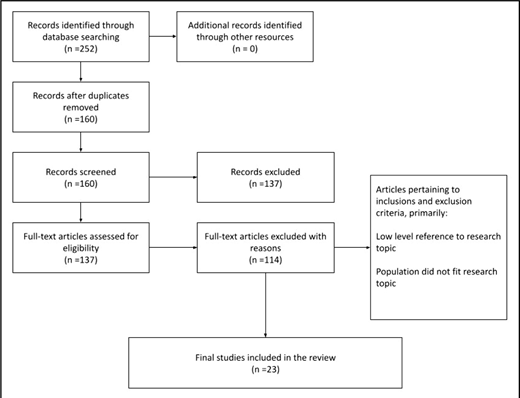
The second and third stages of Arksey and O’Malley’s (2005) framework include study identification and selection. The article selection process followed the Preferred Reporting of Items for Systematic Review and MetaAnalysis (PRISMA) guidelines for scoping reviews (Tricco et al., 2018). Study selection and identification are outlined in Figure 1. Additionally, Arksey and O’Malley (2005) suggested keywords for search terms be broad to ensure wider coverage. Keywords for search terms were developed to include broad coverage of literature as it relates to virtual team use in educational settings.
Three databases were used to search for research articles related to this topic: Academic Search Premier, Education Resource Information Center (ERIC), and Professional Development Collection. These databases were searched using the phrase “Education AND Virtual Teams or Virtual Teamwork” with filters set for a time period, type of article, and language. After reviewing the article title and abstract, research studies were only included that focused on students or teachers using virtual teams in K12 or higher education settings. The remaining references were selected for full-text review, and the articles that met the inclusion criteria were selected to be part of this scoping review. Table 1 provides an overview of the initial inclusion and exclusion criteria.
Inclusion and Exclusion Criteria
| Criterion | Inclusion | Exclusion |
|---|---|---|
|
|
|
|
|
|
|
|
|
|
|
|
|
|
|
Stage Four: Charting the Data
The fourth stage of Arksey and O’Malley’s (2005) scoping review guide is charting key items from the selected articles. This part of the framework includes “synthesizing and interpreting qualitative data by sifting, charting and sorting material according to key issues and themes” (Arksey & O’Malley, 2005, p. 15). Furthermore, Hacking (2012) recommended this to be an interactive process where researchers continually update their charting form. Therefore, a spreadsheet was designed to house data from the selected studies. The form was used initially to develop summaries of each article that included the author, year, content, purpose, methodology, and findings. As the charting process continued, new categories were formed such as limitations, instruments, and definitions of virtual teams. The new categories provided an opportunity to go back and review previous articles for this information. Several of these details from the studies are provided in the Appendix.
Stage Five: Summarize and Report Findings
The final stage of Arksey and O’Malley’s (2005) scoping review guide includes summarizing and reporting findings. Arksey and O’Malley (2005) remind researchers that within this stage, the goal is not to “assess the quality of evidence” (p. 18). Instead, it is the goal of the researcher to lift out patterns and themes based on the research questions and information extracted from the study. Hacking (2012) critiques this stage of Arksey and O’Malley’s (2005) framework by explaining
that it provides the least amount of guidance for researchers conducting scoping reviews. As a result, they recommend three distinct steps to ensure more consistency among researchers undertaking scoping reviews: analyzing data, reporting results, and applying meaning to results. The following section reports findings and includes a discussion that applies both Arksey and O’Malley’s (2005) framework and Hacking’s (2012) suggestions for stage five.
Findings and Discussion
Extent, Range, and Nature of the Research Activity
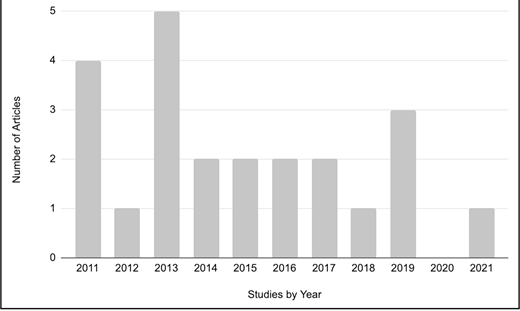
The literature sample on virtual teams in education included 23 articles that met the search criteria. The publication dates of selected studies ranged from 2011 to 2021. However, studies published in 2021 represent only those articles that were in the databases at the time of sampling and should not be considered as a complete record of research activity for the year. Figure 2 displays a frequency chart that depicts the number of articles published on this topic per year based on the sample. Even though technology continues to advance, based on the numbers there appears to be a stagnant and downward trend in studies for virtual teams in education.
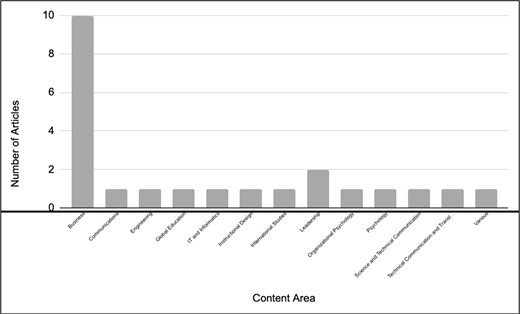
Figure 3 illustrates the number of studies centered around a particular subject or content area in education. For example, business courses represented the majority of studies in this review with business representing 10 out of the 23 studies selected. This suggests that educational organizations perceive virtual teams and virtual teamwork as a more integral part of the business world. Additionally, similarities were found among study rationales where several researchers justified the need for their study due to the potential future career path of the participants.
Virtual Teams in Education
In order to best understand how virtual teams are being used in education, the analysis of the selected studies for this scoping review first examined the content, purpose, and participants within each study. The purpose of this focus was to gain insight into the who, what, and why behind the research on virtual teams in education. Additionally, the kinds of projects and tasks virtual teams experienced through the study were important to understanding virtual team use in education. Since a key component of many virtual team definitions includes working toward a common goal or purpose (Bell & Kozlowski, 2002; Gillam & Oppenheim, 2006; Handke et al. 2019; Lin et al., 2008; Lilian 2014), it was important to consider the deliverables of each group as they represent the common goal or purpose of the virtual teams within these studies. The following two sections include descriptions of how the studies in this scoping review reveal this information as it relates to virtual team use in education.
Content, Purpose, and Participants
Common patterns emerged around the content area, purpose, and design elements through the analysis of selected studies. The focus for the content area was to explore in which educational fields virtual teams were being used. For example, of all the virtual teams deployed within the studies in this scoping review, 10 out of the 23 students incorporated virtual teams with students enrolled in business courses. The only other content area that had more than one study reflected in a content area was leadership. Moreover, the study conducted by Chang and Chun (2013) on leadership in virtual teams still had a business context. This suggests the importance of virtual teams and virtual teamwork across the business discipline.
Of the 23 articles, 16 articles (70%) related to participant experiences and their interactions within virtual teams. Participant experience was a frequent pattern with nearly every study reporting on participant perceptions through different methods. For example, Sloan and Lewis (2001) used Likert-style surveys to gauge students’ experience with satisfaction of virtual teams. Additionally, Gonzalez-Perez et al. (2014) applied a mixed methods approach using Likert-style surveys in addition to conducting individual interviews with participants. Other researchers, such as Cleary et al. (2019), used qualitative analysis and coding on participant blogs and transcripts to interpret participant experiences. While these studies reflect a purpose connected to participant experiences, others included an exploration of interactions within virtual teams. For instance, Cleary et al. (2019) and MartÍnez-Moreno et al. (2012) were concerned with understanding how challenges and conflict impacted the strategies students used to make progress toward goals. Additionally, Yilmaz and Peña (2015) analyzed the impact of negative communication and language influenced interpersonal personal behavior. Two of the studies explored the interactions of virtual teams based on personality types. For example, Olson and Kalinsk (2017) used the Insights Discovery (ID) personality assessment to create homogeneous and heterogeneous groups for virtual teams. Their goal was to evaluate the impact of personality types on virtual team performance. In this study, participants were randomly assigned to teams. Teams were assigned the title of Variable (heterogeneous groups) when at least 50% or more of the team has one ID personality type.
Teams were also categorized as extroverted or introverted and thinking/feeling based on the ID results. Based on the results, the researchers found that extroverted teams outperformed introverted teams and heteroge-
neous groups outperform homogeneous groups. Another study by Cogliser et al. (2013), applied Group Exchange Structures (Seibert et al., 2003) to explore the impact of different structure types on virtual team performance outcomes and overall satisfaction. They found that groups with generalized structures (high-quality exchange relationships and high information sharing and cooperation) did not experience higher levels of performance or satisfaction than groups with balanced structures (low-quality exchange relationships and low trust and concern). However, groups that had isolates (low quality and negative exchanges) experienced negative effects on performance and satisfaction. This suggests the importance of interactions that foster trust, cooperation, and information sharing in virtual teams. The analysis of the studies within this scoping review revealed a common pattern around the purpose for many of the researchers, even if not the primary goal, the importance of interactions was almost always reported or discussed in some measure within the findings or conclusion.
Finally, there were commonalities among participants across all students. First, as mentioned, the majority of participants were students enrolled in a business major course. However, some of the specific business courses varied. For example, Fain and Kline (2013) included international business students in their studies. Additionally, Meier et al. (2016) built their study around accounting students. Furthermore, Darbin (2021) utilized participants enrolled in a management information systems course. Another commonality among participants was their education level. For example, 16 out of the 23 studies include undergraduate participants only. To add, two of the studies consisted solely of graduate students, and one study included both undergraduate and graduate students. The remaining studies in this review either did not report education level or it was not applicable. In summary, this scoping review revealed similarities among study content, purpose, and participants. This suggests that the current literature on virtual teams and education has a preferred topic and audience. In addition to these patterns, the analysis of literature found commonalities among the types of projects and tasks participants engaged in while working on virtual teams.
Group Projects and Tasks
Most of the studies included students working in groups on different projects through virtual communication tools. However, the scope of the projects varied across studies. For example, Andrade (2019) used a team ePortfolio project with students during face-to-face and online sections. The researcher chose to use a qualitative approach to study student experiences for both the creation of the ePortfolio and virtual teamwork. Each week participants would collaborate by adding an artifact that reflected on a concept or topic for that week’s study. All students in face-to-face courses and those online working in virtual teams were expected to set group norms and expectations around behaviors, including communication methods, meeting times, roles, tasks, deadlines, and consequences. Another example from the study selection included a collaborative writing task using cloud technologies. Mehlenbach et al. (2018) studied two online courses, ran asynchronously, as students worked in groups of three to four using a Google Doc to write collaboratively. Groups were required to write a report on globalization in the sciences. Both Andrade (2019) and Mehlenbach et al. (2018) focused on providing written projects that groups were able to collaborate on asynchronously. While the virtual team participants in Andrade’s (2019) study got to work on a collaborative project over the span of a course, the participants in Mehlenbach et al. (2018) worked during a shorter time span on one paper.
Another study included participants who experienced a shift from a large lecture hall to virtual teams. The goal of the instructor in the course was to condense a 450-student class into a collaborative and active learning space.As a result, 30 virtual team groups were created to facilitate postclass work in the form of online discussions, group projects, and papers. Participants used a variety of technologies such as Twitter and Wikispaces to support collaborative activities. Similar to Andrade (2019), the participants in this study were able to engage in virtual teams over a longer time period. However, this study differs from that of Andrade (2019) and Malenbach et al. (2018) in that the virtual teams were not used for one specific project, but rather a tool to foster ongoing community and collaboration throughout the course for different projects and tasks.
Other studies focused on participants working through simulations and global collaboration. For instance, Fain and Kline (2013), wanted to explore global, multicultural teams in action. Therefore, their study carried out a realistic simulation by placing students into global virtual teams where groups needed to use virtual technological developments to solve a new product development problem. Additionally, Meier et al. (2016) simulated a global virtual work environment by connecting students internationally to work on an auditing case. Both Fain and Kline (2013) and Meier et al.’s (2016) studies focused on creating authentic virtual team experiences through the use of simulations. On the other hand, Gonzalez-Perez et al. (2014) explored participants who engaged in the Global Enterprise Experience. In this study, participants had engaged in an international business competition where international virtual teams were required to work together on a six-page paper on an international business topic. Teams had approximately 3 weeks to complete the task. In summation, the virtual teamwork in the studies by Fain and Kline (2013), Meier et al. (2016), and Gonzalez-Perez et al. (2014) provided participants with opportunities to work on real- world projects and tasks with international peers.
Overall, the studies revealed two categories of projects and task types for virtual teams. On the one hand, projects and task types could be related to an assignment where virtual teams were expected to collaborate and contribute to a final piece. On the other hand, virtual team members could work on a longer project or task over time that included a variety of activities for the teams to complete together. While the analysis of studies in this scoping review found patterns and commonalities among the study components as well as participant virtual teamwork, the analysis also revealed a myriad of information on participant perceptions of virtual teams. The following section shifts to the analysis of the final research question for this scoping review which explores participant perceptions and experiences of virtual teams as it relates to perceived benefits, challenges, and effective models.
Participant Perceptions and Experiences of Virtual Teams
To capture participant perceptions and experience of virtual teams, the following analysis examined results from the different studies in order to understand the perceived benefits, challenges, and effective components of virtual teams and virtual teamwork.
Virtual Team Benefits
Even though there were some similarities, the perceived benefits of virtual teams varied across participants and their contexts. First, two studies that included participants who engaged in a global virtual team experience, described an increase in their intercultural competence. For example, the participants in Gonzalez et al’s (2014) study expressed positive feedback about the virtual team project that helped develop their global mindset and cultural competence. Additionally, participants in Dai et al.’s (2014) study described the challenges of working about cultures as a benefit.
Similarly, Cleary et al. (2019) found that even though students did not report facing cultural challenges they did, however, report an increased awareness of cultural issues. During the interviews, three participants mentioned the metacognitive processes that took place during communication opportunities. For example, they would need to think about phrasing and how language might lead to misunderstandings and conflict. The studies that applied global virtual team models created authentic opportunities for participants to interact with other cultures, which they found valuable. Not all studies included a global virtual team model, therefore the benefits of virtual times across other studies in this scoping review were perceived differently by participants.
One study evaluated participant perceptions of the transformation of a large lecture hall into virtual teams. Stoerger and Krieger (2016) sought to use virtual teams to change the environment and dynamic of a 450-person lecture hall. Students were split into virtual teams of 30 and were given opportunities outside of class to interact in a virtual space. Even though participants had mixed reactions to the new activities and assignments, participants in this study perceived this shift as supportive when it came to increasing community and motivation. Additionally, participant perceptions of the ePortfolio (Andrade, 2019) and collaborative writing task (Mehlenbacher et al. 2018) were positive in that the projects supported their reflective processes on course learning.
The analysis of perceived benefits by participants was sparse across the studies in this scoping review. Participants engaging in global virtual team models tended to report positive experiences interacting with other cultures. Next, participants who did not engage in global virtual team models were able to perceive the benefits of virtual team models that connected to an increased sense of community and reflection. As these benefits presented themselves through analysis, so did participant challenges.
Virtual Team Challenges
Participants across the studies in this scoping review experienced similar challenges to one another. For example, participants who engaged in international virtual team experiences struggled with time zones. The participants from the study conducted by Gonzalez et al. (2014) reported that time zones were a significant barrier to completing work. One participant reflected on the nature of the tasks as being “demanding” and “time consuming” (Gonzalez et al., 2014, p. 206). As a result of the time zone differences, participants had a waiting period before they would hear from their virtual team members to be able to move on to the next steps for their work. Similarly, one participant from Cleary et al.’s (2019) study shared that collaborating across different times was “harder than [they] thought it would be” as they did not know how to navigate waiting for team members to respond to inquiries and suggestions (p. 321). Time zones presented a common challenge among participants which often led to challenges with communication.
Closely related to time zone challenges, communication was another barrier according to participants in these studies. Bartel-Radic et al. (2015) reported that participants were surprised by the difficulty of communication with their team. Furthermore, perceptions of the team output did not meet their expectations especially in scenarios where unexpected communication challenges presented themselves. Additionally, Cleary et al. (2019) reported similar challenges as participants shared that it was difficult to get individual team members “to contribute to the forum and to offer suggestions” (p. 321). Likewise, Sloan and Lewis (2011) found that many participants reported feeling frustrated with their teammates as it was often difficult Ío coordinate assignments and tasks. In this study participants even claimed that they had learned a great deal from the experience but still reported strong dissatisfaction with the virtual team approach. Studies from this scoping review point to a key challenge around communication which often was a result of team members having the flexibility of time and space within the virtual team model.
Another perceived challenge was connected to leadership (Chang & Chun; 2013; Cleary et al., 2019; Darbin, 2021; MartÍnez-Moreno et al., 2012; Mehlenbacher et al., 2018; Sloan & Lewis, 2011). For example, Cleary et al. (2019) explained that they did not delegate leadership roles within the teams, nor did they require them. However, participants recognized the importance of leadership within their virtual teams. One participant explained that "“without a team leader, we struggled for a topic, to come up with roles, and to abide by deadlines” (p. 321). Another participant suggested to the researchers that team leaders should be assigned because they “lost time being polite and shy” and that “attitude got [them] nowhere” (p. 321). This suggests that virtual teams could benefit from assigned or group generated roles at the start of virtual teamwork. Additionally, MartÍnez-Moreno et al. (2012) examined the role of conflict on relationships. They found that virtual teams that experienced early task conflict were more likely to experience relationship conflict over time. In other words, when virtual teams had disagreements early on about procedures, delegating tasks, and deadlines, they were more likely to engage in relationship conflict among one another as they progressed. This also suggests the importance of designating leaders and other roles to avoid early task conflict.
In summation, participants in the studies of this scoping review had similar challenges when it came to time zones, communication, and leadership. Time zones made it difficult for teams to progress at an efficient pace. Communication was often a challenge as a result of time zones, but also as a result of coordination issues. Finally, participants perceived leadership and roles as a way to support challenges with a lack of direction toward common goals. While the participants in these virtual teams experienced challenges that created difficulties in their work, through their perceptions researchers gained insight into ways that virtual teams can be more effective in the future within these settings.
Considerations for Effective Virtual Team Models
The authors of the selected articles used different methods to explore facets of virtual teams and virtual teamwork, the results of their efforts often revealed insight into participant needs as it relates to producing more effective virtual team models. For example, four of the studies pointed to the importance of building trusting relationships among team members (Cleary et al., 2019; Gonzalez-Perez 2014; Tseng & Khu, 2011; Zaugg & Davies, 2013). Tseng and Khu (2011) investigated the relationship between the level of trust, performance, satisfaction, and teamwork among virtual teams. Participants were asked to reflect on their trust levels with their team multiple times throughout the virtual team experience. The results of the study revealed three key pieces of information about trust in virtual teams. First, the level of trust has a strong positive relationship with team performance. Next, trust has a strong positive relationship with team satisfaction. Finally, teams that reported higher levels of trust also showed more advanced stages of teamwork development (p. 89). Zaug and Davies (2013) described building relational trust as one of the most challenging aspects of virtual team development, however perceived it as being one of the most important elements to consider when facilitating virtual teams. These studies align with current research on virtual teams in other organizations. Several researchers identify trust as critical to the success of virtual teams (Brahm & Kunze, 2012; Erez et al., 2013; Kiffin-Peterson, 2004;Pangeli & Chan, 2012). Other studies in this scoping review highlighted additional areas of consideration for effective virtual teams based on participant perceptions and experiences.
While communication was often reported as a challenge by participants, it was also an opportunity for them to share solutions to communication-related issues. Based on participant responses, Zaugg and Davies (2013) learned that communication was pivotal during virtual team interactions. As a result, Zaugg and Davies (2013) recommend that those undertaking virtual teams be willing to redefine communication practices in addition to providing autonomy around communication tools. Participants within their study were able to explore communication technologies that best fit the needs of their group which allowed them to reflect on how their choices contributed to effective communication within their virtual team.
Finally, references to potential leadership structures reveal insights into effective strategies for virtual teams. Darbin (2021) explored factors that contribute to shared leadership in virtual teams. Thus, they recommended considerations be made around team composition, team empowerment, and resources for communication and collaboration. For example, the results suggest surveying and distributing team members with low empowerment beliefs. Furthermore, the results showed that geographically dispersed members were more likely to facilitate shared leadership because they experience higher levels of virtuality. Finally, Darbin (2021) suggests that based on participant experience, it is important for those deploying virtual teams to advocate for and ensure access to communication technologies that increase virtuality. Chang and Lee (2013) also conducted a study related to the impact of leadership types on participants in virtual teams. Their results revealed that transformational leadership is shown to be more effective than transactional leadership when handling conflict among virtual team members. Nort-house (2019) described transformational leaders as inspirational and supportive for their followers by motivating them to reach their aspirations. On the other hand, transactional leadership is best described as a give-and-take relationship between a leader and their followers. Given that participants often reported challenges around leadership, this information is crucial to understanding what kind of leadership might be needed to facilitate effective virtual teams.
The investigation of participant perceptions and experiences within the studies of this scoping review highlighted the benefits and challenges of virtual teams and virtual teamwork. Additionally, they helped provide insight into strategies for developing more effective virtual teams in education. This analysis provides future researchers with considerations for developing future virtual team models.
Conclusions
This scoping review of virtual teams in education was conducted to explore the extent, nature, and range of research, how virtual teams are being used in educational settings, and how participants experience and perceive virtual teams and virtual teamwork. Results from this scoping review highlight a trend of virtual team research in business education programs. This suggests that educators in this business field perceive virtual teams and virtual teamwork as a crucial experience for their students. All studies in this review implemented virtual teams in a way that allowed participants to work with their peers using a variety of different communication technologies. However, the length and scope of virtual teams and virtual teamwork across the studies varied. For example, several of the studies conducted with participants in business courses utilized a global virtual team approach. In these studies, participants were connected to peers internationally and had to work across time zones with a variety of different cultures. Additionally, a few studies ran longer virtual team projects throughout a course or multiweek period. Other studies focused on virtual teams and virtual teamwork for a singular project. Regardless of the approach, almost all of the studies focused on gaining insight into virtual teams and virtual teamwork through team outcomes, team satisfaction, team interactions, leadership, and participant perceptions and experiences.
Overall, the researchers took different approaches to learn about virtual teams in their studies. Based on the findings from the studies in this scoping review, future practitioners can apply learnings to their contexts when trying to facilitate virtual teams and virtual teamwork. For instance, the results within a majority of the studies reveal the importance of effective communication strategies and tools, approaches to developing leadership within the team, team composition, and other strategies for building trust among virtual team members. A few researchers collected qualitative data from their participants in the form of interviews. However, most researchers used Likert-style questions on surveys to capture participant perceptions and experiences. Future researchers should encourage more qualitative approaches to capturing participant experiences of this process. The few researchers that did were able to lift out themes that supported much of the analysis of the benefits, challenges, and suggestions for future models of effective virtual teams. Additionally, more attention is needed in areas outside of the business disciplines. Virtual teams are becoming more of the norm across a variety of industries (Martin & Martin, 2021). As a result, students and educators alike need opportunities to experience and practice virtual teamwork for a multitude of careers. A final note on gaps in this literature is the lack of teacher representation in virtual team research. None of the studies in this scoping review reflected any teacher or instructor experience with working in virtual teams. Given the changes education has seen over the last year as a result of the COVID-19 pandemic, this may be a particularly important area for researchers to explore for future use and models.
This scoping review is limited by the selection strategies and methods. As a result, studies could have been missed. Additionally, the key phrase “education” is a very broad term and that could have impacted some of the studies that came up in the search. In closing, based on this scoping review research on virtual teams and education appears biased toward business professionals. Given the vast changes organizations have had to make to accommodate remote and hybrid working environments, more research is needed to explore other industries and organizations to support effective virtual teams in their unique environments.
Authors’ Note
Conflict of Interest: On behalf of all authors, the corresponding author states that there is no conflict of interest.
Data Availability Statement: The datasets generated during the current study are not publicly available to protect the privacy of the study participants.
Informed Consent: Informed consent was obtained from all individual participants included in the study.
References
Appendix: Included Studies
Included Studies
| Study | Content | Purpose D | Design and Participants | Findings |
|---|---|---|---|---|
(1) Andrade (2019) | Business |
|
|
|
International studies |
|
|
| |
Leadership |
|
|
| |
Technical communication and translation |
|
|
| |
Business |
|
|
| |
Global education |
|
|
| |
(7) Darban (2021) | Business |
|
|
|
Business | Assess the impact of cultural aspects on virtual teams. |
|
| |
Business | Evaluate the impact of personality types on virtual team performance of complex tasks. |
|
| |
(10) Gilson et al.(2013) | Business | Demonstrate the advantages and challenges of virtual teams. |
|
|
Business |
|
|
| |
(12) Hirschy (2011) | Leadership |
|
|
|
Psychology |
|
|
| |
Science and technical communication |
|
|
| |
(15) Meier et al. (2016) | Business |
|
|
|
Organizational Psychology |
|
|
| |
(17) Shea et al. (2011) | Business |
|
|
|
Business |
|
|
| |
Information technology and Informatics |
|
|
| |
Mixed |
|
|
| |
(21) Tseng and Khu (2011) | Instructional design |
|
|
|
Communication |
|
|
| |
Engineering |
|
|
|

