


This research brief comprises three articles published in the three-article dissertation at the University of Missouri (MU) in February 2023. The three-article dissertation, “An Exploration of Online Information Spaces That Support Instructional Design and Teacher Professional Development,” examined three online communities of practice (CoPs) in instructional design and technology (IDT) and teacher professional development (PD) using natural language processing (NLP) and usability testing. This research brief summarizes online CoPs‚ unique and shared characteristics, topic patterns, and work-related practical knowledge exchange patterns from an e-learning news outlet, four online CoPs on Facebook, and an online teacher PD CoP.
Introduction
Information and communication technologies (ICTs) are currently built on Web 2.0 technologies emphasizing the creation and distribution of content (Önday, 2019). ICTs have allowed the accumulation of practical knowledge in online communities of practice (CoPs) as the byproduct of members‚ interactions. Erickson and Kellogg (2000) argued that knowledge production is deeply entwined with the dynamic nature of online CoPs as community members coproduce, share, and discover knowledge. Furthermore, the accumulated practical knowledge is deemed an organizational asset and represents the organizational knowledge capital in online CoPs. However, previous studies have documented the navigation challenges that community members face when accessing the accumulated practical knowledge in online CoPs. While the organization of practical knowledge is critical in online CoPs, organized practical knowledge can become a critical asset that improves individuals‚ quality of work, decision-making, and performance accuracy (Brockman & Anthony, 2002; Suppiah & Sandhu, 2011). When effective mechanisms are implemented to organize the accumulated practical knowledge in online CoPs, individuals are better positioned to have more rich professional experiences as they improve their cognitive abilities, somatic skills, and mental and physical perceptions. (Kabir, 2013; Kogut & Zander, 1992).
Although ICTs play a critical role in supporting the creation and distribution of practical knowledge, online CoPs have inefficient organizational schemes that mismanage the accumulated practical knowledge with little or no alignment to professional competencies. The lack of organizational schemes affects community members‚ ability to search for solutions independently, allowing for professional advancement from content- and contextual-based organizational perspectives. First, the literature has noted the usability issues in online CoPs‚ lack of mechanisms for browsing the accumulated practical knowledge from a content-based organizational perspective. Second, online CoPs are not designed as information spaces that enrich the professional advancement of community members by contextualizing practical knowledge with professional competencies.
Community member participation has been studied in five levels of social network engagement in online CoPs, including identifying, lurking, contributing, creating, and leading (Dawley, 2009). Although most community members consist of “lurkers,“ or those who exhibit peripheral participation and observe how members interact and learn from information exchange, “lurkers” are likely to rely on the organizational and search mechanisms to navigate the accumulated practical knowledge in online CoPs without full participation (Marett & Joshi, 2009; Muljana et al., 2021; Rafaeli et al., 2004). Although ICTs have enabled practitioners to develop online CoPs out of shared practice and necessity, future technologies should support community members‚ information tasks through organizational schemes that allow categorizing topics and evaluating practical knowledge based on professional competencies. The studies explore the mechanisms to support the navigation and evaluation of the accumulated practical knowledge ingrained in online CoPs as mental models and shared beliefs, identities, and meanings.
This research brief is organized into three sections. Section I provides the theoretical framework, central and individual research questions, contributions, and brief methodology foundations on natural language processing (NLP) and usability testing. Section II presents the published studies, findings, and limitations as part of the three-article dissertation at the University of Missouri (MU). Section III concludes this research brief by examining the implications for research and practice, five design features that can help improve online CoPs, two implementation examples of the design features, and future directions for this line of research on online CoPs. The three-article dissertation can be found at: https://mospace.umsystem.edu/ xmlui/handle/10355/96103
Theoretical Framework
Wagner and Sternberg (1985) defined tacit knowledge as work-related practical knowledge learned informally through experience on the job concerning the know-how instead of knowing facts. Research studies in the knowledge management literature examine tacit knowledge extraction from explicit forms of knowledge in the workplace (e.g., online platforms, documents, and e-mail communication). These studies are explored through the SECI model, where knowledge is continuously created through Socialization, Externalization, Combination, and Internalization (Nonaka & Takeuchi, 1995):
Tacit knowledge is created through socialization, and its tacitness is difficult to codify into explicit knowledge.
Tacit knowledge is externalized or articulated in symbolic language for sharing with other groups or individuals.
The combination step requires applying and reorganizing explicit knowledge.
When explicit knowledge is applied, individuals embody the knowledge as tacit through action and reflection.
Nonaka and Takeuchi (1995) also elaborated on the concept of ba, or basho, as a context for shared knowledge creation and relationship building between individuals within organizations. Ba can be a physical, online, and mental shared interaction space (Meloni & Villa, 2007). Four types of ba exist to support each phase of knowledge conversion. The first type is the originating ba, which supports the socialization processes where individuals can share tacit knowledge with a deep interchange of experiences and mindsets. The second type is the interacting or conversing ba that supports the externalization process, where tacit knowledge is transformed into explicit knowledge and individuals exchange dialogue in verbal or written forms. The third type is the cyber ba that supports the combination process where explicit knowledge can be organized and disseminated through ICT solutions by facilitating group-to-group communications. The fourth type is the exercising ba, which supports the internalization process where individuals embody explicit knowledge by making it personal tacit knowledge and enhancing the acquisition of new knowledge for self-refinement.
The concept of ba has been used in the research of CoPs in knowledge creation and sharing situations (Cairns & Malloch, 2011; Mäkäräinen-Suni & Hong, 2011). Ba and CoPs share similar characteristics, including bringing individuals with similar interests, being willing to share knowledge and practices, and being part of a community or shared space. Even though the concept of ba and CoPs share similar characteristics, significant differences for ba include the creation of new knowledge in a fluid environment with changing members, whereas, in CoPs, knowledge is embedded with members within clear boundaries of interaction with a stable membership of individuals (Mäkäräinen-Suni & Hong, 2011). Wenger and Synder (2000) described CoPs as groups of people informally gathered to share expertise in a specific domain or field as they interact regularly.
The studies connect to the SECI model, where the knowledge creation process in online CoPs operates under their established goals and depends on their processes for sharing and creating knowledge using web technologies. The first study aims to extract work-related practical knowledge from an e-learning news outlet called elearningindustry.com. This site is one of the largest online CoPs for producing and sharing practical knowledge in instructional design and technology (IDT). IDT practitioners are invited to write online articles under multiple categories. The e-learning news outlet CoP relies on a content management system (CMS) platform where online articles are deployed under different categories and approved by community administrators. The second study aims to extract work-related practical knowledge from four public Facebook groups. Two online CoPs are related to IDT (i.e., Instructional Designers and Designers for Learning), and the other two groups are related to e-learning authoring tools (i.e., Adobe Captivate Users and Articulate Storyline). Community members can ask for professional advice, share new knowledge with others, and hold discussions about best practices and issues in the domain of practice. Community posts and discussions do not require formal approval by administrators.
Community members can also exchange professional knowledge through the Facebook group‚s feed. The third study aims to redesign an online teacher professional development (PD) platform, the EdHub Library, as an online information space that allows educators to align PD materials with Missouri teacher standards. The EdHub Library is a knowledge repository in which experts‚ knowledge is captured and translated into e-learning modules and activities. Self-paced PD materials are organized under multiple categories aligned to Missouri teacher standards using HTML pages, sitemaps, and a search engine.
Central Research Question
The following research question encapsulates the purpose and sequence of the studies: What design features in online information spaces enhance the exchange of skills and knowledge among members of a community of practice?
The sequence of the papers describes the processes for taking inventory of shared practical knowledge from online CoPs that allow the creation of mechanisms to represent, visualize, and organize knowledge. Studies #1 and #2 describe NLP tasks for extracting practical knowledge from codified knowledge found in platforms that use different information architectures (IAs) to organize produced content. In study #1, the e-learning news outlet is structured into seven major categories, and the topic representations of each category allow for further exploration within their existing structure. In study #2, CoPs using social media platforms (i.e., Facebook) do not have an IA that allows members to browse the available knowledge. The topic representations of these public groups should allow for a mechanism to locate specific knowledge rather than rely on members‚ responses in an asynchronous online environment. Study #3 aims to improve the usability of an online teacher professional PD CoP that allows educators to align PD materials with Missouri teacher standards regardless of professional experience. Table 1 describes the central research question, the sequence of the individual studies, and their respective online CoPs.
Rationale and Contribution
The significance of the studies involves generating design recommendations for knowledge discovery in asynchronous online environments in IDT CoPs and documenting online CoPs‚ shared knowledge that builds the foundation for developing taxonomies or classification schemes in future studies. More specifically, the following studies explore shared knowledge and practices in online CoPs and fill a gap in the literature in the following manner:
Study #1 E-Learning News Outlet CoP:This site has its IA in seven news categories. Though practitioners are invited to write for the CoP, it is unclear how community administrators evaluate the quality of the articles. While the site‚s structure helps organize its knowledge, additional structures within each category are needed to facilitate practical knowledge and skills development.
Study #2 IDT CoPs on Facebook: Members are not obligated to participate, and the problem is that discovering existing knowledge within the online CoP is challenging. Designing an online CoP as an online information space and implementing curation practices should enhance community members‚ ability to find the answers independently and take a better inventory of their social capital.
Study #3 EdHub Redesign: This paper is an example of designing an online information space for a specific CoP in K–12 within the Network for Educator Effectiveness (NEE) that aligns PD materials with the Missouri teacher standards. This study contributes to the teacher education literature by implementing several mechanisms to support educators‚ information needs in standards-based teacher PD.
Central Research Question and Sequence of Studies
| Central Research Question: What design features in online information spaces enhance the exchange of skills and knowledge among members of a community of practice? | ||||
|---|---|---|---|---|
| Study/CoP | Audience | Platform | CoP Goal | Research Questions |
|
|
|
|
|
|
|
|
|
|
|
|
|
|
|
Methodological Foundations
The series of studies use quantitative and qualitative approaches to examine the accumulated practical knowledge of online CoPs in IDT and design an interface that supports the information needs of their respective users. The purpose of the studies is to generate design recommendations to support online CoPs as information spaces that enhance the creation, sharing, and evaluation of practical knowledge. In achieving this purpose, the examination of practical knowledge in online CoPs is required to understand the purpose, functions, and how community members produce and exchange practical knowledge in CMS and social media platforms. The first study examined the practical knowledge produced across seven news categories in e-learning development using a CMS as the primary mechanism for producing and sharing practical knowledge. The second study explored the practical knowledge of four online CoPs in IDT on the Facebook platform. The third study examined the custom development of an information space to support a CoP of K–12 educators in Missouri.
Natural Language Processing
In the first two studies, NLP was employed as an exploratory means to examine the practical knowledge behind codified language in prominent online CoPs in IDT. Syntactic andvsemantic NLP tasks were implemented to extract the syntax-based characteristics and meaning behind text sources.
Syntactic NLP tasks refer to the characteristics of the syntax of words concerned with the position of words in a sentence without understanding the context around them. In these studies, the syntactic NLP tasks included average word and sentence lengths, n-grams, and word frequencies that allowed for exploring the codified knowledge from text sources. Lambda functions were used to calculate the average word and sentence lengths, and the visualizations were generated using the Profile Report package (Brugman, 2021). The ngrams language model in the Natural Language Toolkit (NLTK) was implemented to understand the probabilities of contiguous words in trigrams and 4-grams (Natural Language Toolkit—NLTK 3.6.2 Documentation, n.d.). After implementing a stop words dictionary to remove uninformative words, word frequencies were obtained to understand the importance of words based on frequencies.
Semantic NLP tasks are concerned with extracting meaning out of the context of words. The semantic NLP tasks included sentiment analysis, named entity recognition and entity relationships, and topic modeling. The TextBlob package was implemented for sentiment analysis to identify positive, neutral, and negative attitudes in the texts (Lorian, n.d.). Text sources were processed with the spaCy package to extract entities, including names of people, places, organizations, and geographic locations (spaCy � Industrial-Strength Natural Language Processing in Python, n.d.). Once entities were extracted, subject-object relationships were formed as entity pairs to describe the source and target entities linked by edge entities.
The latent Dirichlet allocation and BER- Topic were implemented for topic modeling to identify the latent topic structures in online CoPs. In the first topic modeling technique, latent Dirichlet allocation generated topic models based on the word representations and probabilities from the bag-of-words (BoW)and Term Frequency-Inverse Document Frequency (TF-IDF) (Řehůřek, 2009). In the second topic modeling technique, BERTopic was implemented to generate topic representations against a large pretrained model (Grootendorst, 2020; Reimers, 2021).
Although there is no standard evaluation procedure for topic modeling, semantically coherent topics were examined through human judgment and quantitative approaches. Chang et al. (2009) proposed evaluating topic model outputs using two methods, including topic and word intrusion methods. In terms of topic intrusion, discovered topics can be evaluated to determine whether the topic model‚s decomposition of documents agrees with human judgments. A topic model can be examined regarding word intrusion by observing the words inserted in a topic model that do not provide semantic coherence or coherent meaning. Regarding the quantitative approach, coherence values were obtained by running the topic modeling algorithms until the highest coherence values were achieved.
Usability Testing
In study #3, redesigning the online teacher PD platform, the EdHub Library, required two usability testing sessions through voluntary participation from NEE and Assessment Resource Left (ARC) staff. This study was conducted as part of my employment duties as an instructional designer for improving a university-related service to school districts in Missouri. Participant information was not collected, and no identifiable information can be traced back to participants.
The primary objective of the usability testing sessions was to obtain feedback from participants to refine the three-level hierarchical navigation structure of the prototype. The prototype contained three main sections (i.e., getting started, search engine feature, and topic categories). In the first usability testing session of the prototype, five NEE trainers were tasked to look for specific PD materials, write the location of the PD materials, and provide feedback related to their user experience (UX).
After implementing feedback from the first usability testing session, the second prototype incorporated a fourth section for accessing dedicated NEE teacher indicator sitemaps directly from the homepage. To verify the correct implementation of changes to the second prototype, the same five NEE trainers and three ARC participants were asked to locate PD materials, write down their location, indicate their search preference, and provide feedback on their UX. In the two usability testing sessions, the correctness of the location of the materials was verified.
Overview of the Three Studies
The studies presented in this article represent the critical step for improving IDT CoPs by analyzing the accumulated practical knowledge through NLP to explore how community members use respective CoPs with CMS and social media platform configurations for knowledge sharing and collaboration. Thus, studies #1 and #2 revealed the purpose, functions, and types of practical knowledge exchanged and led to design recommendations that improve IDT CoPs as conducive information spaces for independent exploration of practical knowledge and alignment to professional competencies and standards in IDT. Study #3 is a design case for redeveloping an existing online CoP for teacher PD to support users‚ primary information task of locating PD materials aligned with Missouri teacher standards.
I am the sole author of the articles that were accepted in the following scholarly journals:
Study 1: published in Knowledge. Citation:Leung, J. (2022). An NLP approach for extracting practical knowledge from a CMS-based community of practice in e-learning. Knowledge, 2(2), 310-336. https://doi.org/10.3390/knowledge2020018
The E-Learning Industry CoP produced online articles as recommendations, evaluations, and reports on IDT practice‚s pedagogical and technical aspects (Leung, 2022). The online CoP in IDT heavily emphasized the production of online articles related to learning management systems (LMSs) as the primary mechanism for e-learning courses for online employee onboarding, skills development, and compliance purposes. The online articles of this CoP were characterized by the digestible reading nature, the positive tone across the seven news categories, and the emphasis on educational technology over pedagogical entities. Additionally, the practical knowledge extracted from online articles emphasized the ease of implementation of LMSs with integration and support of e-learning authoring software and the best practices around the technical aspects of design and development. Although most online articles were written positively across the seven news categories, this online CoP did not provide explicit standards for controlling the quality of published online articles and vetting the credentials of subject-matter experts (SMEs). While the online CoP relies on CMS technology to manage the publication of practitioners‚ online articles, the e-learning industry should state the evaluation criteria for producing articles within the current capabilities of a CMS. It is critical to cross-reference the online articles with other news categories related to the pedagogical foundations for supporting the decision-making of educational technology implementation. In addition, the e-learning industry can significantly improve the UX of accessing and cross-referencing practical knowledge with professional standards and competencies in IDT. This way, practitioners of varying degrees of professional experience can assess knowledge gaps that allow for better integrating new practical knowledge into their IDT practice.
Study 2: published in IEEE Access. Citation:Leung, J. (2022). Examining the characteristics of practical knowledge from four public Facebook communities of practice in instructional design and technology. IEEE Access, 10, 90669-90689. https://doi.org/10.1109/access.2022.3201893
The online CoPs in IDT on the Facebook platform have specific purposes, shared and unique characteristics, and conventions for exchanging knowledge (Leung, 2022). In IDT CoPs, the four areas of knowledge exchange between the Instructional Designers and Designers for Learning Facebook groups were related to instructional design programs, job postings, events, and free resources. The unique characteristics of the Instructional Designers group were in the solicitation for reviewing instructional design portfolios and educational animation development. The unique features of Designers for Learning were related to serious games, online game development, and educational technology research. In e-learning development CoPs, the technical aspects of e-learning authoring tools are shared characteristics in the Adobe Captivate Users and Articulate Storyline Facebook groups. The unique features of the e-learning development CoPs involve the integration of e-learning courses with LMSs and JavaScript, respectively. Based on the findings of this study, it is critical for online CoPs in IDT to provide improved topic structures, establish community protocols for correcting misconceptions about learning, align topic structures of e-learning authoring software in support sites and Facebook groups, provide better onboarding of new members, and define the purpose, functions, and curation practices for sharing practical knowledge.
Study 3: published in the International Journal of Designs for Learning. Citation:Leung, J. (2021). Design features of online teacher professional development: a design case for re-developing the EdHub Library to improve usability and alignment of content with teacher standards. International Journal of Designs for Learning, 12(2), 79-92. https://doi.org/10.14434/ijdl.v12i2.29578
The custom development of the online CoP for educators in NEE, the second generation of the EdHub Library, showed how an information space could be implemented to support users of different experience levels with online teacher PD and information tasks despite the current limitations of Web 2.0 technologies (Leung, 2021). Although the goal of the third study was to redesign the library from a usability perspective, the design decisions and the prototype interface can be implemented in other online CoPs to provide better mechanisms for community members to browse and locate practical knowledge independently. Despite the current limitations of Web 2.0 technologies, this study serves as a foundational piece for the future development of CoPs using the next generation of web technologies where platforms support community leaders and members with the monitoring and exchange of practical knowledge.
Limitations
Despite the interesting findings, practical implications, and care for collecting the text sources, external resources, including documents, videos, and graphics from online articles and users‚ posts, were not processed due to intensive tasks for scraping platforms and cleaning textual sources outside the e-learning news outlet and the Facebook platform. Additionally, responses from online articles were not scraped due to inconsistent comments in the e-learning development CoP (study #1). While practical knowledge in these online CoPs represents a given period, word frequencies and topic models may evolve as online CoPs may shift the direction of the discussion. Also, community leaders may engage in curation practices and devise better organizational mechanisms for their platforms that represent the accumulated practical knowledge aligned with professional competencies.
Discussion
The studies explored online CoPs in IDT and teacher PD using ICTs, including CMS, social media, and custom web development. Asynchronous online platforms enable community members‚ production and exchange of practical knowledge. The studies contribute to IDT, teacher education, and software development in several ways:
Examine the practical knowledge produced and exchanged in platforms by analyzing the rich organizational knowledge capital in online CoPs.
Understand different platforms‚ purposes, functions, and knowledge exchange characteristics.
Highlight the need for online CoPs to curate knowledge effectively through better topic structures aligned with professional standards within the current capabilities of platforms.
Give providers of PD, software developers, and professional organizations an understanding of how community members exchange knowledge in online CoPs.
Discussion
Central Research Question: What design features in online information spaces enhance the exchange of skills and knowledge among members of a community of practice?
Due to the popularity of ICTs, the growth of practical knowledge in IDT CoPs has gone unchecked without properly assessing IDT practitioners‚ professional needs, which led to the overproduction of educational technology-related practical knowledge. Although practical knowledge in online CoPs has grown organically due to member interactions over time, the lack of knowledge management practices has led to the reusability barriers that prevent community members from leveraging the accumulated practical knowledge, especially those members who participate at the periphery (i.e., lurkers) and seek solutions independently without fully engaging with other members. Current research examines the design considerations for creating online CoPs for teacher PD that are conducive to the professional needs of educators and compliance aligned with state teaching standards (Dille & Røkenes, 2021; Maciá & García, 2016; O‚Dowd & Dooly, 2022). Also, IDT CoPs are not currently configured as efficient information spaces that enable IDT professionals to self-assess their PD needs against the standards and competencies of the profession.
The studies explored the syntactic and semantic features of the organizational knowledge capital of several online CoPs in IDT. The studies also took inventory of the practical knowledge produced and exchanged using different web technology configurations. In the third study, three mechanisms for locating PD materials and aligning with Missouri teacher standards can be implemented in other online CoPs to provide consistent topic structures and alignment to professional competencies. Online CoPs can become conducive information spaces by enabling members to self-assess existing practical knowledge through topic structures that ensure the reusability of the accumulated practical knowledge. Online CoPs can become information spaces where community members can:
Locate information independently from the accumulated practical knowledge in CMS and social media platforms.
Increase their ability to self-assess newly encountered practical knowledge by aligning professional competencies.
Leverage efficient topic structures for better navigation of the accumulated practical knowledge and not merely for the distribution of resources.
Implications for Research
The research implications of the studies offer opportunities for fellow scholars to examine the mechanisms for sustaining community members‚ exchange of practical knowledge in the knowledge creation processes, especially when converting practical or tacit knowledge to explicit forms in asynchronous online environments (Nonaka & Takeuchi, 1995).
First, the findings suggested that online CoPs must provide better support for socialization when community members deeply exchange practical knowledge (originating ba). For instance, IDT CoPs (studies #1 and #2) lacked the context of originating ba where the purpose and functions of the online CoP were not articulated to benefit new members. Also, in the context of the online teacher PD CoP (study #3), the socialization context was present. However, it could not be directly observed due to educators‚ choices to pursue PD individually or as a group (e.g., professional learning communities or PLCs) in school districts.
Second, the findings suggested that online CoPs (studies #1 and #2) that relied on the CMS and social media platforms enabled the conversing ba context to codify IDT practitioners‚ practical knowledge of e-learning materials production. However, individual IDT CoPs gave little attention to evaluating produced online articles (study #1) and lacked mechanisms to correct misinformation (study #2). Regarding the third study, the conversing ba could not be observed when educators used journal templates to document their learning using PD resources due to the private nature of teacher journals.
Third, the findings showed that the cyber ba context was absent in the e-learning news outlet CoP (study #1) when producing and evaluating online articles. However, this particular context was supported through webinars offered through this online CoP. Although synchronous communication tools were not studied in IDT CoPs (study #2), community members relied on hashtags to share practical knowledge. However, these hashtag structures did not represent the accumulated practical knowledge based on the topic models. Even though the cyber ba could not be observed in the online teacher PD CoP (study #3), NEE trainers often offer classroom observation support to school districts using synchronous communication tools like Zoom. Also, schools have different ways of bringing teachers together in a synchronous manner to debrief PD efforts at the school district level. Although the exercising ba context could not directly be observed in the individual studies, the internalization of practical knowledge in the fourth context varied greatly from individual to individual. In studies #1 and #2, the exercising ba can be examined by surveying or observing practitioners as they integrate newly encountered knowledge and its subsequent integration into their own IDT practice. In study #3, the exercising ba can also be studied through document analysis of reflective journals where teachers are asked about implementing instructional strategies and improving their teaching practice.
Implications for Practice
Although the strengths of platforms built on Web 2.0 technologies involve the ease of formation of online CoPs and members‚ ability to share practical knowledge with others, the current state of technologies presents members with challenges related to the lack of (a) discoverability (b) reusability, and (c) proper representation of the accumulated practical exchanged on these platforms.
Greene et al. (2000) suggested that information can be represented as entities that can be visualized in a graphical or textual manner through overviews and previews. Overviews are representations that provide summary depictions of knowledge, whereas previews are representations of knowledge. A typical example of an overview is a table of contents encapsulating all material components. In terms of online CoPs, the generated topic structures found in studies #1 and #2 can be implemented as a table of contents to represent the wealth of practical knowledge better. An example of a preview is an abstract that summarizes the overall contents of written materials. Previews can also be implemented as explicit statements that encapsulate online CoPs‚ purpose, knowledge exchange protocols, and mechanisms for onboarding new members.
Recommended Design Features
The current state of online CoPs in IDT does not currently support the self-directed learning of community members when browsing practical knowledge and aligning with professional benchmarks in IDT. The design features can support the community member‚s ability to self-manage by controlling the online CoP environment based on PD goals and needs by integrating topic representations through effective hashtags structures (i.e., the contextual aspect of manipulating the wealth of practical knowledge) while allowing better internalization of practical knowledge against professional competencies (i.e., the cognitive aspect of evaluating professional knowledge against practitioners‚ practices). Although usability and UX research have focused on evaluating the learner experience (LX) from a technological standpoint, UX and LX‚s social and pedagogical dimensions are often neglected when designing technology- enhanced environments. This disconnect among these three dimensions leads to technology abandonment due to technical issues, insufficient affordances that meet users‚ needs, and low technology adoption due to unanticipated user needs.
Furthermore, IDT CoPs lacked social presence (i.e., social dimension) and logical organization of the accumulated practical knowledge (i.e., pedagogical usability) when collaborating in an asynchronous online environment. Online CoPs in IDT (study #1 and #2) also act as nonformal learning environments where community members interact with each other to fulfill professional goals and workplace needs. However, UX improvements are required in CMS and social media platforms that allow for meaningful learning experiences from the social, technological, and pedagogical dimensions. As a design case, the online teacher PD CoP (study #3) focused on the three dimensions by improving the arrangement of the user interface (UI) components of materials aligned with Missouri teacher standards (i.e., pedagogical dimension), allowing the attainment of professional goals either individually or collaboratively in professional learning communities (i.e., social dimension), and organizing materials and representation of search results in a consistent manner (i.e., technological dimension).
Regardless of web technology platforms or the adoption of future development of web technologies, the below design features can be implemented in current platforms to stimulate the self-directed learning and usability dimensions in online CoPs. While the first three design features can be integrated into online CoPs, the last two design features rely on future web technologies that allow the processing of textual sources.
Design Feature #1: Provide better organizational schemes for categorizing and curating practical knowledge while aligning to professional standards.
While most articles were related to e-learning materials production in the first study, the news categories used in the online CoP required additional topic structures to add a layer to content categorization. Although pedagogical-related online articles were less prevalent than educational technology topics, an additional IA related to professional standards in IDT is required to better evaluate the knowledge production capabilities of this particular online CoP. In the second study of IDT CoPs on Facebook, the hashtag structures used in individual CoPs were used to distribute materials in user posts without indicating specific topic categories. In the third study of the online teacher PD CoP, the first design feature is implemented in the EdHub Library by organizing teacher materials in three ways: topic categories, teacher indicator sitemaps, and search functions while providing consistent alignment to Missouri teacher standards.
Design Feature #2: Establish community protocols for addressing misinformation and onboarding new members.
In the e-learning news outlet CoP (study #1) and IDT CoPs on Facebook (study #2), community protocols for examining misinformation in knowledge production were absent. For example, several articles related to learning styles were present in the e#learning CoP, and no corrective measures were provided to evaluate the quality of online articles. In IDT CoPs on Facebook, community members and administrators were inconsistent in addressing learning misconceptions. Furthermore, community instructions must be included on interacting with the accumulated practical knowledge and other members. In the online teacher PD CoP (study #3), this design feature is implemented during the storyboarding and content development processes where the SME and the instructional designer align PD materials with Missouri teacher standards. The online teacher PD CoP has specific materials for new members (e.g., beginning teachers and new principals) who need instructions on utilizing the EdHub Library for their respective roles.
Design Feature #3: Increase transparency in online CoPs by explicitly stating the purpose, functions, and protocols for producing, eliciting, and evaluating practical knowledge.
By adding transparency in the form of community protocols, the third design feature enables socialization during the knowledge creation process while supporting self-monitoring and self-management in self-directed learning and the social and pedagogical usability dimensions. Community leaders can inventory the knowledge produced, and members can consistently know what is available. Although this design feature can be implemented in online CoPs, it may be challenging as community norms have been embedded since their inception. A radical shift in how community members exchange practical knowledge may prove challenging to enforce in a nonformal learning space from a community leadership perspective.
Design Feature #4: Improve the search engine functions while aligning with topic structures and competencies.
The search engine tools utilized in the elearning news outlet CoP (study #1) and IDT CoPs on Facebook (study #2) provided essential functions for searching online articles and user posts within the respective online environment. However, the search engine tools needed to provide a mechanism for users to sort through the accumulated practical knowledge. Search engine services can be further optimized to organize search results to support the combination stage of the knowledge creation process, where practical knowledge can be organized into meaningful topic structures that allow users to understand specific aspects of IDT practice quickly. Customizing the search engine service also supports users with self-management tasks in self-directed learning and the technological usability dimension that leads to better content evaluation by reducing users‚ cognitive load of search results. Study #3 of the online teacher PD CoP exemplifies how a search engine tool can be tailored to sort through the wealth of content while organizing results to mirror the topic categories from the EdHub Library homepage and teacher indicators. SiteSearch360 is a search engine service used in study #3 that allowed for the manual curation of instructional modules under topic categories (Site Search 360, n.d.).
Design Feature #5: Leverage NLP pipelines to process and organize practical knowledge to promote member engagement and knowledge sharing.
Studies #1 and #2 required web scraping methods to process online articles from the elearning news outlet CoP and user posts in IDT CoPs on the Facebook platform. It is not an ideal scenario to offload and perform NLP tasks to process large amounts of textual data. Online CoPs will significantly benefit from ICTs integration with NLP pipelines that allow for processing textual data, identifying and categorizing entities, and identifying the overall semantic meaning of text sources. The future generation of ICTs can integrate with NLP pipelines using two types of dashboards that track patterns in practical knowledge at the community member and administrator levels.
Implementation Examples of Design Features
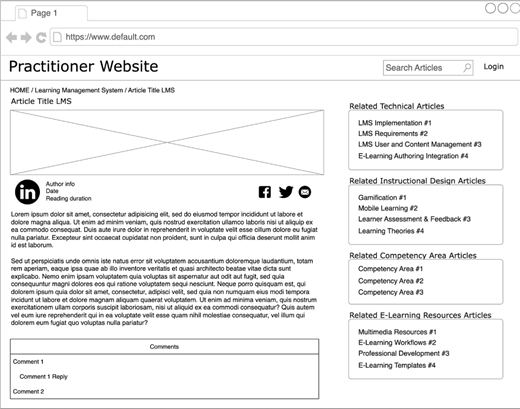
Wireframe of the E-Learning News Outlet
Wireframe of the E-Learning News Outlet
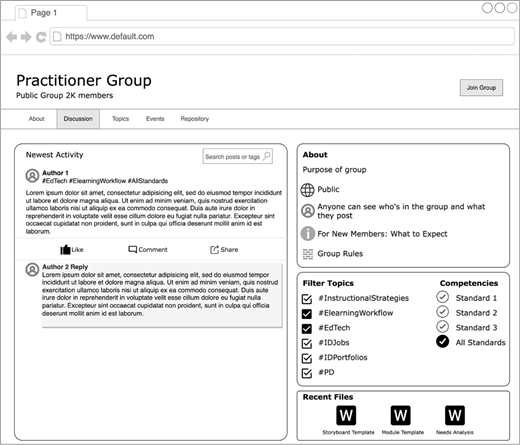
Wireframe of the Instructional Designers Facebook Group
Wireframe of the Instructional Designers Facebook Group
Although online CoPs in IDT on Facebook have a simple search engine function to look for information within the online environment, the fourth design feature involves augmenting the search engine function that ties the topic structures together to give community members a high-level overview of the available practical knowledge by topic or competency category. Future ICTs should increase the search engine functions to allow for high-level overviews of practical knowledge by generating insights from the online CoP from user posts for the fifth design feature.
Conclusion
The studies provided design recommendations for improving online CoPs as information spaces that advance the skills and knowledge of practitioners. The findings of the individual studies can be implemented to enhance online CoPs in IDT within the current limitations of ICTs based on Web 2.0 technologies. Currently, the online CoPs in IDT can improve various mechanisms for organizing their organizational knowledge capital based on the topic structures discovered through topic modeling, including explicit statements for addressing misconceptions and evaluating the quality of codified knowledge produced by IDT practitioners. The future generation of ICTs can support members in monitoring the exchange of practical knowledge by integrating NLP pipelines that digest users‚ textual sources. At the same time, community leaders will benefit from the future generation of ICTs by observing the generation and exchange of practical knowledge at the administrative level and enable them to take appropriate actions to advance the skills and expertise of IDT practitioners.
Research is still needed to inform community leaders, software developers, and providers of PD about (a) additional characteristics of community members‚ exchange of practical knowledge in asynchronous online environments, (b) the evolution of topic patterns over time as a critical indicator of online CoPs‚ priorities, and (c) the prototyping NLP dashboards to sustain knowledge creation processes. As community members exchange practical knowledge, future research can focus on the additional characteristics of codified knowledge through sentiment analysis of topic patterns to discover the challenging aspects of IDT practice. While web technologies enable the rapid creation of online CoPs using different platforms, the future direction of this research includes the development of a comprehensive entity dictionary from the first two studies to investigate other public online CoPs, such as Reddit, Quora, Twitter, and LinkedIn. As current platforms evolve and new ones emerge, further investigating the exchange of practical knowledge through rhetorical and linguistic analyses will inform fellow scholars and stakeholders about how these platforms facilitate or hinder community members. Although community dashboards are not currently integrated into Web 2.0 technologies, this line of research affords the testing of community dashboards using NLP pipelines to assist online CoPs with quantifying the accumulated practical knowledge and facilitating self-directed learning among community members. The topic models generated in these dashboards can be shared as an open-source project in Streamlit or Dash to support the future development of ICTs, providing better support for online CoPs as information spaces.

