


Youth early work experiences and experiences of underemployment are typically framed as problems of skills mismatch or labour market inefficiency. This study examines how young people experience work under these conditions and what these experiences reveal about organizational inclusion and employer readiness. In doing so, the findings in this study reframe underemployment as a relational and developmental issue rather than solely an economic one.
The study adopts a youth participatory action research (YPAR) design combined with interpretive phenomenological analysis (IPA). Data are drawn from 30 qualitative interviews with youth, aged 15–21, conducted in Atlantic Canada between fall 2024 and winter 2025 by 10 youth peer researchers also aged 15–21. Youth acted as both researchers and participants, generating emic insight into lived experiences of work, precarity and organizational inclusion.
Findings position work as a critical developmental space in which identity, agency and engagement are actively shaped. While youth demonstrate motivation and competence, they encounter workplaces that are insufficiently prepared to support them as developing workers. Underemployment is experienced not only through limited hours or wages but also through a lack of recognition, mentorship, progression and voice. Youth frequently assume informal leadership responsibilities without corresponding authority or support, reinforcing patterns of invisible labour and constrained inclusion.
This study contributes to equality, diversity and inclusion scholarship by foregrounding age as an underexamined dimension of workplace inequality and by reconceptualizing underemployment as a failure of organizational readiness rather than an individual deficit. Further, it advances the notion of work as a fragile developmental space. Finally, methodologically, it demonstrates the value of YPAR and IPA for studying work and inequality. The findings highlight the need to move beyond job provision towards organizational practices that meaningfully include young workers.
1. Introduction: youth, work and developmental stakes
This study was inspired by labour market trends in Canada which report ongoing, and in some cases, decreasing labour force participation rates in youth ages 15+ (Storring, 2023). Regular news reports highlight decreasing job rates (Benchetrit, 2024a, c, 2025) and decreasing summer job opportunities (Benchetrit, 2024b; Staff, 2025). The youth we spoke to cite both difficulty finding and keeping a job and insufficient support and development opportunities in the workplace. This phenomenon is compounded by the lasting impacts of the COVID-19 pandemic, which essentially put lives on hold and disproportionately affected youth who experienced both education and work disruptions and corresponding learning losses (Mahboubi and Higazy, 2022). The research question guiding this study is How do youth experience work, in conditions of underemployment, and what does this reveal about employer readiness and organizational inclusion?
Despite sustained attention to youth employment, existing approaches remain anchored in assumptions of youth deficit and labour market mismatch. Rising rates of youth unemployment have renewed attention to the quality of young people's work experiences. While unemployment determines whether young people access work, underemployment shapes what those early work experiences become. This study focuses on the latter. Work for youth is not merely an economic consideration, but equally a developmental one. Additionally, the empirical data in this study challenge the taken for granted perspective that readiness is lacking in youth and reveals a deficiency at the organizational level that requires further investigation and potential investment. Intervention strategies related to youth readiness though heavily relied upon for decades are not resolving the issue of youth employment. Focus on organizational readiness may be one way to improve these interventions and we suggest interventions designed and informed by youth perspectives. Organizational readiness includes promoting more inclusive practices where youth are concerned, understanding the competitive demands upon them for their time and energy and supporting youth by valuing their contributions and fostering their development.
In this study, we also expand the application of youth participatory action research (YPAR) in management and organizational studies (MOS) and explain its benefits and potential. We employ YPAR (Anderson, 2020; Malorni et al., 2022; Mathikithel and Wood, 2019; Williams, 2024; Williams and Mian, 2025) to gather youth perspectives on early work experience and underemployment. We combine YPAR with interpretive phenomenological analysis (IPA) (Smith, 2019; Smith and Osborn, 2004, 2008, 2015; Williams, 2024, Williams and Mian, 2025) to surface youth voice and analyse lived experience. Through a model of YPAR combined with IPA, we explore the how engaging youth in research not only results in rich data but also provides a transformative opportunity for youth, contributing to their positive development.
Therefore, this paper makes two primary contributions. First, it reconceptualizes youth underemployment as a relational and developmental phenomenon rooted in organizational inclusion rather than individual deficit. Second, this study makes a methodological contribution by demonstrating how YPAR, combined with IPA, functions as more than a participatory research strategy. Rather than simply generating rich qualitative data, this approach positions youth as active contributors to knowledge production, enabling theoretically meaningful insights into organizational life, workplace inclusion and underemployment that may remain less visible through conventional researcher-led approaches.
Our study is an exploratory, phenomenological study using qualitative data collected in fall 2024 and winter 2025. Data in this study are informed by 30 interviews with young people aged 15–21, conducted by 10 youth researchers, also aged 15 and 21. Both participants and researchers live in Atlantic Canada (see Data Table 1: Participant List). Each participant has been provided with a pseudonym to protect their identity [1].
Participant list
| Interviewer | Pseudonym |
|---|---|
| Parker | |
| PHEMP1M | Eric |
| PHADP2F | Michelle |
| PHJRP3M | Karim |
| Harry | |
| HFBSP1M | Tariq |
| HFDGP2F | Chelsey |
| HFJBP3M | Nate |
| Mason | |
| MKICP1F | Divya |
| MKOCP2F | Emma |
| MKCMP3M | Elijah |
| Eric | |
| ESCMP1M | Arran |
| ESCBP2M | Harris |
| ESHBP3M | Cameron |
| Sophia | |
| SDEMP1F | Dana |
| SDKPP2F | Emma |
| SDAMP3M | Alasdair |
| Riley | |
| RADHP1M | Craig |
| RAGPP2F | Sarah |
| RAAWP3F | Lena |
| Maddie | |
| MQJKP1F | Sophia |
| MQFCP2M | Marek |
| MQERP3F | Isabella |
| Peighton | |
| PMRMP1M | Callum |
| PMDSP2F | Ursula |
| PMDJP3M | Francesco |
| Carly | |
| CFRLP1F | Charlotte |
| CFBBP2F | Rory |
| CFMSP3F | Claire |
| Becca | |
| BMDMP1M | John |
| BMLMP2F | Eleanor |
| BMGMP3F | Camila |
This study was conducted within the Student Research Lab, a youth-led research program in which high school students participate as peer researchers. The Lab provides both the organizational setting for the research and a sustained environment in which youth are trained to conduct interviews, participate in qualitative analysis and contribute to knowledge production. This peer-research model enabled youth to interview other young people about their experiences of work and underemployment, generating rich emic insights that underpin the analysis presented in this paper.
In the following sections, we share insights from the extant literature on youth employment in Canada to situate our study in the landscape of youth early work experience and underemployment in Canada (and Atlantic Canada, specifically). Our literature examination traverses several themes which also serve as theoretical entry points: (1) history of interventions and supports for youth access to work, (2) historical persistence of youth labour market instability, (3) youth work as a developmental opportunity and site of identity formation, (4) structural and experiential accounts of underemployment and precarity and (5) work as a convergent or fractured developmental site. We continue this primer with a detailed introduction to the context of our research by elaborating on the purpose of the Student Research Lab as a longitudinal, youth-driven research program employing a novel model of YPAR. As a methodological primer, we engage with the literature on YPAR and IPA to illustrate how our study is conversing with these methods of data collection and analysis. We then present our findings and analysis, which is organized across six themes: (1) work as a developmental opportunity, (2) precarity as a normalized entry condition, (3) converging motivations for working, (4) employer readiness and the limits of inclusion, (5) informal leadership and invisible labour and (6) time poverty and competing engagements. Our discussion examines insights in further depth and considers implications and contributions. We specifically raise three important considerations underpinning on contribution claims: (1) underemployment as developmental misalignment, not just labour inefficiency, (2) employer readiness as a missing variable in youth employment discourse and finally (3) work as a fragile engagement space. We conclude with our theoretical and methodological contributions, and with insights for employers. Finally, we convey our thoughts on the future research.
2. Entering the scholarly conversation
2.1 History of interventions and supports for youth access to work
In conducting our literature review, which also included a scan of news and government reports, we surfaced a longstanding commitment by government and stakeholders to both investigate and support youth access to work opportunities. Dating back to the 1930s, we found evidence of government intervention on work readiness for youth, including facilitating training, offering vocational placements and liaising with youth-facing organizations (Globe Staff, 1936). Youth being unable to find work appears to be nothing new. In the 1990s, news reports indicate that youth felt that they needed to leave their home province (often travelling west) to find suitable work and investigations cite a historic problem dating back to the 1970s (Flinn, 1994; Thiessen and Looker, 1999). We were able to trace a continuous history related to youth access to work. In the last 2 decades, the federal and provincial governments in Canada have routinely invested in youth programs designed to facilitate transitions to work, employment opportunities and training with apparent little effect on employment rates (Dinshaw, 2016; Kerr, 2009; MacKay and Finley, 2012; Staff, 2018, 2019; Yelich, 2007). The prospect of youth employment is even more complex for certain groups, including immigrant and racialized youth (Akbari, 2013a, b), youth with disabilities (Bowman et al., 2024; Jetha et al., 2019) and 2SLGBTQ + youth (Government of Canada, n.d.).
2.2 Historical persistence of youth labour market instability
Youth unemployment and underemployment have long been persistent features of labour markets rather than temporary or exceptional disruptions. Historical research consistently shows that young people experience higher unemployment rates, greater exposure to non-standard work and more fragmented employment trajectories than older workers, even during periods of economic growth (Furlong and Kelly, 2005; Ryan, 2001). Early labour market entry has routinely been characterized by temporary contracts, part-time hours, low wages and concentration in service-sector employment, with conditions often framed as transitional or developmental (Kalleberg, 2009; OECD, 2016). In the Canadian context, scholars have documented the durability of these patterns across decades, noting that policy interventions focused on training, credentials and employability have done little to alter structural vulnerability at labour market entry (Lewchuk et al., 2015; Vosko, 2006). The historical persistence of youth labour market instability suggests that unemployment and underemployment are not simply cyclical outcomes of economic downturns or individual deficiencies but are embedded in the organization of work and the stratification of labour markets by age. This study reveals some of the ways that youth experience these patterns and often do not benefit from said interventions; thus, calling into question the focus on youth development and readiness, instead of organizational readiness.
2.3 Youth work as a developmental opportunity and site of identity formation
A growing body of literature conceptualizes youth employment not only as an economic activity but also as a critical developmental opportunity and a formative site of identity construction. Early work experiences have been shown to contribute to youths' social, cognitive and emotional development by providing opportunities to practice responsibility, autonomy and interpersonal skills in consequential settings (Mortimer, 2003; Schoon and Heckhausen, 2019). Within youth employment literature, work is increasingly understood as a context in which young people begin to experiment with possible selves, assess competence and develop a sense of agency and belonging beyond school and family domains (Arnett, 2014; Furlong, 2013). Developmental programs, including work-integrated learning and youth employment initiatives, often draw on this logic by framing work as a pathway for skill acquisition, leadership development and future orientation (OECD, 2016; HUMA, 2018). Identity and leadership scholars further suggest that early opportunities for meaningful contribution, recognition and responsibility support identity coherence and leadership capacity by reinforcing youths' perceptions of themselves as capable and valued actors (Day and Harrison, 2007; Komives et al., 2005). However, this literature also cautions that when work fails to provide developmental scaffolding, recognition or voice, it can undermine confidence and constrain future orientation. These insights position youth work as a powerful developmental site where identity, leadership and aspirations are actively shaped, making the quality of early employment experiences central to understanding youth trajectories.
2.4 Structural and experiential accounts of underemployment and precarity
The literature on youth underemployment and precarity is often divided between structural and experiential accounts. Structural perspectives emphasize macro-level forces such as labour market segmentation, credential inflation, economic restructuring and the expansion of precarious employment, situating youth among a generally defined disadvantaged group, subject to broader political-economic shifts (Kalleberg, 2011; Standing, 2011). These accounts highlight how young workers are systematically channelled into insecure roles and excluded from stable employment pathways, often regardless of skill-level or educational attainment (Arnett, 2014; Tomlinson, 2017). Experiential accounts, by contrast, foreground how youth themselves interpret and navigate insecurity, examining subjective experiences of work, uncertainty and opportunity (Furlong, 2013; Woodman and Wyn, 2015). This body of work reveals how precarity becomes normalized, internalized or strategically managed by young people over time. While structural analyses illuminate the conditions that produce youth underemployment, experiential perspectives reveal how these conditions are lived and meaningfully understood. However, the two traditions are often treated in parallel rather than in dialogue. This study bridges these approaches by using youth narratives to connect macro-level labour structures with everyday organizational practices, showing how underemployment is experienced.
2.5 Work as a convergent or fractured developmental site
By examining youth experiences of underemployment, this paper bridges earlier theorizing from the Student Research Lab (Williams, 2024, 2025; Williams and Mian, 2025) on engagement and empowerment with the material realities of organizational life, revealing how developmental processes identified in prior studies are enacted, or constrained, within workplaces. Positioning work within this framework highlights its dual potential as a site where engagement and empowerment may converge or breakdown. When work provides opportunities for learning, voice, recognition and progression, it mirrors the conditions shown in prior studies in our Lab to support agentic engagement and empowerment, allowing youth to develop confidence, leadership capacity and a sense of belonging. However, when work is characterized by precarity, exclusion or limited developmental support, these same processes are disrupted. Under such conditions, engagement becomes fragile and empowerment is stalled or reversed, despite youth motivation or capability. This study therefore extends youth engagement and empowerment theory by demonstrating that work is not a neutral or uniformly beneficial developmental context, but one shaped by organizational readiness, power relations and age-based inclusion/exclusion. Understanding work as a site of potential convergence or fracture deepens insight into how early employment experiences influence youth trajectories, linking organizational practices to broader patterns of agency, disengagement and inequality over the life course.
3. About the Student Research Lab (research context)
The Student Research Lab was created in response to a persistent tension in youth research: young people are frequently positioned as important objects of inquiry while remaining largely excluded from the processes through which knowledge about their lives is produced, interpreted and mobilized. Despite growing calls for participatory and emancipatory research approaches, much youth research continues to reproduce adult-centric assumptions about expertise, voice and authority (Khawaja et al., 2024; Malorni et al., 2022; Ozer et al., 2013). The Student Research Lab was designed to intervene in this landscape by offering a structured, rigorous and ethically grounded environment in which youth act as co-researchers rather than just respondents.
The Student Research Lab emerged from dissatisfaction with research models that solicit youth perspectives without meaningfully redistributing power. YPAR has long promised to address this imbalance, yet it is often criticized for being under-specified in practice or inconsistently implemented (Cahill, 2016; Cahill et al., 2010; Luguetti et al., 2024; Quijada Cerecer et al., 2013). The Lab was founded to operationalize participatory principles in a sustained, transparent and replicable way, integrating methodological rigor with developmental intention.
At its core, the Lab responds to three interrelated gaps: the lack of authentic youth voice in research informing policy and practice; limited opportunities for youth to engage in high-level, intellectually demanding research; and the absence of structured pathways through which youth can experience research as a viable educational and professional trajectory. The Lab therefore seeks not only to generate knowledge about youth experiences but also to cultivate research capacity, confidence and agency among young people themselves (Williams, 2024, 2025, 2026; Williams and Mian, 2025).
The Student Research Lab is the signature program of a registered charity (Prudentia Institute) dedicated to youth empowerment through research, education and community partnerships. The charity's mission is grounded in the belief that evidence-based insights, when generated with youth rather than about them, can more effectively inform inclusive programs, policies, and practices. The Lab operationalizes this mission by embedding youth-driven inquiry within a broader ecosystem of knowledge mobilization and public scholarship. As an organizational home, the charity provides the Lab with both stability and flexibility. Its charitable mandate enables long-term engagement with youth-serving organizations, schools and funders, while its research orientation ensures that data generated through the Lab meet scholarly standards. This dual positioning, between community engagement and academic research, shapes the Lab's distinctive identity.
The Student Research Lab is hosted at a university in Atlantic Canada (Acadia University), where it operates in close alignment with institutional research priorities while maintaining autonomy over its youth-centred design. All studies are subject to approval through the university's research ethics committee. The university partnership confers legitimacy, access to research infrastructure and exposure to academic culture. For youth participants, conducting research on a university campus demystifies higher education and redefines research as an accessible and meaningful activity. For the Lab, the partnership ensures that youth-generated data are situated within established ethical and scholarly frameworks.
The Student Research Lab is designed for high school students aged 15 to 18, typically enrolled in Grades 11 and 12. Participants are recruited through schools and community networks and are selected by their teachers based on interest, curiosity and readiness to engage in sustained inquiry, rather than prior research experience. Youth enter the Lab not as trainees preparing to assist adult researchers, but as researchers in their own right. The Lab operates as a 14-week program, hosting cohorts weekly. Sessions are held in person, allowing for continuity, trust-building and iterative learning. Each session integrates three core components: research instruction, applied research work and structured reflection.
Core learning covers key concepts related to research design, ethics, data collection and analysis. This allows the youth researchers to navigate all aspects of the research process with increasing confidence. Applied work involves youth directly in ongoing research activities, including data collection, data cleaning, analysis and presentation of findings. Youth manage their own participant recruitment, informed consent and the team develops a joint codebook, reflecting themes arising from the data. Reflection activities provide space to surface questions, challenges and insights. This cyclical structure mirrors the iterative nature of qualitative research and reinforces learning through practice.
During the course of this study, the Lab was also supported by an undergraduate research assistant who served as youth mentor, assisted with data collection and data analysis. In this way, the Lab supports learners of different ages and stages of development. The Lab intentionally cultivates a peer-based learning environment. Youth work collaboratively, learning from one another's perspectives and experiences while developing shared ownership over the research process. This collective orientation reinforces the Lab's commitment to relational knowledge production.
The Student Research Lab is accredited as an approved co-operative education placement for high school credit through the provincial government's department education. This accreditation distinguishes the Lab from traditional research enrichment programs by formally recognizing research as legitimate experiential learning. Unlike most co-operative placements, which emphasize trades or career-specific skill development, the Lab offers youth the opportunity to experience research as a form of intellectual labour. Participants are frequently described as having the experience of “being a graduate student,” engaging in higher order, critical thinking while earning formal educational credit.
A unique feature of the Student Research Lab is the layered and reflexive nature of youth learning and development within the research process itself. Youth do not simply study issues that matter to them; they engage in sustained inquiry into phenomena, such as empowerment, engagement and work. Such subjects are actively shaping their own lives. As youth researchers conduct interviews, analyse data and engage in collective sensemaking, their understanding of these issues evolve. This process fosters a deepening awareness of structural conditions, organizational practices and forms of inclusion and exclusion that they may previously have experienced but not named.
The Lab created a distinctive setting for investigating youth early work experience because the youth researchers were themselves participating in a structured work placement while conducting research about young people's experiences of work. They therefore encountered the phenomenon from multiple positions simultaneously: as young workers developing their own understandings of workplace expectations and relationships, as researchers listening to and interpreting the employment experiences of other young people, and as peers able to compare those accounts with their own emerging experiences. This layered positionality created a unique form of experiential proximity to the research topic. Concepts such as recognition, responsibility, inclusion, mentorship, autonomy and meaningful contribution were not only topics raised in interviews; they were also being encountered and negotiated by the youth researchers through their participation in the Lab and elsewhere. Their interpretations were consequently informed by an ongoing movement between experiencing work, researching work and collectively making sense of what work meant for young people.
In this way, the research process becomes both epistemic and developmental: youth generate knowledge while simultaneously developing critical consciousness, confidence and agency (Williams, 2024; Williams and Mian, 2025). Our approach to YPAR is consistent with other YPAR scholars who view intergenerational, participatory research as an onto-epistemological endeavour. In other words, not just a method, epistemology or intervention, but a process that emphasizes “co-constitution of knowing and being, a knowing-in-being and being-in-knowing” (Barad, 2007 as cited in Albright and Brion-Meisels, 2024, p. 17). The Lab thus functions as a reflexive learning environment in which knowledge production and youth empowerment are mutually constitutive.
To date, there have several research studies conducted in the Lab. However, it is important to note that all studies converse with one another, building on insights from the previous studies and finding inspiration and new areas of inquiry. Previous Student Research Lab studies examined empowerment and engagement among youth (Williams, 2024, 2025; Williams and Mian, 2025). Together these studies established the developmental importance of voice, agency and supportive environments. The present study extends this program of research by examining how these developmental processes unfold within workplaces experiencing underemployment. All studies in the Lab form an intentionally cumulative and dialogic body of work within the Student Research Lab, where each inquiry both emerges from and extends the insights of the last.
4. Methodology: youth participatory action research in practice
YPAR in the Student Research Lab is intentionally designed to be developmental. Youth researchers are positioned not only as data collectors but as co-analysts whose understanding of the research topic evolves through engagement with data, theory and peer dialogue. This layered engagement allows youth to surface emic insights while also developing analytical distance from their own experiences, strengthening both the rigour of the research and the developmental impact of participation.
While the Student Research Lab provides the organizational setting for this research, the methodological contribution of this paper is not the Lab itself. Rather, the contribution lies in demonstrating how YPAR, implemented through a sustained peer-research model and combined with Interpretive Phenomenological Analysis (IPA), can generate rich, emic understandings of youth work and underemployment while simultaneously supporting youth development. The Student Research Lab therefore provides the methodological context within which this YPAR approach is enacted and refined.
Further, this study adopts an interpretivist epistemological orientation that understands knowledge as socially constructed and co-produced through interaction between researchers and participants (Crotty, 1998; Lincoln, 2007). Within this framework, YPAR provides a participatory means of democratizing knowledge production by positioning youth as co-researchers (Cammarota and Fine, 2008; Ozer, 2016), while IPA offers an interpretive analytic approach for understanding how individuals make sense of lived experience (Smith et al., 2022).
4.1 Youth participatory action research as method and intervention
YPAR was selected to centre youth perspectives on work and underemployment while deliberately redistributing epistemic authority to young people as knowledge producers (Cahill, 2016; Khawaja et al., 2024; Ozer et al., 2013). Within this design, youth are not positioned as respondents or assistants, but as peer researchers who actively shape research questions, data collection and interpretation. The participatory structure of the Student Research Lab enabled sustained engagement over a 14-week period, allowing youth to develop research capacity while simultaneously reflecting on issues that directly affect their lives. In this way, YPAR functions not only as a means of accessing emic accounts of youth employment but also as an intervention that supports critical consciousness, confidence and agency among youth researchers themselves (Williams, 2024). This dual orientation is particularly well suited to the study of underemployment, as it foregrounds relational dynamics, power and inclusion that are often obscured in adult-led or extractive research designs.
4.2 Interpretive phenomenological analysis and reflexive youth insight
Data analysis was guided by IPA, which prioritizes close engagement with lived experience and meaning making. In particular, we drew upon the commitments and steps outlined by Smith and Osborn (Smith, 2019; Smith and Osborn, 2004, 2008, 2015). Smith and Osborn describe IPA as an approach which helps explore how “participants make sense of their personal and social words” (Smith and Osborn, 2004, p. 54). In this case, both the youth researchers and the youth participants were sense-makers. Often our participants had not been asked about their thoughts and opinions before, and interviews had an arc of developing depth. Similarly, our youth researchers expanded their understanding of the topic over the course of their interviews and through data analysis.
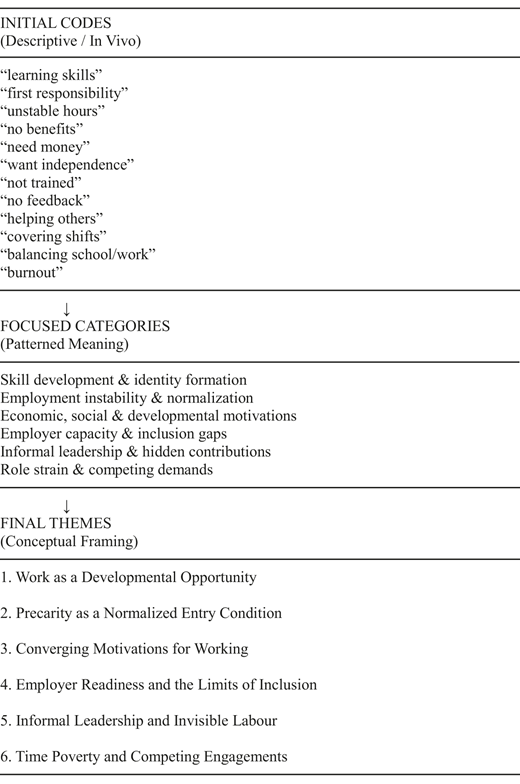
IPA values smaller sample sizes and deep data. The steps outlined by Smith and Osborn and the steps taken herein involved (1) transcribing interviews verbatim, (2) identifying key initial themes, which for us involved developing a shared codebook with descriptive or in vivo codes, definitions and examples, (3) a deductive round of coding followed this inductive phase whereby we intentionally searched for the codes we had found in the other transcripts, (4) then, we connected themes through analytical and theoretical ordering (5) and finally, we organized data for presentation [2]. We used a digital white board to capture our initial themes while both listening to and reading transcripts simultaneously. We paused and discussed frequently. A second stage of analysis involved bringing the youth researchers back together at a later stage when they had spent additional time with their own transcripts. This often resulted in more themes identified and deeper insights. Below, the tables illustrate how we moved from initial codes and examples, to focused categories of analysis, to final themes/codes (see Tables 2 and 3):
Code development
| Initial codes (examples) | Focused categories | Final themes |
|---|---|---|
| Learning skills; gaining confidence; trying different jobs | Skill development; identity formation | Work as a developmental opportunity |
| Unstable hours; no benefits; “this is normal” | Precarity; normalization of insecurity | Precarity as a normalized entry condition |
| Need money; independence; expectations | Economic, social, developmental motivations | Converging motivations for working |
| Poor training; lack of support; no feedback | Employer capacity; limits of inclusion | Employer readiness and the limits of inclusion |
| Helping others; covering shifts; stepping up | Informal leadership; invisible labour | Informal leadership and invisible labour |
| Balancing school/work; burnout; trade-offs | Role strain; competing demands | Time poverty and competing engagements |
Across iterative rounds of coding, youth accounts of work moved from fragmented descriptions of jobs and experiences to a coherent set of themes that position employment not simply as labour market participation, but as a developmental, relational and structurally constrained space of engagement (see Figure 1).
 A flowchart illustrating the process of transforming initial codes into final themes in a youth employment study. The diagram is divided into three main columns: Initial Codes, Focused Categories, and Final Themes. Initial Codes include descriptive or in vivo phrases such as 'learning new skills', 'unstable hours', 'need money', 'not trained properly', 'helping others', and 'balancing school and work'. These codes are grouped into Focused Categories, which are patterned meanings like Skill Development & Identity Formation, Precarity & Normalization of Insecurity, Economic, Social & Developmental Motivations, Employer Capacity & Limits of Inclusion, Informal Leadership & Invisible Labour, and Role Strain & Competing Demands. Arrows indicate the flow from Initial Codes to Focused Categories to Final Themes.
From initial codes to final themes generative AI (ChatGPT, OpenAI) was used to support the visualization of analytic outputs (e.g. figure design). All coding, analysis and interpretation were conducted by the author
A flowchart illustrating the process of transforming initial codes into final themes in a youth employment study. The diagram is divided into three main columns: Initial Codes, Focused Categories, and Final Themes. Initial Codes include descriptive or in vivo phrases such as 'learning new skills', 'unstable hours', 'need money', 'not trained properly', 'helping others', and 'balancing school and work'. These codes are grouped into Focused Categories, which are patterned meanings like Skill Development & Identity Formation, Precarity & Normalization of Insecurity, Economic, Social & Developmental Motivations, Employer Capacity & Limits of Inclusion, Informal Leadership & Invisible Labour, and Role Strain & Competing Demands. Arrows indicate the flow from Initial Codes to Focused Categories to Final Themes.From initial codes to final themes generative AI (ChatGPT, OpenAI) was used to support the visualization of analytic outputs (e.g. figure design). All coding, analysis and interpretation were conducted by the author
It has been our finding in the Student Research Lab that IPA aligns well with the participatory ethos of YPAR. Youth researchers were actively involved in analytic processes, including transcript review, theme development and collective sensemaking, contributing emic insight grounded in their own experiences of work and precarity. Reflexivity was embedded throughout the analytic process through structured reflection, group dialogue and iterative coding, enabling youth to critically examine both participant narratives and their own assumptions. This reflexivity strengthened analytic depth by combining insider understanding with interpretive distance, allowing patterns of developmental opportunity, exclusion and agency to emerge across cases. The integration of YPAR and IPA thus enhanced both methodological rigour and developmental impact, producing findings that are analytically robust while remaining grounded in youth voice.
Importantly, by engaging youth as peer researchers within a sustained developmental environment, the Lab shaped both the research process and the forms of knowledge that emerged. Rather than minimizing researcher influence, this study recognizes that the relationships, shared experiences and the developmental orientation of the Lab informed how participants engaged with the research, the questions that were explored and the interpretations developed through collaborative analysis.
5. Findings and analysis
Youth cite a variety of benefits to work, including personal development, gaining people skills, organizational skills, access to training, creating new social and professional networks, helping create pathways to future work or education and developing financial resources. Youth also acknowledge that work provides access to mentors, allows them to explore leadership behaviours and helps them understand organizational environments and expectations.
Significantly, work contributes to their identity development. Work is seen as an important as academics, athletics and other formative activities where they develop socially, cognitively and behaviourally. As a result, work can positively or negatively affect a young person's sense of self-worth, confidence and competency. Jobs compete with an already cluttered landscape of youth related engagement behaviours and therefore the benefits of work compete with the benefits of school, sports, hobbies, family and other social and formal activities.
Unfortunately, our study also reveals that youth commonly experience discrimination at work. This manifests in the tasks allocated to youth, the way that they are treated, the way that adult counterparts are privileged and the lack of support systems in place. Generally, youth feel prepared for work, and this is in large part because educational systems emphasize job ready skills and training. However, employers are less ready to receive youth as an important and valued part of the labour force, which can negatively impact youth, but also labour attachment.
Youth in this study report that they typically engage in entry-level, part-time and service-oriented work concentrated in sectors such as food service, retail, hospitality, caregiving, recreation and manual labour. These roles are characterized by customer interaction, routine tasks, flexible or irregular scheduling and limited formal authority. While often described as temporary or “starter” jobs, this work requires emotional labour, responsibility for safety and service quality, and the ability to manage competing demands under time pressure. For many young people, such employment represents their primary exposure to organizational life and workplace norms. As a result, these jobs function as critical developmental sites where youth learn how work is structured, how authority is exercised and how inclusion or exclusion is enacted in everyday practice. Understanding the nature of this work is therefore essential to this study, as it shapes youth identity formation, labour attachment and perceptions of fairness, value and belonging at work.
Our analysis revealed six interrelated themes that illuminate how youth experience work under conditions of underemployment. These themes capture work as both a developmental opportunity and a site of constraint, shaped by organizational practices, labour market conditions and age-based power dynamics. Specifically, the findings highlight: (1) work as a developmental opportunity, (2) precarity as a normalized entry condition, (3) converging motivations for working, (4) employer readiness and the limits of inclusion, (5) informal leadership and invisible labour and (6) time poverty and competing engagements. Each theme is elaborated on below through detailed analysis and illustrated using excerpts from the data. By foregrounding first-person accounts, we centre youth voice and lived experience, allowing participants' narratives to reveal how inclusion, agency and inequality are experienced in everyday workplace contexts. For more examples, please see Data Table 4: Illustrative Quotes by Theme.
Illustrative quotes by theme
| Theme | Selected illustrative quotes |
|---|---|
Work as developmental opportunity
|
|
Precarity as a normalized entry condition
|
|
Converging motivations for working
|
|
Employer readiness and the limits of inclusion
|
|
Informal leadership and invisible labour
|
|
Time poverty and competing engagements
|
|
5.1 Work as a developmental opportunity
Youth consistently describe work as a formative developmental space where they acquire practical skills, confidence and a sense of identity. Employment provides opportunities to learn responsibility, time management, communication and problem-solving, often in ways that feel more tangible and consequential than classroom learning. Youth also report that work contributes to identity formation by helping them understand their strengths, preferences and emerging professional selves. Through interactions with coworkers, supervisors and customers, youth begin to see themselves as contributors rather than dependents. Even when work is precarious or entry-level, it is widely experienced as meaningful and influential in shaping self-efficacy, confidence and future aspirations. The following quote captures how youth experience developmental learning, transferability, identity formation and future orientation in one account:
John – Personally, [jobs have] really helped with my work ethic. They've helped me create a lot of good bonds with coworkers and leaders in the different jobs. And when you develop those skills at one job, it makes it a lot easier at the next. Same with professional[ism]: when I gain experience from one certain job, it helps me get to the [next] one. Overall, it just helps me be a better worker in these different environments, especially having all this experience at such a young age.
5.2 Precarity as a normalized entry condition
Youth overwhelmingly describe their initial experiences of work as precarious, characterized by low wages, limited hours, temporary contracts and concentration in service-sector roles. These conditions are largely accepted as the default entry point into the labour market rather than as an exception or injustice. While youth recognize the instability of such work, many frame it as a necessary step towards gaining experience and employability. However, this normalization of precarity also limits expectations for advancement, security or long-term development. As a result, youth learn early to adapt to instability, which may shape both their labour attachment and their understanding of what constitutes “good” or attainable work. The following quote shows patterned movement across precarious roles and how instability becomes normalized rather than contested:
Camila – When I was younger, I worked in a fast-food restaurant … from there, I moved into retail, and then into a sit-down restaurant, and then a hotel. At the foundation of it all, it was customer service, different aspects, but the same intent. It was always entry-level, customer-facing work, just in different places.
5.3 Converging motivations for working
Youth articulate multiple, overlapping motivations for engaging in paid work, including financial necessity, social belonging, skill development and future-oriented goals such as education or career preparation. These motivations are rarely singular; instead, youth describe work as meaningful when several motivations converge. Earning money is important, but satisfaction is often tied to social connection, learning and a sense of purpose. When these motivations align, youth report greater engagement and persistence. Conversely, when work meets only instrumental needs, motivation weakens. These findings suggest to us that youth engagement in work mirrors broader patterns of engagement, where sustained participation depends on the alignment of intrinsic and extrinsic drivers (Williams and Mian, 2025). The following quote demonstrates the shift from purely instrumental motivation to social belonging and enjoyment:
Tariq – I was really opposed to being a dishwasher at first. I was like, “I don’t want to touch people’s forks,” but once I started, I’m genuinely enjoying my job. I enjoy the people I work with, and it’s something I actually look forward to most times.
5.4 Employer readiness and the limits of inclusion
In our study, youth frequently reported that employers are insufficiently prepared to support young workers as learners and developing contributors. Participants describe limited access to mentorship, feedback or clear progression pathways, as well as a lack of recognition for effort, responsibility or initiative. Inclusion is often experienced as superficial, with youth welcomed as labour but not as individuals with developmental needs or perspectives. This contributes to feelings of underutilization and promotes disengagement. Importantly, youth do not describe these limitations as personal failures but as organizational shortcomings. Underemployment is therefore experienced relationally, as a lack of inclusion and support, rather than solely as insufficient hours or pay. The following example clearly illustrates underemployment as relational and age-based rather than skill-based:
Francesco– I feel like I make mostly meaningful contributions—the most I can. But sometimes it does feel like I get treated differently because I’m younger. Like, I’m doing the work, but I don’t always feel like I’m trusted or included the same way.
5.5 Informal leadership and invisible labour
Despite limited formal authority, youth frequently describe taking on leadership responsibilities in the workplace. These include training peers, managing tasks independently, resolving problems and stepping into supervisory roles when needed (even if temporarily). Such leadership is typically informal and situational, emerging from experience rather than formal title. However, these contributions often go unrecognized and are uncompensated, rendering youth leadership largely invisible. This disconnect reinforces feelings of exclusion and undervaluation, even as youth demonstrate agency, confidence and competence. Our findings suggest that youth are already practicing leadership in organizational settings, but that workplaces often lack the structures or willingness to acknowledge and develop this potential meaningfully. The following example illustrates leadership without authority (and responsibility without recognition):
Claire – Sometimes at work, I don’t take an actual leadership or management position, but I’ve had experiences where I have to step up because I’m the most experienced person. I can tell people what to do, where to go—just because someone has to.
5.6 Time poverty and competing engagements
Youth describe chronic time scarcity (i.e. time poverty) as a defining feature of their working lives. Employment is layered onto already demanding schedules that include school, co-op placements, volunteering, extracurricular activities and family and social responsibilities. Managing these overlapping commitments requires constant trade-offs, often at the expense of rest, social experiences or deeper engagement in any single domain. While work provides benefits, it also competes with other developmental opportunities. Youth experience underemployment alongside overextension, challenging assumptions that limited hours equate to ample free time. Time poverty thus emerges as a structural condition shaping how youth experience work, engagement and wellbeing. This final example captures both agency and constraint, showing how time poverty is lived and experienced:
Rory – I get asked a lot how I handle school and work and home and friends, and people think it’s really difficult. I feel like I personally like working because it keeps me busy, but it’s really just school, work, and home. There isn’t much time for anything else.
These findings illustrate that youth experience work as a consequential developmental space shaped by both opportunity and constraint. While employment supports skill development, confidence and emerging identity, these benefits are tempered by normalized precarity, limited employer readiness and chronic time scarcity. Youth demonstrate agency and leadership in their workplaces, often without formal recognition or support and navigate competing demands across school, work and other forms of engagement. Underemployment is therefore experienced not only as an economic condition but as a relational and organizational one, reflecting the degree to which youth are meaningfully included, supported and valued within workplace contexts.
6. Discussion: rethinking youth underemployment
This discussion develops the two principal contributions of this study. The first is theoretical: we argue that youth underemployment is better understood as a relational and developmental phenomenon rather than simply an economic or labour market condition. The three sections that follow elaborate on this argument by considering underemployment as developmental misalignment, examining employer readiness as a missing organizational variable and conceptualizing work as a fragile engagement space. These perspectives offer a more holistic understanding of how organizational practices shape young people's early work experiences.
The discussion concludes by considering the methodological contribution of the study and what YPAR contributes to employment research. Although the Student Research Lab provides the organizational context for this study, the methodological significance lies in demonstrating how a sustained YPAR approach enabled youth researchers to identify relational dimensions of underemployment, including recognition, belonging, invisible labour and employer readiness, which may have remained less visible through conventional researcher-led approaches.
6.1 Underemployment as developmental misalignment, not just labour inefficiency
Our findings suggest that youth underemployment is best understood not merely as a problem of labour market inefficiency or skills mismatch, but as a form of developmental misalignment between young workers and organizational contexts. Youth in this study consistently described work as a meaningful site for learning, identity formation and emerging leadership, yet reported limited access to mentorship, recognition, voice and progression, conditions necessary for developmental engagement. Underemployment therefore manifests as a misfit between youths' readiness to grow and contribute and organizations' capacity or willingness to support that development. This misalignment is reinforced by normalized precarity, age-based power asymmetries and employer practices that prioritize short-term labour extraction over long-term cultivation of talent. Importantly, youth did not describe their experiences as a lack of motivation or competence, but as being underutilized, insufficiently trusted and excluded from meaningful participation. Conceptualizing underemployment in this way shifts analytic attention from individual deficits and labour market statistics to relational and organizational dynamics, highlighting how early workplace experiences can either scaffold development or prematurely constrain youth trajectories.
A common interpretation of youth underemployment locates the problem in labour market inefficiencies or individual human capital deficits, emphasizing insufficient experience, skills or job matching as transitional and largely inevitable features of early employment (Benchetrit, 2024b, c, 2025; Staff, 2018; Storring, 2023). From this perspective, underemployment is expected to resolve as youth accumulate credentials and experience. While such explanations account for structural labour conditions and the early-career positioning of young workers, they do not adequately capture the relational and developmental dimensions evident in our data. Youth in this study routinely demonstrated competence, responsibility and initiative, often assuming informal leadership roles, yet remained excluded from recognition, mentorship and progression opportunities. These experiences cannot be explained solely by skills gaps or temporary mismatch. Instead, they point to organizational practices and age-based assumptions that limit developmental inclusion regardless of youth capability. By foregrounding youth narratives, this study reveals that underemployment persists not simply because youth lack readiness, but because workplaces are insufficiently structured to receive young workers as developing contributors. Recognizing this distinction reconceptualizes underemployment as an organizational and developmental issue, rather than an inevitable or benign stage of early labour market entry.
6.2 Employer readiness as a missing variable in youth employment discourse
The findings of this study suggest that employer readiness represents a largely overlooked variable in the dominant youth employment discourse. While policy, educational and organizational interventions have historically emphasized preparing young people for work, far less attention has been given to whether workplaces themselves are prepared to receive youth as developing workers. Youth in this study consistently described organizational environments characterized by limited mentorship, unclear expectations, constrained voice and a lack of developmental pathways, despite demonstrating motivation, competence and willingness to learn. These conditions signal not an absence of youth readiness, but a deficit in employer readiness to support age-diverse workforces. Employer readiness, as evidenced in the data, extend beyond basic supervision or compliance and includes the capacity to provide guidance, recognition, trust and opportunities for progression appropriate to early career stages. By omitting employer readiness from analytic and policy frameworks, youth underemployment is misdiagnosed as an individual or transitional problem rather than a relational one embedded in organizational practices. Re-centring employer readiness shifts responsibility towards workplaces as active agents in shaping youth labour market outcomes and opens new avenues for research and intervention focused on organizational inclusion, developmental design and age-based equality.
Dominant youth employment policy discourse continues to frame underemployment primarily through the lenses of employability, skills acquisition and labour market participation, reinforcing the assumption that improved outcomes depend largely on enhancing individual readiness (Employment and Social Development Canada, 2018, 2019, 2023; Government of Canada, 2022; Statistics Canada, 2023; Organization for Economic Co-operation and Development, 2020). As a result, policy interventions tend to prioritize training programs, job placement incentives and participation metrics, while paying comparatively little attention to the quality of workplace experiences or the developmental conditions youth encounter once employed. The findings of this study expose a disconnect between these policy assumptions and lived realities of work, where youth report being underutilized, insufficiently supported and excluded from meaningful progression despite meeting or exceeding expectations of readiness. By treating underemployment as a transitional inefficiency rather than a relational and organizational problem, policy frameworks obscure the role of employer practices in shaping youth outcomes and inadvertently normalize precarious, low-development work as an acceptable entry condition. This narrow policy trapping limits both diagnostic clarity and intervention effectiveness, suggesting the need for a reorientation towards policies that foreground job quality, developmental inclusion and employer accountability alongside employment access. More fundamentally, the findings also suggest that employer readiness is often treated as optional rather than constitutive of good employment practice. This assumption shifts responsibility for successful labour market integration onto young workers while rendering organizational responsibilities for mentoring, recognition and development comparatively invisible.
6.3 Work as a fragile engagement space
The findings of this study also position work as a fragile engagement space in which youth agency and empowerment are actively produced, sustained or undermined through everyday organizational practices. Youth consistently described employment as meaningful. It is an opportunity and site for learning, contribution, social connection and recognition, conditions that align with agentic forms of engagement identified in prior youth studies. Under these conditions, work functions as a site where confidence, competence and future orientation are reinforced. However, the same settings quickly become disengaging when youth encounter exclusion, lack of trust or limited voice, illustrating how engagement at work is contingent rather than guaranteed. Unlike other youth engagement domains, such as education or organized extracurricular activities, workplace engagement is less protected, more hierarchical and more exposed to power asymmetries, making it particularly vulnerable to erosion.
This fragility has important implications for youth agency. When work environments fail to acknowledge youth contributions or provide developmental scaffolding, youth do not simply disengage from a job; they recalibrate expectations about work, authority and their own capacity to influence organizational outcomes. Several participants described adapting to these conditions by narrowing effort, disengaging emotionally or treating work as purely instrumental, even when they initially sought growth and responsibility. In this way, eroded engagement can constrain the very agency that youth employment policies aim to cultivate. Conversely, even modest forms of recognition, mentorship or trust were shown to have outsized positive effects, enabling youth to exercise voice, assume informal leadership and envision themselves as capable contributors. Conceptualizing work as a fragile engagement space thus highlights the high developmental stakes of early employment and underscores how organizational inclusion, rather than job availability alone, shapes whether work becomes empowering or corrosive to youth agency. The fragility of youth engagement therefore reflects more than individual uncertainty; it reveals organizational arrangements that normalize limited investment in young workers while simultaneously expecting commitment, adaptability and resilience from them.
These findings reconceptualize youth underemployment as a relational, organizational and developmental phenomenon rather than a temporary labour market inefficiency or individual deficit. Across the findings, youth work emerges as a high-stakes developmental context in which engagement, agency and identity are actively shaped by organizational readiness, policy assumptions and everyday workplace practices. Youth in this study demonstrated motivation, competence and leadership capacity, yet encountered environments ill-equipped to support their development, resulting in underemployment experienced as underutilization, exclusion and constrained growth. By foregrounding employer readiness as a missing variable and critiquing policy frameworks that prioritize employability and participation metrics over job quality, this analysis shifts responsibility from youth adaptation to organizational readiness and systemic design. Conceptualizing work as a fragile engagement space further highlights how early employment can either scaffold empowerment or erode agency, with lasting implications for youth development and labour attachment. These insights call for a reorientation of youth employment research, policy and practice towards developmental inclusion, organizational accountability and an accounting to the lived realities of youth experience at work.
Beyond documenting experiences of underemployment, the findings also invite a more critical reading of how age-based inequalities are reproduced within organizational life. Rather than viewing underemployment as the consequence of individual deficits in skills, motivation or employability, participants' accounts reveal how organizational assumptions about youth shape access to recognition, developmental opportunities and meaningful work. In this sense, age operates not simply as a demographic characteristic but as an organizing principle through which expectations, responsibilities and opportunities are differentially allocated. Organizational practices that normalize limited investment in young workers, overlook their contributions or position them as perpetually inexperienced, contribute to the reproduction of workplace inequalities while simultaneously obscuring organizational responsibility for youth development.
These findings further suggest that youth underemployment is not simply experienced through organizational practices but is actively produced and normalized by them. Participants' accounts challenge taken-for-granted assumptions that position employability as an individual responsibility while leaving organizational responsibility for youth development largely unquestioned. Organizational practices that limit recognition, normalize precarious developmental opportunities and treat mentorship as discretionary, reproduce age-based inequalities while simultaneously presenting these arrangements as natural features of early career employment. Rather than reflecting deficiencies in young workers themselves, the findings suggest that organizational understandings of age, competence and career progression privilege established workers while constraining opportunities for young people to be recognized as developing organizational contributors.
6.4 Practical insights
If underemployment is understood as a failure of organizational readiness rather than individual readiness, then organizational practice must become the primary site of intervention. The findings from this study point to several practical ways employers can better support, develop and include young workers. These strategies are not intended to lower expectations of youth, but rather to recognize them as capable organizational contributors whose development is shaped by intentional inclusion, recognition and support. In this way, the recommendations translate the study's findings into concrete organizational practices that operationalize employer readiness. They also reflect the action-oriented principles of YPAR, demonstrating how youth-generated knowledge can inform meaningful organizational change.
6.4.1 Treat youth as developing workers, not just entry-level labour
Young people benefit when employers recognize that early jobs are formative. Clear expectations, regular check-ins and opportunities to learn, help youth build confidence, skills and long-term attachment to work.
6.4.2 Provide mentorship and guidance
Access to supportive supervisors or mentors makes a significant difference. Even informal mentoring, such as answering questions, offering feedback and explaining workplace norms, helps youth feel valued and supported.
6.4.3 Recognize contributions and informal leadership
Youth often take on responsibility, train peers or solve problems without formal titles. Acknowledging these contributions through feedback, trust or progression opportunities increases engagement and motivation.
6.4.4 Create pathways for growth and progression
Youth are more engaged when they can see how effort leads to opportunity. Clear pathways, such as added responsibility, skill development or future roles, signal that youth contributions matter.
6.4.5 Include youth voice in everyday decisions
Inviting youth input on scheduling, tasks or workplace improvements builds trust and inclusion. Feeling heard reinforces confidence and strengthens commitment.
6.4.6 Be mindful of competing demands on youth time
Many young people balance work with school, co-op placements, other formative activities and family responsibilities. Flexible scheduling and realistic expectations help reduce stress and support wellbeing.
6.4.7 Challenge age-based assumptions
Avoid assumptions that youth are less capable or less committed. Treating young workers with the same respect as others fosters inclusion and unlocks potential.
These recommendations highlight the need to move beyond viewing youth as entry-level labour towards recognizing work as a developmental space. Supporting young workers is not about lowering expectations, but about organizational readiness; providing structure, guidance, recognition and opportunities for growth. When employers invest in these conditions, they not only strengthen youth engagement but also build more inclusive and effective workplaces.
6.5 Methodological insights
The findings also highlight the methodological value of youth participatory action research for employment scholarship. Many of the relational dimensions of underemployment identified in this study, including recognition, belonging, invisible labour, employer readiness and developmental opportunity, are not readily captured through conventional labour market indicators or researcher-led inquiry alone. By positioning young people as peer researchers throughout data collection and analysis, YPAR generated nuanced emic accounts of work that revealed how organizational inclusion is experienced in everyday workplace contexts. The methodological contribution of this study therefore lies not simply in applying YPAR to employment research, but in demonstrating how youth-led inquiry functions as a distinct mode of knowledge production. By positioning young people as co-researchers rather than research participants alone, YPAR enabled the development of theoretical insights into underemployment and organizational inclusion that extend beyond what conventional researcher-led approaches typically reveal.
The developmental orientation of the Student Research Lab also has important methodological implications. Rather than functioning as a neutral setting for data collection, the Lab constituted a relational research environment in which trust, shared experience and ongoing researcher development shaped both the production and interpretation of knowledge. The peer-to-peer relationships fostered through this environment likely enabled participants to articulate experiences of work, exclusion and organizational inequality that may have remained less visible in more conventional adult-led, researcher–participant relationships. At the same time, collaborative analysis encouraged youth researchers to critically interrogate their own assumptions while co-constructing interpretations of the data. The methodological contribution of this study therefore extends beyond the application of YPAR itself to demonstrate how developmental research environments can shape the kinds of organizational knowledge that become possible, thus demonstrating that developmental research environments are not merely settings in which qualitative inquiry occurs, but methodological conditions that actively shape what organizational phenomena become visible.
7. Conclusion
7.1 Theoretical and methodological contributions
This study makes two primary contributions to scholarship on youth employment, organizational studies and labour research. First, it reconceptualizes youth underemployment as a relational and developmental phenomenon rather than simply a problem of labour market inefficiency or individual readiness. By foregrounding youth perspectives, the study demonstrates that underemployment reflects not only labour market precarity but also the normalization of age-based organizational inequalities that shape whose contributions are recognized, developed and valued. By situating work as a developmental space, the study demonstrates how young people's agency, identity formation and leadership development are shaped through everyday organizational practices, employer readiness and age-based power relations. Underemployment therefore emerges not merely as economic insufficiency, but as a failure of organizations to meaningfully include, recognize, mentor and develop young workers. This reconceptualization shifts analytical attention away from conventional measures such as hours worked, wages and job match towards the relational quality of youth workplace experiences, illuminating age as an underexamined dimension of workplace inequality.
Second, the study advances YPAR as a rigorous methodological approach for labour and employment research. By integrating YPAR with IPA, the study demonstrates how youth-led inquiry generates rich emic insights into work, precarity and organizational inclusion that are difficult to access through conventional adult/researcher-led approaches. Beyond its participatory design, YPAR functions as a distinct mode of knowledge production by positioning young people as active contributors to theorizing organizational life. In doing so, the approach generates theoretical insights into workplace inclusion, underemployment and organizational inequality that may otherwise remain obscured. At the same time, the research process functions as a developmental intervention, enabling youth researchers to deepen their own critical understanding of work and inequality while contributing to scholarly knowledge. Consequently, this study positions YPAR not only as an ethical and participatory methodology but as a theoretically generative approach capable of reshaping how labour and organizational scholars understand youth underemployment, organizational inclusion and youth voice.
7.2 Practical implications
The findings of this study carry important implications for employers, policymakers and educators concerned with youth employment and inclusion. For employers, the results highlight the need to move beyond entry-level job provision towards intentional developmental practices, including structured mentorship, meaningful feedback, recognition of informal leadership and visible pathways for progression. Youth in this study demonstrate competence, responsibility and initiative, yet frequently experience underemployment as a lack of trust, inclusion and growth rather than insufficient skill.
For policymakers, the findings suggest that prevailing youth employment strategies focused primarily on job creation and participation rates are insufficient. Measures of success must extend beyond employment metrics to include indicators of job quality, developmental opportunity and organizational readiness to support young workers.
Finally, for educators and those designing work-integrated learning, the study underscores the importance of aligning educational expectations with the realities of youth workplaces. Preparing youth for work without addressing the conditions they encounter risks reinforcing a readiness mismatch. Stronger partnerships between educators, employers and youth are needed to ensure that work-integrated learning environments function as genuine developmental spaces rather than sites of premature precarity.
7.3 Future research and final thoughts
This study underscores that youth employment carries significant developmental stakes, shaping identity, confidence, agency and long-term labour attachment during a formative life stage. When work functions as a site of inclusion, recognition and learning, it can foster positive development; when it does not, it risks entrenching precarity, exclusion and disengagement. Future research would benefit from longitudinal and comparative analyses that trace how early experiences of underemployment shape youth identity, labour attachment and perceptions of organizational inclusion over time. Greater attention should also be given to employer readiness by examining how organizational structures, supervisory practices and age-based assumptions enable or constrain young people's development at work. While the present study intentionally privileges youth voices to understand how underemployment is experienced by young workers themselves, future research could bring these perspectives into dialogue with those of employers to identify areas of alignment and tension surrounding mentorship, inclusion, organizational readiness and youth development. Such work would deepen scholarly understanding of the organizational conditions that support meaningful and sustainable youth employment. Finally, youth-led and participatory approaches offer important opportunities to examine how young people themselves conceptualize “good work”, career progression, and fairness, generating critical insights into how employment systems might be reimagined to better support equitable and developmental transitions into working life. Reconceptualizing youth employment in this way positions early work experiences not as a marginal stage of labour market participation, but as a critical organizational site where inclusion, inequality and future employment trajectories are actively produced.
Our final thoughts turn to The Student Research Lab, which operates as a layered developmental space in which youth engage with issues that simultaneously affect them as research subjects and as emerging workers, students and citizens. Through participation in youth participatory action research, youth researchers move from experiential familiarity with issues such as underemployment and inclusion to a more critical and structured understanding of how these phenomena are produced and sustained within organizational and social systems. As their analytic capacity grows, youth increasingly recognize patterns of inequality, power and exclusion, both in the accounts of their peers and in their own lived experiences. This reflexive process contributes to youth empowerment by enabling young people to articulate, interpret and challenge conditions that shape their opportunities and trajectories.
Situated within this context, the Student Research Lab offers more than a single empirical contribution, it operates as a longitudinal knowledge infrastructure through which youth experiences of work, empowerment, engagement and advocacy can be examined over time and across interconnected domains. By sustaining youth-led inquiry across multiple studies, the Lab enables cumulative theorizing that captures how developmental trajectories unfold, intersect and respond to changing social and labour conditions. The next phase of research builds directly on these foundations by advancing youth-led investigations into advocacy, activism and systems change, with a particular focus on how young people translate workplace experiences into voice, action and collective responsibility (Williams, 2026). Future research will continue to foreground youth as knowledge producers, deepening our understanding of how organizational, educational and policy environments can either support or constrain youth development across the transition to adulthood.
The author would like to thank the 2024-2025 cohorts in the Student Research Lab: Mason Knickle, Parker Haggerty, Sophia Dunham, Harry Fox, Riley Aalders, Eric Swinamer, Carly Forsythe, Peighton Mahar and Maddie Quirk. The author also extends her gratitude to their teachers Mike Smith, Jen Hall, Donald Beck, Amber Langille, Sean Connolly, Rebekah Wheadon, Whitney Vanblarcom, Karen Corbin. The author is especially grateful for the ongoing support of Kim Duncan and Andrew Seymore. A special thank you is owed to Rebecca Mian for serving as research assistant and youth near peer-mentor. The author acknowledges and expresses gratitude to the following community partners: Acadia University, the FC Manning School of Business, LaunchBox Acadia, the Annapolis Valley Regional Centre for Education and the Nova Scotia Department of Education and Early Childhood Development.
Notes
Pseudonyms correspond to gender identity and ethnicity.
As part of the experience in the Lab, youth present their findings to their peers and teachers, in the format of a mini academic conference. They also prepare Instagram posts to help with knowledge mobilization to their peer groups. Examples of these have been provided in other published articles.

