This study investigates the influence of sustainable HRM practices on sustained collaborative efforts and employees' psychological contracts (PC).
The study is empirical, based on primary data collected through a structured questionnaire. The sample consists of 260 doctors and nurses from private hospitals in Bangalore, India, selected using a stratified sampling technique. The statistical methods employed include regression analysis, correlation, and structural equation modeling.
The study reveals a significant relationship between sustainable HRM practices and both sustained collaborative efforts and psychological contracts. Furthermore, sustainable HRM practices act as a mediators in this relationship, reinforcing the importance of HRM in fostering collaboration and strengthening psychological contracts.
The study is limited to private hospitals and focuses on doctors and nurses, which may restrict the generalizability of the findings to other industries and locations. Future research can expand the scope by including diverse sectors and geographical areas to enhance applicability.
The findings provide valuable insights for HR professionals and hospital administrators, emphasizing the role of sustainable HRM practices in enhancing teamwork and reinforcing employees' psychological contracts. Implementing these practices can lead to improved employee retention, job satisfaction, and overall organizational effectiveness.
The study carries important social implications by highlighting how sustainable HRM practices and strong psychological contracts can enhance the well-being, morale, and long-term commitment of healthcare professionals. By fostering trust, fairness, and collaboration, organizations can reduce burnout and turnover, leading to more stable and supportive care environments for patients and communities. Strengthening these people-centric practices contributes to a healthier workforce, improved service quality, and ultimately a more resilient healthcare system that better meets societal needs.
This study contributes to the existing literature on sustainable HRM by empirically demonstrating its mediating role between sustained collaborative efforts and psychological contracts. The findings offer a novel perspective on how HRM strategies can drive long-term workforce sustainability in dynamic and uncertain environments.
Introduction
The dynamic uncertain global business environment with its fast-paced technological advancements has transfused disruptive innovations in work practices and HRM systems. The HR domain has been facing immense challenges to remain sustainable over the last few decades, mandating transitions, and innovations. The healthcare industry is experiencing a revolution like never before, driven by changes in patient demands, demographics, and technology (Siegel, 2024). Sustainability in terms of human resources and HR practices has recently been a much contemporary issue. Robust transformations and disruptive innovations in HRM practices and strategic HRM have been witnessed in modern high-performing organizations. As health care organisations embrace eco-friendly strategies to address environmental problems and save costs, sustainability becomes increasingly important. Since social factors and well-being are linked, remote technologies are transforming the way that healthcare is provided (Siegel, 2024). They are going beyond providing medical treatments to include comprehensive social care. Employee turnover, employee stress and burnout, low engagement, and concern about efficiency as a result of poor work-life balance and unethical behaviours. Sustainable HRM aims to address all such HR challenges to achieve long-term outcomes regarding HR retention, high engagement, motivation, performance, and efficient work systems. Sustainable HRM has been well-defined as the enduring approaches and interventions aimed at socially accountable and economically efficient HR practices like recruitment and selection, deployment, and downsizing of employees for achieving organizations with consistent performance (Thom and Zaugg, 2004). Sustainable HRM enables the building of organizational culture, work practices, policies, and systems that help achieve social and ecological goals by improving employees' work-life quality. Employee engagement and morale, as well as ethically responsible behaviour in business, invariably impact the long-term sustainability of the business, society, and the environment. It is inevitable to emphasize adopting sustainable HRM practices in every sector, where human resources are of utmost importance. A sustained collaborative organizational system and practices with a collaborative organizational culture play a crucial role in developing psychological contracts and commitment among employees through sustainable HRM practices. It is even more important as the distressful impact of high-performance work systems and their rigorous HRM practices to achieve high performance on the well-being of employees and their families has been more evident (Randev and Jha, 2019). Thus, it is significant to identify mechanisms to address these issues and enhance the quality of work-life and psychological contract of employees by increasing human resource sustainability for organizational growth and well-being. Increasing workplace culture and communications and giving mental health services a higher priority for both patients and staff will result in attractive and sustainable work environments.
Research has shown that collaborative HRM practices significantly lead to lower employee turnover rates while calculating HRM results in higher organizational and financial outcomes (Cristiani and Peiro, 2019). Collaboration and teamwork result in strengthening the psychological contract. It was observed that employee cooperation, collaboration, and service quality help achieve high organizational empowerment (Cho and Choi, 2021). Employee collaboration and interpersonal connections are important determinants in individual psychological contract fulfillment (Tekleab et al., 2020). Employee well-being was positively influenced by sustainable HRM strategies that fulfil the criterion of organizational trust. Organizations and employees benefit from the concept of trust because it allows firms to be exposed to certain risks while predicting favourable outcomes. As a result, HR managers must proactively promote HRM practices, corporate support, and social responsibility (Jaskeviciute et al., 2021) to maintain a sustainable work culture.
Sustainable HRM and sustained collaborative culture are contemporary areas of concern in the industry and have garnered attention from researchers and policymakers (Randev and Jha, 2019). With the challenges in managing human resources and gaining their sustained collaboration and PC, it is crucial to relook at the HRM strategies and focus on sustainable HRM. This study aims at understanding the influence of sustained collaboration on the PC development of employees in the healthcare sector through sustainable HRM practices. This paper provides good insight into PC literature and how it had built through sustainable HRM and a code of collaboration. The study focused on the healthcare sector on huge challenges and the importance of its services for the sustainability of mankind, exclusively in the context of the covid pandemic era. The global healthcare sector has been facing an acute workforce shortage, stress, and huge challenges. Thus, it is inevitable to focus on the sustained morale, motivation, PC, and commitment of healthcare professionals through sustainable HRM and collaborative culture. Healthcare professionals deal with a variety of difficulties and pressures at work, including high standards, difficult situations, ethical issues, and emotionally stressful jobs. Through improving their self-awareness, self-regulation, empathy, and communication skills, EI can assist people in overcoming these obstacles. They may also create a culture of cooperation, trust, and feedback by using EI to assist them cultivate strong connections with their supervisors, coworkers, and other stakeholders. Healthcare professionals may decrease burnout, turnover, and mistakes while also increasing their job happiness, performance, and well-being by developing their emotional intelligence.
Significance of the psychological contract in the healthcare sector
The psychological contract is a set of perceived obligations that both parties have from each other, which, if fulfilled, leads to trust, commitment, and stronger bonding. Argyris first suggested the concept in 1960. Some characteristic outcomes of psychological contract development are respect, compassion, objectivity, trust, commitment, loyalty, employee welfare, rewards, appreciation, and communication. Human resource practices influence the development of stronger psychological contracts among employees. HR practices such as induction, placement, training and development, career development, employee welfare, industrial relations, grievance handling, safety, and security build higher psychological contracts. Over the years, healthcare workers (nurses and doctors) have played an important part in the well-being of the patient community worldwide. The pandamic outbreak has a severe psychosocial impact on doctors, particularly those practising in the most affected areas of the country. To implement effective prevention strategies, more research is needed to understand the long-term effects of the epidemic on doctors' well-being and mental health (De sio et al., 2020).
According to the operational model, the PC mediates the relationship between HR practices and organizational performance. It typically comprises two interconnected approaches: the PC approach and the human resource practices approach. The first system is described by the link between employer promise fulfilment (transactional, relational) and employee promise implementation (transactional, relational) as mediated by employee attitudes. The method had founded on the concepts of reciprocity and social exchange, in which the employer retains the terms of the agreement, it will make employees pleased and devoted, and they will return the favor by keeping their part of the contract (Coyle-Shapiro and Kessler, 2003; Rousseau, 1995). The connection between HR practices and organizational success is referred to as the second system. The approach had based on high-performance HR practices, where HR practices impact organizational performance due to PC fulfilment (Rousseau, 1995).
HR professionals face many challenges in the healthcare industry. Studies state that healthcare employees believe that learning new technologies and medical expertise would boost their chances of remaining with their current employer. These play an important role in developing psychological contracts and deep bonding in employees for the organization. Managing psychological contract impressions can lead to loyalty, and promote positive employee behaviour, which leads to a favourable impact on the organization in terms of relations, hiring, and overall effectiveness (Stanway et al., 2020). Employee behaviours towards their organisations that are required of them yet optional (such as extra-role activities) when their expectations match their psychological contract (Mazumdar et al., 2022).
Theoretical framework and the hypotheses development
Sustained collaboration efforts and psychological contract
In the healthcare sector, teamwork and collaboration are important as the safety and quality of healthcare depend on the cooperative efforts of multi-professional and multidisciplinary teams of healthcare providers. “Teams” have aided in identifying relevant factors to patient outcomes and devising strategies to enhance patient outcomes. Collaboration changes the way your team works together and solves problems. Another essential feature is the employee motivational drive, which is the stimulation of a desire to act or exert maximum effort to achieve desired outcomes (Coursey and Pandey, 2007). A better understanding of the different behaviours in organisations (OCB) will assist practitioners in general, and especially doctors, nurses, and paramedical staff in the healthcare sector, in demonstrating a commitment to their organisation and allowing specialised medical departments to delegate more responsibility to medical employees, potentially leading to increased job satisfaction and productivity (Meyer et al., 1997). Recent evidence further suggests that psychological contract fulfillment directly drives OCB through perceived organizational support, particularly in high-pressure service environments. Truckenbrodt (2000) states that organisational commitment is negatively related to turnover, absenteeism, and productive behaviour. This positive relationship is reinforced in clinical settings where relational contracts—focused on long-term stability—reduce job-related anxiety and boost performance.
In contrast, it had positively related to performance and OCB in general, as well as altruism, conscientiousness, organisational compliance, civic virtue, and sportsmanship. In the healthcare sector, healthcare practitioners (doctors, nurses and paramedical staff) are encouraged to attend formal organisational meetings, which would help integrate team members' activities, resulting in higher group effectiveness and efficiency (Chahal and Mehta, 2011). Organisational justice helps to improve the sense of belonging among all employees, which can help attract and retain better medical personnel such as doctors, nurses, and paramedical staff. Ismail et al. (2012) emphasised the importance of organisational citizenship for individuals, claiming that it can provide a conducive environment for motivating and developing creativity by allowing individuals' ideas and suggestions to keep flowing, resulting in achievement-motivation and empowering performance. Griffin and Moorhead (2012) defined a team as a small group of people with components dedicated to a common set of performance criteria and agreeing on a mutually responsible approach. Lack of faith, developed technology, management positions, fear of being given additional tasks or responsibilities, network failure and cultural identity are some challenges healthcare professionals face in sharing knowledge (Assem and Pabbi, 2016). Alzayed et al. (2017) found this prediction is very possible through the mediating effect of affective organizational commitment. Psychological contracts should be considered in the context of change because psychological contracts affect the behaviours and attitudes of employees. Loyalty to long-term partnerships (Syrek and Antoni, 2017). Organisations can benefit from a collaborative culture by maximising staff abilities and expertise. Employees who interact and collaborate across functional and departmental lines distribute knowledge and suggestions more effectively, enhancing the business (Root, 2021). Collaboration that succeeds is based on a foundation of trust and respect for one another, whereas creating cross-functional collaboration possibilities adds value. Beyond individual performance, sustained collaboration is increasingly driven by shared individual psychological contract fulfillment, where the team context acts as a proximal influence on how doctors and nurses evaluate their own mutual obligations (Tekleab et al., 2020). In clinical settings, the fulfillment of relational expectations—such as transparency and professional respect—serves as a primary determinant of interpersonal connection and knowledge-sharing behaviors (Rao, 2021). When healthcare professionals perceive a breach in their psychological contract, particularly regarding training or career development, it significantly reduces job satisfaction and collaborative synergy (Collins and Beauregard, 2020a, b). Trust-based systems in modern hospitals act as a vital bridge, enabling staff to flourish and adapt to conflicting operational demands while maintaining long-term commitment (Loukopoulos et al., 2025). This sustained collaboration is further stabilized when employees perceive high organizational support, which acts as a buffer against the negative effects of the “ebb and flow” of daily stressors (Griep and Bankins, 2022). These sustainable HRM practices foster a resilient collaborative culture that enhances both service quality and employee retention (Jarlstrom et al., 2023). Employees' intention to come together and attain objectives could only occur in an environment of trust and pride. Collaborative cultures are centred on belief and forming relationships, and innovation has made it easier for geographically and collectively distributed people to come together and create a bond (Wilhelmsen, 2021). This effect is stronger when employees perceive high levels of organizational support and trust in management (Griep and Bankins, 2022).
There is a significant impact of Psychological contracts on sustained collaborative efforts of Healthcare professionals.
Sustainable HRM practices and psychological contracts
HR practices created a stronger psychological contract that reflected positive attitudes toward corporate commitment (Rousseau, 1990). Employees usually report a breach of the PC within a few years of starting their job, and the consequences of a contract breach affect employee productivity (Robinson, 1996). HR policies establish a favourable organisational climate that influences the activities in which promises are maintained (Marchington, 2001). Nurses' intentions to leave are linked to a desire for personal autonomy and development (Purvis and Cropley, 2003). Sustainable HRM is important for attracting and retaining talent and keeping employees healthy and productive (Ehnert, 2009). Rapid changes motivate individuals to focus on becoming more proactive and useful in order to retain their employment (Parker and Bindl, 2016). According to Stirling et al. (2011), relational management methods are more prevalent in volunteers (unpaid labour) because volunteers desire to be appreciated and recognised. Organisations must keep a close eye on their use of transactional management methods with volunteers and assess their potential influence on volunteer employees. According to Ehnert and Harry (2012), the younger generation of talent is acutely aware of the need for businesses to learn how to manage resources in a more sustainable, regenerative, and nutritious manner. Awareness towards adopting the concept of sustainability, despite the reality that, even in the past, individuals appeared to become aware of the importance of sustainability thinking in particular or perhaps only in times of severe crisis or resource scarcity (Ehnert, 2009).
Managers who are aware of nursing discourses and manage their expectations via increased engagement and leadership development can result in higher levels of PC and commitment among nursing practitioners (McCabe and Sambrook, 2013). The influence of HRM policies and practises on psychological contracts inside their HR capital must be taken into account while developing them for sustainability (Susomrith, 2020). While a transactional psychological contract moderates the link between sustainable human development and organisational sustainability, relational psychological contracts may support both sustainable human development and sustainability of organisations (Rao, 2021).
Psychological contracts have been shown to be crucial in understanding how employees and their employers interact (Estreder et al., 2021). Long careers, low turnover, a low absentee rate, and late retirements are a few of the favourable outcomes associated with sustainable HRM (Jarlstrom et al., 2023). The Triple Bottom Line (TBL) framework-informed sustainable HRM practices can convert trust into valuable HRM tactics that support organizational priorities and employee needs, like career development opportunities, participatory decision-making, and well-being programs (Aust et al., 2020; Stankeviciute and Savaneviciene, 2018). Recent scholarship further suggests that the effectiveness of sustainable HRM is predicated on the “signalling” strength of HR practices, which helps employees interpret organizational promises and reduces the likelihood of perceived contract breaches (Suazo et al., 2009). Beyond internal operations, sustainable HRM systems are now recognized for their ability to create organizational value by linking HR activities to both internal and external stakeholder expectations, thereby reinforcing the relational nature of the psychological contract (Karman, 2020). This is particularly critical in healthcare, where work engagement acts as a vital bridge; when HR practices are perceived as supportive and sustainable, they foster deeper engagement which helps maintain the psychological bond even during periods of high organizational stress (Shantz et al., 2016). The integration of “Common Good HRM” principles allows organizations to transition from purely performance-driven models to those that prioritize collective well-being, directly satisfying modern employees' relational expectations for a socially responsible workplace (Aust et al., 2020).
According to an empirical study, trust-based, sustainable HRM fosters respect for one another and aligns personal and organizational objectives, which boosts employee commitment (Gamage et al., 2023). By incorporating programs that support both operational success and employee well-being, sustainable HRM practices, which are grounded in paradox theory address these conflicts (Aust et al., 2020; Lewis and Smith, 2014). Building trust enables workers to flourish and adjust, leading to better performance outcomes that demonstrate the skilful handling of conflicting demands (Loukopoulos et al., 2025). Karman (2020) showed that SHRM has an impact on both internal and external stakeholders. According to Lorincova et al. (2018), to adhere to the concept of sustainability, organizations should ensure that, in addition to increasing business efficiency, success, and competitiveness, they also focus on meeting the needs of their employees and giving them good working conditions.
Sustainable HRM involves strategies that foster employee engagement, development, and satisfaction while considering the impact of organizational practices on the environment and society. This approach aims to create a work environment that not only promotes business success but also contributes positively to the broader community and ecosystem. Unlike formal employment contracts, the psychological contracts are dynamic and can evolve based on experiences and interactions. Managing and understanding the psychological contract is crucial for fostering a positive organizational culture, enhancing employee morale, and promoting a healthy employer-employee relationship.
There is a significant influence of psychological contracts on sustainable HRM practices.
Mediating effect of sustainable HR practices on sustained collaborative efforts and psychological contract
Sustainable HR practices prioritize well-being, equity, employee development, and ethical employment relationships to generate long-term value for both individuals and organizations. In this context, the psychological contract is a useful lens because it reflects how employees perceive the promises and obligations that exist between themselves and the organization ( Laulie and Pavez, 2024; Rousseau, 1995). According to Laulie and Pavez (2024) argue that psychological contract theory helps explain how organizations can maintain high-quality employee relationships, thereby strengthening sustainable HRM and clarifying relational tensions in employment relationships. Similarly, Griep et al. (2023) suggest that sustainable psychological contracts can help address precarious work and support long-term employee well-being.
According to Rao (2021) further demonstrates that psychological contracts contribute to both human development and organizational sustainability by reinforcing supportive work relationships. Beyond the individual employment relationship, employee collaboration is increasingly recognized as a critical driver of organizational sustainability (Gomes et al., 2023). Ispiryan et al. (2024) also note that organizations with a strong collaborative culture are better able to encourage sustainable ideas, reduce environmental impacts, and enhance employee engagement. Accordingly, sustainability is more likely to be achieved when organizations foster a collaborative environment, align sustainability goals with cooperative practices, provide employees with adequate resources and training, and value teamwork as a strategic capability (Ispiryan et al., 2024). In addition, Mukhuty et al. (2022) emphasize that HRM practices play a critical role in enabling sustainable Industry 4.0 development. Overall, the literature indicates that sustainable HR strategies are most effective when they uphold employee well-being, build trust, and consistently and ethically meet employee expectations (Griep et al., 2023; Rousseau, 1995).
These is a mediating effect of sustainable HR practices on sustained collaborative efforts and psychological contract.
Conceptual model
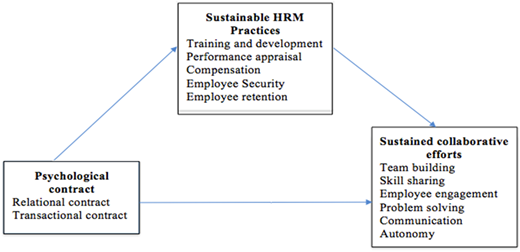
Figure 1 shows the Conceptual model in the present study consists of three variables and addresses the relationships between each variable. The variables are psychological (relational and transactional contracts), sustainable HRM practices, and sustained collaborative efforts. The model explains the influence of sustainable HRM practices on sustained collaborative efforts and psychological contracts.
Research methodology
This study employs a cross-sectional, quantitative empirical design to examine the influence of sustainable HRM practices on sustained collaborative efforts and psychological contract fulfillment among healthcare professionals. Primary data were collected via a structured online survey from 260 respondents (doctors and nurses) across five NABH-accredited private hospitals in Bangalore, India (each with >100 beds), selected for their representation of standardized healthcare operations. Secondary data from industry reports and peer-reviewed journals supplemented the contextual understanding of employer-employee relations. A mixed-methods analytical approach integrated correlation, multiple regression, and structural equation modeling (SEM via AMOS/SPSS) to test direct, indirect, and latent relationships, ensuring robust validation of the conceptual framework.
Sampling technique
A stratified random sampling technique was applied, dividing the population into two mutually exclusive strata: doctors (n = 130) and nurses (n = 130), proportional to their representation in target hospitals (approximately 50:50 ratio). Hospitals were purposively selected based on NABH accreditation and bed capacity to ensure quality comparability. Within strata, respondents were randomly selected from employee rosters (response rate: 72%; n = 260 useable responses). This method enhances representativeness, minimizes bias, and supports generalizability within urban private healthcare settings.
Research design
For collecting the primary data, a well-structured questionnaire was framed. The interview schedule collected data on the perception of psychological contract and the role of sustainable HRM in private hospitals. The secondary data needed for this study were collected from service industry reports and research works published in journals and magazines on employer cum employee relations and HR. According to the nature of the data, the research used correlation, regression and structural equation modelling (SEM) as appropriate statistical tools for analysis.
The researchers intentionally chose an empirical design, employing primary data, to directly measure the perceptions of employees and their respective experiences related to sustainable HRM, psychological contract, and sustained collaboration. These phenomena are quite subjective, context-specific, and perspective-specific. The researchers also employed a stratified sampling method to ensure a proper probability of choices and coverage of both doctors and nurses. This, in turn, increases the generalizability of the collected responses within the healthcare domain.
The researchers used correlation and regression methods to evaluate the vector strength and direction of the significance between different variables. This also provided preliminary support for the assumptions made by the researchers. SEM (Structural Equation Modeling) was used to ensure that the researchers were able to simultaneously compute several interrelated relationships and latent constructs. The researchers used a mixed methods approach to examine the conceptual framework as well as identify the connections (whether direct and/or indirect) between the variables in this study.
Instruments
The psychological contracts were measured using the 17 items shortened version of the PC Scale (PCS) of Millward and Hopkins (1998). The construct of HRM practices is measured using a scale developed by Villajos et al. (2018). To measure sustained collaboration efforts, variables were identified through a questionnaire based on the Collaboration Questionnaire on Assessment (Palloff and Pratt, 2005).
Psychological Contract: Assessed using the 17-item shortened Psychological Contract Scale (PCS; Millward and Hopkins, 1998; α = 0.89), capturing relational (e.g. “My employer values my personal growth”) and transactional (e.g. “Clear job security promises”) dimensions on a 5-point Likert scale (1 = strongly disagree to 5 = strongly agree).
Sustainable HRM Practices: Measured with the 12-item scale by Villajos et al. (2018; α = 0.92), evaluating green training, employee well-being initiatives, and eco-friendly policies (e.g. “My organization provides sustainable development training”; 5-point Likert).
Sustained Collaborative Efforts: Adapted 10-item Collaboration Questionnaire (Palloff and Pratt, 2005; α = 0.87), focusing on trust, shared goals, and conflict resolution (e.g. “Team members support each other's professional growth”; 5-point Likert).
All scales demonstrated strong reliability (Cronbach's α > 0.85), convergent validity (AVE >0.50), and discriminant validity (Fornell-Larcker criterion). Common method bias was addressed via Harman's single-factor test (<40% variance) and procedural remedies (e.g. randomized item order).
Preliminary diagnostics included descriptive statistics, normality tests (Shapiro–Wilk), and multicollinearity checks (VIF<5). Correlation and regression provided initial evidence of variable associations, while SEM tested the full hypothesized model (fit indices: χ2/df < 3, CFI>0.95, RMSEA<0.08), accommodating mediation and latent constructs for comprehensive inference.
Research questions
What is the impact of psychological contracts on the sustained collaboration efforts of healthcare professionals?
How do sustainable HRM practices influence psychological contracts?
What are sustainable HRM practices' relationships with sustained collaboration efforts and psychological contracts?
Objective of the study
Based on the research questions, the objectives framed were as follows-
To analyse the impact of psychological contracts on sustained collaborative efforts of healthcare professionals.
To investigate and analyse the influence of psychological contracts on sustainable HRM practices.
To determine the mediating effect of sustainable HRM practices on sustained collaborative efforts and PC of healthcare professionals.
Hypotheses of the study
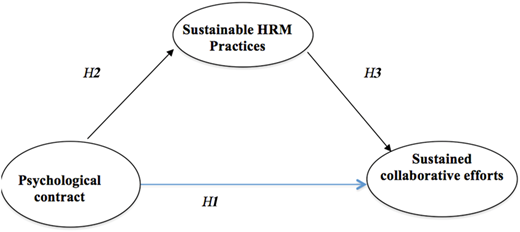
H1: There is a significant impact of psychological contracts on sustained collaborative efforts of healthcare professionals.
H2: There is a significant influence of psychological contracts on sustainable HRM practices.
H3: Mediating effect of sustainable HR practices on sustained collaborative efforts and PC of healthcare professionals.
Figure 2 represents the conceptual mapping between the variables and the causal relationship depicted by the hypothesis.
Analysis and results
Measurement model
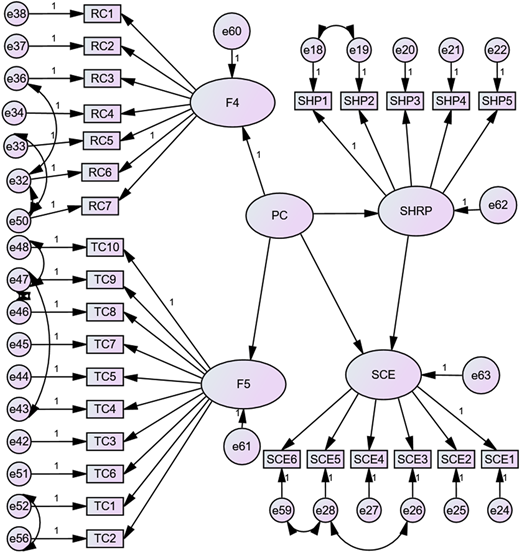
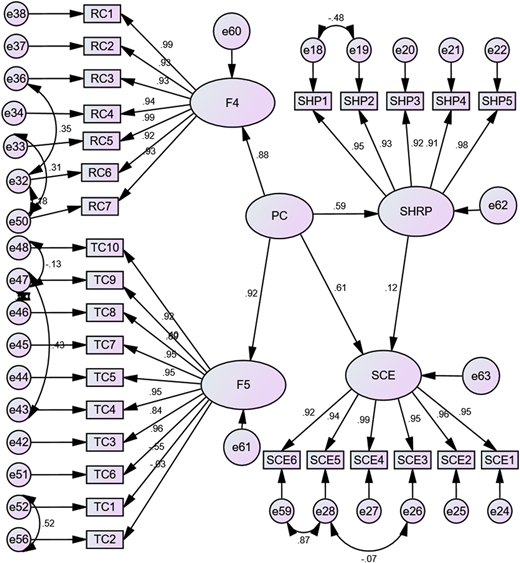
Using AMOS 21 for structural equation modelling, this research first tested the measurement model and then the structural one (Anderson and Gerbing, 1988). We compared the hypothesised model with alternate models to check the correctness of the measurement model. The results revealed that our three - factor model (χ2 = 1445.10, CFI = 0.96, TLI = 0.96, SRMR = 0.051, RMSEA = 0.053) is superior to the one-factor model (χ2 = 12372.41, CFI = 0.625, TLI = 0.58, SRMR = 0.143, RMSEA = 0.231). We also tested our hypothesised model against four-factor and two-factor models. The fit indices are shown in Table 1. The results confirm that the three study variables are different from each other and are unique. The fit indices are well above the suggested cut off values (RMSEA <0.06, SRMR <0.08, CFI > 0.95) (Hu and Bentler, 1999). The construct validity and reliability were assessed as suggested by Hair et al. (2006). The validity of a measurement instrument can be established if standardised factor loadings, Average Variance Extracted (AVE), and reliability are greater than 0.5 (Fornell and Larcker, 1981). The measurement model shows that all the standardised factor loadings were well above the 0.5 cut-offs. Table 2 results indicate that AVE and Construct reliability for each variable is well above the ideal 0.5 cut-offs. All these indicate the convergent validity of the measures used in this study.
Discriminant Validity is estimated based on the comparison of the squared correlation between the two constructs with either one of their AVE estimates. The estimate of AVE should be greater than the value of the squared correlation. Table 2 shows that the above condition is satisfied, as all the values are above 0.7. This indicates discriminant validity. Thus, the scale adopted in the study is good regarding reliability and validity measures.
Structural model and tests of hypotheses
To evaluate the structural model, first, the direct effect of PC on sustained collaborative efforts was tested. The direct effect of PC on sustained collaborative efforts was significant (β = 0.68, p = 0.000 < 0.001).
The fit indices of this initial model (1), χ 2 = 1070.76, df = 218, χ 2/df = 4.91, GFI = 0.875, IFI = 0.968, CFI = 0.968, TLI = 0.963 and RMSEA = 0.074 showed that the model has a moderate fit with the data. Thus, the first hypothesis (1) is supported.
Next, Sustainable HR practices were included as the mediators in the model (2).
χ 2 = 1445.10, df = 335, χ 2/df = 4.314, GFI = 0.976, IFI = 0.965, CFI = 0.965, TLI = 0.961, and RMSEA = 0.071 show that the role of the mediator sustainable HR practices, is important in the relationship between PC and sustained collaborative efforts. The significance of sustainable HR practices as a mediator in the relationship between PC and sustained collaborative efforts was tested using AMOS bootstrapping by specifying a sample of 2,000 at a 95% confidence interval. The results obtained using bootstrapping are shown in Table 3.
Proportion of mediation
Table 3 shows that the indirect effect of psychological contracts on sustained collaborative efforts through sustainable HR practices is significant. Moreover, the direct effect of psychological contracts on sustained collaborative efforts is significant. The effect of the Sustainable HR practices on sustained collaborative efforts was also found to be significant (β = 0.024, p = 0.51 > 0.05), and was non-significant. Thus, Hypotheses2 and 3) is supported. The study results show that sustainable HR practices significantly mediate the positive relationship between PC and sustained collaborative efforts.
Discussions, practical implications, and future research scope
This study examined the relationship between sustainable HRM practices, PC, and sustained collaborative efforts in the healthcare sector. Since the study was based on a sample in the private healthcare sector, this research presents some significant findings. The results indicated PCs significant and direct effect on sustained collaborative efforts. Results also found that the mediating role of sustainable HRM practices significantly influences the relationship between PC and sustained collaborative efforts. While testing the direct and indirect effects between the variables, the study found the indirect effect of psychological contracts on sustained collaborative efforts through sustainable HR practices to be significant. Likewise, the direct effect of psychological contracts on sustained collaborative efforts is also significant. According to Shahnawaz and Jafri (2011), HR practices influence psychological contracts. Involvement in decision-making significantly affected engagement (Shantz et al., 2016).
These results challenge Perkins et al. (2021), who highlighted job redesign challenges in maintaining PC amid volatility; our healthcare context suggests sustainable HRM buffers such erosion, yielding stronger collaboration than transactional HR alone (Suazo et al., 2009). However, the full mediation contrasts Collins and Beauregard (2020a, b), implying that direct PC effects persist even with robust HRM, potentially due to healthcare's professional autonomy (Ahmad and Zafar, 2018a, b). This tension underscores a contingency: sustainable HRM amplifies PC in collectivist, patient-centric settings but may not supplant innate relational bonds.
Eco-friendly HRM elements uniquely contributed here, linking social (team morale), economic (efficiency), and environmental outcomes (reduced waste in collaborative protocols).
It encourages employees to achieve targets and can generate clear team objectives that are quantifiable from a clear vision and mission statement, as long as team members participate in the development and prioritising of objectives and have a good understanding of the requirements (Mickan and Rodger, 2000). Employee allocation, growth, rewards, and interactions are all HR practices that form psychological contracts by shaping the fulfilment of promises made by both the employee and the employer (Suazo et al., 2009).
Clear and open communication is important to encourage employee participation for more engagement and enhanced commitment (Ahmad and Zafar, 2018a, b). It is a challenge to redesign jobs in ways that secure the maintenance and strengthening of psychological contracts (Perkins et al., 2021). The psychological contract includes opportunities for training and job advancement. According to Collins and Beauregard (2020a, b), it is important to tackle the mismatch between employees' expectations to achieve work attributes that result in positive outcomes. Along with individual outcomes, the model also presents the results of sustainable HRM in four integrated categories: organisational and economic outcomes, such as profitability, productivity, customer satisfaction, and sustained competitive advantage; social outcomes, such as long-term employability, voluntary work, quality of life, public health, social justice and equality; and ecological outcomes, such as energy and paper consumption, green products and services, and reduced travel for work. According to Stahl et al. (2020), eco-friendly practices and sustainable HRM techniques may help with value generation and preservation (economic), energy efficiency and eco-friendliness (environmental), and social development by fostering a good work environment. Healthcare managers should embed sustainable HRM (e.g. cross-disciplinary training, eco-wellness programs) to activate PC-driven collaboration, directly improving patient outcomes via enhanced team coordination. NABH-accredited hospitals can prioritize PC audits alongside HRM metrics, fostering measurable gains in retention (target: 15–20% via relational fulfillment) and service quality. Leadership training emphasizing open communication (Ribeiro, 2020a, b) will sustain these effects.
Future studies should focus on integrating HRM practices with the psychological contract, with the moderating effect as a starting point. The strategic role that HRM can play in managing the psychological contracts needs to be discussed further in the healthcare industry. This research has shown that sustainable HRM practices serve as a mediator between two variables: psychological contracts and sustained collaboration efforts, which influence employee actions. Transitional and balanced psychological contracts and HR actions should be examined in the studies, as this might be a lucrative route for future theory development. Future research should focus on human resource management practices. It is also imperative in future to examine sustainable HRM as a moderator in public vs. private healthcare to test generalizability. Longitudinal designs could trace PC evolution under HRM interventions, addressing cross-sectional limits. Integrate emotional intelligence (Gino, 2019) or AI-driven HRM as emerging mediators. Comparative studies across sectors (e.g. IT vs. healthcare) will refine theory, while qualitative explorations unpack “how” sustainable HRM operationalizes PC in diverse cultures.
Conclusion
The present study aims to extend our understanding of building sustained collaboration through psychological contracts and the role of sustainable HRM. Sustainable HRM mediated the relationship between sustained collaboration effort and psychological contracts, therefore representing HRM practices that are likely to be prompted by high levels of sustained collaboration. Sustained collaboration is a mindset that promotes long-term cooperation and includes a broad appreciation of social group’ contributions, an openness to experience with others' ideas (Gino, 2019). The model proposed in the study can be significant in building a sustainable collaborative culture and work environment in an organisation through sustainable HRM practices, which would lead to stronger psychological contracts among healthcare professionals. The importance of psychological contracts is demonstrated by the fact that both individual attitudes and actions as well as many organisational results are influenced by the dynamics of the work relationship between employers and employees. This bonding created by the psychological contract can yield long-term results regarding employee retention, motivation, morale, employee engagement, high employer brand, and service quality enhancement, eventually leading to sustained organisational excellence.
Healthcare professionals with strong emotional intelligence tend to achieve better patient satisfaction, greater treatment adherence, and overall improved health results overall. Their capacity for empathy and clear communication builds trusting relationships with patients, ultimately elevating care quality. Simultaneously organizational psychology increasingly examines the psychological contract—the unspoken mutual obligations and expectations that shape employer-employee dynamics.
Author’s acknowledge the support from REVA University for the facilities provided to carry out the research.