This paper aims to identify the expressions and flows of tacit knowledge in the unstructured decision process. In this type of process, decision-makers use not only the explicit knowledge but also aspects such as intuition, experience and other forms of tacit knowledge. The research developed a qualitative approach, through a study of multiple cases, and applied semi-structured interviews to ten executives. The analysis of data was carried out according to Flores (1994) interpretative analysis of text technique. Results indicated that there was the insertion of tacit knowledge in all unstructured decision-making routines. It was also detected the need to explicitly add the routine of evaluation to the Mintzberg et al.’s (1976) model as elements of tacit knowledge were also identified at this stage of the decision-making process.
The research has taken a qualitative approach, through a study of multiple cases, applying semi-structured interviews to ten executives. The analysis of data was carried out according to technique for interpretative analysis of the text.
Results indicated that there was tacit knowledge in all unstructured decision-making routines. Also detected was the need to explicitly add the routine of evaluation to the model.
It was unable to perform psychological studies to investigate the deepest cognitive and emotional aspects of managers, and it does not address, in depth, some issues that are related to tacit knowledge in decisions and that would be considered relevant.
Although this research was unable to dissect the composition of tacit knowledge in unstructured decision process, a better understanding of the aspects that make up the knowledge in question has been developed, providing some decision-making guidelines to managers.
The language between communications actors can share decision-making rules to assist in the production and process of arguments necessary for the debate, evaluation and attribution of institutionally recurrent decisions.
The original contribution is present in a detailed description of the expressions of flows of tacit knowledge in unstructured decision-making processes, based on the model of Mintzberg et al. (1976). From the influence of tacit knowledge, it was found that the model in question needs to consider the relevance of the evaluation phase, as a stage equivalent to the other described by Mintzberg et al. (1976). These aspects have been better explained in the introduction and conclusion. Participant observation was not possible because the decision had already been taken by the informant at the moment of the interviews.
1. Introduction
In the complex and competitive business scenario, executives, in addition to strategic plan guidelines during the implementation process, must manage emerging strategies that arise in response to the opportunities offered by the environment (Oliveira, Sauaia, Motta, & Garcia, 2011). In this sense, they not only must have prescriptive formulation skills but also skills that enable continuous learning in the face of unexpected situations in the original plan (Mintzberg, Ahlstrand & Lampel, 2010).
The circumstance in which you have to shape strategic changes, and especially during the decision-making process, when a previous identical or very similar situation is not found, and there is no previous explicit ordered set of answers to the problems encountered, is called an unstructured decision process (UDP) (Mintzberg et al., 1976). In this type of process, at the strategic level, it is common to resort to the areas of the brain responsible for emotions and intuitions (Blackman, 2014).
In an UDP, due to the complexity and novelty of such decisions, the use of tacit knowledge (Polanyi, 1962) by executives becomes relevant at least at some point during the process (Mintzberg et al., 1976).
Situations involving intuition, emotion (Fenton-O’Creevy, Soane, Nicholson, & Willman, 2011), perception (Takeuchi & Nonaka, 2008) and sensitivity (Dearlove, 1998), while forms of knowledge, are some manifestations or flows of tacit knowledge (Lucena, 2016).
Tacit knowledge was originally described by Polanyi (1962) and refers to the part of human knowledge which is difficult to explain. However, it accounts for a considerable portion of human activities. For example, when executives make strategic decisions, they are unable to fully explain the knowledge they took into consideration when making the decision (Muñoz, Mosey & Binks, 2015).
During a search in the databases PROQUEST, EBSCO and JSTOR – from January 2005 to May 2016 – for the terms measurement or scale or evaluation or unstructured or decision process or decision-making, combined with the terms tacit knowledge, a lack of results from the insertion of tacit knowledge in unstructured decision-making procedures were detected, despite of other related studies (Jafari, Akhavan & Nourizadeh, 2013; Gubbins et al., 2012; Cianciolo et al., 2006; Zhang & Jin, 2013; Luo et al., 2013; Gourlay, 2006).
Despite the recognition of the importance of individual capabilities, studies on the influence of the profile of professionals on the use of tacit knowledge are scarce. Therefore, it becomes relevant to carry out more in-depth research to better explain the role of this knowledge in some areas of knowledge management (Busch, 2008; Venkitachalam & Busch, 2012).
In this sense, the present study aims to identify expressions and flows of tacit knowledge in UDPs, with the supposition that tacit knowledge is present in all the routines of an unstructured decision-making process.
This study represents a contribution in understanding UDP under the tacit knowledge perspective, enabling a better comprehension of tacit knowledge in UDP’s model of Mintzberg et al. (1976) and providing a clearer view of the role of managers in decision-making processes, especially in regards to their tacit abilities.
2. Literature review
2.1 Unstructured decision process
A UDP is the one in which the decision-maker is faced with complex and unplanned situations. During the analysis of the decision-making process, one does not find an identical or very similar situation, and there is no prior explicitly ordered a set of answers to the problems encountered (Mintzberg et al., 1976). These authors add that a strategic decision-making process is characterized by novelty, complexity and an open character as the organization usually begins with a little understanding of the decision in question, such as which solution will be adopted and how will it be developed.
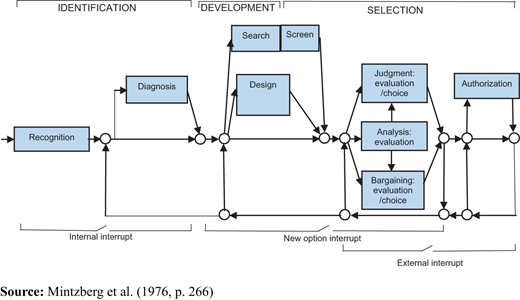
Mintzberg et al. (1976) have developed a general model of analysis that involves three basic phases: identification, development, and selection. The identification phase contemplates the recognition of the decision-making problem and its diagnosis. The development phase involves the search routines for the construction of decision alternatives and the best possible design for the third phase, the selection. In the selection phase, the process occurs through judgment, analysis and bargaining routines, with the consequent authorization. The whole process is dynamic and iterative, as shown in Figure 1.
The process routines of Mintzberg et al. (1976) are described below:
Recognition: In the identification phase, it represents the routine in which opportunities, problems, and crises are recognized, and the decision-making activity is evoked.
Diagnosis: Also in the identification phase, it corresponds to the routine in which the manager seeks to understand the evocative stimulus of the decision-making process and determines the cause-and-effect relations for the decision-making situation.
Search: In the development phase, the search is designed to identify possible solutions to the decision problem, which can result in alternatives to be evaluated by decision-makers.
Design: Also in the development phase, it is concerned with the design of alternative solutions. You can start with a vague image of a solution (custom-made) or by modifying ready-made solutions.
Screen: In the selection phase, it is a superficial routine related mostly to the removal of unfeasible solutions than with the determination of appropriate solutions. The time constraint defines this routine.
Evaluation and choice: Also in the selection phase, it involves judgment, analysis and bargaining. During the judgment, decision-makers choose on their own based on procedures not necessarily explainable. During the bargaining, the selection is made by a group of people who have conflicting objectives among themselves, each one with their own judgments. The analysis, in turn, represents a factual assessment made usually by technocrats, followed by choice by judgment or bargaining.
Authorization: Still in the selection phase, as a final routine, authorization occurs when people who carry out the assessment and choice do not have the authority to decide. In this case, the decision process follows for approval. The search for authorization does not necessarily occur only when the previous routines have been concluded; it may be provoked in the previous phases.
2.2 Tacit knowledge
Tacit knowledge was originally described in depth by Polanyi (1962). According to him, it is made up of two components: the proximal (subsidiary) and the distal (focal), which, integrated, give the notion of objectivity to the connoisseur. However, the connoisseur can only seize the object epistemically by having as subsidies other knowledge that he cannot explain, which the author calls tacit knowledge. Soon, the knower knows more than he/she can report. For example, when using a cane, a visually impaired person feels in a focal way what is in the tip, not in the shaft (Saiani, 2004). Without the shaft – that is subsidiary – the visually impaired does not realize what is in the tip of the cane-focus. It should be stressed that other subsidiary elements (muscle movements, brain synapses, among others) contribute to the visually-impaired understanding of the situation.
According to Takeuchi and Nonaka (2008), tacit knowledge is characterized by two dimensions:
The technical dimension includes difficulty to detect informal skills (know-how), such as highly subjective and personal insights, intuitions, hunches and inspirations derived from bodily experience.
The cognitive dimension consists of beliefs, perceptions, ideal values, emotions and mental models that are embedded in people, who consider them natural.
To Hooff et al. (2012), emotions are mental cognitive states, revealed in physical form, which lead to attitudes or behaviors that are a kind of expression, or a way to deal with these mental states. Fenton-O’Creevy et al. (2011) claim that they play a central role in the functioning of cognition thus interfering in decision-making. The authors complement by saying that when executives have a greater willingness to critically ponder on intuitions and feelings during negotiation processes, their business performance improves.
Likewise, Adiandari (2014) claims that intuition occurs unconsciously or subconsciously, appearing suddenly and driven by experience, which is one of its sources, affecting the ongoing decisions substantially. Professional experience, however, may lead experienced professionals, aware of the knowledge they have of a particular area, to fail due to behavioral biases, sometimes more than less experienced individuals (Rzeszutek, Szyszka & Czerwonka, 2015).
Various kinds of tacit knowledge are identified through expressions and cognitive flows. Concerning the general model UDP by Mintzberg et al. (1976) and the classification of knowledge dimensions by Takeuchi and Nonaka (2008), a framework has been developed that relates these expressions and UDP routines and flows (Table I).
3. Methodological procedures
Considering the absence of specific studies about the identification of the influence of tacit knowledge in UDPs, this research can be considered as both inductive and exploratory, in which the multiple-case study technique was used (Yin, 2012).
By having worked with ten cases and their analysis being focused on holistic observations, it is possible to classify our research as a multiple-case study with a simple analysis unit, based on the classification by Yin (2012). Case studies require additional care as the search for multiple sources of data, to which the triangulation method is recommended (Yin, 2012). In this sense, this research sought to pick up various evidence or ways to process data, which are profiles of respondents and organizations; UDP characterization; mental maps of each UDP; considerations about the respondents; and organizations’ information available on the Web.
This research adopted as units of analysis UDPs related to strategies adopted by executives. UDP was considered the decision process without previous identical or very similar situation and lacking a previous and explicit ordered set of answers to the problems encountered (Mintzberg et al. (1976).
After identifying the UDP, the elements of tacit knowledge involved in such processes were identified. Table I presents the theoretical dimensions of the literature review.
The research approached ten managers, based on accessibility, which is characterized by easy access to the executive’s agenda and intentionality. Thus, the research searched for people with the desired characteristics (Koeing, 2015), which, in this case, included participants with an experience of at least five years in strategic decision processes.
The field research was conducted through semi-structured interviews; the participants’ statements were recorded. They were carried out at their work place, in a reserved room. Later, the interviews were transcribed for analysis. Data from the interviews were analyzed qualitatively with the dossier submitted by Flores (1994), as shown in Table II.
Another aspect that validates this work is the reliability of its conclusions, which, according to Flores (1994), require the verification of the conclusions through comparisons between some participants of the research and other researchers. Thus, out of ten interviewees, three corroborated with the data and respective analyses.
4. Results and analysis
Initially, some data about the respondents are presented. Table III shows that all respondents had previous experience with decision-making processes (over 5 years) and reported to be in business for over 10 years.
Table IV illustrates some data depicting the organizations surveyed herein. It shows that the geographical distribution of Brazilian organizations was diversified, companies being located in the state of Paraíba, Minas Gerais, São Paulo and Paraná. In regard to the participating organizations, they had all been in the business for 12 or more years in 2015. The number of employees showed a significant variation, from 2 up to 1,700 employees. As for the scope of operation in the market, eight worked in local markets and two at the global level.
One of the data collection concerns was to find out whether the respondent's decision was an UDP. In this sense, we took into consideration the requirements that characterize a UDP, namely: novelty, complexity and open character, according to Mintzberg et al. (1976). Table V was constructed with a list of the decisions made in each organization researched herein. In the last column, we present some statements of the respondents who corroborate with the understanding that all researched cases are related to a UDP.
The objective of this research was not to discriminate whether the decisions referred to deliberate or emergent strategies. However, some decisions had a deliberate character, as occurred with Company E2, which, in its constitution, defined its operational market niche.
The first phase of the qualitative data analysis, proposed by Flores (1994), which is the reduction of the data, included the separation of the elements and their identification, classification and grouping. As for the separation of the elements, data were segmented into the following categories:
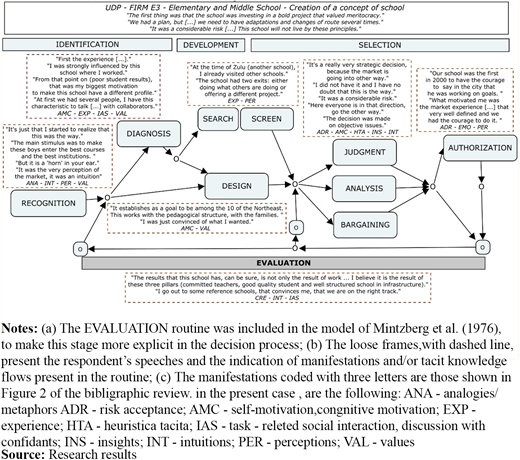
Mintzberg et al. (1976) UDP routines model: recognition, diagnosis, design, search/screen, judgment/analysis/bargaining, authorization and evaluation (this last routine was incorporated into the model).
Expressions and flows of tacit knowledge (Table I).
Finally, the grouping resulted in the connection between the two groups of categories (UDP routines and TK expressions and flows) expressed in the form of mental maps and tables related to both sets.
To build mental maps for each decision process, the model in Figure 1 was used by adding the evaluation routine. In each UDP routine, sentences or phrases that indicate some demonstration and flow of TK were highlighted. These maps refer to visions of interviewed people about the reported UDP as shown in Figure 2 (UDP for Company E3).
Table VI summarizes the incidence of TK expressions and flows in each UDP routine. The first part of the table shows the occurrence of TK expressions and flows, related to the framework of Table I. Some flows previously not observed in the theoretical discussion appear in the cases studied herein. For example, self-motivation/cognitive motivation (AMC) is identified in each of the phases of the UDP, but it had not been indicated in that framework.
The second part of Table VI illustrates the summary of TK expressions and flows for the UDP routine. It turns out that there were 221 cases altogether, being more frequent: perceptions (29), tacit heuristic (25), experience (23), intuition (22), managing other people (19) and task-related social interaction/discussions with confidants (19).
Table VI shows TK expressions and flows presented in 21 distinct forms, from perceptions to hunches. As an example, perception – that is a type of cognitive flow (Takeuchi & Nonaka, 2008) characterized by an impression on a person caused by stimuli or information to deal with certain problems (Wagner, 1987) – was identified in several interviewees’ statements, a total of 29 observations.
Another relevant incidence of TK is the intuition – associated with judgments impregnated with affection (Dane & Pratt, 2007) – which was identified in several interviewees’ statements, a total of 22 observations. For instance, Respondent E7, in the routine evaluation of UDP, stated that data interpretation also had an instinctive character. On its website, the company declares that it requires from professionals a solid analytical profile, which demands intuitive capacity.
This study also examines the evaluation routine, not explicitly present in the model by Mintzberg et al. (1976), but introduced in this work, as it occurred in several TK expressions and flows. According to Gomes and Gomes (2014), it is necessary to evaluate the performance of the decision made systematically and at regular intervals (Štěpánková & Richter, 2015). Perceptions (7), tacit heuristic (5), experience (3), task-related social interaction/discussions with confidants (3) and sensibility (3) were predominant in this routine.
Decision evaluation is a complex activity that requires either perception or sensibility toward the behavior of the variables that were affected by the decision made, or a more analytical reading (data reports) is required, which, in this case, involves tacit heuristic.
During the interviews, some insights about the interviewees were observed. Such perceptions relate to their behavior, statements, and other aspects that reveal, in a way, the modus operandi of their decisions and the way they face them.
5. Conclusions
From the data presented herein, we affirm that tacit knowledge was inserted in all UDP routines. Thus, the importance of tacit knowledge for strategic decisions should not be ignored.
The most observed manifestations of tacit knowledge were perceptions, tacit heuristic, experience, and intuitions. Thus, these tacit skills may represent the core of the tacit knowledge in the UDP in the cases studied. It is recommended, therefore, that competencies associated with such expressions and flows be fostered at the level of managers training.
Evaluation is a routine that could be inserted into the UDP of Mintzberg et al. (1976), as, at least in regards to tacit knowledge, its relevance was evidenced.
This research, however, had some limitations:
It was unable to perform, in greater depth, psychological studies to investigate the deepest cognitive and emotional aspects of managers.
As the investigation did not adopt quantitative instruments, with inferential analyses, it is considered statistically invalid; i.e. it cannot be generalized to all cases of UDP.
A certain level of subjectivity is associated with similar phenomena concepts (intuition versus insight, experience versus learning-by-doing, intuition versus perception versus sensibility).
It does not address, in depth, issues related to tacit knowledge in decisions, which is a relevant aspect.
Some of the limitations could be reduced if there were a participant observation of the researchers in each stage of the model by Mintzberg et al. (1976). However, we consider this possibility very remote due to the difficulty to separate each of these steps in the process of unstructured decision. Although the model by Mintzberg et al. (1976) is didactically clear, in practice, many of the steps happen almost simultaneously and tend to be recursive, coming and going, according to a set of personal and organizational factors that occur routinely in organizations.
Future research can be developed with the following approaches:
Quantitative research that can estimate more accurately the insertion of tacit knowledge in UDPs.
The role of tacit knowledge in emerging strategies.
Through an institutional approach, scholars could carry out a research to check how the social influences interfere in the construction of tacit knowledge applicable to decisions. According to Hoefer and Green (2016), the sedimented language between communication actors can share decision-making rules to assist the production and process of arguments necessary for the debate, evaluation and attribution of institutionally recurrent decisions.
Neuroscientific studies on tacit knowledge during strategic decision-making moments.
We believe that this study can be a starting point for others who have the same direction to identify components of the tacit knowledge in strategic decisions; structured, unstructured, or emergent. Increasingly, in various fields of knowledge, tacit knowledge has been the subject of analysis considering that is a component of the triad of performance of individuals involving cognition, emotion (affection) and the action (psychomotor), which are the subject of studies in field of organizational learning and, therefore, influence the personal, social and organizational decision-making process.