
Skip to article sections
Purpose

This study aims to examine how family-related cyberloafing impacts dual-role conflict, multitasking skills and work−life balance among Indonesian first-generation professional working women. The study draws on cognitive dissonance theory to examine how digital behaviors can reduce psychological stress when professional and familial expectations conflict.

Design/methodology/approach

In Indonesia, 335 first-generation professional working women from dual-income households were surveyed online. Multitasking skills, dual-role conflict, family-related cyberloafing and work−life balance were examined using structural equation modeling.

Findings

Results suggest that family-related cyberloafing mediates dual-role conflict, multitasking capacity and work−life balance. The findings show that cyberloafing can help professional women manage contradictory responsibilities and multitasking, reducing dissonance and maintaining work−life balance.

Research limitations/implications

This study advances cognitive dissonance theory by presenting cyberloafing as a coping mechanism rather than a negative work practice. Digital micro-behaviors are used to explain role conflict and adaptive control in the work−life literature.

Practical implications

Organizations should explore ways to curb cyberloafing and acknowledge that some forms may help employees psychologically adjust to and manage their roles. Management practices that limit digital use may improve the well-being and performance of professional women.

Social implications

The findings highlight how technology-mediated coping supports women navigating dual roles in emerging economies. Recognizing these adaptive strategies can inform broader discussions on gender equity, workplace inclusion and the social sustainability of dual-income households.

Originality/value

Family-related cyberloafing is a new mediator of work−life conflict, and cognitive dissonance theory explains its involvement. It provides culturally grounded insights into how Indonesian professional women use technology to balance dual roles.

Balancing professional and family responsibilities remains a persistent challenge, especially for women navigating both roles without prior models (Hardiani, Rahardja, & Yuniawan, 2018). This study focuses on first-generation professional women who must reconcile career aspirations with domestic expectations. In Indonesia, while cultural norms still associate women with household responsibilities, the rising prevalence of dual-income families has intensified the strain of managing dual roles (Susilo & Handrito, 2024). Many women must negotiate competing expectations in contexts that still position men as primary breadwinners, contributing to increased participation in professional work alongside sustained family obligations. These overlapping demands often generate dual-role conflict and reduced work–life balance, with financial and role-related strains persisting despite dual incomes (Hardiani et al., 2018). Structural workplace barriers, including the glass ceiling, further amplify these challenges (Grangeiro, Silva, & Esnard, 2022).

Dual-role conflict (work and family domains) can affect anyone juggling multiple roles simultaneously (Reimann, Schulz, Marx, & Lükemann, 2022). Studies by Rini, Yustina, and Santosa (2020) and Talukder (2019) underscore that the dual-role conflict significantly undermines work−life balance. Balancing professional and personal life remains elusive due to competing demands (Ahmad, Majeed, Kausar, & Taseer, 2023). According to a survey by Captivate Network, women are more vulnerable to experiencing dual-role conflict (How to Achieve the Perfect Work-Life Balance, 2026). While 75% of men report satisfaction with their work−life balance, the figure drops to 70% for women. Moreover, women typically bear a disproportionate burden of household chores, such as cooking, cleaning and shopping, which doubles their workload compared to men.

Women predominantly manage most household chores, especially in dual-income families (Hamsyah, Shimazu, & Hakanen, 2024), placing added strain on first-generation professionals who lack familial models for managing work and domestic demands. This study, therefore, examines family-related cyberloafing as a coping mechanism for navigating dual roles and maintaining work–life balance. Although grounded in Indonesia, the findings are relevant to other contexts where dual-income structures and gendered expectations create similar work−family tensions. Work–life balance is often disrupted by such pressures, affecting well-being and family functioning (Jayasingam, Lee, & Mohd Zain, 2023), highlighting the need for strategies to manage dual-role conflict and support sustainable balance (Rahmawati & Yuniawan, 2023).

Multitasking ability may support role management, but can also lead to mental overload and emotional strain. It involves performing multiple activities simultaneously or shifting attention across tasks (Marchewka, Nesterak, Sołtysik, Szymla, & Wojnarowska, 2020; Xu, Kee, & Mao, 2021). The widespread use of digital technology reinforces this dynamic. In Indonesia, internet access reached 204.7 million users in 2022, representing 73.71% of the population, while social media usage reached 68.9% (Dhewandrie & Yuniawan, 2023; Kemp, 2022).

One behavior enabled by digital access is cyberloafing. Traditionally viewed as counterproductive, it has also been associated with stress regulation and emotional recovery. Cyberloafing refers to using the internet for non-work-related activities during working hours (Zhong, Chen, Yan, & Luo, 2022). Using devices such as smartphones, computers, tablets and laptops for personal use during working hours can cost companies financially (Giordano & Mercado, 2023) and psychologically (Lu, Wang, Chen, & Lu, 2024). Nevertheless, what if cyberloafing is used to multitask and balance various roles? Previous research has not extensively examined cyberloafing in this context, but several studies have found detrimental consequences, including decreased workplace engagement (Nyoto, Priyono, & Renaldo, 2023). Conversely, recent research suggests that cyberloafing has positive effects, such as reducing stress (Zhong et al., 2022) and boosting or stabilizing employee emotions (Khan, Saeed, Fayaz, Zada, & Jan, 2023). Studies on the causes of cyberloafing behavior have been varied, as evidenced by the findings of Jha, Malik, Patel, and Cvetkoska (2024) and Hu, Chen, and Ye (2023). Cyberloafing has been shown to have both negative (Tandon, Kaur, Ruparel, Islam, & Dhir, 2022) and positive (Pardim, Pinochet, & de Souza, 2024) impacts.

Given the complexities, this study explores whether family-related cyberloafing functions as a coping mechanism for dual-role conflict and whether multitasking contributes to or moderates this process. The research focuses specifically on first-generation professional women in Indonesia. This group faces unique pressures due to their lack of familial role models in the workforce. It focuses on first-generation professional women in dual-income households, with “first generation” referring to the first professional working women in their families.

Families often serve as crucial environments in which individuals acquire resilience to stress (Mendes-Sousa et al., 2023; van der Wal et al., 2024). Individuals facing work–family strain frequently rely on family guidance and coping experiences (Manor, 2021). Despite extensive research on dual-role conflict, limited attention has been given to behavioral strategies that mitigate its effects. From an organizational behavior perspective, understanding such adaptive responses is critical for explaining and predicting employee behavior within complex role environments.

Cognitive dissonance theory, developed by Festinger in 1957, suggests that individuals experience discomfort when their thoughts, beliefs or behaviors are inconsistent and are motivated to restore internal coherence. The theory proposes that psychological discomfort arises when beliefs, behaviors and expectations are inconsistent, motivating individuals to restore internal coherence (Lechner, Mathmann, & Paul, 2022; Sumadi, Alkhateeb, Alnsour, Abuhashesh, & Ahmed, 2022). In this context, cyberloafing may serve as a behavioral response that helps reconcile workplace expectations and family responsibilities while supporting work–life balance.

Work, personal life and family form interconnected domains that cannot be easily separated across settings. Work–life balance involves meeting commitments across domains without significant conflict or interference (Grzywacz & Carlson, 2007). Delecta (2011) describes it as the ability to fulfill professional and familial responsibilities simultaneously, emphasizing harmony and integration between roles.

Greenhaus, Collins, and Shaw (2003) conceptualized work−personal life−family balance as the distribution of time, psychological involvement and satisfaction across roles, and linked it to overall quality of life. Achieving balance, therefore, requires not only time management but also emotional engagement in each domain. This balance is commonly assessed through time allocation, role involvement and satisfaction levels (Akinbode & Ayodeji, 2017).

Dual-role conflict is a major factor shaping work–life balance. Prior studies consistently show its negative influence (Rini et al., 2020; Talukder, 2019). Often, distinguishing between work–family and family–work conflict (Narayanan & Barnabas, 2020) categorizes dual-role conflict into two groups: work–family and family–work conflict. However, Zahoor, Abdullah, and Zakaria (2021) reported a positive association, suggesting that managing multiple roles may sometimes strengthen resilience and time management. These mixed findings highlight the complexity of the relationship and the need for further contextual investigation.

Individuals occupy multiple roles, such as employee, parent, spouse and child, each with distinct expectations that often create competing demands. Working parents, in particular, face challenges in balancing work, personal life and family responsibilities. Molina (2021) describes dual-role conflict as arising from the interdependence of work and family domains, often leading to stress and reduced well-being. Gadzali, Yunizar, and Ausat (2023) further define dual-role conflict as the interference between work and family needs, categorized into time-based, strain-based and behavior-based dimensions. This study adopts these dimensions to examine how conflicts in time allocation, emotional strain and role expectations shape individuals’ experiences across work and family domains.

Previous research on dual-role conflict has been extensive, with notable studies by Molina (2021), Matias et al. (2017) and Tammelin, Malinen, Rönkä, and Verhoef (2017) that focused on dual-income households. These studies highlighted the challenges individuals face when balancing professional and familial responsibilities. Further research by Matias et al. (2017) and Andrade and Mikula (2014) explored the dual-role conflict from psychological perspectives and perceptions of fairness. Akinbode and Ayodeji (2017) found that women are more vulnerable to dual-role conflict compared to men, indicating gender-specific issues in balancing the roles at work and in the family.

Moreover, Li and Guan (2021) emphasized the importance of maternal support in achieving the work–personal life–family balance. They highlighted mothers’ critical role in balancing professional and familial responsibilities. Abendroth and den Dulk (2011) supported this perspective, noting that maternal involvement is crucial for reducing the dual-role conflict. Additionally, earlier generations’ experiences provide valuable insights into conflict resolutions. Manor (2021) and Russo, Shteigman, and Carmeli (2016) suggested that support from parents or older generations significantly helps achieve the work–personal life–family balance, further underscoring the intergenerational dimensions of this issue. For these reasons, the first hypothesis that can be proposed is as follows:

H1.

Dual-role conflict negatively affects work–life balance.

Few individuals can perform multiple tasks simultaneously, let alone complete each task effectively. The concept of multitasking ability refers to the ability to perform more than one activity simultaneously, including working on one task while anticipating another (Brante, 2009). In addition, Carrier, Rosen, Cheever, and Lim (2015) described conventional multitasking as the simultaneous execution of two distinct tasks, each with its own objective. They further explained that multitasking can also involve rapid, repeated switches between activities, a process known as task-switching. These multitasking activities, whether performed consciously or unconsciously, have become an intrinsic part of daily life. The advancement of modern technology has enabled this, making it increasingly accessible and prevalent in everyday life. In addition, Brante (2009) also categorized multitasking activities into three distinct forms: first, performing two activities simultaneously; second, performing one activity while anticipating another; and third, thinking about work-related activities even during leisure time.

This study uses a framework introduced by Brante (2009) for measuring multitasking activities, which consists of three dimensions: (1) dual activities – performing two activities at the same time, such as working while monitoring a child at home via CCTV; (2) single activity, such as performing one activity while anticipating another, for example, writing a report while simultaneously worrying about whether the child at home has eaten; and (3) working or thinking about work during leisure time, using rest periods for work-related thoughts or tasks, such as washing dishes while mentally planning work-related activities.

While multitasking may enhance perceived role flexibility and allow individuals to manage simultaneous demands, it has drawbacks. Studies have found that excessive multitasking can increase cognitive load, cause stress and reduce task performance (Hirnstein, Larøi, & Laloyaux, 2019). Nevertheless, in the context of this study, where multitasking often involves informal integration of family concerns during work, the ability to multitask is theorized to contribute positively to perceived work–life balance. Thus, the second hypothesis is proposed as follows:

H2.

Multitasking ability positively influences work–life balance.

Cyberloafing refers to the use of the internet for non-work-related activities during working hours. Lim (2002) defined it as employees’ voluntary use of organizational internet access for personal purposes, while Ugrin and Michael Pearson (2013) described it as the misuse of workplace internet for personal purposes. Liberman, Seidman, McKenna, and Buffardi (2011) similarly framed it as personal internet use at work. This study focuses on family-related cyberloafing, defined as using digital technologies during work to manage family responsibilities, particularly in response to women’s dual-role demands.

Although often viewed negatively, cyberloafing may also function as a coping mechanism. Andel, Kessler, Pindek, Kleinman, and Spector (2019) and König and De La Guardia (2014) highlighted its potential role in managing stress and balancing work and nonwork activities. In this study, cyberloafing is measured using Lim’s (2002) indicators of internet use, combined with Liberman’s (2011) concept of non-internet loafing, including smartphone use for personal matters during working hours.

Prior research has examined the causes and consequences of cyberloafing (Henle & Blanchard, 2008; Vitak, Crouse, & Larose, 2011), documenting both adverse outcomes, such as reduced productivity and security risks (Hertlein, 2012; Lim & Chen, 2012), and positive effects as a coping response that provides mental breaks and supports productivity (Andel et al., 2019).

The unavoidable integration of technology into the workplace facilitates multitasking, which can be closely related to cyberloafing behaviors. Research on multitasking, such as studies by Marchewka et al. (2020), indicates that daily multitasking can have adverse effects, including reduced efficiency and increased cognitive load. Specifically, Xu, Wang, and Woods (2019) investigated multitasking during media use, revealing negative impacts associated with these activities. Furthermore, Hirnstein et al. (2019) identified significant gender differences in multitasking ability, suggesting that men and women may experience these tasks differently. However, they also noted the need for further research in this area.

Despite the growing body of research on technology, multitasking and cyberloafing, there is still a lack of understanding of their roles in achieving the work–personal life–family balance. Existing studies emphasize the importance of this balance, with contributions from Soomro, Breitenecker, and Shah (2018). Work–personal life–family balance issues are particularly prevalent among women (Schueller-Weidekamm & Kautzky-Willer, 2012), underscoring the importance of creating more equitable balance arrangements for men and women (Adema et al., 2017). This study underscores the importance of developing strategies for managing multitasking and cyberloafing to support overall life balance.

Technology is designed to help people simplify their work and responsibilities. The rapid growth and widespread adoption of technology in the workplace have made it inseparable from the employees’ daily lives. Cyberloafing has inevitably emerged as an activity often intertwined with the myriad roles that individuals must fulfill simultaneously. Research by Islam, Khan, Ahmed, Usman, and Ali (2020) suggests that the dual-role conflict, particularly within the family domain, positively influences cyberloafing. Wong, Kwok, Zhang, Lai, and Cheung (2023) further asserted that cyberloafing behavior also affects the work−life−family balance.

Kusumawati and Franksiska (2018) found that dual-role conflict does not significantly influence cyberloafing, and Sijabat (2021) suggested that cyberloafing behavior may vary by gender. Building on these findings, this study examines whether higher levels of dual-role conflict are associated with increased cyberloafing and whether such behavior contributes positively to work–personal–family balance. This inquiry highlights the complex relationship among role conflict, technological use and balance, with implications for managing digital behavior in multifaceted roles.

Using technology during work requires multitasking. Saritepeci (2020) suggests that habitual tendencies, including multitasking ability, may influence cyberloafing, though prior studies have not directly examined how multitasking shapes the relationship between dual-role conflict and cyberloafing. Greater multitasking ability may increase cyberloafing when individuals manage competing responsibilities. This study, therefore, examines whether individuals with stronger multitasking skills engage in cyberloafing as a coping response to high dual-role conflict, thereby providing the basis for the third and fourth hypotheses.

Although multitasking enables individuals to shift between work and family roles, it increases cognitive load and mental fatigue (Kudesia, Pandey, & Reina, 2022). Women managing both domains may experience psychological strain (Gilbert-Ouimet, Brisson, & Vézina, 2020). In this context, family-related cyberloafing, such as communicating with family or managing household tasks online, may serve as a coping mechanism that temporarily relieves strain and supports a sense of perceived balance. Accordingly, we propose:

H3.

Family-related cyberloafing mediates the relationship between dual-role conflict and work–life balance.

H4.

Family-related cyberloafing mediates the influence of multitasking ability on work–life balance.

The theoretical framework of this study is illustrated in Supplementary Material Figure 1.

This study uses a quantitative, cross-sectional design to examine how family-related cyberloafing mediates the relationship between dual-role conflict, multitasking ability and work–life balance. Data were collected between June and August 2024 through an online survey distributed via professional networks and social media. The sample comprises first-generation professional women in dual-income households in Indonesia, defined as women who entered full-time professional employment without prior female role models in their families. Snowball sampling was used due to the unknown population size, beginning with participants recruited through professional associations and WhatsApp groups who then shared the survey with peers.

Based on a statistical power analysis (four latent variables, 29 indicators, α = 0.05, power = 0.80), the minimum required sample size was 209 respondents. A total of 395 responses were obtained; after screening for completeness and eligibility, 335 remained valid for analysis. Data were collected using Likert-scale questionnaires and analyzed using structural equation modeling with SmartPLS 3 to test the hypothesized relationships.

Because the study relied on single-source self-report data, procedural and statistical steps were taken to reduce common-method bias. Respondents were assured anonymity, and predictor and outcome variables were separated within the questionnaire. Harman’s single-factor test indicated no dominant factor, and full collinearity variance inflation factor values from the PLS-SEM analysis were below recommended thresholds, suggesting that common method bias was not a significant concern.

All variables were measured using previously validated instruments adapted for the Indonesian context, rated on a five-point Likert scale. Dual-role conflict was measured using time conflict, pressure conflict and behavioral conflict, based on Greenhaus and Beutell (1985). Multitasking ability was measured based on Brante (2009), including dual activity, single activity and thinking about work during leisure. The multitasking ability, as explored through Brante’s (2009) framework, encompasses various modes of task handling, including managing multiple activities simultaneously and shifting focus between tasks. Family-related cyberloafing was measured by adapting items from Lim (2002), focusing on internet use during work for family-related matters (e.g. messaging family, checking in on children). Work–life balance was measured using three components: time allotted, psychological involvement and role satisfaction, adapted from Rantanen, Lyyra, Feldt, Villi, and Parviainen (2021).

The respondents in this study were first-generation professional working women with full-time employment from dual-income households from manufacturing and service companies. The questionnaire included demographic items and measures of the study variables. All participants met the study criteria of being married, employed full-time and the first in their families to pursue professional careers.

Most respondents were aged 31–40 (44.2%) and 21–30 (31.9%), followed by 41–50 (16.4%) and 51–60 (7.5%). Regarding dependents, 44.8% had two, 31.3% had one, 13.1% had three, 3.9% had more than three and 6.9% had none. The majority worked in the service sector (64.5%), with the remainder in manufacturing (35.5%). Work experience varied, with 44.5% reporting one to five years, 27.8% five to ten years, 24.8% more than ten years and 3.0% less than one year.

4.1.1 Measurement model.

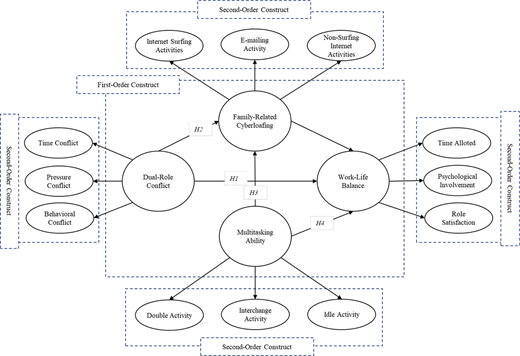
Figure 1 presents the structural and measurement models, illustrating relationships among the key variables. Dual-role conflict and multitasking ability are modeled as exogenous variables, while family-related cyberloafing and work–life balance function as endogenous constructs. As shown in the Supplementary material Table 1, factor loadings were satisfactory for all items except one psychological involvement indicator, which was removed. The table reports reliability (Cronbach’s alpha, composite reliability), convergent validity (AVE) and standardized loadings for both first- and second-order constructs. AVE values exceeded inter-construct correlations, supporting convergent and discriminant validity. Additional evidence from the Fornell–Larcker criterion and the HTMT ratios is presented in Supplementary material Tables 2 and 3.

4.1.2 Direct and indirect results.

This research used structural equation modeling – partial least squares (SEM-PLS) to analyze the direct and indirect relationships between the variables, as depicted in Supplementary material Figure 2. Specifically, the analysis explored the impact of dual-role conflict, a second-order construct, on direct and indirect work engagement through family-related cyberloafing. Additionally, it examined the influence of multitasking ability on work–life balance, considering both its direct effects and its mediation through family-related cyberloafing. The results of these analyses are presented in Table 1, highlighting the direct and mediating effects observed.

As shown in Table 1, all four hypotheses can be supported empirically. The first hypothesis (H1), that dual-role conflict negatively influences work–life balance, is supported (β = −0.397, p ≤ 0.00). Moreover, the second hypothesis (H2), that multitasking ability positively influences work–life balance, is also supported (β = 0.271, p ≤ 0.00), suggesting that individuals with higher multitasking ability are better equipped to manage their work–life balance. Furthermore, the third hypothesis (H3) proposing that family-related cyberloafing mediates the influence of dual-role conflict and work–life balance is also supported (β = 0.015, p ≤ 0.05). Finally, the fourth hypothesis (H4), proposing that family-related cyberloafing mediates the influence of multitasking ability on work–life balance, is also supported (β = 0.051, p ≤ 0.013). The implications of these findings highlight the complex interplay among these variables and underscore the importance of addressing family-related cyberloafing to improve work–life balance outcomes.

Based on the structural model, the R2 for family-related cyberloafing (FRC) is 16.4%, indicating that the exogenous constructs explain only 16.4% of the variance in FRC. This finding suggested a moderate effect, as the model’s predictors provided a limited yet meaningful explanation for variations in family-related cyberloafing. Meanwhile, the R2 value for the work–life balance (WLB) is 26.8%, meaning that the explanatory variables account for 26.8% of the variance in WLB. This finding reflected a more robust predictive capacity, highlighting the independent constructs’ significant influence on the model’s work–life balance.

Regarding predictive relevance, FRC has a Q2 value of 0.097, indicating a small yet positive predictive relevance. This finding suggested that, while not particularly robust, the model could predict the FRC beyond merely explaining the variance. In addition, the WLB has a Q2 value of 0.268, indicating moderate predictive relevance and strong predictive capacity. Therefore, the model is explanatory and accurately predicts WLB.

The findings offer insight into the dynamics of dual-role conflict, multitasking, family-related cyberloafing and work–life balance among first-generation professional women. Consistent with cognitive dissonance theory, the results highlight the mediating role of family-related cyberloafing and its relevance for understanding how individuals manage tension between work and family roles. All proposed hypotheses were supported, with family-related cyberloafing significantly mediating the relationships between dual-role conflict, multitasking ability and work–life balance. This result suggests that informal digital behavior can function as a coping mechanism for professional women facing competing role demands. Rather than simple disengagement, cyberloafing may help restore emotional connection with family and reduce psychological strain.

The strength of this mediating effect suggests that first-generation professional women, who often lack role models for navigating professional life, may rely on such strategies to manage role-related pressures. This behavior reflects an adaptive response to dual-role stress, enabled by digital access and shaped by the absence of inherited coping strategies for balancing work and family domains. This study confirms that dual-role conflict significantly reduces work–life balance, highlighting the strain created by competing work and family expectations (Hartner-Tiefenthaler, Mostafa, & Koeszegi, 2023). Prior research similarly shows that role conflict increases stress and lowers well-being (Manor, 2021). The demographic focus of this research further underscores the intensified burden faced by first-generation professional women, who lack prior family experience in managing professional and domestic roles, making the adverse effects on work–life balance more pronounced.

The findings also show that multitasking ability positively supports work–life balance. Individuals with stronger multitasking capacity appear better able to manage competing demands across domains, leading to improved balance and well-being (Suija-Markova, Briede, Gaile-Sarkane, & Ozoliņa-Ozola, 2020). This capability may reduce role conflict and cognitive dissonance, enabling professional women to function more effectively in both spheres. Mediation analysis indicates that family-related cyberloafing significantly mediates the relationship between dual-role conflict and work−life balance. Individuals experiencing higher levels of conflict were more likely to engage in cyberloafing (De Lara, Tacoronte, & Ding, 2006; Zhang, Akhtar, Zhang, & Sun, 2020). For first-generation professional women, the absence of established coping models may intensify dissonance, making cyberloafing a practical response to psychological strain. Activities such as checking on family or managing domestic matters during work hours provide temporary relief and support perceived balance by allowing women to remain connected to family responsibilities while working.

The findings indicate that family-related cyberloafing mediates the relationship between multitasking ability and work–life balance. Multitasking was common among respondents, many of whom reported performing simultaneous tasks and continuing to think about work during rest periods, suggesting blurred boundaries between professional and personal time.

Family-related cyberloafing appears to function as a coping response to this strain. Many respondents reported communicating with family or managing household matters digitally during work hours while avoiding formal workplace tools. This behavior reflects a deliberate effort to remain emotionally connected to family while sustaining professional identity. Brief shifts toward family concerns may reduce cognitive load and support perceived balance, while also alleviating guilt or anxiety linked to physical absence (Baxter, 2013), even as boundaries become less distinct.

The results further confirm the mediating role of family-related cyberloafing in the relationship between multitasking ability and work–life balance. Even individuals with strong multitasking skills may engage in cyberloafing when cognitive tensions between work and family remain unresolved (Koay et al., 2022). For first-generation professional women, the absence of prior role models may intensify this pressure. Although multitasking supports role management, it does not fully eliminate psychological strain (Crews & Russ, 2020), making family-related cyberloafing an alternative coping strategy that may enhance perceived work–life balance.

This study explored how family-related cyberloafing mediates the relationships among dual-role conflict, multitasking ability and work–life balance among Indonesian first-generation professional women. According to the cognitive dissonance theory, unproductive behaviors may help relieve psychological stress from competing role expectations.

By redefining cyberloafing as a context-specific coping mechanism. It shows how first-generation professional women with few role models for work–life balance adopt behavioral solutions to manage role pressure. Multitasking proficiency may help manage competing demands, but it can increase cognitive strain, reinforcing the mediating role of family-related cyberloafing. These dynamics, along with dual-role conflict, explain how stress and coping affect work–life balance. Cyberloafing could be compared to social support or work reprioritization in future studies.

For practical purposes, organizations should interpret these findings cautiously. Family-related cyberloafing may help temporarily, but not permanently. Instead of condoning the conduct, employers may offer flexible work arrangements and supportive cultures that acknowledge women’s frequently unseen work (Mattarelli, Cochis, Bertolotti, & Ungureanu, 2024). Cyberloafing can lower productivity; thus, digital boundaries are needed.

Further research suggests that digital activities can help women stay emotionally connected to their families at work. It can strengthen family bonds but also muddle boundaries and limit activity in either sphere. Professional performance and family interaction should be addressed in work–life interventions.

After the COVID-19 pandemic, hybrid and remote work normalized digital multitasking and role integration (Iogansen, Malik, Lee, & Circella, 2024), making cyberloafing a more relevant coping strategy, especially for women with extra home duties. However, its cross-sectional, self-reported approach and cultural focus limit the study. The sample exceeds statistical power, but larger and more diverse samples might improve generalizability. To study the emotional and contextual aspects of these behaviors across cultures and generations, future studies should use qualitative or hybrid methods.

Abendroth
,
A. K.
, &
den Dulk
,
L.
(
2011
).
Support for the work-life balance in Europe: The impact of state, workplace and family support on work-life balance satisfaction
.
Work, Employment and Society
,
25
(
2
),
234
256
, .
Adema
,
W.
,
Clarke
,
C.
,
Frey
,
V.
,
Greulich
,
A.
,
Kim
,
H.
,
Rattenhuber
,
P.
, &
Thévenon
,
O.
(
2017
).
Work/life balance policy in Germany: Promoting equal partnership in families
.
International Social Security Review
,
70
(
2
),
31
55
, .
Ahmad
,
R.
,
Majeed
,
S.
,
Kausar
,
S.
, &
Taseer
,
N. A.
(
2023
).
Work-family conflict and work-life balance: A study of secondary school teachers in Sargodha
.
Journal of Arts & Social Sciences
,
10
(
1
),
167
178
, .
Akinbode
,
G. A.
, &
Ayodeji
,
F.
(
2017
).
Gender and family characteristics differences in work-family, family-work conflicts and stress among dual-income earners families: An empirical analysis in cosmopolitan Lagos
.
Nigeria. Gender & Behaviour
,
15
(
3
),
9424
9453
.
Andel
,
S. A.
,
Kessler
,
S. R.
,
Pindek
,
S.
,
Kleinman
,
G.
, &
Spector
,
P. E.
(
2019
).
Is cyberloafing more complex than we originally thought? Cyberloafing as a coping response to workplace aggression exposure
.
Computers in Human Behavior
,
101
,
124
130
, .
Andrade
,
C.
, &
Mikula
,
G.
(
2014
).
Work-family conflict and perceived justice as mediators of outcomes of women’s multiple workload
.
Marriage & Family Review
,
50
(
3
),
285
306
, .
Baxter
,
J.
(
2013
).
Logofamilies working together: Getting the balance right
.
Family Matters
,
92
(
92
),
77
83
.
Brante
,
G.
(
2009
).
Multitasking and synchronous work: Complexities in teacher work
.
Teaching and Teacher Education
,
25
(
3
),
430
436
, .
Carrier
,
L. M.
,
Rosen
,
L. D.
,
Cheever
,
N. A.
, &
Lim
,
A. F.
(
2015
).
Causes, effects, and practicalities of everyday multitasking
.
Developmental Review
,
35
,
64
78
, .
Crews
,
D. E.
, &
Russ
,
M. J.
(
2020
).
The impact of individual differences on multitasking ability
.
International Journal of Productivity and Performance Management
,
69
(
6
),
1301
1319
, .
De Lara
,
P. Z. M.
,
Tacoronte
,
D. V.
, &
Ding
,
J. M. T.
(
2006
).
Do current anti-cyberloafing disciplinary practices have a replica in research findings?: A study of the effects of coercive strategies on workplace internet misuse
.
Internet Research
,
16
(
4
),
450
467
, .
Delecta
,
P.
(
2011
).
Review article: Work-Life balance
.
International Journal of Current Research
,
3
(
4
),
186
189
.
Dhewandrie
,
G. S. A.
, &
Yuniawan
,
A.
(
2023
).
Exploring factors influencing technology adoption among Generation Y: A study of MOOC users
.
Jurnal Manajemen Dan Kewirausahaan
,
11
(
1
),
57
65
, .
Gadzali
,
S. S.
,
Yunizar
,
P.
&
Ausat
,
A. M. A.
(
2023
).
Dual role conflict of working women: A pilot study on female public bank managers in West Java
.
International Journal of Professional Business Review
,
8
(
8
),
e01471
, .
Gilbert-Ouimet
,
M.
,
Brisson
,
C.
, &
Vézina
,
M.
(
2020
).
Psychosocial work stressors, high family responsibilities, and psychological distress among women: a 5-year prospective study
.
American Journal of Industrial Medicine
,
63
(
2
),
170
179
, .
Giordano
,
C.
, &
Mercado
,
B. K.
(
2023
).
Cyberloafing: Investigating the importance and implications of new and known predictors
.
Collabra: Psychology
,
9
(
1
),
1
18
, .
Grangeiro
,
R. D R.
,
Silva
,
L. E. N.
, &
Esnard
,
C.
(
2022
).
I broke the glass ceiling, now what? Overview of metaphors to explain gender inequality in organizations
.
International Journal of Organizational Analysis
,
30
(
6
),
1523
1537
, .
Greenhaus
,
J. H.
, &
Beutell
,
N. J.
(
1985
).
Sources of conflict between work and family roles
.
The Academy of Management Review
,
10
(
1
),
76
, .
Greenhaus
,
J. H.
,
Collins
,
K. M.
, &
Shaw
,
J. D.
(
2003
).
The relation between work-family balance and quality of life
.
Journal of Vocational Behavior
,
63
(
3
),
510
531
, .
Grzywacz
,
J. G.
, &
Carlson
,
D. S.
(
2007
).
Conceptualizing work-family balance: Implications for practice and research
.
Advances in Developing Human Resources
,
9
(
4
),
455
471
, .
Hamsyah
,
F.
,
Shimazu
,
A.
, &
Hakanen
,
J. J.
(
2024
).
How work engagement and workaholism relate to individuals’ and their intimate partners’ mental well-being: A test of the spillover-crossover model among Indonesian dual-earner couples
.
Industrial Health
,
62
(
6
),
377
391
, .
Hardiani
,
W. A.
,
Rahardja
,
E.
, &
Yuniawan
,
A.
(
2018
).
Effect of role conflict and role overload on burnout and its impact on cyberloafing. A study on PT PLN (Persero) Pusat Manajemen Konstruksi
.
Jurnal Bisnis Strategi
,
26
(
2
),
89
, .
Hartner-Tiefenthaler
,
M.
,
Mostafa
,
A. M. S.
, &
Koeszegi
,
S. T.
(
2023
).
The double-edged sword of online access to work tools outside work: The relationship with flexible working, work-interrupting nonwork behaviors, and job satisfaction
.
Frontiers in Public Health
,
10
(
1
), .
Henle
,
C. A.
, &
Blanchard
,
A. L.
(
2008
).
The interaction of work stressors and organizational sanctions on cyberloafing
.
Journal of Managerial Issues
,
20
(
3
),
383
400
.
Hertlein
,
K. M.
(
2012
).
Digital dwelling: Technology in couple and family relationships
.
Family Relations
,
61
(
3
),
374
387
, .
Hirnstein
,
M.
,
Larøi
,
F.
, &
Laloyaux
,
J.
(
2019
).
No sex difference in an everyday multitasking paradigm
.
Psychological Research
,
83
(
2
),
286
296
, .
How to Achieve the Perfect Work-Life Balance
(
2026
).
Retrieved March 19, 2024
. Retrieved from Retrieved March 19, 2024Link to the cited article
Hu
,
Y.
,
Chen
,
Y.
, &
Ye
,
M.
(
2023
).
Eager to belong: Social cyberloafing as a coping response to workplace ostracism
.
Current Psychology
,
42
(
4
),
3372
3381
, .
Iogansen
,
X.
,
Malik
,
J. K.
,
Lee
,
Y.
, &
Circella
,
G.
(
2024
).
Change in work arrangement during the COVID-19 pandemic: A large shift to remote and hybrid work
.
Transportation Research Interdisciplinary Perspectives
,
25
(
March 2023
),
100969
, .
Islam
,
T.
,
Khan
,
M. M.
,
Ahmed
,
I.
,
Usman
,
A.
, &
Ali
,
M.
(
2020
).
Work-family conflict and job dissatisfaction among police officers: Mediation of threat to family role and moderation of role segmentation enhancement
.
Policing: An International Journal
,
43
(
2
),
403
415
, .
Jayasingam
,
S.
,
Lee
,
S. T.
, &
Mohd Zain
,
K. N.
(
2023
).
Demystifying the life domain in work-life balance: a Malaysian perspective
.
Current Psychology
,
42
(
1
),
1
12
, .
Jha
,
N.
,
Malik
,
P.
,
Patel
,
G. N.
, &
Cvetkoska
,
V.
(
2024
).
Unveiling the roots of cyberloafing: A fuzzy analytic hierarchy perspective on antecedents in the Indian IT landscape
.
Croatian Operational Research Review
,
15
(
1
),
51
61
, .
Kemp
,
S.
(
2022
).
Digital 2022: Indonesia — DataReportal – global digital insights. Data reportal
. Retrieved from Digital 2022: Indonesia — DataReportal – global digital insights. Data reportalLink to the cited article
Khan
,
J.
,
Saeed
,
I.
,
Fayaz
,
M.
,
Zada
,
M.
, &
Jan
,
D.
(
2023
).
Perceived overqualification? Examining its nexus with cyberloafing and knowledge-hiding behavior: Harmonious passion as a moderator
.
Journal of Knowledge Management
,
27
(
2
),
460
484
, .
Koay
,
K. Y.
,
Lim
,
V. K. G.
,
Soh
,
P. C. H.
,
Ong
,
D. L. T.
,
Ho
,
J. S. Y.
, &
Lim
,
P. K.
(
2022
).
Abusive supervision and cyberloafing: A moderated moderation model of moral disengagement and negative reciprocity beliefs
.
Information & Management
,
59
(
2
),
103600
, .
König
,
C. J.
, &
De La Guardia
,
M. E. C.
(
2014
).
Exploring the positive side of personal internet use at work: Does it help in managing the border between work and nonwork?
Computers in Human Behavior
,
30
,
355
360
, .
Kudesia
,
R. S.
,
Pandey
,
A.
, &
Reina
,
C. S.
(
2022
).
Doing more with less: Interactive effects of cognitive resources and mindfulness training in coping with mental fatigue from multitasking
.
Journal of Management
,
48
(
2
),
410
439
, .
Kusumawati
,
A.
, &
Franksiska
,
R.
(
2018
).
Work-family conflict and cyberloafing: the mediating role of work stress
.
Diponegoro International Journal of Business
,
1
(
2
),
86
, .
Lechner
,
A. T.
,
Mathmann
,
F.
, &
Paul
,
M.
(
2022
).
Frontline employees’ display of fake smiles and angry faces: When and why they influence service performance
.
Journal of Service Research
,
25
(
2
),
211
226
, .
Li
,
X.
, &
Guan
,
X.
(
2021
).
Mother-daughter work-family role transmission: Effects on daughters’ work and family satisfaction
.
The Family Journal
,
29
(
2
),
227
236
, .
Liberman
,
B.
,
Seidman
,
G.
,
McKenna
,
K. Y. A.
, &
Buffardi
,
L. E.
(
2011
).
Employee job attitudes and organizational characteristics as predictors of cyberloafing
.
Computers in Human Behavior
,
27
(
6
),
2192
2199
, .
Lim
,
V. K. G.
(
2002
).
The IT way of loafing on the job
.
Journal of Organizational Behavior
,
23
(
5
),
675
694
. Retrieved from The IT way of loafing on the jobLink to the cited article doi: .
Lim
,
V. K. G.
, &
Chen
,
D. J. Q.
(
2012
).
Cyberloafing at the workplace: Gain or drain on work?
Behaviour & Information Technology
,
31
(
4
),
343
353
, .
Lu
,
X.
,
Wang
,
Y.
,
Chen
,
X.
, &
Lu
,
Q.
(
2024
).
From stress to screen: Understanding cyberloafing through cognitive and affective pathways
.
Behavioral Sciences
,
14
(
3
), .
Manor
,
S.
(
2021
).
Being a working grandmother, mother, and daughter at the same time: a “double sandwich” in a four-generation family
.
Journal of Family Issues
,
42
(
2
),
324
344
, .
Marchewka
,
M.
,
Nesterak
,
J.
,
Sołtysik
,
M.
,
Szymla
,
W.
, &
Wojnarowska
,
M.
(
2020
).
Multitasking effects on individual performance: An experimental eye-tracking study
.
European Research Studies Journal
,
23
(
1
),
107
116
, .
Matias
,
M.
,
Ferreira
,
T.
,
Vieira
,
J.
,
Cadima
,
J.
,
Leal
,
T.
, &
M. Matos
,
P.
(
2017
).
Work–family conflict, psychological availability, and child emotion regulation: Spillover and crossover in dual-earner families
.
Personal Relationships
,
24
(
3
),
623
639
, .
Mattarelli
,
E.
,
Cochis
,
C.
,
Bertolotti
,
F.
, &
Ungureanu
,
P.
(
2024
).
How designed work environment and enacted work interactions impact creativity and work–life balance
.
European Journal of Innovation Management
,
27
(
2
),
648
672
, .
Mendes-Sousa
,
M. M.
,
Perrone
,
M. B.
,
de Melo
,
R. B.
,
Ribeiro
,
M. V. V.
,
Chao
,
Q.
,
Torres
,
C.
&
Caetano
,
S. C.
(
2023
).
The impact of family stress and resilience on child development: Scope review
.
Trends in Psychiatry and Psychotherapy
, .
Molina
,
J. A.
(
2021
).
The work-family conflict: Evidence from the recent decade and lines of future research
.
Journal of Family and Economic Issues
,
42
(
S1
),
4
10
, .
Narayanan
,
S.
, &
Barnabas
,
A.
(
2020
).
Work-family conflict of women entrepreneurs in the informal sector in India
.
International Journal of Business Excellence
,
22
(
2
),
226
246
, .
Nyoto
,
S.
,
Priyono
,
S.
, &
Renaldo
,
N.
(
2023
).
Emotional intelligence, workload, and cyberloafing on organizational commitment and performance of teachers at the Pelalawan High School Level
.
Journal of Applied Business and Technology
,
4
(
2
),
134
143
, .
Pardim
,
V. I.
,
Pinochet
,
L. H. C.
, &
de Souza
,
C. A.
(
2024
).
Analysis of antecedent factors that lead to cyberloafing and deviant behavior in response to the announcement of formal controls
.
Organizações & Sociedade
,
31
(
108
),
117
148
, .
Rahmawati
,
P. D.
, &
Yuniawan
,
A.
(
2023
).
Pengaruh konflik pekerjaan-keluarga dan konflik keluarga-pekerjaan terhadap niatan keluar melalui burnout sebagai variabel mediasi
.
Diponegoro Journal of Management
,
12
(
4
),
1
15
. Retrieved from Pengaruh konflik pekerjaan-keluarga dan konflik keluarga-pekerjaan terhadap niatan keluar melalui burnout sebagai variabel mediasiLink to the cited article
Rantanen
,
J.
,
Lyyra
,
P.
,
Feldt
,
T.
,
Villi
,
M.
, &
Parviainen
,
T.
(
2021
).
Intensified job demands and cognitive stress symptoms: The moderator role of individual characteristics
.
Frontiers in Psychology
,
12
,
1
12
, .
Reimann
,
M.
,
Schulz
,
F.
,
Marx
,
C. K.
, &
Lükemann
,
L.
(
2022
).
The family side of work-family conflict: A literature review of antecedents and consequences
.
Journal of Family Research
,
34
(
4
),
1010
1032
, .
Rini
,
R.
,
Yustina
,
A. I.
, &
Santosa
,
S.
(
2020
).
How work-family conflict, work-life balance, and job performance connect: Evidence from auditors in public accounting firms
.
Jurnal ASET (Akuntansi Riset)
,
12
(
1
),
144
154
, .
Russo
,
M.
,
Shteigman
,
A.
, &
Carmeli
,
A.
(
2016
).
Workplace and family support and work–life balance: Implications for individual psychological availability and energy at work
.
The Journal of Positive Psychology
,
11
(
2
),
173
188
, .
Saritepeci
,
M.
(
2020
).
Predictors of cyberloafing among high school students: Unauthorized access to school network, metacognitive awareness and smartphone addiction
.
Education and Information Technologies
,
25
(
3
),
2201
2219
, .
Schueller-Weidekamm
,
C.
, &
Kautzky-Willer
,
A.
(
2012
).
Challenges of work-life balance for women physicians/mothers working in leadership positions
.
Gender Medicine
,
9
(
4
),
244
250
, .
Sijabat
,
R.
(
2021
).
Comparative study of cyberloafing outcomes in male and female employees
.
Management Analysis Journal
,
24
. Retrieved from Comparative study of cyberloafing outcomes in male and female employeesLink to the cited article
Soomro
,
A. A.
,
Breitenecker
,
R. J.
, &
Shah
,
S. A. M.
(
2018
).
Relation of work-life balance, work-family conflict, and family-work conflict with the employee performance-moderating role of job satisfaction
.
South Asian Journal of Business Studies
,
7
(
1
),
129
146
, .
Suija-Markova
,
I.
,
Briede
,
L.
,
Gaile-Sarkane
,
E.
, &
Ozoliņa-Ozola
,
I.
(
2020
).
Multitasking in knowledge-intensive business services
.
Emerging Science Journal
,
4
(
4
),
305
318
, .
Sumadi
,
M. A.
,
Alkhateeb
,
N. A.
,
Alnsour
,
A. S.
,
Abuhashesh
,
M. Y.
, &
Ahmed
,
A.
(
2022
).
Festinger’s social comparison using McGregor’s theory X/Y: Investigating biasness among Jordanian employees?
Journal of Positive School Psychology
,
2022
(
6
),
5960
5980
. Retrieved from Festinger’s social comparison using McGregor’s theory X/Y: Investigating biasness among Jordanian employees?Link to the cited article
Susilo
,
Y. E.
, &
Handrito
,
R. P.
(
2024
).
Women’s tendency in work involvement: A study of female labour force in Indonesia
.
Economics & Sociology
,
17
(
1
),
151
165
, .
Talukder
,
A. K. M. M. H.
(
2019
).
Supervisor support and organizational commitment: The role of work–family conflict, job satisfaction, and work–life balance
.
Journal of Employment Counseling
,
56
(
3
),
98
116
, .
Tammelin
,
M.
,
Malinen
,
K.
,
Rönkä
,
A.
, &
Verhoef
,
M.
(
2017
).
Work schedules and work–family conflict among dual earners in Finland, The Netherlands, and the United Kingdom
.
Journal of Family Issues
,
38
(
1
),
3
24
, .
Tandon
,
A.
,
Kaur
,
P.
,
Ruparel
,
N.
,
Islam
,
J. U.
, &
Dhir
,
A.
(
2022
).
Cyberloafing and cyberslacking in the workplace: Systematic literature review of past achievements and future promises
.
Internet Research
,
32
(
1
),
55
89
, .
Ugrin
,
J. C.
, &
Michael Pearson
,
J.
(
2013
).
The effects of sanctions and stigmas on cyberloafing
.
Computers in Human Behavior
,
29
(
3
),
812
820
, .
van der Wal
,
R. C.
,
Nijhof
,
S. L.
,
Leisten
,
L. M.
,
van de Putte
,
E. M.
,
van der Ent
,
C. K.
,
Hindriks-Keegstra
,
A. W.
, …
Nap-van der Vlist
,
M. M.
(
2024
).
A dyadic perspective on parent-child dyadic coping in children with a chronic condition
.
Journal of Psychosomatic Research
,
181
,
111668
, .
Vitak
,
J.
,
Crouse
,
J.
, &
Larose
,
R.
(
2011
).
Personal internet use at work: Understanding cyberslacking
.
Computers in Human Behavior
,
27
(
5
),
1751
1759
, .
Wong
,
G. Y. L.
,
Kwok
,
R. C. W.
,
Zhang
,
S.
,
Lai
,
G. C. H.
, &
Cheung
,
J. C. F.
(
2023
).
Mutually complementary effects of cyberloafing and cyber-life-interruption on employee exhaustion
.
Information & Management
,
60
(
2
),
103752
, .
Xu
,
S.
,
Kee
,
K.
, &
Mao
,
C.
(
2021
).
Multitasking and work-life balance: Explicating multitasking when working from home
.
Journal of Broadcasting & Electronic Media
,
65
(
3
),
397
425
, .
Xu
,
S.
,
Wang
,
Z.
, &
Woods
,
K.
(
2019
).
Multitasking and dual motivational systems: a dynamic longitudinal study
.
Human Communication Research
,
45
(
4
),
371
394
, .
Zahoor
,
N.
,
Abdullah
,
N. A. C.
, &
Zakaria
,
N.
(
2021
).
The roles of high-performance work practices, work-family conflict, job stress, and personality in affecting work-life balance
.
Management Science Letters
,
11
,
1367
1378
, .
Zhang
,
J.
,
Akhtar
,
M. N.
,
Zhang
,
Y.
, &
Sun
,
S.
(
2020
).
Are overqualified employees bad apples? A dual-pathway model of cyberloafing
.
Internet Research
,
30
(
1
),
289
313
, .
Zhong
,
J.
,
Chen
,
Y.
,
Yan
,
J.
, &
Luo
,
J.
(
2022
).
The mixed blessing of cyberloafing on innovation performance during the COVID-19 pandemic
.
Computers in Human Behavior
,
126
(
July 2021
),
106982
, .

Author contribution: Ahyar Yuniawan: Conceptualization (Lead), Funding acquisition (Lead), Methodology (Equal), Supervision (Lead), Writing – original draft (Equal); Kardison Batu: Conceptualization (Equal), Data curation (Equal), Formal analysis (Equal), Investigation (Equal), Methodology (Equal), Writing – original draft (Equal); Mahfudz Mahfudz: Conceptualization (Equal), Formal analysis (Equal), Investigation (Equal), Methodology (Equal), Writing – original draft (Equal); Rosaly Franksiska: Conceptualization (Equal), Formal analysis (Equal), Investigation (Equal), Methodology (Equal), Project administration (Equal), Writing – review & editing (Equal).

The supplementary material for this article can be found online.
Published in RAUSP Management Journal. Published by Emerald Publishing Limited. This article is published under the Creative Commons Attribution (CC BY 4.0) licence. Anyone may reproduce, distribute, translate and create derivative works of this article (for both commercial and non-commercial purposes), subject to full attribution to the original publication and authors. The full terms of this licence may be seen at Link to the terms of the CC BY 4.0 licenceLink to the terms of the CC BY 4.0 licence

Supplementary data

Data & Figures

Figure 1.
A conceptual framework illustrates relationships among dual-role conflict, cyberloafing, multitasking ability, and work-life balance constructs.The conceptual framework presents relationships among dual-role conflict, family-related cyberloafing, multitasking ability, and work-life balance using interconnected first-order and second-order constructs. On the left side, Dual-Role Conflict is linked to 3 second-order construct components labelled Time Conflict, Pressure Conflict, and Behavioural Conflict. At the top centre, Family-Related Cyberloafing is associated with second-order construct categories labelled Internet Surfing Activities, E-mailing Activity, and Non-Surfing Internet Activities. At the bottom centre, Multitasking Ability is connected to Double Activity, Interchange Activity, and Idle Activity as second-order construct components. On the right side, Work-Life Balance is associated with Time Allotted, Psychological Involvement, and Role Satisfaction as second-order construct indicators. Arrows labelled H 1, H 2, H 3, and H 4 indicate directional hypotheses among the major constructs, including relationships between Dual-Role Conflict, Family-Related Cyberloafing, Multitasking Ability, and Work-Life Balance. Dashed rectangular boundaries distinguish first-order and second-order construct groupings throughout the framework.

Structural model

Figure 1.
A conceptual framework illustrates relationships among dual-role conflict, cyberloafing, multitasking ability, and work-life balance constructs.The conceptual framework presents relationships among dual-role conflict, family-related cyberloafing, multitasking ability, and work-life balance using interconnected first-order and second-order constructs. On the left side, Dual-Role Conflict is linked to 3 second-order construct components labelled Time Conflict, Pressure Conflict, and Behavioural Conflict. At the top centre, Family-Related Cyberloafing is associated with second-order construct categories labelled Internet Surfing Activities, E-mailing Activity, and Non-Surfing Internet Activities. At the bottom centre, Multitasking Ability is connected to Double Activity, Interchange Activity, and Idle Activity as second-order construct components. On the right side, Work-Life Balance is associated with Time Allotted, Psychological Involvement, and Role Satisfaction as second-order construct indicators. Arrows labelled H 1, H 2, H 3, and H 4 indicate directional hypotheses among the major constructs, including relationships between Dual-Role Conflict, Family-Related Cyberloafing, Multitasking Ability, and Work-Life Balance. Dashed rectangular boundaries distinguish first-order and second-order construct groupings throughout the framework.

Structural model

Close modal
Table 1.

Path coefficients

ConstructOriginal sampleSDT-statisticsP-valueConclusion
First-order
Dual-role conflict (DRC) → work−life balance (WLB)−0.3970.0567.0810.000Accepted
Multitasking ability (MTA) → WLB0.2710.0664.0840.000Accepted
DRC → family-related cyberloafing (FRC)0.1180.0482.4600.007Accepted
FRC → WLB0.1280.0562.2950.011Accepted
DRC → FRC → WLB0.0150.0091.6510.050Accepted
MTA → FRC → WLB0.0510.0232.2340.013Accepted
Second-order
DRC → behavioral conflict0.8660.01750.6990.000Accepted
DRC → pressure conflict0.9430.006156.3980.000Accepted
DRC → time conflict0.7920.02531.3740.000Accepted
FRC → emailing activity0.8900.01184.3120.000Accepted
FRC → non-internet surfing activity0.5840.03118.7230.000Accepted
FRC → internet surfing activity0.8320.01556.5600.000Accepted
MTA → double activity0.9430.006156.9790.000Accepted
MTA → idle activity0.4810.0627.8160.000Accepted
MTA → interchange activity0.7810.02728.5890.000Accepted
WLB → psychological involvement0.9250.01093.1990.000Accepted
WLB → role of satisfaction0.8890.01276.7820.000Accepted
WLB → time allotted0.9020.01275.0990.000Accepted

Supplements

Supplementary data

References

Abendroth
,
A. K.
, &
den Dulk
,
L.
(
2011
).
Support for the work-life balance in Europe: The impact of state, workplace and family support on work-life balance satisfaction
.
Work, Employment and Society
,
25
(
2
),
234
256
, .
Adema
,
W.
,
Clarke
,
C.
,
Frey
,
V.
,
Greulich
,
A.
,
Kim
,
H.
,
Rattenhuber
,
P.
, &
Thévenon
,
O.
(
2017
).
Work/life balance policy in Germany: Promoting equal partnership in families
.
International Social Security Review
,
70
(
2
),
31
55
, .
Ahmad
,
R.
,
Majeed
,
S.
,
Kausar
,
S.
, &
Taseer
,
N. A.
(
2023
).
Work-family conflict and work-life balance: A study of secondary school teachers in Sargodha
.
Journal of Arts & Social Sciences
,
10
(
1
),
167
178
, .
Akinbode
,
G. A.
, &
Ayodeji
,
F.
(
2017
).
Gender and family characteristics differences in work-family, family-work conflicts and stress among dual-income earners families: An empirical analysis in cosmopolitan Lagos
.
Nigeria. Gender & Behaviour
,
15
(
3
),
9424
9453
.
Andel
,
S. A.
,
Kessler
,
S. R.
,
Pindek
,
S.
,
Kleinman
,
G.
, &
Spector
,
P. E.
(
2019
).
Is cyberloafing more complex than we originally thought? Cyberloafing as a coping response to workplace aggression exposure
.
Computers in Human Behavior
,
101
,
124
130
, .
Andrade
,
C.
, &
Mikula
,
G.
(
2014
).
Work-family conflict and perceived justice as mediators of outcomes of women’s multiple workload
.
Marriage & Family Review
,
50
(
3
),
285
306
, .
Baxter
,
J.
(
2013
).
Logofamilies working together: Getting the balance right
.
Family Matters
,
92
(
92
),
77
83
.
Brante
,
G.
(
2009
).
Multitasking and synchronous work: Complexities in teacher work
.
Teaching and Teacher Education
,
25
(
3
),
430
436
, .
Carrier
,
L. M.
,
Rosen
,
L. D.
,
Cheever
,
N. A.
, &
Lim
,
A. F.
(
2015
).
Causes, effects, and practicalities of everyday multitasking
.
Developmental Review
,
35
,
64
78
, .
Crews
,
D. E.
, &
Russ
,
M. J.
(
2020
).
The impact of individual differences on multitasking ability
.
International Journal of Productivity and Performance Management
,
69
(
6
),
1301
1319
, .
De Lara
,
P. Z. M.
,
Tacoronte
,
D. V.
, &
Ding
,
J. M. T.
(
2006
).
Do current anti-cyberloafing disciplinary practices have a replica in research findings?: A study of the effects of coercive strategies on workplace internet misuse
.
Internet Research
,
16
(
4
),
450
467
, .
Delecta
,
P.
(
2011
).
Review article: Work-Life balance
.
International Journal of Current Research
,
3
(
4
),
186
189
.
Dhewandrie
,
G. S. A.
, &
Yuniawan
,
A.
(
2023
).
Exploring factors influencing technology adoption among Generation Y: A study of MOOC users
.
Jurnal Manajemen Dan Kewirausahaan
,
11
(
1
),
57
65
, .
Gadzali
,
S. S.
,
Yunizar
,
P.
&
Ausat
,
A. M. A.
(
2023
).
Dual role conflict of working women: A pilot study on female public bank managers in West Java
.
International Journal of Professional Business Review
,
8
(
8
),
e01471
, .
Gilbert-Ouimet
,
M.
,
Brisson
,
C.
, &
Vézina
,
M.
(
2020
).
Psychosocial work stressors, high family responsibilities, and psychological distress among women: a 5-year prospective study
.
American Journal of Industrial Medicine
,
63
(
2
),
170
179
, .
Giordano
,
C.
, &
Mercado
,
B. K.
(
2023
).
Cyberloafing: Investigating the importance and implications of new and known predictors
.
Collabra: Psychology
,
9
(
1
),
1
18
, .
Grangeiro
,
R. D R.
,
Silva
,
L. E. N.
, &
Esnard
,
C.
(
2022
).
I broke the glass ceiling, now what? Overview of metaphors to explain gender inequality in organizations
.
International Journal of Organizational Analysis
,
30
(
6
),
1523
1537
, .
Greenhaus
,
J. H.
, &
Beutell
,
N. J.
(
1985
).
Sources of conflict between work and family roles
.
The Academy of Management Review
,
10
(
1
),
76
, .
Greenhaus
,
J. H.
,
Collins
,
K. M.
, &
Shaw
,
J. D.
(
2003
).
The relation between work-family balance and quality of life
.
Journal of Vocational Behavior
,
63
(
3
),
510
531
, .
Grzywacz
,
J. G.
, &
Carlson
,
D. S.
(
2007
).
Conceptualizing work-family balance: Implications for practice and research
.
Advances in Developing Human Resources
,
9
(
4
),
455
471
, .
Hamsyah
,
F.
,
Shimazu
,
A.
, &
Hakanen
,
J. J.
(
2024
).
How work engagement and workaholism relate to individuals’ and their intimate partners’ mental well-being: A test of the spillover-crossover model among Indonesian dual-earner couples
.
Industrial Health
,
62
(
6
),
377
391
, .
Hardiani
,
W. A.
,
Rahardja
,
E.
, &
Yuniawan
,
A.
(
2018
).
Effect of role conflict and role overload on burnout and its impact on cyberloafing. A study on PT PLN (Persero) Pusat Manajemen Konstruksi
.
Jurnal Bisnis Strategi
,
26
(
2
),
89
, .
Hartner-Tiefenthaler
,
M.
,
Mostafa
,
A. M. S.
, &
Koeszegi
,
S. T.
(
2023
).
The double-edged sword of online access to work tools outside work: The relationship with flexible working, work-interrupting nonwork behaviors, and job satisfaction
.
Frontiers in Public Health
,
10
(
1
), .
Henle
,
C. A.
, &
Blanchard
,
A. L.
(
2008
).
The interaction of work stressors and organizational sanctions on cyberloafing
.
Journal of Managerial Issues
,
20
(
3
),
383
400
.
Hertlein
,
K. M.
(
2012
).
Digital dwelling: Technology in couple and family relationships
.
Family Relations
,
61
(
3
),
374
387
, .
Hirnstein
,
M.
,
Larøi
,
F.
, &
Laloyaux
,
J.
(
2019
).
No sex difference in an everyday multitasking paradigm
.
Psychological Research
,
83
(
2
),
286
296
, .
How to Achieve the Perfect Work-Life Balance
(
2026
).
Retrieved March 19, 2024
. Retrieved from Retrieved March 19, 2024Link to the cited article
Hu
,
Y.
,
Chen
,
Y.
, &
Ye
,
M.
(
2023
).
Eager to belong: Social cyberloafing as a coping response to workplace ostracism
.
Current Psychology
,
42
(
4
),
3372
3381
, .
Iogansen
,
X.
,
Malik
,
J. K.
,
Lee
,
Y.
, &
Circella
,
G.
(
2024
).
Change in work arrangement during the COVID-19 pandemic: A large shift to remote and hybrid work
.
Transportation Research Interdisciplinary Perspectives
,
25
(
March 2023
),
100969
, .
Islam
,
T.
,
Khan
,
M. M.
,
Ahmed
,
I.
,
Usman
,
A.
, &
Ali
,
M.
(
2020
).
Work-family conflict and job dissatisfaction among police officers: Mediation of threat to family role and moderation of role segmentation enhancement
.
Policing: An International Journal
,
43
(
2
),
403
415
, .
Jayasingam
,
S.
,
Lee
,
S. T.
, &
Mohd Zain
,
K. N.
(
2023
).
Demystifying the life domain in work-life balance: a Malaysian perspective
.
Current Psychology
,
42
(
1
),
1
12
, .
Jha
,
N.
,
Malik
,
P.
,
Patel
,
G. N.
, &
Cvetkoska
,
V.
(
2024
).
Unveiling the roots of cyberloafing: A fuzzy analytic hierarchy perspective on antecedents in the Indian IT landscape
.
Croatian Operational Research Review
,
15
(
1
),
51
61
, .
Kemp
,
S.
(
2022
).
Digital 2022: Indonesia — DataReportal – global digital insights. Data reportal
. Retrieved from Digital 2022: Indonesia — DataReportal – global digital insights. Data reportalLink to the cited article
Khan
,
J.
,
Saeed
,
I.
,
Fayaz
,
M.
,
Zada
,
M.
, &
Jan
,
D.
(
2023
).
Perceived overqualification? Examining its nexus with cyberloafing and knowledge-hiding behavior: Harmonious passion as a moderator
.
Journal of Knowledge Management
,
27
(
2
),
460
484
, .
Koay
,
K. Y.
,
Lim
,
V. K. G.
,
Soh
,
P. C. H.
,
Ong
,
D. L. T.
,
Ho
,
J. S. Y.
, &
Lim
,
P. K.
(
2022
).
Abusive supervision and cyberloafing: A moderated moderation model of moral disengagement and negative reciprocity beliefs
.
Information & Management
,
59
(
2
),
103600
, .
König
,
C. J.
, &
De La Guardia
,
M. E. C.
(
2014
).
Exploring the positive side of personal internet use at work: Does it help in managing the border between work and nonwork?
Computers in Human Behavior
,
30
,
355
360
, .
Kudesia
,
R. S.
,
Pandey
,
A.
, &
Reina
,
C. S.
(
2022
).
Doing more with less: Interactive effects of cognitive resources and mindfulness training in coping with mental fatigue from multitasking
.
Journal of Management
,
48
(
2
),
410
439
, .
Kusumawati
,
A.
, &
Franksiska
,
R.
(
2018
).
Work-family conflict and cyberloafing: the mediating role of work stress
.
Diponegoro International Journal of Business
,
1
(
2
),
86
, .
Lechner
,
A. T.
,
Mathmann
,
F.
, &
Paul
,
M.
(
2022
).
Frontline employees’ display of fake smiles and angry faces: When and why they influence service performance
.
Journal of Service Research
,
25
(
2
),
211
226
, .
Li
,
X.
, &
Guan
,
X.
(
2021
).
Mother-daughter work-family role transmission: Effects on daughters’ work and family satisfaction
.
The Family Journal
,
29
(
2
),
227
236
, .
Liberman
,
B.
,
Seidman
,
G.
,
McKenna
,
K. Y. A.
, &
Buffardi
,
L. E.
(
2011
).
Employee job attitudes and organizational characteristics as predictors of cyberloafing
.
Computers in Human Behavior
,
27
(
6
),
2192
2199
, .
Lim
,
V. K. G.
(
2002
).
The IT way of loafing on the job
.
Journal of Organizational Behavior
,
23
(
5
),
675
694
. Retrieved from The IT way of loafing on the jobLink to the cited article doi: .
Lim
,
V. K. G.
, &
Chen
,
D. J. Q.
(
2012
).
Cyberloafing at the workplace: Gain or drain on work?
Behaviour & Information Technology
,
31
(
4
),
343
353
, .
Lu
,
X.
,
Wang
,
Y.
,
Chen
,
X.
, &
Lu
,
Q.
(
2024
).
From stress to screen: Understanding cyberloafing through cognitive and affective pathways
.
Behavioral Sciences
,
14
(
3
), .
Manor
,
S.
(
2021
).
Being a working grandmother, mother, and daughter at the same time: a “double sandwich” in a four-generation family
.
Journal of Family Issues
,
42
(
2
),
324
344
, .
Marchewka
,
M.
,
Nesterak
,
J.
,
Sołtysik
,
M.
,
Szymla
,
W.
, &
Wojnarowska
,
M.
(
2020
).
Multitasking effects on individual performance: An experimental eye-tracking study
.
European Research Studies Journal
,
23
(
1
),
107
116
, .
Matias
,
M.
,
Ferreira
,
T.
,
Vieira
,
J.
,
Cadima
,
J.
,
Leal
,
T.
, &
M. Matos
,
P.
(
2017
).
Work–family conflict, psychological availability, and child emotion regulation: Spillover and crossover in dual-earner families
.
Personal Relationships
,
24
(
3
),
623
639
, .
Mattarelli
,
E.
,
Cochis
,
C.
,
Bertolotti
,
F.
, &
Ungureanu
,
P.
(
2024
).
How designed work environment and enacted work interactions impact creativity and work–life balance
.
European Journal of Innovation Management
,
27
(
2
),
648
672
, .
Mendes-Sousa
,
M. M.
,
Perrone
,
M. B.
,
de Melo
,
R. B.
,
Ribeiro
,
M. V. V.
,
Chao
,
Q.
,
Torres
,
C.
&
Caetano
,
S. C.
(
2023
).
The impact of family stress and resilience on child development: Scope review
.
Trends in Psychiatry and Psychotherapy
, .
Molina
,
J. A.
(
2021
).
The work-family conflict: Evidence from the recent decade and lines of future research
.
Journal of Family and Economic Issues
,
42
(
S1
),
4
10
, .
Narayanan
,
S.
, &
Barnabas
,
A.
(
2020
).
Work-family conflict of women entrepreneurs in the informal sector in India
.
International Journal of Business Excellence
,
22
(
2
),
226
246
, .
Nyoto
,
S.
,
Priyono
,
S.
, &
Renaldo
,
N.
(
2023
).
Emotional intelligence, workload, and cyberloafing on organizational commitment and performance of teachers at the Pelalawan High School Level
.
Journal of Applied Business and Technology
,
4
(
2
),
134
143
, .
Pardim
,
V. I.
,
Pinochet
,
L. H. C.
, &
de Souza
,
C. A.
(
2024
).
Analysis of antecedent factors that lead to cyberloafing and deviant behavior in response to the announcement of formal controls
.
Organizações & Sociedade
,
31
(
108
),
117
148
, .
Rahmawati
,
P. D.
, &
Yuniawan
,
A.
(
2023
).
Pengaruh konflik pekerjaan-keluarga dan konflik keluarga-pekerjaan terhadap niatan keluar melalui burnout sebagai variabel mediasi
.
Diponegoro Journal of Management
,
12
(
4
),
1
15
. Retrieved from Pengaruh konflik pekerjaan-keluarga dan konflik keluarga-pekerjaan terhadap niatan keluar melalui burnout sebagai variabel mediasiLink to the cited article
Rantanen
,
J.
,
Lyyra
,
P.
,
Feldt
,
T.
,
Villi
,
M.
, &
Parviainen
,
T.
(
2021
).
Intensified job demands and cognitive stress symptoms: The moderator role of individual characteristics
.
Frontiers in Psychology
,
12
,
1
12
, .
Reimann
,
M.
,
Schulz
,
F.
,
Marx
,
C. K.
, &
Lükemann
,
L.
(
2022
).
The family side of work-family conflict: A literature review of antecedents and consequences
.
Journal of Family Research
,
34
(
4
),
1010
1032
, .
Rini
,
R.
,
Yustina
,
A. I.
, &
Santosa
,
S.
(
2020
).
How work-family conflict, work-life balance, and job performance connect: Evidence from auditors in public accounting firms
.
Jurnal ASET (Akuntansi Riset)
,
12
(
1
),
144
154
, .
Russo
,
M.
,
Shteigman
,
A.
, &
Carmeli
,
A.
(
2016
).
Workplace and family support and work–life balance: Implications for individual psychological availability and energy at work
.
The Journal of Positive Psychology
,
11
(
2
),
173
188
, .
Saritepeci
,
M.
(
2020
).
Predictors of cyberloafing among high school students: Unauthorized access to school network, metacognitive awareness and smartphone addiction
.
Education and Information Technologies
,
25
(
3
),
2201
2219
, .
Schueller-Weidekamm
,
C.
, &
Kautzky-Willer
,
A.
(
2012
).
Challenges of work-life balance for women physicians/mothers working in leadership positions
.
Gender Medicine
,
9
(
4
),
244
250
, .
Sijabat
,
R.
(
2021
).
Comparative study of cyberloafing outcomes in male and female employees
.
Management Analysis Journal
,
24
. Retrieved from Comparative study of cyberloafing outcomes in male and female employeesLink to the cited article
Soomro
,
A. A.
,
Breitenecker
,
R. J.
, &
Shah
,
S. A. M.
(
2018
).
Relation of work-life balance, work-family conflict, and family-work conflict with the employee performance-moderating role of job satisfaction
.
South Asian Journal of Business Studies
,
7
(
1
),
129
146
, .
Suija-Markova
,
I.
,
Briede
,
L.
,
Gaile-Sarkane
,
E.
, &
Ozoliņa-Ozola
,
I.
(
2020
).
Multitasking in knowledge-intensive business services
.
Emerging Science Journal
,
4
(
4
),
305
318
, .
Sumadi
,
M. A.
,
Alkhateeb
,
N. A.
,
Alnsour
,
A. S.
,
Abuhashesh
,
M. Y.
, &
Ahmed
,
A.
(
2022
).
Festinger’s social comparison using McGregor’s theory X/Y: Investigating biasness among Jordanian employees?
Journal of Positive School Psychology
,
2022
(
6
),
5960
5980
. Retrieved from Festinger’s social comparison using McGregor’s theory X/Y: Investigating biasness among Jordanian employees?Link to the cited article
Susilo
,
Y. E.
, &
Handrito
,
R. P.
(
2024
).
Women’s tendency in work involvement: A study of female labour force in Indonesia
.
Economics & Sociology
,
17
(
1
),
151
165
, .
Talukder
,
A. K. M. M. H.
(
2019
).
Supervisor support and organizational commitment: The role of work–family conflict, job satisfaction, and work–life balance
.
Journal of Employment Counseling
,
56
(
3
),
98
116
, .
Tammelin
,
M.
,
Malinen
,
K.
,
Rönkä
,
A.
, &
Verhoef
,
M.
(
2017
).
Work schedules and work–family conflict among dual earners in Finland, The Netherlands, and the United Kingdom
.
Journal of Family Issues
,
38
(
1
),
3
24
, .
Tandon
,
A.
,
Kaur
,
P.
,
Ruparel
,
N.
,
Islam
,
J. U.
, &
Dhir
,
A.
(
2022
).
Cyberloafing and cyberslacking in the workplace: Systematic literature review of past achievements and future promises
.
Internet Research
,
32
(
1
),
55
89
, .
Ugrin
,
J. C.
, &
Michael Pearson
,
J.
(
2013
).
The effects of sanctions and stigmas on cyberloafing
.
Computers in Human Behavior
,
29
(
3
),
812
820
, .
van der Wal
,
R. C.
,
Nijhof
,
S. L.
,
Leisten
,
L. M.
,
van de Putte
,
E. M.
,
van der Ent
,
C. K.
,
Hindriks-Keegstra
,
A. W.
, …
Nap-van der Vlist
,
M. M.
(
2024
).
A dyadic perspective on parent-child dyadic coping in children with a chronic condition
.
Journal of Psychosomatic Research
,
181
,
111668
, .
Vitak
,
J.
,
Crouse
,
J.
, &
Larose
,
R.
(
2011
).
Personal internet use at work: Understanding cyberslacking
.
Computers in Human Behavior
,
27
(
5
),
1751
1759
, .
Wong
,
G. Y. L.
,
Kwok
,
R. C. W.
,
Zhang
,
S.
,
Lai
,
G. C. H.
, &
Cheung
,
J. C. F.
(
2023
).
Mutually complementary effects of cyberloafing and cyber-life-interruption on employee exhaustion
.
Information & Management
,
60
(
2
),
103752
, .
Xu
,
S.
,
Kee
,
K.
, &
Mao
,
C.
(
2021
).
Multitasking and work-life balance: Explicating multitasking when working from home
.
Journal of Broadcasting & Electronic Media
,
65
(
3
),
397
425
, .
Xu
,
S.
,
Wang
,
Z.
, &
Woods
,
K.
(
2019
).
Multitasking and dual motivational systems: a dynamic longitudinal study
.
Human Communication Research
,
45
(
4
),
371
394
, .
Zahoor
,
N.
,
Abdullah
,
N. A. C.
, &
Zakaria
,
N.
(
2021
).
The roles of high-performance work practices, work-family conflict, job stress, and personality in affecting work-life balance
.
Management Science Letters
,
11
,
1367
1378
, .
Zhang
,
J.
,
Akhtar
,
M. N.
,
Zhang
,
Y.
, &
Sun
,
S.
(
2020
).
Are overqualified employees bad apples? A dual-pathway model of cyberloafing
.
Internet Research
,
30
(
1
),
289
313
, .
Zhong
,
J.
,
Chen
,
Y.
,
Yan
,
J.
, &
Luo
,
J.
(
2022
).
The mixed blessing of cyberloafing on innovation performance during the COVID-19 pandemic
.
Computers in Human Behavior
,
126
(
July 2021
),
106982
, .

Languages

or Create an Account

Close Modal
Close Modal
