This paper aims to examine the role of marketing intermediaries in the customer journey, identify key dimensions and analyze how different intermediaries influence customer experiences across various purchase stages.
A systematic literature review analyzed 36 articles from the Scopus and Web of Science databases. The methodology followed a structured approach using assembling, arrangement and assessment criteria, complemented by coding and categorization processes to identify key dimensions and patterns in the literature review.
The analysis identified ten key dimensions that define marketing intermediaries’ roles and four main types: surrogate consumers, opinion leaders, expert sources and supplier-affiliated intermediaries. The results show that surrogate consumers and supplier-affiliated intermediaries affect all stages of the journey, while opinion leaders and expert sources primarily influence the pre-purchase stage. This study reveals that, despite shared characteristics, the impact of intermediaries varies significantly across contexts and types.
This study advances consumer behavior theory by providing a comprehensive framework of marketing intermediary dimensions and their influence on customer journeys. It also strengthens stakeholder theory by systematically analyzing diverse intermediaries in the value-creation process.
Organizations can develop more effective marketing strategies by selecting appropriate intermediaries for different journey stages and enhancing service personalization and customer experience management through targeted engagement with intermediaries.
This research illuminates how marketing intermediaries shape consumers’ decisions and experiences in the digital age. This contributes to a better understanding of social influence on purchase decisions and market dynamics.
This systematic investigation of marketing intermediaries in the customer journey provides a novel framework for understanding their defining dimensions and their impact across purchase stages, thereby filling a significant gap in the marketing literature.
1. Introduction
The proliferation of marketing intermediaries across digital and physical channels has fundamentally transformed how customers navigate their purchase journeys (Becker & Jaakkola, 2020). While traditional research has primarily focused on distribution channel roles (Donnelly, 1976; Pokhrel & Thapa, 2007), contemporary intermediaries actively shape customer experiences across multiple touchpoints throughout the pre-purchase, purchase and post-purchase stages (Lemon & Verhoef, 2016; Verhoef et al., 2009). However, the existing literature presents critical gaps. First, it lacks a comprehensive framework that systematically identifies and organizes the key dimensions defining intermediary roles across different types (surrogate consumers, opinion leaders, expert sources and supplier-affiliated intermediaries). Second, while individual studies have examined specific intermediary types in isolation, no systematic synthesis explains how these distinct types differentially influence customer experiences across journey stages. Moreover, Hollebeek, Kumar, Srivastava, and Clark, (2023) highlighted that the literature fails to satisfactorily address how marketing intermediaries actively co-construct the customer journey, treating these agents as static components rather than recognizing their dynamic, relational and adaptive nature in working with consumers.
This systematic literature review (SLR) addresses these gaps by developing an integrative framework that advances both theory and practice. We identified and synthesized ten key dimensions that characterize marketing intermediaries’ roles and mapped how the four main intermediary types leverage these dimensions to influence customers across journey stages. By conceptualizing intermediaries as specialized stakeholders with distinct functions within the customer-journey ecosystem, we demonstrate that their impact extends beyond facilitating exchange to defining meanings, guiding choices and shaping consumer experiences.
Based on the identification of ten key dimensions characterizing marketing intermediaries’ roles and the mapping of how four intermediary types – surrogate consumers, opinion leaders, expert sources and supplier-affiliated intermediaries – leverage these dimensions across customer journey stages, the paper offers a typology as one of its key contributions. This framework enables a more strategic understanding of customer experiences orchestrated by multiple agents, particularly in digital environments where boundaries between the company and intermediary become increasingly fluid. Our findings provide practitioners with actionable insights for selecting and managing appropriate intermediaries at different stages of the journey, while identifying theoretical gaps and proposing a future research agenda.
The remainder of this paper is organized as follows. Section 2 provides a concise literature review that contextualizes marketing intermediaries within the customer journey framework and introduces the key concepts and framing logic that structure the subsequent systematic review. This initial contextualization is necessary because the SLR requires a conceptual foundation to delineate intermediary types and their theoretical underpinnings before proceeding with the systematic analysis. Section 3 details the methodological procedures of the SLR, whereas Section 4 presents the results, including the ten key dimensions, the four intermediary types and the integrative framework mapping their influence across journey stages. Section 5 discusses the findings in light of existing theory, followed by final considerations, theoretical and managerial implications, limitations and directions for future research.
2. Literature review
2.1 Recontextualizing marketing intermediaries within the customer journey
While definitions of marketing intermediaries (Donnelly, 1976; Solomon, 1986, 1987) provide an essential conceptual foundation, these definitions were developed primarily within traditional distribution channel contexts and do not adequately capture how intermediaries function within the contemporary customer journey framework (Lemon & Verhoef, 2016; Tueanrat, Papagiannidis, & Alamanos, 2021). Specifically, existing definitions fail to account for:
the multistage nature of intermediary influence across pre-purchase, purchase and post-purchase phases;
the diverse types of intermediaries operating at different journey stages; and
the specific dimensions through which intermediaries shape customer experiences.
This gap necessitates recontextualizing marketing intermediaries within the customer journey paradigm.
As conceptualized by Becker and Jaakkola (2020) and Hollebeek et al., (2023), the customer journey comprises the stages and touchpoints that make up the consumer experience, from pre-purchase through purchase to post-purchase. In this context, marketing intermediaries assume a dynamic, multifaceted role beyond traditional distribution and information functions. They become active agents shaping customer experiences at multiple touchpoints throughout the journey (Verhoef et al., 2009). We propose that intermediaries exert differentiated influence across customer-journey stages, with the greatest impact expected during the pre-purchase and purchase stages, where informational asymmetries and trust deficits are most pronounced. To fully understand this relationship, it is necessary to distinguish marketing intermediaries from other agents influencing the customer journey.
Marketing intermediaries differ from other stakeholders in three fundamental ways:
their unique position at the interface between consumers and companies, actively mediating rather than passively observing the purchase process;
their direct role in shaping customer decisions and experiences through personalized interactions rather than indirect influence through regulations or policies; and
their ability to customize interventions at different stages of the customer journey based on specific customer needs (Freeman, 2010).
While internal stakeholders (such as employees and managers) operate primarily within organizational boundaries and indirect external stakeholders (such as regulators and community organizations) exert influence from the macro environment, marketing intermediaries occupy a distinct space of direct, active mediation in customer–company interactions. This conceptual clarity is essential for understanding how different types of intermediaries uniquely contribute to value throughout the customer journey.
In addition, it is essential to recognize the diversity among marketing intermediaries. Different types of intermediaries (surrogate consumers, opinion leaders, expert sources and supplier-affiliated intermediaries), as described later, have distinct characteristics that impact the purchase journey in specific ways. These distinctions are typological and functional, reflecting varying degrees of involvement, control and influence across stages of the customer journey. This reconceptualization of marketing intermediaries within the customer journey enables us to move beyond traditional definitions and explore how these agents actively shape consumer experiences in an increasingly complex, interconnected market.
2.2 Mapping marketing intermediaries in the customer journey
Customer experience complexity has increased due to multiple interactions between consumers, companies, brands and technologies (Becker & Jaakkola, 2020). This creates different realities during the pre- and post-purchase stages, mediated by agents. Marketing intermediaries facilitate relationships between suppliers, producers and consumers. The growth of intermediation services has sparked interest among companies and researchers studying their impact on customer experience (Arora & Bawa, 2022). This section introduces the initial conceptual mapping of marketing intermediaries within the customer journey that serves as a framing structure for organizing the typology subsequently derived from the SLR. The distinctions presented here are grounded in prior literature and provide the analytical lens through which the SLR findings are categorized and interpreted.
Marketing intermediaries are agents that transfer goods and provide product information to customers (Pokhrel & Thapa, 2007; Bahar, Nenonen, & Starr, 2021; Donnelly, 1976; Etgar & Zusman, 1982; Solomon, 1987). While no definitions specifically address the consumer journey, intermediaries can be viewed as both exchange facilitators and journey influencers. Traditional perspectives view intermediaries as passive agents who transfer products (Pokhrel & Thapa, 2007) and as bridges between producers and consumers (Shaw & Jones, 2005). However, modern customer journey research sees them as active co-creators shaping experiences through personalized touchpoint interactions (Becker & Jaakkola, 2020; Hollebeek et al., 2023).
In contrast, these intermediaries assume more dynamic, multidimensional roles throughout the purchase journey. Our review of the literature indicates that marketing intermediaries in the purchase journey actively influence multiple stages of the customer experience, not just the transaction phase; customize their interventions according to specific customer needs rather than simply standardizing offerings; assume varying levels of responsibility for the outcome of the customer experience; and establish trust-based relationships that transcend single transactions.
For these reasons, intermediaries who build relational trust across multiple stages are more likely to generate customer advocacy and brand or product loyalty, particularly in service environments. These distinctions are fundamental to understanding how intermediaries shape customer experiences throughout the customer journey, thereby justifying a specific conceptualization for this context. Solomon (1986) identified the variables that influence customers’ use of marketing intermediaries and classifies them into consumer and environmental factors. Functional (objective) and psychological (subjective) factors guide the use of intermediaries. As objective factors influencing consumer choice, Solomon (1987) and Aggarwal and Mazumdar (2008) noted that reasons for choosing a similar product include low motivation to buy, insufficient product knowledge and a perceived high risk of failure.
Regarding subjective consumer factors, the stimulus can be driven by low confidence in selection ability, poor judgment, a need for status and a strong emphasis on product cues and perceived value (social goals). In addition to consumer variables, Solomon (1986) emphasized that environmental factors, such as limited product availability, restricted access to the distribution channel, low channel leverage and time constraints, can influence delegation. In addition to subjective environmental factors, customers can be affected by a lack of informal reference networks, high levels of role conflict and normative pressures.
To address the conceptual ambiguity in existing literature, we propose a unified typology of marketing intermediaries in the customer journey. This typology distinguishes four main types of intermediaries based on their distinct characteristics, roles and influence patterns:
surrogate consumers’;
opinion leaders;
expert sources; and
supplier-affiliated intermediaries.
While all four types share the fundamental characteristic of mediating between companies and customers, each exhibits unique dimensions of influence, operates at varying levels of control and personalization and affects different stages of the customer journey. Table 1 synthesizes this typology and the defining characteristics of each intermediary type.
3. Method
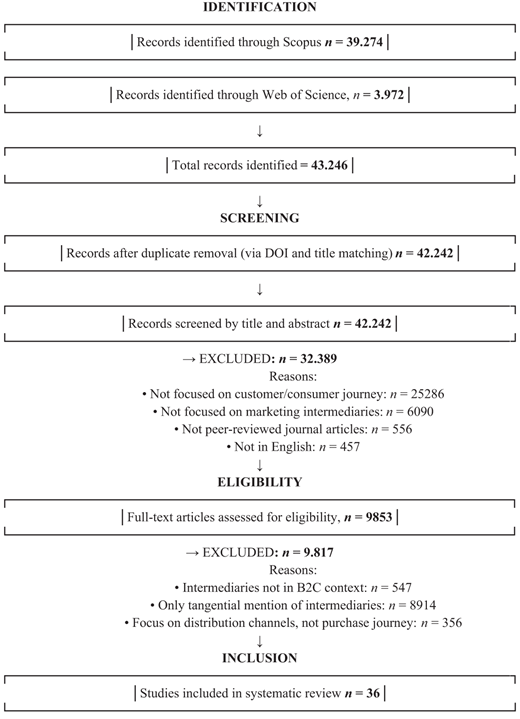
We used an SLR to gather and synthesize literature within a specific domain. The SLR aggregates works on a particular topic (Paul, Lim, O’Cass, Hao, & Bresciani, 2021) and suggests future research directions (Paul & Criado, 2020). Figure 1 outlines our review process following the PRISMA framework, showing the four stages – identification, screening, eligibility assessment and inclusion – with article counts and criteria at each stage.
To ensure reliability and validity, this research followed the methodological criteria established by Tranfield, Denyer, and Smart, (2003) and Hiebl (2021). The review process comprised three main phases as detailed below.
3.1 Phase 1: identification – database search strategy
The initial search was conducted in April 2024 using two comprehensive academic databases: Scopus and Web of Science. These databases were selected for their extensive coverage of business and management literature and for their widespread use in systematic reviews (Hiebl, 2021). Given the multidisciplinary nature of marketing intermediary research and the relatively recent consolidation of customer journey as a specific research stream, we adopted a deliberate two-stage screening approach. Two key considerations guided this methodological choice:
Initial investigations showed that “customer journey” is not consistently used as keywords or in titles/abstracts across relevant studies, particularly in earlier works examining intermediaries’ impact on purchasing processes; and
Limiting searches to “customer journey” could miss key studies that explore intermediary roles under different terms (such as “purchase decision-making” or “buyer behavior”).
As Hiebl (2021) suggests for cross-disciplinary topics, beginning with broader searches, followed by content screening, can enhance comprehensiveness while maintaining accuracy, helping identify relevant research across various terminological frameworks.
Therefore, our initial database search used a focused strategy on intermediary types:
Search String: (“marketing intermediar*” OR “surrogate consumer*” OR “opinion leader*” OR “influencer*” OR “expert source*” OR “supplier-affiliated intermediar*”)
Search fields: Title, abstract and keywords.
This search returned a total of 43,246 records (Scopus: n = 39,274; Web of Science: n = 3,972), reflecting the broad presence of intermediary research across marketing, consumer behavior and related fields.
3.2 Phase 2: screening – two-stage content assessment
Following the best practices for managing significant initial search results (Hiebl, 2021), we implemented a structured two-stage screening process with explicit inclusion and exclusion criteria.
3.2.1 Stage 1: database-level filtering.
We applied the following noncontent filters available in the database interfaces to narrow the initial set: - Document type: Articles (excluding conference papers, books, dissertations) – Language: English – Publication period: 1976–2024 [timeframe encompasses Donnelly’s (1976) seminal work through recent studies]. After applying these filters and removing n = 42.242 duplicates (via DOI and title matching using reference management software), n = 42.242 unique articles remained for title and abstract screening.
3.2.2 Stage 2: content-based screening for customer journey context.
The second stage involved detailed screening to ensure that the included articles substantively addressed intermediary roles in customer-journey contexts. This stage operationalized our research focus on how intermediaries influence customers across pre-purchase, purchase and post-purchase stages:
Content-related inclusion criteria:
Substantive analysis of marketing intermediary influence on customer purchase processes, decisions, or experiences.
Clear focus on business-to-consumer (B2C) contexts where intermediaries mediate customer–company interactions.
Examination of intermediary impact at one or more journey stages (pre-purchase information search and evaluation, purchase facilitation and decision support or post-purchase consumption and relationship management).
Content-related exclusion criteria:
Studies focusing solely on B2B intermediaries or distribution channel logistics without addressing customer experience.
Articles where intermediaries are mentioned only tangentially without substantive analysis of their roles.
Research examining intermediary functions exclusively from supply chain or operational efficiency perspectives without consideration of customer journey implications.
Two researchers independently screened 9,853 articles using an A/B/C system (Hiebl, 2021): (A) clearly relevant, (B) possibly relevant requiring full review or (C) irrelevant. This screening identified 36 articles for full-text review. Articles were excluded if they focused on distribution channels without customer experience (n = 8,914), addressed B2B intermediaries only (n = 547), or lacked analysis of intermediary roles in customer journeys (n = 356). The process yielded 36 articles examining marketing intermediaries in customer journeys, ensuring that the impact of all analyzed intermediaries on customer experiences was assessed.
3.3 Phase 3: data extraction and analysis
For each of the 36 included articles, we extracted:
intermediary type(s) examined;
customer journey stage(s) analyzed;
key dimensions or characteristics of intermediary influence identified;
theoretical frameworks used; and
empirical contexts and main findings.
We used iterative thematic coding, using deductive codes from four intermediary types: surrogate consumers, opinion leaders, expert sources and supplier-affiliated intermediaries. By reading and comparing articles, we inductively identified recurring dimensions that define intermediary roles. After multiple iterations, we merged the codes into ten essential dimensions that describe intermediary functioning across journey stages. Analysis followed the TCM framework (Paul & Criado, 2020), coding for:
themes: key dimensions of intermediary influence;
context: journey stages, product categories and customer segments; and
methods: research approaches and settings.
This enabled systematic comparison and pattern identification across intermediary types and journey stages.
To enhance transparency into how the TCM framework was applied, the Appendix provides a detailed summary of the key results for each TCM component. Specifically, the Themes component guided the identification and classification of the ten intermediary dimensions (e.g. control structure, engagement intensity and basis of influence). The Context component informed the analysis of journey stages (pre-purchase, purchase and post-purchase), product categories (experience goods, complex purchases and routine purchases) and customer segments (high-involvement vs low-involvement consumers). The Methods component enabled the systematic assessment of research approaches used across the 36 included studies, revealing that quantitative methods dominated (66%), followed by qualitative (31%) and mixed methods (3%). This structured application of the TCM framework ensured that the analysis moved beyond simple thematic grouping to capture how intermediary dimensions operate across different contexts and methodological traditions.
4. Results
Our systematic review of the 36 articles identified three main contributions to understanding marketing intermediaries in the customer journey. First, we identified ten key dimensions that define intermediary roles. Second, we analyzed how four intermediary types – surrogate consumers, opinion leaders, expert sources and supplier-affiliated intermediaries – influence customers across pre-purchase, purchase and post-purchase stages. Third, we offered a typology that maps how these intermediary types leverage the ten dimensions across journey stages, providing a structured vocabulary for systematic comparison. These findings show how marketing intermediaries shape customer experiences throughout the journey.
4.1 Ten key dimensions characterizing marketing intermediaries
Our thematic analysis identified recurring dimensions that characterize how marketing intermediaries operate and influence customer journeys. These dimensions emerged consistently across studies and intermediary types, though with varying emphases depending on the specific type and journey stage. Table 2 presents these dimensions, organized by nature (type-based vs degree-based), along with their definitions and supporting literature.
The dimensional framework is divided into two main categories: Type dimensions focus on the qualitative aspects of intermediary relationships; Control Structure deals with how decision-making power is shared among stakeholders (Rusbult & Van Lange, 2003); Covariation of Interest examines the alignment of stakeholder outcomes (Deutsch, 1949); Mutuality of Dependence considers the symmetry of interdependence (Emerson, 1962); Information Availability relates to the transparency of interactions (Akerlof, 1970); Temporal Structure outlines the patterns of stakeholder interactions (Kelley, 1984); Basis of Influence explores the ways intermediaries influence customer decisions (Solomon, 1986); and Degree Dimensions measure the intensity of stakeholder interactions, including Engagement Intensity, which assesses cognitive and behavioral investment (Hollebeek, Srivastava, & Chen, 2019), Interaction Frequency (Becker & Jaakkola, 2020), Relationship Duration (Palmatier, Dant, Grewal, & Evans, 2006) and Interdependence Strength. These dimensions provide a structured vocabulary for describing intermediary roles beyond context-specific descriptions. Unlike earlier studies that examined intermediaries in isolation, our framework enables systematic comparisons across different types and stages of the journey.
4.2 Four intermediary types and their influence patterns
The literature reveals four distinct intermediary types, each exhibiting unique dimensional profiles and stage-specific influence patterns:
Surrogate consumers maintain a strong, consistent influence across all stages of the journey through high control, formal relationships and direct customer compensation (Solomon, 1986; Forsythe, Butler, & Schaefer, 1990). They exercise unilateral decision authority, conduct detailed needs assessments and assume fiduciary responsibility for outcomes (Hollander & Rassuli, 1999; Aggarwal & Mazumdar, 2008). Their influence spans pre-purchase consultation, purchase execution and post-purchase optimization (Arora & Bawa, 2022).
Opinion leaders exert their influence during the pre-purchase stage through informal communication and experiential credibility (Flynn, Goldsmith, & Eastman, 1996; Casaló, Flavián, & Ibáñez-Sánchez, 2020). They provide social proof and product information without direct compensation or decision control (Aggarwal, 1997). Their perceived impartiality stems from their independence from commercial relationships (Fakhreddin & Foroudi, 2022), making them particularly influential during the information search stage but largely absent during the purchase and post-purchase stages (Risselada, Verhoef, & Bijmolt, 2016).
Expert sources leverage professional credentials and technical knowledge to exert strong pre-purchase influence and moderate purchase involvement (Larrick & Feiler, 2015; Camerer & Johnson, 1991). They provide prescriptive advice based on specialized expertise, operate under professional ethical standards and share responsibility for outcomes (Biswas, Biswas, & Das, 2006). Unlike surrogate consumers, their engagement is typically project-based rather than ongoing (Aqueveque, 2015).
Supplier-affiliated intermediaries navigate dual allegiance between customer and supplier interests (Hollander & Rassuli, 1999). Despite moderate pre-purchase influence limited by impartiality concerns, they exert the strongest influence during purchase through transaction facilitation and maintain strong post-purchase engagement through service provision (Bahar et al., 2021). Their indirect supplier compensation creates both opportunities for value creation and risks of misaligned incentives (Gadde & Snehota, 2001).
Comparative analysis reveals three patterns. First, no single type dominates across all stages; each exhibits distinctive strengths in particular phases. Second, the ten dimensions combine differently across types, creating unique “dimensional profiles.” Third, these patterns suggest firms should strategically select different intermediary types based on specific journey stages they wish to influence.
4.3 Integrative framework: mapping influence across journey stages
Table 3 operationalizes the ten-dimensional framework (Table 2) by mapping how each intermediary type manifests these dimensions. This comparative analysis reveals distinctive dimensional profiles across the four intermediary types, demonstrating that while all types share the fundamental characteristic of mediating customer–company interactions, their specific configurations vary systematically.
The pre-purchase phase shows intense intermediary activity, with all four types influencing customer information search and evaluation. During the purchase process, surrogate consumers and supplier-affiliated intermediaries play significant roles, while opinion leaders and expert sources lose influence. In post-purchase, surrogate consumers and supplier-affiliated intermediaries predominate, with minimal presence of opinion leaders and experts.
This dimensional framework provides the first comprehensive model of marketing intermediary diversity and impact across journey stages, demonstrating versatility across diverse stakeholder contexts. In B2B partnerships, joint control structures and symmetric dependence characterize long-term relationships with continuous engagement, as exemplified by Apple’s supplier relationships and Coca-Cola’s distributor networks. These relationships exhibit high engagement intensity and a strong emphasis on coordination throughout the journey.
Moreover, B2C transactions feature stakeholder control, uneven dependence and infrequent interactions (Lemon & Verhoef, 2016; Grewal & Roggeveen, 2020). Online shopping shows moderate engagement and brief relationships, with coordination and competition dynamics. Employee–employer relationships evolve from high partner control to balance as relationships mature, maintaining engagement during career progression. Competitor interactions show shared control, with competition-driven variations and fluctuating engagement due to irregular interactions.
5. Discussion
Our literature review shows that marketing intermediaries act as co-creators of customer experiences rather than just exchange facilitators (Gadde & Snehota, 2001; Pokhrel & Thapa, 2007). The typology proposed in this study reveals that the dimensions identified – especially personalization, control structure and temporal engagement – show that intermediaries shape value across the pre-purchase, purchase and post-purchase stages. Surrogate consumers help creating customer experiences (Solomon, 1986; Forsythe et al., 1990; Arora & Bawa, 2022), while opinion leaders shape pre-purchase decisions through experiential credibility in digital environments (Casaló et al., 2020; Fakhreddin & Foroudi, 2022).
Intermediaries establish interdependent relationships with customers that alter journey dynamics. Intermediaries can experience touchpoints on behalf of customers, usurping their role in the journey (Solomon, 1986; Forsythe et al., 1990; Arora & Bawa, 2022). Their unilateral actions determine outcomes, with surrogate consumers and supplier-affiliated intermediaries maintaining high engagement across journey stages (Li & Feng, 2021). Customer dependence directly correlates with intermediaries’ power over journey outcomes (Hollebeek et al., 2023; Steffel & Williams, 2018).
The dimensional framework shows versatility across stakeholder contexts. B2B partnerships feature joint control and symmetric dependence in long-term relationships, as in Apple’s supplier relationships and Coca-Cola’s distributor relationships. B2C contexts have high stakeholder control, asymmetric dependence and sporadic interactions (Lemon & Verhoef, 2016; Grewal & Roggeveen, 2020). E-commerce and retail demonstrate moderate engagement intensity with mixed coordination dynamics.
Employee–employer relationships evolve from controlled to balanced dynamics during onboarding, while competitor interactions feature shared control with low dependency through market exchanges. Intermediaries’ interests guide their actions: supplier-affiliated intermediaries prioritize firms while serving customers, expert sources focus on customers while meeting firms’ needs and surrogate consumers aim to coordinate to enhance satisfaction (Hollebeek et al., 2023). This interest alignment influences intermediary patterns and creates divided customer journeys based on purchases and assessments.
These findings extend stakeholder journey theory (Hollebeek, Kumar, & Srivastava, 2022a, 2023) by showing intermediaries’ dimensional configurations vary across journey stages. The framework advances customer journey research (Lemon & Verhoef, 2016; Becker & Jaakkola, 2020) by modeling patterns of intermediary diversity and influence. By integrating interdependence theory (Kelley & Thibaut, 1978; Rusbult & Van Lange, 2003) with journey conceptualization, we show how relationship characteristics and interaction patterns shape customer experiences.
5.1 Final considerations
This research emphasizes the crucial role of marketing intermediaries in shaping customer experiences by responding to stimuli during managerial and consumption processes. These intermediaries facilitate customer journeys as company representatives or systemic stakeholders. The article identifies four types of marketing intermediaries, ten characteristics and their impact across purchasing stages. The resulting typology maps how surrogate consumers, opinion leaders, expert sources and supplier-affiliated intermediaries leverage these ten dimensions across customer journey stages, providing a structured vocabulary for analyzing intermediary diversity and impact. Findings show that surrogate consumers and supplier-affiliated intermediaries influence all journey stages, while opinion leaders and expert sources influence the pre-purchase phases. Their effects vary by context despite shared traits. This perspective illuminates the overlooked role of intermediaries in customer experiences and suggests research opportunities in managerial stimuli, consumption processes and integrative approaches, given the growing interest in customer experience.
5.2 Theoretical implications
Our framework offers three key theoretical contributions. First, we identify ten dimensions to define intermediary roles beyond context-specific descriptions, enabling researchers to specify characteristics in terms of these dimensions. Second, our four-type framework enables systematic comparison across intermediary types using standard dimensions, showing that all mediate customer–company relationships, but with varying levels of control. Third, we confirm that intermediary influence varies throughout the customer journey: opinion leaders and expert sources dominate the pre-purchase stages. In contrast, surrogate consumers and supplier-affiliated intermediaries operate throughout the stages, advancing customer journey theory by mapping intermediaries to touchpoints.
5.3 Managerial implications
Our dimensional framework guides intermediary selection using ten dimensions as assessment criteria. For experience goods, impartial opinion leaders with informal communication are effective. Complex purchases benefit from surrogate consumers offering control and personalization. For full journey support, supplier-affiliated intermediaries or surrogates with broad involvement work best. Performance evaluation uses three key metrics: opinion leaders’ impartiality, surrogate consumers’ personalization and intermediaries’ balance of responsibility.
5.4 Limitations
Despite the contributions outlined above, this study has several limitations that should be acknowledged. First, the SLR is confined to articles published in English and indexed in the Scopus and Web of Science databases, potentially excluding relevant studies published in other languages or available in other databases. Second, while the search strategy was deliberately broad to capture diverse intermediary research, the two-stage screening process relied on content-based assessment by two researchers, which, despite inter-rater checks, may have introduced some subjectivity in article selection. Third, the proposed typology and dimensional framework are derived from existing literature and have not been empirically validated through primary data collection. Future research should test the framework across different product categories, cultural contexts and digital environments. Fourth, the rapid evolution of digital intermediaries (e.g., algorithmic recommendation systems, AI-based shopping assistants) may not be fully captured in the current literature, suggesting that the framework will need to be updated as new intermediary forms emerge. Finally, the mapping of intermediary influence across journey stages is based on patterns identified in the reviewed studies and represents tendencies rather than deterministic relationships, as contextual factors may moderate these influence patterns in ways not fully explored here.
5.5 Further research
This article advances intermediary research by synthesizing disparate findings into a cohesive framework mapping intermediary dimensions across customer journey stages. While previous research has explored isolated aspects of intermediary influence (Aggarwal, 1997; Solomon, 1986) or specific types, such as opinion leaders (Casaló et al., 2020), our framework enables systematic comparisons across types, stages and contexts. We propose several testable propositions to guide future empirical research, as presented in Table 4.
Future research can test these propositions across settings. Our findings provide frameworks for intermediary-customer interactions. Quantitative methods (66%) dominated, followed by qualitative (31%) and mixed methods (3%). Research should combine qualitative and quantitative approaches while using longitudinal methods to track intermediary performance. Studies should examine the effectiveness of promotional tools across intermediary types. Understanding the complexity of intermediaries can build customer trust. Comparative studies would validate the model for context-specific strategies.
The authors would like to thank Professor Larissa Becker and the two anonymous reviewers for their very insightful comments.
Author contributions
Daiane Pereira da Fonseca, Conceptualization (Equal), Data curation (Equal), Formal analysis (Equal), Investigation (Equal), Methodology (Equal), Resources (Equal), Software (Equal), Visualization (Equal), Writing – original draft (Equal), Writing – review and editing (Equal); Karim Marini Thomé – Corresponding Author, Conceptualization (Lead), Investigation (Equal), Project administration (Lead), Supervision (Lead), Visualization (Equal), Writing – original draft (Lead), Writing – review and editing (Lead); Ricardo Limongi, Conceptualization (Equal), Formal analysis (Equal), Investigation (Equal), Methodology (Equal), Visualization (Equal), Writing – original draft (Equal), Writing – review and editing (Equal)