This research aimed to develop a novel photocurable biobased resin for LCD 3D printing of reprocessable catalyst-free vitrimer.
A series of new photocurable biobased resins composed of dipentaerythritol pentaacrylate, 1,3-diglycerolate diacrylate, mixture of glycerol methacrylate isomers and resveratrol triglycidyl ether were designed without transesterification catalyst and their photocuring features were investigated to determine the most suitable for LCD 3D printing. The photocuring kinetics was investigated by real-time photorheometry. The thermal and mechanical properties, stress relaxation, self-welding, reprocessability and LCD 3D printability of the selected polymer were investigated.
The determined influence of different resin components is as follows: dipentaerythritol pentaacrylate and 1,3-diglycerolate diacrylate increase photocuring rate and rigidity of resulting polymers, mixture of glycerol methacrylate isomers reduces viscosity and resveratrol triglycidyl ether reduce shrinkage. The selected polymer exhibits vitrimeric properties and thermal stability higher by ca. 100°C than that of most biobased vitrimers reported in the literature and other polymers obtained from the commercial resins for optical 3D printing.
This study demonstrates the importance of resin design for successful application in optical 3D printing and reveals the main challenges in selecting the right components to obtain the targeted vitrimer properties. The exceptional thermal stability and LCD 3D printability of the developed vitrimer are important for manufacturing precise and complex products for various industries, while self-welding and reprocessing capabilities are crucial for the reuse of such products.
1. Introduction
Plastic waste pollution is one of the most concerning environmental issue globally (Phelan et al., 2022). In Europe, almost 40% of plastics are used as packages where they are single-use and end up in the environment (Ceballos-Santos et al., 2024; Gündoğdu et al., 2024). The high demand of plastics for packaging is due to their versatility, low cost, chemical resistance and lightweight (Phelan et al., 2022). Increasing plastic waste pollution and limitations in recyclability are driving scientists to look for new and more environmentally friendly materials (Gonzalez et al., 2025; Willis et al., 2025).
Vitrimers are a relatively new class of polymeric materials that can help solve the worldwide plastic waste pollution problem (Zhang et al., 2024). Vitrimers combine the mechanical properties of thermosets and the recyclability properties of thermoplastics (Zheng et al., 2021). They are strong and rigid due to their crosslinked structure and can be easily recycled using dynamic covalent bonds that undergo exchange reactions (Zee and Nicolaÿ, 2020). There are several types of vitrimers bond exchange reactions: disulfide exchange, imine exchange, boronic ester exchange, transesterification, etc. (Denissen et al., 2015). One of the most common and easiest types of bond exchange in vitrimers is the thermally activated transesterification reaction of the ester and hydroxyl groups (Zhou et al., 2025; Liu et al., 2020). The transesterification catalyst is usually crucial for stress relaxation and reprocessability of vitrimers, and the most widely used one is zinc acetylacetonate hydrate (Kumar et al., 2025). However, most catalysts, including zinc acetylacetonate hydrate, are commonly expensive and toxic and can cause serious health damage (Tran et al., 2024). Because of that catalyst-free vitrimers are of great interest to the scientific community (Cai et al., 2025).
Catalyst-free vitrimers provide all the positive features of vitrimers and makes them environmentally friendly due to their low toxicity. Recently catalyst-free epoxy vitrimer with repairability properties was synthesized using thermal polymerization of trifunctional amine and was able to maintain flexural strength similar to the original sample after four healing cycles (Li et al., 2025). Gallic acid was used for the thermal polymerization of epoxy-based catalyst-free vitrimer with a high glass transition temperature (109–122°C) (Yao et al., 2024). Lately, a fully biobased, catalyst-free vitrimer was synthesized using tannic acid and showed promising scratch healing, shape memory and welding properties (Li et al., 2024). However, most biobased catalyst-free vitrimers have low thermal stability which limit their areas of application (Sereikaite et al., 2025). High thermal stability enables their application in high temperature environments such as automotive, aerospace or electronics and ensures that the vitrimers do not undergo thermal destruction during use (Abdelbary, 2014). That is highly important because it prevents the release of harmful organic compounds which might occur during thermal decomposition (Shanmugam et al., 2024). Furthermore, most catalyst-free vitrimers, reported in the literature, are synthesized using thermal polymerization, which is a time and energy consuming process, and only a few of them are synthesized using a more environmentally friendly photopolymerization method (Shi et al., 2017).
Photopolymerization allows a rapid production of vitrimers at room temperature with low production waste generation (Vilanova-Pérez et al., 2024). Recently, a biobased catalyst-free vitrimer was synthesized by photopolymerization using glycerol derivative and showed promising self-welding properties and reprocessability, and was also successfully applied in optical 3D printing technology (Sereikaite et al., 2025). This technology allows products to be printed very accurately and with a smooth surface finish, which is impossible to achieve using other 3D printing techniques (Sun et al., 2005). Optical 3D printing generates only a small amount of production waste compared to other manufacturing techniques, most of which are defective models and supports of the printed models (Afridi et al., 2024). However, due to the small amount of optical 3D printing production waste, it is too expensive to recycle them, and they are mainly thrown away in landfills (Husna et al., 2024). Reprocessability of vitrimers would allow the reuse of even small amounts of printing waste for the manufacturing of new products, thereby reducing plastic pollution (Toldy et al., 2025).
The aim of this work was to develop a new photocured catalyst-free transesterification vitrimer with high thermal stability, suitable for optical 3D printing technology. A photocurable system was composed of epoxy monomer selected for the increase of rigidity and reduced shrinkage of resins (Pabricaite et al., 2024) and acrylate monomers, which were selected to increase the photocuring rate of resins and control the viscosity. Three biobased acrylate monomers dipentaerythritol pentaacrylate (produced by chemical modification of vegetable oils (Sereikaite et al., 2025), glycerol 1,3-diglycerolate diacrylate and mixture of glycerol methacrylate isomers (both can be produced from glycerol, obtained as a by-product of biodiesel production (Ngaosuwan, 2024). These acrylate monomers were selected due to their wide viscosity range and high amount of hydroxy and acrylic functional groups. Resveratrol triglycidyl ether (produced by chemical modification of resveratrol that is formed naturally by various plants such as grapes (Koushki et al., 2018) was selected as epoxy monomer due to its rigid aromatic structure. Two photoinitiators, free-radical TPO and cationic CPI-410S, were selected for this study due to the high activity at 405 nm, which is necessary for LCD 3D printing. Elegoo Mars Pro LCD 3D printer was chosen for this study due to its high printing speed and cost-effectiveness (Chaughule and Dashaputra, 2021). Composed resins were investigated by real-time photorheometry to select the most promising one for LCD 3D printing.
2. Materials
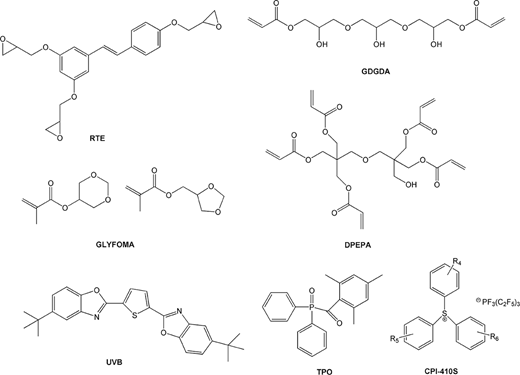
Dipentaerythritol pentaacrylate (DPEPA, Merck), 1,3-diglycerolate diacrylate (GDGDA, Merck), mixture of glycerol methacrylate isomers (GLYFOMA, Evonik), resveratrol triglycidyl ether (RTE, Specific Polymers) diphenyl(2,4,6-trimethylbenzoyl) phosphine oxide (TPO, Merck), sulfonium salt CPI-410S (CPI-410S, San Apro) and 2,5-bis(5-tert-butyl-2-benzoxazolyl) thiophene (UVB, Merck) were used as received (Scheme 1). The compositions of the resins are presented in Table 1.
2.2 Composition of photocurable resins
The primary mixtures containing 10 w.% of RTE, 30–90 w.% of GDGDA, 0–60 w.% of GLYFOMA, 0–30 w.% of DPEPA, 2.5 w.% of photoinitiator TPO, 2.0 w.% of photoinitiator CPI-410S and 0.08 w.% of UVB were mixed at 25°C for 10 min until they had a homogeneous consistency (Table 1).
2.3 Preparation of photopolymer samples
Polymer samples were prepared using LCD 3D printer Elegoo Mars Pro. Printed polymer specimens (70x10x1 mm) were then washed with isopropanol and post-cured for 5 min under a UV/Vis lamp with 310 mW/cm2 intensity.
2.4 Methods
The methodology of the experiments and measurements performed in this study is described in detail in the Supplementary material file. Polymer structure was characterized by Fourier transformation infrared spectroscopy (FT-IR), Soxhlet extraction and swelling tests. The thermal properties of polymers were examined by dynamic mechanical thermal analysis (DMTA) using the shear mode and thermogravimetrical analysis (TGA). The tensile test was performed to determine mechanical characteristics. Microsoft Excel program ANOVA was used to statistically analyze the results.
3. Results and discussion
3.1 Photocuring kinetics
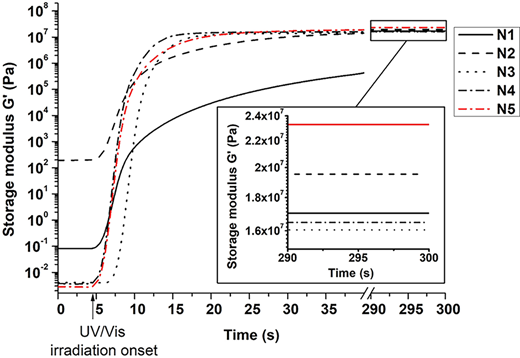
Real-time photorheometry was used to investigate rheological characteristics of photocurable resins and to select the most promising resin for LCD 3D printing. The results are presented in Table 2 and Figure 1. Resin N1 was composed of 70 w.% of acrylate monomer 1,3-diglycerolate diacrylate and 30 w.% of epoxy monomer resveratrol triglycidyl ether. GDGDA was selected because of its biobased origin and three hydroxy groups in its structure, which are crucial for successful transesterification reactions (Hayashi and Ricarte, 2025). RTE was selected because of the biobased origin and aromatic structure, as the rigid aromatic structure reduces shrinkage and increases mechanical strength and thermal stability of the resulting polymers (Mohanty and Bae, 2015). Sample N1 had a very low shrinkage (4.5%), but the high viscosity of the resin N1 (30703 mPa·s) made it unsuitable for 3D LCD printing. To reduce viscosity, the amount of highly viscous RTE was reduced from 30 to 10 w.% and the resin N2 was composed. This change reduced the viscosity and increased the shrinkage value almost by double. However, the viscosity of N2 was still too high. To further reduce viscosity, the amount of GDGDA was reduced to 30 w.% and 60 w.% of other acrylate monomer GLYFOMA was added to the composition (N3). The addition of GLYFOMA greatly reduced the viscosity to 47 mPa·s, but also increased the shrinkage and the value of the gel point (tgel). Next, the amounts of both acrylate monomers were changed to 45 w.% to reduce the gel point and the resin N4 was composed. The resulting resin had a lower gel point (1.75 s) and low viscosity (176 mPa·s), but the storage modulus was too low (16.50 MPa). To increase the rigidity and storage modulus of polymers, DPEPA was added to the composition and resin N5 was prepared using 30 w.% of each acrylate monomer and 10 w.% of epoxy monomer. The resin N5 had a low gel point (1.75 s), a suitable viscosity for LCD 3D printing (381 mPa·s) and the resulting polymer showed high rigidity of 22.96 MPa. After evaluating these results, resin N5 was selected for further investigation as the most suitable for LCD 3D printing.
3.3 Characterization of polymer structure
The FT-IR results are described in Supplementary Material section S2. Results and Figure S1 in Supplementary Material. Swelling tests (Figure S2 in Supplementary Material) and soxhlet extraction were performed to confirm the cross-linked structure of the vitrimer N5. The high value of the yield of insoluble fraction (93.0%) and the very low swelling values after 8 h of swelling in water (0.6%), acetone (0.9%) and toluene (0.0%) confirm that a rigid polymer network with short chains between crosslinking points was formed. These results show that the polymer structure is more similar to that of polar solvent acetone than that of nonpolar solvent toluene, allowing polar solvent molecules to penetrate the polymer more easily.
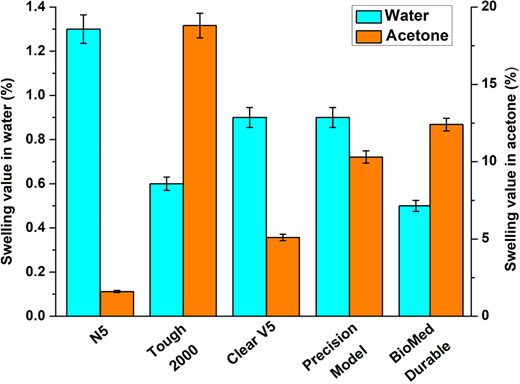
To further analyze the results of vitrimer swelling, the swelling value was measured after 24 h. Similarly to previous results, no swelling was indicated in toluene and the highest swelling value was indicated in acetone (1.6%) and water (1.3%). These results were compared to polymers synthesized from some common commercially available resins for optical 3D printing (Figure 2). N5 had a slightly lower swelling value in acetone compared to Formlabs Clear V5 and a much lower value compared to Formlabs Tough 2000, Precision model and BioMed Durable. However, the swelling value in water was slightly higher compared to all polymers synthesized from commercially available resins for optical 3D printing (Formlabs, 2025). These results prove that vitrimer N5 is suitable for optical 3D printing and is resistant to non-polar solvent toluene and only swells slightly in polar solvents, such as water and acetone.
3.4 Thermal characteristics
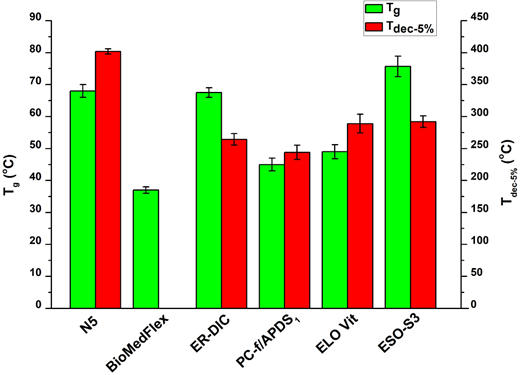
Thermogravimetrical analysis (TGA) and dynamical mechanical thermal analysis (DMTA) were selected to determine the thermal characteristics of vitrimer N5. DMTA and TGA curves are presented in Figure S3 in Supplementary material. Vitrimer had a high glass transition temperature (Tg) – 68°C, which was almost twice higher than that of the polymer synthesized from commercially available BioMed Flex 80A resin (Tg = 37°C) (Formlabs, 2025) (Figure 3). Vitrimer N5 showed promising results compared to other biobased vitrimers prepared by thermal polymerization. It had a higher Tg than polybenzoxazine-based vitrimer PC-f/APDS1 (Wang et al., 2025a, 2025b) and epoxidized linseed oil-based vitrimer ELOVit (Sangaletti et al., 2023). Compared to other vitrimers, the vitrimer N5 had Tg very similar or slightly lower than that of the vitrimer based on resorcinol diglyceryl ether ER-DIC (Zhan et al., 2025) and catalyst-free epoxidized soybean oil-based vitrimer ESO-S3 (Li et al., 2024). These results confirm that Tg of vitrimer N5 is similar or higher than that of other biobased vitrimers.
Furthermore, N5 showed high thermal stability with a temperature of 5% weight loss (Tdec-5%) of 402°C. This value was higher than that of most biobased vitrimers reported in the literature (Figure 4). The high Tdec-5% and Tg expands the areas of application to aerospace, automotive, electronics and other industries.
3.5 Mechanical properties
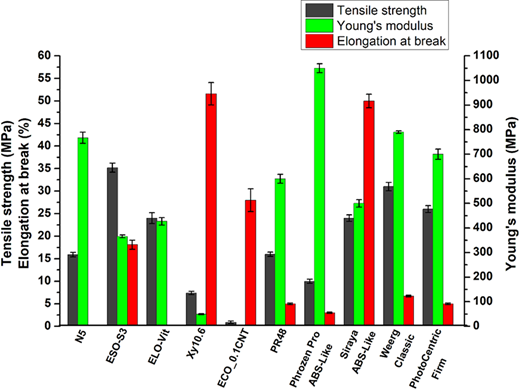
The tensile test showed that catalyst-free vitrimer N5 is a rigid and stiff material with a high value of Young’s modulus (767 MPa) and tensile strength (16 MPa) and minimal elongation at break (0.2%). The tensile stress-strain curve is presented in the Supplementary Figure S4. High stiffness and low elongation at break indicate that polymer is brittle. The brittleness is a critical factor limiting the use of polymers in structural components, however brittleness can also be used as advantage. Brittle polymers usually are hard and scratch resistant, therefore can be used as coatings (Gao et al., 2025). N5 showed higher Young’s modulus values and lower elongation at break than vitrimers produced by thermal polymerization ESO-S3 (Li et al., 2024), ELOVit (Sangaletti et al., 2023), Xyl0.6 (Li et al., 2023) and castor oil-based vitrimer prepared by photopolymerization ECO_0.1CNT (Bergoglio et al., 2024) (Figure 4). However, the tensile strength of vitrimer N5 was lower than that of the epoxidized soybean oil-based vitrimer ESO-S3 (Li et al., 2024) and the epoxidized linseed oil-based vitrimer ELOVit (Sangaletti et al., 2023), indicating that vitrimer N5 is more rigid compared to those vitrimers. The mechanical characteristics of the N5 vitrimer were compared to those of the polymers synthesized from commercially available resins for 3D printing and were similar to those of PR48 (Arkema. 3D Printing Development Center, 2025) and Phrozen Pro ABS-Like (Ultimate 3D printing, 2025) (Figure 4). Young’s modulus, and elongation at break of vitrimer N5 were similar to Siraya ABS-Like (Siraya Tech, 2025), Weerg Classic (Weerg. 3D Printing Services, 2025) and PhotoCentric Firm (Photocentric Inc, 2025); however tensile strength was lower indicating its rigidness. The results show that the mechanical characteristics of the N5 vitrimer are comparable with other biobased vitrimers and polymer samples prepared by optical 3D printing of commercial resins.
3.6 Stress relaxation of vitrimer
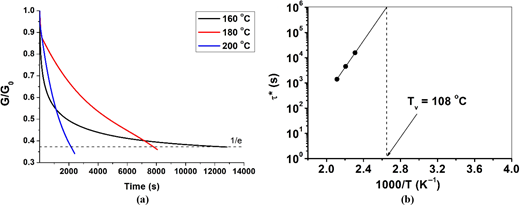
Vitrimers can rearrange their inner network and reduce the relaxation of inner stress by dynamic bond exchange (Liu et al., 2020). Topology rearrangements were investigated by measuring the stress relaxation of polymer N5, and the topology freezing transition temperature (Tv) was determined from the Arrhenius curves for relaxation time of 106 s (Figure 5a–b). The Tv of the vitrimer N5 was 108°C. Relatively low Tv allows vitrimer reprocessing at lower temperature compared to other vitrimers and thermosets and reduces the energy cost of reprocessability due to the low temperature required (Toldy et al., 2025).
3.7 Self-welding behavior of vitrimer
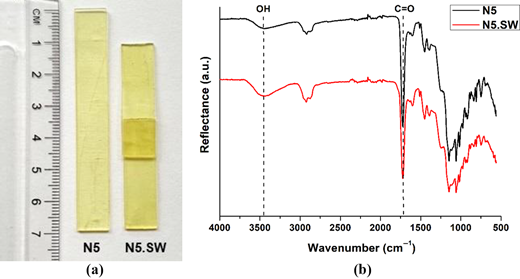
The tensile test was performed to investigate mechanical characteristics of self-welded vitrimer N5.SW and to compare the results obtained with those of the original catalyst-free vitrimer N5 sample. Tensile stress-strain curves are presented in Figure S4 in Supplementary material. The pictures of the original (N5) and self-welded (N5.SW) samples are presented in Figure 6a. Young’s modulus was slightly reduced from 767 to 643 MPa after self-welding compared to the original sample. Tensile strength was also reduced from 16 to 7 MPa indicating that after self-welding the vitrimer became more rigid. The elongation at break remained the same and was lower than 1%. FT-IR spectra of the original and self-welded sample were recorded to confirm that no chemical reaction occurred during self-welding (Figure 6b), and no visible changes between the N5 and N5.SW vitrimer spectra were observed.
3.8 Reprocessability of vitrimer
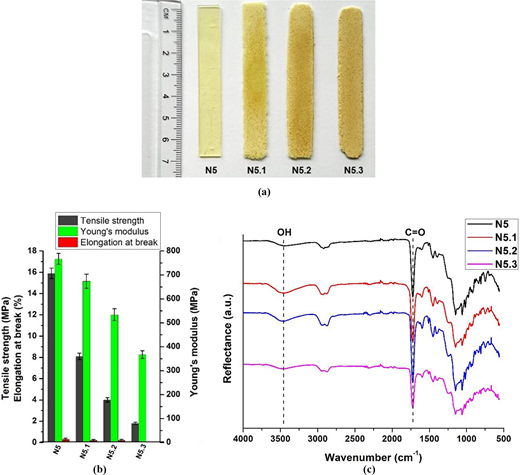
Reprocessability allows the production of new products using polymer waste. Three hot press reprocessing cycles were performed to catalyst-free vitrimer N5, and numbers 1, 2 or 3 were added to the vitrimer codes indicating the first (N5.1), second (N5.2) and third (N5.3) cycle. The pictures of the original (N5) and samples after each reprocessing cycle are presented in Figure 7a. The tensile test was performed to investigate mechanical characteristics of the vitrimer after each cycle of reprocessing. Tensile stress-strain curves are presented in Figure S4 in Supplementary material. The results are presented in Figure 7b. Young’s modulus and tensile strength values gradually decreased after each reprocessing cycle. The reason for that might be microstructural damage or nonreversible bond breakage due to thermal destruction of vitrimer caused by repeated heating cycles, inappropriate process conditions such as too low or too high pressure or temperature and uneven distribution of vitrimer powder in the pressing frame forming air gaps in vitrimer specimen, which are common causes of reduced mechanical strength in vitrimers (Lorenz et al., 2025; Toldy et al., 2025). The elongation at break remained the same after all cycles of reprocessing and was less than 1%. FT-IR spectra of the original vitrimer N5 and reprocessed vitrimer samples N5.1, N5.2 and N5.3 were recorded to confirm that no chemical reaction occurred during reprocessability process (Figure 7c), and there were no visible changes between N5 vitrimer spectrum and spectra of its samples after reprocessing. These results show that vitrimer N5 is suitable for reprocessing and can be used for the production of new products by hot pressing.
3.9 Shape-memory properties of vitrimer
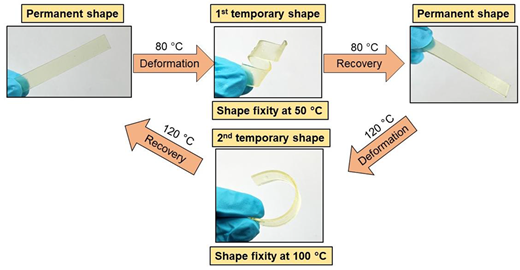
Vitrimer N5 showed thermoresponsive shape-memory properties and was able to maintain two temporary shapes determined by its Tg and Tv. The shape-memory behavior of vitrimer N5 is presented in Figure 8. The first temporary shape was obtained by reshaping the vitrimer sample at a temperature higher than its Tv and then fixing it by cooling it down to a temperature lower than Tv. The second shape is obtained by reshaping the vitrimer at temperature higher than its Tg, and then fixing it by cooling it down to a temperature lower than Tg. Vitrimer N5 was able to maintain its temporary shapes and return to its permanent shape according to temperature. Between the temperatures of Tg and Tv the mobility in vitrimer chains is increased making it more elastic, while dynamic covalent network still maintains fixed topology. As a result, vitrimer acts like a thermoset with some elasticity (Denissen et al., 2015).
3.10 LCD 3D printing
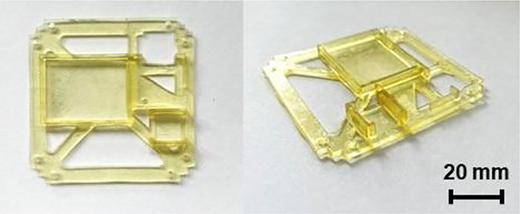
The printability of N5 resin was tested using a Elegoo Mars Pro LCD 3D printer, and the packaging component of electronic devices such as solar panels, sensors or other microschemes (Figure 9) was successfully printed, showing that the selected resin is suitable for this technology (Hirankittiwong et al., 2025). 3D printing was performed several times for the replicas of the same component and showed good reproducibility under selected parameters with identical product quality, e.g. smooth surface, transparency and precise shape. Optical 3D printing enables fast fabrication of precise complex shape products, which cannot be made using other technologies, and generates low amount of waste (Das et al., 2025). It is an environmentally friendly process that helps reduce plastic pollution (Madineh et al., 2025). Another advantage of optical 3D printing compared to other technologies (such as extrusion, cast molding, etc.), is the cheap and fast personalization of products (Wang et al., 2025a, 2025b). The shape of the product can be easily adapted to personal needs by changing the model using only a computer program, and there is no need for expensive molds (Singh et al., 2025). Furthermore, optical 3D printing enables printing of small quantities of products or several different products at the same time. This feature is very important not only for packaging production, but also in other areas such as medicine, optics, aerospace technology and others (Erdem et al., 2023). The suitability of resin N5 for optical 3D printing expands its areas of application to various fields including medicine, aerospace, automotive, electronics and other (Khan, et al., 2026).
4. Conclusions
In this study, new catalyst-free photosensitive resins composed of dipentaerythritol pentaacrylate, 1,3-diglycerolate diacrylate, mixture of glycerol methacrylate isomers and resveratrol triglycidyl ether were successfully designed and their photocuring features were investigated to determine their suitability for LCD 3D printing and investigate the properties of most suitable vitrimer. The main conclusions are as follows:
Dipentaerythritol pentaacrylate and 1,3-diglycerolate diacrylate increase photocuring rate and rigidity of resulted polymers, mixture of glycerol methacrylate isomers reduces viscosity and resveratrol triglycidyl ether reduce shrinkage. Resin composed of 30 w.% of dipentaerythritol pentaacrylate, 30 w.% of 1,3-diglycerolate diacrylate, 30 w.% of mixture of glycerol methacrylate isomers and 10 w.% of resveratrol triglycidyl ether combined benefits of all monomers and was selected as the most promising for LCD 3D printing technology.
Synthesized vitrimer had high yield of insoluble fraction (93.0%) and very low swelling values similar to polymers produced from commercial 3D printing resins. Vitrimer had high temperature of 5% weight loss (402°C), which was higher than those of most biobased vitrimers and its glass transition temperature was 68°C.
Vitrimer demonstrated promising self-welding behavior and reprocessability. The Young’s modulus was slightly reduced from 767–643 MPa after self-welding compared to original sample. The values of Young’s modulus and tensile strength decrease after each cycle of reprocessing by 25% and 50%, respectively.
The selected resin was applied in LCD 3D printing technology using Elegoo Mars Pro 3D printer and the packaging component of electronic devices was printed accurately with a smooth surface finish showing that selected resin is suitable for this technology.
This study presents new catalyst-free biobased transesterification vitrimer with high thermal stability, as well as self-welding behavior and reprocessability. This vitrimer has huge potential for the production of 3D printed packaging components with the ability to easily repair or reshape them after use.
References
Supplementary material
The supplementary material for this article can be found online.