


The aim of this paper is to examine if the use of aggregated graph format and visual cues in graphical visualization of sales historical data can mitigate the end-anchoring effect and improve judgment accuracy.
We run an experimental study in which participants assume the role of a marketing manager who has to judge the need for additional investments in a marketing campaign.
We find that aggregated vs disaggregated graph format to visualize sales historical data increases the likelihood of perceiving the correct sales pattern and that this correct pattern identification results in more accurate judgment about the need for additional marketing investments. In addition, while the moderation effect is not statistically significant, there is an observed tendency for the aggregated graph format to be associated with higher judgment accuracy when visual cues are absent.
The main practical implication of this paper is that the use of an aggregated graph format may help mitigate the end-anchoring effect more effectively than a disaggregated format. This insight can guide professionals responsible for providing support to decision makers in choosing appropriate data visualization formats.
This research provides new evidence regarding the occurrence of the end anchoring in graph analysis, as well as possible ways to mitigate this bias.
1. Introduction
The use of graphs for business decision-making is ubiquitous because they facilitate data interpretation (Beattie and Jones, 2002; Hellmann et al., 2017; IMA, 2021). Several studies have investigated how different graph features can influence decision-making, including the potential for biases that impair judgment (Amer, 2005; Godau et al., 2016; Kim and Lakshmanan, 2021; Tao et al., 2018). In this paper, we focus on the end-anchoring effect (Duclos, 2015) and examine two graph features – level of aggregation and the inclusion of visual cues – that may help mitigate this bias, thereby improving judgment accuracy. Judgment accuracy refers to the process of forming beliefs or estimates (e.g. assessing data trends), which often precedes decision-making, such as selecting a marketing strategy (Bonner, 2008; Nelson and Tan, 2005). Because poor judgments can lead to suboptimal decisions, it is essential to understand how, and under which conditions, graph features affect judgment accuracy.
The end-anchoring effect is a subset of the broader anchoring bias. Anchoring bias refers to the tendency to rely heavily on an initial reference point (anchor) when making judgments, and the end-anchoring effect specifically refers to the tendency to disproportionately select extreme ends of a response scale (Furnham and Boo, 2011; Tversky and Kahneman, 1974; Wu and Cheng, 2011). This bias can manifest in various settings, such as survey research using Likert-type scales (e.g. Baumgartner and Steenkamp, 2001) and performance evaluations (e.g. Murphy and Cleveland, 1995). The end-anchoring effect tends to emerge more prominently when quantitative data is displayed graphically, as individuals often use the most recent or final data point as a mental anchor (Duclos, 2015; Theocharis and Harvey, 2016; Theocharis et al., 2019).
A key management control problem with the end-anchoring effect in a graph is that focusing on the graph's endpoint can lead to short-term bias and misinterpretation of progress, masking underlying decline or volatility and prompting overreactions, such as unnecessary interventions, based on recent fluctuations rather than longer-term trends. Overall, the end-anchoring effect is expected to impair judgment accuracy (Duclos, 2015; Furnham and Boo, 2011; Tversky and Kahneman, 1974).
The end-anchoring effect can be amplified by the vast amount of data that accounting professionals must process, often leading them to rely on simplified visual summaries (e.g. Bhimani and Willcocks, 2014). This challenge is compounded by the need to handle and communicate vast amounts of both financial and non-financial data, which must be summarized and reported in a timely manner to support decision-making across different areas of the organization (Arnaboldi et al., 2017; Oesterreich and Teuteberg, 2019; Perkhofer et al., 2019). Management accountants play a key role in presenting and summarizing financial and operational data in a way that supports accurate judgment and decision-making (Chen and Zhang, 2014; Yaqoob et al., 2016; Järvenpää, 2007; Goretzki et al., 2013).
Thus, the choice of the level of data aggregation in a graph and the use of effective visual cues can be essential for mitigating such biases and improving judgment accuracy (Amer, 2005; Tao et al., 2018; Duclos, 2015). Evidence from studies analyzing forecasts from line graphs indicates that users tend to forecast values closer to the last data point (Duclos, 2015; Theocharis et al., 2019). We still know relatively little about whether these features effectively address the end-anchoring effect (Theocharis and Harvey, 2016). At the same time, taking into consideration different solutions is important because a single intervention may not fully mitigate the end-anchoring effect. By examining two approaches, we aim to provide a more comprehensive understanding of potential remedies and assess whether they have complementary effects.
Results indicate that using an aggregated, rather than a disaggregated, graph format to visualize historical sales data mitigates the end-anchoring effect, thereby improving judgment accuracy. Surprisingly, judgment accuracy is higher in the absence of visual cues. Moreover, although the moderation effect is not statistically significant, the positive effect of using an aggregated vs disaggregated graph format on judgment accuracy appears to be more pronounced when visual cues are absent. Additional analyses show that aggregated graphs increase judgment accuracy, decreasing investment intensity, regardless of whether visual cues are present or absent. In addition, women benefit more from an aggregated graph format, mainly when visual cues are absent, while for men, aggregation improves judgment accuracy regardless of visual cues. Finally, the perceived difficulty of the graphs does not account for the main results.
The results of this study provide contributions to theory and practice. First, we contribute to the literature in management accounting that examines the benefits of using graphs as a data visualization tool. While the use of graphs for data visualization and analysis can be beneficial to judgment accuracy, this study points out the existence of cognitive biases that managers can fall into when using graph analyses (Duclos, 2015; Gamliel and Kreiner, 2013; Godau et al., 2016; Hellmann et al., 2017). Particularly, our results corroborate a warning about the existence of the end-anchoring effect on graph analysis (Duclos, 2015), especially when graphs are used to extract and summarize the most important information from great amounts of data. By disaggregating graphs to observe more data points, managers need to be cautious about the inconsistency of graphs' final trends in relation to the overall performance, such as identifying sales patterns from historical sales data. Based on our results, the ultimate effect of an erroneous sales pattern identification is a reduced judgment accuracy as to the need for additional investment in a marketing campaign. By demonstrating how the level of data aggregation influences susceptibility to the end-anchoring effect, we add to research that identifies structural design choices in graphs as remedies for improving judgment accuracy.
Second, we extend the literature on remedies for mitigating the end-anchoring effect by examining the role of visual cues in graphical representations. Prior anchoring research has explored various strategies to reduce this cognitive bias, such as expanding advisory boards, enhancing information search or introducing incentives and forewarnings, yet results have remained inconclusive (Epley and Gilovich, 2005; Furnham and Boo, 2011). In contrast, research specifically targeting the end-anchoring effect remains limited (Theocharis and Harvey, 2016). We extend this stream of research by investigating the inclusion of salient visual cues in graphs. Surprisingly, our results show that the presence of visual cues does not improve, and may even impair judgment accuracy by reinforcing reliance on the graph's final data points. This finding suggests that visual cues alone may not serve as an effective remedy. Moreover, although the moderation effect is not statistically significant, the results from the simple effects analysis suggest that the benefit of using an aggregated graph format over a disaggregated one may be more pronounced when visual cues are absent. In other words, visual cues appear to reduce, rather than enhance, the positive effect of aggregation on judgment accuracy. Taken together, our study emphasizes that remedies to the end-anchoring effect, such as visual cues, must be evaluated in conjunction with the graph's level of data aggregation, as their effectiveness may not be uniform across different visualization formats.
Finally, we also contribute to management accountants responsible for supporting managers placed in different functional areas and hierarchical levels in the organization by choosing appropriate data visualization formats to summarize and report a growing amount of financial and non-financial data. Given the challenge of choosing data visualization formats to report the available data (Chen and Zhang, 2014; Yaqoob et al., 2016), the results of this study suggest that using graphs with aggregated data may be more effective than using disaggregated data in addressing issues that can impair (e.g. end-anchoring effect) the accuracy of managerial judgment and decision-making. Although the moderation effect is not statistically significant, the findings indicate that the benefits of aggregation may be more evident when visual cues are not included.
2. Theoretical background and hypotheses
2.1 Data visualization formats and end-anchoring
There has been a huge increase in the amount of data available that management accountants have to summarize and report to managers for analysis and interpretation, including traditional databases, online-generated data, texts and social media, as well as non-verbal or non-financial data, such as voice tone or images (Teoh, 2018). There is, however, a challenge with the growing amount of available data, particularly because of the large sizes and high dimensions of the data (Chen and Zhang, 2014; Yaqoob et al., 2016). Dealing with large amounts of data can increase managers' cognitive difficulty in processing all available data (Gorodov and Gubarev, 2013).
As the volume and complexity of data expand, so does the need for appropriate forms of data visualization (Perkhofer et al., 2020). For instance, Kinsella (2019) demonstrates, based on the case of the 2007/08 crisis in Ireland, how appropriate data visualization formats could have contributed to improving decision-making. A proper data visualization format is expected to provide several benefits for managerial judgment and decision making, including effective communication, less cognitive effort and improved accuracy (So and Smith, 2003; Yigitbasioglu and Velcu, 2012).
Prior accounting studies show that the graph visualization format is helpful for improving judgment accuracy and decision making, mainly for decision makers with less task knowledge (Cardinaels, 2008). The use of graphs as a data visualization tool has several advantages, such as attracting attention and allowing the visualization of data in a direct and immediate way, facilitating the identification of trends, patterns and anomalies (Beattie and Jones, 2002). Then, with the growth in data availability, the use of graphs can be an appropriate data visualization format to support managerial judgment and decision-making.
The use of graphs for data visualization can also be detrimental. Prior studies have shown how different trends (up vs down) in results plotted in graphs can promote visual biases in data interpretation and then affect individual judgment and decision-making accuracy (Parrott et al., 2014; Ciccione and Dehaene, 2021). The use of graphs for data analysis and interpretation can also not effectively mitigate cognitive biases, such as the recency effect, through which individuals put more weight and are more influenced by information sequentially received later vs earlier (Hellmann et al., 2017). Similarly, graphs cannot reduce cognitive biases in managerial decisions involving budget allocation (Hutchinson et al., 2010). In this study, we focus on an effect named end-anchoring that can be fostered using graphs as a data visualization tool for data analysis and interpretation.
Anchoring is one of the heuristics people use to facilitate decision-making (Tversky and Kahneman, 1974). While the anchoring effect refers to the cognitive bias in which individuals rely heavily on an initial reference point (anchor) when making judgments (Furnham and Boo, 2011; Tversky and Kahneman, 1974; Wu and Cheng, 2011), the end-anchoring effect specifically describes the tendency to overuse a graph's endpoints as an anchor when making judgments about future data based on graphical information (Duclos, 2015). The phenomenon of end-anchoring was first coined by Duclos (2015), who investigated how people process graphical information of stock prices to forecast future price trends. His research, through five experiments, demonstrates that people tend to give more weight to the final trend in a graph when prompted to make predictions. Specifically, in a series of stock prices closing upward (downward), participants predict a future price increase (decrease) and have more (less) intention to invest in the company with such a trend. Some arguments surrounding Duclos's (2015) research are that individuals' most recent past is predictive of future behavior (Jones and Harris, 1967), as well as the fact that consumers usually give more importance to recent information and neglect prior/base-rate information (DeBondt and Thaler, 1985, 1987).
Duclos (2015) also argues that this effect in graphical information is greater than for tabular information because graphs foster a sense of continuity, which makes it easier to visualize consistency for the future. Interestingly, the continuity effect remains to the Gestalt principle of good continuation, in which lines are seen as belonging together when following a smooth instead of a sharp path (Goldstein and Brockmole, 2017). That is, the chances of predicting a continuation (smooth path) of the final trend line are greater than predicting a change (sharp path). Because individuals appear to use the last data point as a mental anchor and then make some adjustments, these adjustments are usually insufficient (Theocharis and Harvey, 2016). As a result of these adjustments, trend dumping is observed, and forecasters add noise to make their forecasts more representative of the data series presented. In order to improve the quality of forecasts, Theocharis and Harvey (2016) indicate by their results that requiring forecasters to make predictions of the most distant horizon first improves the accuracy of forecasts, especially those of more distant horizons.
The key problem with the end-anchoring effect is that it can impair the accuracy of judgment and decision-making (Duclos, 2015; Furnham and Boo, 2011). Given the potential detrimental effects of the end-anchoring effect – arising from the use of graphs for data analysis and interpretation – on judgment accuracy, management accountants must consider potential remedies to this effect when choosing the data visualization format to report financial and operational data in graphs. Precisely, management accountants have to consider the graph format as well as the inclusion of salient visual cues that provide additional information in graph analysis to help capture managers' attention and facilitate pattern identification for more accurate judgment (Amer, 2005; Correll et al., 2012; Tao et al., 2018; Vila and Gomez, 2016).
2.2 Graph format and the end-anchoring effect
Considering that end-anchoring emerges when individuals emphasize the final trend of a graph, it means that this final trend will exert more influence on the final answer. That is, this final trend on the graph will act as the anchor that influences decision-making. Overall, individuals make adjustments in order to provide proper estimates, but theorists contend that these adjustments are always insufficient (Epley and Gilovich, 2005; Li et al., 2021; Theocharis and Harvey, 2016; Tversky and Kahneman, 1974). For the case of the end-anchoring effect, the necessary adjustment is relative to the observed end of a trend presented in a graph. Because of its pervasive and ubiquitous presence, there is a difficulty in providing remedies against end-anchoring effects (Furnham and Boo, 2011). Here, we argue that changing the graph format is one way to reduce the problem regarding the necessary adjustment when there is end-anchoring and, consequently, affect the effectiveness of estimates or forecasts.
The end-anchoring effect was tested on price-movement graphs with flat distributions and several slopes, resulting in a subsequent estimate anchored to the last slope (Duclos, 2015). For this reason, reducing the number of slopes on the graph both makes it easier to identify a trend on the graph (Schulz and Booth, 1995) and reduces the emphasis on a specific performance anchor by presenting performance over a longer period. Therefore, a graph presented in a disaggregated format can make its final trend more salient, so individuals can rely excessively on this most recent data and fall prey to the end-anchoring effect. Conversely, when the aggregated graph format is analyzed, participants can perceive data as smoother, correctly indicating the trend of the entire data coverage period.
The accounting literature has investigated the effects of information aggregation and disaggregation in financial and management reports (Aguiar and Suave, 2022; Bonner et al., 2014; Gomez-Ruiz and Naranjo-Gil, 2025). Evidence from management accounting is mixed. For example, in budget reports, managers tend to create more budget slack when they present aggregated information from more than one project (Nikias et al., 2010). Conversely, in performance reports, while disaggregated information can generate negative social comparison, aggregated information can increase cooperation at the team level (Gomez-Ruiz, 2015). Specifically in relation to graphs, studies related to time series indicate that the presentation of more data points can represent noise that makes it difficult to identify trends (Rong and Bailis, 2017).
We thus predict that using an aggregated vs disaggregated graph format to visualize historical sales data can mitigate the end-anchoring effect and thus improve judgment accuracy. Formally, we state our first hypothesis as follows:
Aggregated vs disaggregated graph format to visualize historical sales data improves judgment accuracy.
2.3 Visual cues and the end-anchoring effect
Another strategy for dealing with the end-anchoring effect is adding a salient visual cue in the form of reference points in graphs as additional information. In this study, we use the term visual cue to refer specifically to the inclusion of a reference point in the graph (e.g. a line or highlighted range) that provides additional information to guide interpretation (Tao et al., 2018; Vila and Gomez, 2016).
Analyzing graphs that only present standard information on historical sales data might become difficult if decision makers are unaware of biases that impair their interpretation. For instance, a bias called “within-the-bar” leads to an individual's tendency to judge mean values above the actual mean in bar graphs (Godau et al., 2016; Okan et al., 2018). In this case, the addition of a reference point in the graphical representation, such as the inclusion of a mean line, could reduce this bias by acting as a comparison parameter (Correll et al., 2012; Tao et al., 2018; Vila and Gomez, 2016).
Considering that graph information for data visualization depends on the visual salience of the attributes (Jarvenpaa, 1990) and that additional information can drive individual attention (Vila and Gomez, 2016), the information more fundamental to the judgment and decision at hand needs to be included and salient, so that this information can be used and can mitigate biases and problems that mislead graph users. In the case of the end-anchoring effect, encouraging individuals first to prepare estimates for a horizon further away from the end anchor improves the effectiveness of forecasts (Theocharis and Harvey, 2016). Similarly, presenting additional information can shift decision-makers’ attention away from the final trend and toward how the original data move relative to the reference points, thereby improving the quality of their estimates.
Prior studies indicate features for graphs, such as the inclusion of some attribute or visual cue, which can alter their visualization and aim to improve interpretation (Lawrence and O'Connor, 1993; Okan et al., 2012; Sun et al., 2012; Zacks et al., 1998). For example, the inclusion of grid lines can mitigate the effect of visualization biases (Amer, 2005; Amer and Ravindran, 2010), and the inclusion of colors and text, in addition to personalized information, facilitates comprehension (Tao et al., 2018). Vila and Gomez (2016) argue that chart design framing can “nudge” decision-making and found that adding information increases the time users spend analyzing this specific information. This supports the argument that additional details, such as visual cues, can act to draw attention and reduce biases related to other chart characteristics, such as end anchoring.
The key benefit of including visual cues in the form of reference points in a graphical presentation is that, beyond the final anchor, they offer comparison parameters (Correll et al., 2012; Tao et al., 2018; Vila and Gomez, 2016), which can enhance the accuracy of judgments (Nelson et al., 2017). For instance, management accountants can include reference points that signal current and target sales performance. These reference points provide additional information to analyze past sales trends and support more accurate identification of sales patterns before assessing the need for an additional investment.
Therefore, we predict that graphs with the presence vs the absence of visual cues for visualizing historical sales data can reduce the end-anchoring effect, improving judgment accuracy. We state our next hypothesis as follows:
The inclusion of visual cues in graphs to visualize historical sales data improves judgment accuracy compared to their absence.
Additionally, we argue that visual cues moderate the effect of the level of aggregation on judgment accuracy. Since graphs presenting smoother lines (aggregated) are better for pattern identification (Schulz and Booth, 1995), disaggregated graphs present more slopes, which makes it challenging to identify trends. In this sense, it is valuable for disaggregated graphs to incorporate information aligned with the purpose of the graphical analysis, such as visual cues in the form of reference points. While aggregated graphs inherently facilitate trend identification, disaggregated graphs, due to their complexity, need additional feature to guide accurate pattern recognition. Prior studies suggest that the effectiveness of graphical aids or visual cues increases as task difficulty or data disaggregation increases (e.g. Jarvenpaa and Dickson, 1988; Shah and Hoeffner, 2002). Therefore, we contend that for disaggregated graphs, the inclusion of visual cues that serve as reference points mitigates the difficulty of recognizing patterns.
Overall, we predict that the negative effect of a disaggregated graph on judgment accuracy will be higher in the absence and mitigated in the presence of salient visual cues; however, when an aggregated graph format is visualized, the inclusion of visual cues will be of lesser importance. Formally, we state our last hypothesis predicting the moderating effect of visual cues as follows:
The effect of graph format (aggregated vs disaggregated) on judgment accuracy is moderated by the presence of visual cues, such that the lower accuracy associated with disaggregated graphs is attenuated when visual cues are present, whereas visual cues have a limited effect when graphs are aggregated.
Taken together, the central argument of this paper is that visual cues moderate the effect of data aggregation level on judgment accuracy; specifically, their presence becomes particularly beneficial when the data is disaggregated and more cognitively demanding to interpret.
3. Experimental design
3.1 Overview
Participants assume the role of a marketing manager who has to monitor the number of orders placed by customers over a month for a digital company in the food industry. Participants receive historical sales data displayed in a line graph for the first three weeks of the month and indicate their perception of the line trend, which serves as our measure of judgment accuracy. In this scenario, we conduct a 2 × 2 between-participants experimental study in which we manipulate the graph format (aggregated vs disaggregated) and the inclusion of visual cues (absent vs present).
3.2 Participants
We conduct the experiment in a public Brazilian university. We recruit 128 undergraduate students from accounting (55.1%), business (21.3%) and economics (23.6%) [1]. We eliminate one observation because the participant marked two options in one of the variables of interest. We also eliminate one observation because the participant filled in the second part of the instrument before returning the first part. We originally applied the instrument to 130 participants, but with the two exclusions, we have 128 useable responses. We excluded 48 participants who failed either the comprehension or manipulation checks, along with two participants who did not complete the dependent variable measure. This resulted in a final sample of 78 observations.
The mean age of students is 22.3 years, and 49.6% are female. Tests for differences across conditions show that age (t = −2.04, two-tailed, p = 0.043) and gender (χ2 = 3.47, two-tailed, p = 0.063) statistically differ across the graph scale conditions. We include the two variables as covariates in the main analysis.
3.3 Procedures
The experiment is run on paper and pencil during students' class time. One of the researchers performs the application of the materials, and similar procedures are followed in each session (Figure 1). We randomize participants to the experimental conditions based on the delivery of the experimental materials, and according to the sequence, participants are admitted to the classroom. Once participants take their places, the researcher starts with the study's presentation, in which it is informed that the study is about graph analysis and that there is no right or wrong answer. Participants are also informed that the materials contain instructions on how to complete the form, but in case of any doubt, they can ask the researcher. The researcher requests silence and attention during the entire session to prevent observations from being invalidated. After the presentation, participants indicate their agreement in the consent form.

The materials are divided into two parts. The researcher informs the participants that they should finish and return the first part before starting the second part. This information is reinforced at the end of the materials used in the first part. The researcher then delivers the two parts simultaneously to the participants. The first part contains four different versions of the materials with similar instructions but differing in how the graph about historical sales data is visualized, which varies according to the experimental condition. Following the instructions, participants answer comprehension questions about their role in the study – decide whether or not to intensify marketing investment based on a graph analysis – and the impact of their decision – expectation of an increase in the number of orders and expectation of a cost increase. Of the 128 participants, 97 (75.8%) answered the two questions correctly. We decided to include in the main analysis only participants who passed the comprehension checks. Next, participants are exposed to the manipulations and answer the question that captures the dependent variable.
The second part of the materials contains post-experimental questions, including manipulation checks and demographic questions. As a manipulation check for the graph format manipulation, we ask participants how many data points are plotted in the graph, and they answer either daily orders data or weekly orders data. To assess the manipulation of the visual cues in the graph, we ask participants to indicate whether they have observed additional graph visual cues, such as graph lines displaying average and target data, and they answer either yes or no. Seventeen participants failed in at least one of the manipulation checks and were excluded from the main analysis. We apply the study in nine different sessions that last, on average, from 15 to 25 minutes [2].
3.4 Manipulations
We use a 2 × 2 between-participants design, manipulating graph format (aggregated vs disaggregated) based on the number of data points plotted in the line graph (Figure 2). In the aggregated condition, participants view historical sales data presented weekly, with only three data points, each representing one of the first three weeks of the month. In the disaggregated condition, participants view daily sales data, consisting of 21 data points for the first 21 days of the month. The underlying data are identical across conditions: the three weekly data points in the aggregated condition are the averages of each corresponding set of seven daily data points in the disaggregated condition.
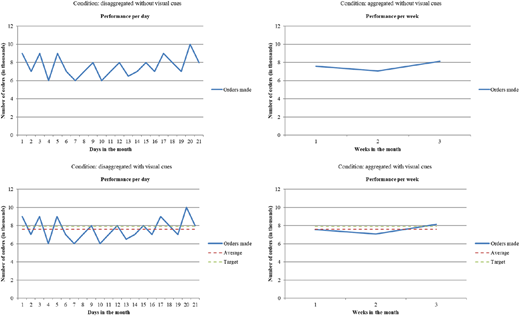
We designed the graphs to indicate an upward trend at the endpoint, consistent with findings on recency effects and end-anchoring biases (Duclos, 2015; Hellmann et al., 2017), suggesting that individuals evaluate performance based on the most recent data. To reflect this, the disaggregated graph contains more point-to-point variability across the 21 data points, while the aggregated graph presents a smoothed version of the same pattern. This approach aligns with Schulz and Booth's (1995) finding that smoothed data enhances the perception of performance trends and with research suggesting that people are more likely to perceive patterns when fewer data points are presented (Calero Valdez et al., 2018; Gilovich, 1991).
We also manipulate the inclusion of visual cues (absent vs present) in the graph visualization of historical sales data. In both conditions, participants visualize a line showing the actual sales performance and receive textual information regarding average sales performance and target sales performance. In the present visual cue conditions, we include two extra straight lines, one signaling average sales performance and another showing target sales performance. We do not include the two extra straight lines in the absent visual cue conditions. Then, the information about average sales performance and target sales performance is provided to all participants, regardless of their experimental condition. However, the inclusion of visual cues in the graph visualization regarding the textual information provided to all participants occurs only for participants in the present visual cue conditions. Because in addition to identifying the trend pattern on the graph, participants need to decide whether to invest more in a marketing campaign, we define the position of the visual cue lines to create tension regarding this decision. Therefore, we have decided that the target line should be above the average performance line, so that even with increasing performance, the decision to invest or not still requires scrutiny.
3.5 Dependent variable
Our dependent variable is judgment accuracy, which is measured through participants' perception of the line graph direction – downward, absence of pattern or upward – of historical sales data for the entire period of the graph. As shown in Figure 2, while the overall sales trend is upward, the last sales fluctuation follows a downward trajectory in the disaggregated graph format condition. Participants can rely excessively on this most recent sales activity and fall prey to the end-anchoring effect. Especially because the disaggregated graph presents greater fluctuation and, in the end, a sharper and more evident drop than the slope of the aggregate graph, this final trend in the disaggregated graph may be more eye-catching for participants. Conversely, when the aggregated graph format is analyzed, participants can perceive that the sales graph trend is upward, correctly suggesting that sales orders are increasing. We create a dichotomous variable by summing up the downward and the absence of a pattern together. We then have two options: an upward trend line or no upward trend line, with the second option capturing the presence of the end-anchoring effect and lower judgment accuracy.
4. Results
4.1 Descriptive statistics
Among participants, 70.6% indicate that the trend line for the covered period in the graph is upward, followed by 21.8% who indicate the trend line has no pattern, and 7.7% who indicate the trend line is downward. Two participants have not responded to this question and are excluded from our main analysis, resulting in a final sample of 78 participants. Table 1 and Figure 3 present descriptive statistics for judgment accuracy across experimental conditions. Greater values for perceived trend line indicate higher judgment accuracy.
Descriptive statistics – judgment accuracy
| Graph format | Visual cues | ||
|---|---|---|---|
| Absent | Present | Total | |
| Aggregated | |||
| Mean | 95% | 81% | 89% |
| Standard deviation | (0.05) | (0.10) | (0.05) |
| Number of participants | [20] | [16] | [36] |
| Disaggregated | |||
| Mean | 59% | 50% | 55% |
| Standard deviation | (0.11) | (0.11) | (0.08) |
| Number of participants | [22] | [20] | [42] |
| Total | |||
| Mean | 76% | 64% | 71% |
| Standard deviation | (0.07) | (0.08) | (0.05) |
| Number of participants | [42] | [36] | [78] |
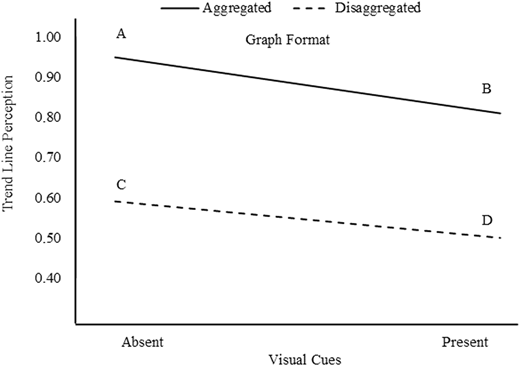
Table 1 shows that participants perceive an upward trend line at a greater likelihood for aggregate (89%) relative to disaggregate (55%) graph scale. This is consistent with H1. This is also evident in Figure 3, where the line corresponding to a disaggregated graph format is above the line corresponding to an aggregated graph format. Table 1 also shows that the likelihood of perceiving an upward trend line is higher when visual cues are absent (76%) than when they are present (64%), contrary to our expectation in H2. Table 1 reveals that when the graph format is aggregated, the likelihood of upward trend line perception is greater in the absence (95%) than in the presence (81%) of visual cue conditions. Similarly, when the graph format is disaggregated, the likelihood of upward trend line perception is greater in the absence (59%) than in the presence (50%) of visual cue conditions. This is also evident in Figure 3 when we compare point A (aggregated graph format and absence of visual cues), B (aggregated graph format and presence of visual cues), C (disaggregated graph format and absence of visual cues) and D (aggregated graph format and presence of visual cues). Considering that the trend of both lines is almost parallel, this is inconsistent with H3.
4.2 Hypothesis testing
The first hypothesis (H1) predicts a main effect of graph format on judgment accuracy, that is, using an aggregated rather than a disaggregated graph format to visualize historical sales data improves judgment accuracy. The second hypothesis (H2) predicts a main effect of visual cues on judgment accuracy; specifically, including visual cues in graphs to visualize historical sales data is expected to improve judgment accuracy compared to their absence. Finally, the third hypothesis (H3) predicts a moderating effect of visual cues: the presence vs absence of visual cues is expected to significantly improve judgment accuracy when the graph format is disaggregated but to have a lesser impact when the graph format is aggregated.
To test H1–H3, we estimate a logistic regression with robust standard errors, using judgment accuracy as the dependent variable (coded 1 if the participant perceives the trend line as upward, and 0 otherwise). The independent variables are graph format, visual cues and their interaction, with gender and age included as covariates. We use one-tailed significance tests for directional hypotheses (H1–H3) and two-tailed tests for all other analyses. Significance levels are reported accordingly. Panel A of Table 2 reports the logistic regression results, and Panel B shows simple effects. Panel A of Table 2 shows that there is a main effect of graph format on judgment accuracy (χ2 = 9.95, one-tailed, p = 0.001), so that the likelihood of participants' perception of an upward trend line is higher when the graph scale is aggregated than disaggregated. This result is consistent with H1, which states that using an aggregated vs disaggregated graph format, providing fewer data points on historical sales data, mitigates the end-anchoring effect and thus improves participants' judgment accuracy.
Logistic regression
| Panel A: Contrast analysis on logistic regression | df | Χ2 | p-value |
|---|---|---|---|
| Graph format (aggregated vs disaggregated) | 1 | 9.95 | 0.001 |
| Visual cues (absent vs present) | 1 | 1.99 | 0.079 |
| Graph format × visual cues | 1 | 0.27 | 0.302 |
| Gender | 1.86 | 0.063 | |
| Age | −2.20 | 0.028 |
| Panel B: Simple analysis | Z | p-value |
|---|---|---|
| Simple effect of graph format when visual cues are absent | −2.00 | 0.023 |
| Simple effect of graph format when visual cues are present | −2.32 | 0.010 |
| Simple effect of visual cues when the graph format is aggregated | −1.44 | 0.075 |
| Simple effect of visual cues when the graph format is disaggregated | −0.88 | 0.190 |
Note(s): 1) The dependent variable is a dichotomous variable that equals to 1 if the perception of the trend line is upward, and 0 otherwise. 2) Graph format is equal to 0 for aggregated graph format and 1 for disaggregated graph format. 3) Visual cues is equal to 0 for the absence of visual cues and 1 for the presence of visual cues. 4) Reported significance is one-tailed for directional hypotheses
Panel A of Table 2 also shows that, contrary to prior evidence (Amer, 2005; Tao et al., 2018), the presence vs absence of visual cues has a marginally significant negative effect on participants' judgment accuracy (χ2 = 1.99, one-tailed, p = 0.079), suggesting that visual cues reduce the perception of an upward trend line and, consequently, reinforce the end-anchoring effect. Although H2, which predicts that the inclusion of visual cues in graphs to visualize historical sales data would improve judgment accuracy compared to their absence, is not supported, the finding of an effect in the opposite direction is noteworthy, as it indicates that visual cues may hinder rather than help accurate judgment in this context.
Panel A of Table 2 also shows that the moderation effect is not statistically significant (χ2 = 0.27, one-tailed, p = 0.302). Although the moderation effect is not significant, we conducted a simple effects analysis in an exploratory manner to better understand the observed patterns. In the absence of visual cues, we first observe that judgment accuracy is significantly higher in the aggregated than in the disaggregated graph format (z = −2.00, one-tailed, p = 0.023). Next, results reveal that, in the presence of visual cues, judgment accuracy is again significantly higher in the aggregated than in the disaggregated graph format (t = −2.32, one-tailed, p = 0.010). Panel B of Table 2 also shows that, when the graph format is aggregated, there is a marginally significant effect of visual cues on judgment accuracy (t = −1.44, one-tailed, p = 0.075). In particular, when the graph format is aggregated, the likelihood of an upward trend line perception is higher in the absence (95%) than in the presence (81%) of visual cues. Finally, when the graph format is disaggregated, results reveal that judgment accuracy does not differ across visual cue conditions (t = −0.88, one-tailed, p = 0.190). These results are inconsistent with H3, which states that the presence vs absence of visual cues is expected to improve judgment accuracy significantly when the graph format is disaggregated but has a lesser impact when the graph format is aggregated.
Finally, Panel A of Table 2 shows that gender significantly affects the perceived trend line (z = 1.86, two-tailed, p = 0.063), with women being more likely to perceive the trend line as upward. The women's inclination to perceive upward trend lines and prioritize the general direction of the data over specific fluctuations to a larger extent than men could be attributed to women's focus on overall patterns rather than specific data points (e.g. Voyer and MacPherson, 2020; Voyer and Smith, 2023). Age also has a marginally significant effect on judgment accuracy (z = 2.86, two-tailed, p = 0.063), with older participants having a greater likelihood of perceiving an upward trend line. This result can be explained based on prior research suggesting that aging affects various cognitive and perceptual abilities, including interpreting graphical information. In particular, older adults may employ more deliberate and holistic processing strategies when interpreting graphical data, leading to a heightened perception of upward trends and potentially improved judgment accuracy (e.g. Le et al., 2014; Dean et al., 2016). In Online Supplementary Material ,we included an additional analysis regarding gender, also an analysis showing there is no effect of task difficulty on our results.
4.3 Additional analysis
4.3.1 Effects on investment intensity
We examine whether higher judgment accuracy, resulting from correctly identifying trend line patterns in historical sales data visualization, decreases the intention to increase marketing investment. While the current sales performance falls short of the target, the evident trend suggests a potential improvement in the near future. Consequently, we expect that participants may perceive no immediate need to intensify marketing investments to enhance the likelihood of reaching sales targets if they correctly perceive the upward trend line pattern. Although we acknowledge that various factors can influence a decision in a real-world context, making it challenging to determine whether investing is the best or worst choice, in this context, ceteris paribus, we justify that, as the available information indicates an upward trend in performance, the best decision is not to invest and would then expect a negative association between the upward perception of the trend line and the additional marketing investment.
We measure investment intensity using a 7-point Likert scale (“1” = extremely unlikely, to “7” = extremely likely). Table 3 indicates that the overall average investment intensity is 4.49, lower when participants perceive the trend line upward (4.25) than when it is not upward (5.04). We run an ANOVA with investment intensity as the dependent variable and judgment accuracy as the independent variable. We also include gender and age as covariates. Untabulated results show that the effect of judgment accuracy on investment intensity is significant (F = 5.39, two-tailed, p = 0.010). Consistent with the influence of the end-anchoring effect, investment intensity varies with judgment accuracy; specifically, investment intensity is significantly lower when judgment accuracy is higher for upward sales patterns, while the direction of this relationship is expected to differ, and potentially reverse, for downward sales patterns. Neither gender (F = 0.17, two-tailed, p = 0.682) nor age (F = 1.09, two-tailed, p = 0.382) significantly affects investment intensity.
Descriptive statistics
| Data points | Not upward | Upward | Overall |
|---|---|---|---|
| Mean | 5.04 | 4.25 | 4.49 |
| Standard Deviation | (0.28) | (0.18) | (0.15) |
| Number of Participants | [23] | [55] | [78] |
We also reran the main analysis using investment intensity as the dependent variable. The independent variables were graph format, visual cues, and their interaction, with gender and age included as covariates. Untabulated results show a main effect of graph format on judgment accuracy (χ2 = 13.79, two-tailed, p = 0.004), indicating that investment intensity is significantly lower when the graph scale is aggregated (3.79) rather than disaggregated (5.00). Neither visual cues (χ2 = 0.07, two-tailed, p = 0.786) nor the interaction term (χ2 = 0.17, two-tailed, p = 0.680) is statistically significant. Similarly, neither gender (z = −0.77, two-tailed, p = 0.444) nor age (z = 0.51, two-tailed, p = 0.611) significantly affects investment intensity. These findings are consistent with the results of the main analysis.
4.3.2 Mediation analysis
We test whether judgment accuracy mediates the effect of graph format on the intention to increase marketing investment. Judgment accuracy is critical in shaping intentional behavior, as intentions are typically based on individuals' interpretations of available information. When those interpretations are accurate, individuals are more likely to form intentions aligned with the actual situation or optimal decision-making (Ajzen, 1991). We then examine whether using an aggregated rather than a disaggregated graph format to visualize historical sales data reduces investment intensity through judgment accuracy. To test this, we first perform a structural equation-based path analysis with graph format as the independent variable, judgment accuracy as the mediating variable, and investment intensity as the dependent variable. We also include two control variables – age and gender – for the effects on the perceived trend line. Table 4 shows the bootstrapped estimates (1,000 repetitions) using the variance–covariance method of the indirect effects of the aggregated vs disaggregated graph format through perception of line graph trend.
The mediating effect of perceived trend line on the association between graph format and investment intensity
| Judgment accuracy | Investment intensity | |||
|---|---|---|---|---|
| LB 95% CI | UB 95% CI | |||
| Graph format (direct effects) | −0.53 | −0.17 | ||
| Age | 0.02 | 0.07 | ||
| Gender | −0.35 | 0.01 | ||
| LB 95% CI | UB 95% CI | |||
| Judgement accuracy | −1.41 | −0.16 | ||
| LB 95% CI | UB 95% CI | |||
| Graph format (indirect effects) | 0.01 | 0.55 | ||
Note(s): Bootstrapped estimates using STATA of the indirect effects of aggregated vs disaggregated graph format through the perceived trend line
The dependent variable is the likelihood of intensifying a marketing campaign investment after visualizing a graph with sales historical data, measured using a 7-point Likert scale (“1” = extremely unlikely, to “7” = extremely likely)
Judgment accuracy is a dichotomous variable that equals one if the perception of the trend line is upward and zero otherwise
Graph Format is equal to 0 when aggregated and 1 when disaggregated
The analysis reported is a structural equation model (SEM) using the variance–covariance method
The reported test of the indirect effect presents bias-corrected confidence intervals based on the results of a 1,000-repetition bootstrapping procedure
Reported p-values are two-sided
Consistent with H1, the results reveal that judgment accuracy is higher when the graph format is aggregated than disaggregated, with a 95% confidence interval (−0.53, −0.17). Second, results show a negative effect of judgment accuracy on investment intensity with a 95% confidence interval (−1.41, −0.16). Finally, the results show that the aggregated vs disaggregated graph format reduces investment intensity through its effect on judgment accuracy with a 95% confidence interval (0.01, 0.55). These results imply that the aggregated vs disaggregated graph format increases judgment accuracy, which, in turn, reduces the marketing investment intensity. This implies that more aggregated data presentations may help organizations avoid overinvestment driven by misinterpretation of short-term fluctuations, leading to more efficient allocation of marketing budgets. Finally, we observe that judgment accuracy is higher among older participants than younger ones, with a 95% confidence interval (0.02, 0.07). Conversely, judgment accuracy does not differ by gender, with a 95% confidence interval (−0.35, 0.01).
We also use the Baron and Kenny (1986) steps to test whether judgment accuracy mediates the effect of graph format on the intention to increase marketing investment. Untabulated results indicate that the effect of aggregated vs disaggregated graph format on investment intensity is positive and significant (t-test = 4.20, one-tailed, p = 0.000). Moreover, the effect of judgment accuracy on investment intensity is negative and significant (t-test = −2.84, one-tailed, p = 0.003). Finally, in the presence of the graph format, the effect of judgment accuracy on investment intensity is negative and marginally significant (t-test = −1.56, one-tailed, p = 0.062), while the effect of graph format on investment intensity is reduced (t-test = 2.92, one-tailed, p = 0.003). Therefore, this suggests partial mediation of the effects of graph format on investment intensity through judgment accuracy. Overall, results suggest that judgment accuracy mediates the association between graph format and investment intensity.
5. Conclusion and discussion
End-anchoring is an effect in which individuals tend to give more weight to the final trend in a graph when prompted to make predictions. Because companies frequently use graphs to directly capture patterns and tendencies from raw data, we examine whether using two strategies – aggregated graph format and visual cues – in the graphical visualization of historical sales data can mitigate end-anchoring, improving judgment accuracy. Overall, the results support the claim that using an aggregated rather than a disaggregated graph format helps marketing managers correctly identify the trend line pattern of sales historical data, thereby mitigating the end-anchoring effect and improving judgment accuracy. Surprisingly, the results do not align with the expectation that including visual cues would improve judgment accuracy. In fact, they suggest the opposite – that judgment accuracy is higher in the absence rather than in the presence of visual cues. One likely explanation for this result is that including visual cues could have increased participants' cognitive overload and then decreased judgment accuracy (e.g. Allen et al., 2014). Alternatively, participants may have perceived the visual cues as Chartjunk, that is, visual elements that could distract participants from visualizing the information represented on the graph (e.g. Tufte and Graves-Morris, 1983).
In addition, aggregated vs disaggregated graph format increases the likelihood of an upward trend line perception regardless of the absence vs presence of visual cues, suggesting that the inclusion of visual cues has no role in helping mitigate the end-anchoring effect and improve judgment accuracy. More surprisingly, although the moderation effect is not statistically significant, the simple effects indicate that participants exposed to the aggregated graph format tend to perceive an upward trend line more often in the absence rather than in the presence of visual cues. This pattern suggests that including visual cues may, in some cases, impair the ability to correctly identify the trend line in historical sales data when the graph format is aggregated, potentially reducing judgment accuracy. Moreover, mediation analysis suggests that using an aggregated graph format indirectly improves judgment accuracy through mitigating the end-anchoring effect. Finally, we find that women benefit more from aggregation mainly in the absence of visual cues, while men benefit regardless of visual cues, and that our main results cannot be explained by perceived graph difficulty.
The results of this study provide theoretical as well as practical contributions. The first regards the existence of biases in graph analysis, especially in documented biases concerning visual analysis, such as the recency effect, the Poggendorff illusion, average estimation and so on. Companies are increasingly investing in technologies related to data gathering and data analytics toward a process of data-driven decision-making. These investments result in huge amounts of data that can be valuable to companies if properly analyzed. While graphs can support data analysis, they may also trigger biases that impair judgment accuracy. We extend prior research on cognitive biases by demonstrating how, and under which conditions, decision makers are more likely to be affected by the end-anchoring in graph-based analyses.
Second, our results offer a possible way of reducing the end-anchoring effect. The literature on this topic indicates that inducing individuals to provide estimates for a further horizon from the final anchor helps mitigate the effect. In this sense, initiatives such as the use of an aggregated graph format, which is a mechanism that hides a final trend, decrease the individuals' perception and possible emphasis on this final anchor and have a direct positive effect on judgment accuracy. In this case, providing managers with an aggregated graph facilitates the identification of an overall performance over the period, which prevents them from being influenced by sharp slopes at the end of the graph, which are inconsistent with the overall performance.
Finally, we also contribute to practice, especially to professionals who develop solutions related to graph analysis and to managers who depend on these solutions for judgment and decision-making. In the case of developers, the results of the study are useful in demonstrating the existence of an effect that can happen in the graph analysis, as well as possible remedies that can be implemented in software development as a way to prevent users from impaired judgment accuracy. Regarding decision makers, in addition to alerting to the existence of the end-anchoring effect, the results point to the need for skepticism regarding the data used for judgment. Specifically, while the choice of an aggregated graph format can contribute to mitigating end-anchoring, the search for additional information and a more thoughtful analysis regarding anchor values is still necessary to avoid biases in prediction tasks. Furthermore, this skepticism arises from potential trade-offs between different graph formats. For instance, while aggregated graphs offer advantages like ease of analysis and reduced end-anchoring, they may also result in informational losses, particularly in identifying patterns such as seasonality or day-of-the-week trends.
This study has limitations that provide opportunities for future research. In our experimental task, we make a design choice of using the number of orders plotted in the graph, instead of financial performance. Companies of the so-called new economy (e.g. Uber, Ifood and Sympla) are characterized as having their core business operating through the internet and with operations measured mainly in terms of sales quantity rather than financial performance. Overall, large companies of the new economy usually deal with huge amounts of data because they intermediate operations between business and consumers and obtain their gains with scale. Then, as our study helps contribute to companies dealing with big data, we choose performance in terms of orders. However, it is not clear if and how our results could be affected if financial performance is used instead. As prior studies suggest that measurement basis – financial or nonfinancial – can affect individual decisions in a corporate social responsibility scenario (Church et al., 2019), future studies could examine whether the end-anchoring effect and judgment accuracy can be affected by whether graph data visualization is made in terms of the number of orders or financial performance.
We also make a design choice as to the graph pattern. Firstly, we present our aggregated graph in which an upward tendency is shown at the end of the graph, suggesting an increase in performance. Because Duclos (2015) found the end-anchoring effect with a final tendency in graphs with several slopes (which is our disaggregated graph condition), we chose to use an aggregated graph as a condition in which there is no end-anchoring, since a greater data aggregation represents performance over a longer time horizon, not just a final performance (final anchor). Moreover, we used the same performance data, in which there is an upward tendency in performance for the overall period, but with disaggregated data showing a final downward slope (inconsistent with the overall performance), to observe whether this final tendency was capable of inducing predictions contrary to the general upward tendency in performance. Finally, another design choice refers to the target line position, which we positioned above and near the average line performance. However, we do not capture whether a different position of the target line could affect our results. Therefore, future studies could examine whether presenting a graph with information about past sales performance with an upward or a downward tendency and with less smoothed data, as well as a different position of the target line, could affect the end-anchoring effect and judgment accuracy.
Ethical statement
Ethical review and approval were waived for this study in accordance with the regulations of the Brazilian National Health Council (CNS Resolution No. 510/2016 and Circular Letter No. 17/2022, Article 1, Item VII). The research involved a low-risk, hypothetical simulation task within professional practices using aggregated and fully anonymized data. Prior to participation, all individuals gave their informed consent, and participation was entirely voluntary with guaranteed confidentiality.
Notes
We formally ask head of departments – accounting, economics and business administration – for permission to conduct the research during class hours. Upon arrival at each session/class, one of the researchers introduces himself, gives a brief explanation of the research purpose and requests voluntary participation.
This variation in time is mainly due to the size of the sessions. The number of participants per session ranged from 3 to 24.
The supplementary material for this article can be found online.

