As climate change accelerates, the frequency and intensity of extreme heat events are rising, making it critical to assess and improve the thermal resilience of residential buildings. Current assessment methods are time-consuming, costly and not easily scalable, while often lacking stakeholder engagement or integration with real-time climate data. This study aims to address these limitations by developing a scalable, cloud-based reference architecture that supports the assessment and mitigation of overheating risk in residential buildings. It offers a systematic approach to improving efficiency, automation and user collaboration within climate adaptation planning.
The study employs a design science research (DSR) methodology to develop a three-layered reference architecture for overheating risk assessment. The architecture includes a data management layer (building information modelling (BIM), climate and comfort data), a business logic layer (simulation and risk analysis) and an application layer (user interface and decision support). The design was informed by expert input across three evaluation phases and supported by visual tools and mock-up prototypes. Validation was conducted through expert reviews and a strengths, weaknesses, opportunities and threats analysis to assess scalability, technical feasibility and usability.
The proposed architecture demonstrates the potential to improve thermal risk assessment efficiency by integrating adaptive comfort models, climate projections and stakeholder-driven workflows. Expert evaluations confirmed the system's value in enabling scalable, automated simulation and visualisation of overheating risk across residential buildings. The mock-up interface supports informed decision-making and usability for non-expert users. The layered architecture enhances transparency, modularity and potential for future integration with digital twins or Internet of Things systems. While not yet implemented, the system offers a strong foundation for future software development and real-world application.
The originality of this study lies in the development of a system reference architecture for assessing heatwave risks in residential buildings, aimed at enhancing resilience to extreme heat. Unlike previous frameworks focused on energy or general risk management, this architecture integrates BIM, climate data and adaptive thermal comfort modelling into a single, cloud-based platform. It supports automation, user collaboration and scenario-based decision-making. The framework is designed to assist platform developers, engineers and policymakers in mitigating heatwave risks, improving building performance and advancing climate adaptation efforts within the built environment.
1. Introduction
With the increasing frequency and intensity of extreme heat due to climate change, the thermal performance of buildings has become a critical concern, not only for energy efficiency but also for occupant health, safety, and wellbeing (Brown, 2020; Santamouris, 2019; Cheval et al., 2024; Machard et al., 2024; Ji et al., 2022). According to the Intergovernmental Panel on Climate Change (IPCC WGII Core Writing Team, 2022), the occurrence of heatwaves has risen sharply since the 1950s, with global temperatures projected to continue rising. This trend poses escalating risks to urban populations, especially in buildings that are poorly adapted to such conditions. Building performance assessments have traditionally relied on simulation-based methods applied to individual buildings, requiring detailed data on geometry, envelope characteristics, and internal loads. These processes are often resource-intensive, expert-driven, and challenging to scale across multiple buildings. They may also overlook practical constraints and stakeholder preferences, which limits their feasibility and consistency in real-world applications.
To address the growing risk of overheating, there is an urgent need for digital platforms capable of managing and analysing building data across multiple assets. These platforms can support centralised storage of as-built models, facilitate collaboration among diverse stakeholders, and enable standardised, simulation-based evaluations aligned with regulatory thermal comfort criteria (Bibri and Krogstie, 2017; Ahmad et al., 2022). However, such integrated and scalable solutions are largely absent in current urban planning and building management practices. In response to this gap, Building Information Modelling, a collaborative digital process widely adopted in the Architecture, Engineering, and Construction (AEC) sector, offers a promising foundation. When integrated with cloud computing, BIM enables centralised access to standardised building data, supports automated simulation workflows, and fosters real-time collaboration across stakeholders (ISO, 19650-1, 2018; Azhar, 2011; Brozovsky et al., 2024; Bello et al., 2021). These capabilities position cloud-based BIM as a transformative tool that can support the evaluation and mitigation of extreme heat impacts in residential buildings.
While cloud-enabled BIM has demonstrated value in domains such as energy management, disaster response, and risk assessment, for example, in district retrofitting, tunnel safety, and flood management frameworks (Martín-Toral et al., 2019; Liu et al., 2023a; Luo et al., 2019; Sood et al., 2017), existing solutions do not offer an integrated architecture that combines adaptive thermal comfort modelling, real-time and projected climate data, automated simulation workflows, and collaboration specifically focused on heatwave risk in residential buildings. To address this gap and build on the potential of cloud-BIM, this study proposes a reference architecture for a cloud-enabled platform tailored to heatwave risk assessment. The architecture defines essential system components, data flows, and user interactions to support functionality, scalability, and usability across diverse urban contexts. This enables end users, such as “Risk Experts” in the municipality, to input, analyse, and retrieve data effectively using the platform.
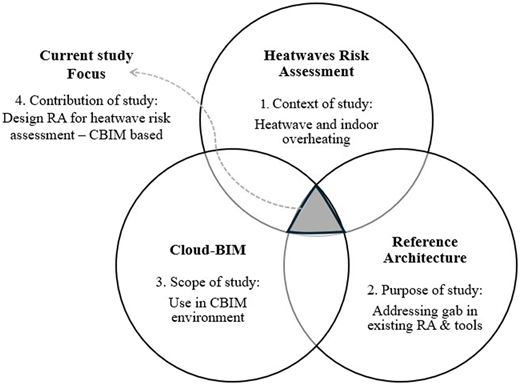
Figure 1 illustrates the research focus at the intersection of three key domains: heatwave risk assessment, Cloud-BIM technologies, and reference architecture. The diagram also shows how the Introduction progresses from the context of climate risks to the purpose, scope, and main contribution of this work.
The remainder of the paper is organised as follows: Section 2 presents the research background and identifies the knowledge gaps addressed by this study. Section 3 describes the methodology. Section 4 details the solution design, including the assessment process and the proposed reference architecture. Section 5 covers the validation phase, platform mock-up, and expert evaluation. Section 6 discusses findings, limitations, and future research directions. Finally, Section 7 concludes with a summary of the research outcomes.
2. Background
2.1 Heatwave risk assessment
Heatwaves are becoming increasingly severe and frequent globally due to climate change. For instance, in 2022, China experienced its most prolonged heatwave on record, lasting over 70 days. In India and Pakistan, the likelihood of devastating heatwaves increased 30 times (WMO, 2023). Record-breaking temperatures in 2023 and 2024 underscore the urgent need for effective climate adaptation strategies (Esper et al., 2024; Wang et al., 2024; Liu et al., 2025). Since people spend around 90% of their time indoors, assessing the risk of heatwaves on buildings is crucial (Cole et al., 2023).
Over time, researchers have adopted several methods to assess and improve indoor thermal comfort in buildings, typically categorised into three primary approaches: occupant-based surveys (Shrestha et al., 2021), field measurements (Gamero-Salinas et al., 2020; Heracleous and Michael, 2019), and building simulation models (BSMs) (Eisazadeh et al., 2025; Baba et al., 2024; Rahif et al., 2021, 2023; Hughes and Natarajan, 2019; Baba, 2025; Nazari et al., 2023; Adekunle, 2019, 2020). Among these, BSMs are the most widely used method due to their capacity to simulate indoor thermal conditions across various design scenarios and climate conditions without intrusive measurement campaigns. However, a major limitation facing BSMs is the availability, and a high level of data fidelity is required. This includes detailed information on building geometry, envelope characteristics (e.g. U-values, infiltration rates), internal loads, and HVAC system specifications. Accurate input data is often unavailable or incomplete, especially for existing buildings, leading researchers to rely on assumptions or generic values. This practice can lead to significant discrepancies between simulated and actual performance, thereby reducing the reliability of BSM outputs in informing comfort-related decisions (Liu et al., 2023). To improve the representativeness of simulations, data must be obtained through detailed on-site surveys, audits, or direct physical measurements (such as in situ U-value testing or blower door tests) (Royapoor and Roskilly, 2015) or on calibration methods using field data like indoor temperature readings or energy consumption records (Baba et al., 2022a; Song and Calautit, 2024; Paliouras et al., 2015). These processes, however, are labour-intensive, time-consuming, and expensive, often requiring months of effort and substantial financial resources for a single building. Consequently, most research projects are limited to analysing a small number of case studies, where researchers can afford to collect the required detailed input data and calibrate the models accordingly (Baba et al., 2022b).
Researchers and engineers also assess thermal performance based on different criteria (Attia et al., 2023; Yao et al., 2022) and then recommend various mitigation strategies (Adekunle, 2019; Baba et al., 2023a; Ben-Alon and Rempel, 2023; Dalach, 2024; Sahebzadeh et al., 2018; Chen and Lai, 2024) based on climatic zone (Al-Assaad et al., 2025). However, this process has typically been carried out without meaningful engagement with key stakeholders such as building owners, contractors, or occupants. As a result, many proposed interventions may not be feasible or acceptable in real-world contexts. For example, while external shading devices like overhangs may be thermally beneficial, they are often impractical for many buildings in the UK, where outward-opening windows prevent their installation (Grussa et al., 2019). Similarly, green roofs may be structurally unviable in older buildings, and aesthetic preferences, such as an owner rejecting white reflective coatings on roofs or walls, can limit the adoption of certain passive strategies. These constraints highlight the importance of integrating stakeholder input into the simulation and decision-making process. This challenge is compounded when shifting from individual buildings to the urban scale with multiple buildings. Imagine a municipality seeking to assess thermal performance and heatwave resilience across hundreds of buildings in a specific district. Applying the traditional, building-by-building simulation and calibration approach would be logistically and economically unfeasible. This limitation has highlighted the urgent need for integrated, scalable solutions that can automate or streamline data collection, simulation execution, and result interpretation, thereby laying the groundwork for digital solutions such as BIM, Internet of Things (IoT)-enabled monitoring, and cloud-based simulation platforms (Ullah et al., 2019).
2.2 Reference architecture, BIM, and cloud technologies
While BIM has been recognised as a key enabler of sustainable development in the construction sector (Ullah et al., 2019; Takim et al., 2013), its widespread adoption continues to face several challenges. These include limited automation capabilities, reliance on outdated or incomplete data, high implementation costs, lack of technical expertise, privacy, and data security concerns, and insufficient alignment with broader sustainability goals (Enshassi et al., 2018; Durdyev et al., 2022; Olawumi et al., 2018; Waqar et al., 2023; Likita et al., 2025). Cloud-based BIM (Cloud-BIM), which integrates cloud computing technologies with BIM processes (Wu and Issa, 2012), has emerged as a promising approach to address many of these limitations. By facilitating scalable data storage, remote access, real-time collaboration, and automated model updates, Cloud-BIM enhances the efficiency, accessibility, and interoperability of digital construction workflows (Wong et al., 2014). In the context of overheating risk and climate resilience, Cloud-BIM platforms can also integrate Internet of Things (IoT) devices and sensor networks to enable real-time monitoring and predictive analytics, allowing for dynamic control of indoor thermal comfort conditions (Ghahramani et al., 2020; Chen et al., 2023a, b). However, to operationalise these capabilities effectively, a clearly defined architectural framework is required, one that identifies the necessary data inputs, system components, and user roles needed to support consistent, scalable, and stakeholder-informed applications.
Chaabane et al. (2017) define reference architecture as the core concepts and properties of a system represented through its elements, relationships, and design principles. A system consists of interacting components organised to fulfil specific goals within a defined environment, which includes external influences and interactions. Effective architectural descriptions require identifying key stakeholders, users, operators, owners, builders, suppliers, developers, and maintainers. Each has specific concerns regarding the system. These concerns include the system's purpose, feasibility, risks, and overall impact on stakeholders throughout the system's life cycle. Addressing this, Procaccianti et al. (2014) conducted a systematic review showing that as system complexity increases, the need for well-structured software architecture grows. Their study examined how cloud software architectures address energy efficiency, emphasising the importance of meeting both functional and sustainability demands, particularly for end users as the primary service consumers. A key characteristic of the reference architecture is its layered structure, which fulfils distinct roles and responsibilities within a system (Liu et al., 2023b). In Cloud-BIM systems, layered reference architecture defines core components, their interactions, and dependencies (Platform Architecture, 2022). This structure supports efficient data management and analysis while addressing user-specific requirements. Moreover, defining use cases for specific scenarios is essential, as they help translate user needs into functional system components.
Layered reference architectures have demonstrated value across various domains by enhancing modularity, scalability, and efficiency while addressing domain-specific needs. For example, Celdrán et al. (2018) developed a layered architecture for securing Medical Cyber-Physical Systems, including layers for physical devices, virtualisation, network management, and autonomic control. This design supports real-time device management, improved security, and reduced latency. Similarly, Liu et al. (2023b) proposed a cloud-based architecture for solar PV energy forecasting in multi-energy systems, structured into layers for data collection, preprocessing, storage, forecasting, and monitoring. This approach improves prediction accuracy, streamlines data management, and supports better integration of solar energy into traditional grids. In another study, Luo et al. (2019) proposed a four-layer IoT-based architecture for predicting building heating and cooling demands, consisting of sensorisation, storage, analytics, and service layers. Applied to a UK office building, it improved energy demand prediction, management, and equipment scheduling. Similarly, Sood et al. (2017) developed a smart flood management framework integrating IoT, big data, and High-Performance Computing, with layers for data collection, real-time flood prediction, data analysis, and information presentation. This architecture facilitated efficient data collection, real-time forecasting, and improved communication. Biswas et al. (2024) introduced a multi-layered approach for energy-efficient cloud systems, including layers for hardware, virtualisation, resource energy management, and application optimisation. Martín-Toral et al. (2019) designed a software architecture for district-scale energy-efficient retrofitting projects. Their approach integrates BIM data, GIS information, and energy simulation models to improve data management and analysis for large-scale urban renovation projects. Their OptEEmAL platform architecture consists of three main layers: a data layer, which includes BIM and CityGML models; a service layer, which manages simulation and optimisation modules; and an application layer, which provides user interfaces and project management tools. This architecture highlights the value of structured systems in addressing complex urban challenges, demonstrating how reference architectures can drive efficiency and innovation. Similarly, Birgonul (2021) developed a Symbiotic Data Platform combining BIM and real-time data to improve thermal comfort and energy efficiency by enabling personalised adjustments. Wong and Zhou (2015) highlight how these cloud-based tools support energy consumption assessments from the design phase to building operation, enabling early optimisation of energy efficiency. For example, the 3L4C tool is a Cloud-BIM platform that enhances collaboration and information sharing, improving project management efficiency (Das et al., 2014; Chen et al., 2023a, b; Jiao et al., 2013; Theoharidou et al., 2013). Liu et al. (2023a) proposed a five-layer BIM-based digital service for risk management in mountain tunnel construction, including infrastructure, model, data, application, and user layers for stakeholder interaction. This structure supports dynamic systems for monitoring, identifying, and assessing risks. Shaw et al. (2024) developed a scalable reference architecture for life cycle cost analysis in construction, demonstrating how structured architectures foster cost-effective, sustainable practices. In the smart grid domain, Meisel et al. (2017) introduced the “RASSA” project, which features a secure framework with business, function, information, communication, and component layers to automate threat analysis and risk estimation. However, despite these advancements, no layered architecture (platform) fully integrates climate data, heatwave risk assessment, and adaptive mitigation strategies for buildings, highlighting the need for an integrated reference architecture within a Cloud-BIM environment.
In response to this gap, BIM, when integrated with cloud computing (ISO, 19650-1, 2018; Azhar, 2011; Cholakis, 2013), offers a promising foundation for developing such a platform. A cloud-based BIM environment can centralise and manage standardised building data across the asset life cycle, support automated thermal simulations, integrate real-time sensor data, and facilitate transparent communication between diverse stakeholders (Brozovsky et al., 2024; Bello et al., 2021; Lee et al., 2020). When properly structured and governed, this solution has the potential to transform how cities assess, plan for, and mitigate the impacts of extreme heat, enabling scalable, data-driven, and collaborative approaches to urban climate resilience. A cloud-based BIM platform for heatwave risk assessment can offer a range of critical capabilities that enhance both analysis and decision-making.
First, it can serve as a centralised repository for storing comprehensive building information, including as-built digital models or digital twins. These models can be dynamically updated with data from (IoT) devices, such as indoor temperature, humidity, or occupancy sensors, enabling real-time monitoring of building conditions.
Second, such a platform can integrate directly with building performance simulation engines (e.g. EnergyPlus), allowing automated or on-demand simulations based on current or projected weather conditions. This ensures timely evaluations of thermal behaviour during heatwaves or under different retrofit scenarios.
Third, the platform can facilitate standardised thermal performance assessments based on government-endorsed comfort criteria or regulatory benchmarks (e.g. ASHRAE 55 (2023)), ensuring that comparisons across different buildings are objective, meaningful, and policy-aligned. By using uniform comfort thresholds and reporting formats, stakeholders can consistently interpret results and identify which buildings are most vulnerable or least compliant.
Finally, the Cloud-BIM environment promotes transparent collaboration by bringing together diverse stakeholders, including owners, architects, engineers, contractors, and policymakers, within a shared digital environment. Simulation results can be presented through visual dashboards or annotated 3D models, enabling evidence-based discussion of feasible mitigation strategies such as improved shading, passive ventilation, insulation upgrades, or cooling system enhancements. This co-design process ensures that proposed measures are not only thermally effective but also structurally feasible, financially acceptable, and aligned with user preferences and operational needs. By doing so, Cloud-BIM platforms can play a transformative role in operationalising urban climate resilience, particularly under the growing threat of extreme heat.
2.3 Point of departure
While reference architectures are widely used across various domains, their application to heatwave risk assessment remains underdeveloped, with two key knowledge gaps.
The first knowledge gap lies in the challenges within existing reference architectures across different fields. Despite their value in energy (Liu et al., 2023b; Biswas et al., 2024; Martín-Toral et al., 2019), healthcare (Celdrán et al., 2018), disaster management (Sood et al., 2017), smart grids (Meisel et al., 2017), and construction (Liu et al., 2023a), several challenges remain. Managing large datasets, balancing computational resources, and optimising cloud systems while addressing cybersecurity concerns remain complex (Liu et al., 2023b; Sood et al., 2017). Existing architectures offer partial solutions but lack a comprehensive framework for integrating security, data optimisation, and computational efficiency (Celdrán et al., 2018; Luo et al., 2019). Moreover, the impact of architectural design on energy efficiency is unclear, with minimal user engagement in sustainability efforts (Procaccianti et al., 2014). The complexity of multi-cloud integration and interoperability adds to the challenge (Procaccianti et al., 2014). While these solutions demonstrate useful approaches in their respective domains, they have not been combined to address the specific challenges of residential overheating risk assessment, leading to the second knowledge gap.
The second knowledge gap is the absence of system reference architectures designed explicitly for heatwave risk assessment and mitigation. While existing frameworks offer valuable insights, they do not adequately address overheating risks and optimise indoor thermal comfort, particularly in residential settings. For instance, current BIM-based reference architectures do not fully integrate climate data or incorporate risk assessment methodologies tailored to heatwave conditions (Côté et al., 2024). The OptEEmAL platform (Martín-Toral et al., 2019), developed for energy-efficient retrofitting, streamlines energy optimisation but offers limited attention to indoor thermal comfort. It lacks tailored mitigation strategies for heatwave events and does not fully integrate climate data for current and future assessments. Similarly, reference architectures in energy systems have primarily focused on efficiency and security. Liu et al.'s (2023b) cloud-based solar PV energy forecasting enhances data accuracy and system performance. Biswas et al. (2024) propose an energy-efficient cloud computing framework that minimises energy consumption and carbon emissions. Meisel et al. (2017) optimise energy consumption while ensuring secure distribution, and Luo et al.'s (2019) framework enhances energy efficiency. However, these approaches do not consider the risks of overheating or thermal comfort in residential buildings. In the domain of disaster and risk management, relevant studies remain context-specific. Sood et al. (2017) focus on flood prediction, while Liu et al. (2023a) introduce a BIM-based digital service for construction risk management. Although these architectures demonstrate robust frameworks within their respective domains, none extend to the unique challenges of heatwaves such as climate-adaptive comfort optimisation, real-time thermal monitoring, or building-level mitigation strategies.
These gaps highlight the need for a reference architecture that integrates indoor thermal comfort metrics, climate-responsive mitigation techniques, and both real-time and projected climate data. To address this, the present study builds upon existing architectures (Liu et al., 2023a, b; Luo et al., 2019; Sood et al., 2017; Biswas et al., 2024; Martín-Toral et al., 2019; Meisel et al., 2017) and extends their capabilities by designing a reference architecture tailored specifically for heatwave risk assessment and mitigation in residential buildings.
Table 1 provides a comparative analysis summarising key studies, including the proposed and used tools/architectures, domain, and identified gaps, highlighting opportunities for further work.
While previous frameworks have advanced cloud-based simulation, IoT-enabled monitoring, and energy optimisation, they have not fully combined (1) real-time and projected climate data integration, (2) adaptive thermal comfort modelling specific to heatwave scenarios, and (3) BIM-enabled simulation and collaboration in a single, unified platform for residential buildings. Accordingly, building on these identified gaps, our architecture aims to provide an automated and efficient solution for heatwave risk assessment, guided by the following research question: “How can a software solution be designed to provide an effective and automated assessment process within a Cloud-BIM environment?”
To achieve the research aim, the study is structured around the following objectives:
Formalise an integral heatwave risk assessment process using BPMN.
Identify the end-user requirements for an effective heatwave risk assessment solution.
Design a cloud-based reference architecture for automated heatwave risk assessment and mitigation in residential buildings.
The research approach used to develop the reference architecture for heatwave risk assessment is detailed in the following section on research methodology.
3. Research methodology
This study employs a Design Science Research (DSR) approach to design a reference architecture for heatwave risk assessment in a Cloud-BIM environment, addressing the challenges posed by extreme heat events. DSR was selected for its ability to bridge theory and practice, providing innovative, practical solutions in complex domains.
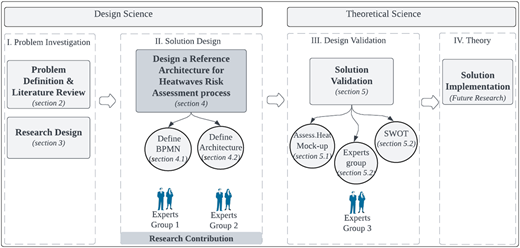
DSR is particularly effective for creating reference architectures, focusing on designing and assessing artefacts to address real-world problems (Hevner et al., 2004). The methodology includes iterative phases: Problem Investigation, Solution Design, Design Validation, and Theoretical Science (Holmström et al., 2009; Wieringa, 2009), ensuring structured development through user feedback and refinement (Peffers et al., 2007; Tremblay et al., 2010; Pries-Heje et al., 2008). Validation, a critical phase in DSR, ensures practical outcomes by aligning the final product with real-world needs through rigorous evaluation (Liu et al., 2021; Brocke et al., 2020; Gonzalez and Sol, 2012; Larsen et al., 2020).
This study adopts a combined DSR framework based on the models proposed by Holmström et al. (2009) and Wieringa (2009). Figure 2 illustrates the four phases of the methodology and their alignment with our research objectives, enabling the systematic development of a robust reference architecture for heatwave risk assessment.
The DSR phases include:
Problem Investigation (incubation phase) covered in sections 2 and 3, involves problem definition and research design.
Section 2 begins with a literature review identifying gaps in current heatwave risk assessment methods, exploring the potential of Cloud-BIM technologies, and understanding the challenges of integrating BIM and cloud computing in the construction industry. The review addressed traditional and data-driven approaches, BIM and cloud applications in AEC, and existing reference architectures, providing a comprehensive understanding of the need for an integrated Cloud-BIM approach to heatwave risk assessment.
Building on the literature review, Section 3 outlines the research design, where we applied the DSR methodology to design and evaluate a reference architecture for heatwave risk assessment in a Cloud-BIM environment. DSR was chosen for its ability to bridge theory and practice, its iterative nature, and its suitability for creating innovative solutions to real-world problems. The research design details the four main phases of our DSR approach, offering a structured yet flexible framework for developing and validating the reference architecture.
Solution Design (refinement phase), detailed in Section 4, is the core of our research, focusing on developing the reference architecture for heatwave risk assessment. This phase is divided into two parts: the heatwave risk assessment process (Section 4.1) and the reference architecture (Section 4.2).
In Section (4.1), we define the risk assessment process using Business Process Model and Notation (BPMN), chosen for its ability to visualise complex processes, facilitate communication, and standardise assessments (Schoknecht et al., 2017; Garcia et al., 2023). BPMN optimises BIM management in cloud environments by enhancing efficiency, data security, and system design (Ramachandran and Chang, 2016). The BPMN models were drawn using Lucidchart (Lucid Software Inc, 2025), a visual diagramming tool suitable for manually creating clear and structured process flows. Our previous work (Samaro and Hartmann, 2023) applied BPMN for heatwave risk assessment in Cloud-BIM environments, visualising activities, managing data sharing, and file handling. We collaborated with Expert Group 1 (four experts), comprising academic researchers with backgrounds in civil engineering, systems engineering, and risk analysis. They contributed to defining the BPMN risk assessment process, incorporating domain expertise into the workflow. Feedback was collected through structured individual discussions, in which experts reviewed process steps and provided input on clarity, feasibility, and completeness. Building on Samaro et al. (2024) and Samaro and Hartmann (2023), the process includes: (1) Data collection for building simulation models across climates, (2) Evaluating overheating hours using current weather data, (3) Generating future climate scenarios, and (4) Implementing and checking mitigation measures.
In Section (4.2), the definition and development of the reference architecture involved two main activities, as detailed in Sections (4.2.1) and (4.2.2). Section (4.2.1) outlines the design steps, as illustrated in Figure 3. Inputs were collected from interviews with end-users (e.g. risk experts) and existing literature to ensure a comprehensive understanding of practical needs and theoretical foundations. Insights were crucial for identifying the barriers end-users faced during their usual practices, as well as the requirements and use cases. While user requirements are typically derived from user stories and then translated into technical solutions by software developers, in this study, the data was refined and validated in collaboration with Expert Group 2 (three experts). This group included practitioners and researchers specialising in heatwave risk assessment, energy efficiency, and climate policy. Feedback was gathered through semi-structured interviews and iterative design sessions.
Section (4.2.2) presents the designed reference architecture. Based on the OptEEmAL platform (Martín-Toral et al., 2019), the architecture was adapted and extended to address heatwave risk assessment in residential buildings. The iterative design process involved co-design and multiple reviews with Expert Group 2 through five 1-h discussion sessions which provided inputs and reviewed the user requirements and architecture design specifications. This iterative refinement ensured the architecture's components were evaluated for completeness, efficiency, and alignment with end-user needs. In addition, the tools, libraries, and data formats used in this study, as well as potential options for future implementation, were identified for each layer of the architecture based on their interoperability and relevance. Details are provided in Section (4.2.2).
The third phase is the Design Validation (evaluation and validation phase). In section 5, we employed a multi-faceted approach to validate the designed reference architecture. First, Section (5.1) presents the platform Mock-up, a preliminary design visualising user interaction to validate the architecture's practical application and enable refinement based on stakeholder feedback. The mock-up interface was created using Lucidchart for diagramming, illustrating key workflows and interactions (Lucid Software Inc, 2025). Section (5.2) details the expert's evaluation process, where nine experts from Group 3, chosen for their specialised knowledge in fields such as civil engineering, building performance, risk analysis, Cloud-BIM technologies, energy efficiency, climate policy, and disaster resilience, contributed to assess the architecture. Feedback was gathered through a combination of structured individual interviews (lasting for 45–60 min) and one group workshop session. Experts were asked to review the layered architecture, the simulation workflows, and the Assess.Heat mock-up. Their insights influenced several aspects of the final design, including: (1) simplifying the user interface to improve accessibility for non-technical users, (2) clearly separating data ingestion and simulation modules to enhance transparency, and (3) adding options for exporting results in different formats. A strengths, weaknesses, opportunities and threats (SWOT) analysis further structured the evaluation, highlighting strengths (scalability and automation potential), weaknesses (interface complexity), opportunities (integration with IoT monitoring), and threats (data availability and regulatory changes). Table 2 presents examples of the discussion questions and answers from the expert evaluation sessions.
The theoretical Science phase. In this phase, we established the theoretical foundation for the proposed solution. Building on the earlier stages, which involved defining the problem, reviewing relevant literature, designing the reference architecture, and developing the framework, the knowledge accumulated from these steps provided a solid foundation for this phase. This phase aims to refine and enhance the theoretical aspects that will support the practical implementation of the proposed solution. While implementation and prototype development are planned for future work, this phase ensures a robust theoretical grounding before advancing to the practical application.
Each phase was closely aligned with our research objectives throughout the methodology, ensuring a coherent and focused approach to addressing the identified research gaps. The following section provides detailed results of the solution design phase, presenting our contribution to heatwave risk assessment in Cloud-BIM environments.
4. Results: solution design
This section outlines the design of a reference architecture for heatwave risk assessment, starting with process definition using BPMN (Section 4.1) and followed by the reference architecture, its requirements, and content (Section 4.2). These steps, part of the DSR refinement phase, directly address the research objectives and form the study's main contribution.
4.1 BPMN
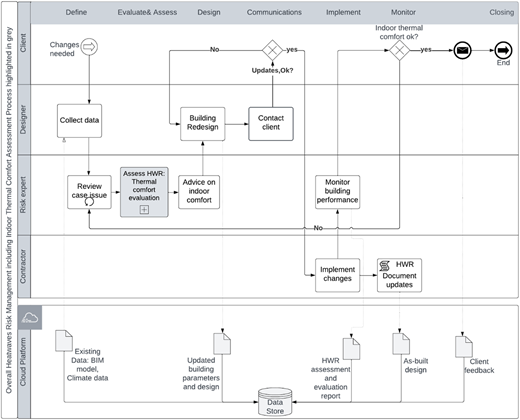
Figure 4 presents the first BPMN diagram, outlining the proposed Heatwave Risk Assessment (HWR) process, involving four stakeholders and seven stages: define, assess, design, communicate, implement, monitor, and close. Each stage is managed by a designated stakeholder, with data securely stored and shared in the cloud.
The proposed process is as follows: (1) Occupants report discomfort, initiating the process. (2) The designer collects relevant BIM and climate data. (3) The risk expert assesses overheating risks and suggests comfort improvements. (4) Collaboration with the designer to update building parameters. (5) The designer seeks client approval. (6) If approved, the contractor implements changes. (7) The risk expert monitors performance and generates HWR reports. (8) Occupant feedback confirms thermal comfort. (9) If comfort is not met, the process repeats. Client feedback, inputs, and outputs are stored and shared in the cloud.
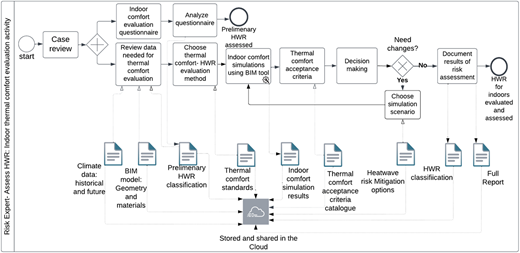
Figure 5 presents the proposed BPMN diagram for the “Heatwave Risk Assessment: Indoor Thermal Comfort Evaluation” sub-process, managed by the risk expert for existing residential buildings. The process begins with the expert reviewing the case, possibly administering a comfort evaluation questionnaire, and analysing results to initiate a preliminary Heat-Wave Risk assessment (HWR).
In parallel, we propose that the risk expert examine key data for thermal comfort evaluation, including historical and projected climate data and BIM model information (e.g. building geometry and materials). Based on this data, a suitable thermal comfort evaluation method is chosen. Indoor comfort simulations are then conducted using a BIM tool, and results are compared with thermal comfort criteria for compliance. If adjustments are needed, the process loops back to refine simulation scenarios and rerun comfort simulations with updated inputs, including possible heatwave risk mitigation options. If no further changes are needed and results are acceptable, the risk expert documents the findings, including heatwave risk classification and a report. The process concludes with a full evaluation of indoor thermal comfort related to heatwave risks. All data is stored and shared on a cloud platform for easy access and collaboration.
4.2 Define the reference architecture
4.2.1 Design phase: steps to design the reference architecture
Summary of end users’ main barriers:
Based on interviews with end users, several relevant barriers in their “usual business practices” were identified. Below are some examples of the main challenges encountered by end users during the heatwave risk assessment process:
Effort and time-intensive manual assessment process.
The traditional method is neither efficient nor comprehensive.
Less accurate processes with increased potential for faults or missed scenarios.
Manual assessment: to automate the assessment process with one click in one place.
Ambiguity in visualisation prevents result comparison, decision-making, and documentation.
The availability of numerous standards and different heatwave risk assessment approaches poses a challenge, and the end users seek a transparent process flow.
Typically, low communication with occupants and the public to provide feedback.
- (2)
User Requirements (URs)
Examples include:
Register through a single entry point and access all functionalities.
Automate heatwave risk assessment for residential buildings.
Technical Requirements (TRs):
TRs are divided into functional and non-functional types. Examples of functional TRs:
FR 01: Users must be able to register and access the platform.
FR 02: The platform should offer a preliminary heatwave risk evaluation.
Use Cases (UC)
Use cases aim to address the needs and requirements outlined by the user, streamlining the overheating risk assessment and mitigation process in residential buildings using cloud-based technologies. They define functionalities that meet the requirements from user stories, such as UC 01: Register, Access, and UC 02: Project Configuration.
4.2.2 Reference architecture for heatwave risk assessment
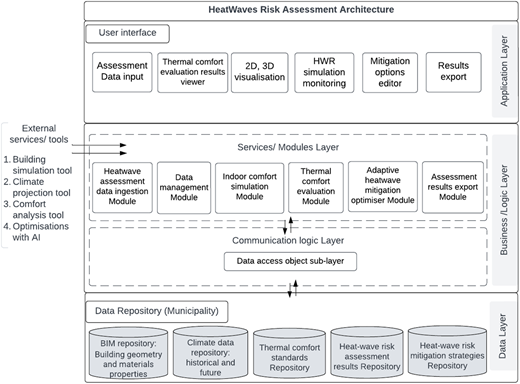
The Heatwaves Risk Assessment (HWR) reference architecture, building on (Liu et al., 2023a, b; Luo et al., 2019; Sood et al., 2017; Biswas et al., 2024; Martín-Toral et al., 2019; Meisel et al., 2017), is tailored to assess and mitigate heatwave risks in residential buildings under current and future climate scenarios. (HWR) architecture focuses on occupant needs with adaptive thermal comfort, climate data, and simulations to optimise mitigation. Integrated into a cloud-based platform; it supports flexible assessments, optimisation, and collaboration to enhance heat resilience. Key features include a future climate focus and efficient heatwave mitigation. Figure 6 presents the designed reference architecture.
Our reference architecture is structured into three main layers, inspired by the OptEEmAL (Martín-Toral et al., 2019) framework layers, comprising the Application Layer, Business Logic Layer, and Data Layer to ensure scalability, efficiency, and data management, as follows:
Application Layer: The primary interface of the HWR system, facilitating interaction through various functionalities essential for assessing heatwave risks, including:
Assessment data input: Enables the input of relevant building characteristics, environmental factors, and occupancy patterns, including building geometry, material properties, current climate data, and historical patterns.
Thermal comfort evaluation results viewer: Displays outcomes of thermal comfort assessments for heatwave events, including overheating risk hours.
Building visualisation: Provides 2D/3D views for building exploration.
HWR simulation monitoring: Enables real-time monitoring of simulation processes with alerts for issues or adjustments.
Mitigation options editor: Facilitates exploring and modifying heat mitigation strategies, including passive cooling techniques and shading solutions.
Results export functionality: Generates reports summarising results and recommendations.
Business Logic Layer: This layer forms the core of the HWR architecture, housing key analytical modules responsible for data processing and insight generation, including:
Heatwave assessment data ingestion module: Manages the selection and input of data required for the HWR assessment process, such as uploading BIM models and climate data.
Data management module: Organises and manages data flow throughout the system, maintaining data integrity and facilitating the analysis.
Indoor comfort simulation module: Manages the selection of thermal comfort evaluation methods and standards and conducts simulations.
Thermal comfort evaluation module: Presents preliminary results based on chosen standards.
Adaptive heatwave mitigation optimiser module: Generates and optimises mitigation strategies, with optional AI integration.
Assessment results export module: Prepares outputs for stakeholders.
The communication logic sub-layer facilitates seamless interaction between modules and integrates with external services such as EnergyPlus (2025) and DesignBuilder Software Ltd (2025), which are employed for detailed building simulations and thermal comfort analysis. Moreover, tools such as WeatherShift (2025) provide climate projections for future heatwave scenarios, enabling additional assessment of climate change impacts on building performance.
Data Layer: This layer serves as the foundation of the HWR architecture by housing repositories that support analyses performed by the Business Logic Layer, including:
BIM repository: Stores detailed building geometry and material properties, offering accurate simulations.
Climate data repository: Includes historical data and future projections for heatwave scenarios.
Thermal comfort standards repository: Stores adaptive comfort standards to guide evaluations.
Heatwave risk assessment results repository: Archives risk assessment outcomes for trend analysis.
Heatwave risk mitigation strategies repository: Lists mitigation techniques and their effectiveness.
This layered structure ensures a systematic approach to data handling, simulation, and mitigation. While the proposed architecture remains conceptual, each layer has been designed with potential integration paths. Tools and standards that could support future implementation are discussed in the Discussion section. The next step involves validating the architecture via a platform mock-up and expert feedback.
5. Solution validation
This section outlines the validation of the reference architecture, beginning with a preliminary platform mock-up and followed by expert feedback and a SWOT analysis. This approach ensures thorough validation of the design and its practical application for heatwave risk assessment.
5.1 “Assess.Heat” platform mock-up
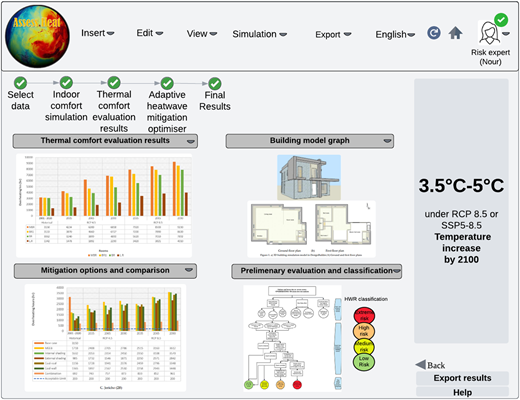
Building on the previously described three-layer reference architecture and its modules, we present a preliminary visual design of the Assess.Heat platform interface in Figure 7.
This platform, developed based on the proposed reference architecture and inspired by OptEEmAL platform, integrates key components for comprehensive heatwave risk assessment. The mock-up illustrates how these components assist the risk expert, aligning with the reference architecture's core functions, as follows:
Heatwave risk assessment results: Tied to the Business Logic Layer, this viewer displays results from BIM models, climate data, and thermal comfort simulations, enabling users to easily interpret and make informed decisions on heatwave risks.
Mitigation options: Based on the Adaptive Heatwave Mitigation Optimiser Module, this feature allows users to explore and apply strategies such as passive cooling and shading to mitigate heatwave risks and enhancing resilience.
Risk classification: Linked to the Thermal Comfort Evaluation Module, this function categorises buildings by thermal comfort during heatwaves, helping users prioritise mitigation actions.
Building model graphs: Visual representations of building geometry and material properties from the BIM Repository help users understand heatwave risk factors, providing insights for effective mitigation.
Functionalities such as data export, insertion, editing, monitoring, and simulation: These features reflect seamless data management and integration, supporting real-time monitoring, tracking, and simulation of mitigation options.
The expected results shown in Figure 7, including the thermal comfort evaluation, mitigation options, and building model sections, illustrate example outputs that users would receive when conducting an integrated risk assessment. The images presented are drawn and attached from previous research by the authors (Samaro et al., 2024). The risk classification feature is included as a future development to enable users to view building risk levels.
This mock-up is an initial step in translating the proposed reference architecture into a practical tool. While further development is required for real-world use, the platform integrates BIM data, climate info, and simulations into an intuitive interface, offering a comprehensive view of heatwave risk to support decision-making and improve building resilience.
5.2 Expert feedback and SWOT analysis
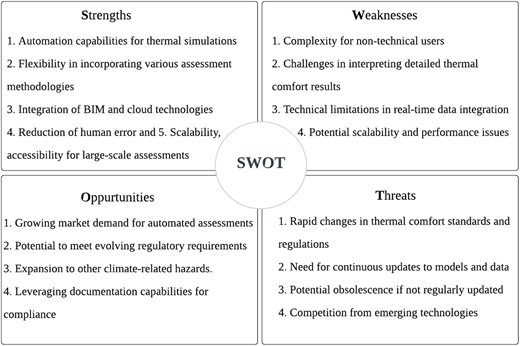
The third phase of our DSR validated the reference architecture through expert feedback and SWOT analysis, focusing on its utility, ability to improve heatwave risk assessments, and automation potential in a Cloud-BIM environment. Expert group 3 highlighted its potential for scalable automation in residential buildings, particularly its strengths in streamlining assessments and improving data integration for thermal comfort and climate data. While the architecture's clarity was appreciated, limitations are discussed in the limitations section. Feedback and suggested improvements are summarised in the SWOT analysis (Figure 8).
Strengths: The architecture excels in automating complex thermal simulations, and integrating BIM and cloud technologies for efficient building data management. Experts noted its ability to reduce human error and scale for large urban heatwave assessments.
Weaknesses: Concerns were raised about the system's complexity for non-technical users, particularly in interpreting results. Experts suggested simplifying the interface and offering tiered services to improve accessibility.
Opportunities: The reference architecture offers significant opportunities, particularly to meet the rising demand for automated heatwave risk assessments driven by climate change awareness. Experts highlighted its documentation capabilities for evolving regulatory needs and potential expansion to other climate risks.
Threats: Potential threats include changes in thermal comfort standards and building regulations, which may require regular updates. Continuous climate data updates are also necessary. Experts recommended agile development and further expert collaboration for long-term adaptability.
6. Discussion
This section discusses the study’s findings, divided into two parts: Results and Limitations. The Results discuss the proposed reference architecture for heatwave risk assessment, its design, functionalities, and contributions. The Limitations highlight challenges and suggest areas for future research and improvements.
6.1 Results discussion
With the growing risks of extreme heat events due to climate change, developing a digital reference architecture for heatwave risk assessment in residential buildings is crucial. While existing solutions improve building performance, they often fall short in addressing overheating risks. This study proposes a reference architecture tailored for assessing and mitigating heatwave risks in a Cloud-BIM environment. The contributions of this research are threefold:
Firstly, our study clarifies the heatwave risk assessment process using Business Process Model and Notation, which maps out stakeholder roles, activities, and workflow. This approach helps streamline data sharing and coordination in a Cloud-BIM environment. In addition, the study addresses the steps required to design the system reference architecture by collecting and incorporating end-user requirements. Collaborating with stakeholders, including software developers and risk experts (end users), we defined user stories, requirements, and use cases, creating a strong foundation for the architecture.
Secondly, our study introduces a reference architecture consisting of three layers: the Data Layer, which integrates BIM, climate data, and thermal comfort standards; the Business Logic Layer, which includes modules for simulating heatwave effects, optimising comfort, and proposing mitigation strategies; and the Application Layer, which Offers user-friendly interfaces for data input, risk visualisation, and exploring mitigation options. This ensures comprehensive risk assessment and management.
Our architecture builds on frameworks (Liu et al., 2023a, b; Luo et al., 2019; Sood et al., 2017; Biswas et al., 2024; Martín-Toral et al., 2019; Meisel et al., 2017), focusing on overheating risks in residential buildings. While OptEEmAL platform addresses energy-efficient retrofitting at a district scale, it does not fully tackle overheating risks or indoor thermal comfort, areas we enhance with detailed comfort evaluation and adaptive mitigation strategies. Liu et al.‘s (2023b) cloud-based architecture for energy forecasting informs our data collection techniques, which we adapt for heatwave-specific climate data in residential settings.
Similarly, Luo et al.‘s (2019) IoT-based architecture for heating and cooling demand lays the groundwork for integrating real-time climate data, which we expand to focus on extreme heat scenarios and adaptive comfort. Sood et al.‘s (2017) flood management framework provides a model for real-time data processing, which we adapt to simulate heatwave impacts on indoor environments. Biswas et al.‘s (2024) energy-efficient cloud systems guide our approach to optimising computational resources while emphasising the integration of environmental data for thermal risk assessments. Liu et al.‘s (2023a) BIM-based risk management framework for tunnel construction informs our approach to risk monitoring, extended to heatwave risks in residential buildings. Finally, the RASSA Project (Meisel et al., 2017), which emphasises cybersecurity in smart grids, informs our focus on ensuring data integrity within Cloud-BIM. While these prior frameworks have demonstrated success in domains such as energy optimisation, flood management, and risk prediction, they have not combined real-time and projected climate data, adaptive thermal comfort assessment, and BIM-enabled simulation within a unified, user-centred platform. The present architecture directly addresses this gap by integrating these elements to specifically target residential heatwave resilience.
Thirdly, we present the practical design of the architecture through a preliminary mock-up, “Assess.Heat”. This mock-up demonstrates how the components work together, integrating BIM and cloud technologies to deliver scalable heatwave risk assessments. The platform visualises results, recommends mitigation measures, and supports informed decision-making for building resilience against extreme heat.
In summary, validation shows that the reference architecture meets the requirements for heatwave risk assessment in residential buildings, enhancing efficiency through data management, simulation tools, and user interfaces in Cloud-BIM environments. Expert feedback highlights strengths such as scalability and automation while suggesting improvements such as user training and real-time data integration. These insights provide a path for refinement and further research to validate its real-world performance. However, we also acknowledge that feedback may have been influenced by cognitive biases (e.g. courtesy bias, groupthink) that could have led to overly positive responses.
6.2 Limitations
Despite its contributions, this study has several limitations that future research should address.
First, the proposed reference architecture is theoretical and untested in real-world scenarios. Its practical effectiveness and adaptability across building types, contexts, and climates require further validation. Integrating emerging technologies like IoT into resilience frameworks, especially for cascading failure modelling and mitigation, remains underexplored.
While no functional prototype has been developed, each architectural layer has been conceptually mapped to exemplary tools, standards, and formats that could support technical realisation in future work. These mappings reflect widely adopted technologies in BIM modelling, thermal simulation, and user interface design, and are summarised in Table 3. For instance, the Data Layer could incorporate tools such as DesignBuilder and EPW weather files, using open formats like IFC and EPW to input building and climate data. The Business Logic Layer could interface with tools such as EnergyPlus to simulate indoor conditions and assess thermal comfort in line with ASHRAE 55 and CIBSE TM52. The Application Layer is illustrated through the Assess.Heat Graphical User Interface (GUI) mock-up, which conceptually demonstrates user interaction, visualisation, and decision support features.
These tools were not implemented in the present study but are provided as illustrative examples of feasible integration paths that could inform future research and the development of a fully operational system based on the proposed conceptual architecture.
Second, while BIM and cloud computing show potential, challenges persist in achieving seamless interoperability and real-time data exchange due to inconsistent formats and standards. Ensuring regulatory compliance and data privacy is critical for wider adoption. While IoT and predictive analytics can aid real-time monitoring and thermal comfort analysis, their role in heatwave risk assessment remains limited.
Third, the study focuses on residential buildings in specific climates, limiting generalisability to commercial or public infrastructure and other regions. Expanding the architecture for scalability and flexibility would improve its relevance for broader applications in urban planning and building management (Heaviside et al., 2017; Bechtel et al., 2019). Current frameworks may also fall short in addressing diverse stakeholder needs (Buscail et al., 2012; Côté et al., 2024; Samaro and Hartmann, 2023).
Expert feedback praised reduced manual effort and effective BIM integration but pointed out the need for a simplified interface for non-technical users and tiered services for varying expertise levels. Finally, the architecture's reliance on high-quality input data poses a challenge, as variability in data availability and accuracy may affect performance. Robust data collection and quality control measures are crucial for consistency and effectiveness. Addressing these limitations will improve practical applicability and support broader adoption for heatwave risk mitigation.
While the current study included system designers and domain experts, future research should expand the evaluation to include a broader range of end users such as building managers, and urban planners. This will ensure the platform's usability, relevance, and support for decision-making across a broader range of stakeholders.
7. Conclusion
In the face of climate change and the increasing frequency of extreme heat events, enhancing the thermal resilience of buildings is a pressing priority. Current building performance assessment methods, while accurate at the individual level, are limited by their reliance on detailed simulations, high-fidelity data, and expert-driven processes, making them difficult to apply at scale. Additionally, these methods often fail to incorporate stakeholder input, real-time environmental data, and standardised comfort criteria. Although the integration of BIM with cloud computing shows considerable promise, a unified, scalable framework for heatwave risk assessment has remained absent. This research presents a reference architecture for assessing and mitigating heatwave risks in residential buildings. By integrating Cloud-BIM technologies, it provides a scalable and automated framework for comprehensive risk assessments. It serves as the foundation for a user-friendly platform, as demonstrated by “Assess.Heat” mock-up, which focuses on optimising indoor thermal comfort and helping users, planners, and policymakers make informed decisions to adapt to climate challenges.
Compared to previous reference architectures, which focused on aspects such as energy efficiency, risk prediction, or BIM data management, this study contributes a holistic framework that unifies adaptive comfort modelling, future climate projections, and automated simulations within a Cloud-BIM environment specifically designed for heatwave assessment. This study strives to break silos and provide a holistic solution as a basis for the development of future practical tools to help design buildings that are risk-informed and account for human health and sustainability.
In summary, the study highlights the importance of adopting a comprehensive approach to assessing heatwave risk in residential buildings. The proposed architecture, with its layered structure, integrates building data, climate information, and thermal comfort standards for more effective risk analysis. Expert feedback highlights the scalability and automation potential of the system, although improvements are needed to simplify the interface and incorporate real-time data.
Future research will focus on implementing the architecture in real-world scenarios, testing its effectiveness across various building types and climates, and expanding its application for local and global assessments. Additional priorities may include developing a fully functional prototype, integrating IoT sensors for real-time monitoring, and linking the system with city-scale digital twins to enhance resilience planning and decision-making. Further work may explore adapting the platform to other domains, such as critical infrastructure, and assessing pathways to position it as a decision-support tool. Advancing these areas will enable the architecture to contribute more broadly to sustainable design and climate adaptation in the built environment. This work lays the foundation for advancing sustainable building practices to tackle climate change while focusing on indoor environmental quality and health.
Ethics approval
This research involved consultations with domain experts in a professional capacity. No personal or sensitive data were collected, and ethical approval was not required in accordance with institutional guidelines.
AI disclosure
AI tools, including Grammarly for language editing purposes and ChatGPT, were used to improve grammar and clarity during the final manuscript preparation. No AI-generated content was used for writing or research interpretation.
As part of this research, a visit was conducted at “Cartif Technology Center” in Spain, where valuable support and expert guidance were provided, particularly in the energy division. The first author extends sincere thanks to Mr. Ali Vasallo, Ms. Susana Martín Toral, Ms. Estefanía Vallejo and Ms. Sonia Álvarez for hosting the visit and sharing their time and knowledge. The visit was part of a secondment supported by the CBIM project, which received funding from the European Union's Horizon 2020 research and innovation programme under the Marie Skłodowska-Curie grant agreement No. 860555 (September 2022 to June 2024). The first author is also funded by the Elsa Neumann Scholarships for Doctoral Researchers, Germany (from July 2024). This paper is an extended version of a previously published conference contribution (Samaro and Hartmann, 2023) and preprint research (Samaro et al., 2024).